Do we exist only to serve government, or does government exist to serve us?

We grow up believing government exists to make life possible. To build, to protect, to maintain, to enable. To stand between us and the things that would otherwise overwhelm us.

But somewhere along the way, that relationship inverted.

Government stopped facilitating life. Life began facilitating government.

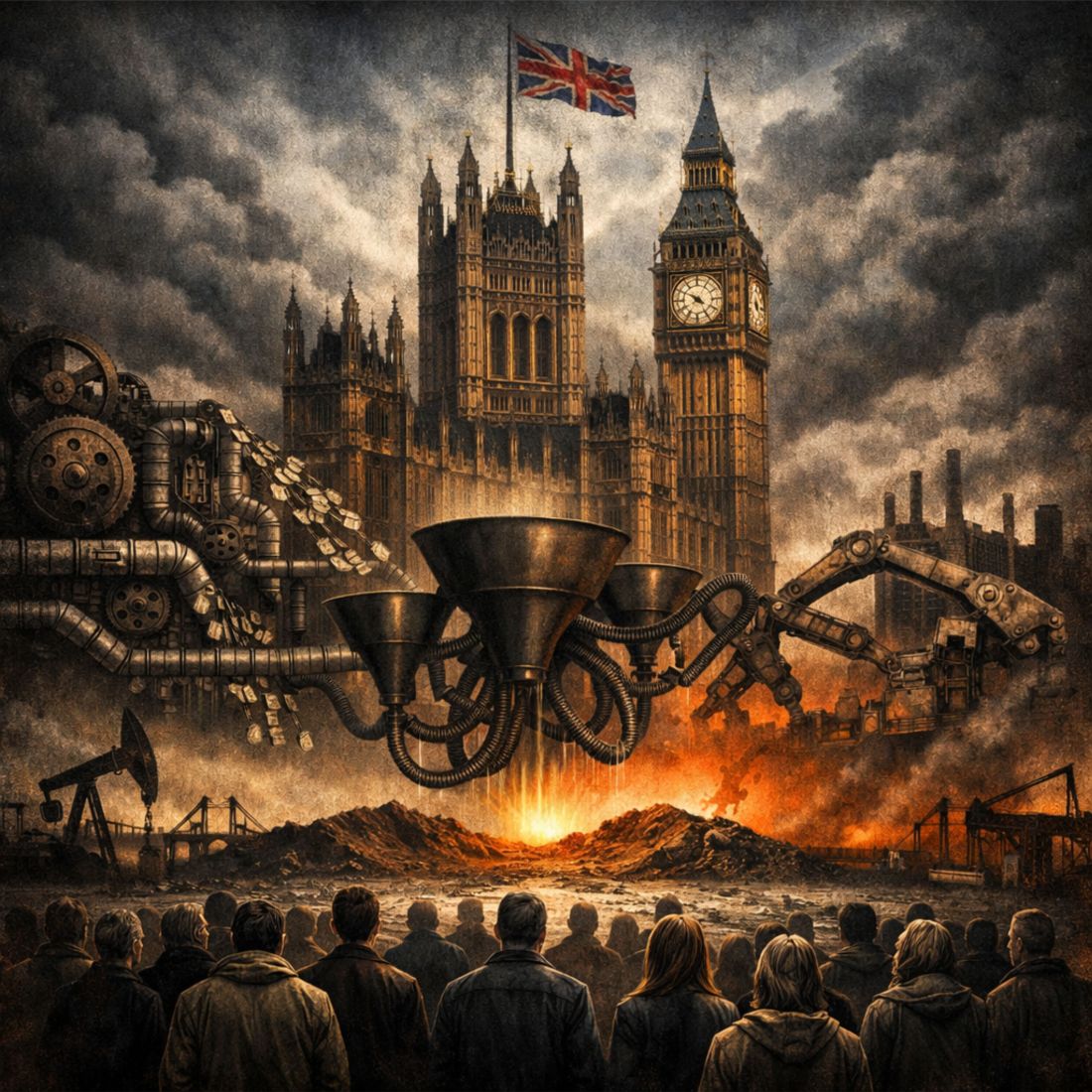
Not because government suddenly changed its intentions, but because the tools it once used to shape the country were quietly dismantled by a financial and monetary system that came to control everything.

For decades, that system rewarded extraction over production, leverage over labour, and financial performance over real capability. It told us stories about modernity – stories about efficiency, globalisation, competitiveness – and it sold myths that made decline feel like progress.

The service economy was one of those myths. A story that said Britain didn’t need to make things anymore, that production was old‑fashioned, that skills were optional, that capability could be imported, that resilience was unnecessary.

And while the country embraced that story, the wheels of productivity were quietly removed.

Factories closed. Skills faded. Infrastructure aged. Supply chains stretched across oceans. Local capability thinned to the point of transparency.

None of this felt dramatic. It felt like modern life. It felt like the world moving forward.

But the financial system wasn’t building the future. It was hollowing out the present.

And when government finally looked up, it realised the tools it once relied on – the tools that made governing possible – were gone.

By then, the productive foundations that once made governing possible had eroded. Government could no longer easily rebuild what had been dismantled, repair what had been neglected, produce what had been offshored, or control many of the systems on which it depended.

But government could not easily admit this. It could not stand before the public and say: “We no longer have enough of the tools required to shape the country.”

So it clung to the only lever it had left.

Taxation.

Taxation is not a sign of strength. It is a sign of limitation.

When a government still has capability, taxation is one tool among many. When a government has lost capability, taxation becomes the only tool left.

And that is where Britain now finds itself.

Increasingly, government appears to rely on taxation to compensate for a diminishing ability to build, repair, produce, grow, and prepare for what is coming.

Taxation becomes the way government sustains itself when it can no longer sustain the country.

If economic growth remains weak while obligations continue to rise, governments eventually face a narrowing set of options: higher taxation, deeper borrowing, monetary intervention, or external assistance.

At the far end of that path lies the possibility of IMF involvement.

IMF involvement would not rebuild capability. It would not restore resilience. It would not protect the public.

It would impose austerity of a kind that might keep politicians in their posts and government departments running, but for real people already struggling, the worst would still be to come.

Because IMF austerity protects the institution, not the population.

And all of this – the hollowing out, the loss of capability, the reliance on taxation, the looming austerity – is happening before external shocks hit.

Before supply chains fracture further. Before infrastructure failures accelerate. Before geopolitical instability intensifies. Before the next global downturn. Before the next energy crisis. Before the next financial contraction. Before the next systemic break. Before something as simple – and as devastating – as the real consequences of the closure of the Strait of Hormuz.

Many within government can see the pressures gathering ahead. Yet the institutions themselves may lack the capacity, political consensus, or time required to respond effectively. They know they cannot rebuild fast enough. They know they cannot deliver everything that has been promised. They know they cannot easily escape the system they inherited.

So it turns to the public – not to protect them, but to sustain itself.

And this is where the moral reckoning begins.

A government that can no longer facilitate life has no moral right to ask the population to bear ever-greater burdens simply so that the institution itself can endure.

The legitimacy of government has never rested on its ability to survive. It has rested on its ability to serve.

Once that distinction is lost, citizens inevitably begin asking a simple question:

Who exists to serve whom?

Which brings us back – inevitably, unavoidably – to the question we began with:

Do we exist only to serve government, or does government exist only to serve us?

Because if government is no longer here to serve us, then what is this all now for?
When Legality Replaced Morality

We’ve reached a point where the law is treated like a moral compass, even though it no longer points anywhere near true north. People talk as if legality and morality are the same thing, as if the moment something is written into legislation it becomes right by default. But anyone paying attention can see that the law no longer serves the best interests of the public in any meaningful way. It has become a tool – a flexible, shape‑shifting instrument that bends to the will of those who write it, not those who live under it.

And this is happening at the very moment when we should be thinking more independently than ever. We have endless information, endless access, endless opportunity to question what we’re told. Yet somehow, we’ve drifted further away from genuine independent thought.

People feel that something is wrong – you can hear it in conversations everywhere – but they haven’t yet reached the point of understanding why.

That’s why the times feel so strange. It’s not that people can’t see the cracks. It’s that they’ve been conditioned to doubt their own instincts, to assume that if something is legal, it must be normal, and if it’s normal, it must be acceptable.

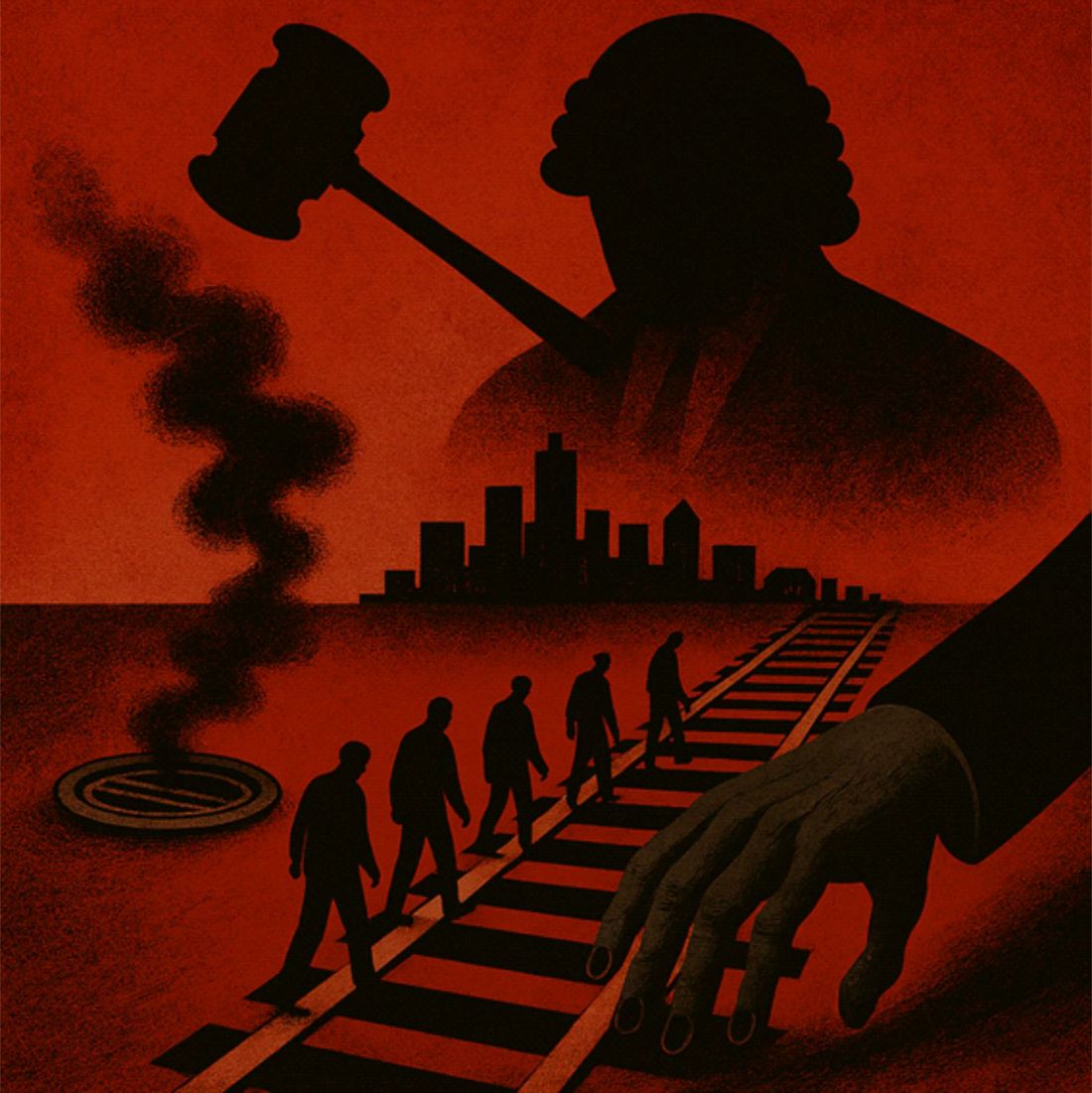
Meanwhile, the lid on the septic tank – the one that hides the real workings of the system – is rattling harder than ever. And every time it shakes, more people catch a glimpse of what’s really going on underneath.

Because when you look around, so much simply doesn’t add up. We’re told the system is fair, yet money is consistently prioritised over people, even when the human cost is obvious.

We’re told decisions are made for the “greater good,” yet the outcomes rarely reflect anything other than the interests of those who benefit.

We’re told to trust the process, even when the process produces results that defy common sense. And the more people try to reconcile what they’re told with what they see, the more they feel that something fundamental is off.

Over the past few days, this disconnect has been thrown into even sharper relief. The latest events in the Eastern Mediterranean, the Persian Gulf, and Iran have pushed the lid on that septic tank to the point of shaking loose. And the most revealing part hasn’t been the prospect of a US‑led war. It’s been the behaviour of our own government.

The Prime Minister has looked out of step, slow to approve US use of bases in Diego Garcia and the UK, and hesitant even about basic security commitments in Cyprus. The obsession in Number 10 seems to be whether the war is legal – as if legality is the highest moral test – rather than what leadership requires or what is right.

This should tell us everything. Yet many people still trip over the question of legality, when the deeper question – the one that should always come first – is morality itself.

The PM’s behaviour suggests a belief that if something is legal, it is automatically right. But that mindset is dangerous. It allows those in power to hide behind the law, using it as a shield for decisions that may be questionable, harmful, or outright wrong. Once something is made legal, it becomes almost impossible to challenge – even when it hurts the very people the law is supposed to protect.

And this isn’t new. Governments and the establishment behind them have been doing this for decades, if not centuries.

The idea that legality equals morality has become so ingrained that all a government needs to do is pass a rule, and suddenly the policy it supports is treated as ethically sound.

But law and morality are not the same. They cannot be the same. Laws are rail tracks laid by those in power, pointing society in the direction they choose. They are not – and must never be confused with – personal agency, independence, sovereignty, or genuine freedom of choice.

Real freedom of choice means decisions made without pressure, manipulation, or engineered constraints. Only in that space can morality exist. Only there can individuals decide what is genuinely right or wrong – and only from that foundation can society do the same.

Yet today, fixed direction is imposed everywhere. People believe they have freedom, but most of their choices have already been made for them. They’re offered false options that maintain the illusion of autonomy while keeping them on rails laid by someone else.

And here’s the heart of it: people have been conditioned to accept things that are wrong – even things that harm them – simply because a law exists that allows those things to happen. If it’s legal, it must be normal. If it’s normal, it must be acceptable. And if it’s acceptable, why should anyone question it?

This is how we end up with everyday absurdities that everyone recognises but few challenge. Healthy food becomes too expensive for the poorest to eat, yet nobody in authority calls that immoral – because the pricing is legal. Councils charge residents to park on their own streets and fine them when they don’t comply, and we’re told this is “policy,” as if that makes it right. Entire communities are reshaped to suit the aims of people who have no connection to them, and somehow their objectives are treated as the standard the rest of us should follow.

None of this happens by accident. It’s what you get when every new layer of legal complexity is built to serve an agenda rather than the public. And every time another pillar is added, the consequences are ignored – because selfish actions never look downstream. They don’t consider who gets hurt, who gets priced out, who gets silenced, who gets left behind, or the gaps that are created for more unscrupulous operators to hide behind. They only consider the goal.

Worse still, the legal system and our legislative processes have become a tool for gaslighting the public. They make ordinary people doubt their own moral instincts. It teaches them to override what their natural conditioning tells them is fundamentally right. If the law says it’s fine, then who are you to question it? If the law says it’s normal, then your discomfort must be the problem.

But nobody can learn what is right if all guidance comes from authority. And while those in authority may have the power to create laws, those laws cannot be considered legitimate unless they clearly and undeniably serve the best interests of everyone.

Within this context, it’s absurd to argue that any war can be morally justified simply because it is legal. At the same time, the right to defend ourselves or others should never be questioned – even if that defence requires full engagement in conflict. The difference lies in motive, not legality.

This is why the world feels upside‑down. It’s why so many things that are obviously wrong are treated as if they’re perfectly fine. Laws have been shaped and reshaped to make questionable policies appear right, and people have been taught to override their own moral instincts in favour of whatever the rulebook says today.

But that spell is breaking. People are waking up to the fact that a system built on extraction, complexity, and self‑interest cannot possibly have their wellbeing at heart.

They’re beginning to see how the law – the very thing they trusted to protect them – has been used to confuse them, restrain them, and in many cases exploit them.

They’re realising that the discomfort they’ve been made to feel isn’t a flaw in their thinking; it’s a sign that their natural sense of right and wrong is still intact.

And once people understand that, they start asking the questions they were never meant to ask. They start looking for the people who hid behind legal language to justify selfish decisions. They start recognising that morality doesn’t come from legislation – it comes from freedom of choice, from agency, from the ability to think without being pushed down a predetermined track.

When enough people reach that point, the system that relied on their compliance begins to lose its power. And that is exactly what we’re watching happen now.

1647

No, MPs should NOT have second jobs. After all, being an MP is NOT a job anyway

The ongoing row over second jobs for MPs has certainly proven to be an interesting one. Yet it has also become increasingly concerning, as it has become ever more obvious that so very few journalists, commentators and people working around the political sphere have any real consideration or respect for what the role of an MP and public representative should actually be about.

Arguments in favour of second jobs range from the suggestion that MPs with outside work enrich their links with, and understanding of, the real world, to claims that additional money is the only way to make the role worthwhile. Those against argue that banning second jobs would be acceptable, but only if MPs were given a ‘realistic’ salary.

Nobody seems to have mentioned that being an MP or public representative is not a job.

Being an MP is a responsibility to others. It is not a role that should be taken if the individual concerned cannot guarantee that their responsibility to others will not be compromised by prioritising income, career opportunities, fears, influences of any kind, or any other motivations that put their own needs before anyone else’s at any time, at any level or in any way.

It is part of the human condition that we can only be loyal to one master. MPs are no different to anyone else. If an MP’s priority is income or career at any level, their focus will not be on anyone else.

There are simply no grey areas with this. It really is very black and white.

If an MP can be swayed in their decision-making by any factor that reflects on them personally at any level and in absolutely any way before anything or anyone else, they can be bought. As such, they cannot be relied upon to represent the general public and the voters within the constituency who elected them.

Being an MP or elected politician of any kind requires people who have the life experience, understanding of others and are at a stage in their lives where they can willingly and unswervingly put the needs of others before themselves in every meaningful way.

It is because we have for so long had a Parliament full of MPs on all sides of the political divides who are ruled by self‑interest at some level and in some way that the British political system – and, as a result, the whole of the UK – is in the mess it is in today.

Public service can be the only master of any politician who wants to fulfil the obligations of the role with which they have publicly been entrusted. There simply is no other way.

For as long as we keep electing politicians in this country and allow them to frame their own roles as careers and jobs, their attitude will continue to focus on nothing other than the impact and consequences of their actions for their future and for themselves before anything else.

There will be many who suggest that this is the way the system works and that you can only change the system from within. The regrettable truth is that this is a myth perpetrated solely for the benefit and furtherance of the interests of those already within that system – people who have a massive investment in ensuring that nothing happens that could bring about the comprehensive systemic change that would help and benefit us all.

Sadly, until we all come together and accept that the people leading this country in government, the establishment and the wider public sector are not working to put our collective best interests first, we are doomed to live the same experience. Public policy today is created in all areas of life where decisions have been made not with us as the priority, but with what is important to the people we elected always put first.

We only have ourselves to blame for each and every day that this sordid and perverse idea of democracy continues to rule, impinge upon and inflict avoidable pain and chaos in our lives.

None of the political parties we have on offer today are focused on all of us in the way they should be.

It is we who must make the decision to elect MPs and politicians of all kinds who will make promises and then keep them – because they are in Parliament as politics is a calling or a vocation for them, rather than just an interpretation of a career or a job. One that, to them, is nothing more than getting the maximum return for themselves for the least amount of work.

We need a real choice in politics. We need MPs who understand and genuinely care. We need #ANewPartyForAll for the next General Election.

To achieve this, we need to start thinking differently and begin to build the alternative to the madness we have right now.

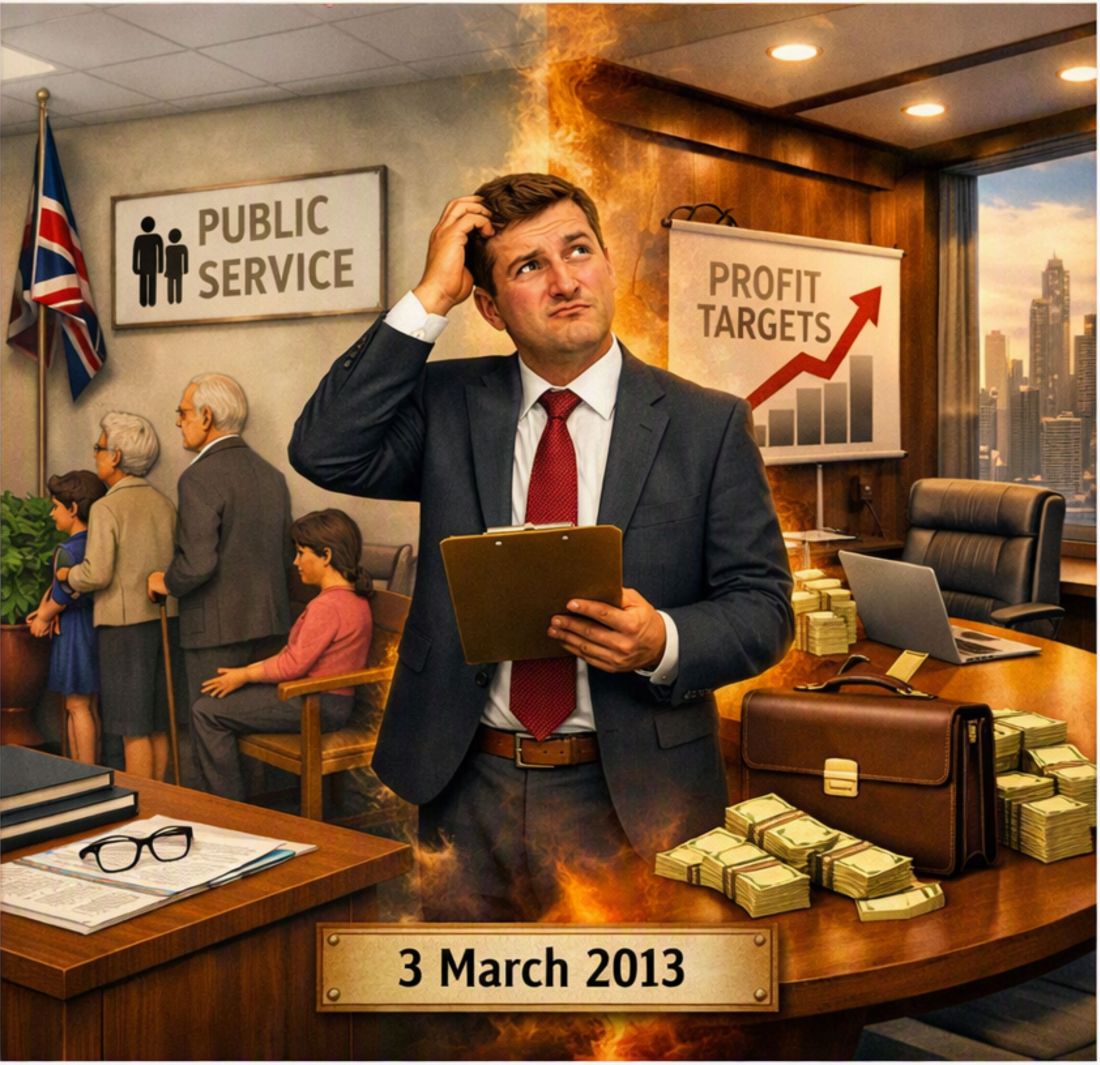
Government is not the same thing as a business, and should never be run like it is one

AU491810_942long

The word ‘business’ conjures up different meanings for different people, depending on their background and of course what exposure they may have had to its use or application.

Most will agree that its use as a term suggests enterprise and methods of working which would sit snugly within a commercial environment. But should this word actually be applied to the modus operandi of any form of Government when the two terms are completely incongruous?

Much is made of the idea that the best people to run Government at any level are those who have a business background. One of the current arguments against the demographic makeup of our MP’s today is the substantial lack of solid business experience possessed by those who lead the Country from Westminster, with the accompanying notion that MP’s who have run or owned businesses of their own would somehow automatically have an almost esoteric level of understanding and midas touch which would solve just about any problem. They wouldn’t; they don’t and they never have.

With years of Local Government experience as both an Elected Member, an Officer and from working within 3rd Sector Organisations alongside, I have also often heard the term ‘business case’, ‘business plan’ and the idea often suggested that Councils are now run ‘like a business’ in meetings.

The problem with this is of course that the political leadership and members of Councils rarely have ‘hands on’ experience of running any kind of business you could draw reasonable parallels with themselves, and when they do, it is often the case that it has been so long since they did so, that any lack of an appreciation that time moves on or that things continually change will soon erode any tangible benefit.

Perhaps worse is the ability that Officers and Civil Servants have been gifted by political demographics and the opportunity to use such terms in plans, which are then taken as read by those who simply don’t know any better as being a true ‘business case’, when such ‘business’ cases could never be any such thing.

Recognising the differences between running a business in its purest sense, and running Government under the delusion that it can be run as business has never been more essential for today’s politicians, because neither Central or Local Government are businesses, and the people running them have to stop believing and behaving like they are.

A business is of course run for the profit of an individual or shareholders. All decisions will normally be made with the form of pay-off that they will receive firmly in mind. It can be expanded or changed to meet the demands of customers as it sees fit, and a business can choose which customers it may wish to target and how much profit it will seek from delivering any particular product or service. Its revenues are never guaranteed.

On the other hand, Government does not run to make profit, but to provide services and support for all those which it has been elected to serve.

Run properly, Government would not actively target any particular group of customers to provide a different quality of service depending on the feedback or profit that it gets from that group, and would work to meet demand for services as best and prudently as it can, well knowing that it has a duty to do so without seeking payment from one customer to pay for the benefits of another, or to irresponsibly borrow money from lenders that it knows it doesn’t have the appropriate levels of revenue to comfortably repay.

However, Government revenues – as long as they remain sensible – will always be guaranteed, and it is with this significant difference that come the even greater levels of responsibility than no one business should ever realistically be able to have.

One of the greatest dangers facing us as a society comes from the fact that politicians at all levels of Government have either failed to recognise these basic differences and therefore maintain them, or have willingly abused their ability to raise revenues to cover badly managed services or implement policies without any due regard to striking the balance for every member of this society or in applying fairness to all, while they have given every thought to political expedience and electability.

The British political system is broken, because it has adopted those very same values of a profit-making business, which are to further the interests of that business. For politicians, this comes in the form of power, whilst they have ignored the basic rule of business as they have done so; the rule which states they must deliver profit to every single one of the shareholders rather than to themselves. Profit in this sense should always be seen as the delivery of the same results for all.

So if our politicians really feel that they have to treat Government like a business, they then must also realise that if they continue to keep raising the fees on the same old products time and again without offering new products and value for money, they will soon price their offerings way beyond the purse of the people who normally pay, and the cash will soon start ceasing to flow.

Government is not run for a financial profit, any more than it should ever be so for the bottom-line benefit of just the ‘staff’.

Whatever their backgrounds, experience and level, politicians must remember that they are the managers; the facilitators; the decision makers; not the beneficiaries themselves – and especially so where the end profit is not even perceptively the same as what it would be for a business.

The time has long since passed when the electorate could continue to live decent lives, whilst those within Government continue to focus on the end result for themselves. Government is not the same thing as a business, and should never be run like it is one.