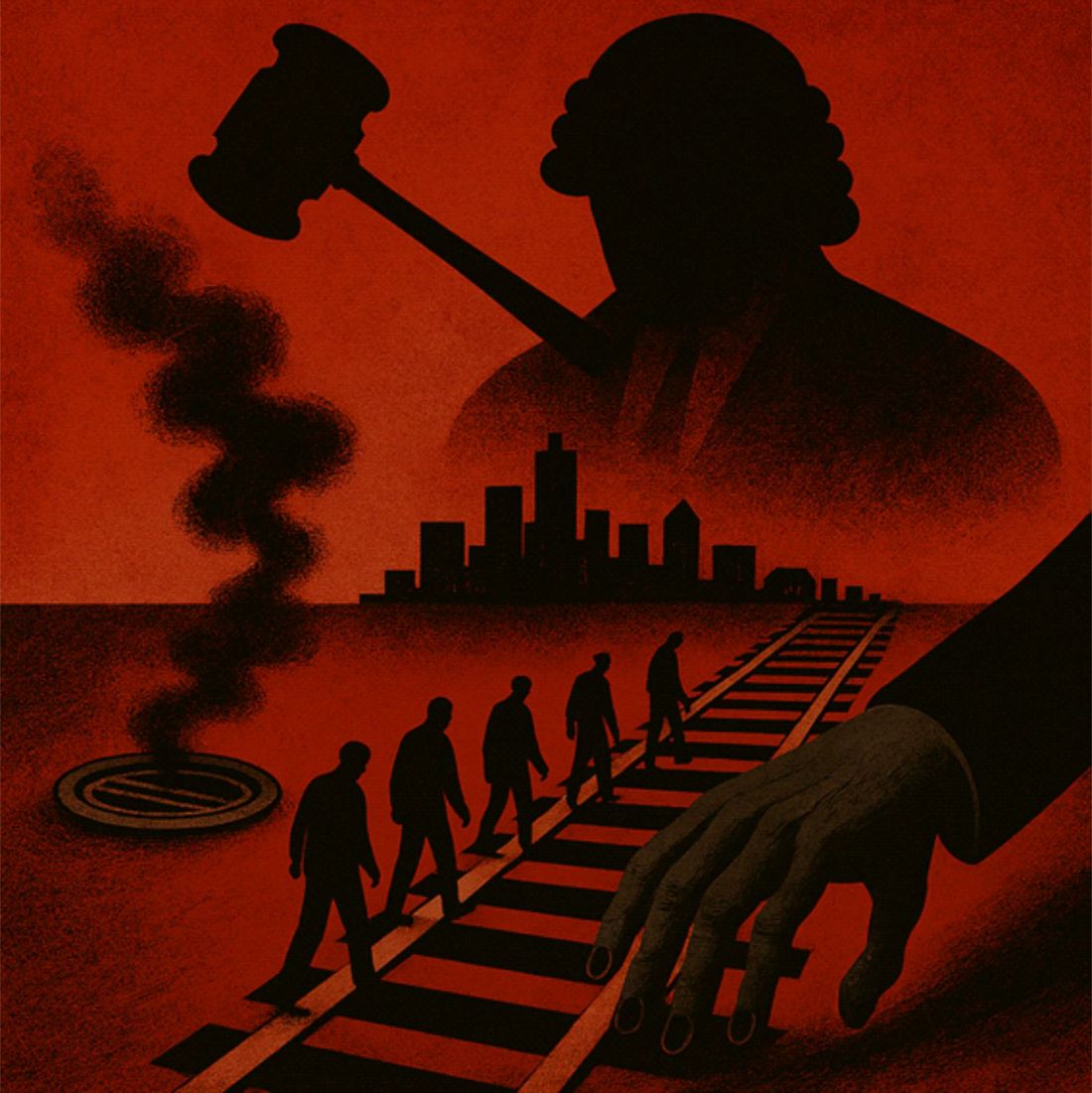


Modern society has made a quiet but devastating mistake:
We have begun to treat what is legal as if it is moral.
That confusion now shapes the entire way we provide for ourselves. It determines how we build homes, how we manage land, how we regulate technology, how we grow food, and how we define progress.
It is the organising principle of a system that increasingly works against the people it claims to serve.
Housing, flooding, food, seeds, bread, technology – these are not separate issues. They are symptoms of the same structural error.
That does not mean every failure is deliberate, or that every official, developer, regulator or business leader is acting in bad faith.
The problem is deeper and more dangerous than conspiracy. It is the result of incentives: systems reward what they measure, protect what they value, and ignore what they do not count.
When profit, throughput, asset inflation and legal compliance become the dominant measures of success, human need is pushed to the margins.
The law may permit the outcome. The spreadsheet may justify it. The market may reward it. But that does not make it right.
Housing: A Crisis Manufactured by Design
Britain is repeatedly told it has a housing shortage. But the numbers tell a different story.
The figures are contested and depend on definition, but they all point to the same uncomfortable truth. England alone had 25.6 million dwellings in 2024, alongside hundreds of thousands of vacant homes and long-term empty properties.
Across the wider UK, the issue is not simply the absolute number of buildings, but the way existing homes are distributed, priced, occupied and withheld from genuine need.
The crisis is therefore not best understood as a simple shortage of bricks and roofs. It is a crisis of access, affordability, allocation and incentives.
New developments do not automatically make homes affordable because housing is not treated primarily as shelter. It is treated as an asset class. Supply is released into a market designed to preserve values, secure lending, generate land uplift and sustain confidence.
Developers have incentives to pace supply so that local prices are not undermined. Banks depend on rising values to protect mortgage books. Councils depend on development, valuation and growth. Governments count construction as economic activity, even when the deeper social problem is insecurity rather than physical absence.
The entire structure rewards scarcity, even when scarcity is manufactured.
The “shortage” is not physical. It is structural – and it is maintained because the system benefits from it.
This matters because it changes the question. If the problem is only shortage, the answer is always more building. If the problem is structure, the answer must also include empty homes, under-occupation, affordability, land value, planning incentives, tenure security and the treatment of housing as wealth rather than shelter.
Flooding: When the Law Overrules the Landscape
My experience as a councillor during the 2007 Gloucestershire floods revealed the same distortion in a different form.
I watched floodplain being reclassified as “safe” for development simply because the land had been raised or ‘built up’ to match or exceed Ordnance Datum Newlyn.
The hydrology of the area had not changed. The water still behaved as water does:
Pluvial flooding from extreme rainfall still sought the lowest point; fluvial flooding from swollen rivers still spilled into the landscape.
Raising land by a metre does nothing to change:
- how water flows
- where water accumulates
- how water is displaced
- how water is redirected into existing homes
But because the land met the legal test, development could be treated as acceptable.
The law said the site had been made safe, so the system behaved as if the water would agree.
This is legality replacing reality. And because legality has been allowed to stand in for morality, the public is told that these outcomes are not only acceptable but necessary.
GDP: The Incentive That Distorts Everything
Governments favour new building partly because construction boosts GDP. That does not mean homes are never needed, or that building is always wrong. It means the measure itself rewards activity more than sufficiency.
GDP rewards:
- activity
- churn
- extraction
- expansion
GDP does not reward:
- sufficiency
- reuse
- stability
- resilience
So:
- building new homes increases GDP
- using existing homes does not
This is one reason the system keeps expanding supply even where the deeper need is security, affordability and better use of what already exists.
GDP was designed to measure economic activity. It was never designed to measure whether people are housed, nourished, secure, healthy or free from avoidable harm.
Yet it has become the scoreboard by which governments claim success.
We have mistaken throughput for progress.
The Free‑Market Myth: The Story That Makes It All Possible
People imagine a free market as a place of open competition, fair rules and level playing fields.
But the market we actually have is one shaped by whoever has the power to write – or remove – the rules.
Over four decades and more, those with the most influence have systematically dismantled the safeguards that once protected people, small businesses, communities and the environment.
These protections weren’t removed because they failed. They were removed because they worked – and because they limited how much big business could take, accumulate and control.
Deregulation is sold as liberation. But it functions as consolidation. It clears the path for large corporations to expand without friction, without accountability, and without the public interest getting in the way.
This is not a free market. It is a captured market, engineered through legislation, lobbying and the slow erosion of public protections.
Seeds: The Quiet Capture of the Food System
Seed markets are now highly concentrated, with a small number of multinational firms holding substantial power over commercial seed, breeding technologies and associated agrochemical systems.
Through patents, licensing agreements, technology-use contracts and market consolidation, corporate actors increasingly shape:
- what can be grown
- how it can be grown
- who can grow it
- what farmers are allowed to do with their own harvests
Practices that sustained humanity for ten thousand years – saving seeds, exchanging varieties, breeding hybrids adapted to local conditions – are now restricted or prohibited.
There are documented concerns about farmers’ dependence on proprietary seed lines, restrictions on replanting, and the narrowing of genetic diversity. The precise legal position varies by crop, country and contract, but the direction of travel is clear: control is moving away from growers and communities and towards corporate ownership.
This is not a free market. It is corporate enclosure of the food system. And because it is legal, it is treated as moral.
Bread: When Corporate Morality Enters the Human Body
The Chorleywood Bread Process, developed in 1961, is one of the clearest examples of industrial efficiency being allowed to redefine food quality.
It was introduced to:
- speed up production
- reduce fermentation time
- use lower‑quality wheat
- increase shelf life
- maximise output
To achieve this, the process relies on high-speed mechanical mixing, added processing aids, shorter fermentation and tightly controlled industrial production. The result is the soft, uniform, sliced loaf that dominates supermarket shelves: visually consistent, cheap to produce and easy to distribute at scale.
The concern is not that every industrial loaf is poison, or that every digestive problem has one cause. The stronger point is that the system selected for speed, volume, shelf life and margin, while giving far less weight to fermentation, digestibility, flavour, biodiversity and long-term health.
Research comparing bread-making processes suggests that longer fermentation, particularly sourdough fermentation, may affect gut microbiota and digestibility differently from no-time industrial processes. That does not prove a single national health story, but it does show why the moral question matters: what do we optimise food for?
And the tragedy is this: we can grow and bake better bread. Traditional methods, longer fermentation and more diverse grains can produce food that is nutritious, digestible and full of flavour. They simply fit less neatly into a model built around scale, uniformity and speed.
If we were organising our food system around needs rather than wants, we would be eating better bread, grown locally, with healthier outcomes. But we aren’t – because legality has been shaped to favour corporate efficiency over human wellbeing.
Technology: The New Frontier of Unregulated Power
Technology is the newest frontier of the same old pattern. Governments often legislate slowly, partly because technologies are complex and partly because the companies developing them move faster, possess more technical knowledge and are able to frame regulation as a threat to innovation.
Politicians, terrified of “stifling innovation”, defer to corporate timelines. Regulation arrives years after the harm. Public protections lag far behind corporate capability.
Once again, legality is used to justify outcomes that would be unacceptable in any other context.
The Systemic Error
Across these domains – housing, land use, food, technology – the pattern is not identical in every detail, but it is recognisable. Rules and incentives are shaped around growth, extraction, scale and legal compliance. Safeguards are weakened or delayed. Public interest becomes negotiable. Corporate morality replaces human morality. And because the resulting system is lawful, we are encouraged to treat it as legitimate.
But legality is not morality. It never has been. And until we stop confusing the two, we will continue to build a society that works beautifully for the system and terribly for the people living in it.
The truth is simple, and it sits beneath every example:
We have mistaken corporate freedom for human progress.
What We Lost When We Replaced Morality with Legality
The most dangerous consequence of this shift is not the individual failures – the flooded homes, the hollow bread, the unaffordable housing, the captured seed supply, the unregulated technologies.
It is the loss of a shared moral compass.
For most of human history, societies understood that certain things were wrong even if they were technically permissible. Communities had norms, expectations, and boundaries that existed outside the written law. You didn’t poison the river because the law allowed it; you didn’t do it because it harmed your neighbours. You didn’t strip the land bare because the regulations hadn’t caught up; you didn’t do it because you knew the land had to sustain your children.
But when corporate morality – a morality built entirely around extraction, accumulation and growth – becomes the dominant organising principle, those unwritten boundaries collapse.
The only question that matters becomes: is it allowed? And if it is allowed, it is pursued, no matter the cost.
This is how we end up with food optimised for shelf life before nourishment, seeds governed by ownership before resilience, homes built where water will still go, housing markets that preserve scarcity, and technologies that reshape society before society has chosen the rules.
When legality becomes the only measure of rightness, harm becomes invisible until it is too late.
The Cost of Confusing Wants with Needs
There is another layer to this story – one that sits beneath the economics and the legislation. It is the cultural shift that has blurred the line between needs and wants.
The Chorleywood Bread Process is a perfect example. We did not need bread that stayed soft for a week, or loaves that looked identical from Cornwall to Carlisle. We wanted convenience, uniformity, and the illusion of abundance. And because the system is built to satisfy wants rather than needs – because wants are more profitable – we ended up with a national diet shaped by industrial efficiency rather than human health.
The same is true of housing. We do not need endless new estates on greenfield land. We need secure, affordable homes. But the system is built to satisfy the wants of capital – asset appreciation, land value uplift, mortgage expansion – rather than the needs of people.
The same is true of seeds. We do not need globalised monocultures. We need resilient, diverse, locally adapted crops. But the system is built to satisfy the wants of corporations – patentable genetics, predictable supply chains, consolidated markets – rather than the needs of farmers or ecosystems.
When wants drive the system, needs become collateral damage.
A Society Built on Extraction Cannot Sustain Itself
The deeper problem is that extraction is not a stable organising principle. It works brilliantly in the short term – for those who benefit from it. But it erodes the foundations of long‑term wellbeing.
You can see this erosion everywhere:
- in the rising tide of gluten intolerance
- in the loss of agricultural biodiversity
- in the hollowing out of local economies
- in the strain on infrastructure
- in the unaffordability of basic needs
- in the environmental fragility exposed by extreme weather
- in the political paralysis around regulating new technologies
These are not isolated failures. They are predictable outcomes of a system that rewards extraction, calls it growth, protects it through law and then mistakes legality for legitimacy.
The Way Back Is Not Nostalgia – It Is Rebalancing
This is not an argument for going backwards. It is not a call to abandon technology, or markets, or innovation.
It is a call to rebalance.
To recognise that:
- markets need boundaries
- innovation needs guardrails
- land needs stewardship
- food needs diversity
- housing needs sufficiency
- technology needs accountability
- communities need protection
- and progress needs a moral compass
We cannot legislate our way out of every problem. But we can stop pretending that legality is enough. We can stop allowing corporate morality to define the limits of what is possible. We can stop mistaking extraction for progress.
And we can start rebuilding a system that works for people, not just for profit.
The Real Question
The question facing us is not whether the system is broken. It isn’t. It is working exactly as designed.
The real question is: who is it designed to serve?
If the answer continues to be “those who benefit from extraction,” then the future will look like the present – only more so.
But if we can reclaim the idea that morality sits above legality – that what is right matters more than what is permitted – then we can begin to build a society that is not just efficient, but humane.
A society that provides for needs before wants. A society that values resilience over throughput. A society that treats people as citizens, not consumers. A society that remembers that progress is not the same as profit.
Because until we make that shift, we will continue to mistake corporate freedom for human progress – and we will continue to pay the price.
Further Reading
The essays and policy papers below develop the practical architecture behind this argument. They are best read as a progression: first the economic model, then the living standard it is meant to secure, then the democratic and community structures needed to make it real.
The Local Economy Governance System – Online Text. Sets out the full model for rebuilding economic life around local resilience, democratic accountability and practical provision rather than distant extraction.
The Local Economy Governance System – Policy Summary. A shorter policy-facing version of the local economy model, useful for readers who want the operational implications and reform priorities in a more concise form.
The Basic Living Standard – Explained. Introduces the idea that society should organise itself around guaranteed access to the essentials of a decent life, placing human need above market permission.
The Basic Living Standard – Full Text. Provides the fuller moral, economic and social case for a needs-based foundation beneath politics, markets and public policy.
The Way of Awakened Politics for Good Government – Full Text. Explores the political mindset required to govern beyond short-termism, party interest and institutional self-preservation.
A Community Route – Full Text. Develops the community-level pathway for practical renewal, showing how local action can reconnect governance, economy and everyday life.
Manifesto for a Good Dictator. A provocative thought experiment about authority, responsibility and public good, best read as a challenge to weak governance rather than a literal political prescription.