For years, Britain’s debate about welfare has been framed as if it were a moral failing, a partisan indulgence, or a political choice. But the truth is far more uncomfortable for Westminster than any of the slogans they trade across the despatch box.
Welfare is no longer a safety net. It is the last structural support holding up an economic system that no longer pays people enough to live.
And now, with recently surfaced comments from a Labour figure – remarks clearly never intended for public release – we have a rare glimpse of what politicians say behind closed doors.
The suggestion that they are exploring “ways to tax people to pay for the rising cost of benefits” is not just politically clumsy. It is revealing.
It suggests a political mindset that treats welfare as a fiscal burden to be funded, rather than as a symptom of a broken economic model.
A System Built on Dependency – But Not the Kind Politicians Talk About
Across successive governments, the UK has drifted into an economic model that no longer makes people self‑sufficient.
Instead, it makes them dependent – on low wages, high living costs, debt, corporate landlords, and ultimately the state.
This did not happen by accident. It emerged from decades of policy choices that:
suppressed wages
inflated housing costs
centralised supply chains
financialised essentials
hollowed out local economies
The result is a country where millions of people in full‑time work cannot meet basic living costs without state support. Not because they are failing – but because the system is.
Yet the political class still talks about welfare as if it were a behavioural tool or a lifestyle subsidy. Too often, they appear to misunderstand both the system they inherited and the one they have helped to create.
Welfare Has Become Structural Infrastructure
The rising cost of welfare is not a sign of moral decline. It is a sign of economic decline.
For some, welfare now performs the function wages used to perform.
For many more, it fills the gap between what people earn and what it costs to live.
It is not optional.
It is not a luxury.
It is not a political indulgence.
It is the pressure valve preventing a system built on extraction and unaffordable living from blowing itself apart.
The Right is Painting Itself into a Dangerous Corner
The rhetoric from the political right has become increasingly absolutist:
“Cut benefits.”
“End dependency.”
“Make work pay.”
“Shrink the state.”
But work often does not pay enough to cover basic living costs, even on full-time hours.
So when the right promises to slash welfare, it risks removing one of the only things preventing:
mass arrears
mass evictions
mass hunger
mass debt defaults
and, ultimately, mass unrest
That is a dangerous gamble with the dam already under strain.
Labour’s Problem is Different – But Just as Dangerous
Labour’s instinct is to preserve welfare, but not to fix the system that makes welfare necessary.
Instead of confronting the structural drivers – rent extraction, corporate pricing power, broken local economies, and wages that lag far behind living costs – Labour reaches for the language of “responsibility” and “funding the welfare state.”
To many readers, this can sound like political code for:
“We will ask the public to pay more to sustain a broken system we remain reluctant to reform.”
The recently surfaced comments suggest that Labour recognises the system is under strain, yet still stops short of confronting its root causes. The approach can look less like structural repair and more like plugging holes in the dam.
The fact these words were not meant to be public does not make them better.
If anything, it makes them more revealing.
It suggests that even behind closed doors, the focus may be less on fixing the system than on finding ways to fund its dysfunction.
What Politicians Say Privately vs What They Tell the Public
One of the most revealing aspects of this moment is the gap between the public narrative and the private conversation.
Publicly, politicians talk about:
“supporting working families”
“making work pay”
“responsible public finances”
“helping people into good jobs”
Privately, the conversation is probably far blunter:
the welfare bill is rising faster than they can politically justify
wages are not keeping up with living costs
the housing market depends on high rents and high benefits
the economy cannot function without topping up millions of low incomes
and they have no plan to fix the underlying system
This is the part the public rarely sees – not necessarily because it is hidden maliciously, but because political language often obscures more than it reveals.
Those who follow politics closely, or who understand the context behind internal documents, leaks, and strategic briefings, can see the real picture clearly:
Britain’s welfare system is not a moral debate. It is a structural necessity created by decades of political choices.
The truth appears in fragments:
internal memos
off-record briefings
think-tank papers
leaked strategy documents
and the occasional unguarded remark
It is all there for anyone who knows how to read it.
But much of this remains obscure to the public, partly because political language can hide the scale of the crisis as much as explain it.
The leaked Labour comment matters not because it is shocking, but because it appears to confirm what many observers have long suspected:
Behind the scenes, politicians may be less focused on fixing the system than on containing its pressures.
In practice, that can amount to managing decline.
The Dam is Cracking
The human reality of life on benefits is not the caricature pushed by commentators or culture warriors. For many, it is a bureaucratic maze, a financial trap, and a constant source of stress and humiliation.
But too often, the political class responds to the numbers more readily than to the lives behind them.
They see rising welfare spending and conclude that the solution is to cut.
They see rising housing benefit and conclude that the solution is to “incentivise work.”
They see rising Universal Credit rolls and conclude that the solution is to tighten sanctions.
Too often, they treat the symptom while leaving the disease untouched.
If They Cut Welfare Without Structural Reform, the System Will Break
This is the central risk.
If politicians cut welfare without rebuilding the economic foundations that make welfare necessary, the consequences could be immediate and severe.
Because welfare is not the problem.
Welfare is the compensation mechanism for the problem.
Remove it, and the underlying crisis is exposed instantly.
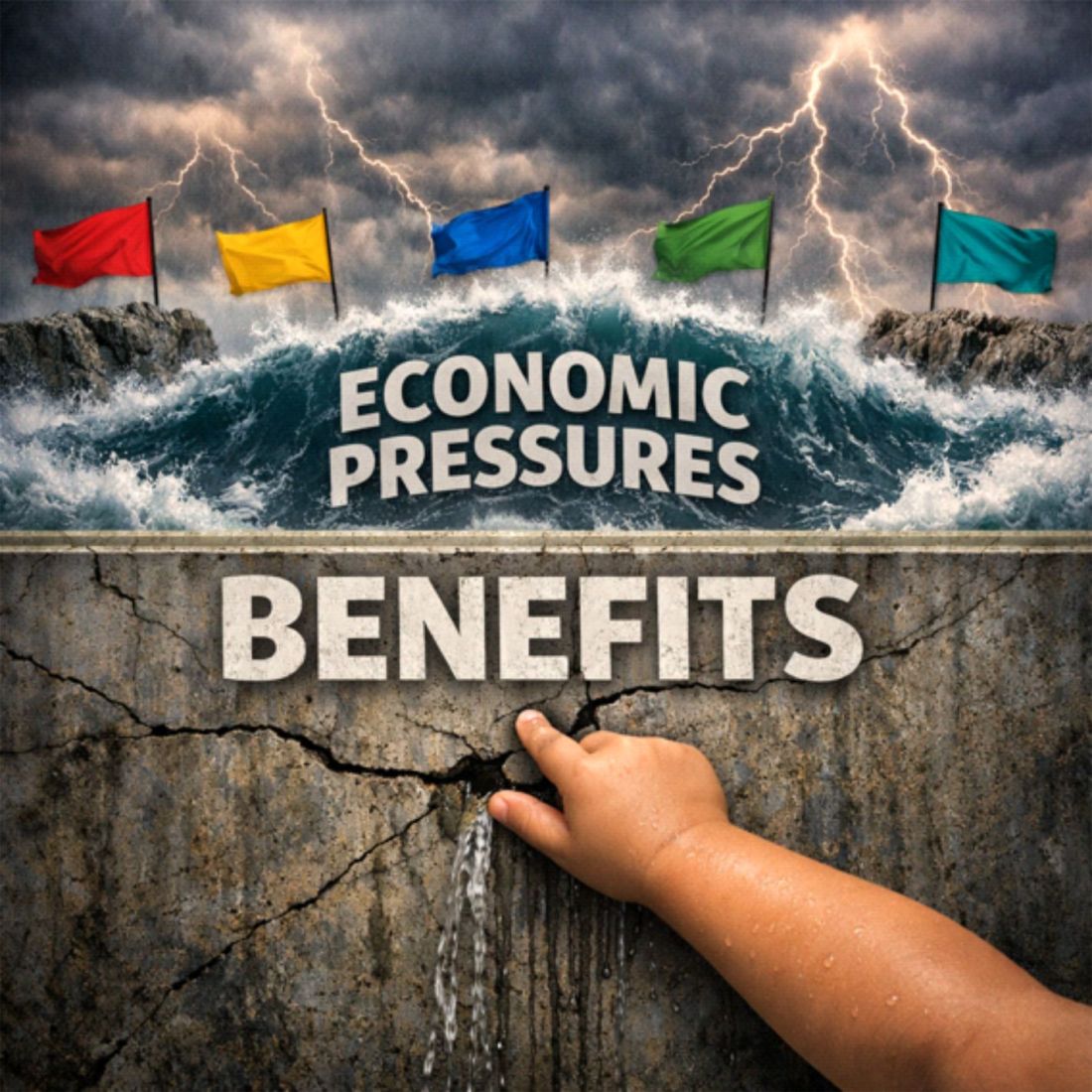
The Finger in the Dam
Welfare is the little boy’s finger in the dam.
For too many, it is what stands between today’s fragile equilibrium and:
homelessness
hunger
civil disorder
political extremism
and systemic collapse
Politicians who promise to cut benefits without rebuilding the economic foundations are not necessarily offering “tough love.”
They may instead be inviting structural failure.
That is a serious gamble.
And they may be underestimating the forces they are about to unleash.
Conclusion
Welfare is not the cause of Britain’s crisis. It is the last fragile barrier preventing that crisis from becoming visible.
The political class – left and right – has spent decades misdiagnosing the problem, blaming the people caught in the system rather than the system itself.
But if they continue down the path of cutting benefits without rebuilding the economic foundations that make benefits necessary, they will not be saving the country money.
They will be breaking the dam.
And when it breaks, it will not be the poor alone who are swept away.
It will be the entire political order that created this mess and refused to understand it.
Further Reading
To understand how Britain reached the point where welfare has become the last structural support holding up a broken economic system, the following pieces explore the deeper causes, consequences, and interconnected failures that have shaped this crisis.
Each article builds on the last, tracing the slow drift from economic balance to systemic fragility.
Explores how decades of incremental policy decisions – none catastrophic on their own – collectively hollowed out Britain’s economic resilience. It sets the stage for understanding why welfare became structural rather than temporary.
Examines how political and economic fragmentation led to short‑term thinking, siloed policymaking, and a failure to see the economy as a connected system – a key reason reform efforts keep missing the mark.
2. The Economic Mechanics Behind Welfare Dependency
Deconstructs the illusion of wealth creation in modern Britain – showing how asset inflation and debt have replaced genuine productivity, leaving households dependent on welfare to bridge the gap.
Connects the dots between stagnant wages, rising living costs, and the structural need for welfare. It explains why welfare spending keeps rising even when employment figures look strong.
Shows how the “working poor” have become the backbone of the welfare system – not through choice, but through necessity. It highlights the mismatch between official narratives about work and the lived reality of millions.
Explores the widening divide between those insulated from economic shocks and those living permanently on the edge. It argues that this split is now cultural as much as financial.
Analyses how populist and establishment politics alike have become trapped in a cycle of blame and short‑term fixes. It warns that cutting welfare without reforming the underlying system will trigger social and economic instability.
Suggested Reading Order
What Happened to Britain – the long view of decline
Britain’s Hidden Problem – how fragmentation deepened the crisis
Why Wealth Isn’t What You Think It Is – the illusion of prosperity
The Exploding Cost of Welfare – the structural inevitability
When Work Isn’t Enough – the lived reality of working poverty
The Real Two‑Tier Britain – the social divide
Being on Benefits Isn’t a Culture – the human cost
Benefits Culture, and System‑Locked Politics – the political consequences
Closing Note
Together, these pieces form a coherent narrative: Britain’s welfare system didn’t fail because people became dependent – it became essential because the economy did.
Understanding this progression is key to seeing why welfare is not the problem, but the last fragile barrier preventing the system itself from collapse.
In May 2026, Reform UK announced a policy to make overtime tax‑free.
That announcement triggered a simple but revealing question:
If a single working adult wanted to be financially independent – able to meet their basic needs without relying on benefits, debt, charity, parental support, or pre‑existing wealth – how many hours of tax‑free overtime would they need to work?
This question wasn’t hypothetical. Reform had already signalled an intention to significantly reduce the benefits budget if they form the next government.
Taken together, these moves point toward a system where people are expected to rely less on state support and more on their own earnings – topped up, if necessary, by overtime.
To test whether that expectation is realistic, I revisited an exercise I first carried out in October 2023: calculating the minimum income required for a single adult to live independently at a basic, non‑luxury standard.
Updating that exercise for 2026 revealed something stark:
The gap between real‑world living costs and government assumptions has widened dramatically.
From there, the analysis expanded:
If a single adult cannot meet their needs on full‑time work without substantial overtime, what does that mean for:
two adults sharing?
families with children?
households receiving Universal Credit?
How do these findings relate to public debates about “high” benefit payments to some families?
Underneath all of this sits a deeper structural question:
What is a fair expectation to place on individuals when the economic system they work within does not provide a fair return for a full day’s work – enough to meet basic needs without external help?
This report answers that question using detailed modelling of:
real‑world costs in Cheltenham
government/ONS assumptions
minimum wage levels
benefit structures
Reform UK’s tax‑free overtime proposal
The conclusion is simple and uncomfortable:
The expectations being placed on working households are often mathematically impossible to meet.
2. Methodology
2.1 Dual‑model approach
Two parallel models were built:
Real‑world model
Based on actual Cheltenham market prices for:
rent and council tax
utilities (gas, electric, water)
broadband and mobile
food and household goods
transport
clothing and health
social participation
insurance
childcare (where relevant)
A 10% “Pleb Premium” is added to reflect higher costs borne by low‑income households due to:
higher insurance premiums
inability to bulk‑buy
worse credit terms
reliance on convenience food due to time poverty
Government/ONS model
Uses ONS “Family Spending” data and related averages to represent the assumptions behind:
minimum wage levels
benefit rates
cost‑of‑living policy decisions
Both models use the same cost centres, enabling direct comparison.
2.2 Household types
Three household types were analysed:
Single adult living independently
Two adults sharing (no children)
Two adults with one child
2.3 Shared household adjustments
For shared households, the model assumes:
Shared costs (split between adults):
rent
council tax
utilities
broadband
household goods
insurance
contingency
Per‑person costs:
food
transport
clothing
health
social participation
mobile phones
Meals cooked for two (or more) are typically cheaper per person than meals cooked for one, and utilities per person fall when more people share a home. The model reflects these economies of scale – but shows they are not enough to make minimum wage genuinely viable.
2.4 Benefits integration
The analysis incorporates:
Universal Credit tapering at 55%
Local Housing Allowance (LHA) vs real rents
UC childcare reimbursement (up to 85%, in arrears, capped)
benefit cliffs (loss of free school meals, council tax reduction, NHS exemptions, Healthy Start vouchers)
the interaction between overtime and UC tapering
2.5 Caveats
Household budgets vary. Some categories may be slightly overstated; others understated. But:
the totals are anchored in real prices
the structure reflects how real households actually spend
variance in one category is typically offset by variance in another
Even under generous assumptions, the structural conclusions do not change.
3. Single Adult Living Independently
This is the baseline case: one adult, living alone, in Cheltenham.
3.1 Real‑world vs ONS monthly costs
Table 1 – Monthly Costs: Real‑World vs ONS (Single Adult)
Category
Real‑World (£/mo)
ONS (£/mo)
Rent
1,000
650
Council tax
120
100
Utilities
180
135
Broadband
35
22
Mobile
40
12
Food
300
195
Transport
400
70
Toiletries & household
60
35
Clothing
50
28
Health
30
12
Social participation
80
40
Insurance
20
10
Contingency
70
20
Subtotal
2,385
1,329
Pleb Premium (10%)
+239
—
Total
2,624
1,329
A Note on Perspective and Assumptions
If the real‑world figures used here seem high to you – higher than you personally spend, or higher than you believe a person “should” need – it is worth pausing for a moment.
These figures are not a judgement on anyone’s lifestyle, nor a claim that every household spends exactly this amount. They are an illustration of what it costs for an ordinary person, with no savings, no family support, no assets, and no professional advantages, to meet their basic needs in Cheltenham without falling into debt.
Before dismissing these numbers, I would ask you to imagine something important: imagine you are not you. Imagine you do not have your current qualifications, contacts, experience, income, stability, or the safety nets you may have built over years. Imagine starting again from scratch, with nothing behind you and no one to fall back on. Then ask yourself honestly: could you live independently, and provide everything you need for yourself, on the amounts suggested by the ONS figures?
If you are someone who is surviving on less than the real‑world figures shown here, it is possible – and sadly common – that you may be doing so by quietly going without things you genuinely need. Many people in this position do not even recognise the extent of their own deprivation because they have normalised it over time.
With that in mind, I would invite you to take another look at the real‑world costs used in this report. They are not extravagant. They are not padded. They simply reflect the realities faced by people who do not have the advantages, buffers, or support systems that many of us take for granted.
3.2 Annual costs
Real‑world total monthly cost: £2,624
Real‑world total annual cost: [ 2,624 x 12 = 31,488 ]
ONS total monthly cost: £1,329
ONS total annual cost: [ 1,329 x 12 = 15,948 ]
Government/ONS assumptions are about half of real‑world costs.
3.3 Required wages
To cover £31,488/year:
Required net hourly
[ 31,488 ÷ 2,080 = 15.1346… ] Rounded:£15.13/hr
Required gross hourly
Approximately £18.70/hr, based on UK tax and NI.
ONS‑based implied wage
Net hourly: ~£7.67
Gross hourly: ~£8.30
Government assumptions imply a single adult can live on less than half of what real‑world conditions require.
Before considering Universal Credit, childcare reimbursement, or benefit cliffs, we can calculate the pure overtime requirement for each household type using:
Minimum wage net income: £22,554/year
Tax‑free overtime rate: £16.90/hour
Real‑world net income required:
Single adult: £31,488
Two adults sharing: £24,420 per adult
Two adults + one child: £30,228 per adult
This gives us the net gap and the overtime hours required to close it.
This is the realistic expectation placed on working families.
Worst‑case
Assumes:
higher rent
higher childcare
higher transport
no slack
One parent must work:
22.62–26.05 hours/week overtime
Total: 62.62–66.05 hours/week
This is not sustainable for any family.
10. System Dynamics
When all the evidence is brought together – real‑world costs, ONS assumptions, minimum wage levels, benefit structures, and the proposed tax‑free overtime policy – a set of deep structural contradictions becomes impossible to ignore.
These contradictions are not ideological.
They are mathematical.
10.1 Real‑world costs vs government assumptions
Across all three household types:
Real‑world costs exceed ONS assumptions by 50–60%.
ONS figures are treated by policymakers as if they represent reality.
They do not.
This gap is the foundation of the entire problem.
10.2 Minimum wage is structurally insufficient
Even with:
full‑time hours
tax‑free overtime
shared living
careful budgeting
Minimum wage cannot support:
a single adult living independently
two adults sharing
a family with one child
The numbers simply do not add up.
10.3 Shared households help – but not enough
Sharing reduces:
rent
utilities
broadband
household goods
insurance
But it does not reduce:
food
transport
clothing
health
social participation
mobile phones
Even with sharing, each adult still needs:
£24,420 net per year
£11.74/hr net
£13.96/hr gross
Minimum wage is £12.71/hr.
The gap remains.
10.4 Families with children face built‑in deficits
Childcare alone can exceed:
£800–£1,000/month
even after UC reimbursement
even after tapering
even after caps
Transport, food, clothing, and school‑related costs all rise.
A family with one child requires:
£60,456 net per year
£30,228 net per adult
£14.54/hr net
£18.10/hr gross
Minimum wage is not close.
10.5 Overtime is neutralised by the benefits system
For UC claimants:
Every £1 earned reduces UC by 55p
Childcare is reimbursed in arrears
Housing support is below real rents
Benefit cliffs remove entire entitlements at once
This means:
Overtime does not deliver £16.90/hour
It delivers £7.61/hour
And sometimes less than £0/hour after childcare
The system actively discourages the behaviour it claims to promote.
10.6 Time poverty becomes unavoidable
When one parent must work:
57.46 hours/week (central case)
62–66 hours/week (worst case)
…there is no time left for:
rest
family life
health
education
career progression
community participation
This is not a sustainable model for any society.
10.7 Insecure work compounds instability
Millions of workers face:
variable hours
zero‑hours contracts
unpredictable shifts
cancelled shifts
unpaid travel time
unpaid preparation time
This makes budgeting impossible and overtime unreliable.
10.8 The system’s expectations are mathematically impossible
The UK’s cost‑of‑living framework is built on assumptions that:
do not reflect real prices
do not reflect real wages
do not reflect real childcare costs
do not reflect real housing costs
do not reflect real transport costs
do not reflect real benefit interactions
The result is a system where:
People are blamed for failing to achieve outcomes that are mathematically impossible.
11. Conclusions
The findings of this report are clear:
1. Government cost assumptions are significantly below real‑world levels.
ONS figures do not reflect the lived reality of households in Cheltenham or similar towns.
2. Minimum wage is structurally insufficient for independent living.
Even with full‑time hours, a single adult cannot meet basic needs without overtime.
3. Shared households reduce costs but do not restore viability.
Two adults sharing still face a structural deficit.
4. Families with children face persistent, unavoidable deficits.
Childcare, transport, and housing costs overwhelm minimum‑wage earnings.
5. Tax‑free overtime does not close the gap.
Even under ideal conditions, overtime requirements are extreme.
6. Benefits help, but introduce tapering, cliffs, and contradictions.
For UC claimants, overtime often produces little or no net gain.
7. The system creates time poverty and instability.
Working 50–66 hours per week is not sustainable for individuals or families.
8. The UK’s cost‑of‑living framework is fundamentally misaligned with household realities.
This is not a political argument.
It is a mathematical one.
Glossary of Key Terms
Local Housing Allowance (LHA) The maximum housing support low‑income households can receive toward private rent through UC or Housing Benefit. LHA is set by government and often falls far below real market rents.
Universal Credit (UC) The UK’s main means‑tested benefit for low‑income households. UC includes support for living costs, housing, and children. Payments decrease as earnings increase.
UC Taper Rate The rate at which UC is reduced as a household earns more. For every £1 earned, UC is reduced by 55p.
Benefit Cliffs Points where a small increase in income causes a household to lose an entire benefit (e.g., free school meals, council tax reduction, NHS exemptions, Healthy Start vouchers).
Childcare Reimbursement (UC Childcare Element) UC reimburses up to 85% of eligible childcare costs, but parents must pay 100% upfront. Reimbursement is in arrears, capped, and reduced as earnings rise.
Pleb Premium A 10% uplift applied in the real‑world model to reflect higher prices paid by low‑income households (higher insurance, inability to bulk‑buy, worse credit, reliance on convenience food).
Time‑and‑a‑Third Overtime Overtime paid at 133% of the normal hourly rate. Under Reform UK’s proposal, this overtime pay would be tax‑free.
Net Income vs Gross Income Gross income is earnings before tax and deductions. Net income is take‑home pay after tax, National Insurance, and other deductions.
Household Types
Single adult: one adult living independently
Two adults sharing: two adults sharing accommodation, no children
Two adults + one child: a family household with one dependent child
Disclaimer
This report has been prepared solely to illustrate the economic dynamics at work between real‑world living costs, wage levels, benefit structures, and the expectations implied by recent policy proposals.
The analysis is intended to highlight the structural pressures faced by individuals and households under current conditions, and to examine whether the expectations being placed upon working people are realistic within those conditions.
All figures, calculations, and assumptions used in this report are provided for informational purposes only.
Anyone wishing to rely on, reproduce, or further use any part of this analysis should independently verify all data, methodology, and conclusions.
No responsibility or liability is accepted by the author for any loss, action, or consequence arising from the use of the information contained herein.
As the cost of living continues to climb across the United Kingdom, many households find themselves struggling to maintain even the most basic standards of financial independence.
With impending tax rises on the horizon, the pressure on those already living near the edge is set to intensify, pushing even greater numbers below the threshold of self-sufficiency.
This is not a temporary crisis, but a symptom of a deeper, systemic failure—a collapsing economic model that now survives only by extracting more from those who can afford it least.
The money-centric economic system that we have – The “Moneyocracy” – perpetuates itself by shifting the burden onto workers and taxpayers, while the promise of prosperity grows ever more distant for the majority.
Against this backdrop, it is essential to confront a fundamental question – one that exposes the uncomfortable realities at the heart of our economy.
A Question:
Do you believe the minimum wage is enough for a full-time worker to live on – and if so, why?
The answer to this question, which varies depending on one’s relationship with the minimum wage, reveals uncomfortable truths about the foundations of our economy and the way work is valued in this country.
What is not surprising is that those who already have financial security often agree in principle that low-paid workers should earn more. Yet when confronted with the implications of paying every worker enough to live independently, many recoil. Why? Because such a change would disrupt their own relationship with the economy.
The Minimum Wage Reality
Let us be clear: the national minimum wage in the UK is not enough for anyone working a full-time 40-hour week to live independently—free from reliance on benefits, charity, or debt.
The widespread acceptance of this wage stems from government and establishment narratives.
What is legally mandated is presented as morally and practically sufficient.
Yet, in truth, the minimum wage is a carefully placed rock covering a pit of myths and lies.
Those who benefit from the system prefer not to lift that rock, because doing so would expose their complicity in maintaining the illusion.
The Employee
A worker earning the minimum wage – currently £12.21 per hour, equating to £488.40 per week or £25,396.80 annually – cannot afford the basic essentials required for independent living.
The gap between what they earn and what they need is effectively the amount by which they are underpaid.
Employers exploit workers by failing to cover the true cost of living.
Regardless of how the deficit is filled—through benefits, charity, or debt—someone else is subsidising both the employee and the employer.
The Employer (Small Business)
Small business owners often insist they pay fairly because they comply with the law. Yet compliance does not equate to fairness.
Paying the legal minimum is not the same as paying enough for employees to live independently.
Common justifications include:
• “They can top up with benefits.”
• “I can’t pay more or I’ll go out of business.”
But these arguments miss the point. The government—and by extension, taxpayers—should not subsidise businesses that cannot afford to pay workers a living wage.
In reality, small businesses are also exploited: they cannot operate independently within the current economic system, because they too are constrained by models that undervalue their work.
The Employer (Big Business)
Large corporations differ because they can afford to pay more.
Supermarkets and other major employers of minimum-wage staff generate enormous profits – even during a cost-of-living crisis, like the one we are experiencing now.
They could easily pay wages that allow workers financial independence, if boards and shareholders accepted smaller returns.
Instead, big businesses exploit both employees and taxpayers. Workers are underpaid, while the government subsidises wages through benefits.
This allows corporations to maximise profits while keeping the mechanics of exploitation hidden from public debate.
The Government
Why does the government subsidise wages so small businesses can survive and big businesses can thrive? Why not simply set a minimum wage that reflects the true cost of living?
The answer is stark: doing so would collapse the system.
The economy functions by undervaluing the majority of jobs deemed “low-skilled” or of “little value.”
If wages reflected reality, the house of cards would fall.
The Taxpayer
The system is a con. The complex machinery of what can be called a Moneyocracy manipulates trust and deference so effectively that taxpayers rarely ask basic questions.
Why, in an economy where corporations make billions annually, must taxpayers top up their employees’ wages through taxes?
Why are we threatened with price hikes whenever government policy shifts, while corporate profits remain largely unscrutinised?
Following the money reveals the truth: wealth is funnelled in one direction, made possible only by exploiting workers, taxpayers, and weak governments.
Corporations profit by underpaying staff, then spin narratives that justify charging consumers more.
Reality Bites
Exploitation of normal people has gone too far. The system enriches the few by exploiting the many – sometimes multiple times over – so profits can grow while wages stagnate or reduce in real terms.
The Moneyocracy survives by perpetuating the myth that it is acceptable for many to grow poorer while a few grow disproportionately rich.
The promise dangled before workers – that if they play the game long enough, they too might “live the dream” – is false.
Humanity is destroying itself chasing a dream that continually recedes, because playing the game requires forgetting our true worth.
The basic equation of the Moneyocracy is simple: for some to be rich, most must be poor.
This is neither humane nor true.
The Alternative
There is another way. A system built on real values – where people, communities, and the environment come first – can replace the current money-centric model.
This alternative requires transparency, local systems, and a commitment to prioritising human worth over profit. Instead of hiding self-interest behind complex structures, society must embrace a model where business and life are conducted openly, sustainably, and with fairness at the core.
The choice is absolute: continue with a Moneyocracy that exploits us all or build a future centred on people.
Path Forward
The Local Economy & Governance System provides the foundational framework for a truly people‑centric future – one where People, Community, and Environment sit at the heart of every decision.
At its core lies a new benchmark: The Basic Living Standard, a guarantee that every individual receives a weekly wage sufficient to cover all essential needs.
This principle of equity and equality is not an optional add‑on, but the priority that guides every part of the system.
By shifting away from exploitation and toward fairness, transparency, and sustainability, this model offers a pathway to rebuild trust and resilience in our economic and social structures.
To explore how this vision can be realised and what it means for the future, please follow these links:
As you read through the pages of this blog or read the eBooks that are available and recognise the story unfolding and the different parts that we can all see, you may be able to step back and observe the reality that those who ‘take from the state’ are the easiest for everyone else to blame.
No matter their background or reason for being dependent upon the State, Benefits Claimants have become scapegoats and little more than everyone else’s ‘guilty bastards.
Worst of all, they have now become a very easy target for those who are actually responsible for everything that is going wrong with the UK, to project their own guilt and fear upon.
For anyone receiving benefits when they could or would rather be ‘paying their own way’, being anywhere near the Benefits System, the many organisations that work within and around it, and being within the exploding sub-class of our society currently being gaslit by the financial benchmark of the National Minimum or Living Wage; life is a fearful, emotionally and practically challenging living hell.
Given the nature of the announcements due to be made as part of the Spring Statement this Wednesday and what we already know is on the way from the October ’24 Budget, I will expand here on 5 of the most important points of what being within or touched by the Benefits System means to many of those whose lives are touched by it:
1. It costs more to live than the Minimum or Living Wage allows
The elephant in the room that is the cost-of-living crisis, is this:
What we currently accept as being the National Minimum Wage or Living Wage, isn’t anywhere near enough for a single person without any parental, caring or partner responsibilities, to live independently without top-up benefits, help from charities (foodbanks), going into debt or raiding savings.
2. Working on the Minimum Wage means you still need help
People working in Minimum Wage jobs in the UK, cannot earn enough, working a 40-hour week, to pay their own way.
Those on Minimum Wage cannot live independently, without still having to jump through the hoops and requirements that come from being a benefit claimant; from ‘qualifying’ to get emergency food packages from Foodbanks; by going into debt using credit cards, loans or pay-day-credit type schemes; or by falling back on family or friends for handouts, just to make ends meet.
3. Being on benefits is no breeze: Welfare cuts are an act of increasing cruelty when many just want safe-to-climb ladder to escape
Being on benefits means being treated like you are someone else’s guilty bastard and like you are the one who is in the wrong.
The staff in jobcentres (understandably) often don’t really want to be there. They are regularly exposed to some of the UKs most unhappy people. When they themselves are at the cutting edge of a Benefits System that has ALREADY removed all sense of humanity from its heart and behaves like it already runs with the dehumanisation that we can expect from universal AI that is being introduced for all the wrong reasons.
People who are not working or who have personal issues that have made them dependent upon benefits often feel vulnerable.
They suffer from the lowered levels of confidence that any form of unexpected or inescapable vulnerability brings. Even before they contact Jobcentres, the Benefits Office or any other organisations that provides the different services and offerings that provide income and support that comes from the public purse.
Some active claimants do use anger and exhibit loud forms of frustration. But this is often a self-protection mechanism and way to try and secure what they need from the System.
Sadly, these few are the stereotype upon which much of the prejudiced behaviour towards those on Benefits that reaches far beyond DWP staff is formed.
The profit-led private contractors who provide ‘back to work’ or ‘welfare to work’ services and ‘support’ are no better.
The tick-box culture that is applied universally towards anyone whose existence touches the welfare purse is one where claimants are considered capable of working if they tried, and therefore there because they choose to be.
Once through the turnstile of the benefits door, benefits claimants are considered worthless.
Nobody operating or administering the benefits system from within is prepared to look at anyone asking for help as being anything other than the same.
The Benefits system is inherently cynical and labels everyone who doesn’t work as being in the benefits queue as a lifestyle choice.
Unless benefits claimants possess a CV or situation which would be strong enough to indicate that they wouldn’t even be there in the first place, the experience of being just within the benefits system itself quickly takes its toll. Once inside, it is a downwards spiral for many where there is no genuine escape, even if you find a way to leave.
Politicians may indeed be openly questioning the number of unemployed who there because of mental health issues.
But beyond the torture of what it takes for growing numbers to keep up with a financial and money-centric culture that demands everyone keep up, the constant hits that come from being in ‘the system’ and treated like you are sub human by those who do and can work, makes for a progressively difficult challenge, that in the situation we all face today, has come down to little more than lucky breaks for the many who do want to escape.
4. Very few want to be on benefits – Living independently on a basic wage is key
I mentioned the angry and the frustrated above.
These are the people that hide behind a mask and fight the contact that they have with the Benefits System, because it’s what they believe they have to do, to survive.
Yes, many receiving benefits suggest openly and behave with a sense of entitlement. But this is the situation that decades of poor politicians – and therefore that we all have created, because of the responsibility that we all have, for appointing the politicians who have created, developed and maintained the mess that the UK is now in.
The stories of people who cannot step out of the benefits trap, because they cannot afford to do so, are also true.
There is something perverse about a situation where claimants will not take the risk of taking jobs and opportunities because of how they will be treated by the benefits system and what support they will lose immediately if and when they take those steps to get out.
Unless they cannot work because of other commitments or they find themselves genuinely unable to do so, there are few Benefits Claimants who have entered or remain within the Benefits System by choice.
5. A Minimum Wage that is guaranteed to be a Living Wage would change everything
Another truth that we have turned a blind eye to, is that many people who cannot do so currently, would be very happy to be working in Minimum Wage jobs IF they actually paid what its costs to live independently.
Many people would choose to work in Minimum Wage jobs, in receipt of a wage that they could live independently on. Because their only working responsibility or responsibility to others would then be to do what they are asked for the time that they are at work.
Many of us would be very happy just to work a working week and at the same time earn enough so that all of the bills and the essentials that it takes to live an independent and self-sustaining life today are paid for. Just as long as we don’t then have to go looking for and making ourselves vulnerable to anyone or anything else, reaching out for help, just to make ends meet.
Today, the establishment offers us ‘The Minimum Wage’ and ‘The Living Wage’.
However, neither the Minimum Wage nor the Living Wage are genuinely representative of what it costs a single person to live independently, without having to rely upon Benefits or Welfare, Charity such as Food Banks, or going into Debt of some kind, in order to meet the real Cost of Living or threshold for independent living.
The reality that government subsidises low wages through income support, housing benefits, tax relief is overlooked by many, because the ‘official’ or ‘establishment’ narrative is that if you received the Minimum Wage or its equivalent, you have enough money to live.
Sadly, the many truths that surround life experience where there is lack, reliance upon others and a culture that looks down upon anyone who needs financial help in ways that too often suggest guilt is overlooked by the very people who should know better.
Every Person should have the ability to live and support themselves independently in the lowest paid work, irrespective of background, qualifications, experience or any factor that could be used to excuse some form of prejudice on the part of others.
Creating and implementing A Basic Living Standard would provide an equal financial or material footing for Every Person is both a necessary and required foundation for the Just, Balanced and Fair society, that we all deserve.
The Basic Living Standard
“Adults, working a full working week in any job at any level, must be able to feed, house, clothe and provide adequately for their own transport needs, whilst providing basic necessities such as communication themselves, without the need for credit, loans, benefits or third-party support of any kind.”
To work effectively and as it should, The Basic Living Standard would become the key requirement of all business and economic activities.
Every economic activity and transaction would be made and progressed with The Basic Living Standard in mind and no economic activity would exist that does not place People and the impact and consequence to People at its core.
The Basic Living Standard will help flip the value set across society and address every wider social problem that society faces, leaving the Public Sector to take care of those who have genuine problems that have not been caused by societal conditioning or environmental factors, as it always should.
The Basic Living Standard could either be adopted as a voluntary change, or as the way to move forward, should the unthinkable happen and we experience some kind of system collapse, where a new form of governance is finally accepted as being essential for change.