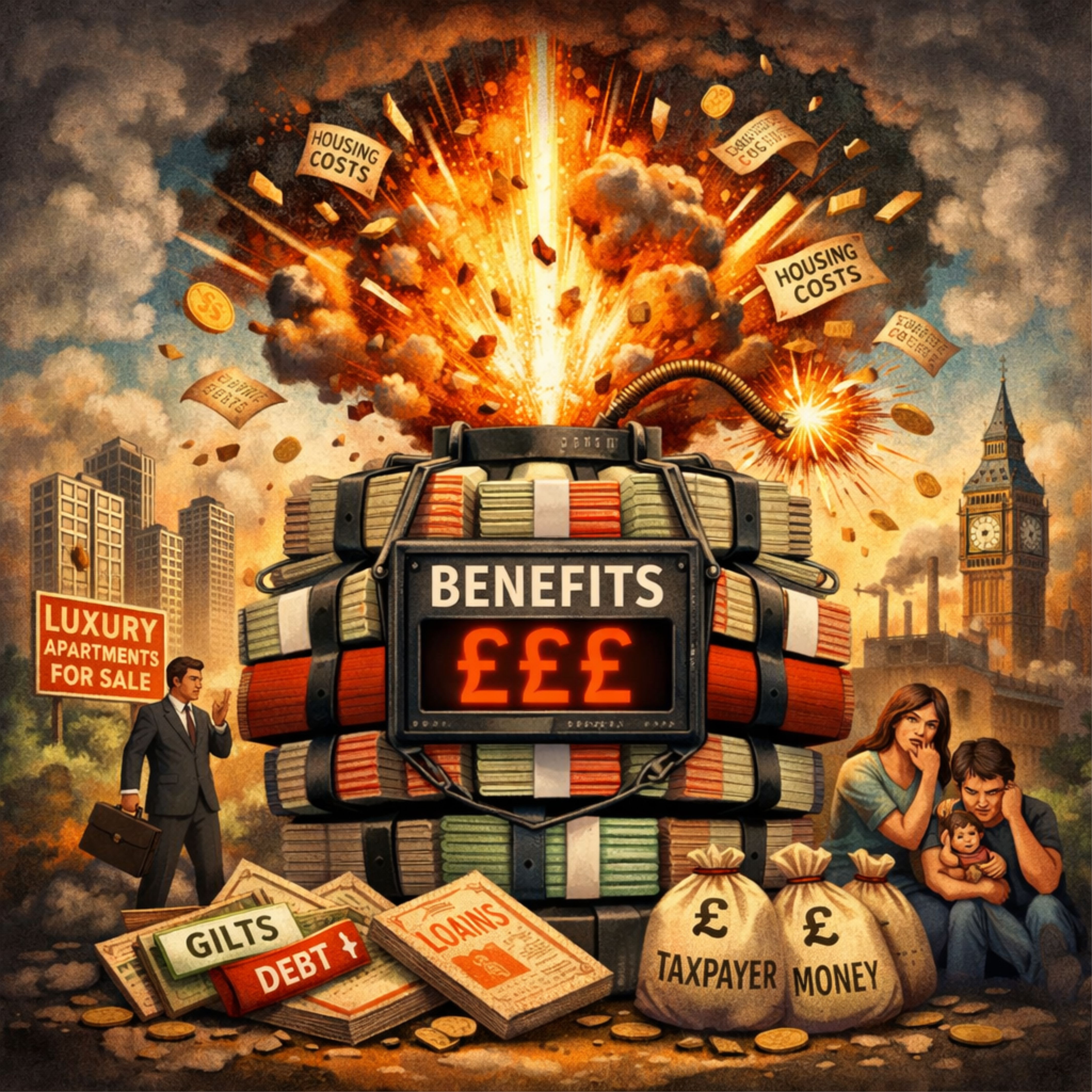

For years, the UK has lived inside a comforting story about how the economy works.
We tell ourselves that if people work hard, they can stand on their own two feet. That welfare is a safety net for the few who fall through the cracks. That public spending is funded by taxpayers in a neat, linear way. And that the system, though imperfect, broadly functions.
But the cost of welfare has become the wedge that splits this story apart. It exposes a truth that has been hiding in plain sight:
Our economic model no longer provides enough people with the means to live independently.
The divide is already here. On one side are those who remain ahead of the system; on the other, those who are falling behind or have already been left behind.
The dividing line is not ideology or effort. It is simply whether your income covers the cost of living.
For millions, it doesn’t.
The Myth of Benefits Abuse vs the Reality of Dependency
Much of the public debate focuses on the tiny minority who abuse benefits. They are held up as if they represent the whole.
But the reality is that the majority of people receiving welfare are in work. They are doing exactly what society asks of them – and still cannot afford to live without support.
This is not a moral failure of individuals. It is a structural failure of the system.
Wages have not kept pace with the cost of living. Housing costs have soared. Childcare is among the most expensive in the world. Energy, transport, food, and basic essentials have all risen faster than incomes.
The welfare bill is not rising because people have become lazier. It is rising because work no longer pays enough to live.
The Extractive Logic Beneath the Surface
The UK’s economic model is built on extraction. It rewards those who own assets and penalises those who rely on wages. It funnels wealth upward through high rents, inflated house prices, low pay, insecure work, and a financial system that treats debt as a product.
This is not the result of a single policy or government. It is the cumulative effect of decades of decisions that prioritised markets over people, growth over resilience, and asset values over living standards.
The cost of our welfare system is the sticking plaster that keeps this model functioning.
Without it, the gap between wages and living costs would be unbridgeable for millions.
The Hidden Architecture of Wage‑Top‑Ups
Most people don’t realise how many different forms of support working households rely on. The system is not designed to support the unemployed – it is designed to subsidise low wages.
- Universal Credit tops up earnings when wages fall short.
- Housing support covers rents that have outpaced incomes for decades.
- Council Tax Support prevents a regressive tax from pushing families into arrears.
- Child Benefit fills the gap between what children cost and what wages cover.
- Childcare support attempts to offset some of the highest childcare costs in the developed world.
- Disability‑related payments cover essential needs that work alone cannot meet.
- Free school meals and cost‑of‑living schemes exist because wages do not cover the basics.
Individually, each form of support looks modest. Together, they reveal a system that is quietly propping up millions of working households.
This is not generosity. It is necessity.
The Irony at the Heart of the System
Here is the part almost no one talks about.
The government is only able to keep paying this enormous welfare bill because of the very system that created the need for it.
The UK does not fund welfare through a simple pot of “public money.” It funds it through borrowing – through issuing gilts, rolling over old debt with new debt, and servicing interest payments that now exceed the education budget.
We talk about welfare as if taxpayers are footing the bill. But the truth is more uncomfortable:
The government is borrowing money into existence to subsidise an economic model that creates the very poverty it then has to fund.
And yet nobody asks the obvious questions:
- Where does the interest on this debt actually go?
- Who receives the payments that now exceed what we spend on educating our children?
- Where did the original money come from?
- How can a country “owe” money that only exists because it issued the debt in the first place?
The system sustains itself by expanding the very mechanisms that created the crisis. It is a loop – one that grows more fragile every year.
Why Politicians Keep Paying a Bill They Know Is Unsustainable
Politicians in opposition promise reform. In government, they all hit the same wall.
They cannot cut the welfare bill without triggering a social crisis.
They cannot raise wages without confronting the corporate interests that underpin the system.
They cannot fix housing without destabilising the asset‑based economy that governments rely on to maintain confidence.
So they do the only thing they can:
Keep paying.
But the bill is becoming unaffordable. And when it becomes impossible to pay, the reckoning begins.
What Happens When the Music Stops
If benefits are cut or fail to keep pace with rising costs, the consequences are immediate:
- People cannot physically or mentally work the hours required to survive.
- Many jobs simply do not pay enough to live on.
- There are not enough jobs for everyone, even before automation.
- AI and technological change will remove even more roles.
- Social cohesion fractures when basic needs go unmet.
This is not ideology. It is arithmetic.
The welfare bill is the last barrier between a fragile society and a crisis of legitimacy.
A System Built for Management, Not Renewal
One of the most uncomfortable truths in all of this is that the limitations we face are not really about politicians at all. They are about the system they inherit.
The people who rise through today’s political structures are selected, shaped, and rewarded for their ability to manage what already exists – not to question it, and certainly not to rebuild it. They are administrators of a model that predates them, not architects of a new one. Their job, as the system defines it, is to keep things stable, keep things calm, and keep things moving. Renewal is not part of the brief.
So they continue paying the welfare bill for as long as the system allows, not because they believe it is the right long‑term answer, but because the alternative would expose the reality that has been avoided for decades. They are not choosing between good and bad options. They are choosing between what the system can tolerate and what it cannot.
This isn’t a criticism of individuals or parties. It is simply the nature of a structure designed for continuity rather than change. A structure that treats questioning its foundations as a threat rather than a responsibility.
But systems have limits. And this one is reaching them. When it finally breaks – whether through economic strain, political paralysis, or technological disruption – change will arrive whether anyone is prepared for it or not. The pressure building beneath the surface will not wait for permission.
The challenge ahead is not to replace one set of politicians with another. It is to recognise that the system they operate within was never built to handle the world we now live in. And until we confront that, we will keep mistaking management for leadership, and drift for direction.
The Truth We Can No Longer Avoid
The welfare bill is not the problem. It is the evidence of a system that no longer works.
It reveals the gap between the economic myths we cling to and the lived experience of millions. It shows us a society where work no longer guarantees security, where independence is slipping out of reach, and where the state is forced to subsidise a system that no longer sustains its people.
We can continue pretending that welfare is the issue.
Or we can confront the truth:
The system itself is broken.
And when the music stops, the truth will no longer be optional.


One thought on “The Exploding Cost of Welfare – and the Economic System That Made It Inevitable”