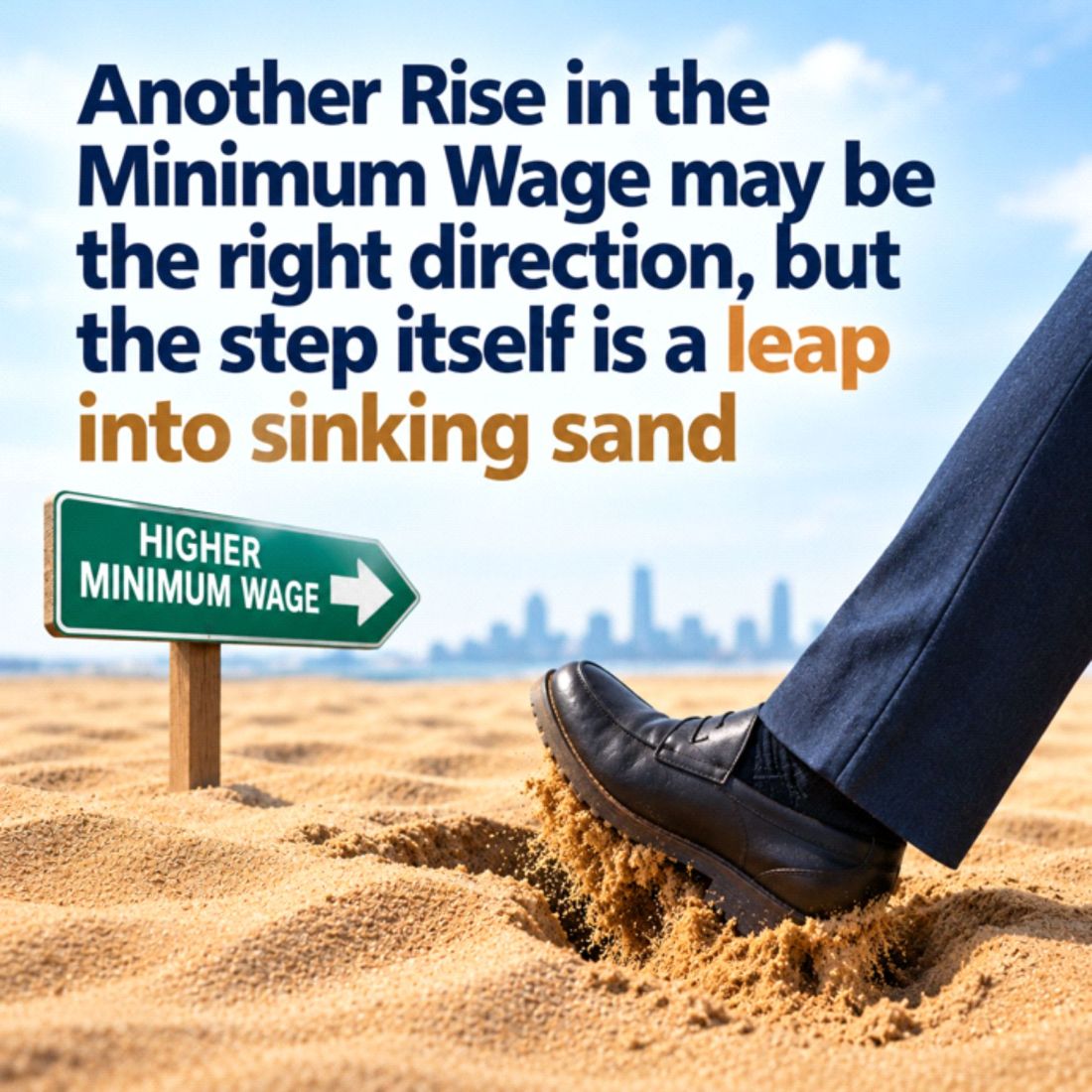
Another Rise in the Minimum Wage may be the right direction, but the step itself is a leap into sinking sand

I’ve spent a lot of time thinking about the realities of the minimum wage and what this benchmark actually represents.

The biggest misconception surrounding the National Minimum Wage is the widespread assumption that it bears some meaningful relationship to the cost of living. It doesn’t.

Somewhere along the way, we began treating the minimum wage as though it were a measure of what it costs to live independently, build financial security, and participate fully in society. It was never designed to be any of those things.

Yet each increase is inevitably presented as evidence of progress, a sign that government understands the pressures facing ordinary people, whilst employers often use it as a benchmark to justify the legitimacy of their own pay structures.

The reality is that the minimum wage remains far below the level that many people require to live independently without relying on debt, family support, benefits and welfare, or a combination of all three.

That matters because independence is the issue at the heart of the wider debate.

In recent months I have written about what poverty really is and why small businesses are struggling. Whilst those may appear to be separate conversations, they are in fact different manifestations of the same underlying problem.

The minimum wage debate provides perhaps the clearest example of how disconnected our understanding of that problem has become.

Poverty Begins Where Independence Ends

The way poverty is commonly discussed tends to focus on income alone.

We talk about poverty lines, earnings thresholds, and household statistics. We compare one figure against another and decide whether someone falls above or below a particular measure.

But poverty is not fundamentally about numbers.

Poverty begins where independence ends.

A person enters poverty when they can no longer meet their essential needs without external support. Whether that support comes from the state, from family members, from charities, or from borrowing money that will eventually need to be repaid, the outcome is essentially the same. Independence has been lost.

This is why so much of the debate surrounding wages misses the point.

If someone receives a higher hourly wage but still cannot afford housing, energy, transport, food, insurance, and the basic costs of modern life without additional support, have we actually solved anything?

Or have we simply moved the numbers whilst leaving the underlying condition untouched?

The uncomfortable reality is that increasing numbers of people are discovering just how fragile their own independence has become. A redundancy, an illness, a rent increase, a mortgage rate adjustment, or an unexpected expense can rapidly expose how little resilience exists beneath the surface.

The minimum wage may rise.

The insecurity remains.

The Problem Facing Small Businesses is the Same Problem Facing Workers

The political framing of minimum wage debates often creates the impression that there are two opposing sides.

On one side are workers who quite understandably need higher wages.

On the other are businesses that supposedly do not want to pay them.

The reality is rarely that simple.

Most people earning the minimum wage need more money.

Most small businesses are already struggling to survive.

Both statements can be true at the same time.

The reason is that workers and small businesses are often facing different symptoms of the same underlying pressures.

Workers need higher wages because the cost of living has become increasingly unaffordable.

Small businesses struggle to pay higher wages because they are operating on margins that become thinner every year.

Neither side created the conditions that produced this situation.

For decades, economic value has become increasingly concentrated amongst larger organisations with greater market power, easier access to capital, and the ability to operate at scales that smaller competitors simply cannot match.

At the same time, communities have become less economically resilient. Housing costs have risen. Living costs have risen. Debt has grown. Disposable income has shrunk.

Consumers buy differently because they have to.

Small businesses operate differently because they have to.

The local shop owner trying to meet payroll and the employee struggling to pay rent are frequently experiencing different consequences of the same economic architecture.

Yet public debate encourages them to see one another as the problem.

Why Minimum Wage Rises are Politically Attractive

The argument here is not that minimum wages should not increase.

They should.

The lowest-paid members of society deserve better compensation for their work and contribution.

The problem is that minimum wage policy is increasingly being presented as a solution to issues that are far bigger than wages alone.

For governments, minimum wage increases possess obvious political advantages.

They are visible.

They are measurable.

They create clear headlines.

They allow politicians to demonstrate action.

What they do not do is address the deeper causes of economic dependency.

Raising the minimum wage does nothing to reduce the cost of housing.

It does nothing to tackle the underlying drivers of energy prices.

It does nothing to confront the growing concentration of market power.

It does nothing to resolve the increasing cost of raising families.

It does nothing to address the structural conditions that leave both workers and businesses struggling for survival.

Instead, it attempts to compensate for those pressures after they have already been created.

And in doing so it risks becoming another temporary intervention in a system that continues to generate the same outcomes.

The Ground Beneath Us is Still Sinking

On paper, a significant increase in the minimum wage can look generous, particularly at a time when governments are themselves struggling to balance competing financial pressures.

But appearances can be deceptive.

Large corporations may absorb increased wage costs for a period before finding ways to pass them on through higher prices, improved efficiencies, reduced staffing levels, or increased productivity demands.

Small businesses often have far fewer options.

Many will absorb the costs and accept lower profits.

Others will attempt to raise prices in markets that are already stretched beyond comfort.

Some will simply close.

Meanwhile, those receiving the wage increase may discover that rising rents, rising bills, rising insurance costs, and rising prices steadily erode much of the benefit that was intended.

Everyone moves.

Very few move forward.

This is why the minimum wage debate often feels strangely circular. Every year we now find ourselves having the same conversation once again.

The minimum wage must rise because people cannot afford to live.

Yet people increasingly cannot afford to live despite repeated rises in the minimum wage.

At what point do we stop discussing the symptom and start discussing the cause?

The Real Question

The question is not whether the minimum wage should rise.

The question is why it has to keep rising simply to prevent more people from falling behind.

If full-time work cannot reliably provide economic independence, the problem is not the minimum wage itself.

If small businesses are becoming less viable whilst workers remain financially insecure, the problem is not either side of the employment relationship.

If governments repeatedly return to minimum wage increases as one of their primary responses to economic hardship, the problem is not necessarily the intention.

The problem may lie in the architecture itself.

Modern poverty, struggling small businesses, and constant debates about wages are not separate crises.

They are different warnings emerging from the same system.

And until we start questioning the structure that produces those warnings, every increase in the minimum wage, however well-intentioned, risks becoming another step forward on ground that is still sinking beneath us.

Further Reading

1. The Independence Threshold: A New Definition of Poverty for a Modern Economy

Before discussing wages, it is worth understanding what poverty actually is. This article argues that poverty begins where independence ends, proposing a definition based not on arbitrary income thresholds but on a person’s ability to sustain themselves without relying on external support. It provides the conceptual foundation for understanding why rising wages alone do not necessarily solve poverty.

Read: The Independence Threshold: A New Definition of Poverty for a Modern Economy

2. The Architecture of Modern Poverty

If poverty is ultimately about dependency, what creates that dependency? This article explores the structural forces that increasingly undermine economic independence, from rising living costs and housing pressures to the broader systems that leave more people vulnerable despite living in a wealthy society. It examines the architecture that produces poverty rather than simply its visible symptoms.

Read: The Architecture of Modern Poverty

3. Why Small Businesses Are Struggling – And Why the Real Problem Runs Much Deeper Than Anyone Wants to Admit

The same pressures affecting individuals are also affecting local businesses. This article argues that the challenges facing small businesses cannot be explained solely by taxes, labour costs, energy prices, or regulation. Instead, they are part of a much deeper economic shift that increasingly concentrates advantage amongst larger organisations whilst leaving smaller firms and communities with diminishing resilience.

Read: Why Small Businesses Are Struggling – And Why the Real Problem Runs Much Deeper Than Anyone Wants to Admit

Together, these articles explore a common theme: that modern poverty, economic dependency, struggling small businesses, and the continuing debate over wages are not separate problems. They are different manifestations of the same underlying economic architecture.

Minimum Wage, Maximum Exploitation: A Collapsing System Propped Up by Rising Taxes

Introduction

As the cost of living continues to climb across the United Kingdom, many households find themselves struggling to maintain even the most basic standards of financial independence.

With impending tax rises on the horizon, the pressure on those already living near the edge is set to intensify, pushing even greater numbers below the threshold of self-sufficiency.

This is not a temporary crisis, but a symptom of a deeper, systemic failure—a collapsing economic model that now survives only by extracting more from those who can afford it least.

The money-centric economic system that we have – The “Moneyocracy” – perpetuates itself by shifting the burden onto workers and taxpayers, while the promise of prosperity grows ever more distant for the majority.

Against this backdrop, it is essential to confront a fundamental question – one that exposes the uncomfortable realities at the heart of our economy.

A Question:

Do you believe the minimum wage is enough for a full-time worker to live on – and if so, why?

The answer to this question, which varies depending on one’s relationship with the minimum wage, reveals uncomfortable truths about the foundations of our economy and the way work is valued in this country.

What is not surprising is that those who already have financial security often agree in principle that low-paid workers should earn more. Yet when confronted with the implications of paying every worker enough to live independently, many recoil. Why? Because such a change would disrupt their own relationship with the economy.

The Minimum Wage Reality

Let us be clear: the national minimum wage in the UK is not enough for anyone working a full-time 40-hour week to live independently—free from reliance on benefits, charity, or debt.

The widespread acceptance of this wage stems from government and establishment narratives.

What is legally mandated is presented as morally and practically sufficient.

Yet, in truth, the minimum wage is a carefully placed rock covering a pit of myths and lies.

Those who benefit from the system prefer not to lift that rock, because doing so would expose their complicity in maintaining the illusion.

The Employee

A worker earning the minimum wage – currently £12.21 per hour, equating to £488.40 per week or £25,396.80 annually – cannot afford the basic essentials required for independent living.

The gap between what they earn and what they need is effectively the amount by which they are underpaid.

Employers exploit workers by failing to cover the true cost of living.

Regardless of how the deficit is filled—through benefits, charity, or debt—someone else is subsidising both the employee and the employer.

The Employer (Small Business)

Small business owners often insist they pay fairly because they comply with the law. Yet compliance does not equate to fairness.

Paying the legal minimum is not the same as paying enough for employees to live independently.

Common justifications include:

• “They can top up with benefits.”

• “I can’t pay more or I’ll go out of business.”

But these arguments miss the point. The government—and by extension, taxpayers—should not subsidise businesses that cannot afford to pay workers a living wage.

In reality, small businesses are also exploited: they cannot operate independently within the current economic system, because they too are constrained by models that undervalue their work.

The Employer (Big Business)

Large corporations differ because they can afford to pay more.

Supermarkets and other major employers of minimum-wage staff generate enormous profits – even during a cost-of-living crisis, like the one we are experiencing now.

They could easily pay wages that allow workers financial independence, if boards and shareholders accepted smaller returns.

Instead, big businesses exploit both employees and taxpayers. Workers are underpaid, while the government subsidises wages through benefits.

This allows corporations to maximise profits while keeping the mechanics of exploitation hidden from public debate.

The Government

Why does the government subsidise wages so small businesses can survive and big businesses can thrive? Why not simply set a minimum wage that reflects the true cost of living?

The answer is stark: doing so would collapse the system.

The economy functions by undervaluing the majority of jobs deemed “low-skilled” or of “little value.”

If wages reflected reality, the house of cards would fall.

The Taxpayer

The system is a con. The complex machinery of what can be called a Moneyocracy manipulates trust and deference so effectively that taxpayers rarely ask basic questions.

Why, in an economy where corporations make billions annually, must taxpayers top up their employees’ wages through taxes?

Why are we threatened with price hikes whenever government policy shifts, while corporate profits remain largely unscrutinised?

Following the money reveals the truth: wealth is funnelled in one direction, made possible only by exploiting workers, taxpayers, and weak governments.

Corporations profit by underpaying staff, then spin narratives that justify charging consumers more.

Reality Bites

Exploitation of normal people has gone too far. The system enriches the few by exploiting the many – sometimes multiple times over – so profits can grow while wages stagnate or reduce in real terms.

The Moneyocracy survives by perpetuating the myth that it is acceptable for many to grow poorer while a few grow disproportionately rich.

The promise dangled before workers – that if they play the game long enough, they too might “live the dream” – is false.

Humanity is destroying itself chasing a dream that continually recedes, because playing the game requires forgetting our true worth.

The basic equation of the Moneyocracy is simple: for some to be rich, most must be poor.

This is neither humane nor true.

The Alternative

There is another way. A system built on real values – where people, communities, and the environment come first – can replace the current money-centric model.

This alternative requires transparency, local systems, and a commitment to prioritising human worth over profit. Instead of hiding self-interest behind complex structures, society must embrace a model where business and life are conducted openly, sustainably, and with fairness at the core.

The choice is absolute: continue with a Moneyocracy that exploits us all or build a future centred on people.

Path Forward

The Local Economy & Governance System provides the foundational framework for a truly people‑centric future – one where People, Community, and Environment sit at the heart of every decision.

At its core lies a new benchmark: The Basic Living Standard, a guarantee that every individual receives a weekly wage sufficient to cover all essential needs.

This principle of equity and equality is not an optional add‑on, but the priority that guides every part of the system.

By shifting away from exploitation and toward fairness, transparency, and sustainability, this model offers a pathway to rebuild trust and resilience in our economic and social structures.

To explore how this vision can be realised and what it means for the future, please follow these links:

Being on benefits isn’t a culture; for many it’s a living hell

As you read through the pages of this blog or read the eBooks that are available and recognise the story unfolding and the different parts that we can all see, you may be able to step back and observe the reality that those who ‘take from the state’ are the easiest for everyone else to blame.

No matter their background or reason for being dependent upon the State, Benefits Claimants have become scapegoats and little more than everyone else’s ‘guilty bastards.

Worst of all, they have now become a very easy target for those who are actually responsible for everything that is going wrong with the UK, to project their own guilt and fear upon.

For anyone receiving benefits when they could or would rather be ‘paying their own way’, being anywhere near the Benefits System, the many organisations that work within and around it, and being within the exploding sub-class of our society currently being gaslit by the financial benchmark of the National Minimum or Living Wage; life is a fearful, emotionally and practically challenging living hell.

In my recent research article and eBook ‘Is Poverty Invisible to those who don’t Experience it’, I discussed the realities that people using Foodbanks and in poverty face across the UK today.

Given the nature of the announcements due to be made as part of the Spring Statement this Wednesday and what we already know is on the way from the October ’24 Budget, I will expand here on 5 of the most important points of what being within or touched by the Benefits System means to many of those whose lives are touched by it:

1. It costs more to live than the Minimum or Living Wage allows

The elephant in the room that is the cost-of-living crisis, is this:

What we currently accept as being the National Minimum Wage or Living Wage, isn’t anywhere near enough for a single person without any parental, caring or partner responsibilities, to live independently without top-up benefits, help from charities (foodbanks), going into debt or raiding savings.

2. Working on the Minimum Wage means you still need help

People working in Minimum Wage jobs in the UK, cannot earn enough, working a 40-hour week, to pay their own way.

Those on Minimum Wage cannot live independently, without still having to jump through the hoops and requirements that come from being a benefit claimant; from ‘qualifying’ to get emergency food packages from Foodbanks; by going into debt using credit cards, loans or pay-day-credit type schemes; or by falling back on family or friends for handouts, just to make ends meet.

3. Being on benefits is no breeze: Welfare cuts are an act of increasing cruelty when many just want safe-to-climb ladder to escape

Being on benefits means being treated like you are someone else’s guilty bastard and like you are the one who is in the wrong.

The staff in jobcentres (understandably) often don’t really want to be there. They are regularly exposed to some of the UKs most unhappy people. When they themselves are at the cutting edge of a Benefits System that has ALREADY removed all sense of humanity from its heart and behaves like it already runs with the dehumanisation that we can expect from universal AI that is being  introduced for all the wrong reasons.

People who are not working or who have personal issues that have made them dependent upon benefits often feel vulnerable.

They suffer from the lowered levels of confidence that any form of unexpected or inescapable vulnerability brings. Even before they contact Jobcentres, the Benefits Office or any other organisations that provides the different services and offerings that provide income and support that comes from the public purse.

Some active claimants do use anger and exhibit loud forms of frustration. But this is often a self-protection mechanism and way to try and secure what they need from the System.

Sadly, these few are the stereotype upon which much of the prejudiced behaviour towards those on Benefits that reaches far beyond DWP staff is formed.

The profit-led private contractors who provide ‘back to work’ or ‘welfare to work’ services and ‘support’ are no better.

The tick-box culture that is applied universally towards anyone whose existence touches the welfare purse is one where claimants are considered capable of working if they tried, and therefore there because they choose to be.

Once through the turnstile of the benefits door, benefits claimants are considered worthless.

Nobody operating or administering the benefits system from within is prepared to look at anyone asking for help as being anything other than the same.

The Benefits system is inherently cynical and labels everyone who doesn’t work as being in the benefits queue as a lifestyle choice.

Unless benefits claimants possess a CV or situation which would be strong enough to indicate that they wouldn’t even be there in the first place, the experience of being just within the benefits system itself quickly takes its toll. Once inside, it is a downwards spiral for many where there is no genuine escape, even if you find a way to leave.

Politicians may indeed be openly questioning the number of unemployed who there because of mental health issues.

But beyond the torture of what it takes for growing numbers to keep up with a financial and money-centric culture that demands everyone keep up, the constant hits that come from being in ‘the system’ and treated like you are sub human by those who do and can work, makes for a progressively difficult challenge, that in the situation we all face today, has come down to little more than lucky breaks for the many who do want to escape.

4. Very few want to be on benefits – Living independently on a basic wage is key

I mentioned the angry and the frustrated above.

These are the people that hide behind a mask and fight the contact that they have with the Benefits System, because it’s what they believe they have to do, to survive.

Yes, many receiving benefits suggest openly and behave with a sense of entitlement. But this is the situation that decades of poor politicians – and therefore that we all have created, because of the responsibility that we all have, for appointing the politicians who have created, developed and maintained the mess that the UK is now in.

The stories of people who cannot step out of the benefits trap, because they cannot afford to do so, are also true.

There is something perverse about a situation where claimants will not take the risk of taking jobs and opportunities because of how they will be treated by the benefits system and what support they will lose immediately if and when they take those steps to get out.

Unless they cannot work because of other commitments or they find themselves genuinely unable to do so, there are few Benefits Claimants who have entered or remain within the Benefits System by choice.

5. A Minimum Wage that is guaranteed to be a Living Wage would change everything

Another truth that we have turned a blind eye to, is that many people who cannot do so currently, would be very happy to be working in Minimum Wage jobs IF they actually paid what its costs to live independently.

Many people would choose to work in Minimum Wage jobs, in receipt of a wage that they could live independently on. Because their only working responsibility or responsibility to others would then be to do what they are asked for the time that they are at work.

Many of us would be very happy just to work a working week and at the same time earn enough so that all of the bills and the essentials that it takes  to live an independent and self-sustaining life today are paid for. Just as long as we don’t then have to go looking for and making ourselves vulnerable to anyone or anything else, reaching out for help, just to make  ends meet.

Rethinking The Minimum Wage: The need for a Basic Living Standard

Today, the establishment offers us ‘The Minimum Wage’ and ‘The Living Wage’.

However, neither the Minimum Wage nor the Living Wage are genuinely representative of what it costs a single person to live independently, without having to rely upon Benefits or Welfare, Charity such as Food Banks, or going into Debt of some kind, in order to meet the real Cost of Living or threshold for independent living.

The reality that government subsidises low wages through income support, housing benefits, tax relief is overlooked by many, because the ‘official’ or ‘establishment’ narrative is that if you received the Minimum Wage or its equivalent, you have enough money to live.

Sadly, the many truths that surround life experience where there is lack, reliance upon others and a culture that looks down upon anyone who needs financial help in ways that too often suggest guilt is overlooked by the very people who should know better.

Every Person should have the ability to live and support themselves independently in the lowest paid work, irrespective of background, qualifications, experience or any factor that could be used to excuse some form of prejudice on the part of others.

Creating and implementing A Basic Living Standard would provide an equal financial or material footing for Every Person is both a necessary and required foundation for the Just, Balanced and Fair society, that we all deserve.

The Basic Living Standard

“Adults, working a full working week in any job at any level, must be able to feed, house, clothe and provide adequately for their own transport needs, whilst providing basic necessities such as communication themselves, without the need for credit, loans, benefits or third-party support of any kind.”

To work effectively and as it should, The Basic Living Standard would become the key requirement of all business and economic activities.

Every economic activity and transaction would be made and progressed with The Basic Living Standard in mind and no economic activity would exist that does not place People and the impact and consequence to People at its core.

The Basic Living Standard will help flip the value set across society and address every wider social problem that society faces, leaving the Public Sector to take care of those who have genuine problems that have not been caused by societal conditioning or environmental factors, as it always should.

The Basic Living Standard could either be adopted as a voluntary change, or as the way to move forward, should the unthinkable happen and we experience some kind of system collapse, where a new form of governance is finally accepted as being essential for change.