
A Familiar Argument Returns
As discussion about Britain’s future relationship with Europe becomes more explicit, two opposing camps are beginning to re-emerge. One argues that Britain’s difficulties stem substantially from Brexit, and that closer alignment, or eventual re-entry into the European Union, offers the most credible route towards economic stability and political coherence. The other argues that Britain’s difficulties stem from a failure to fully exploit Brexit, and that greater sovereignty, greater divergence, and a more confident assertion of national independence offer the better path.
At first glance, these appear to be fundamentally different futures. They are not. That is not because the outcomes would be identical; they would not. Rejoining and staying out would almost certainly be experienced differently, would produce different trade-offs, and would generate different winners and losers. The deeper question is whether either option addresses the forces that have been steadily weakening Britain’s capacity to govern itself effectively over the past several decades.
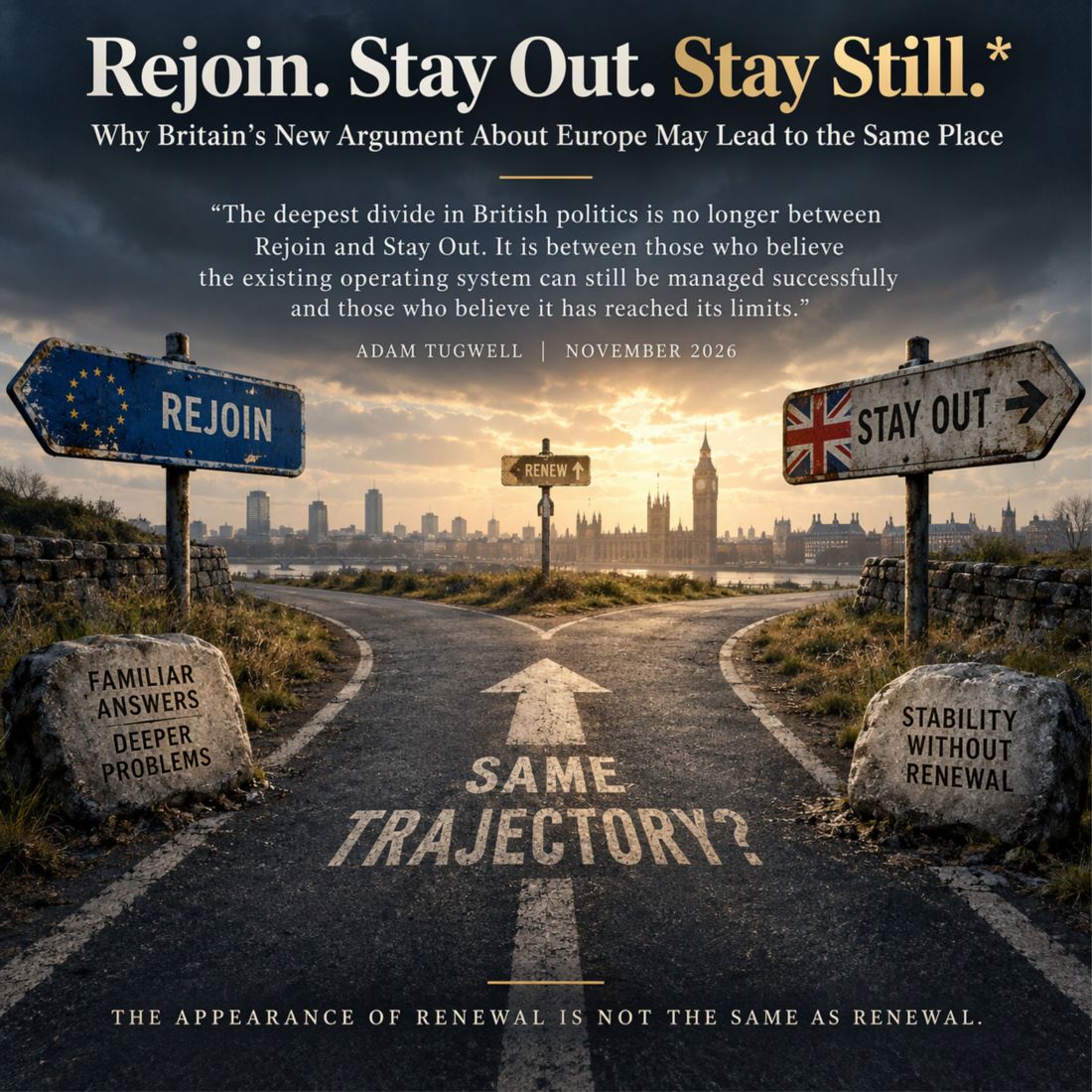
My argument is not that Rejoin and Stay Out are the same. It is that both risk leading to a condition I call Stay Still*. And the asterisk matters, because there is no such thing as standing still.
What “Stay Still*” Actually Means
When most people hear the phrase “stay still”, they imagine stability. I mean something very different.
In politics, government, business, charities, and institutions of every kind, standing still is largely an illusion. Infrastructure ages whether it is renewed or not. Institutions weaken whether they are reformed or not. Capabilities erode whether they are maintained or not, and problems accumulate whether they are addressed or not.
A nation that stops renewing itself is not preserving its condition; it is gradually consuming the strengths it inherited from earlier generations.
This is why the phrase requires an asterisk. Stay Still does not mean nothing changes. It means the underlying trajectory continues. The language changes, the politics changes, and the slogans change, yet the deeper direction remains largely untouched.
If that trajectory is already producing declining resilience, weakening institutions, growing dependency, and diminishing public confidence, then “staying still” is simply another name for managed deterioration.
A more accurate phrase might be stability without renewal.
The Problems Britain Cannot Escape
The strongest objection to this argument is obvious: surely Britain’s relationship with Europe matters?
Of course it does. Trade, regulation, investment, and international relationships all matter. The question is whether these are the primary causes of Britain’s current difficulties.
Consider a handful of problems that have persisted through multiple governments, multiple economic strategies, and both sides of the Brexit divide. Productivity growth has remained weak since the financial crisis. Housing affordability remains a chronic problem, and regional inequalities remain among the largest in the developed world. Public infrastructure is under growing strain, public trust in institutions has weakened, and public services face mounting pressure despite repeated reform efforts.
These are not uniquely British problems, nor were they created in 2016. In many cases they predate Brexit by decades. Brexit did not create them; it exposed them.
Britain has already lived through multiple waves of reform designed to address various aspects of these challenges. New Labour modernised public services through targets, outsourcing, and public-private partnerships. The Coalition pursued austerity and state restructuring. Successive governments promised regional rebalancing, devolution, industrial strategies, productivity plans, levelling up, Brexit renewal, and institutional reform.
Yet many of the underlying measures that shape everyday life – productivity, housing affordability, regional inequality, infrastructure resilience, and public trust – remain stubbornly persistent. The language changed. The programmes changed. The diagnosis often changed. But the deeper condition proved remarkably resistant to treatment. And ten years after the referendum, there is still little evidence that either side of the European argument has developed a convincing answer to these problems.
The Politics of Exhaustion
This is where the concept of exhaustion becomes important. By exhaustion, I do not mean frustration or fatigue. I mean the point at which a political system continues to generate activity while losing the ability to generate genuinely new answers.
Policies, manifestos, announcements, and arguments all continue, yet the range of acceptable solutions becomes increasingly narrow. The same assumptions reappear, the same frameworks dominate, the same debates return, and the same institutions produce variations of familiar answers.
Viewed through that lens, the return of the European argument is revealing. It tells us less about Europe itself than about the narrowing imaginative range of Britain’s political class.
When systems struggle to solve deep structural problems, they often return to familiar territory: old arguments feel safer than new thinking, and known routes appear more credible than unexplored ones. The result is a political environment that increasingly debates direction while struggling to imagine destination.
This points towards a deeper divide than the one currently dominating headlines. By the “operating system”, I mean the set of assumptions, institutions, and habits of management through which Britain is currently governed, which I examine more fully in the next section.
The deepest divide in British politics is no longer between Rejoin and Stay Out. It is between those who believe the existing operating system can still be managed successfully and those who believe it has reached its limits.
Seen this way, the European argument increasingly resembles a disagreement about how to navigate the current system rather than whether a different system is required.
The Establishment as a Worldview
To understand why this matters, it is necessary to define what I mean by “the Establishment.” I do not primarily mean politicians, civil servants, journalists, business leaders, or any particular group of people. I mean a worldview: a shared set of assumptions about what is realistic, responsible, and possible. That worldview is built around market primacy, financial credibility, perpetual economic growth, technocratic management, institutional self-preservation, and centralised expertise.
Most people operating within this worldview do not experience it as an ideology. They experience it as common sense, which is why it is so powerful, and why political disagreement can so often occur entirely within its boundaries.
Rejoin and Stay Out appear fundamentally opposed, yet both frequently continue to accept many of the same assumptions about economics, governance, institutions, and progress.
They disagree about Britain’s relationship with Europe, but they often agree far more than either admits about the operating system underneath.
The danger here is not simply that Rejoin or Stay Out fails; political systems survive failure all the time. It is that either could succeed politically while failing structurally, leaving Britain believing that a fundamental problem has been solved when only one aspect of it has been addressed. Apparent solutions can make deeper problems harder to see rather than easier to solve, and that is the pattern I turn to next.
The Phoenix Paradox
This brings us to what I have previously called The Phoenix Paradox, which describes a situation in which the appearance of renewal becomes an obstacle to genuine renewal.
In simple terms: a visible solution can make a problem harder to solve if it creates the illusion that meaningful change has already occurred.
The pattern is familiar. A reform is introduced, the public sees action, and expectations rise. But the underlying causes remain largely intact, so disappointment follows and confidence in future reform falls. The original problem survives and, in some cases, becomes even harder to address than before.
This danger matters because both Rejoin and Stay Out risk functioning as Phoenix cures. A Rejoin project could persuade people that Brexit was the fundamental issue, only for deeper structural problems to remain. A Stay Out project could persuade people that incomplete Brexit was the fundamental issue, only for those same problems to remain.
Neither outcome would necessarily prove the original diagnosis wrong. It would simply demonstrate that constitutional change and structural renewal are not the same thing.
But Surely the Outcomes Would Be Different?
Yes, and this is worth acknowledging clearly.
Rejoin and Stay Out are not equivalent. Rejoining may reduce some forms of friction, improve institutional coherence, and create different economic opportunities, while remaining outside may preserve greater political discretion and allow for different policy choices. The distinction matters, the outcomes matter, and the experiences would differ.
The argument here is not that Rejoin and Stay Out are identical. The argument is that both remain largely situated within the same underlying worldview, and may therefore struggle to produce fundamentally different long-term trajectories.
Both continue to be heavily market-facing and to judge success through broadly similar assumptions. Both prioritise management over reconstruction, and both operate within a paradigm that struggles to imagine alternatives to itself.
As a result, the disagreement is over the shape and speed of the journey rather than its ultimate direction.
What Genuine Renewal Might Require
At this point an obvious question emerges: if neither Rejoin nor Stay Out represents genuine renewal, what would?
The purpose of this article is not to provide a full blueprint, but it is possible to identify the broad direction. Genuine renewal would require a shift from managing outcomes to rebuilding capability, with renewed attention to productive capacity, local economies, institutional resilience, democratic accountability, energy security, infrastructure, community governance, and long-term stewardship.
Most importantly, it would require questioning assumptions that have become so normal that they no longer appear ideological.
The greatest obstacle to genuine renewal is not opposition but paradigm blindness, because a society cannot build alternatives while treating its current assumptions as immutable reality.
Conclusion
Britain increasingly presents itself as facing a new choice: Rejoin, or Stay Out. Yet beneath the surface lies a more fundamental question. Can Britain renew the capabilities that allow nations to thrive? Can it rebuild resilience, agency, institutional capacity, and public confidence? Can it imagine solutions that extend beyond the assumptions that have governed the last forty years? Those questions receive remarkably little attention compared with arguments about Britain’s constitutional relationship with Europe, and that omission is significant.
The greatest danger facing Britain is not that it chooses Rejoin, nor that it chooses Stay Out. It is that either choice is mistaken for renewal itself. Each would bring a different journey, with different frictions, opportunities, and political stories, and would alter the pace, shape, and character of Britain’s future. But if both remain rooted in the same assumptions that produced the current condition, they may differ more in experience than in destination. The question this article raises is whether either produces a different underlying trajectory.
That is what Stay Still* means: not the absence of movement, but the absence of transformation. Rejoin. Stay Out. Stay Still.* Because there is no such thing as standing still.
Further Reading
This article draws on a series of pieces I have written since May 2026. If you would like to explore any of the ideas in more depth, they are grouped below by theme and listed in the order I would suggest reading them.
The European Argument
Brexit and the Halfway House: Why Britain Cannot Move Forward or Back (12 May 2026)
Argues that Brexit was not the cause of Britain’s difficulties but the first visible rupture in an old order already reaching its limits, leaving the country suspended in a halfway house between the European Union and genuine independence.
Ten Years On: Brexit, Globalisation and the Halfway House Britain Still Can’t Escape (23 June 2026)
A decade-on reflection that places Brexit within the wider forces of globalisation, and asks why Britain remains stuck in the halfway house it entered when it left.
The Politics of Exhaustion: Why Europe Is Becoming Westminster’s Last Remaining Option (4 November 2026)
Suggests that the growing attraction of rejoining reveals less about the strength of the European option than about the weakness of every other option open to Westminster, as a political system running out of ideas returns to familiar territory.
The Ideas Behind the Argument
The Establishment Is Not What You Think It Is (15 July 2026)
Sets out the case that the modern Establishment is best understood as a worldview rather than a class or a group of people, and explains why that makes it so hard to recognise and escape.
The End of Britain’s Current Operating Model: Thatcherism’s Forty-Year Reign and the Beginning of the Post-Thatcher Era (1 August 2026)
Examines the operating model that has shaped Britain for roughly forty years and considers what it would mean for that era to be ending, the fullest treatment of the “operating system” referred to in this article.
The Phoenix Paradox (12 November 2026)
Explores how the appearance of renewal can become an obstacle to genuine renewal, when a visible solution creates the illusion that meaningful change has already occurred.
Each piece stands on its own, but read in this order they trace a single argument: from Britain’s halfway-house position after Brexit, through the exhaustion of its political options, to the worldview that shapes them and the question of what genuine renewal would require.