The Young People Who Didn’t Fail – And the System That Keeps Pretending They Did

Every few years, the government announces it is “reviewing the NEET problem.” You can almost hear the sigh ripple across the country when they do. We’ve been here before. We know how this goes.

The same headlines. The same concern. The same promises that this time, finally, something will change.

But anyone who has lived through the last twenty years knows the truth:

The NEET problem was never solved because it was never understood.

The system keeps circling the same question – “Why aren’t young people engaging?” – without ever asking the one that matters:

“What exactly are we asking them to engage with?”

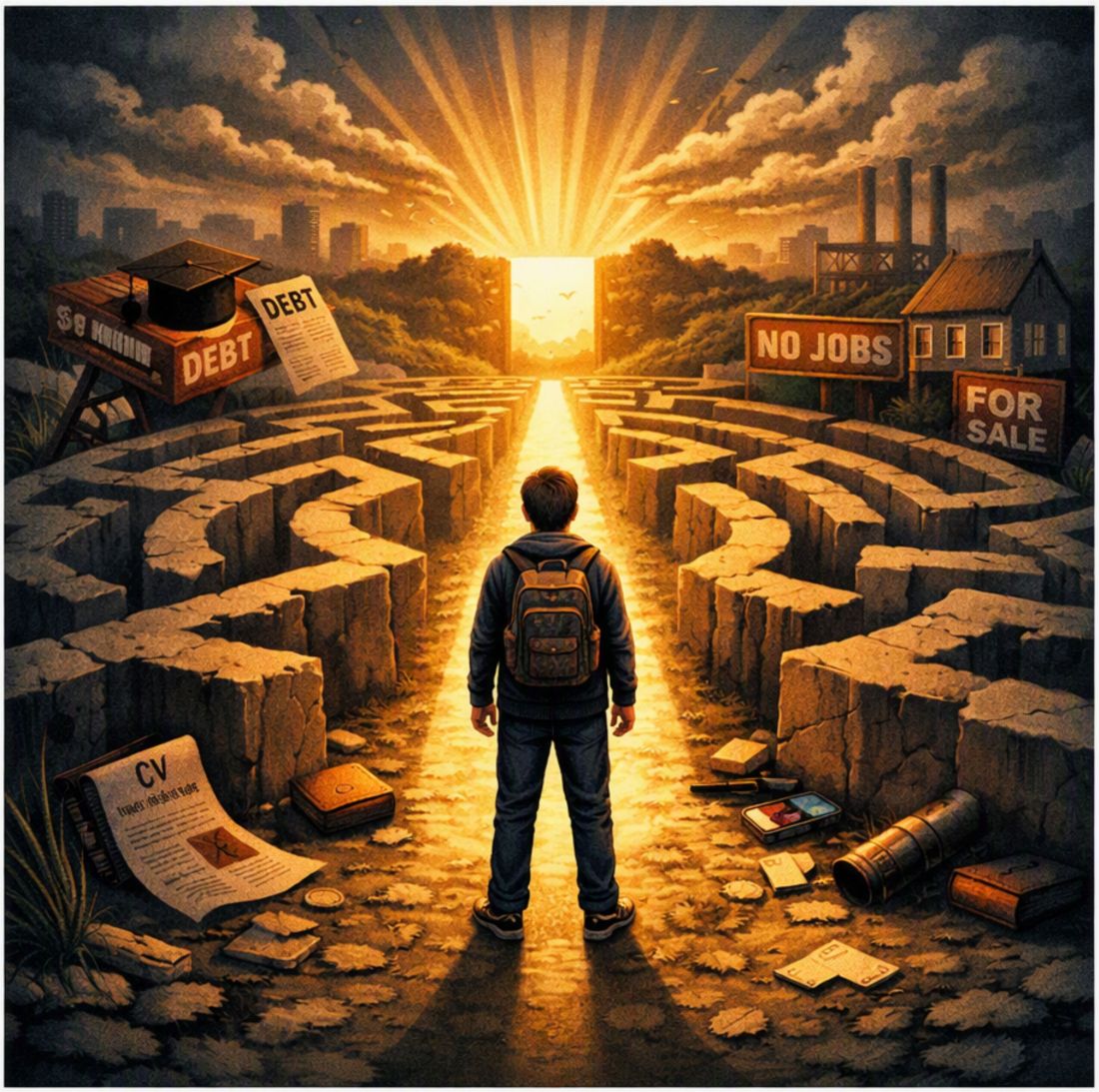
Because if you’re sixteen, or nineteen, or twenty‑three, and you’re looking at the world you’re about to inherit, the picture doesn’t look like opportunity. It looks like a maze with no exit.

And that’s where the story really begins.

The young people who “did everything right”

You meet them everywhere.

There’s the girl who worked hard at school, got the grades, went to college, took on debt, earned the qualification – and now works two part‑time jobs that don’t cover rent. She did everything the system asked of her, and the system shrugged, as if her effort were a footnote.

There’s the boy who was brilliant with his hands, who could fix anything, who learned by doing – but was told that “real success” only comes through exams, essays, and university. He didn’t fall behind because he lacked ability. He fell behind because the system only recognises one kind of intelligence.

And there’s the teenager who tries to revise in a house where the electricity meter runs out, or where caring for siblings matters more than coursework, or where anxiety makes concentration impossible – and is told they “lack motivation.”

None of these young people failed. They were simply born into a system that cannot see them.

And when a system can’t see young people clearly, it reaches for the same old stories to explain away its failures.

The myth that keeps hurting them

Whenever the NEET numbers rise, someone in government inevitably points to a politician who “made it” despite hardship – a story meant to prove that social mobility works.

But these stories often leave out the quiet truths: the family connections, the cultural confidence, the safety nets, the invisible advantages that smoothed the path long before talent or effort had a chance to show themselves.

It’s not that these individuals didn’t work hard. It’s that their success came from a mixture of background and opportunity that most young people today simply don’t have.

And yet the system uses these stories as proof that young people who struggle must be doing something wrong.

It’s a painful irony:

The people who benefited from background‑based mobility are held up as evidence that meritocracy works – as if their story proves the system is fair, rather than proving how uneven it really is.

Meanwhile, the young people with real merit are being shut out.

The world young people are entering is not the world politicians grew up in

This is the part the NEET reviews never acknowledge.

Today’s young people are stepping into an economy where wages don’t meet living costs, a housing market that has quietly closed its doors to them, and a job market shrinking under automation.

They’re navigating an education system commercialised beyond recognition and a society where mental‑health pressures are constant. Even degrees – once the golden ticket – no longer guarantee stability.

They are not disengaging because they don’t care. They are disengaging because the pathways they were promised no longer exist.

And when the system responds with yet another “training scheme,” it feels less like help and more like blame – as if the problem is their attitude, not the architecture around them.

The mental‑health crisis is not a youth crisis – it’s a system crisis

Spend time with young people and you’ll see it.

The quiet panic before opening a bank app. The dread of another rejection email. The feeling of being told “you can be anything” while knowing you can barely afford to be something.

The anxiety that comes from trying to meet expectations that no longer match reality. The depression that comes from believing you’ve failed when you’ve done everything you were told to do. The hopelessness that comes from watching adults insist the system works when your lived experience tells you it doesn’t.

Young people aren’t fragile. They’re perceptive.

They’re simply the first generation to grow up entirely inside a system that has already stopped working – and the only generation being told it’s their fault.

So what do we do?

First, we stop pretending the old model can be patched. We stop pretending that more qualifications will fix a job market that’s disappearing, or that more training will fix an economy that cannot absorb the people it already has.

Most of all, we stop pretending that young people are the problem. They’re not. They never were.

If the old model can’t be patched, then we need a new one – not a slogan, not a scheme, but a framework that values people for what they can contribute, not for how well they fit a broken design.

A framework where experiential learners thrive, practical learners thrive, relational learners thrive, environmentally pressured learners are supported, and academically strong learners still have pathways. A framework where dignity is guaranteed, contribution is recognised, community is rebuilt, and opportunity is real.

A framework where young people aren’t blamed for structural collapse – they’re empowered to help rebuild what comes next.

That’s the promise of contribution culture. That’s the promise of a system built around capability, dignity, locality, and community. That’s the promise of LEGS – not as ideology, but as architecture.

Young people haven’t failed. The system has failed them. And the sooner we stop pretending otherwise, the sooner we can start building something that finally works – for them, and for all of us.
Winning an Election Doesn’t Justify Every Decision

Across the country, people are feeling a growing sense of political disconnection. It isn’t abstract. It isn’t imagined. It is the lived reality of a system that no longer behaves in a way that resembles what most people understand democracy to be.

The act of voting was once seen as the moment where the public shaped the direction of the country. Today, it feels more like a ritual – something we perform because we are told it matters, even as the outcomes drift further and further from what voters believed they were choosing. The gap between expectation and reality has widened to the point where trust is no longer strained; it is breaking.

This is not because people are apathetic. It is because they are paying attention.

The Mandate Voters Believe They Are Giving

When people vote, they do so with a set of assumptions that have always underpinned representative democracy:

  • that the broad direction set out during the campaign will guide the decisions that follow
  • that elected representatives will act in the best interests of everyone they serve
  • that trust is the foundation of the relationship between the electorate and those who govern

Nobody goes to the ballot box believing they are surrendering their agency. Nobody imagines they are authorising a government to act without reference to what was promised or discussed. The mandate voters believe they are giving is conditional, relational, and rooted in trust.

Yet what they see instead is something very different.

The System Behaves as Though Victory Grants Unlimited Permission

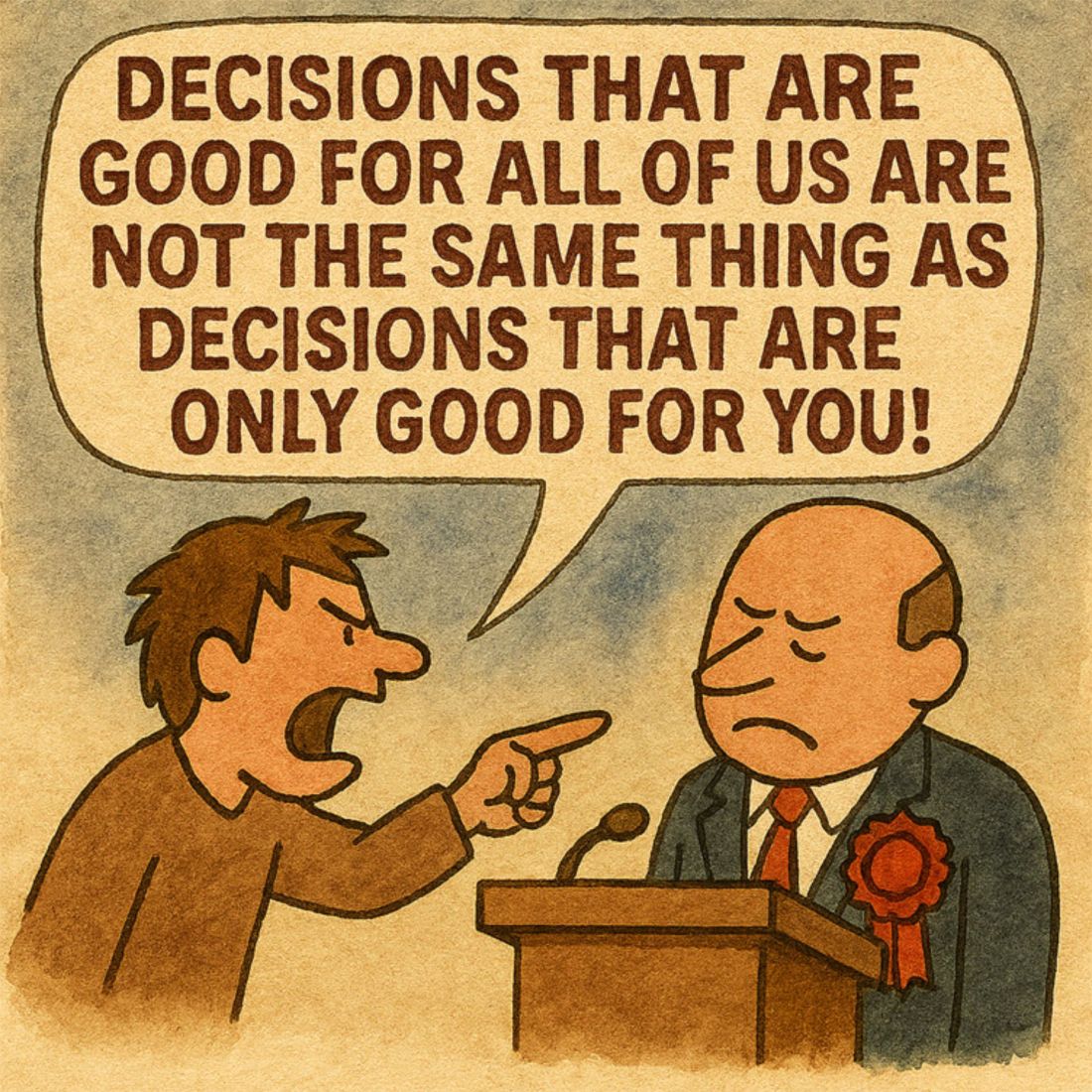
Once in office, governments increasingly behave as though electoral victory grants them licence to do whatever they choose for the duration of their term – regardless of whether those decisions were ever mentioned, justified, or even hinted at beforehand.

Policies appear that were never discussed. Priorities shift without explanation. Decisions are justified with slogans rather than substance. And when questioned, the response is often a variation of the same message: trust us.

But trust is not a renewable resource. It is earned through alignment between words and actions. And today, the gap between the two is widening.

People hear the language of service, fairness, and responsibility. But they see actions that contradict those words. They hear promises of transparency. But they see decisions made behind closed doors. They hear claims of moral purpose. But they see outcomes that feel detached from common sense and lived experience.

This is not cynicism. It is observation.

Centralisation Has Distilled Power to the Point of Theatre

The deeper problem is structural. The system is built to centralise – and it keeps centralising. Power moves upward. Responsibility moves downward. Accountability evaporates. The distance between the people who make decisions and the people who live with them grows wider every year.

In that environment, elections become symbolic rather than substantive. They create the appearance of choice while the mechanics of the system ensure that real power remains concentrated at the centre.

This is why governments of different colours behave in ways that feel eerily similar.
This is why decisions increasingly appear detached from the lives of the people they affect.
This is why the political class no longer feels the need to hide what it is doing.

The relationship between the electors and the elected has been reduced to performance. The public is the audience. The political class is the cast. And the script rarely changes.

Words Have Become a Substitute for Action

One of the most corrosive developments in modern politics is the rise of performative governance. Words have become a substitute for action. Announcements have become a substitute for delivery. Narrative has become a substitute for truth.

The culture rewards performance, not awareness.
It rewards loyalty to the centre, not responsibility to the community.
It rewards obedience, not integrity.

And because the system selects for these traits, it produces representatives who speak the language of public service while acting in ways that serve the system itself.

This is why the gap between political rhetoric and lived reality feels so vast.
This is why people feel unheard even when politicians claim to be listening.
This is why trust continues to erode.

The Moral Contract Has Been Broken

If politicians intend to govern in ways that depart significantly from what voters were led to expect, the moral requirement is simple: they should say so openly.

They should go to the electorate and declare:

“By voting for us, you give us licence to do whatever we believe is necessary for the duration of the government – even if it bears no resemblance to what we told you beforehand.”

Of course, no one would ever say this. Because it would expose the truth: that such a mandate would never be given.

And yet, through their actions, this is precisely the mandate many governments behave as though they possess.

People feel betrayed not because they disagree with every decision, but because they never consented to the direction being taken.

Real Democracy Requires Proximity

Real democracy only works when decisions are made by the people who live with the consequences. Distance destroys representation. Centralisation destroys accountability. Hierarchy destroys awareness.

When decisions are made far away – geographically, psychologically, or morally – they become detached from the realities they shape. And when that happens, the system stops being democratic in any meaningful sense.

The frustration people feel today is not ideological. It is not partisan. It is not even primarily about competence.

It is about distance.

A system that centralises power inevitably produces decisions that feel alien to the people they affect. A system that elevates money as the organising principle inevitably produces outcomes that prioritise the centre over the community. A system that rewards obedience inevitably produces representatives who forget who they are supposed to serve.

Recognising the Disconnect Is the First Step

The growing sense of disenfranchisement is not apathy. It is awareness. It is the recognition that the system no longer behaves as a representative democracy should. It is the understanding that elections have become a ritual rather than a mechanism of accountability. It is the quiet realisation that the mandate voters believe they are giving is not the mandate politicians believe they have received.

Until this disconnect is acknowledged for what it is, nothing will change.

Because the problem is not the decisions themselves.
It is the structure that produces them.
It is the culture that normalises them.
It is the distance that enables them.