
We hear the term growth coming from the mouths of politicians so often that the word now sounds like it’s all government is about.
And yes, it is true that growth today is all that the government is about.
“Great!” say businesses and business owners. “The government are out to help us grow!”
And that is exactly the kind of growth most of us outside Westminster think of – and believe we are hearing – when politicians use the term. But it is not what they actually mean when they talk about “growth”, at least not the politicians who are in the know.
GDP (Gross Domestic Product)
The growth that politicians keep talking about is not the kind of growth most of us imagine when we hear them use the word.
Politicians – and the advisers around them – know perfectly well what the public thinks they mean, and they also know that what they mean is something quite different.
For politicians, growth does not mean business growth in the way most of us understand it. While it still includes the kind of growth we think of, that aspect matters far less to them today than it once did.
For politicians, growth means the growth of Gross Domestic Product, or GDP.
GDP is the size of the economy – the total amount of financial activity that has taken place across every form of business or trading activity involving measurable financial transactions. These transactions are recorded across the entire country by the Office for National Statistics from all the businesses and organisations it monitors.
“Measurable” is the key word here. It is the act of measuring so much of life because it has a financial value that has had such a negative influence on how we now value almost everything in purely monetary terms.
The Devil is in the Detail
GDP is critically important to politicians today because it is the benchmark figure that allows them to hide the true breadth and depth of public spending and public debt.
Yet GDP is really a measure of private‑sector or “commercial” activity, rather than the financial activity of public‑sector organisations.
Public borrowing figures matter because we have been conditioned to believe they have a direct relationship with the “economy”.
This is why they are always presented to us as a proportion or percentage of GDP.
If GDP grows quickly or significantly, the true financial position of the UK becomes easier to conceal.
Furthermore, this form of “creative accounting” can make the amount of money the government is spending, borrowing or creating appear smaller or less significant.
This sleight of hand works effectively because the narratives we hear from politicians and the media always frame public spending and public debt in terms of how “big” the economy is and how much it has “grown”.
Politicians and the money ‘creators’ are making our world unrecognisable whilst we are all being robbed
GDP is a very clever tool – and it was certainly designed to be. But it is also a double‑edged sword.
A quick recap:
Politicians can hide or even obscure public debt and “reduce” the amount they appear to be spending by “growing the economy”.
This is why politicians are obsessed with “growth”.
“Growing the economy” in this sense means increasing the amount of financial activity, or the total money spent or transferred through measurable activities during any defined period of time.
How “growth” works:
Political “growth” is typically achieved through an increase in private‑sector financial transactions and an increase in the volume of money in circulation (essentially the total of all the money sitting in every open bank account at any given moment).
Money is created by private banks and financial institutions – not by government.
While each pound is counted when it is created for GDP purposes, the real “magic” or sleight of hand lies in the fact that the same pound is counted again every time it changes hands in a new financial transaction at each point in a supply chain.
Housebuilding is perhaps the best example of how GDP – and therefore “growth” – can be increased, because large volumes of newly created money and the long chain of financial transactions it triggers can quickly be added to the UK’s balance sheet.
A good example of ‘Growth’ – in the way politicians need it to be:
To build a house requires private banks to create the money needed to buy the land and then to fund the entire building process. This includes the supply chains involving all the different businesses that produce building materials, the machinery used, the fuel required, the specialist tradesmen, and the surveyors.
Once the houses are built, they must be sold, which gives another private bank the opportunity to create the money for the mortgage. The mortgage lender charges a fee, the removal company gains business, the landscaper installs a garden, and so on.
Beyond this specific chain come the ongoing requirements: council tax for each home, which local councils automatically charge; utility accounts; increased demand for bus services; and the list continues.
Every one of the businesses involved provides data to the Office for National Statistics about their performance and turnover. Each set of figures is added to the country’s “productivity”, no matter how many times the same money has changed hands – meaning its value in GDP terms may be multiplied many times over.
Things to bear in mind – The System
It is important to understand that GDP functions as the “credible” measurement of economic activity precisely because it hides the creation of money behind the walls of private banks and finance houses.
Most people still believe that banks simply hold money for individuals or businesses and then lend that money to others – including governments – in return for interest, which is then shared with the original depositors.
While this may have been true in some limited ways historically, today money is created by private banks and finance houses as easily as an employee entering digits into a spreadsheet.
Many of the rules that once regulated and constrained these activities have been watered down or removed entirely under the banner of “deregulation” and “free markets”.
For The System to keep functioning, the amount of money available must keep growing, and the number of recorded financial transactions must keep increasing.
This is why the use – and increasing reliance – on credit, digital banking, and financial‑transaction tracking has become so important.
Cash transactions cannot be monitored or recorded in the same way digital transactions can. This is one of the key reasons cash is being phased out: cash, or any non‑digital transaction, is one of the few remaining tools of genuine financial independence.
Private banks and finance houses also “buy” the bonds that the government “sells” when it needs to “borrow” money to fund public policies and public‑sector delivery.
It is important to recognise that if the total amount of money in circulation were to remain fixed within this FIAT‑based economic and financial system, the value of transactions taking place would naturally fall.
The System was designed – and continues to operate – on the basis that money created within it automatically flows into the pockets of the rich. From there, it is invested in assets such as property, infrastructure, and business ownership, where it is used to generate even more credit‑creation opportunities.
In the FIAT system, money flows back to its source: those who are already very rich – the bubble where it was created in the first place.
Where our reality becomes VERY uncomfortable – just to support politicians’ ‘Growth’
To counteract the perverse nature of an economic system deliberately created to enrich and benefit those who created, manage and understand it (the creators), it becomes necessary for money to be created for new reasons and in an ever‑increasing number of ways. This ensures that money keeps flowing, keeps “multiplying”, and continues to appear as “growth”.
Deregulation allowed the same interests that create money to use even more of that created money to buy up almost everything they would never have been able to acquire otherwise – all because we have been encouraged to believe that the money they use is actually real.
This created, effectively “fake”, money has been used to buy or gain control of everything we recognise as real, typically so it can then be rented back to us – increasingly using more borrowed, created money on which we must pay interest.
Meanwhile, the money used for public spending is considered “dead money” because it generally pays wages and incomes rather than generating long chains of financial transactions that boost GDP. This creates a major problem for government, because running public services requires constant spending that does not produce the kind of measurable, repeatable financial activity that The System depends on. As a result, the government can no longer borrow enough to cover existing bills, especially as the UK has been stripped of its assets and productive capacity by the very same interests that create the money.
In contrast, large infrastructure projects are still politically attractive because they do generate the long supply‑chain activity that inflates GDP. Every stage – planning, contracting, materials, labour, machinery, financing, and eventual operation – produces measurable transactions that can be counted again and again. This makes such projects appear “affordable” or even “profitable” within the GDP‑driven framework, even when the government cannot sustainably fund day‑to‑day public services. Infrastructure spending therefore becomes a preferred tool not because it serves the public best, but because it props up the illusion of growth that The System requires.
More food for thought
Unfortunately for us, the creation of money out of nothing does not correspond in any meaningful way with the real value of what people and businesses across the UK own and produce.
Our politicians have helped to entrench this situation because adopting this system appeared to make life much easier for them.
This means that the real value of whatever money we possess – or expect to receive as income – falls each time even a single pound is “created” by politicians or by the banks.
The value of the pound in our pockets or in our bank accounts declines in proportion to the total amount of money in circulation.
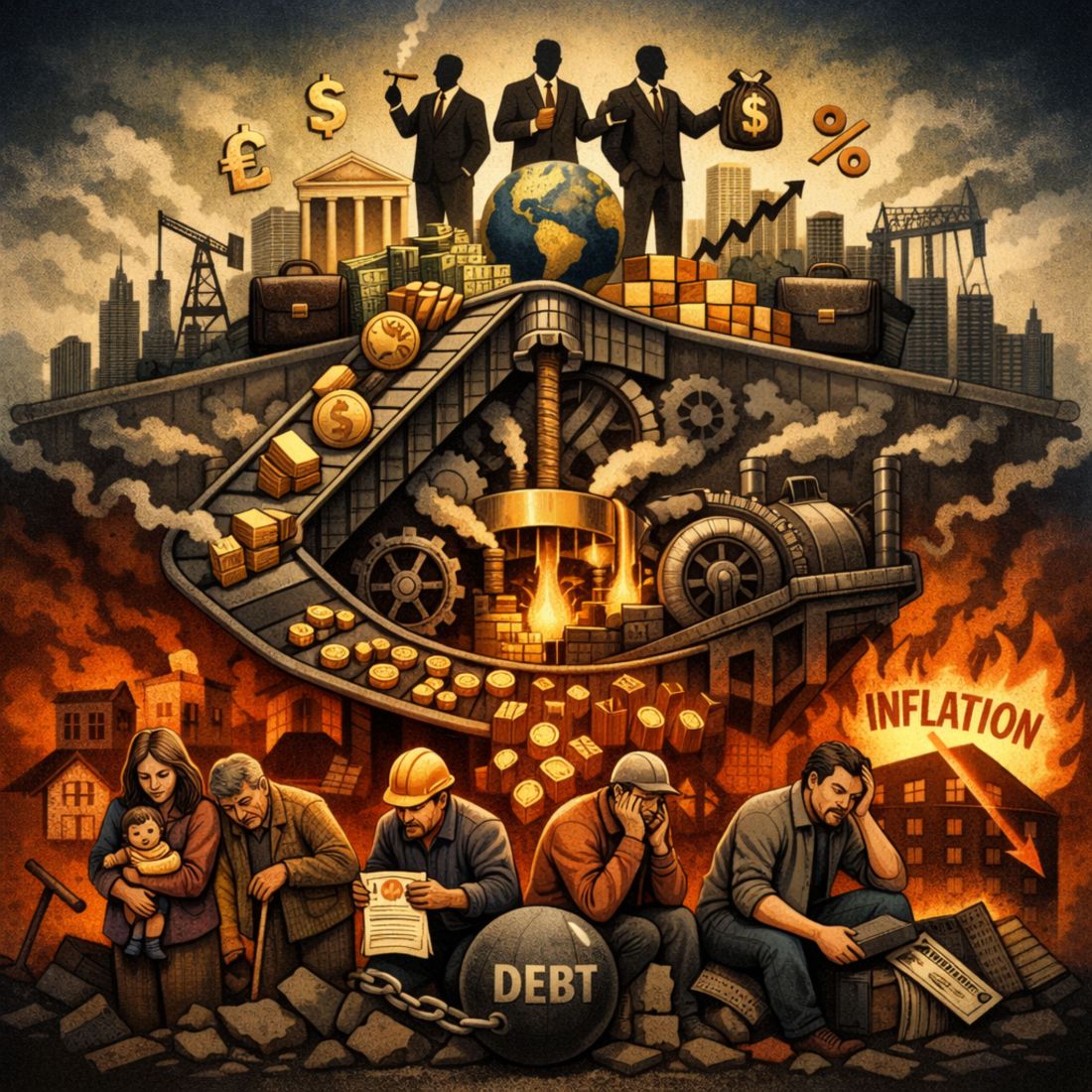
The way The System attempts to counteract or mask this fall in monetary value is through what we know as inflation.
Inflation is the rise in prices that becomes necessary for anyone who owns or produces anything, simply so they can keep up with how “growth” is actually pushing the value of everything down.
How Inflation hurts us
We – the people and consumers – sit at the very end of the supply chain. We do not sell on what we buy, so we have no way to recoup the losses that government policy and economic distortions create across the wider economy.
Everything is driven by money, greed and profit.
As a result, we experience falling living standards because wages and incomes cannot rise fast enough to match the deficit that GDP‑driven “growth” creates for us at the level of everyday life.
Are we the victims of the biggest crime mankind has inflicted upon itself?
If you begin unpicking the layers of this economic onion – layers that have been deliberately obscured by narratives designed to deter anyone from looking too closely – you uncover some very uncomfortable truths that have been hiding in plain sight.
The biggest of these is that The System can only function by steadily impoverishing the masses, making people increasingly dependent on credit simply to exist.
When MMT, neoliberal economics and the FIAT monetary system were implemented in the early 1970s, it was already inevitable that those on the lowest incomes would eventually be unable to live without assistance – preferably in the form of credit.
That credit would be more of the same created money, lent back to us at interest, while our creditworthiness – and therefore our compliance – is monitored.
The government’s current push for welfare reform is not a sign that people want to live off the state. It is a sign that cracks are appearing in this bogus economy, and the fissures have widened so far that new “corporation‑friendly” policies can no longer hide them.
Although few of us trust politicians, most of us have not agreed on why.
What we should recognise is that – deliberate or not – everything politicians have done for the money creators over at least five decades has slowly destroyed the fabric of our society.
The uncomfortable truth is that we have all been robbed
The System has been created and maintained to benefit the few, while the many have been deliberately misled into believing that everything is fair, normal and simply “the way things are supposed to be”.
In reality, we have been robbed of our financial independence, our security, our opportunities, our communities, our public services and our ability to live without fear.
We have been robbed of the value of our labour, the value of our money, the value of our homes and the value of our time.
We have been robbed of the ability to live meaningful lives without being forced into debt, dependency or compliance.
We have been robbed of the truth.
We have been robbed of our peace.
And the worst part is that most people still don’t realise it.
Where we go from here
The harmful hidden meaning of “growth” becomes impossible to ignore once you understand how The System works. What politicians celebrate as “growth” is not the expansion of real prosperity, but the expansion of financial activity that extracts value from ordinary people and concentrates it elsewhere.
It is a cycle that demands ever‑greater debt, ever‑greater dependency and ever‑greater pressure on the real economy that people actually live in.
Growth is important to today’s political class because their political future depends on it. Without the appearance of growth, the economic narrative they rely on begins to collapse – and with it, the credibility of the system they defend.
Recognising this is the first step toward reclaiming what has quietly been taken from us.
The System only survives because we have been conditioned not to question it, not to challenge it and not to imagine that anything different is possible. But once the illusion is exposed, its power begins to fade.
Real change will not come from the same political class that helped build and protect this machinery of extraction. It will come from people who understand that a society cannot thrive when its citizens are reduced to consumers, debtors or data points in a spreadsheet.
We do not have to accept a future defined by insecurity, dependency or manufactured scarcity.
We can choose to rebuild an economy that values people over profit, communities over corporations and reality over the convenient fictions that have been sold to us for decades.
The truth may be uncomfortable, but it is also liberating. Once we understand how “growth” has been used as a tool of extraction, we can begin the work of creating something better – something fair, sustainable and genuinely human.
The theft only continues for as long as we fail to see it.
Awareness is the beginning of the end.
This Blog was first published on 6 December 2024. Updated on 28 April 2026 with minor revisions for clarity and relevance.


