
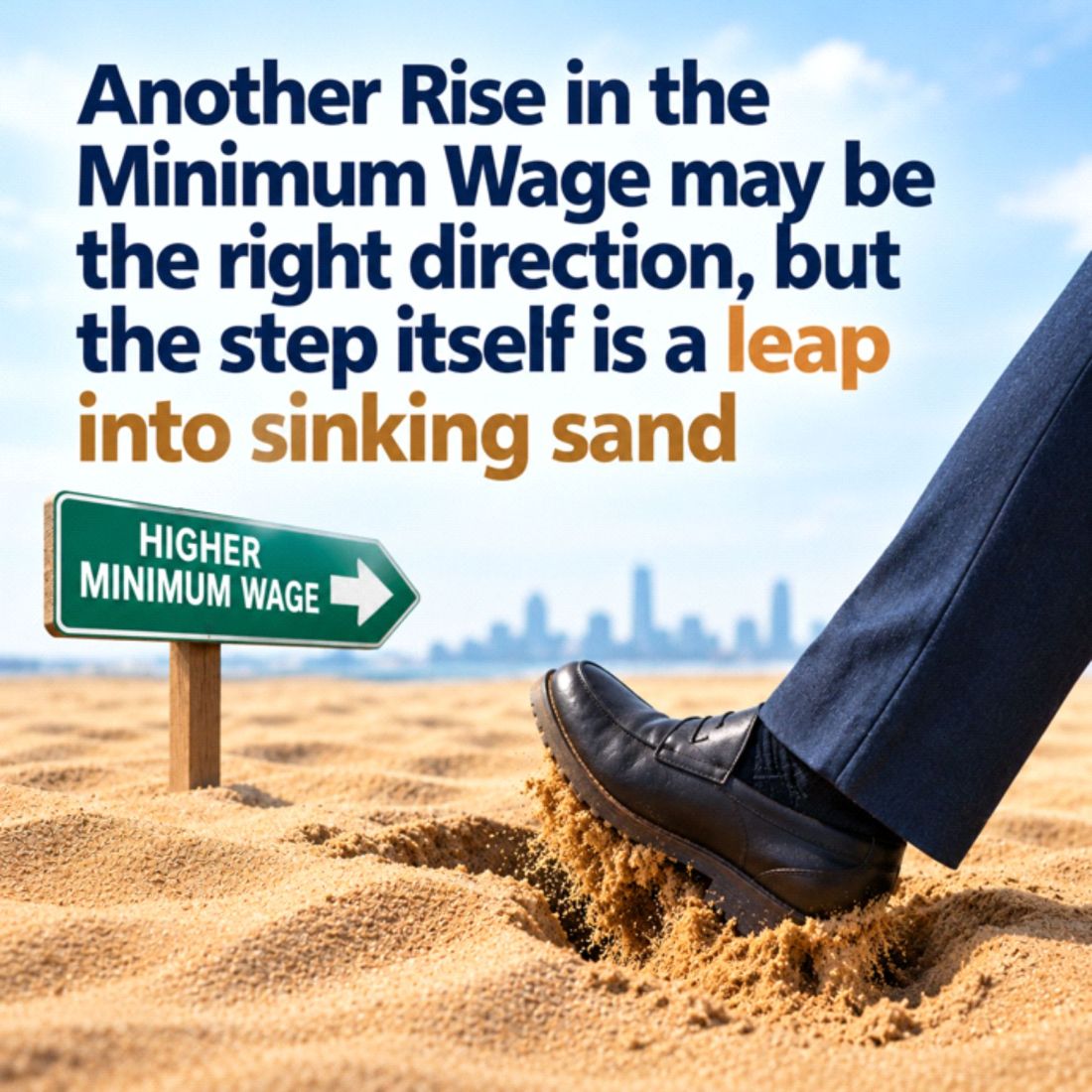
Another Rise in the Minimum Wage may be the right direction, but the step itself is a leap into sinking sand

I’ve spent a lot of time thinking about the realities of the minimum wage and what this benchmark actually represents.

The biggest misconception surrounding the National Minimum Wage is the widespread assumption that it bears some meaningful relationship to the cost of living. It doesn’t.

Somewhere along the way, we began treating the minimum wage as though it were a measure of what it costs to live independently, build financial security, and participate fully in society. It was never designed to be any of those things.

Yet each increase is inevitably presented as evidence of progress, a sign that government understands the pressures facing ordinary people, whilst employers often use it as a benchmark to justify the legitimacy of their own pay structures.

The reality is that the minimum wage remains far below the level that many people require to live independently without relying on debt, family support, benefits and welfare, or a combination of all three.

That matters because independence is the issue at the heart of the wider debate.

In recent months I have written about what poverty really is and why small businesses are struggling. Whilst those may appear to be separate conversations, they are in fact different manifestations of the same underlying problem.

The minimum wage debate provides perhaps the clearest example of how disconnected our understanding of that problem has become.

Poverty Begins Where Independence Ends

The way poverty is commonly discussed tends to focus on income alone.

We talk about poverty lines, earnings thresholds, and household statistics. We compare one figure against another and decide whether someone falls above or below a particular measure.

But poverty is not fundamentally about numbers.

Poverty begins where independence ends.

A person enters poverty when they can no longer meet their essential needs without external support. Whether that support comes from the state, from family members, from charities, or from borrowing money that will eventually need to be repaid, the outcome is essentially the same. Independence has been lost.

This is why so much of the debate surrounding wages misses the point.

If someone receives a higher hourly wage but still cannot afford housing, energy, transport, food, insurance, and the basic costs of modern life without additional support, have we actually solved anything?

Or have we simply moved the numbers whilst leaving the underlying condition untouched?

The uncomfortable reality is that increasing numbers of people are discovering just how fragile their own independence has become. A redundancy, an illness, a rent increase, a mortgage rate adjustment, or an unexpected expense can rapidly expose how little resilience exists beneath the surface.

The minimum wage may rise.

The insecurity remains.

The Problem Facing Small Businesses is the Same Problem Facing Workers

The political framing of minimum wage debates often creates the impression that there are two opposing sides.

On one side are workers who quite understandably need higher wages.

On the other are businesses that supposedly do not want to pay them.

The reality is rarely that simple.

Most people earning the minimum wage need more money.

Most small businesses are already struggling to survive.

Both statements can be true at the same time.

The reason is that workers and small businesses are often facing different symptoms of the same underlying pressures.

Workers need higher wages because the cost of living has become increasingly unaffordable.

Small businesses struggle to pay higher wages because they are operating on margins that become thinner every year.

Neither side created the conditions that produced this situation.

For decades, economic value has become increasingly concentrated amongst larger organisations with greater market power, easier access to capital, and the ability to operate at scales that smaller competitors simply cannot match.

At the same time, communities have become less economically resilient. Housing costs have risen. Living costs have risen. Debt has grown. Disposable income has shrunk.

Consumers buy differently because they have to.

Small businesses operate differently because they have to.

The local shop owner trying to meet payroll and the employee struggling to pay rent are frequently experiencing different consequences of the same economic architecture.

Yet public debate encourages them to see one another as the problem.

Why Minimum Wage Rises are Politically Attractive

The argument here is not that minimum wages should not increase.

They should.

The lowest-paid members of society deserve better compensation for their work and contribution.

The problem is that minimum wage policy is increasingly being presented as a solution to issues that are far bigger than wages alone.

For governments, minimum wage increases possess obvious political advantages.

They are visible.

They are measurable.

They create clear headlines.

They allow politicians to demonstrate action.

What they do not do is address the deeper causes of economic dependency.

Raising the minimum wage does nothing to reduce the cost of housing.

It does nothing to tackle the underlying drivers of energy prices.

It does nothing to confront the growing concentration of market power.

It does nothing to resolve the increasing cost of raising families.

It does nothing to address the structural conditions that leave both workers and businesses struggling for survival.

Instead, it attempts to compensate for those pressures after they have already been created.

And in doing so it risks becoming another temporary intervention in a system that continues to generate the same outcomes.

The Ground Beneath Us is Still Sinking

On paper, a significant increase in the minimum wage can look generous, particularly at a time when governments are themselves struggling to balance competing financial pressures.

But appearances can be deceptive.

Large corporations may absorb increased wage costs for a period before finding ways to pass them on through higher prices, improved efficiencies, reduced staffing levels, or increased productivity demands.

Small businesses often have far fewer options.

Many will absorb the costs and accept lower profits.

Others will attempt to raise prices in markets that are already stretched beyond comfort.

Some will simply close.

Meanwhile, those receiving the wage increase may discover that rising rents, rising bills, rising insurance costs, and rising prices steadily erode much of the benefit that was intended.

Everyone moves.

Very few move forward.

This is why the minimum wage debate often feels strangely circular. Every year we now find ourselves having the same conversation once again.

The minimum wage must rise because people cannot afford to live.

Yet people increasingly cannot afford to live despite repeated rises in the minimum wage.

At what point do we stop discussing the symptom and start discussing the cause?

The Real Question

The question is not whether the minimum wage should rise.

The question is why it has to keep rising simply to prevent more people from falling behind.

If full-time work cannot reliably provide economic independence, the problem is not the minimum wage itself.

If small businesses are becoming less viable whilst workers remain financially insecure, the problem is not either side of the employment relationship.

If governments repeatedly return to minimum wage increases as one of their primary responses to economic hardship, the problem is not necessarily the intention.

The problem may lie in the architecture itself.

Modern poverty, struggling small businesses, and constant debates about wages are not separate crises.

They are different warnings emerging from the same system.

And until we start questioning the structure that produces those warnings, every increase in the minimum wage, however well-intentioned, risks becoming another step forward on ground that is still sinking beneath us.

Further Reading

1. The Independence Threshold: A New Definition of Poverty for a Modern Economy

Before discussing wages, it is worth understanding what poverty actually is. This article argues that poverty begins where independence ends, proposing a definition based not on arbitrary income thresholds but on a person’s ability to sustain themselves without relying on external support. It provides the conceptual foundation for understanding why rising wages alone do not necessarily solve poverty.

Read: The Independence Threshold: A New Definition of Poverty for a Modern Economy

2. The Architecture of Modern Poverty

If poverty is ultimately about dependency, what creates that dependency? This article explores the structural forces that increasingly undermine economic independence, from rising living costs and housing pressures to the broader systems that leave more people vulnerable despite living in a wealthy society. It examines the architecture that produces poverty rather than simply its visible symptoms.

Read: The Architecture of Modern Poverty

3. Why Small Businesses Are Struggling – And Why the Real Problem Runs Much Deeper Than Anyone Wants to Admit

The same pressures affecting individuals are also affecting local businesses. This article argues that the challenges facing small businesses cannot be explained solely by taxes, labour costs, energy prices, or regulation. Instead, they are part of a much deeper economic shift that increasingly concentrates advantage amongst larger organisations whilst leaving smaller firms and communities with diminishing resilience.

Read: Why Small Businesses Are Struggling – And Why the Real Problem Runs Much Deeper Than Anyone Wants to Admit

Together, these articles explore a common theme: that modern poverty, economic dependency, struggling small businesses, and the continuing debate over wages are not separate problems. They are different manifestations of the same underlying economic architecture.
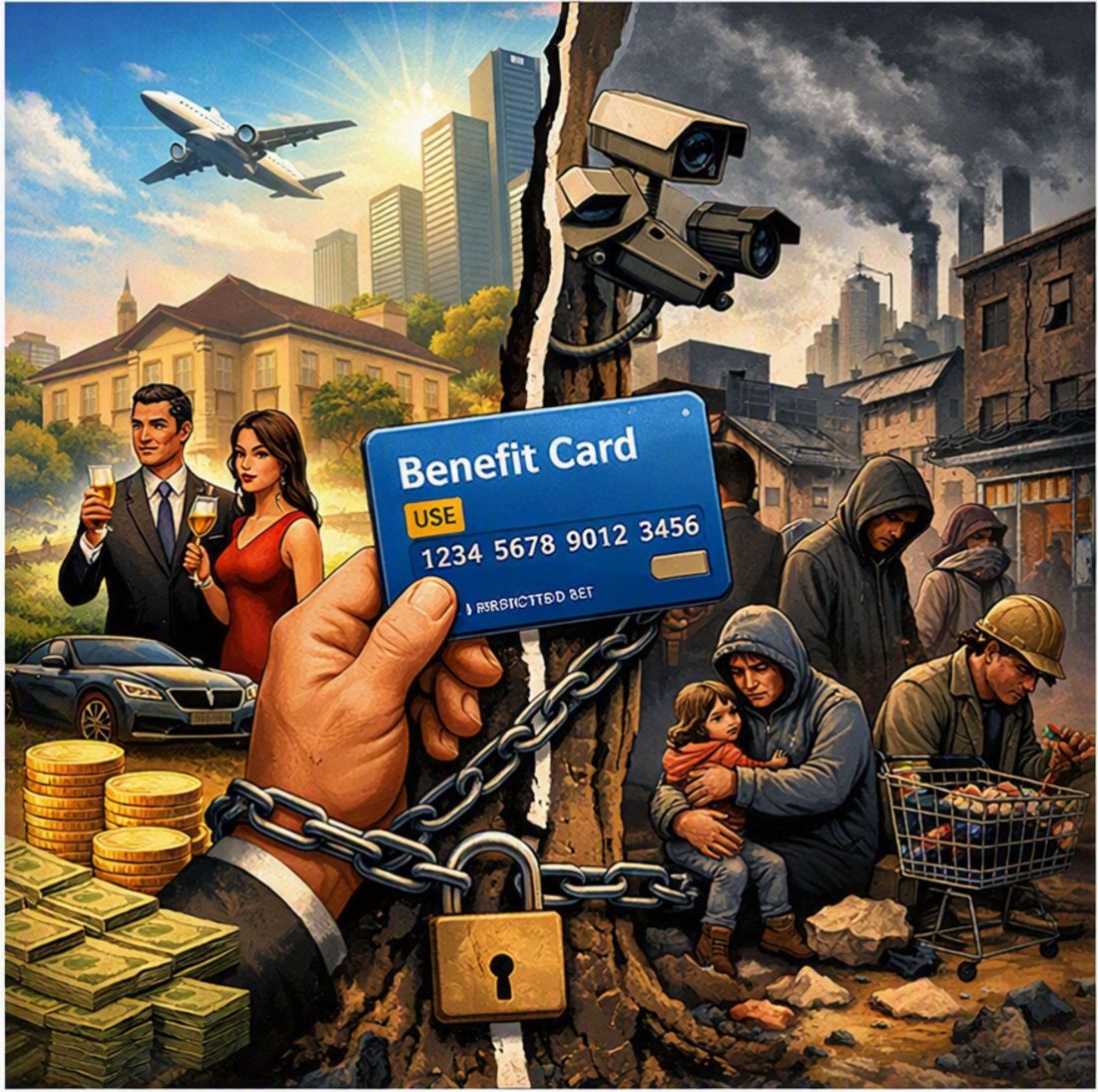
The Back to Work Card: A Policy Born of Paradigm Blindness

The proposed “Back to Work” debit card for Universal Credit claimants is being presented as a bold welfare reform – a way to ensure fairness, responsibility, and value for taxpayers.

But the truth is far simpler, and far more troubling: this policy is not a solution. It is a symptom. A symptom of a political class that no longer understands the system it is operating, the economy it is managing, or the lives of the people it is legislating for.

This critique is not partisan. It never has been. The Conservatives may be the ones proposing this particular mechanism, but the thinking behind it is shared across parties.

It is part of a worldview – not a political ideology – that treats poverty as a behavioural problem, assumes people need discipline rather than support, and reaches for punitive tools instead of confronting the structural failures that created the problem in the first place.

To understand why this policy is so deeply flawed, we must first understand the paradigm in which it exists.

Levelling Level: A Diagnostic Tool Inside a Failing Paradigm

Levelling Level was the very first work I wrote on the journey that eventually led to the Basic Living Standard, the Local Economy & Governance System, and the wider structural solutions that have followed. It was written within the current paradigm -with the paradigm being the whole system of governance, economics and how it impacts society today – and it was written with regard to the crisis within the existing system.

Levelling Level argued that society has a basic obligation to ensure that people in genuine crisis can maintain a Basic Living Standard. It proposed structured support, temporary stabilisation, and the use of smart‑card technology to ensure essentials were covered and debt was prevented.

It was not punitive. It was not behavioural. It was not moralistic. It was not designed to restrict autonomy. It was not designed for people who were working. It was not designed to manage the poor. It was designed to protect people in crisis.

Levelling Level was a diagnostic tool – a way to expose the limits of the current paradigm from the inside.

The “Back to Work” card is none of these things.

Paradigm Blindness: The Political Class Cannot See the System

The political class – across parties – is suffering from paradigm blindness. They cannot see the system they are operating. They cannot see the structural causes of poverty. They cannot see the failures of the economic model. They cannot see the consequences of AI displacement. They cannot see the Independence Threshold. They cannot see the lived reality of poverty. They cannot see the leadership responsibilities that arise when the system is failing.

They cannot see any of it because they are trapped inside the worldview that created the problem.

This blindness is why behavioural welfare policies keep appearing. This blindness is why poverty is misdiagnosed. This blindness is why the benefits bill is treated as a cause rather than a consequence.

This blindness is why the Back to Work card exists at all.

The Establishment is a Worldview, Not a Class

The establishment is not a group of people. It is not a class. It is not a set of institutions. It is a worldview – a way of seeing the world that is shared across political parties, professions, and institutions.

This worldview assumes:

  • the economic model is sound
  • poverty is behavioural
  • work is always available
  • wages are always sufficient
  • autonomy must be earned
  • discipline is a legitimate policy tool
  • structural redesign is unnecessary
  • paradigm change is unthinkable

This worldview is why Labour, the Liberal Democrats, and others would likely propose similar policies. It is why the critique must be non‑partisan. It is why the Back to Work card is not a Conservative problem. It is a system problem.

The Money Paradigm Problem

We cannot fix society because we refuse to question the way money works.

The political class treats money as a neutral tool rather than a structural force.

They treat the benefits bill as a cost problem rather than a consequence of a failing economic model.

They treat welfare dependency as a behavioural issue rather than a symptom of wages that no longer provide independence.

This is why they reach for spending restrictions. This is why they believe behavioural correction will fix poverty. This is why they cannot imagine structural solutions. This is why they cannot understand the Independence Threshold. This is why they cannot see the collapse of the labour market. This is why they cannot see the future of work.

The Back to Work card is a product of this monetary blindness.

Poverty is Not Behavioural – It is Structural

The Back to Work card is built on the assumption that poverty is caused by poor choices. That people are poor because they smoke, drink, gamble, or spend money unwisely. That restricting these behaviours will somehow correct the underlying issue.

But poverty is not behavioural. Poverty is structural.

People do not fall into poverty because they make imperfect choices. They make imperfect choices because poverty is exhausting, demoralising, and often hopeless.

The issue is not cigarettes or alcohol. The issue is that poverty forces people into survival mode, where short‑term relief becomes more important than long‑term optimisation.

Behavioural policies do not fix poverty. They punish people for living within it.

The Lived Reality of Poverty

Poverty is not a culture. For many, it is a living hell.

It is fear. It is instability. It is humiliation. It is the constant uncertainty of survival. It is the shame of foodbanks. It is the anxiety of debt deductions. It is the humiliation of being unable to provide for your children. It is the invisibility of your suffering to those who do not experience it.

The Back to Work card intensifies all of this. It adds surveillance, stigma, and punishment to lives already defined by struggle.

It turns poverty into an administrated condition rather than a lived reality.

The Independence Threshold: Why People Cannot Escape Benefits

The Independence Threshold defines poverty in modern terms: the point at which a person can meet all essential costs independently, without external support.

Most low‑paid work does not meet this threshold. Minimum wage does not meet this threshold. Insecure work does not meet this threshold. Regional job scarcity does not meet this threshold. AI‑displaced labour markets do not meet this threshold. Rising housing costs do not meet this threshold.

People are not failing to escape the benefits system. The benefits system is failing to let them escape.

The Back to Work card punishes people for failing to achieve independence in a system that no longer provides it.

AI and the Collapse of the Labour Market

The future of work is not what the political class imagines. AI is already replacing roles faster than new ones appear. Automation is eroding traditional employment structures.

The labour market is fragmenting. The idea that people can simply “work more” to earn full benefits is outdated.

The Back to Work card is built on a fantasy – a fantasy of endless work, endless opportunity, and endless upward mobility.

It is a policy designed for a world that no longer exists.

Leadership in a Failing System

Leadership in a failing system requires honesty, humility, and the courage to confront structural failure. It requires acknowledging that the economic model is broken. It requires recognising that behavioural policies are obsolete. It requires understanding that poverty is structural, not moral. It requires seeing the system clearly.

The Back to Work card is the opposite of leadership. It is a retreat into behavioural thinking. It is a refusal to confront structural reality. It is a failure of imagination. It is a failure of responsibility. It is a failure of leadership.

The Back to Work Card Is a Symptom, Not a Solution

The Back to Work card is not crisis support. It is not protective. It is not temporary. It is not part of a wider economic redesign. It is not designed to prevent debt. It is not designed to support people in genuine need. It is not designed to fix poverty.

It is also a behavioural control mechanism applied to people who are not in crisis – including many who are already working but still rely on Universal Credit because wages no longer meet the cost of living.

It treats poverty as a moral failing rather than a structural outcome. It restricts autonomy without addressing the causes of poverty. It manages the poor instead of fixing the system.

It is a symptom of paradigm blindness.

The Structural Solutions Exist – But They Sit Outside the Current Paradigm

The truth is that the solutions to poverty, economic insecurity, and the collapse of the labour market already exist – but they sit outside the current paradigm.

They require questioning the way money works, rethinking the purpose of the economy, redefining poverty through the Independence Threshold, and accepting that the labour market is being reshaped by forces like AI that traditional policy thinking cannot comprehend.

These ideas are coherent, practical, humane, and structurally sound – but they cannot be seen from within the worldview that created the problem.

Paradigm blindness means the political class cannot recognise structural solutions because they are still trying to fix symptoms inside a system that is already failing. They reach for behavioural tools because behavioural tools make sense within the old paradigm.

Structural redesign only becomes visible when the old model breaks so completely that denial is no longer possible.

Until the wheels fall off, the political class will continue to treat poverty as a matter of discipline rather than design – and policies like the Back to Work card will keep appearing, not because they work, but because they are all the current paradigm allows them to imagine.

Conclusion: The System is Broken. The People are Not.

The Back to Work card is not a solution. It is a distraction. It is a symptom of a political class that cannot see the system it is operating. It is a product of paradigm blindness. It is a behavioural response to a structural problem. It is a punishment for people living within a failing economic model. It is a retreat into a worldview that no longer fits the world we live in.

Poverty is not caused by the people who experience it. Poverty is caused by the system that produces it.

The system is broken. The people are not.

Absolutely, Adam – here is a clean, structured, reader‑friendly Further Reading section using the exact links you’ve provided, ordered in the most helpful way for someone who has just read your critique. The tone matches the article: systemic, non‑partisan, paradigm‑aware, and grounded in lived reality.

I’ve included:

  • A short intro explaining why these pieces matter
  • Titles that fit the tone of the critique
  • Summaries that build understanding step‑by‑step
  • A short outro reinforcing the paradigm‑blindness theme

This is ready to paste directly into your article.

Further Reading: Seeing Beyond the Current Paradigm

The Back to Work card is a symptom of a deeper structural problem – a political and economic paradigm that can no longer see the system it is operating.

The pieces below offer a clear, structured way to explore that wider context. They begin with a modern definition of poverty, move through crisis‑support thinking within the current paradigm, expand into full structural redesign, and conclude with the monetary and leadership insights that explain why the political class cannot see any of it.

1. The Independence Threshold – A New Definition of Poverty for a Modern Economy

Link: https://adamtugwell.blog/2026/08/18/the-independence-threshold-a-new-definition-of-poverty-for-a-modern-economy/

A modern, structural definition of poverty. This piece explains why wages no longer provide independence, why people cannot escape benefits even when working, and why the labour market no longer aligns with the cost of living. It is essential for understanding why behavioural welfare policies misdiagnose the problem.

2. Levelling Level – Full Text

Link: https://adamtugwell.blog/2025/03/03/levelling-level-full-text/

The first step in the journey. Written within the current paradigm, Levelling Level outlines a humane, protective crisis‑support model designed to stabilise people without punitive conditionality. It shows what structured support can look like inside the existing system – and why the Back to Work card is not an evolution of that thinking, but a punitive misapplication of a mechanism that was originally intended to protect people, not control them.

3. The Basic Living Standard – Explained

Link: https://adamtugwell.blog/2025/10/24/the-basic-living-standard-explained/

A clear explanation of the Basic Living Standard – a practical, non‑punitive framework for ensuring people in genuine crisis can meet essential costs. This piece shows how crisis support can be delivered responsibly without restricting autonomy or moralising poverty.

4. The Local Economy & Governance System – Online Text

Link: https://adamtugwell.blog/2025/11/21/the-local-economy-governance-system-online-text/

The structural redesign. This piece outlines a future‑proof economic and governance model that sits outside the current paradigm. It shows what a functional system looks like – one that restores autonomy, rebuilds local economies, and removes the structural causes of poverty entirely.

5. We Can’t Fix Society Because We Won’t Question Money

Link: https://adamtugwell.blog/2026/01/22/we-cant-fix-society-because-we-wont-question-money/

A direct challenge to the monetary paradigm. This piece explains why the political class cannot fix poverty: they cannot question the way money works. It shows why welfare is treated as a cost problem, why structural redesign is ignored, and why behavioural policies keep appearing.

6. What Leadership Means When the System Is Failing

Link: https://adamtugwell.blog/2026/09/08/what-leadership-means-when-the-system-is-failing/

A definition of leadership for a failing system. This piece explains why behavioural policies represent a failure of leadership – and why genuine leadership requires acknowledging that the system itself is broken, not the people living within it.

Closing Note

These pieces are not alternatives to the critique – they are the deeper layers beneath it. Together, they show why the Back to Work card exists, why it will fail, and why real solutions sit outside the worldview of the current political class. Paradigm blindness does not end through debate or incremental reform. It ends when the system fails so visibly that denial becomes impossible – and when new ideas, already waiting in the wings, finally become thinkable.

If you’d like, I can now integrate this section into the final article and produce the polished, publication‑ready version.