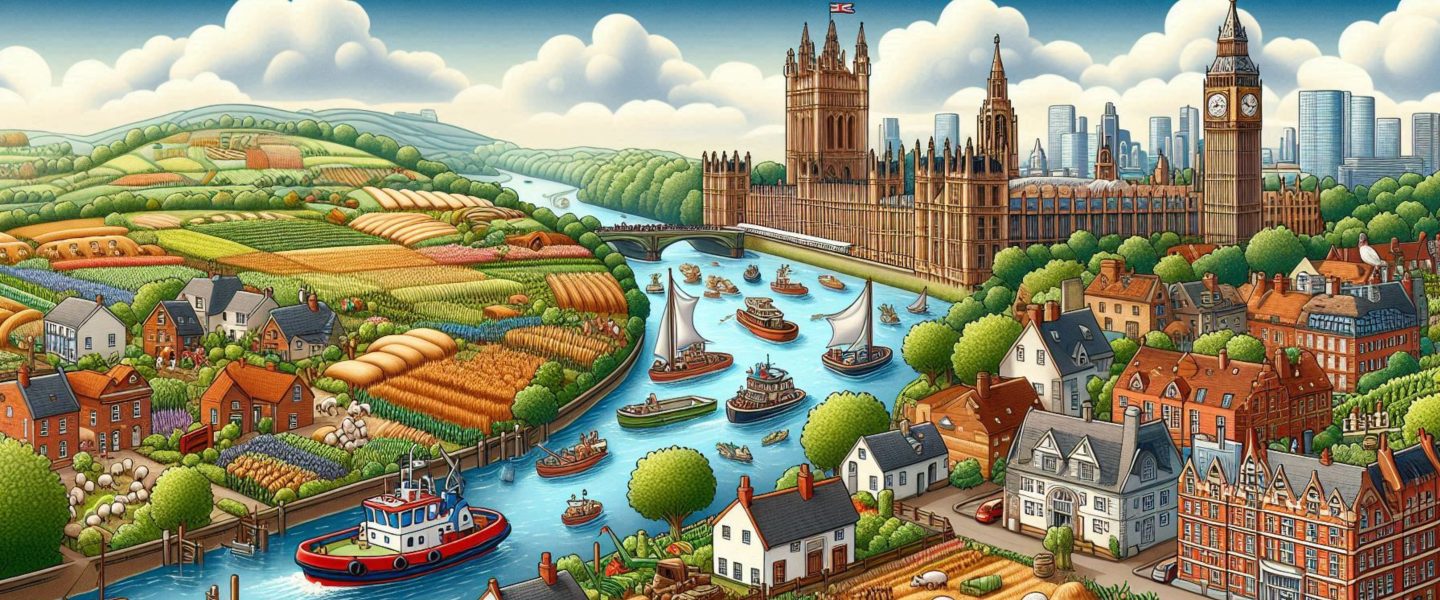

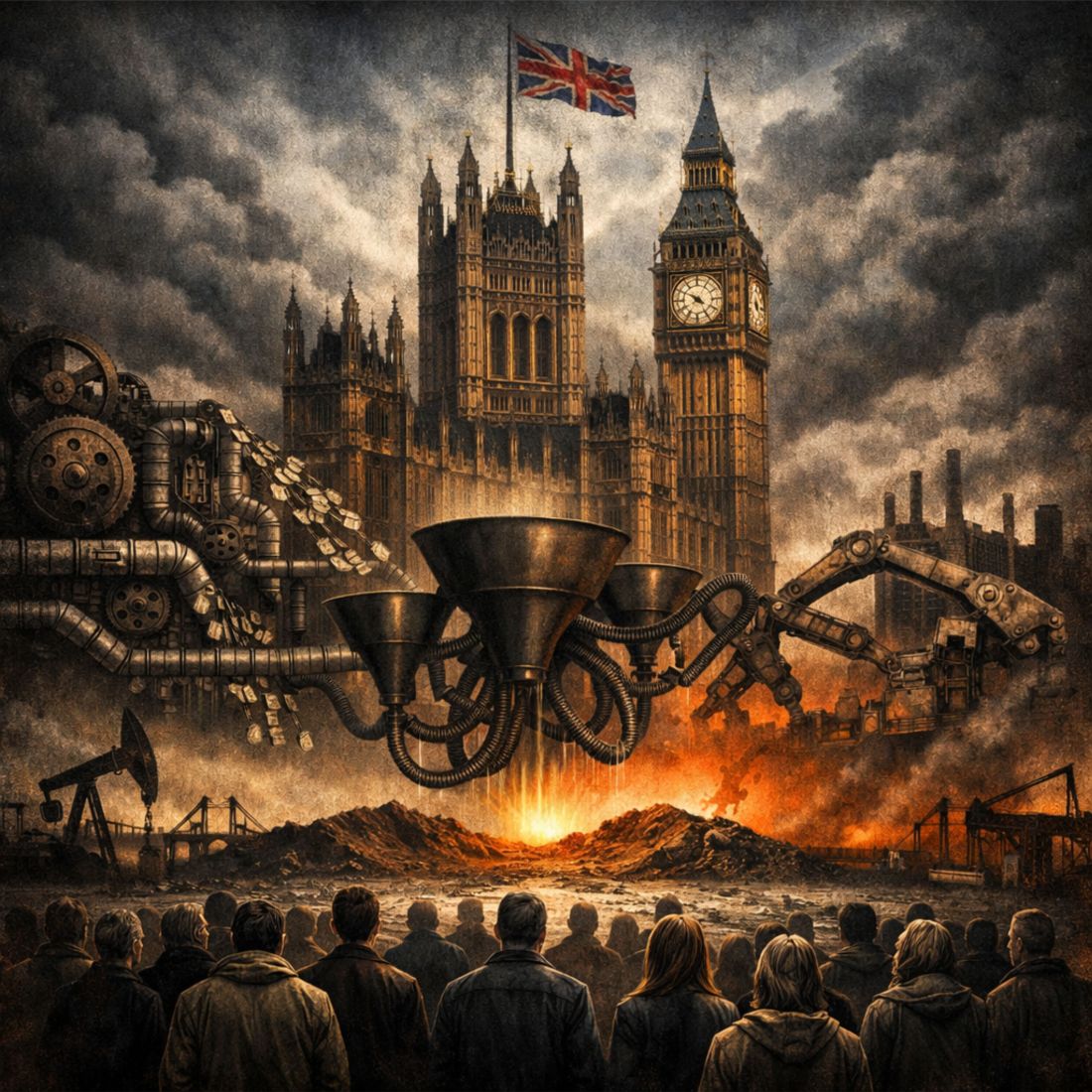
We grow up believing government exists to make life possible. To build, to protect, to maintain, to enable. To stand between us and the things that would otherwise overwhelm us.
But somewhere along the way, that relationship inverted.
Government stopped facilitating life. Life began facilitating government.
Not because government suddenly changed its intentions, but because the tools it once used to shape the country were quietly dismantled by a financial and monetary system that came to control everything.
For decades, that system rewarded extraction over production, leverage over labour, and financial performance over real capability. It told us stories about modernity – stories about efficiency, globalisation, competitiveness – and it sold myths that made decline feel like progress.
The service economy was one of those myths. A story that said Britain didn’t need to make things anymore, that production was old‑fashioned, that skills were optional, that capability could be imported, that resilience was unnecessary.
And while the country embraced that story, the wheels of productivity were quietly removed.
Factories closed. Skills faded. Infrastructure aged. Supply chains stretched across oceans. Local capability thinned to the point of transparency.
None of this felt dramatic. It felt like modern life. It felt like the world moving forward.
But the financial system wasn’t building the future. It was hollowing out the present.
And when government finally looked up, it realised the tools it once relied on – the tools that made governing possible – were gone.
By then, the productive foundations that once made governing possible had eroded. Government could no longer easily rebuild what had been dismantled, repair what had been neglected, produce what had been offshored, or control many of the systems on which it depended.
But government could not easily admit this. It could not stand before the public and say: “We no longer have enough of the tools required to shape the country.”
So it clung to the only lever it had left.
Taxation.
Taxation is not a sign of strength. It is a sign of limitation.
When a government still has capability, taxation is one tool among many. When a government has lost capability, taxation becomes the only tool left.
And that is where Britain now finds itself.
Increasingly, government appears to rely on taxation to compensate for a diminishing ability to build, repair, produce, grow, and prepare for what is coming.
Taxation becomes the way government sustains itself when it can no longer sustain the country.
If economic growth remains weak while obligations continue to rise, governments eventually face a narrowing set of options: higher taxation, deeper borrowing, monetary intervention, or external assistance.
At the far end of that path lies the possibility of IMF involvement.
IMF involvement would not rebuild capability. It would not restore resilience. It would not protect the public.
It would impose austerity of a kind that might keep politicians in their posts and government departments running, but for real people already struggling, the worst would still be to come.
Because IMF austerity protects the institution, not the population.
And all of this – the hollowing out, the loss of capability, the reliance on taxation, the looming austerity – is happening before external shocks hit.
Before supply chains fracture further. Before infrastructure failures accelerate. Before geopolitical instability intensifies. Before the next global downturn. Before the next energy crisis. Before the next financial contraction. Before the next systemic break. Before something as simple – and as devastating – as the real consequences of the closure of the Strait of Hormuz.
Many within government can see the pressures gathering ahead. Yet the institutions themselves may lack the capacity, political consensus, or time required to respond effectively. They know they cannot rebuild fast enough. They know they cannot deliver everything that has been promised. They know they cannot easily escape the system they inherited.
So it turns to the public – not to protect them, but to sustain itself.
And this is where the moral reckoning begins.
A government that can no longer facilitate life has no moral right to ask the population to bear ever-greater burdens simply so that the institution itself can endure.
The legitimacy of government has never rested on its ability to survive. It has rested on its ability to serve.
Once that distinction is lost, citizens inevitably begin asking a simple question:
Who exists to serve whom?
Which brings us back – inevitably, unavoidably – to the question we began with:
Do we exist only to serve government, or does government exist only to serve us?
Because if government is no longer here to serve us, then what is this all now for?


