
The story of Britain’s food system does not begin with a fuel duty cut or a supermarket photo‑op. It begins a long way from here, in a narrow stretch of water that most people will never see.
When the latest conflict involving Iran erupted and the Strait of Hormuz was suddenly back on the news, it was framed, as these things usually are, in the language of foreign policy and defence. Tankers, missiles, alliances, red lines.
But for anyone who grows food, moves it, or depends on it being on the shelves – which is to say, everyone – the real question was much more basic: what happens if the ships slow down, or stop?
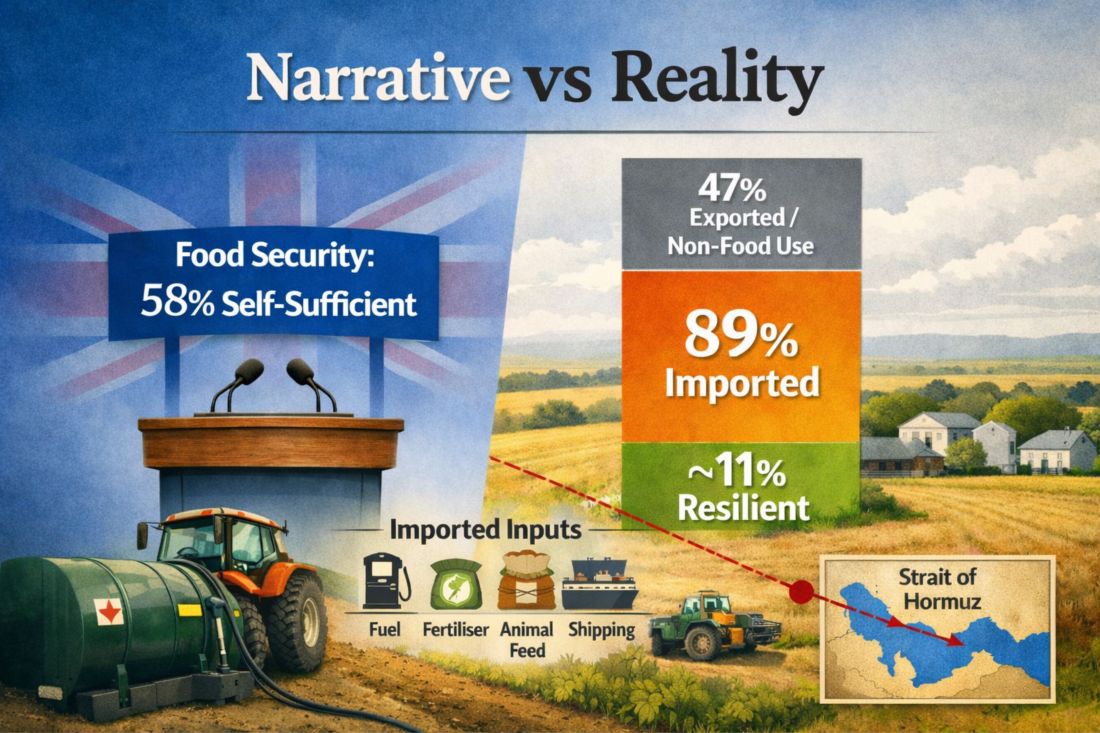
Britain imports a large share of what it eats. The government’s preferred line is that the UK is “roughly 58% self‑sufficient”, which is another way of saying 42% of the food we consume is imported.
Some analysts, using calorie‑equivalent or commodity‑equivalent measures, put the import share closer to 48%. Neither number is wrong. They simply measure different things.
But both numbers share the same flaw: they describe trade, not resilience.
They count food as “British” even when the fertiliser is imported, the diesel is imported, the feed is imported, the chemicals are imported, the packaging is imported, the machinery parts are imported, the ingredients are imported.
They count food that is British in geography but global in dependency.
Strip all that away – strip it back to the food that Britain could grow, harvest, process and consume entirely within its own borders, without relying on imports that could be disrupted tomorrow – and the picture changes dramatically. The real figure is closer to eleven per cent.
Eleven. Not fifty.
Not fifty‑eight.
Not even forty‑two.
Eleven per cent of the food that British people eat can be produced and consumed independently, without the global scaffolding that props up the modern food economy.
This is not a fringe estimate. It is not a doomsday scenario. It is simply the number you get when you stop counting food that only exists because the rest of the world keeps supplying the things that make it possible.
Once you see that number, the rest of the story snaps into focus. It becomes clear why a conflict in the Strait of Hormuz matters to a supermarket in Swindon. It becomes clear why a spike in diesel prices can ripple through the entire food chain in days. It becomes clear why the government’s daily rhythm of announcements – the confident tone, the insistence that everything is under control – feels increasingly detached from the world people can see with their own eyes.
By the time senior politicians began tweeting about the risks to global shipping and the prospect of higher prices at home, farmers had already seen the first wave hit. Red diesel – the fuel that keeps tractors, combines and much of the heavy kit in the countryside running – had been trading at around 75p a litre before the Iran crisis escalated. As the conflict bit, that price surged to around 120p, before easing back to something nearer 105p. Even at that “settled” level, it was still roughly fifty per cent higher than before the crisis.
Those numbers are not abstract. They are the difference between a harvest that just about pays and one that doesn’t. They are the difference between a contractor being able to honour a quote and having to add a fuel surcharge at the last minute. They are the difference between a farmer filling the tank and deciding to leave a job until next week and hoping the price comes down.
Against that backdrop, the government’s response arrived on 20 May in the form of a package designed to show that it was “stepping in”. Fuel duty on road diesel and petrol would remain 5p lower than planned. Hauliers would get a year‑long road tax holiday. And, crucially for agriculture, the duty on red diesel would be cut by “more than a third”, taking it to its lowest rate in over twenty years.
On paper, that sounds dramatic. A third is a big number. It is meant to be. But the duty being cut was not the full price of fuel; it was the tax element on a fuel that already enjoys a reduced rate. The change took the duty from 10.18p per litre down to 6.48p – a reduction of 3.7p.
Three point seven pence.
For a typical family farm, that translates into a saving somewhere in the region of £200 to £500 between now and the end of the year. A large arable operation, running multiple tractors and a combine across a thousand acres or more, might see a benefit in the order of £1,000 to £1,600. Those are not imaginary numbers; they are real money. But they sit in the shadow of something much larger.
When the underlying price of red diesel has jumped by 30, 40, even 50 pence a litre in a matter of weeks, a 3.7p duty cut is not a lever. It is a rounding error. The extra cost of filling a single large tractor tank once or twice can wipe out the entire annual benefit. The difference between last year’s fuel bill and this year’s dwarfs the saving before the first field is finished.
And that is before you even get to the question that has quietly begun to matter more than price: Will the fuel actually arrive?
In farmyards and machinery sheds, the conversation has shifted. People still talk about what they are paying, but increasingly they talk about whether the next tanker will turn up on time, or at all.
Britain has spent decades allowing its refining capacity to shrink and its storage to run down. The country now relies heavily on imported diesel to keep its economy – and its food system – moving.
When global routes are threatened and suppliers are nervous, that dependence stops being a technical detail and starts to feel like a vulnerability.
It is in that context that another, less publicised part of the story sits: the government’s quiet contortions over sanctions and Russian fuel.
Having taken a strong line on Moscow, ministers then found themselves having to “ease” or reinterpret parts of the regime to ensure that enough diesel could still be sourced to keep the wheels turning. On paper, it looks contradictory. In the real world, where tractors do not run on principles, it is grimly logical.
The red diesel duty cut did not fix any of this. It could not. It was never designed to. What it did do was generate a headline that sounded large and reassuring at a moment when the underlying reality was neither.
If fuel was the first act, tariffs were the second.
With the cost of living still biting and food prices a constant source of political anxiety, the government began to talk about reducing or suspending tariffs on certain imported foods as a way of easing pressure on household budgets.
Again, the language was confident. Cutting tariffs sounds like cutting prices. It suggests that there is a simple, mechanical relationship between the two: lower the tax at the border and the price on the shelf will follow.
The reality is more complicated. Most of the food Britain imports already comes in tariff‑free, either because of existing trade agreements or because the applied tariffs are zero.
Even if every remaining tariff were scrapped overnight, the overall effect on prices would be marginal. In a system where currency movements, energy costs, logistics bottlenecks and retailer strategies all exert far greater influence, the tariff lever is small and slow.
There is also the question of who captures any benefit.
A reduction in tariffs does not automatically flow through to consumers. It can be absorbed at any point in the chain: by importers, by processors, by retailers.
In a concentrated market where a handful of supermarket groups dominate, the power to decide where that margin goes does not sit with the shopper.
For domestic producers, however, the signal is clearer. Cheaper imports, or even the threat of them, become a benchmark against which their prices are judged. Buyers point to alternative sources and push down on farmgate prices. Contracts become tighter. Volumes become less certain. The risk is pushed back onto the farm.
So a policy that is sold as a way of helping consumers can, in practice, deepen the pressure on the people who actually grow the food.
It can also increase the country’s reliance on long, fragile supply chains at the very moment when global events are demonstrating how brittle those chains can be.
Supermarket “price talks” have also been reported this week. They were designed to be seen. Ministers summoned the chief executives of the major retailers to a meeting. Cameras captured the arrivals. Briefings suggested that the government was “leaning on” the supermarkets to keep prices down. The message was that someone was “standing up for shoppers”.
What happens inside those meetings is less clear, but the structural reality of the market does not change. Supermarkets are not charities. They are publicly listed companies with shareholders and debt and tight margins of their own. When they are pressed to hold down prices, they do not simply absorb the cost. They look for ways to pass it on.
The easiest place to do that is further up the chain. Processors are asked to trim their prices. Suppliers are told to sharpen their pencils. Payment terms are stretched. Promotions are funded by someone other than the retailer. Eventually, the pressure lands on the farm, where the ability to push it any further has for many farmers already disappeared.
From the outside, it can look as though the government is taking on powerful corporations on behalf of ordinary people. From the inside, it feels more like the state is using its political weight to reinforce a set of commercial dynamics that already favour the biggest players.
Running alongside all of this is a quieter, more technical narrative: the story of inflation.
For months, ministers and officials have pointed to falling inflation as evidence that things are “getting better”.
The rate at which prices are rising has indeed slowed. The headline number is lower than it was at the peak. On paper, that looks like progress.
But inflation is a rate of change, not a level.
When it falls from, say, ten per cent to three per cent, that does not mean prices have gone back to where they were. It means they are still rising, just more slowly. The new, higher plateau remains. Wages and benefits, which lag behind, have to catch up to it.
For many households, that catch‑up never quite happens.
In the supermarket aisle, the distinction between “prices rising more slowly” and “prices falling” is not academic. It is the difference between feeling a little less squeezed and feeling any relief at all. When the official narrative leans heavily on the former and implies the latter, trust erodes.
For farmers, the inflation story has its own twist. Input costs – fuel, fertiliser, machinery, finance – tend to ratchet upwards and then stick. When global prices fall, they do not always fall all the way back.
Farmgate prices, by contrast, are volatile and subject to the bargaining power of buyers. The result is a squeeze that can persist long after the headline inflation rate has eased.
Taken individually, each of these interventions can be defended.
A duty cut is better than no duty cut. Tariff reductions may help at the margins. Talking to supermarkets is preferable to ignoring them. Managing inflation expectations is part of economic policy.
The problem is not that any one of these things is uniquely bad. The problem is that, taken together, they reveal the limits of what government can now do within the system it has inherited and helped to build.
Britain’s food system has, over decades, been shaped into something that is highly efficient on paper and highly fragile in practice. It relies on long, complex supply chains that stretch across continents. It depends on imported energy and inputs. It is dominated at the retail end by a small number of powerful firms. It is financed and evaluated through a lens that prioritises short‑term returns over long‑term resilience.
When such a system is hit by shocks – a pandemic, a war, a shipping disruption, a spike in energy prices – the room for manoeuvre is limited. The levers that remain are mostly optical. They can change the story more easily than they can change the underlying reality.
That is why the announcements keep coming. It is also why they sound increasingly similar, regardless of who is in office.
The names on the ministerial red boxes change. The structural constraints do not.
This is the contemporary politician’s dilemma. To level with the public about the scale of the problem would be to admit that the system itself – the way we organise food, energy, trade, finance – is no longer capable of delivering the outcomes people reasonably expect. It would mean saying that tinkering at the edges will not be enough, and that some of the assumptions of the past forty years will have to be revisited.
The alternative is to keep performing competence. To keep announcing. To keep finding small, symbolic measures that can be presented as decisive action. To hope that the next crisis holds off long enough for someone else to be standing at the despatch box when it arrives.
So far, almost every government has chosen the second path. The system punishes the first.
Meanwhile, the underlying pressures continue to build. Farmers face rising costs, volatile prices and growing uncertainty about the rules of the game.
Consumers juggle higher bills, shrinking buffers and a sense that the weekly shop has quietly become a luxury.
The country as a whole becomes more dependent on global systems that are themselves under strain.
The rollercoaster analogy is overused in politics, but in this case it fits. Britain is strapped into a set of tracks that were laid in a different era, under different assumptions, for a different world. The carriage keeps moving because that is what carriages do. The people in the front seats can wave and smile and point to the scenery, but they cannot easily change the route.
If we want a different destination, we need a different track.
That means asking harder questions than “what can we announce tomorrow?”. It means looking at how much food we produce here, how we value it, how we move it, who controls the routes and the margins and the risks. It means thinking about energy security not just as a question of household bills, but as a question of whether the machines that plant and harvest and transport can keep running when global markets seize up. It means accepting that resilience is not free, and that efficiency measured only in pence at the till can be a very expensive illusion.
None of that will fit into a neat press release. It will not produce a headline as simple as “duty cut by a third”. It will not satisfy the daily hunger for something new to say.
But it is the only conversation that matches the reality we are now living in.
Until we have it, the announcements will keep coming. The system will keep fraying. And more and more people – in fields, in factories, in shops, in kitchens – will feel the widening gap between the story they are being told and the world they can see with their own eyes.
That gap is where trust goes to die.

