

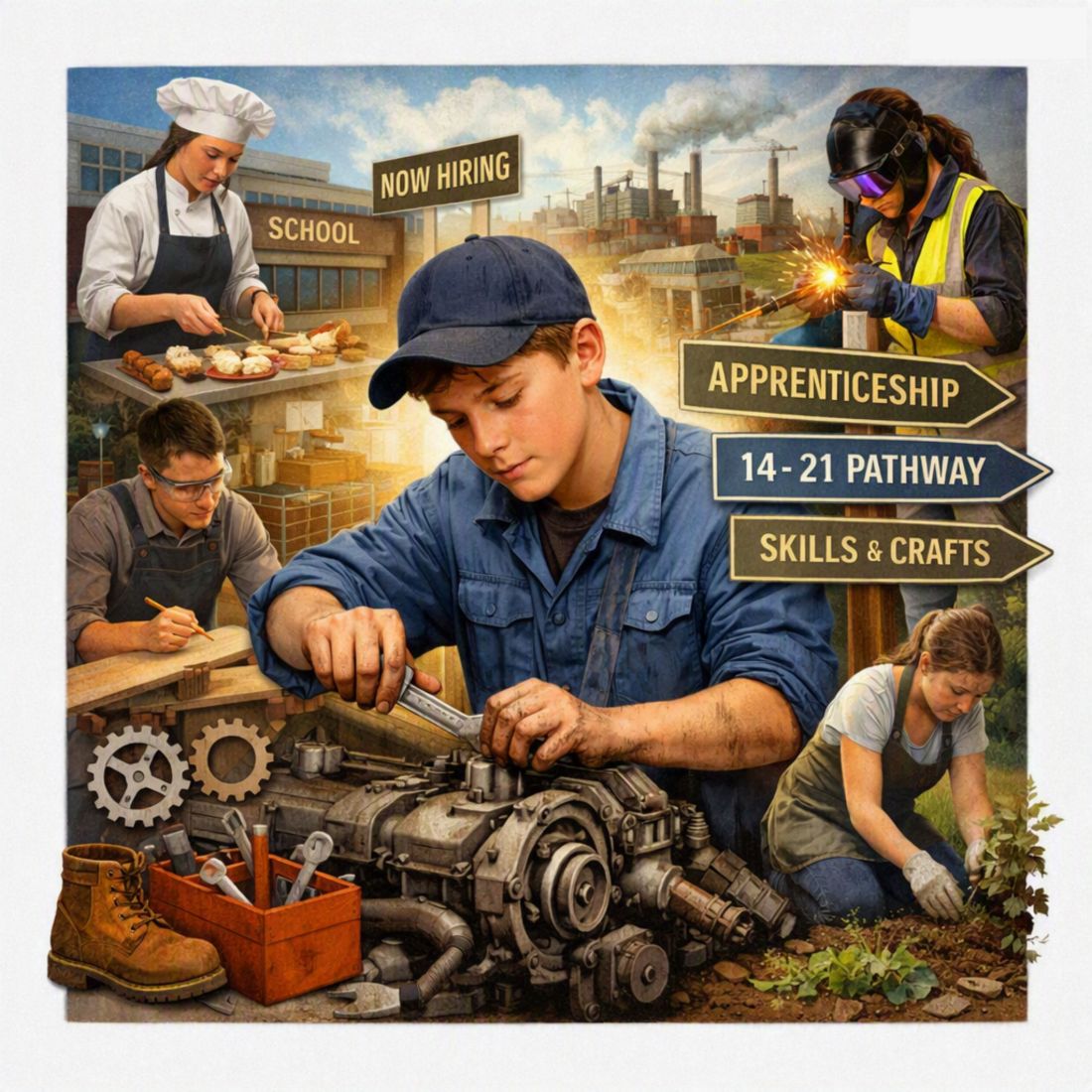
For the first time in years, vocational education is back in the national conversation. That alone is worth acknowledging.
For too long, the young people who learn through doing – those whose intelligence is practical, embodied, relational – have been quietly sidelined by a system that only knows how to value what it can measure. So when vocational GCSEs are announced, it is right to welcome the fact that the subject is finally being opened.
But when a system is structurally incapable of delivering what young people need, even well‑intentioned reforms risk becoming another layer of false hope. And false hope is not neutral. False hope is harm delayed.
This is not about one Prime Minister, one party, or one administration. It is about a political culture that has, for decades, been shaped by management logic rather than human logic.
Governments of every colour inherit the same constraints, the same economic assumptions, the same accountability structures, and the same narrow toolkit of measurable interventions. They are funnelled into the same kinds of initiatives not because they lack imagination, but because the system itself rewards what can be counted and sidelines what cannot.
Until that paradigm changes, every government-left, right, or centre-will find itself reaching for solutions that look meaningful but cannot reach the root of the problem.
The problem is not the absence of vocational options. It is the mindset that shapes them.
Vocational GCSEs still sit within the academic frame that has dominated British education since the Blair years. They are qualifications. They are measurable. They are inspectable. They are standardised. They can be audited, ranked, compared, and reported.
That is precisely why they are politically attractive.
You cannot monetise or monitor what you cannot measure. And real-world experience cannot be measured remotely by this kind of system.
So instead of giving young people lived experience, responsibility, identity and value, we give them another certificate. Another set of grades. Another way of being judged rather than included.
For some young people, this will help. But for many, it will simply store the problem for another day. It will keep them in classrooms when what they need is contact with the adult world. It will keep them in theory when what they need is practice. It will keep them in a system that has already told them-quietly, repeatedly-that their way of learning is a deviation from the norm rather than a strength in its own right.
Qualifications measure performance. Capability emerges through participation.
One is symbolic. The other is real.
Real vocational education begins with participation, not assessment.
If we truly want to value vocational intelligence, we must stop trying to squeeze it into academic shapes. We must stop pretending that practical capability can be captured by written exams or standardised rubrics. And we must stop designing vocational pathways that keep young people at arm’s length from the very world they are supposed to be preparing for.
Real vocational learning should begin at 14. Not in a classroom, but in the workplace. Not as an observer, but as a participant. Not as a child, but as an emerging contributor. Not unpaid, but paid-because contribution deserves recognition.
A proper apprenticeship at 14 will do something no GCSE can: It tells a young person you are needed. It tells them you matter. It tells them you have a place. It tells them your capability is real. It tells them your contribution is valued.
That is the foundation of dignity. And dignity is the foundation of engagement.
Vocational GCSEs cannot deliver that. They are still school. They are still symbolic. They are still abstract. They are still part of a system that values metrics over people, performance over participation, and qualifications over capability.
“But the opportunities no longer exist.” Yes – and that is the point.
One of the arguments often raised against early apprenticeships is that the kinds of businesses that once provided traditional apprenticeship opportunities – small workshops, local trades, craft‑based industries, and regional industrial specialist employers – simply no longer exist in the way they used to.
And that is true.
But they no longer exist because of the same money‑centric, extractive system that has hollowed out almost everything else: local economies, communities, real‑life opportunities, and any pathway that doesn’t fit the narrow, measurable, standardised model.
For decades, extraction has been the organising principle of our economy. It has pulled value out of communities rather than investing into them. It has prioritised scale, efficiency, and centralisation over locality, craft, and human capability. It has rewarded what can be measured and monetised, and quietly eroded everything that cannot.
The result is predictable:
- the disappearance of small employers who once took on young learners
- the collapse of trades that relied on time‑served skill
- the thinning out of regional industrial specialist employers who once offered structured vocational progression
- the loss of community‑based workplaces where capability was formed through participation
- the shrinking of real‑world environments where young people could begin contributing at 14
These opportunities didn’t vanish by accident. They were removed by a system that no longer values the kind of real‑life, experiential learning that apprenticeships depend on.
So when people say, “We can’t do apprenticeships at 14 because the opportunities no longer exist,” they are right about the symptom – but wrong about the cause.
The disappearance of those opportunities is not an argument against early apprenticeships. It is the proof of the very system failure that makes them necessary.
A 14–21 apprenticeship pathway would not simply place young people into whatever remains. It would rebuild the opportunities extraction destroyed. It would restore the conditions in which capability can grow. It would recreate the environments where contribution becomes identity.
And it would do so in a way that is good for everyone:
- Good for young people, who gain dignity, belonging, and real capability.
- Good for employers, including regional industrial specialists, who gain committed, time‑served contributors in a structured, ethical low‑pay developmental model.
- Good for society, which gains a workforce at 21 that no textbook or qualification can produce.
The absence of opportunity is not a barrier to this vision. It is the indictment of the current model – and the strongest possible case for change.
The deeper issue is the economic model that shapes every policy decision.
We cannot fix youth disengagement, social mobility, or vocational identity through isolated initiatives.
These problems are symptoms of a deeper structural reality: an economic model that prioritises metrics, money, and measurable outputs over human contribution, human capability, and human value.
As long as the system is built around extraction rather than contribution, young people will continue to disengage-not because they are apathetic, but because they are rational.
They see a world where effort does not guarantee stability, where qualifications do not guarantee opportunity, and where contribution is not rewarded unless it fits a narrow academic mould.
Until we change that mindset-until we build a paradigm where people come first and metrics come second-every reform will be constrained by the same logic that created the problem in the first place.
This is not a call for better initiatives. It is a call for a different way of thinking.
We need a system that values people for what they contribute, not for how they can be measured. A system that recognises capability in all its forms, not just the academic ones. A system that sees young people as emerging adults, not as data points. A system that understands that dignity comes from participation, not performance. A system that is built around locality, responsibility, and lived experience-not centralised metrics and distant oversight.
Vocational GCSEs may be a step toward acknowledging the problem. But they are not the solution.
The solution requires a paradigm shift-a reimagining of what education is for, what contribution means, and what kind of society we are trying to build.
Until we make that shift, every government will be forced to operate within the same narrow constraints. And young people will continue to pay the price for a system that was never designed with them in mind.
The conversation may have finally begun. But the real work – the structural work, the human work – still lies ahead.

