
Britain has reached the limits of its economic model. What looks, on the surface, like a dispute about welfare and defence spending is really something larger: a state trying to keep a fragile system operating without admitting that the system itself is failing.
There comes a point in every failing system when the people running it stop sounding confident and start sounding cornered. Britain is now in that moment.
The political class will not say this outright. It rarely does. But its actions give the game away: the sudden panic over defence spending, the renewed hostility towards benefit claimants, the insistence that “tough choices” must be made, and the growing desperation to find money anywhere except from those who have accumulated the most of it.
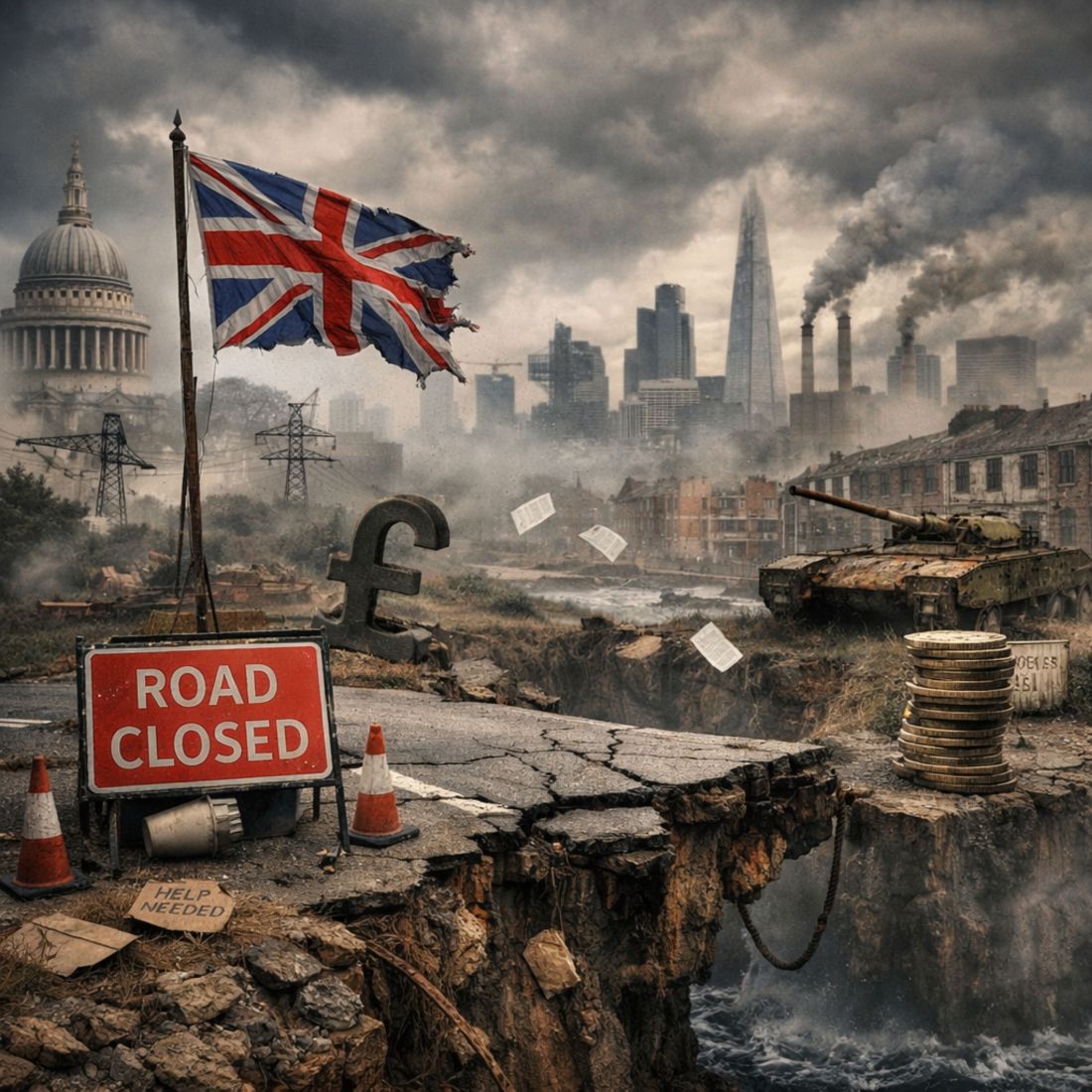
These are not the signs of a confident country making strategic decisions. They are the signs of a system that has run out of road.
The debate about cutting benefits is therefore not really a debate about welfare. It is a debate about whether government can keep the current economic model functioning without confronting the uncomfortable truth that it no longer works.
1. The illusion of choice: why wages alone cannot fix the crisis
Politicians love to talk about raising wages. They talk about “making work pay”, “rewarding effort” and “restoring dignity to labour”. There is truth in that language: wages are too low for millions of people. But there is also a deeper problem.
The current economic structure makes sustained, genuinely liveable wage growth extremely difficult without major consequences elsewhere.
This is not simply a matter of political will. It is structural.
Britain has allowed too many essential sectors to operate on the assumption that wages can remain low while the state, households and debt absorb the difference.
If wages rose rapidly across low-paid sectors without wider reform, the pressure would move through the economy quickly:
- small businesses would be forced to raise prices or close
- big businesses would automate, offshore, or cut staff
- supply chains would pass every cost increase to consumers
- inflation would spike
- the Bank of England would respond by suppressing demand
- and the government would end up increasing benefits anyway
The system is designed so that wages stay low, costs stay high, and the gap between them is filled by:
- benefits
- debt
- charity
- and the quiet desperation of millions of households
This is why the phrase “people should just earn more” is inadequate.
In sectors such as social care, retail, hospitality and logistics, the problem is not merely individual pay. It is a business model in which low wages, high housing costs and public support have become intertwined.
The system does not merely tolerate low pay. In too many places, it relies on it.
2. Benefits are not generosity – they are the subsidy keeping the economy upright
Public debate often treats benefit claimants as if they are separate from the economy: outside it, dependent on it, or somehow choosing not to participate in it.
That framing is misleading.
Universal Credit and related support are not just moral or social policies. They are economic infrastructure.
Official statistics show millions of people and households rely on Universal Credit, including many households with children and many people whose incomes are shaped by work, care, illness or housing costs.
In practice, benefits help support:
- landlords charging rents that wages cannot cover
- supermarkets pricing food at levels households cannot afford
- energy companies extracting profits from a captive market
- employers who rely on the state to top up wages
- local economies that would collapse without benefit‑driven spending
- the tax base that depends on people staying afloat
Remove or sharply reduce that support, and the effect does not stop with claimants. It moves through landlords, shops, employers, councils, schools, the NHS and local economies.
Benefits are the pressure valve that stops the system exploding. Cut that valve, and the pressure does not disappear – it erupts somewhere else.
3. Defence spending exposes the borrowing wall
For decades, Britain has dealt with structural weakness by borrowing, deferring and patching.
Borrowing has helped fund services, subsidise low wages, smooth over weak growth and avoid a more honest reckoning with the economic model underneath.
But every fiscal strategy has limits. Rising defence commitments have made those limits more visible.
The panic over defence spending is not about global threats alone. It is also about a government discovering that higher spending promises must be made inside a tighter fiscal box, with bond markets, debt costs and fiscal rules narrowing the room for manoeuvre.
This creates a brutal political reality:
- the government can only justify spending on things that multiply through the economy
- defence does not multiply
- defence is a fiscal dead end
Housing, infrastructure, skills and local investment can generate wider economic returns when they are well designed.
Defence can support jobs and industry, but much of its value is strategic rather than directly regenerative for household incomes or local demand.
That distinction matters. If a government funds defence by cutting the income floor beneath millions of households, it may strengthen one form of security while weakening another.
So when politicians say benefits must be cut to fund defence, what they are really saying is:
The system has run out of room, and the only place left to squeeze is the people already at breaking point.
This is not a strategy for national renewal. It is a symptom of fiscal desperation.
4. Cutting benefits to fund defence may create the instability defence is meant to prevent
Supporters of benefit cuts often argue that the welfare bill is too high, that work incentives matter, and that government must prioritise national security.
Those arguments deserve to be heard. No state can spend without limits, and defence is not optional in a dangerous world.
But the problem is what happens when cuts are made inside a society already carrying high rents, insecure work, stretched public services and fragile household finances.
In that context, benefit cuts do not simply reduce expenditure. They transfer pressure into other parts of the state.
The likely consequences include:
- rising homelessness
- rising crime
- rising illness
- collapsing local economies
- labour shortages in essential sectors
- overwhelmed councils
- overwhelmed NHS services
- social unrest
- a shrinking workforce
- a destabilised society
In time, government would be forced to spend money managing the domestic crisis it had helped create – through emergency housing, policing, healthcare, local authority support and crisis intervention.
This is the irony at the heart of the current debate:
Cutting benefits to fund defence risks forcing the state to spend defence money managing the fallout of cutting benefits.
It is the fiscal equivalent of setting your own house on fire to save on heating.
5. The real divide: those still keeping up and those already falling behind
One of the most dangerous illusions in Britain today is the belief that the crisis only affects “other people”.
Those who are just about keeping up – homeowners, stable earners, people with savings or secure jobs – can be tempted to look away from those who have already fallen behind.
Not necessarily because they are cruel, but because acknowledging the truth means acknowledging their own vulnerability.
So they cling to comforting narratives:
- “People just need to work harder.”
- “Benefits are too generous.”
- “The system is fine – it’s the people who are broken.”
But when the world feels unstable and war looms, defence suddenly becomes real. The government’s inability to fund its own priorities becomes visible. The fragility of the system can no longer be ignored.
The uncomfortable truth is that the defence crisis and the benefits crisis are connected.
Both expose the same weakness:
A system that extracts more than it creates eventually has nothing left to extract.
6. What happens if nothing changes
If politicians cut benefits without rebuilding the system beneath them, Britain risks deepening the problems it claims to be solving:
- a shrinking workforce
- a collapse in essential services
- a surge in debt defaults
- a rise in civil disorder
- a widening regional divide
- a breakdown in social cohesion
- a government forced to spend more on crisis management than it ever saved
This is not inevitable, but it is foreseeable. A country cannot endlessly squeeze household incomes, underfund essential services, demand higher defence spending and still expect social cohesion to hold.
The question is not whether Britain can make “tough choices”. It is whether it is willing to make honest ones.
7. The truth at the heart of the crisis
Britain cannot fix this crisis by treating symptoms as causes.
It will not be solved by:
- cutting benefits
- raising wages
- tweaking taxes
- increasing defence spending
- punishing claimants
- lecturing the poor
Each of these may be part of a political argument, but none of them reaches the core problem.
The core problem is a model that has depended for too long on low pay, high private costs, public subsidy, household debt and political denial.
Until that changes, everything else is noise.
Conclusion: Britain needs a system that works
Britain is not simply in a benefits crisis. It is in a system crisis.
Benefits are not the cause of that crisis. They are one of the mechanisms preventing it from becoming more visible in the streets, in hospitals, in councils, in schools, in courts and in every community already stretched close to breaking point.
If Britain wants a future that works, it needs more than spending cuts, slogans and scapegoats.
It needs an economic settlement in which work pays enough to live on, housing costs do not swallow household incomes, public services are treated as national infrastructure, and security means more than weapons alone.
The question is no longer whether the existing system can be preserved. It is what replaces it – and whether Britain is honest enough to begin that conversation before the road runs out completely.