

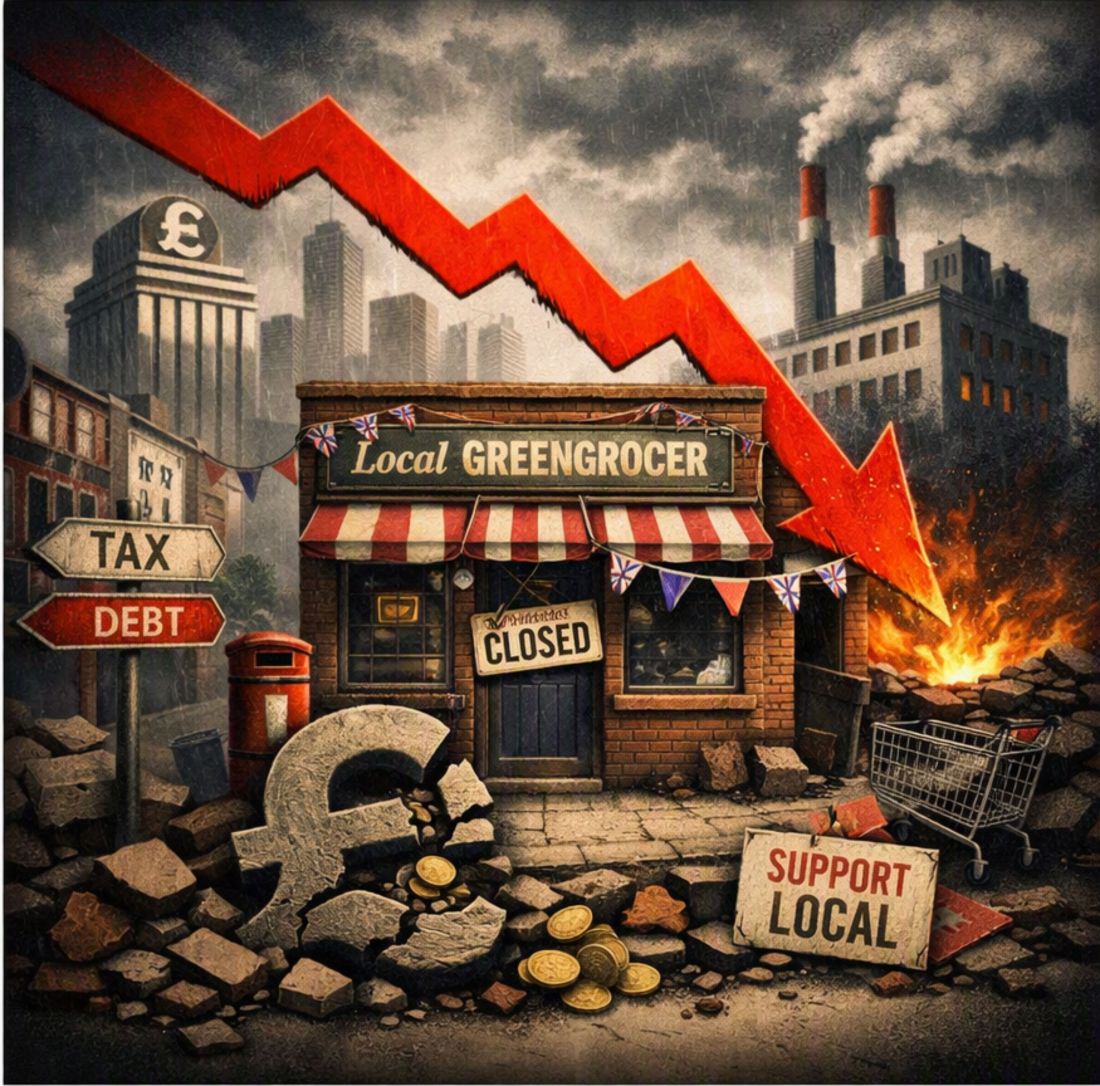
Ask people why small businesses are struggling today and you’ll hear a long list of familiar answers. Taxes. Business rates. Parking. VAT rules. Tourist exemptions. Energy costs. rent. The price of labour. The price of everything. And for the people dealing with those pressures, each one feels painfully real.
But none of them explain what’s really going on.
Because the truth is that the crisis facing small businesses today didn’t begin in July 2024. It didn’t begin with the current government. It didn’t begin with the last one either. What’s happening now is the result of decades of structural change – slow at first, then accelerating, then suddenly impossible to ignore.
And the hardest part to accept is this: the system we live in wasn’t built to support small businesses. It was built to extract from them.
That’s why every “fix” people argue about feels too small. That’s why every debate feels circular. That’s why every solution seems to miss the point. Because the point is buried much deeper than the symptoms we see on the surface.
The long hollowing‑out
For more than forty years, the UK economy has been reshaped around one central idea: that money should move freely, markets should dominate, and growth should come from scale. It sounds modern. Efficient. Sensible. But underneath, it created a system where value flows upward and responsibility flows downward.
Big corporations gained access to cheap credit, global supply chains, and financial backing that allowed them to expand at a pace no local business could ever match.
They could open stores at a loss, undercut prices, buy land, buy competitors, and buy market share. They could operate in ways that looked like “success” but were really just the product of financial engineering.
Small businesses, meanwhile, were increasingly left to survive on margins so thin they could barely absorb a bad month, let alone a bad year.
Communities changed too. As wages stagnated and housing costs soared, people had less time, less money, and less stability. They shopped for convenience, not connection. They chose the cheapest option because they had no choice. And slowly, the conditions that once made local businesses possible began to disappear.
This is why high streets are failing. Not because people suddenly stopped caring about them, but because the system changed what people could afford, how people lived, and where value flowed.
Corporate capture and the illusion of choice
The rise of supermarkets and chains is the clearest example. They used financialised expansion to wipe out local shops, then returned years later with “express” stores – selling back the convenience they had taken, but at a premium.
They didn’t win because they were better. They won because they were backed by a system that gave them every advantage.
Online platforms did the same. They centralised choice, centralised supply, centralised power – and left local businesses competing not with each other, but with global corporations that could dictate prices, terms, and margins.
This wasn’t a market. It was a takeover.
And it happened slowly enough that most people didn’t notice until the damage was already done.
The role of money – and why this part matters most
Underneath all of this sits the part people rarely talk about: the role of money itself.
For decades, the economy has been fuelled by created money – credit, liquidity, financial instruments, and investment flows that allowed large corporations to grow in ways no small business ever could.
This wasn’t organic growth. It was engineered growth. Growth built on debt, speculation, and financial leverage.
Small businesses don’t have access to that world. They operate in the real economy – the one where money has to be earned before it can be spent, where margins matter, where cashflow is survival, where a bad quarter can end everything.
The system didn’t just favour big business. It was designed around them.
Covid didn’t break the system – it exposed who the system really serves
On 20 March 2020, three days before the first lockdown, I wrote that the only humane response to what was coming was simple: pause the bills, freeze the interest, and make sure people had enough to eat and stay clean. Not loans. Not subsidies. Not grants. Just a temporary halt to the machinery so ordinary people and small businesses could survive the shock.
It wasn’t complicated. It wasn’t radical. It was practical.
But that kind of solution was never going to happen – not because it was impossible, but because it would have required government to prioritise people over markets. And that is the one thing the system cannot do.
The idea of pausing the system was treated as unrealistic, not because the logic was flawed, but because the narrative we all live inside teaches us something very specific:
The system cannot be stopped. The system rules. The system must be protected at all costs.
And the cost has been enormous.
Government could have paused the machinery. It could have frozen the costs. It could have protected households and small businesses long enough for everyone to survive the shock.
But it didn’t – because government doesn’t face the public. Government faces the markets.
When crisis hits, the priorities are not communities, not workers, not small businesses – but the financial architecture that sits above them. That is who government answers to. That is who government fears. That is who government protects.
Covid didn’t break the system. It revealed it.
It showed that the system has no built‑in mechanism for protecting ordinary people. It showed that the political class either doesn’t understand the structural reality or is too constrained by it to act differently.
It showed that the real economy – the one made of people, communities, and small businesses – is treated as collateral damage.
Covid wasn’t a stress test. It was a moment of truth.
And what was written on 20 March 2020 captured that truth clearly: government could have protected people, but the system it serves meant it wouldn’t.
Why people think the problem is political
Most people believe the crisis today began with the government elected in 2024 because politics is the part they can see.
They see the headlines, the rhetoric, the decisions being made right now. They see the tax changes, the budgets, the announcements. They see the chaos.
What they don’t see are the decades of structural change underneath:
- the financialisation of everything
- the consolidation of supply chains
- the rise of monopoly power
- the dependence on low wages
- the hollowing out of communities
- the shift from value creation to value extraction
So they blame the nearest political actor. They assume the crisis is recent. They assume it can be reversed with an election.
But the truth is that every government since the 1980s has been operating inside the same model. Some accelerated it. Some managed it. None reversed it. And now the model is reaching the point where it can no longer hide its consequences.
That’s why tax has become the obsession. It’s the only lever left. Everything else has been handed over to the market.
Why some small businesses don’t recognise this immediately
Not every small business owner sees themselves in this story. Some are still doing well. They have loyal customers. They have strong reputations. They operate in niches that haven’t been swallowed by centralised models. They serve communities that value them. They offer things that can’t easily be scaled, automated, or replicated.
Their success is real. But it is also fragile.
Even they can feel the shift:
- footfall is different
- customers are more cautious
- costs rise faster than prices
- competition feels less local and more corporate
- the old stability has gone
They may not be collapsing – but they know the “glory days” are over. They can sense that something deeper has changed, even if they don’t yet have the language for it.
The honest conclusion
Small businesses are not struggling because they’re doing anything wrong. Workers are not struggling because they’re lazy or entitled. Taxpayers are not angry because they’re cruel.
Everyone is struggling because the system we live in was designed to extract value from the bottom and middle to feed the top – and it has been doing so for decades.
Covid exposed it. 2024 accelerated it. But the roots go much deeper.
Until people understand that, they will keep looking in the wrong direction for answers – and blaming the wrong people for the consequences.
The truth isn’t comfortable. But it is necessary. Because once people see what’s really happening, they can finally stop blaming themselves – and start recognising the system that has been shaping their lives for far too long.
Further Reading
If you want to explore the deeper forces behind the struggle facing small businesses today, the following pieces offer a clear path through the last six years of economic and political change.
Each one captures a different part of the story – from the moment the system was exposed in 2020, to the pressures that intensified in the years that followed, to the structural realities now shaping life in 2026.
Together, they show how we arrived here, and why the problems we face today run far deeper than anything that began in July 2024.
1. “We need bills & interest put on hold…” (20 March 2020)
Summary: Written three days before the first lockdown began, this piece argues that the only humane response to the coming crisis was to pause the financial machinery – bills, interest, and basic costs – so people could survive.
It explains why loans and subsidies were never going to protect the real economy, and why government decisions during Covid revealed who the system truly serves. This is the moment where the deeper structural truth becomes visible.
2. “Small business cannot afford escalating wage growth…” (20 September 2021)
Summary: This piece explores the widening gap between wage expectations and the financial reality facing small businesses. It shows how government‑fuelled wage inflation collided with a system already funnelling money upward, leaving small businesses unable to raise pay without collapsing.
It highlights the early signs of the financial crisis that would later become unavoidable.
3. “Why high streets are really failing” (19 August 2026)
Link: https://adamtugwell.blog/2026/08/19/why-high-streets-are-really-failing/
Summary: A clear explanation of why high streets are collapsing – not because people stopped caring, but because the conditions that once made local retail possible have been dismantled.
This piece connects wage stagnation, housing costs, corporate expansion, and community hollowing to the disappearance of local choice. It shows how the high street’s decline is a symptom of a much deeper structural shift.
4. “When tax is the only tool they have left” (22 September 2026)
Link: https://adamtugwell.blog/2026/09/22/when-tax-is-the-only-tool-they-have-left/
Summary: This piece explains why modern governments increasingly rely on tax changes as their primary response to economic problems.
It argues that tax has become the only lever left because most other tools – wages, prices, supply chains, investment, land, energy – have been absorbed into a market model government no longer controls.
It shows why political decisions today feel disconnected from real‑world needs.
Why these pieces matter
Read together, these articles trace the journey from the moment the system was exposed in 2020, through the pressures that intensified in the years that followed, to the structural realities now shaping life in 2026.
They show that the crisis facing small businesses is not recent, not political in the narrow sense, and not caused by the issues people argue about most loudly.
They reveal the deeper truth: this is a systemic problem decades in the making – and understanding it is the first step toward changing it.

