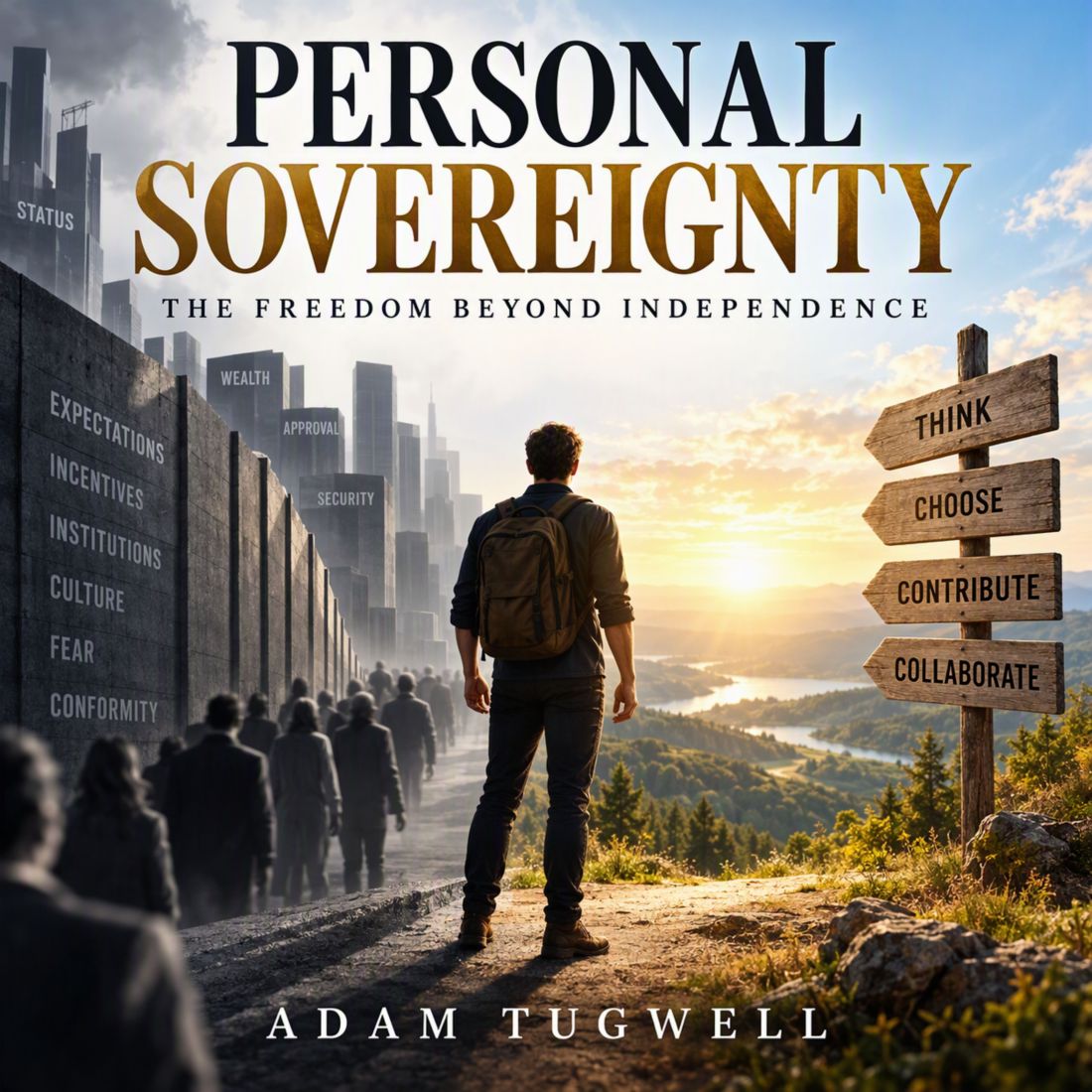
Overview | Personal Sovereignty: The Freedom Beyond Independence

This book explores a simple but profound question:

What does it actually mean to be free?

Most people equate freedom with independence. We assume that if we can support ourselves financially, make our own decisions, and live without relying on others, then we are free.

I argue that independence is only the beginning.

A person can be financially independent and still be constrained by social expectations, economic incentives, institutional pressures, cultural norms, and fears about what might happen if they think or act differently. They may have freedom of movement, freedom of choice, and even considerable wealth, yet still lack the ability to live fully in alignment with their own understanding of reality.

This book introduces the concept of personal sovereignty as the freedom beyond independence.

By sovereignty, I do not mean doing whatever you want. I do not mean rebellion, isolation, self-sufficiency, or withdrawal from society. Nor do I mean freedom at the expense of others.

I define personal sovereignty as:

The ability to act in alignment with your own thinking without being structurally punished for doing so, while respecting the sovereignty of others as equal to your own.

The book explores why this condition is so difficult to achieve in modern society and why so many people mistake comfort, wealth, status, or success for freedom.

A central argument is that today’s system is not primarily maintained through force or conspiracy, but through a shared worldview embedded within institutions, markets, culture, and social expectations. These structures shape not only our choices but also the assumptions through which we interpret the world itself.

As a result, many people are constrained not only by material dependency, but by what I call cognitive capture: the tendency to mistake inherited assumptions for independent thought.

To become sovereign, a person must satisfy three conditions:

  1. Material independence, where essential needs are securely met.
  2. Cognitive independence, where they can recognise and question the assumptions that shape their thinking.
  3. Structural immunity, where they can act on their convictions without risking their livelihood, safety, or stability.

Only when all three conditions exist together does sovereignty become a lived reality rather than an aspiration.

The book also challenges common assumptions about success and freedom. Beyond the point where our needs are met, the pursuit of ever greater comfort, status, and external validation can create new forms of dependency. In some cases, those who appear most free may in fact be among the least sovereign because they have the most to lose from thinking or acting differently.

Ultimately, this is not a book about escaping society. It is a book about understanding the forces that shape our lives and creating the conditions in which people can think, choose, contribute, and collaborate freely.

My argument is that a truly healthy society is not one built upon dependency, fear, competition, or coercion, but one built upon secure, sovereign individuals who are free to participate in community by choice rather than necessity.

Personal sovereignty is not simply a personal ideal. It is the foundation upon which a more human-centred society can be built.

Key Takeaways

1. Independence is the doorway, not the destination

Meeting your essential needs creates the possibility of freedom, but independence alone does not create sovereignty. Freedom begins where dependency ends, but sovereignty requires something more.

2. Sovereignty is not selfishness

True sovereignty depends on recognising that other people’s sovereignty is equal to your own. Freedom without respect becomes domination; sovereignty without reciprocity becomes selfishness.

3. The greatest constraints are often invisible

Many of the forces that shape our behaviour are not laws or commands but incentives, expectations, cultural assumptions, and accepted definitions of what is considered normal, successful, or responsible.

4. We are all shaped by the systems we inhabit

The assumptions we inherit often feel like reality itself. Sovereignty begins when we learn to examine those assumptions consciously rather than unconsciously living through them.

5. Wealth and comfort do not guarantee freedom

A person can possess significant wealth and still be deeply dependent on status, approval, reputation, or material rewards. Comfort can sometimes obscure captivity rather than remove it.

6. Sovereignty requires the ability to act on what you believe

Thinking independently matters, but sovereignty ultimately depends upon whether you can live in accordance with your understanding without fear of losing security, stability, or belonging.

7. Most social problems are symptoms of deeper causes

Housing pressures, inequality, insecurity, and many other challenges emerge from underlying structures and assumptions. Sustainable solutions require addressing root causes rather than symptoms alone.

8. Escaping society is not the same as freedom

Going off-grid or withdrawing from society simply exchanges one set of dependencies for another. Sovereignty is not the absence of constraints; it is the ability to choose your constraints.

9. Freedom is fundamentally about alignment

The closer your life reflects your genuine understanding, values, and convictions, the closer you move toward sovereignty.

10. Sovereignty changes the meaning of community

When people are secure and sovereign, collaboration becomes voluntary, contribution becomes meaningful, and community becomes something chosen rather than imposed.

In One Sentence

Personal Sovereignty argues that true freedom is not merely the ability to survive independently, but the ability to think and act in alignment with your own understanding of reality, without structural punishment, while respecting the equal sovereignty of others.

The Architecture of Modern Poverty: Independence, Economy, and the Basic Living Standard

Poverty is often described as a lack of money. Governments measure it through income thresholds, commentators discuss it in terms of affordability, and public debate frequently focuses on individual expenses such as housing, food, or energy. While these measures and discussions capture important aspects of economic hardship, they often fail to identify the underlying condition that poverty represents.

The fundamental issue is not simply a shortage of income. It is the loss of independence.

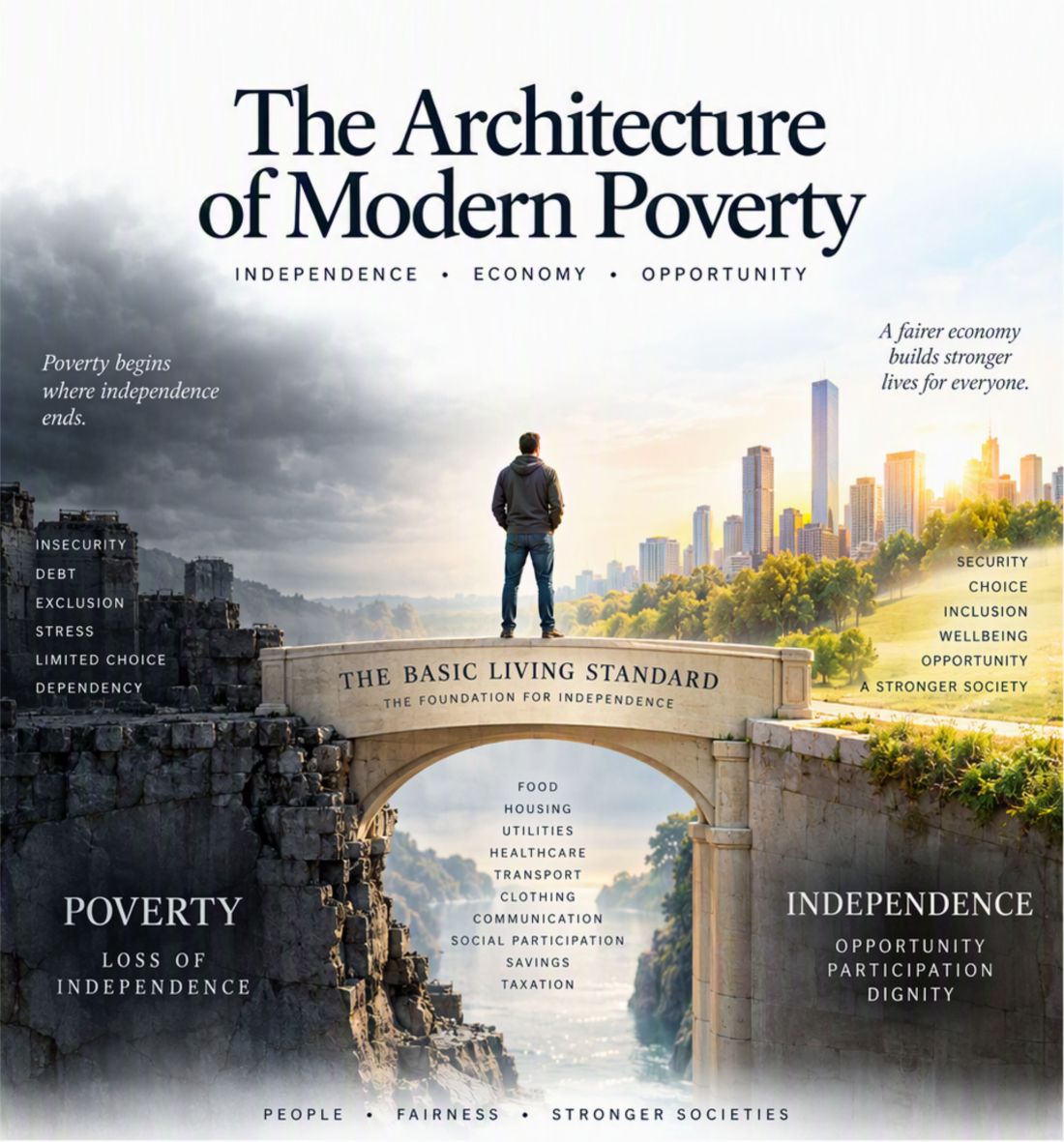
In a modern economy, poverty begins when a person can no longer meet their essential needs through their own resources and must rely on external support to maintain a basic standard of living.

The inability to sustain oneself independently marks the boundary between economic security and economic vulnerability. This point may be described as the Independence Threshold.

Understanding poverty through independence shifts attention away from arbitrary income figures and towards a more meaningful question: can an individual meet the essential requirements of life without falling into debt, relying on welfare, or depending on charity?

If the answer is no, poverty has already begun.

Poverty as the Loss of Independence

Independence is often taken for granted. It is expressed through ordinary activities: paying rent, buying food, travelling to work, heating a home, replacing worn clothing, maintaining communication, and managing unexpected expenses.

These activities appear routine because they are routine for those whose incomes allow them to participate fully in economic life. Yet all depend upon a continuing ability to convert income into essential goods and services.

When that ability is lost, independence begins to erode.

A person who cannot afford housing without assistance is not fully independent. A person who must regularly choose between heating and eating is not fully independent. A person who requires continual borrowing to meet ordinary living costs is not fully independent.

The common feature in each case is not low income itself, but an inability to sustain essential needs through one’s own means.

Poverty is therefore better understood as a condition of dependency rather than simply a condition of low earnings.

Independence Exists Within an Economic Context

No individual becomes independent in isolation. Independence is shaped by the economy in which a person lives.

The resources required to maintain a basic life differ between countries, regions, and periods of history. Modern life carries obligations that did not exist for previous generations and costs that vary considerably between locations.

Housing, transport, energy, communication, healthcare, taxation, childcare, and access to employment all influence the resources required for independent living.

As these costs rise, the income necessary to maintain independence rises with them.

This has important implications for how poverty is understood.

A level of income that provides security in one economy may produce hardship in another. Likewise, an income that supported independence ten years ago may no longer be sufficient today if essential costs have increased.

Poverty cannot therefore be understood solely through absolute measures. It must be understood relative to the economic conditions in which people actually live.

The question is not simply how much money a person has.

The question is whether that money is sufficient to maintain independence within the economic environment that surrounds them.

The Consequences of Falling Below the Threshold

The loss of independence has consequences that extend far beyond finances.

When people cannot reliably meet their essential needs, uncertainty becomes a constant feature of daily life. Long-term planning becomes difficult. Financial shocks become crises. Opportunities are declined because the risks are too great. Immediate necessities take precedence over future ambitions.

Over time, this creates a pattern of exclusion.

Participation in social activities may decline because they can no longer be afforded. Educational opportunities may be deferred. Career progression may be limited by transport costs, childcare costs, or insecure housing. Physical and mental wellbeing may deteriorate as financial pressures intensify.

Poverty therefore affects more than material possessions. It constrains choices, limits participation, and reduces personal agency.

The defining characteristic of poverty is not merely what people lack. It is what they are no longer free to do.

The Limits of Traditional Poverty Measures

Most poverty measures focus primarily on income.

While income remains important, income alone does not determine whether a person is independent.

Two households with identical earnings may experience very different levels of security depending upon their circumstances. Housing costs, debt obligations, family responsibilities, regional price differences, disability-related expenses, transport requirements, and many other factors influence whether income is sufficient to meet essential needs.

As a result, many people who sit above official poverty lines still struggle to maintain independence. They may appear financially secure according to statistical measures while relying on borrowing, family support, charitable assistance, or the continual postponement of essential spending.

Such individuals may not be recognised by conventional poverty measures, yet their independence remains fragile.

A more meaningful understanding of poverty requires identifying the point at which independence becomes unsustainable, rather than merely measuring income against a predetermined percentage or average.

Defining the Requirements of Independence

If poverty begins when independence ends, a practical question emerges.

What is required to remain independent?

The answer cannot be limited to survival alone.

Independence in a modern society requires more than the bare minimum needed to stay alive. It requires access to the goods and services necessary for participation in ordinary economic and social life.

This includes adequate food, secure housing, utilities, transport, healthcare, clothing, communication, and the ability to absorb unexpected expenses. It also requires a modest capacity to participate in society and contribute to the wider community through taxation and civic engagement.

Together, these elements form the basis of a Basic Living Standard.

The Basic Living Standard represents the minimum set of resources required for a person to live independently within a modern economy. It is not a measure of comfort, luxury, or affluence. Nor is it a subsistence model concerned only with physical survival.

Instead, it identifies the economic foundation necessary for stability, dignity, and participation.

The Relationship Between the Independence Threshold and the Basic Living Standard

The Independence Threshold and the Basic Living Standard represent two parts of the same framework.

The Independence Threshold defines the condition of poverty. It identifies the point at which an individual loses the ability to meet essential needs without external support.

The Basic Living Standard defines the resources required to avoid that condition. It establishes the minimum economic foundation necessary to sustain independence.

One identifies the boundary.

The other identifies where that boundary lies.

Together, they provide both a definition and a measurement.

If an individual’s earned income is sufficient to achieve the Basic Living Standard, independence is maintained. If it is insufficient, independence becomes compromised, and poverty emerges.

This relationship transforms poverty from an abstract social concern into a measurable economic reality.

A New Foundation for Economic Policy

Viewing poverty through the lens of independence creates a different basis for public policy.

The central question becomes whether the structures of the economy allow people to maintain independent lives through their own efforts.

Wages, housing policy, taxation, transport infrastructure, energy markets, healthcare provision, and social support systems can all be assessed according to their effect on independence.

A minimum wage, for example, cannot be considered adequate simply because it exists. Its adequacy depends upon whether it enables a worker to achieve the Basic Living Standard without requiring continual supplementation from debt, welfare, or charity.

Similarly, economic growth cannot be evaluated solely through national statistics if increasing living costs simultaneously undermine the independence of large sections of the population.

An economy succeeds not merely when it generates wealth, but when it allows ordinary people to sustain independent lives within it.

Conclusion

Poverty is often treated as a problem of insufficient income. In reality, it is more accurately understood as a loss of independence.

The ability to meet essential needs through one’s own resources represents the foundation of economic security, personal agency, and meaningful participation in society. When that ability is lost, poverty begins, regardless of how it is measured statistically.

The Independence Threshold identifies this critical boundary. The Basic Living Standard identifies the resources required to remain above it.

Together, they provide a framework for understanding poverty that is rooted not in abstract financial measures, but in the practical realities of everyday life. They shift the focus from income alone to the broader question of whether people possess the means to sustain themselves with dignity, stability, and autonomy.

In doing so, they offer a foundation for a more coherent understanding of poverty and a clearer means of addressing it.

Further Reading

The ideas presented in this essay are explored in greater depth across a series of related works. Together, these pieces trace the development of the Basic Living Standard and the Independence Threshold, from the practical question of what people need to live independently, through to a broader philosophy of freedom, autonomy, and economic participation.

1. The Basic Living Standard: Full Text

Foundational Framework

Read the full text

This is the foundational statement of the Basic Living Standard. It sets out the principle that anyone working full time at the lowest legal wage should be able to meet all essential living costs without debt, welfare dependency, or charity.

The article defines the components of a basic but dignified life and establishes the standard as a practical benchmark for wages, public policy, and economic justice.

2. The Basic Living Standard Explained

A Practical Introduction

Read the article

This accessible introduction explains the purpose and mechanics of the Basic Living Standard. It explores why traditional measures such as minimum wage and poverty thresholds often fail to reflect lived reality and demonstrates how a living standard based on genuine economic independence can provide a clearer and more meaningful benchmark.

3. The Basic Living Standard: Freedom to Think, Freedom to Do, Freedom to Be

The Philosophy of Economic Independence

Read the article

Moving beyond economics, this essay explores the deeper human implications of financial security. It argues that economic independence creates the conditions for genuine freedom: the freedom to think without constant anxiety, to act with agency and purpose, and to develop one’s identity without the constraints imposed by persistent insecurity.

The piece examines the relationship between personal sovereignty, dignity, wellbeing, and social stability.

4. The Independence Threshold: A New Definition of Poverty for a Modern Economy

Redefining Poverty Through Independence

Read the article

This work develops a new definition of poverty based on the concept of independence rather than income alone. It argues that poverty begins at the point where a person can no longer meet their essential needs without external support.

The article introduces the Independence Threshold as a framework for understanding poverty within modern economies and explains its relationship to exclusion, participation, and economic resilience.

Personal Sovereignty: The Freedom Beyond Independence

Introduction: The Misunderstanding of Sovereignty

Personal sovereignty is one of the most misunderstood ideas in modern life. People often imagine it means doing whatever you want, whenever you want, free from interference or obligation. Others believe sovereignty is found in rejecting society altogether – going off‑grid, becoming self‑sufficient, or withdrawing from the world.

Neither of these definitions is correct.

Sovereignty is not rebellion. It is not isolation. It is not comfort. And it is not independence alone.

Personal sovereignty is the ability to act in alignment with your own thinking without being structurally punished for doing so – while respecting the sovereignty of others as equal to your own.

This last part is essential. Without it, sovereignty becomes selfishness. With it, sovereignty becomes the foundation of a peaceful, people‑first society.

This explainer sets out what personal sovereignty is, why it is so rarely achieved, and why it matters not only for individuals but for the kind of society we could build together. It sits within a wider body of my work that explores how today’s system shapes our lives and what a people‑first alternative might look like.

You do not need to have read any of that work for this piece to make sense. Where an idea is developed more fully elsewhere, I explain enough here to carry the argument, and point to the relevant reading at the end.

1. Sovereignty Begins Beyond Independence

Independence is the foundation. Sovereignty is the structure built upon it.

By independence, I mean something specific. In The Independence Threshold, I argue that poverty begins where independence ends. A person is independent when they can meet all of their essential costs – housing, food, energy, transport and the other basics of modern life – without relying on support from the state, charity, family or debt.

That threshold is the floor. Sovereignty is what becomes possible above it.

Independence gives you the ability to meet your basic needs.

In doing so, it makes room for:

  • the mental bandwidth to think clearly
  • the emotional stability to question narratives
  • the space to see the system for what it is

But independence alone does not give you sovereignty.

You can be independent and still be:

  • economically coerced
  • socially steered
  • narratively shaped
  • institutionally constrained
  • punished for acting differently

Independence removes survival pressure. Sovereignty removes structural pressure.

Independence is material. Sovereignty is existential.

Independence creates the possibility of sovereignty. It does not create sovereignty itself.

It is also worth being clear from the outset that the threshold is about needs, not wants. It asks whether your essentials are secure – not how comfortable, wealthy or successful you are.

As we will see, that distinction matters more than it first appears.

2. Sovereignty Requires Respect for the Sovereignty of Others

This is the part most people miss – and the part that transforms sovereignty from a personal state into a societal principle.

Sovereignty is not the freedom to impose your will. It is the freedom to live your truth without violating someone else’s.

This means:

  • your sovereignty ends where another person’s begins
  • your choices cannot diminish someone else’s autonomy
  • your freedom is tied to your responsibility
  • your self‑respect creates respect for others
  • your clarity creates space for others’ clarity

This is not moralising. It is structural.

A society where everyone is sovereign is only possible when:

Everyone recognises that their sovereignty is equal to everyone else’s – not superior.

This is why sovereignty is not selfishness. It is the opposite. It is the foundation of mutual respect.

3. The System’s Boundary: Why Sovereignty is so Hard to Reach Today

To understand why sovereignty is so rare, we need to be clear about what I mean by “the system”.

It is not a group of people. It is not a conspiracy. It is not a secret plan.

It is a worldview – a shared set of assumptions about what is realistic, responsible, credible and possible – embedded in:

  • institutions
  • markets
  • cultural norms
  • expectations
  • definitions of success
  • definitions of responsibility
  • definitions of “normal life”

In The Establishment Is Not What You Think It Is, I describe this worldview as the real modern Establishment: not a class or a cabal, but a mental operating system built around market primacy, financial credibility, growth as an unquestioned good, competition as the organising principle, and distance from consequences.

It is not enforced by conspiracy. It is enforced by incentives. It rewards people who think within it and quietly penalises those who do not. And because it feels like common sense to those inside it, it rarely feels like an ideology at all.

This mindset shapes:

  • the choices available
  • the risks that are viable
  • the consequences of deviation
  • the narratives that define “acceptable” behaviour

In everyday life, those consequences are concrete. Acting outside the accepted script can mean lost income, a stalled career, difficulty securing housing or credit, reputational damage, or quiet social exclusion.

Nobody needs to organise these penalties. They emerge naturally from institutions, markets and expectations that all assume the same things.

Even those who see the system clearly still have to live inside it. Unless you withdraw from society entirely, you cannot avoid interacting with it.

This is the structural boundary that keeps full sovereignty out of reach for most people today – not necessarily because they lack the will, but because acting freely carries costs that few can afford to bear.

4. Cognitive Capture: Why the Boundary is so Hard to See

If the system were simply a set of rules imposed from outside, it would be easier to recognise and resist. The deeper difficulty is that it also shapes how we think.

I call this cognitive capture. It does not mean that people are foolish, corrupt or naïve. It means that the assumptions we grow up with, are rewarded for, and see reflected all around us come to feel like reality itself, rather than one possible way of organising life.

Everyone is shaped by the systems they inhabit. Some systems are simply more pervasive than others.

This matters for sovereignty because many of the choices we believe are our own – what counts as success, what feels responsible, what seems realistic – are defaults we inherited rather than conclusions we reached.

Sovereignty begins with recognising that some of the assumptions guiding your life may not be your own, and with the ability to examine them consciously: keeping those that genuinely serve you and others, and questioning those that do not.

It also explains a familiar paradox. Many people who sincerely set out to fight the system end up reinforcing it, because they carry its assumptions with them – judging success by the same measures, reaching for the same tools, and rebuilding the same hierarchies under a different banner.

Rebellion that does not change the underlying assumptions, tends to reproduce what it opposes.

5. The Three Conditions Required for Personal Sovereignty

Sovereignty is not simply a feeling, a mindset or a philosophy.

It is a lived condition, and it depends on three conditions being met together.

Condition 1 – Material Independence (The Independence Threshold Is Met)

You must be free from survival dependency:

  • housing
  • food
  • energy
  • transport
  • basic stability

Without this, sovereignty is out of reach. Survival pressure overrides every other form of freedom.

This condition is a threshold: it is either met or it is not. It concerns needs being securely met and says nothing about wealth, comfort or status beyond that – and, as Section 6 explains, those can become forms of dependency in their own right.

Condition 2 – Cognitive Independence (Awareness)

You must be able to:

  • see the system
  • understand its incentives
  • recognise narrative shaping
  • identify structural boundaries
  • think without fear of social punishment

This is the awakening stage – the ability to recognise cognitive capture and think freely, even while still living inside the system.

Condition 3 – Structural Immunity (No Punishment for Acting Differently)

This is the rarest of the three conditions.

You must be able to:

  • act on your thinking
  • make choices the system does not reward
  • reject coercion
  • refuse narrative conformity
  • choose your constraints

without losing your livelihood, housing, stability, or safety.

This is the condition very few people have today.

Only when all three conditions are present together does sovereignty become a lived reality rather than an aspiration. Each is necessary. None is sufficient on its own.

6. Comfort is Not Sovereignty: Needs, Wants and the Comfortable Captive

It would be easy to read the three conditions and conclude that the more materially comfortable a person is, the closer they must be to sovereignty.

That is not what this explainer is saying.

Beyond the point where needs are met, more comfort does not bring a person closer to sovereignty – and it can sometimes move them further away.

Needs and Wants

Material independence is about having your needs met – a secure home, enough food, warmth, the means to get around, and the basic stability that modern life requires.

When those needs are secure, something important happens. A particular kind of peace becomes possible. You are no longer beholden to the system for your survival, and so you are no longer required to be beholden to it in your thinking either.

Independent thought becomes possible in a way that survival pressure rarely allows.

Whether that possibility is taken up is another matter – and that is where wants come in.

Wants are different. Needs have natural limits; wants do not. And wants are precisely where the system’s worldview does much of its work – shaping what we aspire to, what we compare ourselves against, and what we believe a successful life looks like.

Status, lifestyle, possessions, career position and the approval that comes with them are not needs. But once they become part of who we think we are, they can bind us to the system as tightly as any debt.

This is why recognising what is enough matters so much. Beyond the point where needs are met, every additional want that becomes attached to our identity is another lever by which we can be steered – making it harder to think independently, and more costly to act differently.

The Comfortable Captive

Some of the people who feel most free in today’s world are among the least sovereign. They are materially secure, well rewarded and widely admired. They may feel they have every choice available to them. Yet their sense of success, worth and security may be entirely defined by the system that rewards them.

Because they have so much invested in it – financially, socially and personally – they often have the most to lose by thinking or acting differently. Their freedom is real in its means, but not in its mind. They are free to choose between the options the system offers, but rarely free to question the system itself.

Feeling free is not the same as being free. Captivity that is comfortable rarely feels like captivity at all.

The three conditions make this visible:

  • a wealthy person may comfortably satisfy the first condition and still fail the second, because their thinking belongs to the worldview that made them wealthy
  • a person with influence and standing may see the system clearly and still fail the third, because acting on what they see would cost them their position
  • a person of modest means whose needs are secure, who sees clearly, and whose sense of identity is not heavily invested in wants the system can grant or withdraw, may be closer to sovereignty than either

A light attachment to wants is not a fourth condition. It is part of what makes the second and third possible. The less our identity depends on what the system can give or take away, the more freely we can think – and the less it costs us to act on what we see.

None of this is a judgement on anyone. As the discussion of cognitive capture made clear, being shaped by the system is not a personal failing – it is what happens to everyone who lives inside it, and the more a system rewards us, the harder it becomes to see.

Nor does comfort disqualify anyone from sovereignty. The test is not how much you have. It is whether your thinking is your own, and whether you could act on it if it led you somewhere the system does not reward.

How conditioning ties our identity and worth to external markers of success is explored further in The Paradox of Control. For the purposes of this explainer, one principle is enough:

Independence creates the possibility of sovereignty. It does not create sovereignty itself. And comfort, on its own, creates neither.

7. Why Sovereignty is so Rare

Sovereignty is rare because, in practice, the system relies on dependency – not only on people needing it to survive, but on people needing what it rewards.

This is not because anyone designed it that way. Modern institutions are built to deliver stability and predictability at scale. Employment, credit, housing markets and public administration all work most smoothly when people are reliable, compliant and unable to walk away easily.

Dependency is often an unintended by‑product of that design – but once it exists, it becomes something the system leans on.

A sovereign population cannot easily be:

  • economically coerced
  • narratively manipulated
  • politically leveraged
  • socially steered
  • controlled through fear of loss

A system built on:

  • debt
  • scarcity
  • competition
  • hierarchy
  • accumulation
  • fear

sits uneasily alongside a population that is no longer governed by those pressures.

This is not conspiracy. It is structural reality.

The system behaves like an organism protecting itself – not because anyone planned it that way, but because the worldview behind it is self‑preserving.

Practices that sustain it are rewarded; challenges to it are absorbed, neutralised or dismissed as unrealistic.

Even ideas and technologies that could free people can end up being used to deepen their dependence – a pattern I explore in The Paradox of Control.

8. The Emotional Trap: Why People Treat Symptoms Instead of Causes

Many people today are angry, frightened, and desperate for solutions. They see problems everywhere – inequality, injustice, corruption, coercion – and they believe the only way to solve them is to address them directly.

This is understandable. It feels logical. It feels like common sense.

But it is a trap.

The problems they see are symptoms, not causes.

Addressing symptoms directly:

  • doesn’t solve the underlying issues
  • often makes things worse
  • creates new problems
  • deepens division
  • reinforces the system’s boundaries

Housing is a good example. Unaffordable housing is not simply a market outcome; it reflects land policy, credit conditions, planning rules and investment incentives. Arguing about any single landlord, rate rise or development deals with the symptoms. The cause sits in the assumptions those systems share.

This is why sovereignty matters.

Sovereignty addresses problems at the base level – the level where causes live, not symptoms.

It is not wishful thinking. It is structural thinking.

In practice, this means making decisions – personal, local and political – that reduce dependency rather than simply managing its effects. Consistently, cumulatively and consciously.

Because everything is interconnected.

When you strengthen the base, the surface begins to change with it.

9. The Paradox of Escape: Why Going Off‑Grid Isn’t Sovereignty

Rejecting the system does not create sovereignty.

It creates a different form of captivity.

If you go off‑grid, you become dependent on:

  • isolation
  • environment
  • self‑imposed boundaries
  • survival conditions

You trade structural dependency for survival dependency.

You are still constrained – just differently.

Sovereignty is not escape. It is the ability to choose your constraints.

This idea – choosing your constraints – sits at the heart of personal sovereignty, so it is worth being precise about it.

Freedom does not mean living without constraints. Every life has them: relationships, responsibilities, the limits of time, health and place, and the needs of others.

The difference lies in where those constraints come from.

A sovereign person may commit to a family, a profession, a community or a cause, and those commitments may be demanding. But they are accepted rather than imposed. They are chosen because they reflect what the person values – not because the alternative is losing their home, their income or their standing.

The question, then, is not whether your life is constrained. It is whether you have a meaningful say in which constraints shape it.

10. What Sovereignty Actually Looks Like

Sovereignty is not about doing whatever you want. It is about acting without fear of structural punishment – while respecting the sovereignty of others.

Sovereignty looks like:

  • choosing your values
  • choosing your constraints
  • choosing your risks
  • choosing your contributions
  • choosing your relationships
  • choosing your boundaries
  • choosing your direction

without fear of losing:

  • housing
  • livelihood
  • stability
  • safety
  • social acceptance

And without diminishing anyone else’s ability to do the same.

Sovereignty is the lived experience of freedom.

It is also worth saying what sovereignty does not ask of anyone. It is not a test of purity, and it is not all or nothing.

Few people will experience full sovereignty within today’s system. But sovereignty is a direction as well as a destination.

Every gain in genuine material independence – needs secured, not wants multiplied – reduces the pressure of survival. Every assumption examined honestly weakens cognitive capture. Every reduction in the cost of acting on your values increases your freedom to live by what you genuinely believe.

None of these creates sovereignty on its own, and comfort is no substitute for any of them. But together they bring a person’s life into closer alignment with their own understanding, rather than with pressures imposed by dependency, conditioning or fear. That alignment is where an authentic life, and genuine, voluntary contribution to others, becomes possible.

11. Why Sovereignty Changes the Meaning of Community

Dependency creates forced collectivism. Sovereignty creates authentic collectivism.

When people are sovereign:

  • collaboration is voluntary
  • community is chosen
  • contribution is meaningful
  • relationships are genuine
  • collective interest is natural, not manufactured

Sovereignty does not destroy community. It transforms it.

It creates communities built on choice, not coercion.

This is why sovereignty sits at the centre of the alternative I describe in The Local Economy & Governance System (LEGS) and The Contribution Culture. In that model, a guaranteed Basic Living Standard secures everyone’s essentials, so that work becomes contribution rather than a transaction for survival, and decisions are made locally by the people who live with their consequences.

The aim is a society designed around secure, sovereign people rather than dependent ones.

12. The Strongest Objection

The strongest objection to this argument is that what I am describing as structural pressure is simply the price of living in a complex society. Perhaps people need the discipline of work, the stability of institutions and the coordination that markets provide. Perhaps a world of sovereign individuals would be less productive, less predictable and harder to govern. Perhaps dependency is not a flaw at all, but the glue that holds modern life together.

That objection deserves to be taken seriously. Societies do need institutions, expertise, shared rules and mutual obligation. Sovereignty, as defined here, does not reject any of them. Its built‑in respect for the sovereignty of others is itself a constraint – one that rules out selfishness, disorder and the imposition of one person’s will on another.

But the objection only goes so far. The question is not whether people should be bound to one another. It is whether those bonds are chosen or coerced. A society held together by fear of loss is stable only for as long as that fear holds. A society held together by security, trust and voluntary contribution has a far deeper foundation – and, I would argue, a far more resilient one.

Conclusion: Sovereignty is the Destination

Independence is the doorway. Sovereignty is the room beyond it.

But passing through the doorway is not the same as arriving. Many people pass the threshold with ease and never enter the room – not for lack of means, but because their thinking still belongs to the system that rewards them.

Sovereignty is not measured by what you have. It is measured by whether you are free – in thought as well as in practice – to live by what you believe.

As things stand, today’s system and mass sovereignty sit uneasily together. Not because anyone planned it that way, but because so much of the way the system functions still relies on dependency.

Sovereignty is not rebellion. It is not escape. It is not isolation. It is not comfort.

It is the ability to act freely in alignment with your own thinking – while respecting the sovereignty of others – and, for most people, that requires a system built around people rather than fear.

Before systems can change, assumptions must change. Sovereignty starts there: with seeing the worldview we live inside clearly enough to stop mistaking it for reality itself, and with building the security that allows us – and everyone around us – to act on what we see.

This is the freedom beyond independence. This is the freedom beyond the threshold.

This is personal sovereignty.

Further Reading

This explainer is one part of a wider body of work. The pieces below are not required reading – the argument above is designed to stand on its own – but each develops one or more of its ideas in greater depth. They are grouped by theme and ordered so that you can follow the thread at your own pace.

If you read only two, start with the first section.

Start Here: The Two Companion Pieces

The Establishment Is Not What You Think It Is
Explains what I mean by “the system” throughout this explainer. It argues that the modern Establishment is not a class, an elite or a conspiracy, but a worldview – a shared set of assumptions about what is realistic and responsible – sustained by incentives rather than coordination. It also introduces cognitive capture and the anti‑establishment paradox, and explains why lasting change requires awakening rather than rebellion.

The Independence Threshold: A New Definition of Poverty for a Modern Economy
Sets out the foundation that sovereignty is built upon. It proposes that poverty begins where independence ends: a person is in poverty when they cannot meet their essential needs without support from the state, charity, family or debt. It explains why poverty must be understood relative to the economy people actually live in, rather than judged by physical conditions alone.

Seeing the System More Clearly

The Road We Are On Is Broken – And We Built It Ourselves
Explores why so many people sense the crisis around them yet miss its cause. It argues that perspectives shape perception, that awareness is not the same as understanding, and that the solutions we need will not come from anything we already do – because it is what we already do that created the problems.

The Paradox of Control: How the Things That Could Free Us Are Being Used to Shape Our Dependence
Examines how ideas, technologies and lifestyle changes that could genuinely free people are often introduced through mechanisms of control – and why people instinctively resist them as a result. It also looks at how conditioning ties our sense of identity and worth to external markers of success, keeping us striving, comparing and consuming.

Your Beliefs Today Create Everyone’s Experiences Tomorrow
A book‑length exploration of the different ways people see today’s world, how those worldviews came about, and where each is likely to lead. It invites readers to recognise their own perspective and to consider how thinking differently could shape a different shared future.

The Future Is Abstract
Explains why a future that works for everyone can seem unrealistic from where we stand. Because today’s way of life is the root cause of our problems, a better future cannot be imagined only in terms of what we already know and accept – we have to be willing to leave the old way behind.

The Philosophy Behind a People‑First Society

The Philosophy of a People‑First Society
Brings together the worldview that underpins all of this work. It contrasts the assumptions a money‑centric system makes about people with a different starting point – that people thrive when they are secure, trusted, connected and able to contribute to something that matters – and sets out the first principles behind it, along with the shift in perspective I call the Revaluation.

Civilisation: The Cumulative Pathway to Enlightenment
A wider reflection on how human progress actually happens. It describes civilisation as cumulative wisdom, built from every triumph, mistake and moral awakening, and warns that removing the wrong ‘bricks’ – including the uncomfortable ones – risks destabilising the whole structure we stand on.

From Principle to Practice

The Basic Living Standard Explained
A short introduction to the guarantee at the heart of the alternative: that anyone earning the lowest legal weekly wage should be able to afford all essential costs of living – including food, housing, utilities, healthcare, transport and modest social participation – without debt, welfare or charity. It is the practical expression of the independence threshold.

The Contribution Culture: Transforming Work, Business and Governance for Our Local Future with LEGS
Uses work as the doorway into a people‑first society. It explains how work can move from a transaction for survival to meaningful contribution, and how business, learning, governance and the stewardship of natural resources change when everyone’s essentials are secure. Written as a stand‑alone introduction for readers new to these ideas.

The Local Economy & Governance System (LEGS)
The full framework for a people‑first society, built on three founding principles: People, Community and the Environment. It sets out local, transparent governance, a circular local economy, the Basic Living Standard, and the place of personal sovereignty at the heart of public policy.

From Principle to Practice: Bringing the Local Economy & Governance System to Life
The companion to LEGS, translating its principles into a practical blueprint for real‑world change. It is written for communities, leaders and everyday people who are ready to move from understanding the system to building something better.

The Game in Plain Sight | How Markets, Money and Politics Became One System – And Why the Consequences Land on Everyone Else

As the 28 October Budget approaches, traders are openly betting against the pound. This essay argues that the real story is not the bet itself, but the growing gap between the people who make decisions and the people who live with the results. I call that gap moral distance – and once you see it, a great deal of modern British life starts to make sense.


There are moments when a country sees itself clearly. Not because someone reveals a secret, but because something that has always been happening suddenly becomes impossible to ignore. The run‑up to the 28 October Budget is one of those moments.

Currency traders are openly betting on the pound falling. Commentators treat it as technical. Politicians treat it as background noise. Markets treat it as opportunity. But the reality is far more consequential: people with the ability to move vast sums of money are playing a game whose results land on everyone else – and the extraordinary thing is that the game is happening in full view, without moral scrutiny, and without anyone connecting the dots.

This is not a story about markets alone. It is a story about a political system that has become market‑facing, an economic system built on promises rather than real value, and a society that has been quietly hollowed out by decades of decisions designed to push consequences onto tomorrow.

Tomorrow has now shown up.

The dots can be connected. Running through the currency markets, the political system, the economy and our wider culture is a single thread: the separation of action from consequence. The people who make the decisions are, more and more often, not the people who live with what those decisions bring. That separation is what this essay is about.

I. Moral Distance: The Thread That Connects Everything

Moral distance is the gap between the person who makes a decision and the person who lives with its consequences. When that gap is small – a builder who lives in the street he builds, a business owner who employs her neighbours – responsibility is felt directly. You see the people affected. You meet them. You have to look them in the eye.

When the gap grows large, something changes. The people affected become abstract. Their lives turn into numbers, positions, risks and forecasts. Decisions stop feeling like choices with victims and start feeling like technical moves in a game. Nobody needs to be cruel for harm to be done. Distance does the work.

This essay follows four forms of moral distance that now shape British economic life:

  • Traders are distant from the consequences of the bets they place.
  • Politicians are distant from the future costs of the choices they make.
  • Institutions are distant from the communities affected by their decisions.
  • Markets are distant from the people whose lives become the outcome.

None of these distances is new. What is new is that they now reinforce one another, until markets, money and politics behave as a single system – and a culture that judges actions by whether they pay, rather than by who pays for them, makes the whole arrangement feel normal. The sections that follow take each distance in turn, then ask what it would take to close it.

II. The Game Is Visible – But Its Meaning Isn’t

Currency markets behave like one giant betting arena. Traders wager on the future value of the pound based on expectations of growth, borrowing, political stability and fiscal credibility. When they bet on a weaker pound, they are not expressing an opinion. They are shaping the conditions in which government must operate.

This is not metaphor. It is literal.

For readers less familiar with how this works: a trader who expects the pound to fall can sell pounds today, hoping to buy them back more cheaply later, or use financial contracts that pay out if the pound weakens. One trader makes little difference. But when large funds take the same view at the same time, their selling can help bring about the very fall they are betting on. The forecast becomes part of the cause.

A fall in the pound means:

  • higher import costs
  • higher energy prices
  • higher inflation
  • pressure on interest rates
  • constraints on government action
  • rising costs for households and businesses

The chain is simple. Britain buys much of its energy, food and materials from abroad, priced in other currencies. When the pound buys less, those things cost more. Rising prices push up inflation, which puts pressure on the Bank of England to keep interest rates high – and that, in turn, raises the cost of mortgages, business loans and government borrowing alike.

The people who place the bets are rarely the people who bear the full consequences of those bets. The costs are spread across millions of households and businesses that never entered the game in the first place.

This is the moral inversion at the centre of the system.

It is moral distance in its purest form. The decision and its consequences are separated so completely that the person placing the bet need never see, meet or think about the people who will pay for it.

As Budget day approaches, the familiar ritual is already under way. Journalists speculate about winners and losers. Ministers brief against expectations. Economists debate forecasts. Traders position themselves for gains or losses. Yet beneath the noise sits a quieter question: what kind of economy has become so sensitive to expectations that anticipation itself can help shape outcomes?

The Extraordinary Thing: The Game Is Happening in Full View

This is the part nobody talks about.

Currency speculation is not hidden. It is not subtle. It is not coded.

It is public. It is visible. It is normalised.

Every time the pound moves, the scoreboard updates. Every time traders place bets, the scoreboard reacts. Every time government signals uncertainty, the scoreboard flashes red.

And yet the public conversation treats this as technical rather than moral.


The game is happening in plain sight. The consequences are happening in private. And nobody is connecting the dots.


III. Government and the Governed: The Political System Has Become Market‑Facing

Britain’s political and economic machinery has become increasingly brittle. When a system is fragile, even small market signals can become national events. Governments now govern with markets in mind because markets have become the arbiters of credibility.

Bond yields judge borrowing. Currency markets judge stability. Ratings agencies judge risk. Investor sentiment judges political behaviour.

A brief explanation helps here. When the government borrows, it sells bonds – promises to repay with interest. The bond yield is, in effect, the interest rate investors demand to lend to the state. If they lose confidence, they demand more, and the cost of everything government does rises with it. Ratings agencies, meanwhile, publish grades on how risky a country’s debt appears, and those grades influence what lenders are willing to accept.

This is not democratic accountability. It is market accountability.

And it means the game played in financial markets becomes the game government must respond to.

The issue is not that governments should ignore markets. A government that borrows recklessly, wastes resources or loses credibility will eventually discover that reality matters. The deeper question is why modern states have become so dependent on financial market approval that a week of trading can overshadow years of democratic decision-making. Markets are meant to be one source of information. Increasingly, they function as a source of permission.


The issue is not that markets exist. The issue is that governments, institutions and economies have become organised around satisfying them.


Markets have become powerful because politics, borrowing and economic structure have been built around their reactions. And that creates a second form of moral distance. A government answering to markets is rewarded for looking credible today, while the costs of what it postpones – repairs not made, investment not undertaken, problems not faced – fall on people further down the line, many of whom are too young to vote and some of whom are not yet born. Politicians are held to account by the scoreboard in front of them, not by the future they are shaping.

IV. Money and What It Stands For: The Economic System Enables the Game

The cost of putting something off is almost never the same as the cost of dealing with it. It is almost always bigger, and it is very often paid by someone other than the person who chose to wait.

That is moral distance stretched across time. The person who chooses to wait and the person who pays for the waiting are rarely the same.

For decades, governments, banks and institutions have pushed consequences onto tomorrow. They built a system where money is created as credit, where debt is treated as value, and where promises grow faster than the real things – skills, industries, communities, land, energy – that money is supposed to stand for.

In plain terms: most money today is not printed by the state but created when banks make loans. Every loan is a claim on the future – a promise that value will be produced later to repay it. The modern system increasingly creates those claims on future value faster than it creates the real things that make prosperity possible. Debt grows faster than productive capacity. Asset prices grow faster than wages. Financial wealth grows faster than physical wealth. Each of these is another kind of distance: between money and the things money is meant to represent.

This system works only if everyone keeps believing the promises.

Currency markets are the purest expression of that belief. They trade the future as if it were a commodity. They price political decisions before they happen. They reward instability when instability is profitable.

And because the real economy has been hollowed out – the skills lost, the industries sold, the communities weakened – even small market movements now hit with disproportionate force.

V. Decisions and Places: The Hollowing Out Makes the Consequences Unavoidable

The hollowing out is not abstract. It is visible everywhere:

  • towns that have forgotten what they were for
  • trades that disappeared in a generation
  • public services stretched thin
  • wages that buy less every year
  • rivers that are no longer safe
  • homes priced as assets rather than places to live

This hollowing out rarely makes headlines in one go. It arrives slowly, and then all at once: a long accumulation of choices that only becomes visible when the consequences can no longer be deferred.

When markets bet against the pound, they are not betting against a number. They are betting against a hollowed‑out real economy.

And the consequences land on the people living inside it.

This is the third form of moral distance. The decisions that shaped these places – to close a plant, sell a firm, cut a service, treat housing as an investment – were mostly taken in boardrooms, trading floors and ministries a long way from the streets that live with the results. Institutions rarely see the town that forgot what it was for. They see a line in a report.

VI. The Cultural Reflex That Keeps the Game Alive

Across British economic life, a cultural reflex has taken hold:

  • If it makes money, it’s justified.
  • If it’s possible, it’s acceptable.
  • If it’s legal, it’s moral.
  • If markets reward it, it must be right.

This reflex is not confined to traders. It runs through politics, business, public institutions and even household financial culture. It is the reflex that allowed the creation of money from promises to become the foundation of the modern economy.

It is the reflex that allowed the hollowing out to happen. It is the reflex that allowed consequences to be pushed onto tomorrow. And it is the reflex that allows currency betting to be treated as neutral.

But legality is not morality. Profitability is not justification. Capability is not legitimacy.

The fact that the game is possible does not mean the game is right.

This reflex is what turns moral distance from an accident into a habit. If the only test of an action is whether it pays, nobody ever needs to ask who pays for it. The question that would close the distance – who lives with the consequences of this? – simply never comes up.

VII. Tomorrow Has Shown Up – And the Bill Is Being Paid

Tomorrow rarely arrives with a bang. It arrives the way a damp patch spreads across a ceiling: slowly, and then all at once.

We are living in the “all at once”.

The bill is arriving as:

  • a generation that cannot afford a home
  • wages that fall behind prices
  • public services that no longer stretch
  • political systems that cannot act
  • markets that shape national outcomes
  • a currency vulnerable to speculation
  • a future already spent

The bill is not calculated in pounds. It is calculated in lost skills, lost trust, lost places and lost time.

And it cannot be refinanced, rolled over or printed away.

This is what moral distance looks like when it finally closes. Not on the people who made the decisions, but on the people who were furthest from them.

VIII. The Question the Budget Should Confront

The Budget on 28 October will be judged instantly by markets. But the public should judge it on something else:

Does it challenge the cultural assumption that profit is the highest form of value? Or does it reinforce it?

Put another way: does it narrow the distance between those who decide and those who bear the cost – or widen it?

Because until that assumption is confronted:

  • markets will continue to play the game
  • government will continue to respond to it
  • society will continue to absorb the consequences
  • and tomorrow will continue to arrive faster than anyone expects

Conclusion: Closing the Distance

This essay began with currency traders, but it was never really about them. The trader is distant from the household. The politician is distant from the future. The institution is distant from the town. The market is distant from the people whose lives become its outcome. And a culture that asks only whether something pays has made all of these distances feel ordinary.

Closing the distance does not mean abolishing markets or pretending that borrowing has no price. It means reconnecting decisions with their consequences: asking, every time, who will live with this – and giving those people a voice before the bill arrives, not after. It means remembering the difference between price and value, between profit and legitimacy, between wealth and prosperity, between markets and society.

Because a society that measures everything by its market price eventually forgets how to recognise value that markets cannot price at all.

The game is in plain sight. The consequences are unavoidable. And the only question left is whether we choose to see it.

Key Terms

  • Moral distance – the gap between the people who make a decision and the people who live with its consequences.
  • Currency speculation – buying or selling a currency, or contracts linked to it, to profit from changes in its value.
  • Bond yield – the effective interest rate a government pays to borrow; it rises when lenders become less confident.
  • Ratings agencies – private firms that grade how risky a government’s or company’s debt appears.
  • Market‑facing government – a political system that shapes its decisions around how financial markets are expected to react.
  • Credit money – money created when banks make loans, rather than printed by the state.
  • Hollowing out – the gradual loss of skills, industries, services and community life that sustain a real economy.

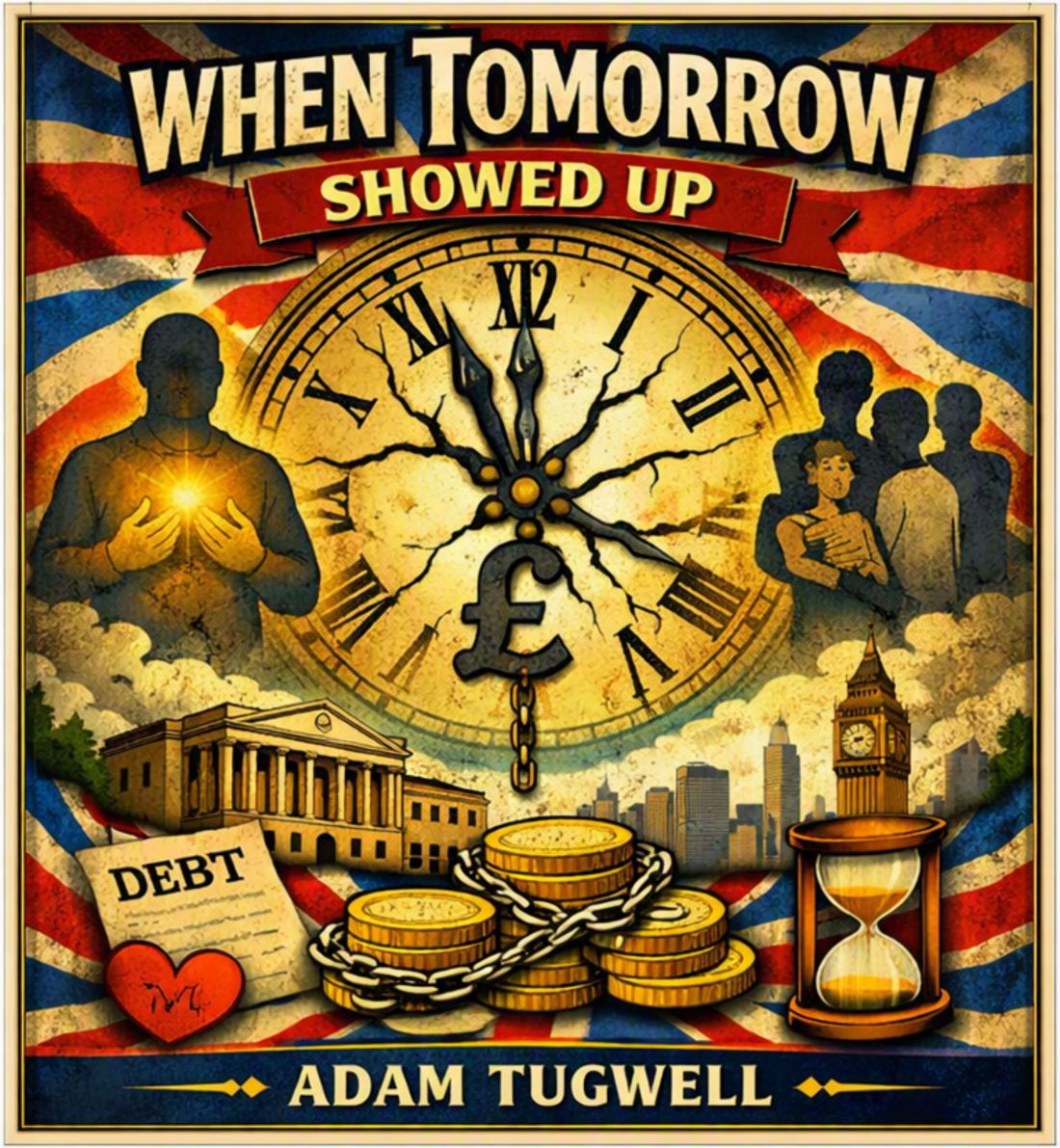
When Tomorrow Showed Up

A story about money, integrity, and the bill we keep passing on to people who haven’t arrived yet

‘The process by which banks create money is so simple that the mind is repelled.’
– J. K. Galbraith, Money: Whence It Came, Where It Went (1975)

One: The Problem for Tomorrow

Everyone has at least been tempted to delay, put off or put on hold a problem when it feels like there is actually a choice. We know, deep down, that we aren’t helping ourselves when we do this, especially if there is an unknown or unpredictable outcome involved – which is probably why it feels so appealing, if not easy, to literally put it off for another day.

Think of the letter that sits unopened in the drawer. The damp patch on the ceiling that we tell ourselves we’ll get looked at in the spring. The conversation we rehearse in our heads a hundred times but never quite start. None of these problems go away because we stop looking at them. If anything, they quietly grow.

So, let’s imagine all the things we would like to put off. To not deal with. Those things that will have a price once dealt with or acted upon, which it would just be nice to leave behind and pretend that they, or the need to address them, simply don’t exist. A difficult message to a loved one? A truth about a new partner to a friend? A relationship or friendship that it would feel better not to have to tell someone in particular, or anyone else, about? The list could be endless if we think about it, and what all these things have in common is that they are about things like honesty, integrity, respect, care and consideration for others – or, collectively, what we might call doing the right thing.

My guess is that most people reading this will have experienced a situation like this at least once in their lifetime, if not on a number of occasions. I know I have.

Something these things always seem to share is that the longer they are left alone or remain hidden, the greater and more far-reaching the consequences of waiting become – particularly if the truth comes out without it being our choice to tell it.

Because a problem left for tomorrow doesn’t sit still. A small untruth needs a second one to protect it. A debt left unpaid gathers interest. A crack left unfilled lets in the water that widens it.

The cost of putting something off is almost never the same as the cost of dealing with it. It is almost always bigger – and it is very often paid by someone other than the person who chose to wait.

The funny thing is that when we don’t make that choice – when we know we could keep quiet, hide things or put the consequences off, but we do the right thing at the time anyway – these things have a habit of working out for the best. There is a moral pay-off, even when there isn’t a material one.

Now imagine something much bigger. Imagine finding a way of doing things that brings a massive reward, with the potential to provide many more – and, this is the important part, a way that means, if you are clever and stick to some boundaries and rules, any reckoning can be put off not just for another day, but for so many days that it might never be a day that you, your children or even their children will have to face. The ultimate problem for tomorrow. All you would have to do is make sure everyone keeps playing by the rules – even if they don’t know the game that’s actually being played.

Do that, and you might never have to face it at all. Nor would anyone you appointed, or anyone appointed by those who followed – because most of them wouldn’t even know…

Two: When Nobody Is Watching

What I am really talking about here is doing the right thing, even when nobody is watching. There is a word for that: integrity. Funnily enough, integrity isn’t the main subject of this story. But it sits underneath every part of it, and if there is one thing I would ask you to take away, it may well be this.

Integrity is easy when people are watching. The real test comes when we know we could get away with something – when the consequences won’t land on us, or won’t land for years, or will land on somebody we’ll never meet.

So here is a question to carry with you. If it would be wrong for one person to quietly push the cost of their choices onto someone else, does it become any less wrong when it is done by a bank? Or a government? Or a whole society?

Does something stop being wrong just because it is done on a bigger scale, by more people, over a longer time?

Let me tell you a story that might help us answer it.

Three: The Banker

Imagine, if you will, a man who works in a bank. Not one of the friendly faces behind the counter at your local high street branch, always sounding lovely as they reset passwords and talk new customers through everything they’ll need. He works at a bank with a name you often hear newsreaders mention in the same breath as markets, economics, how public borrowing is going, and jargon like GDP.

He isn’t just someone crunching the figures or talking to the media about monetary policy. He is one of the people with whom the buck really stops – deciding what is done with the bank’s money, who it lends to, what bonuses are paid, how much help is given to others, and of course who those others will actually be.

I’ll simply call him the Banker.

The Banker has everything he wants. But he would like to have more, and to be able to do bigger things – things that have a much bigger pay-off than before.

All his time in banking has taught him how money makes people think and how it makes them behave. He knows all the formulas that sit behind the psychological levers of money – whether someone is rich or poor, a business or a government, and whatever it is they need money for.

Before we go on, pause for a moment. If you were him, and you knew what he knew – what would you do with it?

Four: The Secret

Because he knows everything about money, and how every part of the system that surrounds it works, the Banker has worked out what people will believe about money – or are willing to believe.

And that means he could literally create more of it. So long as the people who weren’t in on the secret still believed that the money in their hands was exactly the same the day after he changed the system as it was the day before.

Most people, then and now, picture money as a thing. Something solid, kept in a vault, once backed by gold sitting in a basement somewhere.

For a long time that picture was at least partly true: a pound or a dollar was a promise that could, in theory, be swapped for something real.

But the Banker knew the picture didn’t need to be true. It only needed to be believed.

The magic of creating money from nothing rests on creating a debt that isn’t really owed to anyone – but which he knows will be repaid, because he is confident that anyone he lets into the secret, or lends this new money to, will always pay it back, in a way and on a timeline where nobody need ever know that this new way of doing things exists.

And it is astonishingly simple. When the Banker approves a loan, he doesn’t go to a safe and count out notes that someone else deposited. He simply types a new number into the borrower’s account.

That money did not exist a moment before. There is no lorry delivering it, no vault opening, no gold changing hands. There is only a promise to pay it back – and that promise becomes money. When the loan is repaid, the money quietly disappears again.

He calls this money creation ‘credit’ for short. And he imagines all the things that could be done with an almost endless supply of it, and all the people who could be helped – as long as it is legal, and as long as one golden rule is kept: never create money that could not have come from a ‘normal’ route, over what would be considered a ‘normal’ period of time.

Which raises a question worth sitting with. If money can be created simply by a promise to pay it back, what is money, really?

And then, what happens if the promises start to grow faster than the real things – the homes, the food, the skills, the work – that the money is supposed to stand for?

Five: Bringing Everyone on Board

Rules won’t be a problem, the Banker reasons. If the people who actually run the country are brought on board, they will benefit from the new system too, because it will make it a lot easier for them to do whatever they want to do – as long as they play by the same rules of money creation, and change whatever rules and laws need changing to make it all legal.

‘We can give money to whoever we decide,’ he tells himself, ‘and nobody will ask where it comes from, because we are the banks. Nobody will see what’s really going on, as long as we play it right.’

So the Banker, and a few other bankers who share his world view and understanding, decide to go ahead. They bring in the people they need, all of whom benefit in some way from being on board – politicians who can suddenly pay for the things that make their lives easier, other bankers who are paid well, and key business people who know their stuff and can be trusted to pay back on time.

‘With the power we have,’ they agree, ‘we will be able to make whatever adaptations we need to do what we want – as long as we keep it real.’

Of course, money has a different effect on different people – especially when power and influence are involved – so, as the scope and dark brilliance of the new system rolls out, frameworks are put in place to make it all look responsible.

‘We will police the system by creating credit agencies,’ the Banker decides, ‘and as time goes by we will be able to judge everyone’s credibility by the records we keep on them.’

It would be easy to make the Banker a villain. But I don’t think that would be fair – and it would let the rest of us off far too lightly. Schemes like his are rarely born out of pure greed. More often they are born out of a problem that seems too big to solve any other way. A war that has to be paid for. A country that has to be rebuilt. A crisis that won’t wait. It is no accident that the Bank of England itself was founded, back in 1694, to lend money to a government that needed to fight a war.

And at first, it works. Roads are built. Homes are bought. Businesses start that would never otherwise have got off the ground. Wars are fought and, in some cases, won.

If you’re honest, you might even be on the Banker’s side by now. What’s the problem? It sounds brilliant.

Which brings us to one of the oldest moral questions there is: can something be wrong if the outcome is right? If the secret bought a victory, a recovery, a generation of prosperity – does the way it was done still matter?

Hold on to your answer. We will need it later.

Six: The Golden Rule

Everything depends on the golden rule: never create more money than could have come about by a ‘normal’ route, over a ‘normal’ period of time.

In other words – never let the promises get too far ahead of the real world.

I think it is quite possible that the Banker kept to that rule. He may have been confident – perhaps over-confident – but he understood what he had made, and why the limits mattered.

For anyone with a strong sense of what is right and what is wrong, it’s difficult to fathom the idea that money can be created literally by saying ‘this money now exists’ – especially if you’ve never had a lot, and have perhaps struggled to make ends meet with what you had.

But for those who have grown used to money, and comfortable with it, the morality looks very different.

And a rule like the Banker’s has a weakness built into it. It relies entirely on the restraint of whoever comes next. And whoever comes after them. And whoever comes after them.

Can you build a system that relies, forever, on the self-control of people you will never meet?

Seven: Passing the Baton

It started out well. The key was to stick to the rules. But the Banker, who designed the system and understood its limits, saw it very differently from those who came after him and had never known anything else.

The secret – or rather the open secret this system always really was, hidden only because so many people still thought all the money flowing around was ‘real’ – was passed like a baton from one generation of beneficiaries to the next. And with each handover, the new hands lost a little more sight of what was needed to keep it all under control.

Think about how a habit forms in any family or organisation. The first generation makes an exception, for a good reason, in a time of need. The second gets used to the exception. The third mistakes the exception for the rule. And the fourth cannot imagine there was ever any other way.

By the time the baton reaches that fourth pair of hands, nobody is asking whether the system is right any more. They are only asking how to get more out of it. And most of them aren’t bad people. They are doing exactly what they were trained to do, in the only system they have ever known.

The Banker’s successors started to believe it would be possible – realistic, even – to pay for whatever they wanted, especially if it gave them greater control over the profits and incomes they could then use to pay the ‘debt’ from the ‘credit’ back.

Around the 1980s, they found a philosophy to match. Economists today often call it neoliberalism, but at its heart was a simple belief: that markets, left free to buy, sell, compete and borrow, would always make better decisions than governments or communities could.

So industries that had been built and owned in common were sold off. The rules on banks and borrowing were loosened. Money was set free to go wherever it could earn the highest return, as fast as it could get there.

Put that belief together with the Banker’s secret, and something powerful happens. Money stops flowing mainly towards the things a community needs, and starts flowing towards whatever makes more money fastest.

And the question nobody inside the system seemed to ask was the simplest one of all: what happens to the places, the jobs and the people that the money flows away from?

Eight: The Hollowing Out

Unfortunately, whether by design or by accident, having control over what so many people see as real wealth also made those at the centre of the system, and those they helped, blind to consequence – blind to what money that is only believed to be real actually does when everyone who believes in it behaves as if it really is.

Over time, everything was hollowed out. People’s lives, communities and the environment were all hollowed out, and the value they once held was replaced by that giant IOU called credit. It took away the real value and left behind an extraordinary form of human debt: the loss of being able to identify with, and relate to, who we all really are.

That hollowing out rarely makes the headlines in one go. It happens a little at a time.

A family firm that has made things in the same town for eighty years is bought with borrowed money – and the debt used to buy it is loaded onto the firm itself. The buildings are sold and rented back. The profitable parts are sold off, the pension fund is squeezed, and what is left is closed when it can no longer carry the weight.

In the City, it is called a successful deal. In the town, a trade that took generations to learn disappears in a couple of years.

Homes stop being places to live and become places to put money. Prices rise faster than wages, year after year, because it is easier to lend against a house than to build a business. The parents who bought a home on one wage watch their children struggle to rent on two.

Water, energy, railways and the other things that were once built and owned in common are sold, borrowed against and run to produce a return. When the pipes leak, the rivers suffer and the bills rise, the debt is still there – and someone still expects to be paid.

The high street empties. The skills leave. The young people leave. And slowly, a place forgets what it was for.

None of this shows up as a debt on anyone’s bank statement. But it is a debt all the same. And from very early on, it was the people at the bottom of the ladder – the workers, the small towns, the communities with the least say – who paid it first, and paid it in full.

The debt was never only financial. The real bill was paid in lives, in places, and in the world around us.

Nine: The Stories We Were Told

At some point, the people doing well out of the system must have noticed. Not all of them, and perhaps not all at once.

But you cannot close that many factories, sell off that many shared assets, or watch that many town centres empty without someone, somewhere, beginning to ask questions.

And this is where the story becomes less about money and more about people. Because when a system that everyone depends on starts to show its cracks, the easiest thing to do is not to fix it. It is to explain it.

So we were given stories. That the jobs went because of technology, or global competition, or because people simply didn’t want to work. That the money had run out because of whoever was easiest to blame that year. That if prices rose, it was always someone else’s fault. That the answer to too much debt was more debt. That growth – measured by a number called GDP – would sooner or later lift everyone.

Some of those stories had grains of truth in them. Many were told by people who honestly believed them. But they all had one thing in common: they kept attention away from the system itself.

When the whole thing nearly fell over in 2008, it wasn’t allowed to. The banks were rescued. Then the central banks – the Bank of England among them – reached for the Banker’s oldest trick on the grandest scale yet. They created hundreds of billions of pounds of new money and called it ‘quantitative easing’.

The new money was used to buy up government debt and other assets, holding interest rates down and propping up prices. It kept the system going. Many have argued that it also made those who already owned property, shares and other assets a great deal richer, while those who owned nothing watched the things they needed slip further out of reach.

By then, some economists had begun to say out loud what the Banker had always known. A school of thought called Modern Monetary Theory argued that a country which creates its own currency can never simply ‘run out’ of money the way a household can – and that the real limit on what it can do isn’t money at all, but real things: people, skills, materials, energy and land. Push beyond those, and prices rise.

Whatever you think of that idea, notice where it lands. Even the theory that says money itself isn’t the problem agrees that real things are the limit. And real things – the skills, the industries, the communities, the land and the environment – are exactly what had been hollowed out.

You can create money from nothing. You can’t create a lost trade, a living river or a community’s sense of itself the same way.

Underneath it all sat one belief, so comfortable that it rarely needed saying out loud: that this is a system where everyone can have whatever they want, and worry about paying the bill later.

Of course, nobody can. Not a person, not a bank, not a country. A system that only survives by bringing in ever more borrowing to pay for the promises it has already made starts to look uncomfortably like a giant Ponzi scheme – and the thing being borrowed against, in the end, is the future itself.

Ten: Where Has All the Money Gone?

Over time, governments became completely beholden to the system too. Their success was measured by GDP – a number that counts how much is bought and sold, not whether life is getting any better. And when they needed more money than they raised in taxes, they borrowed it by selling bonds – in Britain, they are called gilts. A gilt is simply an IOU: lend the government money today, and it promises to pay you interest every year and give your money back on a set date.

Those IOUs are held by banks, pension funds, insurers and investors at home and abroad – and, after all that quantitative easing, by the Bank of England itself. Every year, interest has to be paid on every one of them.

It was only when things had gone so far that a once-rich country like the UK could no longer afford to do the things it used to do that ordinary people began asking the same question: where has all the money gone? And if we are now paying more in interest on what the country owes than we spend each year on educating our children – where do all those interest payments actually go?

The answer is simple, and uncomfortable. A large part of it goes to those who already hold money – paid for by those who do the work, through their taxes, through public services that no longer stretch as far, and through all the things that quietly stop being done.

Which brings us back to where this story began. Who decided this was a problem for tomorrow? And who did they think would be standing there when tomorrow arrived?

Eleven: When Tomorrow Showed Up

You may have realised by now that this is where – exactly where – we are right now.

The Banker’s story was never really about one banker. It is the story of the money in your pocket, the mortgage on your home, the pension you are counting on, and the country you live in. It is the story of the system we were all born into – the only one most of us have ever known.

And tomorrow didn’t arrive with a bang. There was no single day when the bill landed on the doormat. It arrived the way the damp patch on the ceiling does – slowly, and then all at once.

It arrived as a generation that cannot afford a home. As the potholes, the closed libraries and the waiting lists. As towns that have forgotten what they were for. As rivers that are no longer safe to swim in. As wages that buy less every year. As a growing sense, shared by people who agree on almost nothing else, that something has gone badly wrong – and that nobody in charge will say what.

And here is the cruellest part. The bill isn’t calculated in pounds. It is calculated in lost skills, lost trust, lost places and lost time. It can’t simply be refinanced, rolled over or printed away. The problem was never really put off at all. It was only passed on – to whoever happened to be standing there when tomorrow came.

The future has no vote. That is exactly why it was so easy to spend.

Twelve: The Greatest Crime of All Time?

So was this a crime? Perhaps even the greatest one of all time?

It is tempting to say yes, and to go looking for the people to blame. But remember how this story started.

Maybe the Banker had a genuine problem to solve. Maybe he kept to his own rules. Maybe most of those who followed him were decent people doing what they had been taught, in a system they never designed and never saw from the outside.

None of that makes it right. A harm doesn’t become acceptable because nobody meant it, or because it was spread across millions of hands over a hundred years. If anything, that is what makes it so serious.

A crime with a villain can be punished. A crime that everyone took part in, and that almost everyone benefited from in some small way, is far harder to face – because facing it means facing ourselves.

Which leads to the most uncomfortable question in this whole story. If you have ever had a mortgage, a pension, a loan or a credit card – or simply lived in a country that borrowed to keep the lights on – where do you stand in the chain?

And remember the question I asked you to hold on to: can something be wrong if the outcome was right?

What is your answer now?

Thirteen: Doing the Right Thing

We started with the small things – the message we didn’t send, the truth we didn’t tell, the letter we left in the drawer. And we said that the longer they are left, the bigger the consequences become, especially if the truth comes out without us choosing to tell it.

The same is true here. Tomorrow is already knocking at the door. The only real choice left is whether we open it ourselves – honestly, together, and with our eyes open – or wait for it to be kicked in.

Doing the right thing, even when nobody is watching, starts with being willing to look. To ask where money really comes from, who it really serves, and who really pays. To value the things that can’t be printed – skills, communities, places, the natural world and each other – as the real wealth they always were. And to stop handing our problems to people who aren’t here yet to argue back.

That is what integrity looks like when it is scaled up from one person to a whole society.

It isn’t easy. It never was. But as I hope this story has shown, the alternative was never really easier either.

It was only later.

Tomorrow has shown up. The only question left is what we do today.

Afterword: A Note on This Story

The Banker is not a real person. He is a way of telling a story that is far too big, and spread across far too much time, to be told any other way. He stands for the many people – bankers, politicians, officials and business leaders – who built, inherited and ran the monetary system we live with today.

Some of the details are simplified. Some of the steps may have happened in a different order, and some may have happened by accident rather than by design. Many of them were taken – and are still being taken – by people who have never seen or understood the monetary, financial and economic system in any other way. None of that changes the question at the heart of the story.

This was never meant to be an economics lecture. You didn’t need to know what a bond is, what fiat money means, or what anyone means by MMT or neoliberalism to follow it – and if you didn’t before, I hope you have a clearer idea now. What I hope you take away is a single question, and that you keep asking it: is this a problem for today, or a problem for tomorrow – and who decided?

Questions to Carry With You

For your own reflection, or for discussion with others:

  1. Does something stop being wrong just because it is done on a bigger scale, by more people, over a longer time?
  2. Can something be wrong if the outcome is right? Has your answer changed since you first met the question?
  3. If you had been the Banker, what would you have done with the secret?
  4. Where in your own town or community can you see the hollowing out? Who paid the bill – and who was paid?
  5. Which of the stories we were told have you believed? Which do you still believe?
  6. What would doing the right thing look like now – for you, for your community, and for the country?

A Few Words in Plain English

  • Credit – money lent to someone on the promise that they will pay it back. In today’s system, most new money comes into existence this way.
  • Debt – the other side of credit: what is owed, usually with interest on top.
  • Fiat money – money that has value because a government declares it to be money and people accept it, rather than because it can be swapped for gold or anything else.
  • Interest – the price of borrowing money; what the borrower pays the lender on top of the amount borrowed.
  • Bonds and gilts – IOUs that governments and companies sell to borrow money. A gilt is a UK government bond.
  • GDP (Gross Domestic Product) – a measure of the total value of everything bought and sold in a country in a year. It counts activity, not wellbeing.
  • Credit rating agencies – organisations that judge how likely a person, company or country is to repay what it owes.
  • Quantitative easing (QE) – when a central bank creates new money to buy government bonds and other assets, usually to keep interest rates low and the financial system running.
  • Neoliberalism – a set of ideas, dominant since around the 1980s, that markets usually make better decisions than governments, leading to privatisation and looser rules on finance.
  • MMT (Modern Monetary Theory) – an economic theory that says a country issuing its own currency can’t run out of money, and that the real limits are inflation and real resources.
  • Asset stripping – buying a business, often with borrowed money, and selling off its valuable parts for a quick profit, frequently leaving the rest to fail.
  • Ponzi scheme – a scheme that pays existing investors with money from new ones, and so collapses when the new money runs out.

Notes and Sources

  • The Bank of England was founded in 1694 to lend money to the government of William III, largely to fund war against France.
  • The end of the gold link: in August 1971 the United States suspended the conversion of dollars into gold, ending the last formal tie between the world’s major currencies and gold.
  • How banks create money: the Bank of England explains this in ‘Money creation in the modern economy’, Quarterly Bulletin, 2014 Q1.
  • Quantitative easing: the Bank of England’s asset purchases reached a peak of £895 billion between 2009 and 2021.
  • Debt interest and education: how UK debt interest compares with education spending depends on the year and on how each is measured. Check the latest figures from the Office for Budget Responsibility and HM Treasury before publication.
  • Epigraph: J. K. Galbraith, Money: Whence It Came, Where It Went (1975).