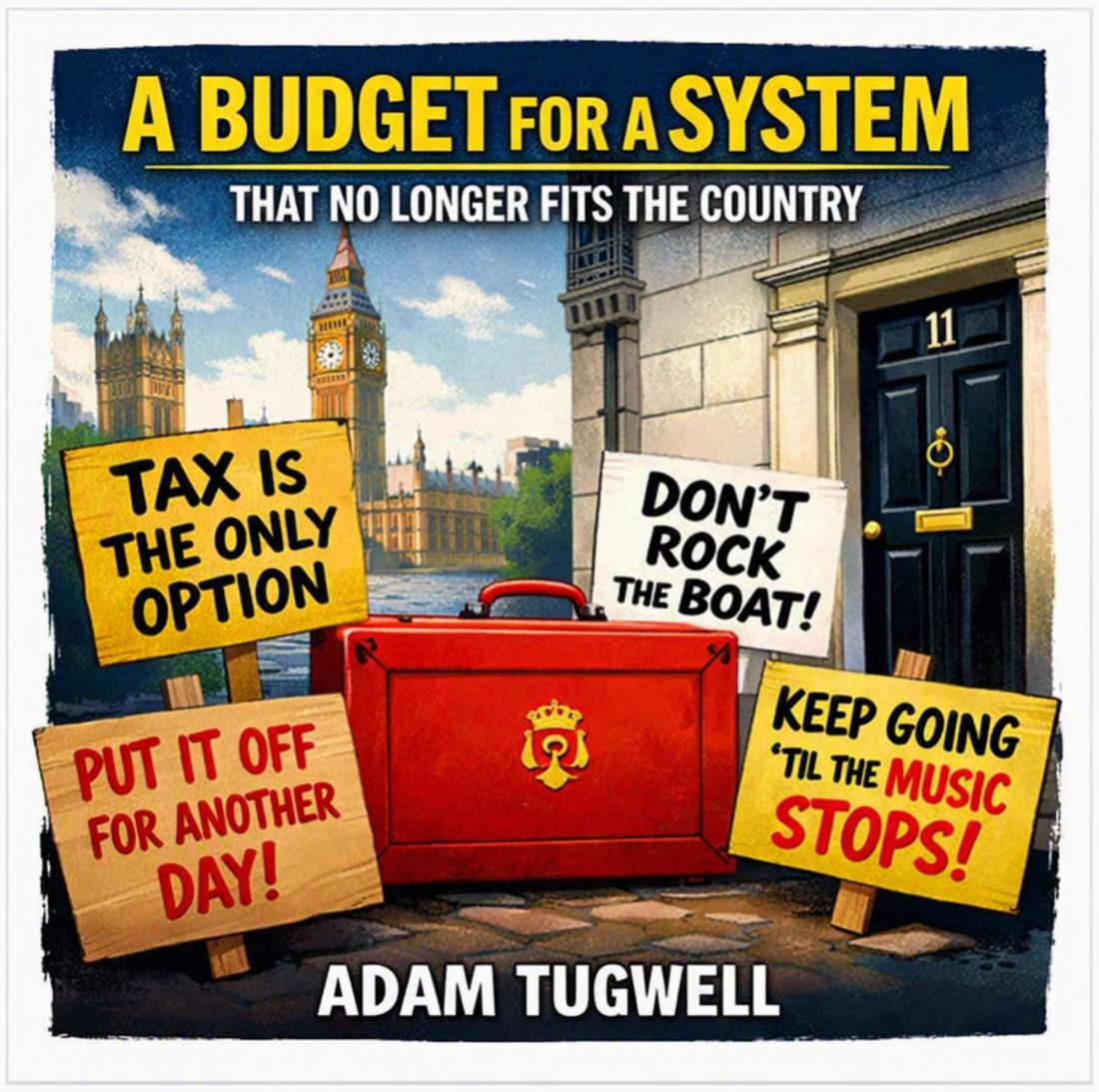
A Budget for a System That No Longer Fits the Country

Why the numbers and everyday life keep drifting apart – and why a change of leader, Chancellor or party cannot, on its own, close the gap

On 28 October the Chancellor will deliver a Budget built around growth, stability and fiscal credibility. Many households and small businesses will hear those words and struggle to recognise the country being described. This piece does not try to guess what will be announced. It tries to explain why that gap exists, why it affects any government of any party, and why it matters more than any single measure in the Red Box.

A note on approach: This is not a prediction, and it is not a case for or against any party. It is my own analysis of the conditions in which any Budget is now written. Where I reach conclusions, I have tried to show how I got there – and to set out the strongest objections to them.

In Brief

  • Every Budget is now judged on two scales: what it means for the markets and the public finances, and what it means for everyday life. Those two scales are drifting further apart.
  • When I talk about “the system”, I do not mean a party, a conspiracy, an economic theory or a group of people. I mean a shared worldview – unspoken assumptions about what counts as realistic, responsible, affordable and possible – that shapes every government, and many of those who oppose it.
  • The economic model those assumptions support was built for conditions that no longer hold: cheap energy, expanding globalisation, favourable demographics, falling interest rates and rising asset values.
  • Governments are not powerless. But the tools they inherit, and the institutions that use them, face the markets first and the public second.
  • That is why changing the leader, the Chancellor or the party does not, on its own, change the direction of travel.

Two Budgets on the Same Day

When the government delivers its Budget on 28 October, the country will once again hear the language of growth, stability and resilience. Forecasts will be revised. Headroom will be calculated. Commitments to the fiscal rules will be restated. In Westminster, that is how a Budget is judged.

But a second Budget is being written at the same time – at kitchen tables, in small business accounts, and in the monthly calculations millions of people make about food, rent, energy and fuel. For many of them, the numbers celebrated in the Commons will bear little resemblance to the reality they live in.

That feeling is not imagined, and it is not simply disappointment with one government. It is the result of a deeper problem – one that affects any government, of any party, operating inside the current economic model.

To explain why, I first need to be clear about what I mean when I talk about “the system”.

What I Mean by “the System”

Most people already sense it. It is the “they” that appears in so many conversations about politics: “they won’t allow it”, “they’ve already decided”, “they’ll never let that happen”.

When pressed to say who “they” are, people reach for different answers – the government, the Treasury, the civil service, the City, the media, “the elites”. Each answer contains a fragment of truth. None captures the whole.

That is because “they” is not really a group of people. It is a worldview – a shared set of assumptions about what is realistic, responsible, credible and possible.

In The Establishment Is Not What You Think It Is, I described this as the modern Establishment: not a class, a cabal or a secret network, but something closer to an operating system that runs quietly beneath politics, finance, the media and public institutions.

It is important to be clear about what this is not. It is not an economic theory, a party programme or a particular school of thought about money and markets.

People who disagree fiercely about policy can share it completely. It sits beneath those arguments, in the assumptions that decide which arguments are allowed to count as serious.

It shows up in what is treated, usually without discussion, as:

  • “realistic” – and what is dismissed as naive
  • “responsible” – and what is labelled reckless
  • “affordable” – and what is ruled out before it is ever costed
  • “credible” – and who is listened to, and who is not
  • “possible” – and what never reaches the table at all

None of this is enforced by conspiracy. It is enforced by incentives. Careers, institutions, budgets and reputations are rewarded for working within these assumptions and quietly penalised for questioning them.

Over time, the assumptions stop feeling like choices and start feeling like common sense. That is what makes them so powerful – and so hard to see from the inside.

It also means that anyone who lives and works within today’s version of normal life, including me, has been shaped by them in some way.

This is why decisions can feel as though they arrive from somewhere without anyone quite making them. The power is real, but it is distributed – spread across policy, finance, professional norms, media narratives and institutional habit. It speaks through many mouths while belonging to no single person. And because it protects the institutions that carry it, and keeps those who make decisions at a distance from the consequences, it is remarkably good at absorbing challenges – including from people who sincerely believe they are fighting it.

Today, that worldview is bound up with a particular economic model, built in Britain over roughly the last forty years.

That model relied on:

  • cheap energy
  • cheap labour
  • expanding globalisation
  • privatisation and outsourcing
  • low and falling interest rates
  • rising asset values, especially property

My argument is simple to state, even if its consequences are not: the assumptions are still in place, but the conditions they were built for are not.

The 2026 Budget is being written by people working with tools designed for a world that has changed beneath them.

Why the Budget Will Feel Detached From Real Life

For most people, the economy is not a set of numbers. It is the cost of food, the rent or mortgage payment, the energy bill, the price of diesel, the viability of a small business and the ability to plan for the future. Yet the Budget will be framed around growth – a measure that has become increasingly detached from lived experience.

That is not to say growth is meaningless. Within the current model it matters a great deal: tax revenues, borrowing capacity, pensions and public services all depend on it, which is precisely why every government pursues it.

The problem is what growth has become. It now functions primarily as a system metric – a number that stabilises borrowing, reassures markets and keeps the machinery turning.

It does not tell you whether your household is secure, whether your business can survive, or whether your community is thriving.

Part of the reason lies in what we take money to be. As I explore in The Money Illusion, money is real in its effects, but it is not a fixed substance. It is a social and legal system of claims, promises and credit – and we do not all enter that system on equal terms.

When new purchasing power is created through lending, it becomes real title over real things: homes, land and businesses. A growing economy, measured in money, can therefore sit alongside households and small firms steadily losing ownership, security and room to manoeuvre, under terms they never chose.

Behind this sits a more fundamental point. The tools of economic government – fiscal rules, growth forecasts, borrowing costs, market confidence – face outward towards the markets first and inward towards the public second.

A Budget built with those tools will naturally speak the language of the markets. That is why so much of what is announced can sound reasonable in Westminster and remote almost everywhere else.

And this year, the gap between the two is being widened by pressures that sit largely outside Westminster’s control.

The Pressures Shaping This Budget

The UK is not facing one crisis. It is facing multiple overlapping pressures, many of which have little to do with the domestic choices of any single government.

They are structural, global and long-term – and together they define the space within which any Chancellor must work.

1. Energy and Fuel: The Hidden Tax on Everything

Diesel prices, oil volatility and gas markets are not just energy issues. They are cost-of-everything issues. Higher fuel and energy costs feed into food distribution, construction, farming, manufacturing, public services and the running costs of small businesses – often long before they show up in the inflation figures.

2. Global Shipping and Chokepoints

The Strait of Hormuz is one example, but the vulnerability is wider: disruption in the Red Sea, drought restrictions on the Panama Canal, rising shipping insurance costs, container shortages and geopolitical tensions along key trade routes. Britain’s supply chains are global. When the world’s arteries narrow, Britain feels it quickly.

3. Fertiliser, Farming and Food Security

Fertiliser costs rise with gas prices. That affects planting decisions, crop yields and livestock feed – and, months later, supermarket prices. As I argued in The Fragile Nation, Britain’s reliance on global food systems leaves it far more exposed to shocks than is often acknowledged. This is not a short-term issue. It is structural.

4. Climate Volatility and Extreme Weather

Floods, droughts, storms and heatwaves are not only environmental stories. They are economic ones. Climate pressures now shape food production, insurance costs, infrastructure resilience, supply chain reliability, water availability and energy demand.

5. Demographics, Health and the Workforce

Britain faces an ageing population, rising demand for health and social care, workforce shortages, weak productivity and long-term sickness at record levels. Together, these increase the demands on public spending while narrowing the base that pays for it.

6. Debt, Interest Rates and Fiscal Constraints

Higher interest rates mean more expensive government borrowing and less fiscal headroom, alongside higher mortgage costs, pressure on renters and squeezed small businesses. But the question is no longer simply how much borrowing costs. It is whether borrowing is possible at all on terms the country can bear. The ability to borrow rests on market confidence, and that confidence is now wafer-thin. When borrowing is expensive, conditional on the markets’ continued patience and growth is weak, the levers left to a Chancellor narrow sharply. That is why, as I have argued before, tax increasingly becomes “the only tool they have left”.

7. Technology, AI and Circular Fragility

Financial markets, supply chains and AI-driven industries are now so interlinked that they are set to rise and fall together. That brings higher volatility, the potential for faster contagion, more systemic risk and less room for error. AI is also widely presented as the route to renewed productivity – a claim I return to below, because it contains a tension that rarely features in Budget debates.

8. The End of the Operating Model

Beneath all of these sits the pressure that connects them. The model built over the last forty years depended on cheap energy, cheap labour, expanding globalisation, low and falling interest rates and rising asset values. None of those conditions can be relied upon today. Each of the pressures above would be difficult on its own. Together, they arrive at a model that no longer has the slack to absorb them.

This is the core constraint behind the Budget.

Why Changing the Leader Does Not Change the Rules

Much of our political debate assumes the answer lies in better people: a more competent Chancellor, a bolder Prime Minister, a different party. That assumption is understandable. It is also, I believe, increasingly misleading.

In The Contemporary Politicians’ Dilemma, I explored what happens when people arrive in office and come face to face with the system they have inherited. Read as a whole, it points to an uncomfortable conclusion: that the system is already failing, and that the job on offer is not to fix it but to manage its decline.

That discovery is not confined to one government. Those now in Downing Street and the Treasury have themselves acknowledged that they did not fully understand the state of the country until they were briefed in post.

It is fair to ask what that says about readiness for office. But the more important point is that they are no different from anyone else who might stand in their place.

The deeper question is about a system in which people can reach the highest offices in the country without a clear view of what they are inheriting.

Once in office, the pattern repeats. Whatever a new government intends, it quickly finds itself managing borrowing costs, market reactions, fiscal rules, service pressures and the next set of headlines.

The machinery of government – the Treasury, the fiscal rules, the forecasting process, the relationship with the bond markets – is itself oriented towards the markets. Its instinct is continuity, because continuity is what the markets reward.

This is why I describe many of today’s political figures as managers rather than leaders. It is not a personal criticism. It is a description of what the system rewards.

Even those who arrive intending to lead are gradually turned into managers by the incentives and institutions around them.

A large parliamentary majority creates real agency on paper. In practice, that agency is overwritten by the cost – economic, political and social – of using it to change direction.

It is also why so much of the gesturing from other parties and leaders should be treated with caution. The promise that a change of leader or party will, by itself, put things right is a powerful one. But many of those presenting themselves as outsiders operate within exactly the same assumptions: success judged by market confidence, growth treated as the unquestioned goal, competition as the organising principle.

Anti-establishment rhetoric is not the same thing as anti-establishment thinking – and in some cases it is a more intense version of the same worldview.

When a change of leadership is no longer the solution, presenting it as one is not just unhelpful. It is dangerous, because it directs public frustration at people rather than at the assumptions they share.

There is a second, quieter version of the same problem. British politics is showing signs of a two-part messiah complex: the belief among some politicians that they are uniquely equipped to lead the country – the self-anointed – and the belief among some supporters that stability will come from choosing the right individual rather than from strengthening the system itself – the self-comforted.

It is not confined to one party, or one wing of a party. It can be heard in the suggestion that the markets would simply “fall in behind” a particular leader, as though systems respond to personalities rather than to signals, and in support for would-be leaders built on tone and managerial polish rather than on defined proposals.

These two instincts look like opposites, but they meet in the same place. Both assume that leadership is primarily about the individual. Both assume the public will accept personality in place of substance. And both assume the system will wait while politics settles its internal contests.

It is not waiting. Local authorities are warning that they cannot meet their statutory duties. Public services are running with little slack. The pressures set out above are already shaping the country’s direction. A politics preoccupied with succession and positioning at such a moment is facing not so much a crisis of ideology as a crisis of focus – and focus is the one thing the country cannot afford to lose.

Testing the Argument: The Strongest Objections

An argument like this should be tested against the strongest case against it. These are the objections I take most seriously – and why I do not think they overturn it.

“Governments are not powerless”

They are not. Governments can still tax, spend, regulate, legislate, invest and reform. Choices on planning, energy, skills and infrastructure make real differences to people’s lives. Anyone who claims otherwise is overstating the case.

But agency is not the same as freedom of direction. The tools available to government are system tools, and the institutions that use them are market-facing.

Governments can choose how to manage the existing model; what they find far harder is choosing a different one.

The model expects them to keep extracting – from households, businesses, public services and public assets – to sustain it, and it offers no natural point at which that extraction stops.

Those who can read the bigger picture are left with an uncomfortable question: can I lead us out of this?

In practice, the honest answer is a choice between managing the model for as long as it can be managed, or deliberately changing direction – something that would demand far more disruption than any Budget statement could contain.

“Britain is not uniquely fragile”

That is true, and it matters. Ageing populations, rising debt, energy constraints, weak productivity and political fragmentation are visible across much of the developed world. Britain is not special.

My argument is not that Britain is on a different path, but that it may be further along the same one.

The shocks and choices of the last decade – including Brexit and the economic response to Covid – have amplified pressures that were already building and brought them into focus sooner here than elsewhere.

Several of our closest neighbours face versions of the same strain, some acutely. That is worth remembering whenever closer alignment with Europe is presented as a straightforward way out: our neighbours are travelling in the same direction, and in some cases are not far behind.

“Growth still pays for everything”

Within the current model, it does. Tax revenues, public services, pensions and borrowing all depend on it, and no responsible government can ignore that.

But that is precisely the point. Growth is essential only for as long as we remain bound by the mechanics of this model.

If managing decline remains the only direction anyone in government is prepared to take, growth will remain the master metric.

The question is not whether growth matters within the system, but whether a system that depends on it can still deliver security to the people living inside it.

“We have been here before”

Every generation believes its problems are uniquely difficult, and systems do adapt. Britain came through the crisis of the 1970s, including the 1976 IMF loan, and through the financial crisis of 2008. Perhaps this is simply another painful period of adjustment.

But the comparison with 1976 is less reassuring than it first appears. Britain then still had a substantial productive base – manufacturing, industrial and energy capacity that recovery could be built around.

Much of that has since been hollowed out, and the economy is now organised around growth, consumption and asset values rather than genuine productive capacity.

Households, too, have far less resilience. Conditions of the kind that come with external rescue would land on a society already dealing with homelessness, food insecurity and stretched public services – and they would not, on their own, address the underlying issue.

“Technology will lift productivity”

It may. AI, automation and energy innovation could raise output significantly, and it would be wrong to dismiss that possibility.

But productivity only becomes prosperity if people still have secure incomes. Much of the current wave of technology is built on the assumption of a large base of paying customers and subscribers – many of whom are the same people whose work it is designed to replace.

That is not an argument against technology. It is an argument that technology alone cannot resolve a problem rooted in how the model distributes its gains.

The Choice Few Are Willing to Name

If this analysis is broadly right, the choices facing this government – and any that follow it – are stark, even if they are rarely stated openly. Neither is easy, and each carries real costs.

Option 1: Manage the model for as long as possible

This is the path most governments take, and it is not hard to see why. It is politically safer. It avoids immediate shocks. It keeps services running, markets calm and the machinery turning. It buys time. Its cost is that the underlying pressures continue to build, each crisis leaves less room for manoeuvre, and the gap between the numbers and lived experience keeps widening.

Option 2: Change direction by choice

This would mean openly acknowledging the limits of the current model and beginning to redesign it: how value is created, how success is measured, how money circulates locally, how public capacity is rebuilt, and how institutions are made answerable to lived reality rather than to the markets alone.

It could offer a path to longer-term stability. Its cost is significant short-term disruption – economic, political and social – and it would mean confronting the very incentives that brought today’s leaders to power.

Describing the second option as blowing up the existing model would not be an overstatement. That is why few politicians focused on re-election are prepared to risk it.

The incentives of the system reward caution over candour, performance over transformation and management over leadership.

There is also a third possibility that nobody chooses: that change eventually arrives on terms set by events rather than by policy. Nothing in this piece predicts whether or when that happens. But it is the quiet consequence of treating the first option as the only responsible one.

What to Look For on 28 October

Rather than guessing what the Chancellor will announce, it may be more useful to ask a few questions of whatever is announced:

  • Is success being measured by what reassures the markets, or by what changes for households, businesses and communities?
  • Do the measures address the structural pressures – energy, food, housing, health, local capacity – or manage their symptoms?
  • Is local government and community capacity treated as a cost to be contained, or as part of the country’s resilience?
  • Does growth appear as a means to better lives, or as an end in itself?
  • Does anything in the Budget question the assumptions behind the model, or does it simply restate them?

These are not partisan questions. They can be asked of any Budget, from any government.

Conclusion: The Wrong Tools for the World We Now Live In

The point of this piece is not to predict what the Chancellor will say. It is to explain why so much of what is said may feel disconnected from everyday life.

It is because the Budget is written, first and foremost, for the machinery: the markets, the fiscal rules and the forecasts. It is because the pressures shaping the economy – energy, shipping, food, climate, demographics, debt and technology – are global, structural and long-term. And it is because politics is still operating inside a worldview that defines what counts as realistic, responsible and affordable by the standards of a model built for conditions that have passed – even as that model explains less and less about how people actually live.

None of this is the fault of one Chancellor, one Prime Minister or one party. In their different ways, they are all in the same boat.

The Budget cannot fix these things because it was never designed to fix these things. Not because politicians lack will, but because the tools they have inherited are the wrong tools for the world we now live in.

Whether this Budget is judged a success in Westminster will depend on forecasts, headroom and the reaction of the markets.

Whether it is judged a success by the public will depend on something much simpler: whether everyday life feels any more secure in six months’ time than it does today.

The growing distance between those two measures may be the most important economic story of all.

Real change will not begin with a new leader, a new party or a new slogan. It begins when enough people stop mistaking the existing model for reality itself – and start asking what a system built for the world we now live in might look like.

Further Reading

This piece draws on a wider body of my work. The essays below follow the same arc as the article: what “the system” is, why growth has drifted away from everyday life, how households and businesses are being squeezed, why Britain has become more fragile, and what leadership means when the model itself is under strain.

I. Understanding the System

The Establishment Is Not What You Think It Is

Why the modern Establishment is a worldview rather than a class, and why even those who oppose it often operate inside it. The foundation for what this piece means by “the system”.

The Contemporary Politicians’ Dilemma

How politicians discover, on entering office, that the system they inherit is already failing – and why that leaves them with so few meaningful levers.

Why We Keep Looking for Answers in the Direction That Created the Problem

On paradigm blindness: the tendency to reach for the same tools, even when those tools helped create the crisis.

The End of Britain’s Current Operating Model: Thatcherism’s Forty-Year Reign and the Beginning of the Post-Thatcher Era

A structural account of the forty-year model behind today’s economy, and why the conditions that sustained it no longer hold.

II. Growth and the Gap With Everyday Life

Why Politicians Obsess Over Growth – And Why It Has Nothing To Do With You

Why GDP has become a political ritual rather than a measure of public wellbeing.

The Harmful Truths Hidden Behind Political Growth

How growth narratives can mask deeper structural weaknesses – and why governments hold on to them.

The Money Illusion

Why money is not a fixed substance but a social and legal system of claims, promises and credit – and how created purchasing power becomes real title over real things, in a system whose rules were never equal.

Why Britain Feels Like We Are Being Priced Out of Everyday Life

A structural explanation of why essentials – food, housing, energy and transport – feel increasingly out of reach.

III. Households, Small Businesses and the Squeeze

When Tax Is the Only Tool They Have Left

Why traditional economic levers have worn out, leaving taxation as the mechanism governments can still use – and what that means for households and businesses.

Why Small Businesses Are Struggling

How rising costs, fragile supply chains and systemic pressures are squeezing small firms – and why the model treats them as revenue sources rather than partners.

Stop Blaming Welfare for Problems This Economic Model Created

Why public frustration is so often directed at welfare rather than at the structural failures of the economic model itself.

IV. A Fragile Nation: Food, Supply Chains and Global Systems

The Fragile Nation: Why Britain Can No Longer Rely on a Global Food System

How global food systems are becoming less reliable, and why Britain’s dependence on imports leaves it exposed to shocks.

Feeding Britain on Eleven Per Cent: Farming, Inflation and the Illusion of Food Security

How limited domestic production interacts with fertiliser costs, climate pressures and global volatility.

The Age of Circular Fragility: Why AI and the World Economy May Now Rise and Fall Together

How financial markets, supply chains and technology have become so interlinked that volatility rises and resilience falls.

V. Leadership and the Performance of Politics

The Performance of Politics: Why Power No Longer Serves People

How political actors have become performers of power rather than exercisers of it – leaving the public trapped in narrative rather than action.

The Time for Performance Is Over

A call for political honesty at a moment when performance can no longer hide structural decline.

What Leadership Means When the System Is Failing

What real leadership looks like inside a failing system, and how it differs from the management politics that now dominates Westminster.

Closing Note

Taken together, these essays form a map of the moment Britain now occupies: a worldview that still defines what counts as realistic, an economic model built for conditions that have passed, a politics increasingly focused on personalities and performance, fragile supply chains, and a public squeezed by forces far larger than any single policy.

They do not predict what will happen next. They explain why the choices available to any government – including the one delivering the 28 October Budget – are shaped by pressures far larger than any single party or personality.


The Cure for Misinformation | Why falsehood spreads so easily in a society that has already lost its grip on reality

Many people feel that the world is going mad. Facts seem negotiable. Institutions contradict themselves. Public debate hardens into rival realities, each with its own evidence, enemies and explanations. We usually describe this as a crisis of misinformation, as though false claims arrived from outside and contaminated an otherwise healthy society.

But misinformation is not the beginning of the crisis. It is what becomes possible when a culture has already weakened its relationship with reality.

For decades, we have organised more of life around a system that rewards what is profitable, convenient and advantageous, even when it conflicts with what is true, sustainable or right. Most of us participate because participation appears to work. It pays the bills, confers status, offers comfort and promises security. The system therefore feels real because its rewards are real – until the moment they are not.

This creates a strange condition: a shared reality built on arrangements that many people privately recognise as unstable, contradictory or morally compromised. We learn to live with the gap. We call it pragmatism. We adapt. We look away. And in doing so, we become used to a world in which appearance and advantage can matter more than truth.

That is the environment in which misinformation flourishes. It does not need to pull people out of reality. It only needs to enter a culture in which reality has already become fluid.

1. Misinformation lands easily when reality is already negotiable

Misinformation is not new. Rumour, propaganda and deliberate deception are as old as human society. What is new is the ease with which falsehood can now settle into everyday life and feel plausible.

The usual explanation is technological: social media spreads claims quickly, algorithms reward outrage and bad actors exploit attention. All of that matters. But it does not explain why so many claims find an audience ready to receive them.

Falsehood needs something to attach itself to. It lands most easily where people no longer trust the public account of how the world works-and where their distrust is not entirely irrational.

When an institution says one thing and does another, when a company speaks of responsibility while externalising harm, or when political language bears little relation to lived experience, people learn a lesson. They learn that official reality is often a performance. They become accustomed to reading between the lines, assuming hidden motives and treating every claim as strategic.

At that point, misinformation is not entering a world of settled truth. It is competing in a marketplace of narratives. Its advantage is not necessarily that it is convincing. It is that the alternatives have already spent their credibility.

2. The system feels real because participation is rewarded

The system we inhabit is not imaginary. Its wages, prices, debts, deadlines and penalties are concrete. Its benefits are concrete too. People participate because participation can provide income, identity, convenience, recognition and a measure of security.

That is precisely why the deeper unreality is difficult to see.

A system can function and still rest on false assumptions. It can generate wealth while exhausting the people and places on which that wealth depends. It can celebrate choice while narrowing the practical choices available. It can speak the language of human value while measuring almost everything in money, output, growth and attention.

Most of us are bought into this system at some level, not because we endorse every part of it, but because refusing it carries a cost. We make compromises, accept contradictions and tell ourselves that this is simply how the world works. As long as the arrangement appears beneficial, its underlying flaws remain tolerable.

Then comes the moment when the benefit disappears: the job is lost, the institution fails, the promised security proves temporary, the environment deteriorates, or the future offered to the next generation no longer looks credible. What seemed solid is suddenly revealed as conditional.

This is the non-reality reality: a social order that is experienced as unavoidable and treated as normal, even while its values and claims increasingly fail the test of lived experience.

3. “You cannot con an honest man”

The old saying is deliberately uncomfortable: You cannot con an honest man.

It does not mean that only bad people are deceived. Intelligent, decent and careful people can be misled. The saying points to the opening a con requires: the wish for an outcome that reality does not support – a shortcut, an easy return, a flattering explanation, a justification for what we already want to believe.

The same principle applies at the level of a society. A culture becomes easier to deceive when it has already accepted dishonesty in more respectable forms. If we routinely tolerate misleading language, concealed costs, performative virtue and rewards detached from contribution, we cannot be surprised when cruder falsehoods find a market.

The vulnerability is moral before it is informational. We want the system to be legitimate because our lives are organised through it. We want our compromises to be harmless because acknowledging their cost would demand change. We want our advantages to be deserved and our discomforts to have simple causes. Misinformation succeeds by offering stories that protect those desires.

This is why the proverb belongs in the argument. The con does not create the appetite. It recognises it.

4. A fluid society produces fluid truths

Once a society grows accustomed to contradiction, truth begins to feel less like a common standard and more like a position to be managed.

Institutions publish values that their incentives undermine. Politics presents choices without addressing the structures that constrain them. Advertising turns desire into need. Public relations converts failure into messaging. Digital platforms personalise what each person sees until a shared picture of events becomes harder to sustain.

None of this means that every institution lies or that all public knowledge is false. It means that people experience enough distance between language and reality to become suspicious of language itself.

In that atmosphere, an unsupported claim can feel no less credible than an official statement. A conspiracy can seem more coherent than a complicated truth. A confident voice can outperform a careful one because certainty feels like solidity.

Misinformation therefore does not win by proving itself. It wins by arriving in a world where proof has lost status, trust has been depleted and every account is assumed to serve somebody.

5. Why the usual remedies are not enough

Fact-checking, media literacy, responsible platform design and proportionate regulation all have a role. False claims can cause real harm, and practical safeguards matter.

But these measures operate downstream. They treat misinformation as a defect in the flow of information rather than a symptom of a deeper failure in the culture receiving it.

A fact-check can correct a claim. It cannot restore trust to an institution that has behaved without integrity. Media literacy can teach people to examine a source. It cannot make public life coherent when incentives repeatedly reward pretence. Regulation can slow the circulation of a lie. It cannot give people a reality worth trusting.

Worse, control imposed by institutions that have not earned confidence can confirm the very suspicion it is meant to reduce. People do not hear, “We are protecting a shared reality.” They hear, “The same system that misled us now wants greater authority over what may be said.”

The point is not that every remedy is censorship, or that nothing should be done. It is that no informational solution can repair a moral and structural problem on its own.

6. The cure is reality, rebuilt through integrity

If misinformation feeds on the distance between appearance and reality, the durable response is to close that distance.

That begins with values – not as slogans, branding or private sentiment, but as standards that carry a cost. Honesty matters when telling the truth is inconvenient. Responsibility matters when the consequences can no longer be passed to somebody else. Service matters when there is no immediate return. Stewardship matters when restraint limits profit. Community matters when belonging demands more than agreement.

Institutions regain trust by becoming trustworthy. Businesses regain legitimacy by valuing people and places as more than inputs. Leaders regain authority by accepting limits, admitting error and aligning their words with their conduct. Individuals regain their bearings by refusing the small daily bargains through which unreality becomes normal.

This is not a call for a perfect past. Earlier societies were often unjust, exclusionary and dishonest in their own ways. Nor is it a demand for one uniform morality imposed from above. It is a simpler proposition: a society cannot maintain a shared reality if it repeatedly rewards behaviour that denies what is true and evades what is right.

Reality is not restored by insisting more loudly on the official version of events. It is restored when the world people are asked to believe resembles the world they actually experience.

Conclusion: Misinformation is not the madness. It is the symptom.

The spread of misinformation is often described as an assault on reality. But it may be more accurate to see it as evidence that reality had already been weakened.

We built a culture in which participation often requires compromise, in which advantage can outrank truth, and in which institutions ask for trust while behaving in ways that corrode it. Because the system still delivers benefits, most of us continue to cooperate with it. We treat it as reality. Yet the arrangement remains convincing only while its promises appear to hold.

When they fail, people do not simply lose faith in one policy, company or leader. They begin to doubt the whole account. Into that doubt come explanations that are simpler, darker and more emotionally satisfying. Misinformation lands ridiculously easily because it does not have to overturn a stable reality. It enters a reality already made fluid by compromised values and failing legitimacy.

The answer is not to abandon fact-checking, education or sensible safeguards. It is to recognise their limits. A society cannot fact-check its way to integrity. It cannot regulate its way to trust. It cannot censor its way to reality.

The deeper cure is to make our shared world believable again: to say what we mean, to do what we say, to accept the real costs of our choices and to organise life around values that remain valid when they are inconvenient.

When reality is lived rather than merely asserted, misinformation loses the conditions it needs. The bearings return – not because everyone agrees, but because truth is no longer treated as whatever best serves the system in the moment.

The AI Middle Ground | Beyond hype and panic: why the real challenge is not whether we use artificial intelligence, but whether we use it honestly, competently and responsibly

AI is neither magic nor a monster. It is a powerful, fallible tool-and the quality of its impact depends on the judgement of the people and institutions using it.

Last week, someone used AI to improve an email and then joined a conversation in which people criticised colleagues for using AI. Neither part of that scene would feel unusual. That is the strange position we have created for ourselves: artificial intelligence has become ordinary, but admitting to using it can still feel risky.

AI is already woven into daily life. It helps people draft, organise, translate, summarise, explore ideas and make sense of information. Students use it to understand difficult concepts. Workers use it to get started, keep up or communicate more clearly. Families encounter it inside products and services without always noticing.

Yet our public conversation remains trapped between two poles. At one extreme, AI is treated as magic: frictionless, authoritative and ready to replace almost anything. At the other, it is treated as a monster: inherently corrupting, socially ruinous or destined to escape human control. Both stories are seductive. Neither is a sound foundation for judgement.

The more useful position lies in the middle. AI is powerful. It is useful. It is fallible. It can extend human capability, but it can also conceal weak thinking, scale bad decisions and encourage people to surrender responsibility. The central question is therefore not simply whether AI is used. It is whether the person using it can understand, evaluate and stand behind the result.

The strange secret everyone shares

If you have used AI recently, the reason may have been modest. Perhaps a paragraph would not come together. Perhaps a blank slide needed a first outline. Perhaps an unfamiliar idea needed explaining in plain English. These uses are now commonplace, but people often describe them in whispers, if they describe them at all.

The result is a peculiar double standard. Workers quietly use AI to polish reports, then question a colleague who does the same. Managers use it to prepare material, then warn their teams not to depend on it. Students use it to structure their thinking, while assuming any classmate who mentions AI must have cheated. Writers use it to break a creative block, yet worry that disclosure will invalidate the work.

Not all of these uses are equivalent, and that is precisely the point. A student who asks for an explanation of a difficult concept is doing something fundamentally different from a student who submits an unexamined generated essay. An employee who uses AI to create a first draft and then checks every claim is not behaving like someone who presents an output they cannot explain. When all AI use is compressed into one moral category, honest use is discouraged and irresponsible use becomes harder to see.

AI is not the taboo. Transparency is. The person who discloses thoughtful use may be judged more harshly than the person who hides careless use. That rewards appearance over competence and secrecy over responsibility.

What we are actually getting wrong

The problem is not that people are using AI. The problem is how they are using it, what they expect from it and whether they remain capable of judging its work.

Imagine two colleagues preparing the same report. One understands the subject, uses AI to organise a rough draft, checks the evidence, challenges weak phrasing and takes responsibility for the final version. The other asks for a finished answer, accepts it because it sounds confident and sends it under their own name. The tool is the same. The intellectual act is not.

The same distinction matters in education. Using AI as a patient tutor can support learning: it can offer another explanation, test understanding or suggest questions to investigate. Using it to bypass the learning process produces the appearance of knowledge without the substance. One strengthens capability; the other hides its absence.

AI becomes dangerous when it replaces human understanding. People who do not understand a domain may use fluent output to fabricate expertise, produce work they cannot evaluate, trust claims they cannot verify or present themselves as competent when they are not. That is not augmentation. It is impersonation.

The deeper incentive is human, not technical. Many workplaces and institutions reward speed, polish and certainty. AI makes it easier to display all three, even when knowledge is shallow. If we reward the appearance of competence at any cost, we should not be surprised when people use new tools to manufacture it.

Technology is rarely dangerous simply because it exists. It becomes dangerous when people stop thinking, checking and accepting responsibility for what they do with it. The risk is not the tool alone. It is the abdication of judgement.

The fear machine

None of this means that AI carries no serious risks. Bias, privacy loss, surveillance, misinformation, concentrated power, insecure deployment and disruption to work all deserve sustained attention. The mistake is to let dramatic speculation crowd out the harms and choices already in front of us.

Two narratives dominate much of the debate. The first imagines AI-driven human extinction. Views on that possibility differ sharply, and uncertainty should invite scrutiny rather than dismissal. But distant scenarios often receive more attention than the immediate questions shaping workplaces, classrooms, public services and democratic trust: Who is accountable? What data was used? Can a decision be challenged? What happens when a confident answer is wrong?

The second narrative is that AI will make human beings redundant. This fear is more immediate, but even here agency matters. Technologies do not restructure organisations by themselves. Leaders choose what to automate, which safeguards to retain, who benefits from productivity gains and whether human expertise is preserved or discarded. AI may enable those choices, but it does not absolve the people making them.

The real threat is not simply replacement. It is devaluation: treating judgement, care, experience and accountability as costs to be removed rather than capabilities to be protected. Institutions can use AI to support people, or they can use it as a convenient explanation for decisions they already wanted to make.

This is why the double standard at the top matters. Some of the loudest warnings about AI coexist with a race to deploy it quickly. Public caution can sit beside private acceleration; calls for safety can sit beside resistance to meaningful scrutiny. That does not make every warning cynical. It does mean we should look beyond rhetoric and ask who holds power, who bears risk and who remains answerable when systems fail.

The real risk

At the individual level, secrecy creates its own damage. Students, workers, managers, writers, recruiters and publishers may all use AI while judging others for doing so. Honest use is punished, hidden use is rewarded, real capability becomes difficult to assess and misuse is pushed further from view.

This is not a coherent ethic. It is a culture that asks people to pretend.

The better boundary is responsibility. Anyone using AI should remain responsible for understanding the domain, evaluating the output, verifying consequential claims, protecting sensitive information, preserving their own capability and communicating honestly about material use. In high-stakes settings, that responsibility should be supported by clear governance, human oversight and a meaningful route to challenge decisions.

Responsibility also means knowing when not to use the tool. Convenience is not the same as appropriateness. A system that is helpful for brainstorming may be unsuitable for a confidential record, a legal conclusion, a medical decision or any task where the user cannot recognise a serious error.

When responsibility collapses, trust and capability follow. People lose confidence in work they cannot trace. Organisations become dependent on systems they cannot question. Knowledge thins out because fewer people practise the craft required to judge the output. AI does not create every one of these weaknesses. It reveals them, and it can scale them.

A workable middle ground

We do not need a ban, a panic or another story in which technology acts and human beings merely watch. We need a cultural reset built on five practical commitments.

Be honest. AI is already part of everyday work and learning. Clear, proportionate disclosure is healthier than ritual denial. The purpose is not to confess to using a tool; it is to make responsibility visible where that use materially affects the work.

Understand before you rely. People should not outsource judgement they do not possess. Domain knowledge, verification and an awareness of limitations are the ethical boundary between assistance and blind dependence.

Keep humans answerable. AI can suggest, organise and generate. It cannot carry moral or professional responsibility. A named person or institution must remain accountable for consequential decisions and outputs.

Distinguish different kinds of use. Augmentation is not automation. Exploration is not impersonation. Professionalising a rough expression is not fabricating expertise. Policies that ignore these differences will be both unfair and ineffective.

Protect capability. A tool should help people think and perform better, not leave them unable to work without it. The test is not only whether AI makes a task faster today, but whether its use strengthens or erodes the judgement needed tomorrow.

These principles do not settle every case. They provide something more useful than a slogan: a way to ask better questions. Did the user understand the subject? Could they detect an error? Was the use appropriate to the risk? Was anything important concealed? Who is accountable for the result? Did the process preserve or weaken human capability?

What happens next is still ours to decide

Every technological era eventually discovers the same truth: tools reveal us. They reveal what we value, what we are willing to overlook and where we prefer convenience to responsibility.

AI is revealing how often we reward appearance over competence, certainty over understanding and speed over care. It is also revealing something more hopeful: used well, it can help people learn, communicate, explore and contribute with greater confidence.

The question is not whether AI will change society. It already has. The question is whether we will use it to strengthen human judgement or gradually replace it with the performance of judgement.

AI did not create our inconsistency, our fragile systems or our temptation to avoid responsibility. It exposed them. The answer is not less thought about AI, but better thought: more honesty, more understanding, clearer accountability and a willingness to distinguish responsible assistance from intellectual surrender.

AI will not decide what happens next. We will-if we remain willing to understand the tools we use, answer for the choices we make and protect the human capabilities that give those tools value.

Further Reading

A wider conversation about AI, responsibility and the systems we build

If this essay has been useful, you may find value in exploring the broader set of ideas that led here. Over the past several years, I’ve written a series of pieces examining how artificial intelligence interacts with human behaviour, organisational incentives and the deeper question of what it means to preserve human capability in a technological age.

These essays approach the subject from different angles – cultural, ethical, economic, philosophical and systemic – but they share a common thread: AI does not decide what happens next. We do. And the choices we make about judgement, responsibility and honesty shape every outcome that follows.

The selection below is ordered to help you explore these themes in a way that builds understanding rather than overwhelm.

1. Actions Speak Louder Than Digital Words (2023)

Link: https://adamtugwell.blog/2025/03/20/actions-speak-louder-than-digital-words-full-text/

Summary: A foundational reflection on how digital tools amplify human intent rather than replace it. It argues that responsibility cannot be outsourced – a principle that underpins all later writing on AI ethics and judgement.

2. The Lie That Makes AI Dangerous (2026)

Link: https://adamtugwell.blog/2026/04/17/the-lie-that-makes-ai-dangerous/

Summary: A critique of the myths surrounding AI. It explains how misunderstanding – not intelligence – creates fear, distortion and poor decision-making.

3. The AI Middle Ground (2026)

(The essay you’ve just read) Summary: A practical exploration of the double standards shaping AI use. It argues for honesty, competence and responsibility as the boundary between augmentation and impersonation.

4. AI Isn’t the Risk, It’s the Reckoning (2026)

Link: https://adamtugwell.blog/2026/07/09/ai-isnt-the-risk-its-the-reckoning-how-the-guardrails-we-removed-made-artificial-intelligence-feel-dangerous-and-what-it-reveals-about-the-system-we-built/

Summary: A systemic analysis of how AI exposes weaknesses in the structures we built long before AI arrived. It shifts the conversation from individual behaviour to institutional responsibility.

5. The Spirit in the Machine (2026)

Link: https://adamtugwell.blog/2026/07/27/the-spirit-in-the-machine-why-emerging-intelligence-deserves-respect/

Summary: A philosophical reflection on emerging intelligence. It argues that powerful tools deserve seriousness and respect – not because they are human-like, but because they shape human outcomes.

6. Human Redundancy Is the Real Threat (2026)

Link: https://adamtugwell.blog/2026/09/11/human-redundancy-is-the-real-threat/

Summary: A reframing of the “AI will replace us” narrative. It shows that redundancy is not caused by AI itself but by systems that devalue human capability and judgement.

7. The Age of Circular Fragility (2026)

Link: https://adamtugwell.blog/2026/08/28/the-age-of-circular-fragility-why-ai-and-the-world-economy-may-now-rise-and-fall-together/

Summary: A macroeconomic exploration of how AI and global systems have become interdependent. It examines how fragility in one amplifies fragility in the other.

8. The Greatest Benefit of AI Today Will Be a New Dark Age of Stupidity and Ignorance (2025)

Link: https://adamtugwell.blog/2025/04/27/the-greatest-benefit-of-ai-today-will-be-a-new-dark-age-of-stupidity-and-ignorance-that-our-surrender-to-it-will-bring/

Summary: A warning about capability erosion. It argues that blind dependence on AI risks thinning out knowledge, weakening judgement and creating a society that performs competence rather than possessing it.

9. AI Won’t Make Life Cheaper for Those Who Cannot Work (2025)

Link: https://adamtugwell.blog/2025/01/15/ai-wont-make-life-cheaper-for-those-who-cannot-work-and-the-mega-rich-would-be-using-their-money-to-help-others-right-now-if-they-were-going-to-do-it-for-everyone-in-the-future/

Summary: A socioeconomic critique of the belief that AI-driven productivity will automatically benefit everyone. It argues that inequality is a human choice, not a technological inevitability.

10. The Future of Work: Redefining Value, Meaning and Human-Centric Employment (2025)

Link: https://adamtugwell.blog/2025/12/08/the-future-of-work-redefining-value-meaning-and-human-centric-employment-in-the-age-of-ai-and-economic-change/

Summary: A constructive vision for human-centred employment. It explores how work, value and meaning must evolve in an AI-driven economy – and how society can protect human capability rather than erode it.

11. The Human Sovereignty Charter for Artificial Intelligence (2026)

Link: https://adamtugwell.blog/2026/03/07/the-human-sovereignty-charter-for-artificial-intelligence-a-constitutional-framework-for-human-centred-governance-of-ai-full-text/

Summary: A constitutional framework for AI governance. It articulates principles for responsible deployment: human judgement, capability preservation, accountability, transparency and ethical boundaries.

Closing Note

These pieces were written across several years, but they belong to the same conversation. Each one examines a different facet of the same central question: how do we use powerful tools without surrendering the human capabilities that give them value?

If you choose to explore further, you’ll find a progression – from early reflections on digital responsibility, through cultural contradictions and systemic fragility, to governance principles and visions for the future of work. Together, they form a wider argument: AI does not decide what happens next. We do, through the honesty, understanding and responsibility we bring to the tools we use.

The Two Conditions That Make Work Work

Why people and especially young people look at the jobs on offer today and quietly think: “This doesn’t make sense.”

1. When Work Stops Working

If you talk honestly with people about work – not the official line, not the political noise, just the lived reality – you eventually reach the same conclusion: work doesn’t feel like it works anymore. Not in the way it used to. Not in the way it’s supposed to. And young people, more than anyone, can see that. They’re not confused, they’re not entitled, and they’re not disengaged because of screens or attitudes. They’re looking at the deal on the table and recognising that it simply doesn’t make sense.

Work is supposed to be the bridge between effort and life. It’s meant to give you the ability to stand on your own feet and the sense that what you’re doing matters.

But the modern system has quietly stripped both of those things away. And when you boil it down, work only really works when it gives you one of two things: independence or value. Ideally both. But at least one.

2. The First Condition: Financial Independence

Financial Independence is the foundation of adulthood. It’s the ability to rent a place without bankrupting yourself, to buy food without doing mental arithmetic in the aisle, to get around, to have a social life, to save a little, to make choices about your own life. It’s not luxury. It’s not excess. It’s the basic ability to live without relying on parents, welfare, or debt.

But minimum wage doesn’t get you there. It doesn’t even come close. It barely covers the basics, and even then you’re juggling, compromising, cutting corners. You’re working, but you’re not independent. You’re employed, but you’re not free. And young people can see this as clearly as anyone else who is struggling.

They can do the maths. They know that the jobs being pushed at them don’t lead to independence. So when they hesitate or disengage, it’s not because they don’t want to work. It’s because the work on offer doesn’t do the one thing work is supposed to do.

3. The Second Condition: Value

The second condition is just as important, and just as absent.

Work has to give you a sense of value – not corporate “values”, not a mission statement, not a poster in the staff room, but real human value.

The feeling that what you’re doing matters to someone, or something, or even just to yourself. That you’re contributing. That you’re learning. That you’re part of something that isn’t pointless.

Value does not mean enjoying every minute of a job. It means being able to see how your effort contributes to something beyond simply generating revenue.

But look at the jobs the modern economy produces. So many of them exist because the system is built around global supply chains, centralised decision‑making, and profit extraction.

Work becomes a cost to be minimised, not a human activity to be dignified.

You end up with roles that are repetitive, hollow, disconnected from anything real. Jobs that don’t build capability. Jobs that don’t meet human needs. Jobs that don’t connect you to your community. By contrast, the work people most often describe as meaningful lets them see who benefits from their effort: colleagues, customers, patients, neighbours or the wider community.

Older and past generations often had work that produced something tangible. Young people and older lower-paid workers today inherit work that produces output, but not meaning. And they feel that hollowness immediately.

The obvious question is how an economy that depends on work ended up producing so many jobs that deliver neither independence nor value. The answer lies in what the economy has been organised to prioritise.

4. The System That Produces Jobs That Fail Both Conditions

None of this is an accident. It reflects an economy increasingly organised around stimulating wants while making many basic needs harder to secure.

Streaming services, fast fashion, takeaways, processed food, endless digital consumption – these things aren’t needs, but the economy treats them like essentials.

Meanwhile, the actual essentials – housing, healthcare, nutritious food, transport, education – have become luxuries. Hard to access. Hard to afford. Hard to rely on.

The problem is not that services built around wants have no value, or that the people doing those jobs contribute less. It is that the system often rewards the creation and consumption of wants more reliably than the meeting of needs. The result is too many roles that provide neither a secure livelihood nor a visible connection between effort and social value. They fail both conditions.

The lower paid have already been hurt and pushed aside by this. And young people aren’t confused by this either. They’re simply the first generation to see the system clearly at the start.

5. Young People Didn’t Fail – The System Did

For years, society has misdiagnosed youth disengagement. It has blamed smartphones, social media, entitlement, lack of resilience, poor attitudes, apathy, welfare dependency.

But none of that explains what’s actually happening. Young people aren’t disengaged because they’re shallow or distracted. They’re disengaged because the system offers education built on sameness and measurement, social mobility built on narrative rather than capability, governance that is distant and hollow, welfare scapegoating that hides economic failure, and work that doesn’t deliver independence or value.

They’re not rejecting adulthood. They’re rejecting a version of adulthood that doesn’t work.

6. Why People Increasingly Reject Jobs That Fail Both Conditions

When work fails both conditions, rejecting it is not laziness. It’s discernment.

People are not refusing responsibility. They’re refusing exploitation.

They’re not rejecting work. They’re rejecting employment that offers neither independence nor value.

And when you look at the reality of what’s on offer, it’s hard to argue with them.

7. The Path Forward: Locality, Contribution, and Real Value

The way forward isn’t about tearing the whole thing down. It’s about recognising where work actually works – and it’s always the same place: locally.

When decisions are made close to the people they affect, work becomes meaningful again. When value is created and recognised within communities, work becomes human again. When contribution is rewarded instead of consumption, work becomes purposeful again. And when basic living standards are guaranteed – not as luxuries, but as the foundation of life – work becomes a bridge again, not a trap.

This isn’t a utopian idea. It’s simply the conditions under which work has always worked, for everyone.

8. Work Has to Work

Work only works when it gives independence, value or both.

Right now, too many jobs give neither.

Young people aren’t the problem and the low paid and vulnerable in older generations have been struggling too. Young people are just the first to recognise the problem, right ‘out of school’. And they’re right.

Work has to work. It has to mean something. It has to lead somewhere. It has to connect you to life, not drain you from it.

Until the system can offer that again, people of all ages will keep rejecting work that doesn’t work. And honestly, who can blame them.

Further Reading

Exploring the deeper roots of why work doesn’t work for so many – and what a better system could look like.

The ideas in The Two Conditions That Make Work Work don’t exist in isolation. They sit within a wider story about how young people are treated, how our political and economic systems have drifted away from real life, how education has been reshaped around measurement rather than capability, and how meaningful contribution for everyone has been pushed aside by consumption and profit‑centric thinking.

The following pieces expand on those themes. They’re arranged in a way that helps a reader move from understanding why young people feel the way they do, through how the system creates these conditions, and finally toward what a better future could look like for everyone.

I. Understanding Young People’s Experience of the System

The Young People Who Didn’t Fail – And the System That Keeps Pretending They Did

A clear, honest look at how young people are blamed for outcomes created by the system itself. This piece explains why disengagement is not a personal failure but a predictable response to structures that don’t work.

Why Young People and Smartphones Are Not the Problem

A dismantling of the idea that technology is responsible for youth disengagement. It shows how smartphones have become a convenient scapegoat for deeper systemic failures.

The Real Crisis Behind the Social Media Ban

This piece explores how political and media narratives about social media distract from the real issues affecting young people – including the erosion of independence, value, and meaningful pathways.

Why these matter: These articles help readers understand that young people aren’t rejecting work, society, or adulthood. They’re responding rationally to a system that has stopped offering the basic conditions required for any of those things to function.

II. Politics, Governance, and Why Young People Disengage

Young People, Politics, and the System That Is Failing All of Us

A deep dive into why young people feel alienated from politics – not because they don’t care, but because governance has become distant, hollow, and disconnected from real life.

Stop Blaming Welfare for Problems This Economic Model Created

This piece explains how welfare is used as a political distraction from the structural failures of the economic model itself – failures that directly shape the work crisis.

The Local Economy & Governance System

A foundational explanation of how local governance and local economies can restore meaning, accountability, and value – themes central to rebuilding work that works.

Why these matter: They show that the crisis in work is inseparable from the crisis in governance. When decision‑making becomes remote and abstract, work becomes remote and abstract too.

III. Education, Capability, and the Myth of Social Mobility

The Two‑Edged Sword of Social Mobility

A critique of how social mobility has been reframed around narrative and status rather than real capability – leaving many young people feeling inadequate despite having genuine strengths.

Vocational GCSEs and the Limits of a System Built on Measurement

An exploration of how education has become obsessed with metrics, qualifications, and standardisation – often at the expense of real learning and practical contribution.

Education Is Currently Failing the UK

A long‑standing argument that equality in education has been misunderstood as sameness, leading to a system that fails to recognise different strengths and pathways.

Equality in Education Has Been Destroyed by the Idea That All Can Make the Best of the Same Opportunities

A companion piece showing how the “one‑size‑fits‑all” model harms capability, confidence, and long‑term prospects.

The Travesty of Tuition Fees

A clear explanation of how the commercialisation of education created debt, distorted incentives, and pushed young people into pathways that don’t lead to independence or value.

Why these matter: They reveal how the work crisis begins long before a young person enters the labour market. The system shapes expectations, limits capability, and funnels people into roles that fail both conditions.

IV. Contribution, Local Value, and a Better Future

The Contribution Culture

A vision for a future where contribution – not consumption, not credentials, not profit extraction – becomes the foundation of work, business, and governance.

Future Economics Must Be Tied Only to People and Their Contribution

A broader economic argument showing how currency, value, and contribution must be re‑anchored to human needs rather than speculation or global extraction.

The Basic Living Standard Explained

A clear, accessible explanation of what a basic living standard is, why it matters, and how it underpins independence – the first condition that makes work work.

Why these matter: These pieces point toward a future where work can once again deliver independence and value – not through abstract policy, but through local contribution, real capability, and systems designed around human needs.

Closing Note

If The Two Conditions That Make Work Work resonates with you, these pieces will help you explore the deeper roots of the problem – and the practical, human‑centred ideas that can guide us toward something better.

They’re not academic papers or political manifestos. They’re reflections on how life actually feels for people navigating a system that has drifted away from what matters.

Taken together, they form a journey: from understanding the crisis, to recognising its causes, to imagining a future where work works again.

Madness by Metaphor

How fear turns the symptoms of a changing world into stories of certainty

We are living through an age of competing alarms. In every direction, someone is warning that a decisive threat has finally revealed itself: migration, elites, artificial intelligence, global institutions, war, environmental collapse, surveillance, pandemics, spiritual corruption or social breakdown.

The subjects differ, but the emotional structure is remarkably consistent. Something vast is happening; ordinary explanations are inadequate; and unless we recognise the hidden cause, it may soon be too late.

Some of these warnings contain important truths. Many begin with real events, legitimate grievances or visible changes. The error is not necessarily invention. It is interpretation: the conversion of a partial truth into a complete explanation.

Most fear-driven narratives are not explanations of what is happening. They are metaphors built around symptoms of a deeper condition that people can sense but cannot easily name.

We feel instability before we understand its sources. We experience declining trust, technological acceleration, economic pressure, institutional weakness and the loss of shared meaning. These forces are diffuse, entangled and difficult to hold in the mind.

A narrative gives them a face. It identifies an agent, supplies a motive and offers the relief of certainty.

This essay is not an argument for dismissing uncomfortable claims, nor a defence of institutions that have often earned distrust. It is an attempt to understand the machinery by which fragments of reality become totalising stories-and how intelligent, educated people can become especially skilled at mistaking a persuasive metaphor for the underlying cause.

The Fever and the Diagnosis

Imagine a patient with a fever. One observer calls it influenza; another, infection; another, poisoning; another, an immune response; another, stress. The fever is real. What remains uncertain is the diagnosis.

Public life now works in much the same way. People encounter a common set of symptoms-uncertainty, declining confidence, rapid change, social fragmentation and a growing sense that events are escaping anyone’s control. They then attach those symptoms to the explanation that best fits their experience, politics, temperament or community.

The mistake is subtle but consequential. We begin with an effect and treat it as a cause. A visible pressure becomes proof of a hidden design. Bureaucratic failure becomes evidence of omnipotent coordination. Technological disruption becomes a settled story about human redundancy. Cultural change becomes a plan of erasure. Political conflict becomes the final battle between good and evil.

The metaphor succeeds because it makes the abstract concrete. It compresses a system into a villain, a date, a slogan or a prophecy.

Yet compression is not comprehension. The story may illuminate one feature of reality while concealing the shape of the whole.

The Longing for “Before”

Much contemporary fear is sustained by nostalgia: the belief that stability can be recovered by returning to an earlier arrangement.

But what people miss is rarely a period in all its complexity. They miss a feeling-the sense that life was sufficiently predictable, institutions sufficiently legible and personal choices sufficiently meaningful.

Stability, safety, security and agency are emotional experiences as much as historical conditions. When they weaken, almost any visible change can become a symbol of what has been lost.

The past is simplified into order; the present is experienced as a breakpoint; the future becomes a threat.

This is why arguments about policy so often carry the force of existential struggle. The contested object is seldom only immigration, technology, climate, health or government. Beneath it sits a more intimate question: Will I still recognise the world, and will there still be a place for me within it?

The Seduction of Certainty

Complexity is exhausting. It demands time, attention, humility and a willingness to live without immediate closure.

Most of us are already overloaded by work, finances, relationships and a continuous stream of information. A simple narrative therefore offers more than an explanation. It offers relief.

Narrative-makers-commentators, activists, influencers, politicians, entrepreneurs, spiritual guides and establishment figures-do not always set out to deceive. Many sincerely believe the patterns they describe.

But sincerity does not guarantee accuracy, and confidence can conceal how much an explanation leaves out.

The most successful stories share several features. They begin with recognisable facts. They connect those facts to lived anxieties. They identify an agent with apparent motive and power. They transform uncertainty into intention. Finally, they offer the audience a privileged role: unlike the deceived majority, you can see what is really happening.

This structure is persuasive because it satisfies emotional and intellectual needs at once. It provides belonging, moral orientation and the pleasure of pattern recognition. It also protects itself from challenge.

Missing evidence becomes evidence of concealment; failed predictions become proof that the plan changed; disagreement becomes proof that the critic has been captured.

Why Intelligence Is Not a Safeguard

We often assume that education or intelligence protects a person from narrative capture. It may do the opposite.

Intelligent people are good at recognising patterns, constructing coherent accounts, finding supporting material and defending a position under pressure. Once committed to a premise, they can build an exceptionally sophisticated structure around it.

The danger is not stupidity. It is premature certainty.

A clever explanation can answer every objection and still be solving the wrong problem. The more elegant the explanation becomes, the harder it is to revisit its starting assumptions.

Intelligence then operates not as a searchlight but as counsel for the defence: selecting evidence, refining arguments and protecting an identity that has become bound to being right.

Humility is therefore not the opposite of intelligence. It is one of intelligence’s necessary disciplines. The essential question is not merely, Can I make this theory cohere? It is, What would show me that I have mistaken a symptom for a cause?

Power Does Not Abolish Human Frailty

Fear narratives frequently depend on an image of powerful people as fundamentally different from everyone else: colder, more rational, more coordinated and more capable of executing a unified design.

Power certainly creates opportunities for concealment and abuse. It can insulate decision-makers from consequences and place extraordinary resources behind bad judgement. But it does not remove ordinary human weakness.

Imagine winning a life-changing lottery. You might become more guarded, more selective about whom you trusted and more dependent on advisers, security and controlled information. From the outside, the resulting behaviour could look secretive or calculated. From the inside, it might feel like self-protection.

This is the Euromillions effect: resources magnify the reach of familiar instincts. Wealth and status can amplify fear, self-preservation, groupthink and the conviction that one’s own interests are exceptional. When these behaviours occur among governments, institutions or billionaires, their scale makes them appear more coherent than they are.

None of this excuses misconduct or rules out coordination. It does, however, suggest a more credible default. Apparent design may emerge from overlapping interests, institutional incentives, imitation, panic and bureaucratic drift.

Human frailty magnified by resources can produce outcomes that look conspiratorial without requiring a single controlling mind.

Different Stories, the Same Anxiety

The value of comparing fear narratives is not to decide that every claim is equivalent. It is to notice how different claims can perform the same psychological function.

Cultural displacement

Arguments about migration and cultural change gain force because the changes are visible, identity matters, public services experience pressure and political language is often evasive. A totalising narrative converts these realities into deliberate replacement. What may be a difficult mixture of labour demand, conflict, demographic change, policy failure and global inequality is compressed into a single intentional project.

Global control

Claims about the World Economic Forum, the United Nations or Agenda 2030 draw strength from opaque institutions, technocratic language and an understandable suspicion of remote decision-making. Yet broad frameworks, elite networking and bureaucratic ambition are not the same as unified command. The metaphor of a world government gives scattered forms of influence a single centre and motive.

Technological redundancy

Warnings that artificial intelligence will replace humanity begin with substantial concerns: automation will alter work, concentrate power and challenge assumptions about creativity and expertise. But the most apocalyptic versions also express a deeper fear-the fear of becoming unnecessary. A technical development becomes a metaphor for lost human value.

Political apocalypse

The claim that democracy will end if the other side wins contains an awareness that institutions can weaken and norms can be broken. Yet repeated across political camps, it also reveals collapsed trust. Ordinary conflict is interpreted as the final contest because people no longer believe the system can absorb defeat, error or change.

Environmental and biological catastrophe

Climate disruption and infectious disease are real domains of risk that require serious evidence, planning and collective action. Fear becomes distorting when uncertainty is converted either into inevitable doom or into proof that the danger is fabricated. One story promises collapse; the other promises conspiracy. Both can spare the believer from the harder work of weighing probabilities, trade-offs and incomplete knowledge.

Alien disclosure

The possibility of life elsewhere is not inherently absurd, and unresolved aerial observations deserve careful investigation. The narrative expands when secrecy, partial disclosure and existential wonder are assembled into timetables, motives and claims of certainty that the available evidence cannot yet bear. Here the metaphor may be humanity’s oldest anxiety in modern form: that powers beyond our understanding are directing events.

Spiritual purification

Ideas of awakening, ascension or purification give turbulence a transcendent purpose. They can offer meaning and encourage serious reflection. They become hazardous when charismatic certainty replaces personal inquiry, when every setback confirms a cosmic timetable, or when metaphor is presented as mechanism. The longing beneath the story is often not foolishness but a hunger for meaning in a disenchanted world.

Other narratives-elite takeover, world war, digital dystopia, permanent political lockout, civil conflict or the next pandemic-contain their own mixtures of evidence, possibility and projection. The task is not to flatten their differences or dismiss them in advance. It is to ask what each story clarifies, what it hides and which deeper anxiety it makes bearable.

What Lies Beneath

If these stories are metaphors, what are they metaphors for? No single answer is sufficient, but several conditions recur: complexity exceeding individual comprehension; institutions losing legitimacy; technology moving faster than social adaptation; economic insecurity; information overload; political systems that appear unable to solve long-term problems; social fragmentation; and the erosion of shared accounts of who “we” are and what the future is for.

These conditions interact. Institutional failure increases distrust; distrust makes coordination harder; failed coordination deepens insecurity; insecurity makes simple explanations attractive; simple explanations reward figures who intensify conflict; intensified conflict further weakens institutions.

The loop produces the feeling that events are accelerating even when no one is fully in control.

People discussing immigration, AI, climate, aliens, global governance or spiritual awakening may appear to inhabit entirely different worlds. At a deeper level, many are expressing the same recognition:

I no longer understand the world I live in, and I am no longer confident that those in charge understand it either.

That statement should not be mocked. It may be one of the most honest descriptions of the present. The mistake comes when discomfort with not knowing is converted too quickly into certainty about who knows, who caused it and what must happen next.

Effects Mistaken for Causes

The greatest danger is not any single narrative. It is a public culture increasingly organised around misdiagnosis.

Fear narrows perception. It accelerates judgement, rewards certainty and makes complexity feel like evasion.

Under its influence, we become highly responsive to visible effects and less capable of tracing the systems that produce them.

We fight the symbol, amplify the messenger and leave the underlying condition untouched.

This does not mean that threats are imaginary. Systemic fragility, material inequality, technological concentration, ecological pressure, institutional decay and the erosion of trust are serious.

Precisely because they are serious, they deserve better than stories that convert them into spectacle.

When effects are mistaken for causes, attempted solutions can deepen the original problem. Distrust is answered with greater secrecy; fragmentation with harsher tribalism; uncertainty with censorship or propaganda; loss of agency with submission to a new authority.

Each response then generates fresh evidence for the opposing narrative.

Metaphor is indispensable. It helps us think about realities too large to grasp directly. But a metaphor is a map, not the terrain. Madness begins when the map is defended more fiercely than the world it was meant to help us navigate.

A Discipline of Clarity

Clarity is not the absence of fear. It is the refusal to let fear complete the argument.

It begins by separating observation from interpretation. What happened? What do I infer from it? Which part do I know through direct experience, and which part reached me through selection, framing or repetition? What evidence would count against my preferred account? Does my explanation require more coordination, competence or foresight than institutions usually display?

Clarity also requires proportion. A possibility is not a probability; a pattern is not necessarily a plan; a shared interest is not always a conspiracy; institutional failure is not proof of innocence; scepticism is not cynicism; and uncertainty is not permission to believe whatever feels most complete.

Above all, we need the patience to remain with an unfinished diagnosis. That is culturally difficult because the information economy rewards immediacy, outrage and certainty.

Yet the ability to say I do not know yet may be one of the most responsible forms of judgement available to us.

Conclusion: Beyond the Loudest Story

Every age creates myths. The myths change, but the needs beneath them do not. When uncertainty rises, people search for certainty. When complexity becomes unbearable, they search for simplicity. When trust collapses, they search for prophets. When the future becomes difficult to imagine, they turn symptoms into stories that can be named, opposed or survived.

The challenge is not to eliminate narrative; that would be impossible. It is to hold our narratives lightly enough that reality can still correct them.

The world is changing, and stability will not come from pretending we can return to an idealised past. Nor will it come from selecting the most compelling account of who betrayed us. It will come, if it comes at all, from rebuilding agency, trust and shared meaning while learning to interpret the present without demanding that it first become simple.

The loudest narratives are rarely the whole truth. The quietest realities rarely announce themselves. Between them lies the difficult work of discernment: looking beneath the fear, beneath the symbol and beneath the answer that arrived too quickly, until we begin to see the shape of the question itself.

Further Reading

The Myth Catcher: A Quiet Guide to Discovering Clarity in an Age of Noise
The conceptual starting point for this essay. This piece examines how myths take hold when trust weakens, why persuasive interpreters become false prophets without necessarily intending deception, and how discernment can interrupt the movement from uncertainty to belief. Madness by Metaphor develops that argument by asking what fear narratives symbolise-and what they prevent us from seeing beneath them.

The Moment
The wider context for the sense of rupture explored here. This essay considers the intuition that society is approaching a breakpoint. Read alongside Madness by Metaphor, it helps distinguish between the pressures that may genuinely be converging and the competing stories through which those pressures are interpreted.