Nobody Arrives at the Beginning

Why the present inherits more than it chooses and shapes more than it can see

Introduction

As the results of the November 2026 United States midterm elections began to come in, I was listening to James Talarico’s appearance on The Diary of a CEO with Steven Bartlett. The interview had been recorded on 8 September, while Talarico was campaigning for the United States Senate in Texas. By the time I began writing, NBC News had projected his victory. Yet it was a reference to a much older document, rather than the election itself, that stayed with me.

The conversation ranged across affordability, inequality and the relationship between money and political power. During it, Talarico mentioned the Powell Memorandum. I had never heard of it. Curiosity, rather than agreement with any particular account of its influence, led me to read further.

What I found was a confidential memorandum written by Lewis F. Powell, Jr. on 23 August 1971 for Eugene B. Sydnor, Jr., chair of the Education Committee of the U.S. Chamber of Commerce. Its title was Attack on American Free Enterprise System. Powell believed that business faced a broad challenge to its legitimacy and urged a more organised response. The document has since attracted sharply differing interpretations of its importance.

Initially, I thought I was investigating a memorandum. Then I noticed the date.

1971.

That year had appeared repeatedly in my own explorations of money, debt, institutions, governance and the relationship between people and systems. It seemed to sit near several changes that mattered to the world I was trying to understand. Finding it again made me wonder whether I had encountered an explanatory turning point: a place where the present might begin to make sense.

But there was a problem with that thought. Even if Powell’s memorandum had been extraordinarily influential, why had he written it? His concerns, his assumptions and the institutions through which he sought to act already had histories of their own.

What began as a question about one document became a question about the way I was reading history. Was I recognising a significant moment – or mistaking significance for a beginning?

1971 and the Temptation of Origins

There are good reasons for noticing 1971. On 15 August, President Richard Nixon suspended the dollar’s convertibility into gold, beginning the end of the Bretton Woods monetary arrangements. Britain was moving towards European Community membership: Parliament debated the negotiated terms in October 1971, and the UK joined the EEC in January 1973. Powell’s memorandum belongs to that same period.

These were consequential developments. Their proximity in time, however, does not establish that they shared a cause, formed a single programme or explain everything that followed. A date can organise an inquiry without answering it. I needed to distinguish what the historical record showed from the connections I was tempted to draw.

The appeal of an origin is easy to understand. It offers a place to begin the story and somewhere to locate responsibility. A document, an organisation or a decision can turn a complicated process into a sequence that feels manageable: first this happened, then the world changed.

Sometimes that is a useful simplification. Institutions have founding dates. Laws come into force. Decisions can close one route and open another. There is no need to deny these beginnings in order to question the larger claim that one of them marks the origin of the present.

The distinction is between the beginning of a particular arrangement and the beginning of all the conditions that made it possible. Powell could propose a strategy, but he did not create the business interests, educational institutions or political disputes to which he was responding. A new organisation can alter a debate without inventing the problems that brought its members together. Industrialisation can transform a society while drawing upon developments already underway.

Nor does an inherited context make an event merely a symptom. A turning point can accelerate a process, consolidate an advantage or produce a genuine break. The question is not whether it mattered, but how it mattered: what it changed, what it carried forward and what would plausibly have happened without it.

The history of Bretton Woods offers a concrete reminder. Nixon’s decision was dramatic, but the pressures behind it were not new. The Federal Reserve’s account describes years of attempts to defend the dollar and sustain confidence in gold convertibility. Even after August 1971, governments tried to preserve fixed exchange rates through the Smithsonian Agreement. The transition continued into 1973. A moment that looks decisive in retrospect was also one stage in a prolonged struggle to maintain, then replace, an inherited arrangement.

This did not make 1971 less interesting. It made my question more precise. Rather than looking for the moment everything started, I began asking which processes became visible there – and how choices made within them could influence a future nobody could fully know.

Direction Without Design

If no single event supplies an absolute origin, why do some historical patterns persist? Why can institutions, incentives and familiar ways of thinking survive the people who established them?

By direction, I do not mean that history has one purpose or moves inevitably towards one destination. I mean something more limited: a recognisable tendency within a particular process. A system can repeatedly favour certain choices without everyone participating in it agreeing about the outcome.

There is a temptation to treat that consistency as evidence of comprehensive design. If similar interests benefit repeatedly, perhaps someone must have planned the whole result. Yet the alternative is not to insist that everything happened by accident. Between a finished blueprint and pure chance lies a world of deliberate decisions, inherited constraints, competing interests and unforeseen consequences.

A blueprint specifies a destination. A trajectory describes a course whose destination may remain unknown. The distinction is useful, but it must not become an excuse to ignore actual planning. People organise, exercise power and pursue long – term goals. The absence of complete foresight neither disproves coordination nor diminishes the influence of those with the resources to act.

Likewise, inheriting a world does not mean inheriting an equal share of power over it. A business leader, a policymaker and a worker may all operate within existing institutions, but their ability to change those institutions can differ greatly. Any account of historical direction needs to ask whose choices count, whose interests are protected and whose objections are excluded.

What inheritance helps explain is why even deliberate strategies do not operate on a blank canvas. People act through institutions that already exist, using concepts and expectations they did not invent. Their plans interact with other plans, with resistance and with circumstances beyond their control. The eventual result can differ from the intentions of every participant.

Continuity can also arise without renewed commitment to the original purpose. An arrangement becomes easier to extend than to replace. Skills, resources and expectations accumulate around it. Later decisions are made within the possibilities it has created, and those decisions may reinforce its course even when the people making them have different ambitions.

This is a way of understanding persistence, not a law that makes change impossible. Institutions can fail. Assumptions can be challenged. Political struggles can redirect a process. The fact that a route has been travelled does not mean it must be followed indefinitely.

History, viewed this way, is neither an elaborate plan executed across generations nor a collection of unrelated accidents. Its larger patterns can emerge from choices that are intentional in their immediate purposes but incomplete in their understanding of what comes next.

The question then becomes more concrete. What connects those choices across time? What do people inherit that makes some possibilities seem sensible, others impractical and others almost unthinkable?

What Gets Passed Forward?

Ideas, policies and institutions are part of the answer. But the thread I found most useful was the assumption: a judgement about how the world works, or what matters within it, that helps determine which decisions appear reasonable.

Some assumptions are stated openly and defended. Others are embedded in rules, incentives and routines. They are not necessarily unconscious, and they are not necessarily wrong. Their importance lies in how easily they can become the starting point of a decision rather than its subject.

Consider a hypothetical institution that judges success principally by the volume of work completed. Initially, this may be a practical response to a backlog. It then designs its reporting around volume, rewards staff for increasing it and allocates resources accordingly. New managers inherit those measures and use them to demonstrate improvement. Eventually, the question “Are we completing more?” can displace the question “Are we completing the right things well?”

No one needs to have intended that displacement. The original measure may have served a legitimate purpose. But once it shapes reporting, rewards and resources, it begins to structure the choices of people who were not involved in selecting it. An assumption about what counts as success has acquired institutional consequences.

The example is illustrative, not evidence about a particular organisation. It shows the mechanism I have in mind: a judgement becomes a rule; the rule shapes behaviour; the resulting behaviour makes the judgement seem natural. Later participants encounter not just an idea, but a working environment built around it.

Such continuity need not depend on universal agreement. Someone may question a measure and still be required to report against it. A policymaker may doubt an inherited arrangement while finding its replacement costly or politically difficult. What persists is not always a belief held equally by everyone, but the influence of a belief already built into the terms of participation.

This also complicates the distinction between an assumption and the reality it helped create. If an institution consistently rewards one kind of behaviour, people adapt to it. Their adaptation can then be presented as proof that the institution was responding to human nature all along. An outcome partly produced by a rule becomes a reason to keep the rule.

That possibility is why examining assumptions matters. It asks us to distinguish necessity from familiarity, evidence from convention and an arrangement’s present effects from its original justification. It also reminds us that inheritance is selective. People resist, reinterpret and discard what they receive; continuity is something to explain, not simply presume.

My interest in the Powell Memorandum changed at this point. Rather than asking it to explain the whole subsequent world, I wanted to see which assumptions it expressed, how they supported its recommendations and what evidence would be needed to trace their later influence.

The Powell Memorandum Revisited

Returning to Powell’s memorandum, I could see more clearly why it had caught my attention. It records both an interpretation of the world and a proposal to act upon that interpretation.

Its opening presents the American economic system as being under broad attack. Powell’s concern extends beyond explicitly revolutionary opponents to criticism from universities, the media, religious institutions and other established parts of society. These are Powell’s assessments, not neutral descriptions that a reader must accept. Their value for this inquiry is that they make his premises visible.

For Powell, defending the enterprise system was an urgent task. From that premise followed the case for an organised business response. The movement from diagnosis to action is the important point: what he believed was threatened shaped what he thought should be done.

It would therefore be misleading to say the memorandum was only a snapshot and not a plan. It was a snapshot of assumptions expressed through a strategic intervention. Deliberate action and historical inheritance coexist within the same document. The question is how far that intervention reached, not whether intention was present.

The record of its reception is more useful than an all – or – nothing account of its importance. Washington and Lee’s Powell Archives describes an initially limited readership within the Chamber, followed by wider attention after Jack Anderson discussed the leaked memorandum in September 1972. The Chamber then published it in full. Its accompanying introduction reported that several approaches had been put into practice, while others would require substantial new resources.

That gives us evidence of circulation and of implementation as reported by the Chamber. It does not, by itself, establish the memorandum as the cause of everything later associated with corporate political influence. Similarities between a recommendation and a later development require investigation: who adopted it, through which institution, with what resources, and alongside what other influences?

The archive also records renewed interest in the memorandum from the early 1990s and sharply contrasting accounts of its significance. Its later reputation is therefore part of the story. We are reading both a document from 1971 and a document interpreted through knowledge of what followed.

Hindsight can illuminate consequences, but it can also make intentions look more comprehensive than they were. The fact that later events resemble an earlier proposal does not mean its author foresaw their full form. Equally, the absence of such foresight does not make the proposal harmless or irrelevant.

For me, the memorandum became a waypoint rather than an absolute origin: a place where a particular set of assumptions and ambitions can be inspected. Its importance need not rest on its ability to explain the whole road. It can help us understand one consequential attempt to influence the route.

And that is what makes it uncomfortable to read. The people of the past do not have a monopoly on assumptions that seem reasonable from within their own moment. Reading theirs raises a question about ours.

The Future Has No Vote

It is easier to notice an assumption once we can see some of its consequences. A historical document lets us compare what its author believed with what later happened. We have no equivalent vantage point from which to inspect the full consequences of our own decisions.

That limitation should encourage humility, but not moral indifference. Understanding the circumstances in which people acted does not settle whether their actions were justified. A person can inherit an assumption, sincerely believe it and still be responsible for how it is used. Nor must a decision’s consequences be wholly unforeseeable simply because its most distant effects remain unknown.

The task is to distinguish what could reasonably have been recognised at the time from what becomes apparent only afterwards. Who warned of a risk? Whose experience challenged the prevailing account? What alternatives were available? These questions preserve responsibility without granting historical actors knowledge they could not have possessed.

They also prevent a reflective account of history from becoming too generous to power. Saying that everyone operates within inherited conditions is true of both those who impose a decision and those who bear its costs. It does not erase the difference between them.

The thought that kept returning to me was this:

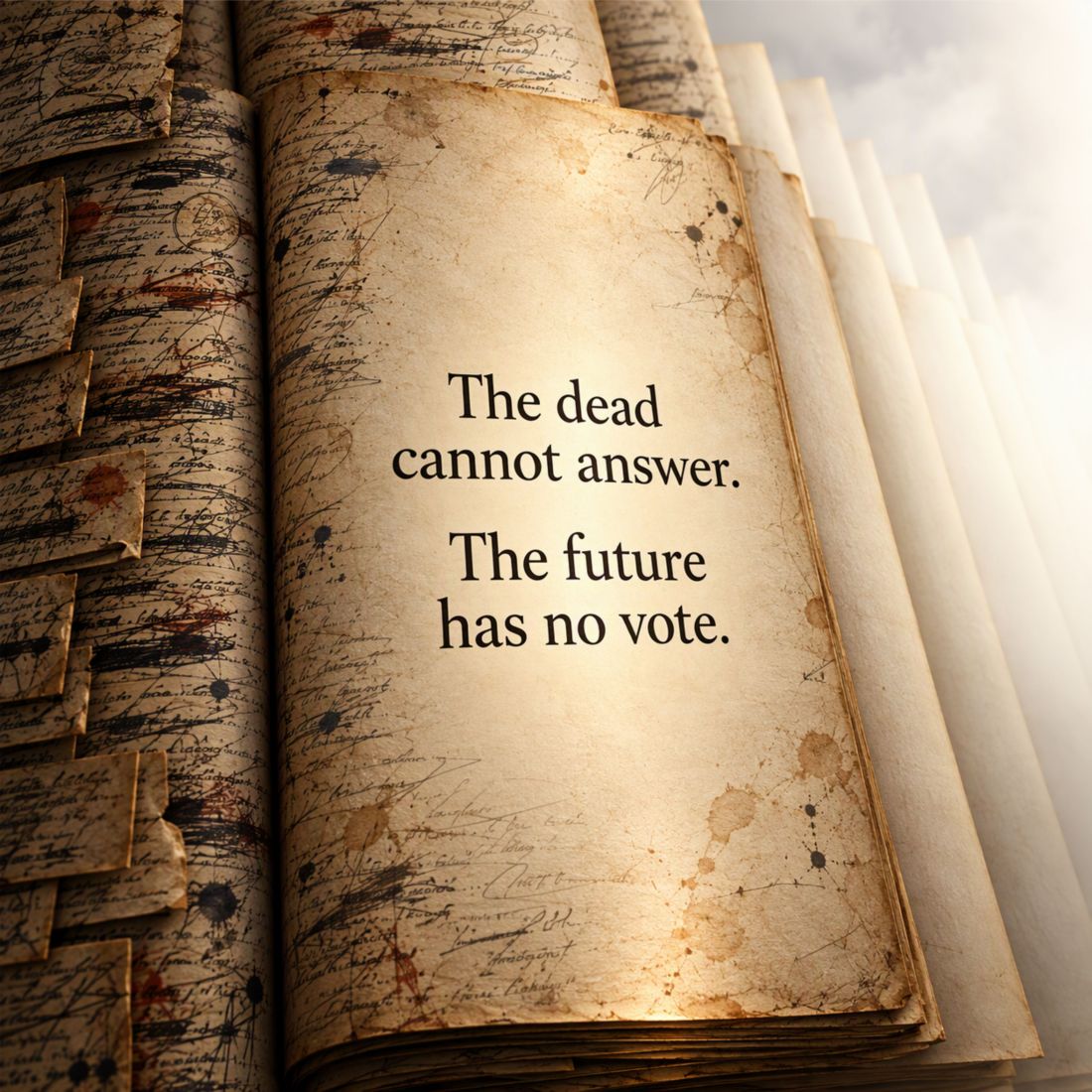
The dead cannot answer.

The future has no vote.

The first line names a limit of historical interpretation. We can examine surviving records, compare accounts and challenge conclusions, but we cannot ask those who are gone to respond. Their silence should not become permission to assign them either perfect foresight or motives unsupported by evidence.

The second names a problem of responsibility. People not yet born cannot participate in today’s decisions, although they may live with their consequences. The future is not entirely absent from public discussion – people can argue on its behalf – but its eventual inhabitants cannot tell us directly what they need.

Between those two limits sits the present. We inherit consequences we did not choose, and we contribute to consequences others will not have chosen. That does not require us to predict everything. It does require us to take the limits of our perspective seriously.

Perhaps the most useful way to think about this is as navigation rather than the construction of a finished destination. We must choose a route without knowing every condition ahead. Good judgement then involves more than confidence in our current map. It involves listening to those who encounter different terrain, noticing when evidence contradicts our expectations and preserving the ability to change course.

For me, that gives the inquiry a practical edge. What do our institutions count as success? Which costs fall outside their measures? Whose interests are treated as obstacles rather than evidence? Which arrangements do we call inevitable because we have become accustomed to them? And how readily could those who follow us revise the choices we are making?

These questions do not guarantee better answers. But they make assumptions available for examination before they harden into the terms on which everyone else must act. They move responsibility beyond the search for a culprit in the past and towards scrutiny of the choices available now.

History cannot place us outside the process. It can only help us recognise our position within it.

Nobody Arrives at the Beginning

One thought continued to return throughout this inquiry. Whenever I believed I had found a starting point, it proved to be another stage.

The Powell Memorandum responded to circumstances that already existed. So did Bretton Woods, industrialisation and the Fabian Society. The deeper I looked, the harder it became to find anyone standing at the beginning of the road. Instead, I found people joining a process already underway.

This distinction changes how responsibility appears. Historical narratives encourage us to search for the decisive person, document or decision: the point at which somebody understood what was happening and set everything else in motion. Real life rarely offers such clarity.

The people living through 1971 did not experience it as a completed historical period. They faced uncertainty, disagreement and incomplete information, just as we do. The same was true of those who drafted constitutions, built institutions or designed economic systems. They were not standing outside history and directing it from above. They were responding to the circumstances they could see.

Perhaps that is the value of a historical milestone. It need not begin a process to make that process visible.

The Powell Memorandum is one such moment. It records assumptions while they were still being stated and defended. It captures people attempting to influence a future they could not see, allowing us to observe historical direction from within rather than only through its consequences.

Every generation enters the story in the middle. It inherits assumptions it did not create, mistakes some of them for reality and contributes something of its own. In doing so, it leaves the road different from the way it found it.

The people who came before us never possessed the complete picture.

Neither do we.

Conclusion: Standing in the Middle

The Powell Memorandum did not provide the beginning I had gone looking for. It provided something more useful: a view of people acting within history rather than outside it.

The dead cannot answer.

The future has no vote.

Between those limits lies our responsibility: not to stand outside history and explain it once and for all, but to participate in it with greater care. We cannot know the whole destination, but we can question the assumptions guiding our route and preserve room for those who follow to choose differently.

Future generations may see limitations in our assumptions that remain difficult for us to recognise. They may ask how we mistook a particular arrangement for the way the world had to be. We cannot supply their answer in advance. We can begin by asking the question ourselves.

Sources and Notes

This is a reflective essay, not a comprehensive history of corporate influence or monetary change. The historical sources below support its factual frame; the broader argument about inheritance, assumptions and responsibility is an interpretation. Temporal proximity is not offered as proof of a shared cause. The institutional example in “What Gets Passed Forward?” is hypothetical.

The opening interview. The Diary of a CEO, James Talarico: You Were Promised the American Dream, It Was a Lie!, published 2 November 2026; recorded 8 September 2026. The episode’s chapter list identifies the discussion of the Powell Memorandum. Accessed 5 November 2026.

The election. NBC News, Texas U.S. Senate election results, 2026. The opening refers to the network’s projected result, not a certified final count. Accessed 5 November 2026.

The memorandum and its reception. Washington and Lee University School of Law, Powell Memorandum collection, including its account of the document’s creation, circulation and later reception. The memorandum itself is reproduced from the university’s archival edition. The Chamber’s printed introduction reports implementation of several approaches; that report is not treated here as an independent measure of their subsequent effects. Accessed 5 November 2026.

Bretton Woods. Sandra Kollen Ghizoni, Nixon Ends Convertibility of U.S. Dollars to Gold and Announces Wage/Price Controls, Federal Reserve History; and the U.S. Department of State, Office of the Historian, Nixon and the End of the Bretton Woods System, 1971–1973. These accounts distinguish the August 1971 decision from the pressures preceding it and the transition that followed. Accessed 5 November 2026.

Britain and Europe. Hansard, House of Lords debate, United Kingdom and the European Communities, 28 October 1971; and UK Parliament and the EU, for the date of UK entry into the EEC. Accessed 5 November 2026.


The Invisible Candidate: Experience, Recruitment, and the Growing Separation Between Capability and Recognition

A headline caught my attention recently.

A successful six-figure IT professional had reportedly found himself working as a supermarket delivery driver after struggling to secure another comparable role. The article was framed as a story about older workers, the jobs market, and the increasingly difficult experience of finding employment later in life.

It would be easy to interpret this as another story about artificial intelligence, technological disruption, or age discrimination.

It may contain elements of all three.

However, I suspect something deeper is taking place.

The question that interests me is not why so many experienced people appear to be struggling.

The question is why so many capable people increasingly find themselves invisible to the systems responsible for recognising capability.

The two things are not necessarily the same.

The Assumption We Rarely Examine

Much modern thinking about work assumes a relatively straightforward relationship between capability and opportunity.

If an individual is capable, they will eventually be recognised.

If they are recognised, they will secure employment.

If they secure employment, they will create value.

This assumption sits quietly beneath many discussions about meritocracy, recruitment and career progression.

Yet for many people, particularly those with substantial experience, this relationship increasingly appears to be breaking down.

People leave organisations with decades of experience, extensive operational knowledge, proven records of delivery, crisis management experience, technical expertise and leadership capability.

Then struggle to obtain an interview.

The capability remains.

The opportunity disappears.

This should immediately raise a question.

If capability remains unchanged, what exactly has changed?

Recruitment Is Not Primarily About Capability

Most people assume recruitment is principally concerned with identifying the best candidate.

In practice, recruitment is often concerned with something else.

Risk.

Recruitment is a process that sits between uncertainty and accountability.

Every appointment carries risk.

Every failed appointment creates consequences.

Every hiring decision may eventually need to be justified.

As a result, recruitment systems increasingly favour defensible decisions over uncertain ones.

This distinction matters.

A defensible decision is not necessarily the same thing as the best decision.

A recruiter who recommends an unconventional candidate takes a risk.

A recruiter who recommends the candidate who ticks every box acquires protection.

If the appointment succeeds, everyone is happy.

If the appointment fails, the recruiter can point towards the specification.

The candidate possessed the required qualifications.

The candidate possessed the required experience.

The candidate passed the required assessments.

The candidate satisfied the stated criteria.

The process was followed.

Responsibility becomes attached to the process rather than the outcome.

Whether consciously or unconsciously, this changes behaviour.

The objective subtly shifts.

Instead of seeking the best possible candidate, the system begins to seek the least risky candidate.

The Rise of the Proxy

Modern organisations cannot directly measure many of the things they care about.

They therefore rely upon proxies.

A proxy is simply a representation of something else.

Qualifications are proxies.

Assessments are proxies.

Competency frameworks are proxies.

Interview scores are proxies.

Job titles are proxies.

Years of experience are proxies.

Keywords on a CV are proxies.

There is nothing inherently wrong with any of these things.

The problem emerges when we begin treating proxies as if they are the thing they represent.

A qualification is not knowledge.

A certification is not competence.

A competency score is not judgement.

A job title is not capability.

A CV is not a person.

Yet increasingly, decisions are made on the basis of these representations rather than the realities they are intended to reflect.

The result is subtle but profound.

Recruitment stops asking:

Can this person do the job?

And starts asking:

Does this person match our representation of someone who can do the job?

Those are very different questions.

The Experience Problem

This creates an interesting challenge for experienced candidates.

Many of the most valuable capabilities that experience develops are exceptionally difficult to measure.

How do we quantify:

  • judgement?
  • practical wisdom?
  • patience?
  • resilience?
  • operational awareness?
  • crisis management?
  • recognising weak signals?
  • balancing competing priorities?
  • understanding unintended consequences?
  • knowing when established procedures are likely to fail?

Most organisations depend heavily upon these capabilities.

Yet most recruitment systems struggle to capture them.

By contrast, qualifications, certifications and recent technical skills are comparatively easy to measure.

As a result, the forms of value that mature experience often provides become increasingly invisible.

The irony is striking.

The very capabilities organisations frequently rely upon during difficult periods become among the hardest capabilities for the recruitment system to recognise.

Why Older Candidates Can Feel Risky

Age discrimination undoubtedly exists.

But I suspect it often manifests through more complex mechanisms than are commonly acknowledged.

A younger hiring manager may have little difficulty evaluating a candidate with a relatively conventional career path.

The signals feel familiar.

The experiences feel relatable.

The expectations feel understandable.

The same manager may encounter a candidate with thirty years of experience and face a different problem entirely.

How should that experience be interpreted?

What are the candidate’s expectations?

Will they be satisfied?

Will they stay?

Will they challenge existing practices?

How easily will they integrate?

Can somebody with significantly greater experience be effectively managed?

None of these questions necessarily arise from prejudice.

Many arise from uncertainty.

Unfortunately, uncertainty itself becomes a form of risk.

And recruitment increasingly seeks to minimise risk.

In such an environment, experience can paradoxically become a disadvantage.

Not because it lacks value.

But because it introduces complexity.

The Financialisation of Value

There is another factor that receives far less attention.

Many professions operate within an increasingly financialised economy.

Value is often determined by relationships to profit, growth, revenue generation or capital allocation.

This produces extraordinary variations in compensation.

Certain professions attract exceptionally high salaries.

Others attract comparatively modest earnings despite providing functions essential to society.

This tells us something important.

Salary is not a measure of human value.

It is a measure of economic valuation within a particular system.

These are not the same thing.

The six-figure professional and the care worker occupy different positions within the economic architecture.

The market prices those positions differently.

That pricing tells us something about economic structures.

It does not tell us how much either individual contributes to society.

The distinction matters because stories about highly paid professionals becoming unemployed can easily become stories about status.

Yet status and economic independence are not the same thing.

The Difference Between Poverty and Status Loss

One of the mistakes frequently made in public discussion is conflating financial decline with poverty.

They are related but distinct phenomena.

A person moving from a six-figure salary to a modest income may experience a substantial loss of status, identity, certainty and expectation.

That experience can be deeply significant.

However, poverty begins somewhere else.

Poverty begins when independence becomes unsustainable.

When people can no longer reliably meet their essential needs through their own resources, dependency begins to emerge.

This distinction is important because it changes the nature of the discussion.

The issue is not merely whether incomes have fallen.

The issue is whether people retain the means to sustain independent lives.

Some individuals earning comparatively modest wages remain independent.

Others earning multiple times as much discover that their financial position is far more fragile than they imagined.

Income alone does not tell us where vulnerability truly exists.

The Hidden Cost to Organisations

There is another side to this story that receives remarkably little attention.

Recruitment systems do not simply affect candidates.

They affect employers.

Every filtering mechanism excludes people.

Every screening stage removes possibilities.

Every requirement narrows the field.

The organisation only ever sees the shortlisted candidates.

It never sees those who were filtered out.

This creates a serious blind spot.

Excellent candidates may disappear before any meaningful conversation occurs.

The reasons may be entirely procedural.

A missing qualification.

An unconventional career path.

Experience acquired outside an approved pathway.

Work completed under a different job title.

The employer never discovers what was lost.

The candidate never knows they were excluded.

The recruiter never receives evidence that a mistake occurred.

The opportunity simply disappears.

Invisible losses are particularly dangerous because they leave no evidence behind.

Why AI May Not Be the Main Story

Artificial intelligence will undoubtedly affect employment.

It already is.

However, there is a danger that AI becomes the explanation for changes that were already underway.

Long before generative AI appeared, organisations had begun moving towards:

  • automated filtering;
  • keyword matching;
  • competency frameworks;
  • compliance-driven recruitment;
  • risk reduction processes;
  • increasingly measurable forms of assessment.

The trajectory was already established.

AI may accelerate these tendencies.

It may scale them.

It may automate them.

But the underlying dynamics predate AI.

The problem did not begin with AI.

AI may simply be arriving at a moment when these systems have already become heavily dependent upon proxies.

The Invisible Candidate

Perhaps the most challenging aspect of this discussion is its human dimension.

Many people experiencing these difficulties blame themselves.

They assume the problem must be a personal failing.

Perhaps they are too old.

Perhaps their skills are outdated.

Perhaps they should have made different choices.

Sometimes individual factors undoubtedly play a role.

But there is also something larger occurring.

Many individuals are discovering that capability and recognition have become increasingly separated.

The ability to perform valuable work and the ability to satisfy modern systems of evaluation are not always the same thing.

Understanding this distinction does not solve the problem.

But it does help explain why so many capable people increasingly struggle to make sense of experiences that appear fundamentally irrational.

Their capability has not necessarily diminished.

The system’s ability to recognise it may have.

Conclusion

The most interesting question raised by stories of experienced professionals struggling to find work is not whether older workers face challenges.

Nor is it whether AI is changing the labour market.

Nor even whether qualifications are becoming more important.

The deeper question is this:

What happens when the systems responsible for identifying capability become increasingly dependent upon representations of capability instead?

The answer matters because this is no longer simply a recruitment issue.

It touches education, management, governance, public policy and organisational decision-making.

It concerns the relationship between reality and representation.

Between judgement and procedure.

Between capability and recognition.

And until we begin examining that relationship more closely, many of the most capable people in society may continue experiencing a strange and growing sense of invisibility.

Further Reading

Can Meaningful Change Still Be Delivered Today?

Explores capability externalisation, human value externalisation, proxy authority, proxy sovereignty, judgement displacement and agency. Provides much of the conceptual framework underlying the arguments presented here.

Link: https://adamtugwell.blog/2026/11/01/can-meaningful-change-still-be-delivered-today/

The Architecture of Modern Poverty: Independence, Economy, and the Basic Living Standard

Examines poverty as the loss of independence rather than simply a shortage of income and introduces the concepts of the Independence Threshold and the Basic Living Standard.

Link: https://adamtugwell.blog/2026/10/24/the-architecture-of-modern-poverty/

Related Themes

  • Capability Externalisation
  • Human Value Externalisation
  • Proxy Authority
  • Proxy Sovereignty
  • Judgement Displacement
  • Financialisation and Measurement
  • Agency and Participation
  • The Recognition Problem in Modern Systems

Author’s note:

This piece is not an argument against qualifications, recruitment processes or technology. All have legitimate purposes. The question is whether the tools designed to help recognise capability are gradually becoming substitutes for the capability they were originally intended to identify.

Gloucester Rugby: More Than a City, a Community

Every now and then a debate emerges about whether Gloucester is really a rugby city. Usually the discussion centres on attendance figures, demographics or where supporters travel from on a matchday. It’s an interesting conversation, but I think it risks missing something more important.

As someone who has supported Gloucester Rugby all my life, yet has never actually lived in Gloucester itself, I understand why the question gets asked. I was born in Cheltenham and live there today. I grew up in Churchdown, between Cheltenham and Gloucester, alongside countless others whose connection to Gloucester Rugby has always been every bit as strong as someone with a Gloucester postcode.

And perhaps that’s the point.

The idea that Gloucester Rugby’s identity can be measured only by where most of the supporters live or travel from misunderstands what rugby has always been in this part of the world.

Gloucester Rugby was founded in 1873. Long before professionalism arrived, long before academies and salary caps, the club sat at the centre of a rugby ecosystem that stretched throughout Gloucestershire and beyond.

Players emerged through local clubs, local schools and local communities. They were not full-time athletes from their teenage years. They were teachers, farmers, builders, tradesmen, engineers and office workers who happened to be exceptional rugby players.

Many who grew up during the amateur era still believe there was something very special about that time.

The people playing the game often lived alongside the people supporting it. Coaches volunteered their evenings because they loved rugby. Club officials gave up countless hours because they believed in what their clubs meant to local communities. Young players learned not only skills and tactics but also the values that made rugby and the community that surrounds it distinctive.

That culture was never confined to Gloucester itself.

The story of Gloucester Rugby cannot be separated from the story of the clubs spread across the county. Longlevens, Cinderford, Drybrook, Tewkesbury, Cheltenham, Lydney, Matson, Old Patesians and many others have all contributed to a rich rugby heritage that continues today. These clubs remain hugely important community institutions, providing opportunities for young people to participate, develop friendships and find a sense of belonging at a time when those opportunities are arguably more important than ever.

The same can be said of the county’s schools.

When I attended Chosen Hill School during the 1980s, rugby formed a significant part of school life. We were fortunate to have teachers and coaches who lived and breathed the game. Adrian Turton, our Games Master, and Dave Protheroe, who helped teach many of us the basics of rugby while coaching Moseley outside school hours, were typical of a generation that gave far more to the sport than they ever received back financially.

Chosen Hill was not unique.

Across Gloucestershire and the surrounding area, schools produced generations of players who understood rugby as something more than a Saturday afternoon pastime. There was a shared culture, a collective understanding and a pathway that connected school rugby, club rugby and Kingsholm in a way that is difficult to describe to those who did not experience it.

The local connections were real and visible.

Growing up in Churchdown, Gloucester Rugby never felt remote. Dave Sims lived around the corner from us when we first moved there. He would go on to captain Gloucester, become the club’s first professional player and represent England. Paul Holford attended the same school as I did and followed his own path into Gloucester Rugby.

Yet what I remember most is not seeing these men as distant sporting figures. My last conversation with Paul was not at Kingsholm at all, but out walking on his family farm while he was repairing a broken fence. Even my last conversation with Mike Teague, one of Gloucester Rugby’s greatest sons and an icon of English rugby, was not about rugby. It was in his pub while I was serving as a local councillor and he needed some help navigating a council matter.

That, to me, says something important about rugby in Gloucestershire.

The players who became heroes on a Saturday were often the same people you would bump into during the week. They remained part of the communities that produced them. They coached local youngsters, ran businesses, worked the land, supported local causes and got on with life much like everyone else. The line between community rugby and Gloucester Rugby was often far thinner than it is in modern professional sport.

That connection still exists today.

Former captain Lewis Ludlow has become a powerful example of the club’s continuing relationship with its community, remaining actively involved in charitable and community initiatives alongside his playing career. Likewise, George Barton demonstrates how closely interconnected the professional and grassroots games remain. A product of Longlevens Rugby’s youth system himself, he has returned to the club as a backs and skills coach, bringing experience gained at Kingsholm back into the environment where his own rugby journey began.

These relationships matter.

The strongest Gloucester sides have often appeared to understand that they represent something far more than a professional rugby club. They represent generations of volunteers, coaches, teachers, parents and supporters who have sustained rugby throughout the county for over a century.

Perhaps that is why the atmosphere at Kingsholm feels different.

For those who have only ever watched Gloucester on television, The Shed can look and sound intimidating. It appears loud, tribal and uncompromising. In truth, it can be all of those things. It is one of the most passionate stands in British rugby.

Yet it is also one of the friendliest.

One of the great joys of a matchday at Kingsholm has always been the social side of rugby. Visiting supporters are not treated as enemies. They are guests. Before the match, supporters share stories and predictions. During the game there is banter, passion and plenty of noise. Afterwards, everyone talks about the rugby.

That is one of the qualities that has always set rugby apart.

Of course we want Gloucester to win. That is the whole point of supporting a team. But rugby supporters also appreciate great rugby wherever it comes from. A brilliant try is a brilliant try. A courageous defensive effort is worthy of admiration regardless of the colour of the shirt. Good rugby is good for everyone who loves the game.

That spirit of welcome is every bit as much a part of Gloucester Rugby’s identity as The Shed itself.

Perhaps that is why I felt compelled to write this piece.

Not because I disagree with anybody in particular. Not because I wanted to challenge anyone’s view. Rather, because discussions about whether Gloucester is a rugby city sometimes overlook the things that truly matter.

Rugby in Gloucestershire has never simply been about geography. It is about the network of clubs that give young people a place to belong. It is about schools that pass traditions from one generation to the next. It is about builders, farmers, teachers, tradesmen and volunteers who helped shape the sport long before professionalism arrived. It is about players who understand the communities they represent and who continue to give back to those communities.

Above all, it is about the sense of belonging that exists when thousands of people converge on Kingsholm from across Gloucester, Cheltenham, Churchdown, the Forest of Dean, Stroud, Tewkesbury, Cirencester and countless villages in between.

Gloucester is a rugby city because Kingsholm stands in Gloucester.

The famous cathedral backdrop is Gloucester.

The club’s history is Gloucester.

But the community that gives life to Gloucester Rugby has always extended far beyond the city boundary.

The fact that so many of us travel there is not evidence against Gloucester being a rugby city.

It is evidence of just how important a rugby city Gloucester has become.

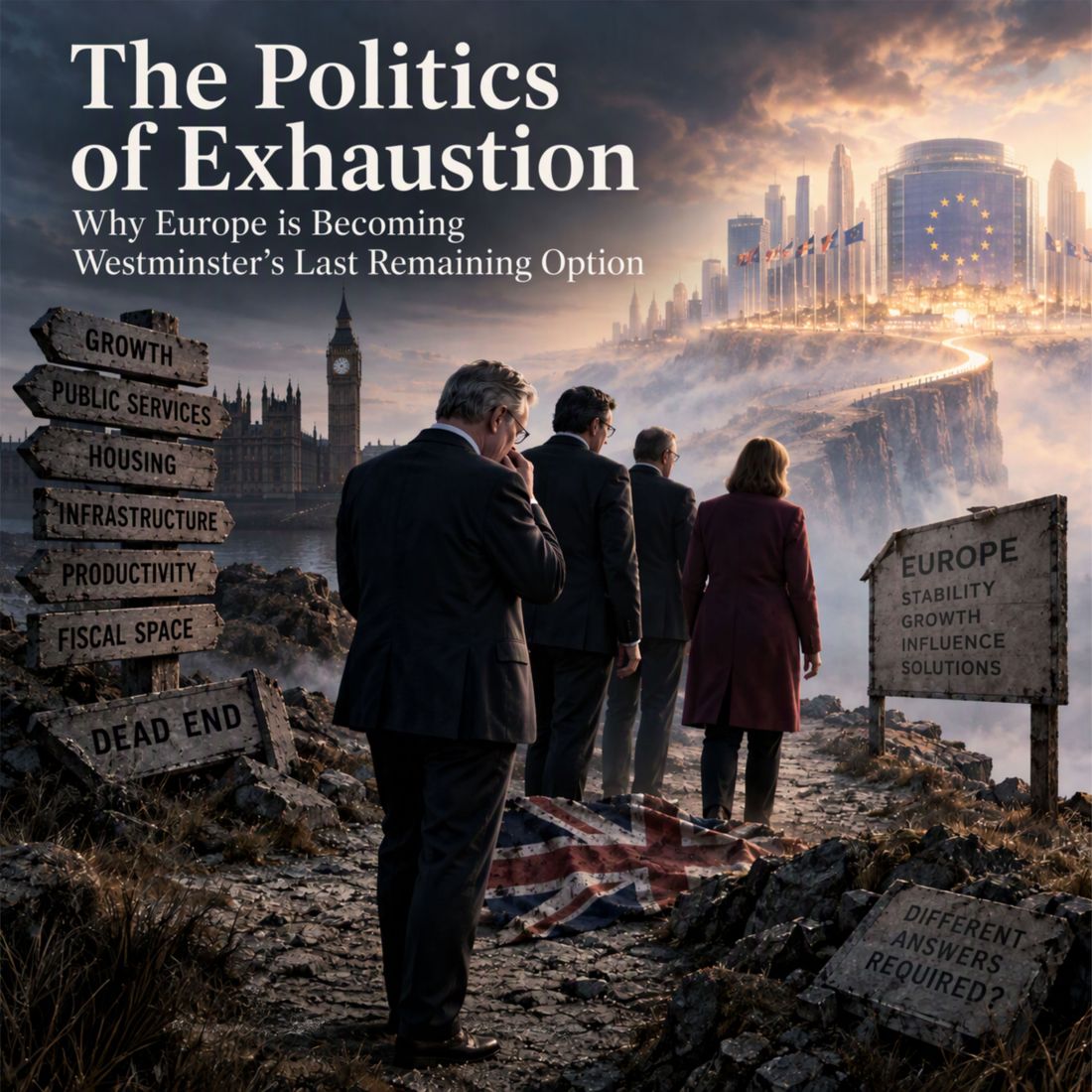
The Politics of Exhaustion | Why Europe is Becoming Westminster’s Last Remaining Option

There are moments in politics when a government appears to be making choices.

And there are moments when it becomes apparent that it is simply running out of them.

Increasingly, Britain feels like the latter.

The significance of the recent interventions by Andy Burnham and Rachel Reeves is not that they have reopened the European question. That process has been creeping forward for years through the language of resets, partnerships, alignment and cooperation.

What has changed is something subtler.

For the first time since Brexit, influential figures are beginning to talk as though Britain’s long-term future may ultimately lie back inside the European project itself. What was once implied is increasingly being stated. What was once political subtext is beginning to look like political direction.

Most commentary has focused on what this says about rejoining The EU.

The more interesting question is what it says about Westminster.

Because the growing attraction of Europe may reveal less about the strength of the European option than the weakness of every other option now visible to Britain’s governing class.

The Halfway House Reaches its Limit

Since leaving the European Union, Britain has existed in an uncomfortable halfway house.

The country formally left the institutional structures of the bloc, yet many of the deeper forces that shaped Britain’s economy remained largely untouched. Financialisation continued. Centralisation continued. Dependence on debt-fuelled growth continued. Productive capacity remained weak. Regional imbalances remained stubbornly entrenched.

The reconstruction that was supposed to follow Brexit never truly arrived.

As a result, Britain has spent much of the last decade trapped in an increasingly peculiar position. Outside enough of The EU to lose some of the advantages of membership, yet without having undertaken the structural reforms necessary to exploit the opportunities of departure.

It is a position that satisfies almost nobody.

And because it satisfies almost nobody, a conclusion has gradually become stronger within parts of the political establishment that ‘leaving’ was the mistake.

But that conclusion rests upon a significant assumption.

It assumes that Britain’s difficulties were created by Brexit rather than revealed by it.

Running Out of Road

The political reality confronting any government today is brutal.

Economic growth remains weak. Public services require resources that governments struggle to provide. Infrastructure demands investment measured in decades while politics increasingly operates in electoral cycles. Housing remains dysfunctional. Productivity remains stagnant. Debt constrains everything.

Every government enters office promising change.

Every government eventually discovers the same limitations.

The result is a political system that increasingly appears trapped.

There is no obvious tax solution.

There is no obvious spending solution.

There is no obvious growth solution.

There is certainly no quick solution.

Eventually a point is reached where governments stop searching for better answers and start searching for larger frameworks.

That is where Europe enters the picture.

Not necessarily as an ideal.

Not necessarily even as a conviction.

But as a mechanism.

A system that appears capable of creating options where none currently exist.

A framework large enough to absorb problems that national governments increasingly struggle to solve.

A route that appears, at least superficially, to lead somewhere.

The Last Remaining Answer

Viewed through this lens, the recent interventions from Burnham and Reeves take on a different significance.

They can be read not simply as endorsements of Europe but as acknowledgements of a deeper reality.

Westminster is running out of ideas.

This is not an accusation of incompetence. Almost any government would likely arrive at a similar position. The constraints are structural rather than personal.

Yet the consequences are profound.

When political systems exhaust their available options, they begin returning to familiar territory. Solutions previously rejected acquire new appeal. Paths once abandoned begin to look attractive again.

EU membership increasingly feels like such a path.

Not because it has suddenly become irresistible.

But because it is increasingly difficult for many within the political establishment to imagine anything else.

The attraction lies not necessarily in EU strength.

It lies in domestic weakness.

The Electoral Calculation

This is why the next general election may prove far more significant than many currently realise.

At present, no government possesses a clear mandate to pursue eventual re-entry into the European Union.

That obstacle remains substantial. But obstacles in politics have a habit of becoming opportunities.

A future manifesto offering a pathway towards deeper integration, closer institutional alignment or eventual membership would solve an immediate political problem.

It would place responsibility back in the hands of voters.

And from the perspective of the governing class, it creates a remarkably attractive outcome regardless of the result.

If such a programme is rejected, the government falls and someone else inherits Britain’s problems. The incoming administration then encounters exactly the same fiscal constraints, infrastructure challenges, demographic pressures and economic limitations as its predecessor.

The reality does not change simply because the occupants of Whitehall do.

If the programme succeeds, however, the government acquires something it presently lacks: democratic legitimacy for a strategic shift towards Europe.

Either way, the dilemma is resolved.

Either the burden is transferred.

Or the mandate is secured.

That is what makes the European question increasingly attractive politically.

The Problem with Desperation

There is, however, a danger in all of this.

Political exhaustion can easily disguise itself as strategic clarity.

When governments become sufficiently constrained, the remaining options inevitably begin to look more attractive than they actually are. Familiarity starts to resemble foresight. Necessity starts to resemble wisdom.

Yet there is remarkably little evidence that the forces constraining Britain are uniquely British.

Many of the pressures visible in the United Kingdom are visible throughout the wider developed world. Weak growth. Demographic strain. Debt burdens. Housing shortages. Growing distrust of institutions. Political fragmentation.

The assumption now quietly emerging within Westminster is that these problems become more manageable inside the European framework.

Perhaps they do. But that remains an assumption rather than a demonstrated fact.

After all, the European Union itself is increasingly confronting profound questions about its own future direction. Debates around fiscal sustainability, economic divergence, governance and political legitimacy are becoming more frequent, not less.

This raises an uncomfortable possibility.

What if Westminster is treating Europe as a solution to pressures that Europe itself is struggling to resolve?

Paradigm Blindness

Perhaps the most important aspect of this debate is not Europe at all. It is the lens through which Britain’s political class sees the world.

Every generation becomes captive to certain assumptions. Over time those assumptions become so deeply embedded that they cease to appear ideological. They simply become reality.

The assumption that larger systems are inherently more stable.

The assumption that deeper integration necessarily produces better outcomes.

The assumption that political problems can ultimately be solved through better administration and larger frameworks.

These assumptions shaped much of the modern political era. They also shaped the generation of politicians currently running it.

This is why the growing movement towards Europe may represent something deeper than policy.

It may represent the limits of political imagination.

Faced with mounting pressures and shrinking room for manoeuvre, Westminster continues searching for solutions inside the framework that produced its understanding of the world.

Europe remains visible because Europe belongs to that framework.

Everything else appears increasingly unimaginable.

Conclusion

The emerging debate about Europe is often presented as a debate about Britain’s future relationship with the European Union.

In reality, it may be a debate about something else entirely.

It may be a debate about what happens when a political class reaches the edge of its available options.

Britain’s governing institutions increasingly appear to believe that Europe represents the last remaining route back towards growth, stability and governability. That belief may yet shape the next general election. It may even become the defining strategic proposition offered to the electorate.

Whether it succeeds is another matter entirely.

Because the central question is not whether rejoining the EU can be presented as an answer.

The central question is whether Britain’s problems are actually the kinds of problems EU membership can solve.

That distinction may determine far more than the next election.

It may determine whether Westminster is identifying a genuine path forward, or simply pursuing the last answer it still knows how to imagine.

Core Works

Core Works

These are the essays, frameworks, stories and proposals that best represent my thinking. Together they explore personal sovereignty, human flourishing, local resilience, governance, economics, technology, and our relationship with each other and the living world. While I have written many articles, these are the works I believe form the foundation of everything else.

Start Here: Four Foundational Works

If you’re new to my work, these four pieces provide the clearest introduction to the ideas that run through everything else. Together they explore personal sovereignty, economic dignity, community resilience and the responsible use of technology.

Personal Sovereignty

What does it mean to govern your own life in a world increasingly shaped by institutions, technology, narratives and external pressures? This essay explores autonomy, responsibility and self-authorship.

Read: Personal Sovereignty

The Independence Threshold

A new way of understanding poverty, prosperity and what people genuinely need to live with dignity, security and choice in a modern economy.

Read: The Independence Threshold: A New Definition of Poverty for a Modern Economy

The Local Economy Governance System (LEGS)

A framework for organising local economies around contribution, participation, stewardship and shared prosperity.

Read: The Local Economy Governance System (LEGS)

The Human Sovereignty Charter for Artificial Intelligence

A human-centred framework for ensuring technology serves people rather than people serving technology.

Read: The Human Sovereignty Charter for Artificial Intelligence

The Individual

The individual is the starting point for all meaningful change. Before we can transform our communities, institutions or societies, we must first understand ourselves.

Personal Sovereignty

The foundation of individual freedom, responsibility and self-authorship.

Read: Personal Sovereignty

Nobody Knows the Story Like the Author

A reflection on narrative ownership and lived experience. Nobody can fully understand your journey from the outside. The person best placed to understand your life is the one who has lived it.

Read: Nobody Knows the Story Like the Author

The Choice

A waking-up story about the moment we realise that different futures are possible and that participation in shaping them is itself a choice.

Read: The Choice

The Myth Catcher

A guide to recognising inherited assumptions, cultural myths and prevailing narratives in order to see more clearly.

Read: The Myth Catcher

The Moment

An exploration of presence, awareness and the unique power of the present moment as the place where all change occurs.

Read: The Moment

Foundational Principles

These works explore the beliefs, assumptions and principles that shape our lives, cultures and institutions.

One Rule Changes Everything

A simple principle with far-reaching implications for individuals, communities and systems.

Read: One Rule Changes Everything

Your Beliefs Today Create Everyone’s Experiences Tomorrow

An examination of how collective beliefs shape institutions, incentives, behaviours and ultimately the future itself.

Read: Your Beliefs Today Create Everyone’s Experiences Tomorrow

The Money Illusion

A challenge to conventional assumptions about wealth, value and economics, inviting readers to reconsider what money is actually for.

Read: The Money Illusion

Economic Foundations

A collection of works exploring prosperity, poverty, dignity, participation and the role of economics in human flourishing.

The Basic Living Standard

A proposal exploring the minimum conditions required for genuine security, dignity and participation in society.

Read: The Basic Living Standard

The Independence Threshold

A proposal for redefining poverty in terms of genuine independence and participation rather than simple income measures.

Read: The Independence Threshold

Is Poverty Invisible to Those Who Don’t Experience It?

A reflection on poverty, perception and the gap between lived experience and public understanding.

Read: Is Poverty Invisible to Those Who Don’t Experience It?

An Economy for the Common Good

A proposal for aligning economic systems with human and community wellbeing rather than narrow financial objectives.

Read: An Economy for the Common Good

Reimagining Society

These works explore how communities, economies and institutions might be redesigned around contribution, participation and local resilience.

Our Local Future

A vision of stronger communities built around local participation, ownership and stewardship.

Read: Our Local Future

The Local Economy Governance System (LEGS)

The foundational framework for organising local economies around contribution, participation and shared prosperity.

Read: The Local Economy Governance System (LEGS)

The Contribution Culture

An exploration of how societies might move beyond extraction and consumption towards meaningful contribution.

Read: The Contribution Culture

Levelling Level

A reflection on equality, opportunity and the foundations of a fair society.

Read: Levelling Level

From Here to There Through Now

A practical exploration of transition, showing how meaningful change is built through present action rather than distant aspiration.

Read: From Here to There Through Now

Governance & Democracy

A collection of works exploring leadership, democracy, participation and political renewal.

The Way of Awakened Politics

An exploration of politics grounded in wisdom, service and the long-term wellbeing of communities.

Read: The Way of Awakened Politics

Manifesto for a Good Dictator

A thought process examining power, leadership and the responsibilities that accompany authority.

Read: Manifesto for a Good Dictator

How to Get Elected

A practical look at politics, representation and democratic engagement.

Read: How to Get Elected

A Community Route

A roadmap for community-led change and local action.

Read: A Community Route

The Grassroots Manifesto

A call for citizen-led participation and bottom-up renewal.

Read: The Grassroots Manifesto

Officially None of the Above

A challenge to political orthodoxy and conventional electoral choices.

Read: Officially None of the Above

Food, Water & Community Resilience

These works focus on the practical foundations of thriving communities.

Who Controls Our Food Controls Our Future

An examination of food systems, dependency and resilience.

Read: Who Controls Our Food Controls Our Future

Food From Farms Guaranteed

A proposal designed to strengthen food security and direct relationships between communities and producers.

Read: Food From Farms Guaranteed

Foods We Can Trust

A blueprint for food security, transparency and resilience.

Read: Foods We Can Trust

Water We Can Trust

An exploration of stewardship and the importance of protecting one of humanity’s most essential resources.

Read: Water We Can Trust

Grow Your Own

A practical argument for restoring local capacity, food knowledge and household resilience.

Read: Grow Your Own

Humanity, Technology & The Future

The future should serve people, communities and the living world, not the other way around.

The Human Sovereignty Charter for Artificial Intelligence

A constitutional framework for ensuring that AI serves humanity while preserving human agency, dignity and freedom.

Read: The Human Sovereignty Charter for Artificial Intelligence

Our Earth Body

A reflection on humanity’s relationship with the planet and the responsibilities that come with belonging to a living system.

Read: Our Earth Body: Living Lightly on a Heavy and Troubled Planet

Closing Note

None of these works stands alone. Each is part of an ongoing exploration into a simple but profound question:

How can people, communities, institutions and technologies evolve together in ways that increase freedom, dignity, resilience and human flourishing?

These Core Works represent my best attempt, so far, to answer that question.