The Phoenix Paradox | Why the Appearance of Renewal Can Prevent Genuine Change: Understanding Failed Reform, Paradigm Blindness, and the Political Utility of Failure

Introduction

This document attempts to explain a recurring phenomenon that appears across politics, economics, institutions, organisations, and social movements.

History is full of genuine problems that persist despite repeated attempts to solve them.

Conventional explanations typically assume one of two causes:

  • The problem was never properly identified.
  • The people responsible lacked the will to act.

While both explanations are sometimes true, they do not adequately explain why some problems appear to survive successful diagnoses, major public attention, repeated reform efforts, and widespread acknowledgement.

The Phoenix Paradox proposes a different possibility:

Problems sometimes survive because inadequate solutions discredit accurate diagnoses.

Under this model, society can become trapped between defenders of the existing system and critics who correctly identify flaws but incorrectly diagnose how genuine change occurs.

The result is a cycle in which real problems persist, public confidence declines, reform becomes harder, and existing systems become more entrenched even as they become less effective.

Intellectual Foundations

The Phoenix Paradox is not presented as a claim of wholly original thought.

It draws upon, extends toward and touches ideas found in:

  • Edmund Burke’s observations about institutions and unintended consequences.
  • Public choice theory and incentive-based political analysis.
  • Systems theory and complexity theory.
  • Institutional economics.
  • The concept of path dependency.
  • Thomas Kuhn’s work on paradigms.
  • Historical analyses of revolutions and reform movements.
  • Organisational theories of institutional inertia.

The contribution of this work is not the discovery of entirely new components.

Its contribution lies in connecting these observations into a single causal model explaining how failed remedies can increase the longevity of the very problems they were intended to solve.

The Core Observation

Most people assume:

Problem → Solution → Improvement

The Phoenix Paradox argues that another sequence is often present:

Problem → Inadequate Solution → Failure → Loss of Confidence → Problem Persists

In some cases:

Problem → Inadequate Solution → Failure → Loss of Confidence → Increased Problem Persistence

The crucial insight is that failed solutions may not leave society where it started.

They may actively reduce society’s future capacity to solve the problem.

The Phoenix Paradox

The work takes its name from the myth of the phoenix: a creature that dies in fire and is reborn from its own ashes.

The phoenix represents one of humanity’s most enduring assumptions: that destruction naturally produces renewal.

In politics, institutions, organisations, and social movements, this assumption appears whenever people believe that identifying a problem and acting against it will inevitably produce improvement.

The Phoenix Paradox challenges that assumption.

The paradox can be stated simply:

The appearance of renewal can become the greatest obstacle to genuine renewal.

Or more formally:

Actions intended to solve a problem may make that problem harder to solve if those actions create the illusion that meaningful change has already occurred.

A failing system may be challenged.

A reform may be launched.

A policy may be implemented.

A movement may achieve power.

To observers, renewal appears to be taking place.

Yet the underlying conditions that produced the original problem may remain largely unchanged.

In such cases, the visible signs of reform create a powerful illusion of progress while leaving the underlying causes intact.

When the reform fails, the resulting disappointment often damages public confidence not only in the reform itself but in the possibility of future reform.

Paradoxically, an attempt at renewal can therefore strengthen the very conditions it sought to overcome.

This insight forms the foundation of the Phoenix Paradox and provides the basis for the concepts explored throughout this document: the Phoenix Trap, the False Cure Effect, the Charlatan’s Legacy, the Straw Remedy, and the Preservation Paradox.

Proposition 1: Systems Exist for Reasons

Every enduring system performs functions.

Those functions may be desirable, undesirable, or mixed.

A system may simultaneously:

  • solve problems;
  • create problems;
  • distribute resources;
  • create inequalities;
  • provide stability;
  • generate inefficiencies.

The existence of dysfunction does not mean the system performs no useful role.

This creates an important distinction:

Criticising a system is not the same as understanding why it exists.

For example:

Many people critique money, markets, governments, bureaucracies, corporations, political parties, or regulatory structures.

The critique may be entirely valid.

However:

A successful critique does not automatically provide a replacement.

The question is never merely:

What should be removed?

The more difficult question is:

What function must still be performed afterwards?

The Phoenix Trap

Definition

The Phoenix Trap is the belief that removing a defective system, structure, policy, institution, or paradigm will naturally result in a superior replacement.

It assumes that destruction creates renewal.

It assumes a phoenix will emerge from the ashes.

The trap lies in confusing diagnosis with succession.

The Mechanism

The reformer identifies something real:

  • corruption;
  • inequality;
  • financial dysfunction;
  • institutional stagnation;
  • democratic failure;
  • environmental degradation.

The diagnosis may be substantially correct.

However, they then assume:

Because I can see the problem, I understand the solution.

This is the critical error.

The underlying forces remain:

  • incentives;
  • scarcity;
  • power;
  • status;
  • self-interest;
  • cultural habits;
  • institutional dependencies.

Removing a structure does not remove the pressures that created it.

Historical Pattern

Many revolutions follow the same pattern:

  1. A genuine problem exists.
  2. Existing institutions lose legitimacy.
  3. Reformers identify real failures.
  4. Existing structures are challenged or removed.
  5. The underlying conditions remain.
  6. Similar structures reappear in different forms.

The names change.

The rhetoric changes.

The symbols change.

The underlying dynamics often survive.

The Replacement Principle

A genuine solution must answer two questions.

Diagnostic Question

What is wrong?

Successor Question

What replaces it?

Many movements answer the first.

Few fully answer the second.

The Phoenix Paradox argues that a proposal should not be judged solely by its ability to dismantle existing systems.

It should also be evaluated according to its capacity to perform the essential functions that remain necessary afterwards.

The False Cure Effect

Definition

The False Cure Effect occurs when a failed solution causes people to lose faith in the original diagnosis.

This is the central insight of the Phoenix Paradox.

The Sequence

A real problem exists.

↓

A prominent figure identifies it.

↓

A solution is proposed.

↓

The solution fails.

↓

The public loses confidence.

↓

Future reform becomes harder.

The Critical Mistake

People often reason as follows:

The solution failed.

Therefore the diagnosis was wrong.

However:

The failed solution may simply have been inadequate.

This distinction is enormously important.

A failed cure does not prove the illness was imaginary.

Yet societies frequently act as if it does.

Example Structure

Suppose:

  • a housing problem exists;
  • a monetary problem exists;
  • a governance problem exists;
  • an institutional problem exists.

An inadequate reform is introduced.

The reform fails.

Public memory eventually becomes:

“We tried that.”

What disappears is the distinction between:

  • trying the right solution badly;
  • trying the wrong solution;
  • trying a diluted version of the right solution;
  • trying a symbolic version of the right solution.

The failure becomes attached to the diagnosis itself.

The Charlatan’s Legacy

Definition

The Charlatan’s Legacy is the long-term damage created when inadequate solutions discredit legitimate concerns.

The charlatan’s greatest harm is often not immediate failure.

It is the future scepticism that failure creates.

Why it Matters

The original problem survives.

But now something else has appeared:

  • public exhaustion;
  • public cynicism;
  • reform fatigue;
  • distrust.

Future reformers inherit a harder environment than existed before.

The problem remains.

Confidence disappears.

The Paradox

The individual who attempted to challenge the system may inadvertently become one of its greatest protectors.

Not because they intended to.

But because their failure made future challenges less credible.

The Charlatan’s Legacy is the long-term residue of the Phoenix Paradox.

The original problem survives while confidence in solving it declines.

Controlled Failure

Until now, the model assumes failure emerged through misunderstanding.

The analysis becomes more troubling when incentives are considered.

Not all failures are necessarily accidental.

The Straw Remedy

Definition

A Straw Remedy is a solution that appears responsive but lacks the capacity to address the underlying problem.

It is the policy equivalent of a straw man argument.

Instead of attacking a weakened version of an opponent’s argument, a weakened version of a solution is implemented.

Characteristics

A Straw Remedy is:

  • highly visible;
  • politically marketable;
  • symbolically significant;
  • structurally insufficient.

Its greatest strength is often appearance.

Its greatest weakness is effectiveness.

Political Incentives Behind Controlled Failure

The Phoenix Paradox does not require conspiracy.

Incentives alone may be sufficient.

Politicians operate within competing pressures.

A genuine solution may:

  • threaten powerful interests;
  • create disruption;
  • impose short-term costs;
  • require unpopular trade-offs;
  • challenge deeply held assumptions.

A symbolic solution often avoids these risks.

It allows politicians to claim:

We listened.

We acted.

We tried.

If the measure fails, responsibility can be shifted onto the proposal itself.

The Political Logic

The sequence becomes:

Public concern grows.

↓

Pressure to act increases.

↓

A limited solution is introduced.

↓

The solution fails.

↓

The issue loses political momentum.

↓

The underlying problem survives.

This creates a powerful incentive structure.

Sometimes solving the problem is politically useful.

Sometimes neutralising the issue is politically useful.

Those objectives are not always identical.

The Straw Remedy represents one of the most common mechanisms through which the Phoenix Paradox manifests itself.

The appearance of action creates the perception of renewal while preserving many of the conditions that produced the original problem.

Paradigm Blindness

The Phoenix Paradox operates within a wider phenomenon: paradigm blindness.

Most people assume paradigm blindness means:

People cannot see problems.

Often the opposite is true.

People see the symptoms clearly.

What they cannot see are the assumptions operating underneath them.

Paradigms define:

  • what is realistic;
  • what is respectable;
  • what is possible;
  • what is discussable.

Solutions outside those boundaries are frequently dismissed before they are evaluated.

Paradigm blindness often enables the Phoenix Paradox by causing institutions and reformers alike to mistake visible change for meaningful change.

Establishment as a Mindset

Within this model, establishment is not principally a class of people.

It is a pattern of thinking.

The establishment mindset prioritises:

  • continuity;
  • stability;
  • predictability;
  • preservation of assumptions.

The mindset can appear anywhere:

  • governments;
  • corporations;
  • activists;
  • academics;
  • media organisations;
  • religious institutions;
  • reform movements themselves.

Any group can become establishment once preserving its assumptions becomes more important than confronting reality.

The Preservation Paradox

Definition

The harder a system works to preserve itself without addressing the forces undermining it, the greater the eventual disruption required to preserve what was valuable within it.

Attempts to avoid change can increase future instability.

The refusal to adapt is itself a form of adaptation failure.

In many cases, the Preservation Paradox and the Phoenix Paradox reinforce one another.

Systems resist meaningful adaptation while inadequate reforms create the illusion that adaptation has already occurred.

Distinguishing Failure from the False Cure Effect

One of the dangers of any framework concerned with failed reform is the temptation to treat every unsuccessful intervention as evidence of incompetence, deception, or bad faith.

The Phoenix Paradox does not make this claim.

Not all failed reforms are false cures.

Not all ineffective policies are straw remedies.

Not all disappointing outcomes are the result of paradigm blindness or institutional self-preservation.

Complex systems are difficult to change.

Good ideas can fail.

Necessary reforms can produce unintended consequences.

Competent leaders can make reasonable decisions that do not achieve their intended outcomes.

The question is therefore not:

Did the reform fail?

The question is:

What happened after it failed?

The False Cure Effect occurs when the failure of a particular intervention is used, consciously or unconsciously, to discredit the underlying diagnosis itself.

A genuine failure should lead to questions such as:

  • Was the diagnosis correct?
  • Was the solution appropriate?
  • Was implementation sufficient?
  • Were important variables overlooked?
  • Does another approach exist?

The False Cure Effect emerges when these questions are replaced by:

“We tried it. Therefore the problem was not what we thought.”

This distinction matters because learning and adaptation require the ability to separate diagnosis from intervention.

A society capable of learning treats failed attempts as information.

A society trapped by the False Cure Effect treats failed attempts as closure.

The purpose of the Phoenix Paradox is therefore not to discourage experimentation, reform, or bold solutions.

Its purpose is to encourage more rigorous evaluation by ensuring that failed remedies do not prematurely discredit genuine problems or prevent future generations from pursuing better solutions.

The Phoenix Paradox Cycle

The complete model can be expressed as follows:

Stage 1

A genuine problem emerges.

Stage 2

Public awareness grows.

Stage 3

Existing institutions struggle to respond.

Stage 4

Reformers identify the problem.

Stage 5

The Phoenix Trap occurs.

Diagnosis is confused with solution.

Stage 6

A solution is implemented.

Either accidentally inadequate or deliberately symbolic.

Stage 7

Failure occurs.

Stage 8

The False Cure Effect emerges.

The failed solution damages belief in the diagnosis.

Stage 9

The Charlatan’s Legacy accumulates.

Future reform becomes harder.

Stage 10

The original problem survives.

Stage 11

System preservation intensifies.

Stage 12

Pressure continues to build.

The cycle repeats.

Central Thesis

The Phoenix Paradox suggests that the greatest long-term threat to solving a genuine problem is often not denial of the problem, but the appearance that the problem has already been addressed when the underlying causes remain.

When inadequate solutions are presented as definitive cures, the resulting failure can weaken confidence in future reform, strengthen existing systems, and allow genuine problems to persist beneath the illusion of renewal.

Denial preserves the debate.

A false cure can end the debate while leaving the problem untouched.

That is why societies may become trapped between false prophets, symbolic reform, institutional self-preservation, and paradigm blindness, while the underlying problems affecting people, communities, economies, and environments continue to grow.

The central challenge therefore is neither blind preservation nor blind disruption.

It is understanding what must change, what must survive, and how transition can occur without allowing the appearance of renewal to undermine the possibility of genuine renewal.

Closing Reflection

The Phoenix Paradox does not argue for preserving existing systems, nor does it argue for their destruction.

It argues for understanding.

Its central claim is that societies are most vulnerable when they confuse diagnosis with solution, symbolism with reform, or failure with proof that no solution exists.

If genuine problems are to be addressed, societies must become capable of asking not only what is wrong, but what comes next, how transition occurs, and how learning can continue when initial attempts fall short.

The alternative is a cycle in which real problems survive both their defenders and their critics, while confidence in change itself gradually disappears.
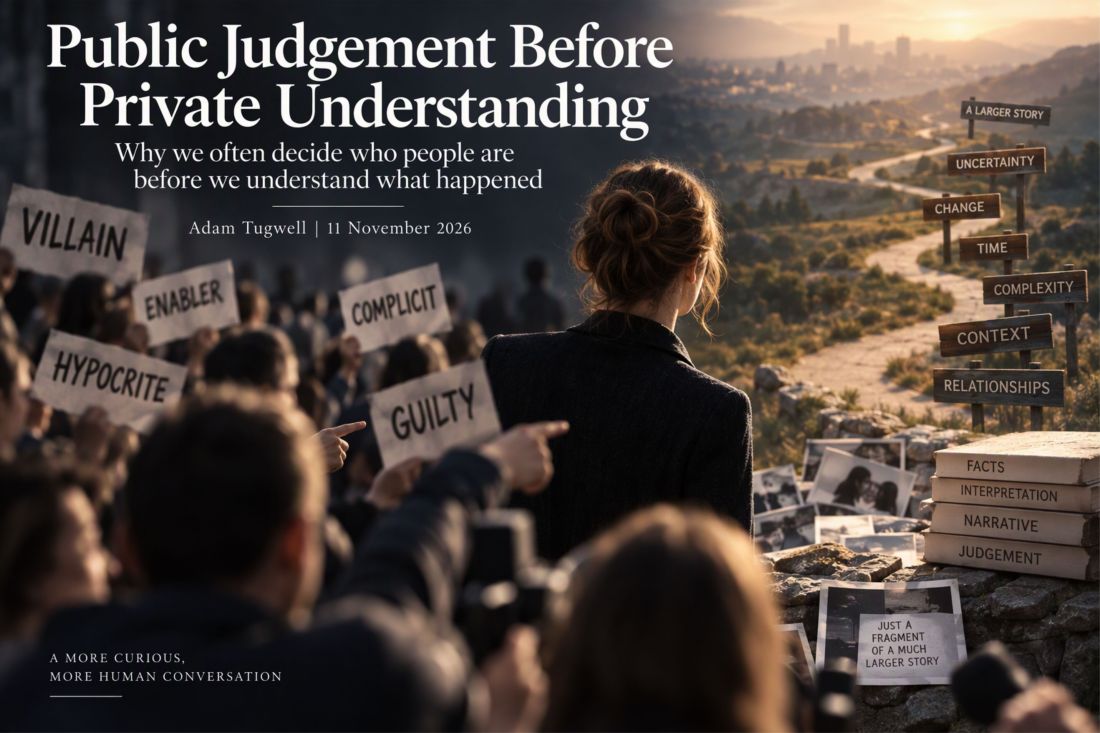
Public Judgement Before Private Understanding | Why we often decide who people are before we understand what happened

The Speed of Certainty

Sometimes the most interesting thing about a public controversy is not the controversy itself.

Following the conviction and sentencing of Russell Brand, a separate debate quickly emerged around Jemima Goldsmith. An injunction that many people had never previously heard of suddenly became the subject of widespread discussion.

Within hours of Goldsmith publishing a lengthy statement explaining her involvement in that injunction and the circumstances surrounding it, people appeared remarkably certain about what it all meant.

More strikingly, many appeared remarkably certain about who she was. And the confidence itself caught my attention.

Not because people were necessarily wrong. Public opinion is sometimes right. New information can alter our understanding of people and events. Criticism is often justified. Yet as I read reactions to Goldsmith’s statement, I found myself increasingly interested in something other than the dispute itself. What fascinated me was the apparent gap between the complexity of the chronology and the simplicity of many of the conclusions being drawn from it.

A chronology and a narrative are not the same thing.

Chronologies are messy. They contain false starts, misunderstandings, changing relationships, unforeseen consequences and facts that only become visible later.

Narratives, by contrast, are efficient. They condense complexity into something manageable. They transform a sequence of events into a story with recognisable characters and a comprehensible moral structure.

Human beings are remarkably good at compressing chronology into narrative.

The problem is that narratives are often far easier to inherit than chronologies are to reconstruct.

Living a Reality and Observing One

The more I reflected on the discussion surrounding Goldsmith, the more conscious I became of an asymmetry that appears far beyond celebrity controversies.

When we are living through a difficult reality, objectivity can be extraordinarily difficult. We experience events from the inside. We know what happened before the visible moment. We remember conversations that were never recorded, pressures that were never public, fears that were never spoken aloud and uncertainties that rarely survive into other people’s accounts. We possess so much context that we can struggle to separate ourselves from it.

Our understanding is deeply subjective because we are immersed within the experience itself.

The observer occupies a fundamentally different position.

The observer has distance. The observer is not carrying the emotional weight of the situation. They are not navigating the relationship, surviving the conflict or trying to make sense of events in real time. They possess something the participant largely lacks: the opportunity to be objective.

What strikes me is how often that opportunity goes unused.

The participant frequently recognises complexity because they cannot avoid it. The observer frequently reaches certainty because they can.

This seems backwards.

The person inside the experience is constrained by subjectivity. The observer possesses distance, perspective and time.

If anyone has the opportunity to exercise caution, curiosity and restraint, it is the observer. Yet public discussions often proceed as though distance itself were proof of understanding.

It is not.

Distance creates the opportunity for objectivity. It does not guarantee it.

The Story We Inherit

One of the themes I explored in Nobody Arrives at the Beginning was the tendency to mistake the point at which we encounter a story for the point at which the story began.

The deeper I looked into historical events, the harder genuine beginnings became to find. Every apparent origin led back to an earlier process. Every significant turning point emerged from circumstances that already existed. We inherit far more than we create.

The same observation seems to apply to people.

Almost nobody arrives at the beginning of another person’s story.

We do not arrive at the beginning of their marriage. We do not arrive at the beginning of their friendship. We do not arrive at the beginning of their dispute, their trauma, their mistakes or their private experiences.

Instead, we encounter fragments.

A resignation.

A court case.

A statement.

A rumour.

A reputation.

An allegation.

A public disagreement.

By the time these things reach us, a great deal has already happened.

What reaches us first is rarely the chronology. More often, it is an interpretation of the chronology.

This matters because interpretations have a tendency to disguise themselves as conclusions we reached independently. We inherit a story already underway and gradually forget that we arrived halfway through it.

By the time many people encountered the Goldsmith story, the chronology was already more than a decade old. Relationships had formed and ended. Allegations had been made and investigated. Journalists had become involved. Criminal proceedings had taken place. A conviction had been secured. A sentence had been imposed.

The chronology was long.

The narrative was short.

As so often happens, it was the narrative that travelled furthest.

What People Hear

Years ago, the political strategist Frank Luntz wrote a book called Words That Work, with a subtitle that captured an uncomfortable truth about communication.

It’s Not What You Say. It’s What People Hear.

Whatever one thinks of Luntz or his politics, the observation itself remains very useful.

Information never arrives in a vacuum.

People do not absorb facts in isolation. They interpret them through assumptions, prior beliefs, experiences, emotions and expectations. The meaning of information is often influenced as much by the context in which it is received as by the information itself.

This seems particularly relevant to the role played by the injunction at the centre of the Goldsmith discussion.

The existence of the injunction was discovered and brought into wider public view. Questions were raised. Those questions were legitimate. Yet once the information entered public discourse, something else happened.

The injunction became a story.

The story became a conclusion.

The conclusion became an interpretation of Goldsmith herself.

Notice how different those stages are.

The existence of an injunction is a fact.

What the injunction means is an interpretation.

What that interpretation says about another human being is another step entirely.

Yet public discussion often moves through those stages at remarkable speed.

Before long, the distinction between chronology and narrative begins to disappear.

The Principle We Forgot

There is an old philosophical concept known as the Principle of Charity.

Despite the name, it is not principally about kindness.

It is about understanding.

Before deciding that another person’s position is wrong, the principle suggests that we should first attempt to understand the strongest reasonable version of what they are actually trying to communicate, or what they actually mean. We should not begin with the weakest interpretation. We should begin with the version that a fair-minded observer would recognise as their intended meaning rather than what the precise form of words or the delivery might otherwise say.

This once seemed like a sensible discipline. But increasingly, it feels like a forgotten one.

Reading reactions to Goldsmith’s statement, I wondered how many people were responding to the statement itself and how many were responding to what they believed the statement must mean.

Those are very different things.

One can disagree with Goldsmith completely and still attempt to understand her accurately.

One can reject her account while still engaging with what she is actually saying.

The Principle of Charity does not require agreement.

It requires understanding to precede judgement.

Yet much contemporary discourse seems organised around the reverse sequence.

Judgement first.

Understanding later.

If later comes at all.

The Roles We Assign

Perhaps the most powerful thing any narrative does is assign roles.

Human beings find complexity difficult to carry. Roles help simplify it.

Somebody becomes the victim.

Somebody becomes the perpetrator.

Somebody becomes the enabler.

Somebody becomes the whistle-blower.

Somebody becomes the villain.

The role creates coherence. It tells us where the character belongs within the story.

Yet real people rarely fit such tidy categories.

One of the things that struck me about the reaction to Goldsmiths statement was how resistant many interpretations seemed to be to complexity. The possibility that someone might occupy several positions at different points in a chronology appeared oddly difficult for many people to entertain.

Relationships are rarely static.

People learn things.

Perspectives change.

Circumstances evolve.

Actions that appear contradictory in retrospect can make perfect sense when viewed within the chronology in which they occurred.

The difficulty is that chronology asks more of us than narrative does.

Narrative rewards certainty.

Chronology demands patience.

Narrative assigns roles.

Chronology asks us to understand people.

Narrative simplifies.

Chronology complicates.

One travels much faster than the other.

The Board We Are Standing On

While writing The Board We Are Standing On, I became interested in the difference between observing a system and standing inside one.

When people play Monopoly, they understand immediately that outcomes emerge from an interaction between rules, incentives, opportunities, constraints and individual decisions. They recognise that both the player and the board matter.

Outside the game, that balance often becomes harder to maintain.

When judging other people, we tend to focus on the move rather than the board that produced it.

We see a statement but not the years behind it.

We see a decision but not the circumstances surrounding it.

We see a consequence but not the system from which it emerged.

The same may be true of public judgement itself.

We often treat our understanding of another person as though it emerged independently. Yet it is influenced by narratives, framing, assumptions, expectations and inherited conclusions.

The observer believes they are assessing the individual.

Frequently they are also responding to the invisible system through which information about that individual has arrived.

The board remains hidden.

Only the piece appears visible.

Understanding Before Judgement

The longer I reflected on the reaction, the less interested I became in whether the public had reached the correct conclusion.

Correct conclusions are possible. Sometimes they are even obvious.

The more interesting question seemed to be whether understanding and judgement had occurred in the same order.

Understanding requires chronology.

It requires context.

It requires acknowledging uncertainty while information remains incomplete.

It requires accepting that another person’s lived reality may contain details we cannot see.

Judgement requires none of those things.

Judgement can emerge from fragments.

This is not necessarily a criticism. Human beings construct stories because stories help make complexity manageable. The problem begins when we forget that the story is not the chronology itself.

Perhaps this is what stayed with me about the whole discussion.

Not because Jemima Goldsmith is uniquely important. Not because she is necessarily right.

But because the mechanism became unusually visible.

A chronology spanning more than a decade collided with a narrative that could be understood in seconds.

A statement intended to add complexity entered a discussion increasingly attracted to simplicity.

A person became a role. And once the role existed, much of what followed appeared to be interpreted through it.

The same thing happens far beyond public scandals.

It happens after divorces.

It happens after workplace disputes.

It happens within families.

It happens anywhere people inherit stories about one another.

Most of us know what it feels like to be misunderstood.

Few of us realise how often misunderstanding begins with people who believe they already understand.

The participant is trapped inside the subjectivity of the experience. They cannot easily step outside it.

The observer possesses distance. The observer has the opportunity to pause, to question, to acknowledge uncertainty and to remain curious.

In theory, the observer has the better chance of objectivity.

Yet certainty often appears first among those furthest from the events themselves.

Perhaps that is why public judgement deserves more scrutiny than it usually receives.

Not because judgement is wrong.

Not because every interpretation is equally valid.

But because distance creates a responsibility alongside an opportunity.

The responsibility is to remember that chronology is usually larger than narrative. That the person is usually larger than the role. And that understanding another human being was never supposed to be the easiest part of the process.

The easiest part is deciding who they are.

Further Reading

The Board We Are Standing On
Why it is easier to see systems in a game than in the world around us

Link: https://adamtugwell.blog/2026/11/09/the-board-we-are-standing-on/

Nobody Arrives at the Beginning
Why the present inherits more than it chooses and shapes more than it can see

Link: https://adamtugwell.blog/2026/11/07/nobody-arrives-at-the-beginning/

Personal Sovereignty – The Freedom Beyond Independence

Link: https://adamtugwell.blog/2026/10/23/personal-sovereignty/

The Road We Are On is Broken – And We Built it Ourselves

Link: https://adamtugwell.blog/2026/01/07/the-road-we-are-on-is-broken-and-we-built-it-ourselves/

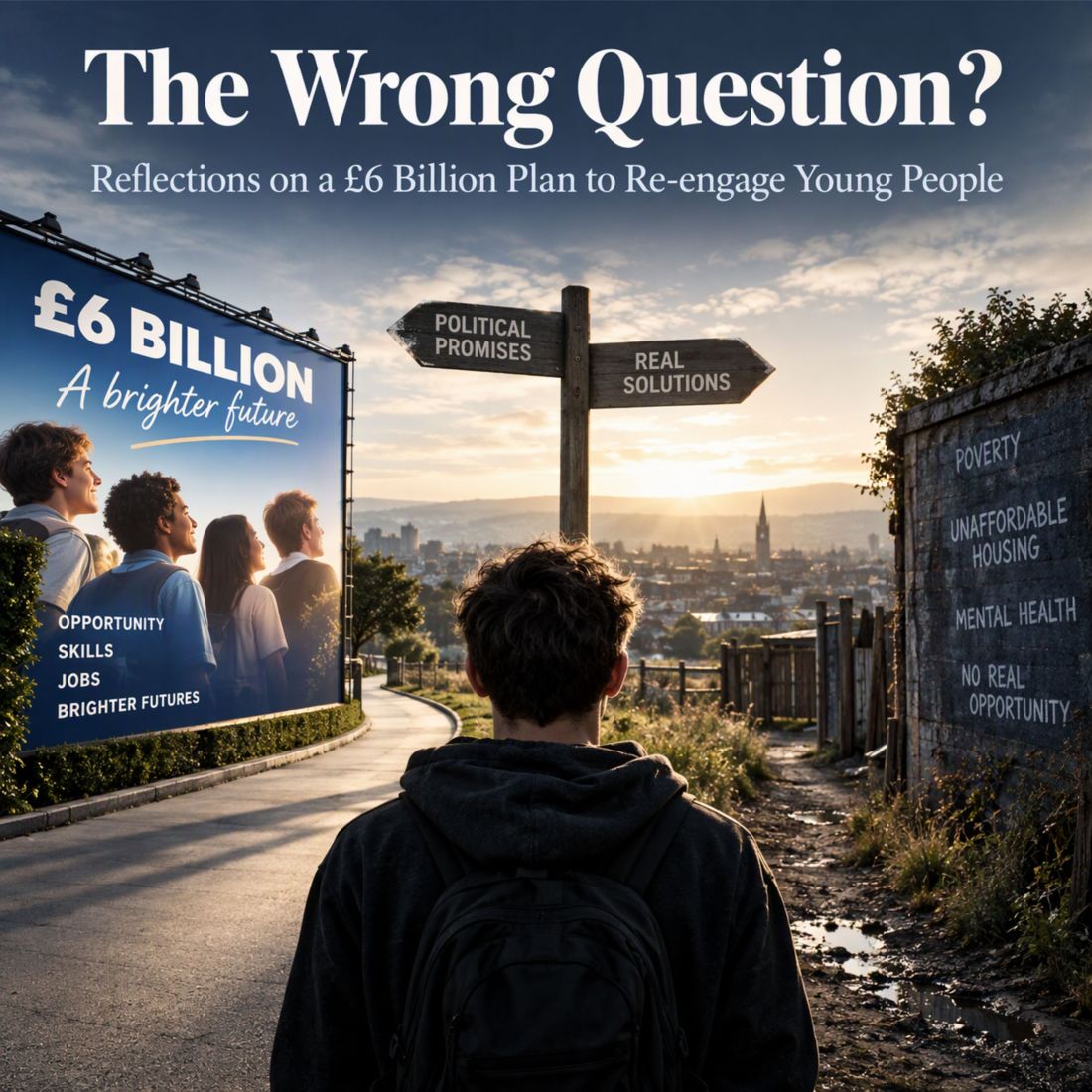
The Wrong Question | Reflections on a £6 Billion Plan to Re-engage Young People

The Comfort of Action

There is something inherently reassuring about large interventions. Faced with a troubling statistic, particularly one involving hundreds of thousands of young people, the instinct to act feels both practical and humane. Indeed, any suggestion that doing nothing might be preferable is likely to strike most people as absurd. If large numbers of young people are struggling to find their place within work, education or training, surely the responsible response is to offer more support, more opportunities and more resources.

This is precisely why the recent proposal to spend £6 billion on tackling youth disengagement feels so difficult to challenge. The scale of the funding communicates seriousness. The language surrounding the proposal communicates concern. The intention appears entirely positive. Everything about it encourages the observer to conclude that society has recognised a problem and is mobilising resources to address it.

The difficulty, however, is that large interventions often reveal as much about how a problem is being understood as they do about how that problem might be solved. Before a single pound is spent, before a single young person enters a programme and before a single outcome is measured, an assumption has already been made. That assumption is rarely discussed because it sits quietly beneath the entire proposal, presenting itself not as an interpretation but as a fact.

The assumption is that the problem begins with disengagement.

Where the Story Begins

Once disengagement becomes the starting point, the rest of the discussion follows naturally. If young people are detached from employment, detached from education or detached from training, then the obvious task becomes finding ways to reconnect them.

More support appears sensible. More intervention appears necessary. More pathways appear desirable.

Yet there is another way of looking at the situation.

A young person does not suddenly arrive at adulthood and become disengaged in isolation from everything that came before. Long before anyone appears within an official category, long before they become visible to policymakers or programme designers, they have already spent years absorbing impressions about the world around them. They have watched people enter work. They have watched people struggle despite working. They have listened to promises about education and achievement. They have observed what qualifications seem to deliver and, perhaps more importantly, what they fail to deliver.

None of this takes place inside a government framework. None of it appears neatly within a dataset. Yet these observations help shape a person’s understanding of what participation actually means.

What makes the current debate feel incomplete is that it begins at the point where disengagement becomes measurable. By then, a great deal has already happened. The visible outcome takes centre stage whilst the conditions from which it emerged quietly retreat into the background.

The Destination Itself

For much of the post-war period, a largely unspoken bargain sat beneath public life. The bargain was never perfect and it certainly did not work equally well for everybody, but enough people believed in it for it to provide a degree of social stability.

Education increased opportunities. Work offered a route towards independence. Qualifications expanded the range of possibilities available.

Effort was not guaranteed to succeed, but it generally felt connected to outcomes in ways that most people could recognise.

Whether that bargain was ever quite as reliable as memory now suggests is open to discussion. What feels more significant is the possibility that increasing numbers of people no longer believe in it.

The distinction matters because a society can continue operating according to assumptions long after confidence in those assumptions has begun to erode.

Institutions continue encouraging participation because participation has historically been associated with desirable outcomes. Politicians continue promoting employment because employment has historically been associated with independence. Educational systems continue promoting attainment because attainment has historically been associated with opportunity.

What if the issue is not that young people fail to understand the value of these things, but that they are increasingly uncertain about what these things now lead to?

That is a very different question from the one currently being asked.

Participation and Independence

Much of my recent work has revolved around the distinction between participation and independence.

Employment statistics tell us who is working.

They do not tell us whether work enables independence.

Educational attainment tells us who has completed qualifications.

It does not tell us whether those qualifications created meaningful opportunity.

Income measures tell us what people earn.

They do not necessarily tell us how secure people feel or what degree of influence they possess over the shape of their own lives.

The reason this matters is that modern policy increasingly appears focused upon encouraging participation whilst paying much less attention to the quality of the outcomes that participation produces.

From that perspective, the proposal begins to raise uncomfortable questions. If a person is being encouraged towards a labour market that struggles to provide security, towards housing that feels increasingly unattainable, towards recruitment systems that seem to recognise credentials more easily than capability, and towards pathways whose outcomes appear progressively less certain, then the challenge may not reside entirely in their willingness to engage.

At the very least, it becomes difficult to separate the behaviour from the environment within which that behaviour emerges.

The Ecosystem of Intervention

Large programmes also possess another characteristic that receives remarkably little scrutiny. They create activity.

This is not criticism. It is simply an observation about the way modern institutions function.

A proposal of this scale immediately generates work. Delivery organisations expand. Local providers seek funding. Consultants are commissioned. Programme managers are appointed. Evaluation frameworks are developed. Targets are established. Reporting systems are created. Entire professional ecosystems begin organising themselves around the successful delivery of the intervention.

None of this is inherently problematic. Complex programmes require administration and oversight.

The question becomes whether the growth of activity is being mistaken for progress.

An observer looking at the resulting landscape would see movement everywhere. Meetings taking place. Contracts being awarded. Programmes being launched. Success measures being monitored. Communications teams publishing updates. Politicians announcing milestones.

The response becomes highly visible.

What remains much less visible is whether the conditions that produced the original problem are changing in any meaningful way.

The Politics of Hope

It is here that the language surrounding the proposal becomes particularly interesting.

Hope is one of the most frequently used words in public life and yet one of the least examined. Governments offer hope. Investments create hope. Initiatives restore hope. Entire political careers are built upon promises of hope.

Yet the experience itself seems far more elusive than the language used to describe it.

People rarely describe feeling hopeful because a programme exists. More often they describe feeling hopeful because the future appears accessible in a way that previously seemed impossible.

Hope emerges when opportunities become tangible rather than theoretical. It emerges when effort appears connected to outcomes. It emerges when individuals feel capable of influencing the direction of their own lives.

In that sense, hope behaves less like something that can be distributed and more like something that emerges from conditions.

Which raises an awkward possibility.

Political systems often talk about hope when what they are really offering is activity.

One is much easier to provide than the other.

The Conversation That Disappears

This is the point at which the £6 billion begins to resemble what political strategists sometimes call a dead cat. Not because the proposal is meaningless. Not because nobody benefits. Not because everyone involved is insincere.

It resembles a dead cat because of what it allows us to stop talking about.

Once the funding is announced, attention naturally shifts towards delivery. Public discussion becomes focused on implementation, targets, outcomes and measurement. The debate concerns whether the intervention works, whether enough money has been allocated and whether additional support may be required in the future.

Meanwhile the original question fades from view.

Why are so many young people arriving at adulthood unconvinced that the systems waiting for them provide a sufficiently attractive destination in the first place?

Why does the relationship between work and independence appear weaker than many people expected?

Why do qualifications appear increasingly disconnected from capability?

Why do growing numbers of people struggle to see a future that feels attainable despite doing the things society continues to ask of them?

Those questions are not easily solved through a programme. They cannot be managed through a delivery contract. They refuse to remain neatly inside departmental boundaries.

Yet there is a growing possibility that they are closer to the source of the problem than the disengagement we have become so focused upon measuring.

The Question Beneath the Question

Perhaps the most striking thing about the proposal is not the £6 billion itself, but the confidence with which a particular diagnosis has been accepted.

If the central problem is youth disengagement, then the proposal makes perfect sense.

If the central problem is a growing loss of faith in the destinations young people are being encouraged towards, the picture becomes considerably more complicated.

The difference between those two interpretations may seem subtle from a distance. In practice, it determines whether the policy is addressing the source of the problem or organising itself around its consequences.

And that distinction may ultimately prove more important than the money being spent. Because if the intervention succeeds politically by focusing attention on disengagement itself, there is a risk that the harder conversation about work, independence, capability, belonging and the future gets postponed once again.

Perhaps that is the real value of the £6 billion. Not as a solution, but as a lens through which to examine the assumptions society continues to make about why so many young people appear reluctant to follow the paths placed before them.

Whether those assumptions are still justified seems a question worth asking before we spend the money, not after it has gone.

The Board We Are Standing On | Why it is easier to see systems in a game than in the world around us

Introduction

There is something curious about Monopoly.

Almost everyone who plays it becomes a systems thinker.

They understand that the rules matter. They understand that incentives matter. They understand that where players start matters. They understand that luck matters. They understand that previous decisions shape future possibilities. They understand that the board itself influences outcomes.

Nobody finds these observations controversial.

In fact, they are so obvious that they barely seem worth saying.

Yet outside the game, many of the same people become far less comfortable with similar ways of thinking.

Discussions about housing, education, work, politics, opportunity, wealth and inequality often collapse into arguments about individuals.

Who worked harder? Who made better decisions? Who deserves success? Who is responsible for failure?

These are reasonable questions. Individual choices matter.

But something interesting happens when people sit around a Monopoly board.

Without needing to be taught, they begin asking a different kind of question.

Not:

What did this player do?

But:

What effect is the board having on the players?

For the duration of the game, they seem perfectly capable of holding both perspectives at once.

The player matters.

The board matters.

The decisions matter.

The rules matter.

Nothing about this feels contradictory.

The question that eventually captured my attention was not whether Monopoly resembles life. It was why people find it so much easier to recognise systems when they are looking at a board game than when they are living inside one.

The Literacy We Didn’t Know We Had

One possibility is that Monopoly reveals a capability most people already possess but rarely recognise.

When discussions turn to systems, institutions, incentives or structures, many people assume these are specialist topics. They sound academic, political or technical. The language alone can make them feel distant from everyday life.

Yet put the same people around a Monopoly board and something quite different happens.

Nobody needs to explain that an early advantage can influence later outcomes. Nobody needs to explain that some decisions create opportunities while others constrain them. Nobody needs to explain that the rules of the game shape what players are likely to do.

Players understand these things instinctively. More importantly, they understand them simultaneously.

A player might observe that someone is winning because they made good decisions. The same player might also recognise that luck played a part, that the timing of property purchases mattered, and that the state of the board created opportunities that were not available to everyone else.

None of these explanations cancels out the others. They coexist naturally.

The interesting thing is not that people can understand these dynamics when they are explained to them. It is that they often see them for themselves.

The game requires no lecture on systems thinking. Players simply watch patterns emerge and begin reasoning about them. In doing so, they demonstrate a form of literacy that often goes unnoticed.

Not literacy in facts.

Not literacy in theory.

A literacy in relationships.

A literacy in incentives.

A literacy in seeing how outcomes emerge from interactions between people, rules, constraints and circumstances.

Most people never describe what they are doing this way. They simply call it understanding the game. And perhaps that is where the puzzle begins.

If people can recognise these patterns so readily around a board game, where does that ability go when the conversation shifts to education, housing, work, politics, money, opportunity or power?

Does it disappear? Or does something else happen?

Perhaps the issue is not that people lack the ability to think systemically.

Perhaps the issue is that the systems we live within are much harder to see than the systems we play.

The Difference Between Seeing the Board and Standing on It

The more I thought about Monopoly, the less interested I became in the game itself.

The interesting part was not the money, the properties or even the outcome.

It was the perspective.

When people play Monopoly, they occupy a position that is strangely difficult to achieve in ordinary life. They are participating in the game while also observing it. They make decisions, pursue opportunities, take risks and experience setbacks, but they can also step back and see how those experiences fit into a wider pattern.

A player knows whether they are doing well or badly, but they can also see who owns which properties, where advantages are beginning to accumulate, and how decisions made earlier in the game continue to influence what is possible later.

They can see the whole board at once.

That ability changes the nature of their understanding.

When a player lands on an expensive property and has to pay rent, they do not experience the event in isolation. They immediately connect it to a larger structure. They understand how the property was acquired, what choices led to its development, and how ownership changes the possibilities available to everyone else. The individual event makes sense because the wider context remains visible.

Life rarely feels like that.

Most of us experience the world from much closer to the action. We experience our rent, our mortgage, our pay cheque, our commute, our career, our opportunities and our frustrations. We experience consequences directly and continuously. What we do not always experience is the larger structure from which those consequences emerge.

Nobody experiences a housing system.

They experience the search for somewhere affordable to live.

Nobody experiences a labour market.

They experience the difficulty of finding work, keeping work, or earning enough from it.

Nobody experiences a monetary system.

They experience prices rising, bills arriving and choices narrowing.

The broader pattern often disappears beneath the immediacy of everyday life.

This is not because people are incapable of understanding systems. In many cases they understand them remarkably well, when they are visible.

The challenge is that the systems which shape our lives are not spread out across a table in front of us. We live inside them. We encounter them one consequence at a time.

The distinction sounds small, but it may explain far more than it first appears to.

Around a Monopoly board, players naturally move between different vantage points. They can think about their own position while simultaneously thinking about the game as a whole. They can ask what move they should make next while also asking what the structure of the board is encouraging everybody else to do.

Neither perspective threatens the other.

In fact, both are necessary to understand what is happening.

Outside the game, however, those vantage points often become separated. People are encouraged to focus on individual experiences, individual decisions and individual outcomes. These things matter enormously. Yet as attention narrows towards the experiences of the piece, the board itself becomes more difficult to see.

Perhaps that is why so many discussions about the world feel as though they are talking past one another.

Some people are describing the experience of the piece.

Others are describing the structure of the board.

Both may be describing something real.

The difficulty lies in recognising that the two perspectives are not enemies. They are views of the same game. And perhaps that is the first clue to the puzzle.

If people are perfectly capable of seeing systems when those systems are visible, why do some systems become so difficult to see at all?

The Hardest Systems to See

The easiest system to examine is one you already know is a system.

Nobody sits down to Monopoly believing its rules are an inevitable feature of reality. Players understand that somebody designed the board, defined the objectives, created the money and decided what winning means.

The entire game is recognised as a constructed environment.

That recognition creates an unusual kind of freedom.

A player can question the rules without feeling as though they are questioning reality itself. They can imagine a different version of the game. They can wonder what would happen if the rules changed. They can even conclude that certain outcomes are being produced less by the players than by the way the game has been designed.

None of this feels threatening because everybody already understands that the game and reality are not the same thing.

Life is different.

The systems we inhabit are not presented to us as systems. We encounter them as normality.

We are born into existing institutions, existing assumptions, existing definitions of success, existing expectations and existing ways of interpreting the world. We learn them gradually, usually without noticing that we are learning them at all. By the time we become aware of them, they often feel less like assumptions and more like facts.

This does not happen because anybody is deceiving us. It happens because inherited assumptions are rarely introduced as assumptions.

They are introduced as common sense.

A child does not usually encounter a lesson entitled The Assumptions of the Society You Live In. They encounter expectations. Incentives. Stories. Definitions of success. Definitions of responsibility. Definitions of what is realistic and unrealistic.

Over time, these things become part of the background.

And background is notoriously difficult to see.

The paradox is that the assumptions that have the greatest influence over us are often the ones we no longer recognise as assumptions at all.

They become the lens through which we interpret everything else.

That is why genuinely new ideas so often feel unrealistic when they are first encountered. The discomfort does not necessarily come from the idea itself. It comes from the fact that the idea conflicts with assumptions that have become invisible.

In Nobody Arrives at the Beginning, I explored the way each generation inherits institutions, narratives and ways of understanding the world that already exist before they arrive. Nobody starts with a blank sheet of paper. Everybody enters a story that is already underway.

Perhaps the same is true of perception itself.

We do not merely inherit systems. We inherit ways of seeing systems. And because we inherit them, we rarely stop to ask where they came from.

Around a Monopoly board, the system remains visible because it never stops feeling separate from reality.

Outside the game, the opposite often happens.

The system becomes so familiar that it starts to look like reality itself. And once that happens, questioning the system can begin to feel like questioning reality.

Perhaps this is why paradigm blindness is so difficult to recognise while it is happening.

The issue is not that people cannot see.

The issue is that we are usually looking through the very thing we are trying to observe.

Both Things Can Be True

One of the strangest things about Monopoly is how easily players accept explanations that would often be treated as contradictory elsewhere.

Imagine a player is winning.

Nobody around the table finds it difficult to say that they made some good decisions. Equally, nobody finds it difficult to notice that they landed on useful properties early in the game, benefited from favourable timing, or took advantage of opportunities that were not available to everyone else.

These explanations do not compete with one another.

They accumulate.

The player may have played well. The circumstances may have helped. The structure of the board may have mattered. The rules may have mattered. Luck may have mattered.

Most people have no difficulty holding all of these possibilities in their minds simultaneously. Understanding the game often requires it.

What is striking is how quickly this changes outside the game.

In public life, discussions frequently become battles between competing explanations. Is a person’s situation the result of their own choices or the circumstances they inherited? Are outcomes produced by individual behaviour or by wider structures? Are people responsible for their decisions or influenced by the systems within which those decisions are made?

Again and again, people are encouraged to choose between explanations that may not actually be in conflict.

Yet around a Monopoly board, they rarely feel the need to choose.

The player acts.

The board influences.

Both things are true.

The player has agency.

The player operates within constraints.

Both things are true.

The outcome emerges from the interaction between decisions, circumstances, rules and opportunities.

All of these things can be true at the same time.

Perhaps this becomes harder in real life because people experience these questions personally.

An observation about the board can feel like a judgement about the piece.

A discussion about incentives can feel like an attack on responsibility.

A discussion about structure can feel like a denial of agency.

As a result, perspectives that might naturally complement one another become treated as rivals.

The irony is that many of the disagreements that dominate public debate are not necessarily disagreements about reality. They are disagreements about vantage point.

One person is describing what it feels like to be the piece.

Another is describing the board.

Both may be observing something real.

Both may be observing the same reality from different positions.

In The Road We Are On Is Broken – And We Built It Ourselves, I explored the idea that perspective shapes perception. What we see depends partly on where we are standing. The same principle may apply here.

The challenge is not choosing the correct perspective. The challenge is recognising that understanding often requires more than one.

Around a Monopoly board, this comes naturally.

Players move effortlessly between their own experience and a wider view of the game.

They can see the move and the board simultaneously.

Perhaps one of the hidden lessons of the game is that reality often works the same way.

The difficulty is not that multiple perspectives exist.

The difficulty is remembering that our own perspective is only one of them.

Nobody Arrives at the Beginning

There is another lesson hidden in Monopoly that is easy to overlook.

Nobody begins by creating the game.

The board already exists. The rules already exist. The money already exists. The objective already exists. Even the meaning of success has already been decided before the first player moves a piece.

The players inherit all of it.

That sounds obvious because it is. It would be strange to imagine a player claiming personal credit for inventing the board, writing the rules or deciding how the game should work. Their role is not to create the game. Their role is to navigate it.

Yet this obvious observation becomes surprisingly difficult to recognise outside the game.

In everyday life, people often speak as though they stand at the beginning of their own story. We talk about choices, achievements, failures, opportunities and responsibilities as though they emerge into an empty space. In reality, none of us start with a blank sheet of paper.

We inherit language before we learn to speak.

We inherit institutions before we begin participating in them.

We inherit markets before we enter them.

We inherit assumptions before we learn to question them.

We inherit measures of success before we decide whether they are worth pursuing.

By the time we become capable of reflecting on the systems around us, we are already immersed within them.

In Nobody Arrives at the Beginning, I explored this idea through history. The deeper I looked for origins, the harder they became to find. Every turning point turned out to have predecessors. Every significant decision emerged from circumstances that already existed. Every generation inherited realities it did not create and passed modified versions of those realities to those who followed.

The same observation applies at the level of individual experience.

Nobody arrives at the beginning.

We arrive in the middle.

We enter a world where rules, assumptions, incentives and expectations are already operating. Some serve us well. Some do not. Some are visible. Others become so familiar that they disappear into the background.

This matters because inherited systems shape more than behaviour. They shape perception.

A player joining a Monopoly game understands immediately that the board was there before them. Because of that, they are capable of questioning it. They can imagine different rules, different objectives and different ways of playing.

Outside the game, inherited assumptions often acquire a different status. They stop appearing as inherited assumptions and start appearing as reality itself.

The distinction is subtle but important.

If something is recognised as a rule, it can be questioned.

If something is recognised as an assumption, it can be examined.

If something is recognised as an incentive, it can be redesigned.

But if those same things are mistaken for reality itself, they become largely invisible.

Perhaps this is one reason meaningful change is so difficult.

People are often trying to solve problems using assumptions they never consciously chose. They are evaluating outcomes using measures they inherited. They are navigating incentives that predate them. They are arguing about moves while taking the board largely for granted.

Not because they are foolish.

Not because they lack awareness.

But because it is extraordinarily difficult to recognise the parts of reality that have become normal.

Around a Monopoly board, nobody mistakes the game for reality.

Outside the game, the distinction becomes much harder to maintain.

And that may be the most important difference of all.

Conclusion: The Board We Cannot See

Perhaps the strangest thing about Monopoly is not what it teaches us about money, ownership or competition.

Perhaps it is what it reveals about ourselves.

For a few hours around a board, people routinely demonstrate an ability that often seems absent elsewhere.

They recognise patterns beyond their own experience. They understand that rules shape behaviour. They understand that incentives matter. They understand that opportunities are not evenly distributed. They understand that outcomes emerge from an interaction between individual choices and larger structures.

Most importantly, they understand that seeing the game requires more than looking at a single piece.

Yet when the game ends, that capability appears to fade from view.

The obvious explanation is that people stop thinking systemically.

I am no longer convinced that is true.

A more interesting possibility is that the capability never disappears at all.

What changes is the visibility of the board.

When the board sits on a table, we can step back from it. We can inspect it. We can argue about it. We can imagine playing differently. We understand instinctively that the rules, incentives and objectives are not reality itself. They are features of a particular game.

The systems we inhabit every day are different. We are born into them rather than sitting down to them. We inherit them rather than choosing them. We learn their assumptions before we are capable of questioning them. Over time, many of those assumptions cease to appear as assumptions at all.

They become simply the way things are.

Perhaps that is why meaningful change so often proves elusive.

The challenge is not necessarily a lack of intelligence, education or awareness. It may be that people are attempting to understand a board upon which they are standing. They are trying to observe a system from within a system. They are trying to examine assumptions that have become part of the background of their own thinking.

That is not impossible. It is simply difficult.

In Nobody Arrives at the Beginning, I argued that every generation inherits a world already in motion. In Personal Sovereignty, I explored the possibility that genuine freedom begins when we become capable of seeing some of the assumptions we have inherited rather than mistaking them for reality itself.

Viewed from that perspective, Monopoly points towards something unexpectedly important.

Not because it explains the world.

Not because the world is secretly a board game.

But because it reveals a capability that many people already possess.

The ability to step back.

The ability to recognise a system.

The ability to see both the piece and the board.

The ability to hold more than one perspective at the same time.

The question, then, is not whether we are capable of systemic thinking.

The question is whether we can learn to apply the same mode of thought to the systems we already inhabit.

Because if we can, a great deal that currently appears inevitable may begin to look very different.

We may discover that some of the things we call reality are, in fact, inherited assumptions.

We may discover that some of the boundaries we regard as fixed are products of particular ways of organising life.

And we may discover that the board has been visible all along.

Not hidden.

Not secret.

Simply mistaken for the ground beneath our feet.

Further Reading

This essay began with an observation about perspective, systems and the strange ease with which people can recognise certain patterns when those patterns are made visible. The pieces below explore many of the same themes from different directions.

Seeing the Board

Nobody Arrives at the Beginning

Explores how every generation inherits assumptions, institutions and ways of understanding the world that already exist before they arrive. It argues that meaningful turning points are rarely true beginnings, and that understanding the present requires recognising the histories embedded within it.

Read: https://adamtugwell.blog/2026/11/07/nobody-arrives-at-the-beginning/

The Road We Are On Is Broken – And We Built It Ourselves

Examines the relationship between perspective, awareness and systemic change. It argues that many modern problems persist because people struggle to see the structures producing them, and that solutions rarely emerge from the same thinking that created the conditions being addressed.

Read: https://adamtugwell.blog/2026/01/07/the-road-we-are-on-is-broken-and-we-built-it-ourselves/

Systems, Assumptions and Cognitive Capture

Personal Sovereignty: The Freedom Beyond Independence

Explores the distinction between independence and sovereignty, introducing the ideas of cognitive capture, inherited assumptions and structural pressure. It argues that genuine freedom begins when we become capable of examining the assumptions we inherited rather than mistaking them for reality itself.

Read: https://adamtugwell.blog/2026/10/23/personal-sovereignty/

The Establishment Is Not What You Think It Is

Presents the argument that the modern Establishment is not primarily a group of people but a worldview: a shared set of assumptions about what is realistic, responsible and possible. It examines how incentives sustain those assumptions and why systems often reproduce themselves without requiring coordination or conspiracy.

Read: https://adamtugwell.blog/2026/07/15/the-establishment-is-not-what-you-think-it-is-why-the-modern-establishment-is-a-worldview-not-a-class-and-why-that-makes-it-so-hard-to-escape/

The Paradox of Control: How the Things That Could Free Us Are Being Used to Shape Our Dependence

Examines how tools, technologies, institutions and ideas that could increase freedom often end up reinforcing dependency. It explores the relationship between control, incentives, identity and the assumptions that shape modern life.

Read: https://adamtugwell.blog/2026/03/31/the-paradox-of-control-how-the-things-that-could-free-us-are-being-used-to-shape-our-dependence/

Understanding the Dynamics Beneath the Symptoms

Can Meaningful Change Still Be Delivered Today?

A concise overview of the wider inquiry from which many of these ideas emerge. It introduces concepts including cost externalisation, human value externalisation, proxy sovereignty, judgement displacement and agency, while asking whether meaningful reform remains possible within the systems we already have.

Read: https://adamtugwell.blog/2026/11/01/can-meaningful-change-still-be-delivered-today/

The Future Is Abstract

Explores why genuinely different futures can be difficult to imagine from within existing systems. It argues that many alternatives appear unrealistic not because they are impossible, but because they sit outside assumptions we have become accustomed to treating as reality.

Read: https://adamtugwell.blog/2024/08/22/the-future-is-abstract-because-todays-way-of-life-is-the-root-cause-of-our-problems-and-we-will-only-have-a-tomorrow-if-we-leave-it-behind/

Independence, Agency and Sovereignty

The Independence Threshold: A New Definition of Poverty for a Modern Economy

Argues that poverty begins where independence ends. Rather than focusing solely on material conditions, it examines whether a person can meet their essential costs of living without reliance on debt, charity, welfare or family support, and why that threshold matters for freedom and agency.

Read: https://adamtugwell.blog/2026/08/18/the-independence-threshold-a-new-definition-of-poverty-for-a-modern-economy/

Your Beliefs Today Create Everyone’s Experiences Tomorrow

A broader exploration of worldviews, perception and the relationship between individual beliefs and collective outcomes. It examines how different understandings of reality shape the futures societies create.

Read: https://adamtugwell.blog/2025/01/12/your-beliefs-today-create-everyones-experiences-tomorrow-new-book/

The Philosophy of a People-First Society

Sets out the philosophical foundations underlying much of this work, including assumptions about human nature, value, contribution, community and the relationship between systems and human flourishing.

Read: https://adamtugwell.blog/2026/01/02/the-philosophy-of-a-people-first-society/

Nobody Arrives at the Beginning | Key Ideas and Reflections

Why this essay exists

We often look for a moment when everything changed.

A document. A leader. A law. A decision.

History becomes easier to understand when it appears to have a beginning.

Yet the deeper we look, the more difficult beginnings become to find. What seem like origins often turn out to be moments when longer processes become visible.

The question is not simply where something started.

The question is what made it possible.

The illusion of beginnings

The essay makes a distinction between two very different things:

The beginning of an arrangement

and

The beginning of all the conditions that made that arrangement possible.

The two are rarely the same.

A law may come into force on a particular day.

An institution may have a founding date.

A memorandum may propose a new strategy.

Yet the assumptions, interests, habits and circumstances that made those things possible often stretch back decades or centuries.

What we call a beginning is often a point in the middle of a longer story.

How assumptions survive

Ideas do not survive only because people keep repeating them.

Often they become embedded in the world around us.

They appear in:

  • systems
  • incentives
  • measurements
  • routines
  • institutions

Over time they can stop looking like assumptions and start looking like reality.

One generation establishes them.

The next generation inherits them.

The generation after that may treat them as obvious.

Direction without destiny

The essay rejects two simple explanations of history.

The first is that everything happens according to some hidden master plan.

The second is that everything happens by accident.

Reality is usually more complicated.

People make decisions.

Those decisions create incentives, institutions and expectations.

Future decisions are then made within the world those earlier decisions helped create.

Patterns emerge.

Trajectories develop.

Yet nobody possesses complete knowledge of where they will lead.

A question worth asking

When an arrangement seems inevitable, ask:

Is this genuinely necessary, or have we simply become accustomed to it?

Familiarity is often mistaken for necessity.

History reminds us that they are not the same thing.

The challenge of responsibility

None of us begins with a blank page.

We inherit:

  • institutions
  • traditions
  • debts
  • opportunities
  • assumptions

Inheritance explains part of the story.

It does not remove responsibility.

We may not have chosen the circumstances we receive, but we still influence the circumstances we leave behind.

Two silences

At the centre of the essay sit two simple observations:

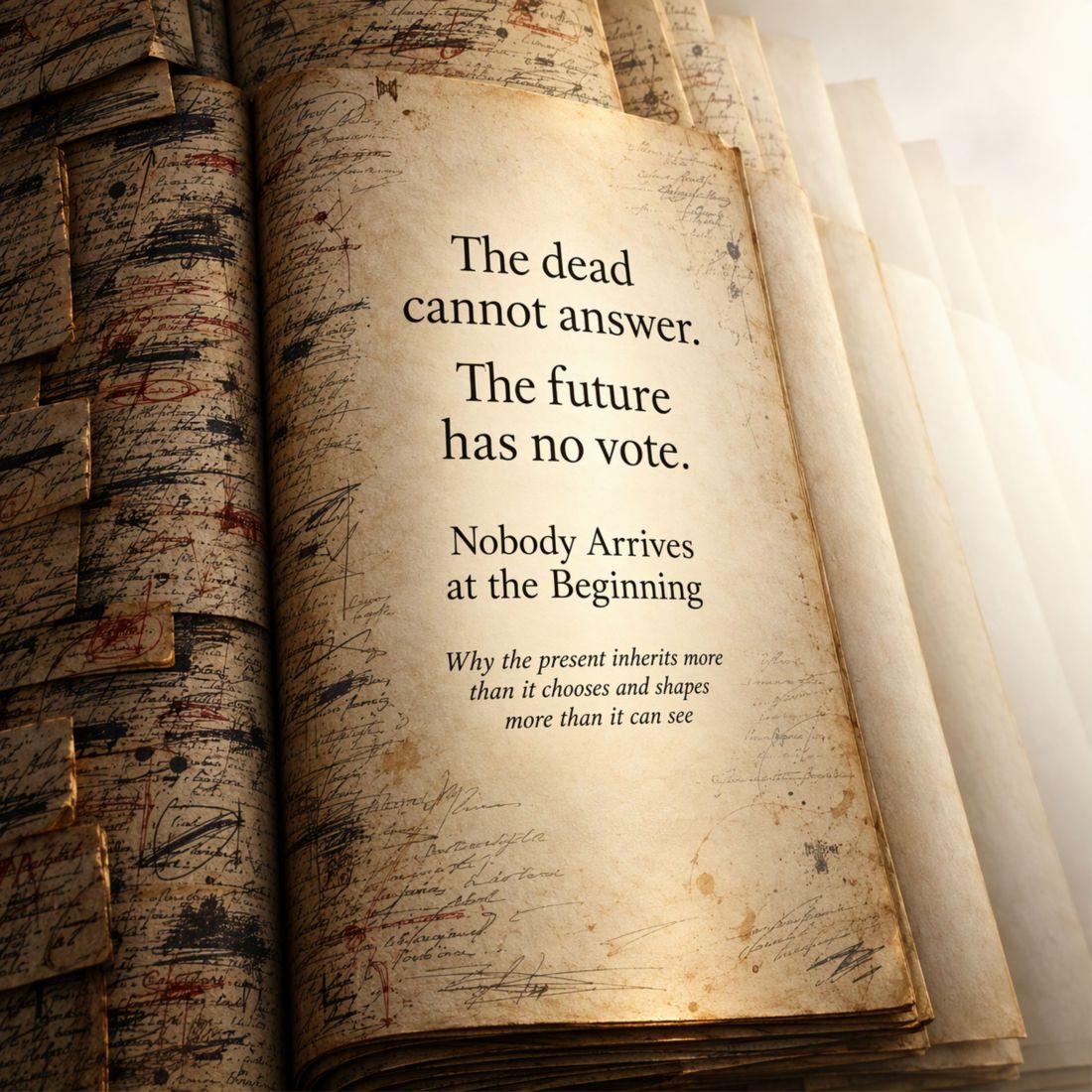
The dead cannot answer.

The future has no vote.

The first reflects a limitation of historical understanding.

We can study the past, but we cannot ask it to respond.

The second reflects a limitation of political responsibility.

Future generations may live with the consequences of today’s decisions, but they cannot participate in making them.

Between those two silences sits the present.

Nobody arrives at the beginning

The deeper the inquiry goes, the harder it becomes to find anyone standing at the start of the road.

The people of the past inherited a world they did not create.

So do we.

Every generation enters the story in the middle.

Every generation mistakes some assumptions for reality.

Every generation leaves something behind.

The challenge is not to find the beginning.

The challenge is to understand our place within the process.

A final reflection

Future generations may look back on some of our assumptions the way we now look back on assumptions held by those who came before us.

The uncomfortable question is not whether this will happen.

The uncomfortable question is:

Which of our own assumptions will seem obvious, unquestioned and mistaken to those who come after us?