There is a persistent and dangerous myth in British politics: that young people are disengaged, apathetic, or uninterested in shaping the future.
The truth is more uncomfortable. Young people are not disconnected from politics because they do not care. Many are disconnected because the system itself has become distant, performative, and detached from everyday life – and that detachment is not confined to the young. It affects everyone.
We have reached a point where Westminster can place individuals with limited experience of community governance into positions of enormous responsibility, while insulating them from the direct consequences of the decisions they make.
They enter a system where relationships are abstract, accountability is delayed, and governance is often performed through layers of bureaucracy rather than lived reality.
We pretend this is normal. Yet if a group of 18-year-olds were placed in charge of government tomorrow with no grounding in community life and no experience of governance, we would rightly call it absurd.
The uncomfortable question is why we tolerate the same absence of rooted experience when it appears inside the political class.
The problem is not young people. The problem is the system that asks them to believe in politics while giving them so little reason to trust it.
The Disconnect: Why Young People Walk Away
Young people are not blind to politics. They see the gap between political theatre and real life. They see leaders making decisions about communities they seldom experience firsthand. They see policy made at a distance, often without any visible understanding of its consequences.
They also see a political culture that often rewards performance over competence, messaging over understanding, and loyalty over responsibility.
So some walk away from formal politics, while others redirect their energy into campaigning, community action, mutual aid, social media advocacy, or issue-based movements.
That is not the same as apathy. It is often a judgement about where their effort is likely to matter.
The evidence increasingly supports this distinction. The John Smith Centre’s UK Youth Poll 2025 found that many young people still value democracy and want a say, even while 63% agreed that democracy in the UK is in trouble. The Diana Award’s 2024 Youth Voice in Politics report found that only 20% of young people agreed that politics takes young people’s voices seriously, while UK Youth reported that 88% of children and young people surveyed believed it was important to have a say in public decisions.
The issue, then, is not whether young people care. The issue is whether the system gives their care a serious route into responsibility, influence, and decision-making.
Why Young People Matter – and Why the Current System Cannot Use Their Contribution
Young people bring clarity, urgency, and direct experience of the realities shaping modern life. They understand the world they are inheriting because they are living its consequences now – in education, housing, employment, mental health, technology, and community life.
But the current system struggles to integrate their contribution meaningfully. It is centralised, distant, insulated, and slow. It is built more around hierarchy than participation, more around institutional process than direct relationship, and more around national performance than local responsibility.
This matters because youth participation cannot be reduced to consultation exercises, photo opportunities, or carefully managed listening events. If young people are only invited to speak after decisions have already been shaped elsewhere, they are not participating in governance. They are providing decoration for it.
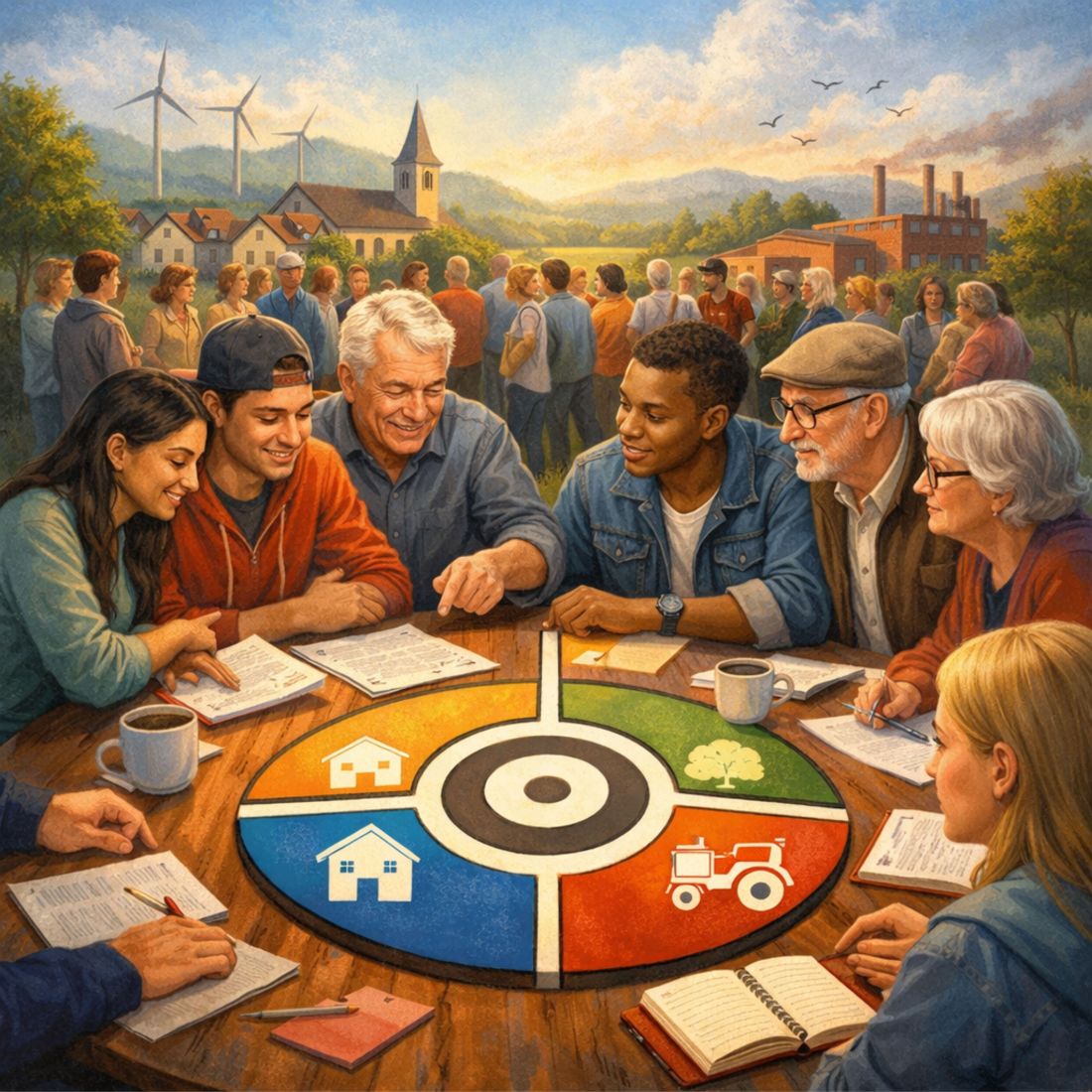
This is why the Local Economy & Governance System (LEGS) and the Circumpunct model matter. They attempt to relocate responsibility closer to the people affected by decisions, creating a structure in which participation is not occasional, symbolic, or distant, but practical, local, and continuous.
The Westminster Problem: Governance Without Proximity
The critical weakness of Westminster is distance.
There is distance between leaders and communities, between decisions and consequences, and between policy language and lived reality.
That distance creates insulation. Over time, insulation becomes detachment, and detachment produces dysfunction.
Young people sense this quickly. They see politics as something done to communities, not with them. They see leaders who rarely experience the outcomes of their own decisions. They see governance become unreal – a performance rather than a practice.
Their rejection of that system is not irresponsibility. It is a rational response to a politics that too often treats them as an audience rather than participants.
The Circumpunct and LEGS: A System Built for Real Participation
The Local Economy & Governance System (LEGS) and the Circumpunct model offer a fundamentally different approach: governance rooted in proximity, relationships, and shared responsibility. Instead of asking people to place blind trust in remote institutions, they seek to create structures where responsibility is visible and participation is practical.
Local people making local decisions for local lives.
This means governance in real time, with real accountability and visible consequences.
Young people can be integrated naturally.
Not through tokenistic youth councils, staged consultations, or symbolic representation, but through direct participation in the decisions that shape community life.
Experience and youth coexist instead of competing.
Older generations provide grounding, continuity, memory, and wisdom. Young people provide energy, clarity, imagination, and urgency. Healthy governance requires both.
Responsibility becomes shared, not delegated.
Young people learn responsibility by doing, not by watching. Older generations remain relevant by guiding, not gatekeeping.
This is governance that works because relationships are direct and consequences are visible. It is governance that teaches young people how to contribute meaningfully while ensuring that experience remains central to decision-making.
It is governance that builds communities rather than managing them from afar.
A Necessary Objection: What About National Coordination?
A local system does not mean abandoning national coordination. Defence, infrastructure, fiscal policy, legal standards, and national rights still require wider frameworks. The argument is not that every decision should be made locally. It is that decisions should be made at the closest responsible level possible, with higher levels supporting rather than replacing local responsibility.
This distinction matters. Central government should provide coordination, safeguards, resources, and standards. Communities should provide knowledge, relationships, accountability, and direct experience. A healthier system would connect these levels rather than allowing one to dominate the other.
The Warning: The System Is Failing Them Today – and Failing Us All Tomorrow
Young people are inheriting a world shaped by decisions they did not make, systems they did not design, and crises they did not cause. Yet they are expected to carry the consequences, repair the damage, and navigate a future built on the failures of the past.
If we continue to exclude them from meaningful responsibility, we should not be surprised when they withdraw from formal politics. If we lose their trust, we lose more than a voting bloc. We lose imagination, continuity, legitimacy, and the future capacity of communities to govern themselves.
The system is failing young people today. Because it is failing them today, it is failing all of us tomorrow.
The Path Forward: Rebuilding Governance from the Ground Up
The solution is not to “get young people more interested in politics.” The solution is to build a system worth their interest, trust, and effort.
A system where:
Governance is local, direct, and human.
Responsibility is shared, not hoarded.
Experience is valued, not weaponised.
Youth is included, not patronised.
Community is the centre, not the afterthought.
Decisions are made by people who live with their consequences.
This is the promise of LEGS. This is the power of the Circumpunct. It offers a way to rebuild political culture by restoring seriousness to participation: people take their role seriously when the system takes them seriously.
Young people are not the problem. They are part of the solution – but only if we build a system capable of receiving their contribution and sharing responsibility across generations.
The future of democracy will not be secured through better messaging, larger bureaucracies, or more sophisticated political theatre. It will be secured when people once again have a meaningful stake in the decisions that shape their lives. That begins locally. It begins with proximity. It begins with responsibility shared across generations. It begins with governance that is real.
Reader Takeaway
Youth disengagement should not be mistaken for indifference. It is a warning sign that political structures have become too distant from the people they claim to serve.
If democracy is to regain trust, it must move closer to everyday life and create real roles for people of all generations in shaping the communities they share.
Further Reading
The Local Economy & Governance System: Online Text https://adamtugwell.blog/2025/11/21/the-local-economy-governance-system-online-text/ This companion text sets out the wider LEGS framework in more detail, explaining how local economic organisation, community governance, and shared responsibility can be brought together into a practical model for rebuilding democratic life from the ground up.
Declining trust, institutional fragility, and the danger of mistaking symptoms for causes.
Trust in political institutions is falling, public frustration is rising, and many people increasingly feel that politics offers different language but the same underlying direction. The slogans change. The faces change. The promises change. But the choices in front of us often seem to lead back to the same narrow set of answers.
This is why politics feels broken to so many people. It is not only because of scandal, incompetence, polarisation, or distrust, although all of those matter. It is because the political system itself appears to be losing its ability to adapt. Institutions feel brittle. Public debate feels repetitive. Outsider movements rise, but often carry the same assumptions as the establishment they criticise.
The risk of the moment is not simply anger, division, or frustration. It is misdiagnosis: the danger that a complex, systemic crisis will be treated as if it were a single problem with a single solution.
Why Does Politics Feel Broken?
Politics feels broken because people are experiencing several overlapping pressures at once: declining institutional trust, economic insecurity, cultural fragmentation, political polarisation, and a governing system that struggles to respond to complex problems. When these pressures are interpreted as one-dimensional failures – corruption, incompetence, weak leadership, or bad ethics – the proposed solutions rarely reach the deeper causes.
Collapse, in this context, does not mean sudden breakdown. More often it means the gradual loss of adaptive capacity: institutions becoming less able to absorb pressure, public trust becoming harder to sustain, and familiar political tools becoming less effective at solving emerging problems.
Why Everything in Politics Feels the Same
The political system is not just struggling. It is running out of room. Many parties, campaigns, and “new” options still draw from the same restricted deck: the same assumptions about markets, competition, growth, individual responsibility, and institutional management. That is why it can be difficult to see genuine daylight between them.
When a political system narrows, the public naturally looks elsewhere. Outsider movements become attractive because they sound fresher, less compromised, and more willing to say what established figures avoid. But unfamiliar is not the same as new.
Many outsider movements rise by naming real failures, but they often remain shaped by the same deeper instincts as the system they oppose. They may reject the tone of the establishment while keeping its underlying logic: competition as the default answer, market discipline as the main tool, and self-interest reframed as principle.
This is the restricted deck problem. A movement can appear disruptive on the surface while still being constrained by the same limited tools underneath. It can criticise the system without escaping the logic that made the system brittle.
The Perception Gap: Symptoms Are Easier to See Than Systems
Most people experience political crisis through its visible symptoms: arguments, scandals, headlines, personalities, broken promises, and day-to-day drama. These symptoms matter, but they are not the whole story.
The deeper problems are quieter. They sit inside institutions, economic pressures, cultural tensions, and the erosion of public trust. They do not fit neatly into interviews, slogans, or campaign messages, so they are often left unnamed.
This creates the perception gap: people feel system-level instability, but they mostly see surface-level conflict.
Someone may feel a loss of security and see only incompetence. They may feel institutional fragility and see only political theatre. They may feel economic pressure and see only blame. The deeper structure remains hidden behind the noise.
When people see only one dimension of collapse, they naturally look for one-dimensional explanations. They want someone who can point to a single cause and offer a single fix. That is why simple narratives are so powerful: not because they are accurate, but because they are comforting.
The danger is that people then choose solutions that match the part they can see. They try to fix a system problem with personality politics, institutional fragility with anger, cultural tension with slogans, and economic pressure with blame. None of these responses reaches the deeper causes.
Why Outsider Movements Rise – and Why They Often Fail
Outsider movements rise when established politics no longer feels capable of interpreting the moment. They gain traction because they appear to break the repetition. They speak plainly. They name frustration. They offer clarity when public life feels foggy.
But there is a crucial transition point when a movement stops being a protest and starts becoming a possible alternative. At that point it must evolve. It has to move from naming failure to understanding complexity, from expressing anger to building capacity, from opposing the system to explaining how a different system would work.
If it cannot make that transition, the opportunity is lost. The movement may still win attention, followers, seats, or headlines, but the deeper chance to change the direction of public life disappears.
When that happens, a vacuum opens. People remain frustrated, but the movement that could have organised that frustration into something constructive has failed to deepen. The space is then filled by movements that sound calm, confident, and certain – even when their certainty is built on oversimplification.
The Danger of Simple Explanations
Simple explanations become powerful in exhausted societies. They reduce complexity to a manageable story. They identify a culprit, promise a remedy, and make the future feel controllable again.
If people believe the crisis is only about ethics, they look for ethical heroes. If they believe it is only about incompetence, they look for competent managers. If they believe it is only about corruption, they look for clean hands. If they believe it is only about mismanagement, they look for stronger leadership.
All of these may be desirable. But none is sufficient on its own. A crisis of institutional trust, democratic legitimacy, economic pressure, and cultural fragmentation cannot be solved by fixing only one visible fault line.
This is how misinterpretation deepens collapse. The surface problem is addressed while the underlying system continues to lose capacity. The noise is treated, but not the structure. The drama is managed, but not the direction. The symptom is soothed, but the disease remains.
As research into political trust has repeatedly shown, declining confidence in representative institutions can make democratic systems more fragile and make it harder for governments to respond to shared problems. That does not mean every institution deserves automatic trust. It means that once legitimacy erodes, societies need more than better messaging. They need institutions capable of earning trust again.
What a Systemic Crisis Looks Like
A systemic crisis is rarely experienced as one dramatic event. It is more often experienced as a pattern: promises that do not land, institutions that struggle to absorb pressure, public debate that becomes more reactive, and citizens who feel that nothing quite changes even when everything seems urgent.
It can appear as declining trust in government, parliament, media, parties, expertise, or public administration. It can appear as polarisation, disengagement, cynicism, or the repeated rise of anti-establishment politics. It can appear as economic pressure being translated into cultural blame, or cultural anxiety being translated into institutional hostility.
The crucial point is that these are not separate stories. They interact. Economic insecurity weakens trust. Low trust makes compromise harder. Weak compromise makes institutions less effective. Ineffective institutions deepen frustration. Frustration creates demand for simple narratives. Simple narratives then make the system even harder to repair.
This is why the crisis feels larger than ordinary political disagreement. Democracies are built to contain disagreement. They are not built to function well when the public no longer believes the system can hear, process, or respond to pressure.
Seeing the Whole Picture
If the risk of the moment comes from misdiagnosis, then the way through begins with seeing the whole picture. Not the noise alone. Not the personalities alone. Not the scandals, slogans, or surface explanations alone. The task is to understand how institutions, economics, culture, trust, and political behaviour reinforce one another.
That does not require specialist expertise. It requires resisting the temptation to make the moment smaller than it is.
Once collapse is understood as multi-layered, the appeal of single-layer solutions weakens. One person cannot fix it. One party cannot fix it. One slogan cannot fix it. One moral diagnosis cannot fix it. A system problem requires system-level understanding.
This does not mean giving up on clarity. It means refusing false clarity. The strongest analysis is not the analysis that makes everything simple. It is the analysis that makes complexity understandable without pretending it has disappeared.
The greatest danger is not political disagreement. Democracies are designed to accommodate disagreement. The greater danger is misdiagnosis: treating a complex, systemic crisis as if it were a single problem with a single solution.
When societies misunderstand the nature of their challenges, they choose remedies that intensify the underlying condition. They mistake confidence for competence, simplicity for truth, and visibility for understanding.
Understanding the whole picture is therefore not a luxury. It is a prerequisite for responding effectively to the moment we are living through.
In recent days, I had a conversation about what Foods We Can Trust can actually mean to different people.
It’s important to recognise that what Foods We Can Trust are, is a subject that can mean different things everyone at first glance.
It does so, because we all think about Food in ways that can be very divisive. Depending on what role Food already plays for us, in our lives.
However, Food really shouldn’t ever be divisive. Because whatever may or may not be important to us when we think about the types of food we Eat and why we do or do not Eat them, we should all be able to make the choice of what We Eat at every mealtime from Foods We Can Trust.
Once we’ve got through all of the questions, objections and every other form of barrier that stop people from being able to choose every meal from Foods We Can Trust today, there are very good reasons why each of us should be thinking a lot more carefully and consciously about the Food we consume and why.
Changing the way that we think about Food is the biggest question to answer, as we consider the Foods We Can Trust.
We take Food for granted in just about every conceivable way.
But perhaps the worst and potentially most harmful way we overlook what we are Eating, for us personally and as far as our bodies are concerned, is our failure to always consider the nutritional value and what the Food we consume contains, at the point that it enters our bodies.
Please don’t be under any illusion. We all do it – Because that’s how life currently works. And that’s a real problem for us all!
We don’t need to be doctors, scientists, nutritionists or dieticians to understand the basic principle or equation that tells us what we put into our bodies will have a direct effect on what we get out.
The Food we consume impacts us all in terms of our physical health, mental health, energy levels, wellbeing, hormonal balances, how we feel at any particular time and yes, the list goes on.
But most of us also take this for granted too. And most worryingly, we don’t really think about any of it until whatever we are eating too much or not enough of, shows up by affecting us personally, in some uncomfortable way.
Sadly, even then we may not feel able to do anything about it because of the relationship we have with Food.
The Human Body is a miraculous biological machine.
It has all sorts of weird and wonderful mechanisms, chemical processes and even physical filtering systems, that can deal with small amounts of things which aren’t actually all that good for us.
However, small really does mean small, in terms of anything that the Human body needs and really doesn’t need to consume.
The amounts of anything within what we Eat that can make a difference, either positively or negatively can be ridiculously small. Even in terms of the amount of the good things that we require each day for our bodies to function at their very best.
So small amounts of anything that we consume regularly that isn’t good for us can soon start to become a problem over time, because the body cannot keep removing the things we don’t need and so it can build up, causing a cumulative effect.
The difficult thing for us to get our heads around is that consuming small amounts of the wrong things doesn’t appear to have any direct relationship with what we Eat. Because we rarely have immediate reactions to bad things at the same moment that we eat it, and we would all typically spit it out or would soon be sick when we do.
This indirect relationship means that we easily overlook foods and ingredients that aren’t good for us at the moment we eat them. Especially when there is some reason that makes those foods very appealing to eat – and perhaps addictive or habit forming when we put them in our mouths. Such as the way that they taste.
The appeal of the Foods that we typically eat today isn’t as simple as all it might seem. Because the companies that make massive profits out of ‘making’ or manufacturing foods that can do us harm when we repeatedly Eat them over a period of time, are only really able to do what they do by using and abusing the knowledge of how our bodies work.
Many of the Foods we eat today are actually designed and then manufactured to fool our bodies into believing that we are only eating things that are actually good for us.
So, when it comes to the taste of the Food we eat, ‘good’ is no guarantee that what we are eating is good for us and can actually mean that its very bad!
Masking is a process where Food or ingredients that are artificial, have been modified or processed in ways that will often mean they will become harmful to our bodies when we keep consuming them over a period of time, are hidden by adding other ingredients that quite literally confuse our bodies and ‘mask’ our taste receptors, so our bodies natural responses are confused and unable to respond to whatever the food we are eating really is.
If we eat more of anything than we need or try to eat anything that isn’t going to be good for us that is naturally produced, a healthy body will usually tell us that we should stop eating.
Regrettably, because we are living through and experiencing an age where so much is available to us at the press of a button, whilst we are at the receiving end of a constant flow of information suggesting there isn’t much that technology cannot fix, it is very easy to think about happiness and pleasure being all about the moment and the now
Many of us don’t believe there is any downside to what we eat and that the consequences – if any really exist – are something we can deal with whenever and if ever we have to, if and when that day comes. (And let’s face it – few of us see anything ‘bad’ hiding between the adverts, narratives and marketing we constantly receive…)
We also fall into the rather large trap of accepting that anything that comes to us through digital devices, through TV, Radio, adverts, sponsorship, influencers, big brands and public figures of any kind can automatically be trusted – whatever it might be.
The phrase ‘Beware of distant elephants’ is very appropriate when it comes to our relationship with Food and what we actually eat. Because when the problems do arrive – which for many they certainly will, those problems will arrive all at once and we will feel like we are being trampled by an elephant when we do.
Let’s get one controversial bit out of the way in terms of how we think about our ‘bodies’. Because the real distant elephant in the ‘what we are eating room’, is this:
What our bodies are, and what the systems of the Human Body can do, is very much at odds with what most of the Food that is accessible and affordable to everyone today already suggests and would make anyone think.
The Human Body isn’t designed or built to work well using the fuel that the Food Chain typically brings to us.
Modern Food Production processes cannot emulate, replace or meet the completely natural set of nutritional requirements that the Human Body has. No matter how good manufacturing processes and the addition of different artificial ingredients can make unhealthy Food taste.
Our bodies have not, will not and cannot evolve to run effectively as they should and thrive when we constantly consume the Foods that the Food Chain and those benefitting from every part of it today would like us to. No matter what the narratives and even the politicians might say.
In terms of where the Human Body came from or how our bodies ‘evolved’, most of us believe in one of two ‘histories’.
The Human Body was either:
Divinely created, or
Evolved ‘naturally’
If our bodies were divinely created, we can be reasonably sure that whoever or whatever created them intended that we fuel them with the foods that are readily available to us. Whether they are grown, harvested or caught.
If our bodies evolved in a way that theories such as Darwinism would indicate could only have only taken place over a period of many thousands if not millions of years in time, we can be just as sure that the Human Body cannot and will not adapt to any kinds of Foods or ingredients that they haven’t been exposed to for pretty much the same period of time.
For anyone who sits outside of these two possible pathways of human history and believes that we are either in a hologram or something that our dreams have made, either or both of the above will almost certainly be just as true. Because they don’t need to be mutually exclusive, and either way, this life as we know it is the experience that we are living, and these two models are basically the software options that we have to choose from!
No matter how much we might love the lifestyle and ‘opportunities’ we have today and can overlook everything that is going on around us in so many different ways, the body is the centre of everyone’s private universe.
If we don’t look after our body and give it the right fuels and lubricants, we will soon be required to focus on the reality that it’s the only one that we have got.
However, it’s just as important to recognise that eating well and eating simply – without all the processes and processing where all the money is there to be made, doesn’t sit well with the way that our culture and economies currently work.
Words can and are being used to convince us of anything we can be led to believe. If the stories and narratives they form will lead to profit, influence and control for the people who run everything.
Food is a key essential for daily life that we all need to have brought to us in the world as we know it, today.
So, controlling the processes and the ingredients that govern and support the Food Chain, so that they appear unavoidably difficult and uncontrollably expensive, is how people who need to eat regularly are increasingly being controlled and massive profits can also be made.
The Foods that our bodies need are not expensive. Or rather they wouldn’t be, IF we were growing them ourselves. Or they were being grown, harvested, produced and traditionally processed locally by small businesses and limited-sized supply chains, run and managed by people we know, who have very similar if not the same needs and ourselves.
Sadly, we have been conditioned to believe that the Foods We Need are too expensive and therefore are increasingly impractical.
We have also been carefully guided or conditioned to believe that we need a much greater variety of Foods to choose from than we do.
To top all of that, we are also being led to believe that the creation and manufacturing of Food is something that normal people and small independent businesses such as farms, growers, bakers, butchers, fishers and fishmongers, and dairies can no longer efficiently do properly, or that any of us can do so in the quantities that the world now needs.
The fight over our Food and what we eat is therefore a fight over control. Because as long as we have control over what we eat and how we produce it, we also have control over our own lives.
Regrettably, if we do not refocus and place our shared need for Foods We Can Trust, right back at the centre of our lives, we will soon lose that control.
With it will go the ability to create the Foods that our bodies need to be healthy and to ensure that happy, healthy and good lives can be experienced and maintained.
Before we finish discussing our own personal needs and requirements for Foods We Can Trust, it is important to begin the task of addressing the many reasons that will be given that suggest we can no longer expect to have open access to the Foods We Can Trust in the way that we always should have.
If you follow current affairs closely and have been watching the impact that the new Trump Presidency has had through Trade Tariffs, you may also be able to see that there is a much bigger problem beginning to surface with the way that the Global Economy works.
The funny thing is that the Global Economy and the way that economics affects everything – not least of all Food, has always been flawed.
But the problems that it has steadily been creating for decades have been hidden by the way that everything has worked.
The problem with addressing the real problem – and this is especially the case when it comes to how we grow and produce our Food, is that those with real influence over the Food Chain as we know it, don’t prioritise Food, and therefore all of us in the way that they should be doing.
Ask them for their opinion or view, and the only thing that you will get back is the suggestion that technological advances in production and efficiencies can only go forward. With the inherent suggestion that everything that we do with Food Production today or that we have already done is archaic and therefore should be treated as if it is already in the past.
Most sovereign states around the world were themselves Agricultural Economies for what were sometimes substantial epochs of Human History.
The Agricultural Age was no accident. Because Food and the need for Food was historically and rightly considered to be the centre of whatever we would now recognise as the equivalent of the economy therefore had Food Production right at its very heart.
There is nothing good about the way we are being taken in respect of our relationships with Food, simply because of the way that money, economics and finance are worshipped and revered by the ruling classes above all things. Not least of all because of the impact that the deference to money, influence and control is already having on our Food Security and Food Supply – even BEFORE we give any thought to the Foods We Can Trust.
Right now, the way that our Farming Industry produces Food isn’t generally good for us.
Many Farmers are reliant on chemicals, maintaining levels of production that are impossible to maintain, and the farming methods that the Food Chain requires inflicts a cost on soil and the environment which is genuinely real, but instead of being helpful to Foods We Can Trust, is absurdly playing into the hands and narratives of those who wish to end traditional farming in every sense.
Moving towards factory farming and Foods that are heavily synthesized and contain many processed and manufactured ingredients – not least of all so they seem tasty enough to eat, is not progress.
Becoming reliant upon heavily processed and artificially constructed Foods that contain a majority of ingredients that we wouldn’t choose to eat is the route to a very bad outcome for us all that is itself littered with health and degenerating living standards, where many people will suffer and fall along the way.
Genuine progress in Food Production, from where Food Production is today, will be to return to traditional forms of Farming and the localised economics that thrive around it.
This is how everything should and would be now, if there wasn’t any self-interest, greed or an obsession with money around.
Moving back towards more simplified methods of Food Production, where technology is used to improve, rather than take over what we do, isn’t going backwards for anyone. Unless you are one of those worried about losing control or how your future profits are going to be made.
On the basis of what we know and what anyone can see about Food Production, the Food Chain and the many things that stand in the way of universal access to Foods We Can Trust today, backwards is most definitely the new forwards.
For humanity and for all of us, this focus on Food Production is how real progress into our future will be made.
This paper is not written to demand agreement. It is written to make space for thought. Many people already sense that something in the current direction of travel is wrong: food systems feel fragile, technology feels increasingly distant from human value, and communities feel less able to shape the things that matter most. This work is for those people.
The aim is not to provide a closed model or a perfect answer. The aim is to introduce a practical doorway into a wider body of work concerned with EFCG, LEGS, Foods We Can Trust, local food resilience, Contribution Culture, and community capability.
The heavy horse proposition is deliberately visible because people need to be able to picture alternatives. It shows that the future does not have to mean either going backwards or being dominated by technology designed around control, extraction, and human replacement.
This is a serious proposal, but it is also an invitation. If it causes the reader to pause, question an assumption, or discuss a different possibility with someone else, it has begun to do its work.
Disclaimer
This publication is intended for informational, educational, and discussion purposes. It presents concepts, models, and proposals designed to encourage reflection, experimentation, and community‑level dialogue. It is not a technical manual, regulatory guide, or prescriptive instruction set.
The author has made every reasonable effort to ensure the accuracy of the information contained within. However, agriculture, land management, engineering, and community‑scale systems involve variables that differ widely across locations, conditions, and capabilities. Readers should exercise their own judgement, seek appropriate professional advice where necessary, and adapt ideas responsibly to their own circumstances.
Neither the author nor the publisher shall be held liable for any loss, damage, or adverse outcome arising directly or indirectly from the use, application, or interpretation of the material in this book.
Any references to external organisations, reports, or research are included for context and illustration. Their inclusion does not imply endorsement, affiliation, or responsibility for the content of this work.
This book is offered as a contribution to ongoing public conversation. It should be read as an invitation to think differently, not as a guarantee, prediction, or instruction.Executive Summary
The AI Age of Heavy Horse proposes a new class of hybrid agricultural and land-management machines that combine horse traction, electric assist, lightweight engineering, sensors, and AI-supported guidance.
These machines are not proposed as a universal replacement for tractors. They are proposed as one practical component within a wider capability system designed for soil health, local resilience, human participation, and reduced dependence on fragile external inputs.
The paper argues that modern agriculture has become highly productive but also highly dependent: on diesel, finance, global logistics, imported components, fertiliser, centralised processing, supermarket distribution, and distant decision-making.
This work therefore treats resilience as a design requirement. It asks what agricultural capability remains when ideal assumptions no longer hold, and what forms of technology can strengthen farmers, workers, animals, soil, and communities rather than replacing them.
Its central proposition is simple: technology should enhance human capability, not remove people from productive systems.
The horse is important because it makes the idea visible. It represents proven biological capability partnered with modern engineering. The wider principle is to take the best of what has been tested over time and combine it with the best of what modern technology can offer, under human-centred and locally accountable purposes.
This paper is one link in a broader architecture: An Economy for the Common Good, LEGS, Foods We Can Trust, community food capability, apprenticeship, local logistics, local processing, and Contribution Culture. It stands alone as a mechanisation brief, but its deeper purpose is to help open a different conversation about agency, freedom, food, technology, and human value.
Purpose
To introduce a new generation of horse-compatible agricultural and land-management machines that combine proven biological traction with modern engineering, electric assist, sensors, and AI-supported guidance.
These machines are designed to operate at human scale, protect soil, reduce dependence on fragile external inputs, and form one practical link within a wider interconnected capability system.
This is not a return to the past. It is retooling for a different economic paradigm: one in which capability, stewardship, community, and interdependence matter more than industrial scale, financial extraction, and supply-chain dependency.
The proposition is deliberately bold because the problem is serious. Modern agriculture has achieved extraordinary productivity, but much of that productivity now depends on fuel, finance, components, fertiliser, logistics, processing, and distribution systems that sit beyond the control of farmers and local communities. Efficiency and resilience are not the same thing.
This brief does not ask farmers, engineers, or communities to abandon progress. It asks whether progress has been defined too narrowly, and whether the next generation of technology should be designed to enhance human and local capability rather than remove people from productive systems.
In this sense, the work is both practical and symbolic. Practical, because machines, traction, soil, fuel, labour, processing, and logistics are real problems. Symbolic, because the image of a horse working with AI-supported machinery makes visible a third path: neither a retreat from technology nor surrender to a technology-dominated future.
Key Concepts
Hybrid Mechanisation Machines powered by horses + electric assist + AI guidance.
Capability Chains Interconnected local systems where each part strengthens the others (e.g., grain → mill → bakery → kitchen).
Human‑Scale Systems Tools and workflows designed for small farms, mixed terrain, and multi‑operator teams.
LEGS – The Local Economy & Governance System Community‑level decision‑making that replaces distant bureaucracy.
EFCG – An Economy for the Common Good A needs‑first, contribution‑based economic model where capability replaces wages.
These definitions are intentionally short. Each concept can be expanded elsewhere, but this brief uses them only to keep the reader oriented.
Capability is the central word. Money can purchase capability only when the systems that convert money into food, fuel, tools, labour, and logistics are still functioning. When those systems weaken, communities need the capability itself.
Respect for Capability
Farmers are among the most innovative and entrepreneurial people in the country. They make things work under pressure, with limited resources, and without downtime.
They are engineers, logisticians, problem‑solvers, and leaders – all at once.
The issue is not capability. The issue is system capture.
Farmers were pushed into a model built around:
bigger machines
bigger fields
bigger debt
bigger dependency
bigger fragility
They trusted systems that were presented as progress: larger machinery, greater output, tighter logistics, global sourcing, finance-led expansion, and supermarket-scale distribution.
Much of it worked while conditions were favourable. The problem is what happens when favourable conditions no longer hold.
This brief is not a criticism. It is an acknowledgement of what farmers are capable of once the system stops extracting their autonomy and starts restoring their capability.
System Capture
The industrial food system has boxed farmers into:
supermarket dependency
machinery finance traps
fuel dependency
monoculture economics
regulatory hostility
supply chain fragility
subsidy distortion
Farmers did not choose this from a position of freedom. They were cornered by incentives, contracts, debt structures, market access, regulation, and cultural pressure that made resistance difficult and sometimes impossible.
This mechanisation system is not designed merely to compete with the industrial model on its own terms. It is designed to provide working capability where the industrial model becomes too expensive, too brittle, too centralised, or too dependent on inputs that are no longer reliable.
The United Kingdom Food Security Report 2024 recognises food, water, energy, and transport as critical national infrastructure sectors, and describes the UK food supply chain as a set of interdependent systems exposed to shocks and stresses involving energy, labour, imports, logistics, climate, and economic pressures.
The point is not to dramatise risk. The point is to treat resilience as a design requirement, not an afterthought.
Failure Conditions That Make This Necessary
Adoption is unlikely to begin with enthusiasm. For many farmers, it will begin when the existing model stops delivering reliability, affordability, or autonomy.
Trigger points may include:
fuel scarcity
machinery immobility
border dependency failure
fertiliser shortages
supermarket supply-chain failure
debt becoming unserviceable
monoculture fragility
legislative paralysis
economic contraction
When these conditions converge, farmers and communities will need capability, not simply capital.
Money is only useful if there are working machines, available fuel, accessible parts, skilled people, functioning logistics, and food moving through the system.
This system is designed to preserve and rebuild capability under constraint.
Critical Supply Period: Community Capability Before Full Retooling
There may be a period – possibly months, possibly longer – where existing supply assumptions no longer hold, but full local retooling has not yet been achieved.
This is the most dangerous period because communities are still dependent on systems that may be disrupted while replacement capability is still forming.
industrial supply chains are disrupted
imports are restricted or delayed
fuel is scarce or unaffordable
machinery is idle or difficult to maintain
supermarkets cannot maintain normal supply
farming is retooling
communities must increase local food capability quickly
During this period:
households grow what they can
community gardens fill gaps
small farms produce essentials
early hybrid machines begin operating
horses provide land‑friendly logistics
local processing ramps up gradually
community kitchens stabilise food access
This is how communities bridge the gap between:
industrial disruption
local retooling
This mechanisation system is designed for that transition: not as a complete answer on day one, but as an early operating layer that helps farms, households, local processors, and community kitchens begin functioning together.
Land-Use Systems: Taking the Best of the Past and the Best of the Future
The mechanisation described in this brief does not stand alone. It is designed to work within land‑use systems that industrial farming sidelined:
regenerative farming
sustainable mixed farming
precision land management
permaculture principles
heritage soil‑care systems
These approaches are not distractions. They are structurally necessary for a resilient, localised food system.
Industrial agriculture dismissed them because they do not scale vertically. But this model scales horizontally, through:
community capability
interconnectivity
distributed labour
human‑scale mechanisation
regenerative cycles
mixed cropping
soil‑friendly traction
AI‑guided precision
This is not “going back.” It is moving forward with the best of the past and the best of the future.
The test is not whether a method is old or new. The test is whether it works, whether it can be maintained, whether it protects the land, and whether it strengthens human and local capability.
Soil: The Living Engine We Forgot
The future of farming does not begin with machines. It begins with soil – the living, breathing, biological engine that industrial agriculture has spent decades extracting from, compressing, sterilising, and exhausting.
Warnings about declining soil health are often framed as a countdown of harvests remaining. The stronger point is this:
The soil is not failing. The industrial model is failing the soil.
Soil is not dead. It is depleted – by:
heavy machinery compaction
monoculture extraction
chemical dependency
loss of organic matter
loss of microbial life
loss of structure
loss of stewardship
Industrial agriculture has treated soil as a substrate for inputs, not a living system.
The AI Age of Heavy Horse treats soil as the centre of the entire economic model.
Why Soil Matters to Hybrid Mechanisation
Hybrid horse‑AI machines are designed specifically to work with soil, not against it:
horses reduce compaction
lightweight frames protect structure
electric assist stabilises traction without weight
AI enables precision depth, spacing, and timing
modular tools suit mixed cropping
multi‑operator workflows allow careful land management
This is not nostalgia. It is engineering for soil health.
Research on soil compaction repeatedly identifies heavy machinery traffic as a significant cause of degraded soil structure, increased bulk density and penetration resistance, reduced porosity, poorer water movement, restricted root development, and yield loss.
A lighter, soil-centred mechanisation model therefore deserves attention not because it is quaint, but because soil structure is productive infrastructure.
A Flat Hierarchy: Human + Technology + Animal
The future is not:
human versus machine
machine replacing human
machine replacing animal
It is:
Human + Technology + Animal working together in a flat hierarchy.
Each contributes what it does best:
Horses provide land‑friendly traction and biological integration.
Humans provide judgement, care, creativity, stewardship, repair, training, and community.
Technology provides precision, optimisation, coordination, safety support, and information.
This partnership is not romantic. It is a design principle. The purpose of technology is not to remove people from productive systems, but to improve the quality, safety, effectiveness, and dignity of human contribution.
This is a central distinction. Current AI and automation are often funded and directed by objectives such as labour reduction, control, concentration, and financial return. That does not make technology inherently harmful. It means the purpose of technology must be changed.
In this model, AI and electrics support farmers, teams, animals, soil, and communities. They do not replace them.
This is not anti-technology. It is pro-human technology. It asks who defines the purpose of innovation, who benefits from it, who becomes dependent on it, and whether it increases or reduces real freedom.
Solution: Hybrid Horse-AI Mechanisation
This proposal does not assume that horses are universally superior to tractors. They are not. Modern tractors outperform animal traction in many high-power, large-scale, time-critical applications.
The question is different: can a hybrid system combining biological traction, lightweight engineering, electric assist, sensors, and AI-supported guidance provide valuable capability under conditions of rising input costs, soil pressure, energy constraint, supply uncertainty, and local retooling?
That is an engineering question, not a nostalgic one.
A new generation of machines built around:
horse traction
electric assist
lightweight modular frames
sensor arrays
AI‑guided operation
multi‑operator workflows
regenerative land principles
These machines:
stand on their own
solve real engineering problems
operate at human scale
reduce dependency on fuel
reduce dependency on industrial supply chains
increase meaningful labour
integrate into a wider capability system
This is hybrid mechanisation, not retro nostalgia. The horse is not the whole answer. It is a visible, practical expression of a wider principle: use the right capability for the task, whether that capability is human, biological, mechanical, electrical, or digital.
The image matters because people need to be able to see the alternative. A horse beside a modern machine carrying sensors, batteries, safety systems and AI guidance is difficult to fit inside the usual categories. That is precisely the point. It interrupts the assumption that the future must be either industrial automation or primitive retreat.
Interconnectivity: One Link in a Larger Chain
This mechanisation system is not isolated. It is part of a multidimensional, interconnected capability network.
Example chain (illustrative, not prescriptive):
A horse‑assisted machine harvests grain.
A carrier rig moves grain to a local mill.
A battery van delivers flour to a baker.
A community kitchen feeds people.
Compost cycles back to the fields.
Fields feed the horses.
Horses power the machines.
Every component stands alone. Every component interlocks. Every component strengthens the others.
This interconnectivity is the survival mechanism during the critical supply period and the operating principle of the longer-term localised economy. The aim is not isolated self-sufficiency on every farm or in every household. The aim is networked capability.
Engineering Opportunity
This is a new engineering frontier because it does not begin with the assumption that bigger, heavier, faster, and more autonomous is always better.
It begins with a different design question: what machinery is needed when soil health, local repairability, human participation, fuel constraint, animal welfare, and distributed production are treated as core requirements?
New Machine Directions (Conceptual, Not Final)
hybrid cultivators
AI‑guided seed drills
lightweight regenerative ploughs
multi‑operator harvest platforms
woodland extraction rigs
modular carrier frames
soil‑health monitoring implements
These are directions, not finished designs.
A serious development pathway would begin with reference machines rather than finished products: prototype platforms that can be tested, measured, criticised, improved, and adapted by farmers, engineers, horse handlers, soil specialists, and local manufacturing teams.
Reference Machine Questions
Any credible prototype programme would need to answer practical questions before wider adoption:
What field operations are most suitable for hybrid horse assistance?
What drawbar loads, operating speeds, and working widths are realistic?
How much electric assist is useful before weight becomes counterproductive?
Which tasks are best handled by the horse, the operator, the machine, and the AI layer?
How should safety systems protect horses, operators, apprentices, and bystanders?
Which components can be manufactured, repaired, or adapted locally?
How should soil health, compaction, fuel displacement, labour quality, and reliability be measured?
What animal-welfare standards, training systems, rest cycles, and handling protocols are required for ethical and reliable use?
What evidence would be sufficient to persuade practical farmers that the system is worth trialling?
Modern Materials
composites
lightweight steels
recycled alloys
shock‑absorbing polymers
Electric Assist
torque support
braking
stability
hill assist
safety systems
Sensors + AI
depth control
soil feedback
route guidance
load balancing
training support
Multi-Operator Workflows
Industrial machines often isolate the operator and concentrate capability into expensive, specialist equipment.
Hybrid machines use teams because the goal is not to remove people from the work.
The goal is to make the work safer, more skilled, more learnable, more productive, and more connected to the land.
The exact number of people depends on:
land
capability
community structure
machine class
season
We do not present fixed labour numbers here. We present a design direction: human capability is not a cost to be eliminated; it is a capacity to be developed.
Trigger Points for Adoption
Farmers will not adopt this system because it is novel. They will adopt it if it solves problems that the existing system can no longer solve.
Trigger points include:
fuel scarcity or volatility
machinery downtime
supply-chain disruption
supermarket failure or rationing
border closure or import instability
debt pressure
labour availability
community necessity
This is structural realism. The proposal is not that every farm should immediately replace tractors with horses. The proposal is that serious work should begin now on hybrid capability systems that can operate when diesel, finance, spare parts, logistics, and centralised food distribution become unreliable or unaffordable.
It also recognises that adoption will not be uniform. Some farms may never use this model. Some may use elements of it only for specific tasks. Some communities may develop shared equipment, shared horses, or local service teams. The purpose is not ideological purity. The purpose is practical capability.
Human-Scale Workflow
A small farm under this model:
uses hybrid machines
employs multi‑operator teams
integrates apprentices
shares capability across community nodes
connects to local processing
connects to local distribution
connects to local consumption
closes loops through regenerative cycles
Work becomes:
meaningful
contributive
skilled
social
structurally necessary
Not employment in the narrow wage-system sense. Capability.
This matters because labour has been treated for generations as something to reduce. In a money-centric system, fewer people can mean higher margins. In a capability-centred system, the question changes: how do we make necessary work better, safer, more skilled, more social, and more valuable to the community?
When a Basic Living Standard is secured through the wider economic system, the meaning of work also changes. Contribution is no longer reduced to survival wages. People participate because their contribution is useful, recognised, skilled, and connected to the real needs of the community.
This is why the document links mechanisation to the wider LEGS and EFCG work. A human-centred machinery system cannot fully succeed inside an economic culture that treats people primarily as costs and communities primarily as markets. It requires a wider shift towards contribution, capability, needs-first design, and local accountability.
Where This Brief Sits in the Larger System
This brief is one link in a chain that includes:
hybrid mechanisation
local logistics
local processing
regenerative land cycles
community kitchens
apprenticeship systems
local governance (LEGS)
needs‑first economics (EFCG)
Each link stands alone. Each link interlocks. Each link strengthens the others.
This brief is the mechanisation link. It should be read alongside the wider work on LEGS, EFCG, local food resilience, community production, apprenticeship, logistics, and needs-first economic design.
The wider lexicon is not intended to impose a single final model. It is intended to give people language, principles, guardrails, and practical examples that help them take back responsibility for the things that actually matter: food, shelter, energy, water, skills, health, governance, dignity, and community.
What This Paper Is Asking For
This paper does not ask the reader to accept every claim, adopt every concept, or abandon existing systems overnight. It asks for something simpler and more powerful: to think differently.
It asks farmers to consider where real autonomy has been lost, and where it might be rebuilt.
It asks engineers to consider machinery designed around soil, people, animals, and local repairability rather than only speed, scale, and automation.
It asks communities to consider food not as a retail product, but as foundational capability.
It asks technologists to consider whether AI should be judged by what it removes from human life or by what it helps human beings do better.
Power begins with thinking differently. Not because thought alone is enough, but because no serious change can begin while the existing paradigm remains invisible, unquestioned, and assumed to be inevitable.
Closing Statement
This mechanisation system is not designed for the world as it is assumed to be. It is designed for the world as it may be becoming: more energy constrained, more supply-chain exposed, more locally dependent, and more in need of practical capability.
It respects farmers by recognising their skill. It respects engineers by presenting a real design challenge. It respects horses by treating them as partners, not relics. It respects technology by asking it to serve humanity. It respects soil by placing it at the centre of the system. It respects communities by giving them a way to build capability before crisis removes choice.
It is hard. It is practical. It is testable. It is necessary to begin before it is needed. And if the assumptions behind this work prove wrong, the outcome is still worthwhile: healthier soil, stronger local skills, more resilient farms, better tools, and technology used in service of people rather than in place of them.
This paper is therefore not an ending. It is a doorway. Its purpose is to place an image, an argument, and a possibility into a space where many people already feel the need for another way but have not yet seen one clearly enough to discuss.
Evidence Notes
The argument in this paper is supported by several recognised areas of evidence and policy concern. The United Kingdom Food Security Report 2024 describes food security as dependent on supply-chain resilience and identifies the food chain as exposed to shocks and stresses across energy, labour, water, imports, logistics, climate, and business conditions. It also reports the UK’s production-to-supply ratio at 62% for all food and 75% for indigenous foods in 2023.
Official statistics on Energy use on farms in England 2023/24 report that red diesel was used by 98% of farm businesses within the Farm Business Survey population, making fuel availability and price a structural issue for agriculture rather than a marginal operational detail.
Research reviews on soil compaction identify heavy agricultural machinery traffic as a major contributor to degraded soil structure, increased bulk density and penetration resistance, reduced porosity, poorer water movement, restricted root development, and yield loss. These findings support the case for lighter, more soil-sensitive machinery systems where they are practical.
Reports on future farm fuels also recognise the difficulty of replacing diesel in larger agricultural machinery through battery-electric systems alone, especially where battery weight, charging infrastructure, energy density, and long working days create practical limits. Hybrid systems and smaller, lighter, task-specific machinery therefore deserve serious development attention.
These notes do not prove the whole proposition. They show that the concerns behind it are not imaginary: food-system interdependence, fuel dependency, soil degradation, and technology choice are already recognised as serious issues. This paper brings them together under a human-centred capability frame.
Further Reading
The following readings are arranged to help the reader move from the wider system architecture into the practical food, community, and technology themes that support this paper. They are not required background, but they provide the conceptual scaffolding behind the terms used here: LEGS, EFCG, Contribution Culture, Basic Living Standard, Foods We Can Trust, and human-centred AI governance.
1. System Architecture and Local Governance
The Local Economy & Governance System https://adamtugwell.blog/2025/11/21/the-local-economy-governance-system-online-text/ This is the primary companion text for understanding LEGS: the local decision-making, coordination, and accountability framework that sits behind the wider capability model. It helps explain how local food, work, production, welfare, and governance could be organised around community need rather than distant market or bureaucratic control.
An Economy for the Common Good https://adamtugwell.blog/2025/02/24/an-economy-for-the-common-good-full-text/ This text sets out the broader economic paradigm behind the paper: a needs-first, capability-centred alternative to wage dependency, extraction, and market-led social organisation. It is useful for readers who want to understand why this mechanisation proposal is framed as part of an economic transition rather than simply a farming technology idea.
The Basic Living Standard Explained https://adamtugwell.blog/2025/10/24/the-basic-living-standard-explained/ This piece explains the social foundation that makes contribution culture possible: a secure baseline of food, shelter, care, energy, transport, and essential participation. It is relevant because this paper’s view of work depends on people being able to contribute without survival pressure reducing every activity to wage necessity.
2. Food Security, Local Production, and Community Resilience
Foods We Can Farm, Catch, Harvest and Grow Locally in and Around the UK https://adamtugwell.blog/2025/07/18/foods-we-can-farm-catch-harvest-and-grow-locally-in-and-around-the-uk/ This practical reference supports the local-production side of the argument by identifying food types that could form part of a more regionally grounded food system. It helps readers connect the abstract idea of food resilience to real crops, harvests, fisheries, livestock, and growing possibilities.
Grow Your Own or Home Growing https://adamtugwell.blog/2025/07/31/grow-your-own-or-home-growing/ This reading brings the resilience conversation down to household and community scale. It is useful for readers interested in the critical supply period discussed in this paper, where gardens, small plots, community growing, and local food skills help bridge the gap before larger systems have fully retooled.
The current paradigm is persuasive because it has shaped the incentives, institutions, language, technology, media, and expectations that surround daily life. Most people are not wrong to have trusted it. They have lived inside it.
But systems are not inevitable. They are built, maintained, funded, defended, and repeated until they appear natural. The first step in changing them is not agreement. It is the ability to imagine that another way of organising life, work, food, technology, and community might be possible.
The AI Age of Heavy Horse is offered in that spirit: not as a finished answer, but as a serious image of a different future – one where technology serves human value, food systems rebuild local agency, work regains dignity, and communities recover the capability to shape the things that matter most.
Imagine being denied a tenancy, a job interview, a loan, or access to a basic service by a system no one can properly explain.
No person takes responsibility. No clear reason is given. There is no meaningful appeal. You are simply scored, sorted, and excluded.
That is the practical fear beneath the debate about artificial intelligence. Not just that machines may become powerful, but that they may be deployed inside systems already built to distance decision-makers from consequences.
For years, we have heard warnings about AI – existential threats, job displacement, democratic disruption. Politicians speak about it as if it is an emergency unfolding in real time. Yet when it comes to meaningful regulation, almost nothing happens.
Instead, political attention is channelled into social-media moderation and online harms: visible, emotive issues that leave the deeper structures untouched.
This contradiction is not a mystery. It is a symptom of something older and more uncomfortable:
The guardrails that would have made AI safer were dismantled long before AI arrived.
AI is not the original cause of our vulnerability. It is the mirror showing how vulnerable we already were.
I. The Myth That Technology “Moves Too Fast”
We are often told that AI is difficult to regulate because it evolves too quickly. But the truth is simpler, and far more revealing.
The problem is not simply that AI moves too fast. The deeper problem is that the UK has lost much of the institutional capacity needed to govern powerful technologies in the public interest.
Over decades, the state was hollowed out in ways that often sounded efficient at the time. Expertise was outsourced. Regulators were asked to do more with less. Public institutions became dependent on consultants, contractors, and private-sector systems they did not fully control.
The result is not simply a slow state. It is a state that has become structurally dependent on some of the same interests it is supposed to scrutinise.
In a system like this, everything looks too fast. Not because it is, but because the institutions meant to govern it were deliberately stripped of the ability to do so.
This matters because regulation is not just the act of passing a law. It requires expertise, enforcement, independence, funding, technical understanding, and the confidence to say no to powerful actors.
Without those foundations, even well-intentioned rules become symbolic.
II. AI Entered a System Already Designed for Extraction
AI did not land in a neutral landscape. It entered a political and economic system already shaped by forty years of:
Deregulation
Privatisation
Outsourcing
Financialisation
The weakening of labour, environmental, and consumer protections – including the growth of work models that blur employment status and shift risk onto workers
These were not isolated policy choices. They were part of a coherent ideological project:
To free markets from the constraints that protect people, communities, and the environment.
That project changed not only who owned services, but how problems were understood. Social needs were reframed as markets. Public responsibilities became contracts. Citizens were increasingly treated as customers, users, claimants, data points, or risks.
Labour protections are a clear example. In the gig economy and other insecure forms of work, the issue is not simply that people are paid too little. It is that the relationship itself is often structured to avoid responsibility. Workers may be treated as independent enough to carry the risks of the job, but not independent enough to set prices, negotiate terms, build security, or exercise real control.
This is how employment status becomes a loophole. Costs that should sit with the employer – downtime, equipment, insurance, holiday, sickness, pensions, training, scheduling instability, and the risk of fluctuating demand – are pushed onto the worker.
The language is flexibility. The reality is often underpayment with extra responsibility attached.
AI fits easily into that model because it can manage, rate, allocate, monitor, and discipline workers at scale while keeping formal accountability at a distance.
A person can be controlled by a platform, priced by an algorithm, penalised by a rating system, and still be told they are not quite an employee in the traditional sense.
The result was a system where:
data became a commodity
people became resources
public services became markets
corporate actors shaped policy
accountability became optional
In such a system, any powerful technology becomes risky – not simply because of what it can do, but because of where it lands, who controls it, and whose interests it is asked to serve.
This is why AI cannot be understood only as a technical issue. It is also a governance issue, an economic issue, and a question of power.
III. Why Social Media Gets Regulated Instead
Social-media regulation is politically convenient because it is visible, emotive, and easy to explain. It offers recognisable villains, clear examples of harm, and a public debate that fits neatly into news cycles.
It also focuses on behaviour more than power. It asks what people are allowed to say online, but less often asks who owns the systems, who profits from them, who audits them, or who is harmed when automated decisions spread into housing, work, finance, welfare, policing, health, and education.
That does not make social-media harms unimportant. It means they are easier for politics to confront than the deeper structural reforms that remain politically off-limits.
Meanwhile, the real issues – data governance, algorithmic accountability, labour displacement, surveillance, power concentration – remain untouched.
The same narrowness appears in the labour debate. We talk about productivity, automation, and skills, but less often about who carries the risk when platforms classify workers as flexible contractors while directing their work through software.
This is why the public debate can feel strangely narrow. We argue about harmful posts, but not about automated welfare decisions. We debate online speech, but not the ownership of the data used to classify citizens, workers, tenants, borrowers, and patients.
IV. The Political Class Was Not Selected for Systemic Responsibility
Most politicians do not see the contradiction clearly because the political system rarely selects for that kind of responsibility.
The Westminster pipeline rewards:
communication
loyalty
campaigning
message discipline
It does not reward:
systems thinking
regulatory literacy
long‑term governance
understanding of political economy
understanding of technology
These skills matter in politics, but they are not the same as governing complex systems. Winning power and using power responsibly require different capacities.
This helps explain the shock of office. Leaders may arrive with conviction, but then discover the scale of the machinery around them: private contracts, fragmented responsibilities, legacy systems, institutional inertia, and a political culture designed for message control rather than long-term stewardship.
The result is a politics that can describe crises fluently but struggles to rebuild the institutions needed to prevent them.
V. The Deeper Guardrails: Distance, Centralisation, and Dehumanisation
Beneath the political and economic layers lies a deeper shift: decision-making has moved further away from the people affected by it.
1. Centralisation created distance
When decisions were made locally, decision‑makers lived among those affected. They had to look consequences in the eye.
Centralisation – and later globalisation – changed that.
Now decisions are made:
in London about people in Cornwall
in New York about people in Newcastle
in Singapore about people in Sheffield
by algorithms about people they will never meet
Distance dissolves accountability. It allows decisions to be made without ever encountering the human cost.
That distance does not automatically make people cruel. It makes consequences easier not to see. And what is not seen is easier to ignore.
2. Globalisation hid the extraction
Globalisation dispersed responsibility.
It created a world where:
supply chains are opaque
ownership is labyrinthine
accountability is diffused
harms are exported
profits are centralised
Power became global. Accountability remained local.
3. The digital revolution turned distance into dehumanisation
Digital systems do not see people.
They see:
risk profiles
credit scores
behavioural patterns
demographic segments
optimisation targets
This is why exclusion can now happen instantly, automatically, invisibly, and without meaningful recourse.
A person may experience this as a rejected application, a higher insurance quote, a closed bank account, a fraud flag, or a risk score they are never allowed to inspect.
The language is technical, but the consequence is ordinary: life becomes harder, and no one is accountable.
This is the point at which distance becomes dehumanisation. The person is still there, but the system no longer has to encounter them as a person.
AI did not invent this dehumanisation. It accelerated it.
VI. Finance and Creditworthiness: The Quiet Architecture of Control
The financial system is one of the clearest examples of guardrails removed, because it already decides who can participate fully in society.
credit scoring is privatised
risk modelling is proprietary
trading algorithms operate beyond oversight
access to finance is controlled by private gatekeepers
Creditworthiness has become a quiet tool of social sorting.
For many people, creditworthiness now functions less like a narrow financial measure and more like a passport to ordinary life.
It can determine:
who can rent
who can buy
who can work
who can move
who can access services
Because the system is largely self-policing, people can be excluded without ever fully understanding why. The companies making those judgements can hide behind commercial confidentiality, proprietary risk models, or automated decision-making.
AI supercharges this exclusion – making it faster, more opaque, and more difficult to challenge.
VII. The State Now Subsidises the Extraction It Cannot Control
As life becomes more unaffordable, the state steps in with:
housing benefit
universal credit
tax credits
energy subsidies
childcare subsidies
But these are not only social protections. They are also, indirectly, subsidies for a system that extracts more from people than many can afford to lose.
The state is paying to keep people afloat in an economy designed to drain them.
This is why public spending rises even as public wellbeing falls.
When wages, rents, energy costs, childcare costs, debt, and insecure work pull in the same direction, the state is forced to compensate for the damage while leaving the underlying model intact. In effect, public support can end up cushioning a labour market where too much risk has been transferred from employers to workers.
VIII. The System Has Become Too Embedded to Correct Itself
This is the uncomfortable truth.
The system cannot be corrected by slogans, ethics panels, or narrow technical fixes alone. It is too embedded, too centralised, and too dependent on extraction to repair itself without deeper political choices.
Even many of the technology leaders driving the digital revolution express fear about where this is heading – yet the machinery continues, because the system rewards momentum more than restraint.
We have built a world where:
power is concentrated
accountability is diffused
decisions are automated
consequences are invisible
people are abstracted into data
profit outranks wellbeing
In such a world, AI is not a disruption. It is the logical next step.
That does not mean nothing can be done. It means the solution cannot be limited to regulating individual tools after they have already been deployed.
The deeper task is to rebuild the conditions under which powerful tools can be governed in the public interest.
IX. The Reckoning
The reckoning is uncomfortable because it reveals that today’s risks were not inevitable. They were created by choices – political, economic, and ideological – made over decades.
But discomfort is not despair. It is clarity. And clarity is the first step toward rebuilding the protections we dismantled.
AI forces this recognition because it compresses old failures into visible form. It makes weak accountability faster, opaque decisions broader, and distant power harder to challenge.
X. The Paradigm Shift We Need
We cannot regulate AI – or housing, finance, labour, welfare, education, health, or the environment – within a system that continues to prioritise extraction over wellbeing.
We need a shift from a money-centric model to a people-centric one. That must not mean another abstract slogan. It should be a practical test for every major decision: does this system increase human agency, democratic accountability, and material security, or does it simply make extraction more efficient?
That means rebuilding practical guardrails that people can feel in everyday life:
regulators with the capacity and independence to act
public expertise that is not permanently outsourced
democratic oversight of systems that shape people’s lives
data rights that give people visibility, control, and meaningful protection
financial accountability when credit, risk, or automated systems exclude people
local decision-making where proximity to consequences matters
institutional responsibility that cannot be hidden inside contracts or algorithms
clear rights of appeal when automated systems affect people’s homes, work, money, services, or freedom
employment protections that prevent firms from using status, platforms, or algorithmic management to transfer employer responsibilities onto workers
AI is not the problem. It is the test.
And it is showing us, with painful clarity, that the guardrails we need are the ones we removed long ago. Rebuilding them will require more than better software or better speeches. It will require institutions capable of seeing people again – and strong enough to act when they do.
Further reading
These pieces expand the practical framework behind the argument above. Together, they explore how AI could be governed around human sovereignty, how local economies could be made more accountable, and how a basic living standard could give policy a clearer measure of real human security.