
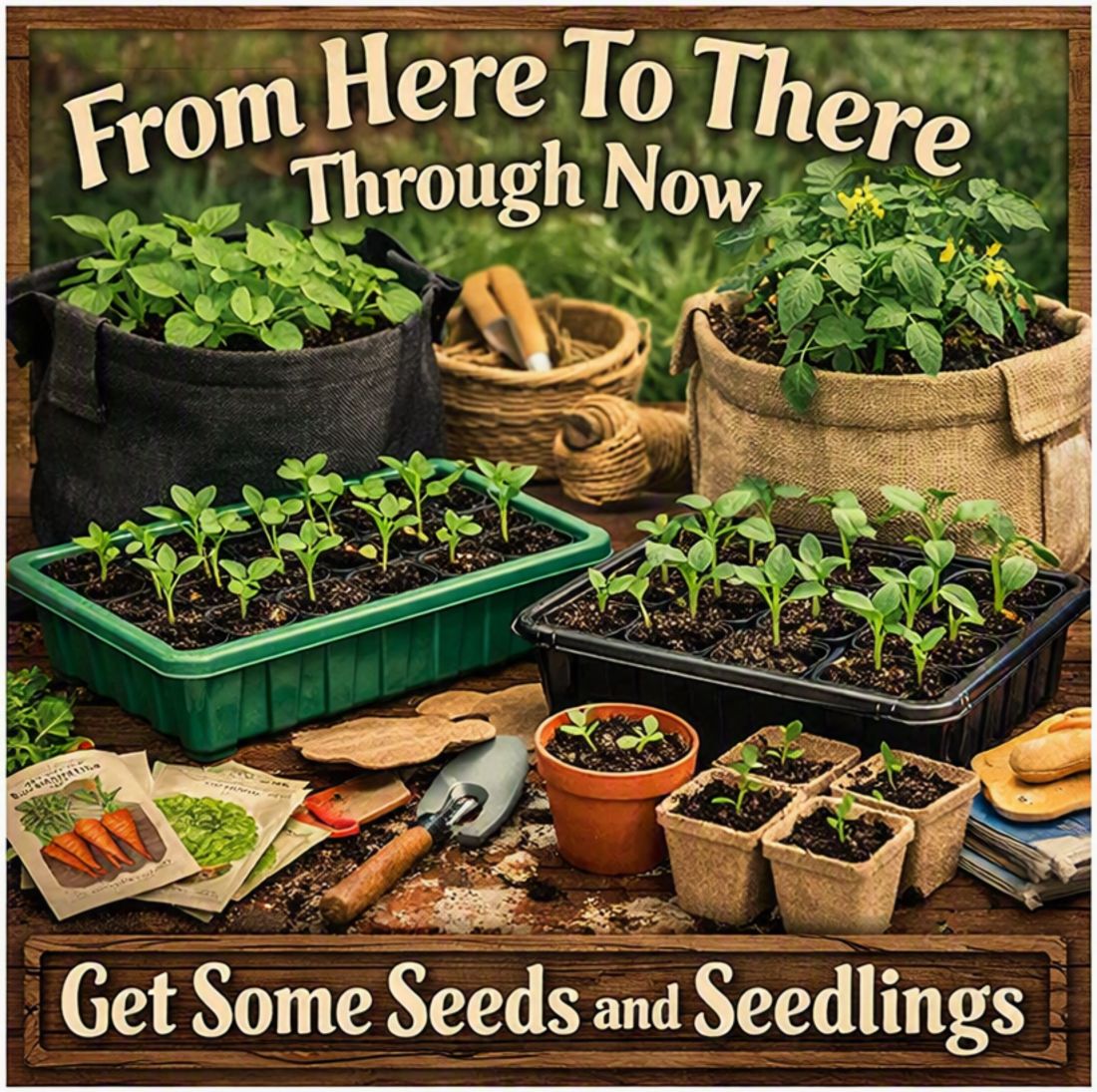
Surviving The Great Reset | Grow Your Own | Get Some Seeds & Seedlings

If you’ve ever heard someone you think of being a nerd, going on about saving or storing seeds, this is probably the moment when you will begin to make some sense of why.

Pretty much every vegetable, fruit or cereal that we eat can only be grown because someone has had the good sense to harvest, store and then distribute their seeds.

You will need seeds to grow whatever vegetables or fruits that you might choose.

Seeds are available online and even in some supermarkets, depending on the time of year. I picked up number of sachets a few days ago in Sainsburys (That’s well-known chain of supermarkets in the UK) and you are likely to find them near the flowers or any gardening things.

Again, its worth having a read up to check what you will be able to grow. Very little that you can grow in the garden will provide a crop year-round, if at all. So the next question will be what, where and how you can grow (or store) so you have something available year-round.

If you are lucky – and especially so at this time of year (spring/early summer), you might happen across seedlings that are vegetable or fruit plants already beginning to grow, on sale by the side of the road, at a garden centre or even in the plants section at your local supermarket. Grab a few if you can, as this is a great way to get a head start – and encourage yourself to get the growing bug – which can be very rewarding once you do!

Afterword – 23 September 2026

Thank you for visiting this piece, which was first published in May 2022 as part of my later book From Here to There Through Now.

With Grow Your Own and the wider question of Food Security becoming ever more important, my work since has led to the publication of a broad range of articles, books, and resources exploring these subjects.

If you have a moment, you will find links to some of those works that are currently available to read on this site below.

Thank you for your interest and support.

Further Reading

If you’ve reached this point and are thinking more seriously about growing your own, food security, or how we can all prepare better for the changes already underway, the following pieces will help you take the next steps. They build on the ideas first explored in this article and expand into what we can grow, how we can plan, and how communities can work together to make sure everyone has access to the food they need.

These resources are listed in the most helpful order – starting with the basics, moving through what’s possible locally, and ending with wider planning and the full portfolio of work available.

Grow Your Own or Home Growing

A practical and encouraging look at why home growing matters and how anyone can get started. If you’re new to all this or just need a nudge to begin, this is the best place to start.

🔗 https://adamtugwell.blog/2025/07/31/grow-your-own-or-home-growing/

Foods We Can Farm, Catch, Harvest and Grow Locally in and Around the UK

Once you’ve got the basics, the next question is what you can realistically grow or source locally. This guide explores the full range of foods that can be produced in and around the UK – essential reading for anyone planning ahead.

🔗 https://adamtugwell.blog/2025/07/18/foods-we-can-farm-catch-harvest-and-grow-locally-in-and-around-the-uk/

Foods We Can Trust: A Blueprint for Food Security and Community Resilience in the UK

This piece takes the conversation further, exploring how communities can build trustworthy, resilient food systems that work for everyone. It’s a blueprint for what secure, localised food networks can look like.

🔗 https://adamtugwell.blog/2025/12/15/foods-we-can-trust-a-blueprint-for-food-security-and-community-resilience-in-the-uk-online-text/

Local Planning for Food Shortages: A Guide to Local Support and Preparedness

A practical guide for individuals, groups and communities who want to be ready for food shortages. It covers local planning, support networks and the steps anyone can take to prepare meaningfully.

🔗 https://adamtugwell.blog/2026/04/28/local-planning-for-food-shortages-a-guide-to-local-support-and-preparedness-full-text/

Adam’s Food and Farming Portfolio: A Guide to Books, Blogs and Solutions

For readers who want to explore the wider body of work on food, farming, resilience and community solutions, this portfolio brings everything together in one place.

🔗 https://adamtugwell.blog/2025/12/18/adams-food-and-farming-portfolio-a-guide-to-books-blogs-and-solutions/

Businesses are not inherently academic, so why are degrees becoming the prerequisite skill?

Latest news suggests that without more degree level education based skills, the UK will experience an exodus of jobs overseas to emerging economies. But when we already have students doing degrees just for the sake of doing them and a basic education system which sees school-leavers failing to possess even basic literacy and numeracy skills, should we really be thinking about pushing more through a university education as the immediate priority?

Like it or not, many young people are neither cut out nor ready for an academic pathway from or even during secondary education. Simply creating more courses to include a wider selection of students is hardly the answer and is fast leading to the existence of meaningless degrees, which won’t help business, and don’t help the students themselves who these days will have had to sell their soul to get it.

One of the greater injustices of recent political times is the idea propagated by New Labour during the 1997-2010 period of Government that everyone could be the same and do the same things. Such socialist ideology permeates itself by changing – or rather levelling systems throughout society to treat everyone the same under the ideal that to do so is providing ‘equal opportunities’.  However, as we are all different – and often in ways that cannot be seen with the naked eye – this method is not only obtuse in the extreme, it has contributed to the creation of a society where younger generations are becoming lazy and without ambition. When you add to this the burden of taxation which is placed upon higher wage earners for daring to do well and the resentment they experience if they do so, neither do you leave in place any real motivation to be any different or encourage the social mobility that the same idealist meddlers suggest to be a milestone of progress.

The good behind many ideas, policies and concepts is often lost when change is enacted simply for the sake of change and this is no less so within education as elsewhere. Whilst the technology age has altered the requirements for skills throughout the industries, the historic format of leaving school at 14 and becoming ‘apprenticed’ was a much better way to foster learning in those who were more ‘hands than head’ at the time, and could as such provide lessons in forming the basis of a very radical and effective way to change the way that we develop our National skills base for business and industry.

Why not:

  • Remove the burdens of red tape which govern the working environment for younger people.
  • Develop an effective subsidy allocation and training scheme to assist participant businesses to replace unused school places, ‘young to work’ schemes and unemployment benefits.
  • Give business a cost-effective motivation to support vocational or ‘on-the-job’ training for 14-21 year olds who in that time, may well have attained the equivalent of academic training in parallel skills and real-world experience, which may in fact have far more use to companies than ‘green’ graduates who refuse to stuff envelopes because they have a degree.

Business can only get the best from employees if they have been nurtured within a system which allows and encourages them to be their best – in whatever way that may be. Even the suggestion that you must have a degree level education to make an effective contribution is not only short sighted; it fails to recognise that a true acceptance of diversity goes way beyond embracing race, impairment, sexuality, location or social group and that each pathway to learning can be highly beneficial to society with real opportunities put in place to appreciate it.

This article was converted to PDF and its accompanying image was updated on 10 October 2026. The original text remains unchanged.