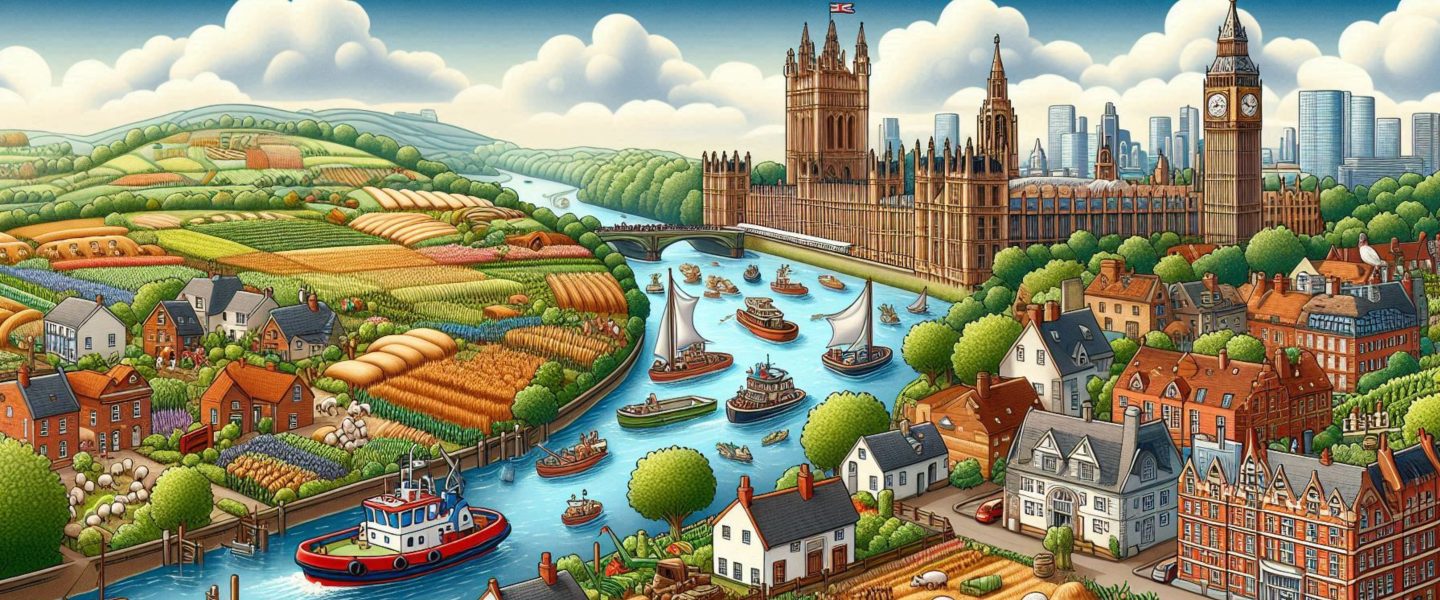
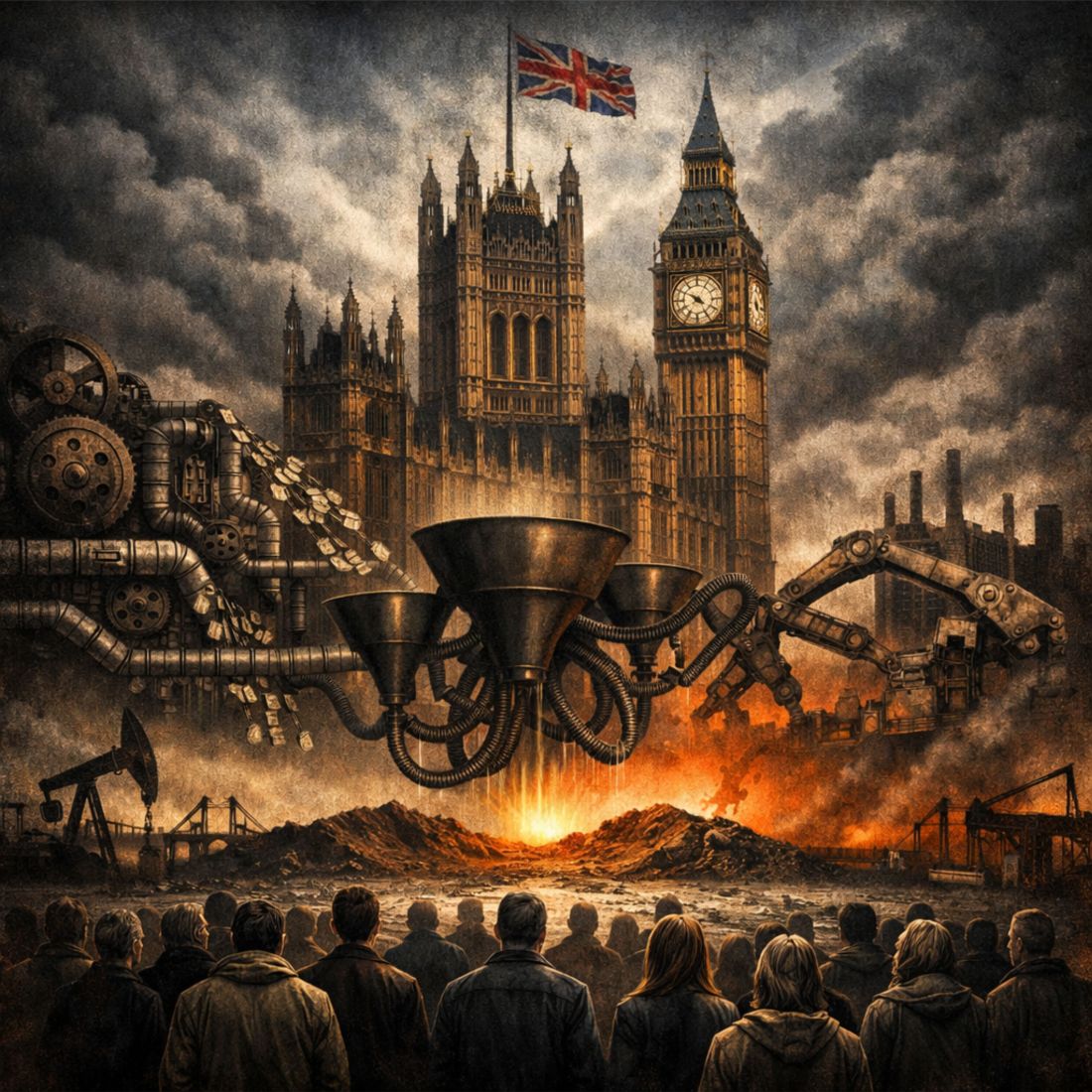
Do we exist only to serve government, or does government exist to serve us?

We grow up believing government exists to make life possible. To build, to protect, to maintain, to enable. To stand between us and the things that would otherwise overwhelm us.

But somewhere along the way, that relationship inverted.

Government stopped facilitating life. Life began facilitating government.

Not because government suddenly changed its intentions, but because the tools it once used to shape the country were quietly dismantled by a financial and monetary system that came to control everything.

For decades, that system rewarded extraction over production, leverage over labour, and financial performance over real capability. It told us stories about modernity – stories about efficiency, globalisation, competitiveness – and it sold myths that made decline feel like progress.

The service economy was one of those myths. A story that said Britain didn’t need to make things anymore, that production was old‑fashioned, that skills were optional, that capability could be imported, that resilience was unnecessary.

And while the country embraced that story, the wheels of productivity were quietly removed.

Factories closed. Skills faded. Infrastructure aged. Supply chains stretched across oceans. Local capability thinned to the point of transparency.

None of this felt dramatic. It felt like modern life. It felt like the world moving forward.

But the financial system wasn’t building the future. It was hollowing out the present.

And when government finally looked up, it realised the tools it once relied on – the tools that made governing possible – were gone.

By then, the productive foundations that once made governing possible had eroded. Government could no longer easily rebuild what had been dismantled, repair what had been neglected, produce what had been offshored, or control many of the systems on which it depended.

But government could not easily admit this. It could not stand before the public and say: “We no longer have enough of the tools required to shape the country.”

So it clung to the only lever it had left.

Taxation.

Taxation is not a sign of strength. It is a sign of limitation.

When a government still has capability, taxation is one tool among many. When a government has lost capability, taxation becomes the only tool left.

And that is where Britain now finds itself.

Increasingly, government appears to rely on taxation to compensate for a diminishing ability to build, repair, produce, grow, and prepare for what is coming.

Taxation becomes the way government sustains itself when it can no longer sustain the country.

If economic growth remains weak while obligations continue to rise, governments eventually face a narrowing set of options: higher taxation, deeper borrowing, monetary intervention, or external assistance.

At the far end of that path lies the possibility of IMF involvement.

IMF involvement would not rebuild capability. It would not restore resilience. It would not protect the public.

It would impose austerity of a kind that might keep politicians in their posts and government departments running, but for real people already struggling, the worst would still be to come.

Because IMF austerity protects the institution, not the population.

And all of this – the hollowing out, the loss of capability, the reliance on taxation, the looming austerity – is happening before external shocks hit.

Before supply chains fracture further. Before infrastructure failures accelerate. Before geopolitical instability intensifies. Before the next global downturn. Before the next energy crisis. Before the next financial contraction. Before the next systemic break. Before something as simple – and as devastating – as the real consequences of the closure of the Strait of Hormuz.

Many within government can see the pressures gathering ahead. Yet the institutions themselves may lack the capacity, political consensus, or time required to respond effectively. They know they cannot rebuild fast enough. They know they cannot deliver everything that has been promised. They know they cannot easily escape the system they inherited.

So it turns to the public – not to protect them, but to sustain itself.

And this is where the moral reckoning begins.

A government that can no longer facilitate life has no moral right to ask the population to bear ever-greater burdens simply so that the institution itself can endure.

The legitimacy of government has never rested on its ability to survive. It has rested on its ability to serve.

Once that distinction is lost, citizens inevitably begin asking a simple question:

Who exists to serve whom?

Which brings us back – inevitably, unavoidably – to the question we began with:

Do we exist only to serve government, or does government exist only to serve us?

Because if government is no longer here to serve us, then what is this all now for?

AI won’t make life cheaper for those who cannot work and the mega rich would be using their money to help others right now if they were going to do it for everyone in the future

You may have noticed that there is a growing trend for people to generate clicks on social media by creating long threads that tell interesting stories – many of which have already been told before.

One of them has popped up on my feed several times recently and outlines the predictions of some great contemporary sage of future tech who has apparently been proven right several times before.

The next prediction tells us that in no more than a few years, AI will have made everything so cheap that nobody will work and everything we pay for will cost just a few pennies and no more.

This prediction is popular. Because in today’s world everything relates to money.

Therefore, when people are handed the suggestion that everything they want will cost next to nothing, and there will also be no need to work, the immediate response and logic for just about anyone is to frame that in the way that we see, feel and experience our lives today or right now. Rather than considering what the pathway to that place will have changed in our lives and what our life experience will have then become.

The Moneyocracy or money-centric way of living that we are all experiencing today isn’t one where anything we need and certainly nothing that we want comes to us for free or without there being some financial-related cost of some kind.

Whilst the narrative that the establishment, big tech and big business would have us believe is that AI is here to make life much cheaper and easier for us all, the financial growth that the establishment’s pet politicians are so obsessed with and the picture of unfettered abundance for everyone that they want us to buy into, don’t go hand in hand.

Yes, there is of course the chance that the money hoarding elites are doing what they do today and that they have done everything that they’ve done in the past so that once they have optimal control of everything that we know, they will then benevolently give every one of us the perfect life experience that was always the aim. Which of course only ridiculous amounts of cash would allow them to do.

However, before we run away with that idea and think more about living our best material lives for free, there are perhaps just a few alternative truths that we all need to consider.

Money has made money by riding off the backs of the masses. First by making many hands do the work that enriched the few, through industrialisation and everything that came with it. Then by turning the mass population into debtors, exploiting the unwitting who have bought into the money myth themselves, so that the elites can continue to make ridiculous profits, just the same.

The system is very clever. And it is clever because it preys on the darker attributes of the human condition that make too many of us overlook common sense and basic logic when we are in receipt of money, wealth, position and shiny things. Everything that makes us live for a constant flow of temporary yet momentary hits that we have foolishly mistaken for what makes life and living feel good.

Addiction hides truths that are big, small and cover the multitude that sit between.

No matter our level or position within this carefully constructed top-down pyramid, the truth swirls all around us. But we remain blind to it for as long as we continue to be bought in.

So, in the sense of this coming ‘nirvana’ that AI is supposedly now promising us all, perhaps we should consider some of the more serious and consequential truths that we are almost certainly missing whilst we remain within:

The wealthy are only wealthy because of where their wealth sits within the hierarchy of the way that money and the wealth divide works against the rest of us today.

If the masses stop working, there will be billions of mouths around the world to feed and as many people to support with all the basics and essentials for life, just for people to continue to exist.

Even if machines are creating food, creating entertainment, providing transport, building houses and doing just about everything else we can imagine that has historically been done by hand up until now, there will always be a cost of some kind to pay.

The running, energy production, maintenance and replacement of the systems that would be required to enable such a massive workless population not only to survive, but to be sustained at what we would surely expect to be a good standard or experience of life, would remain very high.

Indeed, the cost of supporting billions of people around the world would still be much greater than many would imagine and would not be a cost that could be covered by playing with money and the way that people who are earning money today believe in the power of money right now.

In this sense playing with money means the way that the entire monetary, financial and economic system as we know works.

The ‘money’ and currencies we have today are part of the biggest confidence trick that has ever been played on humanity.

The whole economic system and the way money is created and managed within it is well and truly rigged.

The creation of the wealth, and the levels and scope of the asset ownership that the elites enjoy today would not have been remotely possible without them having and retaining the ability to constantly game the system.

Those running, managing and ‘in’ on the system use money that doesn’t exist to buy up everything that has real, non-monetary value to people.

This ‘ownership’ means that they will control our future and everything within it.

This has all been achieved under a system that they have created and manipulated using the establishment and the political and legislative processes within it to allow them to carry out what amounts to nothing less than legalised theft.

The wealth that has been created to enable this world take over by the wealthy can and will only achieve the aims of creating a utopian world if that world is inhabited by few enough to make the absence of money creation sustainable.

It will not be sustainable in any way, if the few have to manage and provide for a world population tomorrow, where the masses do nothing productive, become professional users and behave or act like farm animals or caged pets that exist in every direction and live all over the place.

Many baulk at even the merest hint or suggestion of there being some kind of plan for depopulation.

But anyone who understands how the money, financial and economic system we have today really works and where it is going, will see that depopulation of some kind is the unavoidable answer that bridges what is otherwise an unbridgeable void on the pathway to the outcome which has always been this Moneyocracy’s aim.

The only challenge they face is how to achieve this on a big enough scale without the masses ever awakening to the idea that national and worldwide crises can be planned and implemented by design. Just as easily as an entire monetary, financial and economic system that has led the majority of us to believe that those who don’t have enough of what they need to live today are the only ones who are at fault.