The Moral Case for a Debt Jubilee

Why cancelling the debt that sustains the current system is not reckless, but the first responsible step toward a people-centred future

For most people, the financial world feels like weather: something that simply exists, something to be endured, something beyond human control. Debt is treated as personal obligation. Interest is framed as fair exchange. Governments are told to live within their means. Markets are assumed to be neutral. The rules of the money system are presented as natural laws, rather than human choices.

These beliefs are sincere. They are also wrong.

The money system operating today is not natural, not neutral, and not moral. It is a constructed order built on rules that most people never agreed to, do not understand, and would not consciously choose – yet they live inside its consequences every day.

A debt jubilee – the cancellation of unpayable and system-generated debt – is often dismissed as radical, reckless, or utopian. But that misunderstands what a jubilee is. A jubilee is not a reward for irresponsibility. It is not a reset that allows the same system to begin again. It is a transition point: the moment at which a society recognises that obligations created by an unjust system cannot remain morally binding, and that the system itself must be replaced.

By a debt jubilee, this argument does not mean an arbitrary or chaotic erasure of obligations. It refers to the structured cancellation of debts within a system that creates and depends upon them to function.

All modern debt is, in this sense, systemic. It exists because of the rules, mechanisms, and structures of the money system itself. The question is therefore not which debts are truly ‘systemic’, but whether obligations created within a system that produces harm can retain moral authority simply because they are recorded as binding.

A jubilee recognises that when the system itself is unjust, the obligations it generates cannot be treated as fully legitimate in moral terms.

The moral case for a debt jubilee is therefore inseparable from the case for what must follow it: a people-centred alternative grounded in local economy and governance, a Basic Living Standard, contribution culture, and the wider process of Revaluation.

The system no one sees

Modern money is deliberately opaque. It is abstract, counterintuitive, and normalised through repetition.

People are taught to believe that money is scarce, that debt is real in the same way gravity is real, that interest is natural, and that governments must borrow from private markets to fund public life.

These are not laws of nature. They are institutional stories, repeated until they feel unavoidable.

This does not mean the system is imaginary. It means its authority depends on belief.

Money, markets, debt, interest, and growth have power because they are collectively accepted, institutionally enforced, and treated as reality.

The system works on belief. But belief does not make it morally right.

Whilst many still believe that the problems we are experiencing today are temporary and may only need a change of government to fix them, the reality is somewhat different.

The world is already moving from a money-centred, centralised, growth-obsessed model toward a people-centred, localised and humane system.

For us all, the real shift begins by recognising that the old rules are not permanent truths. They are choices – and different choices are now necessary.

Debt is not a personal failing – it is the foundation of the system

In a healthy society, debt would be a temporary bridge between need and opportunity. In the modern system, debt is something else entirely. It is the foundation on which the entire economy rests.

Banks create money through lending. Every pound created in this way enters the economy as someone’s debt.

Because interest is charged on that debt, the system requires more money to be created to service the obligations already imposed.

More lending creates more debt. More debt requires more interest. More interest demands more growth. More growth drives more extraction. More extraction concentrates more wealth.

Concentrated wealth then shapes the rules that justify the system.

This is not a conspiracy. It is a feedback loop.

The moral problem is that people are then blamed for debts they never had the structural power to avoid. Households are blamed for insecurity created by low wages and high costs. Governments are blamed for borrowing within a system that requires borrowing. Communities are hollowed out to satisfy growth metrics. The environment is degraded to service financial obligations. Wealth flows upwards through mechanisms most people cannot see.

A system built on debt cannot credibly treat debt as a purely personal failure. When debt becomes structural, the moral question changes. The issue is no longer simply whether individuals should honour obligations. The issue is whether obligations manufactured by a structurally unjust system can be morally legitimate at all.

Illusions cannot create legitimate obligations

This is the heart of the moral case.

Debt is not a natural law.

Interest is not a moral principle.

GDP is not a measure of progress.

Financial markets are not democratic.

The value of money is not intrinsic.

These are human inventions. They may be powerful. They may be enforced. They may organise everyday life. But they are still inventions.

Because they were made, they can be unmade, remade, or replaced.

The illusion is not that money has no practical effect. It clearly does. The illusion is that money has inherent moral authority. The illusion is that financial obligations created inside a coercive and extractive system must be honoured simply because the system records them as debt.

But a record is not a moral truth. A contract created inside a harmful framework cannot be separated from the framework that produced it.

Institutional blindness protects the system

One of the greatest barriers to change is not opposition in the conventional sense. It is insulation.

Those who benefit most from the current system are often furthest removed from its human consequences. Academics, economists, politicians, financiers, senior officials, and institutional leaders may be highly intelligent, highly trained, and sincere in their intentions. But their training, status, security, and authority are often tied to the assumptions of the system itself.

Professional expertise develops within a frame. Advancement often requires fluency in that frame. Success rewards those who understand and defend its logic.

Over time, those most trusted to explain the system may become least able to see beyond it.

This creates institutional blindness: not ignorance, but a conditioned inability to recognise alternatives that fall outside the system’s own definitions of realism, responsibility and propriety.

A people-centred alternative can therefore be dismissed as unrealistic. Not because it is impossible, but because it does not fit the money-centred logic through which reality has been interpreted.

A jubilee is justified because the system itself is unjust

A debt jubilee is not an attack on ordinary responsibility.

It is a refusal to mistake system-generated obligation for moral obligation.

If the system that creates debt is itself structurally unjust, then addressing debt without addressing the system merely continues the same harm. A jubilee is therefore not the whole answer. It is the necessary break that makes the answer possible.

A jubilee without transformation would fail, because the system would simply recreate the same debt under new names.

Transformation without a jubilee would also fail, because people, communities, and governments cannot build a humane future while trapped beneath obligations created by the old system.

A jubilee is justified because the system itself is unjust. It is the clearing of the ground. It is the ending of a dehumanised order so that a human centric one can begin.

Most of the harm was unintentional – but it must still end

The argument for a debt jubilee is not a claim that every banker, politician, economist, or investor acted with malice. Most people inside the system believe they are doing the right thing. They believe the rules are natural, the outcomes unfortunate but necessary, and the harm a cost of stability.

But harm that is unintentional is still harm. A system does not become moral because its operators are sincere. A harmful structure does not become legitimate because those who benefit from it cannot see the damage it causes.

Once the harm is visible, inaction becomes a choice.

When a society understands that the system itself is creating dehumanised outcomes, the moral responsibility is not to preserve that system, but to end the conditions that allow the harm to continue.

A jubilee is therefore not punishment. It is release – not only for those trapped by debt, but for society itself.

It releases people from coercion. It releases communities from extraction. It releases government from the logic of perpetual borrowing. And it releases the future from the moral claims of a system that has already failed.

What replaces debt must be people-centred

A humane system cannot grow in soil poisoned by debt. Local agency, community resilience, contribution-based value, and a Basic Living Standard cannot flourish while people, communities, and governments remain structurally coerced by financial obligations created under the old order.

The purpose of a jubilee is not absence, but replacement. A system based on debt must give way to one based on human need, local responsibility, and meaningful contribution.

This is where the Local Economy & Governance System, the Basic Living Standard, contribution culture, and The Revaluation belong within the argument.

The Local Economy and Governance System offers a framework in which economic life is rooted in community rather than extraction. The Basic Living Standard establishes the security required for people to participate without fear. Contribution culture redefines work as meaningful participation in the wellbeing of the community, rather than a transaction for survival. The Revaluation names the wider shift from measuring life in financial terms to understanding value in human, social, and environmental terms.

A debt jubilee creates the conditions for that transition.

It is not the destination. It is the door.

Without a clear alternative, a jubilee can be misrepresented as destruction. With one, it becomes transition.

The real crime would be to understand the system is broken – and do nothing

The old system is failing. People are suffering. Communities are weakening. Public trust is collapsing. The environment is being exhausted.

Much of the harm may have been unintentional, but once the truth is visible, continuing to enforce the system becomes a moral choice.

A debt jubilee is not an attack on the past. It is a commitment to the future. It is the point at which society chooses people over mechanisms, dignity over financial abstraction, and life over the logic of debt.

It is not reckless to end obligations that should never have existed in the form they now take. It is reckless to keep enforcing them when their consequences are known.

A jubilee is not the erasure of responsibility.

It is the restoration of responsibility to its proper place.

It is the moment a society decides that human beings matter more than the mechanisms that once controlled them.

Further reading

The argument above is part of a broader body of work on the transition from a money-centred system to a people-centred one. These related texts set out the practical, cultural, and structural foundations of that transition:

The Basic Living Standard – Explained
A concise introduction to the principle that every person should have secure access to the essentials of life, creating the foundation for genuine participation, dignity, and freedom from coercive economic pressure.
https://adamtugwell.blog/2025/10/24/the-basic-living-standard-explained/

The Basic Living Standard – Full Text
The fuller version of the Basic Living Standard proposal, developing the case for security, dignity, and social stability as the necessary foundation of a humane society.
https://adamtugwell.blog/2025/03/06/the-basic-living-standard-full-text/

The Contribution Culture
An outline of a shift from survival-driven employment and financial extraction toward a culture in which work, enterprise, and governance are organised around meaningful contribution to local and human wellbeing.
https://adamtugwell.blog/2025/12/30/the-contribution-culture-transforming-work-business-and-governance-for-our-local-future-with-legs/

The Local Economy and Governance System
A proposed framework for rebuilding economic and civic life around local responsibility, community resilience, participatory governance, and people-centred decision-making.
https://adamtugwell.blog/2025/11/21/the-local-economy-governance-system-online-text/
There’s Nothing Wrong With Wealth, As Long As It Isn’t Built on Harm

We live in a culture where money has quietly become the central organising principle of almost everything. It shapes our choices, our opportunities, our identities, and even our sense of self‑worth – often without us realising it.

We walk through life believing we are making free decisions, when in reality many of those decisions are filtered through a deeply conditioned relationship with money: what we fear losing, what we believe we deserve, and what we think we must accumulate to feel secure.

This isn’t accidental. The systems we live within – from neoliberal economics to globalisation, from centralised governance to fiat‑based monetary policy – are built on extractive logic.

They rely on continual growth, continual consumption, and continual financialisation of life.

Tools like markets, GDP, and monetary expansion aren’t neutral; they infuse every corner of society with the assumption that more is always better, that profit is natural, and that accumulation is a sign of success.

Centralisation plays a major role in this. It creates distance between action and consequence, between producer and consumer, between decision‑maker and those affected by the decision.

That distance dehumanises. It makes it easier not to see the harm. It allows people and institutions to believe that if something is legal, it must also be right. And it enables a kind of collective blindness to the impact of financialising everything – from housing to healthcare, from education to the environment.

But the national‑level systems are only half the story. The other half is personal.

Because the system’s logic doesn’t just operate “out there”; it operates through us.

The belief that profit is a right – that we are entitled to charge not what we need, but whatever the market will tolerate – has become normalised.

Businesses do it. Individuals do it. And every time we take more than we need simply because we can, we reinforce the very dynamics we claim to oppose.

The evidence is everywhere. Owning multiple houses when you can only live in one. Collecting cars you can only drive one at a time. Choosing extravagance not because it nourishes you, but because it signals status.

None of these things are inherently immoral – but they are symptoms of a culture that confuses abundance with excess, and wealth with accumulation.

True abundance is something different.

It’s having enough – enough to live, enough to thrive, enough to contribute – without taking from others or from the world more than you genuinely need.

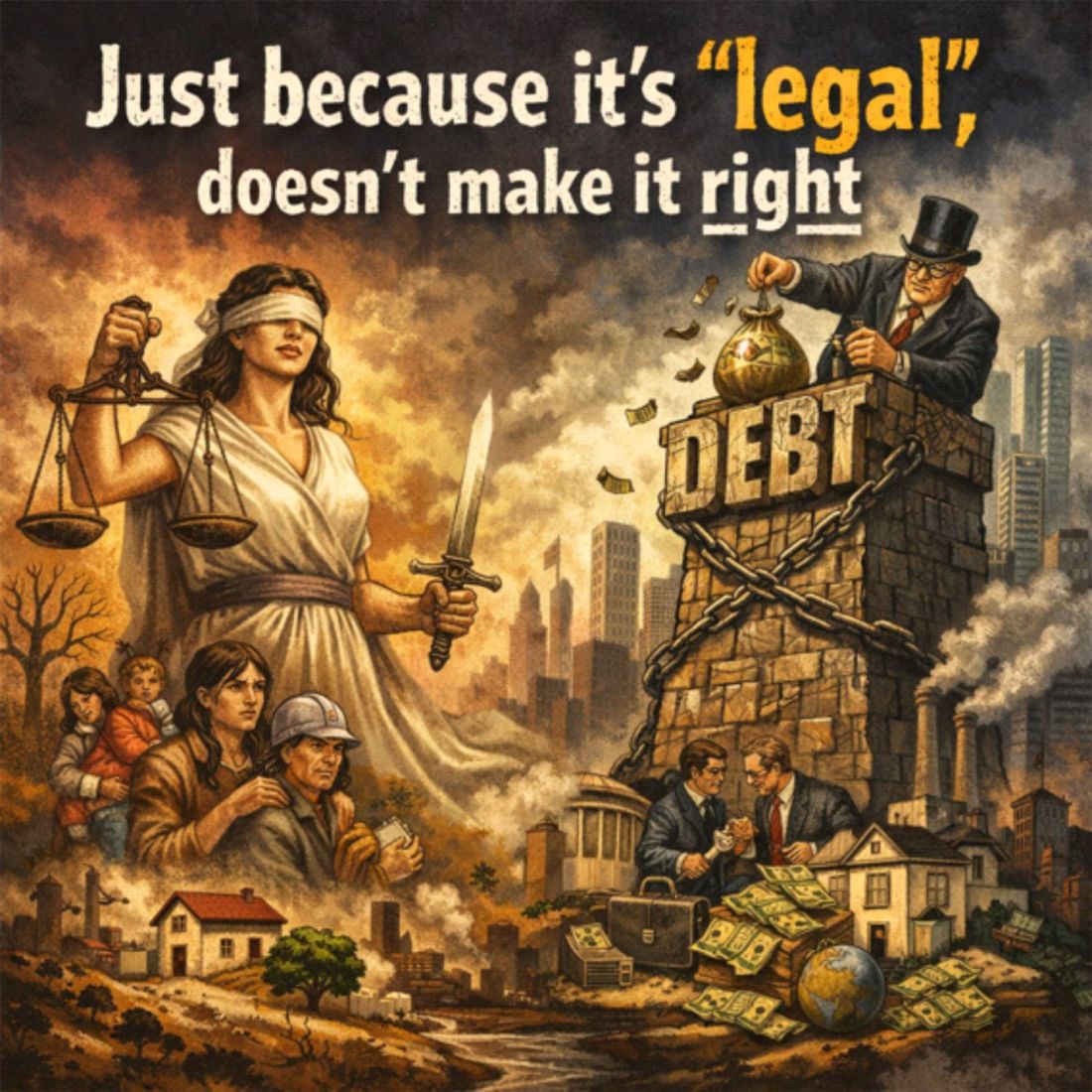
It recognises that legality is not the same as morality. Just because the system allows accumulation that harms people or the planet doesn’t mean it is right.

Nobody has an inherent right to profit when that profit is built on someone else’s loss, someone else’s struggle, or the degradation of something irreplaceable.

There’s nothing wrong with wealth. But there is something deeply wrong with harm disguised as success, extraction disguised as enterprise, and excess disguised as freedom.

If we want a healthier relationship with money – individually and collectively – we have to start by recognising the difference between wealth that enriches life and wealth that drains it.

And that begins with a simple truth:

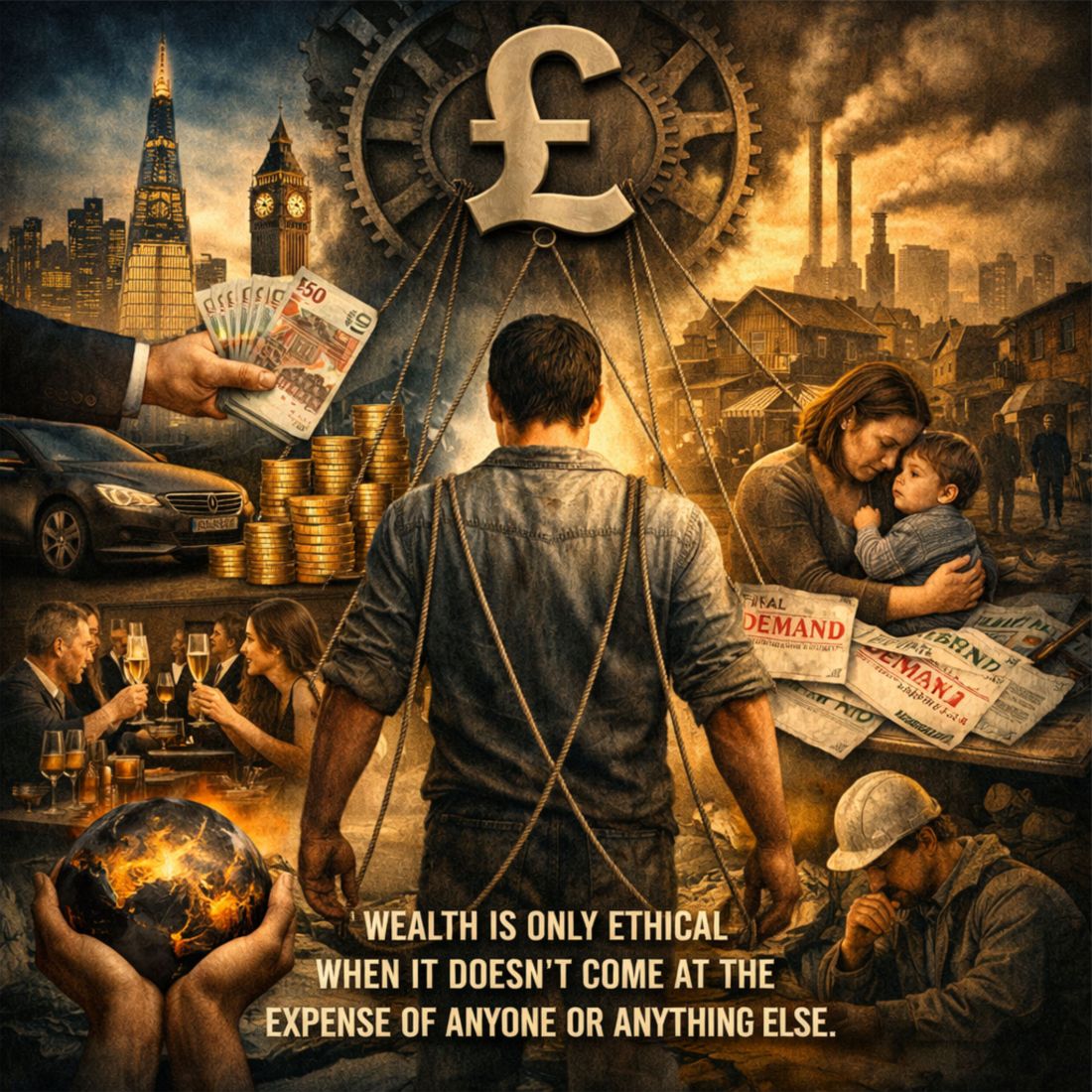
Wealth is only ethical when it doesn’t come at the expense of anyone or anything else.

Money: Terrorism, the cost of living crisis and the collapse of religion & morality

“Money is the root of all evil” was a phrase I often heard as I grew up. I like to think that it was a simple ruse that both my Mother and Grandmother employed to make the lack of cash and the weekly wait for Thursday morning’s ritual trip to the Post Office to ‘cash the giro’  seem all that more holy. But years in Businesses, Charities and Local Government have given me a very different view and it is now clear that this New Testament derived saying has an application which is a whole lot more universal.

Like it or not almost every facet of life has some link with money. Making money, spending money, borrowing money, saving money, winning money, being awarded money, being in some way dishonest for money, selling for money, earning money, playing for money or just thinking about money will almost certainly have a relationship with something that any one of us is doing at any one time whether we realise it or not.

What is in many cases an unconscious or involuntary obsession with money has become so ingrained within our present day existences that many of us have reached a point where we simply overlook the part that it plays in virtually every part of life and how its influence, directly or otherwise is on the way to making communities and cultures within Great Britain, Europe and far beyond almost unrecognisable from what they were less than a hundred years ago.

The “money men” of today and their commercialisation of just about everything that we could imagine are no doubt responsible for many of the problems that people are now experiencing. But payday loans, credit worthiness, spiralling energy bills and the explosion of food prices are only one part of the problem; just as ineptitude on the part of politicians who through successive Governments have taxed almost everything whilst they have taken borrowing to bankruptcy and beyond is another.

The far reaching and what could yet prove to be devastatingly real implications of decisions taken many years ago, primarily based upon freedoms and rights, but effectively about money, ownership and the formulation of private wealth have yet to fully manifest themselves. But to many, the harsh realities of an effectively unregulated free-market in the hands of those out to make money without any sense of ethics, morality or whatever the true cost may be, are already very real indeed.

The apparent liberation of the masses from servitude and the arrival of our perceived freedoms has been accompanied by the growth of a culture which recognises the accumulation of personal wealth and standing above all else.

People en masse are no longer content just to ‘be’, but relate their position in the world to what they do or don’t have and as such take a far more self-centred or self indulgent approach to life, even when they have very little to show for it.

Perhaps one of the noticeable casualties of this change may be the Church of England which has arguably witnessed a significant if not exponential fall in congregation size in parallel with this change. It is fast becoming ill equipped to maintain its standing as the default faith within what the Libertarians amongst us would have us believe to be a secular state – which itself was just a station at where the UK stopped and which our population may have already left way behind it.

It’s not just those who are now struggling to pay their bills who will have noticed; in fact, they have come pretty late to the game.

To those outside the UK and the West, a cultural obsession with money and its related exploitation of people and resources is even more historical than the change that has taken place for individuals in just Great Britain alone. The resentment and in many cases hatred that this has fostered is now manifesting itself in some of the most frightening ways possible through the rise of Islamic Fundamentalism and the extremist acts of terror by which it is closely accompanied.

It is ironic that the very same causes of the problems that we are now experiencing because of money and our obsession with it in this Country may well be the very same motivator that fuels the fire of extremism amongst people who have already recognised it through different eyes and want to deal with it, but in a way that would see us returned to the dark ages.

Sadly and as in most cases where one form of religious or political philosophy is at work and in control, those who are opposed to what some may call the money-based malignancy of this Westernised culture simply want to see it replaced with one which is oppressive in a wholly different way. Regrettably, the indifference of the majority towards what are two extremes does not reduce the likelihood that one could just be replaced by the alternative in any way.

Indifference itself is only exacerbated by the rights culture which has installed a sense of unjustified wrongdoing and often guilt when people speak out about changes and what are effectively the removal of freedoms that we may one day have to fight to regain.

The ‘rights’ of what are minorities within minorities are being preserved, promoted and upheld at the cost of not only the majority of UK Citizens, but the majorities within those very communities too, and we are being frogmarched towards a whole new and unrecognisable culture within the UK at the cost of what two generations fought and suffered for in the First and Second World Wars and the identity-bearing British traditions that we have held dear for so very long.

Many think that if there should be a World War III or Armageddon, it will be a wholly violent conflict that originates in the Middle East and then spreads to physically embrace the World, probably using weapons which will do unspeakable harm. Acts of terrorist violence such as 9/11, 7/7, Mumbai, Woolwich and Nairobi Westgate serve only to bring the news time realities of armed conflicts in Egypt, Libya and Syria all that closer to us.

The arrival of violence on our own shores – albeit on a comparatively small scale – is just another terrible warning of the realities that lie ahead if our politicians and the people with monetary power over our lives continue to go about their work without any real thought for the consequences of their actions.

The human condition dictates that group think will always encourage a level of emotional buy-in, servitude or passion within individuals whom given the right motivation will override any feeling of humanity towards their fellow man.

Encouraged by the belief that the ‘haves’ are somehow deliberately seeking to harm the ‘have not’s’ as part of some elaborate conspiracy – this indirect consequence is enough for indoctrinated people to see no value in their own life and therefore have no respect for that of others. Picking up the gun and delivering their messages with bombs is then just a simple step beyond.

However, whilst this really is the extreme end of the wedge in every possible sense, we should be grateful that the polarised or violent aspects of the rise of this ‘god called money’ have so far affected us at home to date in such limited ways.

It will not remain this way if radical Islam continues its rise within the communities of Britain or worse still, if the financial or cost of living crisis that is facing a significant and growing number of British households continues to be ignored, and frustrated and frightened people reach the point where they feel the time has come to take to the streets.

So could these terrorist attacks, Middle-Eastern battles, wars and the rise of radical Islam really be just be the symptom of the next Great War which is already underway?

If they are such a symptom, terrifying as terrorism and even civil disorder can be, tackling both may only be a small part of dealing with any turmoil that lies ahead, and an issue that our crowd-pleasing political classes will only find slightly harder to deal with than continually focussing on what it takes to win the next elections. Instructing and unleashing the police and security services from the realms of political correctness and claim culture will after all be an easy decision by comparison to dealing with the powers associated with money and reigning in a force beyond nature which has saturated our lives so deeply that it affects the very way that almost every one of us actually thinks.

If you need any evidence of the real battlefield that already exists around us, look at the hollow lives that some in Britain already live.

There are normal everyday people in this Country who feel empty and go in search of meaning. Where some of them once felt happy and content within their communities, they have withdrawn into solitary lives obsessing about what they have or what they don’t have. They seek distractions in whatever form they come, whether it manifests as obsessive behaviour with drink, drugs, sex, junk food, video games, TV, mobile phones, porn, the internet or perhaps even the fringe forms of religion which offer the same addictive power as all of the above and fill the void now deserted by a much happier and less monetary orientated world, where people found a much less invasive form of contentment with a whole lot less.

Whatever direction people who feel empty take; whatever they look for to fill their void; whatever they already possess; people will always willingly accept something if it is perceived to be ‘free’.

Cynical, self-serving politicians know this and flourish off the back of giveaways that somebody somewhere will always end up paying for. This rule extends across party lines, demographics, occupations or whatever your level of wealth or personal standing.

It won’t be difficult to get agreement that others need to change their behaviour from any one of us. But at the level of the individual, this reality will rarely prove to be the problem.

The failure of Westminster Politicians from successive Governments to consider the consequences of their actions or lack of them when it comes to dealing with a cultural and economic problem of this magnitude is astounding. It would be frankly quite laughable, were it not the case that for many people and businesses right across the UK, the outcomes already are and will progressively become so much more serious if nothing is done.

Time is running out for democracy in the way that we have come to know it, and if we don’t begin to witness the evolution of British politics to a form where fairness, what is right and what’s best for everyone becomes the priority and motivation of all in power and of those who aspire to having it, the consequences could be far more extreme for many than even living within a medieval caliphate where heads roll as easy as marbles and women are allowed to do very little other than simply exist.

It really is therefore difficult to conclude anything other than that all the evils facing our society have money unquestionably at their root and whatever your take on it, there is certainly nothing holy about any of it.