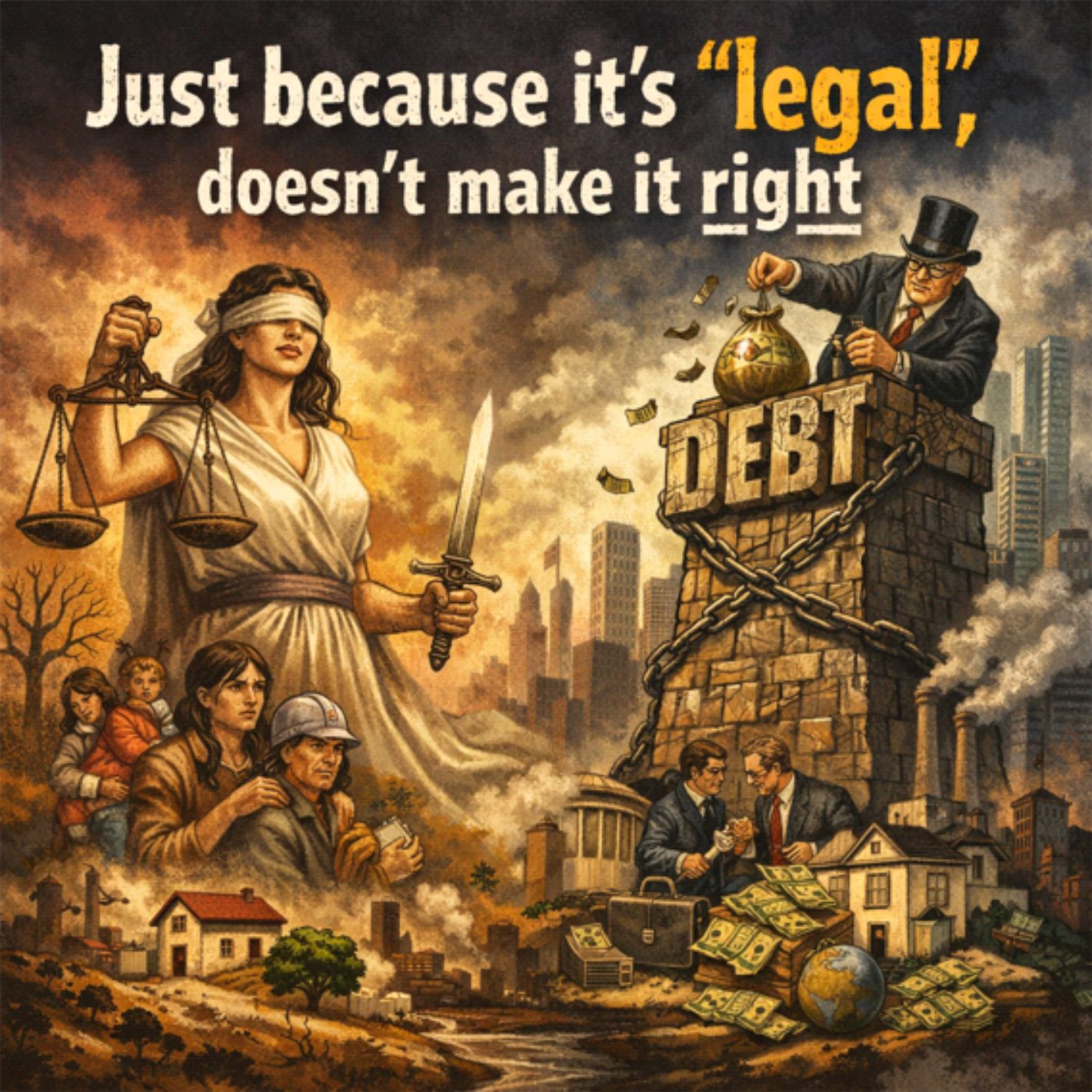

Why cancelling the debt that sustains the current system is not reckless, but the first responsible step toward a people-centred future
For most people, the financial world feels like weather: something that simply exists, something to be endured, something beyond human control. Debt is treated as personal obligation. Interest is framed as fair exchange. Governments are told to live within their means. Markets are assumed to be neutral. The rules of the money system are presented as natural laws, rather than human choices.
These beliefs are sincere. They are also wrong.
The money system operating today is not natural, not neutral, and not moral. It is a constructed order built on rules that most people never agreed to, do not understand, and would not consciously choose – yet they live inside its consequences every day.
A debt jubilee – the cancellation of unpayable and system-generated debt – is often dismissed as radical, reckless, or utopian. But that misunderstands what a jubilee is. A jubilee is not a reward for irresponsibility. It is not a reset that allows the same system to begin again. It is a transition point: the moment at which a society recognises that obligations created by an unjust system cannot remain morally binding, and that the system itself must be replaced.
By a debt jubilee, this argument does not mean an arbitrary or chaotic erasure of obligations. It refers to the structured cancellation of debts within a system that creates and depends upon them to function.
All modern debt is, in this sense, systemic. It exists because of the rules, mechanisms, and structures of the money system itself. The question is therefore not which debts are truly ‘systemic’, but whether obligations created within a system that produces harm can retain moral authority simply because they are recorded as binding.
A jubilee recognises that when the system itself is unjust, the obligations it generates cannot be treated as fully legitimate in moral terms.
The moral case for a debt jubilee is therefore inseparable from the case for what must follow it: a people-centred alternative grounded in local economy and governance, a Basic Living Standard, contribution culture, and the wider process of Revaluation.
The system no one sees
Modern money is deliberately opaque. It is abstract, counterintuitive, and normalised through repetition.
People are taught to believe that money is scarce, that debt is real in the same way gravity is real, that interest is natural, and that governments must borrow from private markets to fund public life.
These are not laws of nature. They are institutional stories, repeated until they feel unavoidable.
This does not mean the system is imaginary. It means its authority depends on belief.
Money, markets, debt, interest, and growth have power because they are collectively accepted, institutionally enforced, and treated as reality.
The system works on belief. But belief does not make it morally right.
Whilst many still believe that the problems we are experiencing today are temporary and may only need a change of government to fix them, the reality is somewhat different.
The world is already moving from a money-centred, centralised, growth-obsessed model toward a people-centred, localised and humane system.
For us all, the real shift begins by recognising that the old rules are not permanent truths. They are choices – and different choices are now necessary.
Debt is not a personal failing – it is the foundation of the system
In a healthy society, debt would be a temporary bridge between need and opportunity. In the modern system, debt is something else entirely. It is the foundation on which the entire economy rests.
Banks create money through lending. Every pound created in this way enters the economy as someone’s debt.
Because interest is charged on that debt, the system requires more money to be created to service the obligations already imposed.
More lending creates more debt. More debt requires more interest. More interest demands more growth. More growth drives more extraction. More extraction concentrates more wealth.
Concentrated wealth then shapes the rules that justify the system.
This is not a conspiracy. It is a feedback loop.
The moral problem is that people are then blamed for debts they never had the structural power to avoid. Households are blamed for insecurity created by low wages and high costs. Governments are blamed for borrowing within a system that requires borrowing. Communities are hollowed out to satisfy growth metrics. The environment is degraded to service financial obligations. Wealth flows upwards through mechanisms most people cannot see.
A system built on debt cannot credibly treat debt as a purely personal failure. When debt becomes structural, the moral question changes. The issue is no longer simply whether individuals should honour obligations. The issue is whether obligations manufactured by a structurally unjust system can be morally legitimate at all.
Illusions cannot create legitimate obligations
This is the heart of the moral case.
Debt is not a natural law.
Interest is not a moral principle.
GDP is not a measure of progress.
Financial markets are not democratic.
The value of money is not intrinsic.
These are human inventions. They may be powerful. They may be enforced. They may organise everyday life. But they are still inventions.
Because they were made, they can be unmade, remade, or replaced.
The illusion is not that money has no practical effect. It clearly does. The illusion is that money has inherent moral authority. The illusion is that financial obligations created inside a coercive and extractive system must be honoured simply because the system records them as debt.
But a record is not a moral truth. A contract created inside a harmful framework cannot be separated from the framework that produced it.
Institutional blindness protects the system
One of the greatest barriers to change is not opposition in the conventional sense. It is insulation.
Those who benefit most from the current system are often furthest removed from its human consequences. Academics, economists, politicians, financiers, senior officials, and institutional leaders may be highly intelligent, highly trained, and sincere in their intentions. But their training, status, security, and authority are often tied to the assumptions of the system itself.
Professional expertise develops within a frame. Advancement often requires fluency in that frame. Success rewards those who understand and defend its logic.
Over time, those most trusted to explain the system may become least able to see beyond it.
This creates institutional blindness: not ignorance, but a conditioned inability to recognise alternatives that fall outside the system’s own definitions of realism, responsibility and propriety.
A people-centred alternative can therefore be dismissed as unrealistic. Not because it is impossible, but because it does not fit the money-centred logic through which reality has been interpreted.
A jubilee is justified because the system itself is unjust
A debt jubilee is not an attack on ordinary responsibility.
It is a refusal to mistake system-generated obligation for moral obligation.
If the system that creates debt is itself structurally unjust, then addressing debt without addressing the system merely continues the same harm. A jubilee is therefore not the whole answer. It is the necessary break that makes the answer possible.
A jubilee without transformation would fail, because the system would simply recreate the same debt under new names.
Transformation without a jubilee would also fail, because people, communities, and governments cannot build a humane future while trapped beneath obligations created by the old system.
A jubilee is justified because the system itself is unjust. It is the clearing of the ground. It is the ending of a dehumanised order so that a human centric one can begin.
Most of the harm was unintentional – but it must still end
The argument for a debt jubilee is not a claim that every banker, politician, economist, or investor acted with malice. Most people inside the system believe they are doing the right thing. They believe the rules are natural, the outcomes unfortunate but necessary, and the harm a cost of stability.
But harm that is unintentional is still harm. A system does not become moral because its operators are sincere. A harmful structure does not become legitimate because those who benefit from it cannot see the damage it causes.
Once the harm is visible, inaction becomes a choice.
When a society understands that the system itself is creating dehumanised outcomes, the moral responsibility is not to preserve that system, but to end the conditions that allow the harm to continue.
A jubilee is therefore not punishment. It is release – not only for those trapped by debt, but for society itself.
It releases people from coercion. It releases communities from extraction. It releases government from the logic of perpetual borrowing. And it releases the future from the moral claims of a system that has already failed.
What replaces debt must be people-centred
A humane system cannot grow in soil poisoned by debt. Local agency, community resilience, contribution-based value, and a Basic Living Standard cannot flourish while people, communities, and governments remain structurally coerced by financial obligations created under the old order.
The purpose of a jubilee is not absence, but replacement. A system based on debt must give way to one based on human need, local responsibility, and meaningful contribution.
This is where the Local Economy & Governance System, the Basic Living Standard, contribution culture, and The Revaluation belong within the argument.
The Local Economy and Governance System offers a framework in which economic life is rooted in community rather than extraction. The Basic Living Standard establishes the security required for people to participate without fear. Contribution culture redefines work as meaningful participation in the wellbeing of the community, rather than a transaction for survival. The Revaluation names the wider shift from measuring life in financial terms to understanding value in human, social, and environmental terms.
A debt jubilee creates the conditions for that transition.
It is not the destination. It is the door.
Without a clear alternative, a jubilee can be misrepresented as destruction. With one, it becomes transition.
The real crime would be to understand the system is broken – and do nothing
The old system is failing. People are suffering. Communities are weakening. Public trust is collapsing. The environment is being exhausted.
Much of the harm may have been unintentional, but once the truth is visible, continuing to enforce the system becomes a moral choice.
A debt jubilee is not an attack on the past. It is a commitment to the future. It is the point at which society chooses people over mechanisms, dignity over financial abstraction, and life over the logic of debt.
It is not reckless to end obligations that should never have existed in the form they now take. It is reckless to keep enforcing them when their consequences are known.
A jubilee is not the erasure of responsibility.
It is the restoration of responsibility to its proper place.
It is the moment a society decides that human beings matter more than the mechanisms that once controlled them.
Further reading
The argument above is part of a broader body of work on the transition from a money-centred system to a people-centred one. These related texts set out the practical, cultural, and structural foundations of that transition:
The Basic Living Standard – Explained
A concise introduction to the principle that every person should have secure access to the essentials of life, creating the foundation for genuine participation, dignity, and freedom from coercive economic pressure.
https://adamtugwell.blog/2025/10/24/the-basic-living-standard-explained/
The Basic Living Standard – Full Text
The fuller version of the Basic Living Standard proposal, developing the case for security, dignity, and social stability as the necessary foundation of a humane society.
https://adamtugwell.blog/2025/03/06/the-basic-living-standard-full-text/
The Contribution Culture
An outline of a shift from survival-driven employment and financial extraction toward a culture in which work, enterprise, and governance are organised around meaningful contribution to local and human wellbeing.
https://adamtugwell.blog/2025/12/30/the-contribution-culture-transforming-work-business-and-governance-for-our-local-future-with-legs/
The Local Economy and Governance System
A proposed framework for rebuilding economic and civic life around local responsibility, community resilience, participatory governance, and people-centred decision-making.
https://adamtugwell.blog/2025/11/21/the-local-economy-governance-system-online-text/


2 thoughts on “The Moral Case for a Debt Jubilee”