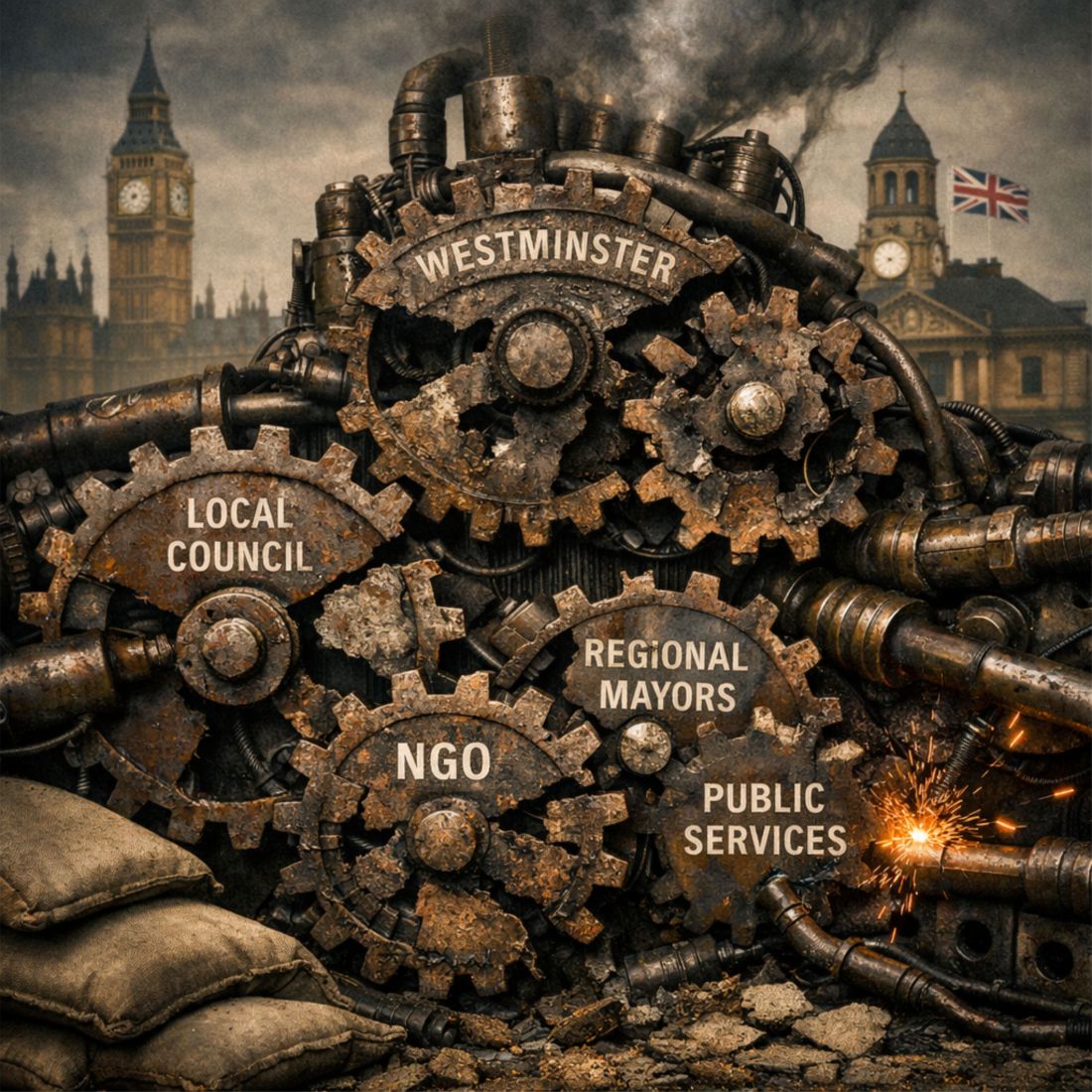


Abstract
Across the past two decades, the UK has experienced repeated systemic failures: the Global Financial Crisis, Brexit, and the COVID‑19 response. Each event exposed the same underlying truths about how the political and administrative system actually functions. These truths are no longer hidden, subtle, or debatable. They are visible, documented, and repeatedly demonstrated. Yet despite this continued exposure, neither government nor the public has meaningfully learned from them.
This paper argues that the core problem is not individual politicians or specific governments, but a persistent structural and cultural pattern within the system itself – and a public tendency to interpret systemic failure as personal failure. As a result, we continue to replace political actors while leaving the underlying machinery unchanged, ensuring that the same mistakes recur across crises.
The analysis identifies three interlinked failures: (1) Systemic fragility – a governance culture that defaults to fear, narrative, and process over judgement. (2) Public misinterpretation – a widespread belief that failures are caused by personalities rather than structures. (3) Credibility fragmentation – the absence of a coherent, trusted, collective voice capable of articulating what the system’s repeated failures actually mean.
The consequence is a cycle in which crises expose the same weaknesses, the public draws the wrong conclusions, and the system continues unchanged. This paper outlines why these patterns persist, why they are becoming more dangerous, and why future crises will produce the same failures unless both system and society confront the truths already revealed.
1. Introduction: Context and Purpose
Over the past two decades, the UK has experienced repeated systemic failures: the Global Financial Crisis, Brexit, and the COVID‑19 response. As the abstract states, “Each event exposed the same underlying truths about how the political and administrative system actually functions.”
These truths were visible, documented, and repeatedly demonstrated.
This paper is the third part of a sequence of work that began during the pandemic. The first two parts – 101: Lockdown Blogs and 202: Another 101 Lockdown Blogs – are collections of the original, unedited blogs written and published in real time throughout the COVID‑19 period. These blogs were published independently on www.adamtugwell.blog as the crisis unfolded, without retrospective adjustment or editorial reinterpretation. Both volumes are publicly available on Amazon.
The vantage point of these books is central to this analysis. The writing was produced contemporaneously by someone with direct experience of how local government and public‑sector systems operate: twelve years as a councillor, four years as a licensing chair, work as a local government officer, regional management for a national health‑related charity, and management of a local charity delivering services funded by and aligned with local authorities and government departments.
This background provided a practical understanding of how public systems behave under pressure, how decisions are made, and how institutional incentives shape outcomes.
The blogs captured the system’s behaviour as events unfolded – its reliance on narrative, its avoidance of responsibility, its inability to manage complexity, and its instinct for self‑preservation. They documented what the system did, how it communicated, and how its weaknesses became visible in real time. This contemporaneous record forms the foundation for the reflective analysis presented in 303.
The earlier crises – the Global Financial Crisis and Brexit – provide essential context.
As the introduction notes, “These events were not isolated. They were not anomalies. They were not unpredictable shocks.” They were sequential demonstrations of the same underlying pattern: a system that consistently fails under pressure, and a public that consistently misinterprets those failures.
Despite this repeated exposure, neither government nor society has meaningfully learned from these events. The abstract states clearly, “Yet despite this continued exposure, neither government nor the public has meaningfully learned from them.” The same assumptions persist, the same behaviours recur, and the same explanations dominate public understanding. We continue to replace political actors while leaving the underlying machinery unchanged.
Purpose of the Paper
This paper begins from a simple premise: “the system has already shown us how it works, repeatedly and unambiguously, yet we continue to behave as if each failure is new, surprising, and personal.”
The purpose of 303 is threefold:
- To analyse the structural and cultural patterns that cause the system to fail repeatedly. The abstract identifies three interlinked failures: systemic fragility, public misinterpretation, and credibility fragmentation.
- To explain why neither government nor society has learned from the truths already revealed. As the introduction states, “Despite the scale and frequency of these exposures, neither government nor society has meaningfully learned from them.”
- To outline why these patterns are becoming more dangerous and why future crises will produce the same failures unless both system and society confront these truths. This purpose is stated directly in the abstract.
Scope of the Paper
303 does not analyse the GFC, Brexit, or COVID‑19 as isolated events. It examines them as milestones that revealed the same structural and cultural weaknesses within the system.
It does not focus on individual politicians or governments. It focuses on the machinery – the incentives, behaviours, and cultural norms that produce predictable failure under pressure.
It does not propose technical reforms or policy adjustments. It identifies the conditions that must change if future crises are to be managed differently.
It is written as a reflection on the real‑time documentation captured in 101 and 202, and as an analysis of why those observations still have not been understood or acted upon.
2. The Pattern of Failure
The systemic failures revealed during the pandemic did not emerge suddenly in 2020. They had already been exposed twice in little more than the decade before.
The Global Financial Crisis demonstrated that when the system is threatened, it protects itself first – even at public expense.
Brexit then demonstrated that when the public issues a democratic instruction that conflicts with institutional preference, the system prioritises its own continuity over the public’s will.
These events form essential context for understanding the failures documented in real time during the pandemic.
COVID did not reveal new weaknesses. It revealed the same weaknesses, but this time with immediate, visible, and unavoidable consequences.
The pattern that emerged – and which 101 captured as it unfolded – can be understood through the following systemic behaviours.
2.1 The System Protects Itself First
The GFC exposed the system’s instinct for self‑preservation. Public money was used to stabilise institutions whose failures had caused the crisis. The priority was not public welfare but institutional continuity.
Brexit reinforced this pattern. The referendum result represented a clear democratic instruction, yet the establishment’s response demonstrated that when public direction conflicts with institutional preference, the system chooses itself.
Rather than treating the referendum as a mandate for a new starting point, Brexit was approached as a managed separation from an existing relationship.
The previous EU framework was treated as the baseline from which any change had to be justified or negotiated.
This approach resembled a divorce in which the history of the relationship determines the terms of separation, rather than a democratic reset defined by the public’s decision.
The consequence was not inherent harm from Brexit itself, but harm arising from the way the system handled it:
- reluctance to accept the referendum as a definitive instruction,
- attempts to preserve institutional continuity,
- negotiation conducted from the perspective of loss rather than opportunity, and
- prioritisation of system stability over democratic direction.
COVID then exposed the same instinct again, but with immediate public consequences. Decisions were shaped to avoid blame rather than to achieve outcomes.
Across all three milestones, the system’s priority was its own stability, not the public’s wellbeing.
2.2 The System Cannot Manage Complexity
Brexit revealed the system’s inability to translate a democratic mandate into a coherent administrative plan. The machinery struggled to handle a multi‑dimensional change without reducing it to a narrow, defensive process.
COVID exposed this limitation more starkly. The system collapsed into single‑track thinking, unable to balance multiple variables simultaneously. Complex realities were reduced to simple narratives, and policy was shaped around those narratives rather than the underlying complexity.
2.3 The System Defaults to Narrative Over Competence
This behaviour was visible during Brexit, where political messaging consistently outran administrative capacity.
It became unavoidable during COVID, where narrative became the organising principle of policy. Decisions were made to maintain a story, not to solve a problem.
The real‑time writing in 101 documented this dynamic clearly: narrative coherence was treated as more important than operational competence.
2.4 The System is Managed, Not Led
The pandemic exposed the absence of leadership capacity within the system. There was no strategic leadership, only management: reactive, fearful, and dependent on external validation.
This was not a new behaviour but a continuation of the same pattern visible in earlier crises.
202 expanded this point: the system is structurally incapable of leadership because it does not select, develop, or reward leaders.
It rewards compliance, communication, and continuity.
2.5 The System’s Incompetence Finally Had Immediate Consequences
The GFC harmed the public indirectly. Brexit harmed the public politically and economically through the way it was handled. COVID harmed the public immediately, physically, and visibly.
This is why the pandemic is central to this paper: it was the first time the system’s failures were experienced in real time by everyone, simultaneously.
The incompetence could no longer be absorbed, delayed, or disguised.
2.6 The Pattern is Now Unavoidable
Across all three milestones, the same behaviours recur:
- self‑preservation,
- avoidance of responsibility,
- narrative‑driven decision‑making,
- inability to manage complexity,
- absence of leadership,
- structural fragility.
COVID did not create this pattern. It simply made it impossible to ignore.
This pattern forms the foundation for the analysis that follows: the system has already shown how it works – repeatedly – yet neither government nor society has learned from it.
3. Why the Public Misinterprets System Failure
The repeated exposure of systemic failure across the GFC, Brexit, and COVID has not resulted in a corresponding public understanding of how the system actually works. Instead, public interpretation consistently frames these failures as the result of individual political actors, specific governments, or isolated mistakes.
This misinterpretation is central to why the system continues unchanged and why the same failures recur across crises.
The public’s misunderstanding is not accidental. It is produced by a combination of cultural assumptions, institutional habits, and communication practices that shape how system behaviour is perceived.
3.1 The Assumption of Competence
A foundational public belief is that the system is broadly competent. Titles, roles, and institutional prestige create an expectation that those in positions of authority possess the capability required to manage complex events.
This assumption persists even when evidence contradicts it.
During the pandemic, this belief was visible in the early acceptance of government decisions, the expectation that policies were based on expertise, and the reluctance to question the underlying logic of interventions.
The public interpreted actions as necessary rather than as symptoms of systemic fragility.
3.2 The Personalisation of Failure
Systemic failure is routinely interpreted as personal failure.
The public attributes outcomes to individual politicians rather than to the structure, culture, and incentives of the system.
This personalisation obscures the underlying machinery and reinforces the belief that replacing individuals will produce different outcomes.
This dynamic was evident during COVID, where criticism focused on specific leaders rather than on the systemic behaviours documented in real time in 101 and 202.
The public saw incompetence as a matter of personality rather than as a structural feature.
3.3 The Power of Narrative
Narrative plays a central role in shaping public understanding. Government communication is designed to create coherence, even when coherence does not exist operationally. The public often accepts these narratives because they provide clarity in situations that are otherwise complex and uncertain.
During the pandemic, narrative became the organising principle of policy. The public interpreted narrative as strategy, mistaking communication for competence.
This reinforced the belief that decisions were grounded in expertise rather than in fear, process, or political self‑preservation.
3.4 The Absence of a Credible Collective Voice
One of the most significant factors in public misinterpretation is the absence of a credible, unified voice capable of explaining systemic failure.
Expertise is fragmented, commentary is polarised, and institutional trust is inconsistent.
As a result, no single source is able to articulate the structural nature of the failures or challenge the dominant narratives effectively.
This fragmentation allows the system’s preferred explanations to dominate public understanding.
Without a coherent alternative, the public defaults to familiar interpretations: individual blame, party politics, and short‑term explanations.
3.5 The Cultural Avoidance of Systemic Critique
There is a cultural reluctance to confront systemic failure. Critiquing the system requires acknowledging that the machinery is not what it appears to be – that competence is not guaranteed, that leadership is not assured, and that institutional stability is not inherent.
This is uncomfortable, and the public often avoids it by focusing on more accessible explanations.
COVID made systemic failure visible, but the cultural habit of avoiding structural critique meant that many people continued to interpret events through familiar personal and political lenses.
3.6 The Consequence: Repetition
Because the public misinterprets systemic failure, the system remains unchallenged.
The same behaviours recur across crises, the same weaknesses persist, and the same assumptions endure.
The public continues to expect competence, continues to personalise failure, and continues to accept narrative as strategy.
This misinterpretation is not a side issue. It is a central reason why the system continues to fail in predictable ways and why the lessons of past crises remain unlearned.
4. Why the System Continues to Fail
The persistence of systemic failure is not accidental. It is the predictable outcome of a political‑administrative structure that is designed, incentivised, and culturally conditioned to behave in ways that produce failure under pressure.
The system does not fail because it encounters unprecedented events. It fails because its internal characteristics make effective crisis management structurally impossible.
The failures documented in real time during the pandemic were not deviations from normal behaviour. They were expressions of the system’s underlying design.
4.1 Structural Incentives Prioritise Stability Over Outcomes
The system is built to preserve itself. Its incentives reward continuity, risk‑avoidance, and political safety. Effective outcomes are secondary to maintaining institutional stability.
This dynamic was visible during the GFC, Brexit, and COVID, where decisions were shaped by the need to avoid disruption to the system rather than by the need to achieve public benefit.
When stability is the primary goal, competence becomes optional. Failure becomes inevitable.
4.2 Leadership Is Selected for Compliance, Not Capability
The system does not select leaders based on strategic competence, crisis capability, or judgement. It selects them based on loyalty, communication skill, and alignment with institutional norms. This produces a leadership class that is structurally incapable of managing complexity.
During COVID, this limitation became unavoidable. The absence of leadership was not a temporary weakness; it was a structural feature.
The system is managed, not led, and management collapses under pressure.
4.3 Complexity Is Treated as a Threat
The system cannot handle complexity without reducing it to narrative. Complex realities require judgement, flexibility, and strategic thinking – qualities the system does not cultivate. As a result, complexity is treated as a threat to stability.
During the pandemic, this behaviour was visible in the reduction of multi‑dimensional problems to single‑track narratives. The system responded to complexity by simplifying it, and the simplification produced failure.
4.4 Process Replaces Thinking
When competence is uncertain, process becomes a substitute for judgement. The system relies on procedure to justify decisions, even when procedure is inadequate or irrelevant.
This behaviour was evident in regulatory failures before the GFC, in the defensive handling of Brexit, and in the procedural rigidity of the pandemic response.
Process provides political cover. It does not provide effective outcomes.
4.5 Accountability Is Diffuse and Avoidable
The system’s accountability structure is fragmented. Responsibility is distributed across institutions, committees, and advisory bodies. This diffusion allows failure to occur without consequence. When no one is accountable, no one is incentivised to prevent failure.
During COVID, accountability was consistently displaced: onto advisers, onto modelling, onto external bodies, onto public behaviour.
The system avoided responsibility because it is designed to avoid responsibility.
4.6 The System Cannot Learn
The most significant structural weakness is the system’s inability to learn. Learning requires acknowledging failure, analysing causes, and changing behaviour. The system avoids all three.
After the GFC, the system did not reform. After Brexit, the system did not adapt. During COVID, the system repeated the same behaviours in real time.
The absence of learning is not a cultural flaw; it is a structural condition.
A system built to preserve itself cannot learn from its own failures.
4.7 Failure Is the Logical Outcome
When a system:
- prioritises stability over outcomes,
- selects leaders for compliance rather than capability,
- treats complexity as a threat,
- replaces judgement with process,
- diffuses accountability, and
- cannot learn,
failure is not an anomaly. Failure is the expected result.
The pandemic did not expose a temporary weakness. It exposed the system’s operating model.
5. Why We Still Haven’t Learned Anything
Despite repeated exposure of systemic failure across the GFC, Brexit, and COVID, neither government nor society has meaningfully learned from these events. The same assumptions persist, the same behaviours recur, and the same explanations dominate public and institutional understanding.
The absence of learning is not a passive condition; it is an active, structural and cultural phenomenon that shapes how the system and the public respond to failure.
The real‑time analysis captured in 101 and expanded in 202 demonstrated that even as failures unfolded in front of the entire country, the mechanisms required for learning were absent.
The system could not learn, and the public did not learn.
5.1 Learning Requires Acknowledgement of Failure
Learning begins with recognition. The system must acknowledge that failure occurred, identify its causes, and accept responsibility. None of these steps are structurally possible.
The system is designed to preserve its own legitimacy, and acknowledging failure threatens that legitimacy.
During the pandemic, failures were reframed as unavoidable consequences of unprecedented circumstances. Decisions were justified retrospectively. Responsibility was displaced. The system avoided acknowledgement because acknowledgement would require change.
5.2 Learning Requires Capacity for Self‑Reflection
Self‑reflection demands institutional humility, analytical capability, and a willingness to confront uncomfortable truths. The system lacks all three.
Its culture rewards certainty, narrative coherence, and defensive reasoning. Reflection is treated as weakness, and weakness is treated as risk.
The result is a system that cannot examine its own behaviour. It cannot ask why it failed, because asking the question would expose the structural conditions that make failure inevitable.
5.3 Learning Requires Structural Flexibility
To learn, a system must be able to change. It must be able to alter incentives, restructure processes, and adapt behaviours.
The UK system is structurally inflexible. Its incentives are fixed, its culture is entrenched, and its processes are designed to maintain continuity.
During COVID, even when failures were visible in real time, the system continued to behave in the same way. It could not adapt because adaptation would require structural change, and structural change is incompatible with the system’s self‑preserving design.
5.4 Learning Requires Public Pressure
Public understanding plays a critical role in forcing institutional learning.
When the public recognises systemic failure, it can demand change. But as Section 3 outlined, the public consistently misinterprets systemic failure as personal failure. This misinterpretation prevents meaningful pressure from forming.
The public continues to expect competence, continues to personalise failure, and continues to accept narrative as strategy.
Without accurate public understanding, the system faces no demand to learn.
5.5 Learning Requires Credible External Voices
A system learns when credible external voices articulate its failures and propose alternatives.
These voices must be trusted, coherent, and capable of influencing public understanding.
Such voices do not currently exist. Expertise is fragmented, commentary is polarised, and institutional trust is inconsistent.
The absence of a credible collective voice allows the system’s preferred explanations to dominate.
Without external challenge, internal learning cannot occur.
5.6 Learning Requires Consequences
Systems learn when failure produces consequences.
In the UK system, failure rarely produces consequences for those responsible.
Accountability is diffuse, responsibility is avoidable, and institutional continuity is prioritised over reform.
During the pandemic, even severe failures produced limited consequences. The absence of consequence reinforces the absence of learning.
5.7 The Result: A System That Cannot Learn and a Society That Does Not Learn
The combination of structural inflexibility, cultural avoidance, narrative dominance, public misinterpretation, and the absence of credible external pressure produces a system that cannot learn and a society that does not learn.
The failures of the GFC were absorbed. The failures of Brexit were reframed. The failures of COVID were personalised.
None produced structural change. None produced institutional learning. None produced public understanding.
The system continues to fail because it cannot learn. Society continues to accept failure because it does not learn.
This dynamic ensures that the same failures will recur in future crises, regardless of their nature or scale.
6. The Absence of a Credible Combined Voice
The repeated failures of the system – exposed across the GFC, Brexit, and COVID – have not produced a coherent, trusted, collective voice capable of interpreting those failures or demanding structural change.
This absence is one of the most significant reasons why the system continues to fail and why society continues to misinterpret those failures. Without a credible combined voice, systemic failure remains unchallenged, unexamined, and uncorrected.
The real‑time writing in 101 and the expanded analysis in 202 highlighted this gap repeatedly. Even as the pandemic exposed the system’s weaknesses to the entire country, there was no unified source capable of explaining what those weaknesses meant or how they connected to earlier failures.
6.1 Fragmentation of Expertise
Expertise exists, but it is fragmented. Specialists operate within narrow domains, each focused on their own area of knowledge.
During the pandemic, epidemiologists, behavioural scientists, economists, public health officials, and policy analysts all provided commentary, but their perspectives were isolated rather than integrated.
This fragmentation prevents the formation of a coherent narrative about systemic failure. Each expert sees part of the problem, but no single voice articulates the whole.
6.2 Polarisation of Commentary
Public commentary is polarised. Analysts, commentators, and institutions interpret events through ideological, political, or cultural lenses. This polarisation reduces credibility, as each perspective is seen as partial, biased, or aligned with a particular constituency.
During COVID, commentary often reinforced existing divisions rather than providing clarity. Polarisation prevented the emergence of a unified explanation of systemic failure.
6.3 Institutional Voices Lack Independence
Institutions that could provide authoritative analysis are constrained by political, cultural, or organisational pressures. Their commentary is shaped by the need to maintain relationships, preserve legitimacy, or avoid conflict with the system.
As a result, institutional voices rarely articulate systemic failure directly. They focus on procedural issues, technical details, or incremental improvements rather than confronting the structural conditions that produce failure.
6.4 Public Trust is Inconsistent
A credible combined voice requires public trust. Trust must be broad, stable, and independent of political alignment. In the UK, public trust is inconsistent and often conditional. Different groups trust different sources, and no single voice commands universal credibility.
During the pandemic, this inconsistency was visible in the varied responses to government communication, expert commentary, and media reporting. Without a trusted central voice, public understanding remained fragmented.
6.5 No Mechanism for Collective Interpretation
There is no mechanism within the system or society for collective interpretation of failure. Crises are analysed retrospectively, through inquiries or reports, but these processes are slow, procedural, and disconnected from real‑time understanding. They do not produce a unified explanation or a shared understanding of systemic behaviour.
The absence of such a mechanism means that even when failure is visible, it is not collectively understood.
6.6 The Consequence: Silence Where Clarity Is Needed
The absence of a credible combined voice creates a vacuum.
Into that vacuum flow:
- political narratives,
- media simplifications,
- personalised blame,
- fragmented expertise,
- polarised commentary, and
- institutional defensiveness.
This vacuum ensures that systemic failure is never articulated clearly enough to force change. The public does not receive a coherent explanation. The system does not face unified pressure. The failures documented in 101 and 202 remain unconnected in public understanding.
6.7 Why This Matters for 303
303 exists because this absence is the central unresolved problem. The system has already shown how it works. The failures are visible, documented, and repeated. But without a credible combined voice, those failures cannot be understood collectively, and therefore cannot be addressed.
The absence of such a voice is not a communication problem. It is a structural problem. It is a cultural problem. It is a societal problem.
And it is one of the primary reasons why the system continues to fail and why society continues to accept those failures.
7. The Consequences of Repeating the Same Mistakes
The repeated failures of the UK’s political‑administrative system are not isolated events. They form a pattern that has persisted across multiple crises.
When a system behaves in the same way under pressure, produces the same failures, and avoids the same lessons, the consequences accumulate. These consequences are structural, cultural, and societal. They shape the country’s resilience, its governance capacity, and its ability to respond to future crises.
The real‑time analysis captured in 101 and expanded in 202 demonstrated that the consequences of systemic failure are not theoretical.
They are immediate, visible, and increasingly severe.
7.1 Erosion of Institutional Credibility
Repeated failure without learning erodes institutional credibility. When the system protects itself, avoids responsibility, and relies on narrative rather than competence, public trust declines.
This erosion is gradual but cumulative. Each crisis reduces the system’s legitimacy, making future crises harder to manage.
During the pandemic, credibility was damaged in real time. Conflicting messages, inconsistent decisions, and visible incompetence undermined trust. This erosion did not begin with COVID, but COVID accelerated it.
7.2 Decline in Public Confidence
Public confidence in governance depends on the belief that the system is capable of managing complex events. When failures recur, this belief weakens. The public becomes sceptical, disengaged, or polarised.
Confidence declines not because of political disagreement, but because of repeated exposure to systemic fragility.
The decline in confidence affects compliance, cooperation, and social cohesion. During COVID, public behaviour was shaped by trust – and trust was shaped by competence. When competence was absent, confidence declined.
7.3 Increased Vulnerability to Future Crises
A system that cannot learn becomes increasingly vulnerable. Each failure exposes weaknesses that remain unaddressed.
Over time, these weaknesses accumulate, reducing the system’s resilience. Future crises become harder to manage because the underlying conditions have deteriorated.
The pandemic revealed vulnerabilities that had been present for years. These vulnerabilities were not created by COVID; they were exposed by it.
Without learning, they remain.
7.4 Normalisation of Failure
When failure recurs, it becomes normalised. The public begins to expect incompetence. The system begins to accept failure as inevitable. This normalisation reduces the urgency of reform and reinforces the behaviours that produce failure.
During COVID, failures that would once have been shocking became routine. The system adapted to failure rather than correcting it.
7.5 Fragmentation of Public Discourse
Repeated failure without explanation fragments public discourse. Without a credible combined voice, interpretations diverge. Polarisation increases. The absence of shared understanding prevents collective action and undermines the possibility of structural change.
This fragmentation was visible during the pandemic, where competing narratives replaced coherent analysis. The public lacked a unified explanation, and the system lacked unified pressure.
7.6 Loss of Strategic Capacity
A system that cannot learn loses strategic capacity. It becomes reactive, short‑term, and defensive.
Strategic thinking requires stability, competence, and the ability to integrate lessons from past events. When these conditions are absent, strategy collapses.
During COVID, strategic capacity was absent. Decisions were reactive, narrative‑driven, and shaped by fear.
This was not a temporary condition; it was the result of long‑term systemic behaviour.
7.7 Reinforcement of Systemic Fragility
Each failure reinforces the system’s fragility. The system becomes more dependent on narrative, more reliant on process, and more resistant to change. Fragility becomes a defining characteristic.
COVID exposed this fragility in real time. The system struggled to manage complexity, coordinate institutions, or maintain coherence.
This fragility was not created by the pandemic; it was revealed by it.
7.8 The Consequence: Predictable Future Failure
The most significant consequence of repeating the same mistakes is that future failure becomes predictable.
When a system behaves in the same way under pressure, produces the same outcomes, and avoids the same lessons, future crises will produce the same failures.
This is not speculation. It is the logical outcome of the system’s design.
The failures of the GFC, Brexit, and COVID were not anomalies. They were demonstrations of how the system works.
Without learning, without structural change, and without a credible combined voice, the consequences of systemic failure will continue to accumulate – and future crises will expose the same weaknesses again.
8. What Needs to Change
The repeated failures of the UK’s political‑administrative system are not the result of isolated mistakes or individual shortcomings. They are the predictable outcome of structural incentives, cultural habits, and institutional behaviours that make effective crisis management impossible.
For the system to stop failing in the same way, fundamental changes are required. These changes are not technical adjustments or procedural reforms. They are structural, cultural, and conceptual shifts that redefine how the system operates.
The real‑time analysis captured in 101 and expanded in 202 demonstrated that without such changes, future crises will produce the same failures, regardless of their nature or scale.
8.1 A Shift from Self‑Preservation to Public Purpose
The system must redefine its primary incentive. As long as institutional stability is prioritised over public outcomes, failure will remain inevitable.
A system designed to protect itself cannot serve the public effectively. Changing this incentive requires altering how institutions are evaluated, how leaders are selected, and how accountability is enforced.
Without a shift in purpose, structural change is impossible.
8.2 A Redefinition of Leadership
Leadership must be understood as a capability, not a title.
The system must select leaders based on judgement, competence, and the ability to manage complexity.
This requires abandoning the cultural preference for loyalty, communication skill, and alignment with institutional norms.
During the pandemic, the absence of leadership was not a temporary weakness; it was a structural condition.
Changing this condition requires redefining what leadership means and how it is identified.
8.3 The Development of Strategic Capacity
The system must build strategic capacity. This requires institutions capable of integrating information, managing complexity, and making decisions based on judgement rather than narrative.
Strategic capacity cannot be created through process or procedure. It requires cultural change, institutional redesign, and the development of genuine expertise.
Without strategic capacity, the system will remain reactive, defensive, and fragile.
8.4 The Creation of Mechanisms for Learning
Learning must become a structural function. The system must be able to analyse failure, identify causes, and adapt behaviour.
This requires mechanisms that are independent of political pressure, insulated from institutional defensiveness, and capable of confronting uncomfortable truths.
The absence of learning is one of the system’s most significant weaknesses. Without mechanisms for learning, failure will continue.
8.5 The Establishment of Clear Accountability
Accountability must be direct, meaningful, and unavoidable. The current structure diffuses responsibility, allowing failure to occur without consequence.
Clear accountability requires redefining institutional roles, clarifying lines of responsibility, and ensuring that failure produces change.
Without accountability, incentives remain misaligned, and behaviour remains unchanged.
8.6 The Emergence of a Credible Combined Voice
A credible combined voice is essential for public understanding and institutional pressure.
This voice must be independent, coherent, and trusted. It must be capable of articulating systemic failure, challenging narrative, and providing clarity during crises.
The absence of such a voice is one of the central reasons why the system continues to fail and why society continues to misinterpret those failures.
Without a credible combined voice, structural change cannot occur.
8.7 A Cultural Shift Toward Systemic Understanding
The public must develop a systemic understanding of failure. As long as failure is personalised, misinterpreted, or absorbed into narrative, the system will face no pressure to change. This requires cultural shifts in how the public interprets crisis, how media presents failure, and how institutions communicate.
Without public understanding, structural change will lack legitimacy and momentum.
8.8 Recognition of the System’s Current Limits
The system must recognise its own limits. It must acknowledge that it cannot manage complexity, cannot lead effectively, and cannot learn without structural change.
This recognition is not a weakness; it is a prerequisite for reform.
The pandemic exposed these limits in real time. Ignoring them ensures that future crises will produce the same failures.
8.9 The Consequence of Inaction
If these changes do not occur, the system will continue to fail in predictable ways. Future crises will expose the same weaknesses, produce the same outcomes, and reinforce the same fragility. The consequences will accumulate, and the system’s resilience will continue to decline.
Change is not optional. It is necessary for the system to function.
9. The Risks of Continuing Without Change
The failures exposed across the GFC, Brexit, and COVID demonstrate that the UK’s political‑administrative system is structurally incapable of managing complex crises.
The absence of learning, the persistence of self‑preservation, and the lack of strategic capacity ensure that future crises will produce the same failures.
Continuing without change carries significant risks. These risks are not hypothetical. They are the logical outcomes of a system that behaves predictably under pressure.
The real‑time analysis captured in 101 and expanded in 202 showed that these risks were already visible during the pandemic.
Without structural change, they will intensify.
9.1 Increasing System Fragility
Each crisis exposes weaknesses that remain unaddressed. Over time, these weaknesses accumulate, reducing the system’s resilience. Fragility becomes a defining characteristic.
A fragile system cannot absorb shocks, manage complexity, or maintain coherence under pressure.
COVID revealed this fragility in real time. The system struggled to coordinate institutions, integrate information, or maintain operational stability.
Without change, fragility will increase.
9.2 Declining Public Trust
Repeated failure without learning erodes public trust. Trust is essential for effective governance, particularly during crises. When trust declines, compliance decreases, cooperation weakens, and social cohesion deteriorates.
During the pandemic, trust was damaged by inconsistent decisions, conflicting messages, and visible incompetence.
Continuing without change will accelerate this decline, making future crises harder to manage.
9.3 Reduced Crisis Response Capacity
A system that cannot learn becomes increasingly incapable of responding to crises.
Each failure reduces capacity, undermines confidence, and reinforces reactive behaviour. Crisis response becomes slower, less coherent, and more dependent on narrative.
COVID demonstrated the limits of the system’s crisis response capacity.
Without change, these limits will become more severe.
9.4 Escalation of Policy Errors
When a system relies on narrative rather than competence, policy errors become more frequent and more severe. Errors are not corrected because the system cannot acknowledge them. They accumulate, producing long‑term consequences.
During the pandemic, policy errors were visible in real time. Continuing without change ensures that future crises will produce similar errors, with potentially greater impact.
9.5 Loss of International Credibility
Repeated failure affects international credibility. Other countries observe systemic behaviour, assess competence, and adjust their expectations accordingly.
Loss of credibility reduces influence, weakens partnerships, and limits strategic options.
Brexit and COVID both affected international perceptions of the UK’s governance capacity.
Without change, credibility will continue to decline.
9.6 Increased Social and Economic Vulnerability
Systemic failure has social and economic consequences. When governance is inconsistent, reactive, or incompetent, economic stability is undermined, social cohesion weakens, and public wellbeing declines.
COVID exposed these vulnerabilities. Continuing without change will deepen them, making society more susceptible to future shocks.
9.7 Entrenchment of Systemic Failure
The most significant risk is the entrenchment of systemic failure. When failure becomes normalised, expectations adjust. The public expects incompetence. The system accepts fragility. Failure becomes part of the political landscape.
Entrenchment ensures that future crises will produce the same outcomes. It prevents reform, undermines resilience, and accelerates decline.
9.8 Predictable Future Crises
A system that cannot learn, cannot lead, and cannot manage complexity will fail in future crises. These failures are not speculative. They are predictable. The nature of the crisis may change, but the system’s behaviour will remain the same.
The risks of continuing without change are therefore structural, cumulative, and unavoidable. Without reform, the system will continue to fail, and the consequences will intensify.
10. Conclusion: Confronting What the System Has Already Shown
Across the Global Financial Crisis, Brexit, and the COVID‑19 response, the UK’s political‑administrative system has repeatedly demonstrated how it behaves under pressure.
These events were not anomalies or unpredictable shocks. They were sequential exposures of the same structural and cultural weaknesses: systemic fragility, an inability to manage complexity, a reliance on narrative over competence, and a persistent instinct for self‑preservation.
The real‑time documentation captured in 101: Lockdown Blogs and 202: Another 101 Lockdown Blogs recorded these behaviours as they occurred. Written independently, published contemporaneously on www.adamtugwell.blog, and grounded in practical experience across local government and public‑sector service delivery, those blogs provided a vantage point that removed the distortions of hindsight. They showed the system’s failures as they happened, without retrospective justification or political reframing.
This paper reflects on that record and places it within the wider pattern of systemic behaviour across two decades. The analysis demonstrates that the core problem is not individual politicians or specific governments, but the structure, culture, and incentives of the system itself – and a public tendency to interpret systemic failure as personal failure.
As long as failures are personalised, the underlying machinery remains unchanged, and the same mistakes recur across crises.
The absence of a credible combined voice capable of articulating what these failures mean ensures that public understanding remains fragmented. Expertise is divided, commentary is polarised, and institutional voices lack independence.
Without a coherent explanation, the public defaults to familiar narratives, and the system continues without pressure to learn or change.
The consequence is a cycle in which crises expose the same weaknesses, the public draws the wrong conclusions, and the system remains structurally incapable of improvement.
Each failure erodes credibility, reduces resilience, and increases vulnerability to future shocks. Without confronting the truths already revealed, future crises will produce the same outcomes, regardless of their nature or scale.
303 therefore serves a single purpose: to make explicit what the system has already shown. The failures are visible, documented, and repeated. The lessons are available, but unlearned. The risks are increasing, not diminishing.
Unless both system and society recognise the structural nature of these failures – and the conditions that allow them to persist – the pattern will continue, and the consequences will intensify.
The system has already demonstrated how it works. The question now is whether we are willing to accept what we have already seen.