

The Comfort of Action
There is something inherently reassuring about large interventions. Faced with a troubling statistic, particularly one involving hundreds of thousands of young people, the instinct to act feels both practical and humane. Indeed, any suggestion that doing nothing might be preferable is likely to strike most people as absurd. If large numbers of young people are struggling to find their place within work, education or training, surely the responsible response is to offer more support, more opportunities and more resources.
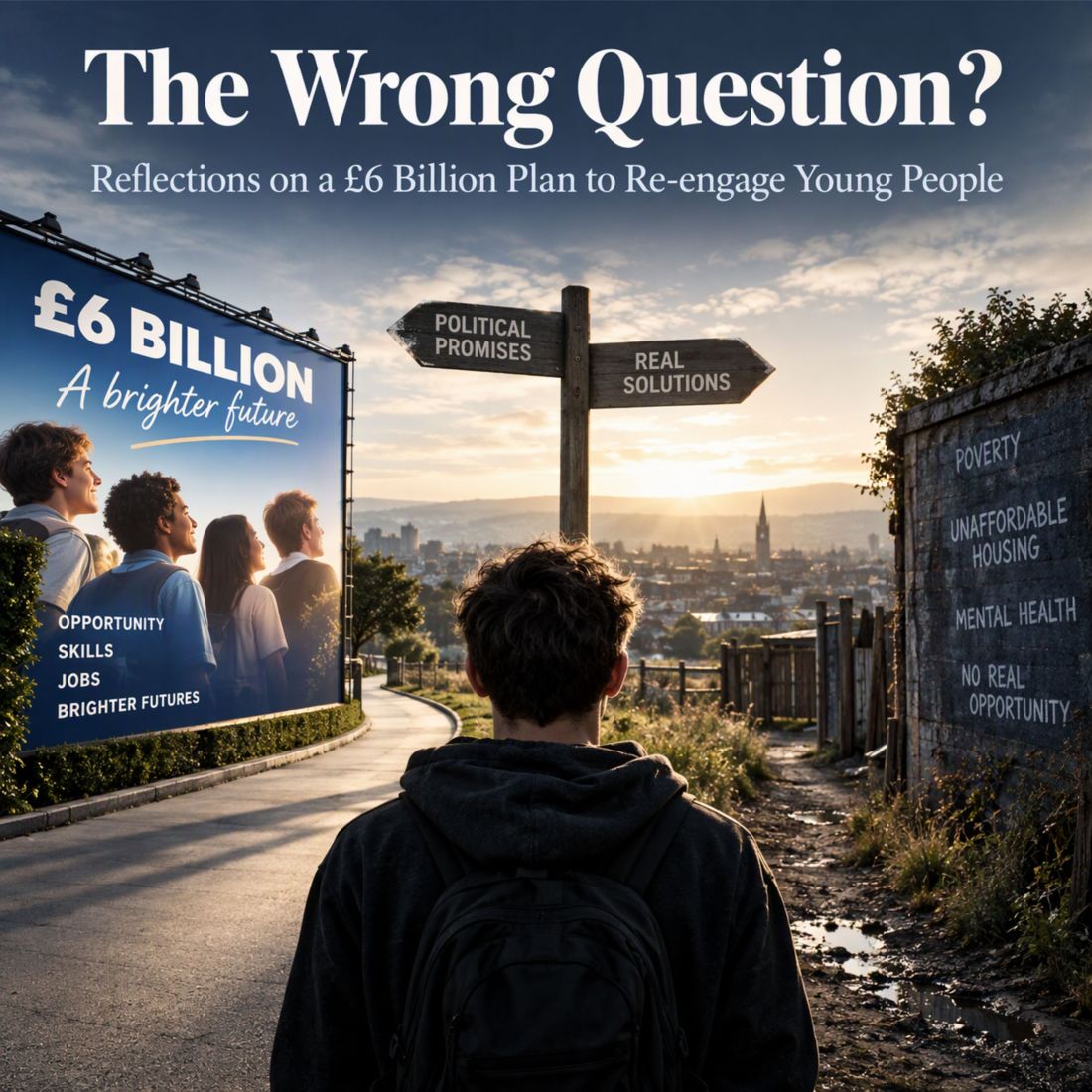
This is precisely why the recent proposal to spend £6 billion on tackling youth disengagement feels so difficult to challenge. The scale of the funding communicates seriousness. The language surrounding the proposal communicates concern. The intention appears entirely positive. Everything about it encourages the observer to conclude that society has recognised a problem and is mobilising resources to address it.
The difficulty, however, is that large interventions often reveal as much about how a problem is being understood as they do about how that problem might be solved. Before a single pound is spent, before a single young person enters a programme and before a single outcome is measured, an assumption has already been made. That assumption is rarely discussed because it sits quietly beneath the entire proposal, presenting itself not as an interpretation but as a fact.
The assumption is that the problem begins with disengagement.
Where the Story Begins
Once disengagement becomes the starting point, the rest of the discussion follows naturally. If young people are detached from employment, detached from education or detached from training, then the obvious task becomes finding ways to reconnect them.
More support appears sensible. More intervention appears necessary. More pathways appear desirable.
Yet there is another way of looking at the situation.
A young person does not suddenly arrive at adulthood and become disengaged in isolation from everything that came before. Long before anyone appears within an official category, long before they become visible to policymakers or programme designers, they have already spent years absorbing impressions about the world around them. They have watched people enter work. They have watched people struggle despite working. They have listened to promises about education and achievement. They have observed what qualifications seem to deliver and, perhaps more importantly, what they fail to deliver.
None of this takes place inside a government framework. None of it appears neatly within a dataset. Yet these observations help shape a person’s understanding of what participation actually means.
What makes the current debate feel incomplete is that it begins at the point where disengagement becomes measurable. By then, a great deal has already happened. The visible outcome takes centre stage whilst the conditions from which it emerged quietly retreat into the background.
The Destination Itself
For much of the post-war period, a largely unspoken bargain sat beneath public life. The bargain was never perfect and it certainly did not work equally well for everybody, but enough people believed in it for it to provide a degree of social stability.
Education increased opportunities. Work offered a route towards independence. Qualifications expanded the range of possibilities available.
Effort was not guaranteed to succeed, but it generally felt connected to outcomes in ways that most people could recognise.
Whether that bargain was ever quite as reliable as memory now suggests is open to discussion. What feels more significant is the possibility that increasing numbers of people no longer believe in it.
The distinction matters because a society can continue operating according to assumptions long after confidence in those assumptions has begun to erode.
Institutions continue encouraging participation because participation has historically been associated with desirable outcomes. Politicians continue promoting employment because employment has historically been associated with independence. Educational systems continue promoting attainment because attainment has historically been associated with opportunity.
What if the issue is not that young people fail to understand the value of these things, but that they are increasingly uncertain about what these things now lead to?
That is a very different question from the one currently being asked.
Participation and Independence
Much of my recent work has revolved around the distinction between participation and independence.
Employment statistics tell us who is working.
They do not tell us whether work enables independence.
Educational attainment tells us who has completed qualifications.
It does not tell us whether those qualifications created meaningful opportunity.
Income measures tell us what people earn.
They do not necessarily tell us how secure people feel or what degree of influence they possess over the shape of their own lives.
The reason this matters is that modern policy increasingly appears focused upon encouraging participation whilst paying much less attention to the quality of the outcomes that participation produces.
From that perspective, the proposal begins to raise uncomfortable questions. If a person is being encouraged towards a labour market that struggles to provide security, towards housing that feels increasingly unattainable, towards recruitment systems that seem to recognise credentials more easily than capability, and towards pathways whose outcomes appear progressively less certain, then the challenge may not reside entirely in their willingness to engage.
At the very least, it becomes difficult to separate the behaviour from the environment within which that behaviour emerges.
The Ecosystem of Intervention
Large programmes also possess another characteristic that receives remarkably little scrutiny. They create activity.
This is not criticism. It is simply an observation about the way modern institutions function.
A proposal of this scale immediately generates work. Delivery organisations expand. Local providers seek funding. Consultants are commissioned. Programme managers are appointed. Evaluation frameworks are developed. Targets are established. Reporting systems are created. Entire professional ecosystems begin organising themselves around the successful delivery of the intervention.
None of this is inherently problematic. Complex programmes require administration and oversight.
The question becomes whether the growth of activity is being mistaken for progress.
An observer looking at the resulting landscape would see movement everywhere. Meetings taking place. Contracts being awarded. Programmes being launched. Success measures being monitored. Communications teams publishing updates. Politicians announcing milestones.
The response becomes highly visible.
What remains much less visible is whether the conditions that produced the original problem are changing in any meaningful way.
The Politics of Hope
It is here that the language surrounding the proposal becomes particularly interesting.
Hope is one of the most frequently used words in public life and yet one of the least examined. Governments offer hope. Investments create hope. Initiatives restore hope. Entire political careers are built upon promises of hope.
Yet the experience itself seems far more elusive than the language used to describe it.
People rarely describe feeling hopeful because a programme exists. More often they describe feeling hopeful because the future appears accessible in a way that previously seemed impossible.
Hope emerges when opportunities become tangible rather than theoretical. It emerges when effort appears connected to outcomes. It emerges when individuals feel capable of influencing the direction of their own lives.
In that sense, hope behaves less like something that can be distributed and more like something that emerges from conditions.
Which raises an awkward possibility.
Political systems often talk about hope when what they are really offering is activity.
One is much easier to provide than the other.
The Conversation That Disappears
This is the point at which the £6 billion begins to resemble what political strategists sometimes call a dead cat. Not because the proposal is meaningless. Not because nobody benefits. Not because everyone involved is insincere.
It resembles a dead cat because of what it allows us to stop talking about.
Once the funding is announced, attention naturally shifts towards delivery. Public discussion becomes focused on implementation, targets, outcomes and measurement. The debate concerns whether the intervention works, whether enough money has been allocated and whether additional support may be required in the future.
Meanwhile the original question fades from view.
Why are so many young people arriving at adulthood unconvinced that the systems waiting for them provide a sufficiently attractive destination in the first place?
Why does the relationship between work and independence appear weaker than many people expected?
Why do qualifications appear increasingly disconnected from capability?
Why do growing numbers of people struggle to see a future that feels attainable despite doing the things society continues to ask of them?
Those questions are not easily solved through a programme. They cannot be managed through a delivery contract. They refuse to remain neatly inside departmental boundaries.
Yet there is a growing possibility that they are closer to the source of the problem than the disengagement we have become so focused upon measuring.
The Question Beneath the Question
Perhaps the most striking thing about the proposal is not the £6 billion itself, but the confidence with which a particular diagnosis has been accepted.
If the central problem is youth disengagement, then the proposal makes perfect sense.
If the central problem is a growing loss of faith in the destinations young people are being encouraged towards, the picture becomes considerably more complicated.
The difference between those two interpretations may seem subtle from a distance. In practice, it determines whether the policy is addressing the source of the problem or organising itself around its consequences.
And that distinction may ultimately prove more important than the money being spent. Because if the intervention succeeds politically by focusing attention on disengagement itself, there is a risk that the harder conversation about work, independence, capability, belonging and the future gets postponed once again.
Perhaps that is the real value of the £6 billion. Not as a solution, but as a lens through which to examine the assumptions society continues to make about why so many young people appear reluctant to follow the paths placed before them.
Whether those assumptions are still justified seems a question worth asking before we spend the money, not after it has gone.