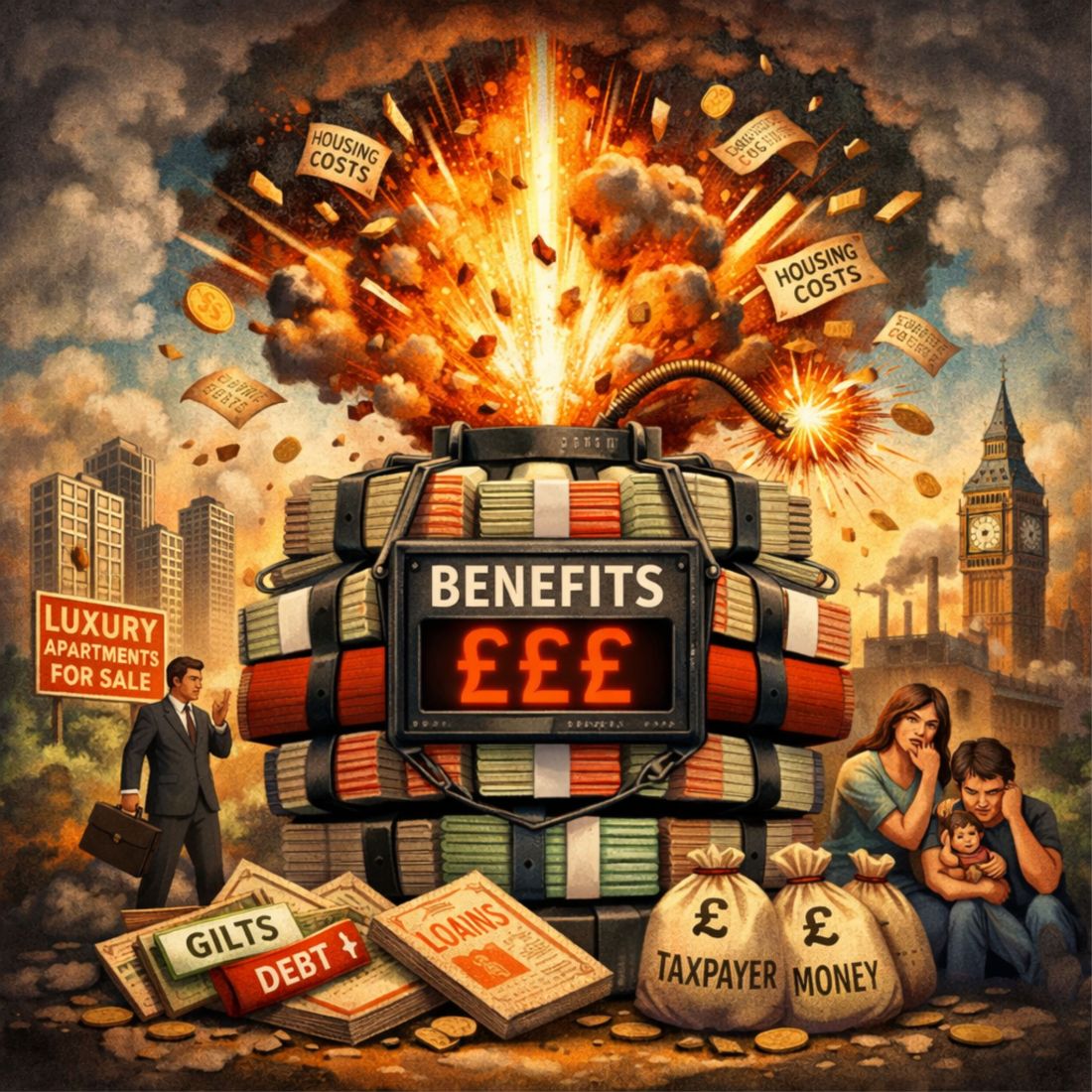
When Tax is the Only Tool They Have Left

A conversation about how Britain reached a point where taxation is no longer a political choice, but a structural necessity.

Noticing the feeling that something has changed

If you talk to people across the UK – in cafés, on trains, at work – you’ll hear a similar sentiment: “It feels like everything is getting difficult.” Not just financially, but structurally.

Public services feel stretched. Infrastructure feels tired. Politics feels stuck. And when a new government arrives and immediately reaches for tax rises, many people instinctively fall back on familiar narratives: “Well, that’s Labour for you.”

But if we slow down, take a breath, and look carefully at the mechanics underneath, a different picture emerges – one that isn’t about party ideology at all. It’s about a country that has gradually run out of road, and a government that has fewer tools available than at any point in modern history.

This isn’t a story about blame. It’s a story about understanding.

Why the old political story no longer fits

For decades, British politics has been framed around a simple rhythm: Conservatives lower taxes, Labour raises them. It was never entirely true, but it was familiar enough that people accepted it.

Yet the data tells us something different. The UK’s tax burden was already heading toward an 80‑year high before the most recent General Election in the summer of 2024, driven by structural pressures rather than ideology.

Even under Conservative governments, taxes rose steadily – partly through explicit measures, partly through “fiscal drag,” where thresholds fail to rise with inflation and more people are pulled into higher tax bands.

So when the Labour Government raises taxes now, it’s not because they are following a party tradition. It’s because the system they’ve inherited leaves them almost no alternative.

This is the first key idea: taxation today is not ideological – it is mechanical.

The broken toolbox: understanding what governments used to rely on

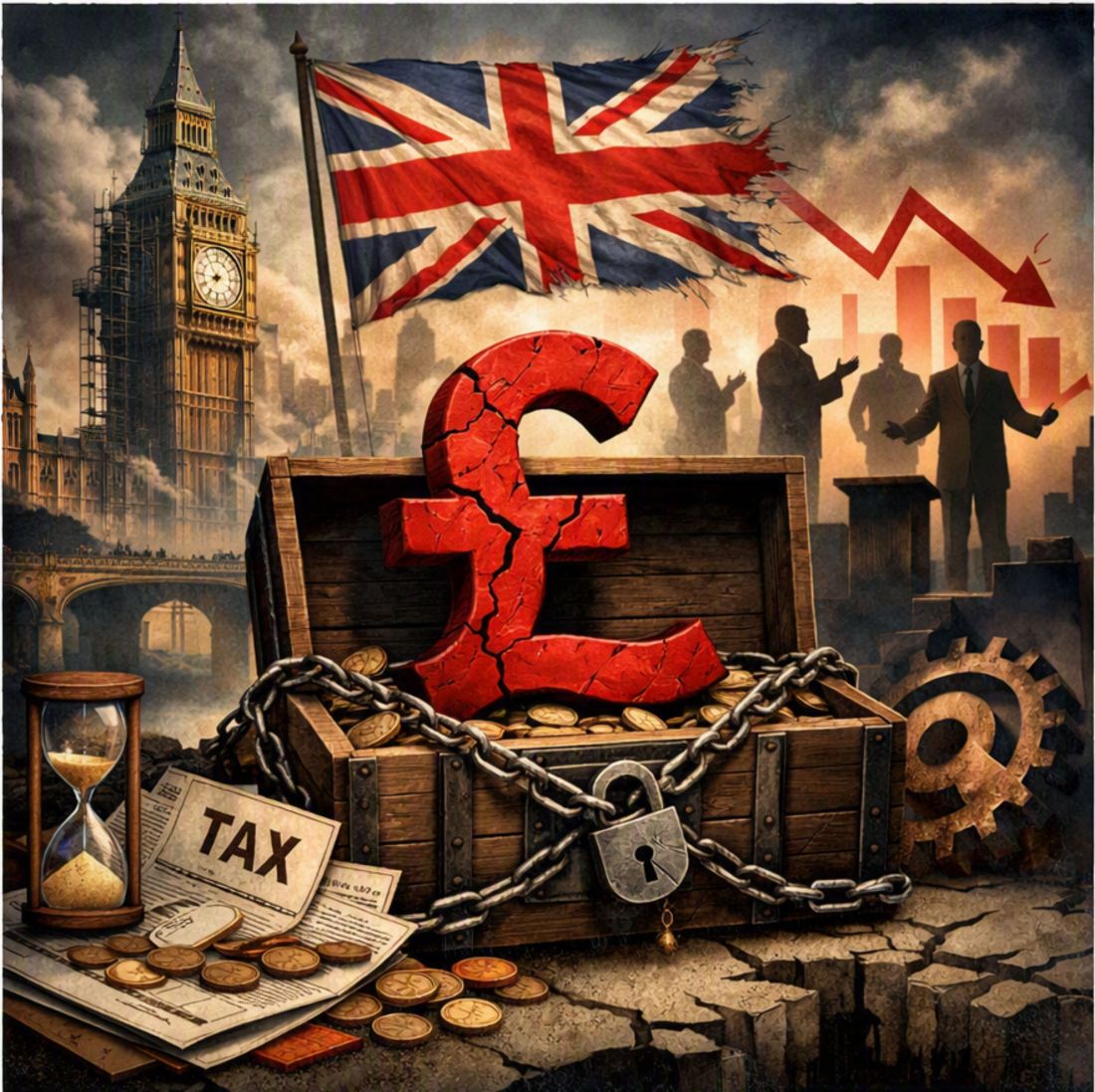
To understand why tax is the only tool left, imagine the UK government as a mechanic with a toolbox. For decades, that toolbox contained several reliable instruments:

  • Borrowing – cheap debt allowed governments to smooth over problems.
  • Spending cuts – austerity was used to rebalance budgets.
  • Privatisation – selling state assets brought in quick cash.
  • Growth – rising productivity and investment expanded the tax base.
  • Efficiency drives – squeezing public services for savings.

But each of these tools has worn out.

Borrowing is no longer cheap

Public debt has nearly tripled since the 2008 global financial crisis (GFC). Markets are more sensitive. Interest rates are higher. Borrowing now comes with real consequences.

Spending cuts have reached their limit

After a decade of austerity, public services are visibly strained. The Resolution Foundation describes the UK as stuck in a “fiscal funk” where cuts no longer fix anything – they simply break things further.

Privatisation has run out of road

Most sellable assets have already been sold. What remains is either essential or politically untouchable.

Growth has stalled

The Institute of Economic Affairs notes that Britain’s long-term growth slowdown is deeply structural, tied to low investment and productivity. Growth can no longer be relied on to “fix” the public finances.

Efficiency savings are a fiction

Public services have been squeezed so hard that further “efficiencies” often mean service reductions, not improvements.

When every tool in the box is broken, the mechanic reaches for the only one left – even if it’s blunt, unpopular, or overused.

That tool is taxation.

The extractive system: how Britain hollowed itself out

To understand why the toolbox is empty, we need to look at the deeper structure of the UK economy – not in a technical way, but in a human way.

For many years, Britain relied on a model that extracted value rather than created it. This wasn’t malicious; it was gradual, almost invisible.

Fiat money and the illusion of prosperity

The UK operates on fiat money – currency backed by trust rather than physical assets.

This allowed governments to borrow cheaply, expand credit, and inflate asset prices.

For a while, this created the feeling of prosperity: rising house prices, booming financial markets, easy credit.

But it didn’t create productivity. It didn’t create resilience. It didn’t create the kind of growth that strengthens a nation.

Financialisation: when money makes more money than work does

Over time, the economy shifted toward financial activity – property, banking, asset management – and away from production, innovation, and infrastructure. The IEA notes that tax policy increasingly discouraged investment, contributing to lower productivity growth.

This meant Britain became very good at moving money around, but less good at building things that last.

The hollowing-out effect

As extraction replaced creation, several things happened:

  • Public services weakened.
  • Infrastructure aged.
  • Local government struggled.
  • Real wages stagnated.
  • Social mobility slowed.
  • Trust in institutions eroded.

People felt the country becoming thinner – not collapsing, but hollowing.

Performance politics: when the story matters more than the substance

Fiat money didn’t just shape the economy. It shaped politics.

For years, governments could rely on cheap borrowing and rising asset values to appear effective. They could announce new initiatives, promise investment, and project confidence – even when the underlying machinery was weakening.

This created what we might call performance politics: politics focused on narrative rather than outcomes.

The ICAEW describes the UK tax system as “trapped by politics,” with reforms blocked because politicians fear creating visible “losers.” This leads to short-term fixes, rushed announcements, and complexity – all symptoms of a system performing rather than governing.

And now we’ve reached the zenith of that performance.

The tragedy: the actors keep performing even though the stage is collapsing

Here is the part that is hardest to talk about, but most important to understand.

Politicians – of all parties – are trapped in a story that no longer works.

They inherited a system that relied on tools that no longer function. They face public expectations shaped by decades of performance politics. And they know that admitting the truth would be politically devastating.

So they keep performing.

They keep promising growth. They keep announcing reforms. They keep projecting confidence.

And when all other tools fail, they reach for taxation – not because they want to, but because it is the only lever that still moves when pulled.

It is immediate. It is predictable. It does not require market confidence. It does not require waiting for growth. It does not require selling assets that no longer exist.

Taxation is the last functioning mechanism in a system that has run out of alternatives.

A fair conclusion: understanding without blaming

This is not a story about Labour. It is not a story about the Conservatives. It is not a story about ideology.

It is a story about Britain – about how decades of structural choices, economic shifts, political incentives, and fiscal pressures have brought us to a point where taxation is no longer a preference, but a necessity.

The wheels of the country are still turning. But they are turning because the government is extracting more from the public than ever before – not out of malice, but out of structural reality.

Understanding this doesn’t make the situation easier. But it does make it clearer.

And clarity is the first step toward imagining something better.

What this means for the future – without predicting anything

It’s important to be clear: this isn’t about forecasting or claiming to know what any government will do next. Politics is human, circumstances change, and unexpected events can reshape the landscape overnight. But when a system reaches a point where taxation is the only reliable tool left, certain patterns tend to emerge – not because of ideology, but because of the mechanics of the situation.

Think of it less as prediction and more as understanding the direction of travel when no other levers are available.

1. Taxation becomes the default response to pressure

When borrowing is constrained, growth is weak, and public services are fragile, governments often turn to tax because it is the only mechanism that produces immediate revenue. This doesn’t mean taxes will rise endlessly; it simply means tax becomes the first tool reached for when something needs funding.

2. The tax base broadens rather than deepens

Instead of dramatic headline tax rises, governments often rely on quieter forms of extraction:

  • frozen thresholds
  • expanded eligibility
  • new categories of taxable activity
  • adjustments that affect more people rather than a few

These changes feel subtle, but they accumulate.

3. Public services stabilise, but rarely improve

When tax is used to keep the wheels turning, the goal often becomes maintenance, not transformation. Services may avoid collapse, but they struggle to regain strength. The system focuses on preventing failure rather than enabling progress.

4. Political debate becomes narrower

When the toolbox is empty, political arguments often revolve around:

  • how to tax
  • who to tax
  • when to tax rather than deeper questions about structural reform. This isn’t because politicians lack imagination; it’s because the system limits what is realistically possible.

5. The public feels the pressure more directly

As extraction increases, people notice it in everyday life:

  • higher effective tax rates
  • reduced disposable income
  • slower improvements in services
  • a sense that the state is asking more while delivering less

This isn’t a prediction – it’s simply what tends to happen when a government is forced to rely heavily on a single tool.

6. The system continues until it reaches a natural limit

Every extractive model has a point where it can no longer extract more without causing harm. That point varies by country, by economy, and by political choices. But the principle is simple: a system that relies on taxation alone eventually reaches a point where there is nothing left to tax without changing the model itself.

Again, this is not a forecast. It is an explanation of how systems behave when they run out of alternatives.

A closing thought

None of this is inevitable. None of it is guaranteed. None of it is a prediction.

It is simply the shape of the landscape when a country reaches a moment where taxation is the last remaining lever.

Understanding that shape helps us see the present more clearly – and perhaps imagine a different future more honestly.

Stop Blaming Welfare for Problems This Economic Model Created

Nobody grows up wanting to depend on support.

Most people want the same basic things: to work, pay their bills, handle life’s shocks, and have enough left over to build some kind of future.

Yet across Britain, more people are discovering that doing everything expected of them is no longer enough.

They work. They budget. They cut back. They try harder. And still the numbers do not add up.

So public debate keeps asking the same question: why are so many people dependent on welfare?

But that may be the wrong question.

The better question is: why are so many people no longer financially independent?

Because welfare did not create that problem. Welfare was built because that problem already existed.

It was built to contain problems that wages, housing, work, and the wider economy had failed to solve.

That is why blaming welfare for rising hardship is like blaming a thermometer for a fever. It may show that something is wrong, but it did not cause the illness.

1. The real crisis is the loss of independence

For years, poverty has been discussed mainly through income lines, benefit levels, and official measures. Those figures matter, but they do not capture the basic reality most people understand immediately.

Poverty begins where independence ends.

A person is not truly secure if they cannot meet essential costs without debt, charity, family help, or state support. They may be working. They may not appear destitute. They may not fit the image of poverty commonly used in political debate. But if one normal setback can push them into crisis, they are not independent.

This is the difference the current debate keeps missing.

Millions of people are not simply below or above a poverty line. They are living on a trap door: just about managing until the rent rises, the car fails, the hours are cut, the child needs new shoes, or the energy bill lands.

That is not a welfare problem. It is an independence problem.

Welfare becomes visible only because independence has already failed.

2. Work is supposed to provide security. Too often, it no longer does.

The old promise was simple: if you worked hard, you could stand on your own feet.

That promise has broken down for too many people.

Imagine a single adult working full time on the legal minimum wage. They are not refusing work. They are not living extravagantly. They are doing exactly what the system asks them to do.

Then the ordinary costs of life arrive: rent, council tax, transport, energy, food, phone, clothing, basic household goods, and the need to save something for emergencies.

The margin disappears. There is no cushion. No real resilience. No room for a broken boiler, a rent rise, a period of illness, or a costly journey to keep a job.

At that point, welfare is not replacing work. It is making low-paid work survivable.

Cutting welfare does not fix low pay. It exposes people to the consequences of low pay.

3. The mechanics are simple: support rises when independence falls

Welfare demand does not rise in a vacuum. It rises when the rest of the system stops giving people enough security to stand without help.

Independence falls when wages lag behind essential costs, when housing consumes more of income, when work becomes insecure, when savings disappear, and when one ordinary shock becomes unaffordable.

The result is predictable. More people need support — not because they changed, but because the arithmetic changed.

Yet political debate often reverses cause and effect. It treats the demand for support as the problem, instead of asking why support became necessary.

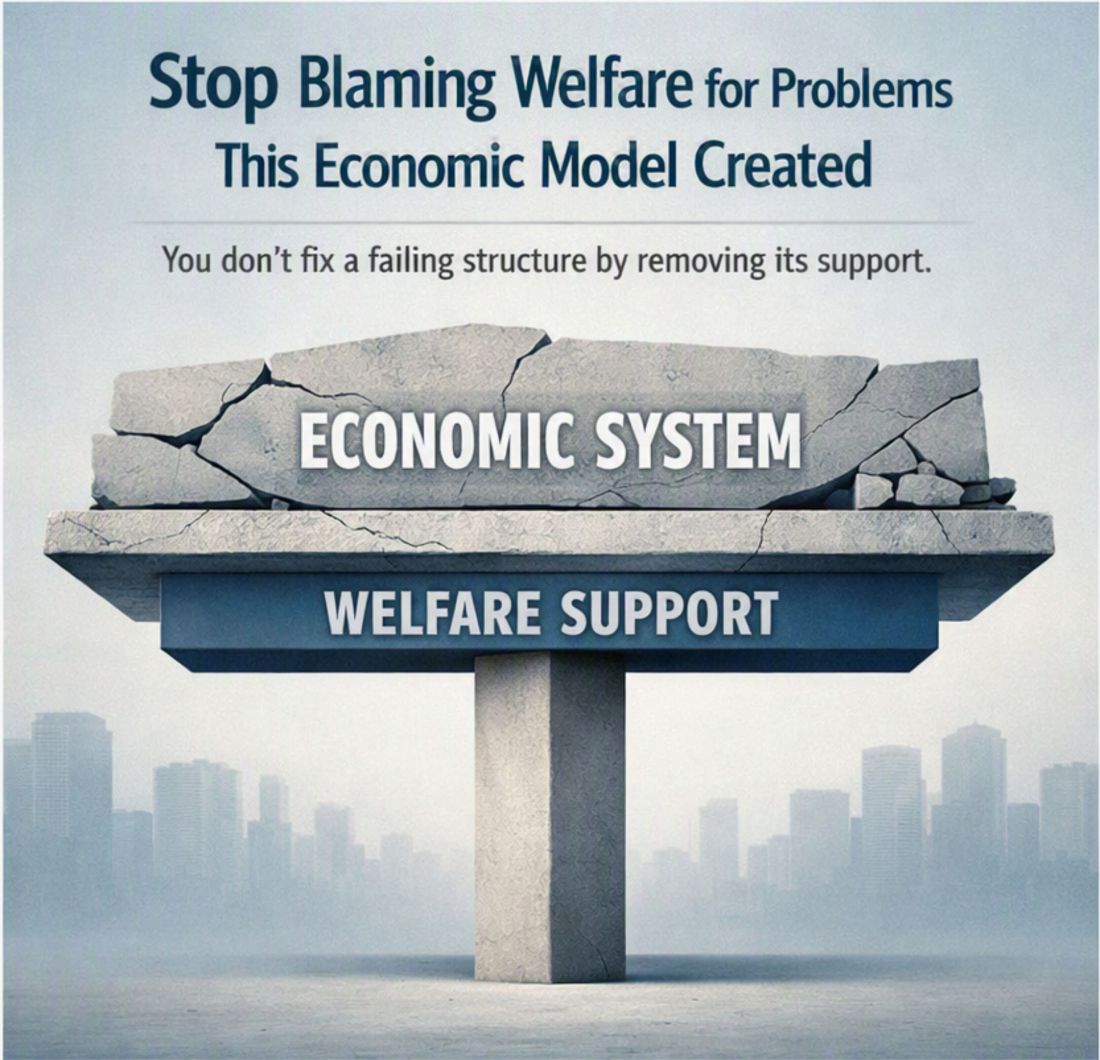
That is why welfare is not the source of instability. It is the scaffolding holding up a weakened structure.

4. Cutting the scaffolding does not repair the building

Nobody is saying the welfare system is perfect. Nobody is saying dependency is desirable. Nobody is saying reform is unnecessary.

But if reform begins with cuts before it understands what welfare is currently holding up, it mistakes the prop for the problem.

For many households, benefits are not an optional extra sitting on top of a stable income. They are part of the structure that allows rent to be paid, food to be bought, children to be clothed, and work itself to continue.

Remove that support without first repairing wages, housing, essential costs, job security, and household resilience, and the pressure does not disappear. It moves elsewhere: into arrears, debt, food banks, family strain, ill health, homelessness, and crisis services.

That is basic systems thinking. You do not remove load-bearing support from a failing structure and call the collapse reform. You reinforce first. Then, and only then, can you reduce the need for the support.

5. Dependency is real – but welfare is not the only cause

Critics are right to say that dependency matters. A society should not be comfortable with large numbers of people needing external support to survive.

But dependency is not created by welfare alone. It emerges when income, essential costs, housing, transport, childcare, health, and resilience no longer align.

If work cannot provide independence, cutting welfare does not remove dependency. It merely changes its form: from state support to debt, insecurity, charity, family pressure, ill health, or crisis.

Reform should therefore reduce dependency by restoring independence, not by withdrawing support before independence is possible.

6. Growth can look healthy while people become poorer

This is one of the great failures of modern economic debate. The headline numbers can look reasonable while ordinary life becomes harder.

GDP can rise while households become poorer. Inflation can fall while essentials remain unaffordable. Employment can rise while independence collapses.

That is why so many official explanations ring hollow. People are not rejecting reality. They are comparing national claims with their own bank accounts.

They are told the economy is growing, but their rent takes more. They are told inflation is easing, but food is still expensive. They are told work is the answer, but work leaves them dependent on top-ups, debt, or family help.

The system can therefore appear to be improving while real-world independence continues to erode.

Cutting welfare does not reverse impoverishment. It accelerates it.

7. This is why trust breaks down

When institutions keep saying one thing and people keep experiencing another, trust does not disappear because the public is irrational. Trust disappears because official explanations no longer match lived reality.

People hear that work pays, but see workers needing support. They hear that growth means prosperity, but feel less secure. They hear that welfare is the burden, but know that without it many households would fall straight through the floor.

That is the trust crisis underneath the welfare debate. It is not simply political. It is mechanical. The public can feel the system failing before institutions are willing to name the failure.

8. The real danger now is misdiagnosis

When political actors believe the problem is simply “the wrong party in No. 10,” they reach for the wrong tools:

  • welfare cuts
  • sanctions
  • conditionality
  • punitive measures
  • behavioural interventions

But the problem is not behaviour. It is independence.

And independence cannot be restored through reduction. It can only be restored through equipping.

Welfare is not the cause of instability. It is the last remaining support in a system where work no longer provides independence.

Cutting it without strengthening independence is not reform. It is destabilisation.

9. The answer is to rebuild independence

The solution is not to pretend that welfare can carry forever what the economy no longer provides. Nor is it to remove support and call the resulting hardship discipline.

The answer is to rebuild the conditions that allow people to stand independently: wages that meet essential costs, housing people can actually afford, work that is stable enough to plan around, local economies that retain value, and public systems designed to equip people rather than merely manage their failure.

10. The message that needs to be heard

People are not asking for luxury.

They are asking for stability: the ability to work, pay their bills, absorb life’s shocks, and build a future without living permanently one step from crisis.

For generations, that was the promise at the heart of the social contract. Today, for growing numbers of people, that promise no longer holds.

That is why welfare demand continues to rise. Not because dependency has become desirable, but because independence has become harder to achieve.

Until we understand that distinction, we will keep treating symptoms while the underlying condition worsens.

The real question is not how quickly welfare can be cut.

The real question is how quickly independence can be rebuilt.

That is where the future of economic security will be decided.

Further Reading

For readers who want to go deeper, the pieces below build the wider framework behind this argument: first the immediate crisis, then the living standard and independence test, then the economic evidence, human reality, and longer-term reform model.

1. When the System Runs Out of Road
Britain’s benefits crisis, defence dilemma, and low-wage economy
The best starting point for the wider argument. It explains why welfare pressure is connected to a national economic model built on low wages, public subsidy, and postponed reform.

2. The Basic Living Standard Explained
The minimum conditions required for work to provide dignity and security
This sets out the baseline beneath the article: full-time work should cover essential costs without leaving people dependent on debt, charity, family help, or state subsidy.

7. The Contribution Culture
Transforming work, business, and governance through contribution
This develops the positive alternative: a society organised around contribution, capability, and participation rather than narrow employment statistics or punitive conditionality.

3. The Independence Threshold
A new definition of poverty for a modern economy
This develops the central test used here: whether people can meet essential needs and absorb normal shocks without external support.

4. Tax Cuts and Universal Credit
Why tax cuts do not automatically restore independence
This explains why headline tax changes can fail to help households trapped by Universal Credit dynamics, taper rates, low wages, and high essential costs.

5. The Impoverishment Index
The widening gap between official economic narratives and lived experience
This supports the claim that the economy can appear to grow while household security continues to weaken.

6. How Would You Feel If It Were You?
A human lens on policy, hardship, and judgement
This adds the human reality behind the systems argument, showing why policy debates must begin with lived experience rather than abstract judgement.

8. The Local Economy & Governance System
A wider model for rebuilding economic resilience locally
This places the welfare argument inside a broader approach to local economic renewal, governance reform, and long-term systems repair.

The Moral Case for a Debt Jubilee

Why cancelling the debt that sustains the current system is not reckless, but the first responsible step toward a people-centred future

For most people, the financial world feels like weather: something that simply exists, something to be endured, something beyond human control. Debt is treated as personal obligation. Interest is framed as fair exchange. Governments are told to live within their means. Markets are assumed to be neutral. The rules of the money system are presented as natural laws, rather than human choices.

These beliefs are sincere. They are also wrong.

The money system operating today is not natural, not neutral, and not moral. It is a constructed order built on rules that most people never agreed to, do not understand, and would not consciously choose – yet they live inside its consequences every day.

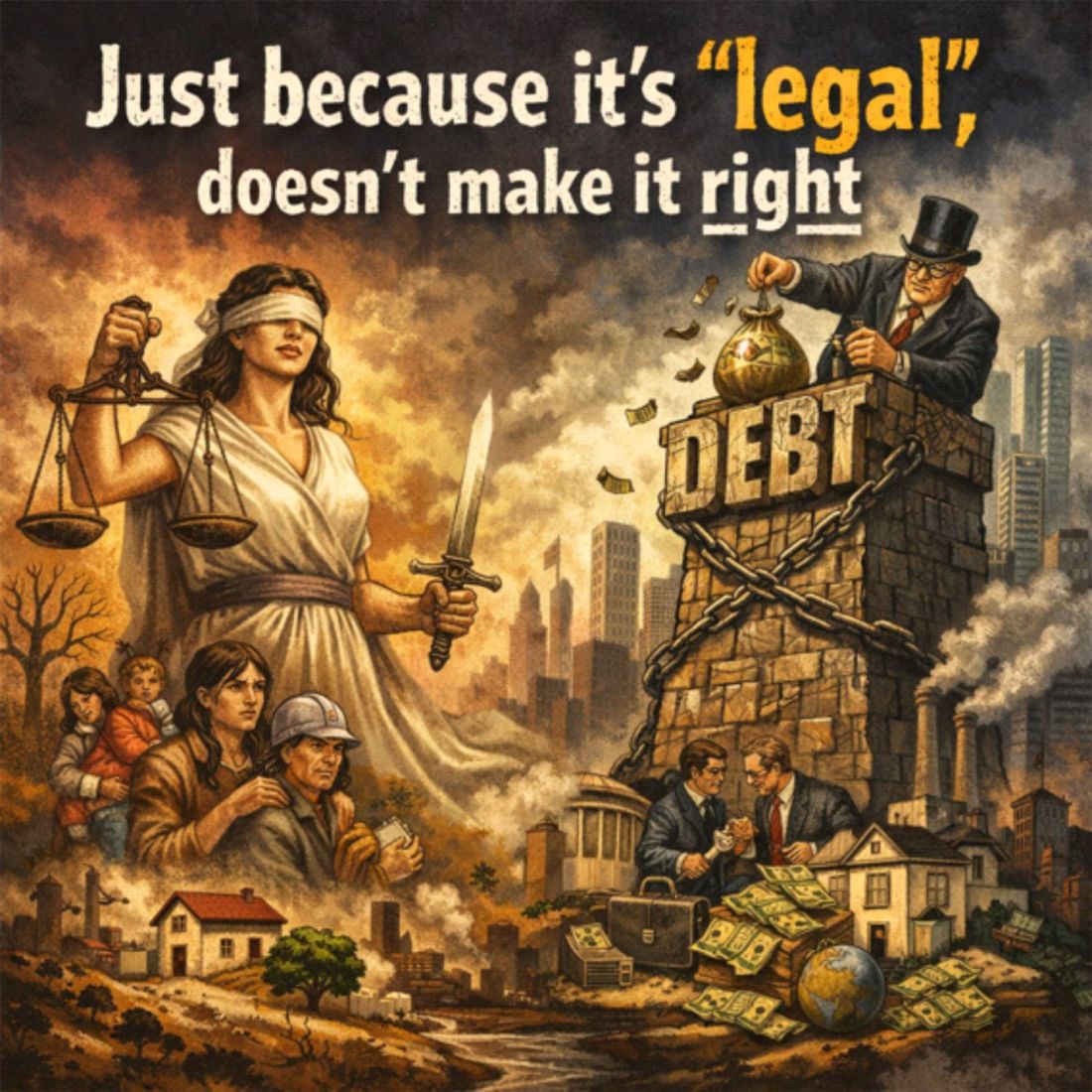
A debt jubilee – the cancellation of unpayable and system-generated debt – is often dismissed as radical, reckless, or utopian. But that misunderstands what a jubilee is. A jubilee is not a reward for irresponsibility. It is not a reset that allows the same system to begin again. It is a transition point: the moment at which a society recognises that obligations created by an unjust system cannot remain morally binding, and that the system itself must be replaced.

By a debt jubilee, this argument does not mean an arbitrary or chaotic erasure of obligations. It refers to the structured cancellation of debts within a system that creates and depends upon them to function.

All modern debt is, in this sense, systemic. It exists because of the rules, mechanisms, and structures of the money system itself. The question is therefore not which debts are truly ‘systemic’, but whether obligations created within a system that produces harm can retain moral authority simply because they are recorded as binding.

A jubilee recognises that when the system itself is unjust, the obligations it generates cannot be treated as fully legitimate in moral terms.

The moral case for a debt jubilee is therefore inseparable from the case for what must follow it: a people-centred alternative grounded in local economy and governance, a Basic Living Standard, contribution culture, and the wider process of Revaluation.

The system no one sees

Modern money is deliberately opaque. It is abstract, counterintuitive, and normalised through repetition.

People are taught to believe that money is scarce, that debt is real in the same way gravity is real, that interest is natural, and that governments must borrow from private markets to fund public life.

These are not laws of nature. They are institutional stories, repeated until they feel unavoidable.

This does not mean the system is imaginary. It means its authority depends on belief.

Money, markets, debt, interest, and growth have power because they are collectively accepted, institutionally enforced, and treated as reality.

The system works on belief. But belief does not make it morally right.

Whilst many still believe that the problems we are experiencing today are temporary and may only need a change of government to fix them, the reality is somewhat different.

The world is already moving from a money-centred, centralised, growth-obsessed model toward a people-centred, localised and humane system.

For us all, the real shift begins by recognising that the old rules are not permanent truths. They are choices – and different choices are now necessary.

Debt is not a personal failing – it is the foundation of the system

In a healthy society, debt would be a temporary bridge between need and opportunity. In the modern system, debt is something else entirely. It is the foundation on which the entire economy rests.

Banks create money through lending. Every pound created in this way enters the economy as someone’s debt.

Because interest is charged on that debt, the system requires more money to be created to service the obligations already imposed.

More lending creates more debt. More debt requires more interest. More interest demands more growth. More growth drives more extraction. More extraction concentrates more wealth.

Concentrated wealth then shapes the rules that justify the system.

This is not a conspiracy. It is a feedback loop.

The moral problem is that people are then blamed for debts they never had the structural power to avoid. Households are blamed for insecurity created by low wages and high costs. Governments are blamed for borrowing within a system that requires borrowing. Communities are hollowed out to satisfy growth metrics. The environment is degraded to service financial obligations. Wealth flows upwards through mechanisms most people cannot see.

A system built on debt cannot credibly treat debt as a purely personal failure. When debt becomes structural, the moral question changes. The issue is no longer simply whether individuals should honour obligations. The issue is whether obligations manufactured by a structurally unjust system can be morally legitimate at all.

Illusions cannot create legitimate obligations

This is the heart of the moral case.

Debt is not a natural law.

Interest is not a moral principle.

GDP is not a measure of progress.

Financial markets are not democratic.

The value of money is not intrinsic.

These are human inventions. They may be powerful. They may be enforced. They may organise everyday life. But they are still inventions.

Because they were made, they can be unmade, remade, or replaced.

The illusion is not that money has no practical effect. It clearly does. The illusion is that money has inherent moral authority. The illusion is that financial obligations created inside a coercive and extractive system must be honoured simply because the system records them as debt.

But a record is not a moral truth. A contract created inside a harmful framework cannot be separated from the framework that produced it.

Institutional blindness protects the system

One of the greatest barriers to change is not opposition in the conventional sense. It is insulation.

Those who benefit most from the current system are often furthest removed from its human consequences. Academics, economists, politicians, financiers, senior officials, and institutional leaders may be highly intelligent, highly trained, and sincere in their intentions. But their training, status, security, and authority are often tied to the assumptions of the system itself.

Professional expertise develops within a frame. Advancement often requires fluency in that frame. Success rewards those who understand and defend its logic.

Over time, those most trusted to explain the system may become least able to see beyond it.

This creates institutional blindness: not ignorance, but a conditioned inability to recognise alternatives that fall outside the system’s own definitions of realism, responsibility and propriety.

A people-centred alternative can therefore be dismissed as unrealistic. Not because it is impossible, but because it does not fit the money-centred logic through which reality has been interpreted.

A jubilee is justified because the system itself is unjust

A debt jubilee is not an attack on ordinary responsibility.

It is a refusal to mistake system-generated obligation for moral obligation.

If the system that creates debt is itself structurally unjust, then addressing debt without addressing the system merely continues the same harm. A jubilee is therefore not the whole answer. It is the necessary break that makes the answer possible.

A jubilee without transformation would fail, because the system would simply recreate the same debt under new names.

Transformation without a jubilee would also fail, because people, communities, and governments cannot build a humane future while trapped beneath obligations created by the old system.

A jubilee is justified because the system itself is unjust. It is the clearing of the ground. It is the ending of a dehumanised order so that a human centric one can begin.

Most of the harm was unintentional – but it must still end

The argument for a debt jubilee is not a claim that every banker, politician, economist, or investor acted with malice. Most people inside the system believe they are doing the right thing. They believe the rules are natural, the outcomes unfortunate but necessary, and the harm a cost of stability.

But harm that is unintentional is still harm. A system does not become moral because its operators are sincere. A harmful structure does not become legitimate because those who benefit from it cannot see the damage it causes.

Once the harm is visible, inaction becomes a choice.

When a society understands that the system itself is creating dehumanised outcomes, the moral responsibility is not to preserve that system, but to end the conditions that allow the harm to continue.

A jubilee is therefore not punishment. It is release – not only for those trapped by debt, but for society itself.

It releases people from coercion. It releases communities from extraction. It releases government from the logic of perpetual borrowing. And it releases the future from the moral claims of a system that has already failed.

What replaces debt must be people-centred

A humane system cannot grow in soil poisoned by debt. Local agency, community resilience, contribution-based value, and a Basic Living Standard cannot flourish while people, communities, and governments remain structurally coerced by financial obligations created under the old order.

The purpose of a jubilee is not absence, but replacement. A system based on debt must give way to one based on human need, local responsibility, and meaningful contribution.

This is where the Local Economy & Governance System, the Basic Living Standard, contribution culture, and The Revaluation belong within the argument.

The Local Economy and Governance System offers a framework in which economic life is rooted in community rather than extraction. The Basic Living Standard establishes the security required for people to participate without fear. Contribution culture redefines work as meaningful participation in the wellbeing of the community, rather than a transaction for survival. The Revaluation names the wider shift from measuring life in financial terms to understanding value in human, social, and environmental terms.

A debt jubilee creates the conditions for that transition.

It is not the destination. It is the door.

Without a clear alternative, a jubilee can be misrepresented as destruction. With one, it becomes transition.

The real crime would be to understand the system is broken – and do nothing

The old system is failing. People are suffering. Communities are weakening. Public trust is collapsing. The environment is being exhausted.

Much of the harm may have been unintentional, but once the truth is visible, continuing to enforce the system becomes a moral choice.

A debt jubilee is not an attack on the past. It is a commitment to the future. It is the point at which society chooses people over mechanisms, dignity over financial abstraction, and life over the logic of debt.

It is not reckless to end obligations that should never have existed in the form they now take. It is reckless to keep enforcing them when their consequences are known.

A jubilee is not the erasure of responsibility.

It is the restoration of responsibility to its proper place.

It is the moment a society decides that human beings matter more than the mechanisms that once controlled them.

Further reading

The argument above is part of a broader body of work on the transition from a money-centred system to a people-centred one. These related texts set out the practical, cultural, and structural foundations of that transition:

The Basic Living Standard – Explained
A concise introduction to the principle that every person should have secure access to the essentials of life, creating the foundation for genuine participation, dignity, and freedom from coercive economic pressure.
https://adamtugwell.blog/2025/10/24/the-basic-living-standard-explained/

The Basic Living Standard – Full Text
The fuller version of the Basic Living Standard proposal, developing the case for security, dignity, and social stability as the necessary foundation of a humane society.
https://adamtugwell.blog/2025/03/06/the-basic-living-standard-full-text/

The Contribution Culture
An outline of a shift from survival-driven employment and financial extraction toward a culture in which work, enterprise, and governance are organised around meaningful contribution to local and human wellbeing.
https://adamtugwell.blog/2025/12/30/the-contribution-culture-transforming-work-business-and-governance-for-our-local-future-with-legs/

The Local Economy and Governance System
A proposed framework for rebuilding economic and civic life around local responsibility, community resilience, participatory governance, and people-centred decision-making.
https://adamtugwell.blog/2025/11/21/the-local-economy-governance-system-online-text/

The Exploding Cost of Welfare – and the Economic System That Made It Inevitable

For years, the UK has lived inside a comforting story about how the economy works.

We tell ourselves that if people work hard, they can stand on their own two feet. That welfare is a safety net for the few who fall through the cracks. That public spending is funded by taxpayers in a neat, linear way. And that the system, though imperfect, broadly functions.

But the cost of welfare has become the wedge that splits this story apart. It exposes a truth that has been hiding in plain sight:

Our economic model no longer provides enough people with the means to live independently.

The divide is already here. On one side are those who remain ahead of the system; on the other, those who are falling behind or have already been left behind.

The dividing line is not ideology or effort. It is simply whether your income covers the cost of living.

For millions, it doesn’t.

The Myth of Benefits Abuse vs the Reality of Dependency

Much of the public debate focuses on the tiny minority who abuse benefits. They are held up as if they represent the whole.

But the reality is that the majority of people receiving welfare are in work. They are doing exactly what society asks of them – and still cannot afford to live without support.

This is not a moral failure of individuals. It is a structural failure of the system.

Wages have not kept pace with the cost of living. Housing costs have soared. Childcare is among the most expensive in the world. Energy, transport, food, and basic essentials have all risen faster than incomes.

The welfare bill is not rising because people have become lazier. It is rising because work no longer pays enough to live.

The Extractive Logic Beneath the Surface

The UK’s economic model is built on extraction. It rewards those who own assets and penalises those who rely on wages. It funnels wealth upward through high rents, inflated house prices, low pay, insecure work, and a financial system that treats debt as a product.

This is not the result of a single policy or government. It is the cumulative effect of decades of decisions that prioritised markets over people, growth over resilience, and asset values over living standards.

The cost of our welfare system is the sticking plaster that keeps this model functioning.

Without it, the gap between wages and living costs would be unbridgeable for millions.

The Hidden Architecture of Wage‑Top‑Ups

Most people don’t realise how many different forms of support working households rely on. The system is not designed to support the unemployed – it is designed to subsidise low wages.

  • Universal Credit tops up earnings when wages fall short.
  • Housing support covers rents that have outpaced incomes for decades.
  • Council Tax Support prevents a regressive tax from pushing families into arrears.
  • Child Benefit fills the gap between what children cost and what wages cover.
  • Childcare support attempts to offset some of the highest childcare costs in the developed world.
  • Disability‑related payments cover essential needs that work alone cannot meet.
  • Free school meals and cost‑of‑living schemes exist because wages do not cover the basics.

Individually, each form of support looks modest. Together, they reveal a system that is quietly propping up millions of working households.

This is not generosity. It is necessity.

The Irony at the Heart of the System

Here is the part almost no one talks about.

The government is only able to keep paying this enormous welfare bill because of the very system that created the need for it.

The UK does not fund welfare through a simple pot of “public money.” It funds it through borrowing – through issuing gilts, rolling over old debt with new debt, and servicing interest payments that now exceed the education budget.

We talk about welfare as if taxpayers are footing the bill. But the truth is more uncomfortable:

The government is borrowing money into existence to subsidise an economic model that creates the very poverty it then has to fund.

And yet nobody asks the obvious questions:

  • Where does the interest on this debt actually go?
  • Who receives the payments that now exceed what we spend on educating our children?
  • Where did the original money come from?
  • How can a country “owe” money that only exists because it issued the debt in the first place?

The system sustains itself by expanding the very mechanisms that created the crisis. It is a loop – one that grows more fragile every year.

Why Politicians Keep Paying a Bill They Know Is Unsustainable

Politicians in opposition promise reform. In government, they all hit the same wall.

They cannot cut the welfare bill without triggering a social crisis.

They cannot raise wages without confronting the corporate interests that underpin the system.

They cannot fix housing without destabilising the asset‑based economy that governments rely on to maintain confidence.

So they do the only thing they can:

Keep paying.

But the bill is becoming unaffordable. And when it becomes impossible to pay, the reckoning begins.

What Happens When the Music Stops

If benefits are cut or fail to keep pace with rising costs, the consequences are immediate:

  • People cannot physically or mentally work the hours required to survive.
  • Many jobs simply do not pay enough to live on.
  • There are not enough jobs for everyone, even before automation.
  • AI and technological change will remove even more roles.
  • Social cohesion fractures when basic needs go unmet.

This is not ideology. It is arithmetic.

The welfare bill is the last barrier between a fragile society and a crisis of legitimacy.

A System Built for Management, Not Renewal

One of the most uncomfortable truths in all of this is that the limitations we face are not really about politicians at all. They are about the system they inherit.

The people who rise through today’s political structures are selected, shaped, and rewarded for their ability to manage what already exists – not to question it, and certainly not to rebuild it. They are administrators of a model that predates them, not architects of a new one. Their job, as the system defines it, is to keep things stable, keep things calm, and keep things moving. Renewal is not part of the brief.

So they continue paying the welfare bill for as long as the system allows, not because they believe it is the right long‑term answer, but because the alternative would expose the reality that has been avoided for decades. They are not choosing between good and bad options. They are choosing between what the system can tolerate and what it cannot.

This isn’t a criticism of individuals or parties. It is simply the nature of a structure designed for continuity rather than change. A structure that treats questioning its foundations as a threat rather than a responsibility.

But systems have limits. And this one is reaching them. When it finally breaks – whether through economic strain, political paralysis, or technological disruption – change will arrive whether anyone is prepared for it or not. The pressure building beneath the surface will not wait for permission.

The challenge ahead is not to replace one set of politicians with another. It is to recognise that the system they operate within was never built to handle the world we now live in. And until we confront that, we will keep mistaking management for leadership, and drift for direction.

The Truth We Can No Longer Avoid

The welfare bill is not the problem. It is the evidence of a system that no longer works.

It reveals the gap between the economic myths we cling to and the lived experience of millions. It shows us a society where work no longer guarantees security, where independence is slipping out of reach, and where the state is forced to subsidise a system that no longer sustains its people.

We can continue pretending that welfare is the issue.

Or we can confront the truth:

The system itself is broken.

And when the music stops, the truth will no longer be optional.

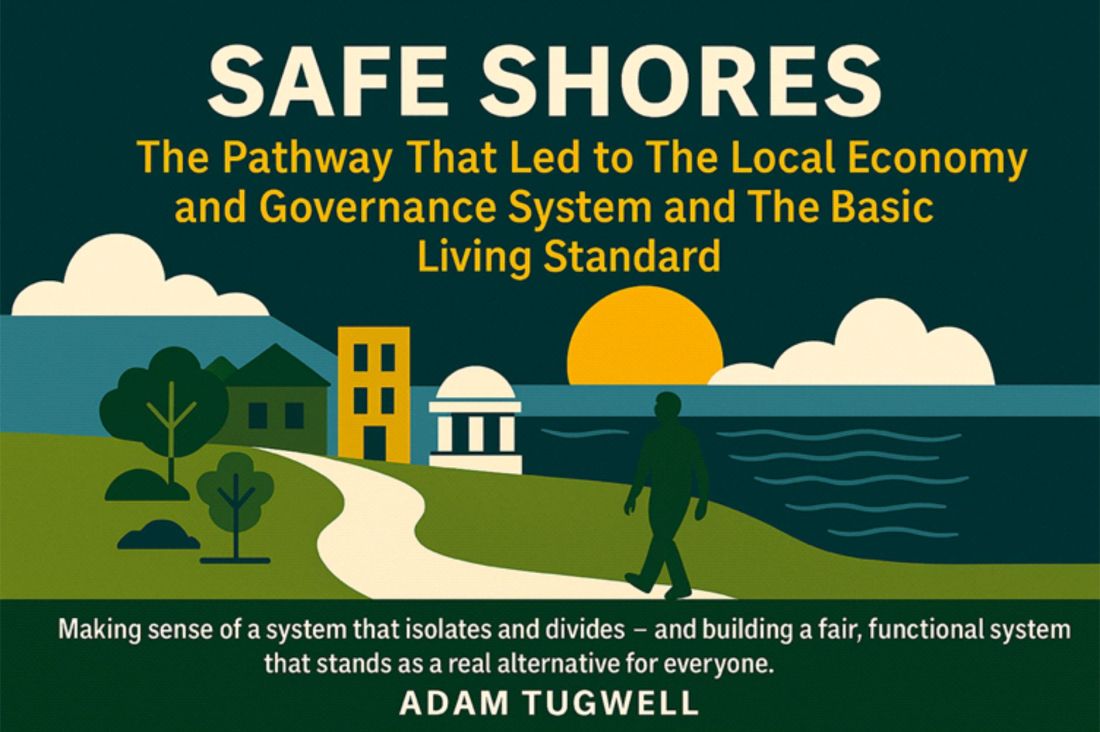
Safe Shores: The Pathway That Led to The Local Economy & Governance System and the Basic Living Standard

Making sense of a system that isolates and divides – and building a fair, functional system that stands as a real alternative for everyone.

A Note from Adam

For nearly four years, I’ve been publishing books and blogs about change – why we need it, what’s wrong with the world as it stands, and why those wrongs keep repeating.

I’ve written knowing full well that only a small number of people were truly interested in the perspective I was offering. Not because the ideas lacked value, but because they don’t fit neatly within the way the world currently works. They challenge assumptions. They question the foundations. They ask us to look at the system itself, not just the symptoms.

And yet, despite the limited audience, I’ve felt compelled to keep writing.

Part of that comes from a long‑held understanding that the world we know has been living on borrowed time. The cracks have been visible for years – widening, deepening, accelerating – and it has been impossible for me to ignore them.

Much of the time, I didn’t even know that another book would follow the one I had just finished. I would wrap up a manuscript, thinking the work was complete, only for a new structure, a new purpose, a new piece of the puzzle to arrive almost immediately. And so I would begin again.

A few of you have been with me from the very beginning, quietly following each step of this journey.

Others have joined along the way. And now, more than ever, I sense a growing number of people recognising what I have felt for a long time: we cannot shape a new future by using the same shape that created everything that’s wrong.

After publishing The Basic Living Standard Explained, LEGS, and From Principle to Practice, it felt like the right moment to share a little more of the experience that has driven this work – the lived reality, the observations, the research, and the personal journey that have informed every page.

Not because my story is important in itself, but because I do not doubt that for many, understanding the path will help to illuminate the destination.

This work has become important – and yes, urgent – in ways I could never have anticipated when I began.

Even if only a few of you are reading, reflecting, and engaging with these ideas, that is enough. Change has always begun with those who are willing to see and lead by thinking differently.

My hope is that what follows here will give you a clear insight into how LEGS came into being, and perhaps offer a sense of the depth and scope of the thinking that has shaped it along the way.

Thank you for being here.

Thank you for reading.

And thank you for caring enough to imagine something better.

Introduction

This work did not begin with a single idea, a political moment, or a sudden revelation. It began with a pattern – one that kept appearing no matter where I stood or what role I was in.

Whether I was a councillor working with public policy, developing services for charities and local authorities, running businesses, or volunteering within communities, I kept seeing the same thing: people were being pushed, pulled, and shaped by forces they didn’t control and often couldn’t even see.

Problems were treated as isolated issues, when in reality they were symptoms of the same failing system. And the system itself – fragmented, money‑centric, hierarchical, and blind to human reality – had no idea it was failing.

At some point, the realisation became impossible to ignore:

I came to see that all of us are in different boats, shaped by our own circumstances, yet all being blown around by the same winds – economic forces, political decisions, and pressures we never chose.

Most people have no control over where they’re heading or even realise when they’re drifting toward danger.

LEGS and the Basic Living Standard are about giving people an engine of their own, the power to steer their own direction, and the ability to reach safe shores they define for themselves, where a new world that works for everyone can begin.

That image stayed with me because it captured exactly what I had witnessed throughout my life. People weren’t failing. They were navigating a storm in vessels that were never built for them, under a system that blamed them for every wave that hit.

My own childhood gave me the first glimpse of this truth. Growing up in a one‑parent family, I didn’t know we were “poor” until the world told me.

What I did know – even then – was that life felt harder than it should, and that the rules seemed to work differently for different people.

Later, when I found myself working with public policy, charity development, local government projects, business operations, and voluntary roles, that early awareness became a lens. I could see the system from both sides: the side that created the rules, and the side that lived with the consequences.

The more I saw, the clearer it became that the system wasn’t malfunctioning. It was functioning exactly as designed – and that design no longer works for the world we live in.

A research project on my Postgraduate Course in 2023 confirmed what experience had already taught me. Inside a Gloucestershire foodbank, I heard stories that revealed the same structural truth: people were not struggling because of personal failure, but because the system had made survival itself a calculation that no longer added up.

‘The minute you step away from the ground, everything becomes theoretical.’

And that is exactly how the system hides its own contradictions.

This four-years body of work – from Levelling Level to The Basic Living Standard, From Here to There Through Now, The Way of Awakened Politics, The Grassroots Manifesto, A Community Route, and the conceptual foundation I call The Revaluation – is the result of following that pattern to its root.

Each step revealed another layer. Each layer made the next step unavoidable. And together, they led to one conclusion:

You cannot fix a system that is designed to protect itself from change.

But you can build a new one.

LEGS – the Local Economy & Governance System – is that new system.

The Basic Living Standard is its foundation.

And the work that follows is the framework or map.

This introduction is not an argument for ideology. It is an invitation to see the world differently – to recognise that the future is not predetermined, and that the systems we live within are choices, not inevitabilities.

If we choose differently, if we choose people first, if we choose dignity, locality, fairness, and responsibility, then the world that follows will be one worth living in.

This is the beginning of that choice.

The Real Problem: A System That Fragments Everything

When people ask me why I’ve spent the past four years working on this – writing, researching, building, refining – the answer isn’t simple. It certainly isn’t ideological. And it didn’t arrive in a single moment of inspiration.

It came from years of watching the same pattern repeat itself in every direction I looked.

Whether I was working in public policy, regulatory environments, the voluntary sector, or running businesses and operations, the same truth kept revealing itself:

We treat every problem as if it exists in isolation.

But nothing in real life works that way.

We talk about the cost-of-living crisis as if it’s separate from housing.

We talk about housing as if it’s separate from wages.

We talk about wages as if they’re separate from business models.

We talk about business models as if they’re separate from governance.

We talk about governance as if it’s separate from values.

We talk about values as if they’re separate from community.

We talk about community as if it’s separate from the economy.

And on it goes – endlessly dividing, categorising, isolating.

This fragmentation is not accidental. It’s built into the way the system thinks.

A money‑centric system can only see problems in terms of:

  • cost
  • efficiency
  • productivity
  • risk
  • compliance
  • metrics
  • optics

It cannot see people.
It cannot see relationships.
It cannot see interconnectedness.
It cannot see the whole.

And because it cannot see the whole, it cannot fix the whole.

So instead, it breaks everything into pieces – and then blames the people trapped in those pieces for the consequences.

If you’re struggling with rent, the problem is you.
If you’re struggling with food, the problem is you.
If you’re struggling with debt, the problem is you.
If you’re struggling with work, the problem is you.
If you’re struggling with mental health, the problem is you.
If you’re struggling with anything at all, the problem is always you.

This is the great sleight of hand of the money‑centric paradigm:

It creates the crisis, then convinces you that you are the crisis.

And because every crisis is treated as a separate issue, the system never has to confront the truth:

All of these problems come from the same place.

They are symptoms of the same design.

They are outputs of the same worldview.

This is why I’m doing this.

Because once you’ve seen the interconnectedness – once you’ve watched the same pattern play out in public policy, in regulation, in business, in community life, in governance, in economics – you can’t unsee it.

And once you’ve seen it, you realise something else:

No amount of tinkering will fix a system that is designed to fragment reality.

The only solution is to build a system that sees the whole.

That is where this journey began.

How the System Turns Symptoms Into “Individual Problems”

One of the most revealing things I’ve learned – not just from research, but from many years of working with charities, in politics, regulatory environments, and business, is that the system has a remarkable ability to turn its own failures into your failures.

It doesn’t matter whether the issue is:

  • poverty
  • housing
  • food insecurity
  • debt
  • mental health
  • loneliness
  • precarious employment
  • small business collapse
  • community breakdown
  • environmental decline

The pattern is always the same.

The system creates the conditions.

The system produces the harm.

And then the system convinces the individual that they are the cause.

If you can’t afford rent, it’s because you “didn’t plan well enough.”

If you can’t afford food, it’s because you “budget badly.”

If you’re struggling with debt, it’s because you “made poor choices.”

If you’re overwhelmed, it’s because you “aren’t resilient enough.”

If you’re exhausted, it’s because you “aren’t working the right way.”

If you’re anxious, it’s because you “aren’t coping.”

If you’re drowning, it’s because “you didn’t swim fast enough.”

This is the quiet violence of a money‑centric system.

It isolates every problem.
It personalises every struggle.
It individualises every consequence.

And in doing so, it hides the truth:

These are not personal failures. They are systemic outputs.

They are the predictable, inevitable consequences of a system that:

  • prioritises money over people
  • treats human needs as market variables
  • reduces life to transactions
  • fragments every issue into separate categories
  • refuses to see the whole
  • refuses to take responsibility

And because each problem is treated as a standalone issue, the system never has to confront the deeper reality:

All of these crises are connected.

They come from the same root.

They are symptoms of the same design.

This is why people feel overwhelmed.
This is why people feel alone.
This is why people feel like they’re failing.

Because the system has trained us to see only the part we’re trapped in – not the whole structure that created it.

And this is where the cruelty becomes almost elegant in its simplicity:

When you’re struggling, the struggle becomes your entire world.

And that is exactly how the system keeps itself hidden.

If you’re fighting to pay rent, you don’t have the bandwidth to question why housing is unaffordable in the first place.

If you’re juggling three jobs, you don’t have time to question why wages don’t cover basic living costs.

If you’re relying on foodbanks, you don’t have the energy to question why food insecurity exists in a wealthy country.

If you’re drowning in debt, you don’t have the clarity to question why debt is built into the economic model.

If you’re exhausted, you don’t have the strength to question why the system demands exhaustion as a condition of survival.

This is not accidental.
This is not incidental.
This is not unfortunate.

This is structural.

A system that fragments problems keeps people fragmented.

A system that isolates problems keeps people isolated.

A system that personalises problems keeps people powerless.

And this is the point where my own lived experience – and later, my research – began to collide with everything I had seen in politics, government, charities and business.

Because once you recognise the pattern, you start to see it everywhere.

You see it in the way government talks about “helping the vulnerable” while designing systems that create vulnerability.

You see it in the way businesses talk about “opportunity” while structuring work so people can never get ahead.

You see it in the way regulators talk about “fairness” while enforcing rules that entrench inequality.

You see it in the way society talks about “personal responsibility” while ignoring the structural conditions that shape every choice people can make.

And you realise something that changes everything:

People are not failing.

The system is failing.

And people are carrying the cost.

This is the moment the narrative shifts.
This is the moment the illusion cracks.
This is the moment you stop seeing isolated problems and start seeing the architecture behind them.

And once you see the architecture, you can no longer pretend that any single issue – poverty included – can be solved on its own.

Because the truth is simple:

You cannot fix symptoms in a system that is designed to produce them.

You can only fix the system itself.

And that is where the next part of this story begins.

Seeing the System from the Inside: My Lived Experience

Long before I ever worked in charities, public policy, regulatory environments, politics or business, I had already seen the system from the ground level – not through theory, but through lived experience.

I grew up in a one‑parent family, in circumstances that would now be described as poverty. At the time, I didn’t have the language for it. I didn’t have the context. I didn’t have the comparisons. I simply lived it.

And that’s the thing about childhood poverty: you don’t know you’re “poor” until the world tells you.

You don’t feel deprived if you’ve never had the things other people take for granted.

You don’t feel different until someone points out the difference.

You don’t feel the weight of the system until it presses down on you.

Looking back, what strikes me most is not the lack of money – it’s the normality of it all.

The rituals of stretching every pound.
The quiet calculations.
The constant trade‑offs.
The small victories that felt enormous.
The moments of shame that arrived without warning.

But the most important part – the part that shaped everything that came later – was this:

When you grow up inside a system that doesn’t work for you, you learn to see the system differently.

You learn to notice the gaps.

You learn to feel the pressure points.

You learn to sense the contradictions.

You learn to recognise when something is being presented as “your fault” when it clearly isn’t.

You learn, very early on, that the world is not designed with everyone in mind.

And once you have it, that awareness never really leaves you.

It sits quietly in the background as you move through life.

It colours the way you see decisions being made.

It shapes the way you interpret policy.

It influences the way you understand power.

It sharpens your sense of fairness.

It makes you pay attention to the things other people overlook.

Later in life, whether I was chairing licensing hearings, building services for charities, developing operational models for a county council, running businesses, or volunteering in roles that put me shoulder‑to‑shoulder with people on the ground, I kept encountering the same pattern from different angles.

And the more I saw, the more I recognised the same pattern I had lived through as a child:

The system creates the conditions.

The system produces the harm.

And then the system tells people the harm is their fault.

This wasn’t just about poverty.

It was about everything.

Housing.
Work.
Food.
Debt.
Health.
Education.
Community.
Governance.
Opportunity.
Security.
Dignity.

Every part of life touched by the system carried the same signature.

And that’s when the realisation began to take shape – slowly at first, then with increasing clarity:

The problem isn’t the people.

The problem is the system.

And the system cannot see itself.

My lived experience didn’t give me the answers. But it gave me the ability to see the questions that weren’t being asked.

It gave me the ability to recognise when a policy was designed to look good rather than do good.

It gave me the ability to sense when a decision was made for optics rather than outcomes.

It gave me the ability to understand why people were struggling even when the numbers said they shouldn’t be.

It gave me the ability to see the human cost behind the spreadsheets, the metrics, the targets, the narratives.

And it gave me something else – something that would become essential later:

The understanding that lived experience is not subjective noise.

It is data.

It is evidence.

It is truth.

This is why, when I began writing Levelling Level in 2022, I wasn’t writing from theory.

I was writing from a lifetime of seeing the system from both sides – the side that suffers its consequences, and the side that creates them.

And that dual perspective became the foundation for everything that followed.

Contemporary Evidence of Systemic Failure: My 2023 Research

By the time I began my postgraduate research project in 2023, I had already spent years seeing the system from multiple angles – as a child living within its consequences, and later as an adult working in professional and voluntary roles reaching across the different sectors.

But nothing prepared me for how starkly the system would reveal itself when I stepped into a Gloucestershire foodbank as part of my project.

I didn’t go there to confirm a theory, or qualify my own experience from decades before.

I went there to understand the lived reality of poverty today – to see how it feels, how it functions, and how it is being experienced by the people who have no choice but to navigate it.

What I found was not simply a story about food insecurity. It was a window into the architecture of the entire system.

Because the foodbank wasn’t just a place where people came for food. It was a place where the consequences of the system gathered in one room.

And the experience I had there crystallised something I had sensed for years:

The system is failing people in real time, every day – and it cannot see that it is failing.

A comment I heard from just one of the many professionals supporting people through Foodbanks across the UK today still echoes in my mind:

Sometimes there just isn’t enough money to cover everything.

Not because people are irresponsible.

Not because they are lazy.

Not because they are making poor choices.

But because the system is designed in such a way that survival itself has become a calculation that no longer adds up.

Another stream of words struck me even harder:

The minute you are removed from the ground, it becomes theoretical.

This wasn’t just about politicians and public sector employees.

It was about the entire structure of decision‑making itself.

It was about the distance between those who design policy and those who live with its consequences.

It was about the blindness that comes from never having to experience the realities your decisions create.

It was about the way the system fragments problems so completely that even those working within it struggle to see the whole.

And then there was this:

What used to be a crisis is harder to get out of… we see people more regularly than we used to.

Foodbanks were never meant to be structural.

They were meant to be emergency support.

But the system has normalised crisis.

It has institutionalised scarcity.

It has made emergency provision part of the everyday landscape.

And the people who walk through those doors carry not just hunger, but shame, fear, exhaustion, and a sense of personal failure – even though the failure is not theirs.

One of the most revealing insights came when the foodbank worker said:

If you work with people, you can get almost anyone out of that crisis point… but sometimes there just isn’t enough money to cover everything.

This is the system in a single sentence:

  • The problem is not the person.
  • The problem is not the behaviour.
  • The problem is not the choices.
  • The problem is the structure.
  • The problem is the design.
  • The problem is the system itself.

And yet, the system continues to treat each case as an individual failing – a budgeting issue, a lifestyle issue, a motivational issue – anything except a structural issue.

This is the same pattern I had seen in every sector I’d worked in.

But here, in the foodbank, it was laid bare.

Poverty is not the cause.

Poverty is the evidence.

Poverty is the symptom of a system that no longer works.

And the most important realisation of all was this:

The experience of poverty becomes the entire world for the person living it.

And that is exactly how the system hides the bigger picture.

Because when you are fighting to survive, you cannot step back far enough to see the architecture that created the fight.

This research didn’t change my understanding.

It confirmed it.

It showed me that the fragmentation I had seen in government, politics, business, regulation, and community life was not theoretical.

It was lived.

It was real.

It was happening now.

And it was happening everywhere.

It showed me that the system is not broken in one place – it is broken in every place.

And because it is broken everywhere, it cannot see its own failures anywhere.

This was the moment the work I had been doing since February 2022 shifted from important to unavoidable.

Because once you have seen the system clearly – once you have seen how it behaves, how it hides, how it blames, how it fragments, how it isolates – you realise something that changes everything:

You cannot fix a system that is designed to produce the very problems it claims to solve.

You can only build a new one.

And that is where the next part of this story begins.

The Realisation: The System Cannot Be Fixed From Within

By the time I completed and submitted my research project in late 2023, something had become unmistakably clear:

the system wasn’t just failing – it was incapable of recognising its own failures.

And once you see that, you can no longer pretend that reform, tinkering, or “better management” will make any meaningful difference.

Because the truth is this:

You cannot fix a system from within when the system is designed to protect itself from change.

This wasn’t an abstract conclusion.

It was something I had watched unfold repeatedly across every environment I had worked in:

  • In politics, where decisions were shaped by narratives rather than needs.
  • In regulatory structures, where rules were written to preserve the system, not improve outcomes.
  • In charity development, where services existed to fill gaps the system refused to acknowledge.
  • In local government, where bureaucracy replaced responsibility.
  • In business operations, where profit dictated priorities even when it harmed people.
  • In voluntary roles, where the human cost of systemic failure was impossible to ignore.

Everywhere I looked, the same pattern emerged:

The system treats symptoms as isolated problems because acknowledging the cause would require changing itself.

This is why poverty is treated as a budgeting issue.

Why housing is treated as a supply issue.

Why food insecurity is treated as a charity issue.

Why debt is treated as a personal responsibility issue.

Why mental health is treated as an individual resilience issue.

Why community breakdown is treated as a behavioural issue.

Why governance failure is treated as a political issue.

Every problem is reframed in a way that keeps the system intact.

And this is where the realisation becomes unavoidable:

The system is not malfunctioning. It is functioning exactly as designed.

A money‑centric system will always:

  • prioritise money over people
  • fragment problems into isolated categories
  • blame individuals for structural failures
  • reward behaviours that harm the collective
  • centralise power away from communities
  • treat human needs as market variables
  • hide its own contradictions
  • resist any change that threatens its logic

This is why the system cannot be repaired.

It can only be replaced.

And this is the point where my earlier work – the books I had written since February 2022 – suddenly made sense as a single, coherent journey.

Levelling Level was the first attempt to articulate the breadth of the problem – to show that no issue exists in isolation, and that political soundbites like “Levelling Up” were distractions from the deeper systemic failures.

The Basic Living Standard emerged because I realised that dignity cannot depend on charity, debt, or government intervention – it must be built into the structure of the economy itself.

From Here to There Through Now explored the transition – the bridge between paradigms – because you cannot leap from a failing system to a new one without understanding the steps in between.

The Way of Awakened Politics for Good Government confronted the reality that governance itself must change – that unconscious decision‑making is the root of systemic harm, and that awakened, values‑based leadership is essential.

A Community Route provided the frameworks – the practical structures that allow communities to lead, decide, and shape their own futures without hierarchy or centralised control.

The Revaluation articulated the paradigm shift – the moment where we stop measuring life through money and begin valuing people, community, and environment as the foundations of a functioning society.

Each book was a step.

Each step revealed another layer.

Each layer exposed another truth.

And together, they led to the same conclusion:

The system cannot be fixed.

But a new system can be built.

A system that sees the whole.

A system that understands interconnectedness.

A system that puts people first.

A system that restores locality, dignity, and responsibility.

A system that treats human needs as non‑negotiable.

A system that values contribution over accumulation.

A system that works with human nature, not against it.

This is the moment where the idea of LEGS – the Local Economy & Governance System – stopped being a concept and became a necessity.

Not because it was perfect.

Not because it was easy.

Not because it was fashionable.

But because once you see the system clearly, you realise:

There is no alternative.

Not if we want a future that works for everyone.

And that is where the next part of this story begins.

The Journey Since February 2022: How Each Step Built the Foundations of LEGS

When I look back at the work I’ve produced since February 2022, it’s tempting to see each book as a separate project – a standalone piece responding to a particular moment or question.

But that isn’t what happened.

What actually unfolded was a process of discovery.

A gradual revealing.

A step‑by‑step evolution of understanding.

Each book was written because the one before it raised a deeper question.

Each question led to a clearer insight.

Each insight exposed another layer of the system. And each layer made the next step unavoidable.

None of this was planned.

It emerged.

It unfolded.

It evolved.

And that evolution is the reason LEGS exists at all.

Levelling Level – Seeing the System Clearly for the First Time

Levelling Level was the moment I became certain that the problems we face cannot be solved one at a time.

It exposed:

  • the fragmentation of public policy
  • the blindness of political soundbites
  • the illusion of “Levelling Up”
  • the failure of both Left and Right
  • the structural nature of inequality
  • the way money distorts every decision

It was the first time I articulated the truth that would underpin everything that followed:

You cannot fix a system by treating its symptoms.

You must understand the system as a whole.

Levelling Level was the diagnosis.

The Basic Living Standard – Defining the First Universal Framework

Once I understood the system, the next question was obvious:

What does fairness actually look like in practice?

The Basic Living Standard answered that question.

It introduced the idea that:

  • dignity must be built into the economic structure
  • survival cannot depend on charity, debt, or government intervention
  • the lowest legal wage must be enough to live on
  • the economy must serve people, not the other way around

This was the first practical framework – the first building block of a new system.

From Here to There Through Now – Understanding the Transition

The next question was equally unavoidable:

How do we get from a failing system to a functioning one?

From Here to There Through Now explored the transition – the bridge between paradigms.

It recognised that:

  • change is a process, not an event
  • people need a way to move from the old to the new
  • the system cannot be replaced overnight
  • the steps matter as much as the destination

This book was the bridge.

The Way of Awakened Politics for Good Government – Redefining Governance Itself

Once the transition was clear, another question emerged:

What kind of governance can actually deliver fairness, balance, and justice?

The Way of Awakened Politics for Good Government answered that.

It showed that:

  • unconscious decision‑making is the root of systemic harm
  • politics today is reactive, self‑interested, and blind
  • awakened, values‑based leadership is essential
  • governance must be human, not hierarchical
  • good government is a method, not an ideology

This book provided the philosophical foundation for a new form of governance.

The Grassroots Manifesto – The Turning Point

And then came the moment where everything shifted.

The Grassroots Manifesto was both a continuation of the journey and a turning point.

It was the first time I articulated:

  • a fully Grassroots‑Up model of democracy
  • Local Assemblies and Community Assemblies
  • the rejection of Top‑Down governance
  • the principle that power flows from the individual outward
  • the idea that communities must shape their own futures
  • the early frameworks that later became A Community Route
  • the recognition that the future must be built from the bottom up

This was the moment where the governance philosophy became a governance structure.

It was the moment where the idea of a new system stopped being conceptual and started becoming real.

A Community Route – The Practical Frameworks

Once the Grassroots model was clear, the next step was to define the practical structures that would make it work.

A Community Route introduced:

  • the 11 Principal Frameworks
  • Economic Localism
  • People First
  • No hierarchies
  • Local decision‑making
  • Fixed‑value currency
  • Technology as a tool, not a master
  • Community‑centred governance

This was the operational blueprint – the practical architecture of a new system.

The Revaluation – The Paradigm Shift (Unpublished but Foundational)

Alongside the published works, another body of thinking was developing – not as a book, but as a deeper conceptual foundation.

I called it The Revaluation.

It wasn’t written for publication.

It wasn’t structured as a standalone work.

It was a set of ideas, reflections, and insights that shaped everything else.

It explored:

  • the shift from money‑centric to people‑centric
  • the collapse of the old paradigm
  • the need to revalue everything
  • the centrality of community, locality, and stewardship
  • the philosophical foundation of LEGS

It was the internal work – the thinking beneath the thinking – that made the rest possible.

And then came LEGS – The Local Economy & Governance System

By the time all these pieces were in place, LEGS – developing from its first evolution Our Local Future, was not just an idea.

It was the inevitable conclusion of everything that had come before.

LEGS is:

  • the synthesis of the diagnosis
  • the application of the frameworks
  • the embodiment of the values
  • the structure of the governance
  • the architecture of the economy
  • the practical expression of the paradigm shift

It is the system that sees the whole.

The system that understands interconnectedness.

The system that puts people first.

The system that restores locality, dignity, and responsibility.

The system that works with human nature, not against it.

And it exists because the journey demanded it.

Introducing LEGS & the Basic Living Standard as the Systemic Alternative

By the time the journey had unfolded – through lived experience, professional experience, research, reflection, and the evolution of ideas across multiple works – one truth had become impossible to ignore:

The system we live in today cannot deliver fairness, balance, or dignity.

Not because the people within it are bad.

But because the system itself is built on the wrong foundations.

A money‑centric system will always:

  • prioritise accumulation over contribution
  • reward extraction over value
  • centralise power away from communities
  • fragment problems into isolated categories
  • blame individuals for structural failures
  • treat human needs as market variables
  • measure life in terms of cost rather than meaning

You cannot reform a system that is designed this way.

You cannot tweak it.
You cannot patch it.
You cannot “fix” it from within.

You have to build something different.

Something that starts from a different premise.

Something that begins with a different question.

Something that places value where value actually lives.

And that is where LEGS – the Local Economy & Governance System – comes in.

The LEGS Paradigm Shift

LEGS begins with one simple, radical shift: People First.

Not as a slogan.
Not as a political promise.
Not as a moral aspiration.

But as the structural foundation of the entire system.

In LEGS, people are not variables in an economic model.

They are not units of productivity.
They are not cost centres.
They are not data points.

They are the purpose of the system.

Everything else – the economy, governance, community structures, technology, currency – exists to serve people, not the other way around.

This is the inversion that changes everything.

The Basic Living Standard – The First Framework of a People‑First System

If people come first, then dignity must be non‑negotiable.

And dignity begins with the ability to live – not survive, not scrape by, not rely on charity or debt – but live a stable, healthy, balanced life.

That is what the Basic Living Standard guarantees.

It is not welfare.
It is not subsidy.
It is not a handout.
It is not a political gesture.

It is a structural rule:

Anyone working the lowest legal full‑time wage must be able to afford all essential costs of living – without debt, without charity, without government intervention.

This single framework:

  • eliminates structural poverty
  • removes the need for foodbanks
  • restores dignity to work
  • stabilises communities
  • reduces dependency
  • rebalances the economy
  • forces businesses to operate ethically
  • aligns value with contribution
  • anchors prices to reality
  • prevents exploitation
  • removes the hidden subsidies that currently prop up the system

It is the foundation stone of a humane society.

And it is only the beginning.

LEGS is not a policy.

LEGS is a system.

A whole system.

A joined‑up system.

It integrates:

  • Economic Localism – because real life happens locally
  • People‑First Governance – because decisions must be made by those who live with the consequences
  • Grassroots Democracy – because power must flow from the individual outward
  • Fixed‑Value Currency – because money must be a tool, not a weapon
  • Community‑Centred Services – because people know what their communities need
  • Frameworks Instead of Rules – because principles endure, bureaucracy does not
  • Technology as a Tool – because innovation must serve humanity, not replace it
  • Local Markets & Supply Chains – because resilience begins at home
  • Values‑Based Decision‑Making – because the system must reflect what matters

LEGS is not a utopia.
It is not abstract.
It is not theoretical.

It is practical.
It is grounded.
It is human.
It is achievable.

And it is built on the understanding that:

When you design a system around people, everything else begins to work.

Work becomes meaningful.

Communities become resilient.

Governance becomes accountable.

Economies become stable.

Technology becomes ethical.

Value becomes real.

Life becomes balanced.

Dignity becomes universal.

This is not a dream.
It is a design.

A design that emerged not from ideology, but from experience.
Not from theory, but from reality.
Not from abstraction, but from lived truth.

And it is the only system that answers the question that began this entire journey:

How do we build a world that works for everyone?

LEGS is the answer.

The Future We Choose

When people ask why I’ve spent years working on this – writing, researching, building, refining – the answer isn’t found in any single moment, book, or experience.

It’s found in the pattern that emerged when all of those moments were placed side by side.

A pattern that revealed a simple truth:

The world we live in today is not inevitable.

It is designed.

And anything designed can be redesigned.

We have been conditioned to believe that the system is too big to change, too complex to understand, too entrenched to challenge.

But systems are not living things.
They do not have consciousness.
They do not have agency.
They do not have power of their own.

People give systems power.
People maintain them.
People enforce them.
People accept them.

And people can choose differently.

That is the quiet truth that sits beneath everything I’ve written, everything I’ve researched, everything I’ve lived:

We are not powerless. We have simply forgotten our power.

The system we have today – the money‑centric, fragmented, hierarchical, centralised system – is not the natural order of things.

It is one way of organising life.
One interpretation.
One design.

And it is failing.

Not because people are failing within it, but because the design itself no longer works for the world we live in.

It cannot see people.
It cannot see communities.
It cannot see interconnectedness.
It cannot see value beyond money.
It cannot see dignity beyond productivity.
It cannot see humanity beyond metrics.

And so it produces outcomes that reflect its own blindness.

But the future does not have to be an extension of the present.
It does not have to be a continuation of the same logic.
It does not have to be a slightly improved version of what we already have.

We can choose differently.

We can choose a system that begins with people, not money.

A system that sees the whole, not the fragments.

A system that values contribution, not accumulation.

A system that restores locality, dignity, and responsibility.

A system that works with human nature, not against it.

A system that treats communities as the foundation, not the afterthought.

A system that understands that fairness is not a luxury – it is the basis of a functioning society.

That system is LEGS.

Not because it is perfect.
Not because it is easy.
Not because it is fashionable.

But because it is built on the only foundation that has ever worked:

People first. Always.

The Basic Living Standard ensures dignity.

Economic Localism ensures resilience.

Grassroots governance ensures accountability.

Frameworks ensure fairness.

Community ensures belonging.

Values ensure direction.

And together, they create something the current system cannot:

A future that works for everyone.

Not a utopia.
Not a fantasy.
Not a dream.

A practical, grounded, human future – built from the bottom up, shaped by the people who live in it, and guided by principles that endure.

This is why I’m doing this.

Not because I believe I have all the answers.

Not because I think I’m the one who will lead the change.

Not because I imagine myself at the centre of anything.

But because I believe in people.

I believe in communities.
I believe in fairness.
I believe in dignity.
I believe in responsibility.
I believe in the possibility of a better world.

And I believe that when people are given the tools, the frameworks, and the opportunity, they will build something extraordinary.

The future is not predetermined.

It is not fixed.

It is not written.

It is chosen.

And the choice begins now – with us, with our communities, with the way we think, the way we act, and the way we imagine what comes next.

The future we need begins with the values we choose today.

And if we choose well – if we choose people, community, dignity, fairness, and truth – then the world that follows will be one worth living in.

The Work Ahead

As you reach the end of this work, it’s worth pausing to recognise something important: nothing in these pages is theoretical. Nothing here is abstract. Nothing here is written for the sake of argument, ideology, or intellectual exercise.

Everything in this book comes from lived experience, from real people, from real communities, from real consequences, and from the realisation that the world we live in today is not the world we have to accept.

The system we inherited was not designed with us in mind. It was built for a different time, a different set of values, and a different understanding of what life should be.

It has served some, harmed many, and shaped all of us in ways we rarely stop to question.

But systems are not permanent. They are not natural laws. They are not immovable truths.

Systems are choices.

And choices can be changed.

LEGS and the Basic Living Standard are not the final answer. They are the beginning of a new conversation – one that starts with people, not power; with communities, not hierarchies; with dignity, not dependency.

They offer a way to rebuild the foundations of society so that everyone has the chance to live a stable, meaningful, and self‑directed life.

But no system, no framework, no set of ideas – no matter how well‑designed – can change the world on its own.

Change happens when people choose to see differently, think differently, act differently, and believe that a better future is not only possible, but necessary.

If this work has done anything, I hope it has shown you that the problems we face are not isolated, accidental, or inevitable. They are connected. They are structural. And because they are structural, they can be rebuilt.

The future will not be shaped by the loudest voices at the top, but by the quiet decisions made in communities, homes, workplaces, and everyday lives.

It will be shaped by people who refuse to drift any longer, who refuse to be pushed around by winds they never chose, and who decide to take hold of the engine that has always been theirs.

A new world does not begin with governments, institutions, or declarations.

It begins with people.

It begins with us.

The work ahead is not easy. It will not be quick. It will not be perfect. But it will be real. And it will be ours.

If we choose it.

This is the end of the LEGS story.

But it is the beginning of the journey itself.

Further Reading:

Seeing the System Clearly

Laying the Foundations: The Basic Living Standard

Rethinking Governance and Power

Building Community and Local Solutions

Turning Principles Into Practice

A Broader Vision for the Future

An Economy for the Common Good
https://adamtugwell.blog/2025/02/24/an-economy-for-the-common-good-full-text/
A vision for an economy that serves everyone, not just a few – rooted in fairness, community, and the belief that we can choose a better way.