
How fear, fragmentation, and a broken social system are failing our children – and why banning the symptom will not fix the cause
A proposal to ban or heavily restrict social media use for under‑16s is expected to come before Parliament. Predictably, it has triggered the familiar storm of headlines, moral outrage, and political theatre.
Once again, the smartphone is being cast as the villain of modern childhood – the corrupting force supposedly destroying attention spans, mental health, confidence, resilience, and society itself.
There are real reasons to worry about the digital world. Children can be exposed to bullying, harmful content, addictive design, commercial pressure, distorted body image, and material no young person should ever have to encounter.
Families are right to be concerned, and platforms should be held to a far higher standard.
But if we stop the argument there, we miss the deeper crisis entirely.
This debate is not really about smartphones.
It is not even only about children.
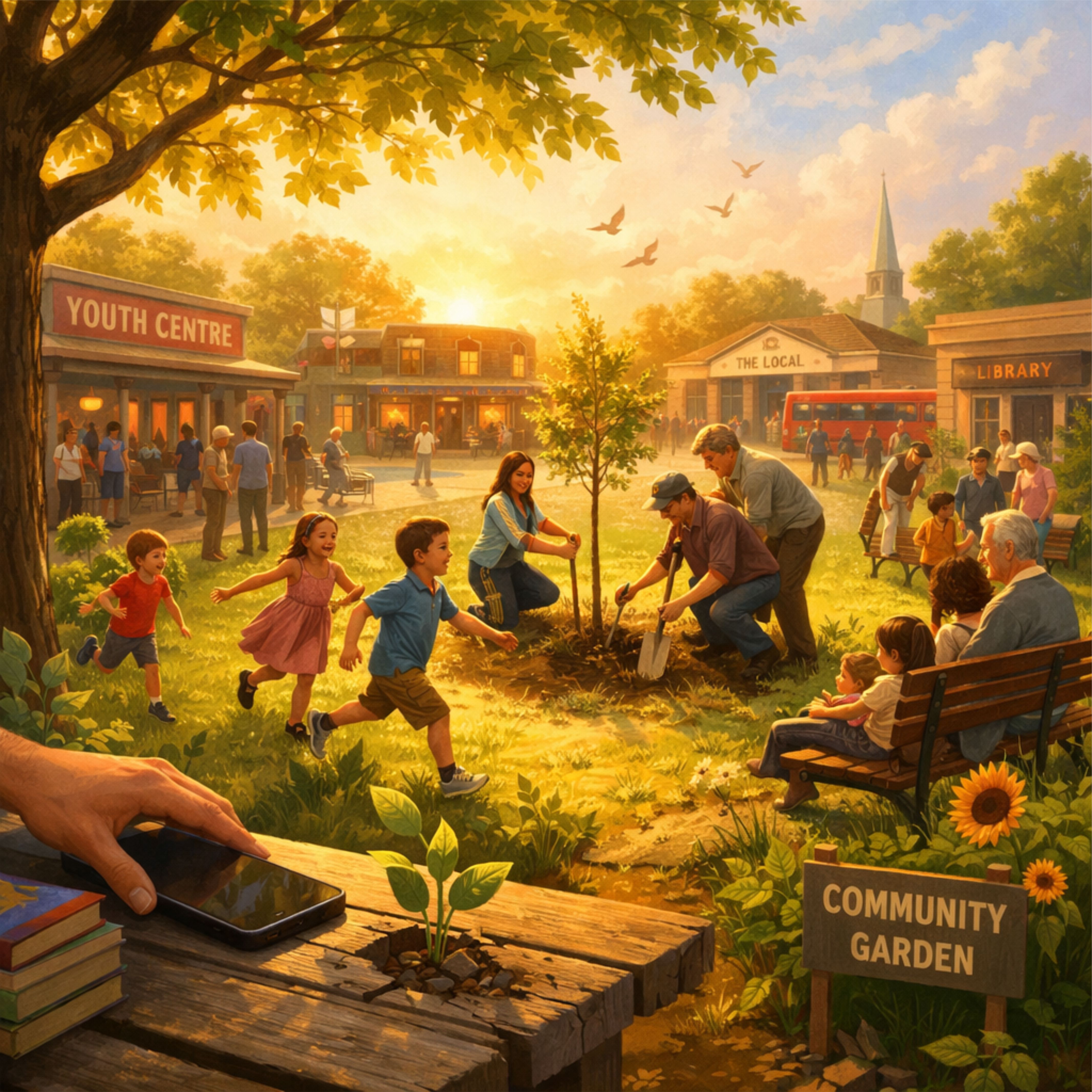
It is about a society that has quietly dismantled the foundations young people once relied on – safe public space, trusted adults, local belonging, meaningful activity, family time, affordable places to gather – and now wants to blame the consequences on a device.
This is not protection.
This is avoidance.
1. Childhood hasn’t collapsed everywhere – but the conditions that support childhood have
It’s easy to point to a new playground, a refurbished park, or a well‑funded youth centre and say, “Look – things aren’t that bad.”
But this misses the point entirely.
The real story isn’t about whether a park exists.
It’s about whether children can use it freely, safely, and socially – and whether the wider conditions of life make that possible.
Across the UK, the underlying ecosystem that once supported childhood has been eroded, even in places where the physical amenities remain.
The decline is structural, not cosmetic.
The evidence is stark. Local authority spending on youth services in England has fallen by around three‑quarters in real terms since 2010, with reports showing cuts of more than £1 billion and hundreds of youth centres lost or hollowed out.
Wales has seen substantial reductions too. These are not marginal changes. They represent the removal of an entire layer of social support that once gave young people somewhere to go, something to do, and adults who were not parents or teachers but still mattered.
But the deeper loss is not the buildings. It’s the conditions that made them matter.
Parents work longer hours and carry more pressure.
Neighbourhood trust has weakened.
Fear dominates public life.
Children’s independent mobility has collapsed over generations.
Public transport is patchy, expensive, or simply not good enough.
Activities that were once free now often carry a cost.
Spaces that once belonged to everyone are increasingly commercialised, regulated, or designed around cars rather than children.
A park is only a park if children can get to it, feel safe in it, and have others to play with when they arrive. A youth centre is only a youth centre if it has people in it. A community is only a community if people trust each other enough to participate.
Even where facilities exist, the conditions that make them meaningful have been stripped away.
And when the offline world becomes harder to access, more expensive to participate in, and more frightening to navigate, children retreat to the only environment that is always available, always open, and always populated: the digital one.
Smartphones didn’t replace childhood. They replaced the conditions that once made childhood possible.
That does not mean technology is harmless. It means technology has become powerful partly because the offline alternatives have been weakened.
The phone did not arrive in a vacuum. It arrived in a society that had already made childhood smaller.
2. Fear hasn’t risen because danger has – fear has risen because community has collapsed
We live in a society where many people genuinely believe danger lurks behind every parked car, every stranger, every unstructured moment.
Some dangers are real. Knife crime, exploitation, online abuse, road danger, and serious violence cannot be dismissed. But the wider picture is more complicated than the emotional climate suggests.
Long‑term crime data in England and Wales shows many traditional forms of crime have fallen over time, even as public anxiety and the visibility of disorder have intensified.
What has risen is the volume of fear‑based messaging.
Fear keeps people watching.
Fear keeps people clicking.
Fear keeps people compliant.
But fear also does something else:
It destroys the social fabric that once kept people safe.
When people fear each other, they withdraw.
When they withdraw, community weakens.
When community weakens, crime finds space to grow.
Crime does not thrive in strong, connected, people‑centred environments. It thrives in the gaps left behind when those environments disappear.
This is the part of the story almost no one tells:
The crime we fear today is often intertwined with the same systemic breakdown that fear itself accelerates.
When youth services vanish, young people lose structure.
When public spaces decline, informal supervision disappears.
When families are stretched thin, support networks collapse.
When communities fragment, accountability evaporates.
When everything becomes transactional, belonging dissolves.
Crime is not simply a moral failing. It is often a social signal – a warning light from a system that no longer supports the people within it.
Fear didn’t rise because danger rose.
Fear rose because community fell.
3. The pub crisis: one case study in how systems fail people – and then blame them
If you want to understand why children spend so much time online, look at what has happened to the places where adults once gathered.
Pubs were once one of the beating hearts of local life – intergenerational, affordable, communal, and human. They were not perfect, and they were never the only form of community infrastructure. Libraries, youth clubs, churches, sports clubs, community centres, parks, working men’s clubs, cafés, and local shops have all played similar roles. But the pub remains a vivid example because it shows what is lost when informal social life is treated as disposable.
But over time, the pub stopped being a community institution and became a financial asset. Corporate ownership, property speculation, debt‑driven business models, and homogenisation hollowed out the soul of the industry.
Many pubs didn’t close because people stopped wanting them; they closed because the system stopped valuing what they were for.
And when pubs disappear, something else disappears with them:
The informal social supervision that keeps communities safe.
The landlord who knew everyone.
The regulars who kept an eye on the street.
The intergenerational mix that built trust.
The shared space where problems were noticed early.
The sense of belonging that kept people anchored.
When these things vanish, crime does not simply “rise” in a neat straight line. Communities are more complicated than that. But risk changes. Isolation deepens. Problems go unnoticed for longer. The informal checks and relationships that once helped people feel seen, known, and accountable start to disappear.
The collapse of the pub is not just an economic story. It is a story about the disappearance of the social immune system.
The same is true for the spaces children use. Close a youth club, price out a sports activity, make buses unreliable, let parks feel unsafe, and then children do not simply stop needing connection. They look for it somewhere else.
4. The political appeal of banning the symptom, not the cause
A social media ban for under‑16s is politically irresistible because it is:
- simple
- visible
- cheap
- emotionally charged
It allows politicians to say, “We are protecting children,” without having to confront the harder truth:
We dismantled the social fabric that once supported them.
A ban avoids the real questions:
- Why do children have so few offline opportunities?
- Why are parents so stretched and unsupported?
- Why is community life collapsing?
- Why is everything that used to be free now commercialised?
- Why is fear the dominant emotion in public life?
These are systemic failures. And systemic failures require systemic solutions.
A ban may reduce some exposure to harm. It may give some parents cover. It may even be part of a wider package if implemented carefully.
But on its own, it is not a solution.
It is a distraction if it allows us to avoid the harder work.
That does not mean we should do nothing online. Quite the opposite. Harmful design, weak age assurance, algorithmic amplification, cyberbullying, predatory behaviour, and exposure to dangerous content all require serious regulation.
Platforms must be made safer. The Online Safety Act must be enforced. Children need digital literacy, parents need support, and companies must not be allowed to profit from avoidable harm.
But a blanket ban risks becoming a political shortcut: a visible act of concern that leaves the underlying conditions untouched.
Worse, if handled badly, it may push some children into less visible and less regulated spaces while doing nothing to rebuild the real‑world places they actually need.
5. The deeper truth: fear is what failing systems use when they cannot offer renewal
When a system is struggling to explain its own failures, it reaches for fear.
Fear divides.
Fear isolates.
Fear distracts.
Fear keeps people looking in the wrong direction.
And right now, fear is being used to:
- pit parents against technology
- pit generations against each other
- pit communities against imagined threats
- pit society against its own children
The more the system fails, the more it needs fear to justify itself.
6. The real crisis is not only digital – it is social, economic, and moral
If we banned every smartphone tomorrow, would children’s lives improve?
Only if we rebuilt the conditions that make childhood possible:
- properly funded youth services, open often enough to matter
- safe, welcoming public spaces that are not designed only for consumption
- local transport that lets young people move independently
- affordable sport, arts, music, and social activities
- libraries, clubs, community centres, and informal “third places” where people can gather
- support for parents who are stretched by work, housing, childcare, and cost‑of‑living pressure
- trusted adults beyond the family home and school gate
- digital literacy taught as a life skill, not a panic response
- platform accountability, not just parental blame
- trust, opportunity, belonging, and hope
Without that, removing smartphones would simply expose how little we’ve given children to replace them.
The crisis is not technological.
The crisis is environmental.
The crisis is structural.
The crisis is systemic.
And the crime we fear is not a separate problem. It is a symptom of the same collapse.
Treating social media as the sole cause allows us to avoid asking why so many children are lonely, anxious, bored, supervised but unsupported, connected but not held, visible online but invisible in their own neighbourhoods.
7. Where real hope lives
Hope does not live in bans, restrictions, or fear‑driven policies.
Hope lives in rebuilding communities.
Hope lives in restoring public spaces.
Hope lives in supporting families.
Hope lives in creating opportunities.
Hope lives in teaching digital literacy.
Hope lives in regulating platforms properly.
Hope lives in making offline life rich enough that the online world is no longer the only place children reliably find connection.
Hope lives in reconnecting society with itself.
Hope lives in the recognition that children are not the problem.
Hope lives in the courage to admit that the system is.
Hope lives in the willingness to build something better – not just remove something convenient to blame.
That means moving beyond symbolic politics and asking harder questions: What would it take for a thirteen‑year‑old to walk safely to a park, meet friends there, stay for a few hours, and come home without fear? What would it take for parents to trust their community again? What would it take for young people to be known by adults who are not paid to manage, test, punish, or sell to them?
8. The choice ahead
We can continue down the path of fear, division, and superficial fixes. We can keep treating children as problems to be managed, parents as failures to be blamed, and technology as a monster that appeared from nowhere.
Or we can confront the truth: children have not abandoned the real world. Too often, the real world has withdrawn from them.
Children do not need bans as a substitute for society.
They need protection online, yes – but they also need freedom, belonging, trusted adults, safe places, real opportunities, and a world worth growing up in.
If we want children to spend less of their lives on screens, we must give them more life beyond them.

