
A Note to the Reader
This paper is not written to demand agreement. It is written to make space for thought. Many people already sense that something in the current direction of travel is wrong: food systems feel fragile, technology feels increasingly distant from human value, and communities feel less able to shape the things that matter most. This work is for those people.
The aim is not to provide a closed model or a perfect answer. The aim is to introduce a practical doorway into a wider body of work concerned with EFCG, LEGS, Foods We Can Trust, local food resilience, Contribution Culture, and community capability.
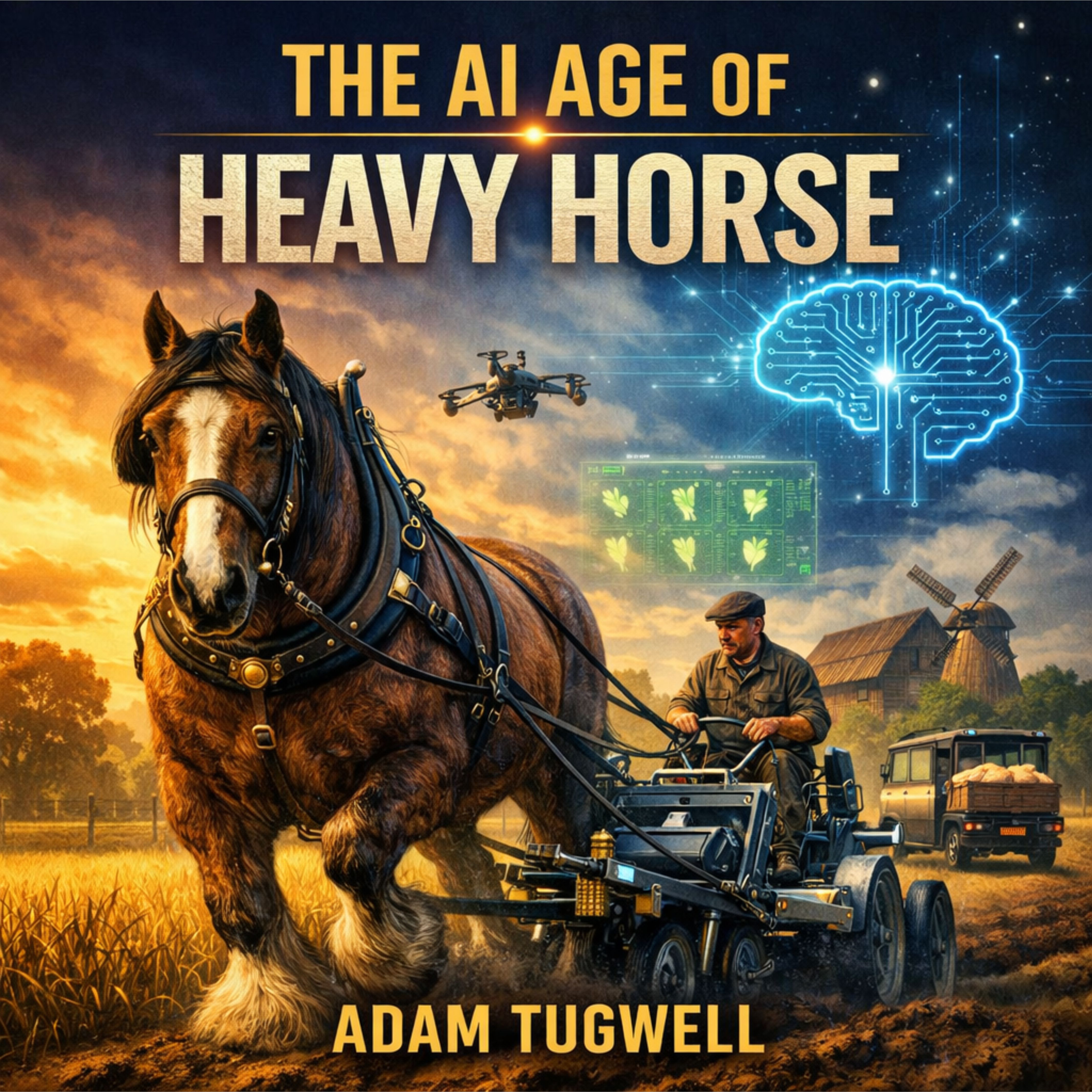
The heavy horse proposition is deliberately visible because people need to be able to picture alternatives. It shows that the future does not have to mean either going backwards or being dominated by technology designed around control, extraction, and human replacement.
This is a serious proposal, but it is also an invitation. If it causes the reader to pause, question an assumption, or discuss a different possibility with someone else, it has begun to do its work.
Disclaimer
This publication is intended for informational, educational, and discussion purposes. It presents concepts, models, and proposals designed to encourage reflection, experimentation, and community‑level dialogue. It is not a technical manual, regulatory guide, or prescriptive instruction set.
The author has made every reasonable effort to ensure the accuracy of the information contained within. However, agriculture, land management, engineering, and community‑scale systems involve variables that differ widely across locations, conditions, and capabilities. Readers should exercise their own judgement, seek appropriate professional advice where necessary, and adapt ideas responsibly to their own circumstances.
Neither the author nor the publisher shall be held liable for any loss, damage, or adverse outcome arising directly or indirectly from the use, application, or interpretation of the material in this book.
Any references to external organisations, reports, or research are included for context and illustration. Their inclusion does not imply endorsement, affiliation, or responsibility for the content of this work.
This book is offered as a contribution to ongoing public conversation. It should be read as an invitation to think differently, not as a guarantee, prediction, or instruction.Executive Summary
The AI Age of Heavy Horse proposes a new class of hybrid agricultural and land-management machines that combine horse traction, electric assist, lightweight engineering, sensors, and AI-supported guidance.
These machines are not proposed as a universal replacement for tractors. They are proposed as one practical component within a wider capability system designed for soil health, local resilience, human participation, and reduced dependence on fragile external inputs.
The paper argues that modern agriculture has become highly productive but also highly dependent: on diesel, finance, global logistics, imported components, fertiliser, centralised processing, supermarket distribution, and distant decision-making.
The UK Government’s Food Security Report 2024 recognised the food supply chain as an interdependent system exposed to shocks and stresses across energy, water, labour, imports, logistics, climate, and economic conditions. Red diesel remains the most commonly used farm fuel in England, with official statistics reporting use by 98% of farm businesses in the Farm Business Survey population in 2023/24.
This work therefore treats resilience as a design requirement. It asks what agricultural capability remains when ideal assumptions no longer hold, and what forms of technology can strengthen farmers, workers, animals, soil, and communities rather than replacing them.
Its central proposition is simple: technology should enhance human capability, not remove people from productive systems.
The horse is important because it makes the idea visible. It represents proven biological capability partnered with modern engineering. The wider principle is to take the best of what has been tested over time and combine it with the best of what modern technology can offer, under human-centred and locally accountable purposes.
This paper is one link in a broader architecture: An Economy for the Common Good, LEGS, Foods We Can Trust, community food capability, apprenticeship, local logistics, local processing, and Contribution Culture. It stands alone as a mechanisation brief, but its deeper purpose is to help open a different conversation about agency, freedom, food, technology, and human value.
Purpose
To introduce a new generation of horse-compatible agricultural and land-management machines that combine proven biological traction with modern engineering, electric assist, sensors, and AI-supported guidance.
These machines are designed to operate at human scale, protect soil, reduce dependence on fragile external inputs, and form one practical link within a wider interconnected capability system.
This is not a return to the past. It is retooling for a different economic paradigm: one in which capability, stewardship, community, and interdependence matter more than industrial scale, financial extraction, and supply-chain dependency.
The proposition is deliberately bold because the problem is serious. Modern agriculture has achieved extraordinary productivity, but much of that productivity now depends on fuel, finance, components, fertiliser, logistics, processing, and distribution systems that sit beyond the control of farmers and local communities. Efficiency and resilience are not the same thing.
This brief does not ask farmers, engineers, or communities to abandon progress. It asks whether progress has been defined too narrowly, and whether the next generation of technology should be designed to enhance human and local capability rather than remove people from productive systems.
In this sense, the work is both practical and symbolic. Practical, because machines, traction, soil, fuel, labour, processing, and logistics are real problems. Symbolic, because the image of a horse working with AI-supported machinery makes visible a third path: neither a retreat from technology nor surrender to a technology-dominated future.
Key Concepts
- Hybrid Mechanisation Machines powered by horses + electric assist + AI guidance.
- Capability Chains Interconnected local systems where each part strengthens the others (e.g., grain → mill → bakery → kitchen).
- Human‑Scale Systems Tools and workflows designed for small farms, mixed terrain, and multi‑operator teams.
- LEGS – The Local Economy & Governance System Community‑level decision‑making that replaces distant bureaucracy.
- EFCG – An Economy for the Common Good A needs‑first, contribution‑based economic model where capability replaces wages.
These definitions are intentionally short. Each concept can be expanded elsewhere, but this brief uses them only to keep the reader oriented.
Capability is the central word. Money can purchase capability only when the systems that convert money into food, fuel, tools, labour, and logistics are still functioning. When those systems weaken, communities need the capability itself.
Respect for Capability
Farmers are among the most innovative and entrepreneurial people in the country. They make things work under pressure, with limited resources, and without downtime.
They are engineers, logisticians, problem‑solvers, and leaders – all at once.
The issue is not capability. The issue is system capture.
Farmers were pushed into a model built around:
- bigger machines
- bigger fields
- bigger debt
- bigger dependency
- bigger fragility
They trusted systems that were presented as progress: larger machinery, greater output, tighter logistics, global sourcing, finance-led expansion, and supermarket-scale distribution.
Much of it worked while conditions were favourable. The problem is what happens when favourable conditions no longer hold.
This brief is not a criticism. It is an acknowledgement of what farmers are capable of once the system stops extracting their autonomy and starts restoring their capability.
System Capture
The industrial food system has boxed farmers into:
- supermarket dependency
- machinery finance traps
- fuel dependency
- monoculture economics
- regulatory hostility
- supply chain fragility
- subsidy distortion
Farmers did not choose this from a position of freedom. They were cornered by incentives, contracts, debt structures, market access, regulation, and cultural pressure that made resistance difficult and sometimes impossible.
This mechanisation system is not designed merely to compete with the industrial model on its own terms. It is designed to provide working capability where the industrial model becomes too expensive, too brittle, too centralised, or too dependent on inputs that are no longer reliable.
The United Kingdom Food Security Report 2024 recognises food, water, energy, and transport as critical national infrastructure sectors, and describes the UK food supply chain as a set of interdependent systems exposed to shocks and stresses involving energy, labour, imports, logistics, climate, and economic pressures.
The point is not to dramatise risk. The point is to treat resilience as a design requirement, not an afterthought.
Failure Conditions That Make This Necessary
Adoption is unlikely to begin with enthusiasm. For many farmers, it will begin when the existing model stops delivering reliability, affordability, or autonomy.
Trigger points may include:
- fuel scarcity
- machinery immobility
- border dependency failure
- fertiliser shortages
- supermarket supply-chain failure
- debt becoming unserviceable
- monoculture fragility
- legislative paralysis
- economic contraction
When these conditions converge, farmers and communities will need capability, not simply capital.
Money is only useful if there are working machines, available fuel, accessible parts, skilled people, functioning logistics, and food moving through the system.
This system is designed to preserve and rebuild capability under constraint.
Critical Supply Period: Community Capability Before Full Retooling
There may be a period – possibly months, possibly longer – where existing supply assumptions no longer hold, but full local retooling has not yet been achieved.
This is the most dangerous period because communities are still dependent on systems that may be disrupted while replacement capability is still forming.
- industrial supply chains are disrupted
- imports are restricted or delayed
- fuel is scarce or unaffordable
- machinery is idle or difficult to maintain
- supermarkets cannot maintain normal supply
- farming is retooling
- communities must increase local food capability quickly
During this period:
- households grow what they can
- community gardens fill gaps
- small farms produce essentials
- early hybrid machines begin operating
- horses provide land‑friendly logistics
- local processing ramps up gradually
- community kitchens stabilise food access
This is how communities bridge the gap between:
- industrial disruption
- local retooling
This mechanisation system is designed for that transition: not as a complete answer on day one, but as an early operating layer that helps farms, households, local processors, and community kitchens begin functioning together.
Land-Use Systems: Taking the Best of the Past and the Best of the Future
The mechanisation described in this brief does not stand alone. It is designed to work within land‑use systems that industrial farming sidelined:
- regenerative farming
- sustainable mixed farming
- precision land management
- permaculture principles
- heritage soil‑care systems
These approaches are not distractions. They are structurally necessary for a resilient, localised food system.
Industrial agriculture dismissed them because they do not scale vertically. But this model scales horizontally, through:
- community capability
- interconnectivity
- distributed labour
- human‑scale mechanisation
- regenerative cycles
- mixed cropping
- soil‑friendly traction
- AI‑guided precision
This is not “going back.” It is moving forward with the best of the past and the best of the future.
The test is not whether a method is old or new. The test is whether it works, whether it can be maintained, whether it protects the land, and whether it strengthens human and local capability.
Soil: The Living Engine We Forgot
The future of farming does not begin with machines. It begins with soil – the living, breathing, biological engine that industrial agriculture has spent decades extracting from, compressing, sterilising, and exhausting.
Warnings about declining soil health are often framed as a countdown of harvests remaining. The stronger point is this:
The soil is not failing. The industrial model is failing the soil.
Soil is not dead. It is depleted – by:
- heavy machinery compaction
- monoculture extraction
- chemical dependency
- loss of organic matter
- loss of microbial life
- loss of structure
- loss of stewardship
Industrial agriculture has treated soil as a substrate for inputs, not a living system.
The AI Age of Heavy Horse treats soil as the centre of the entire economic model.
Why Soil Matters to Hybrid Mechanisation
Hybrid horse‑AI machines are designed specifically to work with soil, not against it:
- horses reduce compaction
- lightweight frames protect structure
- electric assist stabilises traction without weight
- AI enables precision depth, spacing, and timing
- modular tools suit mixed cropping
- multi‑operator workflows allow careful land management
This is not nostalgia. It is engineering for soil health.
Research on soil compaction repeatedly identifies heavy machinery traffic as a significant cause of degraded soil structure, increased bulk density and penetration resistance, reduced porosity, poorer water movement, restricted root development, and yield loss.
A lighter, soil-centred mechanisation model therefore deserves attention not because it is quaint, but because soil structure is productive infrastructure.
A Flat Hierarchy: Human + Technology + Animal
The future is not:
- human versus machine
- machine replacing human
- machine replacing animal
It is:
Human + Technology + Animal working together in a flat hierarchy.
Each contributes what it does best:
- Horses provide land‑friendly traction and biological integration.
- Humans provide judgement, care, creativity, stewardship, repair, training, and community.
- Technology provides precision, optimisation, coordination, safety support, and information.
This partnership is not romantic. It is a design principle. The purpose of technology is not to remove people from productive systems, but to improve the quality, safety, effectiveness, and dignity of human contribution.
This is a central distinction. Current AI and automation are often funded and directed by objectives such as labour reduction, control, concentration, and financial return. That does not make technology inherently harmful. It means the purpose of technology must be changed.
In this model, AI and electrics support farmers, teams, animals, soil, and communities. They do not replace them.
This is not anti-technology. It is pro-human technology. It asks who defines the purpose of innovation, who benefits from it, who becomes dependent on it, and whether it increases or reduces real freedom.
Solution: Hybrid Horse-AI Mechanisation
This proposal does not assume that horses are universally superior to tractors. They are not. Modern tractors outperform animal traction in many high-power, large-scale, time-critical applications.
The question is different: can a hybrid system combining biological traction, lightweight engineering, electric assist, sensors, and AI-supported guidance provide valuable capability under conditions of rising input costs, soil pressure, energy constraint, supply uncertainty, and local retooling?
That is an engineering question, not a nostalgic one.
A new generation of machines built around:
- horse traction
- electric assist
- lightweight modular frames
- sensor arrays
- AI‑guided operation
- multi‑operator workflows
- regenerative land principles
These machines:
- stand on their own
- solve real engineering problems
- operate at human scale
- reduce dependency on fuel
- reduce dependency on industrial supply chains
- increase meaningful labour
- integrate into a wider capability system
This is hybrid mechanisation, not retro nostalgia. The horse is not the whole answer. It is a visible, practical expression of a wider principle: use the right capability for the task, whether that capability is human, biological, mechanical, electrical, or digital.
The image matters because people need to be able to see the alternative. A horse beside a modern machine carrying sensors, batteries, safety systems and AI guidance is difficult to fit inside the usual categories. That is precisely the point. It interrupts the assumption that the future must be either industrial automation or primitive retreat.
Interconnectivity: One Link in a Larger Chain
This mechanisation system is not isolated. It is part of a multidimensional, interconnected capability network.
Example chain (illustrative, not prescriptive):
- A horse‑assisted machine harvests grain.
- A carrier rig moves grain to a local mill.
- A battery van delivers flour to a baker.
- A community kitchen feeds people.
- Compost cycles back to the fields.
- Fields feed the horses.
- Horses power the machines.
Every component stands alone. Every component interlocks. Every component strengthens the others.
This interconnectivity is the survival mechanism during the critical supply period and the operating principle of the longer-term localised economy. The aim is not isolated self-sufficiency on every farm or in every household. The aim is networked capability.
Engineering Opportunity
This is a new engineering frontier because it does not begin with the assumption that bigger, heavier, faster, and more autonomous is always better.
It begins with a different design question: what machinery is needed when soil health, local repairability, human participation, fuel constraint, animal welfare, and distributed production are treated as core requirements?
New Machine Directions (Conceptual, Not Final)
- hybrid cultivators
- AI‑guided seed drills
- lightweight regenerative ploughs
- multi‑operator harvest platforms
- woodland extraction rigs
- modular carrier frames
- soil‑health monitoring implements
These are directions, not finished designs.
A serious development pathway would begin with reference machines rather than finished products: prototype platforms that can be tested, measured, criticised, improved, and adapted by farmers, engineers, horse handlers, soil specialists, and local manufacturing teams.
Reference Machine Questions
Any credible prototype programme would need to answer practical questions before wider adoption:
- What field operations are most suitable for hybrid horse assistance?
- What drawbar loads, operating speeds, and working widths are realistic?
- How much electric assist is useful before weight becomes counterproductive?
- Which tasks are best handled by the horse, the operator, the machine, and the AI layer?
- How should safety systems protect horses, operators, apprentices, and bystanders?
- Which components can be manufactured, repaired, or adapted locally?
- How should soil health, compaction, fuel displacement, labour quality, and reliability be measured?
- What animal-welfare standards, training systems, rest cycles, and handling protocols are required for ethical and reliable use?
- What evidence would be sufficient to persuade practical farmers that the system is worth trialling?
Modern Materials
- composites
- lightweight steels
- recycled alloys
- shock‑absorbing polymers
Electric Assist
- torque support
- braking
- stability
- hill assist
- safety systems
Sensors + AI
- depth control
- soil feedback
- route guidance
- load balancing
- training support
Multi-Operator Workflows
Industrial machines often isolate the operator and concentrate capability into expensive, specialist equipment.
Hybrid machines use teams because the goal is not to remove people from the work.
The goal is to make the work safer, more skilled, more learnable, more productive, and more connected to the land.
The exact number of people depends on:
- land
- capability
- community structure
- machine class
- season
We do not present fixed labour numbers here. We present a design direction: human capability is not a cost to be eliminated; it is a capacity to be developed.
Trigger Points for Adoption
Farmers will not adopt this system because it is novel. They will adopt it if it solves problems that the existing system can no longer solve.
Trigger points include:
- fuel scarcity or volatility
- machinery downtime
- supply-chain disruption
- supermarket failure or rationing
- border closure or import instability
- debt pressure
- labour availability
- community necessity
This is structural realism. The proposal is not that every farm should immediately replace tractors with horses. The proposal is that serious work should begin now on hybrid capability systems that can operate when diesel, finance, spare parts, logistics, and centralised food distribution become unreliable or unaffordable.
It also recognises that adoption will not be uniform. Some farms may never use this model. Some may use elements of it only for specific tasks. Some communities may develop shared equipment, shared horses, or local service teams. The purpose is not ideological purity. The purpose is practical capability.
Human-Scale Workflow
A small farm under this model:
- uses hybrid machines
- employs multi‑operator teams
- integrates apprentices
- shares capability across community nodes
- connects to local processing
- connects to local distribution
- connects to local consumption
- closes loops through regenerative cycles
Work becomes:
- meaningful
- contributive
- skilled
- social
- structurally necessary
Not employment in the narrow wage-system sense. Capability.
This matters because labour has been treated for generations as something to reduce. In a money-centric system, fewer people can mean higher margins. In a capability-centred system, the question changes: how do we make necessary work better, safer, more skilled, more social, and more valuable to the community?
When a Basic Living Standard is secured through the wider economic system, the meaning of work also changes. Contribution is no longer reduced to survival wages. People participate because their contribution is useful, recognised, skilled, and connected to the real needs of the community.
This is why the document links mechanisation to the wider LEGS and EFCG work. A human-centred machinery system cannot fully succeed inside an economic culture that treats people primarily as costs and communities primarily as markets. It requires a wider shift towards contribution, capability, needs-first design, and local accountability.
Where This Brief Sits in the Larger System
This brief is one link in a chain that includes:
- hybrid mechanisation
- local logistics
- local processing
- regenerative land cycles
- community kitchens
- apprenticeship systems
- local governance (LEGS)
- needs‑first economics (EFCG)
Each link stands alone. Each link interlocks. Each link strengthens the others.
This brief is the mechanisation link. It should be read alongside the wider work on LEGS, EFCG, local food resilience, community production, apprenticeship, logistics, and needs-first economic design.
The wider lexicon is not intended to impose a single final model. It is intended to give people language, principles, guardrails, and practical examples that help them take back responsibility for the things that actually matter: food, shelter, energy, water, skills, health, governance, dignity, and community.
What This Paper Is Asking For
This paper does not ask the reader to accept every claim, adopt every concept, or abandon existing systems overnight. It asks for something simpler and more powerful: to think differently.
It asks farmers to consider where real autonomy has been lost, and where it might be rebuilt.
It asks engineers to consider machinery designed around soil, people, animals, and local repairability rather than only speed, scale, and automation.
It asks communities to consider food not as a retail product, but as foundational capability.
It asks technologists to consider whether AI should be judged by what it removes from human life or by what it helps human beings do better.
Power begins with thinking differently. Not because thought alone is enough, but because no serious change can begin while the existing paradigm remains invisible, unquestioned, and assumed to be inevitable.
Closing Statement
This mechanisation system is not designed for the world as it is assumed to be. It is designed for the world as it may be becoming: more energy constrained, more supply-chain exposed, more locally dependent, and more in need of practical capability.
It respects farmers by recognising their skill. It respects engineers by presenting a real design challenge. It respects horses by treating them as partners, not relics. It respects technology by asking it to serve humanity. It respects soil by placing it at the centre of the system. It respects communities by giving them a way to build capability before crisis removes choice.
It is hard. It is practical. It is testable. It is necessary to begin before it is needed. And if the assumptions behind this work prove wrong, the outcome is still worthwhile: healthier soil, stronger local skills, more resilient farms, better tools, and technology used in service of people rather than in place of them.
This paper is therefore not an ending. It is a doorway. Its purpose is to place an image, an argument, and a possibility into a space where many people already feel the need for another way but have not yet seen one clearly enough to discuss.
Evidence Notes
The argument in this paper is supported by several recognised areas of evidence and policy concern. The United Kingdom Food Security Report 2024 describes food security as dependent on supply-chain resilience and identifies the food chain as exposed to shocks and stresses across energy, labour, water, imports, logistics, climate, and business conditions. It also reports the UK’s production-to-supply ratio at 62% for all food and 75% for indigenous foods in 2023.
Official statistics on Energy use on farms in England 2023/24 report that red diesel was used by 98% of farm businesses within the Farm Business Survey population, making fuel availability and price a structural issue for agriculture rather than a marginal operational detail.
Research reviews on soil compaction identify heavy agricultural machinery traffic as a major contributor to degraded soil structure, increased bulk density and penetration resistance, reduced porosity, poorer water movement, restricted root development, and yield loss. These findings support the case for lighter, more soil-sensitive machinery systems where they are practical.
Reports on future farm fuels also recognise the difficulty of replacing diesel in larger agricultural machinery through battery-electric systems alone, especially where battery weight, charging infrastructure, energy density, and long working days create practical limits. Hybrid systems and smaller, lighter, task-specific machinery therefore deserve serious development attention.
These notes do not prove the whole proposition. They show that the concerns behind it are not imaginary: food-system interdependence, fuel dependency, soil degradation, and technology choice are already recognised as serious issues. This paper brings them together under a human-centred capability frame.
Further Reading
The following readings are arranged to help the reader move from the wider system architecture into the practical food, community, and technology themes that support this paper. They are not required background, but they provide the conceptual scaffolding behind the terms used here: LEGS, EFCG, Contribution Culture, Basic Living Standard, Foods We Can Trust, and human-centred AI governance.
1. System Architecture and Local Governance
The Local Economy & Governance System
https://adamtugwell.blog/2025/11/21/the-local-economy-governance-system-online-text/
This is the primary companion text for understanding LEGS: the local decision-making, coordination, and accountability framework that sits behind the wider capability model. It helps explain how local food, work, production, welfare, and governance could be organised around community need rather than distant market or bureaucratic control.
An Economy for the Common Good
https://adamtugwell.blog/2025/02/24/an-economy-for-the-common-good-full-text/
This text sets out the broader economic paradigm behind the paper: a needs-first, capability-centred alternative to wage dependency, extraction, and market-led social organisation. It is useful for readers who want to understand why this mechanisation proposal is framed as part of an economic transition rather than simply a farming technology idea.
The Contribution Culture
https://adamtugwell.blog/2025/12/30/the-contribution-culture-transforming-work-business-and-governance-for-our-local-future-with-legs/
This reading develops the work and participation philosophy that underpins the human-scale workflow sections of this paper. It reframes labour not as a cost to be minimised, but as meaningful contribution, skill, service, and social capability within a local system.
The Basic Living Standard Explained
https://adamtugwell.blog/2025/10/24/the-basic-living-standard-explained/
This piece explains the social foundation that makes contribution culture possible: a secure baseline of food, shelter, care, energy, transport, and essential participation. It is relevant because this paper’s view of work depends on people being able to contribute without survival pressure reducing every activity to wage necessity.
2. Food Security, Local Production, and Community Resilience
Foods We Can Trust: A Blueprint for Food Security and Community Resilience in the UK
https://adamtugwell.blog/2025/12/15/foods-we-can-trust-a-blueprint-for-food-security-and-community-resilience-in-the-uk-online-text/
This is the main food-system companion to the heavy horse paper. It develops the argument for food security as community capability, connecting production, trust, local processing, public kitchens, distribution, and resilience into a wider operating model.
Foods We Can Farm, Catch, Harvest and Grow Locally in and Around the UK
https://adamtugwell.blog/2025/07/18/foods-we-can-farm-catch-harvest-and-grow-locally-in-and-around-the-uk/
This practical reference supports the local-production side of the argument by identifying food types that could form part of a more regionally grounded food system. It helps readers connect the abstract idea of food resilience to real crops, harvests, fisheries, livestock, and growing possibilities.
Grow Your Own or Home Growing
https://adamtugwell.blog/2025/07/31/grow-your-own-or-home-growing/
This reading brings the resilience conversation down to household and community scale. It is useful for readers interested in the critical supply period discussed in this paper, where gardens, small plots, community growing, and local food skills help bridge the gap before larger systems have fully retooled.
3. Technology, AI, and Human Sovereignty
The Human Sovereignty Charter for Artificial Intelligence
https://adamtugwell.blog/2026/03/07/the-human-sovereignty-charter-for-artificial-intelligence-a-constitutional-framework-for-human-centred-governance-of-ai-full-text/
This text provides the AI governance context for the paper’s claim that technology should enhance human capability rather than replace human agency. It is particularly relevant to the hybrid mechanisation proposal because AI is treated here as a support layer for farmers, animals, soil, safety, learning, and local coordination – not as a mechanism of control or human removal.
Final Note
The current paradigm is persuasive because it has shaped the incentives, institutions, language, technology, media, and expectations that surround daily life. Most people are not wrong to have trusted it. They have lived inside it.
But systems are not inevitable. They are built, maintained, funded, defended, and repeated until they appear natural. The first step in changing them is not agreement. It is the ability to imagine that another way of organising life, work, food, technology, and community might be possible.
The AI Age of Heavy Horse is offered in that spirit: not as a finished answer, but as a serious image of a different future – one where technology serves human value, food systems rebuild local agency, work regains dignity, and communities recover the capability to shape the things that matter most.


2 thoughts on “The AI Age of Heavy Horse | Hybrid horse-powered mechanisation for a connected, human-centred, localised economy | Full Text”