A case for progress that protects purpose, safeguards the conditions of human flourishing, and recognises that society cannot be remade by idealism alone.
Every society depends on frameworks it rarely notices until they begin to weaken. Families, communities, institutions, customs, duties, shared expectations and moral restraints are not decorative features of social life. They are the guardrails that help people meet basic human needs: safety, belonging, health, stability, happiness, meaning and the confidence that tomorrow will not be wholly unlike today.
Progress is necessary because these frameworks are never perfect. They can exclude, constrain, stagnate or fail to adapt. But the fact that something is imperfect does not mean it is disposable. Many inherited structures exist because they solve recurring human problems. They help people cooperate, raise children, care for the vulnerable, transmit trust, resolve conflict and live with limits.
The central danger in modern progressivism is not that it seeks improvement. The danger is that it can mistake moral aspiration for practical wisdom. It can assume that if an ideal is sufficiently compassionate, inclusive or emancipatory, then society should be reorganised around it immediately, regardless of whether the conditions exist for that ideal to work in the real world.
This essay is therefore not an argument against progress. It is an argument against progress without anchors: change that removes safeguards before replacements are ready, dismisses disagreement as backwardness, and treats human beings as material to be reshaped rather than creatures rooted in reality, habit, culture, obligation and need.
1. The False Promise of Progress Without Limits
Much progressive politics begins with a noble instinct: the belief that suffering should be reduced, unfairness challenged and life improved.
At its best, this instinct has corrected real wrongs. It has expanded dignity, challenged cruelty and forced societies to confront harms they preferred to ignore.
But noble instinct is not enough. A political or institutional project becomes dangerous when it assumes that the moral desirability of an outcome proves the practicality of the route towards it.
Wanting a more equal, inclusive or liberated society does not mean that every structure standing in the way is merely oppressive. Some of those structures may also be holding society together.
This is where progress can become false hope. It promises a better world while weakening the conditions that make any better world possible. It speaks of liberation while eroding responsibility. It speaks of inclusion while neglecting cohesion. It speaks of rights while forgetting duties. It speaks of change while showing too little interest in continuity.
The issue is not whether the ideal is attractive. Many ideals are attractive. The issue is whether the ideal bears a workable relationship to human nature, social trust, institutional capacity and the lived realities of ordinary people.
Few people fall in behind an idea simply because it has been declared morally superior.
They do so because they can see how it serves them, their families, their communities or the society they inhabit.
This does not mean every popular instinct is right, nor that every unpopular reform is wrong. It does mean that progress must persuade reality before it attempts to command it.
When change moves faster than trust, capacity or consent, it does not create progress.
It creates instability.
2. Why Social Guardrails Matter
Guardrails do not exist to prevent all movement. They exist to stop movement becoming destruction. The same is true in social life. Law, custom, family, community, faith, local identity, civic duty and shared restraint all limit individual will, but they also make freedom liveable.
A child does not flourish merely because every inherited constraint has been removed. A neighbourhood does not become strong because all local norms are treated as suspect. An institution does not earn trust because it has adopted the newest language of reform.
Human beings need stability as well as opportunity, boundaries as well as choice, and belonging as well as recognition.
The frameworks that protect life are often slow, imperfect and frustrating. They rarely satisfy the utopian imagination because they deal in compromise rather than purity. Yet they are usually the means through which basic goods are actually delivered: safety, health, happiness, social trust, mutual care and a sense of purpose.
This is why reform carries a burden of proof. Those who seek to dismantle an inherited structure must show not only that it has flaws, but that what replaces it can perform its essential functions at least as well. Otherwise change may remove visible injustice while producing invisible fragility.
The most serious political errors often begin when leaders confuse a guardrail with a prison wall. A guardrail can constrain, but it can also protect. Remove it without understanding its purpose, and the people most exposed are rarely the powerful. They are the people with the fewest reserves when systems fail.
3. Human Beings Cannot Simply Be Redesigned
One of the most dangerous assumptions in modern institutional life is that people can be forced to think differently if the environment around them is redesigned with sufficient confidence.
‘i.e.Change the language, incentives, policies, symbols and structures, and eventually the human being will follow.’
Yes, there is some truth in this. Environments do influence behaviour. Laws do shape expectations. Institutions can normalise habits.
But influence is not control. People do not surrender conscience, instinct, memory, loyalty or belief simply because a new moral architecture has been imposed above them.
Many will continue to disagree. Some will comply outwardly while withdrawing inwardly. Others will wait until the old safeguards have been removed and then use the new openness to introduce their own competing certainties.
A society that dismantles restraints in the hope that everyone will become more enlightened may instead discover that restraint was protecting it from many directions at once.
4. Progress Requires Preconditions
There are reforms that may be desirable in principle but destructive in practice if introduced before the surrounding culture, institutions or habits are ready to sustain them.
This is not an argument for permanent delay. It is an argument for seriousness.
Progress is not simply the removal of barriers. It is the creation of conditions in which people can flourish after those barriers have been removed.
That requires trust, competence, responsibility, shared standards and enough common ground for disagreement not to become social fracture.
This is why progress is often slow. Slow change can be frustrating, especially to those suffering under genuine injustice.
But slowness is not always cowardice. Sometimes it reflects the time required for institutions to adapt, for communities to absorb consequences, for trust to be built and for replacement structures to become capable of carrying real human weight.
The tragedy of impatient idealism is that it can damage precisely the people it intends to help.
When systems are not ready, the costs of disorder are not evenly distributed. The secure can adapt; the vulnerable are left exposed.
5. Purpose Is Not Manufactured by Ideology
A society does not live by administration alone. People need more than services, rights and managed outcomes. They need purpose. They need a sense that their lives are connected to something beyond immediate appetite or individual preference: family, duty, vocation, place, faith, citizenship, service, memory, inheritance, love.
The risk in a rootless progressivism is that it dissolves the very sources from which purpose is drawn. If every inherited obligation is treated as arbitrary, every boundary as oppression, every tradition as suspect and every identity as self-created, then the individual may be left freer in theory but more disoriented in practice.
This is not liberation in any meaningful human sense. It is exposure.
A person released from all attachments may not become autonomous, rational and fulfilled. They may become lonely, anxious, manipulable and dependent on large systems to supply the meaning once provided by smaller human bonds.
Progress that destroys purpose cannot finally be called progress. It may expand choice while weakening the reasons for choosing well. It may remove constraints while leaving people without orientation. It may promise happiness while undermining the relationships and responsibilities through which happiness is usually sustained.
The mature question is not how to free people from every framework, but how to maintain a healthy relationship between human beings and the world around them.
That relationship requires freedom, but also responsibility; compassion, but also truth; reform, but also continuity; openness, but also protection from chaos.
6. Utopia Is Not the Human Condition
Utopia is a beautiful idea, but it is not what the human experience is about. Human life is marked by limitation, conflict, dependency, disagreement, loss, loyalty, love and imperfection.
Politics cannot abolish those realities. Leadership cannot design them away. Institutions cannot transform finite human beings into frictionless moral actors.
The pursuit of perfection becomes dangerous when it turns disagreement into evidence of moral failure. If a leader or movement begins from the assumption that its own interpretation of the good is immediately and unquestionably correct, then persuasion soon gives way to imposition. The cost is justified by the destination. Resistance is treated not as a warning, but as a problem to be overcome.
This is the old danger of utopian politics. It claims to love humanity while becoming impatient with actual human beings. It speaks of compassion while ignoring trade-offs. It promises harmony while weakening the habits that make coexistence possible. It seeks to redesign the world according to an ideal image, then treats the stubbornness of reality as an enemy.
7. The Leadership Test: Better for Whom, and at What Cost?
Responsible leadership begins with a harder set of questions than ideological politics usually permits.
What problem is this reform trying to solve? What good does the existing system still provide? Who depends on that good? What will replace it? What are the likely unintended consequences? Who pays if the theory fails?
The question “better for whom?” should be central to every serious reform. A change may be better for administrators but worse for families; better for institutional reputation but worse for trust; better for ideological coherence but worse for social peace; better for one group in the short term but damaging to the shared framework on which many groups depend.
This is not an argument for paralysis. It is an argument for humility. The leader’s task is not to impose a preferred interpretation of the good at any cost. It is to steward change in a way that remains accountable to reality, protects the vulnerable, preserves what still works and improves what no longer does.
8. Progressivism as False Hope
Progressivism becomes false hope when it promises outcomes that depend on human behaviour, cultural adaptation, social trust and institutional competence that cannot simply be produced through law, language, policy or moral pressure.
It is false hope when it assumes that removing old boundaries will automatically create healthier people, stronger communities or more compassionate institutions. It is false hope when it treats disagreement as ignorance, inheritance as oppression and practical limits as failures of courage.
Most of all, it is false hope when it weakens the frameworks that protect life in the name of an ideal that has not yet proved capable of replacing them.
A society cannot live inside aspiration alone. It needs habits, duties, trust, restraint, competence and institutions that can bear pressure.
The answer is not to abandon progress. It is to make progress answerable to the world as it is. The task is not to preserve every inheritance or to resist every reform. It is to ask whether a proposed change strengthens or weakens the basic conditions of human flourishing.
9. What Grounded Progress Requires
Grounded progress begins by accepting that reality is not an inconvenience to be overcome. It is the medium in which all improvement must take place.
Human nature, institutional capacity, culture, trust, family life, economic limits and local circumstances are not secondary details. They are the conditions that decide whether an ideal becomes humane reform or destructive fantasy.
Such progress protects what still works, repairs what is failing and changes only with a clear account of what will carry the weight once established structures are altered.
It understands that people need purpose as well as protection, belonging as well as recognition, and responsibility as well as rights.
It also recognises that disagreement is not always a defect to be corrected. In a free society, disagreement is part of the terrain. The aim of leadership is not to eliminate difference, but to preserve enough shared ground for difference to remain peaceful, productive and bounded by mutual obligation.
Progress worthy of the name does not ask, “What would the ideal world look like if human beings were infinitely adaptable?” It asks, “Given what human beings are, what can be improved without destroying the foundations that allow them to flourish?”
Conclusion: The Discipline of Reality
The central error of every utopian project is the belief that society can be remade according to an ideal vision without cost.
Human beings are neither infinitely rational nor infinitely malleable. We are shaped by culture, memory, family, place, obligation and limitation as much as by choice. Any politics that forgets this will eventually collide with reality.
Progressivism becomes dangerous when it treats that collision as proof that reality must be forced harder.
The wiser response is different. It is to recognise that good intentions are not enough, that safeguards often exist for reasons, and that purpose cannot be manufactured by dismantling the relationships and responsibilities through which people learn who they are.
The challenge facing modern leaders is not to resist change, nor to celebrate it reflexively. It is to exercise judgement.
Real progress is neither preservation nor disruption alone. It is the disciplined work of improving what exists while protecting the foundations that allow people and communities to flourish.
The question is not whether change is happening. The question is whether the changes we pursue leave society stronger, safer, healthier, more purposeful and more capable of living truthfully with the world as it is.
This book is a conceptual and practical proposal intended to stimulate discussion, research, experimentation, enterprise development, policy consideration and community action.
The systems, economic structures, governance approaches and capability networks described in this book are proposals for consideration rather than completed or universally validated solutions. Implementation would require further research, practical testing, economic assessment, technological development, governance design and community participation.
References to textile production, wool processing, supply-chain resilience, clothing security, community enterprise, cooperative structures, and local capability are intended to support discussion and exploration rather than predict specific future outcomes.
Nothing in this book should be interpreted as legal, financial, regulatory, investment, business, engineering or policy advice. Readers should seek appropriate professional guidance before making commercial, governance, operational or investment decisions.
The views expressed are offered as a contribution to an ongoing discussion about resilience, local economies, human-centred technology, clothing systems, community participation, and the future of productive life.
Why This Book Now
Across the world, people are re‑examining the systems that shape everyday life – how we produce, repair, share, learn, and participate in the creation of the things we depend on. Many of these systems have become highly efficient, but increasingly fragile. They deliver goods, but often weaken capability. They generate output, but frequently reduce participation. They create prosperity, but not always resilience.
The Economy for the Common Good (EFCG) argues that societies flourish when economic activity strengthens human wellbeing, stewardship, participation and shared capability. Yet many modern systems have evolved in the opposite direction: concentrating production, narrowing ownership, reducing practical skills, and disconnecting communities from the means of meeting their own needs.
Clothing is one of the clearest examples. It is essential to dignity, safety, identity and daily life, yet the capability behind it – the ability to create, repair, adapt, maintain and renew – has become increasingly distant from the communities that use it. The same pattern can be seen across food, energy, materials, manufacturing and local enterprise. When capability disappears, dependency grows. When participation declines, resilience weakens.
This book is written now because the questions it raises have become urgent. How do we rebuild capability in ways that strengthen communities rather than bypass them? How do we design systems where technology enhances human contribution instead of replacing it? How do we create economies that measure success not only by efficiency, but by participation, stewardship and shared prosperity?
Wool and natural fibres provide one practical lens through which to explore these questions, but the argument is larger than any single material. It concerns the future of productive life itself – and the possibility of building human‑scale systems that combine modern tools, local capability, distributed enterprise and community participation.
This book is offered as a contribution to that conversation. Not as a blueprint, but as an invitation: to imagine an economy designed for capability, to explore what communities can rebuild, and to consider how people, technology and living systems might work together to create resilience at human scale.
It is not an attempt to return to a vanished past, abandon modern technology, or recreate the economy of a previous century.
Nor is it written as a criticism of everyone who participated in the systems that produced today’s world.
Industrialisation brought extraordinary advances. It increased production, improved access to goods, accelerated innovation, and transformed living standards for millions of people.
Yet alongside these achievements, something important was gradually lost.
Many capabilities that once existed throughout communities became concentrated into large systems. Many industries that once supported widespread participation became increasingly specialised, centralised, automated, and eventually relocated elsewhere.
The wool and textile industries tell this story particularly clearly.
Britain still produces wool. Britain still possesses farmers, makers, designers, engineers, craftspeople, entrepreneurs, educators, and innovators.
What is often missing are the capabilities that once connected these people together.
The ability to transform local fibre into local products.
The ability to repair clothing rather than replace it.
The ability to teach practical skills across generations.
The ability to participate directly in the creation of things people need.
This book explores how some of those capabilities might be rebuilt.
Not by rejecting modern technology.
Not by rejecting progress.
But by asking whether progress itself should be measured differently.
Should progress be defined primarily by reducing the number of people required?
Or should it be measured by increasing the number of people able to participate meaningfully in productive life?
This book argues for the second approach.
Its purpose is not to provide a final answer.
Its purpose is to explore the possibility that wool, natural fibres, modern technology, local enterprise, apprenticeship, repair, stewardship, and human creativity might together contribute to a different future.
One built not around consumption alone, but around capability.
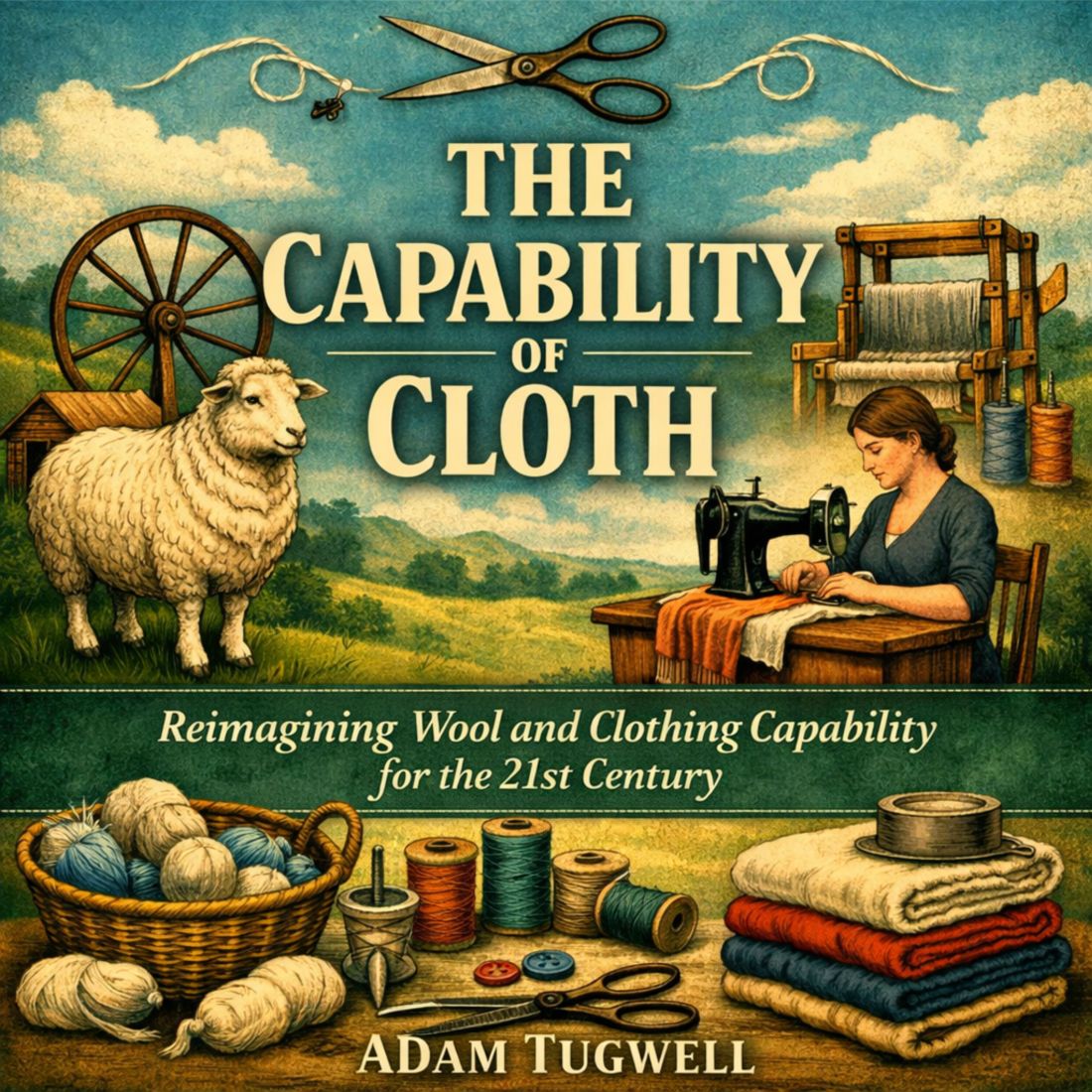
The Capability of Cloth proposes a new approach to fibre, clothing and textile production based upon human-scale industry, local capability, community participation, natural materials and human-centred technology.
The book begins from a simple observation:
Britain continues to produce substantial quantities of natural fibre, particularly wool. According to the British Wool Marketing Board annual report for 2024/2025, the 2024 clip was 19,290,044 kg; the report states that the overall average price achieved for the 2024 clip was 99.5 p/kg and that the total average return to producers, including high-volume premium, was 41.1 p/kg. These figures illustrate both the continuing scale of wool production and the economic pressures surrounding wool.
This book argues that clothing should be viewed not merely as a retail product but as a capability system.
Clothing security is not only the ability to buy clothing.
It is the ability to create, repair, adapt, share, reuse, recycle, and renew it.
The book proposes a distributed network of human-scale fibre industries built around:
wool and natural fibres
local processing capability
shared workshops and fibre hubs
repair and renewal services
apprenticeship and skills development
clothing libraries
cooperative enterprise
modern manufacturing tools
AI-supported learning and coordination
community participation
The objective is not to replace existing textile industries.
Nor is it to recreate historical systems exactly as they once existed.
The objective is to restore capability.
This includes:
economic capability
production capability
repair capability
educational capability
community capability
The book further argues that future industrial systems should be designed around a partnership between:
people
technology
living systems
rather than assuming that progress requires the continual removal of people from productive life.
As part of the wider frameworks of LEGS (The Local Economy & Governance System), EFCG (An Economy for the Common Good), Contribution Culture and the Basic Living Standard, the book explores how local textile ecosystems could support resilience, participation, stewardship and human flourishing in the twenty-first century.
Figure 3: The Human–Technology–Nature Partnership Nature provides fibre and living systems. People provide creativity, judgement, care and stewardship. Technology provides tools, coordination, learning support and production capability. Capability grows when all three work together.
Figure 4: The 21st Century Village Green Fibre Producers ↔ Processors ↔ Makers ↔ Repairers ↔ Clothing Libraries ↔ Educators ↔ Cooperatives ↔ Digital Platforms ↔ Community Users
Concept
Meaning for the Book
Capability
The practical ability to create, repair, adapt, share, learn and steward useful systems.
Stewardship
The care of materials, skills, people, places and future generations.
Participation
The opportunity for people to contribute meaningfully rather than only consume.
Human-scale industry
Enterprise designed to preserve meaningful human involvement while using appropriate technology.
Purpose
To explore how wool, natural fibres, human-scale enterprise, modern technology, and community participation can work together to rebuild clothing capability within a localised and resilient economy.
This book seeks to:
restore attention to fibre and textile capability as an important component of resilience
explore new opportunities for human-scale industry
support apprenticeship, craftsmanship, and practical skills
strengthen local enterprise and participation
encourage repair, reuse, and renewal
examine the role of cooperatives and distributed ownership
demonstrate how technology can support rather than replace people
connect textile production to wider local capability systems
contribute to discussions surrounding LEGS, EFCG, and Contribution Culture
The book is both practical and aspirational.
Practical because it addresses real materials, real skills, real businesses, and real community needs.
Aspirational because it asks readers to imagine a future in which economic systems are designed around human capability as carefully as they are designed around efficiency.
The practical ability to create, repair, adapt, share, maintain, recycle, and renew clothing and textile products.
Clothing Security
Reliable access to appropriate clothing supported by resilient systems of production, maintenance, repair, and renewal.
Fibre Capability
The local ability to transform natural fibres into useful products through knowledge, tools, infrastructure, and community participation.
Human-Scale Industry
An approach to production that combines modern technology and productivity with meaningful human participation, distributed enterprise, stewardship, and local capability.
Contribution Culture
A culture in which people are valued not only for what they consume, but for the capabilities, skills, care, creativity, and service they contribute to others.
The Basic Living Standard
A framework recognising that all people should have reliable access to life’s essential needs, including food, shelter, energy, healthcare, education, participation, and appropriate clothing.
LEGS
The Local Economy & Governance System – a framework for local capability, governance, accountability, enterprise, participation, and resilience.
EFCG
An Economy for the Common Good – a capability-centred economic framework that prioritises human wellbeing, stewardship, participation, resilience, and shared prosperity.
The 21st Century Village Green
A modern network of interconnected local enterprises, community infrastructure, shared spaces, and digital tools that support exchange, participation, learning, and capability at a local scale.
Clothing security is not only the ability to buy clothing. It is the ability to create, repair, adapt, share, renew, recycle, and steward it.
For much of human history, communities possessed many of these capabilities directly.
Today, many people possess unprecedented access to clothing while simultaneously having little connection to how clothing is produced, maintained, repaired, or renewed.
This book does not suggest that all modern systems should be abandoned.
It asks whether some forms of capability deserve to be rebuilt.
It further argues that future textile systems should be designed around a partnership between people, technology and living systems, with each contributing what it does best.
Nature provides fibre.
People provide creativity, judgement, stewardship, craftsmanship, entrepreneurship, teaching, and care.
Technology provides coordination, efficiency, learning, processing, design support, and communication.
The purpose of technology is not to make people unnecessary.
The purpose of technology is to enhance human capability.
Food, water, shelter, and energy are often recognised as essential foundations of resilience.
Clothing receives far less attention.
Yet clothing remains one of humanity’s most basic needs.
It provides:
protection
warmth
dignity
identity
participation
comfort
safety
Every person depends on it.
Yet relatively little discussion takes place about where clothing comes from, how it is made, who makes it, how it is repaired, or whether communities retain any capability to provide it locally.
This book suggests that clothing deserves to be viewed differently.
Not merely as a commodity.
Not merely as a consumer product.
But as part of a wider capability system.
A system involving farmers, fibre producers, makers, repairers, educators, designers, entrepreneurs, apprentices, cooperatives, communities, and technology working together.
The story of cloth is therefore larger than textiles.
It is a story about productive life.
About participation.
About stewardship.
About resilience.
And ultimately, about the kind of economy and society we wish to build.
Long before Britain became known for finance, technology, manufacturing, or global trade, it was known for wool.
For centuries, wool was one of the country’s most important economic resources.
Sheep grazed across landscapes that were often unsuitable for intensive crop production, converting grass into one of the most useful and versatile materials available to human society.
Wool provided:
clothing
warmth
bedding
trade goods
employment
local enterprise
export revenue
The story of British wool is not simply a story about agriculture.
It is a story about how a natural resource became the foundation for entire communities, industries, and ways of life.
The rise of Britain’s textile economy helped shape the development of towns, transport systems, markets, trade routes, and eventually industrialisation itself.
The cloth industry was not a small niche activity.
It was one of the engines that helped drive the emergence of modern Britain.
The history of textiles also reveals a wider pattern that appears repeatedly throughout economic history.
A capability emerges; communities develop skills; enterprises grow; production expands; ownership concentrates; decision-making centralises; participation declines; capability weakens; dependency increases; and eventually production relocates or disappears.
This pattern is not unique to textiles.
It can be observed across many industries.
Food systems.
Manufacturing.
Retail.
Services.
Energy.
In each case, the issue is not growth itself.
The issue is what happens when growth becomes disconnected from stewardship and participation.
Understanding this cycle is important because it helps explain why simply rebuilding an industry may not be enough.
The structures that support capability matter just as much as the capability itself.
The purpose of this book is not to ask whether Britain should reverse industrialisation.
That question belongs to the past.
The more useful question is:
What would a textile industry designed for the twenty-first century look like if human participation, local capability, resilience, stewardship, and technology were treated as equally important design objectives?
What would happen if we combined:
modern technology
advanced communications
AI-supported learning
digital marketplaces
cooperative enterprise
natural fibres
distributed manufacturing
with the strengths that earlier systems possessed:
participation
skill
stewardship
local knowledge
community capability
This is where the history of cloth stops being a story about the past.
Every garment begins long before it reaches a wardrobe.
Before spinning.
Before weaving.
Before sewing.
Before design.
There is fibre.
This is an important distinction because modern clothing systems often focus on products while obscuring the materials and living systems from which those products emerge.
A shirt may appear on a shelf.
A blanket may arrive through a delivery service.
A jumper may be purchased with a few clicks.
Yet behind every textile sits a chain of relationships linking people, materials, landscapes, skills, technology, and time.
This book argues that rebuilding clothing capability begins with rebuilding fibre capability.
Without fibre, there is no cloth.
Without fibre capability, there can be no clothing capability.
Few fibres are more closely connected to the British landscape than wool.
For centuries sheep have shaped:
upland regions
lowland grazing systems
moorland landscapes
mixed farm environments
Wool is more than a commodity.
It is a by-product of a long-standing relationship between people, animals, land, and climate.
Today many farmers continue to produce wool despite often receiving relatively low returns for it.
As several commentators within the sector have observed, wool can sometimes struggle to compete economically against global synthetic and imported alternatives.
This book does not suggest that wool alone can solve the challenges facing rural economies, nor that every wool-based enterprise will be viable in every place.
It does suggest that a material already being produced deserves renewed consideration within a wider capability framework.
One of the central ideas running throughout this book is that the future of textile production is not a choice between traditional methods and modern technology.
The future lies in partnership.
Nature provides:
fibre
renewable materials
regenerative potential
People provide:
creativity
judgement
care
craftsmanship
entrepreneurship
teaching
stewardship
Technology provides:
processing capability
efficiency
communication
coordination
learning support
manufacturing support
No element stands above the others.
Each contributes something valuable.
This is not a hierarchy.
It is a partnership.
The objective is not to replace people.
Nor is it to reject innovation.
The objective is to use innovation in ways that expand human capability.
The decline of local textile processing mirrors challenges seen throughout many sectors.
As processing becomes concentrated:
distances increase
local options decline
skills disappear
ownership concentrates
economic participation narrows
Over time, communities become producers of raw materials and consumers of finished goods while having little involvement in what happens between those stages.
The result is dependency.
Not because communities lack talent.
Not because communities lack resources.
But because critical infrastructure has disappeared.
The challenge is not merely to produce fibre.
The challenge is to retain meaningful involvement in transforming that fibre into useful products.
Resilient communities do not merely possess resources.
They possess the capability to transform resources into useful outcomes.
Processing capability is therefore a resilience capability.
A community that can process fibre possesses more options than one that relies entirely on distant systems.
Those options may never be fully required.
Their value lies in their existence.
As with food processing, repair capabilities, or local manufacturing, resilience comes not from isolation but from maintaining pathways that remain available when needed.
Design is the point at which materials become intention.
It is where function meets creativity.
It is where practical needs meet culture, identity, aesthetics, and human expression.
For thousands of years, human beings have transformed fibres into garments not merely because they required protection from the weather, but because clothing carries meaning.
It communicates:
identity
profession
community
culture
occasion
personality
craftsmanship
The Capability of Cloth therefore depends not only upon producing fibre and processing materials, but upon maintaining the capability to design, adapt, and innovate.
Historically, clothing evolved in response to local conditions.
Materials reflected what was available.
Garments reflected climate.
Techniques reflected experience.
Styles reflected culture.
Design was connected to place.
This does not mean communities should reject influences from elsewhere.
It simply means that local conditions still matter.
A garment designed for an urban office may differ significantly from one designed for farming, forestry, outdoor work, cycling, fishing, or community volunteering.
Human-scale design allows clothing to emerge from real needs rather than mass assumptions.
The Capability of Cloth proposes a future in which design becomes more accessible, more participatory, and more connected to the realities of everyday life.
A future where:
fibre producers influence outcomes
makers influence designs
users influence products
repair is valued
longevity is rewarded
technology supports creativity
communities retain ownership of knowledge
The result is not a return to the past.
It is a modern design ecosystem rooted in participation, stewardship, capability, and human flourishing.
Because before cloth becomes culture, clothing, enterprise, or expression, it must first be imagined.
And the capability to imagine, create, adapt, and improve remains one of humanity’s greatest strengths.
At its heart, enterprise is the practical process of transforming human capability into something useful for others.
It is how ideas become products.
How skills become services.
How resources become solutions.
How people create value together.
The Capability of Cloth therefore sees enterprise not as an isolated commercial activity, but as one of the primary mechanisms through which communities organise participation, innovation, and productive life.
The question is not simply:
How do we create profitable businesses?
The question is also:
How do we create businesses that strengthen capability?
One of the striking features of the fibre economy is the number of potential enterprises it can support.
A single fleece may create opportunities for:
grading
cleaning
carding
spinning
dyeing
weaving
knitting
garment making
repair
education
retail
recycling
Each stage represents a possible enterprise.
Each stage represents a possible livelihood.
Each stage represents a possible apprenticeship.
This diversity is one of the sector’s greatest strengths.
Unlike industries that concentrate value into a small number of highly specialised activities, textile capability naturally creates multiple points of participation.
If successful enterprises simply evolve into new forms of concentration, the long-term outcome may differ little from the system they were intended to improve upon.
This is why governance structures matter.
Ownership structures matter.
Participation requirements matter.
Stewardship matters.
Enterprise must remain connected to the communities and capabilities that support it.
Otherwise capability once again becomes concentrated.
Modern technology creates significant opportunities for human-scale enterprise.
Digital tools can assist:
design
manufacturing
logistics
learning
customer discovery
coordination
AI and digital tools may assist with:
pattern creation
skill development
business administration
local market matching
The principle remains consistent throughout this book:
Technology should enhance human capability.
A technology that enables a hundred small enterprises may create more community value than one that eliminates the need for those enterprises entirely.
The question is not how advanced the technology is.
The question is what kind of economy it helps create.
Within the wider LEGS ecosystem, textile enterprises do not operate in isolation.
They become part of a larger network in which fibre producers, processors, makers, repairers, clothing libraries and community users strengthen one another.
The result is not a collection of disconnected businesses.
It is an ecosystem.
A twenty-first-century village green where economic activity remains rooted in relationships, capability, stewardship, and mutual benefit.
A recurring pattern can be observed throughout economic history.
A community develops a useful capability.
Businesses emerge.
Markets develop.
Success attracts investment.
Scale increases.
Ownership concentrates.
Participation declines.
Control centralises.
Local capability gradually becomes dependent upon increasingly distant structures.
Eventually the community that created the capability may no longer control it.
This book refers to this pattern as the Capture Cycle.
The Capture Cycle is not unique to textiles.
It can be observed across:
agriculture
manufacturing
food processing
energy
retail
logistics
technology
Understanding this cycle is important because rebuilding fibre capability without addressing governance and ownership risks simply repeating the same process.
A clothing library is proposed here as a community capability resource through which garments remain in active circulation rather than being underutilised, discarded, or unnecessarily duplicated.
Examples may include:
children’s clothing
maternity wear
formal clothing
specialist workwear
outdoor clothing
performance costumes
seasonal garments
These are categories where ownership sometimes results in long periods of inactivity between uses.
A clothing library allows garments to continue providing value throughout a longer and more useful lifespan.
Key takeaway: Prosperity is not only financial output. A prosperous community possesses skills, relationships, practical knowledge, resilient enterprises and opportunities for future generations.
Capability: The practical ability to do something useful, including the skills, tools, knowledge, infrastructure, relationships, and governance required to sustain it.
Clothing capability: The ability to create, repair, adapt, share, reuse, recycle, and steward clothing and textile products.
Human-scale industry: Productive activity designed to preserve meaningful human participation while using appropriate modern technology.
Stewardship: The practice of caring for materials, skills, people, communities, infrastructure, and future generations.
Capture Cycle: A recurring pattern in which capability grows, ownership concentrates, participation declines, and communities become increasingly dependent on distant systems.
Further Reading
The ideas explored in The Capability of Cloth connect to a wider body of work on capability, stewardship, participation, and human‑scale economics. The following resources offer deeper insight into textile sustainability, cooperative enterprise, and local resilience. They include both external references and related works by Adam Tugwell, presented with their full URLs.
External Resources
These publications and organisations provide valuable perspectives on textile sustainability, circular economy, cooperative enterprise, and local capability building:
British Wool Annual Reports – Insight into the state of the UK wool industry, fibre quality, and regional production trends.
WRAP (Waste and Resources Action Programme) – Reports and guidance on textile recycling, repair, and circular economy initiatives in the UK.
UK Fashion and Textile Association (UKFT) – Sector analyses and policy updates on British textile manufacturing, skills, and innovation.
OECD Cooperative and Regional Development Case Studies – International examples of cooperative models and local economic resilience.
Ellen MacArthur Foundation – Foundational resources on circular economy principles and regenerative design.
Co‑operatives UK Publications – Guidance and research on cooperative governance, community ownership, and democratic enterprise.
Academic Literature – Research on textile sustainability, repair economies, community wealth building, and local resilience frameworks.
These sources provide a global and national context for the capability‑based approach discussed throughout this book.
Related Works by Adam Tugwell
The following works expand on the conceptual foundations of The Capability of Cloth, exploring capability, governance, and human‑scale economics across different domains.
Beyond the Farm Gate
Explores how rural and agricultural systems can evolve beyond production into capability‑based local economies, connecting land stewardship with enterprise and community participation.
Proposes a hybrid model of mechanisation that combines traditional power sources with modern technology to create a connected, human‑centred, localised economy.
Introduces the EFCG framework and its application to local governance, enterprise, and capability development – a key conceptual foundation for this book.
Examines how work, business, and governance can be transformed through a culture of contribution, aligning with the principles of capability and the common good.
Provides a concise explanation of the Basic Living Standard – a framework for ensuring that every person has access to the essentials required for capability and participation.
This paper is not ultimately about wool. It is about whether communities retain the capability to meet needs, care for resources, use technology wisely, create meaningful work, and pass practical knowledge forward. Cloth provides the example because it is ordinary, essential, and deeply connected to land, skill, enterprise, repair, dignity, and participation. The capability of cloth is therefore a practical question about clothing. It is also a larger question about the kind of economy communities may choose to build.
This paper is not written to demand agreement. It is written to make space for thought. Many people already sense that something in the current direction of travel is wrong: food systems feel fragile, technology feels increasingly distant from human value, and communities feel less able to shape the things that matter most. This work is for those people.
The aim is not to provide a closed model or a perfect answer. The aim is to introduce a practical doorway into a wider body of work concerned with EFCG, LEGS, Foods We Can Trust, local food resilience, Contribution Culture, and community capability.
The heavy horse proposition is deliberately visible because people need to be able to picture alternatives. It shows that the future does not have to mean either going backwards or being dominated by technology designed around control, extraction, and human replacement.
This is a serious proposal, but it is also an invitation. If it causes the reader to pause, question an assumption, or discuss a different possibility with someone else, it has begun to do its work.
Disclaimer
This publication is intended for informational, educational, and discussion purposes. It presents concepts, models, and proposals designed to encourage reflection, experimentation, and community‑level dialogue. It is not a technical manual, regulatory guide, or prescriptive instruction set.
The author has made every reasonable effort to ensure the accuracy of the information contained within. However, agriculture, land management, engineering, and community‑scale systems involve variables that differ widely across locations, conditions, and capabilities. Readers should exercise their own judgement, seek appropriate professional advice where necessary, and adapt ideas responsibly to their own circumstances.
Neither the author nor the publisher shall be held liable for any loss, damage, or adverse outcome arising directly or indirectly from the use, application, or interpretation of the material in this book.
Any references to external organisations, reports, or research are included for context and illustration. Their inclusion does not imply endorsement, affiliation, or responsibility for the content of this work.
This book is offered as a contribution to ongoing public conversation. It should be read as an invitation to think differently, not as a guarantee, prediction, or instruction.Executive Summary
The AI Age of Heavy Horse proposes a new class of hybrid agricultural and land-management machines that combine horse traction, electric assist, lightweight engineering, sensors, and AI-supported guidance.
These machines are not proposed as a universal replacement for tractors. They are proposed as one practical component within a wider capability system designed for soil health, local resilience, human participation, and reduced dependence on fragile external inputs.
The paper argues that modern agriculture has become highly productive but also highly dependent: on diesel, finance, global logistics, imported components, fertiliser, centralised processing, supermarket distribution, and distant decision-making.
This work therefore treats resilience as a design requirement. It asks what agricultural capability remains when ideal assumptions no longer hold, and what forms of technology can strengthen farmers, workers, animals, soil, and communities rather than replacing them.
Its central proposition is simple: technology should enhance human capability, not remove people from productive systems.
The horse is important because it makes the idea visible. It represents proven biological capability partnered with modern engineering. The wider principle is to take the best of what has been tested over time and combine it with the best of what modern technology can offer, under human-centred and locally accountable purposes.
This paper is one link in a broader architecture: An Economy for the Common Good, LEGS, Foods We Can Trust, community food capability, apprenticeship, local logistics, local processing, and Contribution Culture. It stands alone as a mechanisation brief, but its deeper purpose is to help open a different conversation about agency, freedom, food, technology, and human value.
Purpose
To introduce a new generation of horse-compatible agricultural and land-management machines that combine proven biological traction with modern engineering, electric assist, sensors, and AI-supported guidance.
These machines are designed to operate at human scale, protect soil, reduce dependence on fragile external inputs, and form one practical link within a wider interconnected capability system.
This is not a return to the past. It is retooling for a different economic paradigm: one in which capability, stewardship, community, and interdependence matter more than industrial scale, financial extraction, and supply-chain dependency.
The proposition is deliberately bold because the problem is serious. Modern agriculture has achieved extraordinary productivity, but much of that productivity now depends on fuel, finance, components, fertiliser, logistics, processing, and distribution systems that sit beyond the control of farmers and local communities. Efficiency and resilience are not the same thing.
This brief does not ask farmers, engineers, or communities to abandon progress. It asks whether progress has been defined too narrowly, and whether the next generation of technology should be designed to enhance human and local capability rather than remove people from productive systems.
In this sense, the work is both practical and symbolic. Practical, because machines, traction, soil, fuel, labour, processing, and logistics are real problems. Symbolic, because the image of a horse working with AI-supported machinery makes visible a third path: neither a retreat from technology nor surrender to a technology-dominated future.
Key Concepts
Hybrid Mechanisation Machines powered by horses + electric assist + AI guidance.
Capability Chains Interconnected local systems where each part strengthens the others (e.g., grain → mill → bakery → kitchen).
Human‑Scale Systems Tools and workflows designed for small farms, mixed terrain, and multi‑operator teams.
LEGS – The Local Economy & Governance System Community‑level decision‑making that replaces distant bureaucracy.
EFCG – An Economy for the Common Good A needs‑first, contribution‑based economic model where capability replaces wages.
These definitions are intentionally short. Each concept can be expanded elsewhere, but this brief uses them only to keep the reader oriented.
Capability is the central word. Money can purchase capability only when the systems that convert money into food, fuel, tools, labour, and logistics are still functioning. When those systems weaken, communities need the capability itself.
Respect for Capability
Farmers are among the most innovative and entrepreneurial people in the country. They make things work under pressure, with limited resources, and without downtime.
They are engineers, logisticians, problem‑solvers, and leaders – all at once.
The issue is not capability. The issue is system capture.
Farmers were pushed into a model built around:
bigger machines
bigger fields
bigger debt
bigger dependency
bigger fragility
They trusted systems that were presented as progress: larger machinery, greater output, tighter logistics, global sourcing, finance-led expansion, and supermarket-scale distribution.
Much of it worked while conditions were favourable. The problem is what happens when favourable conditions no longer hold.
This brief is not a criticism. It is an acknowledgement of what farmers are capable of once the system stops extracting their autonomy and starts restoring their capability.
System Capture
The industrial food system has boxed farmers into:
supermarket dependency
machinery finance traps
fuel dependency
monoculture economics
regulatory hostility
supply chain fragility
subsidy distortion
Farmers did not choose this from a position of freedom. They were cornered by incentives, contracts, debt structures, market access, regulation, and cultural pressure that made resistance difficult and sometimes impossible.
This mechanisation system is not designed merely to compete with the industrial model on its own terms. It is designed to provide working capability where the industrial model becomes too expensive, too brittle, too centralised, or too dependent on inputs that are no longer reliable.
The United Kingdom Food Security Report 2024 recognises food, water, energy, and transport as critical national infrastructure sectors, and describes the UK food supply chain as a set of interdependent systems exposed to shocks and stresses involving energy, labour, imports, logistics, climate, and economic pressures.
The point is not to dramatise risk. The point is to treat resilience as a design requirement, not an afterthought.
Failure Conditions That Make This Necessary
Adoption is unlikely to begin with enthusiasm. For many farmers, it will begin when the existing model stops delivering reliability, affordability, or autonomy.
Trigger points may include:
fuel scarcity
machinery immobility
border dependency failure
fertiliser shortages
supermarket supply-chain failure
debt becoming unserviceable
monoculture fragility
legislative paralysis
economic contraction
When these conditions converge, farmers and communities will need capability, not simply capital.
Money is only useful if there are working machines, available fuel, accessible parts, skilled people, functioning logistics, and food moving through the system.
This system is designed to preserve and rebuild capability under constraint.
Critical Supply Period: Community Capability Before Full Retooling
There may be a period – possibly months, possibly longer – where existing supply assumptions no longer hold, but full local retooling has not yet been achieved.
This is the most dangerous period because communities are still dependent on systems that may be disrupted while replacement capability is still forming.
industrial supply chains are disrupted
imports are restricted or delayed
fuel is scarce or unaffordable
machinery is idle or difficult to maintain
supermarkets cannot maintain normal supply
farming is retooling
communities must increase local food capability quickly
During this period:
households grow what they can
community gardens fill gaps
small farms produce essentials
early hybrid machines begin operating
horses provide land‑friendly logistics
local processing ramps up gradually
community kitchens stabilise food access
This is how communities bridge the gap between:
industrial disruption
local retooling
This mechanisation system is designed for that transition: not as a complete answer on day one, but as an early operating layer that helps farms, households, local processors, and community kitchens begin functioning together.
Land-Use Systems: Taking the Best of the Past and the Best of the Future
The mechanisation described in this brief does not stand alone. It is designed to work within land‑use systems that industrial farming sidelined:
regenerative farming
sustainable mixed farming
precision land management
permaculture principles
heritage soil‑care systems
These approaches are not distractions. They are structurally necessary for a resilient, localised food system.
Industrial agriculture dismissed them because they do not scale vertically. But this model scales horizontally, through:
community capability
interconnectivity
distributed labour
human‑scale mechanisation
regenerative cycles
mixed cropping
soil‑friendly traction
AI‑guided precision
This is not “going back.” It is moving forward with the best of the past and the best of the future.
The test is not whether a method is old or new. The test is whether it works, whether it can be maintained, whether it protects the land, and whether it strengthens human and local capability.
Soil: The Living Engine We Forgot
The future of farming does not begin with machines. It begins with soil – the living, breathing, biological engine that industrial agriculture has spent decades extracting from, compressing, sterilising, and exhausting.
Warnings about declining soil health are often framed as a countdown of harvests remaining. The stronger point is this:
The soil is not failing. The industrial model is failing the soil.
Soil is not dead. It is depleted – by:
heavy machinery compaction
monoculture extraction
chemical dependency
loss of organic matter
loss of microbial life
loss of structure
loss of stewardship
Industrial agriculture has treated soil as a substrate for inputs, not a living system.
The AI Age of Heavy Horse treats soil as the centre of the entire economic model.
Why Soil Matters to Hybrid Mechanisation
Hybrid horse‑AI machines are designed specifically to work with soil, not against it:
horses reduce compaction
lightweight frames protect structure
electric assist stabilises traction without weight
AI enables precision depth, spacing, and timing
modular tools suit mixed cropping
multi‑operator workflows allow careful land management
This is not nostalgia. It is engineering for soil health.
Research on soil compaction repeatedly identifies heavy machinery traffic as a significant cause of degraded soil structure, increased bulk density and penetration resistance, reduced porosity, poorer water movement, restricted root development, and yield loss.
A lighter, soil-centred mechanisation model therefore deserves attention not because it is quaint, but because soil structure is productive infrastructure.
A Flat Hierarchy: Human + Technology + Animal
The future is not:
human versus machine
machine replacing human
machine replacing animal
It is:
Human + Technology + Animal working together in a flat hierarchy.
Each contributes what it does best:
Horses provide land‑friendly traction and biological integration.
Humans provide judgement, care, creativity, stewardship, repair, training, and community.
Technology provides precision, optimisation, coordination, safety support, and information.
This partnership is not romantic. It is a design principle. The purpose of technology is not to remove people from productive systems, but to improve the quality, safety, effectiveness, and dignity of human contribution.
This is a central distinction. Current AI and automation are often funded and directed by objectives such as labour reduction, control, concentration, and financial return. That does not make technology inherently harmful. It means the purpose of technology must be changed.
In this model, AI and electrics support farmers, teams, animals, soil, and communities. They do not replace them.
This is not anti-technology. It is pro-human technology. It asks who defines the purpose of innovation, who benefits from it, who becomes dependent on it, and whether it increases or reduces real freedom.
Solution: Hybrid Horse-AI Mechanisation
This proposal does not assume that horses are universally superior to tractors. They are not. Modern tractors outperform animal traction in many high-power, large-scale, time-critical applications.
The question is different: can a hybrid system combining biological traction, lightweight engineering, electric assist, sensors, and AI-supported guidance provide valuable capability under conditions of rising input costs, soil pressure, energy constraint, supply uncertainty, and local retooling?
That is an engineering question, not a nostalgic one.
A new generation of machines built around:
horse traction
electric assist
lightweight modular frames
sensor arrays
AI‑guided operation
multi‑operator workflows
regenerative land principles
These machines:
stand on their own
solve real engineering problems
operate at human scale
reduce dependency on fuel
reduce dependency on industrial supply chains
increase meaningful labour
integrate into a wider capability system
This is hybrid mechanisation, not retro nostalgia. The horse is not the whole answer. It is a visible, practical expression of a wider principle: use the right capability for the task, whether that capability is human, biological, mechanical, electrical, or digital.
The image matters because people need to be able to see the alternative. A horse beside a modern machine carrying sensors, batteries, safety systems and AI guidance is difficult to fit inside the usual categories. That is precisely the point. It interrupts the assumption that the future must be either industrial automation or primitive retreat.
Interconnectivity: One Link in a Larger Chain
This mechanisation system is not isolated. It is part of a multidimensional, interconnected capability network.
Example chain (illustrative, not prescriptive):
A horse‑assisted machine harvests grain.
A carrier rig moves grain to a local mill.
A battery van delivers flour to a baker.
A community kitchen feeds people.
Compost cycles back to the fields.
Fields feed the horses.
Horses power the machines.
Every component stands alone. Every component interlocks. Every component strengthens the others.
This interconnectivity is the survival mechanism during the critical supply period and the operating principle of the longer-term localised economy. The aim is not isolated self-sufficiency on every farm or in every household. The aim is networked capability.
Engineering Opportunity
This is a new engineering frontier because it does not begin with the assumption that bigger, heavier, faster, and more autonomous is always better.
It begins with a different design question: what machinery is needed when soil health, local repairability, human participation, fuel constraint, animal welfare, and distributed production are treated as core requirements?
New Machine Directions (Conceptual, Not Final)
hybrid cultivators
AI‑guided seed drills
lightweight regenerative ploughs
multi‑operator harvest platforms
woodland extraction rigs
modular carrier frames
soil‑health monitoring implements
These are directions, not finished designs.
A serious development pathway would begin with reference machines rather than finished products: prototype platforms that can be tested, measured, criticised, improved, and adapted by farmers, engineers, horse handlers, soil specialists, and local manufacturing teams.
Reference Machine Questions
Any credible prototype programme would need to answer practical questions before wider adoption:
What field operations are most suitable for hybrid horse assistance?
What drawbar loads, operating speeds, and working widths are realistic?
How much electric assist is useful before weight becomes counterproductive?
Which tasks are best handled by the horse, the operator, the machine, and the AI layer?
How should safety systems protect horses, operators, apprentices, and bystanders?
Which components can be manufactured, repaired, or adapted locally?
How should soil health, compaction, fuel displacement, labour quality, and reliability be measured?
What animal-welfare standards, training systems, rest cycles, and handling protocols are required for ethical and reliable use?
What evidence would be sufficient to persuade practical farmers that the system is worth trialling?
Modern Materials
composites
lightweight steels
recycled alloys
shock‑absorbing polymers
Electric Assist
torque support
braking
stability
hill assist
safety systems
Sensors + AI
depth control
soil feedback
route guidance
load balancing
training support
Multi-Operator Workflows
Industrial machines often isolate the operator and concentrate capability into expensive, specialist equipment.
Hybrid machines use teams because the goal is not to remove people from the work.
The goal is to make the work safer, more skilled, more learnable, more productive, and more connected to the land.
The exact number of people depends on:
land
capability
community structure
machine class
season
We do not present fixed labour numbers here. We present a design direction: human capability is not a cost to be eliminated; it is a capacity to be developed.
Trigger Points for Adoption
Farmers will not adopt this system because it is novel. They will adopt it if it solves problems that the existing system can no longer solve.
Trigger points include:
fuel scarcity or volatility
machinery downtime
supply-chain disruption
supermarket failure or rationing
border closure or import instability
debt pressure
labour availability
community necessity
This is structural realism. The proposal is not that every farm should immediately replace tractors with horses. The proposal is that serious work should begin now on hybrid capability systems that can operate when diesel, finance, spare parts, logistics, and centralised food distribution become unreliable or unaffordable.
It also recognises that adoption will not be uniform. Some farms may never use this model. Some may use elements of it only for specific tasks. Some communities may develop shared equipment, shared horses, or local service teams. The purpose is not ideological purity. The purpose is practical capability.
Human-Scale Workflow
A small farm under this model:
uses hybrid machines
employs multi‑operator teams
integrates apprentices
shares capability across community nodes
connects to local processing
connects to local distribution
connects to local consumption
closes loops through regenerative cycles
Work becomes:
meaningful
contributive
skilled
social
structurally necessary
Not employment in the narrow wage-system sense. Capability.
This matters because labour has been treated for generations as something to reduce. In a money-centric system, fewer people can mean higher margins. In a capability-centred system, the question changes: how do we make necessary work better, safer, more skilled, more social, and more valuable to the community?
When a Basic Living Standard is secured through the wider economic system, the meaning of work also changes. Contribution is no longer reduced to survival wages. People participate because their contribution is useful, recognised, skilled, and connected to the real needs of the community.
This is why the document links mechanisation to the wider LEGS and EFCG work. A human-centred machinery system cannot fully succeed inside an economic culture that treats people primarily as costs and communities primarily as markets. It requires a wider shift towards contribution, capability, needs-first design, and local accountability.
Where This Brief Sits in the Larger System
This brief is one link in a chain that includes:
hybrid mechanisation
local logistics
local processing
regenerative land cycles
community kitchens
apprenticeship systems
local governance (LEGS)
needs‑first economics (EFCG)
Each link stands alone. Each link interlocks. Each link strengthens the others.
This brief is the mechanisation link. It should be read alongside the wider work on LEGS, EFCG, local food resilience, community production, apprenticeship, logistics, and needs-first economic design.
The wider lexicon is not intended to impose a single final model. It is intended to give people language, principles, guardrails, and practical examples that help them take back responsibility for the things that actually matter: food, shelter, energy, water, skills, health, governance, dignity, and community.
What This Paper Is Asking For
This paper does not ask the reader to accept every claim, adopt every concept, or abandon existing systems overnight. It asks for something simpler and more powerful: to think differently.
It asks farmers to consider where real autonomy has been lost, and where it might be rebuilt.
It asks engineers to consider machinery designed around soil, people, animals, and local repairability rather than only speed, scale, and automation.
It asks communities to consider food not as a retail product, but as foundational capability.
It asks technologists to consider whether AI should be judged by what it removes from human life or by what it helps human beings do better.
Power begins with thinking differently. Not because thought alone is enough, but because no serious change can begin while the existing paradigm remains invisible, unquestioned, and assumed to be inevitable.
Closing Statement
This mechanisation system is not designed for the world as it is assumed to be. It is designed for the world as it may be becoming: more energy constrained, more supply-chain exposed, more locally dependent, and more in need of practical capability.
It respects farmers by recognising their skill. It respects engineers by presenting a real design challenge. It respects horses by treating them as partners, not relics. It respects technology by asking it to serve humanity. It respects soil by placing it at the centre of the system. It respects communities by giving them a way to build capability before crisis removes choice.
It is hard. It is practical. It is testable. It is necessary to begin before it is needed. And if the assumptions behind this work prove wrong, the outcome is still worthwhile: healthier soil, stronger local skills, more resilient farms, better tools, and technology used in service of people rather than in place of them.
This paper is therefore not an ending. It is a doorway. Its purpose is to place an image, an argument, and a possibility into a space where many people already feel the need for another way but have not yet seen one clearly enough to discuss.
Evidence Notes
The argument in this paper is supported by several recognised areas of evidence and policy concern. The United Kingdom Food Security Report 2024 describes food security as dependent on supply-chain resilience and identifies the food chain as exposed to shocks and stresses across energy, labour, water, imports, logistics, climate, and business conditions. It also reports the UK’s production-to-supply ratio at 62% for all food and 75% for indigenous foods in 2023.
Official statistics on Energy use on farms in England 2023/24 report that red diesel was used by 98% of farm businesses within the Farm Business Survey population, making fuel availability and price a structural issue for agriculture rather than a marginal operational detail.
Research reviews on soil compaction identify heavy agricultural machinery traffic as a major contributor to degraded soil structure, increased bulk density and penetration resistance, reduced porosity, poorer water movement, restricted root development, and yield loss. These findings support the case for lighter, more soil-sensitive machinery systems where they are practical.
Reports on future farm fuels also recognise the difficulty of replacing diesel in larger agricultural machinery through battery-electric systems alone, especially where battery weight, charging infrastructure, energy density, and long working days create practical limits. Hybrid systems and smaller, lighter, task-specific machinery therefore deserve serious development attention.
These notes do not prove the whole proposition. They show that the concerns behind it are not imaginary: food-system interdependence, fuel dependency, soil degradation, and technology choice are already recognised as serious issues. This paper brings them together under a human-centred capability frame.
Further Reading
The following readings are arranged to help the reader move from the wider system architecture into the practical food, community, and technology themes that support this paper. They are not required background, but they provide the conceptual scaffolding behind the terms used here: LEGS, EFCG, Contribution Culture, Basic Living Standard, Foods We Can Trust, and human-centred AI governance.
1. System Architecture and Local Governance
The Local Economy & Governance System https://adamtugwell.blog/2025/11/21/the-local-economy-governance-system-online-text/ This is the primary companion text for understanding LEGS: the local decision-making, coordination, and accountability framework that sits behind the wider capability model. It helps explain how local food, work, production, welfare, and governance could be organised around community need rather than distant market or bureaucratic control.
An Economy for the Common Good https://adamtugwell.blog/2025/02/24/an-economy-for-the-common-good-full-text/ This text sets out the broader economic paradigm behind the paper: a needs-first, capability-centred alternative to wage dependency, extraction, and market-led social organisation. It is useful for readers who want to understand why this mechanisation proposal is framed as part of an economic transition rather than simply a farming technology idea.
The Basic Living Standard Explained https://adamtugwell.blog/2025/10/24/the-basic-living-standard-explained/ This piece explains the social foundation that makes contribution culture possible: a secure baseline of food, shelter, care, energy, transport, and essential participation. It is relevant because this paper’s view of work depends on people being able to contribute without survival pressure reducing every activity to wage necessity.
2. Food Security, Local Production, and Community Resilience
Foods We Can Farm, Catch, Harvest and Grow Locally in and Around the UK https://adamtugwell.blog/2025/07/18/foods-we-can-farm-catch-harvest-and-grow-locally-in-and-around-the-uk/ This practical reference supports the local-production side of the argument by identifying food types that could form part of a more regionally grounded food system. It helps readers connect the abstract idea of food resilience to real crops, harvests, fisheries, livestock, and growing possibilities.
Grow Your Own or Home Growing https://adamtugwell.blog/2025/07/31/grow-your-own-or-home-growing/ This reading brings the resilience conversation down to household and community scale. It is useful for readers interested in the critical supply period discussed in this paper, where gardens, small plots, community growing, and local food skills help bridge the gap before larger systems have fully retooled.
The current paradigm is persuasive because it has shaped the incentives, institutions, language, technology, media, and expectations that surround daily life. Most people are not wrong to have trusted it. They have lived inside it.
But systems are not inevitable. They are built, maintained, funded, defended, and repeated until they appear natural. The first step in changing them is not agreement. It is the ability to imagine that another way of organising life, work, food, technology, and community might be possible.
The AI Age of Heavy Horse is offered in that spirit: not as a finished answer, but as a serious image of a different future – one where technology serves human value, food systems rebuild local agency, work regains dignity, and communities recover the capability to shape the things that matter most.
There is a fear moving quietly through communities right now. It rarely speaks in its own voice. Instead, it hides behind the anger of a few who have found the words – or simply the volume – to express what others feel but cannot articulate.
These louder voices capture the mood, but they also distort it. They promise actions that sound decisive but would lead to consequences that nobody, not even they, would truly want to see.
Beneath the rhetoric, beneath the shouting, beneath the slogans, something far more human is happening: people are scared. Scared of losing control. Scared of losing stability. Scared of losing the sense that tomorrow will look anything like today.
And fear, when it has no safe outlet, becomes anger. Anger becomes division. Division becomes a story that writes itself faster than anyone can intervene.
This is the landscape into which the rest of this argument unfolds.
The Paradox at the Heart of the Borders Debate
If we all thought the same way, we wouldn’t need borders. But removing borders doesn’t make us think the same.
For years, open borders were framed as a moral project – a sign of compassion, progress, and unity.
But the moral story was only half the truth. The other half was structural: a system that works best when people are interchangeable, mobile, and measurable.
This wasn’t a conspiracy. It was the predictable outcome of system incentives, elite insulation, and economic convenience.
The System’s Logic: Sameness Over Humanity
The modern economic model rewards:
standardisation
predictability
labour mobility
measurable behaviour
Borders, identities, and cultural differences introduce friction. Friction costs money.
So a moral narrative was built to justify removing them. But there was another narrative too – one dressed in the language of economic freedom.
Open borders were presented as a natural extension of free‑market ideology:
“People should be free to move to where the best opportunities are.”
But this masked a harsher reality.
The same system that celebrated mobility was also hollowing out local economies, decimating stable jobs, and eroding the foundations of community life.
For many, “freedom to move” wasn’t freedom at all – it was compulsion. It was the only way to survive in places where the system had already extracted everything of value.
This wasn’t liberation. It was displacement disguised as choice.
The Collapse of the Moral Story
For a while, the story held. People felt generous because they could afford to. They could believe the narrative because their own lives were stable enough to cushion the strain.
But as the extractive logic deepened – stagnant wages, rising costs, housing pressure, service strain – the emotional equation changed.
People who once felt open now feel squeezed. People who once felt tolerant now feel unheard. People who once felt secure now feel precarious.
And when people feel precarious, they stop believing in stories.
Victims Scapegoating Victims
This is the tragedy unfolding now.
Real debate has been held hostage by a moral framework that punishes honesty. Communities that needed space to talk about pressure were told their concerns were unacceptable. And so the pressure built in silence, until it found release in resentment.
The people suffering most are turning on each other – not because they are bad, but because they are the only ones within reach.
And this includes immigrants themselves. Many did not move out of aspiration but out of necessity – pushed by the same economic forces that hollowed out communities here. They, too, are victims of a system that treats people as units of labour rather than human beings with roots, identities, and limits.
This is horizontal conflict: victims blaming victims while the system that created the pressure remains untouched.
The Tripwire: Polarisation Meets Material Fragility
Polarisation alone would be difficult enough. But we are now facing something far more dangerous: polarisation at the exact moment that the material foundations of daily life are becoming fragile.
food supply risks
fuel insecurity
infrastructure strain
These are not abstract concerns. They are real vulnerabilities that could escalate quickly.
When communities are divided and the basics of life become uncertain, societies don’t unify. They harden. They defend what little they have left. They become reactive, suspicious, and emotionally entrenched.
And leaders – insulated, abstracted, and often unaware of the second‑order effects of their own decisions – misread the moment entirely.
There is no good reason to believe anyone intended to create unrest. But intention is irrelevant when detachment blinds you to reality.
The Limits of Political Hope
People need hope. Hope is psychological oxygen.
But the usual sources of hope – elections, slogans, promises – are exhausted.
A new government cannot fix problems that are the end links in a chain of causality stretching back decades.
These crises are not policy errors. They are not ideological accidents. They are the predictable outcomes of a system that extracted too much, ignored too much, and moralised too much.
Hope cannot come from the same structures that created the conditions we’re now living through.
Where Hope Actually Lives
Real hope – the kind that survives pressure – comes from somewhere else entirely.
It comes from people rejecting external validation. From individuals looking inward, accepting who they are, and grounding themselves in something real. From communities rebuilding trust at the human scale. From decisions made by people who live with the consequences of those decisions. From neighbours, not narratives. From relationships, not rhetoric. From the local, not the abstract.
This is skin in the game – the missing ingredient in modern life.
It isn’t anti‑system. It’s post‑system. A return to the scale at which human beings actually function.
The Path Forward
We cannot undo the chain of causality that brought us here. We cannot reverse decades of extraction with a single election. We cannot heal polarisation by pretending it isn’t real.
But we can rebuild from the ground up.
We can rediscover who we are. We can reconnect with the people around us. We can create pockets of stability in a world that feels increasingly unstable. We can make decisions together, locally, with accountability and humanity. We can stop waiting for permission from systems that no longer understand us.
And in doing so, we can create the only kind of hope that survives pressure:
Hope rooted in people, not promises.Hope rooted in community, not rhetoric.
Hope rooted in the human scale, where life actually happens.
This guide is intended as a practical resource, not a directive, instruction manual, or authoritative standard.
Every community is different. Circumstances vary. Some suggestions in this book may not be possible, appropriate, or safe in all situations.
Readers, volunteers, and organisers should:
use their own judgement
consider local conditions, laws, and guidance
seek advice from relevant authorities or professionals where needed
adapt the ideas in this guide to suit their own context
verify information from external sources before acting
The author accepts no responsibility for actions taken solely on the basis of this text.
This guide is offered in good faith, with the hope that it will support communities to act calmly, fairly, and with care during periods of food strain or uncertainty.
Who This Book Is For
This book is for anyone who finds themselves looking around their community and thinking, “We might need to get organised.”
It is for people who want to act early, calmly, and with care – long before things feel urgent.
It is for:
Neighbours who want to look out for one another but aren’t sure where to begin.
Volunteers who step forward because someone has to, not because they feel qualified.
Local organisers who understand their place better than any outside agency ever could.
People who notice things – empty shelves, rising worry, quiet households, shifting routines.
Those who prefer steady, practical action over panic, noise, or drama.
Anyone who believes communities already hold the skills and relationships they need, even if they haven’t been used in this way before.
This guide is not written for experts, officials, or specialists – though they are welcome to use it.
It is written for ordinary people who care about the place they live, and who want to help it stay steady when familiar systems begin to strain.
If you are reading this because you want your community to be prepared, fair, and calm – then this book is for you.
Preface
Food shortages are not theoretical. They are not distant possibilities or abstract risks. They are moments that arrive quietly, through small signs that most people only recognise when they begin to add up.
A shelf that doesn’t refill. A delivery that doesn’t arrive. A price that rises without warning. These moments can unsettle even the most resilient households, and they can leave communities unsure where to turn.
This guide was written because those moments matter. They matter not only for the practical challenges they bring, but for the uncertainty that follows.
When food becomes difficult to access, people look for answers wherever they can find them. Some sources are steady and reliable. Others are loud, dramatic, or misleading.
In times like these, clarity is as important as calories.
The purpose of this book is to offer that clarity.
It is not a prediction of crisis. It is not a warning. It is a practical resource for communities who want to understand what happens when food becomes uncertain, and how they can organise themselves calmly, fairly, and effectively.
It is written for ordinary people – neighbours, volunteers, growers, coordinators, and anyone who finds themselves wanting to help but unsure where to begin.
The ideas in these pages are grounded in how people actually behave under strain. They are shaped by the simple truth that communities are strongest when they understand themselves, when they communicate openly, and when they act from care rather than fear.
They are also shaped by the recognition that national systems, however capable, cannot always respond quickly enough to the needs of every town, village, or neighbourhood.
Local action does not replace the wider system. It steadies people while the system recovers. It fills the gaps that appear in the early days of disruption. And it gives communities the confidence to support one another without waiting for someone else to take charge.
This guide does not assume expertise. It does not require prior knowledge. It begins with the human side of food strain – how people respond, what they feel, and what they need – and builds gradually toward the practical steps that help a community stay steady: creating a place to gather, mapping local resources, coordinating with growers, supporting vulnerable households, and organising fair distribution.
It also acknowledges something important: moments of strain reveal opportunities. They show where systems are fragile, but they also show where communities are strong. They highlight the value of local capability, fairness, and shared responsibility. And they open the door to ways of organising life that put people first.
This book is not here to tell communities what they must do. It is here to help them see what they can do – and to give them the confidence to begin.
How to Use This Guide
This guide is designed to be used in real situations, by real people, under real pressure.
You do not need to read it all at once. You do not need to become an expert. You do not need to understand every detail before you begin. The aim is to give you clarity, not complexity.
You can start anywhere.
If you are reading this during a food shortage, the early chapters will help you understand what people are feeling and why they respond the way they do.
If you are preparing in advance, the later chapters will help you build the structures and relationships that make a community more resilient.
The book is divided into three broad parts:
1. Understanding people and early behaviour These chapters explain what happens in the first days of food strain – how people react, what they need, and how communities can steady themselves before taking practical action.
2. Building capability and organising locally These chapters show how to create a place for people to gather, how to map local resources, how to work with growers, and how to support households fairly and safely.
3. Strengthening the community for the longer term These chapters focus on distribution, communication, shared meals, rapid growing, and the wider relationships that help a community stay steady as the situation evolves.
You do not need to follow the chapters in strict order.
If you need to set up a hub, go straight to that section.
If you need to understand how to work with farms, start there.
If you need to support vulnerable households, that chapter will guide you.
The aim is not to alarm, but to help. Not to overwhelm, but to orient. Not to dictate, but to offer clarity so that communities can make decisions with confidence.
Use this guide in whatever way helps you most.
Read it slowly or skim it quickly.
Share it with others.
Return to it as the situation changes.
It is here to support you, not to instruct you.
The work ahead belongs to the community. This guide simply helps you begin.
At a Glance – A One‑Page Summary for Communities
Stay calm. Food strain begins with uncertainty, not collapse. People take their cues from tone, not volume.
Create a place to gather. A hall, a room, a corner – anywhere people can arrive, ask questions, and feel steady.
Share what is known. Clarity prevents rumours. Honesty builds trust. Silence creates confusion.
Listen first. People bring information, worries, and assumptions. Listening reveals what is actually happening.
Support vulnerable households quietly. Some people feel strain early. Dignity matters as much as food.
Map what you already have. Skills, tools, growers, spaces, vehicles, volunteers – communities hold more than they realise.
Coordinate with growers. Farms are part of the solution, but they need support, labour, and time.
Grow quickly where you can. Fast‑grow crops stabilise supply and build confidence.
Cook together. Community kitchens reduce waste, support households, and create connection.
Distribute fairly. Fairness is not equal shares – it is meeting needs with clarity and consistency.
Communicate steadily. Tone matters. Calm, regular updates keep people grounded.
Work with authorities when possible. Cooperate where useful, stay independent where necessary.
Keep the community together. Resilience is built from relationships, not stockpiles.
What to Do First – A Quick‑Start Guide for the First Hours of Food Strain
When food becomes difficult to access, people look for certainty. They look for someone who seems to know what is happening. They look for a place to go.
This page gives you the first steps – simple, steady actions that prevent confusion and keep the community calm.
1. Open a Place for People to Gather
It doesn’t need to be perfect.
A hall, a foyer, a vestry, a community room, a sheltered corner – anywhere familiar.
Turn on the lights. Put out a few chairs.
Presence matters more than equipment.
2. Welcome People and Listen
People will arrive with questions, worries, rumours, and fragments of information.
Listening helps you understand what is actually happening.
You don’t need answers. You need steadiness.
3. Share What Is Known – and What Isn’t
A simple message is enough:
“Deliveries are delayed.”
“We’re gathering information.”
“We’ll share updates as we get them.”
Honesty prevents rumours from taking hold.
4. Identify Who Might Need Support Early
Quietly note:
older adults
single parents
people living alone
those with health conditions
anyone who seems anxious or unsure
This is not a list of “the vulnerable.” It is a list of people to check on.
5. Map Immediate Resources
Ask gently:
Who has local knowledge?
Who knows growers?
Who has tools, vehicles, or space?
Who can help check on neighbours?
Communities hold more than they realise.
6. Set a Calm, Human Tone
Tone shapes behaviour.
A steady voice does more to prevent panic than any amount of stored food.
7. Avoid Assumptions About Farms or Supplies
Explain early that:
farms are not warehouses
food cannot appear instantly
coordination takes time
This prevents frustration later.
8. Keep the Doors Open
People need to know where to go.
A visible, reliable point of contact steadies the whole community.
9. Don’t Try to Solve Everything
Your job in the first hours is not to fix the system.
It is to steady the people who depend on it.
The practical work – mapping resources, coordinating growers, organising kitchens – comes next.
Introduction
Food shortages rarely begin with a dramatic moment. They begin with small changes that most people overlook at first – a shelf that stays empty longer than usual, a delivery that doesn’t arrive, a price that rises without explanation. These signs feel isolated until they don’t. And when they start to join together, people begin to sense that something is shifting.
This guide exists for that moment.
Not to alarm, and not to predict disaster, but to help communities understand what is happening and how they can respond with clarity rather than confusion.
When food becomes difficult to access, people naturally look outward for answers. They hope the system will correct itself quickly. They assume someone, somewhere, is managing the situation. And often, the system does recover.
But when it doesn’t – or when the recovery is slow – uncertainty spreads faster than the shortage itself.
Communities do not need perfect plans to stay steady. They need understanding. They need a place to gather. They need clear information. They need to know they are not facing the situation alone.
This guide begins with the human side of food strain because that is where every practical response starts. Before any logistics, before any coordination, before any growing or distribution, people need orientation. They need to know what is happening, what is not happening, and what they can do next.
The chapters that follow move from understanding to action. They explain how people respond under pressure, how to recognise early signs of strain, and how to create a calm, reliable point of contact for the community. They show how to map local resources, how to work with growers, how to support vulnerable households, and how to organise food fairly when supplies are limited. They also highlight the importance of communication – not just what is said, but how it is said, and how often.
This guide does not assume expertise. It does not require prior knowledge. It is written so that anyone – a neighbour, a volunteer, a parish councillor, a grower, or someone who simply notices that things are changing – can pick it up and find a clear starting point.
Food shortages expose the fragility of systems that usually run quietly in the background. But they also reveal the strength of local capability: the skills, spaces, relationships, and instincts that communities already hold. This guide helps you recognise those strengths and use them well.
The work ahead is practical, human, and achievable. This introduction simply opens the door.
Safety & Legality Boundaries
Community action works best when it stays safe, lawful, and within clear boundaries.
This page sets out the practical limits that volunteers and organisers should keep in mind. It is not legal advice – it is a reminder of where caution matters most.
These boundaries protect people, protect the community, and protect the work.
Food Safety & Hygiene
Only handle or distribute food that is safe, in-date, and stored appropriately.
Keep raw and cooked foods separate.
Maintain clean hands, surfaces, and equipment.
Do not repack food at home unless you are certain it is safe to do so.
If in doubt about the safety of any item, do not distribute it.
Food safety laws exist for a reason – they protect the very people you are trying to help.
Safeguarding & Personal Safety
Never enter someone’s home unless absolutely necessary and safe to do so.
Avoid working alone when visiting unfamiliar households.
Keep conversations respectful and appropriate; do not ask for personal details you don’t need.
If you have concerns about someone’s wellbeing, follow local safeguarding procedures or contact the appropriate authority.
Your role is support, not intervention.
Privacy & Data Handling
Collect only the information you genuinely need (e.g., name, address, dietary needs).
Store information securely and share it only with those who require it for the task.
Do not keep personal data longer than necessary.
Never discuss someone’s circumstances with others unless they have given permission.
Trust is fragile – protect it.
Property, Access & Trespass
Do not enter private land, locked areas, or buildings without clear permission.
When delivering food or checking on someone, stay at the threshold unless invited in.
Respect boundaries, even when you are trying to help.
Good intentions do not override property rights.
Working With Existing Authorities
Maintain contact with local councils, health teams, and emergency services where appropriate.
Share relevant information when safety requires it, but do not hand over decision‑making unless circumstances demand it.
Keep the relationship cooperative, not dependent.
If official systems become overwhelmed, continue acting within your community’s capacity while staying within the law.
Authorities are partners, not drivers – unless a critical situation requires otherwise.
Money, Donations & Transparency
Keep clear records of any funds or donations.
Avoid handling cash where possible; use simple, transparent systems.
Never promise support you cannot guarantee.
Clarity prevents misunderstandings and protects volunteers.
Transport, Lifting & Physical Safety
Do not carry loads that are too heavy or unsafe.
Use vehicles legally and safely; ensure insurance covers volunteer use if required.
Avoid rushing – most accidents happen when people are tired or hurried.
Your safety matters as much as the task.
Know Your Limits
Volunteers are not medics, social workers, or emergency responders.
Do what is safe, legal, and within your capacity.
When something is beyond your role, escalate or signpost – don’t improvise.
Boundaries keep people safe.
If You’re Unsure, Pause
When something feels unclear, unsafe, or outside your remit, stop and check. A moment of caution prevents a great deal of risk.
What Matters Most
When food becomes uncertain, communities do not need perfection, expertise, or complex plans.
They need steadiness. They need fairness. They need people who are willing to look around, notice what is changing, and act with care.
This guide rests on a simple understanding:
Communities already hold the relationships, skills, and instincts they need to look after one another.
The work is not to build something new, but to use what is already there – calmly, clearly, and without drama.
These principles sit at the centre of everything that follows:
Start early, stay calm. Preparation works best before anything feels urgent.
Keep things simple. Straightforward steps and clear roles hold up under pressure.
Fairness first. Meeting needs protects trust and prevents tension.
Protect dignity. Support should never expose or embarrass anyone.
Notice what’s changing. Small shifts often matter more than big events.
Use what the community already has. Skills, spaces, growers, volunteers – these are the foundations.
Share information carefully. Clarity prevents confusion; calm prevents panic.
Look after the volunteers. They are stewards, not gatekeepers.
Work with what’s possible. Every place is different; adapt as needed.
Keep relationships at the centre. Strong connections carry communities through strain.
This page is not a checklist.
It is a compass – a reminder of what matters most when familiar systems begin to wobble and people look to one another for steadiness.
If you hold to these principles, the rest of the guide will make sense.
Chapter 1 – When Food Runs Short: How People Respond and What Communities Need to Understand
Understanding
When food becomes difficult to access, people don’t begin with plans or strategies. They begin with instinct. They go first to the places they trust – the shops they know, the neighbours they speak to, the routines that make life feel normal.
Most people try to carry on as usual for as long as they can. They hope the disruption is temporary. They assume the shelves will refill tomorrow.
But when tomorrow looks the same as today, something shifts. People become more alert. They watch what others are doing. They buy a little extra “just in case.” They check the news more often. They talk in quieter tones. They start to wonder whether this is a blip or the beginning of something more serious.
If the situation continues, the emotional landscape changes again. Embarrassment appears. People who have never struggled with food before find themselves unsure who to ask for help. Pride becomes a barrier. Parents worry about children. Older people worry about being a burden. Those living alone worry about being overlooked. People begin to feel the strain privately, long before they show it publicly.
This is the moment when communities matter most. Not because they can solve everything, but because they can offer clarity, steadiness, and a place to turn when people don’t know what to do next.
When food becomes uncertain, people need somewhere that feels safe, organised, and human. They need to know they won’t be judged for asking questions. They need to know someone is paying attention.
Understanding these early behaviours is essential. It helps communities recognise the signs of strain before frustration turns into fear. It prevents misinterpretation – the quiet person is not always coping, and the loud person is not always angry. And it lays the foundation for the practical work that follows.
Doing
When food becomes uncertain, the first practical task is not distribution, or growing, or storage. It is orientation.
People need to know where to go, who to speak to, and what the situation actually is.
Without this, uncertainty fills the space, and uncertainty is far more destabilising than scarcity.
Communities that respond well begin by creating a point of contact – even if it is nothing more than a room, a hall, or a sheltered corner of a familiar building. The purpose of this place is simple: to give people somewhere to arrive, to ask questions, and to understand what is happening. It does not need to be perfect. It needs to be present.
In these early hours, the most valuable work is listening. People will arrive with fragments of information, rumours, worries, and assumptions.
Some will be calm. Some will be embarrassed. Some will be frustrated.
All of them are trying to make sense of a situation they did not expect.
A steady presence – someone who can explain what is known, what is not yet known, and what the next steps might be – does more to stabilise a community than any amount of stored food.
As people gather, patterns begin to show themselves. You start to see who is struggling quietly, who is trying to help, who has resources, who has skills, and who is simply frightened.
These early observations shape everything that follows. They help identify vulnerable households. They reveal which parts of the community are most affected. They show where support is needed first.
Practical action grows naturally from this understanding.
Someone offers to check on neighbours. Someone else knows a local grower. Another person has access to a van. Someone has keys to a hall. Someone has experience organising volunteers. The community begins to form itself around the need.
At this stage, it helps to make a few things clear – not as rules, but as shared understanding:
No one is expected to manage alone. People often assume they should cope quietly. They shouldn’t have to.
Asking for help is not a failure. It is a sign that the community is working.
Information will be shared openly. People stay calmer when they know what to expect.
No one will be judged for needing support. Food strain affects people unevenly and unpredictably.
These simple assurances do more than any amount of logistics. They create the conditions in which practical work can begin without fear or resentment.
None of this requires a perfect plan. It requires a willingness to start, to listen, and to respond to what is actually happening rather than what people assume should be happening.
When food becomes uncertain, the first practical step is not solving the problem. It is creating a place where the problem can be understood together.
Reasoning
Communities that stay steady during food strain do so because they understand the human side of disruption. They recognise that people do not simply need calories. They need clarity, reassurance, and a sense of direction. They need to know they are not alone. They need to feel that someone is paying attention.
If these needs are ignored, frustration grows. People begin to make assumptions. They look for simple explanations and simple solutions. They may believe that someone, somewhere, is withholding food. They may assume that farms are full of supplies. They may feel that no one is doing anything.
These beliefs are not born from malice. They are born from uncertainty.
By creating a place where people can gather, ask questions, and understand the situation, communities prevent these assumptions from taking hold.
They replace uncertainty with information. They replace isolation with connection. They replace fear with a sense of shared purpose.
This early work is not dramatic. It does not look like crisis response. It looks like conversation, listening, and gentle organisation. But it is the foundation on which everything else depends.
Without it, later efforts – distribution, growing, storage, coordination – become harder, more chaotic, and more prone to conflict.
When food becomes uncertain, the first task is not to fix the system. It is to steady the people who depend on it.
Once that is done, the practical work can begin.
Chapter 2 – Understanding Local Vulnerability: Why Communities Cannot Rely on the System Alone
Understanding
Most people in the UK have grown up with a food system that feels dependable. Supermarkets open early and close late. Deliveries arrive quietly in the night. Shelves refill without anyone noticing.
Even during difficult periods, the system has usually recovered before most households felt the strain. This creates a natural assumption: the system will always sort itself out.
But the modern food system is not built on local abundance. It is built on long, complex chains that stretch across regions, countries, and continents.
It relies on timing, fuel, labour, transport, and coordination. When any part of that chain falters, the effects ripple outward quickly. A delay in one place becomes a shortage in another. A shortage becomes a price rise. A price rise becomes a barrier for households already stretched thin.
Communities often don’t see these vulnerabilities until they feel them directly. A supermarket with empty shelves looks like a local problem, but it is usually the end point of a much larger disruption. And because the system is so efficient in normal times, it has very little room to absorb shocks. There is no large buffer of stored food waiting in the background. Most food moves from farm to shelf in a matter of days.
This doesn’t mean collapse is inevitable. It means that local capability matters, not as a replacement for the national system, but as a stabiliser when the system is under pressure.
Communities that understand their own vulnerabilities are better prepared to respond calmly, fairly, and effectively when strain appears.
Doing
Understanding vulnerability is not about predicting disaster. It is about recognising where the weak points are so that communities can act before those weak points turn into real hardship.
A good starting point is simply noticing how dependent daily life is on things that happen far away. Most towns do not grow the food they eat. They do not mill their own flour, store their own grain, or process their own meat. They rely on lorries, distribution centres, and supply contracts that are invisible until they fail. When these systems slow down, even slightly, the effects are felt quickly at the local level.
Communities that respond well begin by looking at what they actually have, rather than what they assume they have. This often reveals a very different picture. A town that feels self‑sufficient may discover it has only a handful of growers. A village surrounded by fields may realise those fields produce crops that are not edible in their raw form. A city may find that its nearest distribution centre is hours away.
These discoveries are not reasons for alarm. They are reasons for preparation.
It helps to talk openly about these realities. People stay calmer when they understand the situation, even if the situation is imperfect.
A simple conversation – “Most of our food comes from outside the region; here’s what that means if deliveries slow down” – can prevent misunderstandings later.
It also encourages people to think about what they can contribute, whether that is time, skills, space, or simply awareness.
At this stage, a few gentle observations can help people orient themselves:
Local food is often limited, but it is not irrelevant. Even small amounts of local production can stabilise a community during strain.
Most farms are not set up for direct supply. They may need support, labour, or coordination before they can help.
Storage is usually minimal. Communities often have less buffer than they imagine.
Vulnerability is uneven. Some households feel strain long before others do.
These points are not warnings. They are foundations.
They help communities understand where to focus their energy, and they prevent the false belief that “someone else will sort it out.”
Once people understand their local vulnerabilities, the next steps – creating hubs, coordinating growers, supporting households – become clearer and more achievable.
Preparation becomes a shared effort rather than a reaction to crisis.
Reasoning
Local vulnerability is not a flaw. It is simply the reality of a modern food system designed for efficiency rather than resilience. Recognising this early allows communities to act from a place of clarity rather than fear.
When people understand how the system works, they are less likely to jump to conclusions when something goes wrong. They are less likely to assume that food is being withheld, or that farms are full of supplies, or that someone is failing to act. They are more likely to respond with cooperation rather than frustration.
Communities that acknowledge their vulnerabilities are not weaker. They are stronger, because they are honest about what they can and cannot rely on. They know where support is needed. They know where gaps exist. They know that resilience is not built on assumptions, but on awareness.
This chapter is not about predicting crisis. It is about understanding the landscape so that, if strain appears, the community is already facing in the right direction.
With this understanding in place, the practical work of the next chapters – creating hubs, coordinating farms, supporting households – becomes not just possible, but natural.
When food becomes uncertain, people naturally look for simple explanations and simple solutions. It’s a human response to stress: the mind tries to reduce a complex situation into something that feels manageable.
One of the most common assumptions is that farms hold large stores of food, waiting to be collected. Another is that someone, somewhere, must have a plan that will quickly put things right.
These beliefs are understandable. They are also dangerous if left unaddressed.
Most farms do not store food in the way people imagine. They grow crops that may not yet be ready, or they raise livestock that cannot be slaughtered without regulation, equipment, and skilled labour. Much of what they produce is already contracted to buyers. Even when they have surplus, it is often perishable and requires coordination to distribute safely. A farm that looks abundant from the road may, in reality, have very little that can be used immediately.
When expectations don’t match reality, frustration grows. People feel misled. They feel ignored. They feel that someone must be withholding something. These feelings can escalate quickly, especially when households are under strain.
Communities that understand this dynamic early are better able to prevent misunderstandings from turning into conflict.
Managing expectations is not about lowering hopes. It is about creating a shared understanding of what is possible, what is not, and what can be built together. It is about keeping people steady by being honest, clear, and consistent.
Doing
The first step in managing expectations is to talk openly about how food actually moves through a community.
People stay calmer when they understand the situation, even if the situation is imperfect. A simple explanation – offered gently, without judgement – can prevent a great deal of tension later.
It helps to describe the reality of farms in everyday terms. Most people have never seen the inside of a packing shed or a cold store. They don’t know how quickly produce spoils once harvested, or how tightly farmers’ schedules are tied to weather, labour, and contracts.
When people understand that farms are not warehouses, they are less likely to assume that food is being withheld or mismanaged.
At the same time, it is important to explain what is possible.
Communities can coordinate with growers. They can organise labour for harvesting. They can set up shared kitchens. They can grow fast‑yield crops. They can support vulnerable households. They can stabilise access even when the wider system is under pressure.
These are real, achievable actions – but they require cooperation, not confrontation.
A few clear, steady messages help anchor expectations:
Farms are part of the solution, but they cannot carry the whole burden. They need support, coordination, and time.
Food cannot appear instantly. Even the fastest crops take days or weeks, not hours.
Fairness matters. If people believe others are being favoured, trust erodes quickly.
Information must be shared openly. Silence creates space for rumours.
No one is entitled to take food directly from farms. This is not only unsafe – it risks damaging relationships the whole community depends on.
These points are not rules. They are shared understandings that help people navigate uncertainty without turning on one another.
Communities that communicate clearly also prevent the “rush to the farm” scenario – a moment that can escalate quickly if not handled early.
When people feel they have nowhere else to go, they go to the nearest visible source of food.
When they feel they have a place to ask questions, a place to receive support, and a process they can trust, they stay steady.
Expectation‑management is not about controlling people. It is about giving them enough clarity that they don’t feel forced to take matters into their own hands.
Reasoning
People cope better with difficulty when they understand what is happening and what to expect next. Uncertainty is far more destabilising than scarcity. When expectations are unmanaged, people fill the gaps with assumptions – and assumptions under strain often turn into frustration.
Frustration becomes confrontation.
Confrontation becomes fear.
Fear becomes escalation.
Communities that manage expectations early interrupt this chain before it begins. They replace assumptions with information. They replace isolation with connection. They replace fear with a sense of shared purpose.
This chapter is not about limiting what communities can do. It is about ensuring that the work ahead – coordinating growers, setting up hubs, organising kitchens, supporting households – is built on a foundation of trust rather than tension.
When people understand the limits and possibilities clearly, they are far more willing to work together, to share fairly, and to support one another.
Expectation‑management is not a side task. It is the quiet, steady work that keeps a community cohesive when pressure rises.
With this understanding in place, the practical steps that follow become not only possible, but sustainable.
Chapter 4 – The First 72 Hours: Creating a Place to Steady the Community
Understanding
When food strain becomes visible – empty shelves, rising prices, delayed deliveries – the first 72 hours are the most important. Not because everything must be solved immediately, but because the tone set in these early days shapes everything that follows.
People look for signs of order, signs of care, signs that someone is paying attention. If they find those signs, they stay steady. If they don’t, uncertainty fills the space.
Most communities are not prepared for this moment. They don’t have pre‑built hubs, formal plans, or designated coordinators.
What they do have is people – people who notice what’s happening, who care about their neighbours, and who are willing to step forward even if they don’t yet know what the next step will be.
The first 72 hours are not about logistics. They are about orientation. They are about giving people somewhere to go, someone to speak to, and something to hold onto when the familiar patterns of daily life begin to wobble.
Communities that understand this stay calmer, more cohesive, and more capable as the situation unfolds.
Doing
The first practical action is to create a place – not a perfect place, not a fully equipped centre, just a place where people can gather and understand what is happening.
This might be a village hall, a school foyer, a church vestry, a community centre, a library room, or even a sheltered outdoor space. The building matters less than the presence.
People need to see that there is a place. They need to know that someone is there. They need to feel that the community is not drifting.
In these early hours, the work is simple but powerful:
Open the doors. A building with lights on and a few chairs set out sends a message: “You are not alone.”
Welcome people as they arrive. Some will come with questions. Some with worries. Some just to see what’s happening.
Listen before acting. People often bring the first clues about what is unfolding – which shops are empty, which deliveries failed, who is already struggling.
Share what is known, and be honest about what is not. Certainty is not required. Clarity is.
Keep the atmosphere calm and human. A steady tone does more to prevent panic than any amount of stored food.
As people gather, the shape of the community’s response begins to form naturally. Someone offers to make tea. Someone else starts noting down concerns. Another person checks on elderly neighbours. Someone with local knowledge begins mapping who might need help.
These small acts are not trivial – they are the beginnings of coordination.
It is also during these early hours that misunderstandings can be prevented. People may arrive assuming that food is being withheld, or that farms have supplies waiting, or that someone is responsible for fixing the situation immediately.
Gentle explanations help here – not lectures, not warnings, just clear, steady conversation about how food actually moves through the community and what can realistically be done next.
A few simple principles help anchor the space:
Everyone is welcome. No one should feel they need a reason to come.
No one is judged for needing help. Food strain affects people unevenly.
Information will be shared openly. Silence breeds rumours.
This is a place for understanding, not blame. Blame solves nothing in the first 72 hours.
These principles are not rules. They are the tone. And tone is what keeps a community steady when the situation is still unfolding.
Reasoning
The first 72 hours are not about solving the food problem. They are about preventing the human problem – the fear, the frustration, the sense of abandonment that can take hold when people feel they have nowhere to turn.
Communities that create a place early avoid the vacuum in which rumours grow. They avoid the rush to farms. They avoid the belief that nothing is being done. They avoid the quiet suffering of households who would never ask for help unless they had a safe place to do so.
This early work is the foundation for everything that follows.
Once people are oriented – once they know where to go, who to speak to, and what the situation actually is – the community can begin the practical tasks: mapping resources, coordinating growers, organising kitchens, supporting vulnerable households.
Without this foundation, later efforts become harder, more chaotic, and more prone to conflict.
With it, the community moves forward with clarity, trust, and a shared sense of purpose.
The first 72 hours are not about fixing the system. They are about steadying the people who depend on it. Once that is done, the real work can begin.
Chapter 5 – Seeing What You Have: Mapping Local Resources When Nothing Is Organised
Understanding
When a community first realises that food is becoming difficult to access, the natural instinct is to look outward – to wonder what the government will do, what supermarkets will do, what farmers will do. But the most important information is usually much closer to home. It sits quietly in the streets, gardens, allotments, kitchens, sheds, and skills of the people who live there.
Most communities have far more resources than they realise, but those resources are scattered, unconnected, and often invisible.
A grower at the edge of town may have surplus produce but no way to distribute it. A neighbour may have tools they rarely use. Someone may have a van. Someone else may have a large freezer. A retired person may have experience in logistics. A young person may know how to organise volunteers.
None of these things solve the problem alone, but together they form the beginnings of capability.
Mapping local resources is not about creating a perfect inventory. It is about understanding what is actually available, who is willing to help, and where the gaps are. It is about seeing the community as it truly is, not as people assume it to be. And it is about doing this gently, respectfully, and without pressure – because people offer more when they feel valued, not when they feel obligated.
Doing
The first step in mapping resources is simply to talk to people. Not with forms or surveys, but with conversation.
People are far more open when they feel they are part of something, not being assessed by it.
As the community hub becomes a familiar place, people naturally begin to share what they know: which farms are nearby, who grows vegetables, who keeps chickens, who has a greenhouse, who has tools, who has space, who has time.
These conversations reveal patterns. You begin to see where food might come from, where it might be stored, who might help distribute it, and who might need support.
You also begin to see the limits – the places where the community will need to build capacity rather than rely on what already exists.
At this stage, it helps to gather information in a way that feels natural rather than formal. A simple notebook on a table. A map pinned to a wall. A whiteboard where people can add what they know.
These tools invite participation without pressure. They allow the picture to grow organically, shaped by the people who live there.
A few areas tend to matter most:
Local growers and farms Not just what they produce, but when, how much, and what support they might need.
Gardens, allotments, and unused spaces These often become the backbone of rapid growing efforts.
Tools and equipment Spades, forks, wheelbarrows, hoses, containers, freezers, fridges – small things that become essential.
Transport Vans, bikes, trailers, or simply people willing to deliver food to those who cannot travel.
Storage Cupboards, sheds, garages, cellars, community buildings – anything that can safely hold supplies.
None of this needs to be perfect. It simply needs to be visible.
Once people see the map forming – whether on paper or in their minds – they begin to understand that the community is not helpless. It has assets. It has strengths. It has options.
This understanding changes the atmosphere. People shift from fear to contribution. They begin to ask, “What can I offer?” rather than “What will happen to us?” And that shift is one of the most powerful stabilising forces a community can create.
Reasoning
Mapping resources is not about creating a catalogue. It is about creating confidence.
When people see what they have, they stop imagining what they lack. They stop assuming that someone else must have the answers. They begin to recognise that capability grows from connection, not from perfection.
Communities that take time to understand their own landscape – their growers, their skills, their spaces, their tools – are better prepared for the practical work that follows.
They know where to focus their energy. They know who to involve. They know which gaps need attention. And they know that they are not starting from nothing.
This chapter is not about gathering data. It is about gathering people. It is about helping a community see itself clearly, so that when the time comes to coordinate farms, organise kitchens, or support vulnerable households, it does so with a sense of shared purpose rather than uncertainty.
Mapping is the moment when a community stops reacting and starts preparing. It is the bridge between understanding the problem and building the capability to respond.
Chapter 6 – Working With the Land: Coordinating Farms and Growers Under Pressure
Understanding
When food becomes uncertain, people often look to farms as the obvious solution. It’s a natural instinct. Fields look abundant. Livestock looks plentiful. The countryside feels like a place where food simply exists, waiting to be collected. But farms are not storehouses. They are living systems with rhythms, constraints, and pressures of their own.
Most farms operate on tight margins and tight schedules. They grow crops that may not yet be ready, or they raise animals that cannot be slaughtered without regulation, equipment, and skilled labour. Much of what they produce is already contracted to buyers. Even when they have surplus, it is often perishable and requires coordination to harvest, transport, and distribute safely.
Farmers themselves may be under strain – from labour shortages, rising costs, unpredictable weather, or disrupted supply chains. They may have produce but no workers. They may have livestock but no feed. They may have crops ready to harvest but no packaging, no fuel, or no route to market.
Understanding this reality is essential. It prevents communities from placing unrealistic expectations on growers. It protects farmers from being overwhelmed or approached in ways that feel confrontational. And it lays the groundwork for cooperation built on respect rather than assumption.
Doing
The first step in coordinating with farms is to approach them as partners, not providers.
Farmers are far more willing to engage when they feel understood, supported, and respected.
A calm conversation – one that begins with listening rather than asking – sets the tone for everything that follows.
Most farmers will tell you openly what they can and cannot do. They will explain what crops are in the ground, what is ready, what is struggling, and what might be available soon. They will also explain what support they need: labour, transport, storage, packaging, or simply time.
These conversations reveal the real picture – not the imagined abundance, but the practical possibilities.
Once a relationship begins to form, coordination grows naturally. A farmer might say, “I have a field of cabbages ready, but I don’t have the hands to harvest them.” A community might respond with volunteers. Another farmer might say, “I have potatoes, but no way to move them.” Someone with a van steps forward. Another might say, “I can offer eggs, but only in small batches.” The community adapts.
At this stage, a few gentle principles help keep things steady:
Farmers cannot meet every need. They are part of the solution, not the whole solution.
Harvesting takes labour. Volunteers may be needed, and they will need guidance.
Distribution takes coordination. Food must move safely, fairly, and predictably.
Surplus is unpredictable. Some weeks there will be plenty; others, very little.
Respect is essential. Farmers are often under pressure themselves.
These principles are not rules. They are reminders that cooperation works best when both sides understand the pressures the other is facing.
Communities that coordinate well often begin with small, achievable steps. A single harvest day. A small batch of produce delivered to the hub. A shared conversation about what might be possible next week.
These early successes build trust.
They show farmers that the community is reliable.
They show the community that farmers are willing to help.
And they create a rhythm that can grow as needed.
Over time, coordination becomes smoother. People learn when crops are ready. They learn how much labour is needed. They learn which farms can offer what, and when. They learn how to move food safely. They learn how to communicate clearly so that no one is left guessing.
This is not a system built overnight. It is a relationship built step by step, shaped by the land, the season, and the people involved.
Reasoning
Working with farms is not simply a logistical task. It is a relationship‑building process. It requires patience, respect, and a willingness to understand the pressures on both sides.
When communities approach farmers with unrealistic expectations, relationships strain quickly.
When they approach with openness and support, cooperation grows.
Farmers are often the most knowledgeable people in the local food landscape. They understand the land, the seasons, the risks, and the possibilities. When they feel valued, they become central partners in stabilising the community. When they feel pressured or misunderstood, they withdraw – not out of unwillingness, but out of necessity.
Communities that coordinate well with growers create a foundation for everything that follows: shared kitchens, local distribution, rapid‑grow crops, fair pricing, and long‑term resilience. They build trust that carries through the difficult moments. They create a sense of shared purpose that strengthens the whole community.
This chapter is not about turning communities into agricultural experts. It is about helping people understand how to work with the land and the people who care for it.
When that understanding is in place, the practical work becomes not only possible, but meaningful.
Chapter 7 – Feeding Each Other: Setting Up Community Kitchens When They’re Needed Most
Understanding
When food becomes difficult to access, one of the first pressures people feel is the strain of preparing meals.
Some households have ingredients but no way to stretch them. Others have nothing at all. Some have the ability to cook but lack fuel. Others have the opposite – food they cannot prepare. And many simply feel overwhelmed, unsure how to make limited supplies last.
In these moments, shared kitchens become more than places to cook. They become places of reassurance. A warm meal, prepared collectively, carries a message that goes far beyond nutrition: you are not alone, and we will get through this together.
Most communities do not have a ready‑made kitchen waiting for this purpose. They have halls, schools, churches, cafés, clubs – spaces that can be adapted, sometimes quickly, sometimes with a little creativity.
What matters is not the equipment but the intention. A community kitchen begins the moment people decide to feed each other, not the moment the first pot is placed on the stove.
Understanding this helps communities avoid the trap of waiting for perfect conditions. A kitchen does not need to be fully equipped before it becomes useful. It needs to be safe, clean, and welcoming. Everything else grows from there.
Doing
The first step in setting up a community kitchen is simply to choose a space.
It might be a hall with a small kitchenette, a school canteen, a church kitchen, a community centre, or even an outdoor area with shelter and portable equipment. The space does not need to be ideal. It needs to be workable.
Once the space is chosen, the atmosphere matters more than the layout. People need to feel comfortable walking in, asking questions, offering help, or receiving a meal. A few chairs, a kettle, and a sense of welcome can transform a room long before the first meal is served.
As the kitchen begins to take shape, the work naturally divides itself:
Some people cook. They bring experience, confidence, or simply willingness.
Some people prepare ingredients. Washing, chopping, sorting – tasks that require hands more than expertise.
Some people organise. They keep track of what’s available, what’s needed, and what’s coming in.
Some people serve. They greet, listen, and make sure everyone feels included.
Some people clean. Quiet work that keeps the whole operation safe.
These roles shift constantly. No one needs to be an expert. People learn from each other. The kitchen becomes a place where skills are shared, not judged.
Food safety matters, but it does not need to be intimidating. Clean surfaces, hand‑washing, proper storage, and sensible handling go a long way. Communities often find that someone with catering experience steps forward naturally, offering guidance without taking over.
The meals themselves do not need to be elaborate. In fact, simplicity is often best.
Soups, stews, casseroles, breads – foods that stretch ingredients, feed many, and bring comfort. What matters is not the recipe but the reliability. A predictable meal at a predictable time becomes an anchor for people who feel unsteady.
As the kitchen grows, it becomes a natural point of connection with farms and growers. Surplus produce finds a home. Volunteers learn what crops are coming in. Farmers see their food feeding their own community. These relationships strengthen both sides.
A few gentle principles help the kitchen stay steady:
Everyone is welcome. No one should feel they need to justify their presence.
Meals are shared, not handed out. The kitchen is a place of dignity, not charity.
No one is judged for needing food. Circumstances change quickly during strain.
The atmosphere matters as much as the meal. People come for food, but they stay for connection.
These principles are not rules. They are the heart of the kitchen.
Reasoning
Community kitchens do more than feed people. They stabilise the emotional centre of a community. They turn fear into familiarity, isolation into connection, and scarcity into shared effort. They give people a place to contribute, even if they have little to give. They give people a place to receive, even if they feel embarrassed to ask.
When people eat together, they talk. They share information. They notice who is struggling. They notice who is missing. They notice who needs checking on. The kitchen becomes a quiet form of social care, woven into the act of feeding.
Kitchens also reduce pressure on households. A single shared meal can stretch limited supplies at home. A warm dish can replace the need to cook when fuel is scarce. A predictable schedule can reduce anxiety for parents, older people, and those living alone.
Most importantly, community kitchens create a sense of continuity. Even when the wider system feels unstable, the kitchen becomes a place where something reliable happens every day. That reliability is a form of resilience in itself.
This chapter is not about turning communities into catering teams. It is about helping people understand how shared meals become shared strength.
When a community feeds itself, it steadies itself – and that steadiness carries through the hardest moments.
Chapter 8 – Holding What You Have: Storage and Refrigeration When Resources Are Limited
Understanding
When people think about food resilience, they often imagine fields, farms, and growing. But in practice, one of the most immediate challenges communities face is not producing food – it is keeping food safe once they have it.
Fresh produce spoils quickly. Dairy and meat spoil even faster. Even dry goods need protection from damp, pests, and contamination.
Most communities assume there is more storage available than there actually is. They picture supermarket back rooms, farm cold stores, or large freezers somewhere out of sight. But the modern food system is built on speed, not stockpiling. Supermarkets hold very little in reserve. Farms often have only enough cold storage for their own operations. And many households have limited freezer space, especially those living in flats or shared accommodation.
When strain appears, this lack of storage becomes visible almost immediately. Surplus from farms cannot be held. Donations arrive faster than they can be used. Community kitchens struggle to keep ingredients fresh. Vulnerable households may receive food they cannot store safely. And without proper storage, waste increases at the very moment when every bit of food matters.
Understanding this helps communities avoid the assumption that storage will simply appear when needed. It encourages them to look closely at what they actually have – and what they can create – rather than relying on imagined capacity.
Doing
The first step in managing storage is to recognise that it doesn’t need to be perfect to be useful.
Communities often discover that they have more potential storage than they realised, but it is scattered across homes, sheds, garages, businesses, and community buildings. The task is not to build a warehouse. It is to connect what already exists.
A natural starting point is to talk to people. Someone may have a large chest freezer they rarely use. Someone else may have a garage that stays cool year‑round. A local café may have a fridge they can spare after hours. A school kitchen may have space that can be shared. A farm may have a small cold store that can be used for short periods. These small contributions add up.
As the picture becomes clearer, the community can begin to organise storage in a way that feels safe and manageable. This often involves a mix of approaches:
Short‑term cold storage Fridges and freezers in homes, cafés, halls, and community centres.
Cool, dry storage Cupboards, cellars, sheds, garages, and unused rooms for grains, tins, and dry goods.
Shared storage agreements Simple understandings about who can access what, when, and for what purpose.
Rotating stock Using older items first, keeping track of what needs to be used quickly, and avoiding waste.
Safe handling Ensuring that food is stored in clean containers, labelled clearly, and kept separate where necessary.
None of this requires formal systems. It requires clarity, communication, and a sense of shared responsibility.
Communities often find that a small group naturally forms around this work – people who enjoy organising, who pay attention to detail, or who simply care about keeping things safe. They become the quiet backbone of the operation, ensuring that food moves smoothly from farms to kitchens to households without spoiling.
It also helps to be honest about limits. Storage will never be perfect. There will be times when produce arrives faster than it can be used. There will be moments when freezers are full. There will be days when the weather makes cool storage difficult.
These challenges are normal. What matters is that the community adapts rather than panics.
A few gentle principles help keep things steady:
Use what you have before seeking what you don’t. Communities often overlook simple solutions in search of ideal ones.
Keep storage visible. When people know what is available, they use it more effectively.
Share responsibility. No one person should be expected to manage everything.
Prioritise safety over quantity. Spoiled food helps no one.
These principles are not rules. They are reminders that storage is a shared effort, not a technical exercise.
Reasoning
Storage and refrigeration are not glamorous parts of community resilience. They are quiet, practical, and often unnoticed – until they fail. But they are also the difference between abundance and waste, between stability and strain.
Communities that understand their storage capacity early are better able to make use of whatever food becomes available. They can accept surplus from farms without fear of spoilage. They can support community kitchens with reliable ingredients. They can ensure that vulnerable households receive food they can actually use. And they can reduce the pressure on the wider system by making the most of what they have.
This chapter is not about building infrastructure. It is about building awareness. It is about helping communities see that storage is not a single place but a network of small spaces, each contributing to the whole.
When that network is understood and cared for, the community becomes far more capable of feeding itself – not just in moments of crisis, but in everyday life.
Storage is the quiet partner of every other effort in this book. Without it, food moves too quickly to be useful. With it, the community gains time – and time is one of the most valuable resources in any period of strain.
Chapter 9 – Growing Quickly: The Fastest Ways to Produce Food When Time Matters
Understanding
When food becomes uncertain, people often imagine that growing food will take months, maybe even seasons. They picture long rows of vegetables, allotments in full bloom, orchards heavy with fruit.
These images are comforting, but they belong to a different rhythm – the rhythm of a stable year, not a strained moment.
In reality, communities do not need to wait for summer harvests to begin feeding themselves.
There are crops that grow quickly, reliably, and in small spaces.
There are methods that require little more than soil, water, and attention.
There are ways to turn windowsills, balconies, courtyards, and unused corners into productive spaces.
And there are crops that go from seed to plate in a matter of weeks.
Understanding this helps communities avoid the belief that growing food is a long‑term solution only. It is also a short‑term stabiliser. It gives people something they can do immediately. It creates a sense of agency at a time when many feel powerless. And it begins to build the skills and confidence that will support longer‑term growing efforts later.
Doing
The fastest way to grow food is to focus on crops that mature quickly and require minimal equipment. These are not the glamorous crops of gardening books. They are the quiet, dependable plants that feed people when time is short.
Fast‑growing greens (20–40 days)
These are the backbone of rapid growing. They thrive in containers, raised beds, or even recycled tubs.
Lettuce
Spinach
Rocket
Pak choi
Mustard greens
Chard (baby leaves)
These crops grow quickly, can be harvested repeatedly, and provide fresh food even when supplies are limited.
Microgreens (7–14 days)
Microgreens are one of the fastest ways to produce nutrient‑dense food. They require no garden, no special tools, and very little space.
Pea shoots
Radish greens
Sunflower shoots
Broccoli microgreens
Mixed salad microgreens
A tray on a windowsill can produce a surprising amount of food in a short time.
Herbs (fast‑yield varieties)
Herbs don’t provide bulk calories, but they transform simple meals and boost nutrition.
Basil
Coriander
Parsley
Mint
Chives
They grow well in pots, indoors or outdoors.
Root crops (slightly longer, but reliable)
Some root crops grow quickly enough to be useful even in short periods.
Radishes (20–30 days)
Baby carrots (40–50 days)
Spring onions (30–40 days)
These can be grown densely in small beds or containers.
Sprouting (3–5 days)
Sprouts are not a full meal, but they are a powerful supplement when fresh food is scarce.
Lentils
Mung beans
Chickpeas
Alfalfa
Fenugreek
Sprouting requires only a jar, water, and a little patience.
Where to grow when space is limited
Communities often discover that they have far more growing space than they realised, once they stop thinking in terms of traditional gardens.
Windowsills
Balconies
Courtyards
School grounds
Churchyards
Community centre edges
Allotment corners
Unused verges
Shared raised beds
Recycled containers (buckets, tubs, crates)
Growing does not need to be neat. It needs to be possible.
How to begin without equipment
People often hesitate to start growing because they believe they need tools, compost, or special containers. In reality, many things can be improvised.
Soil can come from gardens, allotments, or donated bags.
Containers can be made from buckets, crates, or cut‑down bottles.
Watering can be done with cups, jugs, or reused bottles.
Seeds can be shared, swapped, or saved from certain foods.
Tools can be borrowed, shared, or improvised.
Communities often find that once growing begins, people step forward with what they have – a spare trowel, a bag of compost, a stack of old pots. Growing invites contribution.
Keeping it simple
The most important principle in rapid growing is simplicity. People do not need to become gardeners overnight. They need to feel that growing food is something they can do, not something they must master.
A few gentle reminders help:
Start small.
Grow what grows quickly.
Use what you have.
Share what you learn.
Don’t worry about perfection.
Celebrate the first harvest, however small.
These reminders keep the focus on possibility rather than pressure.
Reasoning
Fast‑growing crops do more than provide food. They provide momentum. They give people something to look forward to. They create visible progress at a time when many feel stuck. They turn passive worry into active care. And they begin to rebuild the relationship between people and the land – even if that land is a single pot on a windowsill.
Communities that embrace rapid growing discover that capability grows alongside the plants. People learn what works. They share tips. They support each other. They begin to imagine what else might be possible. And they create a foundation for longer‑term growing efforts that will support the community far beyond the immediate strain.
This chapter is not about turning everyone into a gardener. It is about showing that growing food is not distant, difficult, or slow. It is something people can begin today, with whatever they have, wherever they are.
Fast‑growing crops are the first step in turning uncertainty into action – and action into resilience.
Chapter 10 – Starting From Almost Nothing: What You Need to Grow Food When Supplies Are Scarce
Understanding
When people first think about growing food, they often imagine needing a long list of equipment: tools, compost, raised beds, watering cans, gloves, fertiliser, and a tidy patch of land.
This picture can feel overwhelming, especially for those who have never grown anything before. It can make growing food seem like something reserved for people with gardens, money, or experience.
But growing food – especially the fast, reliable crops that help in times of strain – does not begin with equipment. It begins with intention. It begins with the decision to try.
Everything else can be improvised, shared, borrowed, or created from what the community already has.
Understanding this helps people move past hesitation. It removes the pressure to “do it properly” and replaces it with the confidence to simply begin.
Growing food in difficult times is not about perfection. It is about possibility.
Doing
Growing food requires only a few essentials: seeds, something to grow them in, something to grow them on, and water. Everything else is helpful, but not required.
Communities often discover that once they start, the missing pieces appear naturally – someone donates compost, someone brings spare pots, someone offers tools they no longer use.
Seeds
Seeds are the starting point, but they do not need to be expensive or specialised. Many fast‑growing crops use small, inexpensive seeds that can be shared widely.
Seeds can come from:
community seed swaps
leftover packets in people’s homes
donations from growers
saved seeds from certain foods (e.g., peas, beans, some herbs)
local garden centres willing to help
A small number of seeds can feed many people when used wisely.
Soil
Soil does not need to be perfect. It needs to be workable.
Communities often use:
garden soil
allotment soil
donated compost
soil from unused beds
mixed soil improved with small amounts of compost
Even poor soil can grow fast greens if watered and cared for.
Containers
Almost anything that holds soil can become a growing container.
People commonly use:
buckets
crates
old pots
cut‑down bottles
wooden boxes
food tubs
recycled packaging
Holes for drainage can be made with a nail, a screwdriver, or even a heated fork.
Water
Watering does not require equipment. It requires consistency.
People often use:
cups
jugs
reused bottles
small buckets
improvised watering cans
Rainwater collection – even in simple tubs – can reduce pressure on household supplies.
Light
Most fast‑growing crops need only a few hours of light each day. A windowsill, a balcony, or a bright corner is often enough. Outdoor space helps, but it is not essential.
Tools
Tools are helpful, but not required. Many tasks can be done by hand.
When tools are needed, communities often share:
trowels
forks
spades
watering cans
gloves
A single set of tools can support many growers when shared sensibly.
Growing with limited knowledge
People often worry that they don’t know enough to grow food. But plants are forgiving. They want to grow. They respond to care, not expertise.
A few simple understandings help beginners feel confident:
Seeds need moisture, not soaking.
Soil should be damp, not waterlogged.
Most fast crops prefer cooler temperatures.
Sunlight helps, but shade is not a barrier.
Mistakes are normal – and rarely fatal to the plant.
Growing is a learning process, not a test.
Growing as a community
When people grow together, knowledge spreads quickly. Someone learns how to thin seedlings. Someone else learns how to harvest without damaging the plant. Someone discovers that a certain crop thrives in a particular corner. These small discoveries become shared wisdom.
Communities often create:
shared growing beds
communal seed trays
small teaching moments in the hub
informal “how’s it going?” conversations
shared harvest days
Growing becomes not just a practical task, but a social one.
Reasoning
Growing food with limited resources teaches a powerful lesson: capability does not come from equipment. It comes from people. It comes from willingness, curiosity, and care.
When a community realises it can grow food with almost nothing, it gains confidence that carries into every other part of its response.
This chapter is not about gardening. It is about empowerment. It is about showing that even in difficult times, people can create something nourishing with their own hands. It is about turning small efforts into shared resilience.
When people see seedlings pushing through the soil – in a pot, a bucket, a crate, or a windowsill tray – they see more than plants. They see possibility. They see progress. They see that the community is not waiting helplessly for solutions. It is growing them.
Chapter 11 – Reaching the Quiet Corners: Supporting Vulnerable Households with Dignity and Care
Understanding
When food becomes uncertain, not everyone feels the strain at the same time or in the same way. Some households run out of options quickly. Others hold on longer. Some ask for help early. Others wait until the situation becomes unbearable. Vulnerability is not always visible, and it is rarely simple.
People may be vulnerable because of age, health, disability, income, isolation, or circumstance.
But vulnerability also appears in quieter forms: the parent skipping meals so their children can eat; the older person too proud to ask for help; the neighbour who seems fine but hasn’t left the house in days; the family who suddenly lost income and doesn’t know how to say so.
Communities often underestimate how many people fall into these quiet categories.
They assume that those who need help will come forward. But many don’t. Not because they don’t need support, but because asking feels frightening, embarrassing, or unfamiliar.
Understanding this helps communities avoid the belief that “if someone needs help, they’ll tell us.” In reality, the people who need support most are often the least likely to ask for it.
Doing
Supporting vulnerable households begins with awareness, not assumptions. It begins with noticing who is missing, who is quiet, who is struggling in ways that are easy to overlook. And it begins with creating a culture where asking for help feels normal, not shameful.
Creating gentle pathways to support
People are far more likely to accept help when it feels like part of the community’s shared effort, not a spotlight on their personal situation.
This can be done in simple, human ways:
Offering meals through the community kitchen without requiring explanation.
Making home deliveries available to anyone who asks, no questions.
Providing “take what you need” tables at the hub.
Allowing people to collect food for “a neighbour” without scrutiny.
Using language that emphasises community, not charity.
These approaches reduce the emotional barrier that stops people from seeking support.
Noticing who might need help
Communities often discover that the best information comes from the people who already know their neighbours – the postie, the school staff, the shop workers, the volunteers, the people who walk the same streets every day. They notice patterns others miss.
Signs of strain can be subtle:
A usually tidy garden becoming overgrown.
Curtains staying closed longer than usual.
Someone avoiding conversation.
A parent asking for smaller portions at the kitchen.
A neighbour who suddenly stops attending familiar places.
These signs are not proof of need, but they are invitations to check in gently.
“We’re making extra meals today if you’d like one.”
“We’re checking in on everyone on this street.”
“We’ve got some fresh produce if you’d like to try some.”
“We’re doing a delivery round – can we drop something off for you?”
These approaches offer support without demanding disclosure.
Protecting dignity
Dignity is not a luxury. It is a stabiliser.
When people feel respected, they stay engaged.
When they feel judged, they withdraw.
Communities protect dignity by:
avoiding labels like “vulnerable” in public settings
keeping conversations private
offering choices rather than instructions
ensuring that support feels like participation, not dependency
treating everyone as equals, regardless of circumstance
Dignity is the difference between a community that holds together and one that fractures under strain.
Sharing responsibility
Supporting vulnerable households is not the job of one person or one group. It is a shared effort.
Some people deliver meals. Some check on neighbours. Some organise lists. Some cook. Some simply keep an eye out.
When responsibility is shared, no one becomes overwhelmed, and no one feels singled out.
Reasoning
Supporting vulnerable households is not only an act of compassion. It is an act of stability. When the people most at risk are cared for, the whole community becomes steadier. Fear reduces. Tension eases. Trust grows. And the community becomes more capable of facing whatever comes next.
Vulnerability is not a fixed category. People move in and out of it as circumstances change. A household that is stable today may struggle tomorrow. A person who declines help one week may accept it the next. A community that understands this responds with flexibility rather than judgement.
This chapter is not about creating a system of dependency. It is about creating a culture of care – one where people look out for each other, where support is offered without pressure, and where dignity is protected at every step.
When communities reach their quiet corners, they strengthen their foundations. They ensure that no one is left behind. And they build the kind of resilience that cannot be measured in food alone.
Chapter 12 – Fairness Under Strain: How to Share Food Without Creating Tension
Understanding
When food becomes uncertain, fairness becomes one of the most powerful stabilisers a community has – and one of the quickest ways to create tension if it is mishandled.
People can cope with limited supplies. They can cope with unfamiliar foods. They can cope with queues, delays, and improvisation. What they struggle to cope with is the sense that others are receiving more, or better, or sooner.
Fairness is not just about equal portions. It is about trust. It is about transparency. It is about people feeling that the system – however improvised – is treating them with respect.
When people believe the process is fair, they stay calm even when supplies are tight.
When they believe it is unfair, frustration grows quickly, and frustration spreads.
Communities often underestimate how sensitive people become to fairness during strain. Small differences that would normally go unnoticed suddenly feel significant. A neighbour receiving a slightly larger bag. Someone being served first. A volunteer taking home leftovers. A rumour that certain households are being prioritised. These moments can erode trust if not handled with care.
Understanding this helps communities avoid the belief that fairness will “sort itself out.”
It won’t.
Fairness must be created deliberately, communicated clearly, and protected consistently.
Doing
Fairness begins long before the first bag of food is handed out. It begins with the tone the community sets, the transparency it maintains, and the clarity with which it explains how decisions are made.
Creating a clear, simple process
People stay calmer when they understand how things work.
The process does not need to be perfect. It needs to be visible.
Communities often find it helpful to explain:
where the food came from
how much is available
how it will be shared
when the next distribution will be
what people can expect if supplies change
This information reduces uncertainty, and uncertainty is often the root of tension.
Avoiding “first come, first served”
This approach feels simple, but it creates pressure. People queue early. They worry about missing out. Those with mobility issues or caring responsibilities are disadvantaged. And the atmosphere becomes competitive rather than cooperative.
Communities often replace it with:
timed slots
household lists
rotating collection times
calm, steady distribution windows
These approaches reduce stress and prevent people from feeling they must rush.
Balancing need and equality
Fairness does not always mean identical portions. Some households have more people. Some have specific dietary needs. Some have no cooking facilities. Some have children. Some have medical conditions.
A fair system acknowledges these differences without making people feel exposed.
Communities often use:
quiet conversations rather than public announcements
flexible portions based on household size
additional support for those with specific needs
discretion rather than rigid rules
Fairness is not a formula. It is a relationship.
Keeping volunteers accountable
Volunteers are essential, but they are also visible. If people believe volunteers are taking more than others, trust erodes quickly – even if the perception is inaccurate.
Communities protect trust by:
being open about how volunteers are supported
ensuring volunteers do not serve themselves privately
keeping distribution visible and consistent
reminding everyone that volunteers are part of the community, not above it
This is not about suspicion. It is about transparency.
Handling conflict gently
Even in the calmest communities, moments of tension will arise. Someone may feel overlooked. Someone may be having a difficult day. Someone may misunderstand the process.
A calm response prevents escalation:
listening first
acknowledging feelings
explaining the process clearly
offering solutions where possible
avoiding public confrontation
Most conflicts dissolve when people feel heard.
Reasoning
Fairness is not a luxury in times of strain. It is a stabiliser. It is the foundation on which trust is built.
When people believe the system is fair, they cooperate. They wait their turn. They share. They support each other.
When they believe it is unfair, they withdraw, compete, or confront.
Communities that protect fairness protect themselves. They prevent small misunderstandings from becoming large conflicts. They reduce the emotional pressure that scarcity creates. They ensure that vulnerable households are supported without stigma. And they create a sense of shared purpose that carries through the hardest moments.
This chapter is not about creating bureaucracy. It is about creating clarity. It is about helping people feel that they are part of something that cares about them, not something that is happening to them.
Fairness is not a system. It is a feeling – and feelings are what hold communities together when food becomes uncertain.
Chapter 13 – Keeping Everyone Informed: Communication That Holds a Community Together
Understanding
When food becomes uncertain, information becomes as important as supplies. People can cope with limited food. They can cope with unfamiliar meals. They can cope with queues and delays. What they struggle to cope with is not knowing – not knowing what is happening, what will happen next, or what they should expect.
In the absence of clear communication, people fill the gaps themselves. They rely on fragments of conversation, overheard comments, assumptions, and fears.
Rumours spread quickly in these conditions – not because people want to mislead, but because uncertainty creates a vacuum, and people instinctively try to fill it.
Communication is not simply about sharing facts. It is about creating steadiness. It is about helping people feel connected to the community’s efforts. It is about reducing fear by replacing silence with clarity. And it is about doing this in a way that feels human, not official or distant.
Understanding this helps communities avoid the belief that “people will find out somehow.” They will – but what they find out may not be accurate, helpful, or calming.
Communication must be intentional, consistent, and grounded in care.
Doing
Effective communication does not require technology, formal announcements, or polished statements. It requires clarity, consistency, and a tone that reassures rather than alarms.
Start with what is known – and what is not
People appreciate honesty. They do not expect certainty, but they do expect clarity.
A steady message might sound like:
“Here’s what we know today.”
“Here’s what we’re still finding out.”
“Here’s what we’re doing next.”
This approach prevents rumours from filling the gaps.
Use simple, familiar channels
Communities often communicate best through the methods they already use:
noticeboards
handwritten signs
WhatsApp groups
local Facebook pages
school newsletters
posters in shops
word of mouth through trusted people
brief updates at the community hub
The goal is not to reach everyone at once, but to reach people reliably.
Keep the tone calm and human
People read tone as much as content. A message that feels rushed, defensive, or overly formal can create anxiety. A message that feels steady, warm, and grounded helps people stay calm.
Good communication sounds like a neighbour speaking, not an institution.
Share updates regularly, even when little has changed
Silence creates space for worry. A short update – “No major changes today; we’re continuing as planned” – can be more reassuring than a long announcement.
Predictability is calming.
Explain decisions before people question them
If distribution times change, explain why.
If supplies are limited, explain how they’re being shared.
If a farm can’t provide this week, explain the reason.
People accept difficult news more easily when they understand the reasoning.
Address rumours gently, not confrontationally
Rumours are a sign of uncertainty, not malice. Responding with anger or dismissal only fuels them.
A calm approach works better:
“We’ve heard some concerns about… here’s what’s actually happening.”
“There’s been a misunderstanding – let’s clear it up together.”
This keeps the atmosphere cooperative.
Use trusted voices
Every community has people others naturally listen to – the shopkeeper, the school staff, the postie, the long‑time resident, the volunteer who knows everyone’s name.
When these people share information, it travels further and lands more softly.
Invite questions
People feel calmer when they know they can ask:
“If you’re unsure about anything, come and talk to us.”
“If you’ve heard something worrying, check with the hub.”
Questions prevent assumptions.
Reasoning
Communication is not an add‑on to community response. It is the thread that holds everything together.
When people feel informed, they feel included. When they feel included, they trust the process. When they trust the process, they stay calm, patient, and cooperative – even when supplies are tight.
Poor communication, on the other hand, creates tension. It leads to misunderstandings, frustration, and conflict. It makes people feel isolated and fearful. It turns small issues into large ones.
Communities that communicate well create a sense of shared purpose. They help people understand that they are part of something collective, not facing the situation alone. They reduce the emotional pressure that scarcity creates. And they build the trust that makes every other part of the response possible.
This chapter is not about crafting perfect messages. It is about creating connection. It is about helping people feel seen, heard, and informed.
When communication is steady, the community is steady – and steadiness is the foundation of resilience.
Chapter 14 – Keeping People Safe: Calm, Practical Safety in a Time of Strain
Understanding
When food becomes uncertain, safety concerns don’t always appear immediately. At first, people are focused on finding supplies, supporting neighbours, and understanding what is happening. But as strain continues, new pressures emerge. People become tired. Emotions run higher. Small misunderstandings feel larger. The atmosphere becomes more sensitive.
Safety in this context is not about policing or control. It is about creating conditions where people feel secure – secure in the hub, secure in queues, secure in their homes, secure in their interactions with volunteers, secure in the knowledge that the community is looking out for them.
Most safety issues arise not from malice, but from stress. A raised voice from someone who is frightened. A misunderstanding about fairness. A queue that feels too long. A rumour that sparks worry. A volunteer who is overwhelmed. A household that feels forgotten. These moments can escalate if not handled gently.
Understanding this helps communities avoid the belief that safety is only about preventing extreme situations.
In reality, safety is built from many small, steady actions that keep the atmosphere calm and predictable.
Doing
Safety begins with tone, not enforcement. It begins with the way people are welcomed, the clarity of communication, the fairness of distribution, and the steadiness of volunteers. When these foundations are strong, safety follows naturally.
Creating a calm environment
People feel safer when the environment feels organised but not rigid.
Communities often find it helpful to:
keep the hub tidy and welcoming
ensure volunteers greet people warmly
avoid long, unstructured queues
provide seating for those who need it
keep noise levels manageable
make sure information is easy to find
A calm space reduces tension before it begins.
Supporting volunteers
Volunteers are the emotional front line. They absorb questions, worries, frustrations, and fears. If they become overwhelmed, the atmosphere shifts quickly.
Communities protect volunteers by:
rotating roles
encouraging breaks
pairing new volunteers with experienced ones
checking in regularly
reminding them they are not responsible for fixing everything
A supported volunteer team creates a supported community.
Handling moments of tension
Tension is normal. It is not a sign of failure. What matters is how it is handled.
A gentle approach works best:
listen first
acknowledge feelings
speak slowly and calmly
offer clear explanations
move conversations to a quieter space if needed
Most situations de‑escalate when people feel heard.
Protecting vulnerable people in public spaces
Some people feel unsafe in crowds or queues. Others may be at risk of being overlooked or pushed aside.
Communities can help by:
offering quiet collection times
providing home deliveries
having volunteers keep an eye out for those who seem uncomfortable
ensuring no one is left waiting alone in distress
Safety is not just physical. It is emotional.
Preventing misunderstandings before they grow
Many safety issues begin with confusion – about who gets what, when, or why.
Clear communication prevents escalation:
explain decisions before people question them
repeat key messages in simple language
correct rumours gently
keep processes visible
Clarity is calming.
Looking out for isolated households
Safety also includes those who are not present – the people who stay home because they are anxious, unwell, or unsure.
Communities often create:
check‑in routes
regular phone calls
quiet deliveries
gentle doorstep conversations
These small actions prevent people from slipping through the cracks.
Reasoning
Safety is not a separate task. It is woven into every part of community response. It is the tone of the hub, the fairness of distribution, the clarity of communication, the support given to volunteers, and the care shown to vulnerable households.
Communities that prioritise safety create an atmosphere where people feel held rather than judged, included rather than overlooked, reassured rather than anxious. This atmosphere reduces conflict, strengthens trust, and allows the practical work – growing, cooking, distributing, supporting – to continue smoothly.
This chapter is not about creating rules or restrictions. It is about creating steadiness. It is about helping people feel that, even in uncertain times, they are part of a community that cares for their wellbeing.
Safety is not the absence of risk. It is the presence of care.
Chapter 15 – Keeping Going: Sustaining Volunteers and Momentum Over Time
Understanding
In the early days of food strain, communities often experience a surge of energy. People step forward. They offer time, skills, tools, and goodwill. There is a sense of urgency, purpose, and shared effort. But as days turn into weeks, the emotional landscape changes. The initial adrenaline fades. Fatigue appears. People begin to feel the weight of their own responsibilities. Volunteers who were enthusiastic at the start may become stretched, tired, or overwhelmed.
This is not a sign of failure. It is a natural human response to prolonged pressure. No one can sustain crisis‑level energy indefinitely.
Communities that understand this early are better able to support their volunteers, maintain momentum, and prevent burnout from undermining the entire effort.
Sustaining a response is not about pushing people harder. It is about pacing, sharing responsibility, and creating an environment where volunteers feel valued, supported, and able to step back when needed without guilt.
Doing
Keeping a community effort going requires attention to the people doing the work, not just the work itself.
Volunteers are the backbone of the response, and their wellbeing determines the wellbeing of the whole operation.
Rotate roles regularly
People tire quickly when they do the same task every day – especially emotionally demanding tasks like greeting worried residents, managing queues, or handling complaints.
Communities often find it helpful to:
rotate volunteers between roles
pair experienced volunteers with new ones
allow people to choose tasks that suit their energy levels
avoid placing the same person on the “front line” every day
Rotation keeps people fresh and prevents emotional overload.
Encourage breaks – real breaks
Volunteers often feel guilty stepping away, especially when the need is visible. But breaks are essential.
Communities can support this by:
scheduling shifts
encouraging volunteers to take days off
reminding people that rest is part of the work
ensuring no one feels indispensable
A rested volunteer is far more effective than an exhausted one.
Share responsibility widely
A small group carrying everything will burn out quickly. A large group sharing the load can sustain the effort for months.
Communities often expand their volunteer base by:
inviting people to help with small, manageable tasks
creating “micro‑roles” for those with limited time
encouraging people to help from home if they cannot come to the hub
welcoming new volunteers without judgement
The more people involved, the lighter the load.
People need to feel that their efforts matter. Acknowledging progress – however small – keeps morale high.
Volunteers carry the emotional weight of the community. They hear worries, frustrations, fears, and stories of hardship. This takes a toll.
Communities support volunteers by:
checking in regularly
offering quiet spaces to decompress
encouraging honest conversations
normalising the fact that the work can be emotionally heavy
Emotional support is as important as logistical support.
Allow people to step back without guilt
Life continues outside the hub. People have families, jobs, health issues, and personal pressures. Volunteers need to know they can step back when needed.
Communities can help by:
thanking people for what they’ve done, not focusing on what they can’t do
keeping the door open for them to return
avoiding language that implies obligation
recognising that stepping back is part of sustainability
A volunteer who feels free to rest is far more likely to return.
Reasoning
Sustaining a community response is not about endurance. It is about rhythm. It is about creating a pace that people can maintain without harming themselves or others. It is about recognising that volunteers are human – with limits, emotions, and lives beyond the crisis.
Communities that care for their volunteers create a stable foundation for everything else. They avoid burnout, resentment, and exhaustion. They maintain trust, energy, and goodwill. They ensure that the response remains compassionate rather than mechanical.
This chapter is not about managing people. It is about valuing them. It is about understanding that resilience is not built from constant effort, but from shared effort – effort that ebbs and flows, supported by rest, recognition, and care.
When volunteers feel supported, the community stays strong. When volunteers burn out, the whole effort falters.
Sustaining momentum is not a luxury. It is the quiet, essential work that keeps everything else possible.
Chapter 16 – Making It All Work Together: Light‑Touch Coordination Without Control
Understanding
As a community response grows, so do its moving parts. What began as a few conversations becomes a hub. What began as a handful of volunteers becomes a team. What began as a single harvest becomes a relationship with multiple growers. What began as a simple meal becomes a kitchen serving dozens. What began as a few containers of greens becomes a network of small growing spaces.
At this point, the challenge shifts. The question is no longer “What can we do?” but “How do we keep all of this working together without overwhelming anyone?”
People often assume coordination requires formal roles, committees, or rigid structures. But in times of strain, heavy structures can slow things down, create pressure, or make volunteers feel excluded.
Communities respond best when coordination is light, flexible, and human – when it supports people rather than directing them.
Understanding this helps communities avoid the belief that they need to “professionalise” their response. They don’t. They need to stay connected, communicative, and clear.
Doing
Coordination is not about control. It is about clarity. It is about making sure people know what is happening, what is needed, and how they can contribute without stepping on each other’s toes.
Create a simple daily rhythm
A predictable rhythm helps everyone feel grounded.
Communities often use:
a short morning check‑in at the hub
a midday update on supplies, needs, and tasks
an end‑of‑day tidy and review
These moments don’t need to be formal. They simply keep everyone aligned.
Keep information flowing
People work better when they know what others are doing.
Useful tools include:
a whiteboard with daily tasks
a notebook for messages
a simple rota
a shared WhatsApp group
a visible list of what’s needed and what’s available
The goal is not documentation. It is visibility.
Let roles form naturally
People gravitate toward tasks that suit them. Someone becomes the “kitchen person.” Someone becomes the “grower link.” Someone becomes the “storage organiser.” Someone becomes the “calm presence at the door.”
These roles don’t need titles. They need trust.
Avoid bottlenecks
If one person becomes the only person who knows how to do something, the system becomes fragile.
Communities prevent this by:
sharing knowledge
pairing volunteers
encouraging people to shadow each other
keeping tasks simple and teachable
Redundancy is resilience.
Keep decisions small and local
Most decisions don’t need a meeting. They need a conversation.
A good rule of thumb:
If it affects one area, decide within that area.
If it affects the whole hub, share it at the next check‑in.
If it affects the community, communicate it clearly and calmly.
This keeps things moving without creating confusion.
Stay flexible
Plans will change. Supplies will vary. Volunteers will come and go. Weather will disrupt growing. Farms will have good weeks and bad weeks.
Flexibility is not a weakness. It is a strength.
Communities adapt by:
adjusting meal plans based on what arrives
shifting volunteers to where they’re needed
changing distribution times if necessary
responding to new information without panic
Adaptation is the heart of coordination.
Protect the atmosphere
Coordination is not just logistical. It is emotional.
A calm, respectful atmosphere:
prevents conflict
reduces stress
keeps volunteers engaged
helps vulnerable people feel safe
strengthens trust
Tone is as important as tasks.
Reasoning
Light‑touch coordination works because it respects people’s autonomy while keeping the community aligned. It avoids the pitfalls of rigid structures – burnout, frustration, bureaucracy – while still ensuring that essential tasks are done.
Communities that coordinate well:
move smoothly
avoid duplication
prevent misunderstandings
respond quickly to change
maintain trust
stay human
This chapter is not about creating a management system. It is about creating a shared rhythm – a way of working together that feels natural, sustainable, and grounded in care.
When coordination is light and human, the community remains agile. It can grow, adapt, and respond without losing its heart. And that heart – the sense of shared purpose – is what carries the community through the hardest moments.
Chapter 17 – Living With Uncertainty: Making Good Decisions When the Picture Keeps Changing
Understanding
In the early days of strain, people often look for certainty. They want clear answers: How long will this last? When will supplies return? What should we expect next week?
These questions are natural. They come from a desire for stability, predictability, and control.
But food strain rarely follows a neat pattern. Deliveries may resume one week and falter the next. A farm may have surplus one day and nothing the next. Volunteers may be plentiful one weekend and scarce the next. Weather may help or hinder growing.
Rumours may rise and fall. The situation shifts, sometimes subtly, sometimes sharply.
Communities that expect certainty become frustrated. They feel misled when things change. They blame themselves or others. They lose confidence.
Communities that accept uncertainty stay steadier. They understand that unpredictability is not a sign of failure – it is simply the nature of the moment.
They learn to make decisions based on what they know now, not what they wish they knew. They adapt without panic. They communicate without over‑promising. They stay flexible without losing direction.
Understanding this helps communities avoid the belief that they must “get it right” every time. They don’t. They need to stay responsive, honest, and grounded.
Doing
Living with uncertainty is a skill – one that communities can learn together. It involves practical habits, emotional steadiness, and a willingness to adjust without feeling defeated.
Make decisions based on the best information available – not perfect information
Waiting for perfect clarity leads to paralysis. Acting too quickly leads to confusion. The middle ground is simple:
gather what you know
acknowledge what you don’t
decide what makes sense for now
stay ready to adjust
This approach keeps things moving without creating chaos.
Use short planning windows
Long‑term plans are difficult when the situation is unstable. Short windows work better.
Communities often plan:
meals one or two days ahead
distribution schedules week by week
volunteer rotas in short blocks
growing tasks based on current weather and supplies
Short windows reduce stress and allow for quick adaptation.
Communicate changes calmly and clearly
People accept change more easily when it is explained.
A steady message might sound like:
“Supplies are lower today, so we’re adjusting portions slightly.”
“The farm has a gap this week; we expect more next week.”
“We’re shifting distribution to the afternoon to avoid queues.”
Clarity prevents frustration.
Avoid over‑promising
It is tempting to reassure people with certainty – “We’ll have more tomorrow,” “Deliveries will resume soon,” “This will be sorted by next week.” But if these promises fall through, trust erodes.
A better approach:
“We expect more soon, but we’ll confirm when we know.”
“Here’s what we’re hoping for – and here’s what we’re prepared for.”
Create simple fallback plans
Uncertainty becomes less stressful when there is a backup.
Communities often prepare:
a simple meal that can be made from whatever is available
a small reserve of dry goods for unexpected shortages
a list of volunteers who can step in if someone is ill
a plan for distributing food if the hub becomes too busy
Fallbacks reduce panic.
Normalise change
When people understand that change is expected, they stop interpreting it as a sign of failure.
A calm reminder helps:
“This is a shifting situation – we’ll adapt as needed.”
“Plans may change, but we’ll keep everyone informed.”
Stay connected to growers, suppliers, and volunteers
Uncertainty becomes manageable when communication is strong.
Regular check‑ins with:
farms
community kitchens
storage volunteers
delivery drivers
vulnerable households
…help the community anticipate changes rather than react to them.
Reasoning
Uncertainty is not the enemy. Fear is. And fear grows in silence, confusion, and unrealistic expectations.
When communities learn to live with uncertainty – calmly, openly, and flexibly – they become far more resilient.
They stop expecting perfection.
They stop blaming themselves or others.
They stop panicking when plans shift.
They start trusting their ability to adapt.
They start seeing change as part of the process, not a disruption.
This chapter is not about lowering standards. It is about strengthening confidence. It is about helping communities understand that resilience is not built on certainty – it is built on adaptability, communication, and shared purpose.
When people learn to navigate uncertainty together, they become capable of facing whatever comes next with steadiness rather than fear.
Chapter 18 – When Tension Appears: Preventing and Easing Conflict in a Stressed Community
Understanding
Even in the most cohesive communities, strain creates friction. People are tired. Supplies fluctuate. Expectations shift. Misunderstandings happen. Someone feels overlooked. Someone else feels embarrassed. A rumour spreads. A queue grows longer than usual. A volunteer has a difficult day. A household arrives late and finds less than they hoped for.
Conflict in these moments is not a sign that the community is failing. It is a sign that people are under pressure.
Most conflict arises not from anger, but from fear – fear of not having enough, fear of being forgotten, fear of being treated unfairly, fear of losing control.
Communities that understand this respond to conflict with compassion rather than defensiveness. They see tension as something to be soothed, not confronted. They recognise that a raised voice is often a sign of worry, not hostility. They understand that conflict prevention is far easier than conflict resolution – and that both rely on tone, clarity, and care.
Doing
Preventing and easing conflict is not about authority. It is about atmosphere. It is about creating conditions where people feel safe, respected, and informed.
When these conditions are present, conflict rarely escalates.
Preventing conflict before it starts
Most conflict prevention happens quietly, through small, steady actions:
Clear communication reduces misunderstandings.
Fair distribution reduces resentment.
Predictable routines reduce anxiety.
Warm welcomes reduce defensiveness.
Visible volunteers reduce uncertainty.
Calm spaces reduce emotional overload.
These are not rules. They are the foundations of peace.
Recognising early signs of tension
Tension rarely appears suddenly. It builds in small ways:
someone pacing or hovering
someone speaking more sharply than usual
someone withdrawing or going silent
someone expressing frustration indirectly
someone repeatedly checking supplies or asking the same question
These signs are invitations to step in gently.
Approaching tension with calm curiosity
A calm, human approach can defuse most situations before they escalate.
Useful phrases include:
“It looks like today’s been a bit difficult – how can we help?”
“Let’s take a moment and talk this through.”
“I hear what you’re saying – let’s see what we can do.”
“You’re not alone; we’ll work this out together.”
Tone matters more than words.
Moving conversations to quieter spaces
Public tension can spread quickly. A private, quieter space helps people feel safe enough to speak honestly.
A simple approach:
“Let’s step over here where we can talk properly.”
This reduces the audience effect and lowers emotional intensity.
Listening before explaining
People calm down when they feel heard. They escalate when they feel dismissed.
Listening might sound like:
“I understand why that felt frustrating.”
“Thank you for telling us – let’s look at this together.”
Only after listening should explanations be offered.
Offering solutions without over‑promising
People don’t need perfection. They need reassurance that someone is trying to help.
Solutions might include:
adjusting a portion
offering a different item
arranging a delivery later
explaining when more supplies are expected
checking in on them later in the day
Small solutions often resolve big emotions.
Supporting volunteers during conflict
Volunteers may feel shaken after a tense moment. They need reassurance too.
Communities support volunteers by:
checking in privately
acknowledging the difficulty
reminding them that tension is normal
rotating them to a calmer role for a while
A supported volunteer team prevents future conflict.
Reasoning
Conflict is not a failure of community. It is a natural response to stress.
What matters is how the community responds – with calm, clarity, and compassion rather than defensiveness or judgement.
Communities that handle conflict well:
prevent small issues from becoming large ones
maintain trust even during difficult moments
protect volunteers from burnout
keep vulnerable households safe
preserve the atmosphere of cooperation
This chapter is not about enforcing order. It is about nurturing understanding. It is about recognising that behind every moment of tension is a person who is worried, tired, or afraid – and that a calm, human response can turn conflict into connection.
When communities learn to ease tension rather than react to it, they become stronger, steadier, and more capable of facing whatever comes next.
Chapter 19 Looking Beyond Today: Planning for the Weeks Ahead Without Losing the Present
Understanding
Once a community has found its rhythm – the hub is steady, volunteers are rotating, growers are connected, kitchens are running, vulnerable households are supported – a new question begins to surface:
What happens next?
People don’t ask this because they expect certainty. They ask because they want to feel anchored. They want to know that the community is not simply surviving day to day, but also thinking gently about the future.
But planning in times of strain is delicate. Too much focus on the future can overwhelm people who are already stretched. Too little focus can leave the community unprepared for shifts in supply, weather, or volunteer availability.
The balance lies in planning lightly – enough to stay ahead, not so much that it becomes a burden.
Understanding this helps communities avoid two common traps:
trying to create long-term strategies too early, which leads to frustration
avoiding planning altogether, which leads to unnecessary surprises
The goal is not to predict the future. It is to prepare for possibilities.
Doing
Planning ahead does not require committees, documents, or formal meetings. It requires awareness, conversation, and a willingness to think a little beyond the present moment.
Notice patterns before they become problems
Communities often begin to see patterns:
certain days are busier
certain supplies run out faster
certain volunteers are consistently stretched
certain farms have predictable rhythms
certain households need more support at certain times
These patterns are early signals. Noticing them allows the community to adjust before strain appears.
Think in gentle time horizons
Different parts of the response benefit from different planning windows:
“If supplies are low next week, we’ll shift to simpler meals.”
“If the weather turns, we’ll move seedlings indoors.”
“If volunteer numbers drop, we’ll shorten distribution hours.”
Flexibility is not uncertainty. It is readiness.
Keep the community informed
People feel calmer when they know the community is thinking ahead.
Simple updates help:
“Here’s what we’re preparing for next week.”
“Here’s what might change soon.”
“Here’s what we’re keeping an eye on.”
Transparency builds trust.
Reasoning
Planning ahead is not about predicting the future. It is about reducing the emotional and practical load on the community. It is about ensuring that when change comes – and it will – the community is not caught off guard.
This chapter is not about creating a long-term strategy. It is about creating breathing room. It is about helping the community feel that it is not simply reacting, but gently preparing. It is about giving people confidence that tomorrow will be met with the same steadiness as today.
stay calm during fluctuations
avoid last-minute stress
support volunteers more effectively
make better use of supplies
adapt quickly to new information
maintain trust and stability
When communities look ahead without losing sight of the present, they become not just reactive, but resilient – capable of navigating uncertainty with clarity, care, and calm.
Chapter 20 – The Ties That Hold: Strengthening Relationships That Sustain the Community
Understanding
When a community first responds to food strain, the focus is practical: Where is the food? Who needs help? How do we organise this?
People act quickly, instinctively, and often generously. But as the response continues, something deeper begins to matter – the relationships between the people involved.
Relationships are the invisible infrastructure of resilience. They determine whether volunteers feel supported, whether growers feel respected, whether vulnerable households feel safe, whether conflict dissolves or spreads, whether communication flows or falters.
Strong relationships make everything smoother. Weak relationships make everything harder.
These relationships are not built through formal meetings or structured plans. They are built through small interactions: a shared cup of tea, a quiet conversation, a moment of understanding, a gesture of kindness, a volunteer checking in on another volunteer, a grower feeling appreciated, a household feeling seen.
Understanding this helps communities avoid the belief that resilience is purely logistical. It isn’t. It is relational.
The strength of the community lies not only in what it does, but in how people feel about doing it together.
Doing
Strengthening relationships is not a separate task. It is woven into everyday actions. It is about creating an atmosphere where people feel valued, trusted, and connected.
Create moments of connection
These moments don’t need to be planned. They happen naturally when space is made for them.
Communities often find that connection grows through:
shared meals among volunteers
a kettle always on at the hub
a few minutes of conversation before tasks begin
celebrating small successes together
checking in on someone who seems tired
Connection doesn’t require time. It requires attention.
Show appreciation openly and often
People stay engaged when they feel valued. Appreciation doesn’t need to be grand.
It can be:
a simple “thank you”
a note on the noticeboard
a mention during a check‑in
a message in the group chat
a quiet word after a long shift
Appreciation strengthens commitment.
Build trust through consistency
Trust grows when people see that:
communication is honest
decisions are fair
volunteers are supported
vulnerable households are treated with dignity
mistakes are handled kindly
Consistency creates safety.
Encourage gentle honesty
People need to feel they can speak openly – about being tired, confused, overwhelmed, or unsure.
Communities support honesty by:
listening without judgement
responding with care
avoiding blame
normalising the fact that strain affects everyone
Honesty prevents resentment.
Strengthen relationships with growers
Growers are central partners. Their wellbeing affects the entire food landscape.
Communities nurture these relationships by:
checking in regularly
offering help during busy periods
being flexible when supplies fluctuate
showing gratitude for every contribution
understanding the pressures of farming
Respect builds long-term cooperation.
Include people who feel on the edges
Some people hesitate to join in. They may feel shy, unsure, or out of place.
Communities bring them in by:
offering small, manageable tasks
pairing them with someone friendly
inviting them to join conversations
reassuring them that every contribution matters
Inclusion strengthens the whole community.
Handle disagreements with care
Disagreements are inevitable. They are not harmful when handled gently.
Communities maintain relationships by:
addressing issues privately
listening fully
seeking understanding rather than victory
focusing on shared goals
allowing space for emotions
Care keeps relationships intact.
Reasoning
Relationships are the quiet force that holds a community together. They reduce conflict, increase cooperation, and create a sense of belonging that sustains people through difficult times.
When relationships are strong, the community becomes more than a collection of tasks – it becomes a network of support.
Communities that invest in relationships:
adapt more easily
communicate more clearly
support volunteers more effectively
respond to strain with unity rather than division
maintain momentum without burnout
create an atmosphere where people feel safe and valued
This chapter is not about creating social events or formal structures. It is about recognising that resilience is built in the spaces between tasks – in the conversations, the kindnesses, the shared moments, the quiet understanding that people are in this together.
When relationships are strong, the community can weather uncertainty with steadiness.
When relationships are weak, even the best systems struggle.
The ties that hold the community are not visible, but they are essential – and they are strengthened one small moment at a time.
Chapter 21 – When Things Change: Adapting the Community Response Without Losing Its Heart
Understanding
No community response stays the same for long. Circumstances shift. Supplies rise and fall. Volunteer numbers fluctuate. Growing efforts expand. New households appear. Others stabilise. The emotional atmosphere changes. What worked perfectly last week may feel strained this week. What felt urgent at the start may feel routine now. What once required constant attention may begin to run itself.
Change is not a disruption. It is the natural rhythm of a living community. But change can feel unsettling if people expect things to stay the same. Volunteers may worry that adjustments mean something has gone wrong. Households may feel anxious when routines shift. Growers may feel uncertain when expectations change.
Communities that understand the inevitability of change stay calmer. They see adaptation as a sign of strength, not instability. They recognise that flexibility is not a compromise – it is resilience in motion.
Doing
Adapting to change does not require reinvention. It requires awareness, communication, and a willingness to adjust gently rather than abruptly.
Notice when something no longer fits
Communities often sense when a system is becoming strained:
queues feel longer
volunteers look tired
distribution feels rushed
the kitchen is stretched
storage is overflowing
communication feels muddled
These are signals, not failures. They indicate that the system is ready to evolve.
Make small adjustments before big ones
Communities adapt best through small, steady changes:
shifting distribution times
adjusting portion sizes
reorganising storage
rotating volunteers differently
simplifying meals
adding or removing a collection day
Small changes prevent the need for disruptive overhauls.
Involve people in the adjustment
People accept change more easily when they feel included.
Communities often:
ask volunteers what’s working and what isn’t
check in with growers about their capacity
listen to households about their needs
invite suggestions at the hub
Inclusion builds ownership.
Explain the “why” behind every change
People stay calm when they understand the reason.
A clear explanation might sound like:
“We’re adjusting times to reduce queues.”
“We’re simplifying meals to ease pressure on the kitchen.”
“We’re changing the rota to give volunteers more rest.”
“We’re shifting distribution because supplies are arriving later.”
Clarity prevents confusion.
Keep the core principles steady
Even as systems change, the heart of the response stays the same:
fairness
dignity
calm communication
support for vulnerable households
shared responsibility
respect for growers
care for volunteers
These principles anchor the community through change.
Let new strengths emerge
As the community evolves, new capabilities appear:
someone becomes skilled at organising storage
someone else becomes a natural communicator
a new volunteer brings fresh energy
a grower offers a new crop
a household begins contributing in unexpected ways
Adaptation creates opportunity.
Retire what is no longer needed
Some systems outgrow their original purpose. Letting them go is part of resilience.
Communities may:
close a temporary storage area
reduce a distribution day
simplify a process that has become too complex
shift volunteers to new roles
Letting go is not loss. It is evolution.
Reasoning
Adaptation is not a sign that the community is unstable. It is a sign that the community is alive. It is responding to reality rather than clinging to routines. It is learning, adjusting, and growing.
Communities that adapt well:
stay calm during fluctuations
avoid burnout
make better use of resources
maintain trust
respond quickly to new needs
remain flexible without losing direction
This chapter is not about constant change. It is about thoughtful change – change that is grounded in the community’s values, guided by its experience, and shaped by the needs of the moment.
When communities adapt gently and intentionally, they remain steady even when circumstances shift. They keep their heart, their purpose, and their cohesion – and that steadiness becomes the foundation for whatever comes next.
Chapter 22 – Steadying the Heart: Emotional Wellbeing in a Time of Strain
Understanding
Food strain affects more than cupboards and kitchens. It affects people’s sense of safety, identity, and control.
Even when the community response is strong, people may feel anxious, tired, irritable, or overwhelmed. Some may feel ashamed that they need help. Others may feel guilty that they can’t help more. Some may worry constantly about the future. Others may withdraw quietly.
These emotional responses are not signs of weakness. They are normal reactions to uncertainty. But if they go unnoticed, they can erode the community’s cohesion. A tired volunteer snaps at someone. A worried parent misinterprets a comment. A household feels embarrassed and stops attending. A grower feels unappreciated. A small misunderstanding becomes a larger tension.
Communities that recognise the emotional landscape early are better able to support people gently, prevent burnout, and maintain the calm atmosphere that keeps everything functioning.
Emotional wellbeing is not a separate task. It is woven into every interaction.
Doing
Supporting emotional wellbeing does not require expertise. It requires presence, awareness, and kindness. It is about creating conditions where people feel seen, respected, and safe.
Create a calm, welcoming atmosphere
Atmosphere is one of the strongest emotional stabilisers.
Communities often:
greet people warmly
keep the hub tidy and predictable
offer a place to sit
keep noise levels manageable
ensure volunteers look approachable
A calm space helps people feel calm inside.
Normalise the emotional impact
People feel steadier when they know their feelings are valid.
Challenges are part of the story. They are not failures.
Communities reflect gently by saying:
“This part was difficult – what helped us through it?”
“We struggled here – what might make it easier next time?”
asking how they’re doing
encouraging breaks
rotating demanding roles
offering quiet spaces to decompress
reminding them they’re not responsible for fixing everything
A supported volunteer team supports everyone else.
Notice when someone seems withdrawn or distressed
Emotional strain often shows up quietly:
someone avoiding eye contact
someone arriving later than usual
someone speaking less
someone looking unusually tired
someone stepping away from tasks they normally enjoy
These signs are invitations to check in gently.
Use simple, human conversations
People don’t need solutions. They need connection.
A supportive conversation might sound like:
“You seem a bit quieter today – everything alright?”
“It’s been a long week for everyone. How are you holding up?”
“If you need a break, that’s completely fine.”
Small conversations prevent larger struggles.
Avoid pressure to “stay positive”
Forced positivity can make people feel unseen.
Instead of:
“Don’t worry, it’ll be fine.”
Try:
“This is hard, and you’re doing your best.”
“We’ll get through this together.”
Validation is grounding.
Create small moments of relief
Relief doesn’t need to be big. It needs to be real.
Communities often create relief through:
a cup of tea shared between tasks
a moment of humour
a short walk outside
a volunteer stepping in so someone can rest
a simple thank‑you
Relief restores energy.
Protect dignity at every turn
Emotional wellbeing is deeply tied to dignity.
Communities protect dignity by:
avoiding public discussions of need
offering choices rather than instructions
treating everyone as equals
ensuring support feels normal, not exceptional
Dignity is emotional safety.
Reasoning
Emotional wellbeing is not an extra layer of care. It is the foundation that allows everything else to function.
When people feel steady, they communicate better, cooperate more easily, and handle uncertainty with greater resilience.
When people feel overwhelmed or unseen, strain spreads quickly.
Communities that support emotional wellbeing:
reduce conflict
prevent burnout
maintain trust
strengthen relationships
keep volunteers engaged
help vulnerable households feel safe
create a calm, stable atmosphere
This chapter is not about providing therapy. It is about recognising the emotional reality of strain and responding with humanity. It is about understanding that resilience is not only practical – it is emotional. And emotional steadiness is built through small, everyday acts of care.
When communities look after the emotional wellbeing of their people, they become stronger, calmer, and more capable of navigating whatever comes next.
Chapter 23 – Passing It On: Sharing Skills and Knowledge Without Teaching or Telling
Understanding
As a community response matures, something subtle begins to happen. People start learning things – not formally, not through lessons, but through doing. Someone learns how to organise storage efficiently. Someone else becomes good at calming queues. Another person figures out how to grow microgreens on a windowsill. Someone discovers a simple way to prepare a meal from whatever arrives. A volunteer becomes skilled at spotting when someone is struggling quietly.
These skills are valuable. They make the community more capable, more confident, and more resilient. But they only strengthen the community fully when they are shared.
Sharing knowledge in a community setting is delicate. People don’t want to feel instructed, corrected, or judged. They don’t want to feel like students. They want to feel included. They want to feel that learning is something they do together, not something done to them.
Communities that understand this avoid formalising knowledge too early. Instead, they let it spread naturally – through conversation, observation, and gentle exchange.
Doing
Sharing knowledge is not about teaching. It is about creating conditions where people learn from each other without pressure.
Let learning happen through doing
People learn best when they are involved.
Communities often:
invite new volunteers to shadow experienced ones
let people try tasks at their own pace
encourage gentle experimentation
allow mistakes without embarrassment
celebrate small improvements
Learning becomes part of the rhythm.
Use conversation, not instruction
Knowledge spreads easily when it feels like a chat, not a lesson.
A natural approach might sound like:
“I found it easier when I tried it this way.”
“Here’s something that worked for me last week.”
“Want to see a trick someone showed me?”
Conversation invites curiosity.
Share stories, not rules
Stories carry knowledge without pressure.
Examples:
how a grower managed a difficult season
how a volunteer handled a tense moment
how a household made a meal stretch
how a small change improved distribution
Stories teach without teaching.
Encourage people to show, not tell
Demonstration is gentle and effective.
Communities often:
show how to pack a bag efficiently
show how to harvest greens without damaging the plant
show how to portion meals consistently
show how to organise shelves for easy access
Showing feels collaborative.
Make space for questions
People ask when they feel safe.
Communities create this safety by:
welcoming questions without judgement
answering simply and honestly
admitting when they don’t know
exploring solutions together
Questions strengthen connection.
Value every kind of knowledge
Knowledge doesn’t only come from experience in the hub.
People bring:
cooking skills
growing skills
organisational skills
emotional intelligence
local knowledge
practical problem‑solving
Recognising this makes everyone feel valued.
Let new ideas emerge naturally
Communities evolve when people feel free to suggest improvements.
A gentle culture of openness might sound like:
“If you’ve got an idea, we’d love to hear it.”
“Let’s try it and see how it goes.”
“We can always adjust if needed.”
Openness encourages innovation.
Reasoning
Knowledge is one of the most powerful forms of resilience. It multiplies capability without requiring resources. It strengthens confidence without creating pressure. It turns individual experience into collective strength.
Communities that share knowledge naturally:
adapt more quickly
reduce reliance on a few key people
prevent burnout
empower new volunteers
support vulnerable households more effectively
improve systems without formal planning
This chapter is not about training programmes or structured learning. It is about recognising that knowledge is already flowing – and ensuring that flow is gentle, inclusive, and human.
When knowledge is shared freely, the community becomes more than a group of people responding to strain. It becomes a place where people grow, support each other, and build capability together. And that shared capability becomes one of the strongest foundations for whatever comes next.
Chapter 24 – Growing Stronger: Building Local Food Resilience One Small Step at a Time
Understanding
When a community has weathered the first phase of food strain – the uncertainty, the queues, the improvisation, the emotional weight – something important becomes possible. People begin to look beyond the immediate moment. They begin to ask deeper questions:
How do we make sure we’re not this vulnerable again?
How do we build something steadier?
How do we create a food system that supports us, not just during strain, but always?
These questions don’t come from fear. They come from experience. The community has seen what it can do together. It has seen the strength of its volunteers, the generosity of its growers, the creativity of its cooks, the resilience of its households. It has seen that local capability is not theoretical – it is real.
Food resilience is not about becoming self‑sufficient overnight. It is not about replacing supermarkets or creating complex systems. It is about strengthening the local food landscape in small, steady ways so that the community becomes less vulnerable to shocks and more confident in its own capacity.
Understanding this helps communities avoid the belief that resilience requires large projects or long‑term funding. It doesn’t. It begins with small, achievable steps that build on what already exists.
Doing
Building local food resilience is a gradual process. It grows from relationships, habits, and shared effort. It is practical, grounded, and human.
Strengthen relationships with local growers
Growers are the backbone of local resilience. Even small connections make a difference.
Communities often:
check in regularly with farms
offer help during busy seasons
coordinate harvests and deliveries
share feedback from households
celebrate growers’ contributions
These relationships create stability.
Expand small-scale growing
Community growing doesn’t need to be large or formal. It can be scattered, improvised, and diverse.
Communities build resilience by:
adding a few more containers at the hub
encouraging households to grow herbs or greens
supporting school or church gardens
sharing seeds and seedlings
turning unused corners into productive spaces
Every small patch contributes.
Develop simple preservation habits
Preservation extends the usefulness of food and reduces waste.
Communities often start with:
freezing surplus meals
drying herbs
making simple pickles
storing root vegetables properly
sharing knowledge about safe storage
Preservation doesn’t need equipment. It needs awareness.
Create a small buffer of staple foods
A modest reserve of dry goods can prevent panic during dips in supply.
Communities keep small buffers of:
rice
pasta
lentils
oats
tinned tomatoes
beans
Not stockpiling – just steady preparedness.
Diversify food sources
Resilience grows when the community is not dependent on one source.
Communities diversify by:
connecting with multiple farms
linking with local bakers or millers
exploring community-supported agriculture
encouraging home growers
building relationships with local producers
Diversity reduces vulnerability.
Share knowledge about cooking and growing
Knowledge is one of the strongest forms of resilience.
Communities strengthen capability by:
swapping recipes
sharing growing tips
demonstrating simple preservation methods
encouraging experimentation
celebrating successes
Knowledge multiplies.
Keep systems simple and flexible
Resilience is not built through complexity. It is built through adaptability.
Communities stay resilient by:
avoiding rigid structures
adjusting processes as needed
keeping communication clear
supporting volunteers
staying open to new ideas
Simplicity is strength.
Reasoning
Local food resilience is not a destination. It is a direction. It grows from the community’s lived experience – from the challenges it has faced, the solutions it has created, and the relationships it has built.
Communities that invest in resilience:
feel less anxious during uncertainty
respond more calmly to disruptions
waste less food
support local growers
strengthen social ties
build confidence in their own capability
This chapter is not about creating a perfect system. It is about recognising that resilience is already forming – in the hub, in the gardens, in the kitchens, in the relationships, in the shared understanding that the community can look after itself.
When communities take small, steady steps toward local food resilience, they become stronger not just for the next challenge, but for everyday life. They build a foundation of capability, connection, and care that supports everyone – in strain, in stability, and in whatever comes next.
Chapter 25 – Reaching Outwards: Connecting With Wider Support Without Losing Local Strength
Understanding
A community responding to food strain often begins by looking inward – to its volunteers, its growers, its households, its shared spaces.
This inward focus is natural and necessary. It builds trust, capability, and cohesion. But as the response stabilises, a new question emerges:
How do we connect with the wider world in a way that strengthens us rather than dilutes us?
External support can be valuable – donations, advice, partnerships, surplus food, small grants, shared knowledge. But it can also be overwhelming if not handled carefully.
Too much outside involvement can create dependency, shift decision‑making away from the community, or introduce pressures that don’t fit local needs.
Communities that understand this approach external connections with clarity and confidence. They reach out not from desperation, but from strength. They know what they need, what they can offer, and what they want to protect.
Doing
Connecting with the wider world is most effective when it is intentional, measured, and grounded in the community’s values.
Start with clarity about what the community actually needs
Before reaching out, it helps to understand:
what gaps exist
what support would genuinely help
what the community can manage
what it wants to avoid
Clarity prevents the community from being pulled in directions that don’t serve it.
Build relationships, not transactions
External support works best when it is relational rather than transactional.
External offers can sometimes arrive faster than the community can absorb them.
Communities protect themselves by:
accepting only what they can store or distribute
declining offers that don’t fit their needs
avoiding commitments that create pressure
expanding slowly and intentionally
Saying “not right now” is a sign of strength.
Share the community’s story in a grounded way
When people understand what the community is doing, they often want to support it.
Sharing can be simple:
a short update on social media
a conversation with a local journalist
a noticeboard at the hub
a chat with a local councillor
a message to nearby groups
The tone matters – calm, honest, and focused on community effort rather than crisis.
Protect the community’s autonomy
External support should strengthen local capability, not replace it.
Communities maintain autonomy by:
keeping decision‑making local
ensuring volunteers feel ownership
avoiding reliance on a single external source
staying true to their values of fairness, dignity, and care
Autonomy is resilience.
Offer support outward when possible
Resilience grows when communities support each other.
This might look like:
sharing surplus seedlings
offering advice to a nearby hub
lending equipment
exchanging recipes or growing tips
collaborating on deliveries
Giving strengthens identity.
Stay grounded in local reality
External organisations may have their own priorities, timelines, or assumptions.
Communities stay grounded by:
explaining their needs clearly
setting boundaries
adapting external ideas to local context
choosing what fits and leaving the rest
Local knowledge is the anchor.
Reasoning
Connecting with the wider world is not about expanding for the sake of expansion. It is about strengthening the community’s ability to care for itself. It is about building relationships that support resilience without undermining autonomy. It is about recognising that while the community is capable, it is not isolated – and that thoughtful connections can make it stronger.
Communities that reach outward wisely:
gain access to useful resources
build supportive networks
reduce vulnerability to supply fluctuations
share knowledge and receive it
strengthen their identity
remain adaptable and confident
This chapter is not about seeking help. It is about choosing connection. It is about understanding that resilience grows both inward and outward – through strong local ties and thoughtful external relationships.
When communities connect with the wider world on their own terms, they become part of a larger fabric of support while remaining firmly rooted in their own strengths. And that balance – grounded and connected – is one of the most powerful forms of resilience.
Chapter 26 – What We’ve Learned: Gentle Reflection That Strengthens the Path Ahead
Understanding
When a community has lived through food strain – the uncertainty, the improvisation, the shared effort, the emotional weight, the gradual stabilisation – it emerges with knowledge it didn’t have before. Not formal knowledge. Not written plans. But lived experience.
People understand more about:
how their neighbours cope under pressure
how volunteers respond to strain
how growers adapt to unpredictability
how households manage with less
how communication shapes trust
how fairness shapes calm
how relationships shape resilience
This knowledge is valuable. It is the quiet foundation of future strength. But it only becomes useful when the community takes a moment to notice it – not through formal evaluation, but through gentle reflection.
Reflection is not about judging what went wrong or congratulating what went right. It is about understanding what happened, what mattered, and what the community wants to carry forward.
Communities that reflect together become wiser, steadier, and more confident. They learn not only how to respond to strain, but how to grow from it.
Doing
Reflection does not require meetings, reports, or structured processes. It requires space, conversation, and curiosity.
Create small moments to talk about the experience
Reflection happens naturally when people have time to breathe.
Communities often reflect through:
a quiet chat after distribution
a cup of tea at the end of a shift
a walk around the growing spaces
a conversation while tidying the hub
a shared moment during a calm afternoon
Reflection grows in the pauses.
Ask gentle, open questions
Questions help people articulate what they’ve learned without pressure.
Useful questions include:
“What felt most helpful over the last few weeks?”
“What surprised you?”
“What became easier as time went on?”
“What would you like us to keep doing?”
“What small change made a big difference?”
These questions invite insight, not judgement.
Notice strengths that emerged quietly
Communities often discover strengths they didn’t know they had:
someone who became a natural organiser
someone who calmed tense moments
someone who connected with vulnerable households
someone who kept communication steady
someone who held the emotional tone of the hub
Naming these strengths helps them grow.
Acknowledge challenges without blame
Challenges are part of the story. They are not failures.
Communities reflect gently by saying:
“This part was difficult – what helped us through it?”
“We struggled here – what might make it easier next time?”
Reflection turns challenges into learning.
Capture simple lessons, not detailed plans
Lessons don’t need to be written formally. They can be:
a few notes on a whiteboard
a shared message in the group chat
a conversation with growers
a quiet agreement among volunteers
The goal is understanding, not documentation.
Recognise how people have changed
Strain often reveals qualities people didn’t know they had:
resilience
patience
creativity
leadership
empathy
adaptability
Recognising this strengthens confidence.
Let the community decide what to carry forward
Not everything needs to continue. Some practices were temporary. Others became valuable.
Communities choose what to keep by asking:
“What still serves us?”
“What can we let go of?”
“What feels worth building on?”
Reflection shapes the next steps.
Reasoning
Reflection is not a luxury. It is part of resilience. It helps communities understand themselves – their strengths, their vulnerabilities, their relationships, their capacity. It turns experience into wisdom. It turns strain into growth. It turns uncertainty into confidence.
Communities that reflect:
deepen trust
strengthen relationships
improve future responses
reduce repeated mistakes
recognise their own capability
build a shared sense of identity
This chapter is not about analysis. It is about meaning. It is about helping the community see what it has become – not just what it has done. It is about acknowledging that resilience is not only built through action, but through understanding.
When communities reflect gently and honestly, they carry forward not just systems, but insight. And that insight becomes one of the strongest foundations for whatever comes next.
Chapter 27 – Telling the Story: Sharing Experience in a Way That Helps Others
Understanding
When a community has lived through food strain and found its way to steadiness – through improvisation, cooperation, fairness, communication, and care – it holds something valuable: a story.
Not a dramatic story. Not a heroic story. A human story.
A story of people responding to uncertainty with creativity and kindness. A story of volunteers stepping forward. A story of growers supporting neighbours. A story of households helping each other. A story of resilience built from small, everyday actions.
This story matters. It matters because other communities may face similar strain. It matters because people often feel alone in their challenges. It matters because shared experience can reduce fear, spark ideas, and strengthen confidence. It matters because stories travel further than instructions – they resonate, they reassure, they inspire.
But sharing a community’s story is delicate. It must be done with dignity, honesty, and care. It must protect privacy, avoid exaggeration, and stay grounded in the community’s values. It must never turn people’s hardship into spectacle. It must never claim certainty or perfection. It must simply offer what is true.
Understanding this helps communities avoid the belief that sharing their story requires publicity, media attention, or polished narratives. It doesn’t. It requires authenticity.
Doing
Sharing the community’s story is most powerful when it is simple, human, and respectful.
Share what feels true, not what feels impressive
People connect with honesty.
Communities often share:
how they organised themselves
how volunteers supported each other
how growers contributed
how households adapted
what surprised them
what they learned along the way
Truth builds trust.
Protect people’s dignity
Stories must never expose or embarrass anyone.
Communities protect dignity by:
avoiding personal details
using general examples rather than specific ones
focusing on collective effort rather than individual hardship
seeking consent when mentioning someone’s contribution
Dignity is non‑negotiable.
Use simple, human language
The story doesn’t need to sound official. It needs to sound real.
A natural tone might include:
“We found that small changes made a big difference.”
“People stepped forward in ways we didn’t expect.”
“We learned to adapt as things changed.”
Simplicity carries truth.
Share the challenges as well as the successes
A story that only highlights successes feels distant and unhelpful.
Communities strengthen others by sharing:
moments of uncertainty
times when supplies dipped
days when volunteers were stretched
misunderstandings that were resolved
adjustments that made things easier
Challenges make the story relatable.
Highlight the small things that mattered
Resilience is built from details.
Communities often mention:
the kettle always being on
the whiteboard that kept everyone aligned
the volunteer who greeted people warmly
the grower who delivered in the rain
the household that shared a recipe
Small things carry meaning.
Share the story in ways that feel natural
The story doesn’t need a platform. It needs a path.
Communities share through:
conversations with neighbouring groups
short posts on local pages
chats with schools or faith groups
informal gatherings
simple written reflections
Stories travel through people.
Offer the story as a gift, not a model
Every community is different. What worked in one place may not work in another.
Communities share gently by saying:
“This is what helped us – your community will find its own way.”
“Here’s what we learned – take whatever is useful.”
Humility strengthens connection.
Reasoning
Sharing the community’s story is not about recognition. It is about contribution. It is about offering experience in a way that helps others feel less alone, more prepared, and more confident in their own capacity. It is about strengthening the wider fabric of resilience – not through instruction, but through solidarity.
Communities that share their story:
inspire others
build supportive networks
deepen their own understanding
strengthen their identity
contribute to collective resilience
This chapter is not about publicity. It is about connection. It is about recognising that the community’s experience has value beyond its borders – not as a blueprint, but as encouragement.
When communities share their story with honesty and care, they help others find their footing. And in doing so, they reinforce their own.
Chapter 28 – Resting After Strain: Allowing the Community to Breathe Again
Understanding
A community that has lived through food strain has carried a great deal – emotionally, physically, socially. Volunteers have given time and energy. Growers have stretched their capacity. Households have adapted to uncertainty. The hub has held tension, hope, frustration, relief, and everything in between.
When the immediate pressure eases, people often expect to feel instantly better. But recovery doesn’t work like that. The body and mind take time to settle. The community takes time to find its new rhythm. People may feel unexpectedly tired, irritable, or flat. Volunteers may feel guilty stepping back. Households may feel unsure how to return to normal routines. Growers may feel the delayed weight of the season.
Rest is not a luxury. It is part of resilience. It is the phase that allows everything that came before to integrate, and everything that comes after to be grounded.
Communities that understand this avoid the belief that rest is “doing nothing.” It isn’t. It is healing, recalibration, and renewal.
Doing
Resting as a community is not about stopping everything. It is about softening the pace, reducing pressure, and allowing people to recover in their own ways.
Ease the pace gently
When strain lifts, the community doesn’t need to switch off suddenly. It can simply slow down.
Communities often:
reduce the number of distribution days
shorten volunteer shifts
simplify meals
pause non‑essential tasks
allow systems to run at a lighter rhythm
Gentle easing prevents emotional whiplash.
Encourage volunteers to take real breaks
Volunteers may feel torn – relieved that pressure has eased, but unsure how to step back.
Communities support them by:
reassuring them that rest is part of the process
encouraging days or weeks off
rotating roles more lightly
checking in without expectation
celebrating their contribution without tying them to future commitment
Allow households to settle back into their own rhythms
Households may feel uncertain about what comes next.
Communities help by:
communicating clearly about changes
offering support without pressure
respecting people’s desire for privacy
avoiding assumptions about ongoing need
Rest includes autonomy.
Create small moments of closure
Closure helps people transition from strain to steadiness.
Communities often:
share a quiet thank‑you message
tidy the hub together
plant something symbolic in the garden
reflect briefly on what was learned
acknowledge the effort everyone made
Closure doesn’t need ceremony. It needs sincerity.
Avoid rushing into new projects
After strain, people often feel a burst of energy – a desire to fix everything, build new systems, or prepare for the next challenge.
This impulse is understandable, but acting on it too quickly can lead to burnout.
Communities stay grounded by:
letting ideas rest
allowing energy to return naturally
revisiting plans later with fresh eyes
Rest creates clarity.
Let emotions settle naturally
People may feel:
relief
sadness
pride
exhaustion
gratitude
frustration
numbness
All of these are normal. Rest gives space for emotions to move through without pressure.
Reasoning
Rest is not the end of resilience. It is part of it. It is the phase that allows the community to integrate what it has experienced, recover its energy, and prepare for whatever comes next – not with urgency, but with steadiness.
Communities that rest well:
avoid burnout
maintain long-term volunteer engagement
strengthen relationships
deepen trust
regain emotional balance
make better decisions later
carry forward wisdom rather than fatigue
This chapter is not about stopping. It is about breathing. It is about recognising that resilience is not built through constant action, but through cycles – effort, reflection, rest, renewal.
When communities allow themselves to rest, they honour the work they have done and create the conditions for future strength.
Rest is not the absence of resilience. It is one of its foundations.
Chapter 29 – Renewal: Letting the Experience Shape What Comes After
Understanding
After strain, after adaptation, after reflection, after rest, a community enters a quieter phase – a phase of renewal.
This is not a return to “how things were.” It is not a leap into new projects. It is a gradual settling into a new understanding of what the community is capable of, what it values, and how it wants to move forward.
Renewal is subtle. It doesn’t announce itself. It appears in small ways:
volunteers returning with fresh energy
growers planning their next season with new insight
households feeling more confident
conversations becoming lighter
the hub feeling calmer
new ideas emerging naturally rather than urgently
Renewal is the point where the community realises it has changed – not dramatically, but meaningfully. It has become more connected, more aware, more capable. It has learned to trust itself.
Understanding this helps communities avoid the belief that renewal requires action. It doesn’t. It requires space.
Doing
Renewal is not something the community “does.” It is something the community allows.
But there are gentle ways to support it.
Let new energy emerge naturally
After rest, people often feel a quiet return of motivation.
Communities support this by:
giving volunteers freedom to rejoin at their own pace
allowing growers to suggest new ideas
welcoming households who want to contribute
avoiding pressure to “get things going again”
Energy grows when it is not forced.
Notice what feels different now
Renewal becomes clearer when the community pays attention to subtle shifts.
People may notice:
tasks that once felt heavy now feel manageable
relationships that deepened during strain
new skills that emerged
a stronger sense of trust
a calmer approach to uncertainty
These changes are signs of growth.
Let new ideas surface gently
Ideas that arise during renewal tend to be grounded, realistic, and shaped by experience.
Communities often hear ideas like:
“What if we kept a small growing space going?”
“Could we keep a simple rota for checking in on vulnerable households?”
“Should we keep the hub open once a week for connection?”
These ideas don’t need immediate action. They need space to breathe.
Avoid rushing into structure
Renewal is fragile. Too much structure too soon can stifle it.
Communities stay steady by:
keeping processes light
avoiding formal committees
letting roles remain flexible
allowing ideas to evolve naturally
Structure can come later, if needed.
Strengthen what feels meaningful
Renewal is a chance to recognise what truly mattered during strain.
Communities often choose to keep:
the calm, welcoming atmosphere
the relationships with growers
the habit of checking in on each other
the simple communication rhythms
the sense of shared responsibility
These are the foundations of long-term resilience.
Let go of what no longer serves
Not everything needs to continue.
Communities may gently release:
temporary systems
emergency routines
improvised processes
roles that were only needed during strain
Letting go creates space for renewal.
Allow the community’s identity to evolve
After strain, communities often discover a new sense of themselves.
They may feel:
more connected
more capable
more grounded
more aware of each other
more confident in their ability to adapt
This evolving identity is part of renewal.
Reasoning
Renewal is the quiet phase where everything the community has lived through settles into place. It is where experience becomes wisdom, where strain becomes strength, where relationships become deeper, and where the community begins to see itself not as a group that survived something, but as a group that grew through something.
Communities that allow renewal:
avoid burnout
build long-term resilience
strengthen identity
deepen trust
create space for meaningful future action
carry forward the best of what they learned
This chapter is not about planning the future. It is about letting the future emerge naturally from the community’s lived experience. It is about recognising that resilience is not only built in moments of crisis – it is built in the quiet afterwards, when people breathe, reconnect, and rediscover their sense of possibility.
When communities allow renewal to unfold, they step into the next chapter of their story with steadiness, clarity, and confidence – not because they know what will happen, but because they know they can face it together.
Chapter 30 – Carrying It Forward: The Quiet Continuity of a Stronger Community
Understanding
When a community has lived through food strain – the uncertainty, the improvisation, the shared effort, the emotional weight, the stabilisation, the reflection, the rest, the renewal – something subtle but profound remains. Not a system. Not a structure. Not a programme. A way of being.
People know each other differently now. They understand their neighbours’ strengths. They recognise the growers who feed them. They trust the volunteers who stepped forward. They feel more connected to the land, the seasons, the rhythms of supply. They have seen what they can do together. They have learned that resilience is not a plan = it is a relationship.
Continuity is not about keeping the hub open forever or maintaining every system that was created. It is about carrying forward the spirit that made the response possible: fairness, dignity, calm, adaptability, connection, care.
Understanding this helps communities avoid the belief that the end of strain means the end of what they built. It doesn’t. It means the beginning of something quieter, steadier, and more deeply rooted.
Doing
Continuity is not about maintaining activity. It is about maintaining connection. It is about letting the best of what was built continue in ways that feel natural and sustainable.
Keep relationships alive
Relationships formed during strain are one of the community’s greatest strengths.
Communities maintain them by:
staying in touch with growers
checking in on volunteers occasionally
keeping communication channels open
saying hello when they pass each other in town
sharing small updates or moments of connection
Relationships don’t need structure. They need presence.
Let small habits continue
Some habits created during strain become part of everyday life.
Communities often keep:
the kettle always on at the hub
a simple whiteboard for shared information
a small growing space
a weekly check‑in among volunteers
a culture of welcoming newcomers
Small habits carry big meaning.
Stay ready without staying on alert
The community doesn’t need to remain in crisis mode. It simply needs to remember what it learned.
This might look like:
keeping a small buffer of staples
maintaining contact with growers
knowing how to restart the hub if needed
remembering the rhythms that worked
trusting that the community can respond again
Readiness is calm, not tense.
Let people contribute in their own ways
After strain, contributions become quieter and more varied.
People may:
grow herbs on a windowsill
share surplus produce
check in on a neighbour
volunteer occasionally
offer a recipe or a tip
help with a small task at the hub
Continuity is built from small acts.
Keep the atmosphere of fairness and dignity
Even outside strain, fairness and dignity remain essential.
Communities maintain them by:
treating everyone with respect
avoiding assumptions about need
keeping communication clear
staying open and welcoming
ensuring support feels normal, not exceptional
Dignity is the thread that holds everything together.
Let the community evolve naturally
Continuity doesn’t mean preserving the past. It means allowing the future to grow from it.
Communities evolve by:
following energy rather than forcing it
letting new ideas emerge
allowing old systems to fade
staying flexible
trusting their own rhythm
Evolution is a sign of health.
Reasoning
Continuity is the quiet phase where the community integrates everything it has learned into everyday life. It is where resilience becomes culture. It is where relationships become part of the landscape. It is where the community realises that it is not returning to what it was – it is becoming what it has grown into.
Communities that carry their experience forward:
stay connected
stay adaptable
stay grounded
stay confident
stay compassionate
stay ready
This chapter is not about maintaining a response. It is about maintaining connection. It is about recognising that the community’s strength does not lie in its systems, but in its people – in their relationships, their care, their creativity, their willingness to step forward when needed.
When communities carry forward the spirit of what they built, they remain resilient not because they expect strain, but because they trust themselves. They know that whatever comes next – calm or challenge – they will face it together, with steadiness, dignity, and heart.
A Direction Forward
This guide was written to give communities something steady to work from at a time when clarity is often hard to find.
Food shortages bring uncertainty, and uncertainty brings noise – opinions, claims, warnings, and promises from all directions.
Not all of them are reliable. Not all of them are rooted in people’s best interests.
The aim here has been to offer something grounded, practical, and human: a way for communities to understand what is happening and to organise themselves with confidence.
Up to this point, the focus has been on what communities can do in the first days and weeks of strain.
The same principles, however, also point toward choices that shape what comes after.
When pressure builds, it becomes easier to see what matters. People notice the gaps. They notice what holds and what doesn’t. They notice how quickly the basics can become fragile. And in that moment, a choice appears. Not one anyone asked for, but one that becomes unavoidable once the strain is visible.
That choice is not only about how to get through a food shortage. It is also about what kind of community people want to be on the other side of it.
Throughout this guide, the suggestions and approaches have been shaped by the same underlying principles: that people come first; that dignity should not depend on income; that communities are capable and resourceful; and that fairness and shared responsibility make everyone safer.
These principles sit beneath the practical steps, even when they are not named directly.
They also point toward an opportunity. Food shortages expose weaknesses in national systems, but they also reveal strengths in local ones.
They show how much can be achieved when people organise close to home, when decisions are made with local knowledge, and when the basics are protected because everyone understands their importance.
This is where ideas like a local economy and governance system, a Basic Living Standard, and a contribution‑based culture begin to make sense – not as theories, but as natural extensions of what people already do when things get tight.
Put simply:
The Local Economy & Governance System is the local, practical way a community coordinates essentials when normal channels are strained – who makes which decisions, how information is shared, how needs are identified, and how local assets (growers, kitchens, storage, transport, skills) are connected and supported. It is not “more bureaucracy”; it is a clearer, more trusted way of working that stays close to the people affected.
The Basic Living Standard is the shared agreement that certain essentials are protected for everyone – food, water, warmth, basic shelter, and access to support – because a community cannot stay stable if large numbers are pushed below the line of dignity. In practice, it shows up as predictable access, transparent fairness, and a commitment that nobody is left without the basics.
Contribution Culture is the shift from “who deserves help?” to “how do we all take part?” It recognises that almost everyone can contribute something – time, care, skills, tools, transport, local knowledge, growing space, organisation – and that contribution strengthens dignity on both sides. It also creates resilience because the load is shared widely rather than carried by a small few.
These are not separate from the practical work described in the chapters above. They are names for the patterns that appear when a community responds well: clear points of contact, fair processes, shared information, visible care for vulnerable households, and many small contributions adding up to real capacity.
It would also be unrealistic to pretend there isn’t a decision ahead. There is.
One direction is to rebuild the familiar: a money‑centred system that many will want to return to because it is known, even if it has shown itself to be fragile and uneven.
The other direction is to invest more deliberately in people‑centred foundations, where independence and personal sovereignty are protected, and where the basics are secured because they are recognised as essential, not optional.
Neither direction is without feeling. One is comfortable because it is familiar. The other is unfamiliar because it is new.
But the second is more likely to offer a future that can hold.
There is no perfect moment to begin moving toward that future. Communities rarely get the luxury of certainty before they act. Change usually starts in the middle of strain, not neatly after it.
Like rebuilding from broken parts, the new begins while the old is still fading – not because people feel ready, but because continuing as before no longer feels possible.
Adopting a new approach – slowly or quickly, piece by piece or all at once – is not about perfection. It is about direction: choosing a future that values people, protects dignity, and builds resilience from the ground up.
It also means accepting that the future will look different from the past.
Different does not mean worse. Different does not mean unsafe. Different simply means new.
For those who still hope that unsustainable systems can be made sustainable again, this moment may feel unsettling. For those who have seen the cracks clearly, it may also feel like an opening – a chance to build something stronger, fairer, and more stable than what came before.
What comes next is not a leap into the unknown. It is a continuation of what communities have already shown themselves capable of: organising, adapting, supporting one another, and choosing a direction that reflects their values rather than their fears.
This guide does not end here.
It simply turns outward and says:
Here is the direction forward.
Templates and Working Notes
For those using the online version of this guide, a set of practical templates is available in the downloadable PDF version of this book below. These include simple checklists, working notes, and planning sheets that can help volunteers and coordinators stay organised during periods of food strain.
The templates are optional tools. They are designed to support local action, not to prescribe a particular way of working. Communities differ, and you should adapt or adjust them to suit your own circumstances.
You can download the PDF version of this guide – including all templates – by following the link provided below.
Fairness is the foundation of every community response.
It keeps people steady, prevents resentment, and protects trust when food becomes difficult to access.
These principles are not rules. They are shared understandings that help a community act with clarity and care.
1. Fairness begins with need, not equality
Equal shares are not always fair shares.
Households with children, older adults, or health conditions may need more support.
Meeting needs is not favouritism – it is responsibility.
2. Dignity matters as much as food
People should never feel exposed, judged, or compared.
Support must be offered quietly, respectfully, and without labels.
3. Transparency prevents tension
Explain how decisions are made.
Share what is available and what is not.
Clarity removes suspicion before it forms.
4. No one should be left behind
Some people struggle early and silently.
Fairness means noticing who is missing, not just who is present.
5. First‑come, first‑served is rarely fair
It rewards those who can queue and penalises those who cannot.
A calm, organised approach protects everyone.
6. Volunteers are stewards, not gatekeepers
Their role is to support, not to judge.
Rotating roles prevents power from concentrating and keeps trust intact.
7. Fairness is a conversation, not a system
Communities change. Needs change.
Fairness is maintained through listening, adjusting, and staying human.
8. Everyone contributes in different ways
Some offer time.
Some offer skills.
Some offer space.
Some offer patience.
Some offer nothing today but something tomorrow.
All contributions matter.
9. Fairness protects relationships
Food strain tests communities. Fairness keeps them whole.
Acknowledgements
This guide was shaped by the quiet strength of ordinary people – neighbours who look out for one another, volunteers who step forward without being asked, growers who work with the land in all weathers, and communities who hold together even when the familiar patterns of daily life begin to shift.
It is informed by the countless small acts that rarely make headlines: a knock on a door, a shared meal, a steady conversation, a calm presence in a moment of uncertainty.
These gestures are the real foundations of resilience.
Thanks are due to the people who have shown, time and again, that communities are capable of far more than they realise. Their patience, clarity, and care sit quietly behind every chapter of this book.
And finally, gratitude to those who read early drafts, asked thoughtful questions, and reminded me that clarity is a form of kindness. Their insight helped shape this guide into something practical, human, and usable.
This book belongs to everyone who believes that steadiness is possible, even in difficult moments, and that the simplest actions often matter most.