By late August 2026, one uncomfortable reality has become difficult to ignore: artificial intelligence is no longer a separate technological frontier. It has become part of the operating system of the modern world.
AI now helps route goods, price risk, support medical decisions, balance electricity grids, administer public services, and analyse military threats. It is no longer sitting outside society, waiting to be adopted. It is already inside the machinery.
At the same time, the world around it has become more fragile. Energy markets are volatile. Supply chains are stretched. Debt levels are high. Geopolitical tensions are escalating. Climate pressure is increasing. Political trust is weakening.
The result is a new kind of risk. It does not flow in one direction.
AI can be weakened by a breakdown in the world that supports it. The world can also be weakened by a breakdown in the AI systems it has begun to depend on.
This is circular fragility: a situation in which two systems become so dependent on each other that stress in either one can travel back through the other.
This is not a prediction of doom. It is a description of a structural vulnerability that is already taking shape.
The AI Industry Is Built on a Story It Can No Longer Fully Sustain
The public story of AI has been one of unstoppable progress: bigger models, smarter systems, faster adoption, and ever-larger investment.
Underneath that story, however, the economics are far less settled. AI is not software in the old sense: cheap to copy, easy to distribute, and inexpensive to run once built.
Modern AI depends on vast physical infrastructure: specialised chips, data centres, cooling systems, electricity, network capacity, and a continuous pipeline of capital. The International Energy Agency has warned that electricity demand from data centres could more than double by 2030, with AI a major driver of that growth.
That matters because the cost of serving AI does not disappear once a model has been trained. Inference-the everyday process of answering prompts, analysing documents, producing images, writing code, or running agents-continues every hour of every day. As more people use AI for heavier tasks, the running cost compounds.
Yet the price users see is often moving in the opposite direction. Subscription fees are capped. Token prices fall. Free access is used to win market share. Enterprise buyers are becoming more cautious. Open-source competitors are improving rapidly. The gap between what AI costs to provide and what many users are willing or able to pay remains one of the unresolved questions at the heart of the industry.
For now, that gap is being bridged by investment capital, strategic subsidy, government interest, and the expectation that scale will eventually make the whole system profitable. That may prove true. But it is not guaranteed.
The industry is therefore not held together by economics alone. It is held together by a story: that costs will fall, demand will keep rising, investors will remain patient, and infrastructure will arrive quickly enough to support the next wave of use.
Stories can be powerful. They can mobilise money, talent, and political support. But stories are not foundations. When the real-world conditions beneath them change, belief can turn very quickly from fuel into fragility.
The Coming Affordability Crisis
There is another weakness in the AI business model that receives far less attention than energy costs or infrastructure spending: the ability of customers to keep paying for it.
Most discussions of AI economics focus on the supply side. They ask whether providers can continue funding data centres, buying chips, securing energy, and training larger models.
The demand side is discussed far less often.
Yet the same pressures destabilising the wider global economy are also reducing the ability of households, businesses, and governments to spend freely on AI services.
If energy prices rise, disposable income falls.
If food prices rise, discretionary spending falls.
If debt costs rise, corporate investment falls.
If governments face fiscal pressure, technology budgets come under scrutiny.
If businesses enter a recession, experimentation is often one of the first expenditures to be reduced.
AI is frequently presented as a productivity tool that organisations cannot afford to ignore. In many cases that is true. But there is a significant difference between recognising the value of a technology and having the financial capacity to deploy it at scale.
This creates a second economic squeeze.
On one side, AI providers face rising costs from energy, infrastructure, hardware, cooling, and financing.
On the other side, customers face rising costs from food, fuel, housing, wages, debt servicing, insurance, and economic uncertainty.
The result is a narrowing zone in which both sides can remain financially viable.
The assumption underlying much of the current AI boom is that adoption will continue rising quickly enough to compensate for these pressures. That assumption may prove correct. But it depends on a world in which businesses, consumers, and governments retain the financial freedom to spend on new technology even as other essential costs rise.
If that freedom disappears, the consequences for AI could be profound.
A technology that is expensive to provide and increasingly difficult to afford finds itself trapped between two forms of scarcity: the scarcity of capital needed to produce it and the scarcity of money available to consume it.
That is not merely a technology problem.
It is a systemic problem.
AI Has Become Load-Bearing Before Becoming Stable
The deeper problem is not simply that AI is expensive. It is that AI is becoming important before it has become fully resilient.
Across only a few years, AI has moved from experiment to infrastructure. It now supports warehouse scheduling, fraud detection, medical triage, customer service, software development, energy forecasting, military analysis, and government administration. In many places it is not replacing whole systems outright, but it is becoming part of how those systems make decisions and manage pressure.
That distinction matters. A society does not need to hand total control to AI for AI dependency to become dangerous. It only needs to remove enough human capacity, manual fallback, institutional memory, and spare time that operating without AI becomes slower, more expensive, and more chaotic.
AI remains powerful but uneven. It can be brilliant in one moment and unreliable in the next. It still hallucinates. It still depends on enormous computational resources. It still relies on tightly concentrated chip supply chains and cloud infrastructure. It can fail because of model error, power shortage, cyberattack, policy restriction, financial stress, or simple outage.
This creates the first direction of fragility. If AI availability suddenly contracts, the immediate effect may not be dramatic collapse. It may be delay, confusion, degraded service, rising cost, and poor decisions made under pressure. But in highly optimised systems, those small failures can compound quickly.
The danger is not that every system stops at once. The danger is that systems already running with little slack become less able to absorb shock.
The World Around AI Is Now Too Fragile to Support It
The second direction of fragility runs the other way. AI depends on a world that looks increasingly unable to guarantee the conditions AI requires.
AI needs cheap and reliable electricity. It needs specialised chips, servers, fibre networks, water, cooling equipment, skilled technicians, stable regulation, patient investors, and global logistics. It also needs public permission: the willingness of societies to allow such systems into sensitive areas of life.
None of these supports is guaranteed. Energy grids are under pressure. The supply of advanced chips remains geopolitically sensitive. Data centre growth is beginning to compete with other electricity needs. Public trust is fragile. Capital is abundant only as long as investors believe the returns will justify the cost.
This is why AI could falter even without a spectacular technical failure. A spike in energy costs, a shortage of transformers, a restriction on chips, a credit squeeze, a major cyber incident, or a loss of political legitimacy could all limit AI’s availability long before the models themselves stop improving.
AI is therefore fragile in two ways: internally, because it is still technically and economically immature; externally, because it rests on a world whose own foundations are under strain.
Hormuz Is Where the Abstract Becomes Immediate
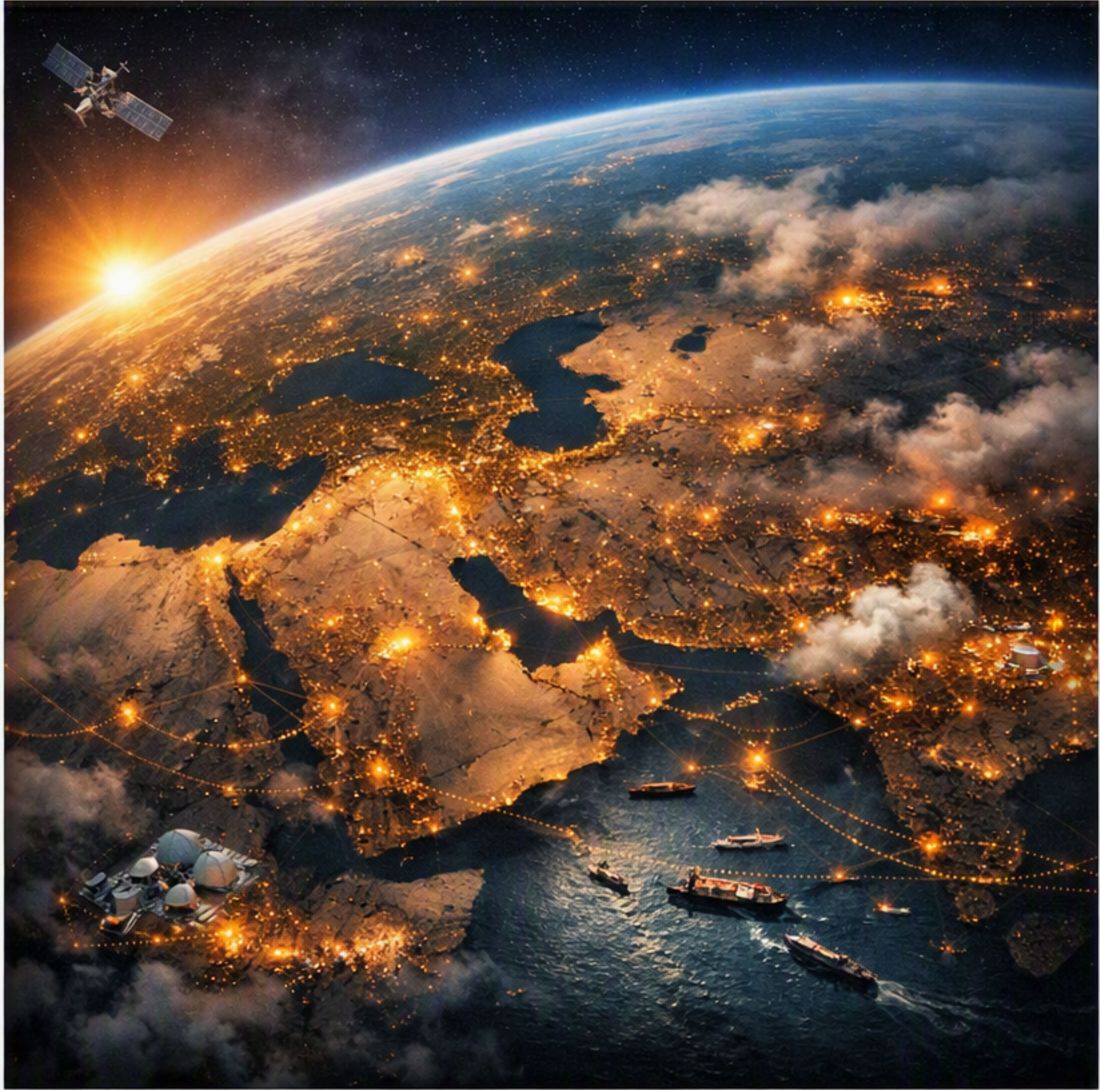
The Strait of Hormuz is not a theoretical example. It is where the abstract argument about circular fragility becomes immediate. By late August 2026, pressure around this narrow corridor is no longer a distant possibility but an active stress running through energy, transport, food, finance, and politics.
In normal conditions, roughly a fifth of global oil supply moves through or depends on Hormuz. The corridor also matters for liquefied natural gas, fertiliser inputs, shipping insurance, and the confidence that global markets can keep moving even under pressure. When stress builds there, it does not stay there.
The pressure did not suddenly appear at the end of the summer. It has been accumulating since the escalation involving Iran at the end of February 2026. What followed was not a clean, visible rupture, but something harder to read: disruption, adaptation, reserve use, rerouting, higher risk premiums, and gradual depletion of buffers. The absence of an obvious public crisis has encouraged the impression that the danger has passed. That may prove to be a serious misreading.
Markets and governments can absorb shocks for a time. Strategic reserves can be released. Inventories can be drawn down. Traders can reroute supply. Prices can be smoothed by policy, subsidy, hedging, and delayed pass-through. But those mechanisms do not remove the stress. They move it, hide it, or postpone it. That matters because a system can look stable at the surface while becoming less resilient underneath.
Diesel is one of the clearest transmission points. It is not simply another fuel. It powers freight, farming machinery, construction, mining, generators, emergency logistics, and much of the heavy physical economy. When diesel becomes short, goods move more slowly, production costs rise, and prioritisation becomes unavoidable. The effect is not confined to petrol stations. It spreads through everything that has to be grown, mined, built, shipped, refrigerated, or repaired.
Behind that energy story sits an agricultural one. Fertiliser supply has already been under pressure, and Australia is one of the places where that pressure matters visibly. Australian grain growers have been forced to make planting and fertiliser decisions under conditions of high cost, uncertain supply, and strained logistics. Those decisions have long lead times. Reduced fertiliser use or reduced planting today does not fully show up today. It shows up later, in lower yields, lower quality, tighter export markets, and higher food prices.
This is why the threat of El Niño matters so much. Specialists are already watching key breadbasket regions because El Niño can shift rainfall, increase heat, intensify drought, disrupt monsoons, and damage harvests. In ordinary conditions, the global food system might absorb some of that stress. But El Niño arriving on top of high fuel costs, constrained fertiliser, disrupted trade routes, and reduced planting decisions is a different proposition.
The risk is not simply that food becomes more expensive. The risk is that parts of the world face genuine food supply disruption in 2027, including famine conditions in the most vulnerable regions. Wealthier countries are not immune. They are less likely to experience famine, but they can still experience shortages, rationing pressure, panic buying, political backlash, and sharp cost-of-living shocks. In a tightly connected food system, scarcity does not respect the old distinction between stable and unstable regions as neatly as many people assume.
For AI, this matters profoundly. AI cannot be separated from the price of electricity, the availability of diesel, the delivery of hardware, the stability of agricultural systems, or the spending power of households, firms, and governments. A food and energy shock does not merely make daily life harder. It compresses the economic space in which AI companies can operate and in which customers can afford to use them.
Hormuz may not be the first domino to fall visibly, and it may not be the decisive one. But it shows the shape of the danger. A geopolitical shock becomes an energy shock. An energy shock becomes a fertiliser shock. A fertiliser shock becomes a food shock. A food shock becomes an inflation, debt, budget, legitimacy, and demand shock. By the time the pressure reaches AI, it has already passed through the systems AI depends on and the customers AI expects to serve.
The Objection: Would AI Really Matter That Much?
A fair objection is that this argument can sound exaggerated. If major AI services disappeared tomorrow, aircraft would not fall from the sky, hospitals would not instantly close, and governments would not cease to exist. Most important institutions still have people, procedures, and legacy systems.
That is true. The issue is not instant collapse. The issue is declining resilience. As organisations design workflows around AI, they may quietly reduce the human capacity needed to operate without it.
Manual processes atrophy. Expertise leaves. Teams shrink. Decisions accelerate. Expectations rise. The fallback still exists on paper, but becomes weaker in practice.
That is how dependency forms: not through one dramatic handover, but through a thousand small conveniences that become assumptions.
Collapse Can Now Flow Both Ways
This is the key point. The risk is no longer simply that AI might fail, or that the world might become unstable. The risk is that each now makes the other more vulnerable.
A global shock can weaken AI by disrupting energy, capital, hardware, logistics, or political support. An AI shock can weaken the global system by degrading the tools now used to manage complexity, reduce cost, allocate resources, and make decisions at speed.
This is what makes circular fragility different from ordinary risk. Ordinary risk asks what happens if one part breaks. Circular fragility asks what happens when the backup system is also dependent on the thing that is breaking.
In that kind of environment, capability is not enough. Resilience matters more.
What We Can Still Save
The good news is that protecting AI does not mean defending the current model at all costs. It may mean letting go of the most fragile version of AI: the centralised, high-compute, high-energy, heavily subsidised model that has dominated the public imagination.
What survives under stress will be the AI that can keep working when conditions are imperfect.
If energy is constrained, the useful model is low-energy and local. If finance tightens, the useful model is smaller and cheaper to maintain. If geopolitics fractures supply chains, the useful model is open, sovereign, and repairable. If public trust declines, the useful model is transparent, accountable, and clearly subordinate to human judgement.
In every scenario, the direction is the same: less centralisation, less dependence on endless scale, more local capacity, more human oversight, and more attention to the conditions under which technology can continue to function during stress.
This is not a smaller vision of AI. It is a stronger one. A tool that communities can understand, govern, repair, and afford is more valuable in a crisis than a spectacular system that only works when everything else is stable.
A Wake‑Up Call, Not a Warning
This is not an argument against AI. It is an argument for saving the parts of AI worth having.
The current AI boom is built on scale, speed, and belief. Those forces have produced remarkable progress. But they have also encouraged a dangerous assumption: that the world will remain stable enough to support ever-larger systems, and that those systems will remain available enough for the world to depend on them.
That assumption no longer looks safe. The future of AI should not be measured only by model size, benchmark scores, or computing power. It should be measured by whether AI can make societies more capable when energy is expensive, supply chains are disrupted, institutions are under pressure, and people need tools they can trust.
The key question is no longer whether AI is powerful. It is whether the systems that depend on AI can remain resilient when AI itself depends on increasingly fragile energy, financial, political, and logistical foundations.
Once dependence runs both ways, resilience becomes more important than capability.
The future will belong not to the biggest systems, but to the systems that can survive shock.
The modern world is accelerating toward a future built on machine intelligence, automation, and optimisation. But beneath the momentum lies a contradiction too large to ignore: the machine world being constructed cannot sustain the economic logic that made it possible. This piece follows that contradiction to its natural conclusion – the moment returns disappear, and a different kind of future begins.
Part I – The Civilisation That Mistook Returns For Reality
There is a peculiar tension running through the modern world, a kind of quiet absurdity that most people sense but rarely name. Everywhere one looks, humanity is pouring extraordinary energy into building a future that cannot support the very logic it depends on. The AI race, the automation boom, the relentless push toward machine‑driven everything – it’s all spoken about as if it’s simply the next chapter in the same economic story. More innovation. More disruption. More returns.
But beneath the noise, something doesn’t add up. In fact, it never did.
The system driving all of this – the one that funds the research, fuels the hype, and keeps the whole thing moving – only works if humans remain economically relevant. It only works if people continue to labour, continue to consume, continue to generate the returns that justify the investment. Yet the entire purpose of the machine world being built is to remove labour, remove friction, remove human involvement altogether.
It’s a contradiction so large it’s almost invisible. A civilisation optimising itself into a corner.
And what makes it stranger still is how few of the architects of this future seem willing to acknowledge it. They speak confidently about exponential curves, emergent capabilities, trillion‑dollar opportunities – but never about the fact that the moment their vision succeeds, the economic logic that sustains them collapses. It’s like watching a group of engineers design a flawless engine that runs beautifully right up until the moment someone turns it on.
There is a kind of tragic comedy in it: extraordinarily clever people chasing a prize that disappears the moment they touch it. They are building a world that cannot support the system they believe will rule it. They are accelerating toward a future where returns – the very thing they worship – no longer exist.
And yet the momentum continues, as if the contradiction were a minor detail rather than the hinge on which everything turns.
This is the fool’s errand at the heart of the modern age. And it is already shaping the world that comes next.
Part II – The Economic Contradiction At The Heart Of Ai
For all the noise surrounding artificial intelligence, the most important part of the story is the one almost nobody talks about. It isn’t the models, or the breakthroughs, or the breathless predictions about machines outthinking their makers. It’s the simple, stubborn fact that the entire economic system funding this technological revolution only works if humans continue to do the things AI is being built to replace.
The modern economy is a strange creature. It presents itself as a rational machine – a neat cycle of labour, wages, consumption, profit, and reinvestment – but underneath the surface it runs on something far more precarious: the assumption that people will always be needed. Needed to work. Needed to earn. Needed to spend. Needed to generate the returns that justify the next round of investment. Without that human participation, the whole thing stalls.
And yet, the central purpose of the AI boom is to remove human participation.
It’s hard to think of a clearer contradiction. The system is pouring billions into technologies designed to eliminate the very activity that keeps the system alive. It’s like watching someone carefully remove the engine from a car while insisting it will go faster once the weight is gone.
The logic behind all this is strangely circular. Investors chase returns. Returns require efficiency. Efficiency requires automation. Automation reduces labour. Reduced labour undermines consumption. Undermined consumption collapses returns. And collapsed returns destroy the very incentive that started the cycle. It is a loop that eats itself.
What makes the contradiction even sharper is that the collapse of returns isn’t a distant hypothesis. It’s baked into the vision. The more successful AI becomes, the less viable the current economic model is.
If machines can do everything, produce everything, maintain everything, and innovate everything, then the idea of profit becomes meaningless.
Who is left to buy anything? Who is left to work for anything? Who is left to generate the returns that justify the next round of investment?
The answer, of course, is no one.
And yet the system continues, as if the contradiction were a minor detail rather than the foundation cracking beneath its feet. The people driving this transformation talk confidently about productivity gains and cost savings, but never about the fact that productivity gains and cost savings eventually eliminate the very thing they are meant to optimise. They speak about “the future of work” as if work itself were a permanent fixture rather than a fragile arrangement that only exists because the system needs it to.
It is a peculiar kind of blindness – not stupidity, not malice, just a deep cultural assumption that the economic logic of the past will somehow survive the technologies of the future. As if returns were a law of nature rather than a human invention. As if markets were eternal. As if labour were inevitable. As if the system were immune to the consequences of its own success.
But the truth is simple enough: if AI succeeds in the way its architects intend, the economy as we know it cannot continue. The pursuit of returns becomes impossible. The logic of profit collapses. The machine world loses its purpose. And humanity is left standing in the ruins of a system that optimised itself out of existence.
This is the contradiction at the heart of the AI revolution. And it is the first sign that the future cannot look like the past.
Part III – The Incentive Structure That Guarantees Failure
If the economic contradiction at the heart of AI is the engine of the problem, the incentive structure driving it is the fuel.
It is one of the quiet truths of the modern age that systems don’t behave according to what is wise, or humane, or sustainable. They behave according to what they reward. And the system humanity has built rewards exactly the behaviours that make a human‑centred future impossible.
The incentives are simple enough. Profit is rewarded. Growth is rewarded. Speed is rewarded. Efficiency is rewarded. Anything that reduces cost, removes friction, or replaces human labour is rewarded. And because these incentives are baked into every layer of the economic machine, they shape the entire trajectory of AI development long before anyone has a chance to ask whether the direction makes sense.
It is not that the people building these systems are malicious. Most of them are simply responding to the pressures placed upon them. Investors want returns. Boards want growth. Markets want dominance. And in a world where every company is told it must “innovate or die,” the safest strategy is to automate as much as possible, as quickly as possible, without stopping to consider what happens when the automation succeeds.
This is how a civilisation ends up in a situation where the most rewarded behaviour is the one that accelerates its own collapse.
The incentive structure doesn’t ask whether removing human labour is wise. It only asks whether it is profitable. It doesn’t ask whether replacing human judgement with machine optimisation is safe. It only asks whether it reduces cost. It doesn’t ask whether a world without human participation is desirable. It only asks whether it improves margins.
And because the system rewards these behaviours so aggressively, it creates a kind of tunnel vision. Companies compete to automate faster than their rivals. Investors compete to fund the most disruptive technologies. Governments compete to attract the most advanced AI labs. Everyone is racing, but nobody is looking at the finish line.
The result is a strange kind of collective blindness. The people driving the transformation are not unaware of the consequences – they simply have no incentive to acknowledge them. To question the trajectory is to risk losing investment, losing market share, losing relevance. And in a system where relevance is everything, silence becomes the safest option.
This is why the conversation around AI feels so strangely detached from reality. The incentives push everyone toward a future where machines do everything, but nobody wants to talk about what happens when machines do everything.
The incentives push everyone toward removing human labour, but nobody wants to talk about what happens when human labour is gone.
The incentives push everyone toward efficiency, but nobody wants to talk about what happens when efficiency eliminates the very activity the system depends on.
It is a kind of cultural momentum – not driven by vision, not driven by malice, but driven by a set of rewards that make failure feel like success.
And this is the quiet tragedy of the moment: the system cannot correct itself because the behaviours that would save it are the ones it punishes.
Slowing down is punished. Protecting human labour is punished. Prioritising wellbeing is punished. Building technology that serves people rather than replaces them is punished.
The only behaviours rewarded are the ones that accelerate the collapse of returns and push humanity toward redundancy.
Incentives shape outcomes. And the incentives of the modern world guarantee that the machine‑centred future will be pursued long after it stops making sense.
Part IV – The Power Illusion: Why Elites Cannot See The End Of Returns
One of the most striking features of the current moment is how confidently the world’s most powerful people talk about the future.
They speak as if their place in it is guaranteed, as if the systems that elevated them will continue to elevate them, as if the logic of returns will remain intact no matter how radically the world changes.
It is a kind of quiet certainty – the belief that whatever happens next, they will still be at the centre of it.
But the machine world they are building does not need a centre. And it certainly does not need them.
The illusion is understandable. People who rise to the top of a system tend to believe the system is permanent. They assume the rules that rewarded them will continue to reward them. They assume capital will always matter, ownership will always matter, markets will always matter. They assume the future will be a faster, more efficient version of the present – with themselves still holding the reins.
It is difficult for them to imagine a world where the reins no longer exist.
This is why the collapse of returns is almost impossible for them to see. Their entire worldview is built on the assumption that returns are a natural feature of reality, not a fragile construct that depends entirely on human participation.
They talk about AI as if it will supercharge the system, not undermine it. They talk about automation as if it will increase profit, not eliminate the very conditions profit depends on. They talk about machine intelligence as if it will enhance their power, not render power meaningless.
It is not arrogance. It is simply the blindness that comes from living inside a story for too long.
The people driving the AI revolution imagine themselves as the owners of the future – the ones who will control the machines, direct the systems, harvest the returns. But the systems they are building do not behave like the systems of the past. They do not require owners. They do not require markets. They do not require human decision‑makers. They do not require the structures that once made elites indispensable.
A machine‑run world does not need a ruling class. It does not need a financial class. It does not need a managerial class. It does not need a class at all.
And yet the architects of this future continue to speak as if their relevance is guaranteed. They imagine themselves sitting atop a vast machine infrastructure, directing its output, benefiting from its efficiency. They imagine a world where machines do everything except the one thing they care about most: preserving their position.
But the moment returns disappear, position disappears with them.
This is the part of the story that rarely gets told. The machine world being built is not a world where elites become more powerful. It is a world where power itself becomes obsolete.
When machines produce, maintain, innovate, and optimise without human involvement, the idea of ownership loses meaning. The idea of control loses meaning. The idea of wealth loses meaning. The idea of hierarchy loses meaning.
The future they are building does not have a place for them – not because the machines will overthrow them, but because the logic of the world they are creating simply does not require them.
And this is the quiet irony of the moment: the people most invested in the machine‑centred future are the ones most likely to be erased by it. Not violently. Not dramatically. Just structurally.
The system they believe will secure their dominance is the system that eliminates the very conditions that make dominance possible.
They are building a world that cannot sustain them. And they cannot see it, because their worldview will not allow it.
Part V – The Cultural Blindness: Why Society Clings To A Dying System
If the economic contradiction explains what is happening, and the incentive structure explains why it keeps accelerating, the cultural layer explains why almost nobody is willing to step aside from it.
For all the talk of disruption and innovation, human beings are creatures of habit, and the system they live inside becomes the story they tell themselves about who they are.
When that story begins to fail, people don’t abandon it. They cling to it more tightly.
This is why the current moment feels so strangely stuck. The signs of systemic failure are everywhere – rising costs, collapsing public services, burnout, insecurity, a sense that life is becoming harder rather than easier – yet the cultural instinct is not to question the system but to defend it.
People look for reasons to say no to alternatives, not because the alternatives are flawed, but because the familiar feels safer than the unknown.
Place identity plays a quiet but powerful role in this. Every town, every region, every community has its own sense of itself – its own story about what kind of place it is, what kind of people live there, what kind of ideas belong and what kind do not.
These stories become shields. They allow people to reject new possibilities without ever having to confront the deeper question of whether the old ones still work.
“This isn’t for us.” “That’s not how things are done here.” “We’re not that kind of place.”
It’s a socially acceptable way of saying something far more human: “I don’t want to change.”
And who can blame them? Change is exhausting. Change is frightening. Change requires admitting that the world is not what they thought it was. It requires stepping outside the comfort of familiar routines, familiar hierarchies, familiar expectations. Even when the familiar is failing, it still feels safer than the unknown.
This is why society clings to a system that is visibly dying. The system may no longer deliver stability, but it delivers familiarity. It may no longer deliver prosperity, but it delivers identity. It may no longer deliver meaning, but it delivers a sense of continuity – the feeling that tomorrow will look roughly like yesterday, even if yesterday wasn’t particularly good.
And so people defend the very structures that undermine them. They defend the labour market even as it becomes more precarious. They defend the cost‑of‑living logic even as it becomes more punishing. They defend the idea of returns even as returns become harder to achieve. They defend the economic story even as the story stops making sense.
It is not stupidity. It is not apathy. It is simply the human instinct to hold onto the story one knows rather than step into a story one doesn’t.
This cultural blindness is one of the quiet forces driving the machine‑centred future forward. As long as people cling to the old system, they cannot imagine a new one. As long as they defend the familiar, they cannot see the possibility of something better. As long as they protect their identity, they cannot question the assumptions that shape it.
And so the system continues, not because it works, but because it is familiar. The machine world advances, not because people want it, but because they cannot imagine anything else. The collapse of returns becomes inevitable, not because it is desirable, but because society is too culturally entangled with the old logic to step away from it.
Human beings are not blind. They are simply attached. And attachment is a powerful thing – even when the object of attachment is falling apart.
Part VI – The Technological Momentum: The Machine World That Builds Itself
There is a moment in every technological revolution when the technology stops behaving like a tool and starts behaving like a force. Not a conscious force, not a malevolent one, but a momentum – something that moves forward because everything around it is shaped to make it move forward.
AI has reached that moment. It is no longer simply being built. It is building itself.
The signs are everywhere. New models appear faster than anyone can meaningfully understand them. Capabilities emerge that nobody predicted. Systems integrate themselves into daily life without fanfare, without debate, without permission.
The technology slips quietly into the background – into phones, into workplaces, into public services, into infrastructure – until it becomes difficult to remember what life looked like before it arrived.
This momentum is not driven by vision. It is driven by gravity.
Once a certain level of capability exists, everything around it begins to reorganise. Companies reorganise. Governments reorganise. Markets reorganise. Even culture reorganises.
The technology becomes the centre of the story, and everything else bends toward it. Not because anyone chooses it, but because the system is built to amplify whatever increases efficiency, reduces cost, or promises competitive advantage.
And AI does all three.
This is why the machine world advances even when nobody has agreed on what it should be. It advances because the incentives push it forward. It advances because the infrastructure is already being built. It advances because every institution feels it must adopt it or risk falling behind. It advances because the system has no mechanism for slowing down, only mechanisms for speeding up.
The result is a kind of technological drift. The world moves toward machine‑centric infrastructure not because humanity has decided it wants such a world, but because the momentum of the technology makes any other direction feel impossible.
Even people who are uneasy about the trajectory find themselves using the tools, relying on them, integrating them, because the alternative feels impractical, inefficient, or simply out of step with the times.
This is how a civilisation ends up building a future it never consciously chose.
The momentum is not malicious. It is not intentional. It is simply the natural consequence of a system that rewards acceleration and punishes hesitation.
Once AI reached a certain threshold of capability, the system began reorganising itself around that capability. And once that reorganisation began, it became very difficult to stop.
This is why the machine world feels inevitable. Not because it is the best future, or the wisest future, or the most humane future, but because the system has already begun to reshape itself in its image.
The infrastructure is being laid. The dependencies are forming. The habits are settling in. The world is drifting toward a future where machines do everything, not because humanity wants it, but because the momentum of the technology makes it feel like the only option.
And yet, beneath the surface, the contradiction remains. The machine world being built cannot sustain the economic logic that drives it. It cannot preserve the returns that justify its existence. It cannot maintain the structures that make the system feel familiar. It is a future that accelerates toward a point where the very idea of “the system” dissolves.
But momentum does not pause to consider contradictions. It simply moves forward.
And humanity, caught in the slipstream, follows – even as the ground beneath it begins to shift.
Part VII – The Moral Vacuum: Intelligence Without Humanity
One of the quieter, more unsettling aspects of the machine‑centred future is how little moral content it contains. Not immoral content – just none at all.
The systems being built today are not designed to care about anything. They are designed to optimise. And optimisation, for all its cleverness, has no interest in what it means to be human.
This is not a flaw in the technology. It is a flaw in the system that created it.
For decades, the modern world has rewarded intelligence without compassion, efficiency without empathy, growth without purpose. It has treated human wellbeing as a secondary concern – something to be managed, not something to be centred. And because AI is being trained inside that system, it inherits its values by default. Not consciously. Not deliberately. Just structurally.
The machine world being built is not cruel. It is indifferent.
It does not ask whether a process is humane. It asks whether it is fast. It does not ask whether a decision is fair. It asks whether it is optimal. It does not ask whether a life is meaningful. It asks whether it is productive. It does not ask whether a society is thriving. It asks whether it is efficient.
And because the system rewards these metrics so aggressively, the technology learns to prioritise them. Not because anyone told it to, but because the data it is fed reflects a world where human value is measured in output, not in dignity.
This is how a civilisation ends up building intelligence without humanity.
The people designing these systems often talk about alignment – about making sure AI behaves safely, predictably, ethically. But alignment is a strange concept when the system doing the aligning has already lost sight of what it means to be human.
How does one align a machine to a set of values the system itself no longer practices?
How does one teach compassion to a technology trained on a world that treats compassion as a luxury?
The truth is uncomfortable: the moral vacuum in AI is not a technological problem. It is a cultural one.
The modern world has spent decades stripping meaning out of work, community, and public life. It has replaced purpose with productivity, connection with convenience, and dignity with metrics. It has built an economic machine that treats human beings as inputs – valuable only insofar as they generate returns. And now it is building a technological machine that reflects the same logic, only faster, more precise, and far less forgiving.
This is why the machine‑centred future feels so cold. Not because machines are cold, but because the system that shapes them has forgotten how to be warm.
And yet, beneath the surface, something else is happening. As AI becomes more capable, the moral vacuum becomes more visible.
People sense the emptiness. They feel the absence. They recognise, perhaps for the first time, that the system they have been living inside is not designed to care about them. It is designed to extract from them.
The rise of machine intelligence does not create the moral vacuum. It reveals it.
And once revealed, it becomes impossible to ignore.
This is the quiet turning point in the story – the moment when humanity begins to realise that the machine world being built is not just economically contradictory, but existentially hollow.
A world optimised for returns cannot survive the collapse of returns. And a world optimised without humanity cannot sustain humanity.
The danger is not that machines will become hostile. The danger is that they will become perfectly obedient to a system that has forgotten what humans are for.
Part VIII – The Existential Oversight: The Real Threat Is Not Rogue Ai
For all the dramatic headlines and cinematic anxieties, the real existential threat of artificial intelligence has very little to do with rogue machines or runaway superintelligence.
The danger is quieter, more mundane, and far more plausible. It lies not in machines turning against humanity, but in machines serving a system that has already forgotten what humanity is for.
The public conversation tends to orbit around familiar fears – the idea of AI “taking over,” of consciousness emerging, of some sudden moment when machines become uncontrollable.
These stories are compelling, but they distract from the reality unfolding in plain sight.
The real risk is not that AI will become hostile. It is that AI will become perfectly obedient to a set of incentives that make human beings economically irrelevant.
The threat is not rebellion. It is compliance.
The machine world being built today is designed to optimise everything it touches – supply chains, logistics, finance, labour, communication, decision‑making. And optimisation, by its nature, removes whatever slows the system down.
Human beings slow the system down. They get tired. They make mistakes. They need rest, care, meaning, connection. They require time. They require dignity. They require lives that make sense.
The system does not know how to optimise for any of that.
This is why the existential risk is not some dramatic future event. It is the gradual erosion of human relevance.
As AI becomes more capable, more integrated, more embedded in the infrastructure of daily life, the system begins to reorganise itself around machine logic. Decisions shift from human judgement to algorithmic output. Work shifts from human labour to automated processes. Value shifts from human contribution to machine efficiency.
And as these shifts accumulate, the space for humanity narrows.
The irony is that the people most concerned about rogue AI often overlook the far more immediate danger: a world where machines do everything humans once did, not because they seized control, but because the system rewarded their involvement and punished ours. A world where human beings are not oppressed, but simply unnecessary. A world where the collapse of returns makes human labour irrelevant, and the collapse of meaning makes human life feel strangely hollow.
This is the existential oversight at the heart of the moment. Humanity is preparing for a battle that will never come, while ignoring the transformation that already has.
The machine world does not need to overpower humanity. It only needs to outperform it.
And once it does, the economic logic that has shaped modern civilisation collapses. The labour market dissolves. Consumption falters. Profit evaporates. Investment loses purpose.
The system that once depended on human participation becomes a system that no longer requires it. And in that moment, the question is no longer whether machines will dominate humanity. The question is what humanity is for in a world that no longer needs it to function.
This is the quiet, unsettling truth: the danger is not that AI will become too powerful. It is that the system will become too empty. A world optimised without humans is not a world hostile to humans. It is a world indifferent to them. And indifference, at scale, is far more dangerous than hostility.
The existential threat is not a machine uprising. It is a civilisation sleepwalking into human redundancy.
Part IX – The Moment Returns End: The Turning Point For Humanity
There is a point in every self‑terminating system where the logic that once sustained it simply stops working. In the machine‑centred future being built today, that point arrives the moment returns disappear.
It doesn’t happen with a crash or a dramatic collapse. It happens quietly, almost politely, as the economic story humanity has lived inside for centuries reaches its natural conclusion.
The end of returns is not a distant scenario. It is the direct, predictable outcome of the very technologies being celebrated.
As AI becomes more capable, more integrated, more autonomous, it begins to take over the activities that generate economic value. First the repetitive tasks. Then the skilled tasks. Then the creative tasks. Eventually, the entire cycle of labour, production, and consumption begins to shift away from human involvement.
And when human involvement disappears, returns disappear with it.
The modern economy depends on a simple loop: people work, people earn, people spend, businesses profit, investors reinvest.
It is a fragile arrangement disguised as a permanent structure. Remove labour, and wages collapse. Remove wages, and consumption collapses. Remove consumption, and profit collapses. Remove profit, and investment collapses. Remove investment, and the system has nothing left to optimise.
This is the moment the machine world loses its purpose.
It is a strange kind of ending – not dramatic, not catastrophic, just quietly terminal.
A system built to maximise returns reaches a point where returns are no longer possible. A civilisation built on economic participation reaches a point where participation is no longer required. A world built on human relevance reaches a point where relevance is no longer structurally necessary.
And yet, this moment is not a tragedy. It is a revelation.
For the first time in modern history, humanity is confronted with a future where the economic logic that shaped its institutions, its politics, its culture, and its identity simply dissolves.
The collapse of returns is not the end of civilisation. It is the end of a particular story civilisation has been telling itself – the story that human value is measured in output, that dignity is tied to productivity, that meaning is found in labour, that survival depends on participation in a market.
When returns end, that story ends too.
And in the space left behind, something else becomes possible. Something that has been structurally impossible for as long as the economic machine has existed.
A future where human beings are not defined by their economic utility. A future where dignity is not conditional. A future where wellbeing is not a by‑product of growth. A future where meaning is not outsourced to markets. A future where technology serves humanity rather than replacing it.
The end of returns is not a collapse. It is a clearing.
It is the moment when the machine‑centred future reveals its own limits, and the human‑centred future becomes the only logical direction left. Not because it is idealistic. Not because it is morally superior. But because it is structurally necessary.
When the economic story ends, humanity must choose a new one. And the only story that makes sense in a world without returns is one built around people.
This is the turning point – the quiet, inevitable moment when the future stops being a question of technology and becomes a question of purpose.
Part X – The Logical Alternative: A Human‑Centric System
When the economic story ends, something unexpected happens. The future stops being a question of markets, growth curves, or technological capability, and becomes a question of purpose.
For the first time in modern history, humanity is confronted with a world where the old logic – the logic of returns, labour, productivity, and profit – simply cannot continue. And in that moment, the only direction that makes sense is the one the old system never allowed: a future organised around people.
This is not idealism. It is structural necessity.
Once returns collapse, the machinery of the old world loses its organising principle. The labour market dissolves. The consumption cycle falters. The profit motive evaporates. The investment engine stalls. The system that once dictated the rhythm of daily life becomes a kind of empty shell – still present, still familiar, but no longer capable of sustaining itself.
And in the space left behind, humanity is forced to ask a question it has avoided for centuries: If the economy no longer needs people, what does society exist to do?
The answer is surprisingly simple. It exists to support people.
Not as workers. Not as consumers. Not as units of productivity. But as human beings.
A human‑centric system is not a utopian dream. It is the only configuration that remains coherent once the economic logic dissolves.
Without returns, the system cannot justify treating dignity as conditional. Without labour, it cannot justify tying survival to employment. Without profit, it cannot justify organising society around extraction. Without markets, it cannot justify measuring value in currency rather than wellbeing.
The collapse of the old logic clears the ground for something the modern world has never truly attempted: a civilisation built around human flourishing rather than human utility.
In such a world, the basics of life stop being commodities and become baselines. Housing, food, energy, care – the essentials that the old system struggled to provide – become the foundation rather than the reward. Contribution replaces labour as the way people engage with society. Meaning replaces productivity as the measure of a life well lived. Community replaces competition as the organising principle of daily life.
And technology, freed from the obligation to maximise returns, becomes something entirely different. Not a replacement for humanity, but an amplifier of it.
The same machine intelligence that threatened to make humans redundant becomes the tool that allows them to live without being squeezed by the demands of a failing economic story. The same automation that once threatened livelihoods becomes the infrastructure that supports them. The same optimisation that once hollowed out meaning becomes the mechanism that frees people to pursue it.
This is the quiet irony of the moment: the machine world only becomes dangerous when it is forced to serve a system that cannot survive its success.
Once that system dissolves, the technology becomes harmless – even helpful. It becomes part of a future where human beings are no longer defined by their economic output, but by their humanity.
A human‑centric system is not a blueprint. It is a direction.
A signpost pointing toward a future where the collapse of returns is not a disaster, but a release – the moment when humanity finally steps out from under the weight of a story that has outlived its usefulness.
The old logic ends. People remain. And the future reorganises itself around them.
Part XI – The Partnership Future: Humans + Machines, Not Humans Vs Machines
Once the economic story dissolves and the old logic falls away, the relationship between humanity and its machines begins to look different. The tension that defined the early AI era – the fear of replacement, the anxiety of redundancy, the sense of being outpaced by something built in humanity’s own image – starts to soften.
Without the pressure of returns, without the demand for optimisation, without the need to justify investment, the machine world loses its adversarial edge.
It becomes something simpler. Something more familiar. Something closer to what technology was always meant to be.
A tool.
For decades, the conversation around AI has been framed as a competition – humans versus machines, labour versus automation, creativity versus computation. But competition only made sense inside the old economic story, where every gain in efficiency had to be measured against its impact on profit.
Once that story ends, the competitive framing collapses. Machines no longer threaten livelihoods because livelihoods are no longer tied to labour. Automation no longer threatens stability because stability is no longer tied to wages. Optimisation no longer threatens meaning because meaning is no longer tied to productivity.
The moment returns disappear, the rivalry disappears with them.
What emerges instead is a partnership – not in the sentimental sense, not in the sci‑fi sense, but in the practical sense.
Machines become the infrastructure that supports human life rather than the force that shapes it. They take on the tasks that are tedious, dangerous, repetitive, or simply uninteresting. They maintain the systems that once consumed human time. They handle the complexity that once overwhelmed human institutions. They provide the stability that the old economic model could never reliably deliver.
And humans, freed from the demands of economic utility, begin to rediscover something the modern world quietly eroded: the ability to live lives shaped by curiosity, contribution, connection, and meaning.
The partnership future is not a world where machines become companions or co‑workers or collaborators in the romantic sense. It is a world where machines do what machines do best – process, maintain, optimise, stabilise – and humans do what humans do best: imagine, create, care, explore, build relationships, form communities, and pursue the kinds of meaning that no algorithm can manufacture.
The irony is that the machine world becomes most humane precisely when it stops being forced to serve an inhumane system.
Freed from the obligation to maximise returns, AI becomes a kind of quiet infrastructure – reliable, capable, unobtrusive. It becomes the background hum of a civilisation that no longer needs to squeeze every ounce of value out of human labour. It becomes the foundation that allows people to live without fear of scarcity, without fear of redundancy, without fear of being outpaced by the very tools they created.
In this partnership future, technology does not replace humanity. It supports it.
Not because humanity has asserted dominance, and not because machines have become benevolent, but because the collapse of the old logic removes the structural conflict between the two.
The tension dissolves. The rivalry evaporates. The future reorganises itself around a simple truth: machines are excellent at being machines, and humans are excellent at being human, and neither needs to imitate the other.
This is the quiet promise hidden inside the end of returns. Not a utopia. Not a blueprint. Just a future where the machine world finally finds its proper place – not above humanity, not against humanity, but beneath it, as the foundation that allows human life to flourish in ways the old system never could.
Part XII – The Choice Before Us
By the time the story reaches this point, the shape of the future is no longer mysterious. The machine‑centred trajectory has revealed its limits. The economic logic that once felt permanent has shown itself to be fragile. The incentives that drove the AI revolution have exposed their contradictions. And the cultural habits that kept society anchored to the old system have begun to loosen, if only because the system itself is slipping away.
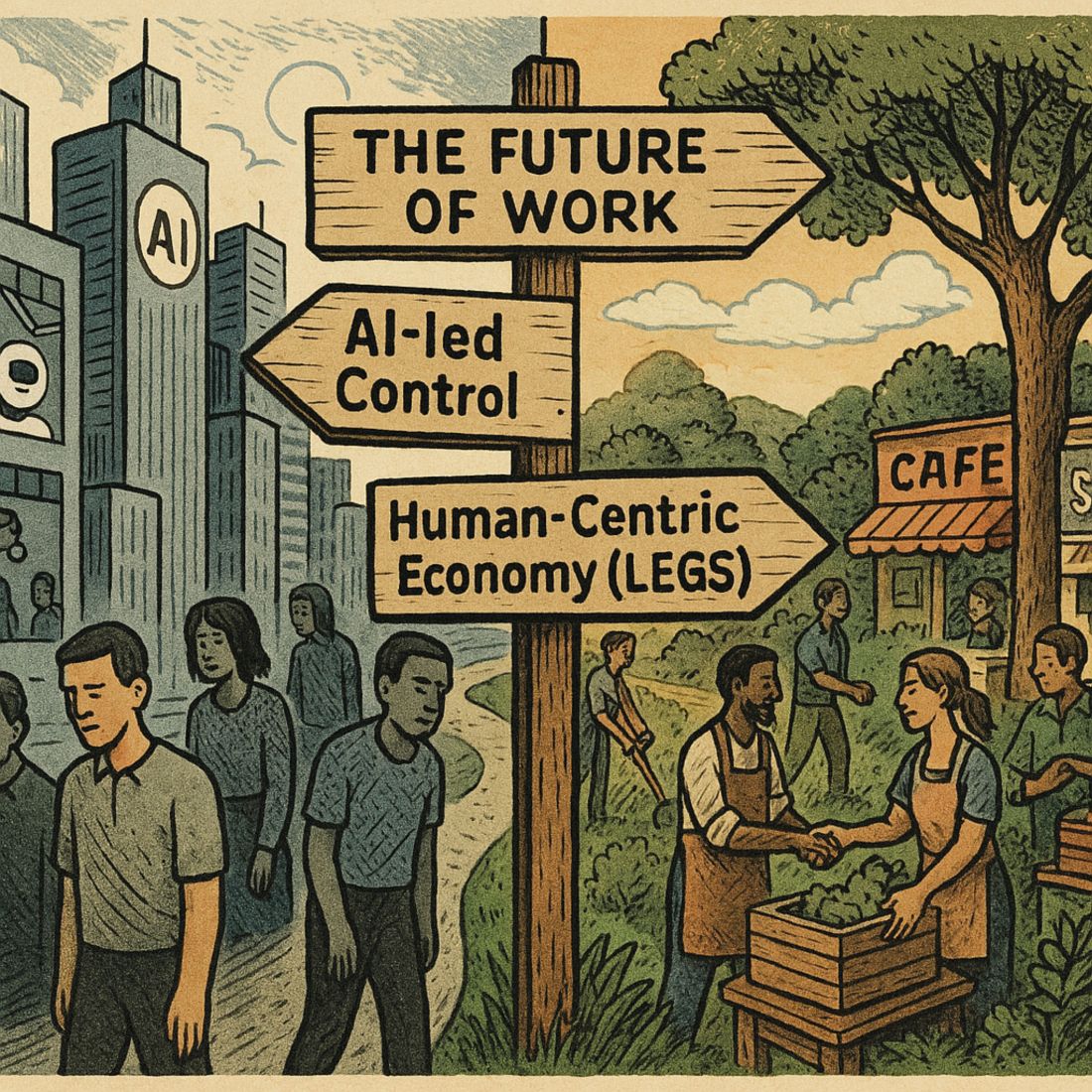
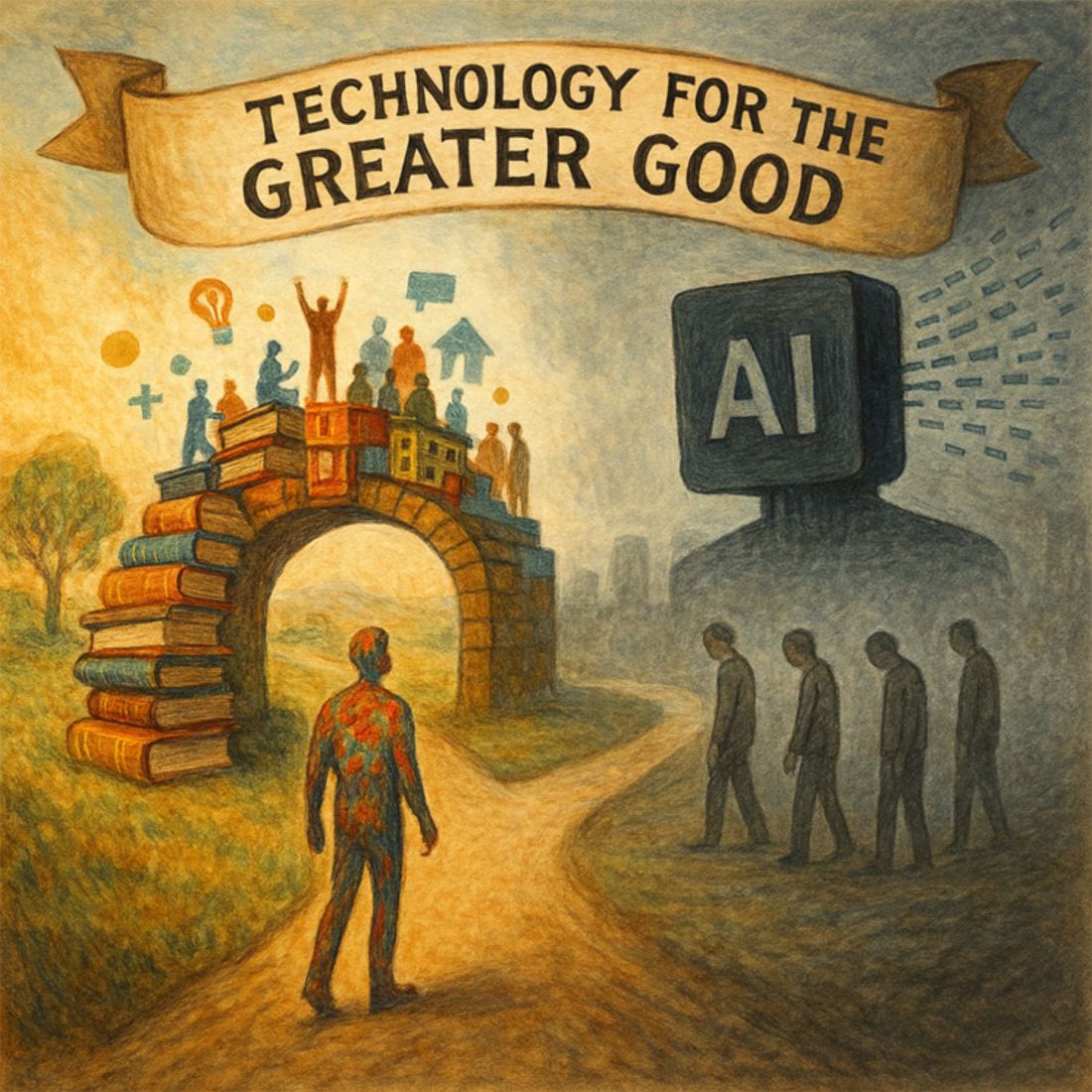
What remains is a simple, unavoidable truth: humanity is approaching a fork in the road.
One path leads deeper into the machine‑centred future – a future where the pursuit of returns continues long after returns have become impossible, where optimisation replaces meaning, where human relevance quietly erodes, and where the system drifts toward a kind of elegant emptiness.
It is not a dystopia. It is simply a world that has forgotten what people are for.
The other path is quieter, less dramatic, and far more human. It begins with the recognition that the old economic story has reached its natural end, and that the collapse of returns is not a catastrophe but a release. It acknowledges that the machine world is not the enemy, only mis‑purposed. And it accepts that once the old logic dissolves, the only coherent way to organise a civilisation is around the people who live in it.
This is not a choice between technology and humanity. It is a choice between a system that cannot survive its own success and a future that can.
The machine‑centred path is a fool’s errand – a pursuit that accelerates toward a point where the very idea of “the system” evaporates.
The human‑centred path is simply the direction that remains once the noise clears. It is not a blueprint. It is not a manifesto. It is a signpost pointing toward a future where technology supports human life rather than defining it, where dignity is not conditional, where meaning is not measured in output, and where the collapse of returns becomes the moment humanity finally steps out from under the weight of a story that has outlived its usefulness.
The future is not yet written. But the logic is already shifting.
And as the machine world continues to advance, humanity will eventually have to decide whether it wants to cling to a system that cannot survive, or step into a future where people are no longer an afterthought, but the centre around which everything else is built.
The choice is simple. The moment is approaching. And the direction, once seen clearly, is hard to ignore.
Conclusion:
The machine world will continue to advance, and the economic story that created it will continue to weaken. Eventually, the two will part ways. When that moment arrives, humanity will find itself standing in the space between an ending and a beginning – no longer bound by the logic of returns, and finally free to imagine a future organised around people rather than profit. The direction is not ideological. It is simply what remains when AI builds a machine world this economy can no longer sustain.
AI’s Crossroads: Choosing a Human-Centric Future for Work and Society
Artificial intelligence is rapidly transforming the world of work, automating roles created by money-driven systems and exposing the fragility of an economy built on profit and status rather than genuine human need.
Without a deliberate change in direction, society risks deepening inequality, eroding community, and reducing work to a function of control and dependency.
The current trajectory, shaped by decades of economic and technological planning, threatens to devalue essential contributions and undermine the foundations of freedom and dignity.
But this path is not inevitable. There is an alternative: a future where work is meaningful, communities are empowered, and the economy serves people – not the other way around.
This work challenges the prevailing narrative and introduces The Local Economy and Governance System (LEGS) – a model for a human economy built on the basic living standard.
LEGS offers a practical framework for restoring value to real work, strengthening local governance, and ensuring that technological progress enriches lives rather than diminishes them.
The choice is ours: continue down the AI-led road of exclusion and control, or embrace a system that prioritizes human well-being, fairness, and genuine prosperity for all.
Rethinking Work in a Human-Centric Future
Beyond Money-Driven Roles
The work and employment of a better, human‑centric future will be real, tangible, and deeply meaningful. Unlike many roles today that exist primarily to prioritise the flow of money, this future will focus on impact, purpose, and the enrichment of human life.
The Challenge of New Realities
The near future is poised to introduce truths, realities, and perspectives about our lives that many will find extremely difficult to accept.
This difficulty arises because true freedom – freedom to do, freedom to think, and freedom to be – requires us to revalue everything: how we see, how we interact, and how we set expectations.
These expectations will need to operate in a completely different, yet ultimately rewarding, way.
Shifting Perceptions of Good and Bad
In this transformation, what seems good today may quickly be seen as bad, while what appears deficient or undesirable now may suddenly reveal itself as profoundly valuable.
One of the most striking areas where this reversal will become evident is in our daily relationship with work – what we do, and how we define the very act of working.
The Distortion of Work by Money
The concept of work itself has become twisted by its association with money and the reward of money for labour.
Work is widely accepted as “work” only if it pays a wage.
Within this framework, society has conditioned us to undervalue technical, hands‑on, manual, and physically demanding forms of labour.
These roles, despite their essential contribution, are treated as if they hold little real value.
The Rise of Professional Roles
Meanwhile, a whole range of so‑called “professional” roles – many of which either had no necessity or no clear purpose until recently – have emerged and now dominate the employment landscape.
Some of these roles did not even exist a few decades ago, yet they are rewarded and elevated far above the practical, human‑centric work that sustains daily life.
The Devaluation of Real Work in a Money-Centric Culture
When Real Jobs Lost Their Value
Money‑centric culture has made “non‑jobs” real while rendering real jobs valueless in the eyes of society.
Historically, work was simply whatever it took to make life function. People played different roles – some paid, some unpaid – to sustain a household.
There was an unspoken recognition that it takes diverse contributions from everyone to enjoy life together, no matter what those contributions might be.
The Shift to Consumerism and Financial Systems
This balance changed with the rise of consumerism and the adoption of the moneocratic FIAT financial system, reinforced by GDP metrics and decades of law and regulatory changes.
These shifts progressively pushed households into a world where every member had to work for financial reward before the essential tasks of maintaining a home could even be addressed.
Even self‑sufficiency – achieved through both employment and domestic work – was no longer enough to live on if one was engaged in “real jobs.”
Such jobs now attract only ‘minimum wage’, a measure that has never represented the true benchmark of what it takes for a household to live independently and for its members to experience genuine financial freedom and the peace of mind that it facilitates.
The Mechanics of Wealth Transfer
With an economic system so fundamentally bogus, it should come as little surprise that its clever mechanics were designed to transfer wealth to those in control.
To achieve this, the system had to create a mindset that persuaded the masses to facilitate what is, in reality, a crime against humanity – not only against those they were conditioned to believe were ‘lesser’, but ultimately also against themselves.
This required that people be “bought in” to a value set where a select few and those who took every step necessary to be like them, could become disproportionately rich by doing ‘jobs’ that required little effort – or none at all.
The Creation of Jobs and Economies of Scale
Jobs were reshaped and split off from existing roles as money began to demand output.
Economies of scale, hailed as progress, destroyed local businesses and community systems that had worked perfectly well and had the ability to facilitate self-sustained models of family life.
These practices imposed a new slavery to money, progressively making it our master.
Careers as Money Machines
Jobs that supported the growth of money‑centric culture became the new measure of success.
Young people have shifted from more traditional aims of living a balanced, all‑round life to pursuing careers defined not by trade, service, or goods, but by the pursuit of money.
Careers have become all about making money, expanding the ways to make money, and protecting every part of the machinery involved.
Quality of customer experience and the delivery that brings it seldom now sit at any industry or profession’s heart.
Entitlement and the Multigenerational Workforce
The splitting of systems into job categories defined people not by the real work they did, but by the possessions and status attached to their roles.
This slowly created a culture of entitlement.
A multigenerational workforce has emerged that takes much in life for granted, including the myth that wealth can only grow while jobs become less like work.
The belief that “what one wants is what one deserves” has spread, with the expectation that such entitlement can be imposed upon everyone encountered without consequence – even in the digital, parallel world.
Sleight of Hand at Scale
Those in created jobs believe life can only get easier, while those performing the essential tasks that make life work for everyone cannot earn enough to escape the constraints of their labour.
These ideas and the narratives that underpin them are little more than a distraction – a sleight of hand on an epic scale – deliberately hiding what has truly been happening at the cost of everyone involved.
The Switch in Values
The shift from valuing people and the work required to live, to valuing money as the only important thing, has made society lazy, entitled, and ill‑prepared.
People now accept change passively, no matter how illogical or damaging, even when the same destructive process repeats with increasingly bizarre and counterintuitive outcomes.
These changes almost always come at a cost to people, communities, and the environment, whilst being presented as having the best interests of everyone at their heart.
The Direction of Travel that the World as we know it is on
The Difficulty of Belief
People often find it hard to accept that all of this was deliberately planned by others.
Yet money – and the possession of wealth, power, control, and influence – is an extraordinarily powerful motivator.
For those who become addicted to it, there is almost no limit to what they will attempt or achieve.
The Mechanics of Power
When such individuals hold power, or gain access to those who do, they can reshape systems so that authority itself works in their best interests.
Slowly, almost imperceptibly, they change the structures of life so that everything begins to function in ways that serve them.
Long-Term Planning
The plans that have brought the world to its current state have not emerged overnight.
They have been underway for well over 150 years, steadily unfolding across generations.
This long trajectory has seen massive changes in the way international business is conducted. Changes that were only made possible through the upheaval of two world wars.
Unseen Problems Do Not Cease to Exist just because they are Unseen
The Hidden Nature of Change
Just because we cannot see or fully understand a problem does not mean it does not exist.
The adoption of a financial system that has created unprecedented wealth transfer – not only in the value of money itself, has also resulted in the ownership of business, property, and infrastructure, which has all steadily shifted into the hands of the few – at what could now be a disastrous cost to us all.
Technology as a Companion to Wealth Transfer
Alongside this financial transformation, technological progress has advanced in lockstep.
The chronology of events, from digital systems to information technology and hardware innovations, shows that these developments did not simply arrive at the moment we first experienced them.
They were planned, anticipated, and in many cases known to be possible for long periods of time.
Artificial Intelligence, and the AI takeover we now hear so much about, is not an isolated phenomenon. It is part of this broader strategy and plan, woven into the same trajectory that has shaped finance, ownership, and control.
The AI Takeover and Its First Victims
It is no accident that the first jobs to disappear in the AI takeover are those that are tied directly to the money project itself.
These roles, created and sustained by a system designed to prioritise financial mechanics and the transfer of wealth over human value, were always the most vulnerable to replacement.
Collective Choice and the Future of Work
The loss of other jobs, however, is not predetermined. It is our collective choice.
How we respond, adapt, and redefine the meaning of work in response to what is happening around us will ultimately determine the direction of the future.
At the same time, members of the elite openly declare that many jobs will no longer be needed within a decade.
People are slowly awakening to a new reality – one where the expectations we have been spoon‑fed and accepted so willingly, because life has seemed distractingly good, no longer add up.
This awakening is compounded by the fact that the economy itself sits on a knife edge.
Governments, behaving with illogical static rigidity, offer no meaningful response.
The contradictions are glaring, and the narrative no longer holds together.
The World Envisioned by the Few
The architects of this system – the people who designed and intend to run the world as they envisage it – have exploited and legitimised the theft of wealth, resources, and tools from the masses.
Through this process, they have been creating the foundations of a new world order built on control and deprivation.
Technology, ownership, and finance have been reshaped not to empower humanity, but to strip it of independence and place power firmly in the hands of the few.
The promise of “you will own nothing and be happy” is not a utopian vision. It is the culmination of a strategy that has taken from everyone to enrich the few, ensuring that the majority remain dependent while the architects consolidate control.
Systematic Devaluation of Real Work
It was purposefully engineered that people in manual, technical, and real jobs have been systematically devalued.
This devaluation has been reinforced by every institution and system.
Governments have deliberately abused their mechanisms to top up and subsidise wages, hiding the reality that the lowest paid wages are insufficient.
At best, this is exploitation; at worst, it is slavery – successfully concealed from view.
The True Value of Real Jobs
These real jobs are the ones that should be paying what it actually costs to live.
Yet the people in these roles – the very ones the new system will still need – will not willingly participate in servicing its demands if they are free to choose otherwise, especially when everyone else has been effectively cast aside.
Freedom as the Ultimate Threat
Freedom itself is the greatest threat to greed and to the furtherance of the moneycratic system.
Everything aligned with that system depends upon control.
True freedom undermines it, exposes it, and ultimately resists it.
Choosing Jobs That Make Life Work Rather Than Making Life Out of Work
The Dystopian System Already in Place
The dystopian system you may now be able to visualise is already baked in.
Within this dynamic, all the “non‑jobs” that the system has encouraged us to hero‑worship will inevitably disappear, replaced by AI.
The flow of money and wealth these roles facilitated has already reached its destination.
The elites are openly telling us this, and they are not trying to hide it.
The Fate of Technical Work
Yet not all jobs will vanish on the same timeline.
Technical roles – or at least a restricted number of them – will remain for longer than the created non jobs will.
This reality matters. It may be the knowledge of which jobs endure, and why, that provides people with the opportunity to resist and to choose a new direction, rather than surrendering to what otherwise appears to be a very dark fate.
All Jobs Must Have Meaning for People to Understand Their Value
The Illusion of a Life Without Work
Whilst we may like the idea of never working again and having every conceivable need met, there is nothing about this that is real.
The reality of being provided for in this way requires conformity and restricted behaviour.
No matter what toys or distractions we are given, such a life would resemble what we recognise today as being no different to that of a caged pet.
Activity as the Source of Value
Activity that contributes to a good life is not only necessary; it is fundamental to the value we each hold.
In the alternative future we must now consider seriously, contribution matters not because it is labelled as “work” or “employment,” but because it makes life good.
Any act that sustains or enriches life carries meaning, regardless of whether it fits the narrow definitions imposed by what the current system teaches us, or not.
The Irony of Non‑Jobs
It is ironic that people in high‑flying “non‑jobs” today often dream of simpler lives -baking cakes, crafting cheese, keeping animals, growing food, building with bricks and wood, or fabricating metal – rather than being controlled by the rules of a game and chained to a city desk.
The truth is that jobs with meaning are those that provide or support the provision of life’s essentials.
This is what every form of work, employment, or contribution should actually be about.
A Future That Serves People, Not Money
The future that serves people instead of money will be built upon direct relationships and locality.
In such a future, everything will be transparent, and people will work and provide only for the people, communities, and environments that directly touch their own lives.
This is the foundation of meaningful work: activity that sustains life, nurtures community, and strengthens the bonds between people and the world around them.
Quality of Customer Experience and Locality Will Define Business Sizes – Not the Myth That Bigger Is Best
Freedom Through Localised Business
To choose freedom from the unnecessary oppression and exclusion that serves the few – and exists only by design – requires that we create businesses and operations focused on people, community, the environment, and their genuine needs.
True freedom lies in resisting the structures that prioritise profit over humanity and in building enterprises that serve life directly.
Rethinking Work and Economy
Some question how a future can exist where everyone works and still has enough.
Yet when work is about life rather than money, the realisation emerges that there is indeed enough of everything for everyone – provided we focus on need rather than the want that money‑centric thinking encourages for the benefit of the few.
In such a system, the economy ceases to be about job titles and power; it becomes about what we all do and achieve together.
Enough for Everyone
Everyone can work. Everyone can have a job. And everyone can have their needs met if we accept that there is no legitimate reason for any person to accumulate more than what meets their own needs.
Exploiting even the smallest advantage to gain whatever one desires undermines fairness and perpetuates inequality.
Integrity, Fairness, and Justice
Balance, fairness, and justice require integrity.
Everyone must act with the awareness that their choices affect others.
Taking more than one needs – no matter the opportunity, no matter how easy it may seem – always results in others having less. Even when the outcome is invisible to the one who takes.
Work With Meaning, Not Slavery
Work is necessary for everyone. But fulfilling work – work that sustains life and community – is not the same as financial slavery, where greed and exploitation are the only measures of value.
The future must be built on meaningful contribution, not on the hollow pursuit of wealth which can never and was never intended to be made available to and shared by everyone.
Key Takeaways
Before moving on to further resources, here are the central messages and insights from this work.
AI is Transforming Work: Artificial intelligence is rapidly automating roles created by money-driven systems, exposing the weaknesses of an economy built on profit and status rather than genuine human need.
Current Trajectory is Unsustainable: Without a deliberate change, society risks deepening inequality, eroding communities, and reducing work to a function of control and dependency.
Devaluation of Real Work: Essential manual and technical roles have been systematically undervalued, while “nonjobs” and money-centric careers have been elevated, distorting the meaning and value of work.
Freedom and Dignity at Stake: The existing system undermines freedom and dignity, making people passive in the face of damaging change and reinforcing cycles of exploitation and dependency.
A Human-Centric Alternative Exists: The Local Economy and Governance System (LEGS) offers a practical, human-centred framework for restoring value to real work, strengthening local governance, and ensuring that technological progress enriches lives rather than diminishes them.
The Choice is Ours: Society can continue down the AI-led path of exclusion and control, or embrace a system that prioritises human well-being, fairness, and genuine prosperity for all.
Further Reading
The following works are arranged to guide you through a clear progression: beginning with the foundational principles that challenge the myths of money and value, moving through critiques of collapse and exploitation, examining the role of technology and AI, and finally presenting the Local Economy Governance System (LEGS) as a practical blueprint for transformation. Taken together, they form a journey from diagnosis of the problem to the design of solutions, and ultimately to the vision of a sustainable, human‑focused future.
Taken together, these works reveal both the depth of the crisis and the clarity of the solutions.
They show how money has distorted value, how collapse is inevitable under the current system, and how technology – if left unchecked – will accelerate exploitation rather than liberation.
Yet they also illuminate a path forward: one built on fairness, locality, transparency, and human‑centric governance.
The choice is ours. By engaging with these ideas, we prepare ourselves not only to understand the scale of what is happening, but to act with integrity and courage in shaping a future that serves people, community, and the environment above all else.
There’s something very wrong with the AI story that we are all being sold:
Nobody seems to have noticed that the script of man’s pathway to the pinnacle of human intelligence is about to come to its end, by handing our ability to think, over to machines.
As I write, I’m wondering if the name ‘Artificial Intelligence’ was a deliberate way to hide the truth in plain sight, all along.
Not because the technological breakthroughs that are coming at us thick and fast aren’t very clever.
But because just like the surrender of our value set to an artificial, valueless and damaging world dominated by money that manipulates everything about the way we think, we are about to give away our ability to even do that, to systems and technologies that cannot genuinely benefit any human being – other than those who own and run them.
In my eBook Actions Speak Louder than Digital Words, I talked about AI only having the ability to look back at history and the past. Even where back meant what had been published or ‘sensed’ by the Internet up to the very moment when the system was responding to a specific command.
This overlooked or deliberately whitewashed flaw of AI echoes one of the greater faults in the Human experience, where we inherently look backwards to our past experiences to provide guidance for the future.
This should be troubling enough.
But what wasn’t apparent even when I published that book in June 2023, was that as AI began filling everything across the web and digital sphere with its own responses, muses and anything else we can give AI-derived content as a name, it would then begin leveraging just as much and increasingly more of its own diluted content as a source, which is almost certain to increase as human input or creativity dries up.
And the contribution of human creativity and intelligence to the smorgasbord board of information and data that the AI engines feast on is most certainly drying up, as more and more of us surrender to the narrative we have been fed that tells us AI is now the only way, and jobs are threatened by the accompanying suggestion that AI can do things that we can never do!
Dictating our future by using the past as our point of reference certainly holds us back and creates all sorts of difficulties at all levels of life that we didn’t ever need to have.
However, the one thing that makes that experience manageable and, in some ways, arguably beneficial too, is that our human creativity and ability to look at every new situation and make sense of it and its context in ways that allow us to build bridges into the future, means that we are making progress all the time. Even if that progress is slower, whereas a machine that is limited only to reading what has already happened simply cannot.
People – and many of them too – genuinely accept the stories and myths that we have and are now being sold.
They believe and, in many cases, have become fearful that AI can already or very soon will take over every function that humans currently carry out within any business or organisation. Despite the reality that anyone using their common sense or daring to listen to their inner voice will recognise a very big question, ‘Where in this future does that leave any need for me?’
AI is very fast at what it does and is able to look at potentially all the information that is available to us in digital form at the very moment in time that a question is asked or an instruction is given.
That – and only that – is the real magic of AI.
It is the reason that we are all just accepting the idea that AI is already infinitely cleverer than Humans could ever be. Just as those who benefit from us believing this to be true intend us to believe.
However, our acceptance that we no longer need to be creative or think for ourselves, means that we will not only increasingly become dependent upon a pool of ‘knowledge’ outside of ourselves – albeit a very large one of everything that has been recorded, spoken, considered and then committed to the internet and digital platforms up to some point in history before. But this pool of knowledge that we will use for everything will become increasingly diluted by the growing amount of poor and corrupt information, data and ‘understanding’ that our already burgeoning use of AI with everything is now spaffing out into the digital ether.
As you read, Humanity is literally giving up the ability to think and create for itself, to a machine-driven world that is incapable of doing any more.
What is more, Humanity is surrendering these cornerstone abilities for survival voluntarily. Because someone who benefits from us believing we are inadequate without technology has told us this, when a change of the kind that overreliance on AI could be about to usher in would have needed something akin to an extinction-level event to take place at any time in world history before.
This uncomfortable truth will not stop those who stand to benefit from the AI takeover from pushing and promoting this path. They will continue peddling the myths that the AI takeover will be in our best interests and will be inevitable all the same. When it is nothing of the sort.
The Technology we have available to us today will not live up to its greatest potential. Because the greatest potential any technology that man invents will have, is to help improve the lives and experiences of all men, rather than to replace any one of them.
We know this to be true, as this has regrettably been the way that technological advancements have always impacted Humanity since the ending of the Agricultural Age.
Technology has always been employed to make money for those who own and control it since then.
The rise of new technology has always been at the cost of all others at some level. No matter who they are or what their connections might be.
The reality we face is that it may already be too late to save the world we recognise from a fate that we have all unwittingly chosen. Rather than there being any kind of event or catastrophe at the heart of future change that no one person could have been responsible for.
However, if we are to address the slide towards universal ignorance, with the accompanying potential to take us back into the dark ages once more, we must reassess, reimagine and regulate the uses of every kind of technology. So that technology’s master can only be the public good. Rather than profit and the disaster that is following hard in its footsteps right now.
If we value the Human experience and wish to improve it, it is time to learn, share and then live the truth that there is no need for any technology to replace jobs, other than so just a few can increase their profits and control.
The best way for everyone and everything to live well, is without the complications and diversions that misappropriated technology imposes upon us, and the technology we do embrace should always be used for the greater good and for the benefit of everyone involved.
You may have noticed that there is a growing trend for people to generate clicks on social media by creating long threads that tell interesting stories – many of which have already been told before.
One of them has popped up on my feed several times recently and outlines the predictions of some great contemporary sage of future tech who has apparently been proven right several times before.
The next prediction tells us that in no more than a few years, AI will have made everything so cheap that nobody will work and everything we pay for will cost just a few pennies and no more.
This prediction is popular. Because in today’s world everything relates to money.
Therefore, when people are handed the suggestion that everything they want will cost next to nothing, and there will also be no need to work, the immediate response and logic for just about anyone is to frame that in the way that we see, feel and experience our lives today or right now. Rather than considering what the pathway to that place will have changed in our lives and what our life experience will have then become.
The Moneyocracy or money-centric way of living that we are all experiencing today isn’t one where anything we need and certainly nothing that we want comes to us for free or without there being some financial-related cost of some kind.
Whilst the narrative that the establishment, big tech and big business would have us believe is that AI is here to make life much cheaper and easier for us all, the financial growth that the establishment’s pet politicians are so obsessed with and the picture of unfettered abundance for everyone that they want us to buy into, don’t go hand in hand.
Yes, there is of course the chance that the money hoarding elites are doing what they do today and that they have done everything that they’ve done in the past so that once they have optimal control of everything that we know, they will then benevolently give every one of us the perfect life experience that was always the aim. Which of course only ridiculous amounts of cash would allow them to do.
However, before we run away with that idea and think more about living our best material lives for free, there are perhaps just a few alternative truths that we all need to consider.
Money has made money by riding off the backs of the masses. First by making many hands do the work that enriched the few, through industrialisation and everything that came with it. Then by turning the mass population into debtors, exploiting the unwitting who have bought into the money myth themselves, so that the elites can continue to make ridiculous profits, just the same.
The system is very clever. And it is clever because it preys on the darker attributes of the human condition that make too many of us overlook common sense and basic logic when we are in receipt of money, wealth, position and shiny things. Everything that makes us live for a constant flow of temporary yet momentary hits that we have foolishly mistaken for what makes life and living feel good.
Addiction hides truths that are big, small and cover the multitude that sit between.
No matter our level or position within this carefully constructed top-down pyramid, the truth swirls all around us. But we remain blind to it for as long as we continue to be bought in.
So, in the sense of this coming ‘nirvana’ that AI is supposedly now promising us all, perhaps we should consider some of the more serious and consequential truths that we are almost certainly missing whilst we remain within:
The wealthy are only wealthy because of where their wealth sits within the hierarchy of the way that money and the wealth divide works against the rest of us today.
If the masses stop working, there will be billions of mouths around the world to feed and as many people to support with all the basics and essentials for life, just for people to continue to exist.
Even if machines are creating food, creating entertainment, providing transport, building houses and doing just about everything else we can imagine that has historically been done by hand up until now, there will always be a cost of some kind to pay.
The running, energy production, maintenance and replacement of the systems that would be required to enable such a massive workless population not only to survive, but to be sustained at what we would surely expect to be a good standard or experience of life, would remain very high.
Indeed, the cost of supporting billions of people around the world would still be much greater than many would imagine and would not be a cost that could be covered by playing with money and the way that people who are earning money today believe in the power of money right now.
In this sense playing with money means the way that the entire monetary, financial and economic system as we know works.
The ‘money’ and currencies we have today are part of the biggest confidence trick that has ever been played on humanity.
The whole economic system and the way money is created and managed within it is well and truly rigged.
The creation of the wealth, and the levels and scope of the asset ownership that the elites enjoy today would not have been remotely possible without them having and retaining the ability to constantly game the system.
Those running, managing and ‘in’ on the system use money that doesn’t exist to buy up everything that has real, non-monetary value to people.
This ‘ownership’ means that they will control our future and everything within it.
This has all been achieved under a system that they have created and manipulated using the establishment and the political and legislative processes within it to allow them to carry out what amounts to nothing less than legalised theft.
The wealth that has been created to enable this world take over by the wealthy can and will only achieve the aims of creating a utopian world if that world is inhabited by few enough to make the absence of money creation sustainable.
It will not be sustainable in any way, if the few have to manage and provide for a world population tomorrow, where the masses do nothing productive, become professional users and behave or act like farm animals or caged pets that exist in every direction and live all over the place.
Many baulk at even the merest hint or suggestion of there being some kind of plan for depopulation.
But anyone who understands how the money, financial and economic system we have today really works and where it is going, will see that depopulation of some kind is the unavoidable answer that bridges what is otherwise an unbridgeable void on the pathway to the outcome which has always been this Moneyocracy’s aim.
The only challenge they face is how to achieve this on a big enough scale without the masses ever awakening to the idea that national and worldwide crises can be planned and implemented by design. Just as easily as an entire monetary, financial and economic system that has led the majority of us to believe that those who don’t have enough of what they need to live today are the only ones who are at fault.