
If you listen to politicians for long enough, you’ll notice that one word appears more than any other: growth. It’s repeated so often, and with such certainty, that most people simply accept it as a kind of universal good.
Growth is presented as the answer to every problem, the justification for every policy, and the measure of every government’s success.
It has become a mantra – a belief system – and like most belief systems, it survives because very few people ever stop to question it.
But what if we did?
What if, just for a moment, you paused and asked yourself what politicians actually mean when they talk about growth?
What if you asked why it matters so much to them, and why it seems to matter so little to the quality of life you experience every day?
Because the truth is this: the growth politicians talk about is not the growth you think it is.
What We Think Growth Means
When ordinary people hear the word “growth”, we think of improvement. We imagine better jobs, rising living standards, stronger communities, investment in public services, and a general sense that life is moving in a positive direction.
Growth, in the everyday sense, feels human. It feels like progress. It feels like something that should make life more secure, more hopeful, and more stable.
That’s the growth most people assume politicians are talking about.
But they’re not.
What Political Growth Actually Is
Political growth has almost nothing to do with people, communities, wellbeing, or the environment. In political and economic circles, growth is a very specific thing: GDP.
GDP doesn’t measure prosperity. It doesn’t measure wellbeing. It doesn’t measure fairness, stability, or the health of society. It measures economic activity – any economic activity – without asking whether that economic activity improves life or destroys it.
If money moves, GDP goes up. If money moves faster, GDP goes up faster. It doesn’t matter what the money is doing or who it is benefitting.
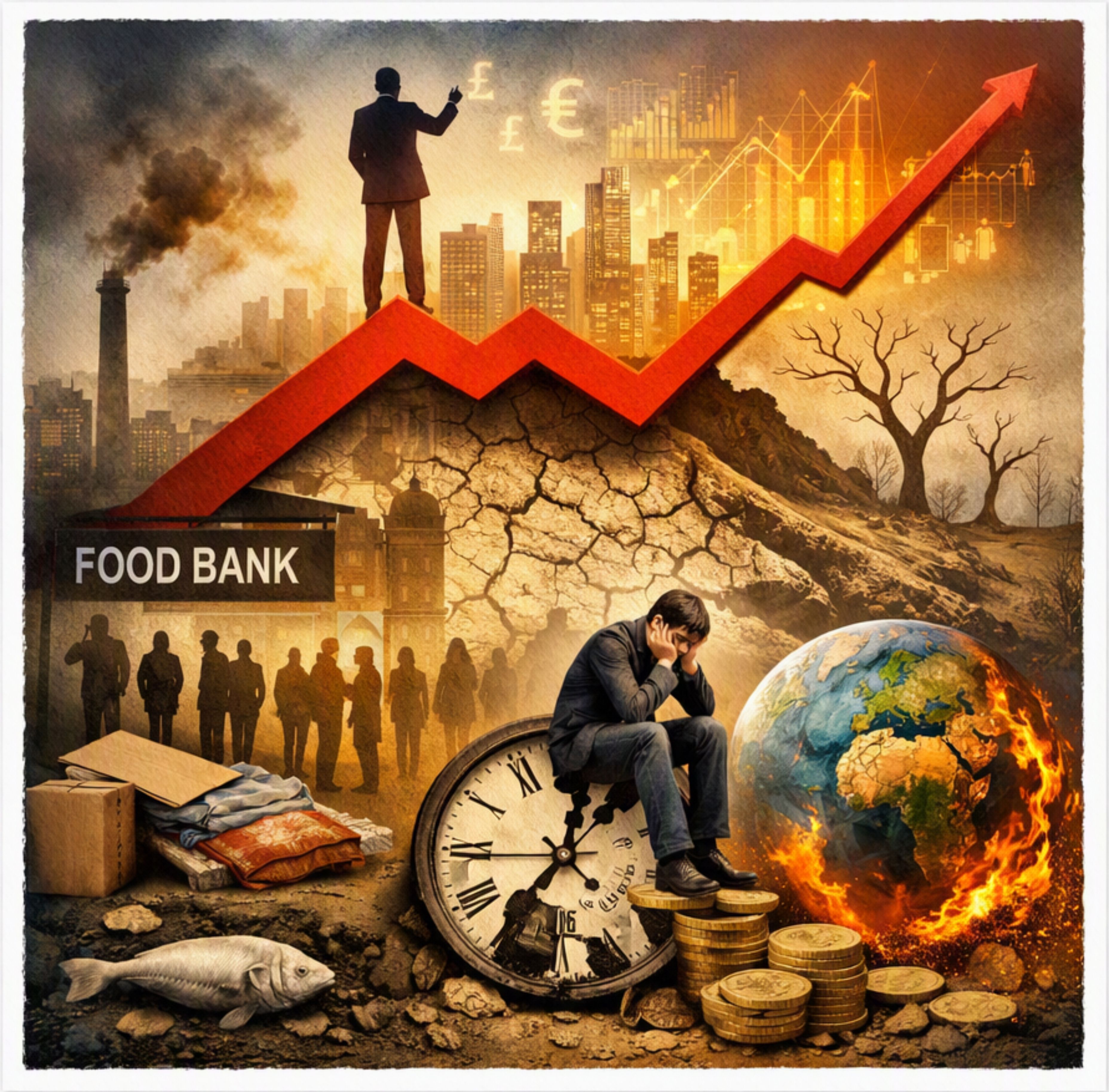
This is why GDP can rise while your life gets worse. It can rise while public services collapse. It can rise while inequality deepens. It can rise while the environment is pushed beyond repair. It can rise while the majority become poorer in real terms – something we’ve seen in Britain as GDP per head has increased while median wages and household disposable incomes have flatlined or fallen .
Yet politicians continue to insist that growth is essential, as if the number itself were more important than the lives it is supposed to represent.
GDP: A Tool That Dehumanises Everything It Touches
In an earlier piece, I described GDP as one of the most dehumanising tools ever created. And I stand by that.
GDP reduces an entire society to a single number. It strips out meaning, humanity, and context. It rewards activity even when that activity destroys communities, erodes stability, or undermines the very foundations of everyday life.
GDP treats human beings as units of economic throughput. It treats communities as marketplaces. It treats the environment as a resource to be consumed. And it’s important to remember that GDP was never designed to measure human wellbeing at all – it was created in the 1930s as a wartime production metric, intended to track industrial output, not the health of society.
Because GDP can be measured, it can be manipulated. If you can measure it, you can control it. If you can control it, you can justify anything – austerity, privatisation, deregulation, asset inflation, debt expansion – as long as the number goes up.
GDP has become the perfect political tool: simple, manipulable, and detached from reality.
How Britain Became Dependent on Growth
Over decades, Britain’s economic model has been hollowed out. Financialisation replaced real productivity. Asset inflation replaced genuine prosperity. Debt-driven expansion replaced sustainable development. Outsourcing and privatisation replaced public responsibility. Austerity stripped out resilience and capacity.
This is the story behind the fiscal armageddon we now find ourselves in. It’s how Britain ended up borrowing into oblivion, hollowing out the institutions that once held society together, and becoming dependent on a model that can only function if the illusion of growth is maintained.
Growth is no longer a sign of strength. It is a sign of dependency – the only thing keeping a failing system upright.
A Place Called Stop
In another piece, I described Britain as having reached a place called Stop – the point where a system built on efficiency, extraction, and dependency simply cannot continue.
Everything that could be cut has been cut.
Everything that could be sold has been sold.
Everything that could be borrowed has been borrowed.
Everything that could be outsourced has been outsourced.
We have reached the limits of a model that has consumed everything it can. Productivity has flatlined for over a decade, public debt has climbed to historic highs, and essential services are stretched beyond capacity – all clear signs of a system running on fumes.
Growth is no longer possible without causing harm – yet the political class demands more of it, because they have no alternative story to tell.
Why Politicians Still Worship Growth
Politicians cling to growth because it is the only metric that makes the system appear functional.
Without growth, the cracks become visible. Without growth, the failures can no longer be hidden. Without growth, the political class has nothing left to point to when asked what they have achieved.
Growth has become a political shield – a way to avoid confronting reality.
This is why political culture is obsessed with growth to the point where it seems more important than life itself. Because without growth, the truth becomes unavoidable.
Why People Still Believe in Growth
One of the most powerful forces keeping the growth narrative alive is something I’ve written about many times: paradigm blindness.
People assume growth is good because they assume growth benefits them. They believe they are personally gaining from the system – even as the evidence of harm becomes unavoidable. They defend the model because they think they understand it, even though they don’t.
Paradigm blindness keeps people trapped in a narrative that no longer serves them. It keeps them believing that the system is working for them, even as it actively works against them.
The Consequences of Mistaking GDP for Prosperity
Mistaking GDP for prosperity has led Britain into a state of profound fragility.
Public services have collapsed. Communities have hollowed out. Inequality has deepened. Environmental destruction has accelerated. People have become poorer in real terms.
Yet GDP has risen. And politicians have pointed to that rise as proof that everything is fine.
This is the danger of growth as a political narrative: it allows leaders to claim success even as society falls apart.
The Question That Changes Everything
So let me ask you directly:
When politicians talk about growth, what do you think they mean?
Are they talking about your wellbeing? Your community? Your future? Your quality of life?
Or are they talking about a number that has nothing to do with any of those things?
Once you confront this question honestly, the entire political narrative begins to unravel.
What Comes After Growth
Britain does not need more growth. Britain needs reconstruction.
Reconstruction begins with honesty. It begins with recognising that the growth model has reached its limits. It begins with accepting that GDP is not prosperity. It begins with rebuilding the foundations that were hollowed out in the pursuit of a number.
A post-growth future is not a step backwards. It doesn’t mean stopping progress; it means redefining it – measuring success by wellbeing, resilience, and sustainability rather than by the speed of financial turnover.
It is the first step toward rebuilding what has been lost – resilience, community, stability, and genuine prosperity.
A Final Thought
Growth is not what you think it is. It is not what politicians tell you it is. It is not what the system pretends it is.
Understanding the truth about growth is the first step toward understanding why everything feels like it is falling apart – and why real change begins with rejecting the illusion.
Further Reading
If the ideas in this piece have raised questions for you – or if you simply want to understand how we reached this point as a country – the following articles explore the themes of growth, financialisation, dependency, and political illusion in much greater depth.
They are arranged in an order that helps build understanding step by step, beginning with the foundations of the growth narrative and ending with what comes next.
1. The Harmful Truths That Are Hidden Behind Political Growth
This is the best place to start. It breaks open the political use of the word “growth” and shows how far removed it is from the everyday meaning most people assume. It explains how growth became a political shield – a way to justify decisions that harm communities while appearing to be signs of success.
If you’ve ever wondered why politicians cling to growth even when life is clearly getting worse, this piece lays the groundwork.
2. If You Can Measure It, You Can Control It: Has GDP Been the Most Dehumanising Tool Ever Created?
Once you understand the political narrative around growth, this article shows you the machinery behind it. It explores how GDP became the central measure of economic success, despite being almost entirely detached from human wellbeing. It explains how GDP rewards activity even when that activity destroys lives, communities, and the environment – and how leaders have used it to control public perception for decades.
3. Borrowing Into Oblivion: How Britain Was Hollowed Out, Why So Few Saw It, and What Comes Next
With the foundations in place, this piece shows how Britain’s economic model was hollowed out from within. It explains how financialisation, asset inflation, and debt-driven expansion created the illusion of prosperity while eroding the real economy.
It also explores why so many people failed to see what was happening – and why the growth narrative was so effective at keeping the truth hidden.
4. How the UK Was Led Into the Fiscal-Driven Armageddon We Are Now Within
This article builds on the previous one by showing how political decisions – austerity, outsourcing, privatisation, and the relentless pursuit of efficiency – pushed Britain into a state of fiscal fragility. It explains how the obsession with growth and “balancing the books” created long-term damage that is now impossible to ignore. It’s a clear, uncompromising look at how political culture led us here.
5. A Place Called Stop: How Britain Reached the Limits of a System Built on Efficiency, Extraction and Dependency – and Why Reconstruction Begins With Honesty
This is the natural conclusion to the journey. It describes the moment Britain reached the limits of the model that has dominated political thinking for decades – a model built on extraction, dependency, and the belief that efficiency is always good.
It explains why the system can no longer continue, why growth has become impossible without causing harm, and why reconstruction must begin with honesty about what has been lost.
A Final Word
Each of these pieces explores a different part of the same story: how a political obsession with growth led Britain into a state of profound fragility, and why understanding the truth behind that obsession is essential if we are ever to rebuild what has been hollowed out.
If you read them in the order above, you’ll see the full picture – not just how we got here, but what must come next.


2 thoughts on “Why Politicians Obsess Over Growth – And Why it Has Nothing to Do with You”