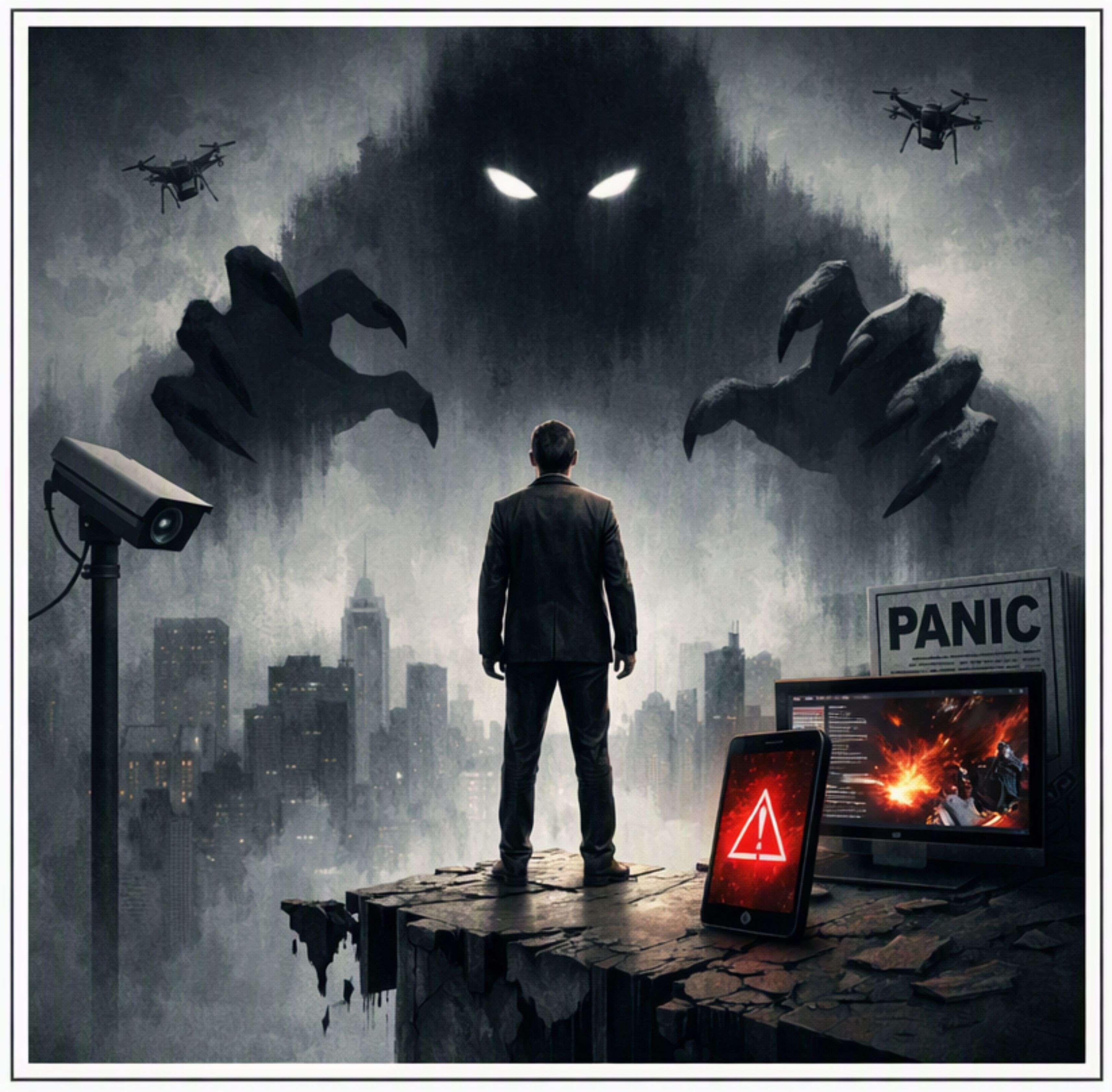

How fear turns the symptoms of a changing world into stories of certainty
We are living through an age of competing alarms. In every direction, someone is warning that a decisive threat has finally revealed itself: migration, elites, artificial intelligence, global institutions, war, environmental collapse, surveillance, pandemics, spiritual corruption or social breakdown.
The subjects differ, but the emotional structure is remarkably consistent. Something vast is happening; ordinary explanations are inadequate; and unless we recognise the hidden cause, it may soon be too late.
Some of these warnings contain important truths. Many begin with real events, legitimate grievances or visible changes. The error is not necessarily invention. It is interpretation: the conversion of a partial truth into a complete explanation.
Most fear-driven narratives are not explanations of what is happening. They are metaphors built around symptoms of a deeper condition that people can sense but cannot easily name.
We feel instability before we understand its sources. We experience declining trust, technological acceleration, economic pressure, institutional weakness and the loss of shared meaning. These forces are diffuse, entangled and difficult to hold in the mind.
A narrative gives them a face. It identifies an agent, supplies a motive and offers the relief of certainty.
This essay is not an argument for dismissing uncomfortable claims, nor a defence of institutions that have often earned distrust. It is an attempt to understand the machinery by which fragments of reality become totalising stories-and how intelligent, educated people can become especially skilled at mistaking a persuasive metaphor for the underlying cause.
The Fever and the Diagnosis
Imagine a patient with a fever. One observer calls it influenza; another, infection; another, poisoning; another, an immune response; another, stress. The fever is real. What remains uncertain is the diagnosis.
Public life now works in much the same way. People encounter a common set of symptoms-uncertainty, declining confidence, rapid change, social fragmentation and a growing sense that events are escaping anyone’s control. They then attach those symptoms to the explanation that best fits their experience, politics, temperament or community.
The mistake is subtle but consequential. We begin with an effect and treat it as a cause. A visible pressure becomes proof of a hidden design. Bureaucratic failure becomes evidence of omnipotent coordination. Technological disruption becomes a settled story about human redundancy. Cultural change becomes a plan of erasure. Political conflict becomes the final battle between good and evil.
The metaphor succeeds because it makes the abstract concrete. It compresses a system into a villain, a date, a slogan or a prophecy.
Yet compression is not comprehension. The story may illuminate one feature of reality while concealing the shape of the whole.
The Longing for “Before”
Much contemporary fear is sustained by nostalgia: the belief that stability can be recovered by returning to an earlier arrangement.
But what people miss is rarely a period in all its complexity. They miss a feeling-the sense that life was sufficiently predictable, institutions sufficiently legible and personal choices sufficiently meaningful.
Stability, safety, security and agency are emotional experiences as much as historical conditions. When they weaken, almost any visible change can become a symbol of what has been lost.
The past is simplified into order; the present is experienced as a breakpoint; the future becomes a threat.
This is why arguments about policy so often carry the force of existential struggle. The contested object is seldom only immigration, technology, climate, health or government. Beneath it sits a more intimate question: Will I still recognise the world, and will there still be a place for me within it?
The Seduction of Certainty
Complexity is exhausting. It demands time, attention, humility and a willingness to live without immediate closure.
Most of us are already overloaded by work, finances, relationships and a continuous stream of information. A simple narrative therefore offers more than an explanation. It offers relief.
Narrative-makers-commentators, activists, influencers, politicians, entrepreneurs, spiritual guides and establishment figures-do not always set out to deceive. Many sincerely believe the patterns they describe.
But sincerity does not guarantee accuracy, and confidence can conceal how much an explanation leaves out.
The most successful stories share several features. They begin with recognisable facts. They connect those facts to lived anxieties. They identify an agent with apparent motive and power. They transform uncertainty into intention. Finally, they offer the audience a privileged role: unlike the deceived majority, you can see what is really happening.
This structure is persuasive because it satisfies emotional and intellectual needs at once. It provides belonging, moral orientation and the pleasure of pattern recognition. It also protects itself from challenge.
Missing evidence becomes evidence of concealment; failed predictions become proof that the plan changed; disagreement becomes proof that the critic has been captured.
Why Intelligence Is Not a Safeguard
We often assume that education or intelligence protects a person from narrative capture. It may do the opposite.
Intelligent people are good at recognising patterns, constructing coherent accounts, finding supporting material and defending a position under pressure. Once committed to a premise, they can build an exceptionally sophisticated structure around it.
The danger is not stupidity. It is premature certainty.
A clever explanation can answer every objection and still be solving the wrong problem. The more elegant the explanation becomes, the harder it is to revisit its starting assumptions.
Intelligence then operates not as a searchlight but as counsel for the defence: selecting evidence, refining arguments and protecting an identity that has become bound to being right.
Humility is therefore not the opposite of intelligence. It is one of intelligence’s necessary disciplines. The essential question is not merely, Can I make this theory cohere? It is, What would show me that I have mistaken a symptom for a cause?
Power Does Not Abolish Human Frailty
Fear narratives frequently depend on an image of powerful people as fundamentally different from everyone else: colder, more rational, more coordinated and more capable of executing a unified design.
Power certainly creates opportunities for concealment and abuse. It can insulate decision-makers from consequences and place extraordinary resources behind bad judgement. But it does not remove ordinary human weakness.
Imagine winning a life-changing lottery. You might become more guarded, more selective about whom you trusted and more dependent on advisers, security and controlled information. From the outside, the resulting behaviour could look secretive or calculated. From the inside, it might feel like self-protection.
This is the Euromillions effect: resources magnify the reach of familiar instincts. Wealth and status can amplify fear, self-preservation, groupthink and the conviction that one’s own interests are exceptional. When these behaviours occur among governments, institutions or billionaires, their scale makes them appear more coherent than they are.
None of this excuses misconduct or rules out coordination. It does, however, suggest a more credible default. Apparent design may emerge from overlapping interests, institutional incentives, imitation, panic and bureaucratic drift.
Human frailty magnified by resources can produce outcomes that look conspiratorial without requiring a single controlling mind.
Different Stories, the Same Anxiety
The value of comparing fear narratives is not to decide that every claim is equivalent. It is to notice how different claims can perform the same psychological function.
Cultural displacement
Arguments about migration and cultural change gain force because the changes are visible, identity matters, public services experience pressure and political language is often evasive. A totalising narrative converts these realities into deliberate replacement. What may be a difficult mixture of labour demand, conflict, demographic change, policy failure and global inequality is compressed into a single intentional project.
Global control
Claims about the World Economic Forum, the United Nations or Agenda 2030 draw strength from opaque institutions, technocratic language and an understandable suspicion of remote decision-making. Yet broad frameworks, elite networking and bureaucratic ambition are not the same as unified command. The metaphor of a world government gives scattered forms of influence a single centre and motive.
Technological redundancy
Warnings that artificial intelligence will replace humanity begin with substantial concerns: automation will alter work, concentrate power and challenge assumptions about creativity and expertise. But the most apocalyptic versions also express a deeper fear-the fear of becoming unnecessary. A technical development becomes a metaphor for lost human value.
Political apocalypse
The claim that democracy will end if the other side wins contains an awareness that institutions can weaken and norms can be broken. Yet repeated across political camps, it also reveals collapsed trust. Ordinary conflict is interpreted as the final contest because people no longer believe the system can absorb defeat, error or change.
Environmental and biological catastrophe
Climate disruption and infectious disease are real domains of risk that require serious evidence, planning and collective action. Fear becomes distorting when uncertainty is converted either into inevitable doom or into proof that the danger is fabricated. One story promises collapse; the other promises conspiracy. Both can spare the believer from the harder work of weighing probabilities, trade-offs and incomplete knowledge.
Alien disclosure
The possibility of life elsewhere is not inherently absurd, and unresolved aerial observations deserve careful investigation. The narrative expands when secrecy, partial disclosure and existential wonder are assembled into timetables, motives and claims of certainty that the available evidence cannot yet bear. Here the metaphor may be humanity’s oldest anxiety in modern form: that powers beyond our understanding are directing events.
Spiritual purification
Ideas of awakening, ascension or purification give turbulence a transcendent purpose. They can offer meaning and encourage serious reflection. They become hazardous when charismatic certainty replaces personal inquiry, when every setback confirms a cosmic timetable, or when metaphor is presented as mechanism. The longing beneath the story is often not foolishness but a hunger for meaning in a disenchanted world.
Other narratives-elite takeover, world war, digital dystopia, permanent political lockout, civil conflict or the next pandemic-contain their own mixtures of evidence, possibility and projection. The task is not to flatten their differences or dismiss them in advance. It is to ask what each story clarifies, what it hides and which deeper anxiety it makes bearable.
What Lies Beneath
If these stories are metaphors, what are they metaphors for? No single answer is sufficient, but several conditions recur: complexity exceeding individual comprehension; institutions losing legitimacy; technology moving faster than social adaptation; economic insecurity; information overload; political systems that appear unable to solve long-term problems; social fragmentation; and the erosion of shared accounts of who “we” are and what the future is for.
These conditions interact. Institutional failure increases distrust; distrust makes coordination harder; failed coordination deepens insecurity; insecurity makes simple explanations attractive; simple explanations reward figures who intensify conflict; intensified conflict further weakens institutions.
The loop produces the feeling that events are accelerating even when no one is fully in control.
People discussing immigration, AI, climate, aliens, global governance or spiritual awakening may appear to inhabit entirely different worlds. At a deeper level, many are expressing the same recognition:
I no longer understand the world I live in, and I am no longer confident that those in charge understand it either.
That statement should not be mocked. It may be one of the most honest descriptions of the present. The mistake comes when discomfort with not knowing is converted too quickly into certainty about who knows, who caused it and what must happen next.
Effects Mistaken for Causes
The greatest danger is not any single narrative. It is a public culture increasingly organised around misdiagnosis.
Fear narrows perception. It accelerates judgement, rewards certainty and makes complexity feel like evasion.
Under its influence, we become highly responsive to visible effects and less capable of tracing the systems that produce them.
We fight the symbol, amplify the messenger and leave the underlying condition untouched.
This does not mean that threats are imaginary. Systemic fragility, material inequality, technological concentration, ecological pressure, institutional decay and the erosion of trust are serious.
Precisely because they are serious, they deserve better than stories that convert them into spectacle.
When effects are mistaken for causes, attempted solutions can deepen the original problem. Distrust is answered with greater secrecy; fragmentation with harsher tribalism; uncertainty with censorship or propaganda; loss of agency with submission to a new authority.
Each response then generates fresh evidence for the opposing narrative.
Metaphor is indispensable. It helps us think about realities too large to grasp directly. But a metaphor is a map, not the terrain. Madness begins when the map is defended more fiercely than the world it was meant to help us navigate.
A Discipline of Clarity
Clarity is not the absence of fear. It is the refusal to let fear complete the argument.
It begins by separating observation from interpretation. What happened? What do I infer from it? Which part do I know through direct experience, and which part reached me through selection, framing or repetition? What evidence would count against my preferred account? Does my explanation require more coordination, competence or foresight than institutions usually display?
Clarity also requires proportion. A possibility is not a probability; a pattern is not necessarily a plan; a shared interest is not always a conspiracy; institutional failure is not proof of innocence; scepticism is not cynicism; and uncertainty is not permission to believe whatever feels most complete.
Above all, we need the patience to remain with an unfinished diagnosis. That is culturally difficult because the information economy rewards immediacy, outrage and certainty.
Yet the ability to say I do not know yet may be one of the most responsible forms of judgement available to us.
Conclusion: Beyond the Loudest Story
Every age creates myths. The myths change, but the needs beneath them do not. When uncertainty rises, people search for certainty. When complexity becomes unbearable, they search for simplicity. When trust collapses, they search for prophets. When the future becomes difficult to imagine, they turn symptoms into stories that can be named, opposed or survived.
The challenge is not to eliminate narrative; that would be impossible. It is to hold our narratives lightly enough that reality can still correct them.
The world is changing, and stability will not come from pretending we can return to an idealised past. Nor will it come from selecting the most compelling account of who betrayed us. It will come, if it comes at all, from rebuilding agency, trust and shared meaning while learning to interpret the present without demanding that it first become simple.
The loudest narratives are rarely the whole truth. The quietest realities rarely announce themselves. Between them lies the difficult work of discernment: looking beneath the fear, beneath the symbol and beneath the answer that arrived too quickly, until we begin to see the shape of the question itself.

Further Reading
The Myth Catcher: A Quiet Guide to Discovering Clarity in an Age of Noise
The conceptual starting point for this essay. This piece examines how myths take hold when trust weakens, why persuasive interpreters become false prophets without necessarily intending deception, and how discernment can interrupt the movement from uncertainty to belief. Madness by Metaphor develops that argument by asking what fear narratives symbolise-and what they prevent us from seeing beneath them.
The Moment
The wider context for the sense of rupture explored here. This essay considers the intuition that society is approaching a breakpoint. Read alongside Madness by Metaphor, it helps distinguish between the pressures that may genuinely be converging and the competing stories through which those pressures are interpreted.

