How fear turns the symptoms of a changing world into stories of certainty
We are living through an age of competing alarms. In every direction, someone is warning that a decisive threat has finally revealed itself: migration, elites, artificial intelligence, global institutions, war, environmental collapse, surveillance, pandemics, spiritual corruption or social breakdown.
The subjects differ, but the emotional structure is remarkably consistent. Something vast is happening; ordinary explanations are inadequate; and unless we recognise the hidden cause, it may soon be too late.
Some of these warnings contain important truths. Many begin with real events, legitimate grievances or visible changes. The error is not necessarily invention. It is interpretation: the conversion of a partial truth into a complete explanation.
Most fear-driven narratives are not explanations of what is happening. They are metaphors built around symptoms of a deeper condition that people can sense but cannot easily name.
We feel instability before we understand its sources. We experience declining trust, technological acceleration, economic pressure, institutional weakness and the loss of shared meaning. These forces are diffuse, entangled and difficult to hold in the mind.
A narrative gives them a face. It identifies an agent, supplies a motive and offers the relief of certainty.
This essay is not an argument for dismissing uncomfortable claims, nor a defence of institutions that have often earned distrust. It is an attempt to understand the machinery by which fragments of reality become totalising stories-and how intelligent, educated people can become especially skilled at mistaking a persuasive metaphor for the underlying cause.
The Fever and the Diagnosis
Imagine a patient with a fever. One observer calls it influenza; another, infection; another, poisoning; another, an immune response; another, stress. The fever is real. What remains uncertain is the diagnosis.
Public life now works in much the same way. People encounter a common set of symptoms-uncertainty, declining confidence, rapid change, social fragmentation and a growing sense that events are escaping anyone’s control. They then attach those symptoms to the explanation that best fits their experience, politics, temperament or community.
The mistake is subtle but consequential. We begin with an effect and treat it as a cause. A visible pressure becomes proof of a hidden design. Bureaucratic failure becomes evidence of omnipotent coordination. Technological disruption becomes a settled story about human redundancy. Cultural change becomes a plan of erasure. Political conflict becomes the final battle between good and evil.
The metaphor succeeds because it makes the abstract concrete. It compresses a system into a villain, a date, a slogan or a prophecy.
Yet compression is not comprehension. The story may illuminate one feature of reality while concealing the shape of the whole.
The Longing for “Before”
Much contemporary fear is sustained by nostalgia: the belief that stability can be recovered by returning to an earlier arrangement.
But what people miss is rarely a period in all its complexity. They miss a feeling-the sense that life was sufficiently predictable, institutions sufficiently legible and personal choices sufficiently meaningful.
Stability, safety, security and agency are emotional experiences as much as historical conditions. When they weaken, almost any visible change can become a symbol of what has been lost.
The past is simplified into order; the present is experienced as a breakpoint; the future becomes a threat.
This is why arguments about policy so often carry the force of existential struggle. The contested object is seldom only immigration, technology, climate, health or government. Beneath it sits a more intimate question: Will I still recognise the world, and will there still be a place for me within it?
The Seduction of Certainty
Complexity is exhausting. It demands time, attention, humility and a willingness to live without immediate closure.
Most of us are already overloaded by work, finances, relationships and a continuous stream of information. A simple narrative therefore offers more than an explanation. It offers relief.
Narrative-makers-commentators, activists, influencers, politicians, entrepreneurs, spiritual guides and establishment figures-do not always set out to deceive. Many sincerely believe the patterns they describe.
But sincerity does not guarantee accuracy, and confidence can conceal how much an explanation leaves out.
The most successful stories share several features. They begin with recognisable facts. They connect those facts to lived anxieties. They identify an agent with apparent motive and power. They transform uncertainty into intention. Finally, they offer the audience a privileged role: unlike the deceived majority, you can see what is really happening.
This structure is persuasive because it satisfies emotional and intellectual needs at once. It provides belonging, moral orientation and the pleasure of pattern recognition. It also protects itself from challenge.
Missing evidence becomes evidence of concealment; failed predictions become proof that the plan changed; disagreement becomes proof that the critic has been captured.
Why Intelligence Is Not a Safeguard
We often assume that education or intelligence protects a person from narrative capture. It may do the opposite.
Intelligent people are good at recognising patterns, constructing coherent accounts, finding supporting material and defending a position under pressure. Once committed to a premise, they can build an exceptionally sophisticated structure around it.
The danger is not stupidity. It is premature certainty.
A clever explanation can answer every objection and still be solving the wrong problem. The more elegant the explanation becomes, the harder it is to revisit its starting assumptions.
Intelligence then operates not as a searchlight but as counsel for the defence: selecting evidence, refining arguments and protecting an identity that has become bound to being right.
Humility is therefore not the opposite of intelligence. It is one of intelligence’s necessary disciplines. The essential question is not merely, Can I make this theory cohere? It is, What would show me that I have mistaken a symptom for a cause?
Power Does Not Abolish Human Frailty
Fear narratives frequently depend on an image of powerful people as fundamentally different from everyone else: colder, more rational, more coordinated and more capable of executing a unified design.
Power certainly creates opportunities for concealment and abuse. It can insulate decision-makers from consequences and place extraordinary resources behind bad judgement. But it does not remove ordinary human weakness.
Imagine winning a life-changing lottery. You might become more guarded, more selective about whom you trusted and more dependent on advisers, security and controlled information. From the outside, the resulting behaviour could look secretive or calculated. From the inside, it might feel like self-protection.
This is the Euromillions effect: resources magnify the reach of familiar instincts. Wealth and status can amplify fear, self-preservation, groupthink and the conviction that one’s own interests are exceptional. When these behaviours occur among governments, institutions or billionaires, their scale makes them appear more coherent than they are.
None of this excuses misconduct or rules out coordination. It does, however, suggest a more credible default. Apparent design may emerge from overlapping interests, institutional incentives, imitation, panic and bureaucratic drift.
Human frailty magnified by resources can produce outcomes that look conspiratorial without requiring a single controlling mind.
Different Stories, the Same Anxiety
The value of comparing fear narratives is not to decide that every claim is equivalent. It is to notice how different claims can perform the same psychological function.
Cultural displacement
Arguments about migration and cultural change gain force because the changes are visible, identity matters, public services experience pressure and political language is often evasive. A totalising narrative converts these realities into deliberate replacement. What may be a difficult mixture of labour demand, conflict, demographic change, policy failure and global inequality is compressed into a single intentional project.
Global control
Claims about the World Economic Forum, the United Nations or Agenda 2030 draw strength from opaque institutions, technocratic language and an understandable suspicion of remote decision-making. Yet broad frameworks, elite networking and bureaucratic ambition are not the same as unified command. The metaphor of a world government gives scattered forms of influence a single centre and motive.
Technological redundancy
Warnings that artificial intelligence will replace humanity begin with substantial concerns: automation will alter work, concentrate power and challenge assumptions about creativity and expertise. But the most apocalyptic versions also express a deeper fear-the fear of becoming unnecessary. A technical development becomes a metaphor for lost human value.
Political apocalypse
The claim that democracy will end if the other side wins contains an awareness that institutions can weaken and norms can be broken. Yet repeated across political camps, it also reveals collapsed trust. Ordinary conflict is interpreted as the final contest because people no longer believe the system can absorb defeat, error or change.
Environmental and biological catastrophe
Climate disruption and infectious disease are real domains of risk that require serious evidence, planning and collective action. Fear becomes distorting when uncertainty is converted either into inevitable doom or into proof that the danger is fabricated. One story promises collapse; the other promises conspiracy. Both can spare the believer from the harder work of weighing probabilities, trade-offs and incomplete knowledge.
Alien disclosure
The possibility of life elsewhere is not inherently absurd, and unresolved aerial observations deserve careful investigation. The narrative expands when secrecy, partial disclosure and existential wonder are assembled into timetables, motives and claims of certainty that the available evidence cannot yet bear. Here the metaphor may be humanity’s oldest anxiety in modern form: that powers beyond our understanding are directing events.
Spiritual purification
Ideas of awakening, ascension or purification give turbulence a transcendent purpose. They can offer meaning and encourage serious reflection. They become hazardous when charismatic certainty replaces personal inquiry, when every setback confirms a cosmic timetable, or when metaphor is presented as mechanism. The longing beneath the story is often not foolishness but a hunger for meaning in a disenchanted world.
Other narratives-elite takeover, world war, digital dystopia, permanent political lockout, civil conflict or the next pandemic-contain their own mixtures of evidence, possibility and projection. The task is not to flatten their differences or dismiss them in advance. It is to ask what each story clarifies, what it hides and which deeper anxiety it makes bearable.
What Lies Beneath
If these stories are metaphors, what are they metaphors for? No single answer is sufficient, but several conditions recur: complexity exceeding individual comprehension; institutions losing legitimacy; technology moving faster than social adaptation; economic insecurity; information overload; political systems that appear unable to solve long-term problems; social fragmentation; and the erosion of shared accounts of who “we” are and what the future is for.
These conditions interact. Institutional failure increases distrust; distrust makes coordination harder; failed coordination deepens insecurity; insecurity makes simple explanations attractive; simple explanations reward figures who intensify conflict; intensified conflict further weakens institutions.
The loop produces the feeling that events are accelerating even when no one is fully in control.
People discussing immigration, AI, climate, aliens, global governance or spiritual awakening may appear to inhabit entirely different worlds. At a deeper level, many are expressing the same recognition:
I no longer understand the world I live in, and I am no longer confident that those in charge understand it either.
That statement should not be mocked. It may be one of the most honest descriptions of the present. The mistake comes when discomfort with not knowing is converted too quickly into certainty about who knows, who caused it and what must happen next.
Effects Mistaken for Causes
The greatest danger is not any single narrative. It is a public culture increasingly organised around misdiagnosis.
Fear narrows perception. It accelerates judgement, rewards certainty and makes complexity feel like evasion.
Under its influence, we become highly responsive to visible effects and less capable of tracing the systems that produce them.
We fight the symbol, amplify the messenger and leave the underlying condition untouched.
This does not mean that threats are imaginary. Systemic fragility, material inequality, technological concentration, ecological pressure, institutional decay and the erosion of trust are serious.
Precisely because they are serious, they deserve better than stories that convert them into spectacle.
When effects are mistaken for causes, attempted solutions can deepen the original problem. Distrust is answered with greater secrecy; fragmentation with harsher tribalism; uncertainty with censorship or propaganda; loss of agency with submission to a new authority.
Each response then generates fresh evidence for the opposing narrative.
Metaphor is indispensable. It helps us think about realities too large to grasp directly. But a metaphor is a map, not the terrain. Madness begins when the map is defended more fiercely than the world it was meant to help us navigate.
A Discipline of Clarity
Clarity is not the absence of fear. It is the refusal to let fear complete the argument.
It begins by separating observation from interpretation. What happened? What do I infer from it? Which part do I know through direct experience, and which part reached me through selection, framing or repetition? What evidence would count against my preferred account? Does my explanation require more coordination, competence or foresight than institutions usually display?
Clarity also requires proportion. A possibility is not a probability; a pattern is not necessarily a plan; a shared interest is not always a conspiracy; institutional failure is not proof of innocence; scepticism is not cynicism; and uncertainty is not permission to believe whatever feels most complete.
Above all, we need the patience to remain with an unfinished diagnosis. That is culturally difficult because the information economy rewards immediacy, outrage and certainty.
Yet the ability to say I do not know yet may be one of the most responsible forms of judgement available to us.
Conclusion: Beyond the Loudest Story
Every age creates myths. The myths change, but the needs beneath them do not. When uncertainty rises, people search for certainty. When complexity becomes unbearable, they search for simplicity. When trust collapses, they search for prophets. When the future becomes difficult to imagine, they turn symptoms into stories that can be named, opposed or survived.
The challenge is not to eliminate narrative; that would be impossible. It is to hold our narratives lightly enough that reality can still correct them.
The world is changing, and stability will not come from pretending we can return to an idealised past. Nor will it come from selecting the most compelling account of who betrayed us. It will come, if it comes at all, from rebuilding agency, trust and shared meaning while learning to interpret the present without demanding that it first become simple.
The loudest narratives are rarely the whole truth. The quietest realities rarely announce themselves. Between them lies the difficult work of discernment: looking beneath the fear, beneath the symbol and beneath the answer that arrived too quickly, until we begin to see the shape of the question itself.
Further Reading
The Myth Catcher: A Quiet Guide to Discovering Clarity in an Age of Noise The conceptual starting point for this essay. This piece examines how myths take hold when trust weakens, why persuasive interpreters become false prophets without necessarily intending deception, and how discernment can interrupt the movement from uncertainty to belief. Madness by Metaphor develops that argument by asking what fear narratives symbolise-and what they prevent us from seeing beneath them.
The Moment The wider context for the sense of rupture explored here. This essay considers the intuition that society is approaching a breakpoint. Read alongside Madness by Metaphor, it helps distinguish between the pressures that may genuinely be converging and the competing stories through which those pressures are interpreted.
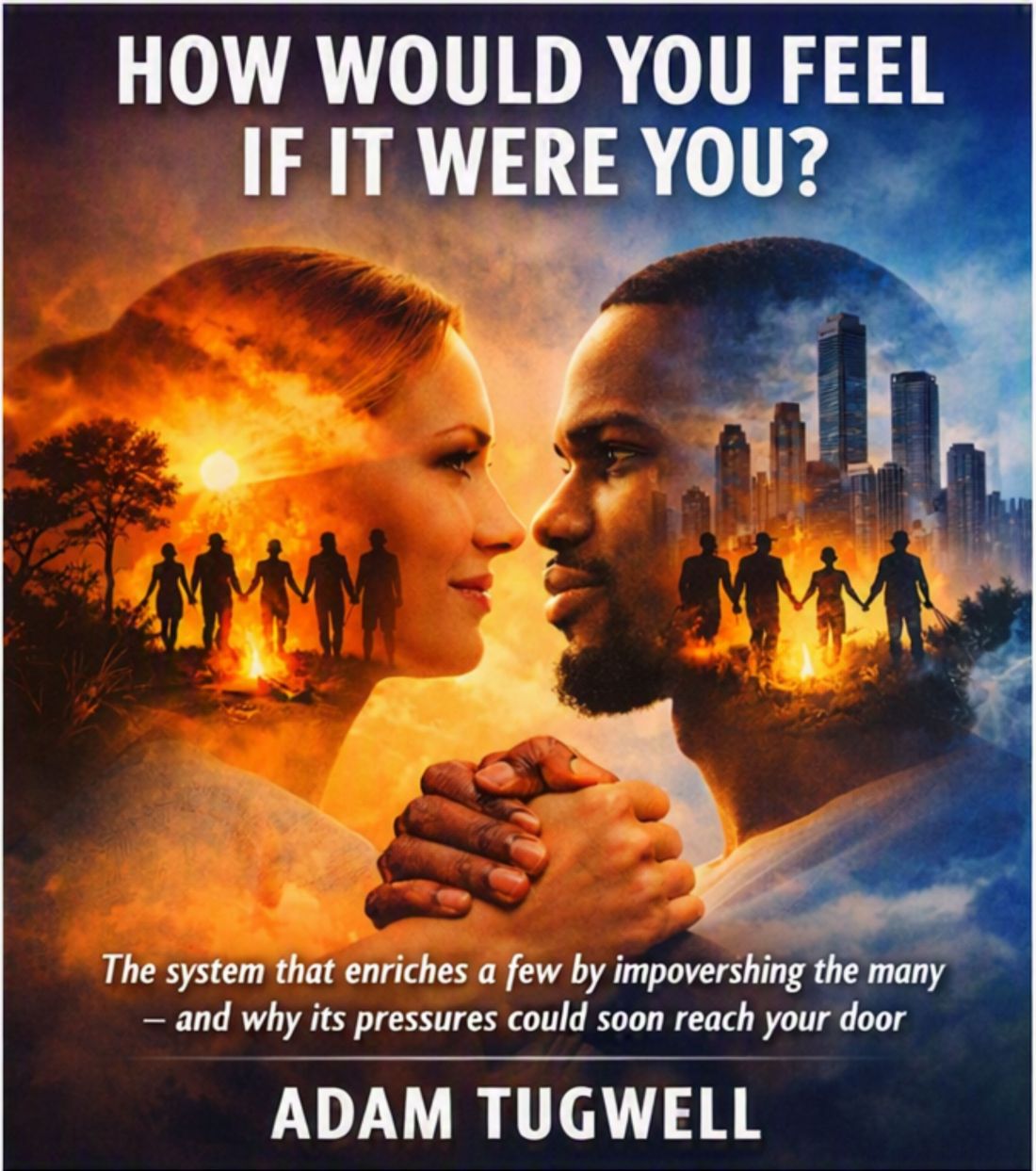
The system that enriches a few by impoverishing the many – and why its pressures could soon reach your door.
1. Introduction: What Would You Feel If It Were You?
We talk about poverty, benefits, work, and hardship as if they are abstract issues – political talking points, economic debates, or moral judgments about other people’s choices.
But poverty is not abstract. It is lived. It is felt. It is endured. And it is often invisible to those who have never experienced it.
The truth is simple, but uncomfortable: Most people who judge poverty have never had to imagine themselves inside it.
They see headlines, stereotypes, and social media narratives. They hear confident voices insisting that hardship is a lifestyle choice, that people simply need to “row their own boat,” that work always pays, and that anyone struggling must be doing something wrong.
But what if we paused? What if we stepped back from the noise? What if, instead of judging, we asked a different question – one that cuts through politics, ideology, and assumption?
What would you feel if it were you?
What would you feel if you worked full‑time and still couldn’t afford to live? What would you feel if your rent rose faster than your wages? What would you feel if your food shop cost more every week? What would you feel if your job disappeared overnight? What would you feel if your commitments swallowed your income? What would you feel if your mental health collapsed under the weight of constant financial fear? What would you feel if society judged you for struggling in a system designed to make you struggle?
This essay is not an argument. It is an invitation.
An invitation to imagine. To empathise. To see clearly. To think differently.
Because poverty is not a personal failure. It is a structural outcome. And the only way we begin to change it is by understanding what it feels like – not from the outside, but from within.
2. The Invisible Reality of Poverty
Poverty in Britain is not always visible. It doesn’t always look like the images people imagine – threadbare clothes, empty cupboards, cold homes, obvious struggle.
More often, it looks like ordinary people living ordinary lives, quietly falling further behind each month while the world insists everything is improving.
Part of the problem is that poverty has become statistical. It is described through percentages, inflation rates, GDP growth, wage averages, and economic forecasts.
These numbers create the illusion of objectivity, but they rarely reflect the lived experience of real households.
Official narratives say:
wages are rising
inflation is easing
the economy is recovering
employment is high
people should be coping
But lived experience says something very different.
People feel poorer. People are poorer. And the gap between the official story and real life grows wider every year.
The Impoverishment Index captures this gap clearly. It shows that:
prices rise faster than wages
essentials rise faster than headline inflation
savings lose value
disposable income shrinks
the cost of participation in society increases
the cost of simply existing increases
Yet because these pressures accumulate quietly – a few pounds more on food, a few pounds more on rent, a few pounds more on energy – many people don’t realise they are being squeezed until they are already in crisis.
And those who aren’t in crisis often don’t see it at all.
Poverty becomes invisible not because it isn’t happening, but because it happens in ways that are easy to overlook:
the colleague who skips lunch
the neighbour who keeps the heating off
the parent who avoids social events
the worker who hides their exhaustion
the family who moves frequently
the person who never complains
People hide their hardship because they feel ashamed. People hide their hardship because they fear judgement. People hide their hardship because they believe it is their fault.
And when hardship is hidden, it becomes easy for others to assume it doesn’t exist.
This invisibility is dangerous. It allows stereotypes to flourish. It allows judgement to harden. It allows people to believe poverty is rare, distant, or self‑inflicted.
But poverty is none of those things.
It is widespread. It is local. It is structural. It is lived by millions. And it is often happening right next to people who cannot see it.
The truth is simple: You cannot understand poverty by looking at statistics.You can only understand it by imagining what it feels like or experiencing it yourself.
3. When Work Isn’t Enough
For generations, the story Britain told itself was simple: If you work hard, you will be able to live.
It wasn’t a promise written into law, but it was woven into culture, politics, and identity.
Work was the path to independence, dignity, stability, and belonging. It was the dividing line between “doing well” and “falling behind.”
But today, millions of people work hard – harder than ever – and still cannot afford a basic, secure life.
This is not a fringe issue. It is not rare. It is not limited to a small group. It is not caused by laziness, irresponsibility, or poor choices.
It is structural.
The numbers tell a story that contradicts everything people were taught to believe:
A single adult now needs well over £30,000 net per year to live independently without debt or deprivation.(Based on current UK living‑cost modelling; varies by region.)
A family with one child often needs £55,000–£65,000 net per year just to meet essential costs.(Housing, childcare, transport, food, utilities — all rising faster than wages.)
Minimum‑wage workers fall hundreds of pounds short every month, even when working full‑time.(This is consistent across most UK regions once rent and transport are included.)
Because Universal Credit removes 55p of every extra £1 earned above the work allowance, many low‑income workers keep less than half of what they earn from overtime.(The exact “effective hourly gain” varies by household and cannot be expressed as a single fixed figure.)
Many households must work 50–66 hours per week simply to break even — and that’s before any unexpected costs.(This reflects typical budgets for low‑income families facing high rent and childcare.)
These aren’t extreme cases. These are ordinary workers in ordinary jobs – the people who keep society running:
refuse collectors
kitchen porters
baristas
shelf‑stackers
delivery drivers
care assistants
cleaners
teaching assistants
retail workers
People who serve, lift, carry, clean, support, and care. People who do the jobs everyone relies on but rarely notices.
And yet, after forty or fifty hours a week, many still cannot afford:
rent
food
heating
transport
childcare
basic essentials
They are exhausted, undervalued, and financially trapped.
They are told to “work harder,” even though they already work harder than most. They are told to “budget better,” even though they have nothing left to budget. They are told to “take responsibility,” even though they carry more responsibility than anyone should have to bear.
And when they finally reach breaking point – when they need help, when they visit a food bank, when they fall behind on bills – society judges them.
Not for their lack of effort, but for their lack of income.
Agency and Structure
None of this means personal responsibility does not matter. People make good decisions and bad decisions. Choices have consequences. Effort matters. Planning matters. Discipline matters. But personal choices do not occur in a vacuum. They take place within economic structures that can either expand opportunity or restrict it. Recognising structural pressures is not the same as denying agency. It is acknowledging the environment in which agency must operate.
What would you feel if you worked full‑time and still couldn’t afford to live?
Would you feel lazy? Or would you feel defeated by a system where work no longer guarantees survival?
This is the reality for millions.
Not because they have failed, but because the system has.
Work used to be enough. Today, it isn’t. And pretending otherwise only deepens the suffering of those already carrying the heaviest load.
4. The Two‑Tier Britain We Refuse to See
Britain has always had inequality. But today, the divide is no longer simply between “rich” and “poor,” or “working” and “unemployed.” It is deeper, more structural, and more hidden than most people realise.
We live in a two‑tier Britain – not defined by culture, geography, or identity, but by the system itself.
On one tier are those the system rewards. On the other are those the system punishes.
This divide is not about effort. It is not about intelligence. It is not about morality. It is not about character.
It is about structure.
The system rewards people who:
have stable, well‑paid jobs
own property
have savings
have access to credit
have predictable income
can absorb shocks
can plan ahead
The system punishes people who:
rent
earn low wages
have insecure work
have no savings
rely on credit to survive
face unpredictable income
cannot absorb shocks
live month‑to‑month
These two groups often live side by side, work in the same towns, shop in the same supermarkets, and send their children to the same schools – yet their experiences of Britain are completely different.
One group experiences stability. The other experiences continual crisis.
One group feels confident. The other feels afraid.
One group sees opportunity. The other sees barriers.
One group believes the system works. The other knows it doesn’t.
And because the divide is structural, not cultural, people often misinterpret it. They assume that those who struggle must be doing something wrong – because they themselves are doing everything “right” and things are working out.
But this is an illusion.
The system is designed to reward some and punish others. It is designed to extract from the bottom to sustain the top. It is designed to keep people in their tier.
This is why:
wages stagnate while rents rise
essentials inflate faster than income
work no longer guarantees security
benefits fill the gap between survival and collapse
people who “should be fine” are drowning
people who “look fine” are visiting food banks
people who “do everything right” still fall behind
And yet, because the divide is invisible to those on the rewarded tier, they often assume it doesn’t exist. They assume everyone has the same opportunities, the same choices, the same chances.
They assume the system is fair.
But fairness is not the lived experience of millions. Fairness is the illusion of those who benefit from the structure.
The truth is simple:
Britain is not divided by culture – it is divided by economics.Not by identity – but by extraction.Not by effort – but by design.
And until we acknowledge this two‑tier reality, we will continue to blame individuals for outcomes created by the system itself.
5. The Mental Health Toll of Falling Behind
Poverty is often described in financial terms – income, rent, bills, debt, inflation. But the deepest wounds it creates are not economic. They are psychological.
Falling behind in a money‑centric culture doesn’t just mean struggling to pay for essentials. It means struggling to maintain your sense of self.
It means living with a constant, grinding fear that you are failing at life.
And that fear is everywhere.
If every day began with financial anxiety
How would you feel if:
you woke up each morning wondering whether you could afford food
you checked your bank balance before every purchase
you feared every brown envelope through the letterbox
you lived with the knowledge that one unexpected bill could ruin you
you felt guilty every time you spent money on anything that wasn’t essential
This is not occasional stress. This is chronic, unrelenting pressure – the kind that rewires the brain.
People living in poverty experience:
heightened anxiety
depression
sleep disruption
cognitive overload
difficulty concentrating
reduced decision‑making capacity
emotional exhaustion
Not because they are weak, but because they are human.
Shame: The Silent Weight Nobody Talks About
Poverty carries a stigma that is rarely acknowledged openly. People feel ashamed of struggling. Ashamed of needing help. Ashamed of not coping. Ashamed of being seen as “less than.”
This shame is not natural. It is taught.
It is taught by:
political narratives that frame poverty as a choice
cultural messages that equate wealth with virtue
social media that showcases curated success
workplaces that reward overwork and punish vulnerability
public voices that mock or dismiss those who fall behind
Shame becomes internalised. People begin to believe they are the problem.
What would you feel if you believed your hardship was your fault?
Self‑Exclusion: When People Withdraw Because They Feel They Don’t Belong
One of the most damaging mental‑health consequences of poverty is self‑exclusion.
People withdraw from social life not because they want to, but because they feel they don’t deserve to participate.
How would you feel if:
you stopped seeing friends because you couldn’t afford to join in
you avoided social spaces because you felt embarrassed
you declined invitations because you couldn’t afford petrol or a drink
you felt ashamed of your clothes, your car, your home, your situation
you believed others were judging you even when they weren’t
This is not isolation by choice. It is isolation by shame.
And it deepens the mental‑health crisis.
The Collapse of Identity
In a society where financial status is treated as identity, falling behind feels like losing yourself.
People begin to think:
“I’m failing.”
“I’m not good enough.”
“I’m letting everyone down.”
“I’m not worth anything.”
“I don’t belong.”
These thoughts are not rare. They are widespread. They are predictable. They are the psychological architecture of poverty.
And they are devastating.
The Cruel Irony: Poverty Creates the Conditions That Make Escape Harder
The mental‑health toll of poverty doesn’t just hurt people emotionally – it makes it harder to escape poverty itself.
Chronic stress reduces:
motivation
confidence
concentration
resilience
decision‑making ability
People who are struggling financially often appear “unmotivated” or “disorganised” to outsiders. But what outsiders see is not laziness – it is cognitive overload.
It is the brain trying to survive under pressure it was never designed to endure.
What would you feel if your mind was constantly fighting to stay afloat?
The Final Truth: Poverty Isn’t Just About Money – It’s About Mental Survival
The mental‑health consequences of poverty are not side effects. They are central to the experience.
They shape:
how people see themselves
how people see others
how people move through the world
how people cope
how people hope
how people survive
And until we understand this – until we see poverty not just as an economic issue but as a psychological one – we will continue to misunderstand the people who live it.
6. Money as the Master Hierarchy
In Britain today, money is not just a practical necessity. It has become the primary measure of human value. It decides who is respected, who is listened to, who is welcomed, who is dismissed, who is admired, and who is ignored.
It is the quiet, unspoken hierarchy that shapes every social interaction.
People rarely admit this openly. But they live it every day.
The loaded question: “So, what do you do?”
It sounds harmless. It sounds friendly. It sounds like small talk.
But in a money‑centric culture, it is anything but.
It is a coded question about:
income
lifestyle
status
class
belonging
hierarchy
It is not really a question about your interests, your skills, your passions, or your contribution to society. It is a question about where you sit.
How would you feel if every introduction was actually an assessment?
Would you feel comfortable, or would you feel judged before you even spoke?
The psychological weight of being “low status”
When society uses money as the default measure of worth, people who earn less – or who struggle – internalise that hierarchy.
They begin to feel:
embarrassed
inferior
ashamed
insecure
judged
exposed
Not because they lack value, but because the culture tells them they do.
How would you feel if your job title determined how seriously people took you?
How would you feel if your income shaped how people treated you?
How would you feel if your financial situation dictated whether you belonged?
This is not vanity. This is not insecurity. This is the predictable mental‑health outcome of a society that equates wealth with virtue.
The hierarchy is everywhere – even when people don’t notice it
It appears in:
conversations
workplaces
friendships
dating
family dynamics
social media
neighbourhoods
schools
politics
People judge others by:
the car they drive
the house they live in
the clothes they wear
the holidays they take
the job they do
the salary they earn
And when someone falls behind – even slightly – they feel the hierarchy closing in around them.
They feel exposed. They feel vulnerable. They feel “less than.”
The cruel irony: the hierarchy harms everyone
Even those at the top of the hierarchy feel its pressure.
They fear:
losing their job
losing their home
losing their lifestyle
losing their status
losing their identity
They fear falling into the tier below.
And that fear often turns into judgement of those already there.
Not because they are cruel, but because they are scared.
The hierarchy creates insecurity at every level. It creates anxiety at every level. It creates pressure at every level.
It harms everyone – just in different ways.
The hierarchy shapes identity
In a money‑centric culture, financial status becomes identity.
People begin to think:
“I am my job.”
“I am my income.”
“I am my possessions.”
“I am my success.”
“I am my ability to keep up.”
And when they can’t keep up, they feel like they are losing themselves.
This is why poverty is not just economic. It is existential.
It affects:
how people see themselves
how people see others
how people move through the world
how people feel about their place in society
It shapes belonging. It shapes confidence. It shapes mental health. It shapes identity.
The final truth: money has become the measure of who is “in” and who is “out”
Financial status is used as the default judgement against others.
Rich or poor, money is used to qualify:
who matters
who belongs
who is respected
who is listened to
who is valued
who is dismissed
This hierarchy is not natural. It is cultural. It is constructed. It is learned. And it can be unlearned.
But only if we first recognise it.
Only if we ask the question at the heart of this essay:
What would you feel if your worth was measured in pounds?
7. Fear, Projection, and the Clarkson Effect
When people judge those who are struggling, it is easy to assume the judgement comes from confidence, superiority, or indifference. But in reality, much of it comes from something far more human – fear.
Not fear of the poor themselves. Fear of becoming poor.
In a money‑centric culture, financial security is fragile. Jobs disappear. Health fails. Costs rise. Contracts tighten. Debts accumulate. Savings evaporate. Rent increases. Unexpected bills strike without warning.
Most people know, deep down, that their stability depends on everything continuing to go right. And that knowledge creates a quiet, persistent anxiety beneath the surface of everyday life.
If your comfort could disappear overnight
How would you feel if:
your mortgage depended on staying healthy
your lifestyle depended on staying employed
your identity depended on your job
your status depended on your income
your sense of belonging depended on keeping up
You might cling to the belief that:
“I’m safe because I work hard.”
“I’m safe because I’m responsible.”
“I’m safe because I’m better than that.”
Because the alternative – that you could end up struggling through no fault of your own – is too frightening to contemplate.
This is where judgement comes from. Not confidence. Not superiority. Fear.
Projection: When people push their fear onto those already living it
When someone sees a person who is struggling, something uncomfortable happens:
They see a version of themselves they are terrified of becoming.
And that discomfort often turns into anger.
How would you feel if:
someone else’s hardship reminded you of your own vulnerability
someone else’s poverty made you question your own stability
someone else’s struggle made you realise your comfort is fragile
You might feel:
defensive
irritated
dismissive
resentful
Not because the other person has done anything wrong, but because their existence threatens your sense of security.
This is projection – the mind pushing away its own fear by placing it onto someone else.
The Influencer Effect: When public voices validate private fear
When a public figure says:
“People just need to row their own boat.”
“If you’re poor, it’s your fault.”
“Hard work always pays off.”
…it doesn’t just express an opinion.
It validates the internal narrative people use to protect themselves from fear.
It tells them:
“Your comfort is deserved.”
“Your stability is earned.”
“Your success is proof you’re different.”
“Your fear of falling is unnecessary – because falling only happens to people who fail.”
This is comforting. It is reassuring. It is psychologically soothing.
But it is also untrue.
And it deepens the stigma faced by those already struggling.
Anger as a defence mechanism
When fear is too uncomfortable to face directly, it often transforms into anger.
Anger at:
people on benefits
people who use food banks
people who fall behind
people who “don’t keep up”
people who “should be doing better”
This anger is not really about them. It is about the person feeling it.
It is about their fear of losing what they have. It is about their anxiety that their own life could collapse. It is about their need to believe they are safe.
And the easiest way to feel safe is to believe that those who struggle are fundamentally different.
That they are lazy. That they are irresponsible. That they are weak. That they are “not like me.”
Because if they are different, then their fate cannot become yours.
The final truth: judgement is often fear in disguise
People judge the poor not because they are confident, but because they are afraid.
They fear:
losing control
losing status
losing identity
losing belonging
losing security
And instead of confronting that fear, they project it onto those who have already fallen through the cracks.
What would you feel if someone else’s suffering reminded you of how fragile your own comfort really is?
8. Disposable Income Collapse and the Culture of Commitments
There is a quiet crisis unfolding across Britain – one that rarely makes headlines, yet affects millions of households.
It is the crisis of disappearing disposable income.
Not because people are reckless, irresponsible, or living beyond their means, but because modern life has been reshaped around contracts, subscriptions, debts, and forward commitments that swallow income before essentials are even considered.
This is the part of poverty most people never see.
The culture of commitments
Over the past two decades, “normal life” has shifted from paying for things outright to paying for things monthly.
Almost every aspect of modern living is now tied to a recurring payment:
phone contracts
broadband packages
car finance
rent agreements
insurance policies
streaming subscriptions
childcare fees
credit cards
buy‑now‑pay‑later
gym memberships
loan repayments
These commitments are not luxuries. They are the baseline expectations of participation in society.
But here is the trap:
These payments come out first.Essentials come last.
When someone’s income drops – even slightly – the commitments remain. The penalties remain. The contracts remain. The direct debits remain. The system does not adjust to their circumstances.
And suddenly, a person who “looks” financially stable is left with nothing for food, heating, transport, or basic survival.
The BMW at the food bank
This is why people sometimes see a BMW driver pull up at a food bank and assume they are playing games.
They are not.
They are living the tragedy of modern Britain:
The car is on finance.
The job that paid for it has gone.
The commitments remain.
The penalties for defaulting are severe.
The person is trying desperately to keep up with a society that punishes anyone who falls behind.
They are not pretending to be poor. They are pretending not to be failing.
Because in a money‑centric culture, failure is treated as a moral flaw.
What would you feel if people judged your car instead of your crisis?
The mental‑health cost of “keeping up”
The pressure to maintain commitments is not just financial – it is psychological.
People fear:
losing their home
losing their car
losing their job
losing their identity
losing their place in society
They cling to the commitments because those commitments represent:
stability
normality
dignity
belonging
self‑worth
Even when those commitments are the very thing destroying them.
This is status anxiety, and it is one of the most powerful mental‑health drivers in modern Britain.
The culture of debt: a system designed for overcommitment
Society encourages people to commit to more than they can afford:
“Spread the cost.”
“Upgrade.”
“Finance it.”
“Pay monthly.”
“Don’t fall behind.”
But it never warns them that:
their income might drop
their job might disappear
their rent might rise
their bills might spike
their commitments might become unaffordable
People commit to a lifestyle that is only sustainable if everything goes right.
And when something goes wrong, they collapse.
Not because they are irresponsible. Not because they are careless. But because the system is designed to extract until people break.
The judgement that comes from misunderstanding
When people see someone who “should be doing fine” but is drowning, they often assume:
mismanagement
irresponsibility
wastefulness
laziness
deceit
But they don’t see:
the commitments
the penalties
the contracts
the debts
the fear
the shame
the collapse of disposable income
the collapse of mental health
They don’t see the person who used to be secure, used to be confident, used to be proud – and is now falling apart because one change in circumstances made their entire life unaffordable.
They don’t see the tragedy of someone who is not trying to look rich, but trying not to look like they are failing.
The final truth: people aren’t drowning because they’re reckless – they’re drowning because the system demands more than they can give
Disposable income collapse is not a personal failure. It is a structural outcome.
It is the predictable result of:
rising costs
stagnant wages
extractive contracts
punitive penalties
cultural pressure
financialisation of everyday life
And until we understand this, we will continue to judge people for symptoms of a system they never chose.
What would you feel if you could pay your contracts but not your food?
9. The Extractive System We All Participate In
Up to this point, we have focused on what poverty feels like: the pressure, the shame, the judgement, the fear, the commitments, and the quiet collapse of disposable income.
But if these experiences are becoming so common, a difficult question follows:
Why do so many different pressures seem to point in the same direction?
Why do wages fail to keep pace with living costs? Why does rent absorb so much of people’s income? Why do debts grow faster than people can repay them? Why do penalties fall hardest on those least able to pay? Why does basic participation in society feel increasingly expensive?
At some point, we have to look beyond individual hardship and ask whether these are separate problems, or symptoms of something larger.
This is where the idea of an extractive system matters.
Not as a slogan. Not as an accusation. But as a way of describing a society where more and more of people’s money, time, attention, stability and emotional energy is taken simply to keep going.
The system extracts from everyone – but not equally
Many of the pressures people experience follow a familiar pattern. More of their income is spoken for before they can make meaningful choices about how to use it.
Rent rises. Debt repayments increase. Interest accumulates. Penalties are applied. Contracts renew. Essential services become more expensive. Food, energy, childcare, transport and housing all demand a larger share of income.
Each pressure may appear manageable on its own. Together, they steadily reduce financial freedom.
For those with savings, assets, secure work or family support, this extraction may be irritating, stressful or inconvenient. For those without a financial buffer, it can be catastrophic.
This is why two people can face the same bill and experience it completely differently. For one person, it is an annoyance. For another, it is the beginning of a crisis.
The discomfort of participation
The most uncomfortable part of this is that none of us stands completely outside it.
We all need homes. We all need work. We all need food, heating, transport, communication and access to money. We all have to participate in the same housing market, labour market, financial system and culture of status, debt and consumption.
Participation is not a moral failing. It is a condition of belonging to the society we live in.
That is what makes it so difficult to face. Even people who see the system clearly still have to live inside it. They may dislike the pressures it creates. They may oppose the unfairness. They may want something better. But they still have rent or a mortgage to pay, bills to meet, food to buy, work to keep, transport to fund, and commitments to manage.
This creates a quiet tension:
We may not want to contribute to a system that harms people, but most of us cannot survive without participating in it.
Some people respond to that tension with guilt. Some with anger. Some with helplessness. Some with denial. Some avoid thinking about it altogether.
But avoiding it does not make the tension disappear.
How ordinary life becomes connected to pressure elsewhere
This is not about blaming ordinary people for living ordinary lives. It is about recognising how connected modern life is.
Many of the goods and services we depend on are produced within structures that rely on low-paid labour, insecure work, high housing costs, debt, and constant consumption. The food we buy, the deliveries we receive, the services we use, the properties we rent, the platforms we subscribe to, and the companies we rely on are all part of wider systems of cost, profit and pressure.
Most of us do not design those systems. Most of us do not choose their rules. Most of us are simply trying to get through the month.
But that does not mean the consequences vanish. It means the consequences are hidden inside normality.
The human cost remains hidden until we choose to see it
For people on the wrong end of these pressures, the consequences are not theoretical. They are lived in homes, bodies and minds.
They show up as empty cupboards, cold rooms, missed payments, debt letters, anxiety, depression, isolation, illness and exhaustion.
They show up when someone works full-time and still falls behind. When someone pays their contracts but cannot afford food. When someone keeps a car because losing it means losing work. When someone hides their hardship because the shame feels unbearable.
These outcomes are not random. They are what happens when the cost of participation rises faster than people’s capacity to carry it.
And when the pressure becomes too great, people do not simply “tighten their belts.” They break.
Recognising the system is not the same as escaping it
Seeing this clearly does not mean any one person can step outside the system tomorrow. We cannot individually redesign the housing market. We cannot individually rebuild the labour market. We cannot individually remove debt, low pay, high rent or financial insecurity from other people’s lives.
But we can stop pretending these experiences are isolated failures.
We can stop pretending poverty is simply the result of weak character, poor discipline or bad choices. We can stop judging people for struggling inside pressures we would find unbearable if they landed on our own doorstep.
We can recognise that the people suffering most are not separate from the rest of us. They are not a different kind of person. They are people living with fewer buffers, fewer options and less room for error.
And perhaps that is the uncomfortable truth this chapter is really asking us to face:
We are not separate from the system. We are inside it. And because we are inside it, we have a responsibility to see it clearly.
That does not require guilt. It requires honesty.
It requires asking the question this essay keeps returning to:
What would I feel if this were me?
And it requires the courage to imagine a society where human worth is not determined by financial status, and where ordinary people are not expected to survive pressures no one should have to carry alone.
10. The Human Cost for Those at the Bottom
For people on the wrong end of the extractive system, the consequences are not abstract. They are not theoretical. They are not political talking points or economic indicators. They are lived, felt, endured – in bodies, in minds, in homes, in families.
The cost is material. The cost is emotional. The cost is physical. The cost is human.
And it is paid every single day.
Material consequences
People at the bottom of the system face continual, grinding deprivation:
cupboards that empty too quickly
heating that stays off even in winter
rent that consumes half their income
bills that rise faster than wages
debts that accumulate quietly
food shops that shrink each month
transport they can’t afford
childcare that costs more than they earn
These are not occasional hardships. They are daily realities.
And they create a life defined not by choice, but by constraint.
Emotional consequences
The emotional toll is heavier still.
People feel:
ashamed of struggling
guilty for not coping
embarrassed to ask for help
anxious about every bill
afraid of every envelope
overwhelmed by every decision
exhausted by constant vigilance
isolated from friends and family
judged by society
invisible to those who have never lived it
This emotional burden is not weakness. It is the predictable outcome of living in continual crisis.
It is the mind trying to survive under pressure it was never designed to endure.
Physical consequences
Poverty is not just a financial condition. It is a physical one.
It leads to:
chronic stress
sleep disruption
weakened immune systems
malnutrition
untreated health conditions
increased risk of illness
reduced life expectancy
People become ill not because they are irresponsible, but because their bodies are worn down by fear, stress, cold, hunger, and exhaustion.
Poverty literally shortens lives.
The collapse of hope
Perhaps the most devastating cost is the collapse of hope.
People begin to believe:
“Nothing will change.”
“I will never get out.”
“I am failing.”
“I don’t belong.”
“I’m letting everyone down.”
“I’m not worth anything.”
Hope is not a luxury. Hope is a survival tool.
And when hope collapses, people collapse with it.
The cruelty of misunderstanding
The tragedy is not only that people suffer – it is that their suffering is misunderstood.
People assume:
laziness
irresponsibility
poor choices
lack of effort
lack of discipline
But they do not see:
the structural barriers
the psychological toll
the cultural hierarchy
the fear of falling
the commitments that swallow income
the extractive system that traps people
the shame that silences them
the exhaustion that overwhelms them
They do not see the human being behind the hardship.
They do not see the person who is doing everything they can – and still sinking.
The final truth: poverty is not a personal failure – it is a systemic outcome
The human cost of poverty is not created by individuals. It is created by the system.
A system that extracts. A system that divides. A system that punishes. A system that shames. A system that blames. A system that demands more than people can give. A system that leaves millions behind.
And until we understand this – until we see poverty not as a moral issue but as a structural one – we will continue to misjudge those who suffer most.
What would you feel if this were you?
11. The Final Question: What Would You Feel If This Were You?
After everything you’ve read – the structural pressures, the psychological toll, the cultural hierarchy, the fear, the commitments, the extraction, the human cost – one truth becomes impossible to ignore:
Poverty is not something that happens to “other people.”It is something that could happen to you.
Not because you are careless. Not because you are irresponsible. Not because you are weak. But because the system is fragile, unforgiving, and built on assumptions that no longer hold.
So the question at the heart of this essay returns, more urgent than before:
What would you feel if this were you?
What would you feel if:
your income dropped and your commitments didn’t
your rent rose faster than your wages
your food shop cost more every week
your energy bill doubled
your car finance swallowed your pay
your mental health collapsed under pressure
your savings evaporated
your job disappeared overnight
your identity felt tied to your income
your sense of worth felt tied to your status
your hope began to fade
What would you feel if:
you were judged for struggling
you were blamed for circumstances you didn’t choose
you were told to “work harder” when you already worked harder than most
you were told to “budget better” when you had nothing left to budget
you were told to “take responsibility” when you carried more responsibility than anyone should
you were told your hardship was your fault
What would you feel if:
you visited a food bank in a car people assumed meant you were fine
you hid your struggle because you feared shame
you withdrew from friends because you couldn’t afford to join in
you felt inferior because society equated money with worth
you felt invisible because nobody saw the truth behind your life
What would you feel if:
you realised the system was designed to extract until you broke
you realised your stability was more fragile than you thought
you realised your comfort depended on everything going right
you realised you were not immune to falling
you realised you were not separate from the people you judged
What would you feel if you finally understood that poverty is not a personal failure – but a structural outcome?
Would you feel anger? Would you feel fear? Would you feel empathy? Would you feel responsibility? Would you feel the need for change?
Or would you simply feel human?
Because that is the point.
Poverty is not about “them.” It is about all of us. It is about what happens when a society forgets that human worth cannot be measured in money.
And once you see that – once you truly feel it – you cannot unsee it.
12. Conclusion: We Are All Capable of Better
We live in a society where poverty is misunderstood, judgement is normalised, fear is hidden, and financial status has quietly become the measure of human worth. We live in an extractive system that demands more than people can give, punishes those who fall behind, and pressures everyone – even those who are coping – to keep running just to stay still.
But we also live in a society full of people who care. People who want fairness. People who want dignity. People who want security. People who want to understand. People who want change.
The problem is not that people are cruel. The problem is that people are afraid. The problem is that people are misinformed. The problem is that people are disconnected from the lived reality of those who struggle.
And the solution begins with something simple:
Thinking differently.
Not with guilt. Not with shame. Not with self‑punishment. Not with denial. Not with defensiveness.
But with awareness.
With empathy.
With the willingness to imagine what life feels like for those on the wrong end of the system.
With the courage to question narratives that blame individuals for structural outcomes.
With the honesty to recognise that we all participate in a system that harms people – even when we don’t want to.
With the humility to accept that financial status is not a measure of human worth.
With the clarity to see that poverty is not a personal failure, but a predictable result of policies, structures, and cultural norms that no longer serve the society we want to be.
If we can hold that question in our minds – not just today, but tomorrow, and the day after – then we can begin to build a society where dignity is not conditional, where worth is not measured in money, and where nobody is left behind because the system demanded more than they could give.
We are all capable of better. And thinking differently is the first step toward a very big change.
Further Reading
The following pieces are suggested as a guided route through the wider thinking behind this essay. They begin with the lived experience of poverty, move through work, welfare and the benefits system, and then widen into the broader structural and cultural questions that shape the argument.
Start here: lived experience and the hidden reality of poverty
Work, wages and the benefits crisis
Is Poverty Invisible to Those Who Don’t Experience It? https://adamtugwell.blog/2025/02/24/is-poverty-invisible-to-those-who-dont-experience-it-full-text/ This is the best starting point for readers who want to understand the human and emotional reality behind poverty. It connects research, lived experience and foodbank insight, making visible what is often hidden from those who have never had to live inside financial hardship.
Being on Benefits Isn’t a Culture; for Many It’s a Living Hell https://adamtugwell.blog/2025/03/24/being-on-benefits-isnt-a-culture-for-many-its-a-living-hell/ This piece challenges the idea that benefits are a lifestyle choice. It shows how the benefits system, low pay, foodbank use, debt and public judgement combine to create fear, shame and practical difficulty for people who are already under pressure.
The Hidden Gap Driving Britain’s Benefits Crisis https://adamtugwell.blog/2026/04/15/the-hidden-gap-driving-britains-benefits-crisis/ This article explains the gap between what work pays and what life costs. It is especially useful for readers who want the core economic argument behind the claim that benefits are increasingly being used to subsidise low wages rather than simply support unemployment.
A World of Broken Dreams That Were Never Ours https://adamtugwell.blog/2026/06/18/a-world-of-broken-dreams-that-were-never-ours/ This essay extends the argument beyond poverty itself, looking at how people blame themselves for failing to reach goals and expectations they did not truly choose. It is a useful bridge between personal shame and wider cultural conditioning.
The Real Two-Tier Britain: The Split We Still Refuse to See https://adamtugwell.blog/2026/05/22/the-real-two-tier-britain-the-split-we-still-refuse-to-see/ This piece gives readers a fuller version of the structural divide explored in this essay. It argues that Britain’s most important split is not primarily cultural or political, but economic, security-based and increasingly invisible to those not yet on the wrong side of it.
We are living in a society that increasingly treats the first thing it sees as the whole truth.
A single image, a few seconds of video, or a headline stripped of context now carries more authority than the full story ever will.
The Golders Green incident this week is a vivid example – not because of the event itself, but because of how quickly and confidently people decided what it meant.
This isn’t just a media problem. It’s a cultural shift in how people think.
The Image That Became the Truth
The photograph that circulated online appeared to show police officers kicking a man in the head as he lay face‑down on the ground. Millions saw it. Millions reacted. And millions did so without knowing anything about what happened before, after, or outside the frame.
This is the defining feature of our moment:
The image becomes the truth long before the truth has a chance to speak.
But what can be seen is rarely the full story.
A single frame – or even a full video – can only ever capture the visible surface of an event.
It cannot show the threat the officers believed they were facing. It cannot show what was said, what was seen, or what was feared in the seconds before the recording began. It cannot show the weapon reportedly being shielded, or the possibility of explosives, or the split‑second calculations that people make when they believe lives may be at risk – whilst they may be knowingly risking their own.
Even the clearest footage is still a narrow window onto a much wider reality. It tells us what happened in front of the camera – not what happened in the minds of the people involved, nor the dangers that may have been invisible to the viewer but obvious to those on the ground.
And yet, in a first‑glance culture, the fragment becomes the whole. The snapshot becomes the story. The surface becomes the conclusion.
Why We React This Way: The Deeper Forces at Work
To understand the problem, we have to go deeper than “people jump to conclusions.”
That’s the surface. The real drivers sit underneath.
1. The collapse of attention
People no longer consume information in minutes or hours – they consume it in seconds. The brain adapts. Depth becomes uncomfortable. Nuance feels like friction.
The first impression becomes the only impression because people no longer have the cognitive patience for the second one.
2. The emotional economy
Social media rewards emotional reactions – anger, fear, moral outrage – because they spread faster.
Platforms are built to amplify the content that triggers the strongest feelings, not the most accurate understanding.
The most inflammatory interpretation becomes the dominant one.
3. The outsourcing of judgement
People increasingly rely on influencers, commentators and politicians to tell them what to think.
When a public figure reacts instantly, it validates the public’s instinct to do the same. The cycle reinforces itself.
4. The erosion of trust
When trust in institutions declines, people rely more heavily on what they can see with their own eyes – even if what they see is only a fragment of the truth.
A single image feels more trustworthy than an official explanation.
5. The speed of modern politics
Political incentives now reward immediacy. Leaders feel compelled to react instantly, not thoughtfully.
The public expects it. Social media demands it. Elections punish hesitation more than they punish error.
These forces combine to create a society where certainty arrives long before understanding.
The Golders Green Reaction: A Case Study in First‑Glance Thinking
Green Party leader Zac Polanski reacted immediately, condemning the officers involved.
He did so without waiting for facts, without asking questions, and without acknowledging that the image represented a single frozen moment in a complex and dangerous situation.
His reaction wasn’t unusual. It was predictable – because political incentives now reward speed, not accuracy.
Polanski later apologised. But apologies rarely travel as far or as fast as outrage.
By the time the fuller picture emerged – including reports that the man on the ground was shielding a weapon and may have been carrying explosives – the narrative had already hardened.
This is the deeper issue:
Political reactions are increasingly shaped by optics rather than understanding.
The Broader Problem: A Society That No Longer Looks Beneath the Surface
The Golders Green incident is not an isolated example. It is a symptom of a much wider cultural shift:
We increasingly treat complex issues as if they have simple, surface‑level explanations.
This affects almost every major topic in public life:
how money works
how globalisation works
how benefits work
why people rely on benefits
why the military is underfunded
why immigration policy seems paralysed
why healthy food is unaffordable
why “growth” is treated as a universal good
why student loans cost so much
why housing demand keeps rising
why politicians talk about global governance
why food banks are now normalised
Each of these issues is layered, structural and interconnected. Yet public debate often reduces them to a single narrative – usually one that blames the visible and protects the powerful.
This is the real danger:
When society stops looking beneath the surface, the people in power stop doing it too.
The Consequences: When First‑Glance Thinking Becomes Policy
When leaders respond to optics rather than substance, we end up with:
policies designed for headlines, not outcomes
debates shaped by emotion, not evidence
blame directed at the visible, not the responsible
solutions that fix appearances, not problems
This is how a country drifts into dysfunction while believing it is simply reacting to events.
The Golders Green Incident as a Warning
The incident is not just a story about policing or politics. It is a warning about what happens when a society loses its ability – or its willingness – to think beyond the first glance.
A single image can now:
distort public understanding
shape political behaviour
inflame division
overshadow truth
and ultimately influence policy
All before the facts are known.
We Need to Relearn the Habit of Depth
If we want better leaders, better decisions and a better understanding of the challenges we face, we must start by resisting the instinct to judge instantly.
Depth is not a luxury. It is a civic responsibility.
Slow down.
Ask questions.
Look beyond the frame.
Because the truth almost always lives outside the snapshot.
“Locality is the natural scale of human life. Everything else is a managed simulation.”
A Note from Adam
This essay sits within a wider body of work that includes The Local Economy & Governance System, The Basic Living Standard, The Revaluation, The Contribution Culture, Foods We Can Trust – A Blueprint’ and Centralisation Only Rewards Those at the Centre.
All of these pieces are attempts to describe something that should be obvious, but has become strangely difficult to see: that the world we live in today is not built on real life, but on layers of abstraction that have replaced it.
The tragedy – and the reason this work is necessary – is that when people are raised inside an abstract world, the real world begins to look abstract.
Locality looks naïve.
Community looks unrealistic.
Contribution looks idealistic.
Real food looks nostalgic.
Real governance looks impossible.
Real value looks imaginary.
Real life looks like a fantasy.
This inversion is not accidental. It is the predictable outcome of a system that has normalised distance, centralisation, and money as the organising principles of life.
When the abstract becomes normal, the real becomes suspicious.
People reject the very things that would make them healthy, grounded, connected, and free – not because they are wrong, but because they have been conditioned to believe that the real is impractical, inefficient, or outdated.
This rejection is not a rational act. It is a form of self‑harm.
It is the moment when a person turns away from the only scale of life that can sustain them – the local, the human, the grounded – and chooses instead the familiar discomfort of the abstract world.
This essay is written to break that spell.
It is written to help people see the abstract world clearly, perhaps for the first time. It is written to show how the real world has been hidden in plain sight. It is written to reveal why the real feels abstract, and why the abstract feels real. It is written to open the doorway back to a life that makes sense.
If the ideas inside this essay feel unfamiliar, strange, or even unsettling, that is not a sign that they are wrong. It is a sign of how deeply the abstract world has shaped our perception.
The work that follows – including LEGS, the Basic Living Standard, and the wider architecture of a local, human or people-first economy – is not an attempt to invent a new world.
It is an attempt to return to the only world that has ever truly worked.
A world where life is lived at the scale of human beings. A world where value is real. A world where community is lived. A world where food is understood. A world where governance is accountable. A world where health is natural. A world where meaning is visible. A world where people are whole.
This essay is the beginning of that return.
Stepping Out of the Abstract: Why This Essay Exists
We live in a world where almost everything that matters has been lifted out of daily life and placed somewhere distant, managed by people we never meet, shaped by systems we never see, and justified by narratives we never question.
This distance has become so normal that most people no longer recognise it as distance at all.
They mistake abstraction for reality because they have never known anything else.
This is the quiet tragedy of the money‑centric, centralised world:
When you are raised inside the abstract, the real begins to look abstract.
Locality – the natural scale of human life – begins to feel naïve. Community begins to feel unrealistic. Contribution begins to feel idealistic. Real food begins to feel nostalgic. Real governance begins to feel impossible. Real value begins to feel imaginary.
And because the abstract world is all we have been shown, many people reject the real world when they first encounter it – not because it is wrong, but because it feels unfamiliar.
This rejection is not a failure of intelligence.
It is a consequence of conditioning.
It is also a form of self‑harm.
Because the real world – the local, the human, the grounded – is the only place where health, meaning, agency, and freedom can genuinely exist.
This essay is written for the moment when people begin to sense that something is wrong, even if they cannot yet name it.
It is written for the moment when the abstract world stops feeling natural. It is written for the moment when the doorway to the real world becomes visible – even if only faintly.
It draws on the wider body of work – including Centralisation Only Rewards Those at the Centre – to show how the abstract world hides in plain sight, how it shapes our behaviour without our consent, and how it convinces us to reject the very things that would make our lives whole again.
This essay is not an argument.
It is an invitation.
An invitation to see clearly. An invitation to understand deeply. An invitation to step back into the real.
SECTION 1 – Life Inside the Abstract
Most people can feel that something is wrong with the world today, even if they can’t quite name it. There is a sense of disconnection running through everything – work, community, politics, food, even our relationship with ourselves.
Life feels harder than it should be. Nothing seems to add up. And yet, when we look around, the structures that shape our lives appear normal, familiar, even inevitable.
The truth is far more uncomfortable.
We are not living real lives anymore.
We are living in an abstract world – a world built on systems, narratives, and mechanisms that sit outside our direct experience, yet govern almost every part of it.
We have been conditioned to treat these abstractions as reality, even when they bear no resemblance to the lives we actually live.
We mistake the abstract for the real because we have forgotten what real life feels like.
Real life is local.
Real life is human.
Real life is experienced directly – through people, places, relationships, and the natural world.
But the world we inhabit today is mediated through layers of distance, bureaucracy, digital interfaces, centralised systems, and economic structures that most of us never see.
We live inside a world of processes we do not control, rules we did not write, and decisions made by people we will never meet.
We have been taught to believe that this is normal.
It isn’t.
It is simply the result of a system that has replaced lived experience with abstraction – and then convinced us that the abstraction is real.
This is why so many people feel exhausted, anxious, or powerless. It is why work feels meaningless. It is why communities feel hollow. It is why food feels fragile. It is why politics feels distant. It is why life feels precarious.
We are trying to live real lives inside an abstract world.
And the abstract world is collapsing.
To understand why – and to understand the alternative – we must first see the architecture of the abstract world clearly. Because once you see it, you cannot unsee it. And once you understand how abstraction has replaced reality, you begin to understand why the only real solution is to return life to the scale where humans actually exist.
That scale is the local.
And the system that makes that return possible is the Local Economy & Governance System (LEGS).
But before we can reach that point, we must first understand how the abstract world was built – and why it has taken us so far away from the lives we were meant to live.
SECTION 2 – How Abstraction Shapes Daily Life
One of the most important things we have to recognise – and perhaps the hardest – is just how much of the world we take for granted without ever questioning how it really works.
We assume that because something is familiar, it must also be real. We assume that because something is normal, it must also be natural. And we assume that because something has always been presented to us in a certain way, that way must be the truth.
But much of what we now treat as “real life” is nothing of the sort.
We are living in an abstract world – a world built on ideas, systems, and processes that sit far outside our direct experience, yet shape almost everything we do. And because these abstractions have been with us for so long, we rarely notice them. They hide in plain sight, precisely because we have stopped looking for anything else.
But the question itself reveals something much deeper.
Because we already have compulsory subjects in schools.
And yet almost none of them connect children to real life.
They are taught in the abstract.
They are delivered through textbooks, screens, worksheets, and exam specifications – not through lived experience. Children learn about the world through representations of the world, not through the world itself. They learn about life without ever touching life.
So when we say “make food education compulsory,” we are really saying “add food to the list of things we teach abstractly.”
We don’t even notice the contradiction.
We don’t notice that the very structure of schooling has become abstract – detached from the realities of life, detached from the skills that sustain us, detached from the communities we live in. We don’t notice that the way we teach children about the world is itself part of the problem.
We don’t notice because abstraction has become normal.
We have been conditioned to believe that learning happens in classrooms, not in fields, kitchens, workshops, or communities.
We have been conditioned to believe that knowledge comes from institutions, not from experience.
We have been conditioned to believe that the abstract version of life is the real one – and that the real one is somehow outdated, inefficient, or unnecessary.
This is how deeply the abstract world has embedded itself.
We no longer see the distance between the representation and the reality. We no longer see the gap between what we are taught and what we need. We no longer see that the systems we rely on are not built around life at all.
Food education is just one example – but it is the example that exposes the whole pattern.
Because food is not abstract.
Food is life. Food is local. Food is real.
And yet most people now understand food only through the abstract lens of supermarkets, supply chains, packaging, and price labels.
They understand food as something they buy, not something they grow, prepare, preserve, or share.
They understand food as a product, not a relationship.
So when we talk about teaching food in schools, we are really talking about teaching the abstract version of food – the version that fits neatly into a curriculum, not the version that sustains life.
This is the heart of the problem.
We are trying to fix the consequences of abstraction by adding more abstraction.
We are trying to reconnect people to real life through systems that are themselves disconnected from real life.
We are trying to solve a problem we have not yet recognised.
Because the problem is not that children don’t understand food.
The problem is that children – and adults – no longer live in a world where real life is visible.
We live in the abstract. We think in the abstract. We learn in the abstract. We work in the abstract. We eat in the abstract. We govern in the abstract.
And because abstraction has become normal, we no longer see what it has taken from us.
But once you begin to see it – once you notice how much of life has been lifted out of reality and placed into distant systems – you begin to understand why so much feels wrong, disconnected, or hollow.
You begin to understand why the sums no longer add up.
You begin to understand why people feel lost.
You begin to understand why communities feel empty.
You begin to understand why the world feels fragile.
And you begin to understand why the only real solution is to return life to the scale where it actually exists.
The local.
The human.
The real.
SECTION 3 – Food: The Evidence for Local Reality
If there is one place where the difference between real life and the abstract world becomes impossible to ignore, it is food. Food exposes the truth that sits beneath everything else:
Local is real. Local is healthy. Local is human.
Abstract is false. Abstract is unhealthy. Abstract is dehumanising.
Food shows us this more clearly than anything else because food cannot be understood in the abstract. You cannot learn food from a worksheet. You cannot respect food from a PowerPoint. You cannot understand food from a supermarket shelf.
Food is something you learn by living with it.
For most of human history, food was part of daily life. Children didn’t need lessons about food – they absorbed it simply by being present.
They saw seeds planted, animals cared for, bread made, meals prepared, leftovers preserved, and seasons change.
They learned respect for food because they saw the work, the patience, the skill, and the care that food requires.
Food was not a subject. Food was a relationship. Food was real.
And because food was real, it made life real.
It grounded people physically, mentally, emotionally, and socially. It connected them to nature, to community, and to themselves.
This is what locality does.
Locality makes life real.
Locality makes life healthy.
But today, food has been lifted out of daily life and placed into the abstract.
Most people no longer grow food. Most people no longer prepare food from scratch. Most people no longer understand where food comes from or what it takes to produce it.
Instead, food arrives through a system that is distant, centralised, and invisible. We experience food through packaging, branding, supply chains, and price labels. We “know” food only as something we buy – not something we understand.
And because food has become abstract, our relationship with life has become abstract.
We no longer see the soil. We no longer see the seasons. We no longer see the labour. We no longer see the community. We no longer see the meaning.
We see only the abstraction – and we mistake it for reality.
This is why the suggestion that food production should be compulsory in schools misses the point so completely. It assumes that the problem is lack of information. It assumes that the solution is more teaching. It assumes that adding food to the curriculum will reconnect children to real life.
But compulsory subjects are already taught in the abstract.
They are delivered through screens, worksheets, and exam specifications – not through lived experience. They are disconnected from the world they claim to describe. They teach children about life without ever letting them touch life.
So when we say “teach food in schools,” we are really saying “teach the abstract version of food.”
We don’t even notice the contradiction because abstraction has become normal.
But food refuses to be abstract.
Food exposes the lie.
Food reveals the truth.
Because food can only be understood locally.
Food can only be respected locally.
Food can only be lived locally.
And when food is local, life becomes local.
When food is real, life becomes real.
When food is part of daily life, people become grounded, connected, and healthy – physically and mentally.
This is the deeper truth hiding in plain sight:
Anything that is real must be lived locally.
Anything that is abstract becomes unhealthy – for people, for communities, and for the world.
Food shows us this with absolute clarity.
When food is local, people are independent.
When food is local, communities are resilient.
When food is local, life makes sense.
But when food becomes abstract, people become dependent.
Communities become hollow. Skills disappear. Respect disappears. Meaning disappears. Health – physical and mental – declines.
Food is the proof that abstraction is not just a philosophical idea.
It is a lived experience with real consequences.
And it is also the proof that the way back to a healthy, grounded, human life is through locality.
Because food cannot be centralised without becoming abstract. And life cannot be centralised without becoming abstract.
Food shows us the truth we have forgotten:
Local is real. Local is healthy.
Abstract is false. Abstract is unhealthy.
And once you see this in food, you begin to see it everywhere.
SECTION 4 – When Abstraction Disrupts Meaning
Once you begin to see how food reveals the difference between the real and the abstract, something else becomes clear: the reason so much of life feels confusing, unstable, or unhealthy today is because we are trying to live real lives inside systems that are not real.
When life is local, it is grounded.
When life is local, it is human.
When life is local, it makes sense.
But when life becomes abstract, it becomes distorted. It becomes stressful. It becomes unhealthy – physically, mentally, emotionally, socially.
And because abstraction has become normal, we rarely connect the dots.
We feel the symptoms, but we don’t see the cause.
We feel overwhelmed, but we don’t see the distance that created it. We feel powerless, but we don’t see the systems that removed our agency. We feel disconnected, but we don’t see how far we’ve been pulled from real life. We feel anxious, but we don’t see that the world we live in is built on instability. We feel lost, but we don’t see that the map we were given was abstract all along.
Food shows us this clearly.
When food was part of daily life, people understood the world around them. They understood seasons, weather, soil, animals, and the rhythms of nature. They understood effort, patience, and consequence. They understood community, because food required community.
This understanding created stability – not just physical stability, but mental and emotional stability too.
Locality grounds people.
Locality gives life shape.
Locality gives life meaning.
But when food becomes abstract, that grounding disappears.
People no longer understand the rhythms of life. They no longer see the connection between effort and outcome. They no longer experience the satisfaction of contribution. They no longer feel part of anything bigger than themselves. They no longer feel capable of providing for themselves.
This creates a deep, quiet anxiety – the kind that sits beneath everything else.
Because when the most essential part of life becomes abstract, everything else becomes abstract too.
Work becomes abstract – disconnected from purpose. Community becomes abstract – disconnected from place. Governance becomes abstract – disconnected from people. Value becomes abstract – disconnected from meaning. Identity becomes abstract – disconnected from reality.
And when everything becomes abstract, life stops making sense.
People feel like they are constantly running but never arriving. They feel like they are constantly working but never secure. They feel like they are constantly consuming but never satisfied. They feel like they are constantly connected but never seen. They feel like they are constantly informed but never understanding.
This is not a personal failing. It is the predictable outcome of living in a world that has replaced reality with abstraction.
A world where:
food is a product, not a relationship
work is a transaction, not a contribution
community is a slogan, not a lived experience
governance is a bureaucracy, not a responsibility
value is a price tag, not a truth
identity is a profile, not a person
A world where the things that should be local – food, work, community, governance, meaning – have been centralised, standardised, and abstracted.
A world where the things that should be lived have been turned into things that are managed.
A world where the things that should be experienced have been turned into things that are consumed.
A world where the things that should be human have been turned into things that are economic.
And because this world is abstract, it is unhealthy.
It is unhealthy for bodies. It is unhealthy for minds. It is unhealthy for communities. It is unhealthy for the environment. It is unhealthy for democracy. It is unhealthy for life.
Locality is not a lifestyle choice.
Locality is the natural scale of human existence.
When life is local, it becomes real again. When life is local, it becomes healthy again. When life is local, it becomes meaningful again.
Food shows us this. Food proves this. Food is the doorway into this understanding.
And once you see how food reveals the truth about locality and abstraction, you begin to see the deeper structure behind it – the mechanism that created the abstract world and keeps it in place.
That mechanism is centralisation.
And centralisation only ever rewards those at the centre.
SECTION 5 – How Centralisation Sustains Abstraction
Once you see how abstraction pulls life away from the local, the next questions become unavoidable:
Why has so much of life been lifted out of the local in the first place?
Who benefits from life becoming abstract?
And why does the system keep moving further away from the real?
The answer is centralisation.
Centralisation is not an accident. It is not a side‑effect. It is not an unfortunate by‑product of “modern life.”
Centralisation is the mechanism that makes the abstract world possible.
It is the structure that takes power, ownership, and decision‑making away from the local – away from the people who live with the consequences – and moves it upward, into the hands of those who benefit from distance.
And once you understand centralisation, you understand why the world feels the way it does.
Centralisation grows because abstraction feeds it
The money‑centric system we live in today is built on a simple equation:
Money → Wealth → Power → Control → Centralisation
Everyone understands the first step.
Even people with very little money know that money gives them more control over their own lives.
But as you move up the hierarchy, the dynamic changes.
Money no longer gives control over your own life – it gives control over other people’s lives.
And once that dynamic exists, centralisation becomes inevitable.
Because the more centralised a system becomes, the easier it is for those at the centre to extract value from everyone else.
Centralisation rewards the centre.
Abstraction hides the extraction.
Locality is the only thing that resists it.
This is why the system keeps pulling life away from the local.
Locality is real. Locality is human. Locality is healthy. Locality is accountable.
And centralisation cannot survive in a world where people live real, local lives.
Centralisation always removes the local – and replaces it with the abstract
You can see this pattern everywhere once you know what to look for.
Food used to be local. Now it is controlled by global supply chains, supermarket monopolies, and distant corporations.
Work used to be local. Now it is shaped by national policy, global markets, and corporate structures that have no relationship to the communities they affect.
Governance used to be local. Now decisions are made by people who will never meet those they govern.
Education used to be rooted in community life. Now it is delivered through standardised curricula designed far away from the children they are meant to serve.
Health used to be grounded in local knowledge, local relationships, and local responsibility. Now it is managed through centralised systems that treat people as data points.
In every case, the pattern is the same:
Centralisation removes life from the local and replaces it with the abstract.
And because abstraction is unhealthy – physically, mentally, socially, environmentally – centralisation always harms the people furthest from the centre.
Centralisation creates distance – and distance removes empathy
When decisions are made locally, they are made by people who see the consequences.
When decisions are made centrally, they are made by people who never do.
This is why centralised systems feel cold, bureaucratic, and indifferent.
It is not because the people inside them are bad.
It is because the structure itself removes the human connection that makes good decisions possible.
A policymaker in Westminster does not see the farmer whose livelihood is destroyed by a regulation. A supermarket executive does not see the community that loses its last local shop. A global corporation does not see the soil degraded by its supply chain. A distant official does not see the child who never learns where food comes from.
Centralisation makes harm invisible – and therefore easy.
Centralisation is the opposite of locality – and the opposite of health
Locality is real. Locality is grounding. Locality is healthy.
Centralisation is abstract. Centralisation is distancing. Centralisation is unhealthy.
Locality connects people to life. Centralisation disconnects people from life.
Food shows us this more clearly than anything else.
When food is local, people are healthy – physically and mentally.
When food is abstract, people become dependent, disconnected, and unwell.
This is not a coincidence. It is the structure of the system.
Centralisation only rewards those at the centre
This is the truth that sits beneath everything:
Centralisation always rewards the centre and always harms the local.
It cannot do anything else.
Because centralisation is built on extraction – the extraction of wealth, power, autonomy, and meaning from the many to benefit the few.
And the only way to maintain that extraction is to keep life abstract.
Because abstraction hides the mechanism. Abstraction hides the harm. Abstraction hides the loss of agency. Abstraction hides the loss of independence. Abstraction hides the loss of community. Abstraction hides the loss of health.
Once you see this, you understand why nothing will change until we stop living in the abstract and return life to the local.
And that is where the doorway opens.
Because if centralisation is the engine of the abstract world, then locality is the engine of the real one.
And LEGS is the structure that makes that return possible.
SECTION 6 – Locality: Where Life Becomes Real
Once you understand how abstraction pulls life away from the real, and how centralisation keeps everything abstract, the next truth becomes impossible to ignore:
Real life only exists at the local scale.
Everything else is a managed simulation.
This isn’t ideology. It isn’t nostalgia. It isn’t a romantic longing for the past.
It is simply how human beings work.
Locality is the natural scale of human life because it is the only scale where life can be experienced directly – through our senses, our relationships, our responsibilities, and our contributions.
Locality is where we see the consequences of our actions.
Locality is where we understand the world around us.
Locality is where we feel connected to something bigger than ourselves.
Locality is where we experience meaning.
Locality is where we experience health – physical, mental, emotional, social.
Locality is real. Locality is grounding. Locality is human. Locality is healthy.
And food shows us this more clearly than anything else.
Food proves that locality is the natural scale of life
When food is local, it is part of daily life.
You see it. You touch it. You smell it. You prepare it. You share it. You understand it.
Food becomes a relationship – not a product.
And because food is real, life becomes real.
People who live close to their food systems are more grounded, more resilient, more connected, and more mentally healthy.
They understand the rhythms of nature. They understand the value of effort. They understand the meaning of contribution. They understand the importance of community.
Local food systems create local understanding. Local understanding creates local agency. Local agency creates local resilience. Local resilience creates local freedom.
This is why every healthy society in history has been rooted in locality.
Not because people were primitive. Not because they lacked technology. But because locality is the only scale where life can be lived fully.
Abstraction destroys the grounding that locality provides
When food becomes abstract, life becomes abstract.
People no longer understand the world around them. They no longer feel connected to anything real. They no longer feel capable of providing for themselves. They no longer feel part of a community. They no longer feel grounded in place. They no longer feel secure.
This is why anxiety rises. This is why depression rises. This is why loneliness rises. This is why communities fracture. This is why people feel lost.
It is not because people have changed. It is because the scale of life has changed.
We are trying to live human lives inside systems that are not human.
Locality restores what abstraction removes
When life returns to the local, everything changes.
People begin to feel connected again. They begin to feel capable again. They begin to feel responsible again. They begin to feel valued again. They begin to feel grounded again. They begin to feel healthy again.
Locality restores:
meaning
agency
contribution
community
resilience
identity
belonging
stability
health
Locality is not small. Locality is not limiting. Locality is not backward.
Locality is the scale at which human beings thrive.
And this is the doorway into the next part of the argument:
If locality is the natural scale of life, then we need a system that is built around locality – not around centralisation, abstraction, or money.
We need a system that:
restores real life
restores real value
restores real contribution
restores real community
restores real governance
restores real independence
restores real health
This is where LEGS enters the picture.
LEGS is not an idea. LEGS is not a theory. LEGS is not an ideology.
LEGS is the practical structure that makes locality work – economically, socially, and politically.
And the first step in that structure is the Basic Living Standard.
SECTION 7 – The Basic Living Standard: Security for Real Life
If locality is the natural scale of human life, then the next questions are simple:
What stops people from living locally today?
What prevents people from reconnecting with real life?
What keeps them trapped in the abstract world?
The answer is fear.
Not dramatic fear. Not panic. Not terror.
A quieter fear – the fear of falling.
The fear of not being able to pay the rent. The fear of not being able to heat the home. The fear of not being able to feed the family. The fear of losing work. The fear of losing stability. The fear of losing everything.
This fear is the glue that holds the abstract world together.
It is the mechanism that keeps people compliant, exhausted, distracted, and dependent. It is the reason people stay in jobs that drain them. It is the reason people accept systems that harm them. It is the reason people tolerate centralisation, even when it destroys their communities. It is the reason people cannot step back into real life, even when they can see the doorway.
Fear is the invisible chain that binds people to the abstract world.
And that is why the Basic Living Standard exists.
The Basic Living Standard removes the fear that keeps people trapped in the abstract
The Basic Living Standard (BLS) is not a benefit. It is not welfare. It is not charity. It is not a safety net.
It is the foundation of a healthy society – the point at which survival is no longer tied to employment, and life is no longer held hostage by money.
The BLS guarantees that every person who works a full week at the lowest legal wage can meet all of their essential needs:
food
housing
heat
water
clothing
healthcare
transport
communication
basic participation in community life
This is not generosity. This is not ideology. This is not utopian.
This is the minimum requirement for a real life.
Because without security, people cannot live locally. Without security, people cannot contribute freely. Without security, people cannot think clearly. Without security, people cannot be healthy – physically or mentally. Without security, people cannot resist centralisation. Without security, people cannot step out of the abstract world.
The BLS removes the fear that centralisation depends on.
It breaks the coercive link between survival and employment. It breaks the psychological link between money and worth. It breaks the structural link between centralisation and control.
It gives people the ground beneath their feet.
The BLS makes locality possible again
Locality is not just a preference. It is a way of living that requires stability.
You cannot grow food if you are terrified of losing your home. You cannot contribute to your community if you are working three jobs to survive. You cannot learn real skills if you are constantly firefighting your finances. You cannot participate in local governance if you are exhausted by insecurity. You cannot build a real life if you are trapped in the abstract one.
The BLS creates the conditions in which locality can flourish.
It gives people the freedom to:
choose meaningful work
contribute to their community
learn real skills
participate in local governance
grow food
support neighbours
build resilience
live with dignity
The BLS is not the end of the journey. It is the beginning.
It is the point at which people can finally lift their heads from the grind of survival and see the world around them – the real world, not the abstract one.
The BLS restores the meaning of contribution
In the abstract world, work is a transaction.
In the real world, work is a contribution.
The BLS makes this shift possible.
When survival is guaranteed, people no longer work out of fear. They work out of purpose. They work out of interest. They work out of ability. They work out of connection. They work out of contribution.
This is the foundation of a healthy local economy.
Not competition. Not scarcity. Not extraction. Not centralisation.
Contribution.
And contribution only becomes possible when people are no longer trapped in the abstract world by fear.
The BLS is the first structural step back into real life
Locality is the natural scale of human life. But locality cannot function without security.
The BLS provides that security.
It is the point at which:
fear dissolves
agency returns
contribution becomes possible
community becomes real
locality becomes viable
centralisation loses its grip
abstraction loses its power
The BLS is the foundation of LEGS because it is the foundation of real life.
It is the moment where the abstract world begins to fall away, and the real world begins to reappear.
And once the foundation is in place, the next step becomes clear:
Food is the clearest example of how life has been lifted out of the real and placed into the abstract. But it is only the doorway. Once you step through it, you begin to see the same pattern everywhere.
Because the truth is this:
We are not just eating in the abstract.
We are living in the abstract.
Food simply makes the invisible visible.
When you realise that your relationship with food has become abstract, you begin to notice that your relationship with almost everything else has too.
Work has become abstract
Work used to be something people did for each other – a contribution to the life of the community. You could see the value of your work. You could see who it helped. You could see the difference it made.
Today, work is defined by:
job titles
performance metrics
compliance systems
productivity dashboards
wages
contracts
HR policies
Work has become a transaction, not a contribution.
You don’t see who benefits. You don’t see the outcome. You don’t see the meaning. You only see the abstraction.
And because work is abstract, it is unhealthy – mentally, emotionally, socially.
Value has become abstract
Value used to be rooted in usefulness, skill, care, and contribution.
Today, value is defined by price – a number that often has no relationship to the real worth of anything.
A handmade loaf of bread is “worth” less than a factory loaf.
A neighbour who cares for an elderly parent is “worth” nothing in economic terms.
A farmer who grows real food is “worth” less than a corporation that processes it.
Price has replaced meaning. Money has replaced value. Abstraction has replaced reality.
Governance has become abstract
Governance used to be local, human, and accountable.
Decisions were made by people who lived among those affected by them.
Today, governance is:
distant
bureaucratic
centralised
opaque
unaccountable
Policies are written by people who will never meet the communities they shape.
Rules are imposed by people who will never experience their consequences.
Governance has become abstract – and therefore unhealthy.
Community has become abstract
Community used to be lived.
It used to be physical. It used to be relational. It used to be local.
Today, “community” is:
a slogan
a marketing term
a digital group
a brand identity
a political talking point
People live near each other, but not with each other.
They share space, but not life.
They share information, but not responsibility.
Community has become abstract – and therefore fragile.
Identity has become abstract
Identity used to be shaped by:
relationships
contribution
place
experience
responsibility
community
Today, identity is shaped by:
job titles
income brackets
digital profiles
algorithms
branding
labels
Identity has become abstract – and therefore unstable.
Food is not the whole story – it is the proof
Food is the example that exposes the pattern.
Because food cannot be abstract without consequences.
Food cannot be centralised without harm.
Food cannot be disconnected from daily life without disconnecting people from life itself.
And once you see this in food, you begin to see it everywhere.
You begin to see that the abstract world is not natural. You begin to see that the abstract world is not inevitable. You begin to see that the abstract world is not healthy. You begin to see that the abstract world is not sustainable. You begin to see that the abstract world is not human.
And you begin to see why life feels the way it does.
Food is the doorway. But the destination is understanding the entire structure of the abstract world – and why we must leave it behind.
And that brings us to the next step:
If abstraction is the problem, and locality is the solution, then we need a system built entirely around locality.
That system is LEGS.
SECTION 9 – LEGS: Rebuilding Real Life
By now, the pattern is clear:
The abstract world is unhealthy.
Centralisation keeps life abstract.
Locality is the natural scale of human life.
The Basic Living Standard removes the fear that keeps people trapped in the abstract.
But recognising the problem is only half the journey.
The next step is understanding the structure that replaces it.
Because locality is not just a feeling. It is not just a preference. It is not just a philosophy.
Locality requires a system – a practical, grounded, human system – that allows people to live real lives again.
That system is the Local Economy & Governance System (LEGS).
LEGS is not an ideology.
LEGS is not a political programme.
LEGS is not a utopian dream.
LEGS is a design – a structure built around the natural scale of human life.
It is the opposite of the abstract world. It is the opposite of centralisation. It is the opposite of the money‑centric system.
LEGS is what life looks like when it returns to the local.
LEGS begins with a simple truth: people are the value of the economy
In the abstract world, value is defined by money.
In the real world, value is defined by people.
LEGS restores this truth.
It recognises that:
people create value
people sustain communities
people maintain the environment
people are the economy
Money is not the centre.
People are.
This single shift changes everything.
Because when people are the value, the economy must be built around people – not the other way around.
LEGS restores the natural relationship between people, work, and community
In the abstract world, work is a transaction.
In the real world, work is a contribution.
LEGS makes this shift possible by:
removing fear through the Basic Living Standard
grounding work in the needs of the community
recognising contribution in all its forms
ensuring that work is visible, meaningful, and connected to real life
Work becomes something you do with your community, not something you do for a distant system.
This is how work becomes healthy again – mentally, physically, socially.
LEGS restores locality to the centre of economic life
The abstract world depends on distance.
LEGS depends on proximity.
It brings:
production
exchange
governance
responsibility
contribution
decision‑making
back to the scale where life is actually lived.
This is not small. This is not limiting. This is not backward.
This is the scale at which human beings thrive.
LEGS makes food local again – because food is the anchor of real life
Food is not the whole story, but it is the centre of the story.
Because food is the one part of life that cannot be abstract without consequences.
LEGS restores:
local food production
local food processing
local food exchange
local food skills
local food resilience
Food becomes part of daily life again – not a distant system controlled by people you will never meet.
And when food becomes local, life becomes local.
LEGS restores governance to the people who live with the consequences
In the abstract world, governance is distant and unaccountable.
In the real world, governance is local and human.
LEGS replaces:
hierarchy with participation
bureaucracy with responsibility
distance with proximity
abstraction with lived experience
Decisions are made by the people who live with the outcomes – not by distant institutions.
This is what real democracy looks like.
This is what real accountability looks like.
This is what real community looks like.
LEGS is not a theory – it is a practical system built on natural principles
LEGS works because it is built on the same principles that have sustained human life for thousands of years:
locality
contribution
reciprocity
transparency
shared responsibility
community
stewardship
human scale
These are not political ideas.
These are human truths.
LEGS simply gives them structure.
LEGS is the system that replaces the abstract world
The abstract world is collapsing – socially, economically, environmentally, psychologically.
LEGS is not a reaction to that collapse.
LEGS is the alternative that makes sense once you understand why the collapse is happening.
Because LEGS is:
local where the abstract world is centralised
real where the abstract world is false
human where the abstract world is mechanical
healthy where the abstract world is harmful
grounded where the abstract world is unstable
meaningful where the abstract world is empty
LEGS is not the future because it is new.
LEGS is the future because it is natural.
It is the structure that allows people to live real lives again – lives that are grounded, connected, meaningful, and healthy.
And once you see the abstract world clearly, LEGS stops looking radical.
It starts looking obvious.
SECTION 10 – The Revaluation: Seeing the Real World Anew
There is a moment – sometimes sudden, sometimes gradual – when the abstract world stops feeling normal.
A moment when the distance, the confusion, the instability, the disconnection, the exhaustion, the sense that life is happening somewhere else finally becomes visible.
A moment when you realise that the world you have been living in is not the real world at all – it is a constructed world, an abstract world, a world built on distance, centralisation, and money.
That moment is the beginning of The Revaluation.
The Revaluation is not a policy.
It is not a programme.
It is not a political movement.
The Revaluation is a shift in perception – a change in how you see value, meaning, contribution, community, and life itself.
It is the moment when you stop accepting the abstract world as inevitable, and begin to see it for what it is: a system built on distance, dependency, and fear.
And it is the moment when you begin to see locality – real life – again.
The Revaluation begins when you see the abstract world clearly
For most people, the abstract world is invisible because it is normal.
We grow up inside it. We are educated inside it. We work inside it. We consume inside it. We are governed inside it.
We mistake the abstract for the real because we have never known anything else.
But once you see the pattern – once you see how food has become abstract, how work has become abstract, how value has become abstract, how governance has become abstract – you cannot unsee it.
You begin to notice the distance everywhere.
You begin to notice the disconnection everywhere.
You begin to notice the centralisation everywhere.
You begin to notice the harm everywhere.
This is the first stage of The Revaluation: seeing clearly.
The Revaluation deepens when you understand what locality really means
Locality is not small. Locality is not nostalgic. Locality is not backward.
Locality is the natural scale of human life.
It is the scale at which:
meaning is created
relationships are formed
contribution is visible
responsibility is shared
governance is human
food is real
work is purposeful
value is grounded
identity is stable
health is supported
Locality is not a political idea.
Locality is a human truth.
And once you see locality clearly, you begin to understand what has been taken from you – and what can be restored.
This is the second stage of The Revaluation: understanding deeply.
The Revaluation becomes real when you recognise your own place in it
The abstract world teaches people to feel powerless.
It teaches people to believe that change is something done by others.
It teaches people to believe that systems are fixed, permanent, immovable.
But once you see the abstract world clearly, and once you understand locality deeply, something else happens:
You begin to feel your own agency again.
You begin to feel your own value again.
You begin to feel your own contribution again.
You begin to feel your own connection again.
You begin to feel your own responsibility again.
You begin to feel your own humanity again.
This is the third stage of The Revaluation: reclaiming yourself.
The Revaluation is the bridge between the abstract world and the real one
The Revaluation is not the end of the journey. It is the beginning.
It is the moment when:
the abstract world becomes visible
the real world becomes imaginable
locality becomes desirable
centralisation becomes unacceptable
fear becomes unnecessary
contribution becomes meaningful
community becomes possible
LEGS becomes obvious
The Revaluation is the shift in consciousness that makes the return to real life possible.
It is the moment when the reader – without being told – begins to feel:
“I want to live in the real world again.”
And that is the doorway into the final section.
Because once you see the abstract world clearly, and once you understand locality deeply, and once you recognise your own agency, the next questions become simple:
What does a real life actually look like?
And how do we build it?
That is where we go next.
SECTION 11 – What Local Life Truly Means
By now, the shape of the truth is visible.
You can see the abstract world for what it is: a system built on distance, centralisation, and money – a system that disconnects people from the real, from each other, and from themselves.
You can see how food exposes the pattern – not because food is the whole story, but because food refuses to be abstract without consequences.
You can see how centralisation maintains the abstract world by removing life from the local and placing it in the hands of people who never experience the outcomes of their decisions.
You can see how locality is the natural scale of human life – the scale at which meaning, health, contribution, and community become possible again.
You can see how the Basic Living Standard removes the fear that keeps people trapped in the abstract world.
You can see how LEGS provides the structure that allows real life to function again – economically, socially, and politically.
And you can see how The Revaluation is not a policy or a programme, but a shift in consciousness – the moment when the real world becomes visible again.
So what does a real, local, human life actually look like?
It looks like this:
A life where food is part of daily experience, not a distant system
You know where your food comes from. You know who grew it. You know how it was made. You know what it means.
Food becomes grounding again – physically, mentally, emotionally, socially.
Food becomes a relationship, not a product.
Food becomes the anchor of real life.
A life where work is contribution, not coercion
You work because you want to contribute, not because you fear falling.
You see the impact of what you do. You see who benefits. You see the meaning.
Work becomes human again.
Work becomes visible again.
Work becomes part of community life again.
A life where value is real, not abstract
Value is no longer defined by price.
Value is defined by usefulness, contribution, care, skill, and meaning.
A neighbour who helps an elder is valued. A farmer who grows real food is valued. A craftsperson who repairs what others throw away is valued. A parent who raises children is valued.
Value becomes grounded again.
A life where governance is local, human, and accountable
Decisions are made by people who live with the consequences.
Governance is not distant. Governance is not abstract. Governance is not bureaucratic.
It is participatory. It is transparent. It is relational. It is human.
This is what real democracy looks like.
A life where community is lived, not imagined
Community is not a slogan.
It is not a digital group. It is not a marketing term.
Community is the people you see, speak to, help, support, and rely on.
It is the people who share responsibility with you. It is the people who share the place with you. It is the people who share life with you.
Community becomes real again.
A life where identity is grounded, not constructed
Identity is no longer defined by job titles, income brackets, or digital profiles.
Identity is shaped by:
contribution
relationships
place
responsibility
experience
community
Identity becomes stable again.
A life where health is supported by the structure of daily living
Locality reduces stress.
Contribution reduces anxiety.
Community reduces loneliness.
Real food improves physical health.
Real relationships improve mental health.
Real responsibility improves emotional health.
Health becomes a natural outcome of real life – not a service purchased in the abstract world.
A life where the environment is cared for because people live close to it
When life is local, the environment is not an idea.
It is the place you live. It is the soil you depend on. It is the water you drink. It is the air you breathe.
Money does not dominate. Money does not accumulate. Money does not control.
Money becomes what it always should have been: a tool for exchange, nothing more.
A life where fear no longer dictates behaviour
The Basic Living Standard removes the fear of falling.
And when fear disappears, something else appears:
agency
dignity
contribution
creativity
responsibility
connection
meaning
Fear is the foundation of the abstract world.
Security is the foundation of the real one.
A life where the abstract world finally loses its power
Once you see the abstract world clearly, it stops feeling inevitable.
Once you understand locality deeply, it stops feeling small.
Once you recognise your own agency, you stop feeling powerless.
Once you see LEGS, you stop feeling trapped.
And once you experience even a glimpse of real life – grounded, local, human – the abstract world begins to feel as strange as it truly is.
This is a doorway
This essay is not the whole journey. It is a doorway.
It is the moment where the abstract world becomes visible, and the real world becomes imaginable.
It is the moment where you begin to see that the life you have been living is not the only life available.
It is the moment where you begin to understand that locality is not a step backward – it is the only step forward that makes sense.
It is the moment where LEGS stops looking radical and starts looking obvious.
It is the moment where The Revaluation begins.
And once you step through this doorway, the rest of the work – the deeper structures, the practical mechanisms, the full system – are waiting for you.
Not as theory. Not as ideology. Not as abstraction.
But as the architecture of a real, local, human life.
Closing Reflection
When the Real World Stops Looking Abstract
If you have reached this point, something important has already happened.
You have seen the abstract world clearly enough to recognise its shape.
You have seen how distance, centralisation, and money have replaced the real with the artificial.
You have seen how food reveals the pattern.
You have seen how locality restores what abstraction removes.
You have seen how the Basic Living Standard and LEGS make real life possible again.
But more importantly, you have felt something shift.
The real world – the local, the human, the grounded – no longer looks abstract.
It no longer looks naïve. It no longer looks unrealistic.
It looks obvious.
This is the beginning of The Revaluation – the moment when the real becomes visible again, and the abstract begins to lose its power.
It is the moment when you realise that rejecting the real was never a rational choice – it was a conditioned response.
It is the moment when you recognise that the systems we inherited were never designed for human wellbeing.
It is the moment when you understand that stepping back into the real is not a risk – it is a return.
A return to meaning. A return to agency. A return to contribution. A return to community. A return to health. A return to life.
This essay is not the end of the journey.
It is the threshold.
Beyond this point lies the deeper work – the full architecture of The Local Economy & Governance System, the Basic Living Standard, the Local Market Exchange, the redefinition of work, the restoration of value, the rebuilding of governance, and the practical steps that make a real, local, human life possible again.
If the abstract world once felt like the only world available, and the real world once felt like an abstraction, that illusion has now begun to dissolve.
You are standing at the doorway.
The rest of the journey is yours to choose.
Further Reading: Stepping Beyond Abstraction
The essay “Out of the Abstract” invites readers to step through a doorway – leaving behind a world shaped by distance, centralisation, and abstraction, and returning to a life grounded in locality, contribution, and real value.
The following readings are curated to guide you further along this path, each expanding on the foundational concepts and practical steps introduced in the essay.
Whether you seek philosophical context, practical frameworks, or blueprints for change, these resources offer a coherent continuation of the journey.
1. Foundations of a People-First Society
The Philosophy of a People-First Society https://adamtugwell.blog/2026/01/02/the-philosophy-of-a-people-first-society/ Summary: This piece lays the philosophical groundwork for a society that prioritises human wellbeing over abstract systems. It explores the values, principles, and mindset shifts necessary to move from centralised, money-centric structures to local, people-first communities. The essay provides context for why locality is not just preferable, but essential for meaningful, healthy lives.
2. The Architecture of Locality: LEGS and Its Ecosystem
The Local Economy & Governance System (LEGS) – Online Text https://adamtugwell.blog/2025/11/21/the-local-economy-governance-system-online-text/ Summary: This comprehensive resource details the LEGS framework, the practical system designed to restore locality as the natural scale of human life. It explains how LEGS re-centres value, work, and governance around people and communities, providing the structure for economic and social resilience.
Visit the LEGS Ecosystem https://adamtugwell.blog/2025/12/31/visit-the-legs-ecosystem/ Summary: This link offers a guided exploration of the LEGS ecosystem, showcasing real-world applications, solutions, and the impact of locality-driven systems. It’s an invitation to see how theory can become practice, and how communities can thrive when grounded in local principles.
The Contribution Culture: Transforming Work, Business, and Governance for Our Local Future with LEGS https://adamtugwell.blog/2025/12/30/the-contribution-culture-transforming-work-business-and-governance-for-our-local-future-with-legs/ Summary: This essay explores the shift from transactional work to meaningful contribution, showing how LEGS enables a culture where work is valued for its impact on community and wellbeing. It discusses the transformation of business and governance when contribution, not extraction, becomes the central principle.
4. Food, Security, and Community Resilience
Foods We Can Trust – A Blueprint for Food Security and Community Resilience in the UK https://adamtugwell.blog/2025/12/15/foods-we-can-trust-a-blueprint-for-food-security-and-community-resilience-in-the-uk-online-text/ Summary: Building on the essay’s theme that food is the anchor of real life, this blueprint offers practical strategies for restoring local food systems, ensuring food security, and strengthening community resilience. It demonstrates how food education, production, and sharing can reconnect people to the real world.
5. The Basic Living Standard: Security as Foundation
The Basic Living Standard Explained https://adamtugwell.blog/2025/10/24/the-basic-living-standard-explained/ Summary: This resource clarifies the concept of the Basic Living Standard (BLS), the foundation that removes fear and enables people to live locally. It explains how BLS guarantees essential needs, liberates individuals from the coercion of abstract systems, and creates the conditions for genuine contribution and community.
6. Centralisation and Its Consequences
Centralisation Only Rewards Those at the Centre https://adamtugwell.blog/2026/01/31/centralisation-only-rewards-those-at-the-centre/ Summary: This essay exposes the mechanisms and consequences of centralisation, showing how it perpetuates abstraction, distance, and inequality. It complements the main text’s argument by detailing why centralisation undermines locality and how reclaiming the local is essential for health, agency, and democracy.
Conclusion
Together, these readings form a coherent pathway for anyone seeking to move “out of the abstract” and into a reality that is local, human, and whole.
They offer philosophical depth, practical frameworks, and actionable blueprints – each one a step further into the architecture of a life that makes sense.
Frequently Asked Questions & Common Objections
1. Isn’t locality just nostalgia or romanticism?
Answer: Locality is not about longing for the past or rejecting progress. It’s the natural scale at which human beings thrive – where relationships, meaning, and health are experienced directly.
The argument for locality is grounded in practical realities: when life is lived locally, people are more resilient, communities are stronger, and systems are more accountable. Locality is not backward; it’s the foundation for a future that makes sense.
2. Is centralisation always bad?
Answer: Centralisation isn’t inherently evil, but when it becomes the dominant organising principle, it creates distance, removes empathy, and undermines accountability.
The problem arises when centralisation replaces local agency and turns lived experience into abstraction.
The goal is not to eliminate all central systems, but to restore balance – ensuring that decisions and value creation happen at the scale where people actually live.
3. Isn’t locality inefficient compared to global systems?
Answer: Efficiency is often measured in terms of speed, scale, or profit, but these metrics can hide the true costs: loss of meaning, health, and resilience.
Local systems may appear less “efficient” in narrow economic terms, but they excel at creating stability, agency, and wellbeing.
Locality is not small or limiting – it’s the scale at which human beings can flourish, adapt, and sustain themselves.
4. How can locality work in urban or highly connected environments?
Answer: Locality is not limited to rural areas. Urban communities can – and do – build local food systems, governance structures, and networks of mutual support.
The principles of locality apply wherever people live: grounding life in relationships, contribution, and shared responsibility.
Technology can be harnessed to strengthen local connections, not just to centralise control.
5. What about global challenges like climate change or pandemics?
Answer: Global challenges require cooperation across scales, but local resilience is essential for effective response.
Local systems are better able to adapt, mobilise, and care for their members.
The argument is not for isolation, but for restoring the capacity of communities to act meaningfully – while still collaborating globally where needed.
6. Isn’t the Basic Living Standard (BLS) just another form of welfare?
Answer: The BLS is not welfare, charity, or a safety net.
It’s a structural guarantee that every person who works a full week at the lowest legal wage can meet their essential needs.
The BLS removes the fear that keeps people trapped in the abstract world, enabling genuine contribution, agency, and community. It’s the foundation for a healthy society, not a handout.
7. How does LEGS differ from other economic or governance models?
Answer: LEGS – The Local Economy & Governance System – is not an ideology or utopian dream. It’s a practical structure built around the natural scale of human life.
LEGS centres value, work, and governance on people and communities, rather than money or distant institutions.
It restores visibility, accountability, and meaning to everyday life.
8. Isn’t this vision unrealistic in today’s world?
Answer: What’s truly unrealistic is expecting people to thrive in systems that disconnect them from meaning, agency, and community.
The abstract world is collapsing – socially, economically, and environmentally.
The vision of locality, BLS, and LEGS is not radical; it’s obvious once you see the costs of abstraction.
The journey begins with a shift in consciousness, and practical steps are possible for individuals, communities, and policymakers.
9. How do I start making my life more local and real?
Answer: Begin by noticing where abstraction has replaced reality in your daily life – food, work, relationships, governance.
Seek out opportunities to reconnect: grow or source local food, participate in community initiatives, support local businesses, and engage in local decision-making.
The journey is incremental, but every step toward locality restores meaning, agency, and health.
Glossary of Key Terms
Abstraction The process by which real, lived experiences are replaced by distant systems, representations, or mechanisms.
In the context of this book, abstraction refers to the way modern life is organised around concepts, structures, and processes that are removed from direct human experience.
Locality The natural scale of human life, where relationships, value, and meaning are experienced directly.
Locality emphasises living, working, and governing at the community or human scale, as opposed to distant or centralised systems.
Centralisation The concentration of power, decision-making, and resources in distant institutions or authorities, often at the expense of local agency and accountability.
Centralisation is identified as the engine that perpetuates abstraction and undermines local resilience.
Basic Living Standard (BLS) A structural guarantee that every person who works a full week at the lowest legal wage can meet all essential needs – food, housing, heat, water, clothing, healthcare, transport, communication, and basic participation in community life.
The BLS is designed to remove the fear that keeps people trapped in abstract systems.
Local Economy & Governance System (LEGS) A practical framework for organising economic and social life at the local scale.
LEGS centres value, work, and governance on people and communities, restoring visibility, accountability, and meaning to everyday life.
Contribution Work or effort that benefits the community or others, as opposed to transactional labour driven by fear or necessity.
Contribution is valued for its impact on wellbeing and community, not just its economic output.
Revaluation A shift in consciousness where individuals begin to see the abstract world clearly, understand the importance of locality, and reclaim agency, meaning, and connection.
The Revaluation marks the beginning of the journey back to real, local, human life.
Food Security The condition in which communities have reliable access to sufficient, safe, and nutritious food produced and distributed locally.
Food security is presented as a cornerstone of local resilience and wellbeing.
Community A group of people who share responsibility, relationships, and lived experience at the local scale.
Community is distinguished from abstract or digital groups by its grounding in place and mutual support.
Agency The capacity of individuals or communities to act meaningfully, make decisions, and shape their own lives.
Agency is diminished by abstraction and centralisation, but restored through locality and the Basic Living Standard.
Resilience The ability of individuals or communities to adapt, recover, and thrive in the face of challenges.
Local systems are described as more resilient than centralised ones because they are grounded in relationships and direct experience.
“Money is the root of all evil” was a phrase I often heard as I grew up. I like to think that it was a simple ruse that both my Mother and Grandmother employed to make the lack of cash and the weekly wait for Thursday morning’s ritual trip to the Post Office to ‘cash the giro’ seem all that more holy. But years in Businesses, Charities and Local Government have given me a very different view and it is now clear that this New Testament derived saying has an application which is a whole lot more universal.
Like it or not almost every facet of life has some link with money. Making money, spending money, borrowing money, saving money, winning money, being awarded money, being in some way dishonest for money, selling for money, earning money, playing for money or just thinking about money will almost certainly have a relationship with something that any one of us is doing at any one time whether we realise it or not.
What is in many cases an unconscious or involuntary obsession with money has become so ingrained within our present day existences that many of us have reached a point where we simply overlook the part that it plays in virtually every part of life and how its influence, directly or otherwise is on the way to making communities and cultures within Great Britain, Europe and far beyond almost unrecognisable from what they were less than a hundred years ago.
The “money men” of today and their commercialisation of just about everything that we could imagine are no doubt responsible for many of the problems that people are now experiencing. But payday loans, credit worthiness, spiralling energy bills and the explosion of food prices are only one part of the problem; just as ineptitude on the part of politicians who through successive Governments have taxed almost everything whilst they have taken borrowing to bankruptcy and beyond is another.
The far reaching and what could yet prove to be devastatingly real implications of decisions taken many years ago, primarily based upon freedoms and rights, but effectively about money, ownership and the formulation of private wealth have yet to fully manifest themselves. But to many, the harsh realities of an effectively unregulated free-market in the hands of those out to make money without any sense of ethics, morality or whatever the true cost may be, are already very real indeed.
The apparent liberation of the masses from servitude and the arrival of our perceived freedoms has been accompanied by the growth of a culture which recognises the accumulation of personal wealth and standing above all else.
People en masse are no longer content just to ‘be’, but relate their position in the world to what they do or don’t have and as such take a far more self-centred or self indulgent approach to life, even when they have very little to show for it.
Perhaps one of the noticeable casualties of this change may be the Church of England which has arguably witnessed a significant if not exponential fall in congregation size in parallel with this change. It is fast becoming ill equipped to maintain its standing as the default faith within what the Libertarians amongst us would have us believe to be a secular state – which itself was just a station at where the UK stopped and which our population may have already left way behind it.
It’s not just those who are now struggling to pay their bills who will have noticed; in fact, they have come pretty late to the game.
To those outside the UK and the West, a cultural obsession with money and its related exploitation of people and resources is even more historical than the change that has taken place for individuals in just Great Britain alone. The resentment and in many cases hatred that this has fostered is now manifesting itself in some of the most frightening ways possible through the rise of Islamic Fundamentalism and the extremist acts of terror by which it is closely accompanied.
It is ironic that the very same causes of the problems that we are now experiencing because of money and our obsession with it in this Country may well be the very same motivator that fuels the fire of extremism amongst people who have already recognised it through different eyes and want to deal with it, but in a way that would see us returned to the dark ages.
Sadly and as in most cases where one form of religious or political philosophy is at work and in control, those who are opposed to what some may call the money-based malignancy of this Westernised culture simply want to see it replaced with one which is oppressive in a wholly different way. Regrettably, the indifference of the majority towards what are two extremes does not reduce the likelihood that one could just be replaced by the alternative in any way.
Indifference itself is only exacerbated by the rights culture which has installed a sense of unjustified wrongdoing and often guilt when people speak out about changes and what are effectively the removal of freedoms that we may one day have to fight to regain.
The ‘rights’ of what are minorities within minorities are being preserved, promoted and upheld at the cost of not only the majority of UK Citizens, but the majorities within those very communities too, and we are being frogmarched towards a whole new and unrecognisable culture within the UK at the cost of what two generations fought and suffered for in the First and Second World Wars and the identity-bearing British traditions that we have held dear for so very long.
Many think that if there should be a World War III or Armageddon, it will be a wholly violent conflict that originates in the Middle East and then spreads to physically embrace the World, probably using weapons which will do unspeakable harm. Acts of terrorist violence such as 9/11, 7/7, Mumbai, Woolwich and Nairobi Westgate serve only to bring the news time realities of armed conflicts in Egypt, Libya and Syria all that closer to us.
The arrival of violence on our own shores – albeit on a comparatively small scale – is just another terrible warning of the realities that lie ahead if our politicians and the people with monetary power over our lives continue to go about their work without any real thought for the consequences of their actions.
The human condition dictates that group think will always encourage a level of emotional buy-in, servitude or passion within individuals whom given the right motivation will override any feeling of humanity towards their fellow man.
Encouraged by the belief that the ‘haves’ are somehow deliberately seeking to harm the ‘have not’s’ as part of some elaborate conspiracy – this indirect consequence is enough for indoctrinated people to see no value in their own life and therefore have no respect for that of others. Picking up the gun and delivering their messages with bombs is then just a simple step beyond.
However, whilst this really is the extreme end of the wedge in every possible sense, we should be grateful that the polarised or violent aspects of the rise of this ‘god called money’ have so far affected us at home to date in such limited ways.
It will not remain this way if radical Islam continues its rise within the communities of Britain or worse still, if the financial or cost of living crisis that is facing a significant and growing number of British households continues to be ignored, and frustrated and frightened people reach the point where they feel the time has come to take to the streets.
So could these terrorist attacks, Middle-Eastern battles, wars and the rise of radical Islam really be just be the symptom of the next Great War which is already underway?
If they are such a symptom, terrifying as terrorism and even civil disorder can be, tackling both may only be a small part of dealing with any turmoil that lies ahead, and an issue that our crowd-pleasing political classes will only find slightly harder to deal with than continually focussing on what it takes to win the next elections. Instructing and unleashing the police and security services from the realms of political correctness and claim culture will after all be an easy decision by comparison to dealing with the powers associated with money and reigning in a force beyond nature which has saturated our lives so deeply that it affects the very way that almost every one of us actually thinks.
If you need any evidence of the real battlefield that already exists around us, look at the hollow lives that some in Britain already live.
There are normal everyday people in this Country who feel empty and go in search of meaning. Where some of them once felt happy and content within their communities, they have withdrawn into solitary lives obsessing about what they have or what they don’t have. They seek distractions in whatever form they come, whether it manifests as obsessive behaviour with drink, drugs, sex, junk food, video games, TV, mobile phones, porn, the internet or perhaps even the fringe forms of religion which offer the same addictive power as all of the above and fill the void now deserted by a much happier and less monetary orientated world, where people found a much less invasive form of contentment with a whole lot less.
Whatever direction people who feel empty take; whatever they look for to fill their void; whatever they already possess; people will always willingly accept something if it is perceived to be ‘free’.
Cynical, self-serving politicians know this and flourish off the back of giveaways that somebody somewhere will always end up paying for. This rule extends across party lines, demographics, occupations or whatever your level of wealth or personal standing.
It won’t be difficult to get agreement that others need to change their behaviour from any one of us. But at the level of the individual, this reality will rarely prove to be the problem.
The failure of Westminster Politicians from successive Governments to consider the consequences of their actions or lack of them when it comes to dealing with a cultural and economic problem of this magnitude is astounding. It would be frankly quite laughable, were it not the case that for many people and businesses right across the UK, the outcomes already are and will progressively become so much more serious if nothing is done.
Time is running out for democracy in the way that we have come to know it, and if we don’t begin to witness the evolution of British politics to a form where fairness, what is right and what’s best for everyone becomes the priority and motivation of all in power and of those who aspire to having it, the consequences could be far more extreme for many than even living within a medieval caliphate where heads roll as easy as marbles and women are allowed to do very little other than simply exist.
It really is therefore difficult to conclude anything other than that all the evils facing our society have money unquestionably at their root and whatever your take on it, there is certainly nothing holy about any of it.