The Next Election Cannot Really Be “Won” – And Why What Follows Matters Even More

We are all thinking about what happens next. Quietly or otherwise, people find predictions irresistible. We know they are usually wrong. We know the future rarely behaves itself. But predictions give us something we understandably crave: reassurance. They offer the sense that someone, somewhere, has a map, even if the map is little more than a sketch drawn in the sand.

I write about the future often, but not in the way pundits do. I do not make fixed predictions about elections, because doing so is usually a fool’s errand. The political runes only ever speak clearly in the moment you read them, and even then they whisper rather than shout. What I try to do instead is look beneath the events themselves and ask what the deeper forces shaping them make possible, likely, or unavoidable.

Right now, those deeper forces are telling us something uncomfortable: the next general election cannot really be “won”, at least not in the way people imagine. And the election that follows may matter even more, if world events don’t intervene first.

To understand why, we need to step back from the daily noise and look at the operating system beneath British politics: a system that has become fragile, hollowed out, and increasingly unable to produce meaningful change.

The System Behind the System

One of the clearest windows into this reality came in The Contemporary Politician’s Dilemma (2024), where I described a moment when newly elected or returning MPs who have found themselves with power discover how government actually works.

They arrive in Westminster full of promises, only to be told – often within days – that everything the previous government was doing, no matter what it said publicly, was the only way to keep the machinery of state running. The alternative was to risk first the economy, then government itself, and then the public services people rely on.

This is the moment the illusion cracks. Politicians realise that every social issue – housing, immigration, inflation, the cost of living, benefits, productivity – is tied to the economic model. The economic model depends on growth. Growth depends on spending. Spending depends on narrative. Narrative depends on performance. And performance depends on maintaining decline in a way that looks like progress.

The practical consequences are visible everywhere. Housing cannot be fixed without confronting land, debt, planning, wages, infrastructure and the financial model that sits beneath them. Welfare cannot be discussed honestly without asking why so many people in work still cannot live independently on what work pays. Public services cannot be restored simply by changing the minister or the slogan above the department. Each problem is treated as separate, yet each is tied to the same economic and institutional framework.

Governments still hold office, pass laws and make announcements. But their room for meaningful manoeuvre has narrowed dramatically. They increasingly manage decline rather than reverse it. That is why so many governments end up looking alike. That is why promises evaporate. That is why legitimacy drains away.

The Establishment Is Not What People Think It Is

In July 2026, I wrote The Establishment Is Not What You Think It Is, which explains the deeper mechanism behind this paralysis.

People imagine the Establishment as a group – elites, mandarins, financiers, media, “the blob”. But the real Establishment is not a class. It is a worldview. A mental operating system. A set of assumptions about what is “realistic”, “responsible”, “credible” and “possible”.

This worldview saturates everything: politics, media, finance, public services, professional norms, institutional culture. It shapes how people think without them realising it, because it feels like reality. It rewards conformity, punishes deviation, and treats alternatives as naive or dangerous. It is enforced not by conspiracy, but by incentives.

This is why even anti‑establishment actors end up reinforcing the system. Reform, Restore, and even parts of the Conservatives behave as if they are fighting the Establishment, yet their actions reveal that they operate fully within its worldview. They judge success by market confidence, treat narrative as power, and assume that centralised management, competitive funding and measurable outputs are the only acceptable forms of action.

The Establishment is not something you overthrow. It is something you wake up inside.

The Right’s Fragmentation Is a Symptom, Not a Cause

In What is the Right Really For? (June 2026), I argued that the right is not divided because its factions have different philosophies. It is divided because they are all trying to reclaim a conservatism that the modern political system no longer allows to exist.

Traditional conservatism depends on locality, community, stewardship, continuity, identity and self‑governance. But the Establishment worldview depends on centralisation, corporatism, globalisation, managerialism, technocracy and distant authority. These two worldviews cannot coexist. The right is not fighting over ideology. It is fighting over something unreachable.

This is why the Conservatives defend a system that is no longer conservative. Reform tries to break the system without knowing what to replace it with. Restore tries to revive conservatism in a landscape where conservatism cannot function. Their conflict is not ideological. It is existential.

The Behaviour of Parties Reveals the Fragility of the System

The strain was already visible up to a year ago. Labour reshuffled repeatedly to manage perception. Reform behaved like a brand rather than a governing force, staging conferences that looked more like victory rallies than policy events. The Conservatives clung to relevance through messaging rather than substance. Farage mistook momentum for capability. Quasi‑Tories migrated to Reform expecting instant change.

This is the behaviour of a system running out of room. Parties behave as if optics equal authority, narrative equals power, and performance equals legitimacy. They chase headlines because they struggle to deliver outcomes. They polish the surface because they cannot repair the structure. They fight over the steering wheel of a vehicle that no longer responds properly to steering.

The Global Dominoes

The next election could be overtaken by events long before polling day. The list is not short: the Strait of Hormuz, financial instability (including Japan), a potential AI‑driven bubble burst, geopolitical escalation, supply chain fragility, food security, energy shocks. Any one of these could expose how vulnerable the UK has become.

A world‑derived crisis could very easily reveal just how fragile the UK really is – not only economically, but institutionally and politically. It could expose weak spots like food security, supply chains, and over‑reliance on imports. And it could make the result of the next general election a moot point, because we simply do not have politicians or leaders capable of operating in an environment that requires real leadership rather than performance.

Yes, this may be pessimistic. Britain has endured crises before: economic shocks, constitutional upheavals, wars, strikes, deindustrialisation, party collapses and social fracture. Institutions can bend without breaking, and electorates can tolerate more discomfort than commentators often assume.

But the question is not whether Britain has survived crises before. It is whether the present system still contains the intellectual, economic and institutional capacity to renew itself from within.

That is far less clear.

The Legitimacy Crisis

Burnham’s legitimacy problem is therefore not merely personal. It is systemic. He may have arrived in No.10 through legitimate processes, but legitimacy is not produced by process alone. It is produced by capability, consent and a credible sense of direction. Those things are difficult to generate when the same worldview sets the limits of what any leader is permitted to imagine.

This is why Reform can look triumphant, the Conservatives nostalgic, Labour managerial, and Restore principled but powerless. Each speaks to a real dissatisfaction. Yet none has convincingly shown how it would escape the assumptions that created the dissatisfaction in the first place.

The Next Election Cannot Really Be “Won”

Polling today suggests that no party can comfortably expect a working majority. The right is fragmented. The left may form a coalition. Reform may surge. Conservatives may revive slightly. Restore may remain fringe. But these are surface‑level dynamics.

The deeper truth is that even a working majority cannot govern in any meaningful sense if the system itself is at its limit. The next government, whatever its shape, will face the same dilemma as the newly elected MP who discovers that the machinery of state permits far less change than the campaign suggested. It may manage decline, or it may disturb the settlement enough to expose how fragile that settlement has become.

The Lifetime of the Next Government

The next government will inherit a fragile economic model, a saturated worldview, degraded public services, brittle institutions, exhausted narratives, declining legitimacy and global volatility. Its tools will be limited. Its room for manoeuvre will be narrow. Its philosophical foundations will be uncertain. Its institutional capacity will be stretched. Its public trust will be weak.

This is why governments now appear to fail faster. Expectations remain high, but capacity is lower. Promises are larger, but delivery is weaker. Narratives are louder, but reality intervenes sooner.

It is possible that the next administration may have months, not years, before it too is forced to admit that it cannot find a way out of the mess using the tools it inherited.

What Happens When the System Can No Longer Continue

Sooner or later, someone near power will have to say what the system currently cannot say: we cannot continue like this anymore.

That moment need not be revolutionary in the dramatic sense. It may simply be the moment when the worldview breaks, the operating system fails, the Establishment loses coherence, and the political map begins to dissolve enough for new possibilities to emerge.

The Establishment is not something you defeat. It is something you outgrow.

What Renewal Requires

If renewal is possible, it will require a return to locality, community‑rooted economies, stewardship, identity grounded in place, governance by the governed, and institutions that serve people rather than systems. This is not nostalgia. It is the foundation of a functioning society.

Conclusion: The Election Is Not the Story – The System Is

The next election matters. But it cannot be “won” in any meaningful sense. The real story is the system itself: its worldview, its fragility, its limits, its contradictions, its saturation, and its inability to solve the problems it created.

The question is not simply who wins. The question is what happens when the system can no longer hide its own failures. And the deeper question is whether enough people can see clearly enough to imagine something better: not merely a different leader, party or slogan, but a different set of assumptions about how economies, institutions and communities should function.

That is the real choice ahead. Not whether the Establishment can be defeated, but whether it can finally be outgrown.
Why High Streets Are Really Failing

The empty shop is not the disease. It is an early warning sign of a money-centric system running out of road.

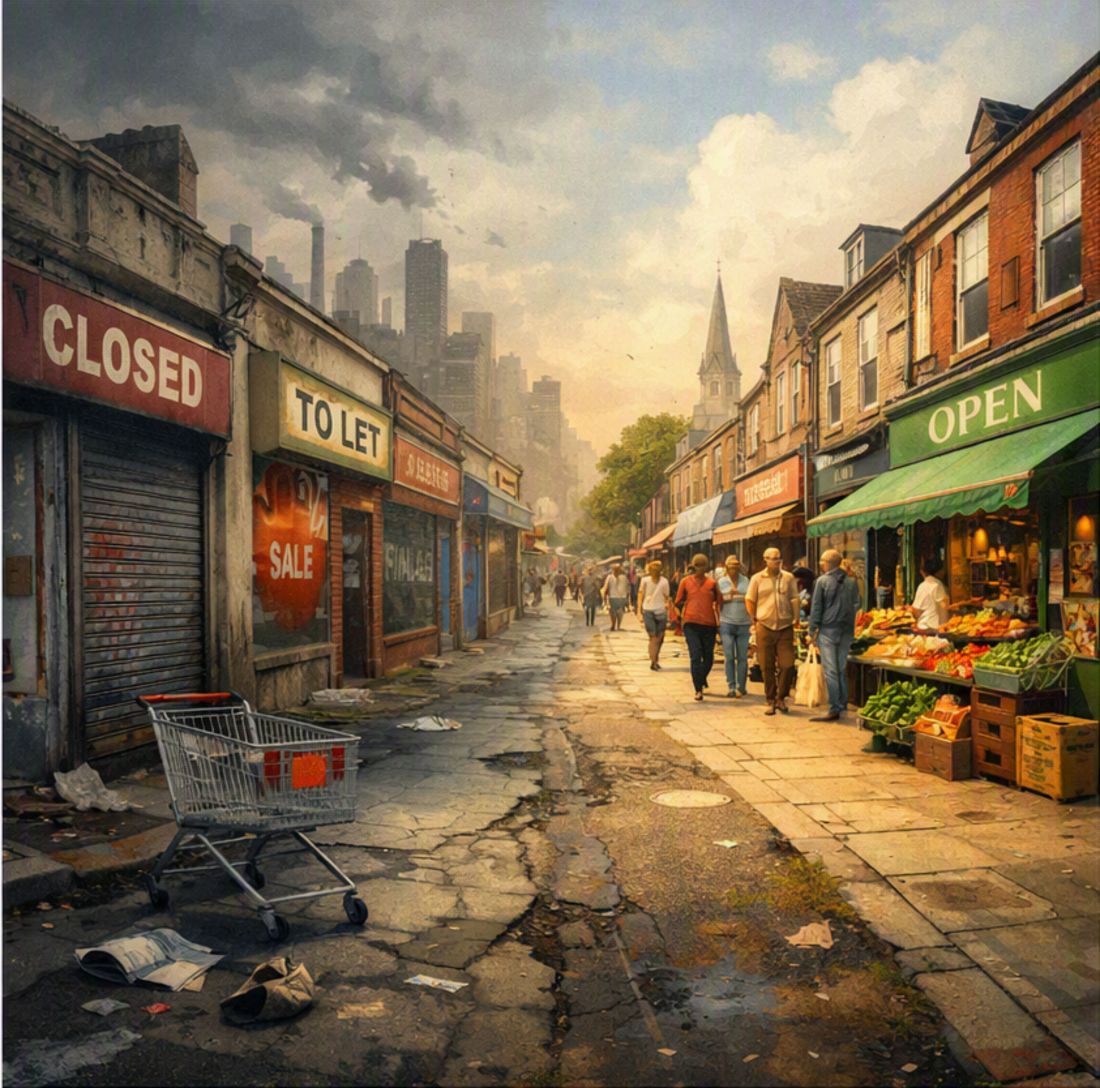
High streets are not failing because people suddenly stopped caring about them. They are failing because the economic system that once made them possible has changed so profoundly that the traditional high street no longer fits within it.

The familiar explanations are well known: online shopping, out-of-town retail parks, high rents, business rates, parking, poor planning, and changing consumer habits.

Each of these factors matters. But each is also a consequence of something deeper: a value system that has placed money, return, scale, and efficiency above human participation, local capability, and community life.

The decline of the high street is therefore not just a retail story. It is a visible expression of a wider economic direction. The same system that has hollowed out town centres is now beginning to hollow out work, ownership, contribution, and the human role in economic life itself.

That is why the empty high street matters. It shows us where the system has been, what it has already broken, and where it is now heading.

To understand the problem, we have to follow the chain properly: from local circulation, to financialisation, to centralisation, to digitalisation, to automation, to the false promise of Universal Basic Income, and finally to the question of whether a money-centred system can survive once people are no longer able to participate in it.

The answer begins with the high street, but it ends with the future of society itself.

The high street was built for a different kind of economy

For most of modern history, the high street worked because everyday life was organised locally. People lived near where they shopped. Money moved between households, independent businesses, local trades, nearby suppliers, and community institutions.

Shops were not just places of transaction; they were part of the social infrastructure of a town.

That system depended on local circulation. A pound spent with a local butcher, baker, café, repair shop, market trader, or family-run store was more likely to remain in the area, supporting other local work and relationships.

The high street was therefore sustained not only by demand, but by a pattern of life in which people, money, services, and trust repeatedly moved through the same place.

This is what is meant by a human-scale economy: an economy small enough for people to see the consequences of their choices, know who they are dealing with, and feel that their town is something they participate in rather than merely pass through.

The old high street was not perfect, and it should not be romanticised. But it did reflect a structure in which local presence mattered. That structure has been steadily dismantled.

Financialisation changed the rules

Over recent decades, the economy has shifted away from production, local exchange, and community resilience towards financialisation.

Financialisation means the process by which financial returns, asset values, debt, speculation, and shareholder value become more important than the practical usefulness of the things being financed.

In a financialised economy, the question changes. Instead of asking, “What does this place need in order to thrive?”, the system increasingly asks, “What produces the highest return?”

  • Efficiency is rewarded more than resilience.
  • Scale is rewarded more than locality.
  • Profit is rewarded more than community benefit.
  • Growth is rewarded more than stability.
  • Centralisation is rewarded more than distributed local ownership.

Once those incentives dominate, decline becomes less mysterious. Supermarkets replace local food shops because they operate at scale. Retail parks draw trade away from town centres because they fit car-based convenience. Online platforms bypass local businesses because they can centralise stock, data, logistics, and profit. Landlords and investors may treat property as an asset class before they treat it as part of a living town.

This does not mean every closure is caused by one villain or one policy. It means the wider system increasingly incentivises behaviour that drains value away from local places.

That is what extraction means in this context: value is created in one place, by real people and real communities, but is captured elsewhere by systems, owners, platforms, or institutions that are distant from the consequences.

Financialisation is not the root cause

Financialisation itself did not appear from nowhere. It emerged from a deeper value system that places money at the centre of every part of life.

When money becomes the primary measure of success, institutions begin organising themselves around its accumulation. Communities become markets. Citizens become consumers. Local capability becomes less important than financial efficiency.

The decline of the high street therefore reveals more than a retail problem. It shows what happens when the economy stops asking what creates healthy places and starts asking only what produces measurable financial return.

Digital convenience accelerated the collapse

Digitalisation did not create the underlying problem, but it accelerated it dramatically.

Online retail, delivery apps, automated logistics, targeted advertising, and platform marketplaces all make it easier for spending to leave our towns and communities without ever touching the local economy.

The promise is convenience. The cost is disconnection.

A purchase that once involved a walk or bus ride into town, a conversation, a shopfront, a local wage, and perhaps another local supplier can now become a silent transfer to a centralised platform where no other human being will ever be seen.

The behaviour feels small and therefore insignificant at the level of the individual, but multiplied across millions of transactions it transforms the physical life of towns and cities too.

The high street is expected to compete, but it is not competing on equal terms. It is being measured against businesses that can exploit scale, data, automation, global supply chains, and financial backing that local shops rarely possess.

This is why decline often feels like a one-way street. The system increasingly makes local presence optional, then wonders why local places become vulnerable, underused, and out of step with the economic world being built around them.

Why some high streets still thrive

Some high streets still work, and their existence is important because it proves that decline is not inevitable.

In many places, especially where communities remain socially dense and locally connected, independent businesses continue to play a central role in daily life.

Part of the reason appears to be stronger social cohesion, local spending habits, walkable routines, and community networks. These are not minor details. They are the social conditions that allow local businesses to survive.

Thriving local economies often depend on behaviours such as:

  • regular walking routes through local shops and services
  • dense social networks that create trust and repeat custom
  • loyalty to community-run or family-run businesses
  • localised spending patterns
  • multi-generational knowledge of place
  • a sense that the high street belongs to the community, not only to landlords and retailers

These behaviours naturally sustain local shops because they keep money, attention, and relationships circulating within the area.

The lesson is not that some communities are immune to economic pressure. It is that high streets need more than buildings, grants, or branding exercises.

High streets and urban centres need the social and economic infrastructure that gives people a reason to use them every day.

Where that infrastructure remains, high streets remain more resilient. Where it has been stripped away, regeneration becomes much harder. This is why the answer cannot be limited to retail strategy. The problem is deeper than shopping, and so the solution has to be deeper too.

The high street is the warning, not the destination

The mistake is to treat the decline of the high street as an isolated problem.

It is not. It is an early warning sign of a much larger direction of travel.

The same forces that reduced the need for local shops are now reducing the need for human involvement elsewhere. Automation, artificial intelligence, platform systems, and machine-led logistics all follow the same basic logic: remove friction, reduce cost, increase efficiency, centralise control, and maximise return.

For those who own the platforms, technologies, data, and infrastructure, this appears rational. It looks like progress. But the contradiction is obvious once we look at the system as a whole: a money-centric economy only functions if people continue to earn, spend, consume, and generate returns.

If technology removes the economic role of growing numbers of people, the system does not become magically abundant. It becomes unstable.

The customers, workers, taxpayers, tenants, borrowers, and consumers who are supposed to keep the machinery turning are the same people whose incomes and agency are being eroded.

This is the direction the empty high street points towards. First local shops become unnecessary. Then local ownership becomes unnecessary. Then local labour becomes unnecessary. Eventually, human participation itself is treated as an inefficiency to be managed.

Why UBI has entered the conversation

This is why Universal Basic Income, or UBI, has become attractive to some of the people building the technological future as we are being led to understand it.

They can see that a problem is coming. They can see that automation and artificial intelligence may leave many people without a reliable route to income. They can see that a system built on employment and consumption faces a serious problem if employment becomes scarce.

But recognising that a problem is coming is not the same as understanding the mechanics of the system that created it.

Proposing UBI as the solution assumes that a collapsing money-centric system can be preserved by giving people enough money to keep consuming. It assumes that the same structure that has concentrated ownership, transferred wealth, extracted value, weakened local capability, and reduced human participation can somehow provide a secure income to a population it no longer needs economically.

That is the contradiction. A system built on wages, debt, rent, consumption, tax, and returns cannot sustain a permanently kept population if the people expected to fund and circulate value no longer have stable incomes. Even if the intention were compassionate, the mechanism does not hold.

UBI may soften the appearance of collapse for a time, but it does not reverse the underlying direction. It does not restore local ownership. It does not rebuild capability. It does not give people a meaningful role in production, governance, or community life. It keeps the money-centred frame intact while the social and economic foundations beneath it continue to weaken.

The problem is not that people need support. They do. The problem is believing that support can be delivered through the same system that created the dependency in the first place.

The alternative: LEGS, BLS, and a people-centred economy

If the high street is a symptom of a deeper economic failure, then saving it cannot mean simply filling empty units with new tenants. Nor can it mean relying on another short-term regeneration scheme, marketing campaign, subsidy, or welfare mechanism that leaves the underlying structure untouched.

What is needed is a revaluation: a shift away from treating money as the centre of value and towards treating human wellbeing, contribution, dignity, place, community resilience, and environmental responsibility as the things an economy is supposed to serve.

This is where the Local Economy & Governance System, or LEGS, becomes relevant. LEGS is not simply an economic policy. It is a different operating system for society: one that begins with people, community, and the environment rather than money, growth, and extraction.

Its purpose is to restore local capability, local decision-making, shared responsibility, and meaningful contribution.

Instead of asking how people can be kept alive inside a system that no longer needs them, it asks how society can be organised so that people remain necessary, valued, secure, and sovereign.

The Basic Living Standard, or BLS, is central to that alternative. Unlike UBI, it is not simply a payment distributed within the existing system. It is a structural guarantee that people can meet the essential costs of living through a normal week’s contribution, without debt, charity, or dependency.

It links security to dignity, participation, and a fair structure of life rather than to passive receipt within a collapsing model.

In practical terms, this means rebuilding local economic life around:

  • local capability, so towns can meet more of their own needs
  • local production and repair, so value is created close to where people live
  • local supply chains, so businesses support one another rather than depend entirely on distant systems
  • local ownership, so wealth does not immediately leave the area
  • local governance, so decisions are made closer to their consequences
  • local value circulation, so money, skills, trust, and responsibility move through the community rather than out of it

This is not a call to go backwards. It is a call to re-scale forwards: to use technology, planning, enterprise, and governance in ways that strengthen human capability rather than replace it.

A healthy high street cannot be created by nostalgia. It can only be created by an economy that gives people a real reason, and real ability, to participate locally. The same is true of society as a whole.

The real message of the empty high street

The decline of the high street matters because it exposes a much deeper problem. It shows what happens when financial efficiency becomes more important than human value, local capability, and community resilience.

Empty shops are not the disease. They are the symptom.

The question is therefore not simply how to save the high street. The question is whether we want to keep organising life around a system that produces dependency, centralisation, extraction, and fragility – or whether we are willing to build systems that restore capability, participation, dignity, sovereignty, and belonging.

The difficulty is not that alternatives such as LEGS and the BLS are impossible to understand. The difficulty is that most of us have been conditioned to believe that a money-centred system is the only way life can work.

We have learned to treat money as value itself, rather than as a tool that should serve life.

That is the real lesson of the high street. It is not asking to be saved as a memory. It is asking whether we still value the kind of society that made it possible – and whether we are willing to build a people-centred future before the money-centred one collapses under its own weight.

Further reading: where to go next

The argument in this article is part of a wider body of work exploring value, local economies, technology, governance, and the need for a people-centred alternative to the money-centric system.

The following pieces are best read in this order, as each one builds on the last.

1. The Basic Living Standard Explained
https://adamtugwell.blog/2025/10/24/the-basic-living-standard-explained/
This piece explains the Basic Living Standard, or BLS, which sits at the heart of the people-centred alternative discussed above. It sets out why security should not depend on charity, debt, insecure employment, or passive state support, but on a fair structure that allows people to meet the essentials of life through meaningful contribution.

2. The Local Economy & Governance System
https://adamtugwell.blog/2025/11/21/the-local-economy-governance-system-online-text/
This is the core alternative framework model referred to as LEGS. It develops the practical structure of a local, participatory, people-centred system built around local capability, local governance, shared responsibility, and the restoration of real economic participation.

3. The Power of Local Communities
https://adamtugwell.blog/2026/03/31/the-power-of-local-communities/
This article expands the social side of the argument. It explores why strong local communities matter, how participation and belonging are created, and why local relationships are not sentimental extras but essential infrastructure for any healthy society.

4. When AI Builds a Machine World, This Economy Can No Longer Sustain
https://adamtugwell.blog/2026/07/20/when-ai-builds-a-machine-world-this-economy-can-no-longer-sustain/
This piece follows the direction of travel beyond the high street into automation, artificial intelligence, and the future of work. It explains why a money-centric economy becomes unstable when the people expected to earn, spend, borrow, pay rent, and consume are increasingly removed from meaningful economic participation.

Taken together, these works show the wider arc: the high street reveals the failure of local circulation; the BLS defines the foundation of security; LEGS provides the structural alternative; local communities explain the social basis; and the AI piece shows why the present direction of travel makes a people-centred system increasingly necessary.

The Independence Threshold | A New Definition of Poverty for A Modern Economy

Poverty has always been difficult to define. Governments use income thresholds. Charities use deprivation indicators. Economists use consumption models. But none of these definitions capture the lived reality of poverty in a modern, high‑income country like the United Kingdom.

They measure symptoms.

They do not measure the condition itself.

The Independence Threshold Definition of Poverty begins from a different starting point – one that reflects how poverty actually works in real life.

Poverty begins where independence ends.

A person is in poverty when they cannot meet their essential needs without external support – whether that support comes from the state, charity, family, or debt.

This definition is simple, but it changes everything.

Poverty is always relative to its own economy

Global institutions often define poverty in ways that evoke extreme deprivation – the kind associated with low‑income countries and subsistence economies.

This framing is useful for international development, but it becomes misleading when applied to wealthy nations.

Poverty is not a universal condition.

Poverty is an economic condition.

Poverty must be understood relative to the economy it exists within.

In the UK, poverty is shaped by:

  • UK housing costs
  • UK energy prices
  • UK transport needs
  • UK childcare costs
  • UK wages
  • UK debt structures
  • UK public services
  • UK labour markets

A person can be in poverty in the UK even if they have electricity, sanitation, and a roof over their head – because the cost of maintaining independence within the UK economy may exceed their income or capacity.

Physical conditions differ between economies.

Poverty does not.

Poverty is not defined by physical conditions

Different economies produce different physical environments:

  • Sanitation
  • transport systems
  • infrastructure
  • heating
  • water access
  • housing quality
  • digital access
  • public services

These are environmental features, not indicators of independence.

A person can have:

  • running water
  • paved roads
  • electricity
  • a smartphone
  • a bus route
  • a supermarket nearby

…and still be in poverty if they cannot sustain themselves within the economic system that surrounds them.

This is why arguments like:

  • “People here live like kings compared to country X,”
  • “They have TVs, so they’re not poor”
  • “They have sanitation, so they’re fine”

are structurally false.

They confuse material environment with economic independence.

Poverty is exclusion – and exclusion is universal

When a person cannot sustain themselves within their own economy, they experience exclusion.

This exclusion is not abstract – it is lived, daily, and universal across all societies.

Loss of independence leads to:

  • Hardship
  • Instability
  • mental health deterioration
  • social isolation
  • loss of dignity
  • loss of agency
  • loss of future planning
  • loss of resilience

These outcomes occur in:

  • wealthy countries
  • developing countries
  • rural areas
  • urban areas
  • different cultures
  • different infrastructures

The physical environment changes.

The exclusion does not.

This is why poverty must be defined by independence, not by conditions.

Why traditional definitions fail

Traditional poverty lines are based on income.

But income alone does not determine independence.

Two people earning the same amount can have completely different levels of stability depending on:

  • housing costs
  • childcare costs
  • transport needs
  • health conditions
  • debt burdens
  • regional prices
  • insecure work patterns

Income‑based definitions hide millions of people who are not officially “in poverty” but cannot survive independently.

These are the people living on the poverty trap door – above the line, but one shock away from falling through it.

The Independence Threshold Definition makes them visible.

A definition for policy, research, and public understanding

This definition is not ideological.

It is not tied to any political party.

It is not designed to support or oppose any policy.

It is a lens – a way of seeing poverty clearly.

It can be used by:

  • Policymakers
  • Researchers
  • Charities
  • Journalists
  • Economists
  • Social Scientists
  • Community Organisations

And by anyone who wants to understand the real structure of poverty today.

The Independence Threshold Definition of Poverty

Poverty begins where independence ends.

A person is in poverty when they cannot meet their essential needs without external support – whether that support comes from the state, charity, family, or debt.

Poverty is always relative to the economy it exists within.

Physical conditions – sanitation, transport, infrastructure, heating, water, housing quality – differ between economies, but they do not define poverty.

Poverty is defined by the inability to sustain oneself within one’s own economic environment.

When independence is lost, people experience exclusion: hardship, instability, mental strain, and social isolation. These outcomes are universal, regardless of the physical surroundings.

Poverty is not about global deprivation standards or material conditions.

Poverty is about independence – and the loss of it.

The Two‑Edged Sword of Social Mobility: Why Our System Elevates Narratives, Not Capability

Social mobility is often presented as a simple moral project: remove barriers, widen opportunity, and allow people from disadvantaged backgrounds to rise.

It is a noble ambition, and one that any fair society should pursue. Yet the way social mobility is currently understood – and operationalised – contains a structural flaw that is rarely acknowledged.

It is a two‑edged sword, capable of empowering genuine talent, but equally capable of elevating individuals for their narrative value rather than their capability.

When this happens, the system not only fails the individuals it seeks to help; it also undermines trust in the very idea of social mobility itself.

At the heart of this problem lies a fundamental confusion between help and hand‑up.

Help is empowering. It equips individuals with confidence, skills, and the ability to step forward on their own merit. A hand‑up, by contrast, is elevating. It places individuals into positions they have not yet earned, often because their background fits a narrative that institutions find symbolically useful.

These two approaches are not merely different; they produce entirely different outcomes.

Help opens a metaphorical door. It says: you have value, you have ability, and we will remove the barriers that prevent you from showing it. A hand‑up opens a literal door and pushes someone through it, often without ensuring they are ready for what lies on the other side. Help respects agency and capability. A hand‑up risks creating fragility, because it confers status without building the foundation required to sustain it.

This distinction becomes dangerous when institutions begin selecting individuals who fit a hero‑mould – dramatic adversity, visible difference, a compelling story – rather than those who possess genuine capability.

Hero narratives are emotionally powerful and politically convenient. They allow institutions to demonstrate progress, inspire audiences, and signal virtue. But hero narratives reward the story, not the skill.

When someone is elevated primarily because their background is narratively useful, two predictable consequences follow. First, they may struggle to perform at the level to which they have been elevated. Second, their struggle becomes a referendum on social mobility itself. Critics generalise from the individual to the group, and from the group to the entire project.

The collateral damage is severe. Exceptional talent gets left behind. Many disadvantaged individuals possess extraordinary capability precisely because of their formative experiences.

They have developed resilience, adaptability, emotional intelligence, and problem‑solving skills that cannot be taught in classrooms. But because their adversity is not dramatic enough, or because they do not perform their hardship in a way that fits the hero narrative, they are overlooked.

Meanwhile, individuals whose wounding – whether true, exaggerated, or misunderstood – is narratively compelling are elevated. Their trauma becomes their currency. Their background becomes their qualification. Their story becomes their evidence.

This dynamic is intensified by the way society has come to value education. In a wealth‑centric system, financial productivity becomes the measure of human worth. Academic qualifications correlate with income, so they become the primary gateway to opportunity.

The result is an educational system weighted almost entirely toward academic achievement. The narrative that “everyone should get a degree” sounds egalitarian, but it is built on a false assumption: that academic learning is the universal route to success.

It isn’t. Many people are not academic or consciously cerebral learners. They are experiential, practical, hands‑on – individuals whose intelligence expresses itself through doing rather than theorising.

These young people are not less capable; they are differently capable. Yet the current system treats them as failures because it only recognises one form of intelligence.

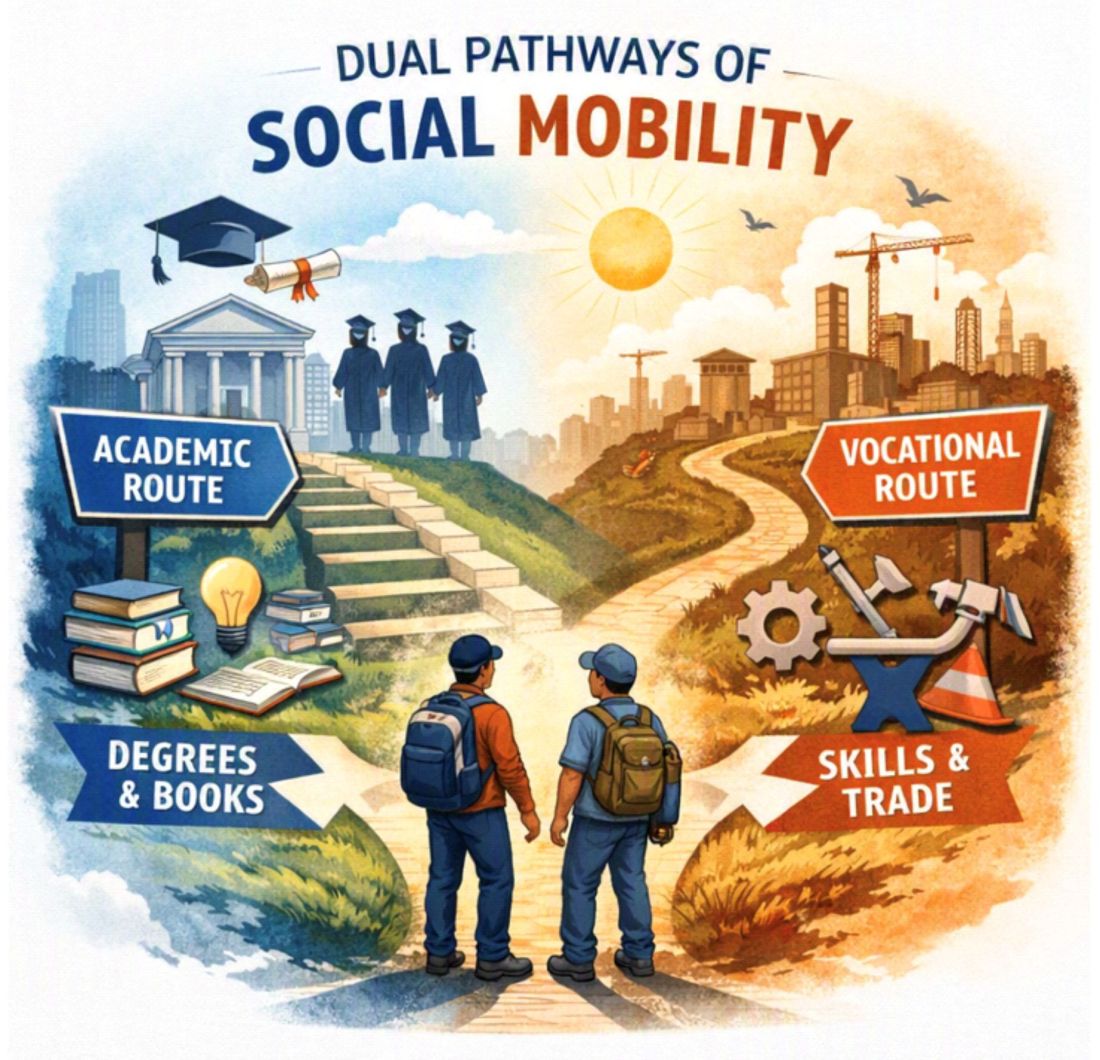
A genuinely vocational pathway – beginning at 14 and continuing to 21 – would allow thousands of young people to thrive in ways no degree can replicate. By the time they finish, they would possess experience, maturity, and professional identity that academic pathways cannot provide.

The tragedy is that the system also fails traumatised young people who could be academic. Growing up in poverty, instability, or survival‑mode environments means that adolescence is not a time for learning; it is a time for coping. These young people may have academic potential, but they cannot access it because their teenage years are spent navigating chaos rather than studying. The system punishes them for circumstances they did not choose.

All of this makes social mobility far more complicated than it needs to be. The bottleneck is not so much the lack of opportunity; it is the narrowness of the educational model and the hero‑mould narrative that sits on top of it.

When society values only academic achievement and visible adversity, it elevates the wrong people and overlooks the right ones. It confuses narrative with merit, background with capability, and trauma with qualification.

Fixing this is not a matter of adding certificates or tweaking qualifications. It requires a fundamental shift in how we value people. We must stop treating wealth as the primary marker of worth, academic credentials as the only legitimate pathway, and adversity as the currency of mobility.

We must start recognising all forms of human capability – practical, vocational, emotional, experiential, and intellectual. When we do this, the number of people genuinely being held back becomes far smaller, and far easier to support.

Social mobility should be about empowerment, not optics. It should uncover talent, not manufacture heroes. It should build capability, not confer status.

And it should recognise that human potential comes in many forms – most of which cannot be measured by degrees, narratives, or the visible markers of wealth.

If You Are Not Comfortable with Who Others Are, You May Not Be Comfortable with Yourself

We live in a time where people often feel unsettled by how others live, think, or identify. Cultural change is fast, loud, and sometimes confusing. New ideas appear before older ones have finished being understood.

In that environment, it’s easy to feel pushed, threatened, or overwhelmed by the choices and identities of other people.

But beneath all of this sits a simple truth: the way we respond to the world is shaped by how well we understand ourselves.

When someone feels uncertain inside, the world outside becomes harder to read. Difference looks dangerous. Change feels personal. Other people’s choices seem like challenges rather than expressions of their own journey.

But when someone understands the experiences and influences that shaped who they are – how they see, hear, interpret, and respond to life – the world becomes clearer, and other people become easier to understand.

This isn’t about ideology. It’s about self-awareness.

The world feels external – but our interpretation of it is internal

Most of us grow up believing that everything important is “out there”: the news, culture, politics, movements, the disagreements. It feels logical to assume the world is the source of all meaning and all threat.

But the world is only half the story.

The other half is the lens we use to interpret it – and that lens is shaped by our own experiences, our own patterns, and our own history.

When we don’t understand that lens, we misread what we see. We assume intention where there is none. We imagine coordination where there is only coincidence. We feel pushed when no one is pushing us.

The world hasn’t become more complicated. Our relationship with it has.

Uncertainty inside creates confusion outside

When someone feels uncertain about who they are, it becomes harder to handle difference.

They may feel:

  • unsettled by new ideas
  • threatened by unfamiliar identities
  • overwhelmed by cultural change
  • convinced that others must change for them to feel comfortable

This isn’t weakness. It’s human. But it leads to a predictable pattern: people try to reshape the world when they don’t feel steady in themselves.

They may say they’re protecting society. They may say they’re resisting harmful ideas. They may say they’re defending tradition or progress.

But often, they’re simply trying to quiet their own discomfort.

Understanding yourself makes others easier to understand

Here is the turning point – the part that matters most.

When you understand the complexity of your own experiences – what shaped you, why you react the way you do, and how your perspective was formed – you naturally become more respectful of the journeys other people are on.

You recognise that:

  • everyone has a history
  • everyone has influences
  • everyone has reasons for being who they are
  • everyone is trying to make sense of their own life

This doesn’t mean you agree with everyone. It doesn’t mean you approve of everything. It doesn’t mean you abandon your own values.

It simply means you see people as people – not threats, not symbols, not enemies.

It would be too simple to call this patience, and not quite right to call it peace, but it certainly leads in a positive, fulfilling, and direction of becoming increasingly aware.

Why this matters now more than ever

We’re living through rapid cultural change. Traditional anchors – community, shared narratives, stable identity – are weaker than they once were. Many people feel unsteady, unsure of their place, unsure of their identity, unsure of how to interpret the world.

In that environment, difference feels heavier. Ambiguity feels threatening. Change feels like loss.

But the solution isn’t to demand uniformity or to insist that others must change. The solution is to understand ourselves more deeply.

Because when we do, the world stops feeling like a battlefield.

Comfort with others begins with comfort within

People who feel settled in themselves don’t need others to shrink or shift. They don’t interpret difference as danger. They don’t assume conspiracy where there is only confusion. They don’t feel personally threatened by someone else’s identity, choices, or worldview.

They can let others be themselves because they are comfortable being themselves.

And that is the heart of this entire work:

If you are not comfortable with who others are, you are not comfortable with yourself.

However, when you understand yourself – truly understand yourself – you become far better equipped to navigate the world with clarity, confidence, and kindness.

A Closing Reflection for Modern Life

We are surrounded by noise – opinions, reactions, labels, movements, counter‑movements, and endless commentary about what society is becoming.

It’s easy to feel that the world is accelerating beyond our ability to keep up.

But the truth is simpler and far more hopeful:

The world becomes easier to understand when you understand yourself.

Self-awareness doesn’t solve every problem, but it gives you the grounding to face them without fear. It helps you recognise that most people are not trying to threaten you, replace you, or reshape you – they are simply trying to live their lives, just as you are trying to live yours.

In a time when so many feel lost, misunderstood, or overwhelmed, the most powerful thing you can do is turn inward, understand your own story, and let that understanding guide how you see the world.

It’s not a retreat from life. It’s the beginning of seeing life clearly.