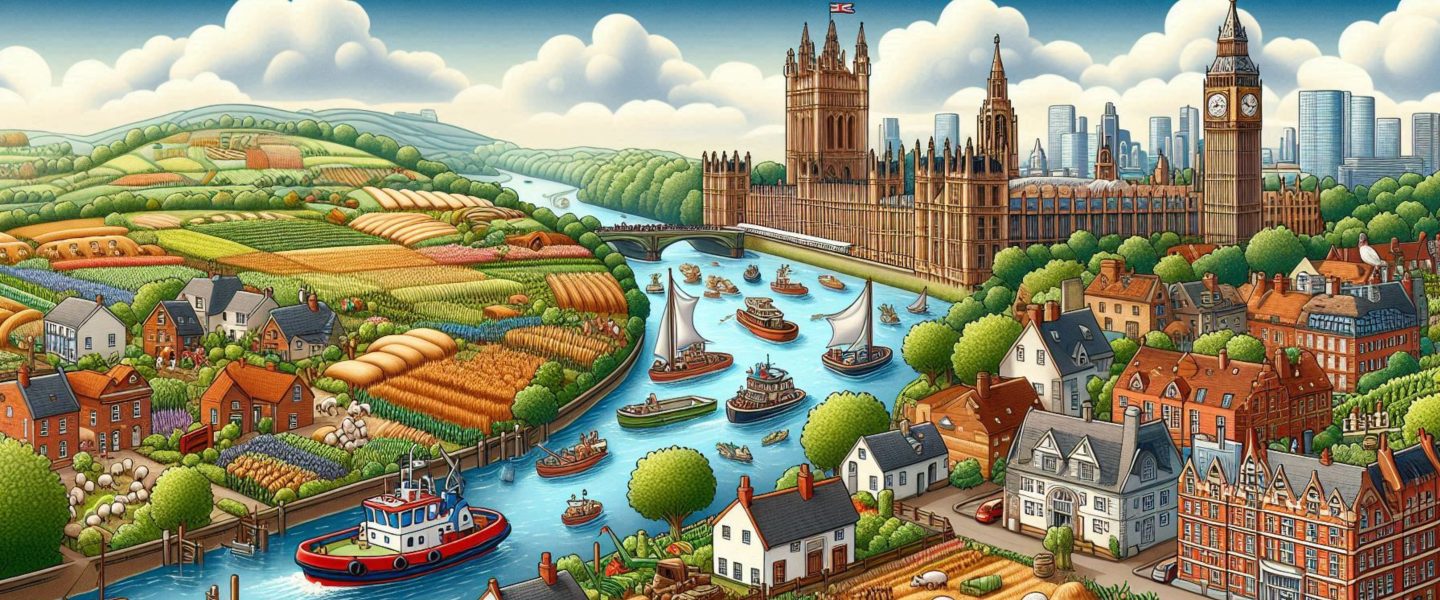
Latest figures suggest that the UK only produces around 52% of the food that we consume. Yet we are increasingly reliant on trading relationships threatened by war and the collapse of global supply chains, making the supply of imported food increasingly vulnerable and insecure.
Despite the risk to UK food security, Politicians and big business keep pushing UK Farms and Food Production towards profit making systems. This approach increases consumer reliance on unhealthy and highly processed foods and manufacturing, is quickly leading to the destruction of Agriculture and our ability to grow food naturally in the UK, and it uses organisations and standards like the Red Tractor scheme to exert ever more influence and control, knowing that significant change can be achieved without question, if the guidance comes from organisations that farmers and growers trust.
The short-, medium- and long-term future of UK farming and food production now hangs in the balance.
If UK Farmers don’t begin to take risks to save their own industry today; there will no longer be anything left of UK Farming worth taking a risk on in just a few tomorrows.
However, the risk taken to secure the future of UK Farming needs to be measured and considerate of all the ingredients necessary to secure permanent change, putting locally grown, healthy and nutritious food back at the centre of consumer and community life.
This cannot be achieved through populist protests and civil disruption that will damage the relationships that we now need to cement.
The creation of a new Food Chain Assurance Standard, led by Farmers, with the help of consumers and everyone who genuinely believes in and champions UK Food Production, offers the opportunity to achieve change that will not be possible in any other way.
Not a day goes by now where AI isn’t featured somewhere in the media. More often than not because of the expectation that adopting the new and future generations of artificial intelligence will make certain jobs that people currently do redundant, and that this technology takeover of usually basic, repetitive or uncreative tasks will be an accelerating trend.
Technical development and the removal of jobs that required people to complete them isn’t a new phenomenon in any way. The reality that we face is ever since the march or industrialisation began, the use of tools, machines and now software have been used by increasing numbers of businesses to reduce the number of people that they employ.
The process of industrial and now technical development is presented to us all within a narrative that maintains progress is one directional. That the reduction in the number of jobs available for growing numbers of people that need them is an inevitable and equally unavoidable part of a process that keeps improving our quality of life.
Yet the question that nobody ever seems to ask is ‘Whose life is being improved by the reduction in the number of jobs and the specialisation that goes with it?’
The people whose lives are enriched by any process that means they can employ fewer people to produce the amounts of products, teach the same figures or potentially even more, are those who stand to make more money quickly or even over the long term, no matter how much they might initially have to invest.
Just because we can do something doesn’t mean that we have to.
The trap we have all fallen into and the myth that we have been led to believe, is that the reduction of the number of people in jobs, as a direct result of technological advancement, is both necessary and good for mankind.
This isn’t true today. It never has been.
Making people redundant for no other purpose than saving and therefore making more money is inhuman. It is a lack of morality and care for other people of the very worst kind.
What is worse, it is the same technology taking away jobs, being pushed at us at the same time in the form of our mobile phones and all the tech and software that we use, that is also providing an open goal to deprogram our understanding and ability to function independently of the people who stand to be able to control the future flow of money from us.
This so-called technological advancement is slavery or little better than farming with the animals replaced by humans. It will be the harvest of money from a controlled or captive audience as the intention or root cause of what takes over our lives next.
Working in jobs that pay enough for each and every one of us to be self-sustaining or fully independent is what genuine freedom looks like.
People are happy and at peace with themselves when they know they will always be able to self-resource. And if the lowest paid jobs provided a salary that meant people could function independently of benefits, charity or debt, people you could never imagine doing so would be happy caring for others, stacking shelves or picking fruit.
As a society and community, we have an obligation to achieve this genuine form of freedom for everyone to enjoy as the basis of a good, healthy and equality-based life, where everyone is valued in exactly the same way.
What we don’t have, as individuals, is the right to make and to continue to make profits that take the possibility of other people doing this for themselves, further and further out of sight.
Tech should certainly be used to improve everything that it can. But it should never be used to put people out of work when the jobs they do provide a function that at the level of the individual and as part of the bigger picture will almost always deliver results and an experience that can never be delivered or experienced again, once it has been taken out of human hands.
The one thing that everyone linked to U.K. Agriculture and Food Production will agree on is that the industry is in crisis. But what the crisis is, what caused it, what will fix it and what approach or what thinking must be prioritised to do so are very different things.
The stakes could not be higher. Farming is quickly becoming unviable for growing numbers of farmers. The land they vacate is coming out of production and not being passed to the next generation or anyone fighting to find their way in. Retailers are exhaustively abusing their relationships with farmers and growers, and the establishment remains blithely confident that the U.K. will never be short of supplies.
Because countries as far away as Australia and New Zealand will always be there to step into the gap and meet every shortfall.
All of this whilst the latest figures suggest that the amount of food that the U.K. produces for its own use only reaches around 52-54%.
That the food we all eat just seems to keep on coming gives the lie to what the real food crisis is. And the fragility of our food supply is hiding in plain sight.
The complexity of the issues involved regrettably mean it is increasingly easy for anyone within the industry who is worried about the future, to be looking for a banner or message to get behind. One that relates enough to their own experience and makes sense of whatever they believe everyone else going through the same experience needs to do.
Unfortunately, messages that can become such a point of focus are therefore very dangerous. They deceive people into believing in a shared purpose that isn’t necessarily there.
This means that time, energy and perhaps even risks or gambles are taken on political vehicles or strands of unanchored activism that sound as if they will deliver results and perhaps even become the next big thing.
Some call this populism. It’s happening within farming right now, fuelled in no small part by the growing unrest involving farmers across Europe who have even gone as far as laying a meadow along once of the key routes into Paris.
Ploughing roads, fertilising the walls of ministry offices, shutting down travel or even manning the barricades might sound very attractive to people even beyond the farming and food production community itself. But what would be the purpose? What would U.K. farmers be trying to achieve? What would it all be for?
Everyone has a different perspective on the issues; what is happening and what really needs to happen, to get the result and to sort all the problems out.
By rushing to protest, no matter how inspiring the pictures from Europe might seem, the real opportunity could be so easily lost. The growing power of the frustration, impatience and lack of trust of the establishment, retailers and big money, who are collectively causing so much harm and distress, could too easily be lost. Worse still, misdirection of this untapped potential could too easily be used against what’s left of the power the industry has to influence its own future.
Protests without purpose will also always fail. Wasting a lot of time and probably money that few can really afford. However, the real cost of responding to the dog whistles rarely blown by those with skin in the game, will be the future of UK Farming and Food Production itself.
Any form of protest that isn’t really thought out in terms of what it needs to achieve and then fails, will inevitably be seen as a whimsical exercise by people ‘on the extreme’.
There is a high probability that any form of mass protest implemented without thought will be repurposed by the establishment to fit the narrative that UK Agriculture is archaic in its current form and must adhere to new ways of thinking and practices. Systems and ways of working that in the longer term, don’t feature what you and I recognise as Farming in any relevant form.
I wish that I could say that the alternative way to facilitate change is easy, and just as easy to understand.
There are people working within and supporting the industry who in some cases have overseen massively useful work on the future of farming in the UK and what needs to change.
The evidence is there to demonstrate that a whole range of problems genuinely exists.
Some of the work done is incredibly good and well-informed. But even in the case of those working very closely with Government, politicians and industry leaders every day, there is not enough appreciation of just how complex the political-government-establishment-public sector relationship and the interaction between them has become.
Worse still, there is very little focus on how the massively misled expectations of members of the public as well as industry professionals and small business owners can possibly be met, when the realities of the future we face are now undoubtedly facing in a very different way.
There are barriers to progress everywhere, and the lens of best intentions doesn’t see these for the problem that they really are. Yet we have years of disappointments with public policy to confirm that it is so.
The control of food is power.
Once we are able to understand the role of food in every one of its aspects and forms, we then and only then, have a chance to recognise that the whole direction of farming and the current production and output-based focus it has, is constructed of policies that simply make no economic sense. We can see what they are really there for.
UK Agriculture has no power and no say in its future today. This must change.
Over the past 40-50 years, all that power and influence has been slowly and yes, deliberately been drained away to wherever we think the money still is, and then beyond.
The future of farming that works for us all is one that fits with and interacts closely with the benefits of production and supply to the surrounding community fixed firmly in mind.
Its form more closely resembles the kind of farm structures and sizes that older generations will remember well. It builds upon community, true localism and a healthy relationship with social enterprises or not-for-profit cooperatives in every potential form.
However, the narratives we overwhelmingly hear today tell us that progress can only ever go one way.
Yet the progress the establishment is driving us all towards isn’t focused on humans, on health, on being happy. It’s all about money, and the wealth of an ever smaller few.
But as the friction in the markets, the talk of politicians and the cost-of-living crisis keep warning us, the monetary and financial system that we have, has actually had its day.
The real progress that will keep farmers farming and people healthy and fed adequately with what they need, isn’t based on a direction where money and all the forces that drive it can continue to be in the driving seat for very long.
The future of food and food production is about community, locality, smaller or more tradition scale and about people working in and around food production being remunerated properly for doing proper, fulfilling jobs.
Local Farms and the role they will play in providing many of the foods, drinks and goods that will make that possible, are at the heart of the future of Food Production.
Farmers have the power to influence this change of direction in a very practical way. But government and the big money interests riding off the destruction of UK farming aren’t going to pay for it.
It’s time for the industry to take a worthwhile risk on its future.
Otherwise, it won’t be long before there isn’t anything left taking a risk for.
Whilst you will probably need to be a financial anorak to have been watching this news unfold, the US SEC finally approved Bitcoin ETFs yesterday, leading to a range of wild claims about where the value of Bitcoin is now going. Some even suggesting that the financial establishment has now legitimised the previously decentralised digital currency after effectively opening the door to the market and letting the blockchain coin walk right on to the trading floor.
Like so many of the issues that we face today in this (deliberately) complex world of ours, the truth, or rather the truths about Bitcoin and what it will now mean for any digital currency to be traded as part of ETF financial packages can be viewed in many different ways. However, the real story is set to be obscured by group think, the narratives that the establishment want us all to believe, and the time that it will take for what will surely be, in the majority, a whole new tranche of lies to fall on their face and for the next new money myth to come unstuck.
Identifying, understanding and yes, accepting the existence of the money myths is very important.
Money myths are at the very core of the problems that the world now faces, and why no matter which way any of us look, everything that we see now appears to be well and truly f***ed up.
Irrespective of whether you are in the ‘digital currency is financial freedom’ or ‘bitcoin was just created as another establishment ruse’ camp, the most compelling benefit of pre-January 10th 2024 Bitcoin was its previously unchecked status of being a ‘finite’ currency or money source. Even though the base of its programming or the blockchain technology that its built upon would already have enabled each coin to have been divided an infinite number of times.
The ’fact’ that Bitcoin (and other cryptocurrencies like it) couldn’t be printed off at will, as has been the case with the US Dollar, the UK Pound, the EU Euro and all other FIAT currencies, has made it a very compelling option for traders of all kinds. Many of whom have bought into the belief that a fixed amount of anything will mean that the value – and therefore the profit to be made, can only ever go up.
Regrettably, the false floor or elephant trap in the pro current digital currency argument is that like the FIAT ‘cash’ that Bitcoin was intended to replace, the true or intrinsic value of the ‘coin’ is zero.
Like any other form of money that is and only ever has genuinely been a medium of exchange, the value of Bitcoin is based purely on belief, and no matter how many people, countries or whether it’s an entire world believe in its value, the reality is that Bitcoin’s value isn’t anything more than zero at any time, and any value held against it in any moment is little more than the equivalent of a bet that can and will be lost, the moment that the secret is either out, or events have enacted their own terminal care.
That the (financial) establishment has taken so long to make any move that can be argued to legitimise the existence and value of Bitcoin should itself be raising many red flags. Rather than leading to any feeling for traders that now is the time to feel overjoyed.
The establishment operates on the basis that nothing is real until it creates or endorses the narrative that says it will be so.
So, the financial marketplace has become very nervous of having so little control over a form of independent currency being seen to be able to offer a financial refuge for traders, when FIAT ‘cash’ is about to collapse and they had no legitimate way to seize the alternative digital form of FIAT that growing numbers have argued is about to take its place.
Regrettably, it takes a very open mind and many hours of viewing or better still, book-based research, to understand the basic principles and yes, the sanitized forms of criminality that underpin the way that the worlds financial and monetary systems currently work.
It is only after challenging and dispelling the many shibboleths that surround the way money works, that a genuine understanding of how ridiculously dishonest the system of money creation and tools such as leverage really are. And that financial products that may be labelled as being one thing such as ETFs cannot be trusted or taken at face value as an indication of what assets, products or the value that genuinely exists within.
The GFC or Great Financial Crisis in 2008 should have proved to be the cautionary tale for everyone about what happens when laws are twisted so that financial traders are legally allowed to play what are potentially world-threatening games. Simply so that they can create and make more and more money – at the expense and to the detriment of everyone else.
Regrettably, our very stupid politicians bought into the idea that it would be in everyone’s interests for the public to bail the crooked bankers out.
After the noise and the dust clouds had at least began to settle down, for the banks and financial sector it was back to business as usual, exploiting everything that they possibly can with money involved and treating everyone – including the glory-seeking political set, as if we and not they are the miscreant clowns.
The lessons haven’t been learned. As FIAT ‘cash’ and its value heads quickly towards the scrap heap, it would appear that the SEC have now provided the opportunity for big money to legally capture and control the digital currency marketplace. Giving them the potential for them to sell – and therefore profit – many times over and exponentially so, from any perceived value that exists from the Bitcoin that any unwitting buyer has been told exists within each and every ETF that they may buy or obtain a part thereof.
Even gold and other precious metals have fallen foul of the dishonesty that exists within financial and market trades. The reality that each and every owner of these – like Bitcoin from now onwards face, is that unless you physically possess the asset or the product that you believe you own, the real value of whatever you think you have bought isn’t worth the paper that its written on, and yes, that will probably mean that it doesn’t even exist.
My focus on Agri politics and the mass of issues that surround UK Food Security, Sustainable Agriculture and the growing problem of Food Poverty in the UK has made the past few months and my time at the Royal Agricultural University highly beneficial. Especially as I have began to look further and further outside my own social and professional circles to see if the troubling patterns that I already recognised, were evident in the same way elsewhere.
I have to be blunt and say that nothing I have experienced has given me any comfort. In all honesty, everything that I have seen has made me realise that the UKs Food Security and self-sustainability issues are significantly worse than I’d already concluded, and they are getting worse the whole time.
As you will have already read, Sustainability and Sustainable Agriculture are issues that are important to what I wish to share. However, the English language, the way that we multipurpose words and the obsession with subtext that most of us have, make communicating difficult issues that need to easily be grasped very difficult. Especially when alternative terms and their meanings can be used as a barrier that allow emotional ties to get in the way of progress and constructive dialogue.
There are very important distinctions to be made about Sustainable Farming in the context of what sustainability really is. Given that terms such as Regenerative Agriculture, Conservation Agriculture and Rewilding have been pushing their way into the Rural, Green, Environmental and Agricultural lexicon. As despite what should be very distinctive threads of commonality running throughout all of them, the differences between them and more importantly what everyone believes to be the most important priorities of each of them, are endlessly getting in the way.
Misunderstanding, misinterpreting and misrepresenting key benefits and issues is preventing everyone coming together to build upon shared commonality to identify and implement ways of working for the future that are meaningful and beneficial for everyone involved.
To add to the complication of addressing these issues, there is also a need to focus on methods and thinking that are likely to seem counterintuitive in a way that requires many of the most logical and business minded people that we could meet, to think about a future that looks very different to how it does today. A comfort zone we are resistant to leaving where every system, policy and story we encounter tell us all that the basics of everything that we accept without thinking, are always set to remain the same.