Your Beliefs Today create Everyone’s Experiences Tomorrow | New Book

How do you look at the world?

How is your view of the world different to other people?

What will tomorrow look like based on the view of the world you have today?

Would you change the way you view the world if you understood the difference between your view, other people’s views and what they could really mean?

These are all very important questions that most of us are typically too busy or distracted to even consider, let alone ask.

However, the consequences of us not doing so could be very profound, as the future will just happen to us unless we do so

Your Beliefs Today create Everyone’s Experiences Tomorrow invites you to consider a range of the different prevailing ways that people look at today’s world. How they came into being, and what – without change – they are likely to bring into our lives for our tomorrows.

Will you recognise yourself and what your beliefs today could bring to your future experiences?

Will you be happy with everything you believe?

Will you see your own perspective as very different?

Or will you choose to step forward into the future armed with the tools and power for change?

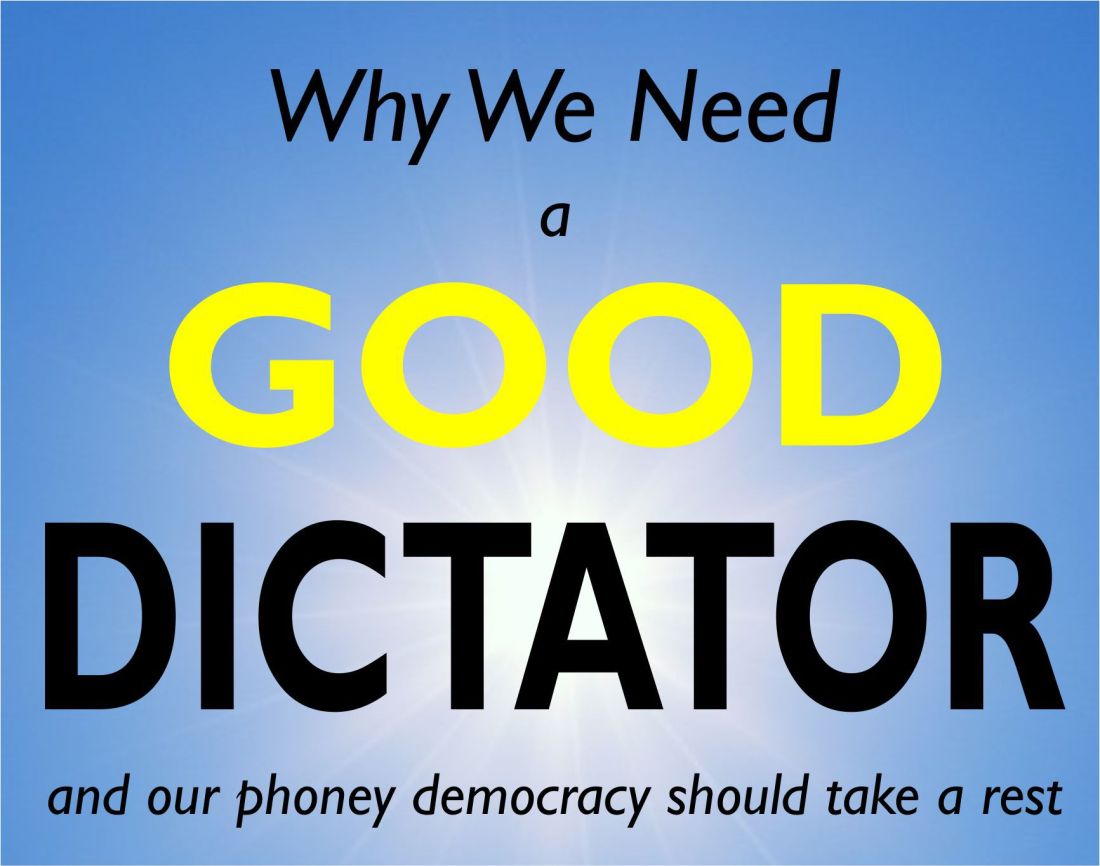
Why we need a Good Dictator, and our phoney democracy should take a rest

In the immediate run up to the December 2019 General Election, I wrote and published The Makeshift Manifesto, here online and as an e-book that’s available on Amazon.

Even though the political terrain was different, from the point of view that the British Electorate were days away from trusting Boris Johnson with an Election Result that very few saw coming because the Conservatives promised to get Brexit done, the truth of the matter was that many areas of the UKs public policy had already gone massively wrong.

Regrettably, it had been doing so for a time that has spanned many different governments, led by different political parties, before.

Within months, we were all subjected to the stupidity and poor leadership that manifested itself in the form of both the Government and the wider political response to Covid 19 and the Covid Pandemic.

We are unlikely to have experienced all the fall-out and consequences of such levels of incompetence and political delinquency that were set in motion, even now.

However, back in early December 2019, I decided to commit all the things a ‘good’ government would actually do to paper. I then shared it with the world.

Since then, The Makeshift Manifesto seems to have been a popular read. So, earlier this year, as I contemplated the run up to the coming General Election, I began to question whether I should revisit the book and update it to reflect what has changed and where the further problems with Public Policy have developed over the 4+ years of time since the first edition was published.

With the original work set up on a screen and being sat ready to dive straight in, it didn’t take many moments for me to realise that if ‘good’ policy was no more than a wish list at the time of the last General Election, because of the quality  of the politicians we had back then, the uncomfortable fact is that with the political options we have available today, such suggestions would be pretty much impossible to deliver through the current structure of government, in any meaningful way.

I’d written about the concept of and asked the question ‘Is it possible to have a Good Dictator’ before.

But at this point I realised, that without people being open to the change that is possible now and which I covered in the book Officially None Of The Above, or there being some kind of Black Swan event that has the power to change everyone’s minds, the only way that meaningful change could be delivered throughout government, the public sector and within every area of Public Policy itself, would be with pure single-mindedness. The kind that could only be achieved if it was driven and directed by one person with the power necessary to command and dictate that massive scale of change.

I worked this thorough as briefly as it was possible to do so.

Leaning on different books that I have written and published over the past two years that included A Community Route and The Grassroots Manifesto, I also added a policy wish list that would be good for everyone, but that in today’s reality, it would only be possible for Good Dictator to deliver and achieve.

There remains a very big question about whether the individual exists who:

  1. Would have the knowledge and experience necessary to change such a massively broken system for the better
  2. Has the desire, drive, motivation and public spiritedness to see it through
  3. Possesses the ethics, morality and principles to stay true to the public cause, when there would be so much temptation to cast what’s in the best interests of others aside

After completing and publishing the book, I concluded that in times as we face today, where politicians and those who aspire to be politicians don’t see any route other than their own, and the public itself has surrendered to the idea that all ‘public’ problems are the responsibility of someone, somewhere else, if nothing else should change in the way we view the importance of the things that are common to us all, the solution of having a Good Dictator, might end up being the only way forward for us all.

It’s what a politician thinks of and does for the person they least identify with that really matters for Fairness, Balance and Justice in Government to exist

Diversity, alternative Political Philosophies and differences in Politics don’t promote or guarantee fairness and balance.

Anyone appointed to a position of influence and authority because of the physical, material or ideological difference they have with others is more likely to prioritise those who they most closely identify with – or for want of a better term, prioritise the interests of ‘those of their own kind’.

The benchmark of any system of government and the political system that facilitates or leads it being truly representative, Fair, Balanced and Just, is what the politician or political decision maker does on behalf of the person they know least about, have least in common with or are least likely to understand.

A system of government cannot and will not work in the best interests of all, if it doesn’t consider and treat fairly, justly and without bias of any kind, even the very people we might consider that we have every reason want excluded in some way or to despise.

If you have read this and immediately think of someone or some group of people that you feel to be undeserving of the same care and consideration that you for yourself would like, you can now use that feeling and emotion to understand how any system of governance and politics will quickly be undone.

This Blog is part of the e-book ‘The Way of Awakened Politics for Good Government’.

No, MPs should NOT have second jobs. After all, being an MP is NOT a job anyway

The ongoing row over second jobs for MPs has certainly proven to be an interesting one. Yet it has also become increasingly concerning, as it has become ever more obvious that so very few journalists, commentators and people working around the political sphere have any real consideration or respect for what the role of an MP and public representative should actually be about.

Arguments in favour of second jobs range from the suggestion that MPs with outside work enrich their links with, and understanding of, the real world, to claims that additional money is the only way to make the role worthwhile. Those against argue that banning second jobs would be acceptable, but only if MPs were given a ‘realistic’ salary.

Nobody seems to have mentioned that being an MP or public representative is not a job.

Being an MP is a responsibility to others. It is not a role that should be taken if the individual concerned cannot guarantee that their responsibility to others will not be compromised by prioritising income, career opportunities, fears, influences of any kind, or any other motivations that put their own needs before anyone else’s at any time, at any level or in any way.

It is part of the human condition that we can only be loyal to one master. MPs are no different to anyone else. If an MP’s priority is income or career at any level, their focus will not be on anyone else.

There are simply no grey areas with this. It really is very black and white.

If an MP can be swayed in their decision-making by any factor that reflects on them personally at any level and in absolutely any way before anything or anyone else, they can be bought. As such, they cannot be relied upon to represent the general public and the voters within the constituency who elected them.

Being an MP or elected politician of any kind requires people who have the life experience, understanding of others and are at a stage in their lives where they can willingly and unswervingly put the needs of others before themselves in every meaningful way.

It is because we have for so long had a Parliament full of MPs on all sides of the political divides who are ruled by self‑interest at some level and in some way that the British political system – and, as a result, the whole of the UK – is in the mess it is in today.

Public service can be the only master of any politician who wants to fulfil the obligations of the role with which they have publicly been entrusted. There simply is no other way.

For as long as we keep electing politicians in this country and allow them to frame their own roles as careers and jobs, their attitude will continue to focus on nothing other than the impact and consequences of their actions for their future and for themselves before anything else.

There will be many who suggest that this is the way the system works and that you can only change the system from within. The regrettable truth is that this is a myth perpetrated solely for the benefit and furtherance of the interests of those already within that system – people who have a massive investment in ensuring that nothing happens that could bring about the comprehensive systemic change that would help and benefit us all.

Sadly, until we all come together and accept that the people leading this country in government, the establishment and the wider public sector are not working to put our collective best interests first, we are doomed to live the same experience. Public policy today is created in all areas of life where decisions have been made not with us as the priority, but with what is important to the people we elected always put first.

We only have ourselves to blame for each and every day that this sordid and perverse idea of democracy continues to rule, impinge upon and inflict avoidable pain and chaos in our lives.

None of the political parties we have on offer today are focused on all of us in the way they should be.

It is we who must make the decision to elect MPs and politicians of all kinds who will make promises and then keep them – because they are in Parliament as politics is a calling or a vocation for them, rather than just an interpretation of a career or a job. One that, to them, is nothing more than getting the maximum return for themselves for the least amount of work.

We need a real choice in politics. We need MPs who understand and genuinely care. We need #ANewPartyForAll for the next General Election.

To achieve this, we need to start thinking differently and begin to build the alternative to the madness we have right now.

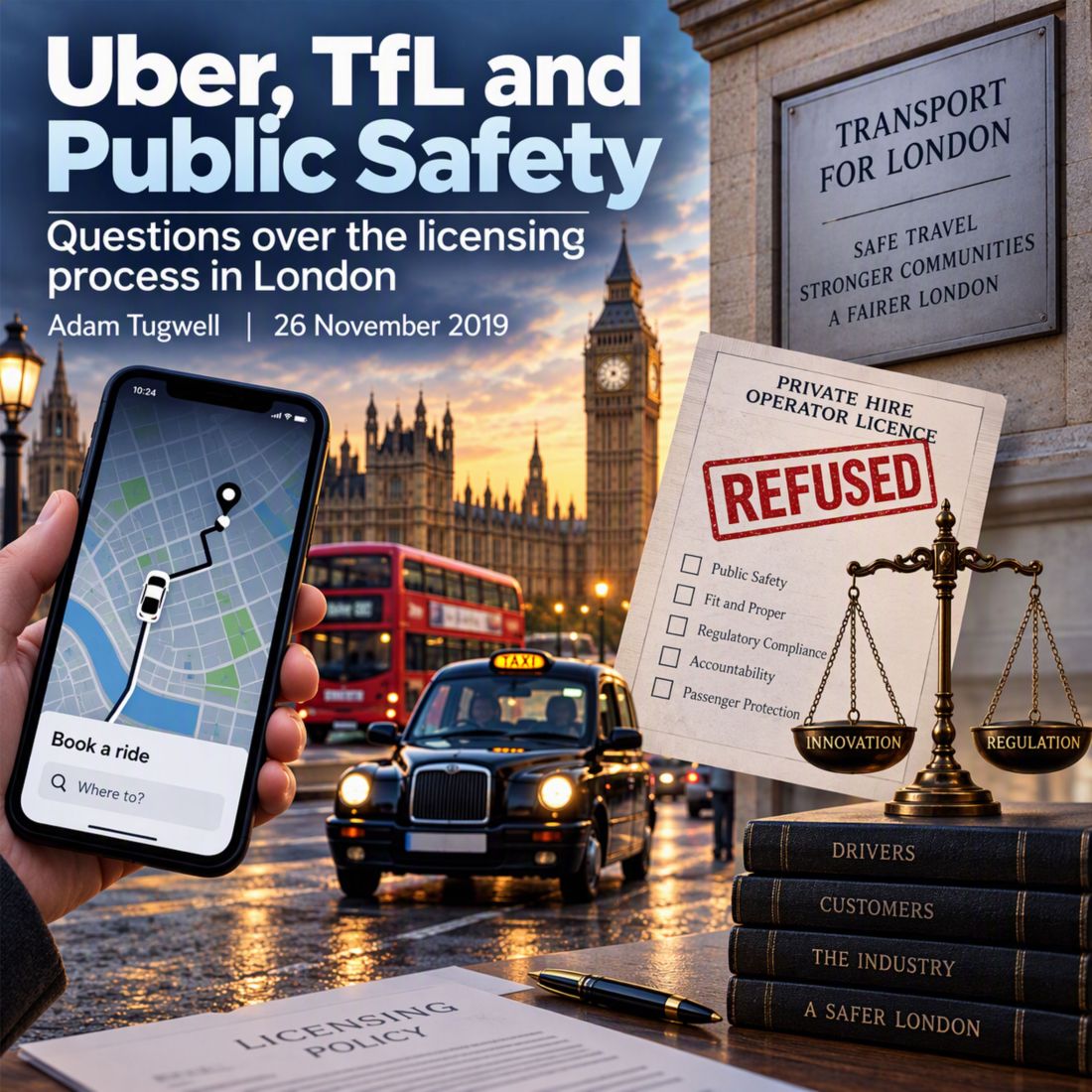
As a Licensing Chair I would have understood why TFL has refused to renew Uber’s License. Actually, I wouldn’t have awarded them one in the first place – but that helps nobody now

If you were looking for a textbook example of what disruptive technology looks like when it hits a marketplace, the assault on the Taxi business in London by Uber would be it.

As a former business owner and entrepreneur, business advisor, business planning tutor and Chairman of a Licensing Authority, the case that has been bubbling away between TFL and Uber over a period of many months has become very interesting reading indeed.

It’s not only because the Licensing Principles have come in to question and this has formed the basis of TFL’s excuse to refuse to reissue Uber’s Operating License.

It’s because the License was awarded in the first place. Especially when the Company’s insistence that it is not itself a Private Hire Company is publicly known.

Licensing in London is of course different to the responsibilities of the Licensing Authority covering rural Gloucestershire and some of its Market Towns that I oversaw for 4 years from 2011 – 2015, just on the basis of size alone. But the principles that underpin Taxi and Private Hire Licensing in each and every part of the Country are exactly the same.

It doesn’t matter how much the Company protests otherwise. Customers know and understand the service and the app they use to book it to be ‘an Uber’.

Customers don’t know Uber to be a price comparison website, an advice site, a recommendation site or anything else that could sound like a plausible re-labelling of a what-it-says-on-the-can technology platform. One that aims to distance itself from the very responsibilities that govern the public-facing service and industry that it has aimed so successfully to disrupt – rather than as being a place where you connect online to get a choice of different ‘taxi co’s’.

The real cost of whatever influences allowed and facilitated the entry of Uber into our Capital in the first place – in these circumstances, have only since started to become known.

But the fact that Customers across London have now experienced the low-cost, comparatively easy to use side of a service that exists purely because of what might have been the intentional misinterpretation of Private Hire Legislation, means that the rules that were arguably broken to facilitate the arrival of the Uber service in London, no longer matter where public opinion is involved.

Herein lies the real problem for TFL having this battle with Uber. Because whoever influenced or made the decision to allow Uber to operate in London without the Company accepting and demonstrating that they would meet all of the requirements of being a Private Hire Operator – not only in principle – but in practical form too – at that very point created the problem that is TFL vs. Uber today.

Because TFL awarded a License in the first place, they should now accept that they have responsibility for Uber being present in London. No matter who was in charge then. No matter who is in charge now.

At the same time however, Uber should not expect to continue operating under the false pretence that it is not itself a Private Hire Operator when doing so is little more than an elaborate charade.

Just because so many drivers now provide a Private Hire Service through Uber in London, it should not in anyway mean that a privately owned company can do whatever it likes without impunity – especially where questions of Public Safety are very clearly involved.

However, the reality that Uber has already held a License of the type they are attempting to regain, does suggest that the Company should at least have the opportunity to address the wider issues that are present. To accept the real responsibilities they have towards customers, to employees and to contractors too. And to begin behaving like they are a part of an established and historic British Industry that they can work with, within and in support of, rather than treating it like it doesn’t exist and is something that they can walkover and ultimately replace.

No private company or commercial enterprise should be allowed to behave like a dictator over the provision of any service that involves public safety, at any level or at any stage.

If Uber wins its License back on Appeal, without any review, reform or change of the way that they operate, that however, is exactly what they will have become.

For good or for bad and for reasons unknown, TFL stepped outside the boundaries of the Licensing Principles to award Uber a Licence in the first place.

If it wants to fix the Uber problem properly it will have to be big enough to step outside those rules again for all the right reasons now and use the power and influence that it has to create a Private Hire model in London that works for TFL, for Uber, for the Industry, for the drivers, for the customers and basically everyone involved.

Please Note: This article was originally published on 26 November 2019. A new featured image was added and the article was prepared for PDF publication on 20 October 2026. Apart from these presentational changes, the article appears exactly as originally written, with no amendments to the text or titles.