
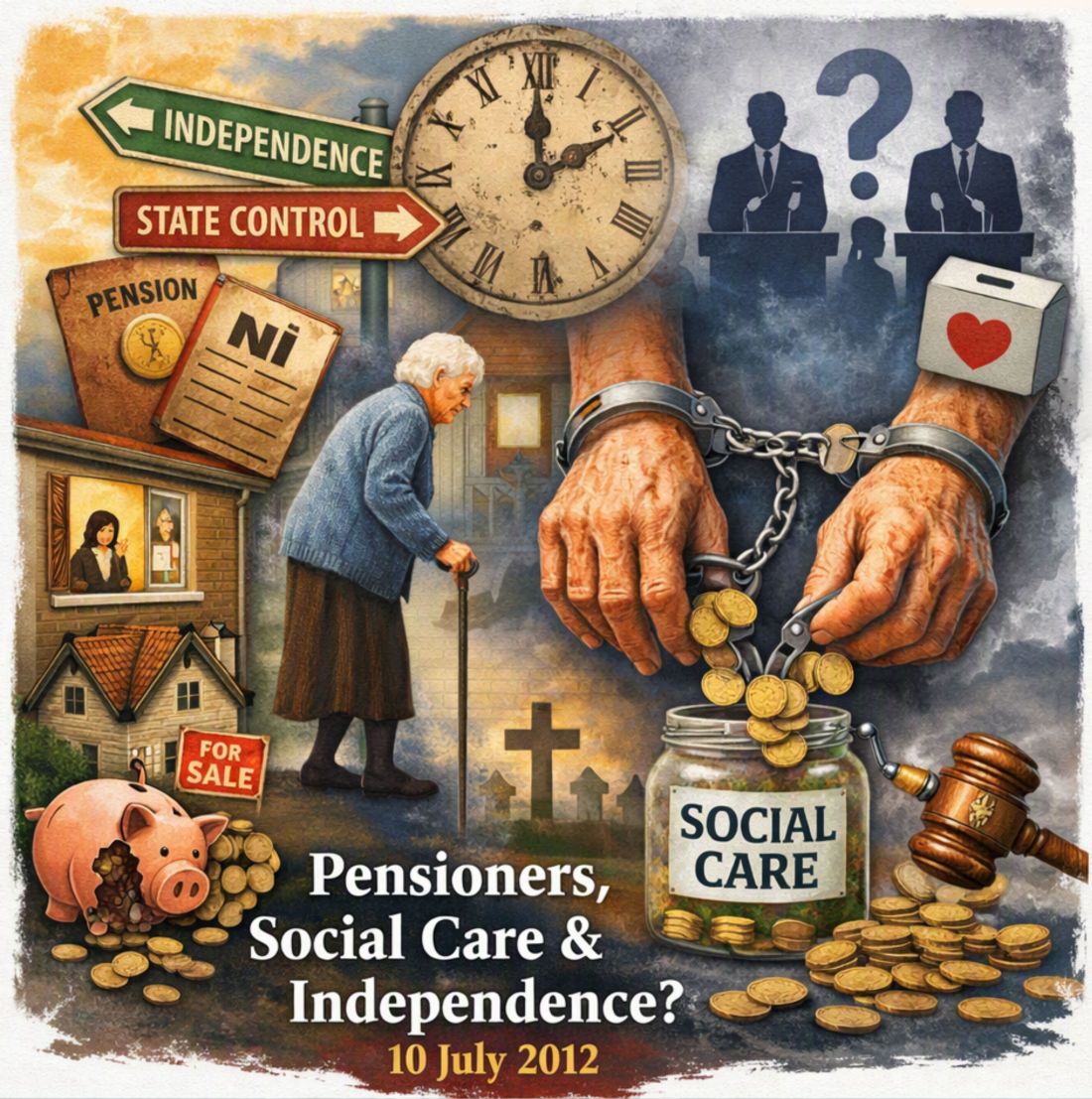
Pensioners, Social Care and the Questions of inevitability, independence & incentives lost

Getting older is one of the few things left that we cannot actually control in our technical age. But how much thought do you give your ability to retain that independence which many of us today simply take for granted?

Just last week, whilst walking through the rain in the local Sainsburys Car Park, I found myself being beckoned by an old lady who literally called ‘will you come to my aid?’. A non-starting car, a phone-call to discover that her roadside assistance was 10 years out of date and then another to drag a Friday-afternoon-weary mechanic out across Town, all paled into insignificance when she excusingly announced that she was 92.

This terrific pensioner regrettably had nobody whom I could call on her behalf to prevent her just sitting there whilst the time passed to the completion of her rescue. But to be fair, I wouldn’t want to make a song and dance if I found myself in a similarly unwelcome situation and would be lying if I were to say anything other than how much I admired her stoic independence and indifference to such items as the seemingly unused mobile phone, still wrapped and jiffy-bagged in the door-well of her car.

Sadly, not many 92 year olds will be driving themselves to the supermarket before returning home alone today, and this is perhaps where many more of us should be casting our thoughts in terms of what support is put in place for older generations, how it is funded and perhaps most importantly how much of that bill we should seriously expect pensioners with varying levels of need to pay themselves.

The issue of Social Care is jumping in and out of the spotlight at the moment. But are MP’s really thinking about the wider issues involved in this nebulous policy area; about how pensioners really feel about having decisions made for them about everything they have worked for? After all, many who have worked hard and been regular taxpayers throughout their lives are potentially being left without the option to leave something for their families, or perhaps even to leave a legacy to a charity which somewhat ironically the Government might itself need to look to for help as part of its push towards ‘Big Society’.

Many are at a loss as to understand what the term ‘National Insurance’ actually means in all this. If any one person can contribute to the NI ‘pot’ on the understanding that they will be supported when they are in times of need, but find that when that need arrives, a judgement is then made on whether they can help themselves first to outwardly save the public purse, can we truly believe that we have a universally-applicable, balanced and fair welfare system?

Evidence would suggest that not only is the welfare system inherently unfair to those who through their actions choose to regularly pay tax, but that it is those who have always paid who will actually continue to keep on doing so. In a modern, civilised and free society it is little more than idealism that creates a situation where some can have all for the price of giving nothing, whilst others can end up with nothing for the price of being forced to give just about all that they have.

The elephant in this room is a difficult one to deal with and most of us appreciate that fact. But we are living in a society where success and simple hard work are now being penalised in every part of life right up until death, and where making little or no effort is now seen to be the ‘right thing’.

No considerate person would suggest that anybody in genuine need should not be given adequate and appropriate help when they need it. But have we really seen the dawn of times when those that work will pay for everything and everyone else throughout their lives and get virtually nothing back in return?

This article was converted to PDF and its accompanying image was updated on 10 October 2026. The original text remains unchanged.

Businesses are not inherently academic, so why are degrees becoming the prerequisite skill?

Latest news suggests that without more degree level education based skills, the UK will experience an exodus of jobs overseas to emerging economies. But when we already have students doing degrees just for the sake of doing them and a basic education system which sees school-leavers failing to possess even basic literacy and numeracy skills, should we really be thinking about pushing more through a university education as the immediate priority?

Like it or not, many young people are neither cut out nor ready for an academic pathway from or even during secondary education. Simply creating more courses to include a wider selection of students is hardly the answer and is fast leading to the existence of meaningless degrees, which won’t help business, and don’t help the students themselves who these days will have had to sell their soul to get it.

One of the greater injustices of recent political times is the idea propagated by New Labour during the 1997-2010 period of Government that everyone could be the same and do the same things. Such socialist ideology permeates itself by changing – or rather levelling systems throughout society to treat everyone the same under the ideal that to do so is providing ‘equal opportunities’.  However, as we are all different – and often in ways that cannot be seen with the naked eye – this method is not only obtuse in the extreme, it has contributed to the creation of a society where younger generations are becoming lazy and without ambition. When you add to this the burden of taxation which is placed upon higher wage earners for daring to do well and the resentment they experience if they do so, neither do you leave in place any real motivation to be any different or encourage the social mobility that the same idealist meddlers suggest to be a milestone of progress.

The good behind many ideas, policies and concepts is often lost when change is enacted simply for the sake of change and this is no less so within education as elsewhere. Whilst the technology age has altered the requirements for skills throughout the industries, the historic format of leaving school at 14 and becoming ‘apprenticed’ was a much better way to foster learning in those who were more ‘hands than head’ at the time, and could as such provide lessons in forming the basis of a very radical and effective way to change the way that we develop our National skills base for business and industry.

Why not:

  • Remove the burdens of red tape which govern the working environment for younger people.
  • Develop an effective subsidy allocation and training scheme to assist participant businesses to replace unused school places, ‘young to work’ schemes and unemployment benefits.
  • Give business a cost-effective motivation to support vocational or ‘on-the-job’ training for 14-21 year olds who in that time, may well have attained the equivalent of academic training in parallel skills and real-world experience, which may in fact have far more use to companies than ‘green’ graduates who refuse to stuff envelopes because they have a degree.

Business can only get the best from employees if they have been nurtured within a system which allows and encourages them to be their best – in whatever way that may be. Even the suggestion that you must have a degree level education to make an effective contribution is not only short sighted; it fails to recognise that a true acceptance of diversity goes way beyond embracing race, impairment, sexuality, location or social group and that each pathway to learning can be highly beneficial to society with real opportunities put in place to appreciate it.

This article was converted to PDF and its accompanying image was updated on 10 October 2026. The original text remains unchanged.