
A clear explanation of the real issues behind the narratives and optics – including affordability, access, and the catch‑22 facing farmers
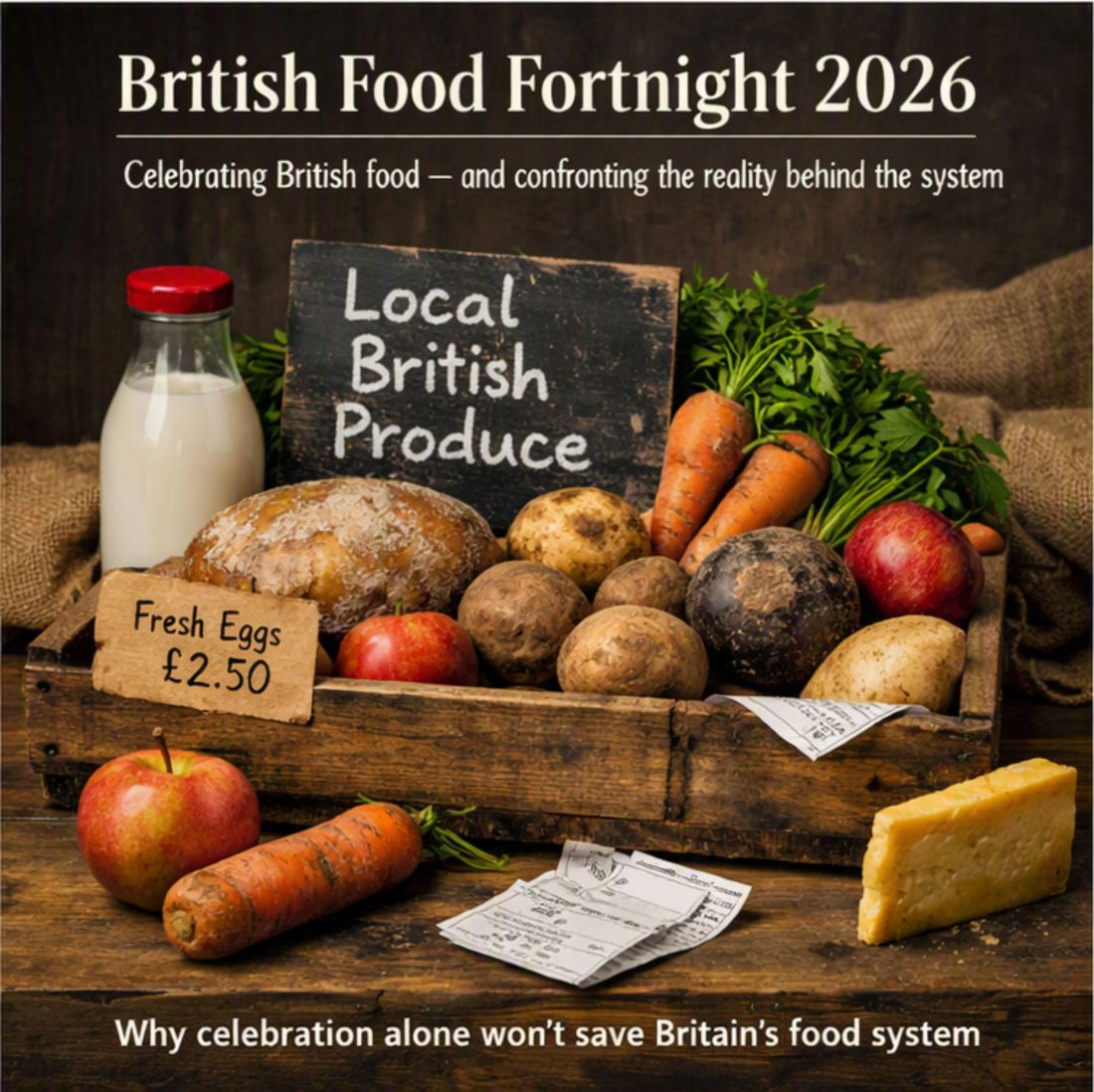
British Food Fortnight is a chance to celebrate the best of British farming, British production, and the local shops that keep our communities fed. And there is a lot to celebrate. British food is produced to some of the highest standards in the world. It’s part of our identity, our culture, and our future.
But celebration alone won’t fix what’s going wrong.
Behind the harvest festivals, seasonal menus, and cheerful messaging, the UK food production and food supply system is becoming more fragile every year. Not in a dramatic, headline‑grabbing way – but in a slow, structural way that most people never see.
And that’s the problem.
We are living with a food system that looks stable on the surface, but underneath it is a ticking time bomb.
UK Food Supply is insecure, NOT because farmers are failing. Not because consumers don’t care. But because the foundations of the system have been quietly weakened over decades.
British Food Fortnight should be the moment we talk about this honestly.
What’s genuinely worth celebrating
British food has real strengths:
- Farmers who produce food to world‑leading standards.
- Local retailers who keep regional supply chains alive.
- Small producers whose craft gives British food its character.
- Communities that choose British when they’re given the option.
These strengths deserve recognition. But they also deserve protection – and right now, they’re under threat.
The truth most people never hear
Here is the reality that rarely makes it into public conversation:
Britain is gradually losing the ability to feed itself.
Not because we lack land. Not because we lack farmers. Not because we lack demand.
But because the system has been reshaped around priorities that have nothing to do with food security.
The evidence is clear:
- Domestic production is declining.
- We rely more on imports every year.
- Small producers and local shops are disappearing.
- Local infrastructure – abattoirs, cold stores, distribution hubs – has been dismantled.
- Supply chains are controlled by fewer, larger players.
- Government messaging often paints a picture of stability that doesn’t match reality.
This isn’t a prediction. It’s already happening.
Why the system is fragile – explained simply
Most people assume food arrives in shops because “the system works”.
But the system only works when all the parts work together.
Right now, several of those parts are failing:
- Costs are rising faster than farm incomes.
- Labour shortages mean crops go unpicked.
- Energy volatility makes planning impossible.
- Local processing facilities have closed.
- Retail price pressure squeezes producers.
- Climate instability disrupts yields.
- Policy focuses on schemes, not production.
When you add these together, you get a system that looks fine – until something goes wrong. And when it does, there’s no slack, no buffer, no resilience.
That’s the ticking time bomb – and that’s before we even begin thinking about other world events.
The affordability problem: the part nobody wants to talk about
There is another uncomfortable truth:
The small amount of British food that reaches consumers directly is unaffordable and inaccessible for many people.
Not because farmers are greedy. Not because local shops are elitist. Not because consumers don’t care.
It’s because the system forces farmers and local retailers into a corner:
- Their costs are higher.
- Their margins are thinner.
- Their volumes are smaller.
- Their infrastructure is weaker.
- Their competition is global, industrial, and subsidised elsewhere.
Farmers who sell direct or through very localised chains are often struggling financially. They cannot drop prices without losing money. They cannot scale without infrastructure. They cannot compete with global imports on price. And they receive no structural support to make local food affordable.
This is the catch‑22:
The food people most want to buy – local, British, trustworthy – is the food farmers can least afford to sell cheaply.
Unless the system changes, this will never change.
Why this matters for food security
When local food becomes unaffordable, people turn to cheaper, imported, often processed food which is not as healthy or nutritious. When farmers can’t sell locally, they stop producing locally. When local shops close, communities lose access to British food entirely. When small producers disappear, diversity disappears. When diversity disappears, resilience disappears.
Affordability isn’t a side issue. It’s a structural warning sign.
A food system that cannot provide affordable local food to everyone is a food system that is already failing.
Real collaboration vs policy collaboration
There is a simple but important distinction in the UK food system – and understanding it explains why things keep getting worse instead of better.
Real collaboration
Real collaboration is what happens when farmers work directly with each other, with local businesses, and with the communities they feed.
It looks like:
- farmers sharing equipment and knowledge
- coordinating production so everyone benefits
- rebuilding local infrastructure together
- connecting directly with local retailers and consumers
- creating practical, ground‑up solutions to real problems
This kind of collaboration strengthens the system because it is built around the people who actually produce and eat the food. It builds resilience. It builds affordability. It builds trust.
Policy collaboration
Policy collaboration is what government, large industry bodies, and many advocacy organisations call “collaboration”.
It looks like:
- schemes
- metrics
- targets
- environmental delivery
- compliance
- reporting
- meetings
- consultations
It sounds like collaboration, but it isn’t. It doesn’t rebuild infrastructure. It doesn’t reduce costs. It doesn’t strengthen local supply chains. It doesn’t make British food more affordable or accessible.
It organises farmers around policy goals – not food security, not community needs, and not the long‑term health of the food system.
Why this distinction matters
Many farmers are still hoping for help from the same institutions that have shaped the system into its current fragile state. They hope for support from government. They hope for representation from advocacy organisations. They hope for change from industry bodies.
But these organisations often prioritise maintaining good relationships with government and large industry players over representing the people who actually produce the food.
This is not a criticism of individuals – it is a structural reality.
When the priority is “staying at the table”, the people who need the most help – farmers, small producers, local retailers – are the ones whose voices are softened or sidelined.
The missing relationship: farmers and consumers
The most important relationship in the food system – the one that should shape everything – barely exists in any meaningful way.
Farmers and consumers are the two principal stakeholders in the food chain. One produces the food. The other eats it.
Yet they rarely speak to each other. They rarely understand each other’s pressures. They rarely collaborate. They are kept apart by layers of policy, industry, and supply‑chain intermediaries.
This separation is one of the biggest reasons the system is failing.
What real collaboration must look like
Real collaboration must be:
- ground‑up, not top‑down
- farmer‑led, not policy‑led
- community‑facing, not industry‑facing
- consumer‑connected, not consumer‑distant
- practical, not theoretical
- people‑first, not profit‑first
It must work with frameworks and governance – but not be dictated by them.
Policy should support direction, not set it.
Because when profit, metrics, and economic modelling set the agenda, people – farmers, consumers, communities – are pushed to the margins.
And when people are pushed to the margins, resilience disappears.
The bottom line
Britain does not need more schemes, consultations, or policy‑driven “collaboration”. It needs real collaboration – built by farmers, supported by communities, connected to consumers, and strengthened by local businesses.
A food system built around people will always be more resilient than a food system built around profit and policy.
And until we make that shift, the system will continue to weaken, no matter how many times we celebrate it.
The constructive path forward
The solution is clear:
Rebuild local food systems through real, farmer‑led collaboration – and support them so local food becomes affordable.
That means:
- Rebuilding local infrastructure
- Restoring local processing and distribution
- Aligning farmers with local industries
- Creating farmer‑employed coordinators
- Strengthening business‑level resilience
- Supporting local retailers
- Making local food affordable through structural support
- Reconnecting communities with the people who feed them
This is practical. This is achievable. This is already happening in pockets across the country.
British Food Fortnight should be amplifying this, not distracting from it – however much we need the message about what makes everything good about British Food championed.
A closing thought
British food is worth celebrating. But celebration without honesty is part of the problem.
If British Food Fortnight is going to matter, it must confront reality – not hide it. It must champion British producers while acknowledging the fragility of the system behind them. It must support local retailers while recognising how close many are to disappearing. It must make local British food affordable and accessible – not just admirable. It must celebrate British food while fighting for the ability to keep producing it.
Because if we lose the ability to feed ourselves, everything else becomes negotiation.
Further Reading
A guided collection of articles that explain the UK food system clearly and simply
1. The Fragile Nation: Why Britain Can No Longer Rely on a Global Food System
Why global supply chains are becoming unreliable – and why domestic resilience matters.
2. The Key Stakeholders in UK Food Production Are the Farmers and Consumers
How the UK food system has been shaped around everyone except the people who produce and the people who eat.
3. The Need for a Collaborative Approach to the UK Farming and Food Security Problem
Why real collaboration – not policy‑driven collaboration – is essential for food security.
4. Real Collaboration vs Policy Collaboration
A clear explanation of how policy‑led collaboration weakens resilience, while farmer‑led collaboration strengthens it.
5. Food From Farms Guaranteed
A blueprint for making local British food affordable, accessible, and structurally supported.
6. Why Is Food Supply Becoming Unstable?
A reader‑friendly breakdown of the pressures making the UK food system fragile.
7. Response to NAO Report: Resilience of the Food Supply Chain
A critical look at official claims about food system resilience – and what the evidence actually shows.
8. The September 26 Farming Evidence Pack and the Reality We Can No Longer Ignore
A detailed look at the data behind the fragility – essential for readers who want deeper evidence.

