
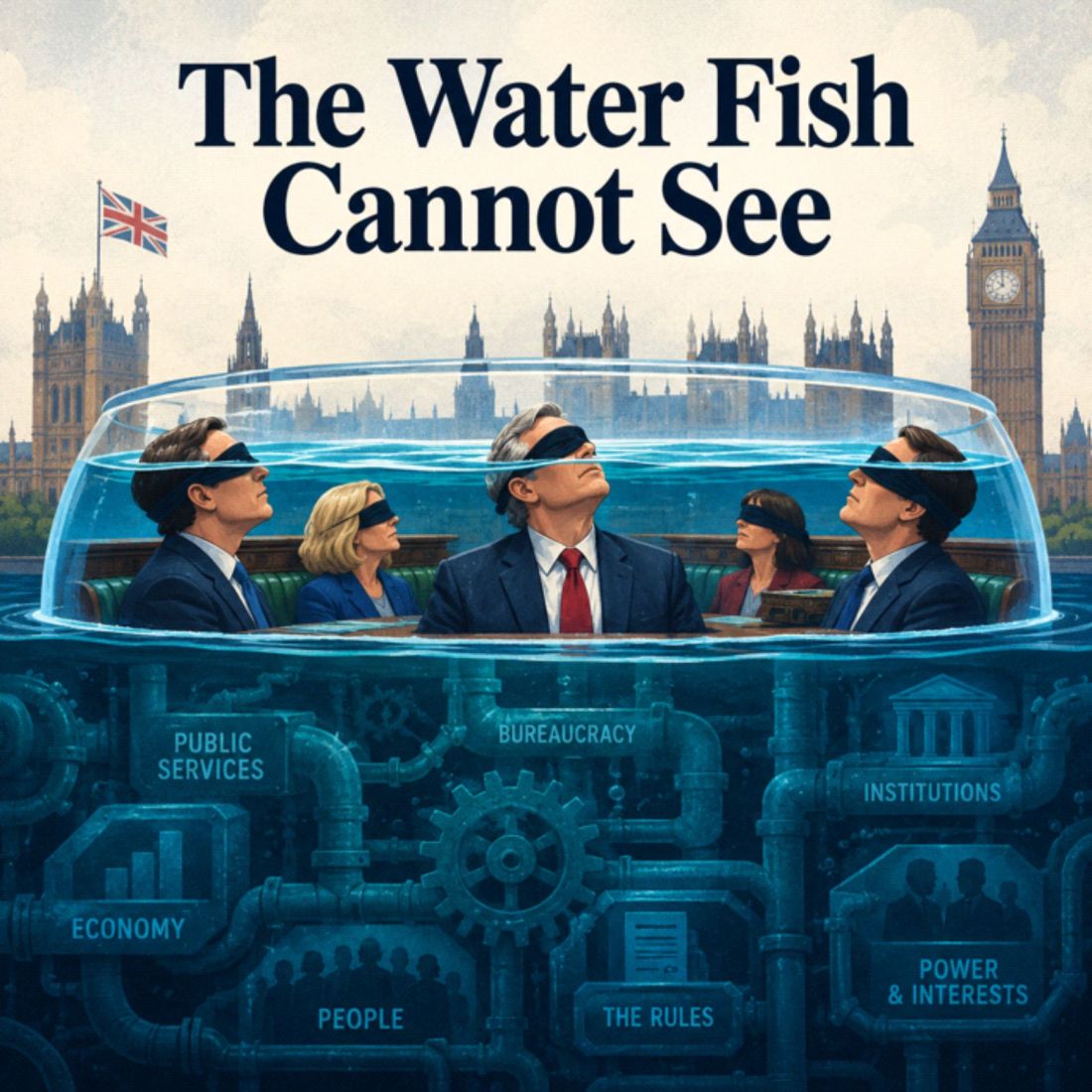
The Water Fish Cannot See

Why the debate about ending forty years of neoliberalism may be missing the point

A Curious Reaction

When Andy Burnham first began talking about ending forty years of neoliberalism, I expected disagreement. Political ideas that touch something substantial almost always provoke a reaction.

What surprised me was not the fact that people argued about it, but the way they argued about it. Within a remarkably short period of time, the conversation seemed to settle into familiar territory.

Supporters presented the idea as a long-overdue recognition of Britain’s failures. Critics responded as though they were hearing an argument for returning to the 1970s. The disagreement was immediate, energetic and entirely predictable.

What interested me was something else.

The entire discussion appeared to assume that everybody already knew what the phrase meant. More than that, it assumed that everybody knew where the boundaries of the debate lay.

The disagreement was not over whether the phrase described reality, but over whether leaving that reality would be desirable.

The argument became a choice between continuation and reversal. We were either remaining on the path set in motion during the Thatcher years or attempting to retrace our steps back to an earlier model.

The possibility that neither description accurately captured the moment we are living through barely appeared.

That omission is worth dwelling on because it points toward a question that feels increasingly important.

How would anybody recognise the end of an era while they were still living inside it?

The Strange Journey of Political Language

Political systems are constantly searching for language that captures things people can already feel but struggle to describe. Most books never reach beyond their audience. Most detailed arguments remain where they begin. What tends to travel are phrases.

A phrase can migrate from essays into newspaper columns, from newspaper columns into think-tank reports, from think-tank reports into speeches and from speeches into everyday conversation.

The more successful the phrase, the further it travels.

What is interesting is that understanding rarely travels at the same speed.

By the time a useful phrase reaches the centre of political discourse, it has often become detached from the intellectual framework that produced it. Different people begin using it for different purposes. It stops functioning as an explanation and starts functioning as a signal. It becomes useful because it conveys a mood, a direction of travel or a sense that something important is happening.

That does not mean everybody using the phrase understands the same thing.

In fact, it often means the opposite.

The phrase survives precisely because different groups can pour different meanings into it.

This may be one reason the language of “forty years of neoliberalism” has been so successful. The phrase clearly touches a nerve. It captures a widespread feeling that something about Britain’s trajectory deserves re-examination. What remains far less clear is whether there is equal agreement about what is actually being described.

When Systems Disappear

Part of the difficulty lies in the way successful systems evolve.

Most people think of neoliberalism as a collection of policies. Privatisation. Deregulation. Globalisation. Financialisation. Depending on who is speaking, those developments either saved Britain or hollowed it out. Entire political careers have been built around defending or attacking those changes.

Yet policies are only the visible layer of a system.

The deeper layer is the collection of assumptions that develops around them.

What counts as economic success. What counts as competence. Which institutions matter. Which risks deserve attention. What questions can be asked. Which outcomes are considered realistic.

At first those assumptions are visible because people remember alternatives. Over time they become harder to see. New generations inherit them. Institutions are organised around them. Political careers are built within them. Eventually they stop appearing as assumptions and start appearing as reality.

The system disappears from view precisely because it becomes normal.

That is why I have always preferred thinking in terms of operating systems rather than ideologies.

People know they are choosing between ideologies.

They rarely realise they are working inside an operating system.

The Water Fish Cannot See

The old phrase about fish being unable to see water survives because it captures something profoundly human.

We are very good at adapting to our environment. In fact, we are so good at it that we often stop noticing the environment altogether.

The process is visible everywhere.

People adapt to fragility.

Institutions adapt to constraints.

Political parties adapt to assumptions.

Entire societies adapt to conditions that previous generations might have regarded as extraordinary.

Eventually the adaptation becomes so complete that the thing shaping behaviour vanishes into the background.

The fish sees the currents, the movement and the consequences. The fish does not see the water.

This is why discussions about political change often feel strangely unsatisfying. Politicians can spend hours arguing about policy while sharing assumptions they no longer recognise as assumptions. Journalists can write thousands of words about reform while accepting the framework within which reform is constrained. Economists can debate outcomes while rarely examining the environment producing them.

This is not evidence of stupidity.

It is evidence of immersion.

Why the Debate Feels Incomplete

The more I listened to the discussion surrounding the end of forty years of neoliberalism, the more I found myself wondering whether the debate was unfolding at the wrong level.

The assumption seemed to be that people stand outside the system, evaluate it and then choose whether to continue it.

But what if that is not how systems work?

What if people are shaped by an operating environment long before they start questioning it?

Viewed through that lens, the interesting question is not whether a political movement wishes to move beyond neoliberalism.

The interesting question is whether anybody can clearly see the assumptions they inherited from it.

That challenge becomes particularly difficult when those assumptions have become embedded within ideas that appear self-evident. Growth. Productivity. Competitiveness. Confidence. Credibility.

These concepts are treated as neutral descriptions of reality. Rarely are they examined as products of a particular way of understanding reality.

The water has become invisible.

Sensing an Ending

This is one reason I find the current moment so fascinating.

For several years I have argued that Britain’s operating model appears to be reaching the end of its natural life. Not because somebody decided it should end, but because the conditions that sustained it are changing. The issue is not morality. It is fit.

Operating systems work because they fit the environment in which they emerge. They begin to struggle when the environment changes faster than the assumptions embedded within them.

What strikes me today is how many institutions appear to be sensing this shift.

The language has changed.

The confidence has changed.

The mood has changed.

People speak increasingly about resilience, security, sovereignty, capability and exposure. Themes that sat comfortably in the background for decades have moved closer to the centre of public debate.

Something is clearly being felt.

Whether it is fully understood is another question.

History suggests that people often experience the sensation of transition before they understand its cause. They feel the edge of an era long before they can describe it.

The Language of Maintenance

This is partly why the recent Budget interested me.

What stood out was not a particular policy but a tone.

Much of the language revolved around creating “breathing space”, managing pressures and helping households navigate difficult circumstances. Even the temporary tax surcharge on banks was presented in terms of short-term support rather than long-term transformation.

The emphasis repeatedly returned to stability, discipline, confidence and the need to navigate a difficult external environment.

None of this is inherently unreasonable. Yet it has a particular flavour.

It is the language of maintenance. The language of holding things together. The language of preserving stability while a system encounters pressures for which it was not originally designed.

That does not mean the people using that language are wrong. It simply raises an interesting possibility.

Perhaps many of the actors discussing the end of an era are simultaneously operating within the assumptions of that era.

Not because they are trapped. But because they have never known anything else.

Missing the Point

This brings us back to the original phrase.

The debate about ending forty years of neoliberalism often assumes that the central question is whether neoliberalism succeeded or failed.

I am increasingly persuaded that a deeper question sits underneath it.

What if the most significant issue is not whether an era is ending, but whether we are capable of recognising the operating system that shaped the era in the first place?

The difference matters.

One debate concerns policies. The other concerns perception.

One asks what should happen next. The other asks whether we fully understand where we are standing now.

Those are not the same thing.

The Ground Beneath Our Feet

The most successful operating systems are not the ones people passionately defend. They are the ones people stop noticing.

The assumptions become common sense. The framework becomes reality. The environment becomes invisible.

At that point, even criticism of the system may continue speaking its language.

That is why I find the current moment so intriguing.

Not because I know what comes next.

Not because I am convinced anybody else does either.

But because more and more people seem to be sensing that something is changing beneath their feet.

The phrase “forty years of neoliberalism” may be evidence of that feeling. The argument surrounding it may be evidence too.

The question is not whether the era is ending.

It is whether we can see the water clearly enough to understand the thing that shaped us before it disappears.
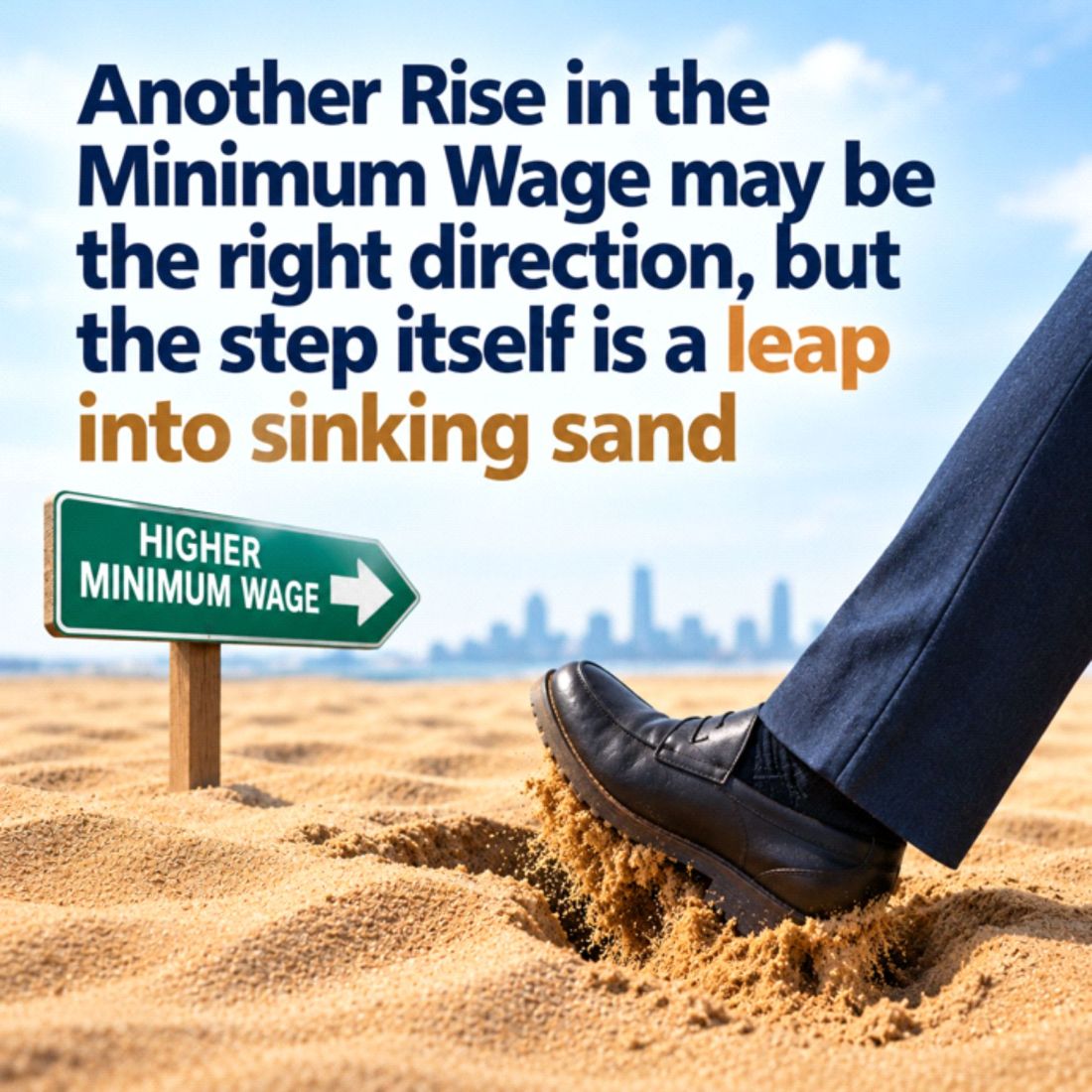
Another Rise in the Minimum Wage may be the right direction, but the step itself is a leap into sinking sand

I’ve spent a lot of time thinking about the realities of the minimum wage and what this benchmark actually represents.

The biggest misconception surrounding the National Minimum Wage is the widespread assumption that it bears some meaningful relationship to the cost of living. It doesn’t.

Somewhere along the way, we began treating the minimum wage as though it were a measure of what it costs to live independently, build financial security, and participate fully in society. It was never designed to be any of those things.

Yet each increase is inevitably presented as evidence of progress, a sign that government understands the pressures facing ordinary people, whilst employers often use it as a benchmark to justify the legitimacy of their own pay structures.

The reality is that the minimum wage remains far below the level that many people require to live independently without relying on debt, family support, benefits and welfare, or a combination of all three.

That matters because independence is the issue at the heart of the wider debate.

In recent months I have written about what poverty really is and why small businesses are struggling. Whilst those may appear to be separate conversations, they are in fact different manifestations of the same underlying problem.

The minimum wage debate provides perhaps the clearest example of how disconnected our understanding of that problem has become.

Poverty Begins Where Independence Ends

The way poverty is commonly discussed tends to focus on income alone.

We talk about poverty lines, earnings thresholds, and household statistics. We compare one figure against another and decide whether someone falls above or below a particular measure.

But poverty is not fundamentally about numbers.

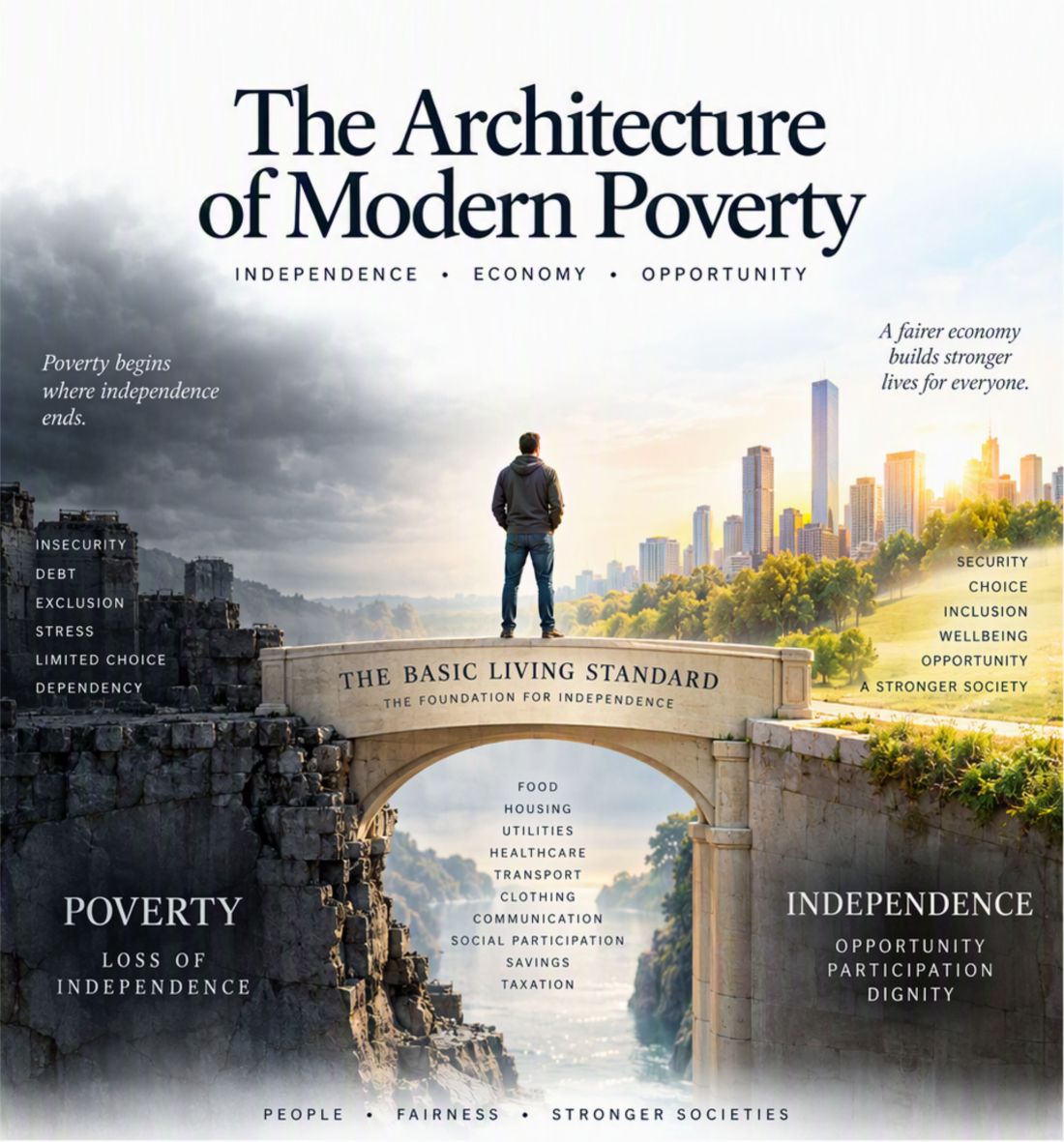
Poverty begins where independence ends.

A person enters poverty when they can no longer meet their essential needs without external support. Whether that support comes from the state, from family members, from charities, or from borrowing money that will eventually need to be repaid, the outcome is essentially the same. Independence has been lost.

This is why so much of the debate surrounding wages misses the point.

If someone receives a higher hourly wage but still cannot afford housing, energy, transport, food, insurance, and the basic costs of modern life without additional support, have we actually solved anything?

Or have we simply moved the numbers whilst leaving the underlying condition untouched?

The uncomfortable reality is that increasing numbers of people are discovering just how fragile their own independence has become. A redundancy, an illness, a rent increase, a mortgage rate adjustment, or an unexpected expense can rapidly expose how little resilience exists beneath the surface.

The minimum wage may rise.

The insecurity remains.

The Problem Facing Small Businesses is the Same Problem Facing Workers

The political framing of minimum wage debates often creates the impression that there are two opposing sides.

On one side are workers who quite understandably need higher wages.

On the other are businesses that supposedly do not want to pay them.

The reality is rarely that simple.

Most people earning the minimum wage need more money.

Most small businesses are already struggling to survive.

Both statements can be true at the same time.

The reason is that workers and small businesses are often facing different symptoms of the same underlying pressures.

Workers need higher wages because the cost of living has become increasingly unaffordable.

Small businesses struggle to pay higher wages because they are operating on margins that become thinner every year.

Neither side created the conditions that produced this situation.

For decades, economic value has become increasingly concentrated amongst larger organisations with greater market power, easier access to capital, and the ability to operate at scales that smaller competitors simply cannot match.

At the same time, communities have become less economically resilient. Housing costs have risen. Living costs have risen. Debt has grown. Disposable income has shrunk.

Consumers buy differently because they have to.

Small businesses operate differently because they have to.

The local shop owner trying to meet payroll and the employee struggling to pay rent are frequently experiencing different consequences of the same economic architecture.

Yet public debate encourages them to see one another as the problem.

Why Minimum Wage Rises are Politically Attractive

The argument here is not that minimum wages should not increase.

They should.

The lowest-paid members of society deserve better compensation for their work and contribution.

The problem is that minimum wage policy is increasingly being presented as a solution to issues that are far bigger than wages alone.

For governments, minimum wage increases possess obvious political advantages.

They are visible.

They are measurable.

They create clear headlines.

They allow politicians to demonstrate action.

What they do not do is address the deeper causes of economic dependency.

Raising the minimum wage does nothing to reduce the cost of housing.

It does nothing to tackle the underlying drivers of energy prices.

It does nothing to confront the growing concentration of market power.

It does nothing to resolve the increasing cost of raising families.

It does nothing to address the structural conditions that leave both workers and businesses struggling for survival.

Instead, it attempts to compensate for those pressures after they have already been created.

And in doing so it risks becoming another temporary intervention in a system that continues to generate the same outcomes.

The Ground Beneath Us is Still Sinking

On paper, a significant increase in the minimum wage can look generous, particularly at a time when governments are themselves struggling to balance competing financial pressures.

But appearances can be deceptive.

Large corporations may absorb increased wage costs for a period before finding ways to pass them on through higher prices, improved efficiencies, reduced staffing levels, or increased productivity demands.

Small businesses often have far fewer options.

Many will absorb the costs and accept lower profits.

Others will attempt to raise prices in markets that are already stretched beyond comfort.

Some will simply close.

Meanwhile, those receiving the wage increase may discover that rising rents, rising bills, rising insurance costs, and rising prices steadily erode much of the benefit that was intended.

Everyone moves.

Very few move forward.

This is why the minimum wage debate often feels strangely circular. Every year we now find ourselves having the same conversation once again.

The minimum wage must rise because people cannot afford to live.

Yet people increasingly cannot afford to live despite repeated rises in the minimum wage.

At what point do we stop discussing the symptom and start discussing the cause?

The Real Question

The question is not whether the minimum wage should rise.

The question is why it has to keep rising simply to prevent more people from falling behind.

If full-time work cannot reliably provide economic independence, the problem is not the minimum wage itself.

If small businesses are becoming less viable whilst workers remain financially insecure, the problem is not either side of the employment relationship.

If governments repeatedly return to minimum wage increases as one of their primary responses to economic hardship, the problem is not necessarily the intention.

The problem may lie in the architecture itself.

Modern poverty, struggling small businesses, and constant debates about wages are not separate crises.

They are different warnings emerging from the same system.

And until we start questioning the structure that produces those warnings, every increase in the minimum wage, however well-intentioned, risks becoming another step forward on ground that is still sinking beneath us.

Further Reading

1. The Independence Threshold: A New Definition of Poverty for a Modern Economy

Before discussing wages, it is worth understanding what poverty actually is. This article argues that poverty begins where independence ends, proposing a definition based not on arbitrary income thresholds but on a person’s ability to sustain themselves without relying on external support. It provides the conceptual foundation for understanding why rising wages alone do not necessarily solve poverty.

Read: The Independence Threshold: A New Definition of Poverty for a Modern Economy

2. The Architecture of Modern Poverty

If poverty is ultimately about dependency, what creates that dependency? This article explores the structural forces that increasingly undermine economic independence, from rising living costs and housing pressures to the broader systems that leave more people vulnerable despite living in a wealthy society. It examines the architecture that produces poverty rather than simply its visible symptoms.

Read: The Architecture of Modern Poverty

3. Why Small Businesses Are Struggling – And Why the Real Problem Runs Much Deeper Than Anyone Wants to Admit

The same pressures affecting individuals are also affecting local businesses. This article argues that the challenges facing small businesses cannot be explained solely by taxes, labour costs, energy prices, or regulation. Instead, they are part of a much deeper economic shift that increasingly concentrates advantage amongst larger organisations whilst leaving smaller firms and communities with diminishing resilience.

Read: Why Small Businesses Are Struggling – And Why the Real Problem Runs Much Deeper Than Anyone Wants to Admit

Together, these articles explore a common theme: that modern poverty, economic dependency, struggling small businesses, and the continuing debate over wages are not separate problems. They are different manifestations of the same underlying economic architecture.

The Architecture of Modern Poverty: Independence, Economy, and the Basic Living Standard

Poverty is often described as a lack of money. Governments measure it through income thresholds, commentators discuss it in terms of affordability, and public debate frequently focuses on individual expenses such as housing, food, or energy. While these measures and discussions capture important aspects of economic hardship, they often fail to identify the underlying condition that poverty represents.

The fundamental issue is not simply a shortage of income. It is the loss of independence.

In a modern economy, poverty begins when a person can no longer meet their essential needs through their own resources and must rely on external support to maintain a basic standard of living.

The inability to sustain oneself independently marks the boundary between economic security and economic vulnerability. This point may be described as the Independence Threshold.

Understanding poverty through independence shifts attention away from arbitrary income figures and towards a more meaningful question: can an individual meet the essential requirements of life without falling into debt, relying on welfare, or depending on charity?

If the answer is no, poverty has already begun.

Poverty as the Loss of Independence

Independence is often taken for granted. It is expressed through ordinary activities: paying rent, buying food, travelling to work, heating a home, replacing worn clothing, maintaining communication, and managing unexpected expenses.

These activities appear routine because they are routine for those whose incomes allow them to participate fully in economic life. Yet all depend upon a continuing ability to convert income into essential goods and services.

When that ability is lost, independence begins to erode.

A person who cannot afford housing without assistance is not fully independent. A person who must regularly choose between heating and eating is not fully independent. A person who requires continual borrowing to meet ordinary living costs is not fully independent.

The common feature in each case is not low income itself, but an inability to sustain essential needs through one’s own means.

Poverty is therefore better understood as a condition of dependency rather than simply a condition of low earnings.

Independence Exists Within an Economic Context

No individual becomes independent in isolation. Independence is shaped by the economy in which a person lives.

The resources required to maintain a basic life differ between countries, regions, and periods of history. Modern life carries obligations that did not exist for previous generations and costs that vary considerably between locations.

Housing, transport, energy, communication, healthcare, taxation, childcare, and access to employment all influence the resources required for independent living.

As these costs rise, the income necessary to maintain independence rises with them.

This has important implications for how poverty is understood.

A level of income that provides security in one economy may produce hardship in another. Likewise, an income that supported independence ten years ago may no longer be sufficient today if essential costs have increased.

Poverty cannot therefore be understood solely through absolute measures. It must be understood relative to the economic conditions in which people actually live.

The question is not simply how much money a person has.

The question is whether that money is sufficient to maintain independence within the economic environment that surrounds them.

The Consequences of Falling Below the Threshold

The loss of independence has consequences that extend far beyond finances.

When people cannot reliably meet their essential needs, uncertainty becomes a constant feature of daily life. Long-term planning becomes difficult. Financial shocks become crises. Opportunities are declined because the risks are too great. Immediate necessities take precedence over future ambitions.

Over time, this creates a pattern of exclusion.

Participation in social activities may decline because they can no longer be afforded. Educational opportunities may be deferred. Career progression may be limited by transport costs, childcare costs, or insecure housing. Physical and mental wellbeing may deteriorate as financial pressures intensify.

Poverty therefore affects more than material possessions. It constrains choices, limits participation, and reduces personal agency.

The defining characteristic of poverty is not merely what people lack. It is what they are no longer free to do.

The Limits of Traditional Poverty Measures

Most poverty measures focus primarily on income.

While income remains important, income alone does not determine whether a person is independent.

Two households with identical earnings may experience very different levels of security depending upon their circumstances. Housing costs, debt obligations, family responsibilities, regional price differences, disability-related expenses, transport requirements, and many other factors influence whether income is sufficient to meet essential needs.

As a result, many people who sit above official poverty lines still struggle to maintain independence. They may appear financially secure according to statistical measures while relying on borrowing, family support, charitable assistance, or the continual postponement of essential spending.

Such individuals may not be recognised by conventional poverty measures, yet their independence remains fragile.

A more meaningful understanding of poverty requires identifying the point at which independence becomes unsustainable, rather than merely measuring income against a predetermined percentage or average.

Defining the Requirements of Independence

If poverty begins when independence ends, a practical question emerges.

What is required to remain independent?

The answer cannot be limited to survival alone.

Independence in a modern society requires more than the bare minimum needed to stay alive. It requires access to the goods and services necessary for participation in ordinary economic and social life.

This includes adequate food, secure housing, utilities, transport, healthcare, clothing, communication, and the ability to absorb unexpected expenses. It also requires a modest capacity to participate in society and contribute to the wider community through taxation and civic engagement.

Together, these elements form the basis of a Basic Living Standard.

The Basic Living Standard represents the minimum set of resources required for a person to live independently within a modern economy. It is not a measure of comfort, luxury, or affluence. Nor is it a subsistence model concerned only with physical survival.

Instead, it identifies the economic foundation necessary for stability, dignity, and participation.

The Relationship Between the Independence Threshold and the Basic Living Standard

The Independence Threshold and the Basic Living Standard represent two parts of the same framework.

The Independence Threshold defines the condition of poverty. It identifies the point at which an individual loses the ability to meet essential needs without external support.

The Basic Living Standard defines the resources required to avoid that condition. It establishes the minimum economic foundation necessary to sustain independence.

One identifies the boundary.

The other identifies where that boundary lies.

Together, they provide both a definition and a measurement.

If an individual’s earned income is sufficient to achieve the Basic Living Standard, independence is maintained. If it is insufficient, independence becomes compromised, and poverty emerges.

This relationship transforms poverty from an abstract social concern into a measurable economic reality.

A New Foundation for Economic Policy

Viewing poverty through the lens of independence creates a different basis for public policy.

The central question becomes whether the structures of the economy allow people to maintain independent lives through their own efforts.

Wages, housing policy, taxation, transport infrastructure, energy markets, healthcare provision, and social support systems can all be assessed according to their effect on independence.

A minimum wage, for example, cannot be considered adequate simply because it exists. Its adequacy depends upon whether it enables a worker to achieve the Basic Living Standard without requiring continual supplementation from debt, welfare, or charity.

Similarly, economic growth cannot be evaluated solely through national statistics if increasing living costs simultaneously undermine the independence of large sections of the population.

An economy succeeds not merely when it generates wealth, but when it allows ordinary people to sustain independent lives within it.

Conclusion

Poverty is often treated as a problem of insufficient income. In reality, it is more accurately understood as a loss of independence.

The ability to meet essential needs through one’s own resources represents the foundation of economic security, personal agency, and meaningful participation in society. When that ability is lost, poverty begins, regardless of how it is measured statistically.

The Independence Threshold identifies this critical boundary. The Basic Living Standard identifies the resources required to remain above it.

Together, they provide a framework for understanding poverty that is rooted not in abstract financial measures, but in the practical realities of everyday life. They shift the focus from income alone to the broader question of whether people possess the means to sustain themselves with dignity, stability, and autonomy.

In doing so, they offer a foundation for a more coherent understanding of poverty and a clearer means of addressing it.

Further Reading

The ideas presented in this essay are explored in greater depth across a series of related works. Together, these pieces trace the development of the Basic Living Standard and the Independence Threshold, from the practical question of what people need to live independently, through to a broader philosophy of freedom, autonomy, and economic participation.

1. The Basic Living Standard: Full Text

Foundational Framework

Read the full text

This is the foundational statement of the Basic Living Standard. It sets out the principle that anyone working full time at the lowest legal wage should be able to meet all essential living costs without debt, welfare dependency, or charity.

The article defines the components of a basic but dignified life and establishes the standard as a practical benchmark for wages, public policy, and economic justice.

2. The Basic Living Standard Explained

A Practical Introduction

Read the article

This accessible introduction explains the purpose and mechanics of the Basic Living Standard. It explores why traditional measures such as minimum wage and poverty thresholds often fail to reflect lived reality and demonstrates how a living standard based on genuine economic independence can provide a clearer and more meaningful benchmark.

3. The Basic Living Standard: Freedom to Think, Freedom to Do, Freedom to Be

The Philosophy of Economic Independence

Read the article

Moving beyond economics, this essay explores the deeper human implications of financial security. It argues that economic independence creates the conditions for genuine freedom: the freedom to think without constant anxiety, to act with agency and purpose, and to develop one’s identity without the constraints imposed by persistent insecurity.

The piece examines the relationship between personal sovereignty, dignity, wellbeing, and social stability.

4. The Independence Threshold: A New Definition of Poverty for a Modern Economy

Redefining Poverty Through Independence

Read the article

This work develops a new definition of poverty based on the concept of independence rather than income alone. It argues that poverty begins at the point where a person can no longer meet their essential needs without external support.

The article introduces the Independence Threshold as a framework for understanding poverty within modern economies and explains its relationship to exclusion, participation, and economic resilience.

Plastic Productivity and the Debt Trap: What the November Budget Won’t Fix

Governments do not collapse in the same way that individuals or businesses do. If they did, the United Kingdom would have gone under financially long ago. Instead, the state continues to function by rolling debt forward, reshaping obligations, and presenting the appearance of stability. For ordinary people, however, the rules are very different. When we cannot meet our commitments, we fail – unless someone steps in to bail us out.

Meeting financial obligations requires honesty. You must know whether you can truly pay your debts or whether survival depends on wishful thinking. Throughout history, people and businesses have thrived or failed for both good and bad reasons. As long as they appear to function, few question what lies beneath.

For tradesmen, small business owners, and entrepreneurs, the reality is harsh. None of us are “too big to fail.” Once obligations can no longer be met, collapse follows unless a benefactor intervenes.

We like to believe the same standards apply to everyone, whether sweeping streets or running government. Yet elites have always bent rules to their advantage. They forget that all people, high or low, share the same human experience. Power corrupts, and politicians often forget they were elected simply to fill a seat, not because they are uniquely qualified to decide what is best for everyone.

The shift to fiat money in 1971 changed everything. It allowed governments, banks, and corporations to manipulate the system, creating the illusion of endless funds. Behind closed doors, decisions were shaped by business and banking interests, while politicians no longer had to worry about the true responsibilities of leadership.

Debt became hidden behind GDP figures. Growth and transaction volumes disguised the reality of an exploding debt pile. To the untrained eye, it looked as though debt was shrinking, when in fact it was spiralling out of control.

This illusion was sustained by what might be called “plastic productivity.”* Assets and infrastructure were bought cheaply, production was outsourced overseas, and consumers were encouraged to buy more and more goods they didn’t need. People became indebted to the same banks that lent to government, yet could just about service their loans. It seemed as though prosperity was endless, and few questioned the narrative.

But the system was never sustainable. Its architects knew it would transfer wealth and ownership to a small elite. By making money and material wealth addictive, they ensured control. With industries hollowed out, productivity now depends almost entirely on expanding debt – by government, business, and individuals alike.

Politicians face a broken system. To keep the machinery of government running, they must tax normal people more heavily. Yet much of public spending delivers little benefit. Policies have been rewritten, words twisted, and meanings changed to allow politicians to cling to power while the wealthy grow richer. Assets of real value have been transferred to people who could never have owned them otherwise.

If the system collapses, the establishment will impose new rules. They may impoverish citizens further, leaving people no choice but to accept whatever is dictated. Many politicians may not even understand the system they oversee. They follow instructions blindly, blamed for decisions that are not theirs, lacking the skills to lead differently.

The situation could drag on for months or years. Collapse may come when the public finally says “enough,” or when the establishment has drained the country dry. Even if a new government is elected – Reform UK, Nigel Farage, or anyone else – they will face the same reality. Cutting spending or taxes cannot fix a nation that is broke and owns nothing. Wealth has already been transferred to lenders.

The system is broken. We must either accept subjugation under a corrupt structure built on trickery, or take a leap of faith and start again from scratch.

***

*”Plastic productivity” refers to the illusion of economic growth created by outsourcing production, encouraging over‑consumption, and sustaining debt, rather than building genuine, sustainable value. It’s not about plastics as a material, but about a system that mimics productivity while hollowing out real industries and transferring wealth.