
Adam Tugwell | 8 September 2026
On 4 September 2026, the National Audit Office published Resilience of the Food Supply Chain to Disruptions, a report that rightly draws attention to weaknesses in the UK’s preparedness for serious food supply shocks. This response is offered as part of my ongoing farming, food security and Foods We Can Trust work, which examines the gap between food being available in normal times and food being resilient enough to withstand disruption.
The NAO report is valuable because it recognises rising risks, weaknesses in contingency planning, declining engagement with industry, and the need to involve households and communities more seriously. However, it remains constrained by assumptions that deserve closer scrutiny: in particular, the use of headline self-sufficiency figures, the reliance on private-sector adaptation, and the continued preference for centralised emergency response over local capability.
This response therefore does three things. First, it explains why food self-sufficiency is not the same as food resilience. Secondly, it identifies where the NAO’s analysis understates structural vulnerability. Thirdly, it sets out the practical direction of travel required if the UK is to build a food system that is more local, more capable, more trusted and more resilient. Links to the specific works that develop these arguments in greater detail are provided in the further reading section.
1. The NAO’s “60% self-sufficiency” figure is useful, but it is not a resilience measure
The report states:
“In 2025, the UK’s food ‘self-sufficiency ratio’ was around 60%.”
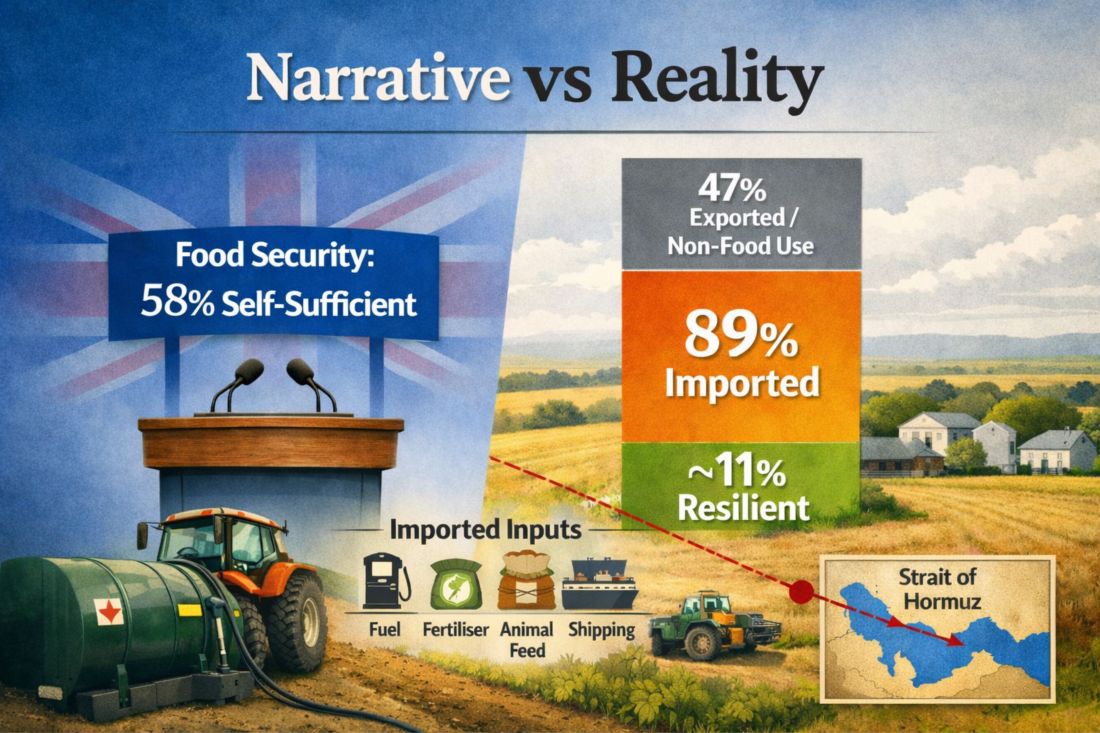
This is a value-based measure: it compares the monetary value of food produced in the UK with the monetary value of food consumed here. That makes it useful as an economic indicator, but it does not answer the practical resilience question: how much food could the UK produce, process, distribute and access during a prolonged disruption?
It ignores:
- UK-produced food that is exported
- Imported inputs (fertiliser, feed, chemicals, energy)
- The caloric composition of UK diets
- The fact that many categories (fruit, vegetables, oils, ingredients) are overwhelmingly imported
The headline figure is also a net figure shaped by the way the modern supply chain works. Domestic production, imports, exports, imported inputs and processing dependencies all interact. Some food counted within domestic production may rely on imported fertiliser, animal feed, fuel, machinery, packaging or processing capacity. Some food produced here is exported. Some foods that are central to healthy diets are heavily import-dependent.
For that reason, the UK’s practical food resilience in a severe disruption scenario may be substantially lower than the self-sufficiency ratio suggests. The issue is not whether the precise figure is 60%, 52%, or lower still. The issue is that the official metric does not measure calorific adequacy, nutritional balance, imported input dependency, processing capacity or local distribution capability.
The NAO’s framing therefore risks creating false reassurance. It implies that production value can stand in for practical food availability. In a crisis, however, people need calories, nutrients, functioning logistics, processing capacity and accessible local distribution. Until government distinguishes those concepts, resilience planning will remain incomplete.
I have explored this in detail in Foods We Can Trust: A Blueprint for Food Security and Community Resilience in the UK, where I outline why caloric sovereignty – not value-based accounting – must be the foundation of food resilience policy.
2. Food inflation at 19.2% is not just an economic statistic – it is a resilience warning
The report notes:
“Food price inflation… peaked at 19.2% in March 2023.”
This is the first time I have noted that an official document has acknowledged the scale of the price shock that households have recently experienced. Food inflation at nearly 20% is not normal. It is not manageable. It is not a blip.
It is a sign that the system is structurally fragile.
Food is not discretionary. When prices rise at this rate, it reflects:
- supply chain instability
- import dependency
- energy volatility
- corporate consolidation
- lack of domestic production capacity
The NAO mentions the figure but does not explore its implications. It should have been a central warning.
3. The NAO’s suggestion that Defra needs more emergency powers misses the point entirely
The report argues that Defra lacks the legal powers needed to manage catastrophic food disruptions.
But additional powers during an emergency cannot compensate for resilience that has not been built beforehand.
Legal authority can help coordinate action, but it cannot create food, processing capacity, distribution routes or community preparedness after the point of failure.
The lesson from recent crises is that centralised decision-making has limits when disruption affects daily life across multiple systems at once.
Food resilience requires operational capability before the crisis: trusted local relationships, clear responsibilities, practical logistics and the ability to identify and support vulnerable households quickly.
Food resilience must be:
- built before a crisis
- decentralised
- community-led
- grounded in local production and distribution
- depoliticised
Emergency powers matter only if there is a resilient system for them to work through. Without food, fuel, people, local knowledge and functioning distribution, legal powers alone offer little practical protection.
4. The agri-food sector’s economic importance is understated – and underutilised
The NAO notes that the agri-food sector:
- supports 4.1 million jobs
- contributes £162.3 billion in GVA
These are enormous figures. And they would be significantly higher if British production and supply were prioritised.
The UK has the land, the skills, and the capacity to produce far more of its own food. What it lacks is a policy framework that values domestic production over globalised efficiency.
In The Need for a Collaborative Approach to the UK Farming and Food Security Problem, I argue that genuine collaboration – not policy-driven “collaboration theatre” – is essential to unlocking this potential.
5. Food as “one of 13 CNI sectors” creates false reassurance
Food is listed as one of 13 Critical National Infrastructure sectors. But unlike energy, water, telecoms, or transport, food is needed every single day.
There is no buffer. There is no downtime. There is no substitute.
Treating food as just another CNI category understates its foundational importance.
It leads to complacency and underinvestment.
6. Defra’s engagement with industry has deteriorated – and has become narrative management rather than collaboration
The NAO reports that:
- engagement groups meet less frequently
- objectives are unclear
- support has declined
- stakeholders see gaps in Defra’s understanding of key areas (e.g., the cold chain)
This aligns with what I have written in Real Collaboration vs Policy Collaboration. The concern is that engagement can become procedural rather than operational: meetings take place, stakeholders are consulted, and the language of partnership is used, but the people who understand production, processing, logistics and community need are not sufficiently empowered to shape the system.
Real collaboration requires:
- shared objectives
- transparency
- local producer involvement
- community representation
- depoliticised structures
The NAO’s findings suggest that too much of this practical collaboration remains underdeveloped.
7. Household and community resilience has been neglected – and this is one of the report’s most important admissions
The NAO states:
“UK households are less prepared for emergencies… government-led messaging is less prominent.”
This is not a minor point. It is a fundamental failure.
Community resilience is the missing layer in UK food security. Without it:
- supply chain shocks hit harder
- vulnerable people suffer first
- government response time shortens
- local distribution becomes chaotic
In Local Planning for Food Shortages and Foods We Can Trust, I outline how community-led food resilience can be built at the lowest level – households, neighbourhoods, local producers – and why this must be prioritised.
8. Catastrophic planning remains theoretical – not practical
The NAO notes that:
- Defra’s plans lack operational detail
- industry is not involved
- food assets are not included in the CNI Knowledge Base
- national exercises have not tested real-world food failure scenarios
This is planning-oriented resilience rather than practical resilience. It may look adequate in documents, but it remains untested unless it is exercised with the businesses, local authorities, producers, distributors and communities that would have to make it work in practice.
Planning without accurate resilience metrics is incomplete. A credible approach should consider not only how much food is produced, but whether it can be processed, transported, stored, allocated and accessed under stress.
9. Local Resilience Forums are structurally incapable of delivering food resilience
The NAO concludes that LRFs:
- lack clarity
- lack capability
- lack authority
- cannot direct supermarkets
- cannot identify vulnerable people effectively
This is not surprising. LRFs were not designed to rebuild food-system capability. They can coordinate emergency response, but food resilience also requires local production knowledge, community networks, producer relationships, storage capacity, transport options and clear mechanisms for supporting vulnerable households.
Food resilience therefore needs structures that are sufficiently independent of short-term political cycles and sufficiently close to communities to understand local need. Local government has a role, but it cannot be the only layer of resilience.
10. The private sector alone cannot be the backbone of UK food security
The NAO states:
“Defra has largely relied on the private sector… but this may not be sufficient.”
This is a significant understatement. The private sector is essential to the food system, but commercial efficiency and national resilience are not the same thing.
Large food businesses are generally incentivised to reduce cost, increase efficiency, consolidate operations and source globally. Those incentives can keep prices low in normal conditions, but they may also reduce redundancy, shorten stockholding, concentrate infrastructure and weaken local capability.
- profit
- efficiency
- global sourcing
- consolidation
Not:
- resilience
- redundancy
- localism
- sovereignty
In Who Controls Our Food Controls Our Future, I explain why corporate control of food systems is incompatible with national resilience.
11. What real food resilience requires: A blueprint
Drawing on my published work, real resilience requires:
- Localised production
Rebuilding local food systems, shortening supply chains, and prioritising domestic output.
- Community-level distribution
Neighbourhood hubs, local coordination, and community-led logistics.
- Regional coordination
County-level frameworks that support local producers and manage regional flows.
- National strategic oversight
A central body that sets resilience targets, not efficiency targets.
- Depoliticised resilience structures
Community leaders, producers, and local organisations empowered to act independently of political cycles.
- Accurate resilience metrics
Caloric sovereignty, not value-based accounting.
- Reduced dependency on global supply chains
Rebalancing imports with domestic capacity.
- Rebuilding domestic processing
Cold chain infrastructure, abattoirs, mills, and food processing facilities returned to UK soil.
Conclusion: The NAO report is a warning, but it is not yet a route to resilience
The NAO has highlighted important risks, and the report should be welcomed for bringing food supply disruption into sharper public view. Its strongest contribution is the recognition that Defra must engage more effectively with industry, households, communities and local government if the food system is to withstand future shocks.
However, the report does not go far enough. The UK’s food resilience is likely to be materially weaker than headline self-sufficiency figures imply, because resilience depends on more than production value. It depends on calories, nutrition, processing capacity, imported inputs, logistics, local access, household preparedness and community capability.
12. Priority actions
To move from acknowledgement to action, government should prioritise five practical steps.
- Supplement value-based self-sufficiency measures with calorific, nutritional and supply-chain resilience indicators.
- Map critical dependencies, including imported fertiliser, feed, energy, packaging, processing infrastructure, cold chain capacity and key transport routes.
- Test severe food disruption scenarios with producers, processors, retailers, logistics providers, local authorities and community organisations.
- Strengthen local and regional food resilience planning, including household preparedness, vulnerable-person support and community distribution capability.
- Rebuild domestic processing and local food infrastructure so that production can be converted into accessible food during both normal conditions and crisis conditions.
The UK must therefore stop treating food solely as an economic sector and start treating it as a foundation of national security, public health, community resilience and democratic trust.
Further reading
1. Foods We Can Trust: A Blueprint for Food Security and Community Resilience in the UK
Online text
The core work behind this response. It sets out the wider argument that food security must include trust, nutrition, domestic capability, local resilience and community preparedness, rather than relying only on national supply figures or market efficiency.
2. Understanding Foods We Can Trust: A Blueprint for Food Security and Community Resilience in the UK
Introductory overview
A shorter explanatory article for readers who want an accessible introduction to the concepts behind Foods We Can Trust, including food security, household preparedness, local production and the importance of rebuilding public trust in the food system.
3. Local Planning for Food Shortages: A Guide to Local Support and Preparedness
Full text
A practical guide to planning at household, neighbourhood and local-authority level. This is especially relevant to the NAO’s concerns about household and community preparedness, vulnerable people and the limits of centralised emergency planning.
4. The Need for a Collaborative Approach to the UK Farming and Food Security Problem
Article
Develops the case for genuine collaboration across farming, food, policy and community systems. It provides the background to the argument that resilience cannot be delivered by government or the private sector acting alone.
5. Real Collaboration vs Policy Collaboration: The Choice That Will Shape the Future of Farming, Local Food Systems and Food Security
Article
Explains the distinction between collaboration that changes outcomes and consultation that mainly manages process. This is relevant to the NAO’s findings on declining engagement and unclear objectives within Defra’s work with industry.
6. Who Controls Our Food Controls Our Future
Full text
Explores the relationship between corporate control, food sovereignty, public trust and democratic resilience. It provides wider context for the argument that food systems should not be judged by efficiency alone.
Disclaimer
This document represents the views and analysis of the author and is provided as an independent response to the National Audit Office report Resilience of the Food Supply Chain to Disruptions (4 September 2026). While every effort has been made to ensure the accuracy of the information presented, it should not be regarded as official policy advice. The opinions expressed are informed by the author’s research, professional experience, and studies in sustainable agriculture and food security, and are intended to contribute to constructive discussion on food resilience, food security and community preparedness.