
Would We Choose This for Ourselves? | What the youth unemployment debate reveals about distance, categories and human value

The debate surrounding the Milburn Review has quickly become one about welfare, work and youth unemployment.

Supporters argue that too many young people are being left behind and that intervention is long overdue. Critics question the impact on disabled young people, the viability of the proposals, and whether the promised outcomes can realistically be delivered. Those disagreements are important, and they deserve serious consideration.

Yet there is another question sitting quietly beneath the entire discussion.

Not whether the proposals will work, whether they are affordable, or whether they represent good politics. Rather, it is whether the people designing solutions truly understand the lived reality of the people those solutions are intended to serve.

That question matters because the further we move away from lived experience, the more likely we are to mistake categories for people, systems for communities, and participation for fulfilment.

The Problem with Categories

The starting point of the review is the category.

NEET. Claimant. Economically inactive. Disabled young person.

These labels are useful from an administrative perspective. Governments need categories, researchers need categories, and policymakers cannot discuss millions of people individually. Yet there is a danger hidden within every category.

A category tells us what a person has been recorded as. It does not tell us what it feels like to be them.

Nobody wakes up in the morning experiencing life as a NEET, a claimant or a statistical classification. Instead, people experience relationships, responsibilities, embarrassment, anxiety, pride, hope, fear, uncertainty, belonging and isolation.

The category appears afterwards, usually attached by somebody else.

The moment we begin seeing categories before people, something important is lost.

The Things We Don’t Understand

Several years ago, while researching the realities of poverty, I reached a conclusion that has remained with me since:

To begin understanding poverty, it is often necessary either to experience it yourself or to be touched by it closely.

That is not because people are uncaring. It is because human beings naturally struggle to understand realities they have never inhabited.

Many people know about poverty, but far fewer know what it feels like. The same is true of unemployment, disability, social exclusion, long-term insecurity, caring responsibilities and precarious work.

Most people encounter these realities through narratives rather than direct experience. The difficulty is that narratives simplify, while experience rarely does. A person can look at someone else’s situation and unconsciously think, “I would cope differently,” “I would make different decisions,” or “I would find a way through.”

What is often missing from that thought experiment is the recognition that circumstances themselves change people. They affect confidence, agency, possibility and the horizon of what feels achievable.

People frequently imagine the situation without ever imagining its consequences.

The Distance Problem

This challenge becomes amplified when systems become increasingly centralised. Because by its very nature, centralisation of any kind creates distance between people.

Distance is not simply a physical phenomenon. It is a social one. A local person can know another local person; a family business can witness an individual’s growth; a community organisation can understand context in ways that larger institutions often cannot.

A large system operates differently. Large systems require consistency, consistency requires categories, and categories require simplification. Over time, that simplification replaces lived reality with administrative representations.

The result is that human beings become visible primarily through the labels attached to them. Not because anyone intends harm, but because the system cannot function otherwise. Yet every additional layer of distance creates another opportunity for misunderstanding.

The person becomes less visible while the category becomes more visible.

Why the Employer Question Matters

One aspect of the review illustrates this particularly clearly.

The emphasis falls heavily upon large employers: national retailers, major hospitality chains and other organisations capable of absorbing large numbers of placements as a key part of ‘the solution’.

At first glance, this seems sensible. If the objective is scale, large organisations make delivery easier. They are easier to contract with, subsidise, monitor, evaluate and report on.

But ease of administration is not the same thing as human development.

If the genuine objective is confidence, belonging, capability, mentorship, responsibility and growth, then an obvious question emerges. Why are local employers not more central? Why not small businesses, family firms, independent trades, community organisations or specialist local employers?

The answer is probably not ideological. It is probably administrative. Large employers fit more comfortably within the logic of a large system.

Yet that reveals something important. The intervention starts to look less like a search for the best human environment and more like a search for the most manageable administrative environment.

This distinction matters because it tells us something about the limitations of the system itself.

The Question Beneath Participation

The review assumes that participation is the answer.

Work, training, education, engagement, support, participation requirements, opportunity guarantees, named advisers and subsidised placements all point towards the same objective: participation.

Yet participation is not the same thing as independence. It is not the same thing as dignity, belonging or agency.

A person can participate whilst remaining insecure. A person can work whilst remaining unable to build an independent life. A person can comply with every expectation placed upon them and still feel disconnected from their future.

The assumption underlying many activation-based policies is that once people enter work, everything else follows. Confidence, independence, purpose and stability are expected to emerge naturally.

Sometimes that is true. Increasingly, however, many people are unconvinced. Not because they reject work, but because they can see the lives of people who already work. They can see housing costs, financial insecurity, stagnant living standards and limited progression.

There is a question that therefore becomes difficult to avoid:

If participation is the answer, what exactly is the destination?

What Would We Choose For Ourselves?

Perhaps the simplest test of any social policy is also the hardest.

Would we willingly choose the same pathway for ourselves? – Not as a temporary compromise or a stepping stone, but as a genuine expression of what a good life should look like.

Would we want our son there? Our daughter? Our partner? Our closest friend?

Would we look at the arrangement and think: “Yes. This is a future I would be genuinely happy for someone I love to build their life around.”

If the answer is uncertain, we should pause.

There is an important difference between designing solutions for other people and designing futures we would willingly embrace ourselves.

The greater the gap between those two things, the greater the danger that policy has drifted away from humanity.

The Expansion That Changes Everything

The most revealing moment came not from the review itself, but from the suggestion that the same philosophy could eventually be applied across the age range.

That changes the discussion completely. The issue ceases to be a youth issue and instead becomes a question about how society understands support, work, welfare, participation and human value.

If the same approach is appropriate for people of every age, then the problem cannot really be one of youth transition alone.

The spotlight inevitably shifts elsewhere: towards the jobs market, towards independence, towards the relationship between work and security, and towards the nature of opportunity itself.

The questions become larger and considerably harder to avoid.

The Human Question

Ultimately, this is not an argument about welfare, nor is it an argument about youth employment.

It is an argument about distance. About what happens when those designing systems become increasingly separated from the realities of those experiencing them.

Every person possesses the same intrinsic human value, regardless of their circumstances.

The unemployed person, the disabled person, the young person struggling to find direction, the minister, the adviser, the policymaker, the economist and the employer are no more or less human than one another.

Yet systems built upon distance inevitably risk forgetting this. They begin seeing categories where there are people, cases where there are lives, and outcomes where there are experiences.

The greatest challenge may not be creating better interventions. It may be preserving our ability to see one another clearly.

Because once the category becomes more visible than the person, even the most well-intentioned solutions can start solving the wrong problem. And when that happens, humanity gradually disappears behind the language used to describe it.


From Kingsholm to Cardiff: Belief, Revival and a Warning for England

Saturday may not prove easy for England.

Wales earned their victory over New Zealand and deserved every moment of it. The All Blacks may be rugby’s perennial pace-setters, but no team owns that position by right. It has to be renewed every time they step onto a field, just as Wales renewed their own belief in Cardiff last weekend.

For Gloucester Rugby supporters, the result carried an extra layer of significance. Four Wales internationals who now call Kingsholm home have helped drive a Premiership resurgence that, only a few months ago, felt almost mythical in terms of possibilities. What seemed impossible suddenly became reality, and with it came that rare feeling in sport when success arrives wrapped in disbelief.

Rugby, however, has never been about individuals alone. With fifteen players on the field, it is tempting to explain success and failure through the performances of one or two stars, or to assume that a squad packed with international talent will inevitably flourish. Yet the game repeatedly teaches the opposite lesson.

The difference is rarely found in individual brilliance. It is found in fifteen players becoming one team.

Every Premiership player operates at or near the highest level of the sport. The real challenge is creating an environment where talent works collectively, where players commit themselves to each other and to the moment rather than chasing personal glory. Success in rugby is not built solely by the player who scores the try. It is built by those who make the try possible.

That is what feels different at Gloucester today.

The influence of players such as Dewi Lake and Jac Morgan extends beyond their own performances. They have become part of a wider culture that appears to have united an entire squad behind a common purpose. The individuals matter, but the collective matters more.

Seen through that lens, Wales’ victory over New Zealand becomes even more fascinating.

The same players who have helped Gloucester rediscover its identity returned home to join a Welsh side that suddenly seems to have found its own rhythm on the pitch. Given the uncertainty that has surrounded Welsh rugby in recent years, and the challenges that still exist within the WRU, there was something remarkable about seeing everything click into place on such a stage.

The catalyst, both at Gloucester and within Wales, appears to be belief.

Not blind optimism. Not hype. Genuine belief.

Belief that good players can become something greater together. Belief that momentum can be real. Belief that history does not dictate the next result.

And when that belief takes hold, strange things happen.

With seven minutes remaining and the scale of what Wales were about to achieve becoming clear, my thoughts drifted to a school friend born in Cardiff. He followed Welsh rugby with a devotion that survived every disappointment and every joke the rest of us threw his way. His birthday would have fallen on Friday. It has been several years since he left us.

As Wales edged closer to victory, I found myself hoping he was somewhere above, watching from a Red-Dragon-flag-draped cloud, enjoying the moment Welsh supporters have waited so long for and preparing to give a little of that relentless rugby banter back at last.

That is the thing about sport that statistics can never fully explain.

The match itself felt special from the outset. When the lights dimmed for the haka, the All Blacks stood beneath the sort of spotlight that normally belongs in cinema rather than rugby. Yet there was also something about the atmosphere surrounding Wales that suggested the script might not follow expectation. The red glow from the backlighting, the dry ice mist, the anticipation, the sense of occasion all seemed to point towards the possibility of something extraordinary.

The famous pedestal occupied by New Zealand is not imaginary. It has been earned through generations of excellence and remains worthy of immense respect. The same applies to South Africa and to any side that defines an era.

But rugby offers no permanent titles.

Respect is inherited. Dominance is not.

That is why it was disappointing to hear suggestions in some quarters that Wales’ triumph somehow amounted to a “pity win”. Such descriptions diminish a team that was simply the better side on the day. Wales earned their victory, just as France earned theirs twenty-four hours earlier.

As an England supporter, all of this brings me to Saturday.

There is a danger that England fans look at recent results and conclude that Wales have merely exposed a weakness in New Zealand. There is a temptation to view the Welsh victory as a low benchmark and assume England should comfortably clear it.

That would be to misunderstand both Wales’ achievement and the nature of rugby itself.

The Wales win was not about New Zealand underperforming. It was about a team discovering what it could become when every part worked in harmony.

England undoubtedly possess the talent to beat the All Blacks. They also have Gloucester players capable of playing major roles in any success. Yet talent alone will not be enough against a New Zealand side that will arrive wounded, motivated and desperate to respond.

What Wales demonstrated was not merely a route to victory. They demonstrated the standard required to achieve it.

If England can find that same collective purpose, if they can play as one and see every action as connected to those around them, then they may discover the same belief that carried Wales through.

Because the lesson from Cardiff was never really about Wales or New Zealand.

It was about what becomes possible when a team stops thinking about itself as fifteen players and starts believing it is something greater.

If You Are With Us, You Can Do No Wrong

One of the more revealing features of public life is not that people protect their friends. It is that we are repeatedly surprised when they do.

Whenever allegations emerge around a famous figure, particularly one who once occupied a prominent cultural position, a familiar question follows. Why was nothing done earlier? Why did nobody speak up? Why were warning signs ignored? Why did institutions, colleagues or admirers seemingly look the other way?

The question is often posed as if the answer must involve conspiracy, corruption or some uniquely sinister arrangement. Sometimes it does. But much of the time the explanation may be far less dramatic and therefore far more troubling.

Human beings make allowances for people they regard as their own.

The principle operates everywhere. In friendships. In families. In workplaces. In politics. In religion. In social movements. In elite institutions. Most of us recognise it in others. Fewer recognise it in ourselves.

The temptation is to imagine that justice is blind and that our judgements are formed solely by evidence and principle. Reality suggests otherwise. The same behaviour can attract radically different responses depending on who commits it.

When a stranger behaves badly, we see character.

When a friend behaves badly, we see circumstances.

The stranger is irresponsible. The friend is under pressure.

The stranger is dishonest. The friend made a mistake.

The stranger reveals what they are. The friend deserves understanding because we know what they have been through.

In other words, familiarity creates context, and context often softens judgement.

This is not necessarily a moral failing. In fact, there is something profoundly human about it. The more we know someone, the more difficult it becomes to reduce them to their worst act. We know their history. We remember their kindnesses. We understand their struggles. We have seen them at their best as well as their worst. Because we possess a fuller picture, we instinctively resist judgements that seem too simple.

The problem emerges when this instinct collides with accountability.

At that point loyalty begins to exert its influence.

Groups, like individuals, develop protective instincts. Organisations protect valuable employees. Political movements protect useful advocates. Institutions close ranks around important members. Social circles defend insiders. Every group develops an answer to the same question:

What do we do when one of us is accused of wrongdoing?

In theory, the answer is simple. Investigate fairly and follow the evidence.

In practice, another question often slips in ahead of it.

Whose side is this person on?

Once that question enters the room, reasoning changes. Facts become entangled with loyalties. Doubts are exaggerated when allegations threaten someone we value. Generosity expands. Explanations multiply. Standards adjust almost imperceptibly.

Nobody has to be consciously dishonest for this to happen.

Indeed, the most powerful forms of protection rarely involve explicit collusion. They emerge from countless small decisions. A concern is dismissed as gossip. A complaint is interpreted generously. An uncomfortable detail is explained away. A person’s importance to the group is quietly factored into every judgement.

No one decision looks outrageous in isolation. Together they can create something resembling impunity.

This dynamic explains why people are often fascinated by cases involving celebrities, political figures or members of traditional elites. Consider the enduring fascination surrounding the mystery of Lord Lucan. What keeps the story alive is not merely the mystery itself. It is the suspicion that networks of privilege may have altered the course of events.

Whether such suspicions are justified is almost secondary. The story persists because it speaks to a deeper anxiety: that there are circles within society where belonging offers a measure of protection not available to everyone else.

We recognise the possibility because we see smaller versions of it all around us. Yet there is another question lurking beneath this observation, one that is perhaps even more interesting.

If we are capable of extending extraordinary understanding to those we know, why are we so reluctant to extend it beyond the boundaries of our tribe?

The usual critique of loyalty is that it makes us too forgiving. But perhaps that is only half true.

When our friends fail, we instinctively seek context. We remember their humanity. We understand that people are often more than the worst thing they have done.

Why do we not approach strangers in the same way?

Why do we so readily grant complexity to those we love while denying it to those we dislike?

Political opponents become caricatures. Public figures become villains or heroes. Entire groups are judged by their most objectionable representatives. We lose interest in the stories, pressures and contradictions that we effortlessly perceive in ourselves and those close to us.

The irony is striking.

The same person who demands ruthless accountability for an opponent may show immense understanding towards an ally. The same person who insists that a public figure should be defined entirely by a single action would never accept being judged in that way themselves.

Perhaps the deepest problem is not that we are too compassionate towards our own. Perhaps it is that our compassion is distributed so unevenly.

This does not mean abandoning standards or excusing wrongdoing. Accountability matters precisely because human beings are so inclined to overlook faults in people they admire. Justice requires consistency. Friends should not receive exemptions from principles we apply to everyone else.

But there is another principle at stake.

Justice demands that we judge our friends by the same standards as strangers.

Love demands that we view strangers with something of the same humanity we reserve for our friends.

Modern culture often struggles with this balance. Some people possess compassion without accountability. Others possess accountability without compassion. One side excuses everything. The other forgives nothing.

Both approaches misunderstand what is required.

The challenge is not to love our own less. Nor is it to abandon moral standards in favour of endless understanding. The challenge is to widen the circle within which understanding operates, while maintaining a consistent commitment to truth.

Most of us already know how to do this. We practise it every day with the people closest to us.

We know how to forgive. We know how to see complexity. We know how to recognise that a human being cannot be reduced to a single moment.

The question is why we draw the boundary where we do.

Perhaps the real moral test is not whether we can condemn our enemies. Most people can do that. Nor is it whether we can defend our friends. Most people can do that too.

The real test is whether we can hold our friends accountable without withdrawing our affection, and extend to strangers the same measure of humanity that we naturally offer to those we call our own.

For if belonging can make us blind to wrongdoing, it may also reveal something else: our capacity for grace already exists. The tragedy is not that we possess it. The tragedy is how selectively we choose to apply it.

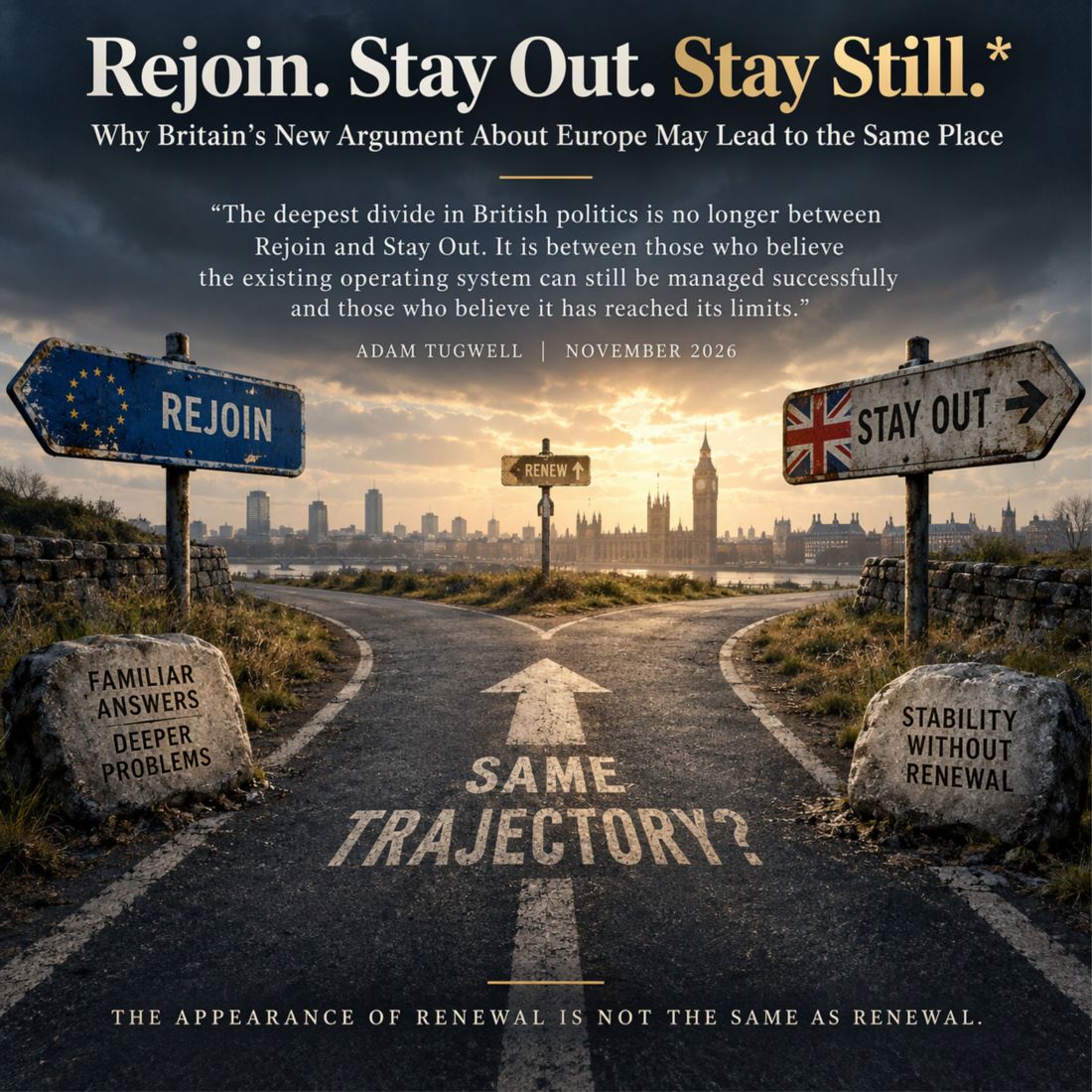
Rejoin. Stay Out. Stay Still.* | Why Britain’s New Argument About Europe May Lead to the Same Place

A Familiar Argument Returns

As discussion about Britain’s future relationship with Europe becomes more explicit, two opposing camps are beginning to re-emerge. One argues that Britain’s difficulties stem substantially from Brexit, and that closer alignment, or eventual re-entry into the European Union, offers the most credible route towards economic stability and political coherence. The other argues that Britain’s difficulties stem from a failure to fully exploit Brexit, and that greater sovereignty, greater divergence, and a more confident assertion of national independence offer the better path.

At first glance, these appear to be fundamentally different futures. They are not. That is not because the outcomes would be identical; they would not. Rejoining and staying out would almost certainly be experienced differently, would produce different trade-offs, and would generate different winners and losers. The deeper question is whether either option addresses the forces that have been steadily weakening Britain’s capacity to govern itself effectively over the past several decades.

My argument is not that Rejoin and Stay Out are the same. It is that both risk leading to a condition I call Stay Still*. And the asterisk matters, because there is no such thing as standing still.

What “Stay Still*” Actually Means

When most people hear the phrase “stay still”, they imagine stability. I mean something very different.

In politics, government, business, charities, and institutions of every kind, standing still is largely an illusion. Infrastructure ages whether it is renewed or not. Institutions weaken whether they are reformed or not. Capabilities erode whether they are maintained or not, and problems accumulate whether they are addressed or not.

A nation that stops renewing itself is not preserving its condition; it is gradually consuming the strengths it inherited from earlier generations.

This is why the phrase requires an asterisk. Stay Still does not mean nothing changes. It means the underlying trajectory continues. The language changes, the politics changes, and the slogans change, yet the deeper direction remains largely untouched.

If that trajectory is already producing declining resilience, weakening institutions, growing dependency, and diminishing public confidence, then “staying still” is simply another name for managed deterioration.

A more accurate phrase might be stability without renewal.

The Problems Britain Cannot Escape

The strongest objection to this argument is obvious: surely Britain’s relationship with Europe matters?

Of course it does. Trade, regulation, investment, and international relationships all matter. The question is whether these are the primary causes of Britain’s current difficulties.

Consider a handful of problems that have persisted through multiple governments, multiple economic strategies, and both sides of the Brexit divide. Productivity growth has remained weak since the financial crisis. Housing affordability remains a chronic problem, and regional inequalities remain among the largest in the developed world. Public infrastructure is under growing strain, public trust in institutions has weakened, and public services face mounting pressure despite repeated reform efforts.

These are not uniquely British problems, nor were they created in 2016. In many cases they predate Brexit by decades. Brexit did not create them; it exposed them.

Britain has already lived through multiple waves of reform designed to address various aspects of these challenges. New Labour modernised public services through targets, outsourcing, and public-private partnerships. The Coalition pursued austerity and state restructuring. Successive governments promised regional rebalancing, devolution, industrial strategies, productivity plans, levelling up, Brexit renewal, and institutional reform.

Yet many of the underlying measures that shape everyday life – productivity, housing affordability, regional inequality, infrastructure resilience, and public trust – remain stubbornly persistent. The language changed. The programmes changed. The diagnosis often changed. But the deeper condition proved remarkably resistant to treatment. And ten years after the referendum, there is still little evidence that either side of the European argument has developed a convincing answer to these problems.

The Politics of Exhaustion

This is where the concept of exhaustion becomes important. By exhaustion, I do not mean frustration or fatigue. I mean the point at which a political system continues to generate activity while losing the ability to generate genuinely new answers.

Policies, manifestos, announcements, and arguments all continue, yet the range of acceptable solutions becomes increasingly narrow. The same assumptions reappear, the same frameworks dominate, the same debates return, and the same institutions produce variations of familiar answers.

Viewed through that lens, the return of the European argument is revealing. It tells us less about Europe itself than about the narrowing imaginative range of Britain’s political class.

When systems struggle to solve deep structural problems, they often return to familiar territory: old arguments feel safer than new thinking, and known routes appear more credible than unexplored ones. The result is a political environment that increasingly debates direction while struggling to imagine destination.

This points towards a deeper divide than the one currently dominating headlines. By the “operating system”, I mean the set of assumptions, institutions, and habits of management through which Britain is currently governed, which I examine more fully in the next section.

The deepest divide in British politics is no longer between Rejoin and Stay Out. It is between those who believe the existing operating system can still be managed successfully and those who believe it has reached its limits.

Seen this way, the European argument increasingly resembles a disagreement about how to navigate the current system rather than whether a different system is required.

The Establishment as a Worldview

To understand why this matters, it is necessary to define what I mean by “the Establishment.” I do not primarily mean politicians, civil servants, journalists, business leaders, or any particular group of people. I mean a worldview: a shared set of assumptions about what is realistic, responsible, and possible. That worldview is built around market primacy, financial credibility, perpetual economic growth, technocratic management, institutional self-preservation, and centralised expertise.

Most people operating within this worldview do not experience it as an ideology. They experience it as common sense, which is why it is so powerful, and why political disagreement can so often occur entirely within its boundaries.

Rejoin and Stay Out appear fundamentally opposed, yet both frequently continue to accept many of the same assumptions about economics, governance, institutions, and progress.

They disagree about Britain’s relationship with Europe, but they often agree far more than either admits about the operating system underneath.

The danger here is not simply that Rejoin or Stay Out fails; political systems survive failure all the time. It is that either could succeed politically while failing structurally, leaving Britain believing that a fundamental problem has been solved when only one aspect of it has been addressed. Apparent solutions can make deeper problems harder to see rather than easier to solve, and that is the pattern I turn to next.

The Phoenix Paradox

This brings us to what I have previously called The Phoenix Paradox, which describes a situation in which the appearance of renewal becomes an obstacle to genuine renewal.

In simple terms: a visible solution can make a problem harder to solve if it creates the illusion that meaningful change has already occurred.

The pattern is familiar. A reform is introduced, the public sees action, and expectations rise. But the underlying causes remain largely intact, so disappointment follows and confidence in future reform falls. The original problem survives and, in some cases, becomes even harder to address than before.

This danger matters because both Rejoin and Stay Out risk functioning as Phoenix cures. A Rejoin project could persuade people that Brexit was the fundamental issue, only for deeper structural problems to remain. A Stay Out project could persuade people that incomplete Brexit was the fundamental issue, only for those same problems to remain.

Neither outcome would necessarily prove the original diagnosis wrong. It would simply demonstrate that constitutional change and structural renewal are not the same thing.

But Surely the Outcomes Would Be Different?

Yes, and this is worth acknowledging clearly.

Rejoin and Stay Out are not equivalent. Rejoining may reduce some forms of friction, improve institutional coherence, and create different economic opportunities, while remaining outside may preserve greater political discretion and allow for different policy choices. The distinction matters, the outcomes matter, and the experiences would differ.

The argument here is not that Rejoin and Stay Out are identical. The argument is that both remain largely situated within the same underlying worldview, and may therefore struggle to produce fundamentally different long-term trajectories.

Both continue to be heavily market-facing and to judge success through broadly similar assumptions. Both prioritise management over reconstruction, and both operate within a paradigm that struggles to imagine alternatives to itself.

As a result, the disagreement is over the shape and speed of the journey rather than its ultimate direction.

What Genuine Renewal Might Require

At this point an obvious question emerges: if neither Rejoin nor Stay Out represents genuine renewal, what would?

The purpose of this article is not to provide a full blueprint, but it is possible to identify the broad direction. Genuine renewal would require a shift from managing outcomes to rebuilding capability, with renewed attention to productive capacity, local economies, institutional resilience, democratic accountability, energy security, infrastructure, community governance, and long-term stewardship.

Most importantly, it would require questioning assumptions that have become so normal that they no longer appear ideological.

The greatest obstacle to genuine renewal is not opposition but paradigm blindness, because a society cannot build alternatives while treating its current assumptions as immutable reality.

Conclusion

Britain increasingly presents itself as facing a new choice: Rejoin, or Stay Out. Yet beneath the surface lies a more fundamental question. Can Britain renew the capabilities that allow nations to thrive? Can it rebuild resilience, agency, institutional capacity, and public confidence? Can it imagine solutions that extend beyond the assumptions that have governed the last forty years? Those questions receive remarkably little attention compared with arguments about Britain’s constitutional relationship with Europe, and that omission is significant.

The greatest danger facing Britain is not that it chooses Rejoin, nor that it chooses Stay Out. It is that either choice is mistaken for renewal itself. Each would bring a different journey, with different frictions, opportunities, and political stories, and would alter the pace, shape, and character of Britain’s future. But if both remain rooted in the same assumptions that produced the current condition, they may differ more in experience than in destination. The question this article raises is whether either produces a different underlying trajectory.

That is what Stay Still* means: not the absence of movement, but the absence of transformation. Rejoin. Stay Out. Stay Still.* Because there is no such thing as standing still.

Further Reading

This article draws on a series of pieces I have written since May 2026. If you would like to explore any of the ideas in more depth, they are grouped below by theme and listed in the order I would suggest reading them.

The European Argument

Brexit and the Halfway House: Why Britain Cannot Move Forward or Back (12 May 2026)

Argues that Brexit was not the cause of Britain’s difficulties but the first visible rupture in an old order already reaching its limits, leaving the country suspended in a halfway house between the European Union and genuine independence.

Ten Years On: Brexit, Globalisation and the Halfway House Britain Still Can’t Escape (23 June 2026)

A decade-on reflection that places Brexit within the wider forces of globalisation, and asks why Britain remains stuck in the halfway house it entered when it left.

The Politics of Exhaustion: Why Europe Is Becoming Westminster’s Last Remaining Option (4 November 2026)

Suggests that the growing attraction of rejoining reveals less about the strength of the European option than about the weakness of every other option open to Westminster, as a political system running out of ideas returns to familiar territory.

The Ideas Behind the Argument

The Establishment Is Not What You Think It Is (15 July 2026)

Sets out the case that the modern Establishment is best understood as a worldview rather than a class or a group of people, and explains why that makes it so hard to recognise and escape.

The End of Britain’s Current Operating Model: Thatcherism’s Forty-Year Reign and the Beginning of the Post-Thatcher Era (1 August 2026)

Examines the operating model that has shaped Britain for roughly forty years and considers what it would mean for that era to be ending, the fullest treatment of the “operating system” referred to in this article.

The Phoenix Paradox (12 November 2026)

Explores how the appearance of renewal can become an obstacle to genuine renewal, when a visible solution creates the illusion that meaningful change has already occurred.

Each piece stands on its own, but read in this order they trace a single argument: from Britain’s halfway-house position after Brexit, through the exhaustion of its political options, to the worldview that shapes them and the question of what genuine renewal would require.

The Phoenix Paradox | Executive Summary

Why the Appearance of Renewal Can Prevent Genuine Change

The Phoenix Paradox is a model for understanding why genuine social, political, economic, and institutional problems often persist despite repeated attempts to address them.

Its central argument is that problems do not survive solely because they are ignored, denied, or misunderstood. In many cases, they survive because inadequate solutions discredit accurate diagnoses.

The paradox is simple:

The appearance of renewal can become the greatest obstacle to genuine renewal.

When a problem is identified, public pressure often demands action. A reform is introduced, a policy is implemented, or a movement promises change. To observers, progress appears to be occurring. Yet the underlying conditions that produced the problem may remain largely unchanged.

If the intervention subsequently fails, public confidence is frequently directed not only against the solution but against the diagnosis itself. Society concludes, “We tried that and it didn’t work,” even when what was attempted was incomplete, symbolic, poorly implemented, or fundamentally inadequate.

The Phoenix Paradox describes this dynamic through several related concepts:

  • The Phoenix Trap – the belief that removing a failing system will naturally produce a better replacement.
  • The False Cure Effect – when a failed solution causes people to lose faith in the original diagnosis.
  • The Charlatan’s Legacy – the long-term damage created when inadequate solutions make future reform more difficult.
  • The Straw Remedy – a visible but ineffective response that creates the appearance of action while leaving underlying problems unresolved.
  • The Preservation Paradox – the tendency of systems to resist meaningful adaptation until doing so becomes significantly more disruptive.

Underlying these dynamics is Paradigm Blindness: the inability to question the assumptions through which problems are interpreted. As a result, societies may become trapped between institutional self-preservation and ineffective reform, while genuine problems continue to grow.

The central insight of the Phoenix Paradox is that failed solutions are not always neutral. They can reduce public confidence, weaken future reform efforts, and ultimately extend the life of the very problems they were intended to solve.

Its core proposition is:

The greatest long-term threat to solving a genuine problem is often not denial of the problem, but the appearance that the problem has already been addressed when the underlying causes remain.

The challenge is therefore not simply to identify what is wrong, nor merely to oppose existing systems, but to understand what must replace them, how transition occurs, and how genuine learning can continue when initial attempts fall short.

In this sense, the Phoenix Paradox is not a theory of failure alone. It is a framework for understanding why societies confuse the performance of change with change itself, and why genuine renewal requires more than ashes, intentions, or appearances.