Solving Society’s problems using our relationship with money, values and people to create a solution that lasts
Introduction
As we begin 2024, ‘Problems, Problems, everywhere’, might be the opening line for some mythical superhero sent to save us all by using their political superpowers.
The challenge for us, is that the multitude of problems we are facing across the UK are not only real, but the list is also growing too.
One thing we can all feel pretty sure about is that in terms of public representation, legislators or the people we could elect or re-elect to be our politicians, there certainly aren’t any superheroes amongst them.
In fact, none of our politicians understand what the responsibilities of their elected roles as public representatives are and what the power, they have been entrusted with is for. That much we can be certain of, simply because of the way that things already are.
To be fair to anyone who has knocked on doors and entered politics with best intentions when they first stepped forward, very few of them – whether in Parliament of within any of our local councils – have the ability or the time necessary to observe, consider and understand how government and the public sector in the UK actually works. That is, before they are either corrupted and become part of it, or the issues they raise that would genuinely help us just as quickly see them spat back out.
This part of how the British Political System works is important to understand. Because no matter what the problems are that we are personally experiencing with the world around us, or what the problems are that the people in our lives are experiencing with the wider world too, the reality is that it is, or was at some point, the result of what a politician did or didn’t do, when they had the opportunity to behave differently, that has ended up with every problem that we are now experiencing across society.
How government and governance work
The laws, regulations and the governance we have to control everything in life outside of ourselves or our homes, is ultimately the responsibility of the people (that’s us).
In the democratic system that we currently have, that means that the decisions taken that have created all the problems the UK has are down to the choices made on our behalf by the people we have elected to represented us and in whom we have collectively placed our trust.
It doesn’t matter whether the politicians and decision makers were aware of the consequences of their actions or not.
No person should ever stand for election to a public office, if they lack the ability to take decisions on behalf of the constituency that they were elected to represent. Rather than putting their political party or themselves, first.
Regrettably, we are where we are today. And because the growing mess that we are being pulled into right now has been created over a period of decades in time, the reality is that the problems that poor, misguided and incorrect governance of the UK has created are now too embedded to be easily fixed – No matter what any of the politicians that are currently lining up with the aim of getting elected in the next General Election have said already or are going to tell us as that time gets nearer.
We can no longer continue as spectators in our own story
The UK and the World itself enters the mid 2020’s in crisis. Whilst some of us may feel happy and contented with the lives that we have and might even feel insulated from the World outside of our daily lives or what some would call our ‘bubble’, very few of us can fail to acknowledge the problems facing people, communities, society and our country as a whole.
Whilst we all have the ability to look outwards and say quietly to ourselves, ‘none of this is my problem’, or ‘someone else will sort that out’, the truth we all have to face is that responsibility for the things that have happened, the things that will happen and the things that still need to happen, rests a lot closer to home.
Those of us who are able, must now enter into the process of looking at all of the problems that we have, and what we do to try and address them, in a very different, and very alternative way.
Surprising as it may sound, it is the complexity of the problems and the interconnected nature of all those problems that the UK has that sit in the areas of law, rules and governance that have not only allowed the creation of all those problems, but has also made finding a solution to them difficult to the degree that many believe the solutions that are now necessary, are impossible to implement, in no small part because we don’t believe that we have any control or relationship with them.
Even harder to fathom for anyone genuinely seeking solutions, is that despite the almost encyclopaedic spread of those problems, that we will later discuss in terms of degrees of separation, both the problem(s) and the solution(s) can be identified and recognised for the power and the reach that they have, in what are very simple terms.
It is the simple way of looking at solving the UKs problems that is most difficult to accept. Because the masses of problems and the complexity of all of them surely means that there must be masses of solutions that are themselves very complex by their nature, after all.
What I can tell you, with the life, education, commercial, volunteer, entrepreneurial, charity, government, not for profit, political and thinking experience that I have, is that we all have the same power, as individuals and as members of our communities, to play our part and to change things. And that change all comes down to the way that each and every one of us think.
Regrettably, we must genuinely want to change our minds before we will be prepared to change them. The resistance to that change is where the root to the solution to every problem genuinely lies.
The System or Paradigm that we experience and are living in now
Because life is so detailed, and we are continually drawn into that detail, it is very easy to miss the bigger picture that is at work around us. Not just within one or a few additional layers, but for some of us what might be described as being a multilayered or multifaceted way.
If you were to stand back and be able to look at, review, consider and think about the way that everything in the world beyond your own day to day experience and what you see every day in the world around you works, no matter how detached, how far away or how irrelevant it might feel, that entire picture, the moving parts, the people, the businesses, the communities, the countries and everything else are what is called a system or what some might refer to as The System.
The Solution isn’t in the detail. It’s about the system itself. If we change the way the system works, the details will take care of themselves
The way that The System works or the processes, patterns and behaviours that make The System work the way that it does is called a Paradigm.
Whilst the many solutions to society’s problems being suggested may have been very well thought out, they are usually idealistic and fail in some way, simply because they overlook the practical reality of the way that The System or the existing Paradigm works and affects everything.
The Paradigm that needs to be changed, or shifted, is based on, focused and is developing even now around Money and how everyone thinks about it.
The shift to a new Paradigm and the process that will bring solutions to all the problems that we have will require us to be values orientated and therefore People-Centric instead.
The question we all face, and that our future, the future of our communities, our country and probably the world too rests upon is ‘What will it actually take for enough of us to change our minds?’
Stepping back from the small stuff to embrace the bigger picture
The switch from subjectivity to objective thinking may sound easy when framed that way. But the reality is that if the ability to see everything objectively were as straightforward or automatic as looking at everything subjectively, the World would already function very differently and be a much happier and healthy place.
Chances are that you will have heard and understand the phrase ‘Can’t see the wood for the trees’.
This is a simple way to consider the relationship between detail (being in the trees) and the overview (the view of the whole wood) that is a key part of the journey that now follows in this book.
Although One Rule Changes Everything is about working with the bigger picture, to give the process and solution the meaning required to be both viable and for its longevity to be assured, it is necessary to appreciate how The System we live in today really works by having an understanding and appreciation of what the detail means or what it collectively adds up to first.
If you are ready, it’s time to begin:
Part 1: The System We are living in is Broken
The Money Centric Paradigm
Today we live in a Money-Centric Paradigm.
Life and everything in it – no matter what you can possibly think of – other than the very personal or ‘special’ relationships that we have – is measured and therefore ruled by the value of money, and the power and influence that goes with it – Because of the Money Centric Value Set that everyone living in the World today has.
Profit, and therefore greed, are the drivers that have been leading so-called economic policy across the West and as such, the whole World for a very long time.
Yet since the early 20th Century – when the combustion engine and the use of oil created a seminal moment in World ‘progress’, and then in the post-war period, when the capitalist consumer economy and then the philosophy called Neoliberalism took off, the greed underpinning it and the actions that it has taken to feed the greed of people with power and influence have gone into a completely different – and arguably inhuman league.
The part you are playing
We are all participants in the success of the Money-Centric Paradigm.
We believe that we need everything that the companies owned by the greedy people running the World, tell us we need.
Even worse, we go running back for more of what they offer us, despite actually not needing much – if any – of what these people and their companies are selling us. Even when the foods, goods and services that we are consuming are doing us physical harm or affecting our mental health.
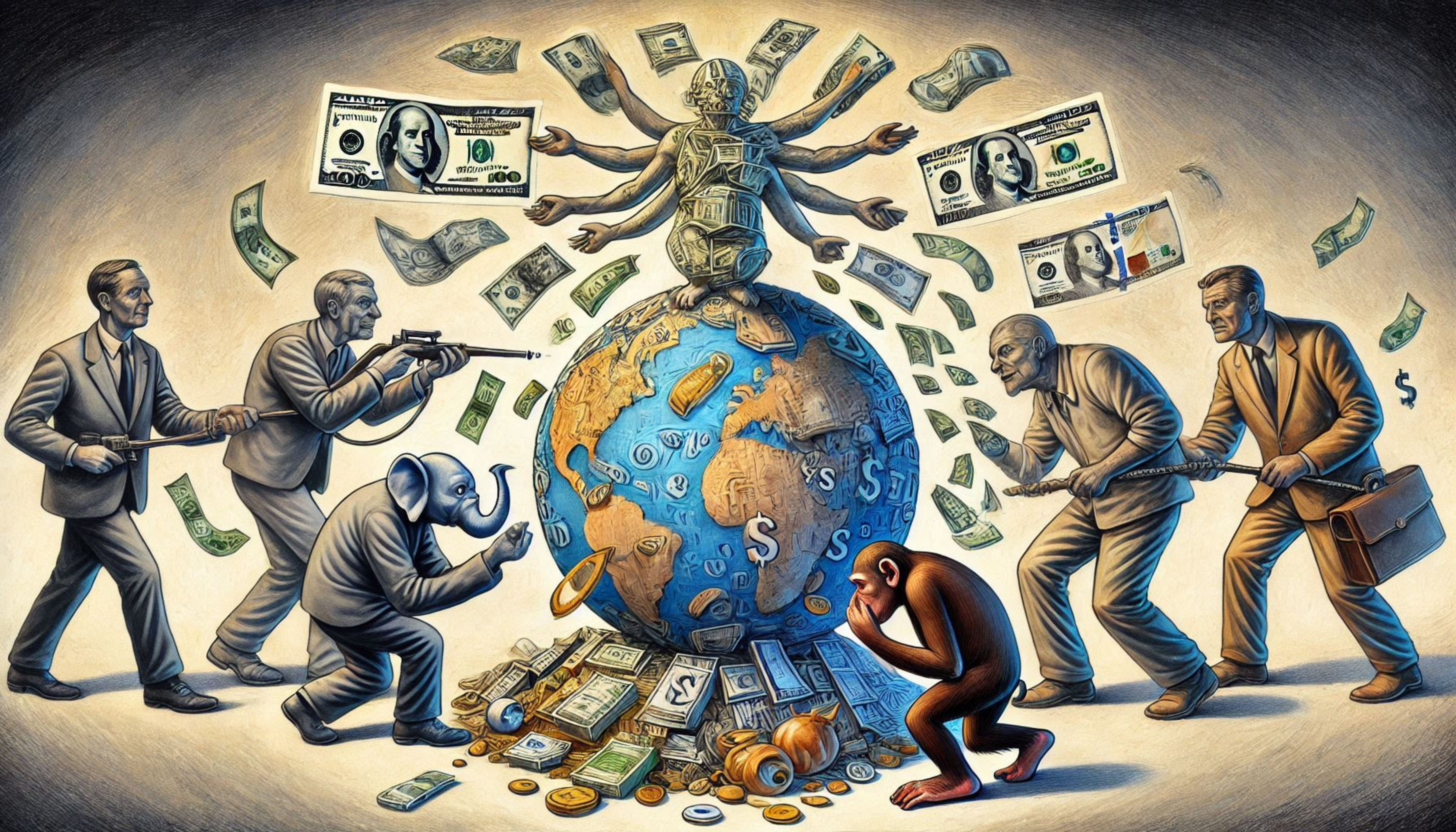
We are addicted to Money. And as anyone who genuinely understands how addictions such as drug or alcohol abuse affect the people who become the victims of any drug, its usually the case that the addicted have to look the damage that is being done to themselves and the world around them by their addiction, in the eye, before they can even hope to rationalize what’s happening.
Only then will they hopefully be able to take the steps necessary to overcome or reject the addiction that they had previously failed to see was ruining their lives.
The addiction of Money-Centric living
Druggies and Drunks may be the first thing you think of.
The next may be ‘I’m in no way anything like them’.
But the reality is that for as long as you keep depending on earning more money, borrowing money, leasing that new car, buying a bigger and more expensive house, going skiing or having a foreign holiday every year, having the biggest and latest mobile phone, having this seasons clothes, shopping for food at a supermarket without giving a thought to where your ready made or exquisite ingredients come from, living off junk or highly processed food, having a car for every member of your household and using it when you know damn well that you could have walked – or any one of basically all the things we do in the world outside of ourselves – other than caring for the people who we know we genuinely love – the reality you have to face up to, is that you are playing your part in all the problems that your community, this country and the world are now facing.
What is more, you are addicted to the way that it all works.
Why Money causes so much pain
We are fortunate that the addictions that people have within our communities and our society are isolated, even though there are far more people affected than any good society should be comfortable with.
If the table were to be reversed, and it was the majority of the population that suffer from those addictions, it would only be the few that are awake to the realities of the addiction and how widespread that it has become who could accurately see and understand the damage that was being done. Because those suffering from the addiction themselves are simply unable to recognise the level of harm that the same addiction can and almost certainly will be doing to everyone else.
Nobody has the right to make a profit. But those addicted to money believe that they do
One of the hard facts about the Money-Centric Paradigm is that no matter who we are, what part we play or what material things we actually have, if we are bought-in and therefore addicted to the way that money works, we are blind to the damage that it is doing to us, and that our actions can do to others, along our way.
As money has played a more and more toxic and addictive role in life, particularly since the Neoliberal approach to economics took over properly in 1971, the motivation to have more money or make more money, no matter how much money or material possessions we have already got, has become more and more of a priority, to the point that it has steadily dehumanised the way we consider our actions and the reach of those actions along the way.
Profit drives the cost-of-living crisis and the rapidly rising prices that we are experiencing today because so many companies are now exploiting the explosive growth in the volume of money that exists because governments have been so happy to print more and more of it.
To those who already have so much, finding new ways to obtain and accumulate even more money is just a game and the free markets and the deregulation that facilitates their growth that Neoliberals tell us are so good for everyone, is just a very clever way to remove the rules that are there to represent the will of the people – and protect us, so that those with money can make even more money and then use that money to obtain increasing and very undemocratic levels of control.
Private interests have obtained so much power over services and industries that provide everyone with the goods and services that are essential for life, that they are effectively able to guarantee that they will always make a profit and be able to pay dividends to shareholders, because the power they have obtained allows them to bully and control the very weak minded people that we have elected, in just about every conceivable way.
Those with power over money today will not relinquish any of the hold that they have on it voluntarily. However, the choice they have to use the obscene amounts of money that they have accumulated to fight change and manipulate others to remove any risk of it will no longer be a problem if we deal with the unhealthy relationship that we have with money first.
We cannot break this pattern or one-way cycle, unless we all break the addiction that we have to living within the Money-Centric Paradigm and refuse to tolerate the behaviour and actions of others who refuse to accept that their greed and profiteering is hurting many more than it ever benefits, and that there is a much better alternative way.
If you would like to understand how big money uses the power and influence it has to unfairly and unjustly take control of industries and systems that are essential for life, please research the story of how the worlds supply of seeds to grow crops is now mostly under the ownership of just a handful of companies that use laws called patents in civil courts – that cost a lot of money – to control how the majority of the World’s agricultural and food crops are grown.
Breaking the Money-Centric addiction
To be rid of the addiction to Money and Money-Centric thinking requires understanding of what Money really is, why it is the problem that it is, and the effect that Money is having on everyone who is addicted – and will continue to have on everyone who is living in or experiencing the Money-Centric Paradigm, and will continue to do so, until The Paradigm Shifts and this results in The System being changed.
The chances are that you are already feeling a little prickly about the idea or suggestion that the relationship that you have with money is in some way wrong.
However, it is also likely that if you are a.) reading this book and b.) feeling prickly, you are ready to read further and to begin the process of understanding the role that money plays in society’s problems and therefore any addiction to the use of money that you may have.
You are likely to have a few moments of reflection where you think ‘That was obvious’, or ‘I already knew that, didn’t I?’
When you do, you’ll know that the rather horrid story of Money and the problems it causes everyone, are beginning to make sense.
There’s no better way to begin that journey by asking yourself a question that all of us should have been asking ourselves all along…
Where does money come from?
Please stop and think about this question for a moment, before you continue reading.
You may have just realised that we don’t think about money in any great depth at all. And the reason you don’t think very deeply about money is likely to be because of the myths that surround money.
The myths around money are paradoxical. Because the money myths are what make money work in the way that it does today. Yet at the same time, the money myths hide the way that money works in a way that stops the majority of us from even questioning things that ‘don’t add up’ about money.
But the truths about money are quite literally hiding in plain sight.
The simplicity of the money system is what makes it seem intelligent and intelligent people don’t question the money system because the way it works is literally too simple to believe
Understanding how money really works within the Money-Centric Paradigm is like going on a voyage of discovery, all of its own and in itself, and there is a risk that it will feel like going down a rabbit hole.
The simplicity of how the economic and financial system works around us is breathtaking in its simplicity. The principles which we all accept as being far more complicated than they really are.
This is what helps anyone who works within or who is benefitting from the way that money works to convince the rest of the world that money is not only real, but how it works is far too complicated for any normal person to understand, to question or get involved.
If you follow the news or current affairs, you will regularly hear newsreaders and commentators talking about National Debts in the Billions and Trillions of US Dollars and Pounds.
But this raises questions about where all that money came from first.
Most people think that the money we save is what banks then use to lend to other people and to businesses, when those people and businesses take out loans.
But where did the money come from that means Governments around the world can now be in Trillions of Dollars or Pounds in debt?
Did we all have that money in our hands or in our bank accounts to begin with?
Have big companies really earned all that money and then kept it in their bank accounts so that they have accumulated all that money so that it can be used to bail our governments out?
The answer – as you are probably beginning to realise, is that the money being used to accumulate all this debt, doesn’t actually exist.
The money we use, borrow and save, has been created by monetary and financial systems that are in private hands and not controlled by the government or the public they represent.
The fact that the money in the Money-Centric Paradigm is controlled by private, profit-making hands makes all the pain that is being inflicted on everyone because of money even worse.
So, yes, it is this same system that is used to ‘print’ or create the money that we all borrow and probably earn or maybe receive in benefits too.
Therefore, the money that runs everything is effectively being conjured out of thin air.
Money is nothing but a belief.
When we are led to believe in something that doesn’t exist and behave as if that thing is real, the reality is that we have been conned and are living a lie.
If you want to understand the money lie better, some of the best information on how the world really works is available for you to watch, listen to and read at your fingertips. You just need to ask the right questions and make sure that you check the credibility of either the sources and speakers or repeat the same process over and over a few times until you have listened to a range of different sources and are able to conclude what you believe to be the truth.
If you can, please avoid using AI for any research if you want to really understand how anything works, as you will never be sure if you are reading the truth, or the truth that someone else wants you to believe, if you do!
Why not give this video on YouTube a try to begin with: It’s called The Four Horsemen by Renegade inc. It’s now a decade old, but it will guide you to further questions and to finding all the answers that you really should know.
Money is nothing. Our problems exist because we treat Money as if it is the value in everything.
It’s not possible to write a book about an alternative way of living that doesn’t spell out some, if not all of the truths that exist around the way that we live right now.
Perhaps the hardest truth to accept about the Money-Centric Paradigm or system that we live and exist in today, is that wherever we are, whatever background we have and however we live our lives, money is the value that controls everything.
We value money as much as we do, because we have learned to consider money as being a thing.
Things actually exist. Things are food, cars, houses, electrical goods, clothes and there are many others.
But in the sense of how the world around us works, things are not symbolic. Things are not there simply to represent something different or something else.
Yet being a symbol of something or many other things is exactly what money is. And this rule applies no matter the form that it comes in, including the current forms of crypto, digital currencies or DeFi.
By making money a thing and by relating the value of everything to money, whether it is an hour’s worth of the skills we have learned given to our employer through work, the cost of the training or education that provided those skills, or the products or services that we make or sell, the intrinsic value of everything has become nothing, that is unless it can be translated into monetary value or into monetary terms.
When you value no thing, nothing will be of the greatest value.
And that’s why people or humanity have less and less value in the Money-Centric Paradigm today. Because the value of money and the accumulation of it, with the power and influence that comes with it has become more important than anything else.
The Practical use of Money
Whilst its real purpose may be disputed by those who have the most to lose from humanity learning to be honest with itself about the true value of money, money is a universal medium or tool.
Money was created to attribute a transferable value to goods and services that could then be exchanged for other non-related goods or services, universally.
Money isn’t a thing. Money is an idea or a concept.
Because money has traditionally been something that we could store, keep hold of or put away, the value of what money represented became subservient to the value of whatever we use it to exchange, with the value then being perceived as being the money itself.
The things that money is used to value will always have value, whereas money cannot hold value.
Because if money is not acceptable or not deemed equal to the value of whatever it is that we wish to exchange, the value of that money then reverts to zero or nothing, which is money’s real value or intrinsic form.
The Money-Centric Problem-Solving Trap
It would be possible to create a never-ending list of the problems that society faces. It would include all the problems that you could list, along with all the other problems that are relevant to the life experience of all the other people who are living and experiencing the Money-Centric Paradigm today.
Indeed, many great thinkers and writers have already written extensively and proposed different solutions, ways of running politics and government and methods that would allow us all to live differently. All with the aim of improving life for somebody somewhere, and more often than not, for the World’s most vulnerable and poor.
But they don’t work in the way they were intended.
In itself, the suggestion that somebody somewhere knows how to fix things shouldn’t be too hard to believe. However, when we look deeper and realise that there are probably as many solutions that come from the political left as the political right, as they do from anywhere that we could classify as sitting in between, the next question you might ask is ‘Why, in the 21st Century are none of these ideas working?’
To be fair, some of these solutions do work. But they only work in isolation and temporarily, which in this case might be counted over a duration of many years in time.
What all these solutions have in common – no matter how well constructed, or argued, is that they are all built upon the foundation of the Money-Centric Paradigm, which leaves every one of them fundamentally flawed.
Whilst it is possible and certainly provable that small-scale People-Centric projects not only exist, but in some cases also appear to thrive, their success will always be on a local level. And that success will almost certainly be dependent upon the drive, enthusiasm and continued input of the key people involved.
False Starts
Giveaway projects such as Universal Basic Income will certainly work on a localised basis too. Because the isolated area of operation means that any money being poured into them doesn’t have any real-term impact on the structure and function of the wider Money-Centric money system that is at work beyond the locality in which it is being tried.
For some people, a system that works for a community or even a town alone will be enough to prove that a project or idea works. Yet the isolation of that project will always question whether anything that doesn’t change everything for everyone affected by the same problems or issues in a fair, balanced and just way, can ever be said to work.
Temporary fixes are not enough, as the problem is still very much there, and will come back as soon as the commitment to keep the finger in the damn of what is every Money-Centric Paradigm based social problem at bay.
A Universal Solution must be a Solution that will work Universally
The only way that the problems society faces can be genuinely addressed on a permanent basis is to remove the foundation upon which all of the problems are built.
Nothing less than a complete switch from the Money-Centric Paradigm to a People-Centric Paradigm will succeed.
However, whilst this would ideally take in the entirety of the world immediately, the reality is that with the question of whether we can ever wholly divorce society from Money-Centric Values and Behaviours, it may be the case that a Societal Split will be the only practical way to proceed.
Universal Change or The Paradigm Switch may be delivered in two steps. The first stage being a two-tiered form of society, which will continue to exist until everyone is ready to fully commit.
Part 2: The New World, where everything works because People always come first
The Alternative ‘People-Centric’ Paradigm
Impossible as it may appear, an alternative Paradigm or ‘system’ exists that holds the answers or the solutions to all the societal problems that we have been looking for. And it’s been there for a very long time.
The reason that we haven’t adopted the alternative Paradigm or System, is that it relies on living life with a system of values that run in a completely different way to any under which a level of profit can be made.
A way of being that can ultimately only come to be beneficial to anyone through exploitation or by disadvantaging someone else.
This ‘People-Centric’, ‘Human’ or ‘Values-Based’ Paradigm or System could exist even now.
But to have and live within the truly People-Centric Paradigm will mean that each and every one of us has to accept and allow the system that governs everything in life to value every human being and what each and every one of us need for today, and for our tomorrow, in exactly the same balanced, fair and just way – no matter who they are, or what we believe any of them to be.
Voluntary Change: The different way available to us right now
The quickest, easiest and pain free way to adopt change is to do it voluntarily. And to adopt the change from the Money-Centric Paradigm to the People-Centric Paradigm, voluntarily, now.
This will literally mean the majority of us, and certainly everyone in a position of power or with responsibility, being required to immediately stop putting profit, themselves, or whatever drives them first. Instead, we must all prioritise people, relationships and everything that feeds and nourishes them first.
I do not doubt that many reading will react with thoughts such as ‘That sounds nice, but its totally unrealistic’, or very similar.
The reason for this resistance is exactly what has been alluded to in the part you are playing, earlier in this book. Where we discussed how addiction works and how those who are bought-in to that addiction cannot see the damage it does or how the situation can be fixed (because they don’t even know or accept that it needs to be fixed).
In isolation, no matter how well meaning and how well-thought-out solutions and new approaches to our societal problems may be, those solutions will not work in any way other than a temporary way – even if that temporary period is one that lasts for years.
Voluntary change can only become meaningful and deliver the experience that people and the World needs, if the level of change reaches a critical mass, or point where the majority of people, groups and organisations have rejected the Money-Centric Paradigm, and then adopted the People-Centric Paradigm instead.
Is Voluntary Change possible or is it pie in the sky?
The most difficult or challenging part of writing this book is to explain and attempt to make sense of the fact that voluntary change is now very unlikely indeed.
Many people will pay lip service to voluntary change, as they can see the benefits to other people.
The responses that come back in discussions outlining the content of this Book will be similar to ‘The world doesn’t work like that’, ‘It would mean everyone will be poor’, or ‘I’ll be on board when everyone else is.’
Because when it comes to the need for change, people soon realise that solving the World’s problems means that they will have to change themselves.
From this perspective, a voluntary change or switch from the Money-Centric Paradigm to the People Centric Paradigm we are now beginning to discuss here will certainly seem to be pie in the sky. And that’s pretty much why change of the kind that would really help everybody who needs it now, or for the future, is being held up.
However, the unwillingness to change is one thing. The unwillingness to accept that change may come whether we like it or invite it, is something else altogether.
Complexity of the System
Whilst there is an absence of willingness to move away from the Money-Centric Paradigm to change The System voluntarily, it is only fair to add that one of the most challenging barriers to ‘looking outside of the box’ for a solution, for many people, revolves around the issue of complexity.
When it comes to changing Public Policy, or the way that everything is governed by laws and regulations, the default setting for most of us is to take way things work or the mechanical aspects of government and the public sector at face value, without giving the matter any further thought.
‘It is what it is’, is a great way to summerise everything that’s wrong with public policy and governance.
But it also lacks any of the detail or more importantly, the understanding that is necessary to be able to see how public policy interacts with and is interconnected with other public policies. And also, not least of all, to be able to work through what the likely impact of changes to any public policy will be on what might be many different fronts – and then, how the people in each of those policy ‘locations’ will be affected and how they will feel about the change.
‘It is what it is’, is also an excuse in response to our unconscious recognition that there is nothing simple about what lies ahead – IF you make the decision to step on to the path of step-by-step change, within the Money-Centric Paradigm.
This is not an excuse in any way, shape or form. But for anyone serious about solving society’s problems with the voluntary support of others, it is essential to recognise how people think about the possibility of meaningful change, and the behaviors and excuses that are likely to follow, as soon as you mention what the first steps of change in that process are likely to be.
What happens if we do not change voluntarily?
The simple answer to this question is that without us making the decision to change voluntarily, the problems that society is experiencing will continue to get worse.
Many don’t see how bad the problems are and that the problems are getting worse, because they don’t want to see it.
But there is a direction of travel with everything and every problem that society has today, that only goes in one direction.
Leadership, innovation and creativity in solving problems and in improving the lives of others simply doesn’t exist within government, the public sector or within The System, under the Money-Centric Paradigm.
Whereas the firm belief that money is the answer to all problems most certainly does.
The reality we face is that politicians and decision makers will not take the gutsy and challenging decisions that the UK and the whole World needs. Because they are more interested in protecting whatever is important to themselves or the people who influence them, and so, are completely repulsed by the idea of risk – even when it is the responsibility of the roles they have taken, to do so.
There really is no silver bullet that can come from any of the politicians who are in power today or soon hope to be. Because all the things that motivate, drive and make these people tick are exactly the same.
If you would like to consider the difference between what politicians say and what they actually do when they gain power, the coming months in 2024 may be the perfect time. If you listen to what all of the Political Parties say or even promise as part of their manifestos as we head towards the coming general election in the UK, careful listening will show that there will be lots of ‘This is what we are going to do’, but other than nebulous suggestions such as ‘We will commit to spend £X Billions to do this’, it’s unlikely that any of them explain the mechanics of how any of the solutions they are promising will actually work.
PLEASE NOTE: That if any of them are called out for this and they suggest something like ‘we aren’t here to do the other party’s job for them’, do bear in mind that everyone seeking election is supposed to share one thing in common: Putting the needs of the electorate first. So, if any of them are doing that, it surely wouldn’t matter who comes up with and who delivers the solution, just as long as the solution is delivered in the shortest period of time!
Involuntary Change will happen if we do nothing:
The experience of life that we are having and the problems that society faces will get worse in ways that will be progressively more and more difficult to change. Because the infrastructure, tools and knowledge that we previously held for generations is being systematically destroyed, discredited or rubbished in the creation of myths.
Where destruction or relabeling isn’t possible, helpful knowledge is being systematically hidden from view so that humanity is losing sight of the basic ideas, thinking and ways of working that are necessary just for people to be able to survive and to look after themselves independently.
The arrival and exponential growth in our use and reliance upon Artificial Intelligence plays perfectly into these aims.
Humanity is falling into the trap of believing that progress is only one way, and that with technology and what it can do for each of us individually already, there is no way that we could ever go backwards again.
AI is the tool of deliberate dehumanisation
What feels like the overnight acceptance that our phones, computers and TVs have the answer to every question, covers up the dangerous reality that the supposed ‘quantum leap’ in technology that using AI ‘gifts us’, comes at the potentially massive cost to humanity of people surrendering or losing basic ability to think for themselves, with what is an essential human ability and survival tool therefore being lost.
If you cannot think for yourself, you cannot answer questions either. And the progressive switch away from every part of life that revolved around locality and human interaction, rather than communicating with everyone through a device of some kind has also meant that since we entered the most destructive phases of the Money-Centric Paradigm, the dehumanization of relationships has progressed just as steadily too.
If we do not rehumanise the relationships we have with everything and everyone that we know, we may only be a short time away from living lives that are controlled by and for the benefit of someone else, right down to the details of what we actually think.
The only relationship that we will then have with anything will be digital. There will not be any way that we can interact with people we are not supposed to, or even visit the world outside – IF there is no benefit to those controlling everything from us doing so.
No, it’s not a conspiracy. This is actually a real plan that is being implemented and acted out in plain sight by people who believe that they are different and therefore more important than anyone else.
The problem with any attempt to stop this happening is people are far too trusting of the people we elect, the people with all the money and all the people we see and hear from or about on any one of our screens.
Right now, because we are not changing the way the World works by making the decision to do so voluntarily, we are actually allowing the changes necessary to transform everything we know into this dystopian world to happen. And that change is happening now, as you read.
Changing without Choice:
We may not wish for it, and I certainly do not. But the change that is now required so that every human being has the ability to enjoy the freedom that can only come from being fully responsible for ourselves, might not be possible or even achievable, voluntarily, without enough people making that choice.
Indeed, it may only now be possible as the result of everything that we consider as being normal and that we take for granted, being utterly destroyed, for the change that is necessary, to happen at all.
Whilst it sounds very pessimistic, this reality puts into context just how selfish and self-centered mankind has become.
Very few of us could deny that we are obsessed with money, or that we are living unsustainably in any one of a multitude of ways.
But for as long as we still believe that this way of living is benefitting us in some way, we will refuse to see anything good in living more responsibly within the Money-Centric Paradigm. We certainly will not accept that there is an alternative way of living, that rejects the prioritisation of money in absolutely every way.
System Collapse
If we were to experience a definable collapse of the Money-Centric Paradigm, accepting that change is necessary might be easier than we currently think.
However, because so few of us are ready to accept that our resistance to voluntary change may lead to Change without Choice, nobody (other than ‘preppers’ or conspiracy theorists) are seriously thinking about how society and our communities will be able to function and provide even for the basic needs of the population such as food, water if and when that happens.
Change without Choice will create a power vacuum based on basic human and essential needs.
It is what fills that void – whether it be a rejig of everything that’s wrong with leadership today, people like conspiracy theorists with a revenge-filled agenda, or something that may look good but ends up being even worse – that should now be the biggest of our concerns.
Part 3: The switch to Values Based Living
Why Morality, Ethics and Frameworks for Life matter
No need to worry, I’m not about to go all biblical here. But it may sound like it, just for a moment or two.
The Ten Commandments have lessons to teach everyone that reach beyond the basic meaning that few could fail to understand – or dare I say agree with. That is, if all things in life were balanced, fair and just – as they really should be, and could be, IF we didn’t have to live and function in a world where some are taking much more than genuinely fair – whilst encouraging many others to approach life in exactly the same way.
We live in troubled times where the misinterpretation or reinterpretation of what great books say and mean are quite literally leading to the rules – or the frameworks for life – that they promote, being broken. And they are being broken in some of the most hideous of ways.
Where these great works and in this specific case, The Ten Commandments came from isn’t really the issue. Because it really doesn’t matter who said or wrote them not being ‘the right person’, having ‘the right platform’, or because we somehow managed to add them to a pile of other people or groups of people that we have no time for, or simply do not like.
It’s the message that matters. Not the voice that spoke it.
For instance, Thou Shalt not Kill is a really good rule to follow, not only because murder is a horrific crime to inflict upon anyone. But because of the impact that it will inevitably have on our own lives and the lives of the people around us too – even if it’s just down to the thoughts we have that nobody else might ever experience or see.
The one about envy (Thou shall not covet) is just as powerful in another way. Because of the blindness that we have to rational thinking, and what the lack of rational thinking can then lead us – often in the heat of the moment – to then go out and do.
No. Whatever the source or whoever the source of these basic and very powerful lines, the truth behind them is that they were crafted, written and initially shared by someone who was very wise.
The reality that we all face today, is that in the trouble world that we are all experiencing, we are in serious need of basic and clear rules like these that can be a guide or framework for life, that can not only put us all back on track but keep us all there too.
Life has no meaning today, because we value it with money and money has no meaning
Our values, value set or rather what we believe, form the basis of not only everything that we do, but everything that we experience and how we experience it.
Once you can see that it is not money that has value, but rather, it is whatever the money gives us access to that has holds the value – especially if money were no longer to exist, or you can imagine what it would be like not to have any money to spend, it is possible to understand that beyond being an idea, or perhaps a tool, money doesn’t have any meaning. Therefore, money shouldn’t be valued by anyone.
If others attribute value to something that doesn’t exist, what do we think about them?
The chances are that we believe them to be fools, stupid or perhaps even dangerous. Because their ideas and what they believe in could be a risk not only to themselves but to everyone else too. They are probably someone that we will be polite to but will otherwise do everything that we can to distance ourselves from or to avoid.
However, if you are a fool and you believe in the value of whatever it is that everyone else can see is dangerous or at best stupid, the chances are that you won’t see the situation any differently until your beliefs jump up, bite you and become painful to you in some way.
Because money does play such a significant, albeit deceptive role in our lives, even coming to terms with the technical reality that underpins the non-value of money itself may not be enough. Because we are emotionally tied to what money represents.
Imagine you live in a world where pretty much everyone has been duped into believing that money is real, but actually isn’t. That all the people you know have been conditioned not to question whether money is real or not, because when believing in money works for everyone, the pretend world everyone is in feels very good indeed, as long as the money keeps on working for them. Therefore, because most of the people you know or can see are living with the same beliefs about money, you accept that money must be real, and although your beliefs are making you more and more self-centered – to the point where you have little or no sympathy for anyone who falls outside of the group that has as much money as they need, you can’t see things being any different and don’t have any reason to fear that it could all end, the moment that money no longer holds any value and you then try to buy something with money that does actually exist?
The money influence in political idealism
Another reason that it is so difficult to see money in any way other than the way that the World today accepts it, is because it has become very easy for politicians to distract us from just how poor they really are by referring to money or ‘growth’ in just about everything that we do.
The obsession with money as the answer or the solution to every political problem, whilst also being the motivation behind all that today’s politicians do, is also hidden by what we believe to be the progressive, conservative or other political philosophies that supposedly define everything that political parties do. Yet the two ideas that seem to drive everything in politics today – that’s Socialism and Capitalism (Neoliberalism) have money built into just about everything they do.
Why Socialism, Neoliberalism and any other ism isn’t the silver bullet (no matter how much you like the Politician)
As I write in December 2023, there is much talk in the news of the UK’s Conservative Prime Minister Rishi Sunak being replaced by his Political Party, and of the next General Election which is generally considered most likely to be called for the early Summer or Autumn of 2024.
Politics in the UK today is regrettably very tribal. But within these tribes, two different ideologies dominate, even though for some people, they will not be recognised by name.
They are Socialism and Neoliberalism (Or what most believe to be Capitalism with a more modernised name).
Whilst Socialism and Capitalism (which has really been Neoliberalism since the removal of the Gold Standard in 1971) were clearly very different political ideas historically and were previously easily defined through analysis of the public policies that they espoused and implemented; such clear definition no longer exists.
The only discernible difference between the Political Parties that exist in the UK today is the language that they use to frame and promote the Neoliberalism that now drives and is common to them all.
Neoliberalism is a control-level obsession with money, overtly displayed as a fixation with the idea that the markets are much better stewards of everything than government could ever be.
The true purpose of Neoliberalism is also its greatest danger to Humanity.
To be successful, Neoliberalism requires constant growth of the volume of money in circulation. This in turn means that whilst newly created money is funneled towards those who are already rich, the value of everything owned by everyone else is constantly becoming less and this now means that the wealth divide is growing exponentially – which is why so many of us are now getting hurt.
The wealth divide is now so wide, that what we are now demonstrating to be the meaningless ideologies that the different Political Parties in the UK play around with can only dictate or influence the speed with which the lived experience of the masses continues to degenerate and get progressively worse.
Both Socialism and Neoliberalism are presented to the public as being the champions or causes of freedom. Socialism through the freedom to be equal with all things, where that equality is inevitably designed or defined by someone else, so is never really about equality at all. Neoliberalism, where freedom is presented as being the removal of the state or government from every part of life and the public sector with the inherent suggestion that market freedom can only benefit everyone. Whereas what that freedom really becomes is freedom for big money from law and restrictions, meaning that those with lots of money can increasingly control everything and everyone using civil law and the courts as if they have become the government itself.
The Neoliberalism pursued by politicians is nothing more than a dictatorship by private proxy that just creates misery, harm and poverty for the masses. It facilitates a System that doesn’t either represent or resemble anything like freedom at all.
If you can understand and accept that this is how the reality of the narrative really works, the only suggestion that I will add is that it will serve neither your own nor anyone else’s interests to feel angry about what the people we have elected have really been doing all the way along.
Politicians, public servants and people in the public eye are human too. It is simply amazing just how many of them don’t really see how they have also been played and as such, they have no real understanding of the damage that they genuinely do.
True Freedom is the ability of the individual to support and sustain themselves independently.
Surprising as it may sound, defining freedom and what freedom really looks and feels like is in no way as easy as any of us are likely to believe it should be.
As an example, we need look no further over the constant debate over what freedom of speech is or what it should be today, and how that debate is getting some of the most learned and intelligent people on the planet into trouble, just because someone, somewhere else is interpreting what that other person’s freedom of speech should look like, in some other way.
Genuine Freedom of Speech requires that any person should be free to speak, and do as they like, as long as what they say or do does not hurt or negatively affect the life or being of some other person or anyone else.
However, there is a difference between promoting ideas or thoughts and acting in a way that promotes only what you believe in or what you wish to do and sharing genuine or real truth.
Nobody has the right to hide from or to be protected from the genuine truth. Because to do so means that they are being allowed to promote ideas or thoughts or are allowed to act in a way that promotes only what they believe in or that they wish to do – no matter what the cost and impact of this may be upon others.
However, this equation or form of words only defines what freedom in our relationship with others and with the world outside of us should be. It doesn’t relate to real freedom or what we should recognise as being the genuine freedom just to be.
Basic Freedom IS The Freedom to Be
The Freedom to be, is what true freedom really is.
The Freedom to Be is the ability to be able to support oneself fully, and to remain happy, healthy, safe and secure, independently of any kind of help, support or the need to ask for it in what would be genuinely normal circumstances.
Basic Freedom or The Freedom to Be has never been so relevant today, in a World that is so self-obsessed and fixated with the self, that it has lost sight of how damaging and far reaching the implications for others of self-serving and selfish behavior can be.
The Freedom to Be requires care for our environment
Whether you agree with it or not, the myth that we live in an age where we can have whatever we want, if we have the money to buy it, is nothing more than an elaborate hoax or lie.
We may have been conditioned to believe that the price of what we want relates only to the value of money. But what this myth doesn’t tell us is that there is always a much bigger cost.
The cost of having the things that we want but don’t actually need costs the World natural resources that we didn’t need to use. By using what we don’t need, we will have unnecessarily reduced the sustainability of everything that’s left for generations in the future. Our behaviour will almost certainly have contributed to the process of climate change, whatever we argue to be the overriding cause.
The Freedom to Be for anyone requires the Freedom to be for everyone else too
The most pressing issue we face from the influence of the Money-Centric Paradigm is the cost of the dehumanisation of relationships.
For every bit of material wealth that any of us feel we have accumulated beyond what we genuinely need, we are taking something away from some person somewhere else and making just a normal life for other people something that is getting further and further away from being an experience that they can now financially afford.
However used to the terms ‘benefits’, ‘loans’, ‘grants’, ‘subsidies’, ‘charity’, ‘foodbanks’ and anything else that can be used to describe handouts or the help that is given or made available to anyone who may find themselves in need, there is nothing ‘normal’ or indeed ‘humane’ about being part of a community or country that considers it ‘normal’ for any of these things to continue to exist.
Every person has the right to Basic Freedom and that means every person must have the Freedom to Be.
Doing the right thing every time will put everything right.
How often do we think to ourselves ‘If I do this, I will then have the choice between doing this or doing that’, or ‘If I ask them to do this, they will then do this for me too’. Or, perhaps any question to ourselves like that, where the decision or choice that we are making in the moment, isn’t about only that one decision, but about something else that could happen or a choice that we then expect to be able to make, beyond?
It’s quite often, isn’t it?
The next question: ‘How often does it actually work out the way that you intended, especially when there was someone else or other people involved?’
Yes, things can work out. But if we are honest with ourselves, in this kind of situation, things don’t often work out as we might have expected – and in this sense it could as easily mean that things could work out better than we had expected, just as easily as the occasions when things don’t work out as well as we’d hoped.
The point here is that we only have control over the decision or choice that we make in the moment that we make it.
We don’t have any control over anything that happens next. Even when we are as certain as we could be of the immediate or following result.
The right thing for everyone
Our power or our point of power is quite literally in the present or in the precise moment when we are thinking about anything and are at the moment of choice.
So, if we make the choice or the decision that is immediately in front of us with a specific result in mind – whether it be to benefit ourselves or because we are trying to anticipate an outcome that in any series of events or choices, could be a number of steps down the line, we are not really exercising any control over that decision or choice in any way, shape or form.
In fact, whilst it may or may not become immediately apparent, by making choices or decisions subjectively, which is to move forward with a specific outcome or anticipated benefit in mind, the chances are that we either won’t experience the result that we intended, or will experience the intended result, but it will come with consequences or results that we had not made allowance for.
The best way for any of us to make decisions or choices that might have an effect on anything that will come into our experience beyond the moment we make any decision, is to always make that decision based on what is in the best interests of and considerate of everyone concerned – whether they are in the room or could only be affected by 6 degrees of separation of events – or even beyond.
Our habits become our truth
Making the right decision at every opportunity isn’t just a practice or good habit that will serve us all well.
The same experience that we will all have had when we just did what seemed right and then everything just seemed to fall into place and work out well for everyone concerned, is a habit that everyone should employ too – whether in a shop about to buy chocolate that is full of sugar, or manage a bank and are about to make a decision that will see the prices of everything everyone else needs to buy shoot up, just so they can make a bigger bonus when the end of the financial year arrives.
Making the right decision every time is a taste of what living in a values-based or people-centric way is really all about.
The funny thing is that when we think about it, values-based living is just as self-serving. The big difference is that when you do it for real and commit to the process, it is a way of approaching life that benefits everyone, not least of all ourselves.
The Right Thing is The Honest Thing
Perhaps the easiest way to consider what the right thing really is will be to treat it in the same way as being honest with the things that you say to others.
You may have heard the idea shared that one lie requires many others to cover its tracks, and that the way to make everything easy on yourself and never have to remember what you’ve said, when and to whom, is to always tell the truth.
You don’t even need to know everything. It is just requisite upon each of us to do the right thing based on what we know – to be honest with ourselves – and not let anticipation, second guessing or what we might like to happen get in the way of any decision, wherever or however it might be made.
Managing Fear
In amongst the mess of the World that the Money-Centric Paradigm has led it to become, the reality at work is that sitting beyond the worship and reverence of money itself is the rather serious problem that everything in the World is fear-led.
The fear of not having money, not having enough money, not being able to earn money or of losing what money we have, is the one that will be easiest for most to relate to, especially when we add the money-based power and influence that comes from financially related position that then works its way in.
However, fear is a much deeper issue for everyone, and in the form of the influence that fear has on all our lives, fear is the one true ruler of the world.
It doesn’t matter what context, subject or relationship we consider, fear of something sits at the base of it. We fear not having food or the essentials that we need, so we work. We fear not working because we will not have money for food and essentials. We fear that people won’t like us, so we change the way that we behave. We fear that we won’t be recognised because of what we are ‘worth’, so we do all we can to obtain and possess even more. We fear not doing what the group does because we might end up being rejected. We fear not being in a relationship, because something might happen that means we cannot function normally and will then be left on our own. When we have money, we fear not having enough to get the things that we want. And the list goes on indefinitely.
The problem is that fear is the basis of what creates problems, distrust and unnecessary misunderstandings between people, Especially when there is a discernable difference between us that means we cannot find comfort in the default belief that what looks the same as us, will think the same as us, will act the same as us, will do the same as us and will therefore BE the same as us.
No spiritual awakening, religious dogma or text will be required to show anyone that fear is the most destructive force that we have within humanity and across the Planet, even though it quietly rules the world.
If we were to all refuse to respond to or be led by fear, it would be the best form of revolution that the World could ever have.
Valuing People, Relationships, Community and everything that sustains us is a much happier life
Surprising as it may sound, people living hippy-lifestyles, in tune with nature, who are spiritual, who live in communes or express what many of them will argue to be a more-enlightened way of living, don’t have exclusive rights or access to the benefits and advantages that come from living a non-Money-Centric lifestyle or life.
Whilst few people exercise basic manners, care and consideration for strangers or people they pass in the street these days, it doesn’t take a massive effort just to smile or say hello and quickly realise what impact that approach can have. Both for others, but also more importantly for ourselves.
And that’s just being nice to people we don’t know, without anything else ever being involved.
Peace quickly equals happiness for those who live it, and I would urge you to try this for a while, no matter how anyone responds (and they may not immediately respond because they were not expecting you to do what you now do!).
A smile costs nothing
People will find it very hard not to smile back or acknowledge you, if you make a commitment to smile at everyone you see at the very least.
The natural progression from having manners and being polite is to be considerate of people we don’t know in all that we do, whether we will ever meet, see or speak to them in real life.
Consideration for consequence is a habit that pays dividends in peace of mind and in unseen ways from the moment that we are genuinely committed to it.
When we apply it to everything that we do, whether its socially, in the community or professionally, the impact for everyone and not least of all ourselves will be untold in a multitude of ways.
How we value happiness is the biggest problem that we have
What makes you happy?
A nice car, nice clothes, fancy holidays, expensive meals, big nights out, regularly going to gigs, being a public name, success, or something else?
Whatever it is, we can be reasonably sure that it will either have money or fear of some kind involved, and that begs the question ‘Are we really happy at all – if our happiness is dependent upon something that is either not in our power or outside of us?’
NEWSFLASH!
WE DON’T NEED THINGS OR EXPERIENCES THAT COST MONEY OR MAKE US DIFFERENT TO ANYONE ELSE TO BE HAPPY!!!
And this is the truth, no matter what anyone else tells you or leads you to think.
Genuine Happiness is a state of mind. Happiness is what we can also call or refer to as peace.
Peace comes to any one of us, without cost or without the need for credit, just as soon as worry of any kind is removed from our thoughts, and the challenge to demonstrate that we are different to everyone else, in whatever way that might have been has gone.
When we accept that we do not need money or possessions to be happy, material wealth and everything that goes with it no long has power over anything we experience or anything that we do.
The Devil is in the detail.
Being able to see how the ‘People-Centric’ Paradigm will work isn’t easy, even for the most educated and worldly wise amongst us, who walk and share the experience of this life.
The chances are that even now, you are already thinking about the ways that prioritising people over money, economics, or how the world works, really couldn’t and wouldn’t work. Even though you might think and even nod your head in agreement that it sounds like a good idea.
Everyone who is invested in the Money-Centric Paradigm will have a very practical reason of their own for it not working.
But like everything that appears to have meaning in this Money-Centric Paradigm, the reasons for not changing are all outside of us. They are all only surface deep, or a problem that someone else is responsible for – and therefore seem impossible to deal with, because the other people really aren’t going to do their bit.
All these are details or complications where good thinking gets bogged down and the excuses for not acting find their cause – even when we sense that things could be very different, were we to just take the necessary steps to look beyond.
Like the motives that created the Money-Centric Paradigm, the power of the will to find and accept these excuses are all about human nature and what happens when we aren’t really thinking about anything and may not even be aware that we are not controlling our own minds.
Regrettably, this means that the majority of us are unlikely to embrace change voluntarily.
But it also means that if circumstances were to demand that we change in a way that gives us no choice because of how World events might unfold, we would also need a set of very basic and clear rules that would keep that change on the better path.
Behind every cloud is a silver lining
Whilst One Rule Changes Everything has not been written with the intention of diving into the World’s religions or what the World and the experience of living and going through our lives is all about, anyone with sense will recognise that there are unwritten laws that not only exist but also find their way into our lives – with the wrapping of religious dogma historically having been one of those ways.
At the practical or material level, the World and every part of it is an ecosystem that is constantly working to maintain balance, even when the implications and impact of nature’s balancing act are hidden from view because the world is too big for us to witness all of it from any one place.
Human behaviour or the behaviour of Humans and humanity are also balanced by what I will refer to here as ‘Universal Laws’.
Universal Laws or the Laws of Nature mean that when humans abuse, manipulate or exploit the experiences of other humans to benefit or enrich themselves, and live and operate without the fear of doing so, the process can and will only continue for so long, before events or changes will occur that will result in the natural balance being reset or returned to an appropriate place.
This ‘Change without Choice’ may come in the shape of something terrible like a Third World War, the collapse of the Worldwide Financial System we have (and money as we know it), or perhaps a pandemic of a kind that cannot be controlled or tamed in any way by politicians, because they no longer have the luxury of abusing that choice.
Part 4: The role of rules and laws in Change
Where rules and laws go wrong
Although I used references to two of The Ten Commandments above, the reality is that although we know that these important but historic rules for life are really important, we have fallen into a trap of considering rules and laws as being relevant or applicable on the basis of who we are, what groups we belong to and what we believe, as opposed to who the supposed wrongdoers are, what groups they belong to and what they believe. All with the added dimension that those in positions of power and influence are now dictating how we should all react to rules, regulations and laws, based on who they qualify as being good or bad, according to whatever they believe.
To put the abuse of ‘interpretation’ of rules and laws into context – both in terms of having too many of them and then how you react to them, depending upon how you (or your representative) interprets them, one of the biggest red flags that we willfully fail to notice is the size and scope of both the legal and accountancy ‘professions’, where people have and still are becoming ridiculously wealthy from ‘interpreting’ or arguing over the ‘interpretation’ of laws and regulations that have become complex enough to seemingly justify the existence of entire industries, when the basic rules of fairness, balance and justice cry out that it should never have become this way.
Any rule or law that is open to interpretation is also open to abuse.
Creating a framework of rules that cannot be misinterpreted.
We discussed The Devil is in the detail earlier.
Our cultural mindset today is to be obsessive about detail.
Not in the sense that everyone is aware of every detail about everything that they or experience. They aren’t.
The Devil is in the detail because we do not even try to consider everything that is in front of us objectively. But instead, always look at the subjectivity of everything and have a tendency to go down every rabbit hole that appears from there.
Subjectivity is a trap door from seeing the bigger picture to getting bogged down in a particular viewpoint that more often than not will nether serve us, nor anyone else very well.
That trap door might also be known as being ‘open to interpretation’, and one of the reasons that laws and regulations are being abused in the way that they are in the Money-Centric Paradigm today is that they are deliberately vague, either to protect whoever wrote them or put them into being, or to allow them to be misused and manipulated by interests that have a lot to gain by using lawyers that very few other people or businesses could afford.
Changing to a situation where everyone can not only expect, but will always have an experience that is just, balanced and fair, demands that the very complex and unnecessary library of laws that we have that is open to such damaging and unnecessary abuse be replaced by new ones, in the simplest form and lowest number possible. And that of these new laws, the focus will always be upon the creation of framework rules or guidelines that cannot be deliberately misinterpreted, or where appropriate, they can only be defined further where there is benefit to them being so at a very local level.
The problem created by the interconnectedness of problems
In the concept of six degrees of separation, the idea is that everyone in the world can be connected socially to everyone else through no more than six different contacts. I.e. you know someone who knows someone who knows someone etc., and that this process repeated no more than six times would, in theory, enable you to reach any other person in the world.
Sadly, although it would be a very quick way for everyone in the world to start getting along, I’m not using the example of six degrees of separation to suggest that everyone could use this process to become overnight best friends. However, the idea of six degrees of separation does make it much easier to draw our focus to how every public policy, rule and law actually works, and that nothing the public sector does or none of the rules, laws or policies that our legislators and decision makers make should ever be thought of as being in isolation.
For instance, you cannot set a minimum or living wage and expect it to work if you do not consider what it costs people to live without help or support first. And you cannot be sure that the rate of that minimum living wage will be enough, if you cannot be sure of what any prices rises will be. You cannot be sure of what prices will be whilst prices are dictated by people in the financial sector who place bets to make money, with the result that they get big payouts, whilst the price of what it costs to live just goes up for everyone else. Unemployed people will not take jobs that don’t pay enough and therefore will not take them out of being dependent upon claiming benefits, because they have then got to work in a job that doesn’t value them as they should, and still get treated inhumanely by a system that judges everything based on what money or wealth-related background you’ve got.
You will get the idea if you stop and think about it. However, even this is a very simplistic overview and the degrees of separation between just one policy being created and changed and the number of other policies that the change will impact through degrees of separation will go way beyond 6 and if considered as thoroughly as it should be, is pretty much insane.
We will not need the complexity of laws that we have if people are considerate of the impact upon others and the community of everything they do.
What is more, a society that trusts itself and trusts others to ‘do the right thing’, doesn’t need rules and laws that govern everything. Especially when it’s the case – as we are experiencing within the Money Centric Paradigm now, that when so many rules exist that they are beginning to take over the way that everyone actually thinks, the rules that exist are there to be manipulated and abused by the very people who they had been created to stop.
Part 5: Change
The Paradigm Switch
Amazing solutions to the problems that people are experiencing today have been suggested and put on the table by some equally amazing minds.
However, the reason that none of the solutions that would make life better for people are working, they work only temporarily or on a very limited scale, is because the solutions being given are about people when the world, system or paradigm that we live, and experience today doesn’t work that way.
Everything in life today either revolves around or is focused upon the value of money. So, money is and only ever will be the solution to any problem, even when as far as the people in that equation are concerned, the money-based solution will never work.
To solve all the problems that society and the World has, we have no choice but to refocus and reprioritise all the things that are important in life.
These are the values, relationships, community, our environment and everything that exists locally to us, rather than being orientated around material wealth and the things that we could have.
Let’s quickly recap on where we are, and where we need to be:
The Money-Centric Paradigm =
Money, Profit, Material Wealth or Possessions and the Influence and Power that we believe it brings.
The People-Centric Paradigm =
Values, Humanity, Value of the Person, Rejection of Difference, Happiness just to be.
Ideally, enough people needed to create a critical mass will adopt the change voluntarily that will enable The Paradigm Switch.
However, because of the hold that the Money-Centric-Paradigm has on almost everyone, the chances are that it is only seismic change in the form of an event that changes everything, that would in itself precipitate The Paradigm Shift that is necessary to make this level of change possible, where The System will then work for us all.
The Pivot Point Rule
All well and good you might think. Or you might question ‘What does this have to do with changing the way the world works when we know it’s the politicians that we have, or how expensive everything is, or because of someone else’s prejudices?’, and so on.
The point is that one of the biggest problems that we have within the Money Centric Paradigm today and the way that we experience the world around us, is because somebody somewhere has already or is in the process of trying to create a law or regulation of some kind that basically removes the freedom for people in life and within the jobs they do, to think for themselves.
What the well-meaning fearful control freaks that create add law to laws for laws-sake don’t appreciate or value, is nobody alive today could possibly possess the understanding of every circumstance or situation that everyone else could experience. Because they would have had to share exactly the same experiences, feelings and emotions as that person, throughout their entire life (and every second of it) to be able to understand the though processes and reactions that make them think and then react in a certain way.
And if anyone did have this level of understanding, you can be sure that they would be comfortable enough in themselves not to feel the need to let anyone else know they were that enlightened, let alone feel the need to legislate and therefore take control of the decision-making processes for others, in any way at all.
The most important, yet challenging factor or requirement in the creation, implementation and maintenance of a New or People-Centric Paradigm, is trusting people to be able to make as many decisions about life as they can for themselves, with only a genuine, minimum-touch, but nonetheless powerful pivot rule or anchor for morality and ethics as a guide.
It would be a pivot or anchor rule, as by using it as the unbroachable guide to life and everything that people, businesses and organisations do, the decisions, rules and where necessary laws that then follow, would in turn fall in to place to ensure that People-Centric thinking and therefore living, would become the priority for and within all that everyone does.
The Domino Effect of the Pivot Point Rule
The simple way to visualise how The Pivot Point Rule will work is to think of it as being like a domino representing every conceivable law, rule or regulation being already stood up in a giant interlinking pattern with every other public-policy-representing domino.
The first domino will be the one that sets off the tumbling effect that brings contact between all and is therefore the most important.
Part 6: One Rule Changes Everything
The Basic Living Standard
The exact form of words doesn’t matter. But the one rule or framework that has the power to change everything for the better is the rule that will ensure that every person experiences Basic Freedom and is able to enjoy The Freedom to Be.
The One Rule would read or sound something like this:
“Adults, working a full working week in any job at any level, must be able to feed, house, clothe and provide adequately for their own transport needs, whilst providing basic necessities such as communication themselves, without the need for credit, loans, benefits or third-party support of any kind.”
This is called The Basic Living Standard.
The Basic Living Standard is a Pivot Point Rule and you can read more about it in my books Levelling Level and The People First ‘True Economy’ and The Basic Living Standard.
Money-Centric resistance to People-Centric thinking
The concept and mechanics of The Basic Living Standard is a subject that I have now discussed many times over, with everyday people, with friends, with business owners and with academics in a university setting too.
There are three veins of commonality that travel through almost all of the responses and discussions that I have had.
The First Truth of People Centric Thinking in the Money Centric Paradigm
Few fail to see the value of the right for everyone to be free in terms of having a law or rules that will ensure that even the lowest paid in society can support themselves independently.
The Second Truth of People Centric Thinking in the Money Centric Paradigm
Few believe that it could ever work, because they always think of such freedom as coming at too big a cost to other people in some (monetary) way.
The Third Truth of People Centric Thinking in the Money Centric Paradigm
Few will voluntarily commit to People Centric Thinking, for as long as the influence of the Money Centric Paradigm continues to exist.
That this is how people living within The Money-Centric Paradigm feel comes as no shock.
The real question for everyone is whether we have the ability and willingness to open our minds to the alternative way of living that will solve all of the problems that society has, simply on the basis of making the conscious and voluntary decision to change the way we think and therefor change our minds?
Part 7: The Future and What comes next?
Can we ever divorce from a values set based on Money?
The majority of people are completely bought-in to the Money Centric Paradigm.
If asked about the validity or functionality of a system which didn’t revolve around money at its core, the usual answer that you would receive is ‘it won’t work’.
Money isn’t something that we need. Although some of the things that we can use money to buy most certainly are.
We don’t get addicted to anything that we actually need. Because those things are necessary to sustain us, rather than what we want being only necessary to sustain who we believe ourselves to be.
Money is an addiction. And just like many of the addictions like alcohol and drugs that touch so many of our lives, it’s the addiction that is in control of the people who are addicted. No matter how well they are able to function or whatever it is they think.
It is certainly possible that circumstances could arise where money has no value. Because The System is destroyed and so the value of money no longer exists.
However, for as long as anyone lives who has been touched by the money addiction and still believes that the value of money at the centre of everything is something that genuinely works, there will be people who will push to have money and a money-centric paradigm, rather than one which is fair, balanced and just, and which works to the benefit of us all.
The Societal Split
Being realistic about the effect that the Money-Centric Paradigm has had on so many people, and how resistant a great many of us will be to any way of life that doesn’t mean we can have whatever we want and keep pushing others aside as we aim to accumulate more, means that even if through voluntary choice or as a result of unforeseen events, a majority of people are ready to make The Paradigm Switch, there will inevitably remain a good number who will want everything to return to being as it was for them, before.
Once people have experienced a better way of living and seen just how good and happy everyone can be when everyone’s needs are met through a system that puts People First, there is a reasonable chance that the two belief systems will result in people making a choice between living and committing to a People-Centric Paradigm, or returning to a Money-Based system – if they still believe it to be in their best interests and that remains their overriding choice.
Sooner or later, those benefitting from any kind of continuance of a money-centric paradigm will have no choice but to wrestle with the reality that their system can only continue with growing numbers of people who remain subservient or enslaved to it.
Once people realise that Money-Centric living is little more than a lie, there will be a commitment to the People-Centric Paradigm by enough people that Money-Centric dominance will never be brought back.
If this is the way that our future goes, it is quite possible that we will experience a Societal Split, where two different types of Society will emerge.
One version of humanity that is focused on People and another that is focused on the value of money, as it was before.
Federation For the Future
One of the greatest obstacles to voluntary change or progress is the way that we now choose to congregate or be a part of groups in our worldly lives, depending very much upon how we think about things within.
In many cases, a false sense of security and safety comes the moment that we either identify with a group or the ideas that a group have. For some, that ‘jump’ could literally come simply from hearing perhaps only a few words or lines that made sense or sounded like it had been spoken or created as a reference to our own experience or lives.
Emotional attachment to an idea or a group can be very dangerous for each of us on a personal level – just as many are finding out today, after unthinkingly voting for the same Political Party and their candidates at every election throughout their lives.
However, at a group level, or within what we might recognise online as ‘an echo chamber’, this unquestioning commitment to the first thing that makes sense of anything after we realise that everything that is supposed to, doesn’t, is not only a trap for us.
It means that entire swathes of our society have been entrapped by ideas that may seem very important when everyone we know or look up to is referencing them, but are at the same time making us blind to other ideas, facts, groups and people that we need to stop treating as if they are wrong, simply because our own or the position of our group is what we believe to be exclusively right.
We all have much more in common than anything that divides us.
Yet we each fall into the trap of believing that the differences – that encourage fear – are far more important than anything else.
There is value in what everyone has to say.
This is no different in respect of groups and we have to learn to dismiss the prejudices that we have about groups and people, that are built not on hatred or anything that we should feel guilty about, but upon difference and the fear of anything that doesn’t appear, sound or feel like it is the same.
We do not need to agree on how we each live our lives in order for everyone to live together in a way that we agree on.
Groups will always exist. So, for a better way of living and life to exist for everyone, it is vital that we accept that we have differences between us, at group as well as individual level, so that we can again focus on the things that are important because we share them all between us, rather than fixating on the detail of what everyone else only thinks.
Community and Locality are going to be more important than ever in the future. If you would like to read more about these important areas of life where small changes for us will result in big change for everyone, please read A Community Route, The Grassroots Manifesto, Officially None of The Above and Our Local Future.