Writing about people, systems and the realities that shape our lives
Category: Contemporary Philosophy
Discussing the world and life today, how we behave, why we behave the way that we do, how we can change life, how we can improve life, solutions to the problems that society has
How fear, fragmentation, and a broken social system are failing our children – and why banning the symptom will not fix the cause
A proposal to ban or heavily restrict social media use for under‑16s is expected to come before Parliament. Predictably, it has triggered the familiar storm of headlines, moral outrage, and political theatre.
Once again, the smartphone is being cast as the villain of modern childhood – the corrupting force supposedly destroying attention spans, mental health, confidence, resilience, and society itself.
There are real reasons to worry about the digital world. Children can be exposed to bullying, harmful content, addictive design, commercial pressure, distorted body image, and material no young person should ever have to encounter.
Families are right to be concerned, and platforms should be held to a far higher standard.
But if we stop the argument there, we miss the deeper crisis entirely.
This debate is not really about smartphones.
It is not even only about children.
It is about a society that has quietly dismantled the foundations young people once relied on – safe public space, trusted adults, local belonging, meaningful activity, family time, affordable places to gather – and now wants to blame the consequences on a device.
This is not protection.
This is avoidance.
1. Childhood hasn’t collapsed everywhere – but the conditions that support childhood have
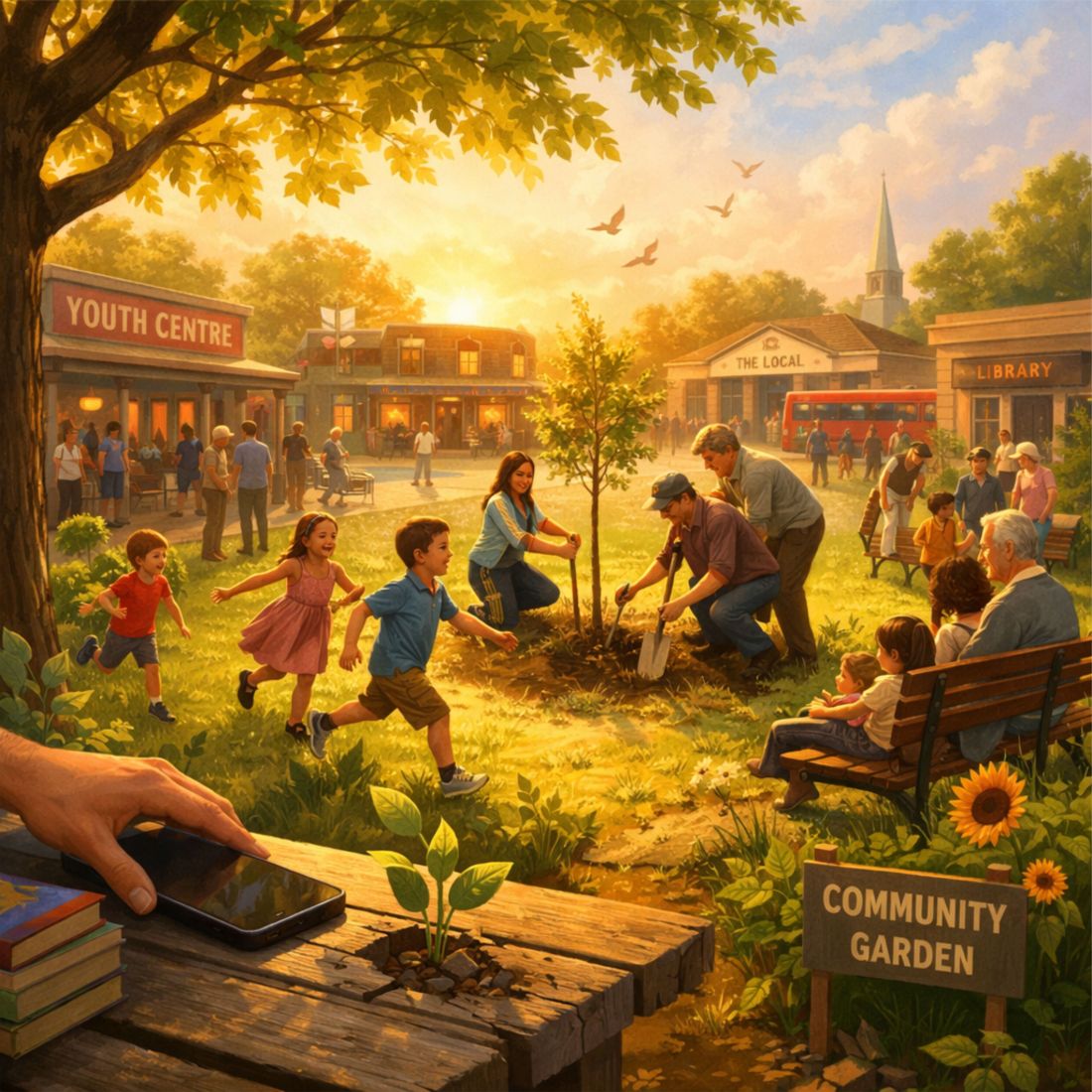
It’s easy to point to a new playground, a refurbished park, or a well‑funded youth centre and say, “Look – things aren’t that bad.”
But this misses the point entirely.
The real story isn’t about whether a park exists.
It’s about whether children can use it freely, safely, and socially – and whether the wider conditions of life make that possible.
Across the UK, the underlying ecosystem that once supported childhood has been eroded, even in places where the physical amenities remain.
The decline is structural, not cosmetic.
The evidence is stark. Local authority spending on youth services in England has fallen by around three‑quarters in real terms since 2010, with reports showing cuts of more than £1 billion and hundreds of youth centres lost or hollowed out.
Wales has seen substantial reductions too. These are not marginal changes. They represent the removal of an entire layer of social support that once gave young people somewhere to go, something to do, and adults who were not parents or teachers but still mattered.
But the deeper loss is not the buildings. It’s the conditions that made them matter.
Parents work longer hours and carry more pressure.
Neighbourhood trust has weakened.
Fear dominates public life.
Children’s independent mobility has collapsed over generations.
Public transport is patchy, expensive, or simply not good enough.
Activities that were once free now often carry a cost.
Spaces that once belonged to everyone are increasingly commercialised, regulated, or designed around cars rather than children.
A park is only a park if children can get to it, feel safe in it, and have others to play with when they arrive. A youth centre is only a youth centre if it has people in it. A community is only a community if people trust each other enough to participate.
Even where facilities exist, the conditions that make them meaningful have been stripped away.
And when the offline world becomes harder to access, more expensive to participate in, and more frightening to navigate, children retreat to the only environment that is always available, always open, and always populated: the digital one.
Smartphones didn’t replace childhood. They replaced the conditions that once made childhood possible.
That does not mean technology is harmless. It means technology has become powerful partly because the offline alternatives have been weakened.
The phone did not arrive in a vacuum. It arrived in a society that had already made childhood smaller.
2. Fear hasn’t risen because danger has – fear has risen because community has collapsed
We live in a society where many people genuinely believe danger lurks behind every parked car, every stranger, every unstructured moment.
Some dangers are real. Knife crime, exploitation, online abuse, road danger, and serious violence cannot be dismissed. But the wider picture is more complicated than the emotional climate suggests.
Long‑term crime data in England and Wales shows many traditional forms of crime have fallen over time, even as public anxiety and the visibility of disorder have intensified.
What has risen is the volume of fear‑based messaging.
Fear keeps people watching.
Fear keeps people clicking.
Fear keeps people compliant.
But fear also does something else:
It destroys the social fabric that once kept people safe.
When people fear each other, they withdraw.
When they withdraw, community weakens.
When community weakens, crime finds space to grow.
Crime does not thrive in strong, connected, people‑centred environments. It thrives in the gaps left behind when those environments disappear.
This is the part of the story almost no one tells:
The crime we fear today is often intertwined with the same systemic breakdown that fear itself accelerates.
When youth services vanish, young people lose structure.
When public spaces decline, informal supervision disappears.
When families are stretched thin, support networks collapse.
When communities fragment, accountability evaporates.
When everything becomes transactional, belonging dissolves.
Crime is not simply a moral failing. It is often a social signal – a warning light from a system that no longer supports the people within it.
Fear didn’t rise because danger rose.
Fear rose because community fell.
3. The pub crisis: one case study in how systems fail people – and then blame them
If you want to understand why children spend so much time online, look at what has happened to the places where adults once gathered.
Pubs were once one of the beating hearts of local life – intergenerational, affordable, communal, and human. They were not perfect, and they were never the only form of community infrastructure. Libraries, youth clubs, churches, sports clubs, community centres, parks, working men’s clubs, cafés, and local shops have all played similar roles. But the pub remains a vivid example because it shows what is lost when informal social life is treated as disposable.
But over time, the pub stopped being a community institution and became a financial asset. Corporate ownership, property speculation, debt‑driven business models, and homogenisation hollowed out the soul of the industry.
Many pubs didn’t close because people stopped wanting them; they closed because the system stopped valuing what they were for.
And when pubs disappear, something else disappears with them:
The informal social supervision that keeps communities safe.
The landlord who knew everyone.
The regulars who kept an eye on the street.
The intergenerational mix that built trust.
The shared space where problems were noticed early.
The sense of belonging that kept people anchored.
When these things vanish, crime does not simply “rise” in a neat straight line. Communities are more complicated than that. But risk changes. Isolation deepens. Problems go unnoticed for longer. The informal checks and relationships that once helped people feel seen, known, and accountable start to disappear.
The collapse of the pub is not just an economic story. It is a story about the disappearance of the social immune system.
The same is true for the spaces children use. Close a youth club, price out a sports activity, make buses unreliable, let parks feel unsafe, and then children do not simply stop needing connection. They look for it somewhere else.
4. The political appeal of banning the symptom, not the cause
A social media ban for under‑16s is politically irresistible because it is:
simple
visible
cheap
emotionally charged
It allows politicians to say, “We are protecting children,” without having to confront the harder truth:
We dismantled the social fabric that once supported them.
A ban avoids the real questions:
Why do children have so few offline opportunities?
Why are parents so stretched and unsupported?
Why is community life collapsing?
Why is everything that used to be free now commercialised?
Why is fear the dominant emotion in public life?
These are systemic failures. And systemic failures require systemic solutions.
A ban may reduce some exposure to harm. It may give some parents cover. It may even be part of a wider package if implemented carefully.
But on its own, it is not a solution.
It is a distraction if it allows us to avoid the harder work.
That does not mean we should do nothing online. Quite the opposite. Harmful design, weak age assurance, algorithmic amplification, cyberbullying, predatory behaviour, and exposure to dangerous content all require serious regulation.
Platforms must be made safer. The Online Safety Act must be enforced. Children need digital literacy, parents need support, and companies must not be allowed to profit from avoidable harm.
But a blanket ban risks becoming a political shortcut: a visible act of concern that leaves the underlying conditions untouched.
Worse, if handled badly, it may push some children into less visible and less regulated spaces while doing nothing to rebuild the real‑world places they actually need.
5. The deeper truth: fear is what failing systems use when they cannot offer renewal
When a system is struggling to explain its own failures, it reaches for fear.
Fear divides.
Fear isolates.
Fear distracts.
Fear keeps people looking in the wrong direction.
And right now, fear is being used to:
pit parents against technology
pit generations against each other
pit communities against imagined threats
pit society against its own children
The more the system fails, the more it needs fear to justify itself.
6. The real crisis is not only digital – it is social, economic, and moral
If we banned every smartphone tomorrow, would children’s lives improve?
Only if we rebuilt the conditions that make childhood possible:
properly funded youth services, open often enough to matter
safe, welcoming public spaces that are not designed only for consumption
local transport that lets young people move independently
affordable sport, arts, music, and social activities
libraries, clubs, community centres, and informal “third places” where people can gather
support for parents who are stretched by work, housing, childcare, and cost‑of‑living pressure
trusted adults beyond the family home and school gate
digital literacy taught as a life skill, not a panic response
platform accountability, not just parental blame
trust, opportunity, belonging, and hope
Without that, removing smartphones would simply expose how little we’ve given children to replace them.
The crisis is not technological.
The crisis is environmental.
The crisis is structural.
The crisis is systemic.
And the crime we fear is not a separate problem. It is a symptom of the same collapse.
Treating social media as the sole cause allows us to avoid asking why so many children are lonely, anxious, bored, supervised but unsupported, connected but not held, visible online but invisible in their own neighbourhoods.
7. Where real hope lives
Hope does not live in bans, restrictions, or fear‑driven policies.
Hope lives in rebuilding communities.
Hope lives in restoring public spaces.
Hope lives in supporting families.
Hope lives in creating opportunities.
Hope lives in teaching digital literacy.
Hope lives in regulating platforms properly.
Hope lives in making offline life rich enough that the online world is no longer the only place children reliably find connection.
Hope lives in reconnecting society with itself.
Hope lives in the recognition that children are not the problem.
Hope lives in the courage to admit that the system is.
Hope lives in the willingness to build something better – not just remove something convenient to blame.
That means moving beyond symbolic politics and asking harder questions: What would it take for a thirteen‑year‑old to walk safely to a park, meet friends there, stay for a few hours, and come home without fear? What would it take for parents to trust their community again? What would it take for young people to be known by adults who are not paid to manage, test, punish, or sell to them?
8. The choice ahead
We can continue down the path of fear, division, and superficial fixes. We can keep treating children as problems to be managed, parents as failures to be blamed, and technology as a monster that appeared from nowhere.
Or we can confront the truth: children have not abandoned the real world. Too often, the real world has withdrawn from them.
Children do not need bans as a substitute for society.
They need protection online, yes – but they also need freedom, belonging, trusted adults, safe places, real opportunities, and a world worth growing up in.
If we want children to spend less of their lives on screens, we must give them more life beyond them.
Britain has reached the limits of its economic model. What looks, on the surface, like a dispute about welfare and defence spending is really something larger: a state trying to keep a fragile system operating without admitting that the system itself is failing.
There comes a point in every failing system when the people running it stop sounding confident and start sounding cornered. Britain is now in that moment.
The political class will not say this outright. It rarely does. But its actions give the game away: the sudden panic over defence spending, the renewed hostility towards benefit claimants, the insistence that “tough choices” must be made, and the growing desperation to find money anywhere except from those who have accumulated the most of it.
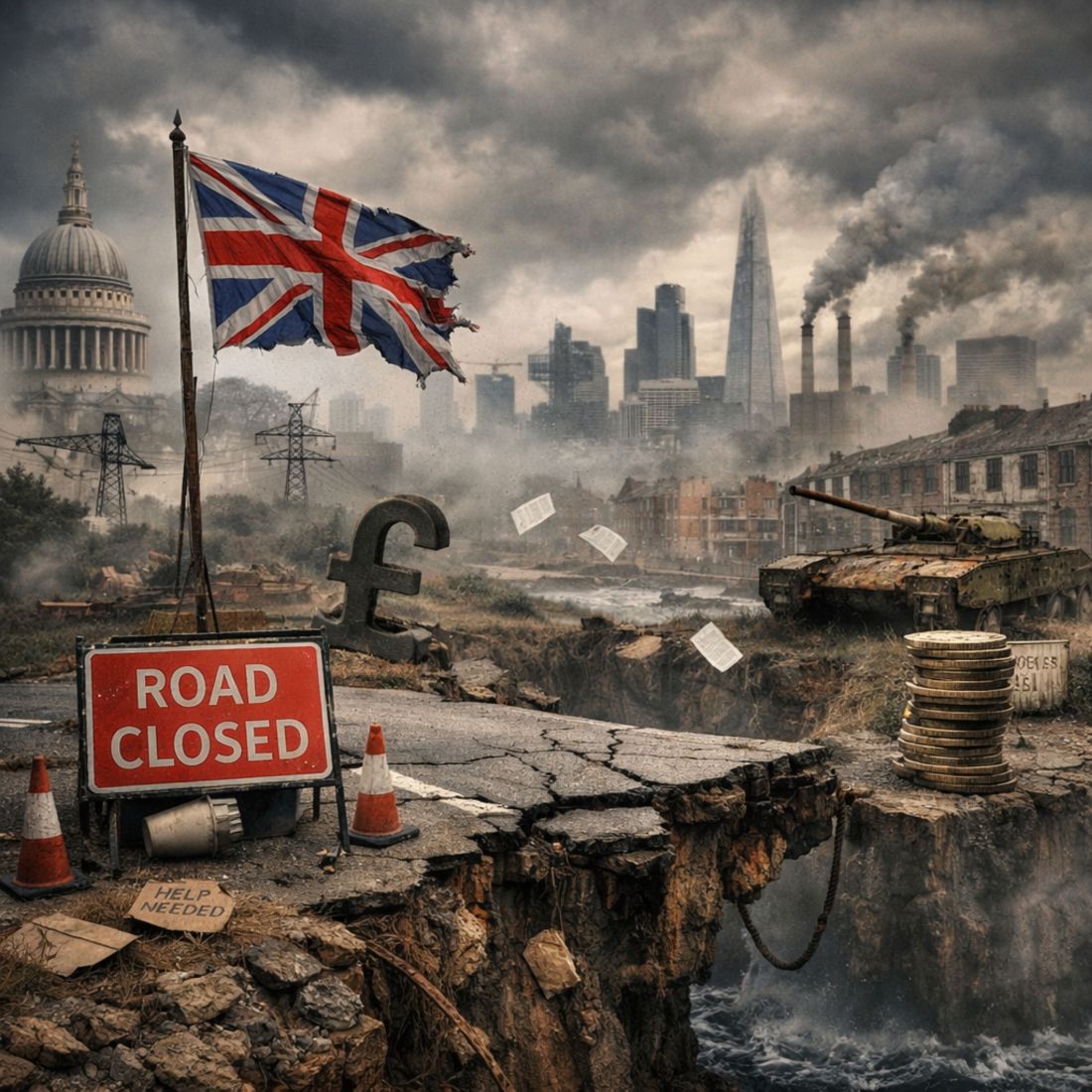
These are not the signs of a confident country making strategic decisions. They are the signs of a system that has run out of road.
The debate about cutting benefits is therefore not really a debate about welfare. It is a debate about whether government can keep the current economic model functioning without confronting the uncomfortable truth that it no longer works.
1. The illusion of choice: why wages alone cannot fix the crisis
Politicians love to talk about raising wages. They talk about “making work pay”, “rewarding effort” and “restoring dignity to labour”. There is truth in that language: wages are too low for millions of people. But there is also a deeper problem.
The current economic structure makes sustained, genuinely liveable wage growth extremely difficult without major consequences elsewhere.
This is not simply a matter of political will. It is structural.
Britain has allowed too many essential sectors to operate on the assumption that wages can remain low while the state, households and debt absorb the difference.
If wages rose rapidly across low-paid sectors without wider reform, the pressure would move through the economy quickly:
small businesses would be forced to raise prices or close
big businesses would automate, offshore, or cut staff
supply chains would pass every cost increase to consumers
inflation would spike
the Bank of England would respond by suppressing demand
and the government would end up increasing benefits anyway
The system is designed so that wages stay low, costs stay high, and the gap between them is filled by:
benefits
debt
charity
and the quiet desperation of millions of households
This is why the phrase “people should just earn more” is inadequate.
In sectors such as social care, retail, hospitality and logistics, the problem is not merely individual pay. It is a business model in which low wages, high housing costs and public support have become intertwined.
The system does not merely tolerate low pay. In too many places, it relies on it.
2. Benefits are not generosity – they are the subsidy keeping the economy upright
Public debate often treats benefit claimants as if they are separate from the economy: outside it, dependent on it, or somehow choosing not to participate in it.
That framing is misleading.
Universal Credit and related support are not just moral or social policies. They are economic infrastructure.
Official statistics show millions of people and households rely on Universal Credit, including many households with children and many people whose incomes are shaped by work, care, illness or housing costs.
In practice, benefits help support:
landlords charging rents that wages cannot cover
supermarkets pricing food at levels households cannot afford
energy companies extracting profits from a captive market
employers who rely on the state to top up wages
local economies that would collapse without benefit‑driven spending
the tax base that depends on people staying afloat
Remove or sharply reduce that support, and the effect does not stop with claimants. It moves through landlords, shops, employers, councils, schools, the NHS and local economies.
Benefits are the pressure valve that stops the system exploding. Cut that valve, and the pressure does not disappear – it erupts somewhere else.
3. Defence spending exposes the borrowing wall
For decades, Britain has dealt with structural weakness by borrowing, deferring and patching.
Borrowing has helped fund services, subsidise low wages, smooth over weak growth and avoid a more honest reckoning with the economic model underneath.
But every fiscal strategy has limits. Rising defence commitments have made those limits more visible.
The panic over defence spending is not about global threats alone. It is also about a government discovering that higher spending promises must be made inside a tighter fiscal box, with bond markets, debt costs and fiscal rules narrowing the room for manoeuvre.
This creates a brutal political reality:
the government can only justify spending on things that multiply through the economy
defence does not multiply
defence is a fiscal dead end
Housing, infrastructure, skills and local investment can generate wider economic returns when they are well designed.
Defence can support jobs and industry, but much of its value is strategic rather than directly regenerative for household incomes or local demand.
That distinction matters. If a government funds defence by cutting the income floor beneath millions of households, it may strengthen one form of security while weakening another.
So when politicians say benefits must be cut to fund defence, what they are really saying is:
The system has run out of room, and the only place left to squeeze is the people already at breaking point.
This is not a strategy for national renewal. It is a symptom of fiscal desperation.
4. Cutting benefits to fund defence may create the instability defence is meant to prevent
Supporters of benefit cuts often argue that the welfare bill is too high, that work incentives matter, and that government must prioritise national security.
Those arguments deserve to be heard. No state can spend without limits, and defence is not optional in a dangerous world.
But the problem is what happens when cuts are made inside a society already carrying high rents, insecure work, stretched public services and fragile household finances.
In that context, benefit cuts do not simply reduce expenditure. They transfer pressure into other parts of the state.
The likely consequences include:
rising homelessness
rising crime
rising illness
collapsing local economies
labour shortages in essential sectors
overwhelmed councils
overwhelmed NHS services
social unrest
a shrinking workforce
a destabilised society
In time, government would be forced to spend money managing the domestic crisis it had helped create – through emergency housing, policing, healthcare, local authority support and crisis intervention.
This is the irony at the heart of the current debate:
Cutting benefits to fund defence risks forcing the state to spend defence money managing the fallout of cutting benefits.
It is the fiscal equivalent of setting your own house on fire to save on heating.
5. The real divide: those still keeping up and those already falling behind
One of the most dangerous illusions in Britain today is the belief that the crisis only affects “other people”.
Those who are just about keeping up – homeowners, stable earners, people with savings or secure jobs – can be tempted to look away from those who have already fallen behind.
Not necessarily because they are cruel, but because acknowledging the truth means acknowledging their own vulnerability.
So they cling to comforting narratives:
“People just need to work harder.”
“Benefits are too generous.”
“The system is fine – it’s the people who are broken.”
But when the world feels unstable and war looms, defence suddenly becomes real. The government’s inability to fund its own priorities becomes visible. The fragility of the system can no longer be ignored.
The uncomfortable truth is that the defence crisis and the benefits crisis are connected.
Both expose the same weakness:
A system that extracts more than it creates eventually has nothing left to extract.
6. What happens if nothing changes
If politicians cut benefits without rebuilding the system beneath them, Britain risks deepening the problems it claims to be solving:
a shrinking workforce
a collapse in essential services
a surge in debt defaults
a rise in civil disorder
a widening regional divide
a breakdown in social cohesion
a government forced to spend more on crisis management than it ever saved
This is not inevitable, but it is foreseeable. A country cannot endlessly squeeze household incomes, underfund essential services, demand higher defence spending and still expect social cohesion to hold.
The question is not whether Britain can make “tough choices”. It is whether it is willing to make honest ones.
7. The truth at the heart of the crisis
Britain cannot fix this crisis by treating symptoms as causes.
It will not be solved by:
cutting benefits
raising wages
tweaking taxes
increasing defence spending
punishing claimants
lecturing the poor
Each of these may be part of a political argument, but none of them reaches the core problem.
The core problem is a model that has depended for too long on low pay, high private costs, public subsidy, household debt and political denial.
Until that changes, everything else is noise.
Conclusion: Britain needs a system that works
Britain is not simply in a benefits crisis. It is in a system crisis.
Benefits are not the cause of that crisis. They are one of the mechanisms preventing it from becoming more visible in the streets, in hospitals, in councils, in schools, in courts and in every community already stretched close to breaking point.
If Britain wants a future that works, it needs more than spending cuts, slogans and scapegoats.
It needs an economic settlement in which work pays enough to live on, housing costs do not swallow household incomes, public services are treated as national infrastructure, and security means more than weapons alone.
The question is no longer whether the existing system can be preserved. It is what replaces it – and whether Britain is honest enough to begin that conversation before the road runs out completely.
Why cancelling the debt that sustains the current system is not reckless, but the first responsible step toward a people-centred future
For most people, the financial world feels like weather: something that simply exists, something to be endured, something beyond human control. Debt is treated as personal obligation. Interest is framed as fair exchange. Governments are told to live within their means. Markets are assumed to be neutral. The rules of the money system are presented as natural laws, rather than human choices.
These beliefs are sincere. They are also wrong.
The money system operating today is not natural, not neutral, and not moral. It is a constructed order built on rules that most people never agreed to, do not understand, and would not consciously choose – yet they live inside its consequences every day.
A debt jubilee – the cancellation of unpayable and system-generated debt – is often dismissed as radical, reckless, or utopian. But that misunderstands what a jubilee is. A jubilee is not a reward for irresponsibility. It is not a reset that allows the same system to begin again. It is a transition point: the moment at which a society recognises that obligations created by an unjust system cannot remain morally binding, and that the system itself must be replaced.
By a debt jubilee, this argument does not mean an arbitrary or chaotic erasure of obligations. It refers to the structured cancellation of debts within a system that creates and depends upon them to function.
All modern debt is, in this sense, systemic. It exists because of the rules, mechanisms, and structures of the money system itself. The question is therefore not which debts are truly ‘systemic’, but whether obligations created within a system that produces harm can retain moral authority simply because they are recorded as binding.
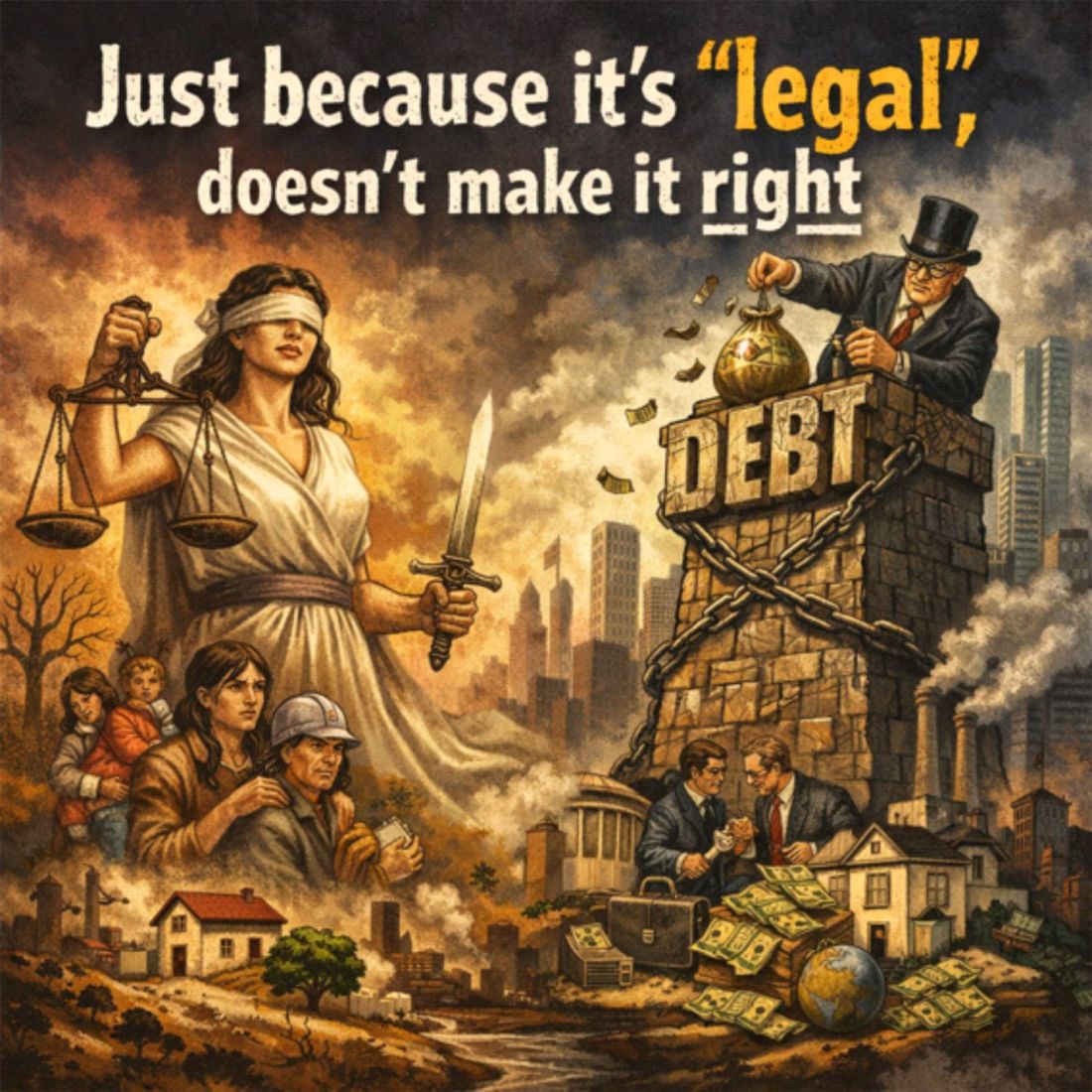
A jubilee recognises that when the system itself is unjust, the obligations it generates cannot be treated as fully legitimate in moral terms.
The moral case for a debt jubilee is therefore inseparable from the case for what must follow it: a people-centred alternative grounded in local economy and governance, a Basic Living Standard, contribution culture, and the wider process of Revaluation.
The system no one sees
Modern money is deliberately opaque. It is abstract, counterintuitive, and normalised through repetition.
People are taught to believe that money is scarce, that debt is real in the same way gravity is real, that interest is natural, and that governments must borrow from private markets to fund public life.
These are not laws of nature. They are institutional stories, repeated until they feel unavoidable.
This does not mean the system is imaginary. It means its authority depends on belief.
Money, markets, debt, interest, and growth have power because they are collectively accepted, institutionally enforced, and treated as reality.
The system works on belief. But belief does not make it morally right.
Whilst many still believe that the problems we are experiencing today are temporary and may only need a change of government to fix them, the reality is somewhat different.
The world is already moving from a money-centred, centralised, growth-obsessed model toward a people-centred, localised and humane system.
For us all, the real shift begins by recognising that the old rules are not permanent truths. They are choices – and different choices are now necessary.
Debt is not a personal failing – it is the foundation of the system
In a healthy society, debt would be a temporary bridge between need and opportunity. In the modern system, debt is something else entirely. It is the foundation on which the entire economy rests.
Banks create money through lending. Every pound created in this way enters the economy as someone’s debt.
Because interest is charged on that debt, the system requires more money to be created to service the obligations already imposed.
More lending creates more debt. More debt requires more interest. More interest demands more growth. More growth drives more extraction. More extraction concentrates more wealth.
Concentrated wealth then shapes the rules that justify the system.
This is not a conspiracy. It is a feedback loop.
The moral problem is that people are then blamed for debts they never had the structural power to avoid. Households are blamed for insecurity created by low wages and high costs. Governments are blamed for borrowing within a system that requires borrowing. Communities are hollowed out to satisfy growth metrics. The environment is degraded to service financial obligations. Wealth flows upwards through mechanisms most people cannot see.
A system built on debt cannot credibly treat debt as a purely personal failure. When debt becomes structural, the moral question changes. The issue is no longer simply whether individuals should honour obligations. The issue is whether obligations manufactured by a structurally unjust system can be morally legitimate at all.
Illusions cannot create legitimate obligations
This is the heart of the moral case.
Debt is not a natural law.
Interest is not a moral principle.
GDP is not a measure of progress.
Financial markets are not democratic.
The value of money is not intrinsic.
These are human inventions. They may be powerful. They may be enforced. They may organise everyday life. But they are still inventions.
Because they were made, they can be unmade, remade, or replaced.
The illusion is not that money has no practical effect. It clearly does. The illusion is that money has inherent moral authority. The illusion is that financial obligations created inside a coercive and extractive system must be honoured simply because the system records them as debt.
But a record is not a moral truth. A contract created inside a harmful framework cannot be separated from the framework that produced it.
Institutional blindness protects the system
One of the greatest barriers to change is not opposition in the conventional sense. It is insulation.
Those who benefit most from the current system are often furthest removed from its human consequences. Academics, economists, politicians, financiers, senior officials, and institutional leaders may be highly intelligent, highly trained, and sincere in their intentions. But their training, status, security, and authority are often tied to the assumptions of the system itself.
Professional expertise develops within a frame. Advancement often requires fluency in that frame. Success rewards those who understand and defend its logic.
Over time, those most trusted to explain the system may become least able to see beyond it.
This creates institutional blindness: not ignorance, but a conditioned inability to recognise alternatives that fall outside the system’s own definitions of realism, responsibility and propriety.
A people-centred alternative can therefore be dismissed as unrealistic. Not because it is impossible, but because it does not fit the money-centred logic through which reality has been interpreted.
A jubilee is justified because the system itself is unjust
A debt jubilee is not an attack on ordinary responsibility.
It is a refusal to mistake system-generated obligation for moral obligation.
If the system that creates debt is itself structurally unjust, then addressing debt without addressing the system merely continues the same harm. A jubilee is therefore not the whole answer. It is the necessary break that makes the answer possible.
A jubilee without transformation would fail, because the system would simply recreate the same debt under new names.
Transformation without a jubilee would also fail, because people, communities, and governments cannot build a humane future while trapped beneath obligations created by the old system.
A jubilee is justified because the system itself is unjust. It is the clearing of the ground. It is the ending of a dehumanised order so that a human centric one can begin.
Most of the harm was unintentional – but it must still end
The argument for a debt jubilee is not a claim that every banker, politician, economist, or investor acted with malice. Most people inside the system believe they are doing the right thing. They believe the rules are natural, the outcomes unfortunate but necessary, and the harm a cost of stability.
But harm that is unintentional is still harm. A system does not become moral because its operators are sincere. A harmful structure does not become legitimate because those who benefit from it cannot see the damage it causes.
Once the harm is visible, inaction becomes a choice.
When a society understands that the system itself is creating dehumanised outcomes, the moral responsibility is not to preserve that system, but to end the conditions that allow the harm to continue.
A jubilee is therefore not punishment. It is release – not only for those trapped by debt, but for society itself.
It releases people from coercion. It releases communities from extraction. It releases government from the logic of perpetual borrowing. And it releases the future from the moral claims of a system that has already failed.
What replaces debt must be people-centred
A humane system cannot grow in soil poisoned by debt. Local agency, community resilience, contribution-based value, and a Basic Living Standard cannot flourish while people, communities, and governments remain structurally coerced by financial obligations created under the old order.
The purpose of a jubilee is not absence, but replacement. A system based on debt must give way to one based on human need, local responsibility, and meaningful contribution.
This is where the Local Economy & Governance System, the Basic Living Standard, contribution culture, and The Revaluation belong within the argument.
The Local Economy and Governance System offers a framework in which economic life is rooted in community rather than extraction. The Basic Living Standard establishes the security required for people to participate without fear. Contribution culture redefines work as meaningful participation in the wellbeing of the community, rather than a transaction for survival. The Revaluation names the wider shift from measuring life in financial terms to understanding value in human, social, and environmental terms.
A debt jubilee creates the conditions for that transition.
It is not the destination. It is the door.
Without a clear alternative, a jubilee can be misrepresented as destruction. With one, it becomes transition.
The real crime would be to understand the system is broken – and do nothing
The old system is failing. People are suffering. Communities are weakening. Public trust is collapsing. The environment is being exhausted.
Much of the harm may have been unintentional, but once the truth is visible, continuing to enforce the system becomes a moral choice.
A debt jubilee is not an attack on the past. It is a commitment to the future. It is the point at which society chooses people over mechanisms, dignity over financial abstraction, and life over the logic of debt.
It is not reckless to end obligations that should never have existed in the form they now take. It is reckless to keep enforcing them when their consequences are known.
A jubilee is not the erasure of responsibility.
It is the restoration of responsibility to its proper place.
It is the moment a society decides that human beings matter more than the mechanisms that once controlled them.
Further reading
The argument above is part of a broader body of work on the transition from a money-centred system to a people-centred one. These related texts set out the practical, cultural, and structural foundations of that transition:
The Basic Living Standard – Explained A concise introduction to the principle that every person should have secure access to the essentials of life, creating the foundation for genuine participation, dignity, and freedom from coercive economic pressure. https://adamtugwell.blog/2025/10/24/the-basic-living-standard-explained/
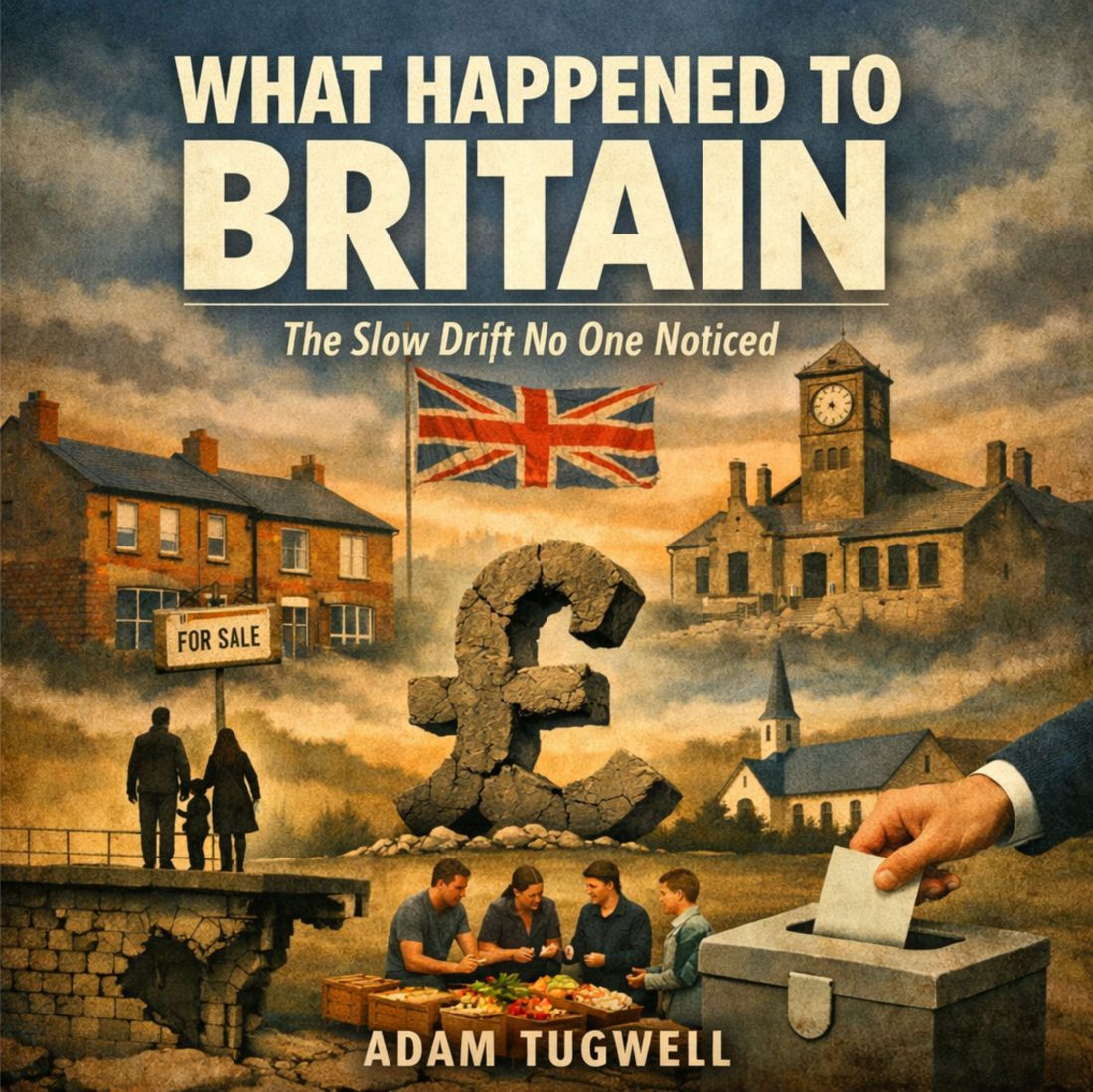
This isn’t a book. It’s an essay – written because the drift has gone on long enough.
Britain’s slow unravelling didn’t arrive with a crash or a crisis. It arrived quietly, through ordinary decisions that hollowed out the structures people once relied on.
This piece was written to make that quiet visible again – to connect the exhaustion people feel to the system that produced it.
It’s offered here not as a manifesto, but as a moment of clarity.
The Slow Unravelling
Britain didn’t fall apart. It wasn’t blown over by a single storm or undone by one bad decision. It drifted: quietly, slowly, almost politely. The way a house becomes damp before anyone notices the roof has slipped. The way a town centre empties out one shop at a time. The way a generation lowers its expectations without ever quite admitting that it has.
People talk about Britain’s problems as if they’re separate. Young people can’t afford to move out. Work doesn’t lead anywhere. Communities feel hollow. Politics feels like theatre. Everyone is exhausted. Everyone is anxious. Everyone is coping, but only just.
These aren’t separate stories. They belong to the same shift: the slow reordering of Britain around the demands of finance rather than the needs of ordinary life.
If you want to understand why Britain feels thinner, meaner, and harder to live in, you have to start with the moment money became detached from anything solid enough to impose limits – not because inequality or instability began there, but because the system entered a different phase once they did.
Britain had long carried deep inequalities, uneven protections, and older forms of social hierarchy; the struggle over wealth and security did not begin in the late twentieth century. But after Bretton Woods and then, more decisively, after 1971, money became easier to create, expand, and direct toward returns rather than needs. From there, the centre of gravity shifted further away from people, places, and communities and towards markets, debt, and institutions most people could neither see nor influence.
Local businesses were swallowed by chains. Local banks disappeared. Local employers collapsed or were bought out. Local infrastructure was sold off. Local government was hollowed out. The things that made life feel stable – the things that made adulthood possible – were treated as inefficiencies to be removed.
And because the change was slow, people blamed themselves. They thought they were failing. They thought they weren’t trying hard enough. They thought the problem was personal.
It wasn’t personal. It was structural. It was systemic. And while not every outcome was consciously designed in advance, the direction of travel was repeatedly reinforced through policy, institutions, and incentives that rewarded extraction over stability.
The truth is simple:
Britain didn’t drift because people changed. Britain drifted because the system changed – and people were left to deal with the consequences alone.
How Money Quietly Rewrote Britain
This matters because once money could be detached from tangible limits, the economy could be reorganised around extraction, leverage, and growth on paper rather than stability in people’s lives. The monetary shift did not create every injustice that followed, but it changed the scale, speed, and governing logic of the system those injustices were now moving through.
That shift sounds abstract until you follow it into everyday life. Homes became more fully investment vehicles. Jobs were treated more aggressively as costs to be minimised. Public assets became opportunities for private gain. Governments became managers of market confidence. Policy choices, technological change, global competition, and deindustrialisation all shaped the path – but they increasingly operated inside the same dominant value system, with money at its heart.
Because the change arrived gradually, it was experienced as a series of personal setbacks rather than as a systemic rewrite: a job lost, a bus route cut, a youth centre shut, a high street hollowed out, a generation priced out of adulthood.
The drift wasn’t cultural. It wasn’t moral. It wasn’t generational.
The economy no longer needed people in the way it once had. It needed consumers more than citizens, flexibility more than stability, and efficiency more than community. So the everyday supports that made life feel grounded were treated as expendable.
The result was not immediate collapse but a thinning of the real world: fewer local institutions, weaker civic capacity, and less of the practical structure people rely on to build a life.
And because this happened slowly, people often blamed themselves. They thought they weren’t working hard enough, smart enough, or resilient enough. They thought the problem was them.
It wasn’t them. It was the system – a system that had quietly rewritten the rules of life.
What Drift Looks Like from the Ground
If you want to see drift, you don’t look at Westminster. You don’t look at the Bank of England. You don’t look at the FTSE. You look at a town centre on a Tuesday afternoon. You look at the boarded‑up shop that used to be a butcher. You look at the pub that closed because the brewery sold the building to a developer. You look at the bus stop where the timetable has been replaced by a laminated notice saying the service has been withdrawn.
You look at the young couple pushing a pram back into the house they still share with their parents because they can’t afford a place of their own. You look at the man in his fifties who used to run a small business but now works for a delivery app, waiting for his phone to buzz. You look at the teenager who spends most of his life online because there’s nowhere else to go and nothing else to do.
This is what drift looks like. Not dramatic. Not cinematic. Not a collapse, exactly, but a thinning.
A slow, steady removal of the things that used to hold life together.
People talk about community as if it’s a feeling. It isn’t. It’s infrastructure: the neighbour who keeps an eye out, the local employer who gives someone a first chance, the youth club, the bus route, the high street where people recognise one another.
When those things disappear, life doesn’t stop. It just becomes harder: more brittle, more solitary, more expensive, more exhausting. And because the losses happen one at a time, people don’t always connect them. They don’t see the pattern. They think it’s just their town, their family, their luck.
It shows up in the way young people plan their lives – or don’t. The way they delay everything: moving out, settling down, having children, taking risks. Not because they’re lazy or fragile, but because the ground beneath them doesn’t feel solid enough to stand on.
It shows up in the way older people compare the present to the past and assume the difference is moral rather than structural. They remember a world where effort led somewhere, where work paid enough to live on, where housing was within reach, where community was thick enough to catch you if you slipped. They think the young don’t have those things because they don’t want them.
But the truth is simpler:
The pathways that existed for one generation simply don’t exist for the next.
What changed was not human nature but the environment around it: the ordinary systems that once made adulthood legible were quietly dismantled and replaced with something far less supportive.
How the System Replaced the Real World
One of the strangest things about Britain’s drift is how normal it all looked while it was happening. Nothing arrived with flashing lights. There was no announcement saying, “We’re replacing your world with a cheaper, thinner version.” It happened through a thousand small decisions made far away from the people who would live with the consequences.
A council sells a building because it needs the cash. A private equity firm buys it because it wants the asset. A supermarket chain opens on the bypass and the butcher closes. A bus company cuts an unprofitable route and a teenager loses the only way to get to college. A landlord sells to a developer and a family is priced out of the town they grew up in. A local employer is bought by a multinational and the jobs are moved somewhere cheaper.
None of these things looks like a national crisis on its own. Together, they show how the everyday world was gradually thinned out.
The system didn’t set out to destroy community. It simply didn’t care whether community survived. It cared about efficiency, not belonging. It cared about growth, not stability. It cared about shareholder value, not whether a town still had a heartbeat.
Because decision-makers were rewarded for financial outcomes rather than local consequences, the logic was always the same: centralise, consolidate, commercialise, outsource, privatise, strip out the slack, and call the result efficiency.
The result was a country that still functioned on paper but felt increasingly hollow in practice.
You can see it in public services that are measured relentlessly yet feel unreliable, in jobs that exist without opening a path forward, in housing that exists without serving the people who need it, and in politics that generates noise without direction.
The system became very good at producing activity and very bad at producing stability.
And because the system was built around money – not people, not places, not relationships – it kept rewarding the wrong things. It rewarded the supermarket chain that replaced five local shops. It rewarded the developer who turned a community asset into luxury flats. It rewarded the employer who cut staff and called it efficiency. It rewarded the council that sold off land to plug a budget hole created by the same system that told it to be efficient in the first place.
And the strangest part is that most people didn’t realise what was happening until they were already living inside the consequences. They just knew life felt harder. They knew everything cost more. They knew the future felt foggier. They knew they were carrying more on their own shoulders than their parents ever had to.
Why Young People Feel the Collapse First
If you want to understand the real cost of drift, you don’t start with the people who lived most of their lives before it happened. You start with the people who walked straight into it. The ones who never saw the old scaffolding because it was already gone by the time they arrived.
Young people aren’t fragile. They aren’t entitled. They aren’t confused about life. They’re simply trying to build adulthood on ground that no longer holds weight.
Ask anyone under forty what adulthood is supposed to look like and you’ll get a strange mixture of certainty and disbelief. They know the script – move out, get a job, build a life – but they also know the script doesn’t match the stage they’re standing on. They’re being judged by rules that no longer apply, by people who grew up in a world that no longer exists.
Older generations talk about “getting on the ladder” as if it’s still there. But the ladder has been pulled up, repurposed, and sold to an investment fund. The rungs are now made of debt, inflated house prices, insecure work, and a cost of living that eats through wages before the month is half over. The idea that you can work your way into stability is treated as common sense, even though it hasn’t been true for decades.
Young people feel the collapse first because they enter a system that still speaks the old language of opportunity while offering much less security, direction, or access to the basics.
And because they’re the first to hit the wall, they’re the first to be blamed for it.
But fragility isn’t the problem. The problem is that the world they’re entering is thinner, harsher, and more precarious than the one their parents entered. The old pathways into adulthood have been replaced by a maze with no exit signs, and the system expects them to build a life on foundations that no longer exist.
When older people say, “We had it tough too,” they’re not wrong. But they’re comparing effort, not environment. They’re comparing their own struggle to a world that still had structure. They’re comparing their own hardship to a world where the basics were within reach. They’re comparing their own resilience to a world where resilience wasn’t the only thing holding everything together.
Young people aren’t failing. They’re navigating a world that has been hollowed out by decisions they didn’t make and forces they can’t see.
Because they have grown up entirely inside the drift, they often see most clearly that the promises no longer match the conditions and that the old story of adulthood has quietly expired.
The Collapse of the Old Pathways
For most of the post‑war period, Britain ran on a simple, unwritten promise: If you worked hard, you could build a life. Not an extravagant one. Not an effortless one. But a life with shape. A life with direction. A life where effort and outcome were connected by something more solid than luck.
That promise wasn’t perfect. It wasn’t equal. It wasn’t universal. Large parts of Britain were always excluded from its full protection, and older inequalities ran far deeper than the post-war settlement ever fully resolved. But it was legible. People could see the path ahead of them. They could see where they were going. They could see how to get there.
That path doesn’t exist anymore.
Education still talks as if it leads somewhere, but the ground has shifted beneath it. A degree used to be a bridge. Now it’s a toll gate. Students leave with debt, not direction. They’re told they’re entering a world of opportunity, but the opportunities are mostly unpaid internships, zero‑hour contracts, and jobs that require experience nobody can afford to get.
Work still talks as if it’s the foundation of adulthood, but it no longer behaves like it. Jobs exist, but they don’t offer the stability that adulthood requires. Wages don’t match the cost of living. Hours don’t match the cost of housing. Progression doesn’t match the cost of a future. Work has become something people do to stay afloat, not something they can build a life on.
Housing still talks as if it’s a market, but it’s really an auction. Homes aren’t priced according to what people earn. They’re priced according to what investors can extract. The idea that a young person could buy a home on an ordinary wage has become a punchline. Renting isn’t a stepping stone anymore. It’s a trap. A treadmill. A monthly reminder that the system wasn’t built for you.
And community – the quiet, everyday structure that once held everything together – has been treated as an optional extra. Something sentimental. Something nostalgic. Something that can be replaced by apps, or events, or “engagement strategies.” But community isn’t a hobby. It’s the environment in which people learn how to be adults. It’s where confidence comes from. It’s where belonging comes from. It’s where direction comes from.
When the old pathways collapse, people don’t stop trying. They stop trusting the map. They stop expecting life to make sense in the old way, because the connection between effort and outcome has become too weak and too contingent.
And because the collapse happened slowly, the country never had the conversation it needed to have. Instead, it kept pretending the old pathways were still there. It kept telling young people to follow a map that no longer matched the terrain. It kept insisting that the problem was effort, not environment.
But the truth is simple:
The old pathways didn’t fail because people stopped walking them. They failed because the ground beneath them was sold, privatised, financialised, and stripped for parts.
Why We Keep Misreading the Problem
One of the most damaging things about Britain’s drift is how easy it has been to misread. When a system weakens slowly, people don’t see the structure collapsing. They see individuals struggling. They see differences in who copes and who doesn’t. And because the system still looks functional from a distance, the temptation is to assume the problem must lie with the people who are falling behind.
This is how a structural failure becomes a moral story.
If one person manages to buy a house and another doesn’t, the assumption is that the first was disciplined and the second was careless. If one person finds stable work and another doesn’t, the assumption is that the first was determined and the second was unfocused. If one person seems to be coping and another seems overwhelmed, the assumption is that the first is resilient and the second is fragile.
But visible coping often depends on invisible support.
A parent who can help with a deposit.
A partner with a stable income.
A family home to fall back on.
A network that opens doors.
A community that still has some structure left.
These things aren’t character traits. They’re conditions. They’re the quiet advantages that drift hasn’t stripped away from everyone equally.
And because the system still produces success stories – because some people still manage to climb the ladder – the country convinces itself the ladder still exists. It doesn’t see that the ladder has become a tightrope, and only those with a safety net can afford to walk it.
This is why public debate feels so confused. People argue about generations, values, work ethic, immigration, culture, technology, policy, and globalisation – all real influences in their own right – but too rarely about the underlying system that increasingly organised how those forces interacted. They look sideways for explanations because the deeper logic sits beneath the surface, built into the way money moves, value is measured, and decisions are made.
It is easier to talk about resilience, mindset, or culture than to admit that the conditions of ordinary life have been weakened and redistributed unequally.
And so the country keeps misreading the symptoms. It treats exhaustion as weakness. It treats anxiety as fragility. It treats delayed adulthood as immaturity. It treats loneliness as a lifestyle choice. It treats economic insecurity as personal failure.
Meanwhile, the deeper causes – the thinning of everyday institutions, the financialisation of essential goods, and the quiet centralisation of power and wealth – remain largely unspoken.
This misreading isn’t accidental. It’s built into the system. A system that extracts value from people needs those same people to believe the problem is them. It needs them to internalise the strain. It needs them to carry the burden privately. It needs them to keep coping, quietly, without asking why life has become so much harder than it used to be.
But the truth is simple:
People aren’t failing. The system is. And it has been failing for a long time.
The drift didn’t just weaken the structures that support life. It weakened the language people use to describe what’s happening to them. It left them with feelings they can’t explain and pressures they can’t name. It left them thinking they were alone in their struggle, when in reality they were living through the same quiet collapse as everyone else.
And until we stop misreading the problem, we won’t be able to fix it.
The Politics of Misrecognition
If you want to see how deeply the drift has distorted Britain, you only have to look at the way people talk about each other. The country has become obsessed with comparing groups – generations, regions, classes, cultures – as if the differences between them are moral rather than structural. As if the people who seem to be coping better must have better values, better habits, better discipline, better character.
It’s a comforting story. It lets people believe the system still works. It lets them believe that success is proof of virtue and struggle is proof of failure. It lets them avoid the harder truth: that the system is failing unevenly, and the unevenness is being mistaken for personal difference.
Take the way people talk about migrants. The common explanation is moral – that one group simply works harder or copes better. Sometimes the outcomes do differ, but often because some groups still possess stronger networks of support, interdependence, and shared expectations than the Britain around them now does.
People arriving from places where community still exists often cope better because they’re standing on something solid. They have family networks that haven’t been scattered by housing costs. They have cultural expectations that haven’t been eroded by individualisation. They have social structures that haven’t been replaced by apps, debt, and market logic. They have the very things Britain used to have – the things that made life navigable – before drift thinned them out.
But instead of recognising this, the country turns it into a moral comparison. It says, “Why can they cope and we can’t?” as if the answer is character rather than conditions. As if the collapse of local infrastructure, stable work, affordable housing, and community life has nothing to do with it.
The same thing happens between generations. Older people look at younger people and see fragility. Younger people look at older people and see luck. Both are misreading the situation. Older people grew up in a world where the scaffolding still existed. Younger people are growing up in a world where the scaffolding has been sold off. Neither group is wrong about their own experience. They’re just wrong about what it means.
And then there’s the political version of misrecognition – the one that plays out every election cycle. Politicians talk about “hard‑working families” as if work still leads to stability. They talk about “opportunity” as if the pathways still exist. They talk about “growth” as if GDP has anything to do with whether people can build a life. They talk about “reform” as if the problem is inefficiency rather than extraction.
It’s all misrecognition: a country mistaking symptoms for causes, a political class mistaking activity for progress, a public mistaking structural collapse for personal struggle.
And because the drift has been slow, the misrecognition has become normal. People don’t question it. They don’t ask why some groups seem to cope better than others. They don’t ask why the same pressures land differently depending on where you live, who you know, and what you inherited. They don’t ask why the system rewards some people and punishes others for reasons that have nothing to do with effort.
They just assume the differences must be cultural. Or generational. Or moral. Or personal.
But the truth is simpler:
People aren’t different – their environments are.
And until the country sees through the misrecognition, it will keep blaming the wrong people for the wrong things.
What Has Actually Broken
If you strip away the noise – the headlines, the culture wars, the political theatre – what’s broken in Britain is something much simpler and much more fundamental: The link between effort and stability.
The old deal was never perfect, but it was at least recognisable. You put in the work, you got something back. Not riches. Not luxury. But a life with shape. A life with direction. A life where the basics were within reach.
That deal has collapsed. And it didn’t collapse because people stopped working. It collapsed because the system stopped rewarding work in any meaningful way.
You can see it most clearly in housing. A home used to be something you lived in. Now it’s something you compete for. Something you bid on. Something you’re priced out of by people who will never set foot in it. Housing has become a financial product, and once that happened, the idea that ordinary people could build a life through work alone became a fantasy.
You can see it in work itself. Jobs still exist – more than ever, in fact – but they don’t lead anywhere. They don’t offer the stability that adulthood requires. They don’t pay enough to match the cost of living. They don’t come with the security that lets people plan more than a month ahead. Work has become a treadmill: constant motion, no forward movement.
You can see it in education. Young people are told to invest in themselves, to get qualifications, to build skills. But the return on that investment has evaporated. They leave with debt and enter a labour market that treats them as interchangeable. The promise of education hasn’t disappeared – it’s just become detached from reality.
You can see it in community life. The places where people used to gather – the pubs, the youth centres, the libraries, the clubs, the high streets – have been thinned out or priced out. Community hasn’t died because people stopped caring. It died because the system stopped valuing it. It died because the things that held it together were sold off, shut down, or replaced by cheaper, thinner alternatives.
And you can see it in politics. The country still talks as if it’s in control of its own direction, but the real decisions are made elsewhere – in markets, in boardrooms, in supranational institutions, in the quiet logic of a financial system that treats people as variables and communities as inefficiencies. Politics has become a performance staged in front of a system it no longer controls.
What has broken is not the character of the country but the structure that once connected effort to stability, contribution to security, and ordinary life to a believable future.
And because the collapse happened slowly, the country never had the moment of clarity that usually comes with crisis. There was no single event that forced a reckoning. No shock that made everyone stop and ask what had gone wrong. Instead, the country adapted. It normalised the abnormal. It lowered its expectations. It learned to live with the drift.
The Human Consequences
You can tell when a country is drifting long before the statistics catch up. It shows in the way people carry themselves. There’s a heaviness now, a kind of background fatigue that doesn’t come from a bad night’s sleep but from years of trying to hold together a life that no longer fits inside the old promises. People talk about being tired, but it’s not the kind of tiredness that goes away with a weekend off. It’s the tiredness of constantly adjusting to things that shouldn’t need adjusting to – the rent that jumps without warning, the job that changes its hours, the bills that creep up month after month.
There’s a tension underneath everything, a low‑level hum that people have learned to live with. You hear it when someone talks about their landlord putting the house on the market. You hear it when someone mentions their job “might be changing” and everyone knows what that really means. You hear it when people talk about the future as if it’s something happening somewhere else, to someone else. Not because they’ve given up, but because the future has stopped behaving like something you can plan for.
Relationships feel the strain too. Not because people care less, but because everyone is stretched so thin that the smallest disruption can knock everything sideways. Friendships that used to be effortless now require scheduling. Families that once lived within walking distance are scattered by housing costs. Couples delay everything – moving in, getting married, having children – not out of indecision, but because the ground beneath them doesn’t feel solid enough to build on.
And then there’s the way people talk about themselves. That’s where the drift shows up most clearly. You hear it in the quiet self‑blame that slips into conversations. The sense that if life isn’t working, it must be a personal failure. People apologise for not being “further along.” They apologise for struggling. They apologise for not being able to do what their parents did at the same age, as if the world hasn’t changed beyond recognition.
What they’re really apologising for is the collapse of a system they didn’t break.
The emotional landscape of the country has shifted. People are more anxious, but they don’t call it anxiety. They call it “being stressed.” They call it “being busy.” They call it “just how things are now.” They’ve normalised a level of uncertainty that would have been unthinkable a generation ago. They’ve learned to live with a constant sense of being one unexpected bill away from trouble.
And because everyone is dealing with their own version of the same pressures, nobody wants to burden anyone else. So people carry it quietly. They keep it to themselves. They tell each other they’re fine. They keep going because they have to, not because the system makes it easy.
This is what drift does at a human level. It turns security into something people must constantly negotiate, pushes major life decisions further out of reach, and makes the future feel less like a destination than a source of apprehension.
The human consequences aren’t dramatic. They’re cumulative. They build up in the background until people forget what life felt like before everything became this hard. And because the drift has been slow, people mistake these consequences for normality.
But they’re not normal.
They’re the emotional footprint of a country that has lost its foundations.
The Moment of Clarity
There comes a point in any long drift where people stop blaming themselves and start looking around. It doesn’t happen all at once. It happens in small moments – a conversation in a kitchen, a comment at work, a glance at a bill that’s jumped again for no reason anyone can explain. It happens when someone realises they’re doing everything right and still feel like they’re running uphill. It happens when people compare notes and discover their private struggles aren’t private at all.
Britain is reaching that point.
You can feel it in the way people talk now. There’s a new kind of honesty creeping in, the kind that comes when the old explanations stop making sense.
People are beginning to say out loud what they’ve been thinking for years: that life shouldn’t be this hard, that the basics shouldn’t feel like luxuries, that the future shouldn’t feel like a rumour.
It’s happening quietly, but it’s happening everywhere: in conversations between parents who admit they don’t know how their children will ever afford a home, in workplaces where people talk about “burnout” as if it’s a normal stage of adulthood, in towns where the high street has become a museum of what used to be possible, in families where three generations live under one roof because the system no longer supports independence.
People are beginning to understand that the drift wasn’t a natural decline. It wasn’t the result of laziness or fragility or cultural decay. It was the result of political, economic, social, and monetary choices that, over time, hollowed out the foundations of ordinary life and embedded a value system that placed financial logic above lived stability.
And once you see that, you can’t unsee it.
You start to notice how much of the country has been shaped by forces nobody voted for. You start to notice how many of the pressures people face are the direct result of a system that treats stability as inefficiency and community as an afterthought. You start to notice how often the people who talk about “growth” are the same people who never have to live with the consequences of it.
The moment of clarity arrives when private strain becomes recognisable as a shared condition and people begin to see that the problem is not individual inadequacy but a system organised against stability.
And once that clarity arrives, the question changes. It stops being “Why can’t people cope?” It becomes “Why was the system allowed to drift this far?”
The Alternative Path
Once a country reaches the point of clarity, the question becomes unavoidable: if this system no longer works, what comes next?
And the honest answer – the one nobody in Westminster ever seems willing to say – is that the alternative isn’t ideological. It isn’t left or right. It isn’t a new slogan or a new leader or a new five‑point plan.
It’s something much simpler and much more difficult.
It’s rebuilding the real world.
What needs rebuilding is not national spirit but the everyday world people depend on: the practical structures that make stability, agency, and belonging possible.
The alternative path isn’t about tearing everything down. It’s about putting back the things that should never have been removed. It’s about restoring the conditions that allow people to build a life without feeling like they’re balancing on a tightrope. It’s about creating a society where stability isn’t a luxury and adulthood isn’t a gamble.
And it starts with something very basic: giving people a floor to stand on.
Not a safety net that catches you after you fall – a floor that stops you falling in the first place. A baseline of security that isn’t conditional on luck, or inheritance, or whether your employer decides to cut your hours this month. A baseline that gives people the bandwidth to think, to plan, to contribute, to breathe.
Because without a floor, nothing else works. People can’t build families, communities, futures – they can’t build anything.
Once the floor is there, the next step is obvious: power has to move closer to the people who live with the consequences of decisions. Not because it’s fashionable to talk about “localism,” but because the drift happened through distance – decisions made far away, by people who never had to see what those decisions did to the places they affected.
Reversing drift means reversing that distance. It means letting towns shape their own futures, letting communities decide what they need, and letting people rebuild the structures that were stripped away.
And when people have a floor beneath them and power near them, something else becomes possible – something the current system has almost forgotten how to value: contribution. Not the kind measured in productivity charts or quarterly reports, but the kind that makes a place worth living in. The kind that builds trust, belonging, and meaning. The kind that turns a collection of individuals into a community.
This isn’t a utopian vision. It’s the opposite. It’s practical. It’s grounded. It’s what used to exist before the drift hollowed everything out. It’s what people instinctively rebuild whenever disaster strikes – the shared effort, the local decision‑making, the sense that everyone has a role.
Steering Back
The thing about drift is that it only looks unstoppable while you’re inside it. When you finally see it for what it is – not a natural decline, not a generational failing, but a long series of choices that hollowed out the foundations of ordinary life – the spell breaks. The country stops feeling like a mystery and starts feeling like something that can be steered again.
Britain isn’t broken beyond repair. It’s not even close. What it has lost is direction. What it has lost is the sense that the system is working with people rather than against them. What it has lost is the belief that the basics of life should be reliable, affordable, and within reach. Those things can be rebuilt. They always can. But only once the country stops pretending the drift was inevitable.
The first step in steering back is the simplest: admitting what happened. Admitting that the system changed in ways most people never saw. Admitting that the real world was thinned out to make room for a financial one. Admitting that the old pathways into adulthood were dismantled, not outgrown. Admitting that people have been carrying burdens that used to be shared by communities, institutions, and the state.
Once you admit that, the rest follows naturally. You stop blaming individuals for structural failures. You stop treating exhaustion as a personal flaw. You stop pretending that resilience is a substitute for stability. You stop expecting people to build a life on foundations that no longer exist.
And you start asking different questions: not “How do we get people to cope better?” but “Why are we asking them to cope with this at all?” Not “How do we encourage aspiration?” but “What happened to the conditions that made aspiration realistic?” Not “How do we fix people?” but “How do we fix the environment they’re living in?”
Steering back doesn’t require a revolution. It requires a rebalancing – a shift in what the country values, what it invests in, what it protects, and what it refuses to sacrifice. It requires rebuilding the real world with the same seriousness that the financial world has been protected for decades. It requires treating stability as infrastructure, not as a private achievement. And it requires understanding that no single policy change created this condition in isolation; it emerged from a wider order of priorities in which money, power, and value became increasingly detached from ordinary life.
The drift took decades. Steering back will take time too. But it begins the moment a country stops treating private struggle as personal failure and recognises it as the consequence of a system that has been allowed to run too far from the needs of ordinary life.
We like to imagine that “small print” is something that lives at the bottom of a contract – a few cramped lines of legalese we’re meant to skim past on our way to the signature.
But the truth is far less tidy. The small print isn’t confined to paperwork. It’s everywhere.
It’s woven into the systems we rely on, the platforms we use, the people we trust, and the beliefs we adopt without a second thought.
Most of the time, we don’t even realise we’ve agreed to anything at all.
Modern life runs on unseen agreements. We sign them not with a pen, but with our attention, our habits, our assumptions. When a student takes out a loan, they think they’re borrowing money; in reality, they’re entering into a decades‑long relationship with terms they never truly saw. When we join a social platform, we think we’re connecting with friends; in reality, we’re trading pieces of ourselves in ways that only become clear years later.
Even when we listen to a public figure – a celebrity, an influencer, a politician – we’re accepting more than their words. We’re accepting the worldview beneath them, the values they smuggle in between the lines.
This is the real small print: the part we don’t read because we don’t know it’s there.
And the world is built on the assumption that we won’t look too closely. Complexity has become a strategy. Confusion has become a business model. Everything important is buried in detail because detail is where resistance lives.
If we truly understood the terms of half the things we sign up for – literally or metaphorically – we might hesitate. We might question. We might walk away.
So the detail is hidden, softened, scattered, or wrapped in language that feels deliberately engineered to exhaust us before we reach the truth.
We tell ourselves that taking things at face value is harmless, even sensible. Life is busy. Time is short. Who has the energy to interrogate every decision, every product, every promise?
But we’re no longer living in a world where face value is safe. The cost of not paying attention has grown teeth. It shows up in the fine print of a loan agreement, yes – but also in the quiet erosion of privacy, in the subtle shaping of our beliefs by people who profit from our trust, in the way convenience slowly rearranges our expectations of ourselves and each other.
Influence, too, has its own small print. We don’t think of it that way, but every time we let someone’s voice into our head, we’re accepting a set of terms. Their confidence becomes a shortcut for our uncertainty. Their certainty becomes a substitute for our own thinking. Their lifestyle becomes a silent benchmark for our own.
None of this is stated outright. It doesn’t need to be. Influence works best when it feels natural, effortless, invisible.
And so we drift through a world full of contracts we never saw, living by consequences we never consciously agreed to. Not because we’re careless, but because the systems around us rely on our inattention.
They depend on it. They’re designed for it.
The question isn’t “Why didn’t we read the small print?” It’s “Who benefits when we don’t?”
Because once you start asking that, the world begins to look different. The edges sharpen. The patterns reveal themselves. You start to see the hidden terms in places you never thought to look – in the products you buy, the platforms you use, the people you admire, the stories you believe.
The small print of modern life isn’t hidden because it’s boring.
It’s hidden because if we understood it, we might say no.
And maybe that’s the beginning of something. Not cynicism, not paranoia – just awareness. A willingness to look at the detail, even when the world hopes we won’t. A refusal to accept the terms blindly. A quiet, steady insistence on understanding what we’re really signing up for.