Food, Land and Power: Why the Future of Britain Depends on Rebuilding Local Food Economies | Some Thoughts on The Land Use Framework

When the Government released England’s first Land Use Framework this week, most people saw a technical document about planning, farming, nature recovery and renewable energy. But within its pages was a signal that recreational gamebird shooting may soon require statutory licensing – a move that, on the surface, appears to be about environmental management.

Look deeper, however, and a very different picture emerges.

The debate over pheasant shooting is not really about pheasants.

Just as farm inheritance‑tax changes were never really about tax fairness.

Just as farm subsidy reforms were never really about environmental improvement.

These policies are symptoms of something much bigger: a long‑running shift in who controls Britain’s land, Britain’s food, and ultimately Britain’s future.

And unless farmers and communities recognise what is happening – and act – the UK will continue down a path that weakens independent food production, centralises power, and leaves the country even more dangerously exposed.

The Hidden Thread: Food as a Tool of Control

If you want to understand why land‑use policy is changing, why farming is being squeezed, and why rural industries are being picked off one by one, you have to start with a simple truth:

Food is power.

Food is one of the three basic essentials of human survival – air, water, and food – but it is the only one that is fully embedded in a market system.

  • Air remains untouched – for now.
  • Water is sold, transported, and commodified – but still regulated as a public utility.
  • Food, however, is treated as a free‑market commodity, even though it is a basic human need.

And that’s the lie at the heart of the system:

We pretend food is governed by market logic, but the market itself is rigged – by subsidies, monopolies, global supply chains, and policy distortions.

For decades, the UK has allowed its food system to drift into the hands of:

  • multinational processors
  • supermarket oligopolies
  • global supply chains
  • financial markets
  • and political actors who see food not as a public good, but as a strategic asset

The result is a contradiction so absurd it should be impossible:

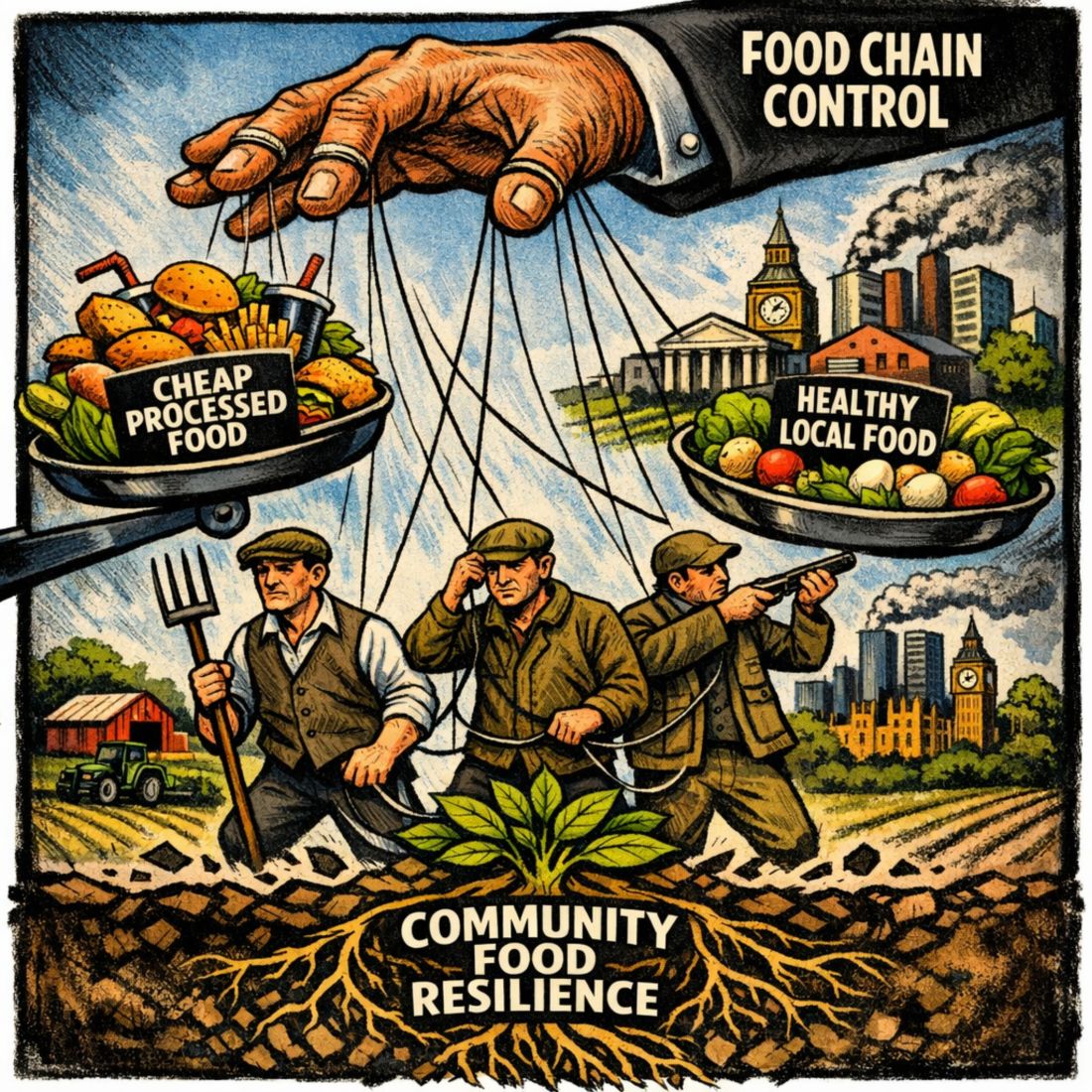
The healthiest, freshest, most local and most nutritious food – the food that should be cheapest – is now the most expensive.

Meanwhile:

  • ultra‑processed foods
  • imported ingredients
  • long supply chains
  • and nutritionally empty calories

…are the cheapest and most accessible.

This is not an accident.

It is the predictable outcome of a system designed around profit, not health; control, not resilience.

And it is the backdrop against which every rural policy – including gamebird licensing – must be understood.

Why Food Costs Are a Smokescreen

Politicians justify the dominance of ultra‑processed food by claiming it keeps costs down for consumers. But this is a smokescreen.

Cheap food is not cheap.

It is subsidised by:

  • poor health
  • environmental damage
  • collapsing rural economies
  • and the erosion of local food production

The “low cost” argument is used to justify a system where:

  • food travels thousands of miles
  • ingredients are processed beyond recognition
  • supply chains are fragile
  • and communities have no control over what they eat

This is the real hidden thread.

Not hunting.

Not shooting.

Not even farming subsidies.

It is the deliberate centralisation of the food chain – because the more dependent people are on distant suppliers, the more power those suppliers hold.

Where Gamebird Licensing Fits In

This is why the government’s interest in pheasant shooting is not really about environmental impact. If it were, the policy would look very different.

The real significance is symbolic:

  • It extends state oversight into another area of rural land use.
  • It reinforces the narrative that rural practices are morally suspect.
  • It distracts from the far more consequential issue: the collapse of independent food production.
  • And it divides rural communities at the very moment they need unity most.

The irony is that pheasant shooting rarely displaces food production at all.

It coexists with farming, forestry and conservation.

And if every bird shot entered the food chain, the “waste” argument would evaporate.

But rural industries often undermine themselves by failing to adapt, failing to collaborate, and failing to see the bigger picture.

Farmers Are Under Attack – But They Also Undermine Themselves

Farmers are being squeezed by:

  • inheritance‑tax changes
  • subsidy reforms
  • supermarket power
  • planning restrictions
  • and land‑use centralisation

But they also weaken their own case when they:

  • defend practices that don’t feed the nation
  • expect special treatment while criticising others
  • fail to build alliances across rural sectors
  • cling to the belief that government policy is based on common sense

The same is true of shooting.

The same is true of every rural industry that assumes policymakers understand or value the countryside.

They don’t.

And they haven’t for a long time.

The Land Use Framework: A Turning Point

The new Framework is presented as a rational attempt to balance competing demands on land. But once government begins ranking land uses, it inevitably begins ranking the people who depend on them.

The Framework:

  • centralises decision‑making
  • prioritises energy and carbon markets
  • treats food production as one priority among many
  • and opens the door to licensing activities that were previously self‑regulated

This is not accidental.

It is structural.

And it is happening at the same time as:

  • inheritance‑tax changes that weaken family farms
  • subsidy systems that reduce output
  • planning rules that favour corporate agriculture
  • and supermarket power that leaves farmers with no bargaining strength

The direction of travel is unmistakable.

The Future Must Be Food‑Centred – And Community‑Led

Here is the part that matters most.

The UK cannot fix its food‑security crisis through government policy alone – because the political system is not designed to prioritise resilience over control.

A change of government will not fix this.

It has not fixed it before.

It will not fix it next time.

The only sustainable future is one where:

  • food production is embedded in communities
  • farmers are partners, not suppliers
  • local economies are built around food
  • short supply chains replace fragile global ones
  • communities regain control over what they eat

This is not nostalgia.

It is survival.

Food is as essential as air and water – but it is the easiest to manipulate, the easiest to profit from, and the easiest to centralise. That is why it has been allowed to drift into the hands of a small number of powerful actors.

Reversing that drift will not come from Westminster.

It will come from farmers, communities, and local food networks that refuse to wait for help from the very people invested – knowingly or unknowingly – in their decline.

A Call to Action

The writing is on the wall.

The UK is at a crossroads.

One path leads to deeper dependency, weaker food security, and a countryside shaped by distant interests.
The other leads to resilient communities, empowered farmers, and a food system built around people rather than profit.

The choice will not be made in Parliament.

It will be made in fields, villages, towns, and local markets across the country.

Farmers and communities must lead the change.

Because if they don’t, the future of Britain’s food – and Britain itself – will be decided by those who see land not as a living resource, but as a tool of power.
The Government’s Biodiversity & National Security Report Misses the Real Threat: Our Food System is Already on the Brink

A response to HM Government – Global biodiversity loss, ecosystem collapse and national security: A National Security Assessment (Published 20 January 2026)

When the UK Government publishes a national security assessment warning that global biodiversity loss and ecosystem collapse threaten our food supply, you would expect honesty, clarity, and a sober assessment of the risks we face.

Instead, the report released on 20 January 2026 offers a strange mixture of stark warnings and comforting illusions – particularly around the UK’s food security.

It acknowledges that ecosystem degradation could destabilise global food production, disrupt supply chains, and trigger geopolitical competition for food. All of that is true.

But then it slips in a familiar, misleading reassurance:

“The UK imports 40% of its food.”

This figure is presented as if it reflects our real‑world vulnerability. It doesn’t.

It’s a net figure, not a resilience figure.

And it hides the truth that the UK is far more dependent on foreign food systems than the report admits.

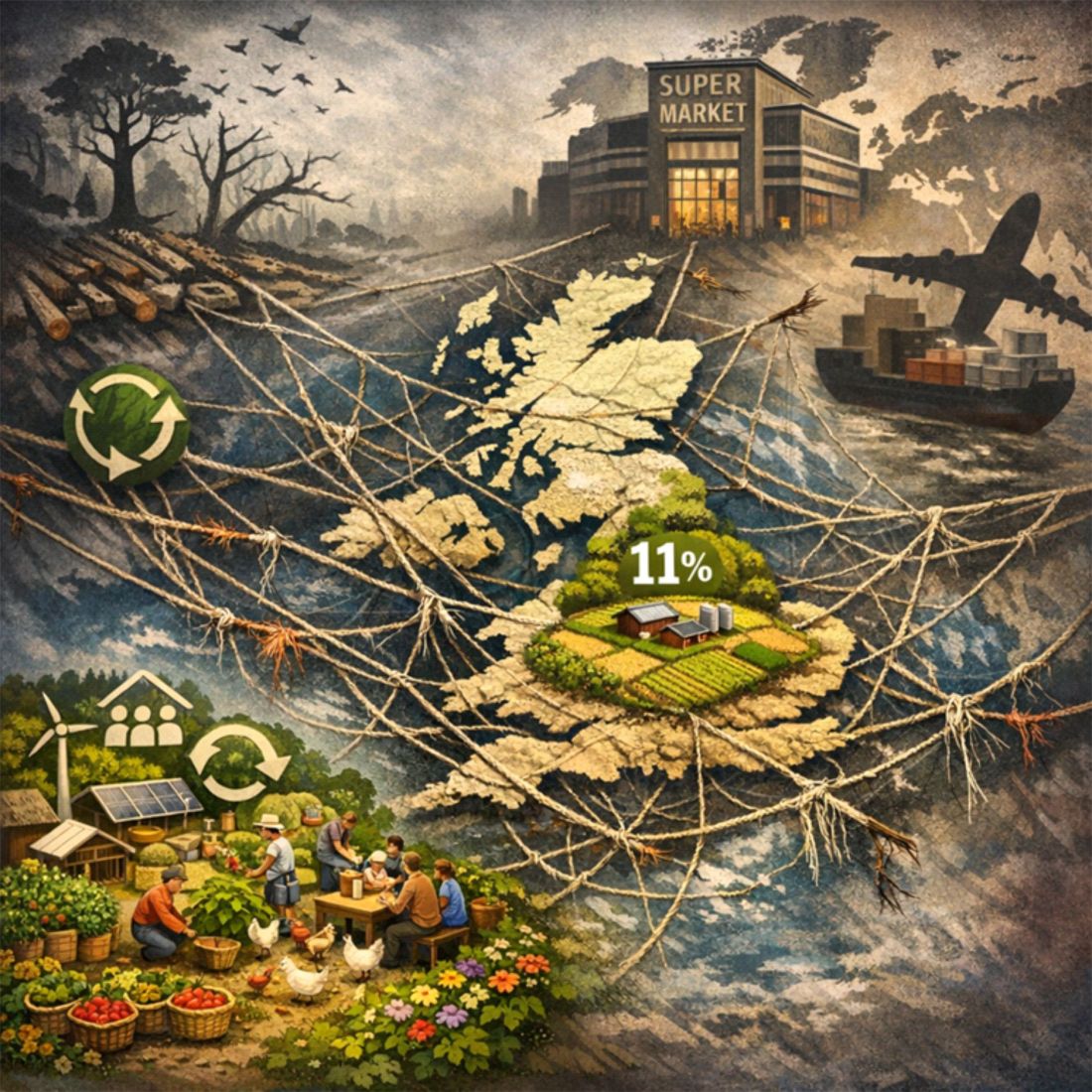
In fact, if the UK’s borders closed tomorrow, the amount of food immediately available for the population is closer to 11%.

That is the real national security threat – and it has nothing to do with future ecosystem collapse.

It is the result of decades of political choices, corporate control, and a food system designed around globalisation rather than public need.

The 40% Myth: A Convenient Political Fiction

The government’s “40% import dependence” statistic is based on food by value, not food by:

  • calories
  • volume
  • nutritional availability
  • immediate edibility
  • or domestic accessibility

It also ignores the dynamic reality of the UK food chain:

1. UK‑produced food is routinely exported

Much of what we grow or rear here is not eaten here.

We export beef, lamb, dairy, fish, cereals, and vegetables – then import substitutes.

2. “British food” often depends on foreign inputs

Even domestic harvests rely on imported:

  • fertiliser
  • feed
  • seed
  • chemicals
  • machinery
  • packaging
  • labour

A UK-grown crop is not a UK-secure crop.

3. The UK’s food system is globally entangled

Ingredients cross borders multiple times before becoming something we can eat.

A “British” ready meal may contain components from 10–20 countries.

4. The UK cannot feed itself under current systems

Even the report admits:

“The UK cannot currently produce enough food to feed its population based on current diets.”

But it fails to explain why:

Because the UK no longer has a food system designed to feed its own people.

The Real National Security Threat is Already Here

The government frames biodiversity loss as a future risk. But the UK’s food insecurity is a present reality, engineered over decades.

This is the uncomfortable truth:

The UK dismantled its own food resilience long before ecosystems began collapsing.

  • Traditional farming was replaced by industrial, globalised supply chains.
  • Local food systems were hollowed out.
  • Supermarkets and processors gained total control over production.
  • Farmers became contract‑bound suppliers rather than independent producers.
  • Policy after policy pushed the UK away from self-sufficiency.

The result?

A nation that produces food – but cannot feed itself.

This is why the 11% figure matters.

It reflects the food that is:

  • edible immediately
  • consumed domestically
  • not dependent on foreign inputs
  • not locked into export contracts
  • not reliant on overseas processing

This is the food that would still be available if global supply chains failed.

And it is terrifyingly small.

Biodiversity Collapse Will Hurt Us – But It Will Hit a System Already Broken

The government report is right about one thing:

Ecosystem collapse will make global food production more volatile.

But the UK’s vulnerability is not caused by ecological decline.

It is caused by:

  • globalisation
  • supermarket dominance
  • financialisation of land
  • industrialised processing
  • loss of local food infrastructure
  • policy choices that prioritised profit over people

Ecosystem collapse will simply expose the fragility we have already created.

The Missing Piece: A Food System Built Around People, Not Profit

The report warns that the UK must “increase food system resilience”.

But it offers no meaningful pathway to achieve it.

It talks about:

  • lab-grown protein
  • AI
  • alternative proteins
  • technological innovation

But it barely mentions the one thing that actually works:

Traditional, regenerative, localised farming.

The kind of farming that:

  • Builds soil
  • Restores biodiversity
  • Strengthens communities
  • Reduces dependency on imports
  • Shortens supply chains
  • Produces real food, not processed substitutes
  • Keeps value circulating locally
  • Increases national resilience

This is the farming model that the UK abandoned.

And it is the farming model we must return to.

LEGS: A Framework for the Food Security We Actually Need

The Local Economy & Governance System (LEGS) offers exactly the kind of structural shift the government report refuses to contemplate.

Under LEGS:

Food is treated as a Public Good

Not a commodity.

Not a profit centre.

Not a tool of corporate control.

Local farming is prioritised

Communities produce the food they eat.

Farmers regain independence.

Supply chains shrink.

Resilience grows.

Traditional and regenerative methods become the norm

Because they work.

Because they protect ecosystems.

Because they feed people.

Because they build long-term security.

The economy becomes circular and local

Value stays within communities.

Food sovereignty becomes real.

Dependency on global systems collapses.

People, Community, and The Environment become the organising principles

Not money.

Not shareholder value.

Not global trade flows.

This is the only credible pathway to genuine food security.

The Government Report Is a Warning – But Not the One It Thinks It Is

The report warns that biodiversity loss threatens our food supply.

It’s right.

But the deeper warning is this:

The UK’s food system is already so fragile that any external shock – ecological, geopolitical, or economic – could collapse it.

We do not need to wait for the Amazon to fall or coral reefs to die.

We are already exposed.

The real national security threat is not future ecosystem collapse.

It is the current food system, built on:

  • Global dependency
  • Corporate control
  • Industrial processing
  • Financialised land
  • Political complacency

We cannot fix this with technology, trade deals, or emergency stockpiles.

We fix it by rebuilding the one thing that has always fed people:

Local, traditional, community-rooted farming.

And we fix it by adopting a governance and economic model – like LEGS – that puts food, people, and the environment back at the centre of national life.

If the Government Is Serious About Food Security, It Must Change Course Now

The UK cannot continue:

  • Exporting food we need
  • Importing food we could grow
  • Relying on global supply chains
  • Allowing supermarkets to dictate farming
  • Treating food as a commodity
  • Ignoring the collapse of local food systems

If we want real food security, we must:

  • Rebuild local food production
  • Restore traditional farming
  • Shorten supply chains
  • Treat food as a public good
  • Prioritise people over profit
  • Adopt community‑based governance
  • Embrace the principles of LEGS

Because the truth is simple:

A nation that cannot feed itself is not secure.

A nation that depends on global systems is not resilient.

A nation that abandons its farmers abandons its future.

The government’s report is a wake‑up call.

But the real alarm has been ringing for years.

It’s time we listened.

Further Reading: Navigating the Real Threats to UK Food Security

The blog’s central argument is that the UK’s food system is already dangerously fragile -not just because of future biodiversity loss, but due to decades of policy choices that prioritised global supply chains and corporate control over local resilience.

The following resources are curated to help readers move from understanding the government’s official stance, through critical analysis, to actionable frameworks for rebuilding food security.

1. Official Context: The Government’s Assessment

Nature security assessment on global biodiversity loss, ecosystem collapse and national security

https://www.gov.uk/government/publications/nature-security-assessment-on-global-biodiversity-loss-ecosystem-collapse-and-national-security
Summary:
This is the UK Government’s own national security assessment, published on 20 January 2026. It warns that global biodiversity loss and ecosystem collapse threaten food supply and national security. While it acknowledges risks to food production and supply chains, the report is critiqued in this blog for offering misleading reassurances about UK food resilience and failing to address the deeper, present-day vulnerabilities in the food system.

(Please note that a copy of the Report can be downloaded as a PDF below)

2. Critical Analysis & Solutions: The Author’s Portfolio

Adam’s Food and Farming Portfolio: A Guide to Books, Blogs, and Solutions

https://adamtugwell.blog/2025/12/18/adams-food-and-farming-portfolio-a-guide-to-books-blogs-and-solutions/
Summary:
This curated portfolio gathers key writings, books, and practical solutions from the blog’s author. It’s designed for readers who want to go beyond critique and discover actionable ideas for food system reform, regenerative agriculture, and community-based resilience. The portfolio reflects the blog’s ethos: prioritising people, local economies, and ecological health over profit and global dependency.

3. Deep Dive: The LEGS Ecosystem

Visit the LEGS Ecosystem

https://adamtugwell.blog/2025/12/31/visit-the-legs-ecosystem/
Summary:
LEGS (Local Economy & Governance System) is the framework proposed in the blog as the structural shift needed for genuine food security. This resource introduces LEGS in detail, showing how it treats food as a public good, rebuilds local farming, and fosters circular economies. It’s essential reading for those interested in systemic change and practical pathways to resilience.

4. In-Depth Reference: LEGS Online Text

The Local Economy Governance System – Online Text

https://adamtugwell.blog/2025/11/21/the-local-economy-governance-system-online-text/
Summary:
For readers seeking a comprehensive understanding of the LEGS framework, this online text provides the full theoretical and practical foundation. It expands on the principles outlined in the blog, offering guidance for communities, policymakers, and advocates aiming to rebuild food sovereignty and resilience from the ground up.

Guidance for Readers

Start with the government’s official report to understand the mainstream narrative and its limitations.

Move to the author’s portfolio for critical analysis and practical solutions.

Explore the LEGS resources to discover a transformative framework for food security rooted in local economies and regenerative practices.

This order will help readers progress from context, through critique, to concrete action – mirroring the blog’s call for urgent, systemic change in the UK’s approach to food and farming.

Visit The LEGS ecosystem

So here we are, New Year’s Eve, and as I sit here with not much more than 12 hours of 2025 left, my thoughts – like those of many others – are reflecting on the past year and what may lie ahead.

2025 has been a busy writing year for me, and an important one. It feels as though the real purpose behind a four‑year journey of writing, researching, studying and creating has finally taken shape in The Local Economy & Governance System, which I published in November, and in the refined or distilled version of The Basic Living Standard, which I published about a month earlier.

As I discussed in the story that gives meaning and depth to the journey that brought me here – Safe Shores, published just a day or two ago – the compulsion I first felt in early 2022 to share an honest view of what is really going on, how we got here, what lies ahead, and what we truly need to consider, first became the book Levelling Level.

At that point, nothing suggested that a whole series of standalone works would follow, each offering perspectives that wouldn’t begin to reveal their practical interconnectedness until I was already several titles in.

In the future, it may be appropriate to bring all of these works together in one or more books that will make more sense for those looking solely for reference material. However, that time isn’t now.

I feel sure of this because I understand that the different efforts and approaches I used to cover the varied but equally important perspectives needed for genuine change are best left as they are – for now. As they each feed into The Local Economy & Governance System from different directions, meeting people where they currently are.

Nonetheless, as we stare at the imminency of 2026 – with what I suspect will be a shared sense that the year ahead is unlikely to resemble anything anyone alive today has ever experienced – I feel it is time to put the list of all the key books, blogs and papers that have effectively created the “LEGS ecosystem” in one place.

This is for those of you already stepping into this room with the understanding that nothing we know can continue as it is.

You will be able to explore the different angles and perspectives I have shared so far -those I believe will be most valuable if you truly want to make sense of what change needs to be, why it must take that form, what we must consider and allow for along the way, and what a new culture of community leaders and community members will need to do once they have made sense of it all.

It is important to reiterate that while different elements of this portfolio may sound like solutions or methods that could be applied within the money‑centric system that is now collapsing, the reality is that I had always hoped the political class and establishment leaders we have would experience a lucid moment and suddenly find a set of gears they never realised they had.

Regrettably, I no longer see that as possible. The process of discovery and thought I have been on has made clear that every part of life currently points the wrong way –towards money as the priority in every sense – and that nobody who believes in, or benefits from, the systems that feed this will relinquish that belief until circumstances outside the control of the collapsing system intervene and force their hand.

The politicians we have – even those so many are placing their hopes upon – are not and cannot be the saviours that the disillusioned and angry would like them to be. They simply want to take over as the drivers of a train that can only go in the same direction.

In their current roles, and in the roles they hope to attain, they cannot be anything other than managers with an ever‑dwindling set of responsibilities – because that is how the recusers of this same system have successfully set up anyone subservient to this political model to be.

Yes, there may be some genuine leaders in politics today who have a part to play. But the difference between the end of the Moneyocracy and the centralised, hierarchical, top‑down, patriarchal system we must leave behind is that the people who lead our communities politically in the future will do so through natural disposition, respect and merit from the community itself. Not simply because someone none of us will ever know rubber‑stamped their ascent after they said and did all the right things.

There are tough times ahead. But they can be navigated and overcome if we remember who we really are, and what our relationships with other people, our communities and the environment around us should be.

It sounds simple when put like that, I know. But the work that follows in the lists below will show that it is anything but simple – until the moment when the truth of all this makes sense. Then the need to change the direction and thinking behind everything becomes clear, and you begin to believe.

I hope you find this resource useful, and that if you have genuine questions or an interest in building on the words and ideas I have shared, you will get in touch and step toward the opportunity of a great future that begins where the conversation begins.

Thank you for reading, and thank you for your support.

Adam Tugwell

Cheltenham, UK

New Years Eve, 2025

The LEGS ecosystem Portfolio

The collection that follows represents the full body of work that has grown around the Local Economy & Governance System – the LEGS ecosystem.

Each piece was written at a different stage of the journey, often without knowing what would come next, yet all of them now sit together as part of a single, evolving picture.

Some began as blogs written in the moment, some became online versions of the books, and others developed into the published editions now available on Amazon.

This portfolio isn’t intended to be read in a particular order or treated as a linear argument. Instead, it offers a set of perspectives, explanations, warnings and practical ideas that together help make sense of where we are, how we got here, and what genuine change will require.

Whether you dip into one or explore them all, each contributes something different to the understanding of the system we must leave behind and the one we must build.

What you’ll find below is simply a clear way to access it all: the blogs, the online texts, and the links to the books themselves.

If you’re ready to explore the thinking behind the LEGS ecosystem in more depth, this is where that exploration begins.

Foundational Concepts & Philosophy (Books)

1. The Basic Living Standard: Introducing Locality Based Economics and how we can achieve financial freedom for ALL
https://www.amazon.co.uk/dp/B0CTHS8137
Explains the concept of a basic living standard, advocating for local economies that empower everyone to achieve financial freedom. It introduces foundational ideas for a fairer, people-centric economic system.

2. Levelling Level: Using the impact and lessons of everything in crisis to change the UK for the better and create a benchmark standard for a balanced and fair way of life that will benefit us all
https://www.amazon.co.uk/dp/B09WYVV9H8
Reflects on crises and their lessons, proposing a new benchmark for a balanced, fair society. It sets the stage for systemic change by examining what needs to be improved in the UK.

3. Safe Shores: The Pathway That Led to The Local Economy & Governance System and the Basic Living Standard
https://www.amazon.co.uk/dp/B0GD12BN5P
Shares the personal journey and motivations behind the creation of the LEGS ecosystem and the Basic Living Standard, providing context for the development of these ideas.

Core System & Practice

4. The Local Economy & Governance System: Act Now to build Fair Sustainable Communities Together
https://www.amazon.co.uk/dp/B0G34VX1LQ
Presents the core framework of the LEGS ecosystem, detailing how communities can act collectively to build fair, sustainable local economies and governance structures.

5. From Principle To Practice: Bringing the Local Economy & Governance System to Life
https://www.amazon.co.uk/dp/B0GCG1D4HG
Focuses on practical steps for implementing the LEGS system, translating its principles into actionable strategies for communities.

6. The Contribution Culture: Transforming Work, Business and Governance for Our Local Future with The Local Economy & Governance System
https://www.amazon.co.uk/dp/B0GD7VHYR1
Explores how work, business, and governance can be transformed through a culture of contribution, aligning with the LEGS philosophy for local futures.

Practical Applications & Sector Focus

7. Foods We Can Trust: A Blueprint for Food Security and Community Resilience in the UK
https://www.amazon.co.uk/dp/B0G6T5RRMR
Addresses food security and community resilience, offering solutions for trustworthy food systems within the UK’s local economies.

8. Who controls Our Food controls Our Future: Why Farming is collapsing, Food Security is disappearing, and Myths convince Consumers that no problem exists
https://www.amazon.co.uk/dp/B0DN17THTK
Examines the collapse of farming and food security, challenging myths and highlighting the importance of local control over food systems.

9. One Rule Changes Everything: Solving Society’s problems using our relationship with money, values and people to create a solution that lasts
https://www.amazon.co.uk/dp/B0CQKFW4DV
Proposes a transformative rule for society, focusing on the interplay between money, values, and people to create lasting solutions.

Societal Change & Governance

10. The Way of Awakened Politics for Good Government
https://www.amazon.co.uk/dp/B0BNYZQT95
Discusses the need for a new approach to politics and governance, advocating for awakened, community-driven leadership.

11. The Grassroots Manifesto: Establishing Policy & Governance for a post-Reset Democracy, putting People and Communities First
https://www.amazon.co.uk/dp/B0C2ZL3HZ5
Outlines policies and governance models for a post-reset democracy, emphasizing grassroots involvement and prioritizing people and communities.

12. Officially NONE OF THE ABOVE: 10 Steps to Vote NONE OF THE ABOVE and make every Vote count too
https://www.amazon.co.uk/dp/B0C5RN8BGQ
Provides a guide for political engagement, encouraging readers to make their votes count by considering alternatives to traditional choices.

13. An Economy for the Common Good: Building, enabling and maintaining good governance, self-sufficiency and freedom for all people and our communities
https://www.amazon.co.uk/dp/B0DXPQNJ28
Describes how to build and sustain an economy focused on the common good, self-sufficiency, and freedom for all.

Personal & Community Transformation

14. A Community Route: How we work together to fix the societal issues that are hurting everyone
https://www.amazon.co.uk/dp/B0BZW8JMH1
Explores collaborative approaches to solving societal problems, emphasizing community action and shared responsibility.

15. Our Local Future: People, Community, Environment and what Our shared tomorrow may look like when We leave today’s selfish Moneyocracy behind
https://www.amazon.co.uk/dp/B0DDKZC7P1
Imagines a future shaped by local values, community, and environmental stewardship, moving beyond a money-centric society.

16. Your Beliefs Today create Everyone’s Experiences Tomorrow: The Timelines we are on today, the Diversity of their Outcomes and the impact of Thinking Differently for Our Future
https://www.amazon.co.uk/dp/B0DSSY84ST
Examines how current beliefs shape future experiences, encouraging readers to think differently for better outcomes.

17. The Choice – A Waking Up Story: It may be false. It could be true. But one way or another this is a story for our time and somewhere it will probably include you
https://www.amazon.co.uk/dp/B0FJ2Y5Y92
Offers a narrative exploring personal and societal awakening, prompting reflection on individual roles in shaping the future.

18. From Here to There Through Now
https://www.amazon.co.uk/dp/B0BGSHSSDX
Focuses on navigating change and transition, guiding readers through the process of moving from current realities to desired futures.

19. Is Poverty invisible to those who don’t experience it?
https://www.amazon.co.uk/dp/B0D674762T
Investigates the realities of poverty, challenging perceptions and highlighting the need for greater awareness and action.

20. Actions Speak Louder than Digital Words: Living with & making sense of AI
https://www.amazon.co.uk/dp/B0C7L7PYRV
Discusses the impact of artificial intelligence on society, emphasizing the importance of meaningful action in a digital age.

Online Books: Titles, Links, and Summaries

Already Described in Kindle Section

The following online books correspond to Kindle editions already summarized above. For their descriptions, please refer to the previous list:

Unique Online Blogs (Titles, Links, and Summaries)

  1. A Reader’s Companion to From Principle To Practice
    https://adamtugwell.blog/2025/12/25/a-readers-companion-to-from-principle-to-practice-bringing-the-local-economy-governance-system-to-life/
    A supplementary guide to “From Principle To Practice,” offering commentary, clarifications, and additional insights for deeper understanding.
  2. The Basic Living Standard: Freedom to Think, Freedom to Do, Freedom to Be – with Personal Sovereignty that Brings Peace to All
    https://adamtugwell.blog/2025/12/15/the-basic-living-standard-freedom-to-think-freedom-to-do-freedom-to-be-with-personal-sovereignty-that-brings-peace-to-all/
    Explores the philosophical and practical dimensions of the Basic Living Standard, focusing on personal sovereignty and the freedoms necessary for a peaceful, equitable society.
  3. Understanding Foods We Can Trust: A Blueprint for Food Security and Community Resilience in the UK
    https://adamtugwell.blog/2025/12/15/understanding-foods-we-can-trust-a-blueprint-for-food-security-and-community-resilience-in-the-uk/
    Provides an accessible explanation of the key ideas in “Foods We Can Trust,” making the blueprint for food security and resilience understandable for a broad audience.
  4. The Future of Work: Redefining Value, Meaning and Human-Centric Employment in the Age of AI and Economic Change
    https://adamtugwell.blog/2025/12/08/the-future-of-work-redefining-value-meaning-and-human-centric-employment-in-the-age-of-ai-and-economic-change/
    Examines how work and employment must evolve in response to AI and economic transformation, emphasizing human-centric values and meaningful contribution.
  5. Power and Distance: Why UK Politics Fails the Public and How Local Governance Can Restore Trust
    https://adamtugwell.blog/2025/12/06/power-and-distance-why-uk-politics-fails-the-public-and-how-local-governance-can-restore-trust/
    Analyzes the disconnect between UK politics and the public, and proposes how local governance reforms can rebuild trust and accountability.
  6. The Local Economy & Governance System (LEGS): Escaping the AI Takeover and Building a Human Future
    https://adamtugwell.blog/2025/12/04/the-local-economy-governance-system-legs-escaping-the-ai-takeover-and-building-a-human-future/
    Discusses the risks of unchecked AI in economic systems and presents the LEGS model as a way to ensure a human-centered future.
  7. The Role of Barter and Exchange in the Local Economy & Governance System
    https://adamtugwell.blog/2025/12/03/the-role-of-barter-and-exchange-in-the-local-economy-governance-system/
    Explores alternative economic mechanisms such as barter and exchange, and their place within the LEGS framework.
  8. The Basic Living Standard: How & Why It Works
    https://adamtugwell.blog/2025/12/01/the-basic-living-standard-how-why-it-works/
    A practical explanation of the mechanisms and rationale behind the Basic Living Standard, aimed at demystifying its implementation.
  9. LEGS: The Human Economy – A Blueprint for Transformation
    https://adamtugwell.blog/2025/12/01/legs-the-human-economy-a-blueprint-for-transformation/
    Presents a transformative blueprint for shifting from a money-centric to a human-centric economy using the LEGS principles.
  10. Understanding Who Controls Our Food Controls Our Future: Everything You Need to Know
    https://adamtugwell.blog/2025/11/23/understanding-who-controls-our-food-controls-our-future-everything-you-need-to-know/
    Breaks down the arguments and evidence from “Who Controls Our Food Controls Our Future,” making the case for local food sovereignty.
  11. The Local Economy & Governance System Policy Summary
    https://adamtugwell.blog/2025/11/22/the-local-economy-governance-system-policy-summary/
    A concise summary of the key policies and recommendations within the LEGS framework.
  12. The Basic Living Standard: Not a Fix for a Collapsing Money-Centric System but the People-Centric Foundation of a New One
    https://adamtugwell.blog/2025/11/16/the-basic-living-standard-not-a-fix-for-a-collapsing-money-centric-system-but-the-people-centric-foundation-of-a-new-one/
    Clarifies the Basic Living Standard’s role as a foundation for a new, people-centric system, rather than a patch for the old money-centric model.
  13. Technology and Artificial Intelligence Should Only Fill Jobs When No Humans Are Available
    https://adamtugwell.blog/2025/11/13/technology-and-artificial-intelligence-should-only-fill-jobs-when-no-humans-are-available/
    Argues for a cautious approach to AI in the workforce, prioritizing human employment and dignity.
  14. After the Collapse: Who Gets the Blame?
    https://adamtugwell.blog/2025/11/12/after-the-collapse-who-gets-the-blame/
    Reflects on accountability and responsibility in the aftermath of systemic collapse.
  15. Breaking the Money Myth: Rethinking Value, Exchange and Equality
    https://adamtugwell.blog/2025/11/12/breaking-the-money-myth-rethinking-value-exchange-and-equality/
    Challenges conventional beliefs about money, value, and equality, and suggests new paradigms for exchange.
  16. The Coming Collapse and the Revaluation of Everything Needed to Regain Personal Freedom and Control
    https://adamtugwell.blog/2025/11/12/the-coming-collapse-and-the-revaluation-of-everything-needed-to-regain-personal-freedom-and-control/
    Examines the societal shifts required to restore personal freedom and control in the face of systemic collapse.
  17. Government is Broken: Collapse Now or Collapse Later
    https://adamtugwell.blog/2025/11/05/government-is-broken-collapse-now-or-collapse-later/
    A critical look at the failures of government and the inevitability of systemic change.
  18. Why People Can’t Just Get a Job
    https://adamtugwell.blog/2025/11/04/why-people-cant-just-get-a-job/
    Explores the structural barriers to employment and the inadequacy of simplistic solutions.
  19. The Basic Living Standard Explained
    https://adamtugwell.blog/2025/10/24/the-basic-living-standard-explained/
    Provides a straightforward explanation of the Basic Living Standard for newcomers.
  20. Beliefs We Accept as Our Own Are Destroying Everything – Including Who We Really Are
    https://adamtugwell.blog/2025/09/16/beliefs-we-accept-as-our-own-are-destroying-everything-including-who-we-really-are/
    Investigates how internalized beliefs shape society and individual well-being.
  21. Neither This Government Nor the Next Can or Will Stop the Coming Collapse – and That’s When You May Well End Up Owning Nothing and Be Forced to Be Happy About It
    https://adamtugwell.blog/2025/09/05/neither-this-government-nor-the-next-can-or-will-stop-the-coming-collapse-and-thats-when-you-may-well-end-up-owning-nothing-and-be-forced-to-be-happy-about-it/
    Warns of the limitations of political solutions to systemic crises.
  22. Future Economics Must Be Tied Only to People, Their Contribution, What Is Important to Sustain Good, Fair and Balanced Lives – and Legal Currency Must Never Again Be Open to Speculation and Manipulation
    https://adamtugwell.blog/2025/07/25/future-economics-must-be-tied-only-to-people-their-contribution-what-is-important-to-sustain-good-fair-and-balanced-lives-and-legal-currency-must-never-again-open-to-speculation-and-manipulation/
    Advocates for a people-centered economic model and the reform of currency systems.
  23. Desperate Times, Desperate Resets
    https://adamtugwell.blog/2025/03/24/desperate-times-desperate-resets/
    Reflects on the necessity and risks of radical systemic resets in desperate times.
  24. How the UK Was Led into the Fiscal-Driven Armageddon We Are Now Within
    https://adamtugwell.blog/2025/03/24/how-the-uk-was-led-into-the-fiscal-driven-armageddon-we-are-now-within/
    Analyzes the policy decisions and events that led to the UK’s current fiscal crisis.
  25. The Basic Living Standard: A Pathway to Economic Equality and Fairness Throughout Life
    https://adamtugwell.blog/2025/03/10/the-basic-living-standard-a-pathway-to-economic-equality-and-fairness-throughout-life/
    Details how the Basic Living Standard can create lifelong economic equality and fairness.
  26. Rethinking the Minimum Wage: The Need for a Basic Living Standard
    https://adamtugwell.blog/2024/12/17/rethinking-the-minimum-wage-the-need-for-a-basic-living-standard/
    Makes the case for moving beyond minimum wage debates to a universal Basic Living Standard.
  27. The Harmful Truths That Are Hidden Behind Political Growth
    https://adamtugwell.blog/2024/12/06/the-harmful-truths-that-are-hidden-behind-political-growth/
    Uncovers the negative consequences of growth-focused political narratives.
  28. The Contemporary Politician’s Dilemma
    https://adamtugwell.blog/2024/12/05/the-contemporary-politicians-dilemma/
    Examines the challenges and contradictions faced by today’s politicians.

UK Farmers’ Inheritance Tax Changes: What does the Government’ Christmas Announcement Really Mean for Food Security?

This morning, I was asked by someone who grew up in farming and knows what I do whether I thought the government’s announcement about changes to the farmers’ inheritance tax threshold and transfer allowance would be the end of it.

My immediate reply was that, given the Spring Budget or Statement date had been announced only the day before, the whole thing seemed suspicious to say the very least.

That’s before we even consider the timing: just before Christmas, and only days after the Batters Farming Profitably Review (FPR) was published.

As I suggested in my follow‑up blog, the FPR told many truths about the downward spiral that U.K. farming is now in, but it did so firmly within the context and framing that government and the wider establishment have set.

That’s only helpful if you believe that having the truth spelled out about the things killing an industry – and by default, UK food security – is the same as being heard. And that being heard – if you actually are – will lead to meaningful change rather than simply becoming more words added to the pile.

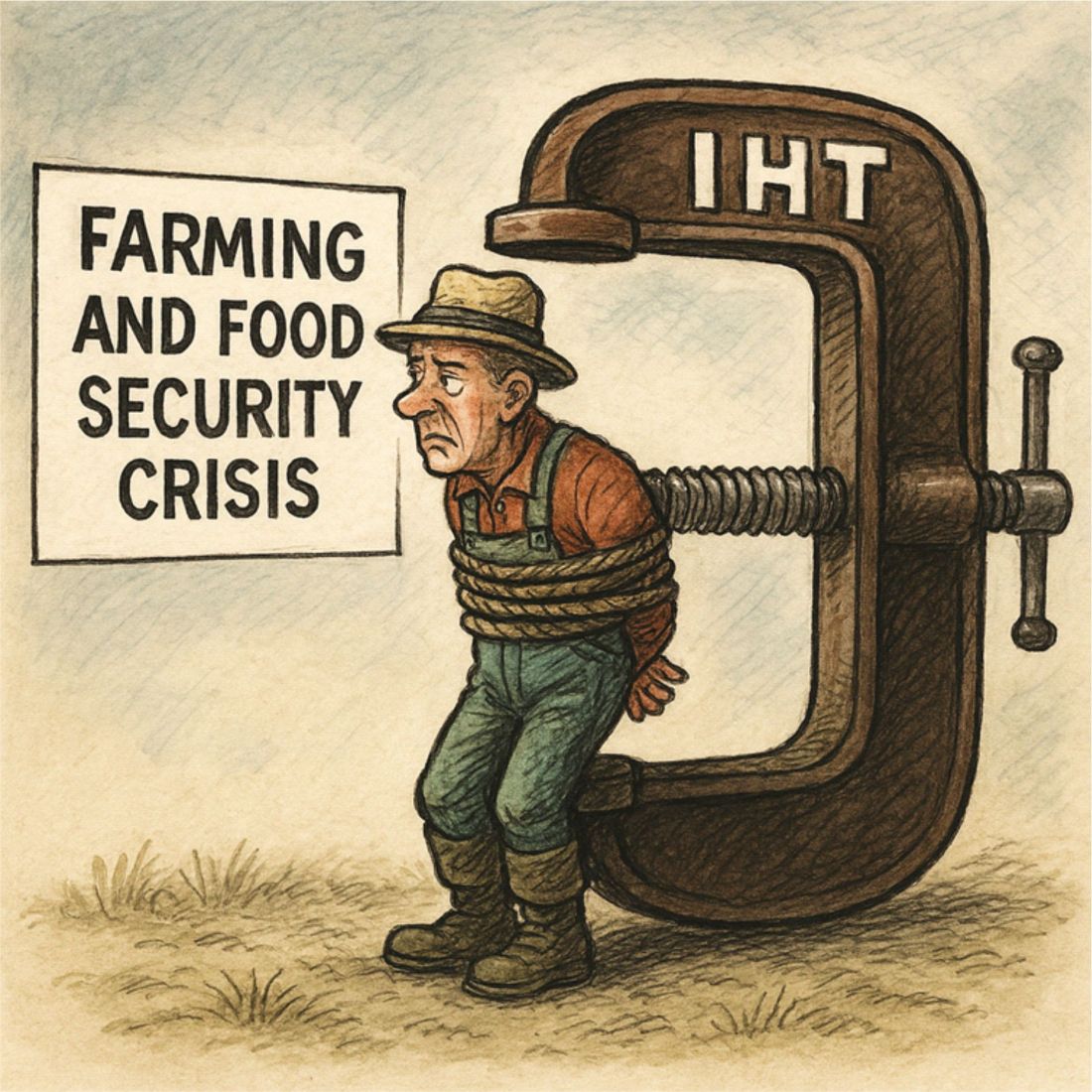
Whilst the news will bring some comfort to those who see the extension of the IHT window as a kind of Christmas gift, the regrettable truth is that even a complete U‑turn by the government on this single policy won’t change the direction of travel.

Nor will it alter the wide range of influences and pressures – many of which were identified in the FPR – that are tightening like a thumb screw and will ultimately destroy independent and traditional farming methods in this country.

The question, regrettably, given that everyone is still moving in the same direction, when you look at what their legs rather than what their lips are doing, is this: what will be the real cost of a story that grabs just enough attention to make people believe the farming and food‑security crisis is suddenly heading somewhere different?

Further Reading: Understanding the Context and Challenges Facing UK Farming

To help you dive deeper into the issues discussed in this blog – especially the government’s inheritance tax changes, the Batters Farming Profitably Review, and the broader crisis in UK food security – here’s a recommended list of Adam’s articles.

Each summary highlights the relevance of the link to the ongoing debate and the future of British farming.

1. https://adamtugwell.blog/2025/12/19/a-few-thoughts-on-minette-batters-farming-profitability-review-fpr/

A critical analysis of the FPR, this post explores the truths revealed about the downward spiral in UK farming, while questioning whether simply acknowledging the problems will lead to meaningful change. It sets the stage for understanding the policy environment and the pressures facing farmers today.

2. https://adamtugwell.blog/2025/08/14/farm-inheritance-tax-was-always-about-wrecking-independent-uk-food-production-thats-why-it-defies-common-sense/

This article delves into the history and intent behind farm inheritance tax, arguing that it has long undermined independent food production in the UK. It provides essential background for readers seeking to understand why inheritance tax remains such a contentious issue.

3. https://adamtugwell.blog/2025/11/22/risk-and-responsibility-why-farmers-must-choose-to-rebuild-the-uk-food-system-before-its-too-late/

This post emphasises the urgency for farmers to take proactive steps in rebuilding the UK food system. It discusses the risks involved and the responsibilities that fall on those within the industry to drive change before the situation becomes irreversible.

4. https://adamtugwell.blog/2025/11/23/understanding-who-controls-our-food-controls-our-future-everything-you-need-to-know/

An exploration of the power dynamics in UK food production, this article explains how control over food systems shapes the nation’s future. It’s a vital read for those interested in the intersection of policy, industry, and food security.

5. https://adamtugwell.blog/2025/01/18/the-need-for-a-collaborative-approach-to-the-uk-farming-and-food-security-problem/

This piece advocates for collaboration among farmers, policymakers, and stakeholders to address the complex challenges facing UK farming and food security. It offers practical insights and solutions for building a more resilient system.

6. https://adamtugwell.blog/2025/12/22/how-the-trail-hunting-ban-exposes-a-bigger-battle-for-britain/

Broadening the discussion, this article connects rural policy battles – like the trail hunting ban- to the larger struggle over Britain’s countryside, farming, and food systems. It provides context for understanding the wider political and cultural forces at play.

7. https://adamtugwell.blog/2025/12/18/adams-food-and-farming-portfolio-a-guide-to-books-blogs-and-solutions/

A comprehensive guide to further reading and resources, this portfolio is ideal for readers who want to explore more about UK farming, food security, and potential solutions.