We grow up believing government exists to make life possible. To build, to protect, to maintain, to enable. To stand between us and the things that would otherwise overwhelm us.
But somewhere along the way, that relationship inverted.
Government stopped facilitating life. Life began facilitating government.
Not because government suddenly changed its intentions, but because the tools it once used to shape the country were quietly dismantled by a financial and monetary system that came to control everything.
For decades, that system rewarded extraction over production, leverage over labour, and financial performance over real capability. It told us stories about modernity – stories about efficiency, globalisation, competitiveness – and it sold myths that made decline feel like progress.
The service economy was one of those myths. A story that said Britain didn’t need to make things anymore, that production was old‑fashioned, that skills were optional, that capability could be imported, that resilience was unnecessary.
And while the country embraced that story, the wheels of productivity were quietly removed.
Factories closed. Skills faded. Infrastructure aged. Supply chains stretched across oceans. Local capability thinned to the point of transparency.
None of this felt dramatic. It felt like modern life. It felt like the world moving forward.
But the financial system wasn’t building the future. It was hollowing out the present.
And when government finally looked up, it realised the tools it once relied on – the tools that made governing possible – were gone.
By then, the productive foundations that once made governing possible had eroded. Government could no longer easily rebuild what had been dismantled, repair what had been neglected, produce what had been offshored, or control many of the systems on which it depended.
But government could not easily admit this. It could not stand before the public and say: “We no longer have enough of the tools required to shape the country.”
So it clung to the only lever it had left.
Taxation.
Taxation is not a sign of strength. It is a sign of limitation.
When a government still has capability, taxation is one tool among many. When a government has lost capability, taxation becomes the only tool left.
And that is where Britain now finds itself.
Increasingly, government appears to rely on taxation to compensate for a diminishing ability to build, repair, produce, grow, and prepare for what is coming.
Taxation becomes the way government sustains itself when it can no longer sustain the country.
If economic growth remains weak while obligations continue to rise, governments eventually face a narrowing set of options: higher taxation, deeper borrowing, monetary intervention, or external assistance.
At the far end of that path lies the possibility of IMF involvement.
IMF involvement would not rebuild capability. It would not restore resilience. It would not protect the public.
It would impose austerity of a kind that might keep politicians in their posts and government departments running, but for real people already struggling, the worst would still be to come.
Because IMF austerity protects the institution, not the population.
And all of this – the hollowing out, the loss of capability, the reliance on taxation, the looming austerity – is happening before external shocks hit.
Before supply chains fracture further. Before infrastructure failures accelerate. Before geopolitical instability intensifies. Before the next global downturn. Before the next energy crisis. Before the next financial contraction. Before the next systemic break. Before something as simple – and as devastating – as the real consequences of the closure of the Strait of Hormuz.
Many within government can see the pressures gathering ahead. Yet the institutions themselves may lack the capacity, political consensus, or time required to respond effectively. They know they cannot rebuild fast enough. They know they cannot deliver everything that has been promised. They know they cannot easily escape the system they inherited.
So it turns to the public – not to protect them, but to sustain itself.
And this is where the moral reckoning begins.
A government that can no longer facilitate life has no moral right to ask the population to bear ever-greater burdens simply so that the institution itself can endure.
The legitimacy of government has never rested on its ability to survive. It has rested on its ability to serve.
Once that distinction is lost, citizens inevitably begin asking a simple question:
Who exists to serve whom?
Which brings us back – inevitably, unavoidably – to the question we began with:
Do we exist only to serve government, or does government exist only to serve us?
Because if government is no longer here to serve us, then what is this all now for?
Why the modern Establishment is a worldview, not a class – and why that makes it so hard to escape.
Introduction – The Establishment Is Not What People Think It Is
Everyone claims to know what “the Establishment” is. Politicians campaign against it. Commentators blame it. Voters distrust it. Reformers promise to dismantle it. Yet when pressed to define it, most people reach for different answers – government, elites, the civil service, the media, finance, the judiciary, universities, “the blob”, or some hidden network of insiders.
All of these interpretations contain fragments of truth – but none of them capture the whole.
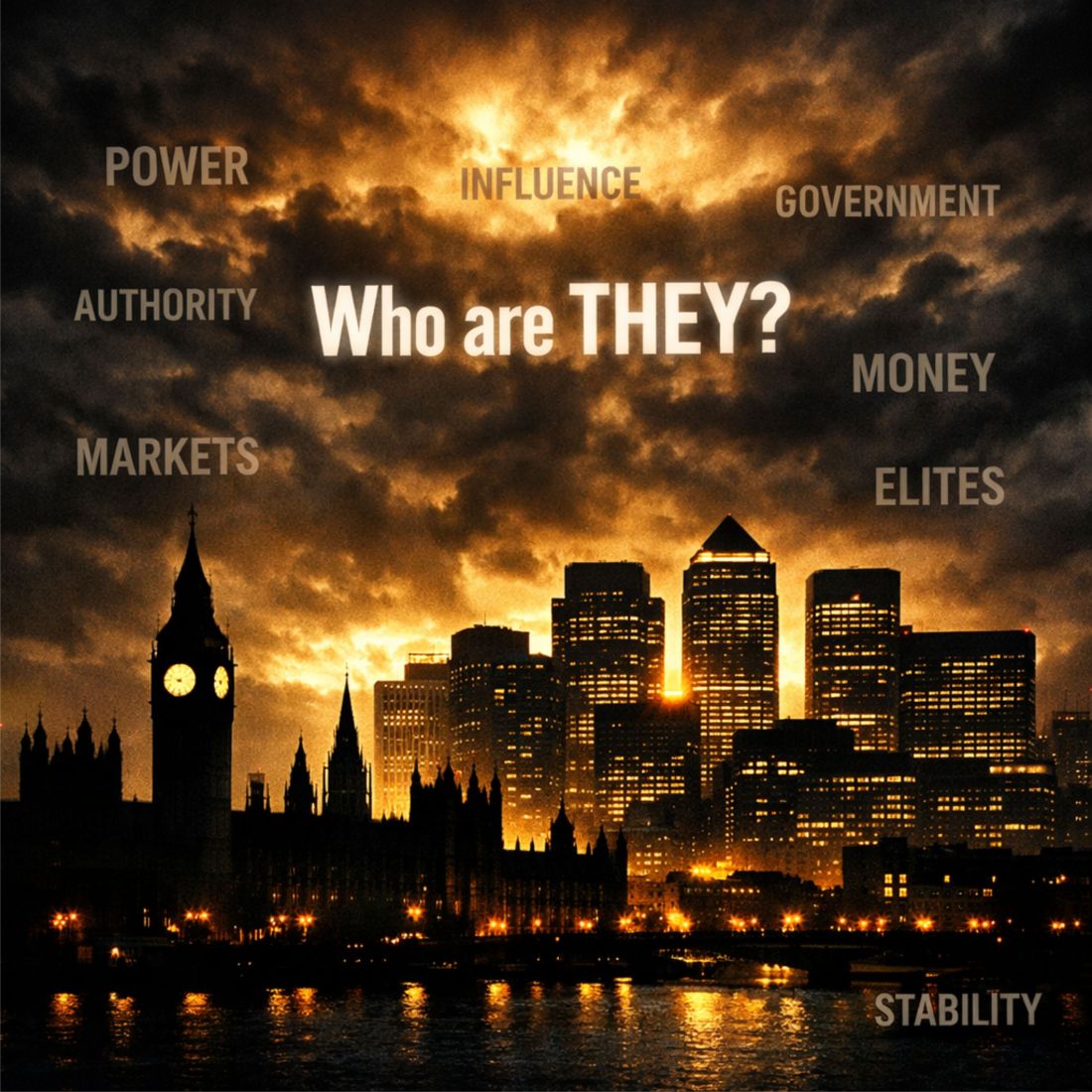
The Establishment is also the “they” that appears in countless political conversations. When people say “they won’t allow it”, “they don’t understand”, “they’ve already decided”, or “they’ll never let that happen”, they are usually trying to describe a force that feels real but is difficult to identify.
When challenged to explain who “they” are, many people struggle – not because they are foolish, irrational or imagining things, but because they are trying to describe a worldview as if it were a group of people. They can see the effects. They simply lack the language to explain the mechanism.
That is what the word “they” often signifies: an awareness of power without a clear map of how that power works. It is a tell. People know, at some level, that something larger than any one minister, party, company or institution is shaping outcomes. The mistake is not sensing it. The mistake is assuming it must be a single hidden group rather than a shared operating system.
The real Establishment is a worldview. A way of thinking. A mental operating system.
It is not a group of people. It is not a secret bunker. It is not a coordinated conspiracy.
It is a belief system that has become so dominant, so embedded, and so pervasive that it shapes everything – including many of the people who think they’re fighting it.
The Old Establishment: A Visible Hierarchy
Historically, the Establishment was simple:
aristocracy
inherited power
the Church
the military
the judiciary
Whitehall mandarins
elite universities
old boys’ networks
It was a visible hierarchy. You could point at it. You could name it. You could see who was in and who was out.
This is the Establishment people still imagine – even though it no longer exists in that form.
The Modern Perception: A Spectrum, Not a Consensus
Today, people see the Establishment through very different lenses.
1. Those who benefit from the system
They see the Establishment as:
competent
stabilising
necessary
expert
responsible
They trust it because it works for them.
2. Those harmed or excluded
They see it as:
distant
unaccountable
elitist
opaque
indifferent
They experience its decisions as disconnected from real life.
3. Those who see conspiracy
They imagine:
puppet‑masters
hidden committees
coordinated elites
This is understandable – the system behaves in ways that look coordinated – but it is not accurate.
4. Those who think they’re outside but are actually inside
This includes:
anti‑establishment politicians
populists
disruptors
commentators
They believe they are fighting the Establishment. But their actions, not their words, reveal that they operate fully within its worldview.
This is not unique to one party, faction or ideology. A politician can denounce “the elites” while still judging success by market confidence. A newspaper can attack bureaucrats while still treating financial credibility as the final test of seriousness. A reformer can call for renewal while still assuming that centralised management, competitive funding, external consultancy and measurable outputs are the only acceptable forms of action.
The important point is not the behaviour of one individual, but the wider pattern: much of what presents itself as anti‑establishment politics is actually a more intense expression of the same underlying worldview.
5. Those who see clearly but cannot escape
Analysts, academics, journalists and reformers may understand parts of the system, but still live inside it.
Because unless you become an off‑grid hermit, you cannot avoid interacting with the Establishment.
It is not something you leave. It is something you wake up inside.
The Real Establishment: A Worldview That Saturates Everything
The modern Establishment is not a group. It is a belief system.
By “worldview”, I do not mean a formal doctrine or a book of rules. I mean a shared set of assumptions about what is realistic, responsible, credible, modern and possible.
A worldview is powerful precisely because it usually does not feel ideological to those inside it. It feels like common sense.
It is a worldview built around:
market primacy
financial credibility
growth as the unquestioned good
competition as the organising principle
state restraint
technocratic management
institutional self‑protection
distance from consequences
This worldview has become the centre of gravity for anyone who wants to succeed in politics, media, finance, business, or public institutions.
It is not enforced by conspiracy. It is enforced by incentives.
How the Establishment Was Captured: The Slow, Invisible Drift
The capture was not deliberate. It was not planned. It was not coordinated.
It was a slow drift driven by:
globalisation
financialisation
deregulation
privatisation
market‑centric policy design
media consolidation
think‑tank influence
political professionalisation
legislative entrenchment
Over decades, the worldview became:
normal
sensible
realistic
responsible
inevitable
This is cognitive capture – not a personal failing, but a structural condition.
Here, “capture” should not be read as a claim that one group seized control of everything. It is more subtle than that.
It is the process by which institutions, careers, policy choices and public language gradually align around the same underlying assumptions until alternatives appear naive, dangerous or unserious.
People didn’t choose the worldview. They inherited it. They were rewarded for it. They were insulated by it. They were promoted for it. They were praised for it.
It became the mental furniture of their lives.
Cognitive Capture – The Human Mechanism Behind the System
This is the part many of us may find hardest to accept. Not because it is an accusation, but because it asks us to recognise something uncomfortable: if we live and work inside today’s version of normal life, then we have almost certainly been shaped by the Establishment worldview in some way.
That does not make us foolish, corrupt or guilty. It makes us human. But it does mean that real change cannot begin while we continue to tell ourselves that everything is basically fine, or that the system is only temporarily out of sync, or that the problem is simply the wrong government, the wrong leader, or the wrong party.
Deep down, many people already know this is no longer enough. The unease is not just political disappointment. It is the recognition that something more fundamental has stopped working.
Cognitive capture does not mean people are:
stupid
corrupt
malicious
incompetent
It means:
The system shapes how people think, and they don’t realise it because it feels like reality.
Anyone can be shaped by a system this pervasive.
This worldview becomes:
familiar
rewarded
reinforced
socially validated
professionally required
This is why even intelligent, well‑intentioned people struggle to imagine alternatives.
And this is why telling people “you’re captured” feels insulting – because it sounds like saying they don’t understand their own world.
But the truth is gentler:
Everyone is shaped by the systems they inhabit.Some systems are just more pervasive than others.
The Anti-Establishment Paradox: Why Rebels Reinforce the System
This is one of the most important dynamics.
Many “anti‑establishment” actors:
use establishment logic
reinforce establishment incentives
pursue establishment definitions of success
rely on establishment structures
defend establishment assumptions
They think they’re outside. But they’re inside.
The paradox can be seen repeatedly in modern politics.
Many figures present themselves as insurgents, outsiders or challengers of the Establishment. They speak the language of disruption, renewal and rebellion. Yet when examined more closely, their proposed solutions often rely upon the same assumptions, incentives and measures of success that define the existing system.
In some cases, they are not challenging the Establishment worldview at all. They are intensifying it. They push its logic further, pursue its assumptions more aggressively, and then interpret the resulting resistance as evidence of conspiracy or institutional sabotage.
This is why anti‑establishment rhetoric is not the same thing as anti‑establishment thinking. Some of the people waiting in line to inherit power may be more deeply embedded in the worldview than many of the people who currently hold it.
This is the paradox:
People who think they’re outside are often the ones most deeply inside.
And the most chilling part:
Even those who can see the system clearly are still inside it, because the Establishment exists in the assumptions, incentives and institutions that shape ordinary life.
Unless you become a literal hermit, you cannot avoid interacting with it.
How the Establishment Works: The Operating System of Society
The Establishment operates through:
incentives
norms
legislation
finance
institutional culture
professional pathways
institutional memory
risk aversion
narrative control
This creates a self‑reinforcing loop:
The worldview shapes institutions.
Institutions reward conformity.
Conformity strengthens the worldview.
The worldview becomes invisible.
The system becomes fragile but self‑protecting.
Attempts to challenge it are absorbed or neutralised.
Anti‑establishment actors end up reinforcing it.
The worldview becomes even more entrenched.
It behaves like a deep state even though it isn’t one.
How the Establishment Shapes Everyday Life
The worldview defines:
housing
healthcare
education
wages
taxation
public services
infrastructure
media narratives
political debate
what counts as “affordable”
what counts as “possible”
what counts as “responsible”
People feel the consequences:
rising costs
stagnant wages
degraded services
insecure work
unaffordable housing
shrinking local government
political cynicism
social fragmentation
But they rarely see the worldview behind it.
This is why “they” is such a revealing word. People feel decisions arriving from somewhere, but the source is dispersed across policy, finance, professional norms, media narratives, institutional habits and inherited assumptions. The power is real, but it is distributed. It speaks through many mouths while often belonging to no single person.
This is where abstract language becomes concrete. Housing is not simply a market outcome; it is the result of land policy, credit conditions, planning rules, investment incentives and political tolerance for scarcity. Public services are not merely “inefficient”; they reflect choices about taxation, outsourcing, central control, workforce morale and what forms of care are valued. Local government does not shrink by accident; it shrinks when national systems treat local capacity as a cost rather than as democratic infrastructure.
Why the Establishment’s Belief System Has Reached Its Limit
The worldview appears to have reached its limit because:
the economic model is fragile
the social contract is fraying
public trust has weakened sharply
inequality has widened
services have degraded
infrastructure is under visible strain
markets are volatile
the worldview struggles to solve the problems it helped create
each crisis leaves the system with less room for manoeuvre
This is not merely a mood. Recent UK evidence points in the same direction: official statistics show that homes remain unaffordable for many households; public attitude research has recorded deep dissatisfaction with major services and low trust in governing arrangements; and income research has shown weak living‑standards growth across the period since the financial crisis and through the cost‑of‑living shock.
The system increasingly appears to be defending a model that is struggling to meet the challenges it claims to solve.
None of this proves that every institution is failing, or that every person inside those institutions is acting badly. That would be too crude. The point is narrower and more important: a worldview that promised efficiency, prosperity and competent management now struggles to explain why so many people experience the system as expensive, remote, fragile and unresponsive.
The Strongest Objection
The strongest objection to this argument is that what I am calling an Establishment worldview may simply be the unavoidable logic of a complex modern society. Perhaps advanced economies need expertise, central institutions, financial discipline, legal continuity and professional management. Perhaps markets, whatever their failures, remain the least bad way of coordinating activity at scale. Perhaps the alternative to the current system is not renewal, but chaos.
That objection deserves to be taken seriously. Expertise matters. Institutions matter. Stability matters. The answer is not to romanticise disorder or imagine that sincerity can replace competence.
But this objection only goes so far. The issue is not whether societies need institutions. They do. The issue is what assumptions those institutions are built around, who they are accountable to, what outcomes they privilege, and whether they remain capable of learning from failure. When expertise becomes detached from consequence, when stability protects dysfunction, and when “responsibility” means preserving a failing model, the language of competence becomes part of the problem.
Why Change Requires Awakening, Not Rebellion
Even if a crisis creates the conditions for paradigm change, nothing will change unless enough people:
see the worldview clearly
recognise its limits
recognise its harms
recognise their own participation in it
Otherwise they will:
circle back
rebuild the same logic
re‑establish the same hierarchy
re‑entrench the same worldview
People rebuild the cage from the inside.
Conclusion – The Establishment Is Not Something You Overthrow, It’s Something You Wake Up From
The Establishment is not a deep state. It is a worldview that saturates the entire system. People who think they’re outside are often deeply inside. Even those who see it clearly still have to interact with it. And this is why change is so hard – because the Establishment is not something you defeat, it’s something you outgrow.
Its belief system has reached its limit. The question now is whether enough people can see it clearly enough to imagine something better – not merely a different leader, party or slogan, but a different set of assumptions about how economies, institutions and communities should function.
That is why the direction of travel matters. If the Establishment is a worldview, then meaningful change has to be practical as well as intellectual. It has to ask how value is created locally, how decisions are made, how communities govern themselves, how money circulates, how public capacity is rebuilt, and how institutions become answerable to lived reality rather than insulated from it.
Whether that alternative succeeds is a separate question. But no alternative can emerge until the limitations of the existing worldview are recognised. Before systems can change, assumptions must change. Before new institutions can be built, people must first stop mistaking the existing model for reality itself.
Next Step
For a more practical exploration of the direction implied by this argument, see the following text on local economy and governance:
There is a persistent and dangerous myth in British politics: that young people are disengaged, apathetic, or uninterested in shaping the future.
The truth is more uncomfortable. Young people are not disconnected from politics because they do not care. Many are disconnected because the system itself has become distant, performative, and detached from everyday life – and that detachment is not confined to the young. It affects everyone.
We have reached a point where Westminster can place individuals with limited experience of community governance into positions of enormous responsibility, while insulating them from the direct consequences of the decisions they make.
They enter a system where relationships are abstract, accountability is delayed, and governance is often performed through layers of bureaucracy rather than lived reality.
We pretend this is normal. Yet if a group of 18-year-olds were placed in charge of government tomorrow with no grounding in community life and no experience of governance, we would rightly call it absurd.
The uncomfortable question is why we tolerate the same absence of rooted experience when it appears inside the political class.
The problem is not young people. The problem is the system that asks them to believe in politics while giving them so little reason to trust it.
The Disconnect: Why Young People Walk Away
Young people are not blind to politics. They see the gap between political theatre and real life. They see leaders making decisions about communities they seldom experience firsthand. They see policy made at a distance, often without any visible understanding of its consequences.
They also see a political culture that often rewards performance over competence, messaging over understanding, and loyalty over responsibility.
So some walk away from formal politics, while others redirect their energy into campaigning, community action, mutual aid, social media advocacy, or issue-based movements.
That is not the same as apathy. It is often a judgement about where their effort is likely to matter.
The evidence increasingly supports this distinction. The John Smith Centre’s UK Youth Poll 2025 found that many young people still value democracy and want a say, even while 63% agreed that democracy in the UK is in trouble. The Diana Award’s 2024 Youth Voice in Politics report found that only 20% of young people agreed that politics takes young people’s voices seriously, while UK Youth reported that 88% of children and young people surveyed believed it was important to have a say in public decisions.
The issue, then, is not whether young people care. The issue is whether the system gives their care a serious route into responsibility, influence, and decision-making.
Why Young People Matter – and Why the Current System Cannot Use Their Contribution
Young people bring clarity, urgency, and direct experience of the realities shaping modern life. They understand the world they are inheriting because they are living its consequences now – in education, housing, employment, mental health, technology, and community life.
But the current system struggles to integrate their contribution meaningfully. It is centralised, distant, insulated, and slow. It is built more around hierarchy than participation, more around institutional process than direct relationship, and more around national performance than local responsibility.
This matters because youth participation cannot be reduced to consultation exercises, photo opportunities, or carefully managed listening events. If young people are only invited to speak after decisions have already been shaped elsewhere, they are not participating in governance. They are providing decoration for it.
This is why the Local Economy & Governance System (LEGS) and the Circumpunct model matter. They attempt to relocate responsibility closer to the people affected by decisions, creating a structure in which participation is not occasional, symbolic, or distant, but practical, local, and continuous.
The Westminster Problem: Governance Without Proximity
The critical weakness of Westminster is distance.
There is distance between leaders and communities, between decisions and consequences, and between policy language and lived reality.
That distance creates insulation. Over time, insulation becomes detachment, and detachment produces dysfunction.
Young people sense this quickly. They see politics as something done to communities, not with them. They see leaders who rarely experience the outcomes of their own decisions. They see governance become unreal – a performance rather than a practice.
Their rejection of that system is not irresponsibility. It is a rational response to a politics that too often treats them as an audience rather than participants.
The Circumpunct and LEGS: A System Built for Real Participation
The Local Economy & Governance System (LEGS) and the Circumpunct model offer a fundamentally different approach: governance rooted in proximity, relationships, and shared responsibility. Instead of asking people to place blind trust in remote institutions, they seek to create structures where responsibility is visible and participation is practical.
Local people making local decisions for local lives.
This means governance in real time, with real accountability and visible consequences.
Young people can be integrated naturally.
Not through tokenistic youth councils, staged consultations, or symbolic representation, but through direct participation in the decisions that shape community life.
Experience and youth coexist instead of competing.
Older generations provide grounding, continuity, memory, and wisdom. Young people provide energy, clarity, imagination, and urgency. Healthy governance requires both.
Responsibility becomes shared, not delegated.
Young people learn responsibility by doing, not by watching. Older generations remain relevant by guiding, not gatekeeping.
This is governance that works because relationships are direct and consequences are visible. It is governance that teaches young people how to contribute meaningfully while ensuring that experience remains central to decision-making.
It is governance that builds communities rather than managing them from afar.
A Necessary Objection: What About National Coordination?
A local system does not mean abandoning national coordination. Defence, infrastructure, fiscal policy, legal standards, and national rights still require wider frameworks. The argument is not that every decision should be made locally. It is that decisions should be made at the closest responsible level possible, with higher levels supporting rather than replacing local responsibility.
This distinction matters. Central government should provide coordination, safeguards, resources, and standards. Communities should provide knowledge, relationships, accountability, and direct experience. A healthier system would connect these levels rather than allowing one to dominate the other.
The Warning: The System Is Failing Them Today – and Failing Us All Tomorrow
Young people are inheriting a world shaped by decisions they did not make, systems they did not design, and crises they did not cause. Yet they are expected to carry the consequences, repair the damage, and navigate a future built on the failures of the past.
If we continue to exclude them from meaningful responsibility, we should not be surprised when they withdraw from formal politics. If we lose their trust, we lose more than a voting bloc. We lose imagination, continuity, legitimacy, and the future capacity of communities to govern themselves.
The system is failing young people today. Because it is failing them today, it is failing all of us tomorrow.
The Path Forward: Rebuilding Governance from the Ground Up
The solution is not to “get young people more interested in politics.” The solution is to build a system worth their interest, trust, and effort.
A system where:
Governance is local, direct, and human.
Responsibility is shared, not hoarded.
Experience is valued, not weaponised.
Youth is included, not patronised.
Community is the centre, not the afterthought.
Decisions are made by people who live with their consequences.
This is the promise of LEGS. This is the power of the Circumpunct. It offers a way to rebuild political culture by restoring seriousness to participation: people take their role seriously when the system takes them seriously.
Young people are not the problem. They are part of the solution – but only if we build a system capable of receiving their contribution and sharing responsibility across generations.
The future of democracy will not be secured through better messaging, larger bureaucracies, or more sophisticated political theatre. It will be secured when people once again have a meaningful stake in the decisions that shape their lives. That begins locally. It begins with proximity. It begins with responsibility shared across generations. It begins with governance that is real.
Reader Takeaway
Youth disengagement should not be mistaken for indifference. It is a warning sign that political structures have become too distant from the people they claim to serve.
If democracy is to regain trust, it must move closer to everyday life and create real roles for people of all generations in shaping the communities they share.
Further Reading
The Local Economy & Governance System: Online Text https://adamtugwell.blog/2025/11/21/the-local-economy-governance-system-online-text/ This companion text sets out the wider LEGS framework in more detail, explaining how local economic organisation, community governance, and shared responsibility can be brought together into a practical model for rebuilding democratic life from the ground up.
Declining trust, institutional fragility, and the danger of mistaking symptoms for causes.
Trust in political institutions is falling, public frustration is rising, and many people increasingly feel that politics offers different language but the same underlying direction. The slogans change. The faces change. The promises change. But the choices in front of us often seem to lead back to the same narrow set of answers.
This is why politics feels broken to so many people. It is not only because of scandal, incompetence, polarisation, or distrust, although all of those matter. It is because the political system itself appears to be losing its ability to adapt. Institutions feel brittle. Public debate feels repetitive. Outsider movements rise, but often carry the same assumptions as the establishment they criticise.
The risk of the moment is not simply anger, division, or frustration. It is misdiagnosis: the danger that a complex, systemic crisis will be treated as if it were a single problem with a single solution.
Why Does Politics Feel Broken?
Politics feels broken because people are experiencing several overlapping pressures at once: declining institutional trust, economic insecurity, cultural fragmentation, political polarisation, and a governing system that struggles to respond to complex problems. When these pressures are interpreted as one-dimensional failures – corruption, incompetence, weak leadership, or bad ethics – the proposed solutions rarely reach the deeper causes.
Collapse, in this context, does not mean sudden breakdown. More often it means the gradual loss of adaptive capacity: institutions becoming less able to absorb pressure, public trust becoming harder to sustain, and familiar political tools becoming less effective at solving emerging problems.
Why Everything in Politics Feels the Same
The political system is not just struggling. It is running out of room. Many parties, campaigns, and “new” options still draw from the same restricted deck: the same assumptions about markets, competition, growth, individual responsibility, and institutional management. That is why it can be difficult to see genuine daylight between them.
When a political system narrows, the public naturally looks elsewhere. Outsider movements become attractive because they sound fresher, less compromised, and more willing to say what established figures avoid. But unfamiliar is not the same as new.
Many outsider movements rise by naming real failures, but they often remain shaped by the same deeper instincts as the system they oppose. They may reject the tone of the establishment while keeping its underlying logic: competition as the default answer, market discipline as the main tool, and self-interest reframed as principle.
This is the restricted deck problem. A movement can appear disruptive on the surface while still being constrained by the same limited tools underneath. It can criticise the system without escaping the logic that made the system brittle.
The Perception Gap: Symptoms Are Easier to See Than Systems
Most people experience political crisis through its visible symptoms: arguments, scandals, headlines, personalities, broken promises, and day-to-day drama. These symptoms matter, but they are not the whole story.
The deeper problems are quieter. They sit inside institutions, economic pressures, cultural tensions, and the erosion of public trust. They do not fit neatly into interviews, slogans, or campaign messages, so they are often left unnamed.
This creates the perception gap: people feel system-level instability, but they mostly see surface-level conflict.
Someone may feel a loss of security and see only incompetence. They may feel institutional fragility and see only political theatre. They may feel economic pressure and see only blame. The deeper structure remains hidden behind the noise.
When people see only one dimension of collapse, they naturally look for one-dimensional explanations. They want someone who can point to a single cause and offer a single fix. That is why simple narratives are so powerful: not because they are accurate, but because they are comforting.
The danger is that people then choose solutions that match the part they can see. They try to fix a system problem with personality politics, institutional fragility with anger, cultural tension with slogans, and economic pressure with blame. None of these responses reaches the deeper causes.
Why Outsider Movements Rise – and Why They Often Fail
Outsider movements rise when established politics no longer feels capable of interpreting the moment. They gain traction because they appear to break the repetition. They speak plainly. They name frustration. They offer clarity when public life feels foggy.
But there is a crucial transition point when a movement stops being a protest and starts becoming a possible alternative. At that point it must evolve. It has to move from naming failure to understanding complexity, from expressing anger to building capacity, from opposing the system to explaining how a different system would work.
If it cannot make that transition, the opportunity is lost. The movement may still win attention, followers, seats, or headlines, but the deeper chance to change the direction of public life disappears.
When that happens, a vacuum opens. People remain frustrated, but the movement that could have organised that frustration into something constructive has failed to deepen. The space is then filled by movements that sound calm, confident, and certain – even when their certainty is built on oversimplification.
The Danger of Simple Explanations
Simple explanations become powerful in exhausted societies. They reduce complexity to a manageable story. They identify a culprit, promise a remedy, and make the future feel controllable again.
If people believe the crisis is only about ethics, they look for ethical heroes. If they believe it is only about incompetence, they look for competent managers. If they believe it is only about corruption, they look for clean hands. If they believe it is only about mismanagement, they look for stronger leadership.
All of these may be desirable. But none is sufficient on its own. A crisis of institutional trust, democratic legitimacy, economic pressure, and cultural fragmentation cannot be solved by fixing only one visible fault line.
This is how misinterpretation deepens collapse. The surface problem is addressed while the underlying system continues to lose capacity. The noise is treated, but not the structure. The drama is managed, but not the direction. The symptom is soothed, but the disease remains.
As research into political trust has repeatedly shown, declining confidence in representative institutions can make democratic systems more fragile and make it harder for governments to respond to shared problems. That does not mean every institution deserves automatic trust. It means that once legitimacy erodes, societies need more than better messaging. They need institutions capable of earning trust again.
What a Systemic Crisis Looks Like
A systemic crisis is rarely experienced as one dramatic event. It is more often experienced as a pattern: promises that do not land, institutions that struggle to absorb pressure, public debate that becomes more reactive, and citizens who feel that nothing quite changes even when everything seems urgent.
It can appear as declining trust in government, parliament, media, parties, expertise, or public administration. It can appear as polarisation, disengagement, cynicism, or the repeated rise of anti-establishment politics. It can appear as economic pressure being translated into cultural blame, or cultural anxiety being translated into institutional hostility.
The crucial point is that these are not separate stories. They interact. Economic insecurity weakens trust. Low trust makes compromise harder. Weak compromise makes institutions less effective. Ineffective institutions deepen frustration. Frustration creates demand for simple narratives. Simple narratives then make the system even harder to repair.
This is why the crisis feels larger than ordinary political disagreement. Democracies are built to contain disagreement. They are not built to function well when the public no longer believes the system can hear, process, or respond to pressure.
Seeing the Whole Picture
If the risk of the moment comes from misdiagnosis, then the way through begins with seeing the whole picture. Not the noise alone. Not the personalities alone. Not the scandals, slogans, or surface explanations alone. The task is to understand how institutions, economics, culture, trust, and political behaviour reinforce one another.
That does not require specialist expertise. It requires resisting the temptation to make the moment smaller than it is.
Once collapse is understood as multi-layered, the appeal of single-layer solutions weakens. One person cannot fix it. One party cannot fix it. One slogan cannot fix it. One moral diagnosis cannot fix it. A system problem requires system-level understanding.
This does not mean giving up on clarity. It means refusing false clarity. The strongest analysis is not the analysis that makes everything simple. It is the analysis that makes complexity understandable without pretending it has disappeared.
The greatest danger is not political disagreement. Democracies are designed to accommodate disagreement. The greater danger is misdiagnosis: treating a complex, systemic crisis as if it were a single problem with a single solution.
When societies misunderstand the nature of their challenges, they choose remedies that intensify the underlying condition. They mistake confidence for competence, simplicity for truth, and visibility for understanding.
Understanding the whole picture is therefore not a luxury. It is a prerequisite for responding effectively to the moment we are living through.
England is undergoing a constitutional transformation of unusual scale and significance. Under the banner of “devolution,” political leaders – most prominently Andy Burnham – are advancing a model that appears to empower regions but may, in practice, centralise authority at a higher tier, away from the most immediate and accessible forms of local democracy.
This is not a partisan project; politicians across the spectrum have expressed interest in similar reforms. But its implications for democratic legitimacy, local representation, and constitutional balance are profound.
What is emerging is not devolution in the traditional sense. It is regional centralisation: the consolidation of power into larger, higher-tier executive bodies that sit above existing councils, accompanied by the quiet removal or hollowing out of the lower tiers of government that citizens interact with most directly.
Crucially, this transformation is proceeding without a clear, direct mandate from the public.
The argument is not for preserving the current system unchanged, but for reform that deepens local accountability rather than bypassing it. Genuine devolution would move authority downward – to parish, town, district, and borough levels – granting councils meaningful fiscal autonomy and policy discretion within broad national frameworks.
The Disappearing Layers of Local Democracy
Most people are unaware of how many layers of local government currently represent them.
In much of England, people have:
• Parish or town councils, handling hyper‑local matters such as parks, community centres, and neighbourhood issues.
• District or borough councils, responsible for housing, planning applications, waste collection, and local services.
• County councils, overseeing education, social care, highways, libraries, and major infrastructure.
This multi‑layered system reflects the principle of subsidiarity: decisions should be made at the lowest possible level, closest to the people they affect. It provides multiple democratic access points, enabling residents to contact representatives who live nearby, understand local issues, and are accountable to small electorates.
Yet these layers are increasingly vulnerable to being reduced, merged, or bypassed. The shift toward unitary authorities and combined regional structures can replace large numbers of locally elected councillors with a smaller number of higher-tier decision-makers.
Accessibility shrinks, accountability thins, and decision-making moves further away from communities.
This is not administrative tidying.
It risks removing some of the most accessible forms of democracy.
Why Local Councils Already Feel Arbitrary – and Why That Matters
This loss is not always immediately visible. One reason it is easy to overlook is that many people already feel disconnected from their local councils.
Planning decisions, licensing rules, and other supposedly “local” policies often feel arbitrary or unresponsive. But this is not because councils are inherently flawed; it is because much of their power has already been stripped away.
Over the past two decades, local authorities have increasingly operated as delivery arms for central policy, rather than as fully autonomous democratic bodies.
In areas such as planning, licensing, housing, and social care, councils frequently:
• interpret national frameworks rather than create their own,
• implement centrally defined targets within strict statutory guidance,
• and make decisions constrained by national funding formulas.
This hollowing-out has helped create the impression that local government is ineffective or irrelevant. In reality, many councils have been significantly constrained by central policy, statutory obligations, and funding arrangements.
Regional centralisation now risks removing what remains.
Some may argue that if councils already feel powerless, their abolition is no great loss. But this misunderstands the problem. England’s democratic malaise stems from too much power already being held at the centre.
The remedy is not to remove even more local autonomy, nor to dismantle the structures that facilitate it. The remedy is to restore genuine local power, not to eliminate it.
Regional Executives: Power Upwards, Not Downwards
The emerging model concentrates authority in large, combined authorities led by regional executives. These bodies already oversee, or are being positioned to oversee, areas such as transport, housing, skills, infrastructure, and potentially wider fiscal powers.
They are designed to be strategic and streamlined – but streamlining comes at a democratic cost.
Where multiple tiers of local representation are replaced or subordinated to a higher regional executive, several consequences may follow:
• People may have fewer directly accessible representatives.
• Decision‑makers become more distant.
• Local dissent may carry less institutional weight.
• Party machinery may gain greater influence over candidate selection.
• Central government may face fewer local veto points.
This is why the term regional centralisation is so important.
Power is not being devolved to neighbourhoods or communities. It is being consolidated into larger units that are easier to manage from the centre.
As governance becomes more distant, electoral participation and civic engagement may weaken further, reinforcing the perception that local democracy is symbolic rather than meaningful.
A Constitutional Change Without Public Consent
The most serious issue is not merely structural; it is constitutional.
Changes of this magnitude alter the relationship between people and the state. They redefine how democracy functions and reshape the architecture of representation.
Yet England’s electorate has not been asked whether it wants:
• the abolition of district and county councils,
• the creation of regional executives with sweeping powers,
• new layers of governance with tax‑raising authority,
• or a restructured democratic system that reduces local access.
These reforms have not been clearly set out as a comprehensive constitutional settlement in recent national manifestos. They have not been subject to sustained public debate or submitted to referendum. Instead, they are largely being advanced through administrative and legislative pathways: secondary legislation, funding agreements, centrally negotiated devolution deals, and institutional restructuring rather than direct electoral mandates.
The constitutional principle is simple:
Consent in this context does not require unanimity, but it does require clear public awareness and an explicit opportunity to approve or reject change.
As a democratic principle, reforms of this scale can only claim legitimacy without a public vote where they clearly return power to people – not where they remove or distance it.
Regional centralisation does the latter while presenting itself as the former.
Historical Context: England Has Rejected This Before
This is not the first attempt to reorganise England into regional units.
During the early 2000s, the Blair government – in which Burnham served as a minister – supported proposals for elected regional assemblies in England. Wales and Scotland accepted their own forms of devolution; England did not follow the same path. In the North East, a referendum was held, and voters decisively rejected an elected regional assembly.
That earlier process, whatever its flaws, respected democratic norms. It asked the public. It held plebiscites. It acknowledged that constitutional change requires consent.
Today’s process does not.
A comparable regional logic is now being revived, but without referendums, without equivalent transparency, and without comparable public debate.
The electorate is being asked to accept institutional change after the fact, even though the principle at stake remains similar: who governs England, and at what level?
Why Policymakers Favour Regionalisation
To remain balanced, it is important to acknowledge why regional centralisation appeals to policymakers, particularly within the constraints of modern governance, fiscal pressure, and fragmented local structures.
Supporters argue that fragmented local governance cannot deliver the scale of planning required for modern transport, housing, skills, and economic development.
Larger regional bodies promise:
• clearer strategic planning,
• simplified negotiation with central government,
• economies of scale,
• more coherent transport and housing systems,
• and the ability to deliver large infrastructure projects.
These aims are understandable. In several areas, existing district and county structures have already or are being replaced by single unitary authorities as a precursor to, or companion of, wider combined regional bodies.
But administrative efficiency does not, by itself, justify reducing democratic access or proceeding without clear public consent. It cannot substitute for legitimacy.
Taxation: Local Powers, Higher Burdens
One of the most consequential elements of regional centralisation is the possible expansion of local or regional tax-raising powers. These are framed as tools for flexibility and investment. But England’s fiscal reality makes additional taxation a plausible and, in many cases, likely outcome.
Regional authorities may be handed responsibilities without matching resources.
Central government is under severe financial pressure. The Treasury is unlikely to provide substantial new funding.
The likely result is that local taxes and levies could rise, often in areas least able to absorb the cost.
This is not empowerment.
It risks downloading fiscal strain onto households already struggling with living costs. Citizens may pay more while having less influence over the bodies that set those taxes.
Party Control and the Rise of Regional Governors
Regional executives are not simply administrative leaders. They are political figures whose authority derives from national party structures.
As regional governance expands, these executives increasingly function as de facto regional governors – each representing a potential “Number 10 of the North” within their region – negotiating directly with central government and overseeing large budgets.
If proportional representation or party-list systems are introduced at the regional level – a possibility discussed in several political circles – party control could intensify. Candidate selection may move further from communities and closer to party headquarters.
Local independents may struggle to compete. Citizens may find themselves voting for party lists rather than individuals they know.
This is not an expansion of democracy.
It risks becoming a consolidation of party power.
Global Governance and Public Distrust
Regional centralisation also sits within a broader global context.
International governance networks often favour larger-scale, technocratic models of administration.
Such frameworks emphasise efficiency, coordination, and strategic planning, but can do so at the expense of local autonomy.
Whether one supports or opposes these trends, the perception that power is drifting upward – toward larger units, distant executives, and global networks – contributes to public distrust.
Citizens may come to feel that decisions are being made far away, by people they did not choose directly, within systems they do not understand.
Regional centralisation amplifies that feeling.
The Manchester Question: Optics Versus Outcomes
Advocates of regional governance often point to Manchester as a success story. The city-region has made visible progress in areas such as transport branding, homelessness initiatives, and cultural identity.
But the deeper metrics are mixed:
• productivity growth has remained challenging,
• inequality remains persistent,
• housing affordability has worsened in many areas,
• transport integration remains incomplete,
• and health outcomes continue to vary sharply across neighbourhoods.
Manchester’s experience is complex. It may demonstrate the power of regional branding and strategic coordination, but it does not justify scaling up a model that simultaneously removes local councils, increases tax powers, and reduces democratic access.
Conclusion: A Democratic Architecture Being Rewritten Without Consent
England’s democratic architecture is being reshaped through regional centralisation.
This process:
• risks removing accessible local councils,
• concentrates power in regional executives,
• may expand party control,
• may introduce new tax burdens,
• proceeds without clear public consent,
• and revives a regional model that England has previously rejected when it was put directly to voters.
The narrative is empowerment.
The reality is consolidation.
The danger is not that regional centralisation might fail.
The greater danger is not failure, but success on these terms: England could wake up with fewer democratic access points, higher taxes, more insulated political elites, and a governance structure it never explicitly agreed to.
The constitutional principle remains clear:
A change of this magnitude can only be considered legitimate without a public vote if it demonstrably returns power to the people – not if it removes or distances it.
Regional centralisation risks doing the latter while presenting itself as the former.




 Adam Tugwell