Did you know that Statistical Averages suggest we need to earn about £9.41 an hour net to live. But the real-world figure is probably £14+?

It’s strange what you start thinking about when you are awake and unable to sleep in the small hours of the morning.

One thing that has been fascinating me (for all the wrong reasons) is just how committed our politicians and public figures are to the idea that the National Minimum Wage is enough for someone on a basic full time wage to live on, with the unspoken suggestion that anyone who can’t manage on that must be some kind of financial delinquent.

The journey to discovering truths can be a rocky one. Especially when you uncover the data that makes the argument for whoever you disagree with. That is, until you then take the series of steps and start looking beyond what they believe, based on what they have said.

Today, the National Minimum Wage is £10.42 per hour, for an adult of 23 years of age or older.

The question I really wanted to answer was ‘How is it our legislators are so confident that they are right about this rate – which in turn becomes the benchmark upon which the UKs basic standard of living is calculated?

The Average Living Rate

There’s a lot of data available through the Internet (Although I would strongly suggest doing the research for yourself rather than using AI if you want to try this).

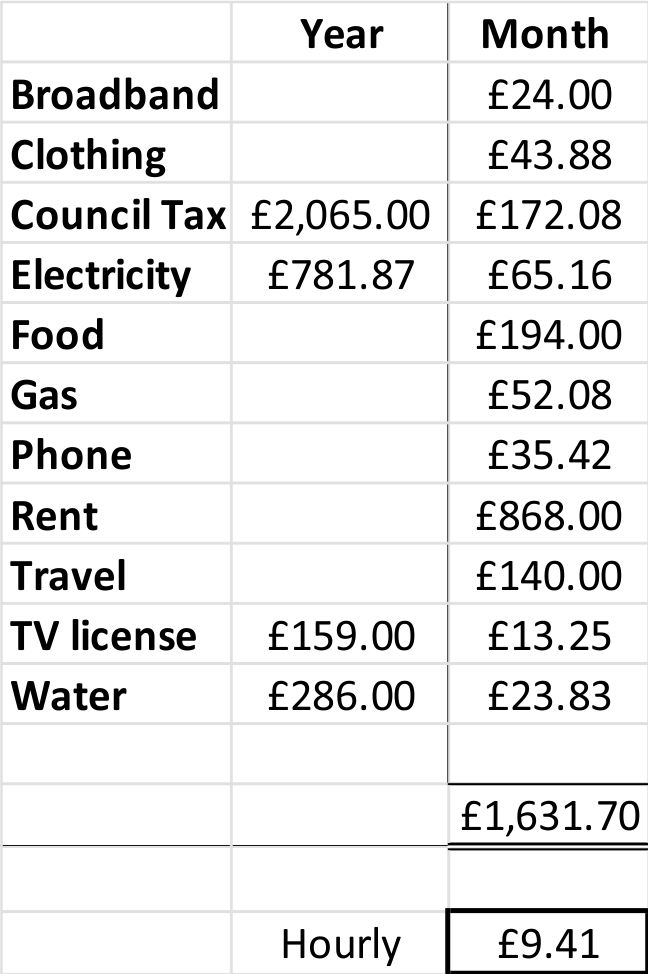
On an Excel Spreadsheet, I set out a list of all the key expenses that a single person would need to cover – without the added extras like holidays and big beer accounts. I looked up all the relevant figures for the average spend if you are a single person, and then did the maths to work out how much a single person on a basic, minimum or living wage needs to earn every hour, without deductions, to cover those costs, for themselves.

Initially, this was the point where I had that moment and thought ‘Are these people actually right: Do they have a point?’.

The figure I reached, based on a person working a 40 hour week, was £9.41, which with a National Minimum Wage rate of £10.42 per hour, would mean that person would have £1.01 per hour SPARE, if they were only on Minimum Wage.
But then I thought a little more.

As I said, my sums for these figures is based on the accepted average costs for travel, utilities, phones, food, clothes, rent and all you need, adds up to the grand total of £9.41 per hour, for a 40 hour week.

So, the reality that this calculation indicates a single person on a Minimum Basic Wage has £40.40 SPARE per week, certainly made me understand where our public representatives find the confidence to talk down at the poor and vulnerable with conviction that really can only come from believing they are right.

But are averages real? Do average expense costs really reflect what it costs a single person on a low income to live in the UK today?

I’m afraid, I certainly don’t think so. And I’m not going with the idea that because a politician or a public figure says so, it must naturally follow that they are automatically right!

The Real Living Rate

Averages are all well and good. But in my experience, they don’t redirect real life.

So I started all over again and this time, applied the figures that I believe to be accurate as a minimum expense so that I could see just where the real world experience of what it costs an everyday ‘normal’ person lies.

Here is how I did my working:

You’ve probably heard the phrase ‘lies, damn lies and statistics’. (Mark Twain or Disraeli?) And whilst there will always be a need for reliable data, the rather obvious truth is that average data can be completely skewed by just one figure that is disproportionately different to all the others.

However, that difference can very easily be big enough to suggest that the average is very different to what it actually is.

Having studied Statistics at A-Level many moons ago, the wide portfolio of statistical methods available to present data is mind boggling.

But within that spectrum of options also comes the option to use methods which serve the interests of biases of the researcher or whoever is paying for the research, by manipulating the data so that it looks very different to what it really is.

From this standpoint alone, real world experience is likely to be a much better guide. One that demonstrates for factors such as transport costs for a single person, commuting across a city using buses shows the costs of travel are likely to be significantly different to the many others who live in rural areas or even market towns where it cannot be assumed as practical to use a bus as there is limited public transport and normal life requires the use of a car.

Just as important is the reality that costs like broadband and phones aren’t just as simple as a connection and a basic handset.

Today’s culture revolves around smart technology. The reality is that for anyone of working age, limited access to tech means limited access to work – as it does increasingly in every other sense. The argument that nobody needs the latest iPhone simply doesn’t fly – especially when very few people buy them outright and pay an overinflated purchase cost over a period of perhaps 24-36 months.

If you feel prickly about the idea that someone classed as poor is ‘fully connected’, please ask yourself if you would feel disadvantaged if you were to give your phone up?

Finally, and perhaps most controversially, I’ve added what I’m going to call the Pleb Premium at 10%, with this figure representing the extra that people who have very little get charged because of the ‘perceived risk’ that poor people represent (To those who really should know better).

What I found was quite alarming and suggests that the real rate of the National Minimum Wage in October 2023 should be no less than £14 an hour (based on a 40 hour working week)!

More troubling is that in relation to current living standards or rather what is culturally deemed acceptable or even expected, these figures may still be some way lower than what it would take for a single person to support themselves fully, without the need to go into debt or call upon the charity or support of a third party or the benefits system.

And if these figures don’t make you gasp, they probably should.

One of the most challenging phenomena about the current cost of living crisis is the suggestion that people on the average wage – currently just under £28k, cannot afford to buy food.

If you consider that a 40 hour week at £14 per hour, adds up to an annual salary of just over £29k, you will understand that this leaves even the average wage earner over £1000 a year underpaid or £20 a week short.

So, never mind being only £20 a week short. What does it look like if you are expected to be happy that you are being paid the National Minimum Wage at £10.42 per hour for that 40 hour week?

In basic terms, on National Minimum Wage today, set against the figures suggested here, you would be underpaid by £3.58 per hour, £143.20 per week, or by £7,446.40 per year.

Go figure.

This blog was originally published on 31 October 2023. It was adapted for PDF publication on 29 October 2026, and a new image was added. No changes were made to the original text.

It’s what a politician thinks of and does for the person they least identify with that really matters for Fairness, Balance and Justice in Government to exist

Diversity, alternative Political Philosophies and differences in Politics don’t promote or guarantee fairness and balance.

Anyone appointed to a position of influence and authority because of the physical, material or ideological difference they have with others is more likely to prioritise those who they most closely identify with – or for want of a better term, prioritise the interests of ‘those of their own kind’.

The benchmark of any system of government and the political system that facilitates or leads it being truly representative, Fair, Balanced and Just, is what the politician or political decision maker does on behalf of the person they know least about, have least in common with or are least likely to understand.

A system of government cannot and will not work in the best interests of all, if it doesn’t consider and treat fairly, justly and without bias of any kind, even the very people we might consider that we have every reason want excluded in some way or to despise.

If you have read this and immediately think of someone or some group of people that you feel to be undeserving of the same care and consideration that you for yourself would like, you can now use that feeling and emotion to understand how any system of governance and politics will quickly be undone.

This Blog is part of the e-book ‘The Way of Awakened Politics for Good Government’.

The introduction of Price controls on foods, goods and services may become essential as this cost-of-living crisis develops. We would be fools to rule out rationing becoming necessary too

Yes, it does feel a bit like being the voice of doom and gloom as I write and produce videos about all the things that are going on and talk about what we can realistically expect as being likely to happen next.

The point is, that if someone like me can see what is happening and what is likely to happen next, the people we have elected as MPs have absolutely no excuse not to do so too.

In fact, our public representatives should be well ahead of the curve in both their horizon scanning and thinking than most.

Regrettably, they are not.

To be fair, the complexity of the growing problems and how each and every one of them interacts with the others is mind bogglingly scary to say the least.

Yet it is the culture of ‘let’s always take the easy option’ that exists, top to bottom within the British Political System, that has made the difficulties that are only just starting for us, significantly worse.

There are many people in this Country today who cannot afford to feed themselves, home themselves, clothe themselves, transport themselves or function normally in any way on the wages or income they have, without debt or benefits – or what is really a subsidy from the Government and therefore everyone else in some way.

Prices of the foods, goods and services that provide the basic essentials for life are spiralling out of control. Living at the standard we are experiencing even today, will soon become unaffordable for most.

Yet the complexities I mentioned above, all come back to just one thing: That the economic system we have today has been developed to benefit the self-interests of the few. That those driving it have continued to push prices up in the pursuit of ever-growing profits for as long as our stupid politicians have printed money and kept handing it out. When instead good politicians would have faced up to reality and dealt with the problems for wider society that have been caused by that same greedy few.

The Covid Pandemic has caused out of touch politicians and greedy business and financial leaders to overplay their hand.

In fact, the inflationary spiral they have created together is now out of reach of any form of control they possess. Indeed, the only actions our politicians have to address the issues are only serving to make the whole problem worse.

Events, or a coming chronology of them – which will have been caused by so many different profit-driven people with influence behaving in the same way, will combine to make basic food unaffordable where it is available. It will be absent from the supermarket and shop shelves where it would otherwise be not.

Food riots, as the system collapses and the old order makes way for a new one that will work for all will settle the mind of many. Especially the politicians that we have for the time that their waning power remains.

Greed, hoarding and any kind of self-driven prioritisation will have to go out of the window.

That will mean supermarket rationing as we experienced during the early Lockdowns. There will be an immediate need for Government to step in and fix prices along the entire food and essential goods supply chain, so that nobody can use this time of crisis to profit off the backs of us all.

Some of the more economically minded will baulk at the idea of any kind of price fixing, price regulation or price controls, because of its non-capitalist and non-market-friendly nature.

But the reality is that the epoch of easy money and making massive profits by exploiting the many to benefit the already bloated few, is now reaching its end.

A new system will emerge that will be fair to all. But it will not resemble anything that we’ve seen or experienced before.

As we walk the pathway to get there, it will be necessary to ensure that what we still have available – which will plenty for all of us without the influence or intervention of ongoing greed – will be made available fairly to all.

Money as we know it is likely to become only one of many different ways to make payment as change takes place. And it is therefore just as likely that rationing of the essentials that are available will also be necessary for everyone.

The times ahead may prove to be painful. But it’s the future which is possible for everyone once the change has been completed that we should look forward to.

The opportunities for a fair and just way of living, where everyone and everything matters are not just a pipe dream. They really exist and are there for us all.

After the pain, we have much happier times in store.

Qualified academically or not, we are all capable of greatness or of being complete and utter fools

Qualified academically or not, we are all capable of greatness or of being complete and utter fools

As humans, we love difference. We love it so much that we use it as a way to qualify other people by colour, gender, sexual orientation, financial and material wealth, social background, taste, appearance and in many other ways too.

Many of the benchmarks we carry within our own personal make‑up, as we attribute value to others, are unconscious or, to the world outside us, completely hidden.

The fact that we make these judgements behind closed doors means that no matter how hard do‑gooders attempt to legislate or control our behaviour, controlling other people’s thinking at a personal or private level is a battle that even the most politically correct amongst us will never win.

The obsession with qualifying others

We have become obsessed with legitimising our qualification of others when it suits us. Society provides markers intended to help, yet we use them to create differences that stand far outside their original purpose.

For a long time, academic qualification has increasingly been used as the preferred way to distinguish ability, attitude, application, intelligence and countless other traits. To the audience, these markers become a convenient way to judge whether someone is “qualified” or not.

By bypassing the cold, hard reality that academic qualifications – whether GCSEs, A Levels, Degrees, Masters or PhDs – are simply benchmarks created in someone’s (usually an academic’s) thoughts, the elephants of our society have fallen head over heels into the trap of believing that academic standards portray the genuine quality or value of every individual. They do not.

Angela Rayner and the cruelty of perception

Yesterday, we witnessed these maleficent social anchors at their worst, when Shadow Education Secretary Angela Rayner was ridiculed for having what are considered to be four very poor GCSEs and, academically speaking, no more.

Whilst Labour and their principal spokesperson for Education demonstrate little credibility in terms of the policies they have been putting forward with an eye on the upcoming General Election at their Party Conference this week, there are few of us outside Westminster who could list on one hand the number of politicians from any Party who we could hand‑on‑heart consider credible in fulfilling their roles properly and representing the people well.

Perception is everything – particularly when it comes to the influences on our thinking and lives played out on social media and TV.

Just because an MP or politician looks good on camera, comes across as confident, sounds competent or can boast an academic CV that includes Eton, Oxford or wherever it may be, the reality may be – and in many cases is – that they are not “qualified” by being any such thing.

The lost value of real‑world experience

We have learned, and increasingly been conditioned against, the value of life experience and the practical understanding of people, business, community, and the views that time in the real world brings.

We have reached a stage where we look for things that make high‑profile people stand out for all the wrong reasons, mistakenly thinking those reasons are right.

There is rich irony in the fact that it was the Labour Government of 1997–2010 that pushed qualification bias to its extreme by suggesting that everyone should have a degree.

This malignant and ill‑conceived step has contributed to the biggest shift in perception about what qualifies a person. It has pushed us further away from regarding each individual as equal and the same.

The consequences of commercialised Higher Education

The meddling of Angela Rayner’s political predecessors bears much responsibility for the commercialisation of Higher Education. The rancid truth is that many young people have been condemned to financial servitude by a past Labour Government, encouraged to take degrees that nobody in industry values.

Others are being left behind simply because they are excluded by a system that frowns upon anyone not academically inclined, or because they know that a lifetime of debt is not something they can realistically afford.

Education, in its real sense, is only partially academic. No matter how any person is educated, they are equally capable of greatness or of behaving like fools. The suggestion that people are only capable of anything great if they have good academic qualifications is fundamentally flawed.

A better way forward

When we finally have a Government led by politicians who are responsible and not so easily led, the hard decisions over how we educate and support our young people will be addressed properly.

The focus will return to the basic reality that as teenagers, we are pretty much all either “heads” or “hands”. Once we value the fact that not everyone in their early teens is ready or able to spend another seven years in books, we can get back to providing real parallel educational – not academic – pathways.

Developed properly with business, and with the opportunities that Leaving the EU will give us, rewarding lives for people – whatever their background or birth – will, for many more of them, be fully assured.

Degree level entry for all Police Officers is a retrograde step which will push a common sense approach to policing even further away down the bureaucratic queue

With everything happening across the political and public sector world feeling so very uncertain already, it will have come as a surprise to many that the Government has allowed the College of Policing to announce that candidates wishing to become Police Officers will be required to have Degrees from 2020.

The reasoning cited behind this move is the increasing level of activity within the role including the research which Police Officers are required to undertake online. But is this itself really justification enough to raise the bar to an occupation and public service which in recent years has been a key target to become a lighthouse of diversity?

Information Technology and ‘web fluency’ levels are arguably highest within the generation now reaching the workplace at 16 and above – irrespective of the level of formal education they have attained, simply because use of smartphones and PCs to access the web has now reached a point of social permeation where children are culturally conditioned in their use. To suggest otherwise would arguably demonstrate just how seriously out of touch our policy makers have now become.

Cyber-crime has become increasingly prevalent. But it has not in any way superseded the need for real-world policing, which has itself become painfully absent in recent years as a mix of bureaucracy and the public sector funding crisis have hit the Police Service very hard indeed. The widespread perception exists that the physical presence of our Police forces have now dwindled to a point where it would logical for us to ask if our communities are really safe.

The concept that more can be delivered using less is one that is now followed in every sector. In some cases there are significant efficiencies that can be made within organisations of all descriptions, particularly when new technology can reduce the workload or requirement of staff numbers. However, this is not without consequence as the current raft of strikes in the UK have arguably displayed. There is also a significant question to be addressed regarding these economies being made when the financial benefit has become the priority over the experience of the customer or members of the public.

Like many, I grew up with a respect for the Police which is increasingly hard to justify, given the level and type of interaction which Police Officers and Police Community Support Officers now have within the community. The focus on a system of delivery where you once felt that a Police Constable really did have autonomy as they enforced and represented the Law appears to have long since left the building. It appears to have been replaced with a bureaucratic nightmare where Officers now have to look over their shoulders before they decide either to engage or to act.

It may seem romantic, but an age where a Police Officer didn’t have to resort to making arrests or presenting Court Summons to achieve a real-life result with ‘petty crime’ was not so long in the past. Yes, these Officers of the Law did not have to chase their quarry online, but they also engaged with would-be criminals in a much more meaningful way. One which was adapted to the specific circumstances they were addressing and did not result in so many young people being tarred by acts of stupidity which with the arrival of the net itself, have become far too accessible to the people looking for controversy who need no degree to go searching for any mud that can easily be used to stick.

Most of those less senior Officers had very little formal education. But what they did have was life experience and common sense by the bag load; the essential ingredient for constructive interaction with people of all levels and of all kinds.

Being ‘streetwise’ isn’t something that can be taught from a text book. One of the simple facts that the College of Policing may be seriously overlooking, is that degree level students want to earn their money straight away. University leavers will not have the world view or wherewithal that the public should be able to expect any Police Officer to have, whilst waiting for the graduates who would make ideal police officers to gain experience in other occupations first may prove to be a fruitless exercise given that they will probably stay in other safer, more lucrative and perhaps even more rewarding careers if they have by then already found them.

Police Officers in the UK already undergo extensive training to support them in their roles, and extra modules to support non-specialist officers to fit their IT skills to the purposes of our Law enforcement regime would be no quantum leap for those who have qualified for entry by today’s terms.

Sadly, this move towards elitism within the Police Service has all the hallmarks of taking one very large step in the progress of bureaucracy too far and risks disenfranchising communities from those in power beyond that too.