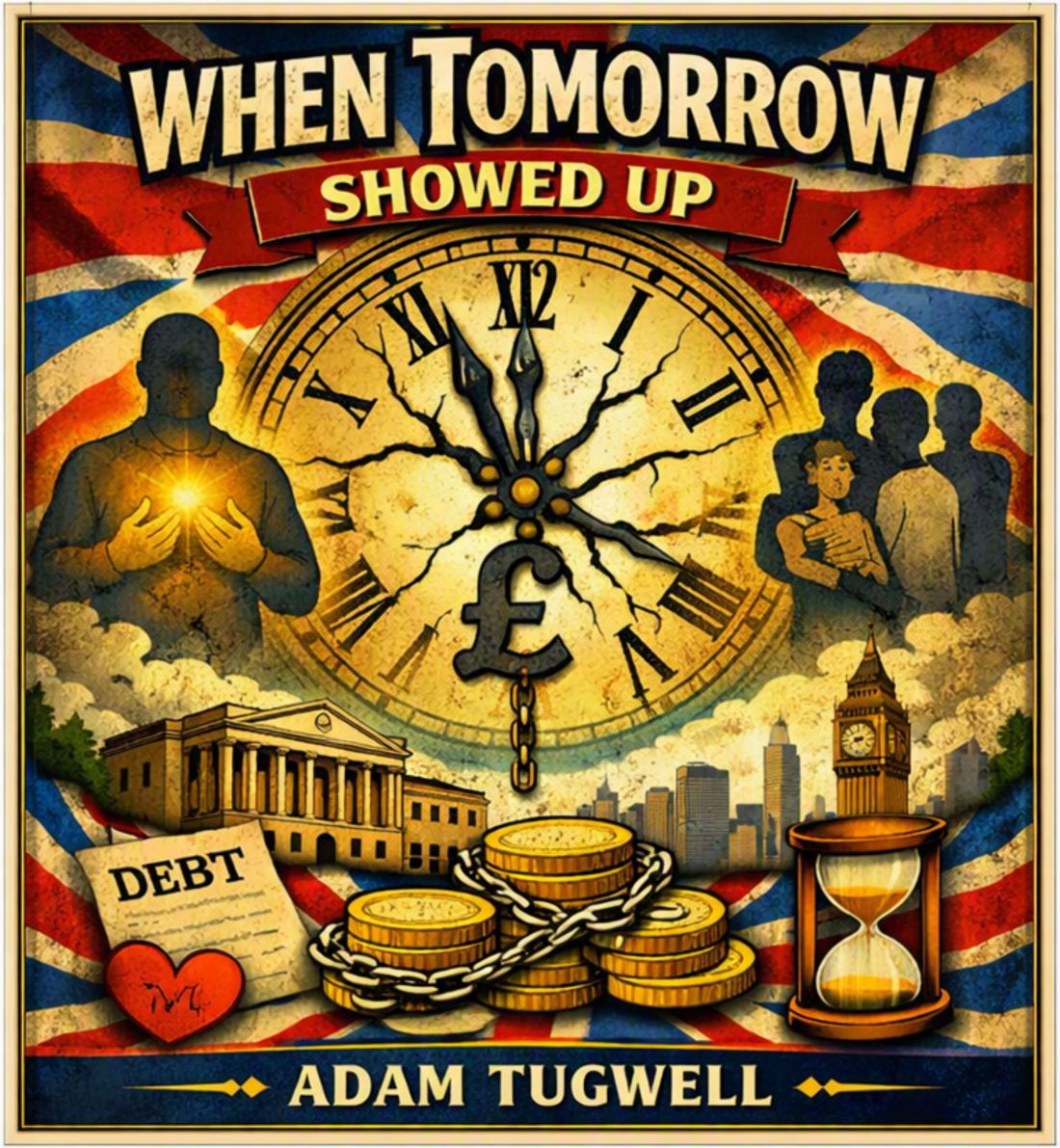
When Tomorrow Showed Up

A story about money, integrity, and the bill we keep passing on to people who haven’t arrived yet

‘The process by which banks create money is so simple that the mind is repelled.’
– J. K. Galbraith, Money: Whence It Came, Where It Went (1975)

One: The Problem for Tomorrow

Everyone has at least been tempted to delay, put off or put on hold a problem when it feels like there is actually a choice. We know, deep down, that we aren’t helping ourselves when we do this, especially if there is an unknown or unpredictable outcome involved – which is probably why it feels so appealing, if not easy, to literally put it off for another day.

Think of the letter that sits unopened in the drawer. The damp patch on the ceiling that we tell ourselves we’ll get looked at in the spring. The conversation we rehearse in our heads a hundred times but never quite start. None of these problems go away because we stop looking at them. If anything, they quietly grow.

So, let’s imagine all the things we would like to put off. To not deal with. Those things that will have a price once dealt with or acted upon, which it would just be nice to leave behind and pretend that they, or the need to address them, simply don’t exist. A difficult message to a loved one? A truth about a new partner to a friend? A relationship or friendship that it would feel better not to have to tell someone in particular, or anyone else, about? The list could be endless if we think about it, and what all these things have in common is that they are about things like honesty, integrity, respect, care and consideration for others – or, collectively, what we might call doing the right thing.

My guess is that most people reading this will have experienced a situation like this at least once in their lifetime, if not on a number of occasions. I know I have.

Something these things always seem to share is that the longer they are left alone or remain hidden, the greater and more far-reaching the consequences of waiting become – particularly if the truth comes out without it being our choice to tell it.

Because a problem left for tomorrow doesn’t sit still. A small untruth needs a second one to protect it. A debt left unpaid gathers interest. A crack left unfilled lets in the water that widens it.

The cost of putting something off is almost never the same as the cost of dealing with it. It is almost always bigger – and it is very often paid by someone other than the person who chose to wait.

The funny thing is that when we don’t make that choice – when we know we could keep quiet, hide things or put the consequences off, but we do the right thing at the time anyway – these things have a habit of working out for the best. There is a moral pay-off, even when there isn’t a material one.

Now imagine something much bigger. Imagine finding a way of doing things that brings a massive reward, with the potential to provide many more – and, this is the important part, a way that means, if you are clever and stick to some boundaries and rules, any reckoning can be put off not just for another day, but for so many days that it might never be a day that you, your children or even their children will have to face. The ultimate problem for tomorrow. All you would have to do is make sure everyone keeps playing by the rules – even if they don’t know the game that’s actually being played.

Do that, and you might never have to face it at all. Nor would anyone you appointed, or anyone appointed by those who followed – because most of them wouldn’t even know…

Two: When Nobody Is Watching

What I am really talking about here is doing the right thing, even when nobody is watching. There is a word for that: integrity. Funnily enough, integrity isn’t the main subject of this story. But it sits underneath every part of it, and if there is one thing I would ask you to take away, it may well be this.

Integrity is easy when people are watching. The real test comes when we know we could get away with something – when the consequences won’t land on us, or won’t land for years, or will land on somebody we’ll never meet.

So here is a question to carry with you. If it would be wrong for one person to quietly push the cost of their choices onto someone else, does it become any less wrong when it is done by a bank? Or a government? Or a whole society?

Does something stop being wrong just because it is done on a bigger scale, by more people, over a longer time?

Let me tell you a story that might help us answer it.

Three: The Banker

Imagine, if you will, a man who works in a bank. Not one of the friendly faces behind the counter at your local high street branch, always sounding lovely as they reset passwords and talk new customers through everything they’ll need. He works at a bank with a name you often hear newsreaders mention in the same breath as markets, economics, how public borrowing is going, and jargon like GDP.

He isn’t just someone crunching the figures or talking to the media about monetary policy. He is one of the people with whom the buck really stops – deciding what is done with the bank’s money, who it lends to, what bonuses are paid, how much help is given to others, and of course who those others will actually be.

I’ll simply call him the Banker.

The Banker has everything he wants. But he would like to have more, and to be able to do bigger things – things that have a much bigger pay-off than before.

All his time in banking has taught him how money makes people think and how it makes them behave. He knows all the formulas that sit behind the psychological levers of money – whether someone is rich or poor, a business or a government, and whatever it is they need money for.

Before we go on, pause for a moment. If you were him, and you knew what he knew – what would you do with it?

Four: The Secret

Because he knows everything about money, and how every part of the system that surrounds it works, the Banker has worked out what people will believe about money – or are willing to believe.

And that means he could literally create more of it. So long as the people who weren’t in on the secret still believed that the money in their hands was exactly the same the day after he changed the system as it was the day before.

Most people, then and now, picture money as a thing. Something solid, kept in a vault, once backed by gold sitting in a basement somewhere.

For a long time that picture was at least partly true: a pound or a dollar was a promise that could, in theory, be swapped for something real.

But the Banker knew the picture didn’t need to be true. It only needed to be believed.

The magic of creating money from nothing rests on creating a debt that isn’t really owed to anyone – but which he knows will be repaid, because he is confident that anyone he lets into the secret, or lends this new money to, will always pay it back, in a way and on a timeline where nobody need ever know that this new way of doing things exists.

And it is astonishingly simple. When the Banker approves a loan, he doesn’t go to a safe and count out notes that someone else deposited. He simply types a new number into the borrower’s account.

That money did not exist a moment before. There is no lorry delivering it, no vault opening, no gold changing hands. There is only a promise to pay it back – and that promise becomes money. When the loan is repaid, the money quietly disappears again.

He calls this money creation ‘credit’ for short. And he imagines all the things that could be done with an almost endless supply of it, and all the people who could be helped – as long as it is legal, and as long as one golden rule is kept: never create money that could not have come from a ‘normal’ route, over what would be considered a ‘normal’ period of time.

Which raises a question worth sitting with. If money can be created simply by a promise to pay it back, what is money, really?

And then, what happens if the promises start to grow faster than the real things – the homes, the food, the skills, the work – that the money is supposed to stand for?

Five: Bringing Everyone on Board

Rules won’t be a problem, the Banker reasons. If the people who actually run the country are brought on board, they will benefit from the new system too, because it will make it a lot easier for them to do whatever they want to do – as long as they play by the same rules of money creation, and change whatever rules and laws need changing to make it all legal.

‘We can give money to whoever we decide,’ he tells himself, ‘and nobody will ask where it comes from, because we are the banks. Nobody will see what’s really going on, as long as we play it right.’

So the Banker, and a few other bankers who share his world view and understanding, decide to go ahead. They bring in the people they need, all of whom benefit in some way from being on board – politicians who can suddenly pay for the things that make their lives easier, other bankers who are paid well, and key business people who know their stuff and can be trusted to pay back on time.

‘With the power we have,’ they agree, ‘we will be able to make whatever adaptations we need to do what we want – as long as we keep it real.’

Of course, money has a different effect on different people – especially when power and influence are involved – so, as the scope and dark brilliance of the new system rolls out, frameworks are put in place to make it all look responsible.

‘We will police the system by creating credit agencies,’ the Banker decides, ‘and as time goes by we will be able to judge everyone’s credibility by the records we keep on them.’

It would be easy to make the Banker a villain. But I don’t think that would be fair – and it would let the rest of us off far too lightly. Schemes like his are rarely born out of pure greed. More often they are born out of a problem that seems too big to solve any other way. A war that has to be paid for. A country that has to be rebuilt. A crisis that won’t wait. It is no accident that the Bank of England itself was founded, back in 1694, to lend money to a government that needed to fight a war.

And at first, it works. Roads are built. Homes are bought. Businesses start that would never otherwise have got off the ground. Wars are fought and, in some cases, won.

If you’re honest, you might even be on the Banker’s side by now. What’s the problem? It sounds brilliant.

Which brings us to one of the oldest moral questions there is: can something be wrong if the outcome is right? If the secret bought a victory, a recovery, a generation of prosperity – does the way it was done still matter?

Hold on to your answer. We will need it later.

Six: The Golden Rule

Everything depends on the golden rule: never create more money than could have come about by a ‘normal’ route, over a ‘normal’ period of time.

In other words – never let the promises get too far ahead of the real world.

I think it is quite possible that the Banker kept to that rule. He may have been confident – perhaps over-confident – but he understood what he had made, and why the limits mattered.

For anyone with a strong sense of what is right and what is wrong, it’s difficult to fathom the idea that money can be created literally by saying ‘this money now exists’ – especially if you’ve never had a lot, and have perhaps struggled to make ends meet with what you had.

But for those who have grown used to money, and comfortable with it, the morality looks very different.

And a rule like the Banker’s has a weakness built into it. It relies entirely on the restraint of whoever comes next. And whoever comes after them. And whoever comes after them.

Can you build a system that relies, forever, on the self-control of people you will never meet?

Seven: Passing the Baton

It started out well. The key was to stick to the rules. But the Banker, who designed the system and understood its limits, saw it very differently from those who came after him and had never known anything else.

The secret – or rather the open secret this system always really was, hidden only because so many people still thought all the money flowing around was ‘real’ – was passed like a baton from one generation of beneficiaries to the next. And with each handover, the new hands lost a little more sight of what was needed to keep it all under control.

Think about how a habit forms in any family or organisation. The first generation makes an exception, for a good reason, in a time of need. The second gets used to the exception. The third mistakes the exception for the rule. And the fourth cannot imagine there was ever any other way.

By the time the baton reaches that fourth pair of hands, nobody is asking whether the system is right any more. They are only asking how to get more out of it. And most of them aren’t bad people. They are doing exactly what they were trained to do, in the only system they have ever known.

The Banker’s successors started to believe it would be possible – realistic, even – to pay for whatever they wanted, especially if it gave them greater control over the profits and incomes they could then use to pay the ‘debt’ from the ‘credit’ back.

Around the 1980s, they found a philosophy to match. Economists today often call it neoliberalism, but at its heart was a simple belief: that markets, left free to buy, sell, compete and borrow, would always make better decisions than governments or communities could.

So industries that had been built and owned in common were sold off. The rules on banks and borrowing were loosened. Money was set free to go wherever it could earn the highest return, as fast as it could get there.

Put that belief together with the Banker’s secret, and something powerful happens. Money stops flowing mainly towards the things a community needs, and starts flowing towards whatever makes more money fastest.

And the question nobody inside the system seemed to ask was the simplest one of all: what happens to the places, the jobs and the people that the money flows away from?

Eight: The Hollowing Out

Unfortunately, whether by design or by accident, having control over what so many people see as real wealth also made those at the centre of the system, and those they helped, blind to consequence – blind to what money that is only believed to be real actually does when everyone who believes in it behaves as if it really is.

Over time, everything was hollowed out. People’s lives, communities and the environment were all hollowed out, and the value they once held was replaced by that giant IOU called credit. It took away the real value and left behind an extraordinary form of human debt: the loss of being able to identify with, and relate to, who we all really are.

That hollowing out rarely makes the headlines in one go. It happens a little at a time.

A family firm that has made things in the same town for eighty years is bought with borrowed money – and the debt used to buy it is loaded onto the firm itself. The buildings are sold and rented back. The profitable parts are sold off, the pension fund is squeezed, and what is left is closed when it can no longer carry the weight.

In the City, it is called a successful deal. In the town, a trade that took generations to learn disappears in a couple of years.

Homes stop being places to live and become places to put money. Prices rise faster than wages, year after year, because it is easier to lend against a house than to build a business. The parents who bought a home on one wage watch their children struggle to rent on two.

Water, energy, railways and the other things that were once built and owned in common are sold, borrowed against and run to produce a return. When the pipes leak, the rivers suffer and the bills rise, the debt is still there – and someone still expects to be paid.

The high street empties. The skills leave. The young people leave. And slowly, a place forgets what it was for.

None of this shows up as a debt on anyone’s bank statement. But it is a debt all the same. And from very early on, it was the people at the bottom of the ladder – the workers, the small towns, the communities with the least say – who paid it first, and paid it in full.

The debt was never only financial. The real bill was paid in lives, in places, and in the world around us.

Nine: The Stories We Were Told

At some point, the people doing well out of the system must have noticed. Not all of them, and perhaps not all at once.

But you cannot close that many factories, sell off that many shared assets, or watch that many town centres empty without someone, somewhere, beginning to ask questions.

And this is where the story becomes less about money and more about people. Because when a system that everyone depends on starts to show its cracks, the easiest thing to do is not to fix it. It is to explain it.

So we were given stories. That the jobs went because of technology, or global competition, or because people simply didn’t want to work. That the money had run out because of whoever was easiest to blame that year. That if prices rose, it was always someone else’s fault. That the answer to too much debt was more debt. That growth – measured by a number called GDP – would sooner or later lift everyone.

Some of those stories had grains of truth in them. Many were told by people who honestly believed them. But they all had one thing in common: they kept attention away from the system itself.

When the whole thing nearly fell over in 2008, it wasn’t allowed to. The banks were rescued. Then the central banks – the Bank of England among them – reached for the Banker’s oldest trick on the grandest scale yet. They created hundreds of billions of pounds of new money and called it ‘quantitative easing’.

The new money was used to buy up government debt and other assets, holding interest rates down and propping up prices. It kept the system going. Many have argued that it also made those who already owned property, shares and other assets a great deal richer, while those who owned nothing watched the things they needed slip further out of reach.

By then, some economists had begun to say out loud what the Banker had always known. A school of thought called Modern Monetary Theory argued that a country which creates its own currency can never simply ‘run out’ of money the way a household can – and that the real limit on what it can do isn’t money at all, but real things: people, skills, materials, energy and land. Push beyond those, and prices rise.

Whatever you think of that idea, notice where it lands. Even the theory that says money itself isn’t the problem agrees that real things are the limit. And real things – the skills, the industries, the communities, the land and the environment – are exactly what had been hollowed out.

You can create money from nothing. You can’t create a lost trade, a living river or a community’s sense of itself the same way.

Underneath it all sat one belief, so comfortable that it rarely needed saying out loud: that this is a system where everyone can have whatever they want, and worry about paying the bill later.

Of course, nobody can. Not a person, not a bank, not a country. A system that only survives by bringing in ever more borrowing to pay for the promises it has already made starts to look uncomfortably like a giant Ponzi scheme – and the thing being borrowed against, in the end, is the future itself.

Ten: Where Has All the Money Gone?

Over time, governments became completely beholden to the system too. Their success was measured by GDP – a number that counts how much is bought and sold, not whether life is getting any better. And when they needed more money than they raised in taxes, they borrowed it by selling bonds – in Britain, they are called gilts. A gilt is simply an IOU: lend the government money today, and it promises to pay you interest every year and give your money back on a set date.

Those IOUs are held by banks, pension funds, insurers and investors at home and abroad – and, after all that quantitative easing, by the Bank of England itself. Every year, interest has to be paid on every one of them.

It was only when things had gone so far that a once-rich country like the UK could no longer afford to do the things it used to do that ordinary people began asking the same question: where has all the money gone? And if we are now paying more in interest on what the country owes than we spend each year on educating our children – where do all those interest payments actually go?

The answer is simple, and uncomfortable. A large part of it goes to those who already hold money – paid for by those who do the work, through their taxes, through public services that no longer stretch as far, and through all the things that quietly stop being done.

Which brings us back to where this story began. Who decided this was a problem for tomorrow? And who did they think would be standing there when tomorrow arrived?

Eleven: When Tomorrow Showed Up

You may have realised by now that this is where – exactly where – we are right now.

The Banker’s story was never really about one banker. It is the story of the money in your pocket, the mortgage on your home, the pension you are counting on, and the country you live in. It is the story of the system we were all born into – the only one most of us have ever known.

And tomorrow didn’t arrive with a bang. There was no single day when the bill landed on the doormat. It arrived the way the damp patch on the ceiling does – slowly, and then all at once.

It arrived as a generation that cannot afford a home. As the potholes, the closed libraries and the waiting lists. As towns that have forgotten what they were for. As rivers that are no longer safe to swim in. As wages that buy less every year. As a growing sense, shared by people who agree on almost nothing else, that something has gone badly wrong – and that nobody in charge will say what.

And here is the cruellest part. The bill isn’t calculated in pounds. It is calculated in lost skills, lost trust, lost places and lost time. It can’t simply be refinanced, rolled over or printed away. The problem was never really put off at all. It was only passed on – to whoever happened to be standing there when tomorrow came.

The future has no vote. That is exactly why it was so easy to spend.

Twelve: The Greatest Crime of All Time?

So was this a crime? Perhaps even the greatest one of all time?

It is tempting to say yes, and to go looking for the people to blame. But remember how this story started.

Maybe the Banker had a genuine problem to solve. Maybe he kept to his own rules. Maybe most of those who followed him were decent people doing what they had been taught, in a system they never designed and never saw from the outside.

None of that makes it right. A harm doesn’t become acceptable because nobody meant it, or because it was spread across millions of hands over a hundred years. If anything, that is what makes it so serious.

A crime with a villain can be punished. A crime that everyone took part in, and that almost everyone benefited from in some small way, is far harder to face – because facing it means facing ourselves.

Which leads to the most uncomfortable question in this whole story. If you have ever had a mortgage, a pension, a loan or a credit card – or simply lived in a country that borrowed to keep the lights on – where do you stand in the chain?

And remember the question I asked you to hold on to: can something be wrong if the outcome was right?

What is your answer now?

Thirteen: Doing the Right Thing

We started with the small things – the message we didn’t send, the truth we didn’t tell, the letter we left in the drawer. And we said that the longer they are left, the bigger the consequences become, especially if the truth comes out without us choosing to tell it.

The same is true here. Tomorrow is already knocking at the door. The only real choice left is whether we open it ourselves – honestly, together, and with our eyes open – or wait for it to be kicked in.

Doing the right thing, even when nobody is watching, starts with being willing to look. To ask where money really comes from, who it really serves, and who really pays. To value the things that can’t be printed – skills, communities, places, the natural world and each other – as the real wealth they always were. And to stop handing our problems to people who aren’t here yet to argue back.

That is what integrity looks like when it is scaled up from one person to a whole society.

It isn’t easy. It never was. But as I hope this story has shown, the alternative was never really easier either.

It was only later.

Tomorrow has shown up. The only question left is what we do today.

Afterword: A Note on This Story

The Banker is not a real person. He is a way of telling a story that is far too big, and spread across far too much time, to be told any other way. He stands for the many people – bankers, politicians, officials and business leaders – who built, inherited and ran the monetary system we live with today.

Some of the details are simplified. Some of the steps may have happened in a different order, and some may have happened by accident rather than by design. Many of them were taken – and are still being taken – by people who have never seen or understood the monetary, financial and economic system in any other way. None of that changes the question at the heart of the story.

This was never meant to be an economics lecture. You didn’t need to know what a bond is, what fiat money means, or what anyone means by MMT or neoliberalism to follow it – and if you didn’t before, I hope you have a clearer idea now. What I hope you take away is a single question, and that you keep asking it: is this a problem for today, or a problem for tomorrow – and who decided?

Questions to Carry With You

For your own reflection, or for discussion with others:

  1. Does something stop being wrong just because it is done on a bigger scale, by more people, over a longer time?
  2. Can something be wrong if the outcome is right? Has your answer changed since you first met the question?
  3. If you had been the Banker, what would you have done with the secret?
  4. Where in your own town or community can you see the hollowing out? Who paid the bill – and who was paid?
  5. Which of the stories we were told have you believed? Which do you still believe?
  6. What would doing the right thing look like now – for you, for your community, and for the country?

A Few Words in Plain English

  • Credit – money lent to someone on the promise that they will pay it back. In today’s system, most new money comes into existence this way.
  • Debt – the other side of credit: what is owed, usually with interest on top.
  • Fiat money – money that has value because a government declares it to be money and people accept it, rather than because it can be swapped for gold or anything else.
  • Interest – the price of borrowing money; what the borrower pays the lender on top of the amount borrowed.
  • Bonds and gilts – IOUs that governments and companies sell to borrow money. A gilt is a UK government bond.
  • GDP (Gross Domestic Product) – a measure of the total value of everything bought and sold in a country in a year. It counts activity, not wellbeing.
  • Credit rating agencies – organisations that judge how likely a person, company or country is to repay what it owes.
  • Quantitative easing (QE) – when a central bank creates new money to buy government bonds and other assets, usually to keep interest rates low and the financial system running.
  • Neoliberalism – a set of ideas, dominant since around the 1980s, that markets usually make better decisions than governments, leading to privatisation and looser rules on finance.
  • MMT (Modern Monetary Theory) – an economic theory that says a country issuing its own currency can’t run out of money, and that the real limits are inflation and real resources.
  • Asset stripping – buying a business, often with borrowed money, and selling off its valuable parts for a quick profit, frequently leaving the rest to fail.
  • Ponzi scheme – a scheme that pays existing investors with money from new ones, and so collapses when the new money runs out.

Notes and Sources

  • The Bank of England was founded in 1694 to lend money to the government of William III, largely to fund war against France.
  • The end of the gold link: in August 1971 the United States suspended the conversion of dollars into gold, ending the last formal tie between the world’s major currencies and gold.
  • How banks create money: the Bank of England explains this in ‘Money creation in the modern economy’, Quarterly Bulletin, 2014 Q1.
  • Quantitative easing: the Bank of England’s asset purchases reached a peak of £895 billion between 2009 and 2021.
  • Debt interest and education: how UK debt interest compares with education spending depends on the year and on how each is measured. Check the latest figures from the Office for Budget Responsibility and HM Treasury before publication.
  • Epigraph: J. K. Galbraith, Money: Whence It Came, Where It Went (1975).
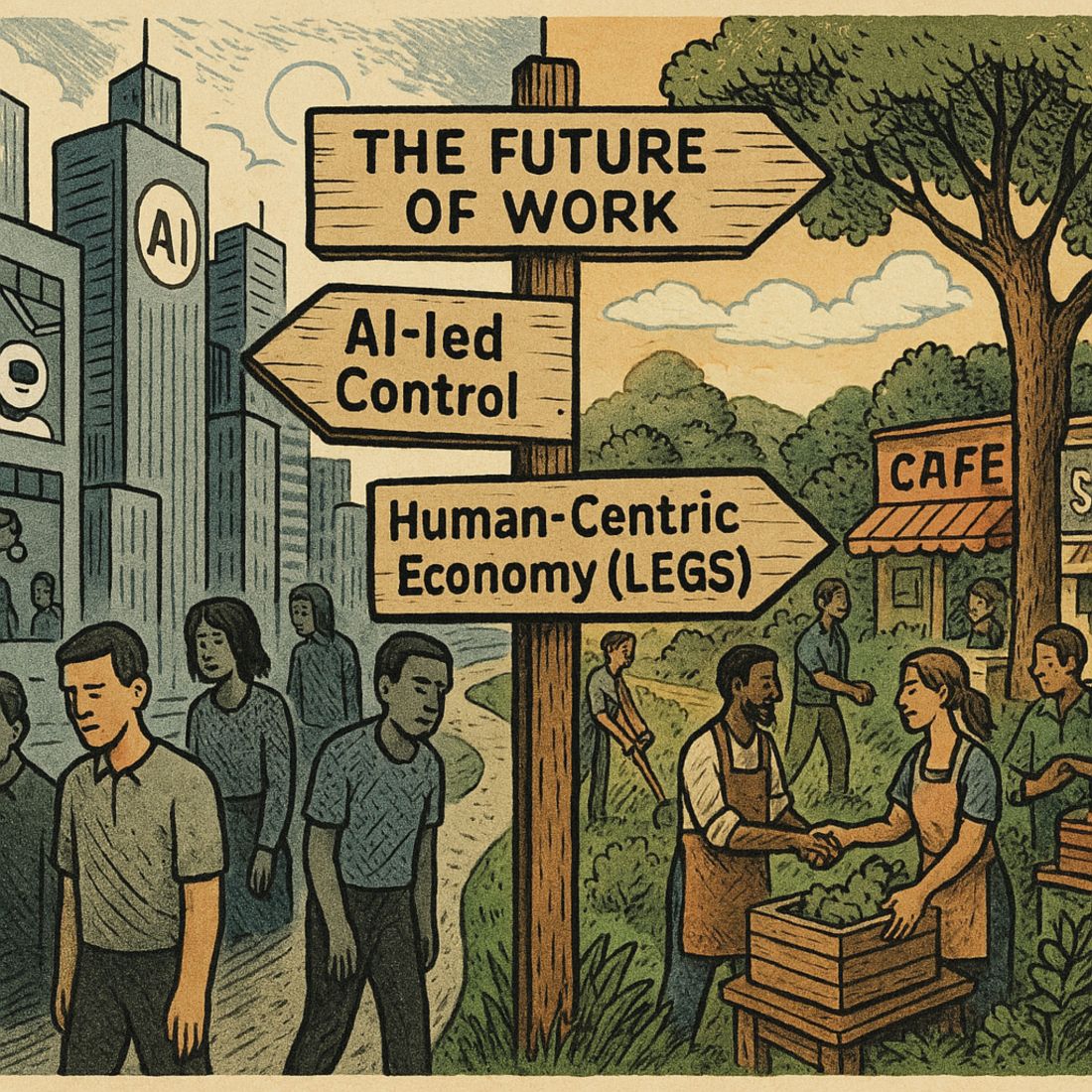
The Future of Work: Redefining Value, Meaning, and Human-Centric Employment in the Age of AI and Economic Change

AI’s Crossroads: Choosing a Human-Centric Future for Work and Society

Artificial intelligence is rapidly transforming the world of work, automating roles created by money-driven systems and exposing the fragility of an economy built on profit and status rather than genuine human need.

Without a deliberate change in direction, society risks deepening inequality, eroding community, and reducing work to a function of control and dependency.

The current trajectory, shaped by decades of economic and technological planning, threatens to devalue essential contributions and undermine the foundations of freedom and dignity.

But this path is not inevitable. There is an alternative: a future where work is meaningful, communities are empowered, and the economy serves people – not the other way around.

This work challenges the prevailing narrative and introduces The Local Economy and Governance System (LEGS) – a model for a human economy built on the basic living standard.

LEGS offers a practical framework for restoring value to real work, strengthening local governance, and ensuring that technological progress enriches lives rather than diminishes them.

The choice is ours: continue down the AI-led road of exclusion and control, or embrace a system that prioritizes human well-being, fairness, and genuine prosperity for all.

Rethinking Work in a Human-Centric Future

Beyond Money-Driven Roles

The work and employment of a better, human‑centric future will be real, tangible, and deeply meaningful. Unlike many roles today that exist primarily to prioritise the flow of money, this future will focus on impact, purpose, and the enrichment of human life.

The Challenge of New Realities

The near future is poised to introduce truths, realities, and perspectives about our lives that many will find extremely difficult to accept.

This difficulty arises because true freedom – freedom to do, freedom to think, and freedom to be – requires us to revalue everything: how we see, how we interact, and how we set expectations.

These expectations will need to operate in a completely different, yet ultimately rewarding, way.

Shifting Perceptions of Good and Bad

In this transformation, what seems good today may quickly be seen as bad, while what appears deficient or undesirable now may suddenly reveal itself as profoundly valuable.

One of the most striking areas where this reversal will become evident is in our daily relationship with work – what we do, and how we define the very act of working.

The Distortion of Work by Money

The concept of work itself has become twisted by its association with money and the reward of money for labour.

Work is widely accepted as “work” only if it pays a wage.

Within this framework, society has conditioned us to undervalue technical, hands‑on, manual, and physically demanding forms of labour.

These roles, despite their essential contribution, are treated as if they hold little real value.

The Rise of Professional Roles

Meanwhile, a whole range of so‑called “professional” roles – many of which either had no necessity or no clear purpose until recently – have emerged and now dominate the employment landscape.

Some of these roles did not even exist a few decades ago, yet they are rewarded and elevated far above the practical, human‑centric work that sustains daily life.

The Devaluation of Real Work in a Money-Centric Culture

When Real Jobs Lost Their Value

Money‑centric culture has made “non‑jobs” real while rendering real jobs valueless in the eyes of society.

Historically, work was simply whatever it took to make life function. People played different roles – some paid, some unpaid – to sustain a household.

There was an unspoken recognition that it takes diverse contributions from everyone to enjoy life together, no matter what those contributions might be.

The Shift to Consumerism and Financial Systems

This balance changed with the rise of consumerism and the adoption of the moneocratic FIAT financial system, reinforced by GDP metrics and decades of law and regulatory changes.

These shifts progressively pushed households into a world where every member had to work for financial reward before the essential tasks of maintaining a home could even be addressed.

Even self‑sufficiency – achieved through both employment and domestic work – was no longer enough to live on if one was engaged in “real jobs.”

Such jobs now attract only ‘minimum wage’, a measure that has never represented the true benchmark of what it takes for a household to live independently and for its members to experience genuine financial freedom and the peace of mind that it facilitates.

The Mechanics of Wealth Transfer

With an economic system so fundamentally bogus, it should come as little surprise that its clever mechanics were designed to transfer wealth to those in control.

To achieve this, the system had to create a mindset that persuaded the masses to facilitate what is, in reality, a crime against humanity – not only against those they were conditioned to believe were ‘lesser’, but ultimately also against themselves.

This required that people be “bought in” to a value set where a select few and those who took every step necessary to be like them, could become disproportionately rich by doing ‘jobs’ that required little effort – or none at all.

The Creation of Jobs and Economies of Scale

Jobs were reshaped and split off from existing roles as money began to demand output.

Economies of scale, hailed as progress, destroyed local businesses and community systems that had worked perfectly well and had the ability to facilitate self-sustained models of family life.

These practices imposed a new slavery to money, progressively making it our master.

Careers as Money Machines

Jobs that supported the growth of money‑centric culture became the new measure of success.

Young people have shifted from more traditional aims of living a balanced, all‑round life to pursuing careers defined not by trade, service, or goods, but by the pursuit of money.

Careers have become all about making money, expanding the ways to make money, and protecting every part of the machinery involved.

Quality of customer experience and the delivery that brings it seldom now sit at any industry or profession’s heart.

Entitlement and the Multigenerational Workforce

The splitting of systems into job categories defined people not by the real work they did, but by the possessions and status attached to their roles.

This slowly created a culture of entitlement.

A multigenerational workforce has emerged that takes much in life for granted, including the myth that wealth can only grow while jobs become less like work.

The belief that “what one wants is what one deserves” has spread, with the expectation that such entitlement can be imposed upon everyone encountered without consequence – even in the digital, parallel world.

Sleight of Hand at Scale

Those in created jobs believe life can only get easier, while those performing the essential tasks that make life work for everyone cannot earn enough to escape the constraints of their labour.

These ideas and the narratives that underpin them are little more than a distraction – a sleight of hand on an epic scale – deliberately hiding what has truly been happening at the cost of everyone involved.

The Switch in Values

The shift from valuing people and the work required to live, to valuing money as the only important thing, has made society lazy, entitled, and ill‑prepared.

People now accept change passively, no matter how illogical or damaging, even when the same destructive process repeats with increasingly bizarre and counterintuitive outcomes.

These changes almost always come at a cost to people, communities, and the environment, whilst being presented as having the best interests of everyone at their heart.

The Direction of Travel that the World as we know it is on

The Difficulty of Belief

People often find it hard to accept that all of this was deliberately planned by others.

Yet money – and the possession of wealth, power, control, and influence – is an extraordinarily powerful motivator.

For those who become addicted to it, there is almost no limit to what they will attempt or achieve.

The Mechanics of Power

When such individuals hold power, or gain access to those who do, they can reshape systems so that authority itself works in their best interests.

Slowly, almost imperceptibly, they change the structures of life so that everything begins to function in ways that serve them.

Long-Term Planning

The plans that have brought the world to its current state have not emerged overnight.

They have been underway for well over 150 years, steadily unfolding across generations.

This long trajectory has seen massive changes in the way international business is conducted. Changes that were only made possible through the upheaval of two world wars.

Unseen Problems Do Not Cease to Exist just because they are Unseen

The Hidden Nature of Change

Just because we cannot see or fully understand a problem does not mean it does not exist.

The adoption of a financial system that has created unprecedented wealth transfer – not only in the value of money itself, has also resulted in the ownership of business, property, and infrastructure, which has all steadily shifted into the hands of the few – at what could now be a disastrous cost to us all.

Technology as a Companion to Wealth Transfer

Alongside this financial transformation, technological progress has advanced in lockstep.

The chronology of events, from digital systems to information technology and hardware innovations, shows that these developments did not simply arrive at the moment we first experienced them.

They were planned, anticipated, and in many cases known to be possible for long periods of time.

Artificial Intelligence, and the AI takeover we now hear so much about, is not an isolated phenomenon. It is part of this broader strategy and plan, woven into the same trajectory that has shaped finance, ownership, and control.

The AI Takeover and Its First Victims

It is no accident that the first jobs to disappear in the AI takeover are those that are tied directly to the money project itself.

These roles, created and sustained by a system designed to prioritise financial mechanics and the transfer of wealth over human value, were always the most vulnerable to replacement.

Collective Choice and the Future of Work

The loss of other jobs, however, is not predetermined. It is our collective choice.

How we respond, adapt, and redefine the meaning of work in response to what is happening around us will ultimately determine the direction of the future.

Opening Ourselves to an Alternative Future

Awakening to a New Reality

Influencers are now beginning to ask the pressing question: “What happens to everyone whose job is taken by AI?”

At the same time, members of the elite openly declare that many jobs will no longer be needed within a decade.

People are slowly awakening to a new reality – one where the expectations we have been spoon‑fed and accepted so willingly, because life has seemed distractingly good, no longer add up.

This awakening is compounded by the fact that the economy itself sits on a knife edge.

Governments, behaving with illogical static rigidity, offer no meaningful response.

The contradictions are glaring, and the narrative no longer holds together.

The World Envisioned by the Few

The architects of this system – the people who designed and intend to run the world as they envisage it – have exploited and legitimised the theft of wealth, resources, and tools from the masses.

Through this process, they have been creating the foundations of a new world order built on control and deprivation.

Technology, ownership, and finance have been reshaped not to empower humanity, but to strip it of independence and place power firmly in the hands of the few.

The promise of “you will own nothing and be happy” is not a utopian vision. It is the culmination of a strategy that has taken from everyone to enrich the few, ensuring that the majority remain dependent while the architects consolidate control.

Systematic Devaluation of Real Work

It was purposefully engineered that people in manual, technical, and real jobs have been systematically devalued.

This devaluation has been reinforced by every institution and system.

Governments have deliberately abused their mechanisms to top up and subsidise wages, hiding the reality that the lowest paid wages are insufficient.

At best, this is exploitation; at worst, it is slavery – successfully concealed from view.

The True Value of Real Jobs

These real jobs are the ones that should be paying what it actually costs to live.

Yet the people in these roles – the very ones the new system will still need – will not willingly participate in servicing its demands if they are free to choose otherwise, especially when everyone else has been effectively cast aside.

Freedom as the Ultimate Threat

Freedom itself is the greatest threat to greed and to the furtherance of the moneycratic system.

Everything aligned with that system depends upon control.

True freedom undermines it, exposes it, and ultimately resists it.

Choosing Jobs That Make Life Work Rather Than Making Life Out of Work

The Dystopian System Already in Place

The dystopian system you may now be able to visualise is already baked in.

Within this dynamic, all the “non‑jobs” that the system has encouraged us to hero‑worship will inevitably disappear, replaced by AI.

The flow of money and wealth these roles facilitated has already reached its destination.

The elites are openly telling us this, and they are not trying to hide it.

The Fate of Technical Work

Yet not all jobs will vanish on the same timeline.

Technical roles – or at least a restricted number of them – will remain for longer than the created non jobs will.

This reality matters. It may be the knowledge of which jobs endure, and why, that provides people with the opportunity to resist and to choose a new direction, rather than surrendering to what otherwise appears to be a very dark fate.

All Jobs Must Have Meaning for People to Understand Their Value

The Illusion of a Life Without Work

Whilst we may like the idea of never working again and having every conceivable need met, there is nothing about this that is real.

The reality of being provided for in this way requires conformity and restricted behaviour.

No matter what toys or distractions we are given, such a life would resemble what we recognise today as being no different to that of a caged pet.

Activity as the Source of Value

Activity that contributes to a good life is not only necessary; it is fundamental to the value we each hold.

In the alternative future we must now consider seriously, contribution matters not because it is labelled as “work” or “employment,” but because it makes life good.

Any act that sustains or enriches life carries meaning, regardless of whether it fits the narrow definitions imposed by what the current system teaches us, or not.

The Irony of Non‑Jobs

It is ironic that people in high‑flying “non‑jobs” today often dream of simpler lives -baking cakes, crafting cheese, keeping animals, growing food, building with bricks and wood, or fabricating metal – rather than being controlled by the rules of a game and chained to a city desk.

The truth is that jobs with meaning are those that provide or support the provision of life’s essentials.

This is what every form of work, employment, or contribution should actually be about.

A Future That Serves People, Not Money

The future that serves people instead of money will be built upon direct relationships and locality.

 In such a future, everything will be transparent, and people will work and provide only for the people, communities, and environments that directly touch their own lives.

This is the foundation of meaningful work: activity that sustains life, nurtures community, and strengthens the bonds between people and the world around them.

Quality of Customer Experience and Locality Will Define Business Sizes – Not the Myth That Bigger Is Best

Freedom Through Localised Business

To choose freedom from the unnecessary oppression and exclusion that serves the few – and exists only by design – requires that we create businesses and operations focused on people, community, the environment, and their genuine needs.

True freedom lies in resisting the structures that prioritise profit over humanity and in building enterprises that serve life directly.

Rethinking Work and Economy

Some question how a future can exist where everyone works and still has enough.

Yet when work is about life rather than money, the realisation emerges that there is indeed enough of everything for everyone – provided we focus on need rather than the want that money‑centric thinking encourages for the benefit of the few.

In such a system, the economy ceases to be about job titles and power; it becomes about what we all do and achieve together.

Enough for Everyone

Everyone can work. Everyone can have a job. And everyone can have their needs met if we accept that there is no legitimate reason for any person to accumulate more than what meets their own needs.

Exploiting even the smallest advantage to gain whatever one desires undermines fairness and perpetuates inequality.

Integrity, Fairness, and Justice

Balance, fairness, and justice require integrity.

Everyone must act with the awareness that their choices affect others.

Taking more than one needs – no matter the opportunity, no matter how easy it may seem – always results in others having less. Even when the outcome is invisible to the one who takes.

Work With Meaning, Not Slavery

Work is necessary for everyone. But fulfilling work – work that sustains life and community – is not the same as financial slavery, where greed and exploitation are the only measures of value.

The future must be built on meaningful contribution, not on the hollow pursuit of wealth which can never and was never intended to be made available to and shared by everyone.

Key Takeaways

Before moving on to further resources, here are the central messages and insights from this work.

  • AI is Transforming Work: Artificial intelligence is rapidly automating roles created by money-driven systems, exposing the weaknesses of an economy built on profit and status rather than genuine human need.
  • Current Trajectory is Unsustainable: Without a deliberate change, society risks deepening inequality, eroding communities, and reducing work to a function of control and dependency.
  • Devaluation of Real Work: Essential manual and technical roles have been systematically undervalued, while “nonjobs” and money-centric careers have been elevated, distorting the meaning and value of work.
  • Freedom and Dignity at Stake: The existing system undermines freedom and dignity, making people passive in the face of damaging change and reinforcing cycles of exploitation and dependency.
  • A Human-Centric Alternative Exists: The Local Economy and Governance System (LEGS) offers a practical, human-centred framework for restoring value to real work, strengthening local governance, and ensuring that technological progress enriches lives rather than diminishes them.
  • The Choice is Ours: Society can continue down the AI-led path of exclusion and control, or embrace a system that prioritises human well-being, fairness, and genuine prosperity for all.

Further Reading

The following works are arranged to guide you through a clear progression: beginning with the foundational principles that challenge the myths of money and value, moving through critiques of collapse and exploitation, examining the role of technology and AI, and finally presenting the Local Economy Governance System (LEGS) as a practical blueprint for transformation. Taken together, they form a journey from diagnosis of the problem to the design of solutions, and ultimately to the vision of a sustainable, human‑focused future.

Foundations of Change

  1. One Rule Changes Everything – full text (20 December 2024)
    Introduces the single guiding principle that underpins systemic change, framing the rest of the discussion.
  2. Future economics must be tied only to people, their contribution, what is important to sustain good, fair and balanced lives – and legal currency must never again be open to speculation and manipulation (25 July 2025)
    Outlines the foundational principle that economics must serve people directly, not speculation or manipulation.
  3. The basic living standard explained (24 October 2025)
    Defines what a fair and sustainable living standard should look like in practice.

Collapse and Critique

  1. Breaking the money myth: rethinking value, exchange and equality (12 November 2025)
    Challenges the myths surrounding money and explores alternative ways of defining value and fairness.
  2. Money is the greatest crime of our time (12 November 2025)
    A powerful critique of how money has been weaponised against society and freedom.
  3. The coming collapse and the revaluation of everything needed to regain personal freedom and control (12 November 2025)
    Explores the inevitability of collapse and how revaluing essentials can restore freedom.
  4. Facing the economic collapse: the real crisis behind money, wages and freedom (14 November 2025)
    Examines the deeper crisis of wages, freedom, and exploitation hidden beneath economic collapse.

Technology and AI

  1. People need jobs more than AI and the tech revolution (1 September 2025)
    Argues that human work is essential for dignity and meaning, beyond the promises of automation.
  2. Technology and artificial intelligence should only fill jobs when no humans are available (13 November 2025)
    Argues for a human‑first approach to work, with AI as a last resort rather than a replacement.

Workforce and Revaluation

  1. Revaluing the workforce: escaping the grip of greed (26 November 2025)
    Calls for a revaluation of the workforce, freeing people from exploitation and restoring dignity to work.

LEGS and Transformation

  1. The Local Economy Governance System – online text (21 November 2025)
    Provides the full text of the Local Economy Governance System (LEGS) as a framework for change.
  2. LEGS – The Human Economy: a blueprint for transformation (1 December 2025)
    Introduces LEGS as a practical blueprint for building a human‑centric economy.
  3. The Local Economy Governance System (LEGS): escaping the AI takeover and building a human future (4 December 2025)
    Explains how LEGS can resist the AI takeover and create a sustainable, human‑focused future.

Closing Note

Taken together, these works reveal both the depth of the crisis and the clarity of the solutions.

They show how money has distorted value, how collapse is inevitable under the current system, and how technology – if left unchecked – will accelerate exploitation rather than liberation.

Yet they also illuminate a path forward: one built on fairness, locality, transparency, and human‑centric governance.

The choice is ours. By engaging with these ideas, we prepare ourselves not only to understand the scale of what is happening, but to act with integrity and courage in shaping a future that serves people, community, and the environment above all else.

The greatest benefit of AI today will be a new dark age of stupidity and ignorance that our surrender to it will bring

There’s something very wrong with the AI story that we are all being sold:

Nobody seems to have noticed that the script of man’s pathway to the pinnacle of human intelligence is about to come to its end, by handing our ability to think, over to machines.

As I write, I’m wondering if the name ‘Artificial Intelligence’ was a deliberate way to hide the truth in plain sight, all along.

Not because the technological breakthroughs that are coming at us thick and fast aren’t very clever.

But because just like the surrender of our value set to an artificial, valueless and damaging world dominated by money that manipulates everything about the way we think, we are about to give away our ability to even do that, to systems and technologies that cannot genuinely benefit any human being – other than those who own and run them.

In my eBook Actions Speak Louder than Digital Words, I talked about AI only having the ability to look back at history and the past. Even where back meant what had been published or ‘sensed’ by the Internet up to the very moment when the system was responding to a specific command.

This overlooked or deliberately whitewashed flaw of AI echoes one of the greater faults in the Human experience, where we inherently look backwards to our past experiences to provide guidance for the future.

This should be troubling enough.

But what wasn’t apparent even when I published that book in June 2023, was that as AI began filling everything across the web and digital sphere with its own responses, muses and anything else we can give AI-derived content as a name, it would then begin leveraging just as much and increasingly more of its own diluted content as a source, which is almost certain to increase as human input or creativity dries up.

And the contribution of human creativity and intelligence to the smorgasbord board of information and data that the AI engines feast on is most certainly drying up, as more and more of us surrender to the narrative we have been fed that tells us AI is now the only way, and jobs are threatened by the accompanying suggestion that AI can do things that we can never do!

Dictating our future by using the past as our point of reference certainly holds us back and creates all sorts of difficulties at all levels of life that we didn’t ever need to have.

However, the one thing that makes that experience manageable and, in some ways, arguably beneficial too, is that our human creativity and ability to look at every new situation and make sense of it and its context in ways that allow us to build bridges into the future, means that we are making progress all the time. Even if that progress is slower, whereas a machine that is limited only to reading what has already happened simply cannot.

People – and many of them too – genuinely accept the stories and myths that we have and are now being sold.

They believe and, in many cases, have become fearful that AI can already or very soon will take over every function that humans currently carry out within any business or organisation. Despite the reality that anyone using their common sense or daring to listen to their inner voice will recognise a very big question, ‘Where in this future does that leave any need for me?’

AI is very fast at what it does and is able to look at potentially all the information that is available to us in digital form at the very moment in time that a question is asked or an instruction is given.

That – and only that – is the real magic of AI.

It is the reason that we are all just accepting the idea that AI is already infinitely cleverer than Humans could ever be. Just as those who benefit from us believing this to be true intend us to believe.

However, our acceptance that we no longer need to be creative or think for ourselves, means that we will not only increasingly become dependent upon a pool of ‘knowledge’ outside of ourselves – albeit a very large one of everything that has been recorded, spoken, considered and then committed to the internet and digital platforms up to some point in history before. But this pool of knowledge that we will use for everything will become increasingly diluted by the growing amount of poor and corrupt information, data and ‘understanding’ that our already burgeoning use of AI with everything is now spaffing out into the digital ether.

As you read, Humanity is literally giving up the ability to think and create for itself, to a machine-driven world that is incapable of doing any more.

What is more, Humanity is surrendering these cornerstone abilities for survival voluntarily. Because someone who benefits from us believing we are inadequate without technology has told us this, when a change of the kind that overreliance on AI could be about to usher in would have needed something akin to an extinction-level event to take place at any time in world history before.

This uncomfortable truth will not stop those who stand to benefit from the AI takeover from pushing and promoting this path. They will continue peddling the myths that the AI takeover will be in our best interests and will be inevitable all the same. When it is nothing of the sort.

The Technology we have available to us today will not live up to its greatest potential. Because the greatest potential any technology that man invents will have, is to help improve the lives and experiences of all men, rather than to replace any one of them.

We know this to be true, as this has regrettably been the way that technological advancements have always impacted Humanity since the ending of the Agricultural Age.

Technology has always been employed to make money for those who own and control it since then.

The rise of new technology has always been at the cost of all others at some level. No matter who they are or what their connections might be.

The reality we face is that it may already be too late to save the world we recognise from a fate that we have all unwittingly chosen. Rather than there being any kind of event or catastrophe at the heart of future change that no one person could have been responsible for.

However, if we are to address the slide towards universal ignorance, with the accompanying potential to take us back into the dark ages once more, we must reassess, reimagine and regulate the uses of every kind of technology. So that technology’s master can only be the public good. Rather than profit and the disaster that is following hard in its footsteps right now.

If we value the Human experience and wish to improve it, it is time to learn, share and then live the truth that there is no need for any technology to replace jobs, other than so just a few can increase their profits and control.

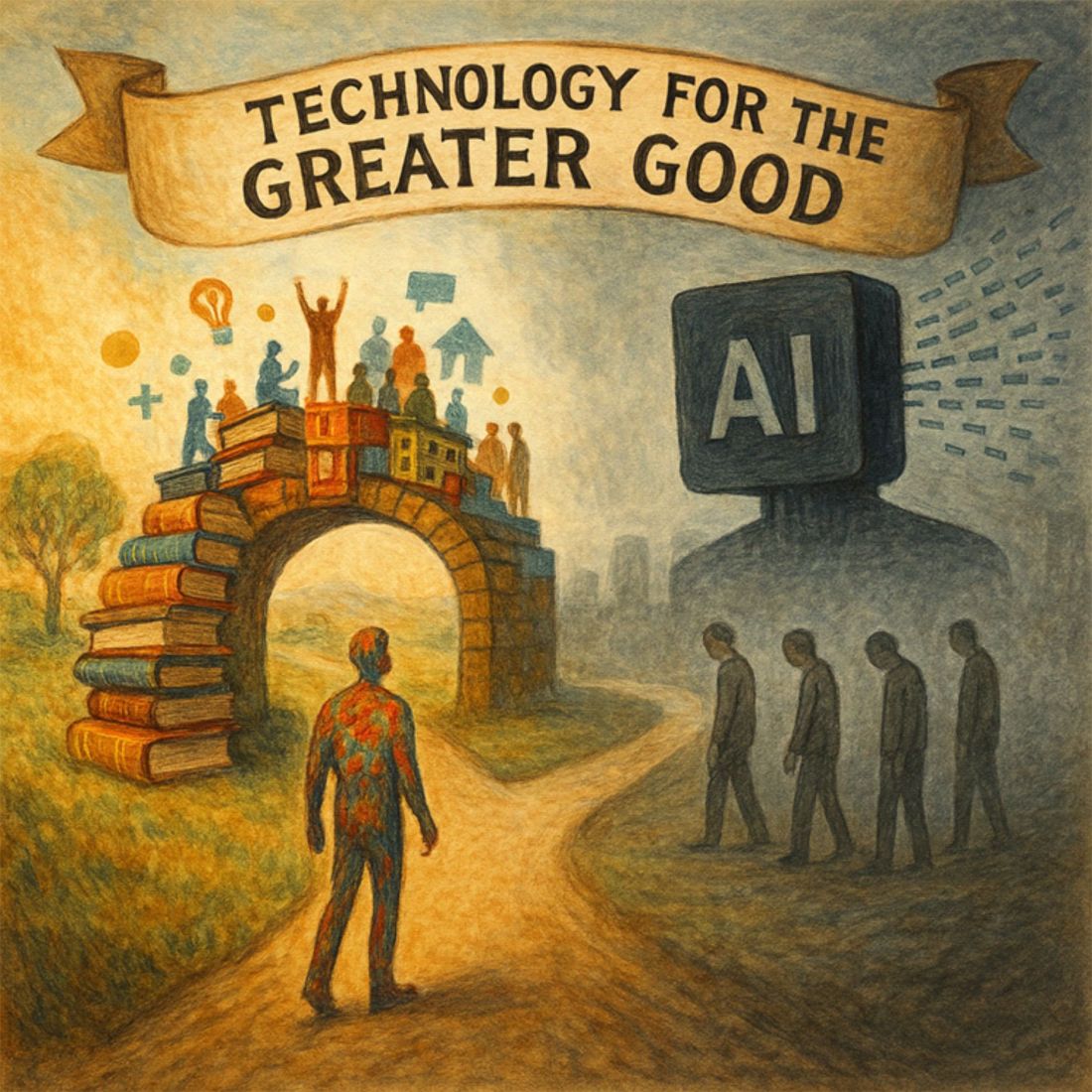
The best way for everyone and everything to live well, is without the complications and diversions that misappropriated technology imposes upon us, and the technology we do embrace should always be used for the greater good and for the benefit of everyone involved.

AI won’t make life cheaper for those who cannot work and the mega rich would be using their money to help others right now if they were going to do it for everyone in the future

You may have noticed that there is a growing trend for people to generate clicks on social media by creating long threads that tell interesting stories – many of which have already been told before.

One of them has popped up on my feed several times recently and outlines the predictions of some great contemporary sage of future tech who has apparently been proven right several times before.

The next prediction tells us that in no more than a few years, AI will have made everything so cheap that nobody will work and everything we pay for will cost just a few pennies and no more.

This prediction is popular. Because in today’s world everything relates to money.

Therefore, when people are handed the suggestion that everything they want will cost next to nothing, and there will also be no need to work, the immediate response and logic for just about anyone is to frame that in the way that we see, feel and experience our lives today or right now. Rather than considering what the pathway to that place will have changed in our lives and what our life experience will have then become.

The Moneyocracy or money-centric way of living that we are all experiencing today isn’t one where anything we need and certainly nothing that we want comes to us for free or without there being some financial-related cost of some kind.

Whilst the narrative that the establishment, big tech and big business would have us believe is that AI is here to make life much cheaper and easier for us all, the financial growth that the establishment’s pet politicians are so obsessed with and the picture of unfettered abundance for everyone that they want us to buy into, don’t go hand in hand.

Yes, there is of course the chance that the money hoarding elites are doing what they do today and that they have done everything that they’ve done in the past so that once they have optimal control of everything that we know, they will then benevolently give every one of us the perfect life experience that was always the aim. Which of course only ridiculous amounts of cash would allow them to do.

However, before we run away with that idea and think more about living our best material lives for free, there are perhaps just a few alternative truths that we all need to consider.

Money has made money by riding off the backs of the masses. First by making many hands do the work that enriched the few, through industrialisation and everything that came with it. Then by turning the mass population into debtors, exploiting the unwitting who have bought into the money myth themselves, so that the elites can continue to make ridiculous profits, just the same.

The system is very clever. And it is clever because it preys on the darker attributes of the human condition that make too many of us overlook common sense and basic logic when we are in receipt of money, wealth, position and shiny things. Everything that makes us live for a constant flow of temporary yet momentary hits that we have foolishly mistaken for what makes life and living feel good.

Addiction hides truths that are big, small and cover the multitude that sit between.

No matter our level or position within this carefully constructed top-down pyramid, the truth swirls all around us. But we remain blind to it for as long as we continue to be bought in.

So, in the sense of this coming ‘nirvana’ that AI is supposedly now promising us all, perhaps we should consider some of the more serious and consequential truths that we are almost certainly missing whilst we remain within:

The wealthy are only wealthy because of where their wealth sits within the hierarchy of the way that money and the wealth divide works against the rest of us today.

If the masses stop working, there will be billions of mouths around the world to feed and as many people to support with all the basics and essentials for life, just for people to continue to exist.

Even if machines are creating food, creating entertainment, providing transport, building houses and doing just about everything else we can imagine that has historically been done by hand up until now, there will always be a cost of some kind to pay.

The running, energy production, maintenance and replacement of the systems that would be required to enable such a massive workless population not only to survive, but to be sustained at what we would surely expect to be a good standard or experience of life, would remain very high.

Indeed, the cost of supporting billions of people around the world would still be much greater than many would imagine and would not be a cost that could be covered by playing with money and the way that people who are earning money today believe in the power of money right now.

In this sense playing with money means the way that the entire monetary, financial and economic system as we know works.

The ‘money’ and currencies we have today are part of the biggest confidence trick that has ever been played on humanity.

The whole economic system and the way money is created and managed within it is well and truly rigged.

The creation of the wealth, and the levels and scope of the asset ownership that the elites enjoy today would not have been remotely possible without them having and retaining the ability to constantly game the system.

Those running, managing and ‘in’ on the system use money that doesn’t exist to buy up everything that has real, non-monetary value to people.

This ‘ownership’ means that they will control our future and everything within it.

This has all been achieved under a system that they have created and manipulated using the establishment and the political and legislative processes within it to allow them to carry out what amounts to nothing less than legalised theft.

The wealth that has been created to enable this world take over by the wealthy can and will only achieve the aims of creating a utopian world if that world is inhabited by few enough to make the absence of money creation sustainable.

It will not be sustainable in any way, if the few have to manage and provide for a world population tomorrow, where the masses do nothing productive, become professional users and behave or act like farm animals or caged pets that exist in every direction and live all over the place.

Many baulk at even the merest hint or suggestion of there being some kind of plan for depopulation.

But anyone who understands how the money, financial and economic system we have today really works and where it is going, will see that depopulation of some kind is the unavoidable answer that bridges what is otherwise an unbridgeable void on the pathway to the outcome which has always been this Moneyocracy’s aim.

The only challenge they face is how to achieve this on a big enough scale without the masses ever awakening to the idea that national and worldwide crises can be planned and implemented by design. Just as easily as an entire monetary, financial and economic system that has led the majority of us to believe that those who don’t have enough of what they need to live today are the only ones who are at fault.