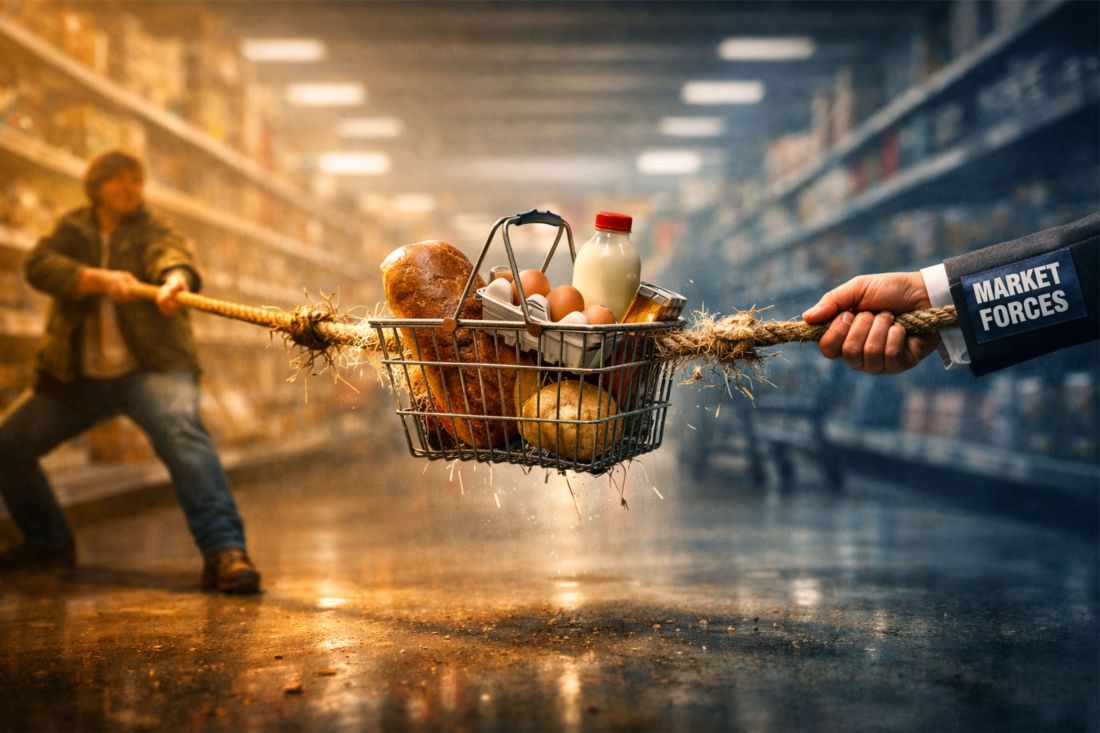
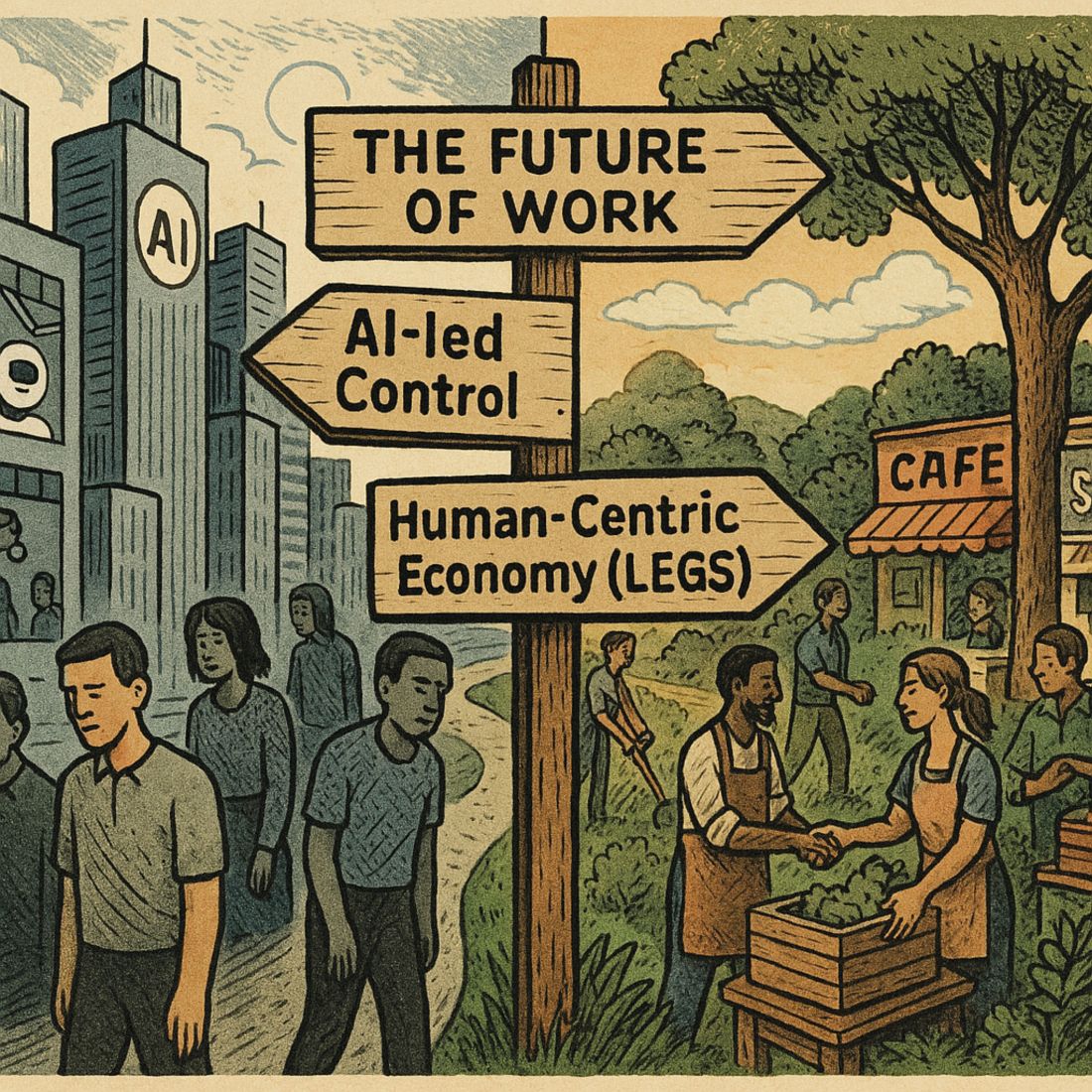
It says something about the moment we are living through that the government has begun quietly asking supermarkets to hold down the price of basic essentials. Not ordering, not legislating – simply asking.
The discussions, that have taken place between Treasury officials and the major retailers, were framed as a voluntary gesture: a request to restrain price rises on items like bread, milk, eggs and pasta in exchange for easing certain packaging and labelling rules.
It is not the kind of conversation British governments usually have. For decades, the political consensus has been that food prices are the business of the market, not the state.
Yet here we are, with ministers leaning on supermarkets in the hope of softening the cost‑of‑living crisis, even if only at the margins.
The fact that these talks happened at all is revealing. It shows a government under pressure, a public at breaking point, and an economic model that is no longer delivering what it once promised.
However, the idea itself is not new. France has been experimenting with similar measures since 2023, when it launched an “anti‑inflation quarter” – a voluntary agreement with retailers to keep a basket of everyday goods at the lowest possible price.
Later, the French government pushed large manufacturers to cut wholesale prices where their own costs had fallen, threatening to “name and shame” those who refused.
These interventions were time‑limited, targeted and heavily negotiated. They were not a blanket cap on essentials, nor a permanent redesign of the food system. And even in France, with its long tradition of state involvement in markets, the results have been mixed.
The UK’s version is far more modest. Retailers would choose which items to include. Participation would be voluntary. There would be no enforcement mechanism, no penalties, no mandated price points.
It is, in effect, a polite request dressed up as policy. But it is also a sign of something deeper: a system straining under its own weight, and a government reaching for tools that do not fit the machinery they are being applied to.
Because the truth is that price fixing – even the soft, voluntary kind – does not work inside the economic model Britain has built over the past fifty years.
It is not designed to.
The modern food system is a long chain of extraction. Farmers sell to processors, who sell to manufacturers, who sell to distributors, who sell to retailers, who sell to consumers.
At each stage, the expectation is the same: maximise efficiency, minimise cost, protect margin.
This is not a moral failing; it is simply how the system has been structured. But it means that when the government asks supermarkets to hold down prices, the pressure does not disappear. It moves backwards. Someone else absorbs it. And that someone is rarely in a position to do so.
In France, the state can lean harder on the chain because the chain itself is more consolidated and more accustomed to intervention.
In the UK, the system is looser, more fragmented, more globalised and far more resistant to pressure. A voluntary price restraint here is not a lever; it is a gesture. It may shave a few pence off a few items for a few weeks.
It will not change the underlying forces that have made essentials unaffordable for millions.
And those forces run far deeper than supermarket pricing.
The cost‑of‑living crisis did not begin with a war in Ukraine or a spike in global energy prices. Those events accelerated it, but they did not create it. The roots lie in an economic model that has, for decades, prioritised growth measured in GDP over the lived experience of the people who generate it. A model that has allowed wages to stagnate while housing costs soared. That has turned energy into a speculative commodity. That has stretched supply chains across continents in pursuit of efficiency, leaving them fragile in the face of shocks. That has treated essentials – food, heat, shelter – as opportunities for profit rather than foundations of a stable society.
In such a system, food poverty is not really about food. It is about the cost of being poor.
For millions of households, rent consumes the first share of income, energy the second, debt repayments the third. Food is whatever is left – and increasingly, there is nothing left at all.
Even if a voluntary price restraint saved a family a few pounds a week, that saving would simply be redirected to another essential cost. The underlying problem would remain untouched.
This is why the current moment feels so precarious. The government’s talks with supermarkets are not a sign of bold intervention; they are a sign of a system running out of road.
When policymakers begin asking retailers to voluntarily hold down prices, it is because the usual tools no longer work – or no longer work fast enough to prevent real hardship.
There are circumstances in which price controls become necessary. If supply chains in the Gulf were to collapse, or if energy markets were to spiral again, governments might have no choice but to intervene to prevent panic, hoarding or collapse of access to essentials. But even then, price controls only work when the entire system is aligned behind them. Without that alignment, they become temporary patches on a structure that is still pulling itself apart.
The alternative is to begin the slow, deliberate work of redesigning the system itself – building local resilience, shortening supply chains, ensuring that essentials are stable and accessible, and creating governance structures that reflect the needs of real communities rather than the demands of abstract markets.
The government’s talks with supermarkets are a symptom, not a solution. They reveal a political class that can see the crisis but is still trying to solve it within the logic of the system that caused it.
The cost‑of‑living crisis will not resolve itself. It will continue to deepen until decision‑makers confront the structural causes – or until events force their hand.
The question now is not whether change is coming. It is whether we choose to shape it, or wait for the system to reshape itself through crisis.
When you ask people who they vote for, or who they’re planning to vote for at the next election, the answer almost always comes back as the name of a political party. Labour. Conservative. Reform. Liberal Democrat. SNP. Green. It’s become such a normal part of our political culture that we rarely stop to question it. Voting equals choosing a party. That’s just how things are done.
But if you pause for even a moment, a more important question starts to surface – one that most of us never really ask ourselves.
The Disconnect Between Politicians and People
Who are we actually voting for?
Not the party. Not the brand. Not the colour on the leaflet. But the people. The individuals. The ones who will sit in rooms we never enter, making decisions that shape our lives in ways we often don’t see until long after the fact.
And the truth is, we don’t know these people.
We didn’t choose them. We didn’t interview them. We didn’t test their judgement, their awareness, their integrity, or their understanding of real life.
We simply accepted the list of names the parties put in front of us and hoped for the best.
We’ve been conditioned to believe that this is democracy. That this is how representation works. That this is the best we can do.
But deep down, most people already sense that something isn’t right. They feel the distance. They feel the disconnect. They feel the frustration of decisions being made that make no sense to ordinary people, yet are pushed through as if they were inevitable.
You only have to look at the decisions made in recent years – decisions that have cost billions, decisions that have reshaped communities, decisions that have affected national security, public services, and everyday life – to see how far removed they are from the experiences of the people who live with the consequences.
And people feel it. They feel it every time a politician talks confidently about a problem they’ve never personally faced. They feel it every time a policy is announced that sounds good on paper but falls apart the moment it meets reality. They feel it every time they’re told that things are improving when their own lives tell a very different story.
This isn’t cynicism. It’s awareness.
It’s the early recognition that the political system we have today is not working the way we assume it does.
Election season only makes this clearer. The leaflets arrive. The promises flow. Candidates knock on doors with the same lines we’ve heard for decades. They promise to fix things they can’t fix, change things they can’t change, and deliver things they have no power to deliver. And we play along, because what else can we do?
We pick the least bad option. We vote tactically. We hold our noses. We hope.
But hope isn’t a strategy. And it certainly isn’t a system.
The deeper truth – the one we’ve avoided for far too long – is that the political system we have today is built on assumptions that no longer hold. It assumes that parties represent people. It assumes that politicians understand real life. It assumes that centralised power can make good decisions for millions of people it never meets. It assumes that distance doesn’t matter.
Assumptions That No Longer Hold
But distance matters more than anything.
Because the further away power moves from the people it affects, the more distorted, harmful, and unaccountable it becomes. And that’s exactly what we’re living through now.
Politicians today are making decisions without understanding the lives of the people those decisions affect. Not because they’re bad people, but because they’re disconnected. They’re insulated. They’re operating in a world that has very little in common with the world most people live in.
And when you combine that with a party system that rewards obedience over integrity, loyalty over awareness, and ambition over service, you end up with a political class that is simply not equipped to make good decisions.
This is why public services are failing. This is why communities feel abandoned. This is why trust has collapsed. This is why everything feels harder than it needs to be.
It’s not because the problems are impossible. It’s because the people making the decisions don’t understand the problems in the first place.
And they don’t understand because the system doesn’t require them to.
The system checks the paperwork, not the person. It checks eligibility, not suitability. It checks the form, not the character. It checks the rules, not the awareness.
And because the parties control the selection process, the real questions – the ones that matter – are never asked in public.
They’re asked behind closed doors, by people whose priorities are not aligned with the public interest.
This is how we end up with politicians who are loyal to the party, not the people. Who follow the whip, not their conscience. Who defend the indefensible because their career depends on it. Who vote for policies that harm their own constituents because the party leadership demands it.
It’s not an accident. It’s not a glitch. It’s how the system is designed.
And if the people at the top were making good decisions, perhaps we could tolerate it.
But they’re not. And the consequences are everywhere.
This is where the conversation naturally shifts – not into a list of solutions, but into a recognition that the system itself cannot deliver what people need. Not because people are bad, but because the structure is wrong.
And when the structure is wrong, no amount of money, noise, or political theatre can fix it.
So the question becomes:
If the system cannot be fixed from within, what do we do?
Understanding the Foundations of the Problem
Once you see that the system itself can’t deliver what people need, everything changes. It stops being about which party is better, or which leader is less damaging, or which manifesto sounds more believable. Those questions start to feel small – almost irrelevant – because they’re all framed inside a structure that no longer works.
And when you realise that, you start to see the same pattern everywhere. You see it in the way public services are run. You see it in the way decisions are made. You see it in the way politicians talk about problems as if talking were the same as solving. You see it in the way money gets thrown at crises without ever addressing the reasons those crises exist in the first place. You see it in the way communities are left to cope with the fallout of decisions made by people who have never lived the consequences.
It becomes obvious that the system isn’t broken in one place – it’s broken in its foundations.
And once you see that, you can’t unsee it.
You start to notice how far removed politicians are from the realities of everyday life. You notice how often they speak with confidence about things they don’t understand. You notice how decisions are made without any sense of how they will play out in real communities, with real people, living real lives. You notice how the people who are supposed to represent us seem to spend more time representing their party, their donors, or their own ambitions than the people who actually put them there.
And you notice something else too – something that sits quietly in the background until you finally pay attention to it.
You notice that the people who do understand real life, the people who do have awareness, the people who do have integrity, the people who do care about their communities, are almost never the ones who end up in positions of power.
Not because they’re not capable. Not because they’re not willing. But because the system isn’t built to select for those qualities.
It selects for obedience. It selects for ambition. It selects for people who won’t challenge the party line. It selects for people who will vote the way they’re told. It selects for people who fit the mould.
And the people who don’t fit the mould – the ones who think for themselves, who speak honestly, who put the public first – are quietly filtered out long before they ever get near real influence.
Once you understand that, the idea of “voting for the least bad option” starts to feel like a trap. Because it is. It’s a way of keeping the system going without ever addressing the reasons it keeps failing.
And that’s the moment – the moment when people realise the system can’t fix itself – when the real discussion begins.
Because if the system can’t deliver what we need, then we have to look somewhere else. Not upwards, to Westminster or party headquarters, but outwards – to each other, to our communities, to the places where real life actually happens.
This is where the idea of participatory democracy stops sounding like a theory and starts sounding like common sense. It’s where the idea of choosing representatives based on awareness, integrity, and lived experience stops sounding idealistic and starts sounding necessary. It’s where the idea of a contribution‑based culture – where people are valued for what they bring to their community, not just what they earn or what job title they hold – starts to feel like the only thing that could actually work.
Because when you strip away the noise, the slogans, the party branding, the media spin, and the political theatre, what people really want is simple. They want to be heard. They want decisions to make sense. They want fairness. They want honesty. They want competence. They want leaders who understand real life. They want a system that works for everyone, not just for those who hold power.
And the truth is, we can have that.
But we won’t get it from the system we have now.
We’ll get it by building something different – something grounded in community, shaped by contribution, and led by people who understand the lives of the people they represent.
People-Centric Governance: A New Approach
Once you start looking outward – toward your community, toward the people you actually live alongside – something shifts. The whole idea of politics begins to feel different. It stops being this distant, abstract thing that happens in Westminster or on the news, and it becomes something much closer, much more human.
You begin to realise that the real expertise about how life works isn’t held by politicians or party strategists or think tanks. It’s held by the people who live with the consequences of decisions every single day.
And that’s the part the current system never acknowledges. It treats people as if they’re too uninformed, too emotional, too inconsistent to be trusted with real influence.
Yet the irony is that the people who are supposedly “qualified” to make decisions are often the ones who understand the least about the realities those decisions create.
You see this everywhere once you start paying attention. You see it in the way national policies land in local communities like a dropped weight – heavy, clumsy, and completely out of sync with what people actually need. You see it in the way councils are forced to implement decisions they had no say in, even when they know those decisions will cause harm. You see it in the way people talk about politics with a kind of weary resignation, as if they’ve accepted that the system will never work for them, no matter who they vote for.
And that resignation is dangerous. Not because people are giving up, but because they’re giving up on something they were never truly included in to begin with.
This is where the idea of stepping up – of taking part in your community – stops being a nice sentiment and starts becoming a practical necessity. Not in the sense of “everyone must become an activist,” but in the sense that communities work best when people are involved in them. When people talk to each other. When they share responsibility. When they notice what’s happening around them and feel able to do something about it.
You don’t need a political party to do that. You don’t need permission. You don’t need a manifesto. You just need to care about the place you live and the people you share it with.
And the moment you start thinking in those terms, the idea of a different kind of political system – one built around communities rather than parties, around contribution rather than competition, around awareness rather than ambition – stops feeling radical and starts feeling obvious.
Because the truth is, most of the problems we face today aren’t complicated.
They’re made complicated by the distance between the people who make decisions and the people who live with them.
Remove that distance, and everything becomes clearer. You can see what needs to be done. You can see what isn’t working. You can see what would make life better. And you can see who in your community has the awareness, the integrity, and the lived experience to help make those decisions well.
That’s what participatory democracy really is. Not endless meetings or constant voting, but a way of organising public life that recognises the value of lived experience. A way of choosing representatives who understand the people they represent because they are part of the same community. A way of making decisions that reflect real life, not party strategy.
The Value of Lived Experience
And once you start imagining that – once you let yourself picture what it would feel like to have representatives chosen by the community, accountable to the community, and grounded in the community – the old system starts to look even stranger. You start to wonder why we ever accepted a system where people we don’t know, chosen by organisations we don’t control, make decisions about our lives with almost no input from us.
It’s only when you step back that you realise how upside‑down it all is.
And that’s the moment when the alternative stops being an idea and starts becoming a direction – a path that leads away from distance, away from party control, away from unconscious decision‑making, and toward something more human, more grounded, and more capable of actually working.
Reimagining Politics: Contribution Over Competition
As soon as you start imagining politics as something rooted in the place you live – rather than something happening far away, controlled by people you’ll never meet – the whole idea of governance begins to feel different. It becomes less about ideology and more about practicality. Less about parties and more about people. Less about winning and more about contributing.
And contribution is really at the heart of all this. Not in the narrow sense of “what job you do” or “how much tax you pay,” but in the broader, more human sense of what you bring to the life of your community. The way you show up. The way you help. The way you care about the people around you. The way you take responsibility for the things that matter.
When you look at communities that work well – the ones that feel alive, connected, supportive – you notice that they’re not built on politics. They’re built on contribution. People know each other. They talk. They help. They notice what’s happening. They step in when something needs doing. They don’t wait for permission. They don’t wait for a party to tell them what to think. They just get on with it because they care.
What Makes Communities Thrive
And that’s the part the current political system has never understood. It treats people as voters, not contributors. It treats communities as administrative units, not living ecosystems. It treats representation as a transaction, not a relationship. It treats governance as something done to people, not with them.
But when you start from contribution – when you start from the idea that people are the value, not the problem – everything changes. You begin to see how much wisdom, awareness, and capability already exists in every community. You begin to see how many people understand what needs to be done because they live with the consequences every day. You begin to see how much better decisions could be if they were made by people who actually understand the lives they affect.
This is where the idea of a different system – one built around locality, participation, and contribution – stops being theoretical and starts becoming real.
You can picture it. You can feel it. You can imagine what it would be like to have representatives chosen by the community, accountable to the community, and grounded in the community. People who know the streets, the schools, the services, the challenges, the strengths. People who understand the detail because they live in it.
And once you imagine that, the old system starts to look even more absurd.
The idea that someone chosen by a party, living miles away, following instructions from people even further away, could possibly understand what your community needs – it starts to feel almost comical. Like a relic from a time when people didn’t know any better.
But we do know better now. We can see the consequences. We can feel the distance. We can recognise the harm. And we can imagine something better.
That’s the moment when LEGS – the Local Economy & Governance System – begins to make sense.
Not as a grand plan or a political project, but as the natural next step in the story.
A way of organising public life that reflects how people actually live. A way of making decisions that reflect real experience. A way of choosing representatives who are awake, aware, and capable of putting the best interests of everyone first.
LEGS isn’t complicated. It’s not ideological. It’s not a manifesto. It’s simply a way of bringing governance back to where life happens – in communities, among people who know each other, who understand each other, who share the same streets, the same services, the same challenges, the same hopes.
And once you see that, you realise something important:
We don’t need to overthrow the old system. We just need to outgrow it.
People are already losing faith in party politics. Communities are already stepping up. Local initiatives are already filling the gaps. People are already imagining something different.
The shift has already begun – quietly, naturally, almost inevitably.
And that’s where the story goes next:
Into the recognition that the future of governance isn’t something we wait for. It’s something we build, together, through contribution, awareness, and community.
Participatory Democracy is natural within any real community
The more you sit with this idea – that the future of governance grows from communities rather than parties – the more obvious it becomes.
It’s not a leap. It’s not a revolution. It’s not even particularly radical. It’s simply a return to something we’ve drifted away from: the understanding that people know their own lives better than anyone else, and that decisions work best when they’re made close to the people they affect.
And once you see that, you start to realise how much of our frustration with politics comes from the fact that we’ve been trying to solve local, human problems with distant, impersonal structures.
We’ve been expecting people who don’t know us, don’t live where we live, and don’t experience what we experience to make decisions that fit our lives. And then we’re surprised when those decisions don’t fit.
It’s like asking someone who’s never been in your house to rearrange your furniture. They might have opinions. They might have theories. They might even have confidence. But they don’t know where the light falls in the morning, or where you like to sit, or which chair has the wobbly leg, or where the dog sleeps, or how you move through the space.
They don’t know the detail. They don’t know the lived reality. And so whatever they do will always feel slightly off.
That’s what national politics feels like now – a constant rearranging of furniture by people who don’t live in the house.
And the thing is, people feel this. They might not use the language of systems or governance or political theory, but they know when something doesn’t make sense.
They know when decisions are made without understanding. They know when the people in charge don’t get it. They know when the system is too far away to see what’s really happening.
This is why so many people have lost faith in politics. Not because they don’t care, but because they’ve been excluded from it for so long that it no longer feels like it belongs to them. And when something doesn’t belong to you, you stop expecting it to work for you.
But the moment you bring politics back into the community – the moment you make it something people can see, touch, influence, and take part in – everything changes. It stops being abstract. It stops being distant. It stops being something you watch from the outside. It becomes something you’re part of. Something you help shape. Something that reflects your life, your values, your experience.
And that’s where LEGS really comes alive – not as a model or a framework, but as a way of living. A way of organising ourselves that feels natural because it is natural.
People making decisions together. People contributing to the place they live. People choosing representatives they actually know. People taking responsibility for the things that matter. People building a system that grows from the ground up, not imposed from the top down.
It’s not complicated. It’s not ideological. It’s not theoretical. It’s human.
And once you start thinking in those terms, the idea of continuing with the current system starts to feel almost absurd.
Why would we keep relying on a structure that has shown, again and again, that it cannot deliver what people need? Why would we keep electing people we don’t know, chosen by parties we don’t control, to make decisions about lives they don’t understand? Why would we keep pretending that this is the best we can do?
It isn’t. It never was. We just forgot that we had other options.
And that’s the real turning point – the moment when people realise that the alternative isn’t some distant dream or complicated plan. It’s simply a different way of organising ourselves. A way that starts with people, not parties. With contribution, not competition. With awareness, not ambition. With community, not distance.
Everyone being accountable is accountability for everyone
The more you picture this shift – away from distant party politics and toward something rooted in real life – the more you realise how much sense it makes.
It’s not a leap into the unknown. It’s not a rejection of everything we’ve built. It’s simply a recognition that the way we’ve been doing things no longer fits the world we live in.
And once that becomes clear, you start to see how much of our frustration with politics comes from the fact that we’ve been trying to solve human problems with a system that has forgotten how to be human.
A system that treats people as data points, communities as administrative zones, and decisions as transactions. A system that has become so tangled in its own processes, hierarchies, and loyalties that it can no longer see the people it was supposed to serve.
You can feel this in the way public services operate now – stretched, strained, and often held together only by the goodwill of the people working in them.
You can feel it in the way communities talk about politics, not with anger anymore, but with a kind of tired acceptance, as if they’ve quietly concluded that the system will never work for them.
You can feel it in the way people describe their lives: everything harder than it needs to be, everything more complicated than it should be, everything feeling just slightly out of reach.
And when you look at it through that lens, the idea of continuing with the same system – the same parties, the same structures, the same distance – starts to feel almost surreal.
Why would we keep doing this to ourselves? Why would we keep relying on a model that has shown, time and again, that it cannot deliver what people need? Why would we keep electing people we don’t know, chosen by organisations we don’t control, to make decisions about lives they don’t understand?
It’s only when you step back that you realise how strange it all is.
And that’s the moment when the alternative stops feeling like a theory and starts feeling like a return to something we’ve always known: that people understand their own lives better than anyone else, and that communities work best when the people in them are involved, connected, and able to contribute.
Contribution is the thread that runs through all of this. Not in the narrow sense of “what job you do,” but in the broader sense of what you bring to the life of your community. The way you show up. The way you help. The way you take responsibility for the things that matter. The way you care about the place you live.
When you look at communities that thrive, you see contribution everywhere. You see people who know each other, who talk to each other, who notice what’s happening around them. You see people who step in when something needs doing, not because they’re told to, but because they care. You see people who understand that community isn’t something you consume – it’s something you create.
And that’s the part the current political system has never understood. It treats people as voters, not contributors. It treats communities as problems to be managed, not places full of capability. It treats governance as something done to people, not with them.
But when you start from contribution – when you start from the idea that people are the value – everything changes. You begin to see how much wisdom already exists in every community. You begin to see how many people understand what needs to be done because they live with the consequences every day. You begin to see how much better decisions could be if they were made by people who actually understand the lives they affect.
This is where LEGS – the Local Economy & Governance System – stops being a concept and starts becoming a picture. You can imagine it. You can feel it. You can see how it would work. Not as a replacement for everything overnight, but as a way of organising ourselves that grows naturally from the problems we face today.
It’s not complicated. It’s not ideological. It’s not abstract. It’s human.
It’s people making decisions together. It’s communities choosing their own representatives. It’s contribution shaping the life of the place. It’s awareness guiding decisions. It’s governance happening where life happens – locally, visibly, responsibly.
And once you imagine that, the old system starts to look like something from another era – a structure built for a world that no longer exists, held together by habit rather than purpose.
The People Centric Future of Politics and Governance
Once you begin to see the old system as something we’ve simply outgrown, the future stops feeling like a distant hope and starts feeling like something we can actually reach.
Not by waiting for the next election. Not by hoping the next party will be different. Not by trusting that the same structures will somehow produce different outcomes. But by recognising that the power to change things has always been closer than we think.
Because the truth is, communities already know how to look after themselves. They always have.
Long before party politics existed, people organised their lives through relationships, contribution, shared responsibility, and awareness of each other’s needs.
They didn’t need manifestos or whips or party lines. They needed each other. And they still do.
You can see this whenever something goes wrong locally. A flood. A fire. A crisis. A family in trouble. People don’t wait for Westminster to intervene. They don’t wait for a party to issue a statement.
They step in. They organise. They help. They contribute. They do what needs to be done because they care about the place they live and the people they share it with.
That instinct – that natural, human response – is the foundation of the alternative. It’s the part of us that the current political system has ignored, suppressed, or simply forgotten.
But it’s still there, in every community, waiting to be recognised for what it is: the real engine of governance.
And once you see that, you realise that the future of politics isn’t about replacing one party with another. It’s about replacing distance with connection. Replacing hierarchy with participation. Replacing competition with contribution. Replacing unconscious decision‑making with awareness.
This is where LEGS – the Local Economy & Governance System – fits so naturally. Not as a grand plan imposed from above, but as a way of organising ourselves that grows from the ground up. A way of making decisions that reflects real life. A way of choosing representatives who understand the people they represent because they live among them. A way of building a system that works because it’s built by the people who use it.
And the thing is, once you imagine this – once you picture a community choosing its own representatives, discussing its own priorities, shaping its own future – it stops feeling like an alternative and starts feeling like the most obvious thing in the world. You wonder why we ever accepted anything else.
Why did we ever believe that people we don’t know, chosen by organisations we don’t control, could represent us better than we represent ourselves? Why did we ever think that distance was a strength? Why did we ever assume that awareness, integrity, and lived experience were less important than party loyalty?
It’s only when you step back that you realise how upside‑down the old system is.
And that’s the moment when the future becomes clear. Not as a dream, not as a theory, but as a direction – a path that leads away from the frustration, the distance, the noise, and the dysfunction, and toward something more grounded, more human, and more capable of actually working.
A system built on people. A system built on community. A system built on contribution. A system built on awareness. A system built on the understanding that representation only works when it grows from the place it represents.
Transformation begins with Acceptance
Once you recognise that the future of governance grows from communities rather than parties, something else becomes clear too: the shift doesn’t begin with a grand announcement or a national movement. It begins quietly, in the smallest places, with the simplest actions. It begins when people start to see themselves not as spectators of politics, but as participants in the life of their community.
And that’s the part that often surprises people. They imagine that changing the system means conflict, upheaval, or some dramatic break with the past.
But real change rarely looks like that.
Real change looks like people doing what they’ve always done when systems stop working – they start building something better alongside it.
Building Change from the Ground Up
You can already see this happening. Look at any community that’s thriving despite the pressures around it, and you’ll find people who’ve stopped waiting for permission. People who’ve stopped expecting distant institutions to fix things. People who’ve taken responsibility for the place they live because they know nobody else will do it for them. People who’ve realised that the most powerful thing they can do is contribute.
And contribution doesn’t need a title. It doesn’t need a party. It doesn’t need a manifesto. It just needs awareness – the awareness that you are part of something bigger than yourself, and that your actions shape the life of the place you live.
This is why the idea of a contribution‑based culture fits so naturally into the story. It’s not a theory. It’s not a policy. It’s simply a recognition of how communities actually work when they’re healthy.
People contribute because they care. They contribute because they belong. They contribute because they understand that community isn’t something you receive – it’s something you help create.
And once you see contribution in that light, you begin to understand why the current political system feels so hollow. It has no place for contribution. It has no mechanism for it. It has no understanding of it. It treats people as voters, not participants. It treats communities as problems, not partners. It treats governance as something done by a small group of people, rather than something shaped by everyone.
But the moment you bring contribution back into the centre – the moment you recognise that people are the value – the whole picture changes. Governance stops being a distant process and becomes something rooted in everyday life. Representation stops being a transaction and becomes a relationship. Decision‑making stops being abstract and becomes grounded in lived experience.
This is where LEGS – the Local Economy & Governance System – becomes more than an idea. It becomes a way of organising ourselves that feels natural because it is natural. It’s built on the understanding that people know their own lives. That communities know their own needs. That awareness grows from proximity. That responsibility grows from involvement. That good decisions grow from understanding.
And once you imagine a system built on those principles, the old one starts to look like something we’ve simply outgrown. Not something we need to fight, or overthrow, or destroy – just something that no longer fits the world we live in.
Because the truth is, systems don’t collapse when people oppose them. They collapse when people stop believing in them. They collapse when people stop participating in them. They collapse when people quietly build something better alongside them.
And that’s exactly what’s happening now.
People are losing faith in party politics. Communities are stepping up. Local initiatives are filling the gaps. People are imagining something different. People are contributing in ways the old system can’t see or measure.
The shift has already begun – not loudly, not dramatically, but steadily, in the places where real life happens.
No reason to wait until its obvious
The more you sit with this idea – that the future grows from contribution, awareness, and community – the more you realise that the shift doesn’t require permission from anyone.
It doesn’t need a vote in Parliament. It doesn’t need a party to endorse it. It doesn’t need a national campaign.
It simply needs people to recognise what they already know: that the system we have isn’t working, and that the alternative is already taking shape in the places where people live their lives.
And once you see that, the whole conversation about politics changes. It stops being about who’s right or wrong, who’s winning or losing, who’s up or down in the polls.
Those things start to feel small – almost irrelevant – compared to the bigger truth that’s been hiding in plain sight: that the real power has always been with the people who show up, who contribute, who take responsibility, who care.
That’s the part the current system has never understood. It thinks power comes from authority, from hierarchy, from distance.
But real power – the kind that actually changes things – comes from connection. It comes from people who know each other, who trust each other, who understand the place they live because they’re part of it.
And once you recognise that, the idea of continuing with the old system starts to feel like trying to repair a machine that was never designed for the job it’s being asked to do.
You can keep patching it. You can keep replacing parts. You can keep hoping it will somehow start working the way you want it to. But deep down, you know it won’t. It can’t. It’s built on the wrong assumptions.
So the question becomes: what do we build instead?
And the answer, when you strip away the noise, is surprisingly simple.
We build something that reflects real life. We build something that grows from the ground up. We build something that values contribution. We build something that understands awareness. We build something that keeps decision‑making close to the people it affects. We build something that treats communities as the foundation, not an afterthought.
We build a system that works because it’s built by the people who use it.
That’s what LEGS really is. Not a theory. Not a manifesto. Not a political project.
It’s a way of organising ourselves that feels natural because it is natural.
It’s a way of making decisions that feels human because it is human.
It’s a way of choosing representatives that feels trustworthy because it’s built on relationships, not party loyalty.
And once you imagine that – once you picture a community choosing its own representatives, discussing its own priorities, shaping its own future – the old system starts to look like something we’ve simply outgrown. Not something we need to fight, or overthrow, or destroy. Just something that no longer fits.
Because the truth is, systems don’t end when people oppose them. They end when people stop believing in them. They end when people stop participating in them. They end when people quietly build something better alongside them.
And that’s exactly what’s happening now.
People are tired of being ignored. They’re tired of being talked at. They’re tired of being treated as voters rather than contributors. They’re tired of decisions that make no sense. They’re tired of a system that feels distant, disconnected, and unaccountable.
But they’re not powerless. They’re not apathetic. They’re not incapable. They’re simply waiting for something that feels real – something that feels like it belongs to them.
Because the truth is simple:
Politics fails when it is built on distance. Representation succeeds when it is built on community.
And the moment we choose community over distance, everything changes.
Conclusion
In the end, this isn’t really a story about politics at all. It’s a story about people – about how far we’ve drifted from each other, and how much better things work when we find our way back.
It’s about remembering that representation was never meant to be distant, and that leadership was never meant to be something done by strangers.
It’s about recognising that the system we’ve inherited no longer fits the world we live in, and that the alternative isn’t something dramatic or disruptive, but something deeply familiar.
Because the truth is, we already know how to build a society that works. We do it every day in the places where life actually happens – in our homes, our streets, our neighbourhoods, our communities. We do it when we show up for each other. We do it when we contribute. We do it when we take responsibility. We do it when we care.
And if we can do it there, we can do it everywhere.
The future won’t be shaped by parties or manifestos or distant institutions. It will be shaped by people who decide that they’ve had enough of watching from the sidelines. People who realise that the power to change things has been in their hands all along. People who understand that community isn’t something you wait for — it’s something you build.
We don’t need to fight the old system. We just need to stop feeding it. We just need to outgrow it. We just need to choose something better.
And the moment we do – the moment we choose connection over distance, contribution over competition, awareness over ambition – everything begins to shift. Quietly at first, then unmistakably.
Politics fails when it forgets the people it’s meant to serve.
Communities thrive when they remember who they are.
And that’s where the future lies. Not in Westminster. Not in party headquarters. Not in the next election.
But here – with us – in the places we live, in the choices we make, and in the way we show up for each other.
That’s where representation begins again. That’s where governance becomes human again. That’s where everything changes.
Further Reading:
1. Understanding the Problem: Why Politics Fails
Power and Distance: Why UK Politics Fails the Public and How Local Governance Can Restore Trust https://adamtugwell.blog/2025/12/06/power-and-distance-why-uk-politics-fails-the-public-and-how-local-governance-can-restore-trust/ Summary: This article explores the core argument that the increasing distance between decision-makers and the public is at the heart of political failure in the UK. It details how centralisation and party control have eroded trust and effectiveness, and makes the case for restoring governance at the local level as a way to rebuild public confidence and deliver better outcomes.
2. The Alternative: Local Economy & Governance System (LEGS)
The Local Economy & Governance System (LEGS) – Online Text https://adamtugwell.blog/2025/11/21/the-local-economy-governance-system-online-text/ Summary: This foundational piece introduces LEGS, a model for organising public life around local communities rather than distant parties or institutions. It explains the principles, structure, and practicalities of LEGS, showing how it can empower communities to make decisions that reflect their real needs and lived experiences.
3. The Culture Shift: Contribution and Participation
The Contribution Culture: Transforming Work, Business, and Governance for Our Local Future with LEGS https://adamtugwell.blog/2025/12/30/the-contribution-culture-transforming-work-business-and-governance-for-our-local-future-with-legs/ Summary: This article explores the idea of the “contribution culture,” where value is measured by what individuals bring to their community rather than by status or party loyalty. It connects this cultural shift to the success of LEGS and shows how contribution-based thinking can transform not just governance, but work and business as well.
4. Practical Guidance: Getting Involved and Making Change
How to Get Elected – Full Text https://adamtugwell.blog/2025/02/26/how-to-get-elected-full-text/ Summary: A practical guide for those interested in stepping up and representing their communities. It demystifies the process of standing for election outside traditional party structures, offering advice, encouragement, and real-world tips for would-be local leaders.
Officially None of the Above – Full Text https://adamtugwell.blog/2025/03/26/officially-none-of-the-above-full-text/ Summary: This piece discusses the realities of “None of the Above” and its potential significance for democratic renewal. It examines why many people feel unrepresented by existing options and how new forms of participation and candidacy can give voice to the disillusioned.
5. Deeper Philosophy: Rethinking Politics and Society
The Way of Awakened Politics for Good Government – Full Text https://adamtugwell.blog/2025/01/17/the-way-of-awakened-politics-for-good-government-full-text/ Summary: A philosophical exploration of what it means to practice “awakened politics”- politics rooted in awareness, integrity, and service. This article provides a vision for ethical leadership and governance that prioritises the well-being of all.
A Deep Dive Guide to the Philosophy of a People-First Society https://adamtugwell.blog/2026/01/03/a-deep-dive-guide-to-the-philosophy-of-a-people-first-society/ Summary: This guide delves into the foundational ideas behind a people-first approach to society and governance. It offers readers a comprehensive look at the values, principles, and mindset shifts needed to move beyond party politics and toward genuine community empowerment.
Recommended Reading Order
Power and Distance: Why UK Politics Fails the Public and How Local Governance Can Restore Trust
The Local Economy & Governance System (LEGS) – Online Text
From Principle to Practice: Bringing the Local Economy & Governance System to Life
The Contribution Culture: Transforming Work, Business, and Governance for Our Local Future with LEGS
How to Get Elected – Full Text
Officially None of the Above – Full Text
The Way of Awakened Politics for Good Government – Full Text
A Deep Dive Guide to the Philosophy of a People-First Society
This order takes readers from understanding the problem, through the proposed solution and practical steps, to the deeper philosophical context that underpins the movement for local, people-centric governance.
Reflecting on the December 2025 publication and its foundations in The Local Economy & Governance System (November 2025)
This document serves as a guided companion to From Principle to Practice, published on 24 December 2025, and to its foundational predecessor, The Local Economy & Governance System, released on 20 November 2025.
Together, these two works form a coherent blueprint for a new way of organising human life – one that places People, Community, and The Environment at the centre of society.
Both books are available on Kindle and can also be read online at adamtugwell.blog
This companion is not a summary of the books, nor a replacement for reading them.
Instead, it is designed to help readers approach the material with the mindset required to truly understand it.
LEGS is not an adaptation of the existing money‑centric system. It is not a reform, a patch, or a variation on familiar economic structures.
It is a clean‑slate design – a return to natural human principles that have been obscured by centuries of systems built around accumulation, scarcity, and control.
To read the book well, the reader must be conscious of a subtle but powerful reflex: the tendency to interpret new ideas through the lens of the old system.
This reflex is not a flaw in the reader. It is a conditioned response created by a lifetime inside a system that taught us to see money as the centre of life, work as the measure of worth, and survival as something to be earned.
This companion exists to help the reader recognise that reflex, set it aside, and engage with the material as it was intended – as a fresh start.
Overview
From Principle to Practice expands the conceptual foundations laid out in the earlier LEGS publication and translates them into a complete, functioning system.
It explains how value is created, how essentials are secured, how money circulates, how contribution is shared, and how governance becomes local, transparent, and participatory.
But more importantly, it invites the reader to imagine a world not shaped by the assumptions of the money‑centric system.
It asks the reader to consider what society would look like if we designed it today – not from inherited structures, but from natural human needs and behaviours.
The book is not ideological. It is structural.
It is not theoretical. It is practical.
It is not utopian. It is human.
Key Themes
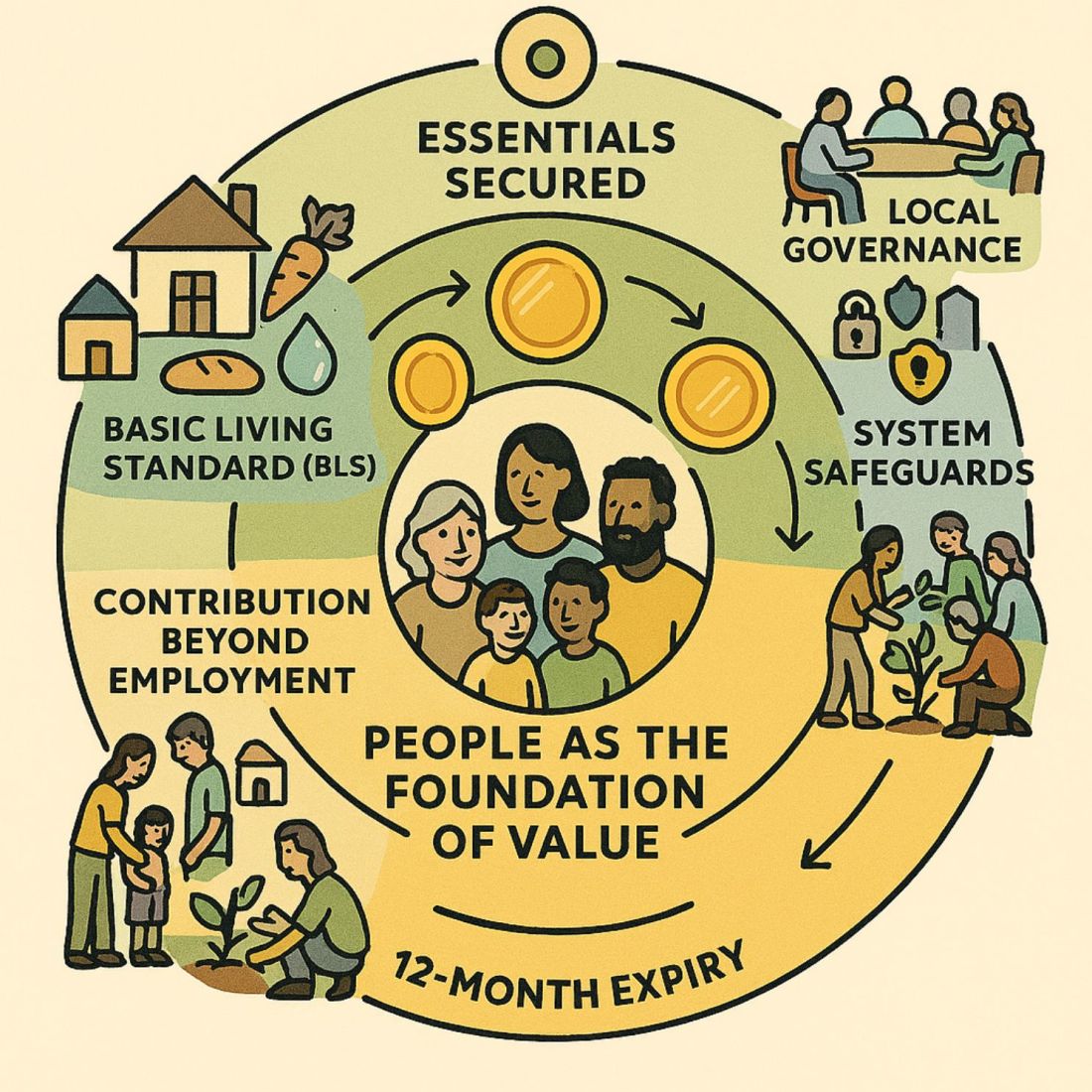
1. People as the Foundation of Value
The central premise of LEGS is that people – not money, markets, or institutions – are the true source of economic value.
This is not a metaphor. It is a structural principle.
The system quantifies value based on people, their stage of life, and their capacity for contribution.
In doing so, it restores dignity to every individual, regardless of wealth, status, or productivity.
2. Essentials as a Protected Foundation
The Basic Living Standard (BLS) is not a benefit or a safety net. It is the baseline of dignity that full‑time work must guarantee.
By securing essentials structurally, the system removes fear as the organising force of society.
When survival is no longer a commodity, people regain the freedom to think, act, and live without coercion.
3. Money as a Circulating Tool
Money in LEGS is designed to circulate, not accumulate.
It expires after 12 months, ensuring that it remains a tool of exchange rather than a store of power.
This design removes the addictive behaviours – hoarding, speculation, scarcity creation – that distort human life under the money‑centric system.
4. Contribution Beyond Employment
LEGS recognises that valuable work extends far beyond paid employment.
Caregiving, learning, community work, environmental stewardship, and social support are all essential to a healthy society.
The system acknowledges these contributions structurally, not symbolically.
5. Locality as the Anchor of Stability
Value, money, trade, and governance all operate at the community level.
This strengthens resilience, reduces dependency on distant systems, and restores the natural human scale of economic life.
6. Governance as a Participatory Practice
The Circumpunct replaces hierarchical power structures with a flat, transparent, community‑led model.
Governance becomes a living practice, not a distant authority.
7. A System Designed to Resist Capture
Every safeguard – from money expiry to fixed values for essentials – exists to prevent the system from being manipulated, centralised, or distorted.
LEGS is intentionally designed to protect itself from the very forces that corrupted previous systems.
Key Messages
1. You cannot understand LEGS by comparing it to the current system
The money‑centric system is built on scarcity, competition, and accumulation.
LEGS is built on contribution, locality, and shared responsibility.
These frameworks are incompatible. Attempting to interpret LEGS through the logic of the old system will distort it.
2. The old system creates addictive patterns
People unconsciously cling to the idea that money must accumulate, that essentials must be earned, that success is numerical, and that security must be purchased.
These patterns are not natural – they are conditioned.
LEGS requires the reader to recognise and release them.
3. LEGS is a clean‑sheet design
It is not a variation of capitalism, socialism, or communism.
It is a return to natural human principles that predate all of them.
4. The system works because it aligns with human reality
People thrive when essentials are secure, contribution is shared, governance is local, and money cannot dominate life.
LEGS restores these conditions.
Core Takeaways
1. The greatest challenge is mental carry‑over
Readers must actively notice when they are interpreting LEGS through the lens of wages, markets, profit, or hierarchy.
These assumptions belong to the system that is now collapsing and cannot be carried into a new one.
2. LEGS is a complete system
Money, value, essentials, contribution, governance, and trade are interdependent.
Understanding one requires understanding the whole.
3. Essentials are guaranteed through structure
The BLS is not charity.
It is the structural foundation of the economy.
4. Money expires to prevent harm
Expiry is not punitive. It is protective.
It ensures that money remains a tool, not a weapon.
5. Contribution is universal
Everyone contributes according to capacity.
No one is excluded or left behind.
6. Local governance prevents capture
The Circumpunct ensures that decisions remain with the people they affect.
7. LEGS is a return to natural human living
It aligns with the rhythms of community, the cycles of nature, and the realities of human behaviour.
Closing Reflection
This companion exists to help the reader approach From Principle to Practice with the mindset required to understand it.
The book is not asking the reader to imagine a slightly improved version of the world they know.
It is asking them to imagine a world built on natural principles – contribution, locality, transparency, and shared responsibility.
To see that world clearly, the reader must temporarily set aside the assumptions of the money‑centric system.
Only then does the coherence, practicality, and humanity of LEGS become visible.
One of the biggest misunderstandings of the time and culture we live in is the way we understand, respond to, and relate to what freedom really is.
Many of us believe that we are free: that we can do what we want, think what we want, say what we want, and be what we want.
Yet we all live under rules that must be followed – rules which few would deny are becoming more intrusive, more prescriptive, and increasingly powerful in the consequences they impose if we fail to use our “freedom” in the way someone else has dictated it must be perceived and lived.
The Everyday Policing of Speech
Some reading this may respond with something like “Tell me something I don’t know.” And that would be fair enough, given the growing body of anecdotal evidence confirming that freedom of speech is not what it seems.
Almost everyone we might consider “ordinary” – those without an agenda, simply wishing to get on with their lives – now finds themselves policing their own relationships and interactions with the outside world.
Speaking truths rooted in common sense, or even in the way things have always been, increasingly risks offending those who demand the world operate according to their own design.
The Marginalisation of Independent Thought
Even reflecting on what is, at best, the marginalisation of independent thinking – and at worst, the steady criminalisation of individual thought – opens up a maze of debates.
These debates inflame questions about the role, scope, and power of groupthink, and how establishment narratives are not only shaping, but increasingly dictating blueprints for how everyone must live their lives.
Encroachment by the Establishment
To believe we are free in a world, country, and culture where the establishment seeks not merely to encroach but to manage every part of life is alarming enough.
Yet it becomes even more disturbing when we recognise that these restrictions and attacks on freedom are not created for the common good, but to benefit someone else.
The Role of Money as Gatekeeper to Life, Peace, Happiness and Freedom that is Governed by Someone and Something Else
Freedom Defined by Money, Not Ourselves
Yes, we are already in a fight for those freedoms outlined above.
The fight is increasingly hard because a division has already been created between what we believe freedom is, and what we believe we already know it to be – which itself isn’t what we are experiencing.
That we continually look outside of ourselves for validation should make sense, because when we think about the difference between what we imagine freedom to be – doing whatever we want – and what society actually allows us to do, shaped by those who create the narratives that control society, we quickly begin to see that there is a significant difference involved.
The Manipulation of Meaning
Creating circumstances where somebody can change the meaning of something so that a word comes to mean something very different from what we know it to be could never happen in an environment where people are confident in who they are, their communities, their culture, and what it ultimately means just to be themselves.
We have now reached the point where even the term common sense is being brought into question, sometimes considered offensive or demeaning.
This is because the fundamental basics of life – the value set that upholds the framework for a good life – have been replaced by a system that places money at the heart of everything.
Money at the Centre of Every Choice
Money has become so ingrained in every part of life that, without even questioning our motives, it dictates the decisions and choices we make.
Everything in life is based on what we can afford, earn, save, accumulate, or the cost and risk of cost.
Jobs are about what we earn now and in the future. Insurance is about betting against risk. Education is about securing a career that pays more than a working wage. The house we live in depends on the mortgage and deposit we can save or borrow. What we own depends on money already earned or borrowed. Holidays depend on savings or loans. Cars depend on leases or borrowing, unless bought outright.
Contracts Before Basic Essentials
It doesn’t matter who we are or what we earn. The world now requires us to sign up, subscribe, or rent services and products we once simply bought.
These arrangements are backed by contracts that must be paid before any income can be considered disposable.
Only food and basic essentials remain in the realm of pay-as-you-go – and even those are increasingly tied to credit cards, buy-now-pay-later schemes, or payday loans.
Judgement Through Wealth and Appearance
We judge people by their appearance, their property, their clothes, or their transport – signals of “who the world tells us they are.” And when we consider how much future earnings and financial security matter, even ordinary people outside the elites evaluate partners and marriage commitments based on what a potential partner can afford.
The Private Turmoil of Dependence
Few can see just how powerful, overwhelming, and controlling money has become.
Fewer still talk about it comprehensively.
Yet the reality is that what we do, what we have, how we are perceived, and whether we are accepted or rejected all revolves around money.
This leaves us in private turmoil and pain – what some might call or know as hell – because parts of life, or what is respected as life today, are cut off or restricted by money’s role.
The System’s Sick Success
This system is not natural. It has been deliberately created for the benefit of those who already have much more than they will ever need.
Its success lies in convincing the masses that freedom and status are directly proportional to wealth.
Meanwhile, the mechanics of the system ensure that resources flow away from those who have every right to them, leaving them dependent on credit and enslaved by debt.
In return, people have unwittingly surrendered property, ownership, and the peace of mind that comes only from self-sufficiency.
Fear as the Final Driver
Everything in life is driven by money – or more precisely, by the fear of not having it.
Everyone, at every level, makes decisions and behaves according to financial implications.
When people or businesses are pushed into dependence on external finance, even reason itself is abandoned. Questions of viability or self-sufficiency are ignored, as survival becomes the only priority.
When this mindset dominates, it doesn’t matter who someone is or what position they hold. They become vulnerable to the power and control of whoever influences what happens next.
This is the world we live in today. The plans, strategies, and changes overtaking life – many of which defy common sense – have taken hold because someone, somewhere, intended and created it to be this way.
This Is by Design
Where this all becomes difficult to accept is in recognising that nothing about the journey which has brought the world to this point is accidental.
It is by design.
The reason is simple: people who know they are free, cannot be controlled.
Freedom Cannot Be Controlled
If people cannot be controlled, they will not accept, take part in, or contribute to a system that is stripping away everything from them.
Everything that should, and always will, remain naturally theirs.
The Drive to Own and Control
Those who want more – who want to control more, own more, and take everything from everyone else – cannot succeed unless they first control people themselves.
They cannot take everything away unless they make the process appear legitimate.
Control must come first, because without it, the system suffocates and then collapses, under the weight of its own injustice.
Freedom Does Not Look Like This
Because most of us are not physically imprisoned and we face each day with choices that seem to be ours, many believe we are free and living free lives.
However, what we are experiencing – where we are coerced by narratives, advertising, groupthink, the media, and even the “free-minded” influencers we follow online to keep up – is not freedom at all.
Coercion Disguised as Choice
Beyond the natural requirement to meet the basic and essential needs of maintaining human life, anything that influences our behaviour or sets frameworks for “acceptable” choices is not freedom.
It is an infringement upon freedom.
At its most basic level, it is simply doing what we are told.
Money as the Measure of Freedom
Because of the way the money system has been designed, people believe they are free if they have enough money to do what they want or to buy what they think will meet their needs, as the system suggests them to be.
But money has become the value itself – rather than the work, the products, the property, the services, or the people involved.
We now believe we can only have anything, whether it is to meet needs or wants, if we have or can obtain the money to pay for it – and that these things are all the same.
Our freedom is dictated entirely by our relationship with money.
The Illusion of Value
If money were as real as we believe it to be, the value of the money in our pockets or the salary we earn would not reduce without us doing anything that changes anything.
Yet it does.
And the value of our money changes, because money is under someone else’s control.
The game, or rather the whole deck of life, is stacked in someone else’s favour.
The Mathematics of Decline
In the UK, inflation typically reduces the value of the £Pound by 2–3% each year.
This means prices rise, and your money buys less over time.
Inflation is measured by the Consumer Price Index (CPI).
If inflation is 3%, £100 today will buy only what £97 did a year ago.
The effect compounds: after 5 years at 3% inflation, £100 is worth about £85.87 in real terms.
Year
Real Value (£100 Start)
0
£100.00
1
£97.00
2
£94.09
3
£91.27
4
£88.53
5
£85.87
To keep up, your income must rise at least as fast as inflation. Otherwise, your purchasing power declines each year. And in truth, when we look more closely at the figures against what it costs to buy the things that we rally need, inflation seems to be putting those prices up a whole lot more.
Running to Stand Still (Revised)
Because inflation in the UK typically reduces the value of the £Pound by at least 2–3% each year, you must increase your income by at least this amount just to maintain your current standard of living.
The effect compounds: after five years at 3% inflation, £100 is worth only about £85.87 in real terms.
This means you are running uphill simply to stay in the same place.
Of course, this is assuming the official rate of inflation is accurate – if the real rate is higher, the decline in purchasing power is even greater.
It Doesn’t Have to Be This Way – The Alternative Is The Basic Living Standard and an economy that puts People First
Because money sits at the heart of everything in life, very few of us can visualise a way of living that works differently. And as we’ve already discussed, you aren’t supposed to – because this is how you come to believe you are free, when in fact you have been enslaved.
Its genius lies in the way it convinces people to participate in, and even further, the very crime being committed against themselves.
In this system, money is the only god. But it is not benevolent or caring.
It is unjust, unfair, and strikes no balance when it comes to equity, equality, or what is good for mankind.
Two Masters Cannot Be Served
Man cannot have two masters.
For as long as money and the money system remain the only god, people, community, the environment, and basic human values will never be what life is truly about.
The system is designed to keep us dependent, fearful, and compliant. Whilst it slowly takes or destroys everything that is genuinely important and of value to us all.
The Alternative: The Basic Living Standard
There is an alternative. And although it may sound radical to suggest that one rule changes everything, the truth is that a future awaits where real freedom is not only possible for some, but becomes the way of the world for all.
The Basic Living Standard (BLS) is that rule.
It guarantees that everyone’s essential needs – food, shelter, energy, water, clothing, healthcare, and the means to participate in society – are met.
It is not charity, welfare, or a handout. It is a universal right, paired with universal responsibility.
Real Freedom Through Self-Sustainability
By meeting everyone’s basic and essential needs, the BLS creates the foundation for self-sustainability and genuine freedom.
It dismantles the false god of money by ensuring that survival is no longer dependent on debt, wages, or exploitation.
This is the only way to achieve real freedom: freedom to think, freedom to do, freedom to be, and personal sovereignty that gives peace to all.
What Financial Freedom Is and What It Means
The simple difference between the world that is destroying us and the world we need is this principle: We should only take what we need to meet our basic and essential needs, and reject completely the idea that there is anything good in accumulation, control, or influence beyond that.
No person or organisation should have the right to hold or control any more than they need for themselves or those they have direct and meaningful responsibility for.
Abundance
Natural abundance is the state of having our basic needs met and knowing they will continue to be met through our contribution and work – without interference or control from others.
Yet what we have come to believe abundance to be is wholly manufactured. It equates to accumulating, owning, and controlling as much as possible, regardless of the cost to others or to the environment.
When we recognise that true abundance is simply safety, security, health, happiness, and the basics that sustain them, we will also understand that these are the real foundations of inner peace. And peace is what abundance is really all about.
The Peace to Relax
Think carefully about how you feel when you no longer have to worry about what you will earn, borrow, or buy; how people will judge your clothes or job title; or anything else that creates fear of loss, anxiety about the future, or depression about what you think you may have already lost.
Yes, life has its own natural anxieties – relationships, health, and personal challenges.
But these are not manufactured to benefit someone else or a system that exploits us in every conceivable way.
When you have natural peace – because you are not in a constant race to keep up (while condemned to fall behind unless you add more than 3% value to your financial ‘worth’ each year) – if you are not already too far behind – you begin to see life through an entirely different lens.
Freedom to Think
When we have the freedom to think, we have the freedom to learn what life is really about.
We can be open to joys and pleasures that appear too simple or meaningless when we are trapped in pursuit of someone else’s agenda.
These joys hold value and meaning that help us grow into the human beings we truly are.
With this level of freedom, we see life’s mechanisms and systems in a healthier way.
Our expectations become simple. We develop patience with others and understand that we are not defined by what we have or earn, but by how we treat and respect others – even when there is no advantage to gain.
Freedom brings the ability to experience natural joy, not happiness sanctioned by someone else’s criteria.
It allows us to make and learn from mistakes, seeing them as value rather than cost – a perspective denied by the money-centric world.
Personal Sovereignty
Freedom on this level opens the door for us to be exactly who we are meant to be.
It facilitates personal sovereignty – the ability to make real, independent, and meaningful choices that affect only us, without fear of consequences from outside of ourselves.
This sovereignty exists beyond the participation and contribution required of us within the community to do our part, ensuring that everyone’s basic and essential needs are met.
It is the balance between individual freedom and collective responsibility, and it is the essence of financial freedom.
The Framework for a People-Centred Life
The Basic Living Standard is the formulaic basis of the life we all need.
It guarantees that everyone has access to everything necessary to meet their basic and essential needs, in return for each person contributing through work and activity to ensure that every necessary process – and yes, every business – is completed so that everyone’s needs are met.
Businesses That Serve Needs, Not Greed
The entire system revolves around this formula.
Businesses and organisations exist only where a basic or essential need must be met.
They never grow beyond the size necessary to serve the community in which they are located and involved.
This ensures that the purpose of business is not accumulation or profit, but service to people and the environment.
Technology as Support, Not Replacement
In this system, people are supported and aided — but not replaced — by technology and AI. The need for human contribution remains central, because participation is not about money or profit. It is about people, community, and the environment around which our lives revolve, and the experiences we share together.
The Same Rules Must Apply to Everyone
For fairness, balance, and justice to exist, the same rules must apply to all.
Part of the human condition is the instinct to survive – an instinct that quickly evolves into selfishness.
It drives us to use any advantage, whether through opportunity or design, to take more, hold more, or obtain power over more than we actually need.
We often justify this behaviour by believing it makes us special compared to others, or by using it to visibly demonstrate superiority.
Survival Instinct vs. Shared Responsibility
Yes, it can be argued that this is how humanity naturally behaves.
But just because it appears to be the default response to fear of lack, it does not mean it is right.
When there is enough of everything for everyone, and when we have the knowledge and understanding to build and manage a world that works for all – as we now have, the pursuit of excess is neither natural nor justified.
The True Depth of the Basic Living Standard
In this sense, the Basic Living Standard is not just a benchmark or guarantee of dignity and financial independence.
It is also a framework that requires everyone and everything to function with its principles in mind.
Every process, system, and mechanism must flow from and to its implementation.
The BLS is not simply about meeting needs – it is about ensuring that the way society operates is aligned with fairness and responsibility.
No Special Rules, No Hierarchies, No Excerptions
There can be no special rules for anyone. No exceptions or hierarchies where some hold more power or influence than others. No materially based differences that allow one person to be perceived as fundamentally different from another.
Only when everyone and everything plays by these basic but essential rules, can the integrity of the system be assured.
Integrity Between Person, Community, and Environment
Ultimately, it is the integrity of the relationship between person, community, and environment that must be protected.
This integrity ensures that fairness is not just an ideal, but a lived reality – one that sustains balance and justice for all.
The Local Economy & Governance System (LEGS)
The Local Economy & Governance System offers the framework and societal structure that enables the Basic Living Standard to function.
It ensures that everyone can thrive and enjoy the freedom to think, to be, and to do – the personal sovereignty that guarantees peace for all.
A Human Economy
LEGS is a human economy.
Everyone who can, works or contributes, and contribution replaces currency as the foundation of exchange.
This means that the value of each person’s effort is measured not in money, but in the way it sustains people, community and the environment.
The End of Inequality
Most of the social issues we experience today are the effects of inequality – wealth inequality, social inequality, and the distortions created by a money-centric system.
In LEGS, these issues disappear. They no longer exist because the system is built on fairness and the natural law of cause and effect: when everyone contributes and takes fairly, everyone’s needs are met.
Businesses That Serve Communities
As described in the Basic Living Standard framework, businesses and organisations exist only to meet essential needs.
They remain the size necessary to serve their communities, never expanding into monopolies or profit-driven empires.
This ensures that resources are not hoarded, and that abundance is measured by access, not accumulation.
Technology as a Partner, Not a Master
Technology and AI support people but do not replace them.
The purpose of contribution is not profit, but participation.
Work is about sustaining life, community, and environment – not about chasing growth or accumulation.
In this way, LEGS ensures that human dignity and responsibility remain at the centre of society.
A System Built for People
The Basic Living Standard cannot work within the collapsing money-centric system that we have today.
It requires a new foundation – and LEGS provides that foundation.
By reorienting governance and economy around people, community, and environment, LEGS makes possible a society where freedom is real, sovereignty is respected, and peace is shared.
Benefits of the Basic Living Standard and LEGS
The benefits of the Basic Living Standard (BLS) and the Local Economy & Governance System (LEGS) are wide-ranging.
They work not only at the individual level, but also across communities and the environment.
Together, they create a framework where fairness, responsibility, and sustainability replace fear, inequality, and exploitation.
Reducing Crime
When everyone’s essential needs are guaranteed, desperation disappears.
Crime rooted in poverty, scarcity, or inequality declines because survival is no longer at stake.
Contentment and Peace of Mind
True abundance is not accumulation, but having enough.
By ensuring that everyone has what they need, BLS and LEGS foster contentment.
People are free to live without constant anxiety about money, status, or survival, creating peace of mind and stability across society.
Removing the Mental Health Crisis
Much of today’s mental health crisis is driven by insecurity, debt, and the relentless pressure to “keep up.”
With BLS, those pressures dissolve. Freedom to think, be, and do allows people to experience natural joy, rather than manufactured happiness tied to wealth or possessions.
Ending the Benefits Problem
The current welfare system is built on dependency and stigma.
BLS replaces this with a universal guarantee: everyone has what they need, and everyone contributes what they can.
This ends the cycle of benefits, bureaucracy, and inequality, creating dignity and independence for all.
Sustainable Living and the End of Overuse
Because businesses under LEGS exist only to meet essential needs, they never grow beyond the size and capacity required by the communities they serve.
This prevents monopolies, overproduction, and exploitation of resources.
Communities consume sustainably, and the environment is protected.
Work and Contribution as Valid Beyond Pay
Contribution replaces currency. Work is valued not by wages, but by its role in sustaining the community.
Whether paid or not, every contribution matters – from caring for others to maintaining essential services.
Valuing Every Kind of Work
In a system where survival is guaranteed, people see the value in every kind of work.
No job is “beneath” anyone, because all jobs contribute to sustaining life.
Happiness in Any Role
People become happy and content to do any kind of job, because work is no longer about survival or status.
It is about contribution, community, and purpose.
Experience as a Shared Tool
Life experience itself becomes valued as a tool for the benefit of all.
Wisdom, skills, and lessons learned are shared within communities, enriching collective wellbeing.
Care Rooted in Community
Care for those who may be too young, too old or unable to contribute for any other reason is carried out by members of the community who are best able, and who still receive what they need to meet their basic and essential needs.
This ensures that care is not commodified or dependent on profit, but is a natural part of community life.
A System That Benefits All
The benefits of BLS and LEGS extend beyond individuals.
They strengthen communities, restore dignity to work, protect the environment, and create peace of mind.
By removing scarcity, inequality, and fear, they build a society where freedom, sovereignty, and justice are not privileges, but universal realities.
Life Beyond Survival
Freedom Creates Time for Life
When freedom and personal sovereignty are real — when the compulsion to “keep up” is gone – something remarkable happens. Time and space open up.
Social activities, sports, and hobbies stop being luxuries or calculated uses of “spare” time that isn’t really spare at all. They become normal parts of everyday life.
The Basic Living Standard and LEGS make this possible by removing the constant pressure of survival and competition.
Instead of chasing money or status, people can invest their energy in pursuits that bring joy, health, and connection.
Communities thrive when individuals have the freedom to play, to create, and to participate in activities that enrich life rather than drain it.
Yet the greatest gift of this freedom is not only the chance to do more, but the chance to be more.
With peace of mind and comfort secured, people gain the space to think differently and expansively about who they are and what their existence really means.
Freed from fear and scarcity, we can explore our true selves, discover new perspectives, and embrace the human experience in full.
Rediscovering Real Relationships
Equally important is the refocusing and repurposing of face-to-face, in-person, real-life relationships.
In the money-centric system, digital interactions and transactional exchanges have all too often replaced genuine human connection. But under the Basic Living Standard, relationships regain their rightful place at the centre of life.
The priceless social skills and social learning that come from real-world interaction equip every person for a happy, healthy life.
They foster empathy, cooperation, and understanding – qualities that cannot be replicated by algorithms or screens.
When survival is guaranteed and competition is replaced by contribution, people are free to build communities rooted in trust and shared experience.
This is not just a benefit of the system; it is its very purpose.
Human beings are not data points or consumers. We are social creatures, and our wellbeing depends on the strength of our relationships.
Conclusion: A Future Built on Real Freedom
The journey through this essay has shown that what we call freedom today is little more than an illusion.
Rules, narratives, and the money system have combined to create a world where survival is dictated by fear, debt, and inequality.
Yet this system is not natural – it is by design, and it benefits only those who already have more than they will ever need.
The Basic Living Standard and the Local Economy & Governance System offer a different path.
Together, they dismantle the false god of money and replace it with a framework built on fairness, contribution, and sustainability.
They guarantee that everyone’s essential needs are met, that businesses serve communities rather than greed, and that technology supports rather than replaces people.
The benefits of this transformation are not limited to crime reduction, mental health, or dignity in work. They reach far wider – across personal wellbeing, community strength, and environmental sustainability.
They reshape how we understand abundance, how we value relationships, and how we live in balance with the world around us.
They restore the integrity of the relationship between person, community, and environment, ensuring that freedom is not just an individual experience but a shared reality.
Beyond these practical gains, BLS and LEGS deliver something even greater – the freedom to live fully.
Time for hobbies, sports, and social activities becomes normal, not a luxury. Real relationships are rediscovered, and the social skills that equip us for happy, healthy lives are restored.
This is not utopia. It is a practical, people‑centred system that aligns with the natural law of cause and effect: when everyone contributes, everyone’s needs are met.
It is a vision of a world where freedom is not defined by money, but by sovereignty; where justice is not a privilege, but a universal reality; and where peace is not manufactured, but lived.
The choice before us is simple. We can continue down the path of fear, inequality, and exploitation and the destruction of humanity that it guarantees. Or we can embrace the Basic Living Standard and LEGS, and build a future where freedom, fairness, and community are the foundations of life.
The Basic Living Standard and LEGS create a human economy, where balance, fairness, and justice underpin life. They place people before money, with priorities fixed upon community and environment. The BLS is the simple benchmark rule — the rule of all rules – upon which all systems of trade and commerce are aligned. By recognising abundance in its natural form, where everyone has enough to meet their needs but not their wants, the dynamics of life are transformed. Every need beyond the tangible can then be met, because peace, freedom, and personal sovereignty flow from financial independence. This is what allows each of us to enjoy and learn from the human experience in full.
Glossary of Key Terms
Basic Living Standard (BLS): A universal framework that guarantees everyone’s essential needs—such as food, shelter, energy, water, clothing, healthcare, and the means to participate in society—are met. It is not charity or welfare, but a right paired with responsibility.
Local Economy & Governance System (LEGS): A proposed societal structure that replaces currency with contribution, ensuring that the value of each person’s effort is measured by its impact on people, community, and environment. LEGS supports the BLS and aims to eliminate inequality and exploitation.
Personal Sovereignty: The ability to make real, independent, and meaningful choices that affect only oneself, without fear of external consequences. It is the balance between individual freedom and collective responsibility.
Contribution Economy: An economic system where work and participation are valued by their role in sustaining the community, not by monetary reward. Contribution replaces currency as the foundation of exchange.
Universal Rights and Responsibilities: The principle that everyone has the right to have their basic needs met, and the responsibility to contribute to the wellbeing of the community so that others’ needs are also met.
Abundance (Natural): A state where basic needs are met and will continue to be met through contribution and work, without interference or control from others. True abundance is defined by safety, security, health, and happiness—not accumulation or control.
Money-Centric System (Moneyocracy): A societal structure where money is at the heart of every decision, relationship, and opportunity, often leading to inequality, dependence, and loss of freedom.
Groupthink: The tendency for collective narratives or establishment views to shape and dictate how individuals think and behave, often at the expense of independent thought and personal freedom.
Self-Sustainability: The ability for individuals and communities to meet their own basic needs without reliance on debt, wages, or exploitation. It is a foundation for genuine freedom.
Universal Guarantee: A commitment that everyone’s essential needs will be met, removing the stigma and dependency associated with traditional welfare systems.
Further Reading:
To help deepen understanding of the ideas behind the Basic Living Standard (BLS) and the Local Economy & Governance System (LEGS), the following resources are grouped by theme.
This structure will help you explore the foundational critiques, proposed solutions, mindset shifts, economic mechanisms, and personal perspectives that underpin the vision for a fairer, people-centred society.
Each link includes a brief summary to guide your reading.
The Basic Living Standard Explained Introduces the BLS framework, guaranteeing everyone’s essential needs are met, and explains how it differs from charity or welfare by emphasizing universal rights and responsibilities. https://adamtugwell.blog/2025/10/24/the-basic-living-standard-explained/
AI’s Crossroads: Choosing a Human-Centric Future for Work and Society
Artificial intelligence is rapidly transforming the world of work, automating roles created by money-driven systems and exposing the fragility of an economy built on profit and status rather than genuine human need.
Without a deliberate change in direction, society risks deepening inequality, eroding community, and reducing work to a function of control and dependency.
The current trajectory, shaped by decades of economic and technological planning, threatens to devalue essential contributions and undermine the foundations of freedom and dignity.
But this path is not inevitable. There is an alternative: a future where work is meaningful, communities are empowered, and the economy serves people – not the other way around.
This work challenges the prevailing narrative and introduces The Local Economy and Governance System (LEGS) – a model for a human economy built on the basic living standard.
LEGS offers a practical framework for restoring value to real work, strengthening local governance, and ensuring that technological progress enriches lives rather than diminishes them.
The choice is ours: continue down the AI-led road of exclusion and control, or embrace a system that prioritizes human well-being, fairness, and genuine prosperity for all.
Rethinking Work in a Human-Centric Future
Beyond Money-Driven Roles
The work and employment of a better, human‑centric future will be real, tangible, and deeply meaningful. Unlike many roles today that exist primarily to prioritise the flow of money, this future will focus on impact, purpose, and the enrichment of human life.
The Challenge of New Realities
The near future is poised to introduce truths, realities, and perspectives about our lives that many will find extremely difficult to accept.
This difficulty arises because true freedom – freedom to do, freedom to think, and freedom to be – requires us to revalue everything: how we see, how we interact, and how we set expectations.
These expectations will need to operate in a completely different, yet ultimately rewarding, way.
Shifting Perceptions of Good and Bad
In this transformation, what seems good today may quickly be seen as bad, while what appears deficient or undesirable now may suddenly reveal itself as profoundly valuable.
One of the most striking areas where this reversal will become evident is in our daily relationship with work – what we do, and how we define the very act of working.
The Distortion of Work by Money
The concept of work itself has become twisted by its association with money and the reward of money for labour.
Work is widely accepted as “work” only if it pays a wage.
Within this framework, society has conditioned us to undervalue technical, hands‑on, manual, and physically demanding forms of labour.
These roles, despite their essential contribution, are treated as if they hold little real value.
The Rise of Professional Roles
Meanwhile, a whole range of so‑called “professional” roles – many of which either had no necessity or no clear purpose until recently – have emerged and now dominate the employment landscape.
Some of these roles did not even exist a few decades ago, yet they are rewarded and elevated far above the practical, human‑centric work that sustains daily life.
The Devaluation of Real Work in a Money-Centric Culture
When Real Jobs Lost Their Value
Money‑centric culture has made “non‑jobs” real while rendering real jobs valueless in the eyes of society.
Historically, work was simply whatever it took to make life function. People played different roles – some paid, some unpaid – to sustain a household.
There was an unspoken recognition that it takes diverse contributions from everyone to enjoy life together, no matter what those contributions might be.
The Shift to Consumerism and Financial Systems
This balance changed with the rise of consumerism and the adoption of the moneocratic FIAT financial system, reinforced by GDP metrics and decades of law and regulatory changes.
These shifts progressively pushed households into a world where every member had to work for financial reward before the essential tasks of maintaining a home could even be addressed.
Even self‑sufficiency – achieved through both employment and domestic work – was no longer enough to live on if one was engaged in “real jobs.”
Such jobs now attract only ‘minimum wage’, a measure that has never represented the true benchmark of what it takes for a household to live independently and for its members to experience genuine financial freedom and the peace of mind that it facilitates.
The Mechanics of Wealth Transfer
With an economic system so fundamentally bogus, it should come as little surprise that its clever mechanics were designed to transfer wealth to those in control.
To achieve this, the system had to create a mindset that persuaded the masses to facilitate what is, in reality, a crime against humanity – not only against those they were conditioned to believe were ‘lesser’, but ultimately also against themselves.
This required that people be “bought in” to a value set where a select few and those who took every step necessary to be like them, could become disproportionately rich by doing ‘jobs’ that required little effort – or none at all.
The Creation of Jobs and Economies of Scale
Jobs were reshaped and split off from existing roles as money began to demand output.
Economies of scale, hailed as progress, destroyed local businesses and community systems that had worked perfectly well and had the ability to facilitate self-sustained models of family life.
These practices imposed a new slavery to money, progressively making it our master.
Careers as Money Machines
Jobs that supported the growth of money‑centric culture became the new measure of success.
Young people have shifted from more traditional aims of living a balanced, all‑round life to pursuing careers defined not by trade, service, or goods, but by the pursuit of money.
Careers have become all about making money, expanding the ways to make money, and protecting every part of the machinery involved.
Quality of customer experience and the delivery that brings it seldom now sit at any industry or profession’s heart.
Entitlement and the Multigenerational Workforce
The splitting of systems into job categories defined people not by the real work they did, but by the possessions and status attached to their roles.
This slowly created a culture of entitlement.
A multigenerational workforce has emerged that takes much in life for granted, including the myth that wealth can only grow while jobs become less like work.
The belief that “what one wants is what one deserves” has spread, with the expectation that such entitlement can be imposed upon everyone encountered without consequence – even in the digital, parallel world.
Sleight of Hand at Scale
Those in created jobs believe life can only get easier, while those performing the essential tasks that make life work for everyone cannot earn enough to escape the constraints of their labour.
These ideas and the narratives that underpin them are little more than a distraction – a sleight of hand on an epic scale – deliberately hiding what has truly been happening at the cost of everyone involved.
The Switch in Values
The shift from valuing people and the work required to live, to valuing money as the only important thing, has made society lazy, entitled, and ill‑prepared.
People now accept change passively, no matter how illogical or damaging, even when the same destructive process repeats with increasingly bizarre and counterintuitive outcomes.
These changes almost always come at a cost to people, communities, and the environment, whilst being presented as having the best interests of everyone at their heart.
The Direction of Travel that the World as we know it is on
The Difficulty of Belief
People often find it hard to accept that all of this was deliberately planned by others.
Yet money – and the possession of wealth, power, control, and influence – is an extraordinarily powerful motivator.
For those who become addicted to it, there is almost no limit to what they will attempt or achieve.
The Mechanics of Power
When such individuals hold power, or gain access to those who do, they can reshape systems so that authority itself works in their best interests.
Slowly, almost imperceptibly, they change the structures of life so that everything begins to function in ways that serve them.
Long-Term Planning
The plans that have brought the world to its current state have not emerged overnight.
They have been underway for well over 150 years, steadily unfolding across generations.
This long trajectory has seen massive changes in the way international business is conducted. Changes that were only made possible through the upheaval of two world wars.
Unseen Problems Do Not Cease to Exist just because they are Unseen
The Hidden Nature of Change
Just because we cannot see or fully understand a problem does not mean it does not exist.
The adoption of a financial system that has created unprecedented wealth transfer – not only in the value of money itself, has also resulted in the ownership of business, property, and infrastructure, which has all steadily shifted into the hands of the few – at what could now be a disastrous cost to us all.
Technology as a Companion to Wealth Transfer
Alongside this financial transformation, technological progress has advanced in lockstep.
The chronology of events, from digital systems to information technology and hardware innovations, shows that these developments did not simply arrive at the moment we first experienced them.
They were planned, anticipated, and in many cases known to be possible for long periods of time.
Artificial Intelligence, and the AI takeover we now hear so much about, is not an isolated phenomenon. It is part of this broader strategy and plan, woven into the same trajectory that has shaped finance, ownership, and control.
The AI Takeover and Its First Victims
It is no accident that the first jobs to disappear in the AI takeover are those that are tied directly to the money project itself.
These roles, created and sustained by a system designed to prioritise financial mechanics and the transfer of wealth over human value, were always the most vulnerable to replacement.
Collective Choice and the Future of Work
The loss of other jobs, however, is not predetermined. It is our collective choice.
How we respond, adapt, and redefine the meaning of work in response to what is happening around us will ultimately determine the direction of the future.
At the same time, members of the elite openly declare that many jobs will no longer be needed within a decade.
People are slowly awakening to a new reality – one where the expectations we have been spoon‑fed and accepted so willingly, because life has seemed distractingly good, no longer add up.
This awakening is compounded by the fact that the economy itself sits on a knife edge.
Governments, behaving with illogical static rigidity, offer no meaningful response.
The contradictions are glaring, and the narrative no longer holds together.
The World Envisioned by the Few
The architects of this system – the people who designed and intend to run the world as they envisage it – have exploited and legitimised the theft of wealth, resources, and tools from the masses.
Through this process, they have been creating the foundations of a new world order built on control and deprivation.
Technology, ownership, and finance have been reshaped not to empower humanity, but to strip it of independence and place power firmly in the hands of the few.
The promise of “you will own nothing and be happy” is not a utopian vision. It is the culmination of a strategy that has taken from everyone to enrich the few, ensuring that the majority remain dependent while the architects consolidate control.
Systematic Devaluation of Real Work
It was purposefully engineered that people in manual, technical, and real jobs have been systematically devalued.
This devaluation has been reinforced by every institution and system.
Governments have deliberately abused their mechanisms to top up and subsidise wages, hiding the reality that the lowest paid wages are insufficient.
At best, this is exploitation; at worst, it is slavery – successfully concealed from view.
The True Value of Real Jobs
These real jobs are the ones that should be paying what it actually costs to live.
Yet the people in these roles – the very ones the new system will still need – will not willingly participate in servicing its demands if they are free to choose otherwise, especially when everyone else has been effectively cast aside.
Freedom as the Ultimate Threat
Freedom itself is the greatest threat to greed and to the furtherance of the moneycratic system.
Everything aligned with that system depends upon control.
True freedom undermines it, exposes it, and ultimately resists it.
Choosing Jobs That Make Life Work Rather Than Making Life Out of Work
The Dystopian System Already in Place
The dystopian system you may now be able to visualise is already baked in.
Within this dynamic, all the “non‑jobs” that the system has encouraged us to hero‑worship will inevitably disappear, replaced by AI.
The flow of money and wealth these roles facilitated has already reached its destination.
The elites are openly telling us this, and they are not trying to hide it.
The Fate of Technical Work
Yet not all jobs will vanish on the same timeline.
Technical roles – or at least a restricted number of them – will remain for longer than the created non jobs will.
This reality matters. It may be the knowledge of which jobs endure, and why, that provides people with the opportunity to resist and to choose a new direction, rather than surrendering to what otherwise appears to be a very dark fate.
All Jobs Must Have Meaning for People to Understand Their Value
The Illusion of a Life Without Work
Whilst we may like the idea of never working again and having every conceivable need met, there is nothing about this that is real.
The reality of being provided for in this way requires conformity and restricted behaviour.
No matter what toys or distractions we are given, such a life would resemble what we recognise today as being no different to that of a caged pet.
Activity as the Source of Value
Activity that contributes to a good life is not only necessary; it is fundamental to the value we each hold.
In the alternative future we must now consider seriously, contribution matters not because it is labelled as “work” or “employment,” but because it makes life good.
Any act that sustains or enriches life carries meaning, regardless of whether it fits the narrow definitions imposed by what the current system teaches us, or not.
The Irony of Non‑Jobs
It is ironic that people in high‑flying “non‑jobs” today often dream of simpler lives -baking cakes, crafting cheese, keeping animals, growing food, building with bricks and wood, or fabricating metal – rather than being controlled by the rules of a game and chained to a city desk.
The truth is that jobs with meaning are those that provide or support the provision of life’s essentials.
This is what every form of work, employment, or contribution should actually be about.
A Future That Serves People, Not Money
The future that serves people instead of money will be built upon direct relationships and locality.
In such a future, everything will be transparent, and people will work and provide only for the people, communities, and environments that directly touch their own lives.
This is the foundation of meaningful work: activity that sustains life, nurtures community, and strengthens the bonds between people and the world around them.
Quality of Customer Experience and Locality Will Define Business Sizes – Not the Myth That Bigger Is Best
Freedom Through Localised Business
To choose freedom from the unnecessary oppression and exclusion that serves the few – and exists only by design – requires that we create businesses and operations focused on people, community, the environment, and their genuine needs.
True freedom lies in resisting the structures that prioritise profit over humanity and in building enterprises that serve life directly.
Rethinking Work and Economy
Some question how a future can exist where everyone works and still has enough.
Yet when work is about life rather than money, the realisation emerges that there is indeed enough of everything for everyone – provided we focus on need rather than the want that money‑centric thinking encourages for the benefit of the few.
In such a system, the economy ceases to be about job titles and power; it becomes about what we all do and achieve together.
Enough for Everyone
Everyone can work. Everyone can have a job. And everyone can have their needs met if we accept that there is no legitimate reason for any person to accumulate more than what meets their own needs.
Exploiting even the smallest advantage to gain whatever one desires undermines fairness and perpetuates inequality.
Integrity, Fairness, and Justice
Balance, fairness, and justice require integrity.
Everyone must act with the awareness that their choices affect others.
Taking more than one needs – no matter the opportunity, no matter how easy it may seem – always results in others having less. Even when the outcome is invisible to the one who takes.
Work With Meaning, Not Slavery
Work is necessary for everyone. But fulfilling work – work that sustains life and community – is not the same as financial slavery, where greed and exploitation are the only measures of value.
The future must be built on meaningful contribution, not on the hollow pursuit of wealth which can never and was never intended to be made available to and shared by everyone.
Key Takeaways
Before moving on to further resources, here are the central messages and insights from this work.
AI is Transforming Work: Artificial intelligence is rapidly automating roles created by money-driven systems, exposing the weaknesses of an economy built on profit and status rather than genuine human need.
Current Trajectory is Unsustainable: Without a deliberate change, society risks deepening inequality, eroding communities, and reducing work to a function of control and dependency.
Devaluation of Real Work: Essential manual and technical roles have been systematically undervalued, while “nonjobs” and money-centric careers have been elevated, distorting the meaning and value of work.
Freedom and Dignity at Stake: The existing system undermines freedom and dignity, making people passive in the face of damaging change and reinforcing cycles of exploitation and dependency.
A Human-Centric Alternative Exists: The Local Economy and Governance System (LEGS) offers a practical, human-centred framework for restoring value to real work, strengthening local governance, and ensuring that technological progress enriches lives rather than diminishes them.
The Choice is Ours: Society can continue down the AI-led path of exclusion and control, or embrace a system that prioritises human well-being, fairness, and genuine prosperity for all.
Further Reading
The following works are arranged to guide you through a clear progression: beginning with the foundational principles that challenge the myths of money and value, moving through critiques of collapse and exploitation, examining the role of technology and AI, and finally presenting the Local Economy Governance System (LEGS) as a practical blueprint for transformation. Taken together, they form a journey from diagnosis of the problem to the design of solutions, and ultimately to the vision of a sustainable, human‑focused future.
Taken together, these works reveal both the depth of the crisis and the clarity of the solutions.
They show how money has distorted value, how collapse is inevitable under the current system, and how technology – if left unchecked – will accelerate exploitation rather than liberation.
Yet they also illuminate a path forward: one built on fairness, locality, transparency, and human‑centric governance.
The choice is ours. By engaging with these ideas, we prepare ourselves not only to understand the scale of what is happening, but to act with integrity and courage in shaping a future that serves people, community, and the environment above all else.