The hardest thing for any of us to get our heads around, as we look at the problems we face, is that the solutions are not going to come from the people or the places we expect.
The problems the UK faces today are all connected. Government, politics, the public sector, money, the cost of living, not having enough, not having work, not feeling valued – it doesn’t matter which part you look at. Everything circles back to the same root cause. And that means the way forward has to be something genuinely different.
Something that leaves all of that behind.
It’s not easy to imagine a new way of living and interacting with the world outside ourselves. But once we begin to remember who we really are – and what actually matters – it becomes much clearer.
What comes next isn’t about abandoning technology or pretending we can go back to some nostalgic version of the past. It’s about putting people, community, and the environment we live in first, instead of money or whatever we can access on a screen.
Some people will automatically assume this means rejecting modern life or living in some kind of bubble. It doesn’t. What comes next is about creating a level playing field where everyone has access to the basic essentials they need for life – without anyone else controlling them.
When people have enough, they are free to think, to breathe, to find peace, and to live the best life they can, without the actions or behaviours of others holding them back.
This isn’t utopian. It isn’t socialist. It isn’t communist. And it isn’t capitalist either.
All of those systems – just like commercialisation – rely on centralisation and hierarchy. They all depend on power being held at the top. The alternative doesn’t hide processes or motives because it can’t. It turns everything on its head and makes what is local – your community, your environment, your relationships – the most important part of life. And it puts you, and the people you care about, right at the centre.
There’s a lot to think about, and I’m not going to try to explain the whole Local Economy and Governance System (LEGS) here. What I will say is that it all begins with a benchmark for life called the Basic Living Standard. This means everyone has enough of what they actually need. And through a Contribution Culture, everyone brings value to life by contributing in the ways that work best for them – without taking more than they need from other people, the community, or the environment.
We approach life as a partnership. We take out, but we also put back. We respect the cycles of life for what they are and what they do.
One of the greatest benefits of embracing what comes next is realising how much of our lives today rely on value and reference points outside of ourselves. That’s why so many of us feel powerless, unheard, and unable to control what we can do – or even what we can think or say.
LEGS – and the system for life and governance it describes – works on a very different principle: each of us should be able, and actively encouraged, to rely on our own thinking, our own consideration, and our own agency before we engage with anything else.
It may sound counterintuitive, but when we can think independently, rely on ourselves, and act with confidence, we have a much healthier and more respectful relationship with the world outside us too. And that leads to a kind of happiness that nobody else can control.
This book is a conceptual and practical proposal intended to stimulate discussion, research, experimentation, enterprise development, policy consideration and community action.
The systems, economic structures, governance approaches and capability networks described in this book are proposals for consideration rather than completed or universally validated solutions. Implementation would require further research, practical testing, economic assessment, technological development, governance design and community participation.
References to textile production, wool processing, supply-chain resilience, clothing security, community enterprise, cooperative structures, and local capability are intended to support discussion and exploration rather than predict specific future outcomes.
Nothing in this book should be interpreted as legal, financial, regulatory, investment, business, engineering or policy advice. Readers should seek appropriate professional guidance before making commercial, governance, operational or investment decisions.
The views expressed are offered as a contribution to an ongoing discussion about resilience, local economies, human-centred technology, clothing systems, community participation, and the future of productive life.
Why This Book Now
Across the world, people are re‑examining the systems that shape everyday life – how we produce, repair, share, learn, and participate in the creation of the things we depend on. Many of these systems have become highly efficient, but increasingly fragile. They deliver goods, but often weaken capability. They generate output, but frequently reduce participation. They create prosperity, but not always resilience.
The Economy for the Common Good (EFCG) argues that societies flourish when economic activity strengthens human wellbeing, stewardship, participation and shared capability. Yet many modern systems have evolved in the opposite direction: concentrating production, narrowing ownership, reducing practical skills, and disconnecting communities from the means of meeting their own needs.
Clothing is one of the clearest examples. It is essential to dignity, safety, identity and daily life, yet the capability behind it – the ability to create, repair, adapt, maintain and renew – has become increasingly distant from the communities that use it. The same pattern can be seen across food, energy, materials, manufacturing and local enterprise. When capability disappears, dependency grows. When participation declines, resilience weakens.
This book is written now because the questions it raises have become urgent. How do we rebuild capability in ways that strengthen communities rather than bypass them? How do we design systems where technology enhances human contribution instead of replacing it? How do we create economies that measure success not only by efficiency, but by participation, stewardship and shared prosperity?
Wool and natural fibres provide one practical lens through which to explore these questions, but the argument is larger than any single material. It concerns the future of productive life itself – and the possibility of building human‑scale systems that combine modern tools, local capability, distributed enterprise and community participation.
This book is offered as a contribution to that conversation. Not as a blueprint, but as an invitation: to imagine an economy designed for capability, to explore what communities can rebuild, and to consider how people, technology and living systems might work together to create resilience at human scale.
It is not an attempt to return to a vanished past, abandon modern technology, or recreate the economy of a previous century.
Nor is it written as a criticism of everyone who participated in the systems that produced today’s world.
Industrialisation brought extraordinary advances. It increased production, improved access to goods, accelerated innovation, and transformed living standards for millions of people.
Yet alongside these achievements, something important was gradually lost.
Many capabilities that once existed throughout communities became concentrated into large systems. Many industries that once supported widespread participation became increasingly specialised, centralised, automated, and eventually relocated elsewhere.
The wool and textile industries tell this story particularly clearly.
Britain still produces wool. Britain still possesses farmers, makers, designers, engineers, craftspeople, entrepreneurs, educators, and innovators.
What is often missing are the capabilities that once connected these people together.
The ability to transform local fibre into local products.
The ability to repair clothing rather than replace it.
The ability to teach practical skills across generations.
The ability to participate directly in the creation of things people need.
This book explores how some of those capabilities might be rebuilt.
Not by rejecting modern technology.
Not by rejecting progress.
But by asking whether progress itself should be measured differently.
Should progress be defined primarily by reducing the number of people required?
Or should it be measured by increasing the number of people able to participate meaningfully in productive life?
This book argues for the second approach.
Its purpose is not to provide a final answer.
Its purpose is to explore the possibility that wool, natural fibres, modern technology, local enterprise, apprenticeship, repair, stewardship, and human creativity might together contribute to a different future.
One built not around consumption alone, but around capability.
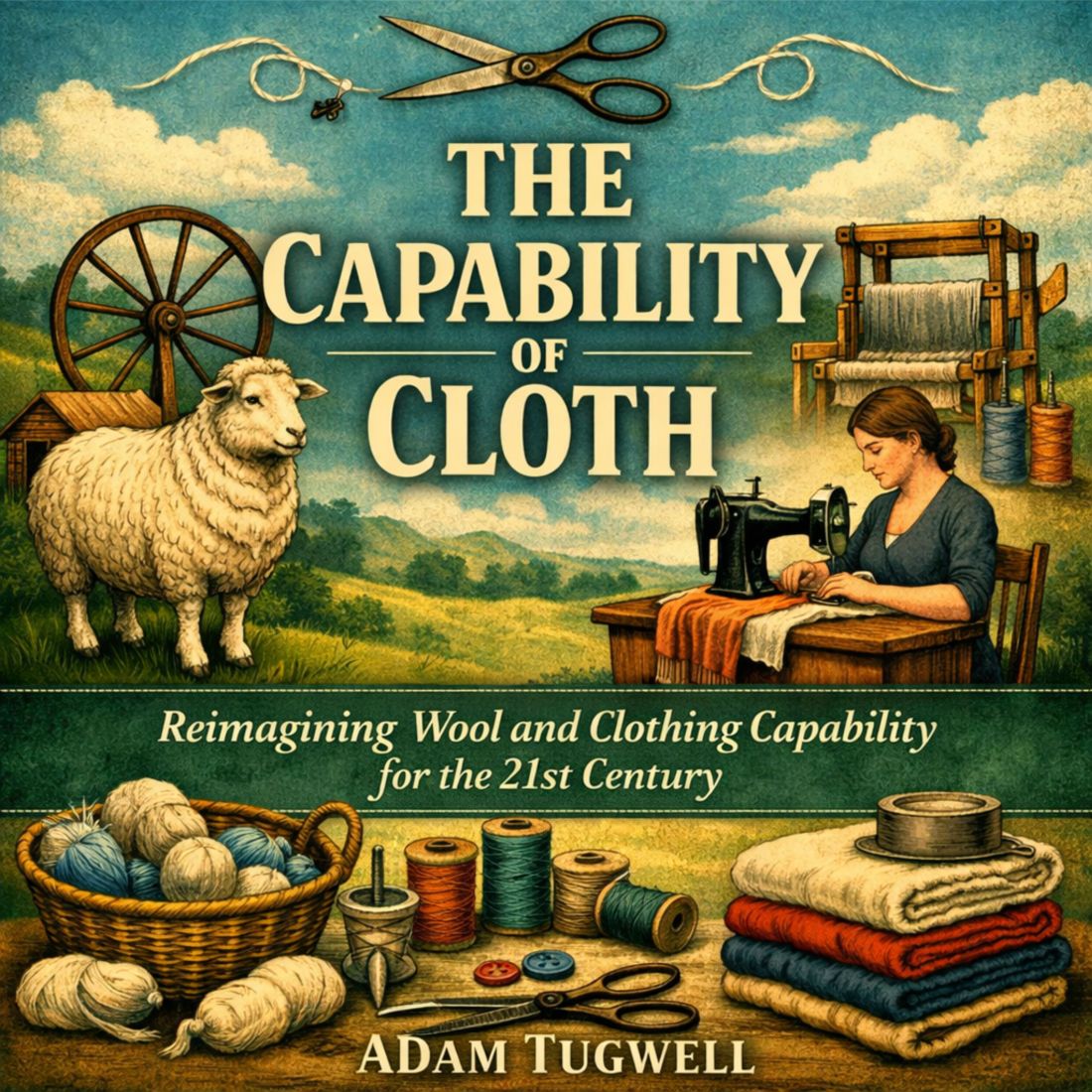
The Capability of Cloth proposes a new approach to fibre, clothing and textile production based upon human-scale industry, local capability, community participation, natural materials and human-centred technology.
The book begins from a simple observation:
Britain continues to produce substantial quantities of natural fibre, particularly wool. According to the British Wool Marketing Board annual report for 2024/2025, the 2024 clip was 19,290,044 kg; the report states that the overall average price achieved for the 2024 clip was 99.5 p/kg and that the total average return to producers, including high-volume premium, was 41.1 p/kg. These figures illustrate both the continuing scale of wool production and the economic pressures surrounding wool.
This book argues that clothing should be viewed not merely as a retail product but as a capability system.
Clothing security is not only the ability to buy clothing.
It is the ability to create, repair, adapt, share, reuse, recycle, and renew it.
The book proposes a distributed network of human-scale fibre industries built around:
wool and natural fibres
local processing capability
shared workshops and fibre hubs
repair and renewal services
apprenticeship and skills development
clothing libraries
cooperative enterprise
modern manufacturing tools
AI-supported learning and coordination
community participation
The objective is not to replace existing textile industries.
Nor is it to recreate historical systems exactly as they once existed.
The objective is to restore capability.
This includes:
economic capability
production capability
repair capability
educational capability
community capability
The book further argues that future industrial systems should be designed around a partnership between:
people
technology
living systems
rather than assuming that progress requires the continual removal of people from productive life.
As part of the wider frameworks of LEGS (The Local Economy & Governance System), EFCG (An Economy for the Common Good), Contribution Culture and the Basic Living Standard, the book explores how local textile ecosystems could support resilience, participation, stewardship and human flourishing in the twenty-first century.
Figure 3: The Human–Technology–Nature Partnership Nature provides fibre and living systems. People provide creativity, judgement, care and stewardship. Technology provides tools, coordination, learning support and production capability. Capability grows when all three work together.
Figure 4: The 21st Century Village Green Fibre Producers ↔ Processors ↔ Makers ↔ Repairers ↔ Clothing Libraries ↔ Educators ↔ Cooperatives ↔ Digital Platforms ↔ Community Users
Concept
Meaning for the Book
Capability
The practical ability to create, repair, adapt, share, learn and steward useful systems.
Stewardship
The care of materials, skills, people, places and future generations.
Participation
The opportunity for people to contribute meaningfully rather than only consume.
Human-scale industry
Enterprise designed to preserve meaningful human involvement while using appropriate technology.
Purpose
To explore how wool, natural fibres, human-scale enterprise, modern technology, and community participation can work together to rebuild clothing capability within a localised and resilient economy.
This book seeks to:
restore attention to fibre and textile capability as an important component of resilience
explore new opportunities for human-scale industry
support apprenticeship, craftsmanship, and practical skills
strengthen local enterprise and participation
encourage repair, reuse, and renewal
examine the role of cooperatives and distributed ownership
demonstrate how technology can support rather than replace people
connect textile production to wider local capability systems
contribute to discussions surrounding LEGS, EFCG, and Contribution Culture
The book is both practical and aspirational.
Practical because it addresses real materials, real skills, real businesses, and real community needs.
Aspirational because it asks readers to imagine a future in which economic systems are designed around human capability as carefully as they are designed around efficiency.
The practical ability to create, repair, adapt, share, maintain, recycle, and renew clothing and textile products.
Clothing Security
Reliable access to appropriate clothing supported by resilient systems of production, maintenance, repair, and renewal.
Fibre Capability
The local ability to transform natural fibres into useful products through knowledge, tools, infrastructure, and community participation.
Human-Scale Industry
An approach to production that combines modern technology and productivity with meaningful human participation, distributed enterprise, stewardship, and local capability.
Contribution Culture
A culture in which people are valued not only for what they consume, but for the capabilities, skills, care, creativity, and service they contribute to others.
The Basic Living Standard
A framework recognising that all people should have reliable access to life’s essential needs, including food, shelter, energy, healthcare, education, participation, and appropriate clothing.
LEGS
The Local Economy & Governance System – a framework for local capability, governance, accountability, enterprise, participation, and resilience.
EFCG
An Economy for the Common Good – a capability-centred economic framework that prioritises human wellbeing, stewardship, participation, resilience, and shared prosperity.
The 21st Century Village Green
A modern network of interconnected local enterprises, community infrastructure, shared spaces, and digital tools that support exchange, participation, learning, and capability at a local scale.
Clothing security is not only the ability to buy clothing. It is the ability to create, repair, adapt, share, renew, recycle, and steward it.
For much of human history, communities possessed many of these capabilities directly.
Today, many people possess unprecedented access to clothing while simultaneously having little connection to how clothing is produced, maintained, repaired, or renewed.
This book does not suggest that all modern systems should be abandoned.
It asks whether some forms of capability deserve to be rebuilt.
It further argues that future textile systems should be designed around a partnership between people, technology and living systems, with each contributing what it does best.
Nature provides fibre.
People provide creativity, judgement, stewardship, craftsmanship, entrepreneurship, teaching, and care.
Technology provides coordination, efficiency, learning, processing, design support, and communication.
The purpose of technology is not to make people unnecessary.
The purpose of technology is to enhance human capability.
Food, water, shelter, and energy are often recognised as essential foundations of resilience.
Clothing receives far less attention.
Yet clothing remains one of humanity’s most basic needs.
It provides:
protection
warmth
dignity
identity
participation
comfort
safety
Every person depends on it.
Yet relatively little discussion takes place about where clothing comes from, how it is made, who makes it, how it is repaired, or whether communities retain any capability to provide it locally.
This book suggests that clothing deserves to be viewed differently.
Not merely as a commodity.
Not merely as a consumer product.
But as part of a wider capability system.
A system involving farmers, fibre producers, makers, repairers, educators, designers, entrepreneurs, apprentices, cooperatives, communities, and technology working together.
The story of cloth is therefore larger than textiles.
It is a story about productive life.
About participation.
About stewardship.
About resilience.
And ultimately, about the kind of economy and society we wish to build.
Long before Britain became known for finance, technology, manufacturing, or global trade, it was known for wool.
For centuries, wool was one of the country’s most important economic resources.
Sheep grazed across landscapes that were often unsuitable for intensive crop production, converting grass into one of the most useful and versatile materials available to human society.
Wool provided:
clothing
warmth
bedding
trade goods
employment
local enterprise
export revenue
The story of British wool is not simply a story about agriculture.
It is a story about how a natural resource became the foundation for entire communities, industries, and ways of life.
The rise of Britain’s textile economy helped shape the development of towns, transport systems, markets, trade routes, and eventually industrialisation itself.
The cloth industry was not a small niche activity.
It was one of the engines that helped drive the emergence of modern Britain.
The history of textiles also reveals a wider pattern that appears repeatedly throughout economic history.
A capability emerges; communities develop skills; enterprises grow; production expands; ownership concentrates; decision-making centralises; participation declines; capability weakens; dependency increases; and eventually production relocates or disappears.
This pattern is not unique to textiles.
It can be observed across many industries.
Food systems.
Manufacturing.
Retail.
Services.
Energy.
In each case, the issue is not growth itself.
The issue is what happens when growth becomes disconnected from stewardship and participation.
Understanding this cycle is important because it helps explain why simply rebuilding an industry may not be enough.
The structures that support capability matter just as much as the capability itself.
The purpose of this book is not to ask whether Britain should reverse industrialisation.
That question belongs to the past.
The more useful question is:
What would a textile industry designed for the twenty-first century look like if human participation, local capability, resilience, stewardship, and technology were treated as equally important design objectives?
What would happen if we combined:
modern technology
advanced communications
AI-supported learning
digital marketplaces
cooperative enterprise
natural fibres
distributed manufacturing
with the strengths that earlier systems possessed:
participation
skill
stewardship
local knowledge
community capability
This is where the history of cloth stops being a story about the past.
Every garment begins long before it reaches a wardrobe.
Before spinning.
Before weaving.
Before sewing.
Before design.
There is fibre.
This is an important distinction because modern clothing systems often focus on products while obscuring the materials and living systems from which those products emerge.
A shirt may appear on a shelf.
A blanket may arrive through a delivery service.
A jumper may be purchased with a few clicks.
Yet behind every textile sits a chain of relationships linking people, materials, landscapes, skills, technology, and time.
This book argues that rebuilding clothing capability begins with rebuilding fibre capability.
Without fibre, there is no cloth.
Without fibre capability, there can be no clothing capability.
Few fibres are more closely connected to the British landscape than wool.
For centuries sheep have shaped:
upland regions
lowland grazing systems
moorland landscapes
mixed farm environments
Wool is more than a commodity.
It is a by-product of a long-standing relationship between people, animals, land, and climate.
Today many farmers continue to produce wool despite often receiving relatively low returns for it.
As several commentators within the sector have observed, wool can sometimes struggle to compete economically against global synthetic and imported alternatives.
This book does not suggest that wool alone can solve the challenges facing rural economies, nor that every wool-based enterprise will be viable in every place.
It does suggest that a material already being produced deserves renewed consideration within a wider capability framework.
One of the central ideas running throughout this book is that the future of textile production is not a choice between traditional methods and modern technology.
The future lies in partnership.
Nature provides:
fibre
renewable materials
regenerative potential
People provide:
creativity
judgement
care
craftsmanship
entrepreneurship
teaching
stewardship
Technology provides:
processing capability
efficiency
communication
coordination
learning support
manufacturing support
No element stands above the others.
Each contributes something valuable.
This is not a hierarchy.
It is a partnership.
The objective is not to replace people.
Nor is it to reject innovation.
The objective is to use innovation in ways that expand human capability.
The decline of local textile processing mirrors challenges seen throughout many sectors.
As processing becomes concentrated:
distances increase
local options decline
skills disappear
ownership concentrates
economic participation narrows
Over time, communities become producers of raw materials and consumers of finished goods while having little involvement in what happens between those stages.
The result is dependency.
Not because communities lack talent.
Not because communities lack resources.
But because critical infrastructure has disappeared.
The challenge is not merely to produce fibre.
The challenge is to retain meaningful involvement in transforming that fibre into useful products.
Resilient communities do not merely possess resources.
They possess the capability to transform resources into useful outcomes.
Processing capability is therefore a resilience capability.
A community that can process fibre possesses more options than one that relies entirely on distant systems.
Those options may never be fully required.
Their value lies in their existence.
As with food processing, repair capabilities, or local manufacturing, resilience comes not from isolation but from maintaining pathways that remain available when needed.
Design is the point at which materials become intention.
It is where function meets creativity.
It is where practical needs meet culture, identity, aesthetics, and human expression.
For thousands of years, human beings have transformed fibres into garments not merely because they required protection from the weather, but because clothing carries meaning.
It communicates:
identity
profession
community
culture
occasion
personality
craftsmanship
The Capability of Cloth therefore depends not only upon producing fibre and processing materials, but upon maintaining the capability to design, adapt, and innovate.
Historically, clothing evolved in response to local conditions.
Materials reflected what was available.
Garments reflected climate.
Techniques reflected experience.
Styles reflected culture.
Design was connected to place.
This does not mean communities should reject influences from elsewhere.
It simply means that local conditions still matter.
A garment designed for an urban office may differ significantly from one designed for farming, forestry, outdoor work, cycling, fishing, or community volunteering.
Human-scale design allows clothing to emerge from real needs rather than mass assumptions.
The Capability of Cloth proposes a future in which design becomes more accessible, more participatory, and more connected to the realities of everyday life.
A future where:
fibre producers influence outcomes
makers influence designs
users influence products
repair is valued
longevity is rewarded
technology supports creativity
communities retain ownership of knowledge
The result is not a return to the past.
It is a modern design ecosystem rooted in participation, stewardship, capability, and human flourishing.
Because before cloth becomes culture, clothing, enterprise, or expression, it must first be imagined.
And the capability to imagine, create, adapt, and improve remains one of humanity’s greatest strengths.
At its heart, enterprise is the practical process of transforming human capability into something useful for others.
It is how ideas become products.
How skills become services.
How resources become solutions.
How people create value together.
The Capability of Cloth therefore sees enterprise not as an isolated commercial activity, but as one of the primary mechanisms through which communities organise participation, innovation, and productive life.
The question is not simply:
How do we create profitable businesses?
The question is also:
How do we create businesses that strengthen capability?
One of the striking features of the fibre economy is the number of potential enterprises it can support.
A single fleece may create opportunities for:
grading
cleaning
carding
spinning
dyeing
weaving
knitting
garment making
repair
education
retail
recycling
Each stage represents a possible enterprise.
Each stage represents a possible livelihood.
Each stage represents a possible apprenticeship.
This diversity is one of the sector’s greatest strengths.
Unlike industries that concentrate value into a small number of highly specialised activities, textile capability naturally creates multiple points of participation.
If successful enterprises simply evolve into new forms of concentration, the long-term outcome may differ little from the system they were intended to improve upon.
This is why governance structures matter.
Ownership structures matter.
Participation requirements matter.
Stewardship matters.
Enterprise must remain connected to the communities and capabilities that support it.
Otherwise capability once again becomes concentrated.
Modern technology creates significant opportunities for human-scale enterprise.
Digital tools can assist:
design
manufacturing
logistics
learning
customer discovery
coordination
AI and digital tools may assist with:
pattern creation
skill development
business administration
local market matching
The principle remains consistent throughout this book:
Technology should enhance human capability.
A technology that enables a hundred small enterprises may create more community value than one that eliminates the need for those enterprises entirely.
The question is not how advanced the technology is.
The question is what kind of economy it helps create.
Within the wider LEGS ecosystem, textile enterprises do not operate in isolation.
They become part of a larger network in which fibre producers, processors, makers, repairers, clothing libraries and community users strengthen one another.
The result is not a collection of disconnected businesses.
It is an ecosystem.
A twenty-first-century village green where economic activity remains rooted in relationships, capability, stewardship, and mutual benefit.
A recurring pattern can be observed throughout economic history.
A community develops a useful capability.
Businesses emerge.
Markets develop.
Success attracts investment.
Scale increases.
Ownership concentrates.
Participation declines.
Control centralises.
Local capability gradually becomes dependent upon increasingly distant structures.
Eventually the community that created the capability may no longer control it.
This book refers to this pattern as the Capture Cycle.
The Capture Cycle is not unique to textiles.
It can be observed across:
agriculture
manufacturing
food processing
energy
retail
logistics
technology
Understanding this cycle is important because rebuilding fibre capability without addressing governance and ownership risks simply repeating the same process.
A clothing library is proposed here as a community capability resource through which garments remain in active circulation rather than being underutilised, discarded, or unnecessarily duplicated.
Examples may include:
children’s clothing
maternity wear
formal clothing
specialist workwear
outdoor clothing
performance costumes
seasonal garments
These are categories where ownership sometimes results in long periods of inactivity between uses.
A clothing library allows garments to continue providing value throughout a longer and more useful lifespan.
Key takeaway: Prosperity is not only financial output. A prosperous community possesses skills, relationships, practical knowledge, resilient enterprises and opportunities for future generations.
Capability: The practical ability to do something useful, including the skills, tools, knowledge, infrastructure, relationships, and governance required to sustain it.
Clothing capability: The ability to create, repair, adapt, share, reuse, recycle, and steward clothing and textile products.
Human-scale industry: Productive activity designed to preserve meaningful human participation while using appropriate modern technology.
Stewardship: The practice of caring for materials, skills, people, communities, infrastructure, and future generations.
Capture Cycle: A recurring pattern in which capability grows, ownership concentrates, participation declines, and communities become increasingly dependent on distant systems.
Further Reading
The ideas explored in The Capability of Cloth connect to a wider body of work on capability, stewardship, participation, and human‑scale economics. The following resources offer deeper insight into textile sustainability, cooperative enterprise, and local resilience. They include both external references and related works by Adam Tugwell, presented with their full URLs.
External Resources
These publications and organisations provide valuable perspectives on textile sustainability, circular economy, cooperative enterprise, and local capability building:
British Wool Annual Reports – Insight into the state of the UK wool industry, fibre quality, and regional production trends.
WRAP (Waste and Resources Action Programme) – Reports and guidance on textile recycling, repair, and circular economy initiatives in the UK.
UK Fashion and Textile Association (UKFT) – Sector analyses and policy updates on British textile manufacturing, skills, and innovation.
OECD Cooperative and Regional Development Case Studies – International examples of cooperative models and local economic resilience.
Ellen MacArthur Foundation – Foundational resources on circular economy principles and regenerative design.
Co‑operatives UK Publications – Guidance and research on cooperative governance, community ownership, and democratic enterprise.
Academic Literature – Research on textile sustainability, repair economies, community wealth building, and local resilience frameworks.
These sources provide a global and national context for the capability‑based approach discussed throughout this book.
Related Works by Adam Tugwell
The following works expand on the conceptual foundations of The Capability of Cloth, exploring capability, governance, and human‑scale economics across different domains.
Beyond the Farm Gate
Explores how rural and agricultural systems can evolve beyond production into capability‑based local economies, connecting land stewardship with enterprise and community participation.
Proposes a hybrid model of mechanisation that combines traditional power sources with modern technology to create a connected, human‑centred, localised economy.
Introduces the EFCG framework and its application to local governance, enterprise, and capability development – a key conceptual foundation for this book.
Examines how work, business, and governance can be transformed through a culture of contribution, aligning with the principles of capability and the common good.
Provides a concise explanation of the Basic Living Standard – a framework for ensuring that every person has access to the essentials required for capability and participation.
This paper is not ultimately about wool. It is about whether communities retain the capability to meet needs, care for resources, use technology wisely, create meaningful work, and pass practical knowledge forward. Cloth provides the example because it is ordinary, essential, and deeply connected to land, skill, enterprise, repair, dignity, and participation. The capability of cloth is therefore a practical question about clothing. It is also a larger question about the kind of economy communities may choose to build.
Mobile and Localised Abattoirs, Food Capability, and Community Resilience
A capability-centred proposal for restoring local meat-processing infrastructure, strengthening food resilience, and supporting trusted local food systems.
Publication Note
This edition has been prepared for online and digital publication. It is written as a public proposal, a resilience argument, and a contribution to wider work on the Local Economy & Governance System, An Economy for the Common Good, Foods We Can Trust, the Basic Living Standard, and Contribution Culture.
The central claim is deliberately practical: food security is not secured by production alone. Communities also require the processing, storage, distribution, skills, governance, and social participation needed to turn food production into food provision.
This paper uses the mobile and localised abattoir as a specific example of a wider principle: communities become more resilient when they retain the practical ability to do the things that matter.
How to Read This Paper
This paper can be read in three ways: as a practical proposal for mobile and localised abattoirs, as a systems argument about the missing middle of the food chain, and as part of the wider EFCG and LEGS work on local capability, stewardship, and community resilience. Its central concern is the same throughout: communities need the practical ability to turn food production into food provision.
The argument does not depend on any particular forecast about the future. Mobile and localised processing has value under normal conditions and becomes more valuable whenever supply chains, costs, infrastructure, or access come under pressure. The book is therefore framed as capability planning rather than prediction.
Disclaimer
This paper is a conceptual and practical proposal intended to stimulate discussion, research, engineering development, pilot projects, and policy consideration.
The systems described herein are not presented as completed technologies, universal solutions, or regulatory guidance. Their implementation would require appropriate legal compliance, welfare oversight, food safety assurance, engineering validation, economic assessment, and operational testing.
References to food-system resilience, local processing capability, supply-chain vulnerability, livestock welfare, and governance are intended to support capability planning and constructive discussion, not to predict specific future events.
Nothing in this paper should be interpreted as legal, veterinary, engineering, financial, regulatory, or operational advice. Readers should seek appropriate professional guidance before making any business, livestock, infrastructure, or investment decisions.
The views expressed are offered as a contribution to ongoing discussions about food security, animal welfare, local resilience, community capability, and human-centred technology.
A Note to the Reader
This paper is not written to argue that every existing food system is wrong, nor that every modern development should be reversed. It is written because an important capability is disappearing: the local ability to process livestock into trusted food.
Across much of the United Kingdom, sector evidence and policy discussion indicate that local slaughter and processing infrastructure has declined substantially over recent decades. Facilities have closed, distances have increased for some producers, services have become harder to access in some regions, and capacity has become concentrated into fewer locations.
The consequences are practical: animals may travel further, farmers may have fewer choices, smaller producers may struggle to access suitable processing, and communities become more dependent on infrastructure located elsewhere.
How can high standards be maintained while rebuilding local capability?
How can technology support animal welfare, processing quality, food trust, and rural resilience without forcing every activity into larger and more centralised systems?
How can communities remain capable of feeding themselves if essential processing infrastructure continues to disappear?
The mobile and localised abattoir is presented here not as a complete answer, but as one practical contribution towards addressing these questions.
Like the wider work surrounding LEGS, EFCG, Foods We Can Trust, local food resilience, apprenticeship, and Contribution Culture, this paper is ultimately concerned with capability.
Money can purchase capability only while functioning systems exist to convert money into food, labour, equipment, fuel, logistics, and essential services. When those systems become disrupted, communities require the capability itself.
It is about preserving an essential link in the chain connecting land, livestock, food, people, and community.
Executive Summary
Mobile & Localised Abattoir Systems proposes a network of ethical, human-scale livestock-processing facilities designed to restore local food-processing capability while maintaining high standards of animal welfare, food hygiene, traceability, and operational integrity.
The proposal responds to a challenge widely identified by small-abattoir users, sector bodies, and policy discussions: the continuing pressure on local slaughter and processing infrastructure.
Public discussions about food security often focus on production, imports, retail supply, distribution networks, or consumer prices. Far less attention is given to processing capability. Yet livestock cannot become food without the systems, facilities, equipment, skills, and people required to process it safely and ethically.
The central argument is simple: food security is not only the ability to produce food. It is also the ability to process it.
The proposed solution combines modern engineering, digital traceability, modular infrastructure, welfare-centred design, cooperative ownership models, and local accountability to create processing systems that are practical under current conditions and valuable within future resilience strategies.
These systems are designed to:
operate lawfully within existing regulatory frameworks
reduce transport distances for livestock
support higher animal welfare outcomes
strengthen local food economies
restore farmer agency
rebuild local processing capability
support local butchery and apprenticeship
increase resilience during supply-chain disruption
integrate into wider community capability systems
Their purpose is simple:
To help ensure that communities retain the practical ability to convert livestock into trusted food close to where that livestock is raised.
The Proposal in Brief
A mobile or localised abattoir system is a legally approved, welfare-centred, hygienic livestock-processing facility designed to operate closer to where animals are raised. It may take the form of a mobile unit, a modular facility, a small fixed site, or a network combining mobile slaughter, local chilling, butchery, cold storage, inspection, waste handling, and distribution.
The proposal is not that every farm should have its own slaughter facility. It is that regions should retain enough distributed processing capability to avoid complete dependence on distant, concentrated infrastructure.
Core Operating Model
A group of farms, butchers, local enterprises, or community bodies identifies a regional processing gap.
A mobile, modular, or localised unit is developed through lawful approval, competent design, professional oversight, and appropriate financing.
Animals travel shorter distances where suitable, reducing avoidable transport while preserving welfare and inspection standards.
Slaughter, chilling, traceability, record keeping, veterinary oversight, waste handling, cleaning, and food safety procedures are built into the operating model from the beginning.
Local butchers, apprentices, cold storage, community kitchens, retailers, and direct-sale routes connect the facility to the wider food capability network.
Three Planning Contexts
Continued stability
Mobile and localised processing can improve farmer choice, support shorter supply chains, strengthen local butchery, preserve skills, and reduce dependence on distant facilities.
Supply-chain pressure
Mobile and localised processing can provide additional regional capacity when fuel costs, booking delays, workforce shortages, disease controls, or logistics pressures affect normal routes.
Longer-term resilience
Mobile and localised processing can form part of a broader local food-capability network, helping communities maintain processing access, skills, trust, and flexibility as conditions change over time.
What This Proposal Is Not
It is not a call to weaken animal welfare, food hygiene, inspection, traceability, or public health standards.
It is not a claim that mobile abattoirs are automatically cheaper, greener, or better in every circumstance.
It is not a rejection of all large facilities or national food infrastructure.
It is not a completed engineering specification.
It is not a prediction about future events.
It is a capability proposal: a way for farmers, communities, local authorities, engineers, butchers, regulators, and food-resilience planners to consider how essential processing capacity might be rebuilt before access becomes more difficult.
Indicative System Components
Mobile or modular slaughter unit
Provides approved, welfare-centred slaughter capability closer to livestock.
Chilling and cold storage
Maintains food safety, product quality, and local supply continuity.
Inspection and official controls
Protects public health, welfare standards, consumer confidence, and legal compliance.
Traceability and records
Supports accountability, provenance, food trust, and audit readiness.
Waste and by-product management
Ensures environmental responsibility, hygiene, regulatory compliance, and potential resource recovery.
Local butchery and apprenticeship
Turns carcasses into usable food while preserving practical skill and employment.
Community governance
Links infrastructure to local accountability, shared responsibility, and long-term stewardship.
Purpose
The purpose of this book is to introduce mobile and localised livestock-processing systems as practical infrastructure for restoring food-processing capability at community and regional level.
These systems are designed to:
reduce dependence on distant infrastructure
support animal welfare and stewardship
strengthen local food resilience
maintain high hygiene and traceability standards
support farmers, butchers, and processors
preserve practical skills and apprenticeship
integrate with future local capability systems such as LEGS
The core question is whether essential food-processing capability should be treated as critical infrastructure rather than merely an industrial service.
Key Concepts
Processing Capability
The practical ability to convert livestock into safe, traceable, consumable food through local infrastructure, skilled practitioners, and supporting systems.
Human-Scale Systems
Infrastructure, tools, and workflows designed around people, communities, stewardship, and practical manageability rather than maximum scale alone.
Food Resilience
The ability of communities and regions to maintain reliable food supply during disruptions, shortages, economic shocks, or infrastructure failures.
Local Capability Networks
Interconnected systems in which production, processing, storage, distribution, skills, governance, and community support strengthen one another.
LEGS
The Local Economy & Governance System – a framework for local decision-making, accountability, resource coordination, and community capability.
EFCG
An Economy for the Common Good – a needs-first economic model focused on capability, contribution, stewardship, and community wellbeing.
Foods We Can Trust
A wider framework exploring transparency, provenance, resilience, local production, and consumer confidence throughout the food chain.
These definitions are intentionally concise. Their purpose is to orient the reader and establish a common language throughout the document.
Part One: The Missing Capability in Food Security
Farmers, butchers, livestock handlers, processors, inspectors, transport operators, refrigeration specialists, and hygiene professionals form the chain that makes livestock usable as food.
Processing is skilled work requiring judgement, responsibility, technical competence, welfare awareness, and public trust.
The loss of local processing infrastructure may also reduce opportunities for practical learning, apprenticeship, and the transfer of specialist knowledge. This is a reasonable concern, but the scale of that loss would need to be verified through sector-specific workforce and training evidence before being stated as a measured fact.
Many have experienced increasing transport distances, shrinking processing options, reduced scheduling flexibility, longer waiting times, and rising costs. These challenges are often accepted as inevitable consequences of modernisation.
The issue is whether communities should permanently lose the practical capacity to process their own food.
The Part of Food Security Nobody Wants to Talk About
Food-security discussions often neglect the question of what happens after the animal leaves the field.
Food security is weakened when processing capability becomes concentrated, inaccessible, unaffordable, or disrupted. Livestock cannot become food without infrastructure, refrigeration, transport, skilled professionals, hygiene systems, inspection, and traceability.
Processing capability therefore deserves recognition as critical food infrastructure.
Why This Matters Now
Local abattoirs have disappeared through a combination of industrial consolidation, economic pressure, regulatory complexity, declining margins, workforce challenges, ageing infrastructure, and changing market structures.
The result is fewer local options, longer journeys for some livestock, limited booking availability, and additional pressure on smaller producers, independent butchers, and local food networks.
Independent butchers and local food networks face additional pressures when nearby processing capability disappears.
This paper does not argue that catastrophe is inevitable. It argues that resilience is a design requirement.
Mobile and localised abattoirs should therefore be viewed through three lenses:
Current: addressing a real and growing processing-capability gap.
Practical: helping communities rebuild local processing, butchery, storage, and food skills.
Strategic: forming one component of a more resilient, distributed, transparent, and human-scale food system.
The question is whether communities retain enough capability to secure food when normal arrangements become strained.
The Missing Middle of the Food System
Modern discussions about food often focus on two ends of the chain:
production
consumption
We discuss what farmers grow and raise. We discuss what consumers buy and eat.
The infrastructure that sits between those two activities is often overlooked.
Yet it is the middle of the chain that determines whether food can move from field to table.
Between livestock in a field and food on a plate sits an entire ecosystem of capability:
transport
processing
refrigeration
storage
butchery
inspection
waste handling
distribution
skills
labour
governance
When these systems function well they become almost invisible.
When they begin to disappear, their importance becomes impossible to ignore.
The challenge facing many regions today is not a lack of livestock. It is a decline in the infrastructure required to process and distribute that livestock effectively, ethically, and locally.
This is the infrastructure gap.
Food Security Requires More Than Production
Food security is often measured through production metrics:
acreage
yields
livestock numbers
imports
exports
These matter.
However, food security cannot be reduced to production alone.
A farm may produce livestock successfully.
A community may possess suitable land, skilled farmers, and healthy animals.
But if slaughter, processing, refrigeration, and distribution capability are unavailable, a critical link in the chain has failed.
Food security therefore depends upon:
production capability
processing capability
storage capability
distribution capability
community capability
Weakness in any one area weakens the entire system.
The industrial model has often prioritised efficiency within individual stages while assuming that all supporting infrastructure will remain permanently available.
This assumption may be reasonable during periods of stability.
Resilience requires a different question:
What capability remains if one or more parts of the system become constrained?
The Decline of Local Processing Infrastructure
For many decades, slaughter and processing capacity appears to have become increasingly concentrated, although precise figures vary according to definitions, species, jurisdiction, and source.
This trend has brought certain advantages:
economies of scale
high throughput
specialised facilities
centralised compliance systems
consolidated distribution networks
At the same time, concentration creates dependencies.
As local facilities disappear:
distances increase
alternatives decrease
local knowledge declines
processing options narrow
resilience reduces
The issue is not that larger facilities are inherently wrong. It is that concentrating capability into fewer locations increases vulnerability when those locations become unavailable, overbooked, uneconomic, or inaccessible.
However, it did mean that many communities possessed practical knowledge and infrastructure that connected livestock production to food provision.
Every additional stage between farm and processing introduces potential stress factors:
loading
transport
waiting periods
unfamiliar environments
repeated handling
While modern transport systems can operate to high welfare standards, distance remains a practical consideration.
The longer the journey, the greater the importance of maintaining welfare conditions throughout the process.
Local processing infrastructure can reduce some of these pressures by shortening the distance between rearing and processing.
This should not be viewed as an argument against regulation.
It is an argument for considering physical proximity as one component of welfare-centred design.
In a human-scale food system, distance matters.
The Loss of Local Skills
Infrastructure is more than buildings.
Infrastructure includes people.
When facilities disappear, skills often disappear with them.
Communities may lose:
experienced butchers
livestock handlers
food processors
maintenance specialists
apprenticeships
training pathways
These capabilities cannot simply be recreated overnight.
Skills are built through practice, mentorship, experience, and repetition.
Once lost, rebuilding them can take years.
This is one reason why processing infrastructure should be viewed as strategic capability rather than merely commercial activity.
A functioning facility supports:
employment
learning
knowledge transfer
community resilience
The building matters.
The people matter more.
The Cold Chain Challenge
Processing capability is only one part of the infrastructure gap.
Storage is equally important.
A resilient food system requires:
chilling
refrigeration
cold storage
transport integration
The industrial system often assumes these services are readily available.
Many local systems cannot make the same assumption.
If processing is restored but no local cold-storage capacity exists, another bottleneck emerges.
This paper therefore views mobile abattoirs as part of a wider capability network rather than a standalone solution.
Processing capability must connect to:
refrigeration
local butchery
distribution
community food systems
Every link matters.
The Infrastructure Gap in a Supply Disruption
Under normal conditions, missing local capability may simply appear inconvenient.
Under conditions of disruption, it becomes far more significant.
Potential stressors include:
fuel shortages
transport disruption
labour constraints
energy instability
supply-chain interruption
economic contraction
infrastructure failure
The purpose of resilience planning is not to predict these events.
The purpose is to understand their consequences.
A community that raises livestock but lacks processing capability may discover that production alone cannot provide food security.
The bottleneck shifts from farming to processing.
The existence of livestock does not automatically translate into food availability.
Capability matters at every stage.
Why Mobile and Localised Systems Matter
The infrastructure gap is not solved by nostalgia.
Nor is it solved by rejecting modern standards.
The challenge is to rebuild capability using contemporary tools and contemporary knowledge.
This is where mobile and localised systems become relevant.
They offer the possibility of:
restoring processing access
reducing transport requirements
supporting welfare outcomes
reconnecting processing with farming
strengthening local supply networks
supporting regional resilience
Most importantly, they allow capability to move closer to where it is needed.
Rather than requiring every farm to possess every facility, communities can share resources through cooperative and networked models.
Capability becomes distributed without becoming isolated.
An Infrastructure of Stewardship
The purpose of food infrastructure should not be measured solely by throughput.
It should also be measured by:
reliability
accountability
welfare
stewardship
resilience
community value
Mobile and localised abattoirs are not proposed because they are old-fashioned.
They are proposed because they address a practical capability gap that already exists.
They restore a missing layer of infrastructure between production and consumption.
They help ensure that food security remains connected to real-world capability rather than depending entirely on increasingly distant systems.
The question is therefore not whether communities can raise livestock.
The question is whether they retain sufficient infrastructure to transform livestock into trusted food.
That question leads directly to the next challenge:
How can processing systems be designed to serve people, animals, communities, and the land simultaneously?
Part Two: Stewardship, Responsibility, and the Last Journey
The Measure of a Food System
A food system should not be judged solely by how much food it produces, how quickly it can process livestock, or how efficiently it can move products through supply chains.
It should also be judged by how it treats living animals.
The welfare of livestock is not a peripheral concern. It is a reflection of the values embedded within the system itself.
A society that benefits from animals for food has a responsibility to ensure that their care extends beyond birth, rearing, and husbandry. It includes the final stage of their journey.
The question is not whether slaughter occurs.
The question is how it occurs.
This paper begins from a simple principle:
Animal welfare should remain central throughout the entire food chain, including the final journey from farm to processing.
Welfare Is Not a Box to Tick
Modern welfare regulations have delivered important protections for animals.
Inspection systems, transport regulations, facility design requirements, handling standards, and operator training all play valuable roles.
These protections matter.
However, welfare should not be reduced to compliance alone. It concerns the lived experience of the animal: handling, movement, familiarity, stress, calmness, and transport.
A system may meet formal requirements while still leaving room for improvement in how stress, handling, distance, and familiarity are managed. This should be understood as a welfare-design principle rather than a verified outcome claim.
The purpose is to examine whether system design itself can contribute to better welfare outcomes.
The Last Journey
For many livestock animals, transportation can be one of the more significant welfare events in the final stage of life, particularly where journeys are long, handling is repeated, weather conditions are difficult, or animals are already vulnerable.
Animals are often moved from familiar environments to unfamiliar ones.
They may encounter:
loading and unloading procedures
transport vehicles
unfamiliar sounds
unfamiliar smells
new surroundings
handling by unknown people
Transport can be carried out professionally and responsibly.
Nonetheless, transport remains a welfare event.
The further the distance between farm and processing facility, the more important careful planning, competent handling, suitable vehicles, rest, water, ventilation, weather protection, and inspection become.
This is one reason why the decline of local slaughter infrastructure matters.
As facilities become more distant, transport often becomes a larger and more unavoidable component of the process.
The welfare discussion is therefore not simply about what happens inside an abattoir.
It begins long before arrival.
It begins at the farm gate.
Distance Matters
Distance affects transport duration, handling requirements, scheduling flexibility, animal movement, farmer involvement, and welfare management.
This does not mean every long journey causes poor welfare or every local system is better. It means that reducing unnecessary travel should be considered in welfare-centred design.
All else being equal, reducing unnecessary travel deserves serious consideration when designing welfare-centred food systems.
Stewardship Beyond Production
Farmers invest enormous time and effort caring for livestock.
Good husbandry requires:
knowledge
observation
patience
responsibility
daily commitment
Many livestock keepers know their animals intimately.
They understand their health, behaviour, strengths, and vulnerabilities.
Yet in highly centralised systems, the final stage of the animal’s journey may take place far from the farm and largely outside the farmer’s direct influence.
This can create a disconnect between stewardship and outcome.
Mobile and localised processing systems help reduce that separation.
They make it more possible for final-stage welfare to remain connected to those who have cared for the animal throughout its life.
The significance of this should not be underestimated.
People often perform better when responsibility remains visible.
Local systems make responsibility visible.
Respect for Animals
Animals are not machines or products waiting to be manufactured. They are living creatures whose lives support human communities. A welfare-centred food system accepts that people consume meat, that slaughter is part of meat production, and that ethical responsibility extends to the design of the whole system.
Human Scale and Animal Welfare
One of the advantages of human-scale systems is visibility.
In smaller operations it is often easier to see:
the animals
the handling process
the people involved
welfare concerns
operational problems
Visibility encourages accountability.
The people involved are less likely to become abstract occupants of distant organisational structures.
Actions are connected to identifiable individuals.
Responsibilities become clearer.
This is not an argument against large facilities.
It is an argument that welfare often benefits when relationships remain visible.
Human-scale systems reduce the distance between responsibility and consequence.
Technology in Service of Welfare
Technology should not be viewed as the opposite of welfare.
Well-designed technology can significantly improve welfare outcomes.
Modern systems can support:
welfare monitoring
environmental control
handling safety
operator training
temperature management
traceability
compliance documentation
The important question is not whether technology is used.
The important question is the purpose it serves.
In a welfare-centred system, technology assists:
better handling
better oversight
greater consistency
improved safety
reduced stress
Technology becomes a tool of stewardship rather than merely a tool of efficiency.
This mirrors a wider principle found throughout this body of work:
Technology should enhance responsibility, not remove it.
Welfare, Trust, and Transparency
Public trust in food systems depends upon confidence.
People want confidence that:
animals were treated appropriately
food was processed safely
standards were maintained
accountability exists
Trust grows when systems become visible.
The closer communities are to food production and processing, the easier it becomes to understand how food is produced and handled.
Transparency does not automatically create trust.
However, transparency makes trust possible.
Mobile and localised systems have the potential to strengthen this transparency by shortening the distance between:
producer and processor
processor and butcher
butcher and consumer
community and food source
This directly supports the wider goals of Foods We Can Trust.
Welfare During Times of Disruption
Animal welfare becomes particularly important during periods of strain.
Supply-chain disruption can create pressures including:
delayed transport
overcrowding
processing bottlenecks
workforce shortages
infrastructure limitations
A resilient system is one that reduces the likelihood of such welfare pressures developing in the first place.
Distributed capability provides options.
Options matter when circumstances become difficult.
Mobile and localised processing systems should therefore be viewed not merely as welfare improvements, but as welfare resilience infrastructure.
They provide additional pathways for maintaining standards during periods of disruption.
The Welfare Principle
The argument for mobile and localised processing is economic, logistical, technological, and moral.
If communities consume livestock products, they share responsibility for welfare throughout the whole process, including the final journey.
It extends to the design of the system itself.
A welfare-centred system seeks to minimise unnecessary stress, maintain dignity in handling, preserve accountability, and align infrastructure with stewardship.
And the measure of a food system is not only how it feeds people, but how responsibly it treats the animals entrusted to it.
Part Three: Rebuilding Capability Through Local Food Infrastructure
Resilience Is Not Self-Sufficiency
Resilience does not mean isolation. It means retaining enough practical capability to continue functioning when normal systems become strained, disrupted, delayed, or unavailable. Mobile and localised abattoirs are not designed to replace wider food networks; they are designed to strengthen local capability within them.
A resilient community is one that retains enough practical capability to continue functioning when normal systems become strained, disrupted, delayed, or unavailable.
They are designed to strengthen local capability within them.
The Fragility of Long Chains
Modern food systems achieve remarkable things.
Food moves across regions, nations, and continents every day.
Livestock, feed, equipment, fertiliser, machinery, refrigeration systems, packaging, processing capacity, and retail distribution operate through extensive networks that are often highly efficient.
However, efficiency and resilience are not the same thing.
The longer a chain becomes, the more dependencies it contains.
Food systems may depend upon:
fuel availability
transport networks
refrigeration
labour availability
processing capacity
communications infrastructure
energy supply
imports
finance
regulatory systems
None of these dependencies are inherently negative.
The question is what happens when one or more become constrained.
A resilient system assumes that disruption is possible and designs accordingly.
The Missing Links
What they increasingly lack are the connecting systems that turn production into community food security.
Many regions still possess farmland, livestock, farmers, and agricultural knowledge, but increasingly lack the connecting systems that turn production into community food security: processing, butchery, cold storage, distribution, apprenticeship, and coordination.
The Critical Supply Period
The critical supply period is the time between disruption and adaptation, when communities remain partly dependent on wider systems while needing to develop more local capability. In such periods, bottlenecks may occur not in farming but in processing, refrigeration, storage, or distribution.
Mobile and localised abattoirs are designed partly to address this challenge.
They may provide one mechanism through which processing capability could remain more flexible and geographically distributed, provided that the model is tested, approved, resourced, and shown to work under real operating conditions.
Mobile systems fit this process because they can be deployed incrementally, support multiple farms, operate alongside existing infrastructure, and provide additional capacity while wider systems continue functioning. This is not revolution; it is retooling.
Scenario Planning: Stability, Pressure, and Long-Term Resilience
The proposal should be considered across three planning contexts: useful under normal conditions, important during supply-chain pressure, and valuable as part of longer-term local resilience. Readers may hold different views about future risks. The case for rebuilding capability does not depend on any single prediction.
The Community Capability Chain
This paper views food resilience as a chain of interconnected capabilities.
Consider an illustrative example:
Livestock are raised on local farms.
A mobile processing unit provides slaughter capability.
Local butchers process and prepare products.
Cold storage preserves supply.
Community kitchens convert food into meals.
Local distribution delivers food where needed.
Waste streams support composting, soil health, and regenerative systems.
Apprentices develop skills that sustain the entire cycle.
Each link strengthens the next.
Each link depends upon the others.
No link is sufficient on its own.
The mobile abattoir is therefore not the centre of the system.
It is one critical connection within a wider network.
Its importance lies in what it enables.
Local Governance and Accountability
Resilience also depends on decision-making. Infrastructure performs best when the people affected by it have a meaningful voice in its operation.
Infrastructure performs best when the people affected by it have a meaningful voice in its operation.
This is one reason the wider LEGS framework emphasises local accountability and governance.
Mobile and localised processing infrastructure can support this approach by making food systems more visible, more accessible, and more accountable to the communities they serve.
Resilience as a Design Requirement
A recurring theme throughout this paper is that resilience should not be treated as an afterthought.
It should be treated as a design requirement.
Questions such as:
What happens if fuel becomes scarce?
What happens if transport is disrupted?
What happens if processing capacity becomes unavailable?
What happens if skills are lost?
What happens if communities need to increase local food capability?
are not questions of pessimism.
They are questions of responsible planning.
Well-designed systems prepare for uncertainty while attempting to preserve flexibility.
Mobile and localised processing systems are one way of building that flexibility into the food chain.
When production, processing, storage, skills, trust, relationships, and infrastructure work together, communities are better able to meet challenges without losing agency, dignity, or responsibility.
Mobile and localised abattoirs are one contribution to that wider goal.
Part Four: Land, Resources, and Living Systems
Sustainability Beyond Carbon
Environmental sustainability is often reduced to a single question:
How much carbon does a system produce?
While emissions matter, sustainability is broader than carbon alone.
A genuinely sustainable food system must also consider:
soil health
biodiversity
water quality
waste management
nutrient cycles
transport requirements
energy use
land stewardship
ecosystem resilience
The purpose of sustainability is not simply to reduce damage.
It is to create systems capable of supporting both human communities and the natural systems on which those communities depend.
This paper therefore approaches environmental sustainability through the broader lens of stewardship.
The question is not merely how to produce food.
The question is how to produce food while strengthening the ecological systems that make food production possible.
The Hidden Environmental Cost of Distance
Modern food systems often depend upon movement.
Animals, feed, equipment, inputs, packaging, and finished products may travel significant distances before reaching consumers.
Many of these movements are entirely legitimate.
However, every additional stage introduces additional requirements for:
fuel
transport infrastructure
refrigeration
handling
storage
logistics coordination
The environmental impact of food is therefore influenced not only by how food is produced, but also by how far it moves through the system.
The decline of local processing infrastructure can unintentionally increase these distances.
Livestock may travel further for slaughter.
Carcasses may travel further for processing.
Products may travel further for distribution.
The cumulative effect can increase dependence on transport-intensive systems.
Localised processing may reduce some unnecessary movements, but this should not be presented as an automatic environmental gain. Any environmental claim would need to consider transport distance, vehicle utilisation, refrigeration, energy use, cleaning, waste handling, and the efficiency of both local and centralised alternatives.
Distance is not the only environmental factor.
But it is one that communities can influence.
Environmental Stewardship Begins at the Farm
Environmental sustainability cannot be separated from agricultural practice.
The quality of food systems depends heavily on how land is managed.
This includes:
grazing management
soil stewardship
biodiversity protection
water management
nutrient cycling
habitat preservation
Some regenerative, mixed-farming, and conservation-grazing approaches seek to strengthen these relationships by treating livestock as part of wider ecological cycles. The suitability and outcomes of these approaches vary by land type, management practice, stocking level, ecology, and local conditions, so this should be treated as a contextual design possibility rather than a universal claim.
This paper does not advocate a single farming model.
However, it recognises that localised processing infrastructure can support a broader diversity of land-management approaches, including:
mixed farming
regenerative systems
conservation grazing
small-scale livestock operations
community-supported agriculture
When processing options remain accessible, farmers have greater flexibility to develop systems appropriate to their land and circumstances.
Nutrient Cycles and Resource Use
Industrial systems often operate through long and complex supply chains.
Materials move in one direction.
Resources are extracted, consumed, and discarded.
Resilient ecological systems tend to work differently.
They cycle resources.
Waste from one process becomes an input for another.
Natural systems continuously transform materials without producing true waste.
Food systems can learn from this principle.
Mobile and localised processing systems create opportunities to increase visibility and accountability around:
organic waste streams
nutrient recovery
composting
agricultural reuse
local resource management
The goal is not perfect circularity.
The goal is reducing unnecessary waste while encouraging responsible stewardship of available resources.
Environmental sustainability improves when communities understand where materials come from and where they go.
Waste as a Resource
One of the most important shifts in environmental thinking is the recognition that many waste streams contain value.
Historically, agricultural communities often integrated by-products into wider systems.
Modern environmental management still requires strict hygiene and regulatory compliance, but the underlying principle remains relevant.
Potential pathways may include:
compost systems
soil improvement
energy generation
agricultural by-product utilisation
nutrient recovery
The precise methods will depend upon regulation, technology, economics, and local conditions.
The larger principle is simple:
Waste should be managed responsibly and viewed as part of a wider environmental system rather than merely as a disposal problem.
Local Systems and Biodiversity
Environmental sustainability is not only about production efficiency.
It is also about landscape health.
Diverse rural landscapes often support:
wildlife habitats
pollinators
hedgerows
wetlands
woodland systems
mixed agricultural environments
A highly centralised food system can unintentionally encourage uniformity.
Distributed systems can create space for greater diversity in farming practices and land use.
The purpose is not to oppose productivity.
The purpose is to recognise that ecological resilience often benefits from diversity.
Just as economic systems become more resilient when capability is distributed, natural systems often become more resilient when ecological diversity is preserved.
Energy and Appropriate Scale
The environmental discussion surrounding food frequently focuses on scale.
Larger systems may benefit from economies of scale.
Smaller systems may benefit from flexibility and proximity.
Neither scale is automatically superior.
The more useful question is:
What scale is appropriate for the task?
Mobile and localised processing systems are designed around human-scale operation.
This can create opportunities for:
reduced transport requirements
lower infrastructure demands
modular energy systems
adaptive deployment
incremental expansion
Many future systems may incorporate combinations of:
grid electricity
battery storage
renewable generation
energy-efficient refrigeration
hybrid power systems
The goal is not technological purity.
The goal is practical sustainability.
Sustainability and Resilience
Environmental sustainability and resilience are often treated as separate discussions.
In reality, they are closely connected.
A food system that degrades:
soil
water
biodiversity
local capability
cannot remain resilient indefinitely.
Likewise, a system that lacks resilience may struggle to maintain environmental standards during periods of stress.
Long-term sustainability depends upon balancing:
productivity
ecology
welfare
economics
community capability
Removing any one of these elements weakens the whole.
Environmental stewardship therefore supports resilience, and resilience supports environmental stewardship.
Technology in Service of the Environment
Technology should not be viewed as the enemy of sustainability.
Modern tools can support environmental outcomes through:
improved monitoring
energy management
waste reduction
traceability
resource efficiency
environmental reporting
The key question remains one of purpose.
Technology should be deployed to improve stewardship rather than merely increasing extraction.
In this respect, environmental sustainability aligns closely with the wider philosophy of this paper.
Technology should serve:
people
animals
land
communities
rather than treating them solely as inputs into production systems.
Environmental Responsibility Across the Entire Chain
Food does not emerge from isolated processes.
Every stage affects every other stage.
Land management influences livestock health.
Livestock systems influence processing requirements.
Processing influences distribution.
Distribution influences energy use.
Waste management influences soil.
Soil influences future production.
Everything is connected.
This paper therefore treats environmental sustainability not as a separate objective but as an integrated design principle.
Mobile and localised abattoirs are not proposed simply because they can process livestock.
They are proposed because they may help support a food system that is:
more visible
more accountable
more resource conscious
more locally capable
more environmentally responsible
Stewardship for Future Generations
Environmental sustainability ultimately asks a simple question:
What kind of food system are we leaving behind?
A system that consumes capability faster than it can be replaced will eventually weaken.
A system that degrades soil, loses biodiversity, wastes resources, and disconnects communities from stewardship will eventually face increasing pressures.
The alternative is not perfection.
The alternative is continuous stewardship.
A food system capable of feeding people while caring for the land, managing resources responsibly, reducing unnecessary waste, and preserving capability for future generations.
Mobile and localised processing infrastructure is only one small part of that story.
But it can be an important part.
Because environmental sustainability, like food security, is ultimately about responsibility.
Responsibility for the land.
Responsibility for resources.
Responsibility for communities.
And responsibility for the generations that follow.
Part Five: Capability, Agency, and Local Prosperity
Money is valuable because it allows access to capability.
It enables people to purchase food, fuel, labour, equipment, services, and infrastructure.
However, money can only purchase capability when the systems that provide it are functioning.
If the processing facility has closed, the service may not be available regardless of the price offered.
If the skilled butcher has retired and no apprentice has replaced them, capability has disappeared.
If the nearest processing facility is fully booked, physical capacity becomes the constraint rather than financial capacity.
This distinction is central to understanding economic resilience.
Economic resilience is not simply about increasing money flows.
It is about preserving and strengthening the capabilities upon which those flows depend.
The Hidden Cost of Centralisation
Centralised systems often achieve significant efficiencies.
Larger facilities can:
process higher volumes
spread costs across more output
specialise equipment
optimise logistics
achieve economies of scale
These advantages are real.
However, centralisation can also create hidden costs that are rarely visible in headline figures.
These may include:
increased travel distances
reduced local competition
loss of local services
reduced flexibility
dependence on fewer providers
loss of specialist rural skills
reduced economic circulation within communities
As local infrastructure disappears, some forms of value may move away from the places where food is produced. The extent of this effect will vary by ownership, supply relationships, processing routes, employment patterns, and local business capacity, so it should be treated as a plausible economic concern rather than a quantified claim.
The farm remains local.
Much of the economic activity does not.
This can gradually weaken the wider rural economy.
The Shrinking Economic Ecosystem
A farm does not operate in isolation.
It forms part of a broader rural ecosystem that may include:
agricultural engineers
hauliers
processors
butchers
veterinarians
feed suppliers
refrigeration specialists
fabricators
apprentices
local retailers
Each supports the others.
When one part disappears, the effects often extend beyond that individual business.
A local abattoir closure is not simply the loss of a processing facility.
It may also reduce activity for:
local butchers
livestock transport providers
maintenance contractors
equipment suppliers
training programmes
apprenticeships
Over time, economic ecosystems can become less diverse and less resilient.
Economic resilience therefore depends not only on individual businesses surviving but on maintaining a network of complementary capabilities.
Farmer Agency
One of the strongest themes running throughout this document is agency.
Farmers are highly capable individuals.
They regularly manage:
biological systems
weather uncertainty
machinery
infrastructure
animal welfare
regulation
finance
logistics
The challenge facing many farmers is not a lack of capability.
The challenge is a lack of options.
As infrastructure becomes concentrated, choices can narrow.
Farmers may have limited alternatives regarding:
processing
scheduling
transport
pricing
service availability
Economic resilience increases when options increase.
Localised processing infrastructure provides additional pathways rather than a single route through the system.
This is not about rejecting larger facilities.
It is about avoiding complete dependence upon them.
Keeping Value Closer to the Community
Every stage of the food chain creates economic activity.
When more of those stages occur locally, more value may remain within the surrounding community.
This can support:
employment
local businesses
training opportunities
rural services
community investment
The impact extends beyond the processing facility itself.
A functioning local processing system often supports a wider network of activity.
Food systems become economic ecosystems rather than isolated transactions.
The objective is not economic isolationism.
Communities will continue trading with wider regional, national, and international markets.
The objective is ensuring that local communities retain meaningful participation in the value they help create.
Cooperative Ownership Models
One of the most promising opportunities presented by mobile and localised processing infrastructure is shared ownership.
Not every farm requires its own facility.
In many cases, cooperative approaches may prove more practical and economically viable.
Such arrangements can allow:
shared capital costs
shared maintenance costs
shared scheduling
wider utilisation rates
reduced barriers to entry
Most importantly, cooperative models can distribute capability across multiple producers rather than concentrating ownership in a single organisation.
This aligns closely with the wider principles of community capability and local resilience.
The goal is not merely access to infrastructure.
The goal is shared stewardship of infrastructure.
Apprenticeship as Economic Infrastructure
Economic discussions often treat training as separate from infrastructure.
This is a mistake.
Skills are infrastructure.
Knowledge is infrastructure.
Experience is infrastructure.
Without people capable of operating, maintaining, inspecting, repairing, and improving systems, physical assets rapidly lose value.
A mobile processing programme can therefore become a vehicle for:
training butchers
developing livestock handlers
supporting engineers
mentoring new entrants
preserving specialist knowledge
These outcomes would represent economic investments as much as educational ones, if the systems are deliberately designed to include training, mentoring, supervision, and progression routes. Without those design choices, training benefits should not be assumed.
They strengthen future capability while addressing present needs.
Economic Resilience During Disruption
Periods of disruption reveal which capabilities genuinely exist.
Under stable conditions, goods and services can often be sourced from increasingly distant locations.
When conditions become more challenging, proximity begins to matter.
Potential pressures may include:
rising fuel costs
logistical disruption
labour shortages
economic contraction
infrastructure bottlenecks
The purpose of resilience planning is not to predict failure.
Just as insurance is valuable because it may not be needed, resilience infrastructure is valuable because it provides capability when circumstances become difficult.
From Cost Reduction to Capability Creation
Many economic systems focus primarily on reducing costs.
While efficiency remains important, resilience introduces a second question:
What capabilities are being created, maintained, or preserved?
A decision that reduces costs may simultaneously eliminate capability.
A decision that preserves capability may appear less efficient in the short term while creating substantial value over longer periods.
This paper therefore encourages a broader economic perspective.
Questions should include:
Does this strengthen local capability?
Does this increase resilience?
Does this preserve skills?
Does this improve flexibility?
Does this create future options?
These are economic questions as much as financial ones.
Local Prosperity and Human Value
Ultimately, economic resilience is about people.
Infrastructure exists to serve communities.
Food systems exist to support human wellbeing.
Markets exist to facilitate exchange.
The purpose of economic activity is not merely accumulation.
It is the creation of conditions in which people and communities can thrive.
Mobile and localised abattoirs contribute to this aim by supporting:
farmer agency
local enterprise
practical skills
community participation
food resilience
trusted supply chains
They create opportunities for economic activity that remains connected to place, responsibility, and stewardship.
An Economy of Capability
Within the wider EFCG framework, economic success is measured not solely through growth or financial throughput, but through capability.
A capable community can:
feed people
develop skills
manage resources
solve problems
respond to disruption
support participation
Money remains important.
Markets remain important.
Enterprise remains important.
But capability remains foundational.
Mobile and localised processing infrastructure should therefore be viewed not merely as a business opportunity or engineering project.
It is part of a broader effort to rebuild practical capability within food systems.
It strengthens one of the critical links between production and consumption.
It restores options.
It supports agency.
It keeps knowledge alive.
And it helps ensure that economic resilience is built on something more durable than financial transactions alone.
It is built on the ability of communities to do the things that matter.
Part Six: From Consumers to Contributors
The Distance Between People and Food
One of the defining characteristics of modern food systems is distance.
Not simply physical distance, but social distance.
Many people have become increasingly disconnected from:
where food comes from
how it is produced
who produces it
how it is processed
what infrastructure makes it possible
Food often appears as a finished retail product rather than the result of a long chain of human effort, skill, stewardship, and responsibility.
This is understandable.
Modern systems were designed to make food accessible, convenient, and consistently available.
Yet convenience can sometimes obscure understanding.
The more distant people become from food systems, the harder it becomes to appreciate the capabilities upon which those systems depend.
This paper argues that rebuilding local food infrastructure also creates an opportunity to rebuild participation.
Beyond Consumption
Most economic systems define people primarily through their role as consumers.
People purchase products.
Services are delivered.
Transactions occur.
The relationship is largely passive.
Capability-centred systems view people differently.
People are not merely consumers.
They are contributors.
Communities become stronger when people participate in the things that matter:
food
skills
learning
stewardship
governance
resilience
Participation does not require everyone to become a farmer or butcher.
It means recognising that food systems function best when communities understand them, value them, and contribute to them in appropriate ways.
Reconnecting Communities with Food
Food is one of the few things that connects every individual.
Everyone depends upon it.
Yet many people have little visibility into how it reaches their table.
Localised food systems create opportunities for greater understanding.
When production, processing, distribution, and consumption occur closer together, communities are more likely to develop:
awareness
engagement
trust
responsibility
People begin to see food not simply as a product, but as part of a shared system that requires care and stewardship.
This does not mean everyone will participate directly.
It means participation becomes possible.
The option exists.
And options matter.
Visible Food Systems
Large systems can become difficult to see.
Processes take place behind distant facilities, complex logistics networks, and multiple layers of infrastructure.
Yet trust often grows through visibility.
People are more likely to understand and value systems they can observe.
Local infrastructure contributes to this visibility.
Communities gain a clearer understanding of:
farming practices
animal welfare standards
processing methods
food handling
local supply chains
Visibility promotes accountability.
Accountability strengthens trust.
Trust strengthens participation.
The relationship is circular.
The Community Capability Model
Within the wider LEGS and EFCG frameworks, communities are not viewed as passive recipients of services.
They are viewed as networks of capability.
Every community contains:
knowledge
experience
practical skills
resources
relationships
opportunities for learning
The challenge is often not a lack of capability.
The challenge is creating structures that allow capability to emerge.
Food systems provide one powerful way to do this.
When communities engage with local food infrastructure, participation may take many forms:
volunteering
education
apprenticeships
governance
cooperative ownership
local enterprise
knowledge sharing
The objective is not mandatory participation.
The objective is meaningful opportunity.
Apprenticeship and the Next Generation
A resilient food system must be capable of renewing itself.
Skills cannot simply be inherited automatically.
They must be taught.
The decline of local processing facilities has often meant fewer opportunities for:
apprentices
trainees
younger farmers
new entrants
career changers
When practical knowledge is not transferred, it gradually disappears.
Mobile and localised systems can help create environments where learning becomes visible and accessible once again.
Apprenticeship is not simply about training workers.
It is about preserving capability between generations.
Communities that teach their skills retain their future.
Communities that lose those skills become increasingly dependent on others.
Cooperative Participation
Community participation also becomes easier when people have a stake in the systems around them.
Cooperative models offer one possible approach.
Shared ownership can encourage:
responsibility
accountability
collaboration
long-term thinking
Rather than viewing food infrastructure as something owned entirely elsewhere, communities begin to see it as something they help sustain.
This does not eliminate professional standards or operational expertise.
Instead, it strengthens the relationship between infrastructure and the people it serves.
The goal is not collective control over every decision.
The goal is meaningful local involvement.
Participation and Dignity
Many discussions about work focus almost entirely on employment.
Work becomes synonymous with income.
While income remains important, human participation has a deeper dimension.
People often want opportunities to:
contribute
learn
belong
develop skills
support others
create value
Food systems offer many pathways for meaningful contribution.
This aligns closely with the wider idea of Contribution Culture.
Contribution is not measured solely through wages or job titles.
It includes the many ways people strengthen their communities and support shared wellbeing.
Participation therefore becomes part of human dignity.
People are not simply recipients of outcomes.
They help create them.
Community Participation During Transition
Periods of change often reveal unexpected strengths.
When communities face challenges, people frequently step forward to contribute knowledge, skills, effort, and support.
Food-system transition is no different.
As communities seek to rebuild local capability, participation may come from:
farmers
butchers
engineers
educators
retirees
apprentices
local organisations
volunteers
Each contributes something different.
The goal is not to create dependence on unpaid labour.
The goal is to recognise that resilience emerges through collective capability.
Communities become stronger when participation is possible.
Food as a Shared Responsibility
Food systems touch every aspect of society.
They affect:
health
wellbeing
environment
economy
community life
resilience
Because food affects everyone, some degree of shared responsibility becomes unavoidable.
This responsibility does not mean everyone must agree on every issue.
Nor does it mean everyone must participate in the same way.
It simply means recognising that food systems work best when communities remain engaged with the capabilities that sustain them.
Local processing infrastructure can help support that engagement.
It shortens the distance between people and food.
It makes systems more visible.
It creates opportunities for participation.
And it strengthens the connection between stewardship and outcome.
From Dependence to Participation
The deeper purpose of community participation is not activity for its own sake.
It is capability.
Communities become more resilient when people move from passive dependence towards informed participation.
This shift may be gradual.
It may emerge through:
learning
apprenticeship
local enterprise
cooperative ownership
governance
food education
Each step strengthens the wider system.
Mobile and localised abattoirs are ultimately one piece of that larger picture.
They do more than process livestock.
They create opportunities for communities to reconnect with food systems, preserve practical knowledge, support local capability, and contribute to the resilience of the places they call home.
Because resilient communities are not built solely through infrastructure.
They are built through participation.
And participation begins when people are invited to become contributors rather than merely consumers.
Part Seven: Governance, Trust, and Local Accountability
Governance Matters
Every food system is governed.
The only question is by whom, how, and for what purpose.
Governance is often misunderstood as bureaucracy, regulation, paperwork, or administration. While these may form part of governance, they are not its essence.
Governance is ultimately about decision-making.
It determines:
who is responsible
who is accountable
who sets standards
who resolves disputes
who manages risk
who protects welfare
who safeguards public trust
Without governance, systems become vulnerable to inconsistency, misunderstanding, and abuse.
Without accountability, trust eventually erodes.
The challenge is not whether governance is necessary.
The challenge is designing governance systems that protect standards while supporting practical capability.
A False Choice
Discussions about regulation often become trapped between two extremes.
On one side is increasing centralisation.
On the other is complete deregulation.
Neither extreme adequately addresses the needs of resilient food systems.
Centralisation can create consistency, but it can also create distance between decision-makers and the communities affected by those decisions.
Deregulation can create flexibility, but it can also create uncertainty, inconsistency, and loss of public confidence.
This paper proposes a different approach.
The goal is not less governance.
The goal is better governance.
Governance that maintains high standards while allowing local capability to flourish.
Standards Matter
The argument for localised processing is not an argument against standards.
Animal welfare standards matter.
Food hygiene standards matter.
Traceability standards matter.
Public health standards matter.
Inspection matters.
Training matters.
Accountability matters.
Communities depend upon confidence that food systems operate responsibly and safely.
That confidence should never be taken for granted.
The purpose of governance is therefore not merely to enforce compliance.
It is to maintain trust.
Localised systems will only succeed if they maintain the confidence of:
farmers
processors
regulators
consumers
local communities
Trust is not optional.
It is infrastructure.
The Principle of Subsidiarity
One useful governance principle is subsidiarity.
In simple terms, it means that decisions should be made at the most local level capable of making them effectively.
Not every decision should be local.
Some standards should remain universal.
Some oversight should remain independent.
Some functions are best performed nationally.
The principle simply asks:
Can this decision be made closer to the people affected by it?
If the answer is yes, there may be benefits in doing so.
This principle is particularly relevant to food systems because food is inherently local in many respects.
Land is local.
Communities are local.
Livestock is local.
Environmental conditions are local.
The more governance reflects practical realities, the more responsive it can become.
Governance Through Visibility
One of the strengths of human-scale systems is visibility.
People are more likely to understand and engage with systems they can see.
Visibility creates opportunities for:
accountability
transparency
participation
trust-building
In highly centralised systems, governance often relies heavily on formal structures because relationships become more distant.
Local systems can complement formal governance with social accountability.
People know each other.
They see outcomes directly.
They develop shared responsibility for maintaining standards.
This does not replace professional oversight.
It strengthens it.
Good governance combines visibility with accountability.
The Current Regulatory Environment
Mobile and localised processing systems must operate within existing legal frameworks.
This paper does not propose ignoring regulations or bypassing legitimate safeguards.
On the contrary, lawful operation is essential.
Any practical implementation must address current animal welfare legislation, food hygiene requirements, premises approval, licensing conditions, official controls, veterinary inspection, waste management, traceability, environmental responsibilities, and local authority requirements.
These requirements exist for good reasons.
The challenge is ensuring that compliance remains achievable for smaller-scale systems where appropriate, without weakening the statutory safeguards that protect animal welfare, public health, food safety, traceability, and consumer confidence.
Innovation should occur within a framework of responsibility, approval, inspection, competent operation, and evidence-based regulatory engagement.
Governance as Enablement
Governance is often perceived as restrictive.
It can also be enabling.
Good governance creates:
clarity
confidence
predictability
trust
accountability
When rules are clear and proportionate, communities can innovate more effectively because expectations are understood.
The purpose of governance should not be to prevent capable people from acting responsibly.
The purpose should be to ensure that responsible action remains possible.
This distinction is important.
A capability-centred approach asks not only:
“What risks must be prevented?”
but also:
“What capabilities should be enabled?”
Both questions matter.
Local Ownership and Shared Responsibility
Governance becomes stronger when responsibility is shared appropriately.
Mobile and localised abattoir systems may operate under a variety of ownership models, including:
private ownership
farmer cooperatives
community cooperatives
social enterprises
mixed partnerships
Each model has advantages and disadvantages.
The important principle is accountability.
Ownership should remain visible.
Responsibilities should remain clear.
Decision-making processes should be transparent.
The objective is not ideological purity.
The objective is stewardship.
Good governance encourages systems that remain answerable to the communities they serve.
LEGS and Community Capability
Within the wider LEGS framework, governance is understood as a practical capability rather than merely a political function.
Communities require the ability to:
coordinate resources
set priorities
manage infrastructure
resolve issues
support participation
maintain accountability
Food infrastructure provides an excellent example of this principle in practice.
A community that can participate meaningfully in decisions about food processing, distribution, training, and resilience is better positioned to maintain long-term capability.
The role of governance is not control for its own sake.
Its role is to support effective stewardship.
Governance During Transition
Periods of transition often expose the strengths and weaknesses of governance systems.
Highly rigid systems may struggle to adapt.
Highly informal systems may struggle to maintain consistency.
Resilient governance balances both stability and flexibility.
This becomes particularly important during:
supply-chain disruptions
infrastructure failures
economic shocks
emergency conditions
Under such circumstances, communities require the ability to make practical decisions without abandoning standards.
The objective is not lower standards.
It is adaptive capability.
Governance should support responsible action under changing conditions.
Human-Centred Governance
Throughout this body of work, technology is discussed in human-centred terms.
The same principle applies to governance.
Governance exists to serve people, communities, animals, and the wider public good.
It should not become an end in itself.
Questions worth asking include:
Does this improve welfare?
Does this strengthen accountability?
Does this support trust?
Does this preserve capability?
Does this help communities function effectively?
If governance serves these purposes, it becomes a source of resilience rather than a source of friction.
Trust as the Foundation
Ultimately, governance is about trust.
Consumers must trust food systems.
Farmers must trust regulatory systems.
Communities must trust local infrastructure.
Operators must trust that rules are fair, proportionate, and consistently applied.
Without trust, systems become increasingly dependent on enforcement alone.
With trust, communities become active participants in maintaining standards.
Mobile and localised processing infrastructure should therefore be governed according to a simple principle:
High standards, local accountability, visible stewardship, and practical capability.
This is not a rejection of regulation.
It is an attempt to align governance more closely with the realities of resilient, ethical, human-scale food systems.
Because governance is not merely about managing processes.
It is about creating the conditions in which trust, responsibility, and capability can flourish together.
Part Eight: Building Viable, Ethical, and Resilient Infrastructure
The Question Behind the Question
Whenever local food infrastructure is discussed, the same question eventually emerges:
Can it pay for itself?
It is an important question.
No infrastructure survives indefinitely without resources, labour, maintenance, investment, and organisational support.
However, there is a second question that is often overlooked:
What is the cost of not having the capability at all?
A processing facility may be judged expensive.
A local cold store may be judged expensive.
An apprenticeship programme may be judged expensive.
Yet the disappearance of these capabilities also carries costs.
Those costs often appear elsewhere:
longer transport distances
loss of local employment
loss of skills
reduced resilience
fewer options for farmers
weaker local economies
reduced community capability
Economic models should therefore consider not only financial cost, but capability value.
This paper approaches localised processing through both lenses.
Beyond Pure Efficiency
Modern economic systems often prioritise efficiency.
Efficiency has delivered remarkable advances in:
productivity
logistics
technology
supply chains
food availability
These achievements should be recognised.
However, efficiency and resilience are not identical.
An extremely efficient system may have very little spare capacity.
An extremely resilient system may maintain capabilities that appear underutilised during normal conditions.
The challenge is finding an appropriate balance.
Mobile and localised processing systems should not attempt to compete solely on industrial throughput.
That is not their purpose.
Their purpose is to provide:
accessibility
flexibility
resilience
local capability
farmer choice
community value
These outcomes possess economic significance even when they are difficult to express in traditional accounting terms.
The Capability Economy
Within the wider EFCG framework, economic activity is viewed through the lens of capability.
Capability means the practical ability to meet real needs.
Examples include:
producing food
processing food
repairing equipment
educating people
providing care
coordinating resources
maintaining infrastructure
Money remains important.
Markets remain important.
Trade remains important.
Yet capability is fundamental because it represents what a community can actually do.
A resilient economic model strengthens capability rather than merely increasing transactions.
Mobile and localised processing systems fit naturally within this perspective.
Their value lies not only in revenue generation but also in preserving critical food-system capability.
Viable Ownership Models
There is no single correct ownership model.
Different communities will require different arrangements depending on geography, scale, local culture, capital availability, and operational requirements.
Potential models include:
Independent Commercial Operators
Privately owned businesses delivering processing services to multiple farms.
Advantages include:
entrepreneurial flexibility
rapid decision-making
clear accountability
Challenges may include:
capital requirements
succession planning
financial vulnerability
Farmer Cooperatives
Groups of farmers jointly owning and operating infrastructure.
Advantages include:
shared costs
shared responsibility
stronger local ownership
alignment with producer needs
Challenges may include:
governance complexity
scheduling coordination
consensus building
Community Interest Companies
Purpose-driven organisations focused on community outcomes alongside financial viability.
Advantages include:
local accountability
social impact focus
access to certain funding streams
Challenges may include:
balancing mission and sustainability
organisational complexity
Social Enterprise Models
Enterprises combining commercial activity with community benefit.
Advantages include:
long-term stewardship
wider social objectives
reinvestment into capability
Challenges include:
maintaining financial viability
balancing multiple objectives
Hybrid Models
Many communities may choose combinations of the above.
The most resilient systems are often pragmatic rather than ideological.
The question is not whether a model is public, private, cooperative, or community-based.
The question is whether it strengthens capability while remaining sustainable.
Shared Ownership and Shared Capability
One of the most attractive characteristics of mobile systems is that capability can be shared.
A mobile unit might support:
multiple farms
multiple communities
regional livestock networks
apprenticeship programmes
local butchery services
This allows investment to be distributed across many beneficiaries.
For example, subject to regulatory approval, suitable siting, utilisation rates, veterinary inspection capacity, waste handling, chilling, cleaning, staffing, and scheduling, a shared system may provide meaningful regional capability without requiring every farm to construct its own facility.
Shared infrastructure does more than reduce cost.
It creates relationships.
Those relationships become part of the resilience of the system itself.
Local Economic Participation
When food processing happens locally, more opportunities may exist for economic activity to remain within the surrounding area. This should be understood as a participation and capability argument, not as a measured multiplier claim unless supported by specific regional economic evidence.
Income circulates through:
local businesses
service providers
tradespeople
transport operators
refrigeration specialists
equipment suppliers
educators
apprentices
Economic value is not simply captured at a single point.
It moves through a network.
This may create local multiplier effects, although the scale of those effects will vary according to ownership, procurement, wages, supply capacity, leakage, and the wider local economy.
The broader principle is cautious but important:
When more stages of the food chain occur locally, more opportunities exist for local economic participation.
The Cost of Capability Loss
Economic discussions frequently focus on visible costs.
Less attention is given to the cost of losing capability.
When a local processing facility disappears, communities may lose:
specialist knowledge
practical experience
training opportunities
economic activity
flexibility
resilience
These losses may not appear immediately in financial accounts.
Yet they can become extremely significant over time.
A community that loses capability becomes increasingly dependent upon external providers.
Sometimes that dependency functions reasonably well.
Sometimes it creates vulnerability.
Economic resilience requires recognising both possibilities.
Apprenticeship as Long-Term Investment
Perhaps the most overlooked economic asset is human capability.
Every experienced butcher, engineer, processor, livestock handler, and inspector represents years of accumulated knowledge.
This knowledge cannot simply be purchased whenever needed.
It must be developed.
Training therefore deserves recognition as productive investment rather than merely operational expenditure.
A resilient economic model should actively support:
apprenticeships
mentoring
knowledge transfer
practical education
skills development
The future viability of local food systems depends as much upon people as upon buildings and equipment.
A Transition Economy
This paper recognises that food systems are not transformed overnight.
Communities must work within current realities.
Existing infrastructure will continue to play an important role.
Large-scale facilities will continue serving many functions.
National food systems will continue existing.
The purpose of mobile and localised processing is not immediate replacement.
It is diversification.
It creates additional pathways.
Additional options.
Additional capability.
A transition economy builds resilience gradually rather than attempting abrupt transformation.
Funding and Investment
Because mobile and localised processing serves both economic and social purposes, funding may come from multiple sources.
Potential mechanisms could include:
private investment
farmer cooperatives
community share schemes
social investment
grant programmes
regional development funds
blended finance models
The objective is not dependence upon any single funding source.
The objective is creating viable and durable capability.
Communities are often strongest when infrastructure can be supported through several complementary channels.
An Economy That Serves Real Needs
The wider EFCG framework begins with a simple proposition:
Economic systems should help communities meet real needs.
Food is among the most fundamental of those needs.
Mobile and localised processing infrastructure contributes to this objective by helping maintain one of the essential capabilities required to transform food production into food provision.
Its value cannot be measured solely in tonnes processed, transactions completed, or profits generated.
Its wider value includes:
farmer agency
community resilience
animal welfare
local participation
knowledge preservation
food security
economic diversity
These outcomes possess real economic value, even when they are difficult to express within conventional metrics.
Economic Stewardship
Ultimately, the question is not whether mobile and localised processing can generate economic activity.
It can.
The deeper question is what kind of economy communities wish to build.
An economy based solely on concentration, scale, and throughput may achieve certain efficiencies.
An economy based on capability, stewardship, resilience, and participation may achieve something different.
It may preserve options.
It may strengthen local agency.
It may keep value circulating within communities.
And it may help ensure that essential food-system infrastructure remains accessible to those who depend upon it.
Mobile and localised abattoirs should therefore be understood not simply as processing facilities, but as investments in community capability.
Because the strongest economies are ultimately not those that move the most money.
They are those that retain the greatest ability to meet the needs of their people.
Part Nine: Food, Community, and the Human Dimension
Beyond Infrastructure
Food systems are often discussed in terms of:
production
logistics
regulation
economics
technology
All of these matter.
Yet food is also profoundly social.
People gather around food.
Families depend upon it.
Cultures are built around it.
Communities are strengthened through it.
The deeper purpose of food systems is not merely to move products through supply chains. It is to support human wellbeing.
This paper has already explored infrastructure, welfare, resilience, governance, and economics.
The social dimension brings these elements together.
Because ultimately, the success of a food system is measured not simply by what it produces, but by how it contributes to the lives of the people it serves.
The Social Infrastructure We Forget
When people think of infrastructure, they often imagine:
roads
buildings
machinery
power systems
communications networks
Yet every society also depends upon social infrastructure.
This includes:
trust
relationships
shared knowledge
local institutions
community networks
cultural traditions
mutual support
These systems are less visible than physical infrastructure but no less important.
A resilient community is rarely defined by physical assets alone.
It is defined by the quality of the relationships between people.
Food systems play a crucial role in strengthening those relationships.
Food as a Social Connector
Food occupies a unique position in human life.
Few activities touch every person more consistently.
Food connects:
producers and consumers
rural and urban communities
generations
cultures
families
neighbours
Historically, food systems were deeply embedded within community life.
People often had direct relationships with:
farmers
butchers
bakers
processors
growers
As food systems became larger and more geographically dispersed, many of these relationships weakened.
The benefits of scale often came with increasing social distance.
This paper does not argue that every aspect of the past should be restored.
It asks whether some of these lost connections still have value.
Trust and Human Relationships
Trust rarely develops through systems alone.
Trust develops through people.
Communities tend to trust what they can understand.
They tend to understand what they can see.
They tend to see what remains connected to daily life.
Local food infrastructure strengthens these connections.
People become more aware of:
where food originates
how it is processed
who is involved
what standards exist
how decisions are made
Transparency becomes easier when systems remain visible.
Trust becomes easier when relationships remain human.
This idea sits at the heart of the Foods We Can Trust framework.
The Loss of Community Knowledge
Food knowledge was once distributed throughout society.
People commonly understood:
seasonality
food preservation
cooking
food preparation
livestock husbandry
local production systems
Modern life has brought many advantages, but some practical knowledge has become increasingly specialised and concentrated.
When knowledge becomes distant, communities often become more dependent on systems they do not fully understand.
This is not necessarily a problem during periods of stability.
However, resilience depends upon maintaining at least some level of distributed capability.
Knowledge itself is a form of resilience.
The stronger a community’s understanding of food, the stronger its ability to adapt when circumstances change.
Local Identity and Place
Food is closely connected to place.
Different regions develop:
traditions
recipes
farming practices
landscapes
specialties
These contribute to local identity.
As food systems become increasingly standardised, some of this diversity can be lost.
Localised processing infrastructure helps support the continued existence of place-based food cultures.
This does not mean rejecting innovation.
It means recognising that diversity can be a strength.
Communities become richer when local identity remains connected to practical activity and lived experience.
Food provides one of the most powerful ways for this connection to endure.
Contribution Culture in Practice
The wider Contribution Culture framework argues that people flourish when they are able to contribute meaningfully to the wellbeing of others.
Contribution takes many forms:
paid work
volunteering
mentoring
teaching
caregiving
problem-solving
community participation
Food systems offer opportunities across all of these dimensions.
People can contribute through:
farming
butchery
food preparation
distribution
education
governance
apprenticeship
community support
The value of these contributions extends beyond economics.
They create belonging.
They create purpose.
They strengthen community life.
The Social Value of Practical Skills
Modern societies often celebrate highly specialised knowledge.
Practical skills deserve equal respect.
Communities benefit from people who know how to:
produce food
prepare food
preserve food
repair equipment
maintain infrastructure
teach others
These skills create confidence and independence.
They also strengthen social bonds because they are frequently shared through direct human interaction.
Apprenticeship is therefore not simply an economic activity.
It is a social activity.
Skills create relationships between generations.
They connect experience with curiosity.
They allow knowledge to move through communities rather than disappear from them.
Reducing Social Fragility
Resilience is often discussed in technical or economic terms.
There is also such a thing as social resilience.
Social resilience refers to the ability of communities to:
cooperate
adapt
solve problems
share resources
support vulnerable people
Communities with strong social networks often respond to challenges more effectively than those where relationships have weakened.
Food systems can contribute significantly to this strength.
Shared infrastructure encourages cooperation.
Shared challenges encourage collaboration.
Shared responsibility encourages participation.
These social benefits may be difficult to measure, but they are nevertheless real.
Community Kitchens and Community Food
Within the wider Foods We Can Trust vision, local processing forms one link in a broader chain that includes:
farming
processing
storage
distribution
community kitchens
household food preparation
Community kitchens deserve particular attention.
They represent one of the most practical examples of food becoming a shared social asset.
They can:
support food access
reduce waste
strengthen participation
encourage intergenerational learning
build community connections
Mobile and localised abattoirs could contribute to this broader ecosystem by helping ensure that local food has a clearer route through the chain. This is a design possibility rather than a verified outcome, and it would depend on governance, funding, participation, logistics, and local demand.
The value lies not simply in the infrastructure itself, but in what the infrastructure enables.
Human-Centred Food Systems
Throughout this series of papers, a common principle appears repeatedly:
Technology should serve people.
Economics should serve people.
Governance should serve people.
Food systems should serve people.
This may sound obvious, yet systems can gradually lose sight of their purpose.
Infrastructure becomes an end in itself.
Efficiency becomes an end in itself.
Growth becomes an end in itself.
The social model presented here starts from a different premise.
The purpose of food systems is human wellbeing.
Everything else should support that goal.
A Society of Participants
Perhaps the most important social distinction is the difference between spectators and participants.
Many people experience modern systems primarily as consumers.
Products appear.
Services are delivered.
Processes remain invisible.
A participation-centred society creates opportunities for people to engage more actively with the systems that support their lives.
This does not mean everyone must be involved in everything.
It means pathways for participation exist.
Food systems are particularly well suited to this approach because they affect everyone.
The question is not whether people consume food.
The question is whether people are given opportunities to contribute to the systems that produce it.
Social Resilience Through Food
Food is more than nutrition.
It is more than economics.
It is more than infrastructure.
Food is one of the foundations of community life.
A resilient food system therefore contributes to:
trust
participation
belonging
identity
learning
stewardship
intergenerational connection
Mobile and localised abattoirs represent only one component within that larger picture.
However, they help preserve an important capability that allows communities to remain connected to the food systems upon which they depend.
Their significance extends beyond processing.
They support visibility.
They support participation.
They support stewardship.
And they help remind us that food systems are ultimately human systems.
Because a strong community is not built solely through what it consumes.
It is built through what it contributes, what it understands, and what it chooses to sustain for future generations.
This can create several challenges:
Questions should include:
A capable community possesses the ability to:
A local processing facility can support:
Part Ten: Food Systems That Work for Everyone
Equity as a Design Principle
A resilient food system should not only be productive.
It should also be fair.
Fairness does not mean identical outcomes for every individual, nor does it mean eliminating personal responsibility, enterprise, or initiative.
Rather, it means ensuring that essential systems are designed so that people have a reasonable opportunity to participate, contribute, and access the necessities of life.
Food is one of those necessities.
The question is therefore not simply whether food exists.
The question is whether people can access it reliably, affordably, and with dignity.
This is where social equity intersects directly with food-system design.
A system may be efficient, technologically sophisticated, and highly productive, but if large sections of society struggle to access the food it produces, important questions remain unanswered.
Food Security and Food Access
The availability of food and access to food are not always the same thing.
A country may produce significant quantities of food while some households still experience food insecurity.
Communities may exist close to agricultural production while simultaneously struggling to obtain locally produced food.
This apparent contradiction highlights an important principle:
Food security is not merely about production.
It is also about access.
Access depends upon:
affordability
distribution
infrastructure
transportation
community support
economic participation
A resilient food system must pay attention to all of these factors.
The Geography of Food Inequality
Food inequality is often shaped by geography.
Some communities possess:
strong local food networks
retailers
transport links
community resources
Others face:
reduced retail access
limited transport
higher costs
fewer local services
These challenges can affect both urban and rural communities.
In some rural regions, food production may sit close to communities while key food infrastructure such as processing, retail, markets, or transport services remains limited or fragile. This should be read as a place-based concern rather than a universal statement about all rural areas.
When infrastructure disappears, access frequently becomes more difficult.
Social equity therefore includes consideration of where capability is located and who can benefit from it.
Dignity and Participation
Support systems are important.
However, social equity involves more than assistance.
People generally want opportunities to participate meaningfully in society.
They want to contribute.
They want to develop skills.
They want to support themselves, their families, and their communities.
A food system that creates opportunities for participation strengthens dignity alongside resilience.
Opportunities may include:
employment
apprenticeship
volunteering
community enterprise
cooperative ownership
skill development
The objective is not dependency.
The objective is empowerment.
Communities become stronger when people are viewed as participants rather than passive recipients.
Food as a Shared Foundation
Food occupies a unique place within society because every individual depends upon it.
This creates a shared interest that crosses:
age groups
income groups
occupations
political views
cultures
communities
Food systems therefore have a responsibility that extends beyond narrow commercial considerations.
They help underpin:
public health
social stability
community wellbeing
economic participation
When food systems function well, many other systems function more effectively.
When food systems struggle, wider social pressures frequently emerge.
This is one reason food infrastructure deserves to be viewed as foundational capability.
Local Food and Community Inclusion
Localised food systems can create opportunities for greater inclusion.
When communities possess local infrastructure they often gain:
more visibility
more participation pathways
more educational opportunities
more local decision-making
People become more connected to the systems that sustain them.
This can be particularly valuable for:
young people
career changers
apprentices
community organisations
volunteers
local enterprises
The goal is not to ensure that everyone participates in the same way.
The goal is to ensure that opportunities exist.
Fair systems create pathways rather than barriers.
Skills, Opportunity, and Social Mobility
One of the most important forms of social equity is access to practical opportunity.
Skills often provide that opportunity.
A resilient food system supports the development of:
agricultural skills
butchery skills
engineering skills
food-processing skills
logistics skills
governance skills
These capabilities create real economic and social value.
They also create pathways for individuals to contribute meaningfully regardless of academic background, social status, or financial circumstances.
Communities that invest in capability often expand opportunity at the same time.
The Basic Living Standard
Within the wider EFCG framework, the concept of a Basic Living Standard plays a central role.
The principle is simple:
Every individual should have reliable access to life’s essential needs.
These include:
food
shelter
energy
healthcare
education
participation in community life
This principle does not seek to remove responsibility.
Rather, it seeks to establish the conditions from which people can contribute effectively.
Food sits at the heart of this foundation.
A society that cannot maintain reliable access to food for its population would be difficult to describe as resilient. This is a normative principle within the EFCG framework rather than a statistical claim about current household food insecurity.
Community Kitchens and Shared Provision
One practical expression of social equity is the community kitchen.
Community kitchens can:
improve food access
reduce waste
support vulnerable households
strengthen social connections
encourage skill sharing
create opportunities for participation
Importantly, they can move beyond the idea of charity alone.
The strongest community kitchens often operate as places of contribution, learning, and connection.
They become part of the wider food-capability network.
Local production, local processing, local distribution, and community kitchens can work together to improve both resilience and equity.
Equity During Times of Disruption
Periods of disruption often expose existing inequalities.
Those with resources may have more options.
Those with fewer resources may face greater challenges.
This is why resilience planning must consider social equity from the beginning rather than as an afterthought.
Questions include:
Who has access to food?
Who has access to transport?
Who has access to information?
Who has access to support networks?
Who is most vulnerable to disruption?
Systems designed around equity are generally better positioned to respond to these challenges.
Capability that is widely distributed tends to benefit more people.
From Consumers to Citizens
Many systems treat people primarily as consumers.
A capability-centred approach recognises a broader role.
People are also:
neighbours
contributors
learners
mentors
caregivers
citizens
Food systems can help support these roles by encouraging participation, visibility, and shared responsibility.
Social equity improves when people are recognised as active members of communities rather than merely purchasers within markets.
Equity and Stewardship
Social equity is not separate from stewardship.
Both concern responsibility.
Stewardship asks:
How do we care for land, resources, animals, and future generations?
Equity asks:
How do we ensure that people can participate fairly in the systems that sustain life?
Together, these principles create a more complete vision of resilience.
A food system should care for the land.
It should care for animals.
It should care for communities.
And it should ensure that the benefits of capability are not reserved only for those already advantaged.
Food Systems That Leave No One Behind
The purpose of social equity is not uniformity.
The purpose is inclusion.
A resilient food system should create opportunities for broad participation while ensuring that access to life’s essentials is not determined solely by geography, wealth, or circumstance.
Mobile and localised abattoirs may seem an unlikely place to discuss social equity.
Yet they form part of a larger capability chain that influences:
food availability
local employment
apprenticeships
community resilience
trusted food networks
participation opportunities
By preserving and rebuilding local processing capability, they help strengthen one of the foundations upon which equitable and resilient communities depend.
Because the ultimate purpose of food systems is not merely to produce food.
It is to help sustain human beings, communities, and the shared conditions that allow people to live with dignity, security, and opportunity.
Part Eleven: Participation in Practice
Building a Living Food Community
The Difference Between Knowing and Doing
Many discussions about community participation remain abstract.
People talk about engagement.
They talk about inclusion.
They talk about local involvement.
Yet participation only becomes meaningful when it takes practical form.
Communities are not strengthened by ideas alone.
They are strengthened when people work together to build capability.
The purpose of this chapter is therefore not to discuss participation as a principle.
It is to explore participation as practice.
What does a capable food community actually look like?
What roles do people play?
How does local infrastructure become part of everyday life?
And how do food systems move from being something people consume to something they actively help sustain?
Participation Across the Food Chain
Not everyone needs to be a farmer.
Not everyone needs to be a butcher.
Not everyone needs to work directly within food production.
A resilient food system creates opportunities for many forms of participation.
Examples may include:
farming
livestock care
apprenticeship
engineering
fabrication
refrigeration services
transport
food preparation
logistics
governance
education
mentoring
community kitchens
Resilience grows when participation is distributed across the whole community rather than concentrated in a few specialist roles.
Capability becomes a shared asset.
The Food Community Model
Many communities already possess more capability than they realise.
People often bring:
practical skills
professional expertise
lived experience
local knowledge
organisational ability
The challenge is connecting these capabilities together.
A community food model may include:
farms
growers
processors
butchers
bakers
kitchens
schools
volunteers
apprentices
local organisations
Each performs a different function.
Each contributes to the same system.
The result is not self-sufficiency.
The result is interdependence.
Learning by Participation
Some skills can be learned from books.
Many practical skills require participation.
Food systems provide opportunities for experiential learning in:
animal husbandry
food preparation
preservation
handling
hygiene
engineering
maintenance
logistics
Local infrastructure creates visible environments where learning can occur.
Young people observe.
Apprentices practice.
Experienced practitioners teach.
Knowledge remains active rather than becoming historical.
Communities that learn together retain practical capability.
The Role of Apprenticeship
Apprenticeship deserves special attention because it connects generations.
Knowledge transfer rarely happens automatically.
Experienced practitioners are often the custodians of techniques, judgement, and practical understanding developed over many years.
Without apprenticeship:
skills become fragile
professions decline
capability diminishes
Mobile and localised processing systems create opportunities for structured pathways into:
butchery
livestock handling
processing
engineering support
food safety
local enterprise
These pathways help ensure that capabilities remain alive rather than becoming dependent on a shrinking number of specialists.
Participation and Food Trust
When people participate in food systems, trust changes.
Trust is no longer based only on labels, certifications, or distant institutions.
It is reinforced through understanding.
People gain awareness of:
production methods
welfare standards
handling procedures
processing systems
community accountability
This understanding strengthens confidence.
Not because mistakes become impossible.
But because systems become visible.
Visibility encourages responsibility.
Responsibility encourages trust.
Community Events and Food Culture
Food has always been more than nutrition.
It creates opportunities for people to gather.
Food-centred communities often develop activities such as:
farm open days
educational events
apprenticeship showcases
local food festivals
harvest celebrations
training programmes
community meals
These activities strengthen social connections while improving public understanding of food systems.
A resilient food culture encourages both participation and appreciation.
Participation During Times of Transition
Periods of change often reveal hidden capabilities.
People who may never have considered involvement in food systems can become active contributors when communities face challenges.
Examples may include:
retired professionals sharing expertise
volunteers supporting food distribution
engineers helping develop infrastructure
educators delivering practical training
community groups organising local initiatives
The goal is not emergency mobilisation.
The goal is creating systems where participation becomes normal rather than exceptional.
From Consumption to Stewardship
One of the central themes running throughout this paper is the movement from passive dependence towards active stewardship.
Stewardship does not require everyone to become experts.
It requires people to recognise that food systems are shared responsibilities.
When people understand how food systems work, they become more capable of contributing to their improvement.
Participation becomes an expression of stewardship.
Stewardship becomes an expression of community responsibility.
A Living Food System
The strongest food systems are not merely efficient.
They are alive.
They contain:
relationships
knowledge
participation
trust
responsibility
learning
Infrastructure remains important.
Technology remains important.
Economics remains important.
But resilient food systems ultimately depend upon people.
People who care.
People who contribute.
People who teach.
People who learn.
People who take responsibility for the capabilities that sustain their communities.
Mobile and localised abattoirs are one practical element within this wider vision.
Not because they solve every problem.
But because they help bring food systems back into the everyday life of the communities they serve.
And resilient communities are built not only through what they possess, but through what they participate in, understand, and choose to sustain together.
Part Twelve: Questions, Risks, and Objections
Why Include Objections?
A serious proposal must be able to withstand challenge. Mobile and localised abattoir systems raise practical, economic, regulatory, welfare, and operational questions. These questions should not be avoided. They should be brought into the design process.
Objection: Mobile Abattoirs May Not Be Economically Viable
This is a legitimate concern. A mobile or localised system must cover capital costs, staffing, maintenance, cleaning, chilling, transport, inspection, waste handling, insurance, downtime, depreciation, and administration. If utilisation is too low, costs per animal may become prohibitive.
The answer is not to pretend that these costs disappear. The answer is to design ownership, scheduling, regional cooperation, grant support, apprenticeship, cold-chain integration, and multi-farm utilisation carefully enough to test whether the wider capability value justifies the cost. In many regions, the correct question may not be whether one mobile unit can undercut a large plant. It may be whether the region can afford to lose local processing capability entirely.
Objection: Welfare Gains Are Not Automatic
This is correct. A poorly designed local system could deliver poor welfare. A well-run larger facility can maintain high standards. Distance is only one welfare factor. Handling, competence, lairage, weather protection, equipment, stunning, inspection, staff training, and calm operation all matter.
The welfare argument in this book is therefore conditional. Mobile and localised systems may improve welfare where they reduce unnecessary travel, preserve calm handling, maintain regulatory standards, and keep stewardship visible. They do not improve welfare simply by being local.
Objection: Regulation and Inspection May Be Too Difficult
Lawful slaughter and meat processing require approval, official controls, competent operators, hygiene procedures, traceability, veterinary involvement, food safety management, and waste compliance. These requirements are not optional.
The practical challenge is to determine whether mobile or modular designs can meet these requirements proportionately and consistently. That requires early engagement with regulators, detailed operating procedures, engineering validation, pilot projects, and transparent evidence. The proposal succeeds only if high standards are maintained.
Objection: Localism Can Become Romantic
Local is not automatically good. Small is not automatically ethical. Community ownership is not automatically competent. This book does not argue otherwise.
The argument is not romantic localism. It is capability realism. If a community produces livestock but has no practical way to process it within a reasonable distance, then its food system contains a vulnerability. Localised infrastructure is valuable where it restores real capability, not where it merely satisfies sentiment.
Objection: Farmers May Not Cooperate
Shared infrastructure depends on trust, scheduling discipline, governance, capital contribution, conflict resolution, and realistic expectations. Cooperation cannot be assumed.
For that reason, pilot projects should begin with committed groups, clear rules, transparent costs, defined responsibilities, and modest operational scope. Successful cooperation is built through practical usefulness, not slogans.
Objection: Throughput May Be Too Low
Mobile and localised systems are not intended to replace high-throughput national infrastructure. Their purpose is different. They are designed for access, flexibility, welfare-centred operation, regional resilience, rare and native breeds, direct-sale routes, emergency capacity, and the preservation of local skills.
Low throughput becomes a problem if the system is judged by industrial metrics alone. It becomes an asset if the aim is distributed capability. The correct metric is not maximum volume, but appropriate capacity in the right place.
Objection: This Is Really an Argument About Future Crisis
The book does not ask the reader to accept a crisis forecast. It asks whether the current food system contains vulnerabilities serious enough to justify rebuilding local capability. That question is valid under many interpretations of the future.
Those who expect continuity may support mobile abattoirs because they improve access, welfare, and local enterprise. Those who expect volatility may support them because they provide redundancy. Those focused on long-term resilience may support them because they preserve skills, infrastructure, and practical options that communities should not lightly lose.
What Must Be Tested
Regulatory approval pathway and inspection practicality.
Engineering design, biosecurity, cleaning, and maintenance.
Animal welfare outcomes compared with existing routes.
Economic viability at realistic utilisation rates.
Cold-chain integration and carcass handling.
Waste and by-product management.
Governance arrangements and dispute resolution.
Training, staffing, and succession planning.
Environmental performance compared with centralised alternatives.
Community acceptance and farmer participation.
Evidence and Citation Notes
This book distinguishes between evidence, policy guidance, sector testimony, and systems interpretation. The following linked sources provide the clearest evidence base for the factual claims made here. Readers should consult the latest versions of official guidance before making legal, operational, veterinary, engineering, financial, or investment decisions.
Food Standards Agency – Meat Inspection Charges Explained. Explains why official veterinarians and meat hygiene inspectors are required in meat premises, the role of official controls in animal health, welfare, food safety and exports, and the charging framework applied to businesses.
GOV.UK / Food Standards Agency – Charges for controls in meat premises. Provides current charge guides and documents explaining how the FSA charges for activities carried out in meat premises in England, Wales, and Northern Ireland.
GOV.UK / Food Standards Agency – The impact of discounts on charges for activity in meat premises. Records the FSA call for evidence and outcome on meat-premises charging discounts, including recognition that smaller businesses face a greater proportional regulatory burden and that support for small and some medium-sized abattoirs can serve public goods and supply diversity.
House of Commons Library – Potential merits of Government support for small abattoirs. Summarises parliamentary background on small abattoirs, definitions by livestock units, decline in smaller facilities, the Smaller Abattoir Fund, welfare considerations, veterinary capacity, and sector pressures.
Hansard – Small Abattoirs, Westminster Hall Debate. Records parliamentary debate on the merits of government support for small abattoirs, including concerns about local food infrastructure, welfare, biodiversity, direct-sale routes, regulatory pressure, and sector viability.
GOV.UK / Defra and APHA – Animal welfare in transport. Sets out requirements to plan journeys properly, keep journeys as short as possible, ensure animals are fit to travel, provide suitable vehicles and loading facilities, train handlers, and avoid injury or unnecessary suffering.
GOV.UK / Defra and APHA – Transporting animals in Great Britain. Explains transporter authorisation, certificates of competence, vehicle approval, animal transport certificates, journey requirements, and documentation for transporting animals in connection with economic activity.
GOV.UK / Defra and APHA – Animal welfare. Provides general guidance on animal welfare responsibilities, including the duty of care under the Animal Welfare Act 2006 and welfare requirements for farmed animals, transport, markets, and slaughter.
Sustainable Food Trust – Local Abattoirs. Provides campaign material and survey evidence on the importance of small abattoirs to local meat supply chains, private kill services, direct sales, farmer access, rare breeds, welfare, and resilience.
Sustainable Food Trust, Soil Association and Rare Breeds Survival Trust – Abattoir Users Survey 2025. Reports findings from 850 farmers and land managers on local abattoir access, direct sales, distance to slaughter, business viability, rural employment, rare and native breeds, and local meat supply chains.
Sustainable Food Trust – Small abattoirs are critical to farming and meat businesses in the UK, survey finds. Summarises the 2025 survey findings, including the reported decline from around 2,500 UK abattoirs in the 1970s to 203, the importance of private kill and local markets, and farmer concerns about long-distance transport.
Humane Slaughter Association. Describes the HSA’s role as an independent charity promoting the humane treatment of food animals in markets, during transport, at slaughter, and during killing for welfare or disease-control reasons.
FAO / Chambers, Grandin, Heinz and Srisuvan – Guidelines for humane handling, transport and slaughter of livestock. Provides international guidance on animal stress, handling, transport, slaughter, meat quality, and practical improvements to livestock slaughter systems.
The following works provide the wider intellectual context for this proposal. They are ordered from the broadest systems framework through to the most directly related food-resilience material.
An Economy for the Common Good – Sets out the wider needs-first, capability-centred economic model in which money remains useful but is no longer treated as the sole measure of value.
The Local Economy & Governance System – Introduces LEGS as a framework for local decision-making, accountability, resource coordination, and community capability.
The Basic Living Standard – Explains the principle that people require reliable access to essentials such as food, shelter, energy, healthcare, education, and participation.
The Basic Living Standard Explained – Provides a more accessible explanation of the Basic Living Standard and its role in a capability-centred society.
The Contribution Culture – Develops the idea that people should be understood not merely as consumers or employees, but as contributors to community wellbeing and resilience.
Foods We Can Trust – Presents a wider food-security and community-resilience framework focused on provenance, transparency, local production, trusted supply chains, and practical capability.
The Need for a Collaborative Approach to the UK Farming and Food Security Problem – Explores cooperation between farmers, communities, institutions, and policymakers in responding to food-system pressures.
Who Controls Our Food Controls Our Future – Examines food-system power, dependency, ownership, and the risks of excessive concentration in essential systems.
A Future of Communities – Develops the wider transition argument around local capability, resilience, and rebuilding essential systems beyond centralised dependency.
This book is not ultimately about abattoirs alone. It is about capability. A society that can produce food but cannot process it securely possesses only part of a food system. Resilience depends upon the whole chain: land, livestock, processing, storage, distribution, skills, governance, trust, and people.
The mobile and localised abattoir is a visible expression of a deeper requirement:
communities should retain the practical ability to feed themselves with dignity, responsibility, and trust.
Under stable conditions, that capability strengthens welfare, farmer agency, and local economies. During periods of pressure, it provides options. Over the longer term, it helps preserve the infrastructure and skills on which resilient food systems depend.
The wider challenge remains the same: to preserve the skills, infrastructure, stewardship, and participation upon which trusted food ultimately depends. Communities become more resilient when they retain the ability to do the things that matter. Food processing is one of those things.
There is a persistent and dangerous myth in British politics: that young people are disengaged, apathetic, or uninterested in shaping the future.
The truth is more uncomfortable. Young people are not disconnected from politics because they do not care. Many are disconnected because the system itself has become distant, performative, and detached from everyday life – and that detachment is not confined to the young. It affects everyone.
We have reached a point where Westminster can place individuals with limited experience of community governance into positions of enormous responsibility, while insulating them from the direct consequences of the decisions they make.
They enter a system where relationships are abstract, accountability is delayed, and governance is often performed through layers of bureaucracy rather than lived reality.
We pretend this is normal. Yet if a group of 18-year-olds were placed in charge of government tomorrow with no grounding in community life and no experience of governance, we would rightly call it absurd.
The uncomfortable question is why we tolerate the same absence of rooted experience when it appears inside the political class.
The problem is not young people. The problem is the system that asks them to believe in politics while giving them so little reason to trust it.
The Disconnect: Why Young People Walk Away
Young people are not blind to politics. They see the gap between political theatre and real life. They see leaders making decisions about communities they seldom experience firsthand. They see policy made at a distance, often without any visible understanding of its consequences.
They also see a political culture that often rewards performance over competence, messaging over understanding, and loyalty over responsibility.
So some walk away from formal politics, while others redirect their energy into campaigning, community action, mutual aid, social media advocacy, or issue-based movements.
That is not the same as apathy. It is often a judgement about where their effort is likely to matter.
The evidence increasingly supports this distinction. The John Smith Centre’s UK Youth Poll 2025 found that many young people still value democracy and want a say, even while 63% agreed that democracy in the UK is in trouble. The Diana Award’s 2024 Youth Voice in Politics report found that only 20% of young people agreed that politics takes young people’s voices seriously, while UK Youth reported that 88% of children and young people surveyed believed it was important to have a say in public decisions.
The issue, then, is not whether young people care. The issue is whether the system gives their care a serious route into responsibility, influence, and decision-making.
Why Young People Matter – and Why the Current System Cannot Use Their Contribution
Young people bring clarity, urgency, and direct experience of the realities shaping modern life. They understand the world they are inheriting because they are living its consequences now – in education, housing, employment, mental health, technology, and community life.
But the current system struggles to integrate their contribution meaningfully. It is centralised, distant, insulated, and slow. It is built more around hierarchy than participation, more around institutional process than direct relationship, and more around national performance than local responsibility.
This matters because youth participation cannot be reduced to consultation exercises, photo opportunities, or carefully managed listening events. If young people are only invited to speak after decisions have already been shaped elsewhere, they are not participating in governance. They are providing decoration for it.
This is why the Local Economy & Governance System (LEGS) and the Circumpunct model matter. They attempt to relocate responsibility closer to the people affected by decisions, creating a structure in which participation is not occasional, symbolic, or distant, but practical, local, and continuous.
The Westminster Problem: Governance Without Proximity
The critical weakness of Westminster is distance.
There is distance between leaders and communities, between decisions and consequences, and between policy language and lived reality.
That distance creates insulation. Over time, insulation becomes detachment, and detachment produces dysfunction.
Young people sense this quickly. They see politics as something done to communities, not with them. They see leaders who rarely experience the outcomes of their own decisions. They see governance become unreal – a performance rather than a practice.
Their rejection of that system is not irresponsibility. It is a rational response to a politics that too often treats them as an audience rather than participants.
The Circumpunct and LEGS: A System Built for Real Participation
The Local Economy & Governance System (LEGS) and the Circumpunct model offer a fundamentally different approach: governance rooted in proximity, relationships, and shared responsibility. Instead of asking people to place blind trust in remote institutions, they seek to create structures where responsibility is visible and participation is practical.
Local people making local decisions for local lives.
This means governance in real time, with real accountability and visible consequences.
Young people can be integrated naturally.
Not through tokenistic youth councils, staged consultations, or symbolic representation, but through direct participation in the decisions that shape community life.
Experience and youth coexist instead of competing.
Older generations provide grounding, continuity, memory, and wisdom. Young people provide energy, clarity, imagination, and urgency. Healthy governance requires both.
Responsibility becomes shared, not delegated.
Young people learn responsibility by doing, not by watching. Older generations remain relevant by guiding, not gatekeeping.
This is governance that works because relationships are direct and consequences are visible. It is governance that teaches young people how to contribute meaningfully while ensuring that experience remains central to decision-making.
It is governance that builds communities rather than managing them from afar.
A Necessary Objection: What About National Coordination?
A local system does not mean abandoning national coordination. Defence, infrastructure, fiscal policy, legal standards, and national rights still require wider frameworks. The argument is not that every decision should be made locally. It is that decisions should be made at the closest responsible level possible, with higher levels supporting rather than replacing local responsibility.
This distinction matters. Central government should provide coordination, safeguards, resources, and standards. Communities should provide knowledge, relationships, accountability, and direct experience. A healthier system would connect these levels rather than allowing one to dominate the other.
The Warning: The System Is Failing Them Today – and Failing Us All Tomorrow
Young people are inheriting a world shaped by decisions they did not make, systems they did not design, and crises they did not cause. Yet they are expected to carry the consequences, repair the damage, and navigate a future built on the failures of the past.
If we continue to exclude them from meaningful responsibility, we should not be surprised when they withdraw from formal politics. If we lose their trust, we lose more than a voting bloc. We lose imagination, continuity, legitimacy, and the future capacity of communities to govern themselves.
The system is failing young people today. Because it is failing them today, it is failing all of us tomorrow.
The Path Forward: Rebuilding Governance from the Ground Up
The solution is not to “get young people more interested in politics.” The solution is to build a system worth their interest, trust, and effort.
A system where:
Governance is local, direct, and human.
Responsibility is shared, not hoarded.
Experience is valued, not weaponised.
Youth is included, not patronised.
Community is the centre, not the afterthought.
Decisions are made by people who live with their consequences.
This is the promise of LEGS. This is the power of the Circumpunct. It offers a way to rebuild political culture by restoring seriousness to participation: people take their role seriously when the system takes them seriously.
Young people are not the problem. They are part of the solution – but only if we build a system capable of receiving their contribution and sharing responsibility across generations.
The future of democracy will not be secured through better messaging, larger bureaucracies, or more sophisticated political theatre. It will be secured when people once again have a meaningful stake in the decisions that shape their lives. That begins locally. It begins with proximity. It begins with responsibility shared across generations. It begins with governance that is real.
Reader Takeaway
Youth disengagement should not be mistaken for indifference. It is a warning sign that political structures have become too distant from the people they claim to serve.
If democracy is to regain trust, it must move closer to everyday life and create real roles for people of all generations in shaping the communities they share.
Further Reading
The Local Economy & Governance System: Online Text https://adamtugwell.blog/2025/11/21/the-local-economy-governance-system-online-text/ This companion text sets out the wider LEGS framework in more detail, explaining how local economic organisation, community governance, and shared responsibility can be brought together into a practical model for rebuilding democratic life from the ground up.
Understanding Human‑Scale Leadership, The Revaluation, and LEGS – and Why They Matter to All of Us
Most people can feel that something in society isn’t working anymore. Life feels harder, institutions feel distant, and the systems we rely on seem to be creaking under their own weight.
We sense the symptoms every day – rising costs, failing services, political frustration, and a growing feeling that ordinary people have less and less control over their own lives.
But what if these problems aren’t random?
What if they all come from the same root cause?
And what if there is a coherent, practical alternative?
This document introduces three connected ideas that together offer a new way forward:
Human‑Scale Leadership Theory – why leadership has disappeared
The Revaluation – how society transitions from the old world to the new
The Local Economy & Governance System (LEGS) – a practical model for a fair, local, people‑centred society
You don’t need to know anything about these ideas beforehand.
This is your starting point.
1. Why the World Feels Like It’s Falling Apart
Most of us can sense that the systems we live under – political, economic, and social – no longer work the way they should.
We see:
leaders who don’t seem to lead
decisions that feel disconnected from real life
communities losing their identity
an economy that benefits a few while leaving many behind
public services that feel stretched, distant, or broken
These aren’t isolated issues.
They’re symptoms of a deeper structural problem.
Over time, our systems have grown:
too large
too centralised
too complex
too focused on money
too disconnected from everyday people
When systems grow beyond human scale, something vital is lost: leadership.
2. Human‑Scale Leadership Theory: Why Leadership Has Disappeared
Human‑Scale Leadership Theory begins with a simple truth:
Leadership is a human relationship – and it only works at human scale.
Real leadership requires:
knowing the people you serve
understanding their lives
seeing the impact of your decisions
being accountable to them directly
acting with courage and responsibility
But in modern systems, leaders are:
distant
insulated
surrounded by bureaucracy
rewarded for compliance, not courage
disconnected from the people they represent
This isn’t because people today are worse.
It’s because the system makes leadership impossible.
When systems become too big, they don’t produce leaders – they produce managers. People who maintain the system rather than serve the people.
Human‑Scale Leadership Theory explains why this happens and why leadership cannot return unless systems are redesigned around human beings.
3. The Revaluation: The Transition We’re Already Living Through
If Human‑Scale Leadership Theory explains the problem, The Revaluation explains the transition.
The Revaluation is the period – already underway – where society begins to reassess what truly matters.
It’s the shift from a world built around money, hierarchy, and centralisation to one built around people, community, and the environment.
It happens because the old system is failing in ways we can no longer ignore:
money no longer guarantees security
global systems are fragile
public trust is collapsing
inequality is widening
communities feel hollowed out
people feel powerless
The Revaluation is the moment when society collectively realises:
money is not value
growth is not progress
centralisation is not stability
and leadership cannot be manufactured
It is the psychological and cultural reset that makes a new system possible.
4. LEGS: A Practical System for a Better Future
If Human‑Scale Leadership Theory explains why we need change, and The Revaluation explains how we transition, then LEGS explains what comes next.
LEGS – The Local Economy & Governance System – is a complete model for a society built around:
People
Community
The Environment
It is not abstract.
It is not utopian.
It is practical, local, and grounded in lived experience.
What LEGS provides
A new kind of governance
local
democratic
transparent
accountable
rooted in community
free from distant hierarchy
A new kind of economy
local circular economies
community‑issued currency
barter and exchange
time‑limited money to prevent hoarding
social businesses for essential services
a Basic Living Standard for all
A new kind of society
flat hierarchy
personal sovereignty
shared responsibility
community contribution
local decision‑making through the Circumpunct
LEGS is the practical expression of Human‑Scale Leadership Theory.
It creates the conditions where real leadership can re‑emerge.
5. How These Three Ideas Fit Together
These three works are not separate.
They are three parts of one coherent whole.
Human‑Scale Leadership Theory
Explains why leadership has collapsed and why centralised systems fail.
The Revaluation
Explains the transition – the cultural and economic shift we must go through.
LEGS
Provides the practical system that replaces the failing structures.
Together, they form a complete arc:
Why → How → What
Philosophy → Transition → System
Understanding → Transformation → Implementation
This is the full architecture of a better future.
6. Why This Matters to You
You don’t need to be a political theorist.
You don’t need to be an economist.
You don’t need to be an activist.
If you’ve ever felt:
that life is harder than it should be
that leaders don’t listen
that communities feel disconnected
that the economy doesn’t work for ordinary people
that the world is changing in ways that don’t make sense
…then this work is for you.
It offers:
a clear explanation of what’s gone wrong
a practical model for what can replace it
a pathway from the world we have to the world we need
Most importantly, it offers hope – not as a slogan, but as a system.
7. Where to Go Next
If this document has given you a sense of clarity, curiosity, or possibility, the next steps are simple:
explore Human‑Scale Leadership Theory to understand the root causes
dive into LEGS to see how a better system actually works
Each piece deepens the picture.
Together, they offer a complete, humane, and practical alternative to the failing systems of today.