Can Meaningful Change Still Be Delivered Today?

Author’s Note

This book is best read as an inquiry rather than an argument.

It began with a practical question:

Can meaningful change still be delivered today?

At the time, I did not set out to develop a new framework, prove a particular theory or advocate for a specific political position. The objective was simpler.

If meaningful improvements remained possible within the systems we already inhabit, I wanted to understand where those opportunities existed and what might be preventing them from being realised.

As the investigation progressed, a series of recurring patterns began to emerge. None of these discoveries were anticipated at the outset. Indeed, several challenged assumptions I held when the inquiry began.

For that reason, I would encourage readers not to approach the chapters that follow as a collection of conclusions to be accepted or rejected. Instead, I invite you to follow the inquiry itself.

The concepts described in this book were not designed first and then applied to reality. They emerged from observation, comparison and an attempt to understand why seemingly unrelated problems often appeared connected.

You may agree with every conclusion, some of them, or none at all.

What matters most is the question.

Because if meaningful change is still possible, understanding how matters.

And if it is becoming increasingly difficult, understanding why may matter even more.

Introduction

This book began with a question.

It is a simple question to ask. It has proven considerably harder to answer.

Can meaningful change still be delivered today?

Not in theory.

Not after a crisis.

Not after the collapse of existing institutions.

Not after the emergence of an entirely new political or economic model.

Today.

Within the world as it actually exists.

At first glance, the answer feels obvious. Of course meaningful change is possible. Governments change. Policies change. New ideas emerge. Societies evolve. Every generation leaves its mark on the world it inherits.

Yet when looking more closely, the picture becomes less clear.

Across politics, public services, business, communities and everyday life, there is little shortage of people who can identify things that are no longer working as they should. Housing has become increasingly difficult for many people to access or afford. Public services often appear trapped between rising demand and limited capacity. Communities that once felt resilient frequently describe themselves as fragile. Trust in institutions appears weaker than it once was. Economic growth may continue to be reported, yet many people struggle to see how that growth translates into lived improvements in their daily lives.

The specifics vary from issue to issue. The underlying feeling is often remarkably similar.

Something is not working.

The difficulty begins when we try to explain why.

For much of my life I have found myself moving between very different environments and perspectives. I have experienced parts of society that are often discussed but rarely connected.

Over time, a recurring pattern began to emerge. People frequently disagreed about causes, priorities and solutions. What they often agreed upon was the outcome. Whatever their politics, profession or circumstances, many people could see evidence that something was not functioning as intended.

What interested me was not simply the existence of those problems. Every generation faces problems. What interested me was the growing gap between intention and outcome.

Policies intended to improve conditions often appeared to achieve something else.

Strategies justified on one basis frequently produced different results in practice.

Decisions which looked rational when viewed in isolation sometimes generated consequences that seemed increasingly irrational when viewed collectively.

Most importantly, many of the people involved appeared neither malicious nor incompetent. In many cases they were intelligent, capable and acting in what they believed to be the public interest.

Yet undesirable outcomes continued to emerge.

That observation raised a difficult question.

If the people involved are often acting rationally, and if institutions are frequently attempting to solve genuine problems, why do so many outcomes appear to move in the wrong direction?

For a long time I assumed the answer lay in better policy. Better incentives. Better leadership. Better governance. These things undoubtedly matter. They still matter.

The problem was that each answer seemed to expose another question.

If one policy failed, why was it adopted in the first place?

If one institution struggled, why did similar problems appear elsewhere?

If one reform failed to achieve its objectives, why did so many reforms seem to encounter similar difficulties?

The deeper I looked, the harder it became to treat individual problems as isolated events.

At roughly the same time, another body of work was developing. Beginning with questions about governance, communities, economics and how a genuinely people-first society might function, a series of projects gradually evolved into a broader exploration of alternative possibilities. These works were not originally connected. Over time, however, they began interacting with one another. What appeared to be separate questions increasingly looked like different aspects of the same challenge.

That challenge was not designing a better future.

Many people have attempted that.

The challenge was understanding how a society moves from where it is to somewhere different.

Knowing where you would like to go is only part of the problem.

Understanding whether there is a realistic route to get there is something else entirely.

This became increasingly important because the world does not pause while ideas are debated. People still need homes. Communities still need stability. Public services still need to function. Businesses still need to operate. Families still need security.

Whatever future eventually emerges, it will emerge from the conditions that exist today.

This raises an uncomfortable but unavoidable question.

If meaningful change is needed, can it still be delivered deliberately?

Or will change only occur once circumstances leave no alternative?

That distinction matters.

Not because large-scale change is necessarily undesirable. History is full of periods of significant transition. The concern is that when change becomes entirely reactive, the costs are often borne by those least able to absorb them. Communities suffer. Opportunities disappear. Trust collapses. People find themselves living through events they neither caused nor chose.

If there is any realistic opportunity to reduce that suffering through meaningful, deliberate and people-centred change, then it seems worth exploring.

That became the central constraint of this investigation.

The purpose was not to prove that the current system had failed.

Nor was it to prove that an alternative system was necessary.

The purpose was to understand whether meaningful improvements in people’s lived experience could still be delivered within existing structures, and if not, to understand why.

What followed was unexpected.

The search for practical reform gradually became an investigation into recurring patterns that appeared across institutions, sectors and policy areas. The investigation led into questions of incentives, responsibility, value, capability, authority and governance. It eventually arrived at subjects I had never intended to explore when the journey began.

None of those discoveries were planned.

All of them emerged from following the question.

This book is an account of that inquiry.

It is not a manifesto.

It is not a prediction.

It is not a demand for a particular political outcome.

It is an attempt to understand whether meaningful change remains possible, what may be preventing it and what that means for the future.

Because before deciding where society should go next, it seems sensible to answer a simpler question first.

Can meaningful change still be delivered today?

Chapter 1 – Why This Question Matters

Living Through the Contradictions

The question at the heart of this inquiry did not emerge overnight.

Neither did it emerge from a single event, political disagreement or intellectual discovery.

It emerged gradually.

Over many years, I found myself encountering situations that appeared to challenge the explanations that were normally offered for why things worked the way they did. Sometimes these situations emerged through politics. Sometimes through business. Sometimes through public services. Sometimes through community life. The setting changed, yet there was often a familiar feeling lurking beneath the surface.

Things were rarely as simple as they first appeared.

Problems that looked isolated often turned out to be connected to something much larger. Likewise, solutions that seemed obvious frequently proved far more complicated in practice. Yet despite this complexity, there remained a persistent sense that many outcomes could have been anticipated if the incentives, pressures and likely consequences had been examined honestly from the beginning.

That observation would become increasingly important.

Not because it provided answers.

Because it kept generating questions.

The Difference Between Activity and Change

One of the most striking observations was that modern societies appear exceptionally good at activity.

Governments announce initiatives. Institutions publish strategies. Organisations produce plans. Reviews are conducted. Working groups are established. Consultations take place. Reforms are launched.

From a distance, there is often no shortage of movement.

Yet movement and change are not necessarily the same thing.

The longer I observed public life, the more interested I became in a deceptively simple distinction:

Who actually experiences the benefit?

This question is surprisingly difficult to answer.

A report may indicate improvement.

A target may have been achieved.

A policy may have been implemented precisely as intended.

Yet the lived experience of many people may remain largely unchanged.

At times, it can even deteriorate.

The more this happened, the harder it became to ignore.

And gradually another question appeared.

If genuine improvements are occurring, why do so many people feel that things are moving in the wrong direction?

The People Who Matter Most

One of the underlying concerns running through all of this work has always been remarkably simple.

What happens to the people who are least able to absorb failure?

Every society contains people who possess resources, resilience and flexibility. When things go wrong, they have options. They can relocate. Retrain. Access support networks. Draw upon savings. Adapt.

Other people have far fewer options.

The consequences of poor decisions, failing institutions or ineffective policies tend to arrive first and land hardest on those already carrying the greatest burdens.

This is not a political observation.

It is an observable reality.

And it creates a responsibility.

Because if meaningful improvements remain possible, those improvements matter most for the people whose lives are most affected by the shortcomings of the current system.

This became one of the guiding principles of the inquiry.

Not growth for the sake of growth.

Not reform for the sake of reform.

Not change for the sake of change.

Real improvements in lived experience.

Observable improvements.

The sort of improvements that people can recognise without needing to read a report explaining them.

The Problem with Waiting

At the same time, another concern was becoming increasingly difficult to ignore.

Many discussions about social, economic and political change operate as though significant transformation will eventually arrive as a consequence of failure.

The assumption often appears to be that systems continue until they reach breaking point, after which societies are forced to build something new.

History certainly offers examples of this.

The problem is that such transitions often arrive carrying considerable human costs.

Communities are disrupted.

Opportunities disappear.

Trust erodes.

People find themselves reacting to events rather than shaping them.

Whether these transitions are ultimately beneficial or harmful is almost a secondary question.

The immediate concern is the pain associated with getting there.

That observation became increasingly difficult to ignore.

Because if meaningful improvements could still be achieved before such pressures accumulate, then surely those possibilities deserved serious attention.

The Question Behind the Question

At first glance, this book asks a straightforward question:

Can meaningful change still be delivered today?

The deeper question is slightly different.

It asks whether societies remain capable of intentional adaptation.

Can meaningful improvements be delivered before circumstances force larger changes upon us?

Can institutions still respond effectively to problems that are already visible?

Can governance systems still produce outcomes that people can feel in their everyday lives?

Can reform remain meaningful when confidence in institutions appears increasingly fragile?

Those questions are not theoretical.

Nor are they abstract.

They affect housing, public services, economic opportunity, community resilience, local government, health, education and almost every other domain of public life.

If the answer is yes, then understanding how becomes critically important.

If the answer is no, then understanding why becomes equally important.

Beginning the Inquiry

These concerns did not immediately lead to theories.

They did not lead to frameworks.

They certainly did not lead to concepts such as Cost Externalisation, Proxy Sovereignty or Judgement Displacement.

Those came much later.

The inquiry began in a far more practical place.

It began with a belief that if genuine improvements remained possible, they should be identified and pursued.

Not because they would solve every problem.

Not because they would create an ideal society.

But because even modest improvements in people’s lives matter.

Particularly for those who have the fewest alternatives available to them.

That belief created the next challenge.

Before meaningful change could be identified, it was necessary to establish the rules of the investigation itself.

And those rules turned out to matter far more than I initially realised.

Chapter 2 – The Constraint

More Than One Question

At first glance, the question driving this inquiry appears straightforward.

Can meaningful change still be delivered today?

The difficulty is that there are actually two very different questions hiding within it.

The first asks whether a better society can be imagined.

The second asks whether there is still a realistic route from where we are to wherever that better future might be.

The distinction matters.

Over the years, I had spent increasing amounts of time thinking about governance, economics, communities and the structures that shape everyday life. Like many people who spend enough time looking at these things, I eventually found myself exploring alternatives. Some of these ideas became books, frameworks and proposals. Others remained thoughts, notes or unfinished concepts.

The important point is that the question of alternatives had already been explored.

The inquiry described in this book began somewhere else.

It began when I realised that knowing where you would like to go tells you very little about whether you can actually get there.

The Responsibility of the Present

One of the things that has always troubled me about discussions of large-scale change is how easily the present can disappear.

People become focused on destinations.

They argue about ideal systems.

They debate what society ought to become.

All of which may be valuable.

Yet meanwhile, people still need somewhere to live.

Families still need security.

Communities still need resilience.

Public services still need to function.

Businesses still need to operate.

Life continues.

For that reason, I found myself increasingly drawn back to a simple thought:

If meaningful improvements can be delivered now, they matter.

They matter regardless of what future system somebody prefers.

They matter regardless of what long-term transition may eventually occur.

And they matter most to those who are currently experiencing the consequences of things not working as they should.

This became one of the central constraints of the inquiry.

The existence of larger questions did not remove the responsibility to examine smaller ones.

Reform Before Replacement

This led to a position that some people found confusing.

On the one hand, I had spent years exploring alternatives.

On the other, I remained deeply interested in the possibility of meaningful reform within the existing system.

To some, these positions appeared contradictory.

I never saw them that way.

Imagine standing in a house with visible structural problems.

You might conclude that at some point the house will require major rebuilding.

That possibility does not eliminate your responsibility to repair the roof if it is leaking today.

Nor does it eliminate your responsibility to improve conditions for those living there.

The same principle seemed to apply here.

Even if significant future changes eventually become necessary, that does not invalidate opportunities for meaningful improvement in the present.

If anything, it makes them more important.

Because every avoided hardship matters.

Every strengthened community matters.

Every improved outcome matters.

Particularly for those with the fewest resources available to absorb the consequences when things go wrong.

A Deliberate Limitation

The inquiry therefore adopted a deliberate limitation.

Rather than beginning by questioning the legitimacy of existing democratic institutions, market structures or governance arrangements, it would begin by accepting them as they currently exist.

Not because they were assumed to be ideal.

Not because they were assumed to be permanent.

Because they are the conditions within which people actually live today.

The practical question became:

If the current framework remains the starting point, what meaningful improvements remain possible?

This constraint was important because it prevented the inquiry from escaping into abstraction.

Whenever a problem appeared, the first question became:

What can realistically be done about it?

Only after that possibility had been explored would it make sense to ask whether deeper structural issues existed.

Without this discipline, it would have been far too easy to conclude that every problem required a completely new system.

Such conclusions may occasionally prove correct.

They should never be assumed.

The Difference Between Real and Administrative Change

As the inquiry developed, another principle emerged.

The change being sought had to be real.

That sounds obvious.

It turned out to be surprisingly important.

Modern societies are exceptionally good at recording activity.

Reports are produced.

Performance measures are monitored.

Targets are achieved.

Programmes are delivered.

Reviews are completed.

From inside institutions, these indicators often serve an important purpose.

Yet they also create a risk.

The risk that evidence of activity becomes confused with evidence of improvement.

The inquiry therefore adopted another simple test:

Can people actually feel the difference?

Not statistically.

Not administratively.

Not theoretically.

In their lived experience.

Has life become more secure?

More manageable?

More affordable?

More stable?

Are communities becoming stronger?

Are opportunities becoming more accessible?

Are outcomes becoming visibly better?

If the answer is no, then claims of success require careful scrutiny regardless of what the reports might suggest.

This proved to be a surprisingly useful discipline.

The Question Beneath the Question

There was another reason these constraints mattered.

By this stage, I had become increasingly concerned about the possibility that society was entering a period of significant change.

Not because of any specific event.

Not because of any particular prediction.

Simply because pressures appeared to be accumulating across multiple areas simultaneously.

Economic pressures.

Political pressures.

Social pressures.

Institutional pressures.

Technological pressures.

Whether these pressures eventually result in major disruption remains to be seen.

The point is that they exist.

The possibility of transition therefore seemed increasingly difficult to ignore.

Yet that possibility raised an uncomfortable question.

What if change is coming anyway?

If that is true, then the most important issue may not be whether change occurs.

It may be whether societies retain the capacity to shape it deliberately.

Because transitions imposed by events often arrive carrying substantial human costs.

Transitions shaped deliberately may still involve difficulty, but they offer the possibility of reducing unnecessary suffering.

That distinction became increasingly important.

Establishing the Ground Rules

Looking back, the constraints imposed on this inquiry were not methodological.

They were moral.

The objective was never to prove that the current system could be saved.

Nor was it to prove that it could not.

The objective was to honestly investigate whether meaningful improvements remained achievable within existing structures.

If they did, those opportunities deserved to be understood.

If they did not, that deserved to be understood as well.

Only by establishing those ground rules could the investigation proceed with any credibility.

And once those rules were in place, the next challenge became obvious.

If meaningful change remained possible, where exactly should we begin looking for it?

That question led directly into the first stage of the investigation itself.

Chapter 3 – Looking For a Bridge

Starting With a Simple Assumption

Having established the question and the constraints, the next challenge appeared straightforward.

If meaningful change remained possible, where would it be found?

At the time, I did not believe this required a new theory. Nor did I imagine it would eventually lead into questions of governance, sovereignty, authority or judgement.

My assumption was much simpler.

Somewhere inside the existing system there would be opportunities for meaningful improvement. Some would be local. Some national. Some practical. Some policy based. Some administrative. Taken together, they might provide a route towards better outcomes without requiring large-scale disruption.

That felt both reasonable and responsible.

After all, if improvements are possible, there is an obligation to find them.

The consequences of getting that wrong are significant. If society dismisses opportunities for positive change simply because they fall short of some ideal future, then real people continue living with avoidable problems in the present.

For that reason, the investigation began from a position of practical optimism.

Perhaps the system was struggling.

Perhaps institutions were under pressure.

Perhaps public trust was weakening.

None of that automatically meant meaningful change was impossible.

The only sensible response was to look carefully.

Where Do You Begin?

The difficulty was deciding where to start.

Modern societies contain no shortage of visible problems.

Housing.

Infrastructure.

Economic insecurity.

Public services.

Health.

Education.

Local government.

Planning.

Rural decline.

Community resilience.

Take almost any area of public life and it quickly becomes apparent that somebody is already arguing for reform.

At first, it seemed logical to examine individual issues one at a time.

Surely the reasons for housing challenges would differ from the reasons behind difficulties in healthcare.

Surely local government problems would have different causes from economic problems.

Each area possessed its own history.

Its own institutions.

Its own stakeholders.

Its own political debates.

The more I looked, however, the harder it became to keep these issues neatly separated.

Familiar Patterns

One of the first things that stood out was how often the same frustrations appeared in very different contexts.

People would describe feeling disconnected from decision-making.

Communities would describe losing influence over outcomes that directly affected them.

Public services would struggle with pressures that everyone appeared capable of recognising, yet somehow incapable of resolving.

Long-term consequences would repeatedly be subordinated to short-term priorities.

Resources would be directed towards managing symptoms while underlying causes remained largely untouched.

Initially, these observations appeared unrelated.

The temptation was to view each through the lens of its specific policy area.

Housing problems belonged to housing.

Planning problems belonged to planning.

Economic problems belonged to economics.

Yet the more examples accumulated, the more a question emerged:

Why do these completely different problems feel so similar?

The Limits of Conventional Explanations

The standard explanations rarely seemed sufficient.

Sometimes the problem was attributed to poor leadership.

Occasionally to incompetence.

Frequently to politics.

Just as frequently to economics.

In other cases the culprit was bureaucracy, regulation, austerity, globalisation or any number of other familiar explanations.

The difficulty was not that these factors were irrelevant.

Many clearly mattered.

The difficulty was that none appeared capable of explaining the whole picture.

More importantly, none seemed capable of explaining why so many of the same dynamics emerged in completely different environments.

The same frustrations appeared under different governments.

Under different institutions.

Under different policies.

Sometimes even under opposing political philosophies.

That observation didn’t disprove any particular explanation.

It simply suggested that something deeper might be at work.

The Beginning of a Shift

Looking back, this was the point where the nature of the inquiry began to change.

I had started by looking for reforms.

Practical interventions.

Ways of improving outcomes.

The assumption was that once enough examples had been gathered, a pattern of solutions would emerge.

Instead, a pattern of questions emerged.

The focus gradually shifted.

Less attention was being given to individual policies.

More attention was being given to recurring behaviours.

Less attention was being given to outcomes.

More attention was being given to processes.

Something was repeatedly generating similar results across very different environments.

Whatever it was, it seemed unlikely to be specific to any one institution or policy area.

Following the Pattern

Once that possibility appeared, it became difficult to ignore.

The obvious next step was to stop looking primarily at problems and start looking at what appeared to connect them.

Not the visible symptoms.

The underlying dynamics.

If a housing problem and an economic problem can produce similar patterns, perhaps those patterns deserve attention.

If different institutions repeatedly encounter similar difficulties, perhaps those difficulties have something in common.

This may sound obvious now.

At the time, it represented a significant change in direction.

The investigation was beginning to move away from reform and towards diagnosis.

Not because reform ceased to matter.

Because meaningful reform becomes difficult without understanding what is actually producing the conditions requiring reform in the first place.

That distinction proved to be critical.

And it was at this point that the first major breakthrough occurred.

The more closely I examined these recurring patterns, the more one dynamic seemed to appear everywhere.

A dynamic that would eventually become known as Cost Externalisation.

Chapter 4 – Cost Externalisation

The First Breakthrough

The first major discovery of the inquiry did not arrive as a theory.

It arrived as a pattern.

In fact, it appeared so often that eventually it became difficult not to see.

No matter which issue I was examining, somebody seemed to be benefiting while somebody else carried the consequences.

At first, this appeared entirely normal.

Life is full of trade-offs. Every decision creates winners and losers. Every policy has consequences. Every choice carries costs.

The question was not whether costs existed.

The question was where they went.

The more closely I looked, the more often the same situation appeared.

The benefits of a decision were frequently immediate, visible and concentrated.

The costs were often delayed, dispersed or hidden.

Sometimes they were pushed into the future.

Sometimes they were transferred elsewhere.

Sometimes they fell on people who had little influence over the original decision.

This was occurring often enough that it no longer looked accidental.

Something deeper appeared to be happening.

The Invisible Direction of Travel

One of the reasons this pattern proved difficult to recognise is that externalisation rarely feels dramatic.

Most decisions are not made with the intention of creating harm.

Most are made to solve immediate problems.

Budgets must be balanced.

Targets must be achieved.

Deadlines must be met.

Growth must be maintained.

Services must continue functioning.

Viewed in isolation, many decisions appear entirely reasonable.

The difficulty emerges when looking at what happens next.

The immediate benefit remains visible.

The longer-term cost often disappears from view.

Not because it has vanished.

Because it has moved.

Over time I found myself repeatedly asking the same question:

Who is paying for this?

Not financially.

More broadly.

Who ultimately carries the consequences?

Housing

Housing provided one of the clearest early examples.

When housing supply fails to keep pace with need, the consequences do not disappear.

They move.

People remain with parents longer.

Families live in overcrowded conditions.

Employers struggle to recruit.

Communities become less stable.

Younger generations delay major life decisions.

Health outcomes can deteriorate.

Public services experience additional pressure.

The original problem remains.

The cost simply spreads elsewhere.

The budget may not record it.

Somebody somewhere still pays.

Public Services

The same pattern appeared repeatedly across public services.

When preventative interventions are reduced, demand rarely disappears.

Instead, it often reappears later in a more complex and expensive form.

Problems that might have been addressed early become crises requiring intervention.

Resources become concentrated on responding to symptoms rather than addressing causes.

Again, the original cost never disappears.

It simply arrives somewhere else.

Often later.

Often larger.

Often affecting people who had no influence over the initial decision.

The Economy

The pattern became even more interesting when viewed economically.

Modern economies are exceptionally good at measuring certain forms of value.

They are less effective at measuring many forms of cost.

Environmental degradation.

Community disintegration.

Declining trust.

Isolation.

Poor health.

Lost opportunity.

Reduced resilience.

These things frequently remain real regardless of whether they appear in conventional economic measures.

The absence of a measure does not imply the absence of a consequence.

Yet institutions often respond most strongly to those things they can easily count.

This observation would become increasingly important later.

At the time it was simply another example of the same pattern.

Costs were moving.

Not disappearing.

The Political Incentive

Politics introduced another dimension.

Elected governments generally operate within relatively short electoral cycles.

Many significant benefits, however, emerge only over longer periods.

This creates a natural tension.

The rewards for taking action often arrive long after the costs of that action.

Conversely, the rewards for avoiding difficult decisions can be immediate while the consequences arrive years later.

This does not require bad intentions.

Nor does it require incompetence.

It simply creates a structural pressure.

One that repeatedly encourages costs to move forwards through time.

The future becomes the recipient.

Beyond Specific Issues

The more examples accumulated, the less interested I became in the individual policy areas that first revealed them.

Housing mattered.

Healthcare mattered.

Education mattered.

The economy mattered.

Yet the recurring pattern seemed more important than any individual domain.

This was no longer merely a housing question.

Or a public service question.

Or a governance question.

The same dynamic appeared repeatedly.

Benefits remained concentrated.

Costs became distributed.

Responsibility often became blurred.

Consequences became increasingly disconnected from the decisions creating them.

At some point it became obvious that a name was needed.

Not because naming something explains it.

Because naming something makes it easier to examine.

Naming the Pattern

The term that eventually emerged was Cost Externalisation.

The phrase was not intended as an accusation.

Nor was it intended as an economic theory.

It was simply a description.

A cost is externalised whenever the consequences of an action are transferred away from the person, organisation or institution responsible for creating them.

Those costs may move through time.

They may move geographically.

They may move institutionally.

They may move socially.

They may move politically.

What matters is that they move.

And once they move, their visibility often declines.

This proved to be an unexpectedly powerful observation.

Because it helped explain why so many systems can appear successful while simultaneously generating increasing pressures elsewhere.

The visible benefit remains attached to the system creating it.

The invisible cost appears somewhere else.

A Question That Changed Everything

The discovery of Cost Externalisation was important for another reason.

It transformed the direction of the inquiry.

Until this point, I had largely been looking for solutions.

Cost Externalisation raised a different possibility.

What if many of the problems being examined were not isolated failures at all?

What if they were symptoms?

What if seemingly unrelated difficulties were connected by underlying dynamics operating across multiple systems simultaneously?

That possibility changed everything.

Because if costs can become externalised, perhaps other things can too.

Perhaps value can become externalised.

Perhaps capability can become externalised.

Perhaps responsibility can become externalised.

At the time, these were little more than questions.

But they would prove impossible to ignore.

And they would lead directly to the next major discovery.

Chapter 5 – Externalised Value

A Question Cost Externalisation Could Not Answer

For a time, Cost Externalisation appeared capable of explaining a remarkable range of problems.

The concept proved useful because it highlighted something that is often hidden from view. Decisions rarely eliminate costs. More commonly, they move them. They move through time, across institutions, into communities or onto people who had little influence over creating them.

The more examples that were examined, the more frequently this pattern appeared.

Yet eventually the framework encountered a problem.

Some of the things being lost did not look like costs.

At least not in the conventional sense.

Housing provided an example.

A shortage of housing clearly creates economic costs.

But it also creates something else.

A reduced sense of security.

A delayed ability to form families.

A weaker connection to place.

A diminished sense of control over one’s future.

These things matter.

Yet they are difficult to describe purely as costs.

The same issue appeared elsewhere.

Again and again, something important seemed to be disappearing from view.

The difficulty was finding language capable of describing it.

The Things We Value Most

One of the weaknesses of modern systems is not that they fail to value anything.

It is that they tend to value what they can most easily measure.

That distinction matters.

Economic systems are generally effective at measuring prices.

Institutions are generally effective at measuring outputs.

Governments are generally effective at measuring budgets, targets and performance indicators.

None of these measurements are inherently problematic.

The problem emerges when they begin standing in for everything else.

Human beings value many things that are difficult to count.

Trust.

Belonging.

Security.

Purpose.

Community.

Dignity.

Stewardship.

Identity.

Relationships.

None of these fit comfortably inside a spreadsheet.

Yet few people would argue that they are unimportant.

The question therefore became:

What happens when systems increasingly optimise for what can be measured rather than what is valued?

The View From the System

One of the more uncomfortable observations that emerged during this stage of the inquiry was that systems often appear blind to things that human beings regard as deeply significant.

This is not necessarily because institutions are uncaring.

More often it is because institutions require representations of reality rather than reality itself.

A government department cannot directly experience a community.

It can experience data about a community.

A healthcare system cannot directly experience every aspect of wellbeing.

It can measure selected indicators associated with wellbeing.

A large organisation cannot directly understand every consequence of every decision.

It relies on reports, metrics and summaries.

For practical reasons, this is unavoidable.

The difficulty is that every representation is incomplete.

Something remains outside the frame.

Something becomes invisible.

What Happens When Value Becomes Invisible?

The more I reflected on this, the more a troubling possibility emerged.

What if some of the things people value most are not disappearing?

What if they are simply becoming invisible to the systems making decisions about them?

That is a very different proposition.

It suggests that communities may continue generating value even when institutions fail to recognise it.

It suggests that relationships may continue to matter even when policies fail to account for them.

It suggests that local knowledge, stewardship, civic participation and social cohesion may remain critically important despite being difficult to capture in formal measures.

This possibility felt significant because it explained a recurring tension that appeared throughout public life.

People often felt that something important was being lost.

Institutions often struggled to identify exactly what that thing was.

Both observations could be true simultaneously.

The Economic Lens

The economy provided another revealing example.

Many activities that create considerable value for society generate relatively little financial return.

Likewise, some activities capable of generating substantial financial return may create limited wider value.

Parents raising children create immense social value.

Volunteers create value.

Community organisers create value.

Carers create value.

Neighbours helping neighbours create value.

The importance of these activities is rarely disputed.

Yet many remain largely invisible within conventional measures of economic success.

Again, the issue is not that the value does not exist.

The issue is that recognition becomes detached from reality.

What is measured and what is valuable begin drifting apart.

Naming the Pattern

At this point the framework needed new language.

Cost Externalisation was no longer sufficient.

A different pattern was becoming visible.

Value itself appeared capable of becoming externalised.

Not removed.

Not destroyed.

Externalised.

Located outside the systems responsible for recognising, rewarding and responding to it.

The phrase Human Value Externalisation emerged from this observation.

The intention was not philosophical.

Nor was it intended as a criticism of any particular institution.

It was simply an attempt to describe a recurring reality.

Human beings frequently create value that remains unseen by the systems that increasingly shape their lives.

When that happens, decisions become vulnerable to distortion.

Not because decision-makers are necessarily acting badly.

Because they are often responding to an incomplete picture of reality.

A More Difficult Question

The discovery of Human Value Externalisation created a challenge.

If systems are capable of externalising costs and overlooking human value, what else might be occurring?

The inquiry was beginning to encounter a recurring theme.

Reality and representation were no longer comfortably aligned.

The things being measured were not always the things that mattered most.

The things that mattered most were not always the things being measured.

This observation would become increasingly important.

Because eventually it led to a question that proved impossible to ignore.

What happens when capability itself becomes separated from the systems intended to recognise it?

That question would shape the next stage of the investigation.

Chapter 6 – Externalised Capability

A Discovery Hidden in Plain Sight

The next stage of the inquiry emerged almost accidentally.

Cost Externalisation explained a great deal. Human Value Externalisation explained even more. Yet there remained situations that neither concept seemed able to fully account for.

Once again, the issue appeared across very different domains.

Politics.

Education.

Employment.

Business.

Public services.

Community organisations.

The same uncomfortable observation kept reappearing.

The people who appeared most capable were not necessarily the people receiving the greatest recognition, influence or opportunity.

Equally, those receiving recognition, influence and opportunity were not always demonstrably the most capable.

This was not intended as a criticism of any individual or profession. Nor was it a complaint that merit never matters. Clearly it does.

The issue was more subtle.

Capability and recognised capability did not always appear to be the same thing.

The more I looked, the more difficult it became to ignore.

Capability and its Proxy

At first, the explanation appeared obvious.

Modern societies require ways of assessing capability.

Without some form of assessment, selecting employees, professionals, leaders and decision-makers would quickly become impossible.

Qualifications help.

Experience helps.

Professional memberships help.

References help.

Performance measures help.

In principle, all of these things exist for sensible reasons.

The difficulty emerges when the representation of capability gradually becomes more important than capability itself.

A qualification may represent learning.

It is not learning.

A job title may represent expertise.

It is not expertise.

A performance measure may represent effectiveness.

It is not effectiveness.

A credential may represent competence.

It is not competence.

The distinction appears obvious once stated. Yet throughout the inquiry, examples repeatedly emerged where the distinction seemed increasingly blurred.

The Gap Between Knowing and Being Seen

One of the reasons this observation felt important was because it appeared in so many different forms.

Most people can recognise examples from their own lives.

The experienced employee who quietly solves problems while receiving little recognition.

The volunteer who possesses deep practical knowledge but lacks formal status.

The entrepreneur whose capability becomes visible only after succeeding.

The individual whose potential remains largely unseen because it is not packaged in a recognised form.

Conversely, most people have encountered situations where credentials, status or authority appeared disconnected from demonstrated capability.

Neither observation is unusual.

What was unusual was how often the system appeared to depend on those representations rather than the underlying reality.

The gap between capability and recognised capability appeared larger than it should have been.

Education and Recognition

Education provided some of the clearest examples.

A qualification may indicate capability.

It may also indicate persistence, opportunity, support or access to resources.

None of these should be dismissed.

The issue is that they are not identical.

As a society, we often speak as though qualifications and capability occupy the same space.

In reality, they overlap.

Sometimes significantly.

Sometimes less than we might like to admit.

The distinction matters because systems increasingly respond to recognised indicators rather than direct evidence.

The qualification becomes easier to evaluate than the capability itself.

The proxy becomes easier to process than reality.

At first glance, this appears merely administratively convenient.

The implications turn out to be much larger.

The Cost of Missing Capability

Whenever a system consistently fails to recognise capability, a cost emerges.

Sometimes that cost falls on individuals.

Potential remains unrealised.

Opportunities remain limited.

Talent remains unseen.

Sometimes the cost falls on organisations.

Capable people are overlooked.

Decisions become weaker.

Innovation slows.

Performance suffers.

And sometimes the cost falls upon society itself.

Human potential remains underutilised.

Communities lose contributors.

Institutions become less adaptive.

The cost therefore does not disappear.

As with the earlier stages of the inquiry, it moves.

It becomes externalised.

When Capability Becomes Invisible

At this stage, a pattern was beginning to emerge.

First, costs had become detached from the decisions creating them.

Then value had become detached from the systems intended to recognise it.

Now capability appeared capable of becoming detached from the structures responsible for identifying and rewarding it.

The similarities were becoming difficult to ignore.

In each case, reality remained present.

The problem was visibility.

The system increasingly appeared to be responding to representations of reality rather than reality itself.

That observation felt significant.

Not because it explained everything.

Because it appeared repeatedly.

And when a pattern continues appearing in different forms across unrelated settings, it deserves attention.

Naming the Pattern

The phrase Capability Externalisation emerged from this observation.

The concept is straightforward.

Capability becomes externalised when genuine ability exists outside the systems responsible for recognising, rewarding or utilising it.

Like Human Value Externalisation, this does not imply that capability disappears.

Nor does it imply malicious intent.

The capability remains.

The problem is that the connection between capability and recognition becomes weakened.

Systems start responding to indicators, credentials and representations.

Capability increasingly exists elsewhere.

Three Discoveries, One Direction

At this point, the inquiry had produced three significant observations.

Cost could become externalised.

Value could become externalised.

Capability could become externalised.

Initially these appeared to be separate discoveries.

Yet the more they were examined, the more they seemed connected.

Something deeper appeared to be happening.

In each case, reality was becoming separated from the mechanism used to represent it.

Costs and cost allocation diverged.

Value and value recognition diverged.

Capability and capability recognition diverged.

These did not look like isolated problems.

They looked like different manifestations of the same underlying dynamic.

The challenge was identifying what that dynamic might be.

And it was while searching for an answer to that question that the inquiry encountered one of its most important discoveries.

The role of proxies.

Chapter 7 – The Role of Proxies

A Necessary Part of Modern Life

At this stage of the investigation, three related discoveries had emerged.

Costs could become externalised.

Value could become externalised.

Capability could become externalised.

Each discovery appeared significant in its own right. Yet none completely explained why these patterns kept appearing.

Something still seemed to be missing.

What eventually became clear was that all three discoveries contained a common feature.

In every case, there was a separation between reality and the mechanism being used to represent reality.

Actual costs became detached from the systems measuring them.

Actual value became detached from the systems recognising it.

Actual capability became detached from the systems rewarding it.

The obvious question was why.

The answer, or at least part of the answer, appeared to lie in something that modern societies rely on constantly:

Proxies.

The Problem That Proxies Solve

Before going any further, it is important to be clear about something.

Proxies are not the problem.

In many respects, they are essential.

Modern societies would struggle to function without them.

No government can directly observe every consequence of every policy.

No employer can personally evaluate every applicant in depth.

No university can directly assess every aspect of a student’s knowledge.

No healthcare system can directly experience the wellbeing of every individual.

The complexity is simply too great.

Proxies exist because reality is often too large, too complicated or too costly to observe directly.

They allow systems to simplify.

To compare.

To prioritise.

To coordinate.

Without them, many large institutions would become unmanageable.

The existence of proxies is therefore not a failure.

It is a practical necessity.

Reality and Representation

A proxy is best understood as a representation.

A qualification is often used as a proxy for capability.

Income is often used as a proxy for success.

A target is often used as a proxy for performance.

A statistic may serve as a proxy for reality.

A report may serve as a proxy for experience.

A metric may serve as a proxy for value.

Most of the time this works reasonably well.

The qualification may genuinely indicate capability.

The target may genuinely indicate performance.

The statistic may genuinely reflect reality.

The difficulty is that a proxy is never the thing itself.

It only points towards it.

This distinction seems obvious.

The consequences of forgetting it can be substantial.

A Familiar Drift

Once the role of proxies became visible, it became difficult not to see them everywhere.

Educational systems increasingly relied upon qualifications.

Recruitment increasingly relied upon credentials.

Healthcare increasingly relied upon measurable indicators.

Governments increasingly relied upon performance targets.

Organisations increasingly relied upon metrics and dashboards.

Again, none of these developments were inherently unreasonable.

In many cases they represented attempts to improve consistency, accountability and fairness.

Yet a recurring question emerged.

What happens when the proxy becomes more important than the thing it was originally intended to represent?

The Incentive Problem

The answer became visible surprisingly quickly.

The moment an organisation begins measuring something, attention naturally shifts towards the measure itself.

If a service is assessed through a target, the target becomes important.

If funding depends upon a metric, the metric becomes important.

If career progression depends upon a performance indicator, the indicator becomes important.

This should not be viewed as evidence of bad intentions.

It is often a rational response to incentives.

People tend to pay attention to the things that institutions reward, measure and prioritise.

The problem emerges when the optimisation of the proxy gradually becomes detached from the optimisation of reality.

The measure improves.

The experience may not.

The target is achieved.

The underlying issue may remain.

The representation succeeds.

The reality struggles.

Seeing the Pattern

At this point, many earlier observations began making more sense.

A healthcare service can meet its targets while patients remain dissatisfied.

An educational institution can improve measurable outcomes while failing to develop genuinely capable individuals.

An organisation can achieve its performance indicators while becoming less effective.

A government can point to positive statistics while citizens experience declining confidence.

These situations initially appeared contradictory.

Viewed through the lens of proxies, they became easier to understand.

The contradiction was often not between success and failure.

It was between measured success and lived reality.

Why Externalisation Keeps Appearing

The connection between proxies and the earlier discoveries gradually became impossible to ignore.

Costs become externalised because systems frequently respond to the measurable benefits of decisions while the consequences appear elsewhere.

Value becomes externalised because many forms of human value remain difficult to capture through institutional measures.

Capability becomes externalised because proxies for capability often receive greater attention than capability itself.

The same dynamic appeared repeatedly.

Reality remained present.

The proxy increasingly became the focus.

The more this happened, the greater the risk of drift.

Not because anyone necessarily intended it.

Because institutions naturally organise themselves around what they can observe.

A More Uncomfortable Question

At first, this observation seemed sufficient.

Proxies explained a great deal.

Perhaps they explained everything.

Yet another question soon emerged.

If proxies exist to support decision-making, what happens when decisions increasingly rely upon proxies and less upon direct judgement?

Or put differently:

What happens when the representation becomes the primary reality for the institution itself?

This question proved surprisingly important.

Because it suggested that proxies do more than simplify complexity.

They shape behaviour.

They shape incentives.

They influence decisions.

In some circumstances, they may even begin exercising a form of authority.

At the time, that possibility seemed unnecessarily dramatic.

Later, it would become one of the most important discoveries in the entire inquiry.

The investigation had started with costs.

It had moved through value and capability.

Now it was beginning to examine something much deeper.

Not what was being represented.

But what was increasingly making decisions in the first place.

Chapter 8 – Proxy Authority

More Than a Measurement Problem

Up to this point, the inquiry had revealed something important.

Costs could become externalised.

Value could become externalised.

Capability could become externalised.

The discovery of proxies appeared to provide a plausible explanation. Modern systems rely upon representations because reality itself is too complex to observe directly. Qualifications stand in for capability. Targets stand in for performance. Statistics stand in for reality. Dashboards stand in for lived experience.

This explained a great deal.

Yet it still did not explain everything.

Something else appeared to be happening.

The problem was not simply that proxies were being used. The problem was that they increasingly appeared to influence decisions in their own right.

The distinction is subtle but important.

A proxy intended to inform judgement is one thing.

A proxy that begins replacing judgement is something else entirely.

When the Indicator Starts Driving Behaviour

Most proxies begin life as useful tools.

A target is introduced to improve performance.

A metric is introduced to improve accountability.

A qualification is introduced to identify capability.

A reporting measure is introduced to provide visibility.

In principle, all of these seem entirely sensible.

The difficulty emerges when people begin adapting their behaviour to the proxy itself.

Once funding depends upon a target, the target starts shaping decisions.

Once promotion depends upon a metric, the metric starts shaping behaviour.

Once institutional success is defined through specific indicators, those indicators begin influencing organisational priorities.

None of this requires bad intentions.

In fact, it often emerges from completely rational behaviour.

People respond to incentives.

Institutions respond to incentives.

Organisations respond to incentives.

The proxy starts becoming a source of influence.

Authority Without Intention

This was the first point at which the word “authority” entered the inquiry in a meaningful way.

Not political authority.

Not legal authority.

Operational authority.

The ability to influence behaviour.

The ability to shape decisions.

The ability to determine priorities.

Traditionally, we tend to think of authority as something exercised by people.

A manager exercises authority.

A politician exercises authority.

A board exercises authority.

A court exercises authority.

Yet the more examples I examined, the more I encountered situations where the most influential factor in a decision was neither a person nor an institution.

It was the metric.

The target.

The indicator.

The performance measure.

The proxy.

No individual necessarily wanted a particular outcome.

The proxy simply made some outcomes easier to justify than others.

Over time, that influence accumulated.

The Shift Nobody Notices

One of the reasons this process is difficult to detect is that it tends to happen gradually.

Very few organisations consciously decide that proxies should become more important than reality.

The transition is usually incremental.

A useful measure becomes an important measure.

An important measure becomes a primary measure.

A primary measure becomes a defining measure.

Eventually, people start managing the proxy rather than the thing the proxy was originally created to represent.

At that point, a subtle inversion has occurred.

The tool has begun shaping the purpose.

The representation has begun shaping reality.

And because the process happens gradually, it often attracts little attention.

The Recruitment Example

Recruitment provided a useful illustration.

Most organisations receive more applicants than they can reasonably evaluate in depth.

Proxies therefore become necessary.

Qualifications.

Experience.

Job titles.

Certifications.

All provide useful signals.

Initially, they help filter candidates.

Over time, however, a different risk emerges.

The system begins selecting for people who fit the proxy rather than necessarily identifying the most capable person.

The candidate who demonstrates capability through unconventional routes may struggle to be recognised.

The candidate who displays the recognised indicators may advance more easily.

Again, this is not necessarily unfair.

Nor is it necessarily intentional.

It is simply the predictable consequence of proxy dependence.

The proxy begins exercising influence over outcomes.

The Governance Example

The same pattern appeared in governance.

Targets intended to measure success gradually become objectives in themselves.

Reporting requirements begin consuming increasing amounts of time and attention.

Demonstrating compliance becomes increasingly important.

Demonstrating improvement becomes increasingly important.

Sometimes more important than the underlying reality those measures were originally intended to illuminate.

A service may improve its indicators.

Citizens may continue experiencing the same frustrations.

Both statements can be true simultaneously.

The proxy has become the primary object of attention.

The Question That Changed the Direction of the Inquiry

At this point, an uncomfortable thought emerged.

What if proxies do not simply represent reality?

What if they increasingly compete with it?

That possibility initially felt exaggerated.

The more examples accumulated, the less exaggerated it appeared.

Proxies seemed capable of acquiring influence disproportionate to their original purpose.

They were created to support decision-making.

Increasingly, they appeared to shape the decisions themselves.

The implications were significant.

Because if proxies are capable of acquiring influence, they may also be capable of acquiring authority.

Not authority in a legal sense.

Authority in a practical sense.

The capacity to determine what matters.

The capacity to determine what is rewarded.

The capacity to determine what receives attention.

The capacity to shape behaviour throughout entire systems.

Following the Logic

The logic of this observation was difficult to ignore.

If costs, value and capability could become separated from the systems intended to recognise them, and if proxies increasingly guided behaviour within those systems, then perhaps the inquiry had identified something more fundamental.

Perhaps the issue was not simply externalisation.

Perhaps externalisation was the consequence of a deeper process.

A process through which representations gradually become more influential than the realities they were intended to represent.

That possibility explained more than any previous stage of the investigation.

It connected costs, value, capability and institutional behaviour into a single emerging pattern.

Yet it also created a new question.

If proxies can acquire authority, what happens when that authority continues to increase?

What happens when systems begin organising themselves around proxies rather than purposes?

And what happens when those proxies become so influential that they effectively govern behaviour throughout entire institutions?

The answer to that question would become one of the most significant discoveries of the entire inquiry.

The emergence of what would eventually be described as Proxy Sovereignty.

Chapter 9 – Proxy Sovereignty

When a Tool Becomes a System

The discovery of proxy authority raised an uncomfortable possibility.

Up until this point, the investigation had largely been examining how proxies influence decisions. Metrics influence behaviour. Targets influence priorities. Qualifications influence opportunity. Performance measures influence resource allocation.

This was significant, but it still implied that proxies remained subordinate. They influenced decisions, but they did not ultimately determine them.

The more examples I examined, however, the less confident I became that this distinction always held.

In some situations, the proxy appeared no longer to be serving the system.

The system appeared to be serving the proxy.

That is a very different proposition.

And once seen, it became surprisingly difficult to unsee.

The Original Purpose

Almost every system begins with a purpose.

A hospital exists to improve health.

A school exists to educate.

A planning authority exists to shape development.

A business exists to provide goods, services or value.

A public body exists to fulfil a public purpose.

Proxies enter the picture later.

They are introduced because success cannot be observed directly at every moment.

Measures are needed.

Targets are needed.

Indicators are needed.

Reporting mechanisms are needed.

In principle, this creates no problem.

The proxy exists to support the purpose.

The metric serves the mission.

The indicator serves the outcome.

The representation serves reality.

That relationship appears entirely sensible.

Until it begins to reverse.

The Reversal

The first signs are easy to miss.

Attention gradually shifts towards the measure.

Success increasingly becomes defined through reporting.

Resources become allocated according to indicators.

Performance becomes evaluated through proxies.

None of these developments are necessarily unreasonable in themselves.

The difficulty emerges when the purpose begins adapting to the proxy rather than the proxy adapting to the purpose.

A school begins optimising examination results rather than education.

A healthcare service begins optimising waiting-time measures rather than health outcomes.

A government department begins optimising reportable success rather than lived experience.

The organisation may still talk about its original purpose.

The practical reality increasingly revolves around something else.

The proxy has begun setting the terms.

The Sovereignty Question

It was at this point that the language of authority no longer felt sufficient.

Authority describes influence.

Sovereignty describes something larger.

Sovereignty concerns what ultimately governs behaviour.

What determines priorities.

What defines success.

What establishes legitimacy.

The more examples I examined, the more a troubling possibility emerged.

What if proxies are not merely influencing systems?

What if, in some circumstances, they are governing them?

Not officially.

Not formally.

Functionally.

The distinction is critical.

A target does not possess legal authority.

A metric cannot issue instructions.

A performance indicator cannot speak.

Yet entire organisations may organise themselves around them.

People may adjust behaviour in response to them.

Resources may flow because of them.

Decisions may be shaped by them.

In practical terms, the proxy begins acting as though it possesses sovereignty.

The Planning Example

One of the reasons this discovery felt important was because it helped explain situations that had long seemed irrational.

Many readers will recognise examples from their own experience.

An organisation continues pursuing an approach that clearly is not working because the reporting framework says it is.

An institution keeps producing the required evidence despite worsening outcomes.

A department achieves formal success while failing substantively.

Individuals inside the system can often see the problem.

Sometimes they discuss it privately.

Sometimes they actively disagree with it.

Yet the system continues in the same direction.

Why?

Because the proxy remains satisfied.

And once the proxy becomes the source of legitimacy, challenging it becomes increasingly difficult.

Reality itself begins losing authority.

The Appearance of Rationality

One of the most surprising aspects of Proxy Sovereignty was that it explained how systems could drift without requiring widespread incompetence or malice.

This was important.

Throughout the inquiry I repeatedly encountered situations where blaming individuals simply felt inadequate.

The people involved often appeared intelligent.

Capable.

Hardworking.

Frequently well-intentioned.

Yet problematic outcomes continued emerging.

Proxy Sovereignty offered a possible explanation.

People may continue acting rationally inside a system while the system itself becomes oriented around increasingly detached representations of reality.

The problem is therefore not necessarily the individual decisions.

It is the environment within which those decisions are being made.

Why it Matters

The implications of this observation are substantial.

If proxies become sovereign, then improving outcomes becomes increasingly difficult.

Reality can send signals.

Communities can raise concerns.

Professionals can issue warnings.

Citizens can express dissatisfaction.

Yet if legitimacy is derived primarily from proxies, those signals become easier to dismiss.

The report still looks positive.

The metric still looks healthy.

The target is still being met.

The institution therefore appears successful, even if lived experience suggests otherwise.

This helps explain one of the recurring frustrations that initially inspired the inquiry.

Why do some problems seem so obvious to the people experiencing them, yet so difficult for institutions to recognise?

Proxy Sovereignty offered a possible answer.

The institution may not be responding primarily to the reality being experienced.

It may be responding to the proxy through which that reality is represented.

A Systemic Dynamic

At this stage, the investigation began taking on a very different character.

Cost Externalisation, Human Value Externalisation and Capability Externalisation no longer appeared as separate discoveries.

They increasingly looked like consequences.

Proxy Sovereignty appeared capable of connecting them.

If proxies become more important than reality, then costs become easier to externalise.

Human value becomes easier to overlook.

Capability becomes easier to misrecognise.

The pattern suddenly possessed coherence.

Yet another question immediately followed.

If proxies increasingly govern systems, what happens to the people within those systems who are expected to exercise judgement?

More specifically:

What happens when judgement itself begins adapting to the needs of the proxy?

That question would become one of the most significant turning points in the entire inquiry.

It led directly to the concept that ultimately became the organising centre of the framework.

Judgement Displacement.

Chapter 10 – Judgement Displacement

The Discovery That Reorganised Everything

Some discoveries answer questions.

Others change the question itself.

Judgement Displacement proved to be the second kind.

Up until this point, the inquiry had uncovered a series of patterns that appeared connected. Costs could become externalised. Value could become externalised. Capability could become externalised. Proxies could acquire influence and, under certain conditions, appear to take on a form of authority that extended far beyond their original purpose.

These discoveries were significant. Yet they still felt incomplete.

The reason was simple.

They described what was happening.

They did not fully explain why it kept happening.

Something was still missing.

Returning to the Individual

At this stage, the investigation returned to a deceptively simple question.

If proxies are becoming more influential, what happens to the people who are expected to exercise judgement?

After all, every institution still contains people.

Professionals.

Managers.

Leaders.

Officials.

Teachers.

Clinicians.

Elected representatives.

Despite increasingly sophisticated systems and processes, decisions ultimately still pass through human beings.

Or at least they appear to.

The more examples I examined, however, the more I found myself wondering how much genuine judgement was actually being exercised.

Not because people lacked capability.

Not because they lacked integrity.

Because the environment within which they operated increasingly appeared to reward something else.

Compliance.

Consistency.

Procedural correctness.

Target achievement.

Metric performance.

Observable alignment with established frameworks.

None of these things are necessarily undesirable.

Yet they are not the same thing as judgement.

What Judgement Actually Does

One of the reasons judgement is difficult to discuss is that it often becomes most visible when rules are insufficient.

Judgement operates in the space between instructions and reality.

It allows a teacher to recognise when a student requires something different.

It allows a clinician to identify an unusual presentation that does not fit neatly within standard expectations.

It allows a leader to recognise that a formally correct decision may produce an undesirable outcome.

It allows a councillor, manager or professional to weigh competing factors that cannot all be captured through a predefined process.

In other words, judgement exists because reality is more complicated than any system designed to represent it.

This had always seemed obvious.

What was becoming less obvious was how much room remained for its exercise.

The Quiet Transfer

The investigation increasingly suggested that something unusual was occurring.

Responsibility often remained with people.

Judgement increasingly migrated elsewhere.

This process rarely announced itself.

Nobody explicitly states that judgement is no longer required.

Quite the opposite.

Most institutions continue speaking the language of professional discretion, expertise and decision-making.

The reality often felt different.

More and more decisions appeared framed by indicators, compliance requirements, procedural frameworks, performance measures and risk management systems.

The individual frequently remained accountable.

The range of acceptable judgement appeared increasingly constrained.

This observation felt important because it appeared repeatedly across entirely different domains.

Different institutions.

Different professions.

Different sectors.

The same underlying dynamic.

The Safety of the Proxy

At first, this seemed difficult to explain.

Then another possibility emerged.

Perhaps proxies offer something that judgement cannot.

Protection.

Judgement involves responsibility.

A decision reached through judgement can be challenged.

Defended.

Questioned.

Examined.

The individual owns it.

A decision justified through a proxy often feels different.

The target required it.

The policy required it.

The process required it.

The framework required it.

Responsibility becomes easier to distribute.

Sometimes easier to avoid altogether.

This does not imply bad faith.

It reflects a powerful organisational incentive.

Proxies can reduce uncertainty.

They can reduce risk.

They can reduce personal exposure.

The challenge is that they can also reduce ownership.

The Planning Question

Many years before the framework existed, I encountered situations where outcomes seemed entirely predictable long before they occurred.

People would raise concerns.

Evidence would be available.

Alternative approaches would be suggested.

Warnings would be issued.

Yet decisions would continue moving in the same direction.

When the anticipated consequences eventually arrived, the discussion often shifted towards managing those consequences rather than examining why the original warning had been ignored.

At the time, these experiences felt frustrating.

Viewed through the lens of Judgement Displacement, they began to make more sense.

The issue was often not a lack of information.

Nor necessarily a lack of capability.

The issue appeared to be that exercising judgement carried greater risk than adhering to the process.

The process therefore became dominant.

Even when the likely outcome was visible in advance.

The Organisational Consequences

Once this possibility became visible, it appeared almost everywhere.

Institutions continued employing intelligent people.

Yet systems increasingly encouraged those people to operate within narrow decision frameworks.

Professional expertise remained important.

Yet procedural compliance often became more important.

Knowledge remained valued.

Yet alignment with measurable objectives frequently received greater emphasis.

Over time, this creates a subtle shift.

People become less accustomed to exercising judgement.

Not because they are incapable of doing so.

Because the circumstances requiring it become less frequent.

The capability remains.

The opportunity declines.

This observation would become increasingly significant later.

At the time, it simply appeared to be another consequence of proxy dependence.

A New Interpretation of Earlier Discoveries

One of the reasons Judgement Displacement proved so important is that it suddenly connected almost everything that had come before.

Costs become easier to externalise when nobody feels able to challenge the assumptions producing them.

Human value becomes easier to overlook when systems respond primarily to proxies.

Capability becomes easier to misrecognise when representations become more important than direct assessment.

Proxy Sovereignty becomes easier to sustain when judgement increasingly defers to proxies rather than interrogating them.

The framework began acquiring coherence.

What initially appeared to be separate discoveries increasingly looked like consequences of the same underlying process.

Reality becomes represented.

Representations become prioritised.

Proxies acquire influence.

Judgement adapts.

Systems drift.

A Much Larger Question

The discovery of Judgement Displacement answered many questions.

It immediately created a much larger one.

If judgement plays such an important role in connecting institutions to reality, what happens when opportunities to exercise judgement continue declining?

Not merely inside organisations.

Across society more broadly.

What happens when increasing numbers of decisions become mediated through systems, processes and representations?

What happens to responsibility?

To accountability?

To authority?

To sovereignty itself?

Those questions were far beyond the scope of the investigation when it began.

Yet by this stage they had become impossible to avoid.

Because the inquiry was no longer simply examining how systems function.

It was beginning to examine the relationship between systems and the people living within them.

And that would take the investigation into entirely new territory.

Chapter 11 – Authority, Responsibility and the Missing Connection

Following the Consequences

By the time the inquiry reached Judgement Displacement, something unusual had happened.

The original question had not been answered.

Instead, it had become larger.

The investigation had started by asking whether meaningful change could still be delivered within the existing system. It was now uncovering a series of dynamics that appeared capable of limiting exactly that.

Costs could become externalised.

Human value could become externalised.

Capability could become externalised.

Proxies could acquire authority.

Judgement could become displaced.

Taken individually, each discovery was interesting.

Taken together, they raised a more fundamental question:

What happens to responsibility when judgement loses authority?

The answer proved surprisingly difficult to examine.

The Traditional Assumption

Most societies operate on a fairly simple assumption.

Authority and responsibility should broadly travel together.

If somebody possesses decision-making power, they should also bear responsibility for the consequences of those decisions.

Likewise, if somebody is held accountable for outcomes, they should possess sufficient authority to influence them.

At first glance this appears obvious.

In practice, many systems rely upon it.

Parents are responsible for children because they possess authority over decisions affecting them.

Business leaders are expected to be accountable because they possess authority over organisations.

Elected representatives derive legitimacy partly because authority and responsibility remain visibly connected.

The principle is rarely questioned.

Which may explain why its gradual weakening often attracts little attention.

The Emerging Separation

Once the inquiry began examining institutions through the lens of proxies and judgement, an uncomfortable pattern started becoming visible.

Authority and responsibility increasingly appeared to be travelling in different directions.

Responsibility often remained attached to individuals.

Authority increasingly appeared embedded within systems.

A manager remains responsible for targets.

The targets are largely defined elsewhere.

A clinician remains responsible for decisions.

The acceptable range of decisions may be increasingly constrained.

An elected representative remains accountable to constituents.

The practical options available to them may be narrower than they appear.

An employee remains responsible for performance.

The metrics defining performance are often established elsewhere.

The individual continues carrying responsibility.

Authority appears increasingly distributed throughout systems they do not control.

This observation felt significant.

Not because authority had disappeared.

Because its location had become harder to identify.

The Planning Problem Revisited

Looking back at situations encountered during public life, I found myself viewing them differently.

Initially, many appeared to be examples of poor judgement.

Later, they looked more like examples of constrained judgement.

People were frequently operating inside frameworks that rewarded some forms of behaviour while discouraging others.

Alternative options often existed.

The practical incentives attached to those options did not.

This distinction matters.

Because once authority begins moving into procedures, frameworks, targets and proxies, responsibility can remain with individuals even as control over outcomes steadily weakens.

The result is a system in which many people may feel responsible while relatively few feel genuinely empowered.

The Politics of Responsibility

Politics provided some particularly revealing examples.

Political debate often revolves around responsibility.

Who is responsible for housing?

Who is responsible for economic outcomes?

Who is responsible for healthcare?

Who is responsible for public spending?

Yet beneath these debates sits another question.

Who actually possesses the authority necessary to bring about different outcomes?

Sometimes the answer is obvious.

Often it is not.

The more complex the system becomes, the more difficult this question appears to answer.

Responsibility remains highly visible.

Authority becomes increasingly diffuse.

The distinction became impossible to ignore.

When Nobody is Responsible

One of the most striking consequences of this process is that accountability becomes increasingly difficult.

Not because nobody cares.

Not because nobody is working hard.

Because responsibility itself becomes fragmented.

When an undesirable outcome appears, responsibility may be distributed across:

  • multiple institutions;
  • multiple levels of governance;
  • multiple procedures;
  • multiple regulatory frameworks;
  • multiple decision-making processes.

Every component may have operated exactly as intended.

Yet the outcome remains poor.

This creates a peculiar situation.

Everyone can point to compliance.

Nobody can point to ownership.

The system functions.

The purpose struggles.

This observation would later connect strongly with broader questions about sovereignty.

At the time, it simply appeared to be another symptom of the same underlying dynamic.

Why The Question Matters

This chapter marks an important point in the inquiry.

Until now, much of the investigation had focused on what systems were doing.

The focus was increasingly shifting towards what systems were becoming.

There is an important difference.

A system that occasionally produces poor outcomes is one thing.

A system that systematically separates authority from responsibility is something else.

The first requires reform.

The second raises deeper questions.

Questions about governance.

Questions about legitimacy.

Questions about adaptation.

Questions about whether institutions remain capable of producing the outcomes they were originally established to achieve.

The significance of those questions was becoming difficult to ignore.

The Next Discovery

At this stage, the inquiry had reached an interesting position.

The original search for meaningful change had produced a growing collection of mechanisms.

Each seemed connected.

Each appeared capable of explaining part of the puzzle.

Yet something was still missing.

The framework increasingly described how systems behaved.

It did not yet fully explain where those behaviours appeared to lead.

If Cost Externalisation, Human Value Externalisation, Capability Externalisation, Proxy Sovereignty and Judgement Displacement represented recurring dynamics, then a new question naturally followed:

What happens if those dynamics continue?

Not next year.

Not under a particular government.

Not under a specific policy.

What happens if the direction of travel itself remains unchanged?

The inquiry was about to move from understanding current conditions to exploring their implications.

And that would lead to the concept of Destination States.

Chapter 12 – Destination States

A Different Kind of Question

By this stage of the inquiry, the focus had changed significantly.

The original question had been practical:

Can meaningful change still be delivered today?

The discoveries that followed had gradually shifted attention towards something deeper.

Cost Externalisation.

Human Value Externalisation.

Capability Externalisation.

Proxy Sovereignty.

Judgement Displacement.

Each helped explain aspects of the present. Together, they began raising questions about the future.

Not predictions.

Not forecasts.

Something else.

Direction.

If these dynamics were real, where were they leading?

This proved to be a surprisingly difficult question because modern discussions about the future often become trapped between certainty and speculation.

Some people predict catastrophe.

Others predict progress.

Most predictions say more about the assumptions of the person making them than they do about reality itself.

The purpose of this inquiry was never to predict what would happen.

The purpose was to understand what might happen if current dynamics remained largely unchanged.

That distinction matters.

Looking at Direction Rather Than Events

Imagine standing beside a river.

You may not know exactly where any individual leaf will end up.

You may not know how weather conditions will change.

You may not know every obstacle ahead.

What you can observe is the direction of flow.

Destination States emerged from a similar idea.

The inquiry was not asking:

What will happen?

It was asking:

If these pressures continue, what outcomes become increasingly likely?

The difference may seem subtle.

In practice, it changes everything.

One approach attempts prediction.

The other attempts understanding.

The Logic of Incentives

One of the reasons Destination States became important was that incentives tend to create direction even when they do not create certainty.

If organisations are rewarded for short-term outcomes, short-term thinking becomes more likely.

If institutions focus increasingly on proxies, proxy dependence becomes more likely.

If costs can continually be externalised, cost externalisation becomes more likely.

This does not mean every organisation behaves the same way.

Nor does it mean every outcome is predetermined.

It simply means certain responses become systematically encouraged.

Once viewed this way, the inquiry began seeing trends differently.

Not as isolated events.

As expressions of underlying pressures.

The Train Driver Question

One of the examples that repeatedly influenced my thinking concerned automation.

Not because automation itself was the central issue.

Because it revealed the importance of destination thinking.

A train driver may one day become technically unnecessary.

The technology may exist.

The economics may support it.

The organisational incentives may favour it.

Yet none of these things automatically determine whether the change occurs.

Public trust matters.

Legitimacy matters.

Human acceptance matters.

Political realities matter.

The example demonstrated something important.

A destination state is not an inevitability.

It is a logical endpoint that may be approached, accelerated, resisted, modified or rejected.

The distinction proved crucial.

The Aviation Question

Aviation produced a similar insight.

Throughout the inquiry, aviation repeatedly appeared as a domain where judgement retained extraordinary importance.

Checklists matter.

Procedures matter.

Metrics matter.

Yet there remains a recognition that situations arise where professional judgement becomes indispensable.

In many respects, aviation functions because proxies remain servants rather than masters.

This made it particularly useful as a comparative case.

It demonstrated that direction is not destiny.

Institutional choices still matter.

Cultures still matter.

Design still matters.

Human judgement still matters.

This observation would become increasingly important later.

Following the Current Path

When the framework was applied more broadly, several recurring destination states appeared.

These were not predictions.

Rather, they represented logical extensions of existing dynamics.

If cost externalisation continues, society becomes increasingly burdened by consequences that appear disconnected from their causes.

If human value continues becoming invisible to systems, people increasingly experience institutions as detached from lived reality.

If capability recognition continues to diverge from capability itself, institutions become progressively less adaptive.

If proxies continue gaining authority, institutional attention shifts further away from purpose and towards representation.

If judgement continues to be displaced, systems become increasingly dependent upon process while becoming less capable of responding to novel situations.

Viewed individually, each appears manageable.

Viewed collectively, they begin describing a very different landscape.

The Importance of Noticing Early

One of the reasons Destination States became important was that they highlighted the difference between prevention and response.

Most systems react more easily to crises than trajectories.

A crisis is visible.

A trajectory is not.

A crisis attracts attention.

A trajectory often appears normal until it becomes a crisis.

This observation repeatedly appeared throughout the inquiry.

The consequences of long-term trends often seem obvious in retrospect while remaining difficult to address in the moment.

Not because the evidence is absent.

Because establishing urgency before a crisis emerges is inherently difficult.

Yet this is precisely where meaningful change has the greatest potential impact.

The Transition Question Returns

At this point, the inquiry began reconnecting with its original concern.

The issue was no longer simply whether a better future could be imagined.

The issue was whether societies remain capable of changing direction before destination states become entrenched.

This was a much more practical question.

If a destination appears undesirable, can institutions still respond?

Can communities still influence outcomes?

Can governance systems still adapt?

Can meaningful reform still alter the trajectory?

These questions felt considerably more important than attempting to predict a specific future.

Because they returned directly to the purpose of the investigation.

Beyond Reform and Beyond Prediction

One of the most significant realisations to emerge from Destination States was that the inquiry occupied an unusual position.

It was not arguing that collapse is inevitable.

Nor was it arguing that reform is guaranteed.

It was attempting to understand the space between those positions.

The possibility that systems may continue operating while becoming increasingly disconnected from their intended purpose.

The possibility that meaningful adaptation remains achievable.

The possibility that opportunities narrow as pressures accumulate.

Most importantly, the possibility that understanding direction may matter more than predicting events.

The Question That Followed

Destination States helped explain where current dynamics might lead.

They did not explain why societies often struggle to alter direction even when those dynamics become visible.

That question turned attention towards something even deeper.

Not systems.

Not institutions.

People.

More specifically, the relationship between human beings and the systems they create.

Because if meaningful change depends upon agency, adaptation and choice, then another question becomes unavoidable:

What happens when people gradually surrender responsibility for shaping outcomes to the very systems they have created?

That question would eventually lead the inquiry into its deepest territory.

The question of sovereignty itself.

Chapter 13 – Agency

A Question Hiding in Plain Sight

By this stage of the inquiry, a pattern was becoming increasingly difficult to ignore.

Cost Externalisation explained how consequences became separated from decisions.

Human Value Externalisation explained how important aspects of human experience could become invisible to the systems intended to serve people.

Capability Externalisation explained how genuine ability and recognised ability could diverge.

Proxy Sovereignty and Judgement Displacement explained how representations could gradually become more influential than the realities they were intended to represent.

Taken together, these discoveries explained a great deal.

Yet they also raised a new question.

Not about systems.

About people.

More specifically:

What happens when people feel increasingly unable to influence the outcomes affecting their lives?

This question appeared repeatedly throughout the investigation, even though it rarely announced itself directly.

The Experience of Distance

Many of the issues examined throughout the inquiry shared something in common.

People often felt distant from the decisions affecting them.

Residents felt distant from planning decisions.

Communities felt distant from economic decisions.

Citizens felt distant from political decisions.

Employees felt distant from organisational decisions.

The specific circumstances varied.

The underlying experience often felt similar.

Things appeared to happen around people rather than with them.

This observation was not universal.

Nor was it equally true everywhere.

Yet it appeared frequently enough to attract attention.

The question ceased to be whether people technically possessed influence.

The question became whether they experienced meaningful influence.

Those are not necessarily the same thing.

Formal Influence and Practical Influence

One of the more interesting distinctions emerging from the inquiry concerned the difference between formal agency and practical agency.

Most people possess at least some formal influence.

They can vote.

They can participate in consultation processes.

They can raise concerns.

They can engage with institutions.

Yet many people increasingly describe a feeling that these opportunities rarely translate into meaningful outcomes.

Whether that perception is always correct is almost secondary.

The perception itself matters.

People respond not only to reality, but to their experience of reality.

If large numbers of people increasingly believe they cannot meaningfully influence the systems shaping their lives, that belief has consequences regardless of whether every aspect of it is objectively true.

Trust begins to weaken.

Participation declines.

Disengagement increases.

The relationship between people and institutions becomes strained.

The Cost of Disconnection

The inquiry repeatedly encountered situations where expertise existed.

Concern existed.

Solutions existed.

People could see problems developing long before they became crises.

Yet the ability to turn that awareness into meaningful action often appeared limited.

This was one of the most frustrating observations of the entire investigation.

Not because nobody cared.

Quite often the opposite.

People cared deeply.

The difficulty appeared to lie elsewhere.

Awareness and influence were not always travelling together.

People could recognise problems while feeling unable to meaningfully shape outcomes.

Once again, the issue was not absolute.

It was directional.

The pattern appeared frequently enough to matter.

Communities and Capability

This became particularly visible at community level.

Communities often possess extraordinary amounts of knowledge.

They understand local circumstances.

They understand local needs.

They understand local consequences.

In some cases they understand them far better than distant institutions possibly could.

Yet the ability to act upon that knowledge frequently appeared constrained.

The result is a peculiar contradiction.

Knowledge exists.

Capability exists.

Commitment exists.

Yet outcomes continue being determined elsewhere.

This observation felt increasingly important because it connected directly to several earlier discoveries.

Capability was not necessarily absent.

Recognition and influence often were.

The Human Dimension

By this point, the inquiry was beginning to shift emphasis.

The earlier chapters had largely focused on systems.

This chapter concerns the people living within them.

Because ultimately every pattern identified throughout the investigation becomes meaningful only when viewed through its human consequences.

Costs matter because somebody carries them.

Value matters because it relates to people’s lives.

Capability matters because it shapes human potential.

Judgement matters because people exercise it.

The practical question increasingly became:

What conditions are required for people to exercise meaningful agency within increasingly complex systems?

At the time, I did not yet have a satisfactory answer.

I only knew that the question seemed important.

And the more I examined it, the more it appeared connected to the broader issue of meaningful change.

Returning to the Central Question

By this stage, the inquiry had travelled a long way from where it began.

A search for practical reform had become an exploration of systems, incentives, proxies, judgement, authority and agency.

Yet the original question remained unchanged.

Can meaningful change still be delivered today?

The answer increasingly appeared to depend upon something deeper than policy alone.

It depended upon whether individuals, communities and institutions retained sufficient capacity to recognise problems and respond to them deliberately.

In other words, meaningful change appeared inseparable from meaningful agency.

And that realisation would shape the final stage of the inquiry.

Because before asking whether change is possible, it became necessary to ask whether we still possess enough collective capacity to bring it about.

Chapter 14 – Returning to the Question

What the Inquiry Actually Found

The purpose of this investigation was never to build a theory.

Nor was it to prove one.

It began with a practical question.

Can meaningful change still be delivered today?

Everything that followed emerged from trying to answer that question honestly.

Along the way, the inquiry uncovered a series of patterns that appeared repeatedly across institutions, sectors and policy areas.

Costs were frequently externalised.

Human value was frequently externalised.

Capability was frequently externalised.

Proxies increasingly shaped behaviour.

Judgement appeared increasingly constrained.

Authority and responsibility appeared increasingly disconnected.

None of these discoveries were anticipated when the inquiry began.

Yet each emerged from the same process.

Following observed outcomes back towards the mechanisms producing them.

What Was Not Found

It is important to be equally clear about what the inquiry did not discover.

It did not discover evidence that meaningful change is impossible.

It did not discover evidence that collapse is inevitable.

It did not prove that a different governance model must replace the current one.

It did not identify a single group, institution or collection of individuals responsible for every problem examined.

In many respects, some of the most popular explanations proved surprisingly inadequate.

The further the inquiry progressed, the harder it became to attribute observed outcomes purely to incompetence, corruption or bad intentions.

This does not mean such things never exist.

Clearly they do.

What it suggests is that the deeper patterns often appear capable of generating similar outcomes regardless of who occupies positions of authority.

That distinction matters.

Because systems that depend upon bad actors can often be improved by replacing them.

Systems that generate outcomes through their underlying dynamics present a much more difficult challenge.

Reform Revisited

The question of reform therefore takes on a different character.

At the beginning of the inquiry, reform largely appeared to be a matter of identifying better policies.

By the end, reform looked considerably more complicated.

Policies still matter.

Leadership still matters.

Governance still matters.

Yet the framework increasingly suggests that many reforms occur inside environments already shaped by deeper incentives and constraints.

The practical implication is not that reform becomes impossible.

The implication is that reform often encounters pressures that are poorly understood.

A housing policy may address housing while leaving underlying dynamics untouched.

A governance reform may improve accountability while leaving proxy dependence intact.

An economic intervention may alter outcomes temporarily while costs continue moving elsewhere.

The challenge therefore becomes understanding not merely which reforms to pursue, but which mechanisms those reforms must engage with if they are to produce lasting change.

The Question of Capacity

One of the most important realisations to emerge from the investigation concerns capacity.

Not economic capacity.

Institutional capacity.

Societal capacity.

Adaptive capacity.

Do our institutions retain the ability to recognise and respond to emerging realities?

Do governance systems retain sufficient flexibility to change direction when required?

Can communities still exert meaningful influence over the decisions affecting them?

Can citizens still participate in shaping outcomes rather than merely responding to them?

These questions increasingly appear central.

Because meaningful change ultimately depends upon the existence of sufficient capacity to recognise problems and respond to them before they become crises.

The inquiry offers reasons both for concern and for optimism.

Concern because many of the dynamics examined appear capable of reducing adaptive capacity over time.

Optimism because recognising those dynamics creates opportunities to respond intentionally rather than reactively.

The Transition Problem

This brings us back to the concern that eventually sat behind the entire investigation.

The world does not stand still.

Whatever one’s political beliefs, it is difficult to deny that significant pressures are accumulating across multiple domains.

Economic pressures.

Institutional pressures.

Social pressures.

Governance pressures.

Technological pressures.

Whether these pressures eventually produce gradual adaptation, significant disruption or something in between remains uncertain.

The point is not the precise form they take.

The point is that the future will emerge from the conditions already present today.

This is why the question of transition matters.

Not because change is necessarily desirable.

Not because change is necessarily undesirable.

Because unmanaged transition tends to carry substantial human costs.

People lose security.

Communities lose resilience.

Trust deteriorates.

Opportunities disappear.

The burden rarely falls equally.

Those with the least capacity to absorb disruption tend to carry the greatest consequences.

If those outcomes can be avoided, they should be.

The Best and Second-Best Outcomes

Looking back over the inquiry, two possibilities increasingly emerged.

The best outcome would be meaningful, people-centred change delivered early enough to reduce the pressures already becoming visible.

Not perfection.

Not utopia.

Simply genuine improvement.

The kind of improvement visible in people’s lives rather than solely in reports, targets or performance indicators.

The kind of improvement people can experience without needing someone else to explain it to them.

If such change remains possible, then every effort should be made to pursue it.

There is, however, a second possibility.

If meaningful adaptation proves more constrained than hoped, then understanding the dynamics involved becomes critically important.

People are better equipped to navigate change when they understand the forces shaping it.

Communities are more resilient when they possess agency.

Societies respond more effectively when they understand not only what is happening, but why.

If the first responsibility is to pursue meaningful improvement, the second may be to help people understand the environment within which that improvement is being sought.

What the Inquiry Provides

There is a temptation at the end of any investigation to present a definitive answer.

This inquiry does not permit that.

The central question remains open.

Meaningful change may still be possible.

The evidence suggests it is likely to be more difficult than many assume.

The evidence also suggests it may be more important than ever.

What the inquiry ultimately provides is not certainty.

It provides a framework for understanding.

A way of interpreting patterns that otherwise appear disconnected.

A way of examining the relationship between systems, institutions, communities and individuals.

A way of asking better questions.

And perhaps that is where meaningful change always begins.

Not with certainty.

Not with ideology.

But with a willingness to look honestly at reality and ask whether a different future remains possible.

The question that started this journey therefore remains the question that closes it.

Can meaningful change still be delivered today?

The answer may depend less upon what we believe and more upon what we are prepared to recognise, understand and act upon while the opportunity still exists.

Afterword

The Questions That Remained

When I began this inquiry, I believed I was undertaking a relatively straightforward exercise. The question itself was simple enough: could meaningful change still be delivered within the system we already have?

What made the exercise unusual was the condition I imposed upon it.

For many years I had been exploring questions of governance, economics, community resilience and people-first approaches to society. I already possessed views on many of these subjects. Had I approached this work from that position, it would have been very easy to produce a book explaining why existing arrangements were inadequate and why alternatives should be pursued instead.

That was precisely what I wanted to avoid.

The value of this inquiry depended upon suspending that position and asking a different question. If meaningful change remained possible within the existing paradigm, what would it look like? What stood in its way? What patterns emerged when apparently unrelated problems were examined together?

Everything that followed emerged from that decision.

Whether I agreed with where the inquiry might lead was, at least initially, beside the point.

The task was simply to follow the question.

What Changed and What Didn’t

One of the more surprising outcomes of this work is that it has not fundamentally altered the direction of my broader thinking.

Several people have assumed that a book asking whether meaningful change remains possible within the current paradigm would necessarily lead either to renewed confidence in that paradigm or a complete rejection of it. Neither really captures my experience.

The simplest way I can explain it is through an analogy.

Imagine already understanding what a vehicle is supposed to do. You know where it is intended to go. You understand its purpose and believe the destination remains worthwhile. Then somebody hands you a detailed explanation of the engine, transmission, fuel system and all the hidden mechanical relationships that determine how the vehicle actually functions.

The destination has not changed.

The purpose has not changed.

What has changed is your understanding of the machinery.

That is what this inquiry has felt like.

The people-first ideas explored elsewhere in my work remain important to me. Questions of community, governance, resilience, participation and human flourishing remain every bit as relevant as they were before.

What this investigation provided was not a new destination.

It provided a deeper understanding of the environment within which that destination must be pursued.

A Bigger Pattern Than Politics

Another unexpected outcome was the realisation that the patterns described throughout this book seem to extend far beyond the political sphere where many of the earliest observations emerged.

Politics provided the starting point because it is where I first encountered many of the contradictions that inspired the inquiry. Yet the more the framework developed, the more frequently the same dynamics appeared elsewhere.

Healthcare.

Education.

Business.

Professional organisations.

Community groups.

Charities.

Large institutions of every description.

Again and again, remarkably similar questions surfaced.

Who carries the costs?

What forms of value become invisible?

How is capability recognised?

How do proxies shape behaviour?

What happens to judgement?

Who possesses meaningful influence over outcomes?

The details differed from system to system. The language differed. The incentives varied.

Yet the recurring patterns frequently felt familiar.

One of the most encouraging aspects of sharing the ideas informally has been watching people immediately connect them to environments entirely different from those in which they were first identified. They often describe situations I have never directly experienced yet can instantly recognise through the lens of the framework.

That does not prove the framework is correct.

What it does suggest is that the questions being explored may be broader than the specific systems that originally brought them into view.

The Question That Refused to Go Away

Of all the questions raised by this investigation, one has stayed with me more than any other.

Throughout the inquiry, authority and responsibility appeared repeatedly.

At first this seemed unremarkable. Most systems require both.

Yet the deeper I looked, the more often I encountered situations where the two appeared to be drifting apart.

Responsibility remained attached to people.

Authority increasingly migrated into systems, procedures, frameworks, targets and proxies.

Initially, this appeared to be a structural phenomenon.

As systems become more complex, simplification becomes necessary. As simplification increases, proxies become more important. As proxies become more important, judgement gradually adapts around them.

This explanation remains persuasive.

Yet over time I found myself wondering whether it was sufficient.

What if something deeper is taking place?

Most discussions of authority assume that people seek power because they want control over others. The longer I sat with this question, the less certain I became that this was the whole story.

Increasingly, I found myself asking a different question.

What if many people do not actually want responsibility for others?

What if the deeper tension lies elsewhere?

Agency and the Human Condition

Every human being experiences themselves as a thinking, feeling and reasoning individual.

We possess preferences.

Judgements.

Beliefs.

Values.

We experience our own agency as we understand it intimately and continuously.

What often proves more difficult is accepting the agency of others as being equally legitimate.

Not in theory.

In practice.

The challenge is not recognising that others think.

The challenge is accepting that their judgement may be no less valid than our own.

It is an uncomfortable possibility, but the inquiry repeatedly brought me back towards it.

Perhaps some of the structures we create are not merely responses to complexity.

Perhaps they also help us navigate the discomfort that emerges when many autonomous people coexist within the same system.

A proxy can settle a disagreement.

A procedure can settle a disagreement.

A framework can settle a disagreement.

A process can settle a disagreement.

The decision no longer appears to belong to a person.

It belongs to the system.

The judgement has somewhere else to live.

Seen through this lens, proxies begin to look slightly different.

Not merely administrative mechanisms.

Not merely tools of coordination.

But possible responses to an inherently human problem.

How do we reconcile our own sense of judgement with the existence of countless others who possess exactly the same claim?

I do not know the answer to that question.

The inquiry certainly does not establish one.

Yet it is difficult to ignore once seen.

Why This Matters

This possibility matters because it changes how we think about systems.

If the dynamics described throughout this book emerge solely because institutions are badly designed, then the solution may simply be better institutions.

If they emerge because particular policies are flawed, then the solution may simply be better policies.

But if some portion of these patterns reflects recurring characteristics of human behaviour itself, then the challenge becomes rather different.

No system remains fixed forever.

No set of rules survives unchanged.

No society permanently remembers the circumstances that created it.

Even the most thoughtful and people-centred arrangements would eventually be inhabited by generations increasingly distant from the conditions that led to their creation.

Over time, safeguards become assumptions.

Assumptions become constraints.

Constraints become frustrations.

Eventually somebody asks a simple question.

“What if?”

History suggests that this process is not unusual.

Indeed, it may be one of the defining features of civilisation itself.

The possibility therefore arises that every generation inherits not only systems, but also the responsibility of understanding why those systems exist and what problems they were originally attempting to solve.

Without that understanding, the conditions that produced previous failures may gradually re-emerge, often wearing different names and appearing in different forms.

On Influence and Overlap

Readers familiar with systems thinking, governance, economics, philosophy, organisational theory or human behaviour will almost certainly encounter ideas in this book that feel familiar.

That should not be surprising.

The questions explored here are not new questions.

People have spent centuries thinking about institutions, power, incentives, responsibility, judgement and social organisation.

This inquiry was not an attempt to synthesise their work.

Nor was it undertaken in deliberate conversation with any particular school of thought.

The concepts emerged through observation, experience and the process of following a question wherever it happened to lead.

Where similarities exist, I regard them less as evidence of derivation and more as evidence that different investigations can sometimes converge upon similar territory when examining the same underlying realities.

If anything, that possibility should encourage humility rather than certainty.

A Final Reflection

The central question of this book remains important, but perhaps not for the reason I originally imagined.

The inquiry began by asking whether meaningful change could still be delivered within the existing paradigm. In doing so, it required me to deliberately suspend assumptions I already held and examine the question on its own terms.

I am glad I did.

Without that discipline, many of the discoveries described throughout this book would never have emerged.

The patterns uncovered by the inquiry have not significantly altered my broader thinking. If anything, they have deepened my understanding of the environment within which that thinking must operate.

The possibility of genuinely people-centred systems remains no less compelling to me than when this investigation began. Indeed, one of the reasons such systems matter is that they seek to create the conditions under which large-scale corrective change becomes less necessary in the first place. A society organised around human flourishing should not need to repeatedly rediscover the same lessons through cycles of deterioration and repair.

Yet completing this work has left me with a different concern.

No system, however thoughtfully designed, is ultimately inhabited by frameworks. It is inhabited by people.

People inherit institutions they did not create.

They inherit assumptions they did not test.

They inherit safeguards whose original purpose becomes increasingly distant.

Over time, the reasons things are done a certain way become less immediate. Constraints begin to appear unnecessary. New ideas emerge. New possibilities become attractive. Somebody eventually asks a question that is both entirely reasonable and potentially transformative:

“What if?”

There is nothing inherently wrong with that question. Curiosity, experimentation and adaptation are part of being human.

The difficulty is that the same process that allows societies to innovate may also allow them to drift.

This is why the question of authority and responsibility feels so important to me.

The inquiry repeatedly revealed situations in which responsibility remained attached to people while authority migrated elsewhere. Initially, this appeared to be a feature of systems. By the end, I was no longer certain it was only that.

I found myself wondering whether something deeper might be taking place.

Perhaps the greatest challenge is not that human beings seek responsibility over others. Perhaps many do not.

Perhaps the deeper challenge lies in accepting the agency of others as equal to our own.

We experience our own judgement from the inside. We know our intentions. We understand our reasoning. We trust our conclusions far more intimately than we can ever trust those of another person.

Living alongside countless others who possess exactly the same claim to agency creates a tension that every society must somehow resolve.

It is possible that some of the systems, proxies and structures we create are not merely responses to complexity. They may also be responses to that tension.

I cannot prove that. The inquiry certainly does not establish it.

Yet it is the question that remained when most of the others had settled.

If it is true, even in part, then every generation inherits the same responsibility.

Not to build a perfect system.

Not to eliminate every flaw.

But to remain conscious of the ways in which authority, responsibility and agency can gradually become separated from one another, and to understand the consequences when they do.

The question that inspired this work therefore led somewhere unexpected.

A question about change became a question about systems.

A question about systems became a question about judgement.

A question about judgement became a question about agency.

And, ultimately, a question about agency became a question about what it means for human beings to share responsibility for the world they create together.

That is a question I suspect will remain worth asking for a very long time.

Glossary

Agency

The practical ability of individuals or communities to influence the outcomes affecting their lives.

Capability Externalisation

The separation of genuine capability from the systems responsible for recognising, rewarding or utilising it.

Cost Externalisation

The transfer of the consequences of decisions away from those responsible for creating them.

Destination State

A logical endpoint towards which existing incentives and dynamics tend to drive systems if left unchanged.

Human Value Externalisation

The process through which forms of human value become invisible to the institutions and systems intended to serve people.

Judgement

The ability to interpret reality where rules, procedures and proxies are insufficient.

Judgement Displacement

The process through which human judgement becomes increasingly secondary to proxies, procedures and representations.

Proxy

A representation used in place of direct observation of reality.

Proxy Authority

The influence proxies acquire when decisions increasingly adapt to measures, indicators and representations.

Proxy Sovereignty

The condition in which systems become increasingly organised around proxies rather than the realities they were created to represent.

Representation

A measure, indicator, metric, credential or other substitute used to simplify reality for decision-making purposes.

Further Reading

Where To Go Next

This book is best understood as an inquiry into a question:

Can meaningful change still be delivered today?

It does not attempt to provide a complete blueprint for an alternative future, nor does it attempt to fully explore every concept touched upon during the investigation.

Many of the ideas referenced throughout these chapters connect to a wider body of work exploring governance, economics, community resilience, independence, agency and people-centred systems.

Readers who wish to continue the journey may find the following works useful.

The suggested reading order below is deliberate. It begins with the individual, moves through the structures that shape everyday life, and eventually arrives at broader proposals for societal organisation.

Part I: Understanding Agency, Independence and the Individual

Personal Sovereignty: The Freedom Beyond Independence

This work explores the conditions required for genuine personal sovereignty and examines the relationship between independence, agency, awareness and structural constraints. Readers interested in the later reflections contained within the Afterword may find this a useful companion piece.

Read online

Nobody Knows the Story Like the Author

An exploration of perspective, lived experience and the limits of external interpretation. It considers the relationship between personal narrative, judgement and individual agency, while examining the importance of allowing people to remain the primary authors of their own lives.

Read online

The Independence Threshold: A New Definition of Poverty for a Modern Economy

Introduces the concept of the Independence Threshold and argues for a practical definition of poverty based upon the ability to meet essential living costs without dependence on the state, charity, family support or debt.

Read online

Part II: Understanding the System We Live In

The Architecture of Modern Poverty

Examines poverty as a structural condition rather than merely an issue of income. Explores the economic and institutional arrangements that can restrict agency, independence and opportunity even within wealthy societies.

Read online

The Basic Living Standard Explained

Provides an accessible introduction to the Basic Living Standard and explains how it differs from traditional welfare mechanisms, minimum income approaches and poverty measures.

Read online

The Basic Living Standard: Full Text

The complete explanation of the Basic Living Standard framework. Readers seeking a detailed account of the proposal and its underlying rationale may wish to begin here.

Read online

The Basic Living Standard: Not a Fix for a Collapsing Money-Centric System, But the People-Centric Foundation of a New One

Examines the philosophical foundations of the Basic Living Standard and situates it within a broader people-centred approach to governance and economics.

Read online

The Basic Living Standard: Freedom to Think, Freedom to Do, Freedom to Be

Explores the relationship between the Basic Living Standard, independence, freedom and personal sovereignty. Particularly relevant to readers interested in the themes of agency and human flourishing.

Read online

Part III: From Diagnosis to Alternative Possibilities

The Local Economy Governance System (LEGS)

The foundational text describing a governance framework designed around communities, participation, resilience and people-centred outcomes. Readers wishing to explore a complete alternative governance model may wish to begin here.

Read online

A Reader’s Companion to From Principle to Practice

A practical companion guide that demonstrates how the principles of LEGS operate in everyday life and how governance structures translate into lived experience.

Read online

The Contribution Culture

An exploration of how work, business, governance and participation might evolve within a people-centred society. It examines the cultural foundations necessary to support long-term resilience and human flourishing.

Read online

A Closing Thought

The purpose of the inquiry contained within this book was not to persuade readers that any particular alternative is correct.

It was to explore whether meaningful change remains possible and to better understand the dynamics that may be preventing it.

The works listed here represent related explorations of questions that sit beyond the scope of this inquiry. Some examine the conditions required for personal agency and independence. Others explore poverty, economic security, governance and community resilience. Still others attempt to answer a question that this book deliberately left open:

If meaningful change proves difficult within existing systems, what might a genuinely people-centred alternative look like?

Readers are, as always, encouraged to reach their own conclusions.
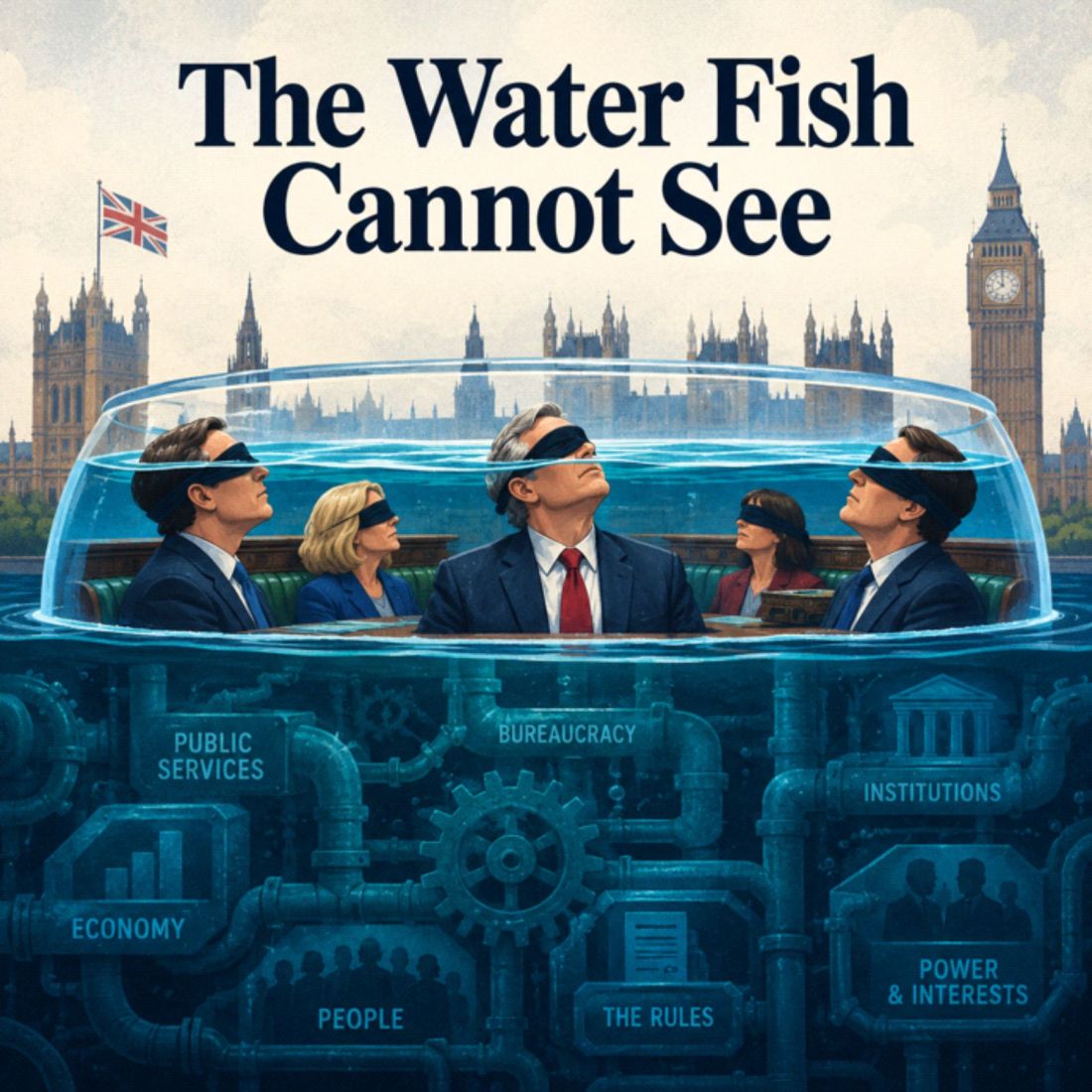
The Water Fish Cannot See

Why the debate about ending forty years of neoliberalism may be missing the point

A Curious Reaction

When Andy Burnham first began talking about ending forty years of neoliberalism, I expected disagreement. Political ideas that touch something substantial almost always provoke a reaction.

What surprised me was not the fact that people argued about it, but the way they argued about it. Within a remarkably short period of time, the conversation seemed to settle into familiar territory.

Supporters presented the idea as a long-overdue recognition of Britain’s failures. Critics responded as though they were hearing an argument for returning to the 1970s. The disagreement was immediate, energetic and entirely predictable.

What interested me was something else.

The entire discussion appeared to assume that everybody already knew what the phrase meant. More than that, it assumed that everybody knew where the boundaries of the debate lay.

The disagreement was not over whether the phrase described reality, but over whether leaving that reality would be desirable.

The argument became a choice between continuation and reversal. We were either remaining on the path set in motion during the Thatcher years or attempting to retrace our steps back to an earlier model.

The possibility that neither description accurately captured the moment we are living through barely appeared.

That omission is worth dwelling on because it points toward a question that feels increasingly important.

How would anybody recognise the end of an era while they were still living inside it?

The Strange Journey of Political Language

Political systems are constantly searching for language that captures things people can already feel but struggle to describe. Most books never reach beyond their audience. Most detailed arguments remain where they begin. What tends to travel are phrases.

A phrase can migrate from essays into newspaper columns, from newspaper columns into think-tank reports, from think-tank reports into speeches and from speeches into everyday conversation.

The more successful the phrase, the further it travels.

What is interesting is that understanding rarely travels at the same speed.

By the time a useful phrase reaches the centre of political discourse, it has often become detached from the intellectual framework that produced it. Different people begin using it for different purposes. It stops functioning as an explanation and starts functioning as a signal. It becomes useful because it conveys a mood, a direction of travel or a sense that something important is happening.

That does not mean everybody using the phrase understands the same thing.

In fact, it often means the opposite.

The phrase survives precisely because different groups can pour different meanings into it.

This may be one reason the language of “forty years of neoliberalism” has been so successful. The phrase clearly touches a nerve. It captures a widespread feeling that something about Britain’s trajectory deserves re-examination. What remains far less clear is whether there is equal agreement about what is actually being described.

When Systems Disappear

Part of the difficulty lies in the way successful systems evolve.

Most people think of neoliberalism as a collection of policies. Privatisation. Deregulation. Globalisation. Financialisation. Depending on who is speaking, those developments either saved Britain or hollowed it out. Entire political careers have been built around defending or attacking those changes.

Yet policies are only the visible layer of a system.

The deeper layer is the collection of assumptions that develops around them.

What counts as economic success. What counts as competence. Which institutions matter. Which risks deserve attention. What questions can be asked. Which outcomes are considered realistic.

At first those assumptions are visible because people remember alternatives. Over time they become harder to see. New generations inherit them. Institutions are organised around them. Political careers are built within them. Eventually they stop appearing as assumptions and start appearing as reality.

The system disappears from view precisely because it becomes normal.

That is why I have always preferred thinking in terms of operating systems rather than ideologies.

People know they are choosing between ideologies.

They rarely realise they are working inside an operating system.

The Water Fish Cannot See

The old phrase about fish being unable to see water survives because it captures something profoundly human.

We are very good at adapting to our environment. In fact, we are so good at it that we often stop noticing the environment altogether.

The process is visible everywhere.

People adapt to fragility.

Institutions adapt to constraints.

Political parties adapt to assumptions.

Entire societies adapt to conditions that previous generations might have regarded as extraordinary.

Eventually the adaptation becomes so complete that the thing shaping behaviour vanishes into the background.

The fish sees the currents, the movement and the consequences. The fish does not see the water.

This is why discussions about political change often feel strangely unsatisfying. Politicians can spend hours arguing about policy while sharing assumptions they no longer recognise as assumptions. Journalists can write thousands of words about reform while accepting the framework within which reform is constrained. Economists can debate outcomes while rarely examining the environment producing them.

This is not evidence of stupidity.

It is evidence of immersion.

Why the Debate Feels Incomplete

The more I listened to the discussion surrounding the end of forty years of neoliberalism, the more I found myself wondering whether the debate was unfolding at the wrong level.

The assumption seemed to be that people stand outside the system, evaluate it and then choose whether to continue it.

But what if that is not how systems work?

What if people are shaped by an operating environment long before they start questioning it?

Viewed through that lens, the interesting question is not whether a political movement wishes to move beyond neoliberalism.

The interesting question is whether anybody can clearly see the assumptions they inherited from it.

That challenge becomes particularly difficult when those assumptions have become embedded within ideas that appear self-evident. Growth. Productivity. Competitiveness. Confidence. Credibility.

These concepts are treated as neutral descriptions of reality. Rarely are they examined as products of a particular way of understanding reality.

The water has become invisible.

Sensing an Ending

This is one reason I find the current moment so fascinating.

For several years I have argued that Britain’s operating model appears to be reaching the end of its natural life. Not because somebody decided it should end, but because the conditions that sustained it are changing. The issue is not morality. It is fit.

Operating systems work because they fit the environment in which they emerge. They begin to struggle when the environment changes faster than the assumptions embedded within them.

What strikes me today is how many institutions appear to be sensing this shift.

The language has changed.

The confidence has changed.

The mood has changed.

People speak increasingly about resilience, security, sovereignty, capability and exposure. Themes that sat comfortably in the background for decades have moved closer to the centre of public debate.

Something is clearly being felt.

Whether it is fully understood is another question.

History suggests that people often experience the sensation of transition before they understand its cause. They feel the edge of an era long before they can describe it.

The Language of Maintenance

This is partly why the recent Budget interested me.

What stood out was not a particular policy but a tone.

Much of the language revolved around creating “breathing space”, managing pressures and helping households navigate difficult circumstances. Even the temporary tax surcharge on banks was presented in terms of short-term support rather than long-term transformation.

The emphasis repeatedly returned to stability, discipline, confidence and the need to navigate a difficult external environment.

None of this is inherently unreasonable. Yet it has a particular flavour.

It is the language of maintenance. The language of holding things together. The language of preserving stability while a system encounters pressures for which it was not originally designed.

That does not mean the people using that language are wrong. It simply raises an interesting possibility.

Perhaps many of the actors discussing the end of an era are simultaneously operating within the assumptions of that era.

Not because they are trapped. But because they have never known anything else.

Missing the Point

This brings us back to the original phrase.

The debate about ending forty years of neoliberalism often assumes that the central question is whether neoliberalism succeeded or failed.

I am increasingly persuaded that a deeper question sits underneath it.

What if the most significant issue is not whether an era is ending, but whether we are capable of recognising the operating system that shaped the era in the first place?

The difference matters.

One debate concerns policies. The other concerns perception.

One asks what should happen next. The other asks whether we fully understand where we are standing now.

Those are not the same thing.

The Ground Beneath Our Feet

The most successful operating systems are not the ones people passionately defend. They are the ones people stop noticing.

The assumptions become common sense. The framework becomes reality. The environment becomes invisible.

At that point, even criticism of the system may continue speaking its language.

That is why I find the current moment so intriguing.

Not because I know what comes next.

Not because I am convinced anybody else does either.

But because more and more people seem to be sensing that something is changing beneath their feet.

The phrase “forty years of neoliberalism” may be evidence of that feeling. The argument surrounding it may be evidence too.

The question is not whether the era is ending.

It is whether we can see the water clearly enough to understand the thing that shaped us before it disappears.

Overview | Personal Sovereignty: The Freedom Beyond Independence

This book explores a simple but profound question:

What does it actually mean to be free?

Most people equate freedom with independence. We assume that if we can support ourselves financially, make our own decisions, and live without relying on others, then we are free.

I argue that independence is only the beginning.

A person can be financially independent and still be constrained by social expectations, economic incentives, institutional pressures, cultural norms, and fears about what might happen if they think or act differently. They may have freedom of movement, freedom of choice, and even considerable wealth, yet still lack the ability to live fully in alignment with their own understanding of reality.

This book introduces the concept of personal sovereignty as the freedom beyond independence.

By sovereignty, I do not mean doing whatever you want. I do not mean rebellion, isolation, self-sufficiency, or withdrawal from society. Nor do I mean freedom at the expense of others.

I define personal sovereignty as:

The ability to act in alignment with your own thinking without being structurally punished for doing so, while respecting the sovereignty of others as equal to your own.

The book explores why this condition is so difficult to achieve in modern society and why so many people mistake comfort, wealth, status, or success for freedom.

A central argument is that today’s system is not primarily maintained through force or conspiracy, but through a shared worldview embedded within institutions, markets, culture, and social expectations. These structures shape not only our choices but also the assumptions through which we interpret the world itself.

As a result, many people are constrained not only by material dependency, but by what I call cognitive capture: the tendency to mistake inherited assumptions for independent thought.

To become sovereign, a person must satisfy three conditions:

  1. Material independence, where essential needs are securely met.
  2. Cognitive independence, where they can recognise and question the assumptions that shape their thinking.
  3. Structural immunity, where they can act on their convictions without risking their livelihood, safety, or stability.

Only when all three conditions exist together does sovereignty become a lived reality rather than an aspiration.

The book also challenges common assumptions about success and freedom. Beyond the point where our needs are met, the pursuit of ever greater comfort, status, and external validation can create new forms of dependency. In some cases, those who appear most free may in fact be among the least sovereign because they have the most to lose from thinking or acting differently.

Ultimately, this is not a book about escaping society. It is a book about understanding the forces that shape our lives and creating the conditions in which people can think, choose, contribute, and collaborate freely.

My argument is that a truly healthy society is not one built upon dependency, fear, competition, or coercion, but one built upon secure, sovereign individuals who are free to participate in community by choice rather than necessity.

Personal sovereignty is not simply a personal ideal. It is the foundation upon which a more human-centred society can be built.

Key Takeaways

1. Independence is the doorway, not the destination

Meeting your essential needs creates the possibility of freedom, but independence alone does not create sovereignty. Freedom begins where dependency ends, but sovereignty requires something more.

2. Sovereignty is not selfishness

True sovereignty depends on recognising that other people’s sovereignty is equal to your own. Freedom without respect becomes domination; sovereignty without reciprocity becomes selfishness.

3. The greatest constraints are often invisible

Many of the forces that shape our behaviour are not laws or commands but incentives, expectations, cultural assumptions, and accepted definitions of what is considered normal, successful, or responsible.

4. We are all shaped by the systems we inhabit

The assumptions we inherit often feel like reality itself. Sovereignty begins when we learn to examine those assumptions consciously rather than unconsciously living through them.

5. Wealth and comfort do not guarantee freedom

A person can possess significant wealth and still be deeply dependent on status, approval, reputation, or material rewards. Comfort can sometimes obscure captivity rather than remove it.

6. Sovereignty requires the ability to act on what you believe

Thinking independently matters, but sovereignty ultimately depends upon whether you can live in accordance with your understanding without fear of losing security, stability, or belonging.

7. Most social problems are symptoms of deeper causes

Housing pressures, inequality, insecurity, and many other challenges emerge from underlying structures and assumptions. Sustainable solutions require addressing root causes rather than symptoms alone.

8. Escaping society is not the same as freedom

Going off-grid or withdrawing from society simply exchanges one set of dependencies for another. Sovereignty is not the absence of constraints; it is the ability to choose your constraints.

9. Freedom is fundamentally about alignment

The closer your life reflects your genuine understanding, values, and convictions, the closer you move toward sovereignty.

10. Sovereignty changes the meaning of community

When people are secure and sovereign, collaboration becomes voluntary, contribution becomes meaningful, and community becomes something chosen rather than imposed.

In One Sentence

Personal Sovereignty argues that true freedom is not merely the ability to survive independently, but the ability to think and act in alignment with your own understanding of reality, without structural punishment, while respecting the equal sovereignty of others.

No Skin in the Game: Absentee Ownership and the Burden You Never Chose

Introduction: The Twin Bridges

We live in a world that feels increasingly out of shape. Problems show up in different places and at different scales, yet they all seem to follow the same underlying pattern. Decisions are made far away from the people who live with their consequences. Ownership has drifted from presence. Responsibility has drifted from action. And the distance between the two is where most of our everyday trouble begins.

This book builds two bridges. The first is a bridge of understanding – a way of seeing the world as it actually works, rather than as we assume it does. The second is a bridge of possibility – a case for an alternative that puts ownership, decision‑making, and consequence back in the same place. Not a slogan, not a quick fix, but a structure that works because the parts belong together.

What follows is an attempt to make both bridges visible: the one that explains the world we have, and the one that shows the world we could build.

Part I – Today’s World

1. The World We Think We Live In

Most people believe they live in a world that more or less makes sense. A world where hard work leads to reward, where investment is a responsible thing to do, where owning a little more than you need is a sign of prudence, and where the economy – whatever that word really means – is something that grows because clever people somewhere are making good decisions.

It’s a comforting picture. It’s also a very incomplete one.

We’ve been taught to see the modern economy as a kind of neutral machine. You put effort in at one end, and you get reward out at the other. You invest money, and it grows. You buy a property, and it pays for itself. You put your savings into a pension fund, and it multiplies quietly in the background while you get on with your life.

The whole thing feels clean, efficient, and almost automatic. And because it feels automatic, it feels harmless.

But the truth is that the modern economy isn’t a neutral machine. It’s a cultural construction – a worldview – and it shapes how we think about ownership, responsibility, and consequence.

Most of us don’t notice this because we’ve grown up inside it. We speak its language without realising it. We repeat its assumptions without ever questioning where they came from.

We think we’re describing reality. But we’re really describing a system.

And that system has taught us a very specific way of seeing the world.

It has taught us that profit is a sign of success. It has taught us that investment is responsible. It has taught us that passive income is smart. It has taught us that bigger is better. It has taught us that distance is professionalism. It has taught us that markets are truth. It has taught us that growth is progress.

None of these ideas are natural. None of them are inevitable. None of them are universal.

They are simply the rules of the game we were born into.

And because we were born into them, we rarely stop to ask whether the game itself makes sense – or whether it’s fair, or whether it’s even safe.

Most people don’t ask those questions because the system gives them just enough comfort to feel secure, and just enough distance to avoid seeing the consequences of how it really works.

Distance is the most powerful tool the system has. It hides everything that matters.

It hides the harm. It hides the cost. It hides the fragility. It hides the extraction. It hides the people who pay the price.

Distance is what makes absentee ownership feel harmless. Distance is what makes passive income feel clever. Distance is what makes economies of scale feel efficient. Distance is what makes investment feel responsible.

Distance is what makes the modern world feel normal.

And because it feels normal, we rarely question it.

Most people genuinely believe the system is fair because it feels fair. They believe the rules are neutral because they look neutral. They believe the outcomes are deserved because they appear to follow effort, intelligence, or good judgement.

But the modern economy doesn’t reward effort. It rewards position.

It doesn’t reward contribution. It rewards ownership.

It doesn’t reward responsibility. It rewards distance.

And it doesn’t reward skin in the game. It rewards being insulated from consequence.

This is the world we think we live in. It’s familiar. It’s comfortable. It’s coherent.

But it’s not real.

It’s a worldview – and we need to understand that worldview before we can understand why the system behaves the way it does, why absentee ownership feels harmless, and why the harm it causes has become invisible.

That’s where we go next.

2 – Absentee Ownership as “Responsible” Modern Behaviour

If you ask most people what “being responsible with money” looks like, they’ll give you a list that sounds sensible enough on the surface. Buy a house. Maybe buy another one if you can. Put money into a pension. Invest in a few companies. Build a portfolio. Diversify. Let your money “work for you.”

It’s presented as maturity. As prudence. As adulthood.

It’s the kind of advice people give each other with a tone that suggests they’re passing down ancient wisdom, even though the whole thing is barely a few decades old.

And because everyone repeats it, it feels normal. It feels harmless. It feels like the responsible thing to do.

But what we call “responsible” today is really just a set of behaviours that make perfect sense inside the current system – and almost no sense outside it.

Take buy‑to‑let. It’s framed as a smart move. A way to secure your future. A way to “get ahead.” A way to build a nest egg. People talk about it as if it’s a kind of public service: “I’m providing housing.” “I’m helping people who can’t buy.” “I’m investing in the community.”

But the truth is simpler: buy‑to‑let is absentee ownership. It’s ownership without contribution. Ownership without presence. Ownership without responsibility. Ownership without skin in the game.

And the only reason it feels normal is because the system has been designed to make it normal.

The same is true of shareholding. Most people who own shares have never set foot in the companies they “own.” They don’t know the workers. They don’t know the customers. They don’t know the communities affected by the company’s decisions. They don’t know the environmental impact. They don’t know the supply chain. They don’t know the risks.

They don’t need to. The system doesn’t ask them to. The system rewards them for not knowing.

The less involved they are, the safer they feel. The more distant they are, the more profitable it becomes.

Absentee ownership is not an accident. It’s the design.

And because it’s the design, it has been wrapped in a cultural story that makes it feel virtuous. We call it “investing.” We call it “planning for the future.” We call it “building wealth.” We call it “being responsible.”

But none of these phrases describe what’s actually happening.

What’s actually happening is extraction. Quiet, normalised, socially accepted extraction.

And the people doing the extracting rarely see it that way, because the system has given them a language that hides the reality. It’s not “extracting rent from people who can’t afford to buy.” It’s “property investment.” It’s not “profiting from a company you don’t contribute to.” It’s “shareholder value.” It’s not “benefiting from someone else’s labour.” It’s “passive income.”

Passive income is perhaps the clearest example of how deeply the worldview has embedded itself. The phrase sounds harmless. It sounds clever. It sounds like something you’d hear in a seminar about financial literacy.

But think about what it actually means: income without effort. income without contribution. income without responsibility. income without presence.

Income without skin in the game.

And yet, in today’s world, this is held up as the pinnacle of financial intelligence. It’s the dream. The goal. The thing people aspire to.

We’ve built a culture where the highest reward goes to the people who do the least – as long as they own something.

Ownership has replaced contribution. Ownership has replaced responsibility. Ownership has replaced work. Ownership has replaced presence.

And because the system rewards this behaviour, people believe it must be right. They believe it must be fair. They believe it must be sensible. They believe it must be responsible.

But it isn’t responsible. It’s just normalised.

And it’s normalised because the system has been captured by a worldview that treats ownership as inherently virtuous, even when the owner has no involvement in the thing they own.

Absentee ownership feels responsible because the system has taught us to see it that way. It feels harmless because the system hides the harm. It feels fair because the system hides the cost. It feels inevitable because the system hides the alternatives.

And it feels like adulthood because the system hides the truth.

The truth is simple: Absentee ownership is only possible because distance hides consequence. And distance is the mechanism that makes the modern world feel normal.

We’ll explore that mechanism in Section 4. But first, we need to look at the idea that makes absentee ownership feel efficient – the myth of economies of scale.

3 – Economies of Scale: The Myth of Efficiency

If you ask people why big companies, big landlords, big investors, big supply chains, and big institutions dominate the modern world, they’ll usually give you the same answer: economies of scale.

It’s one of those phrases that sounds technical enough to shut down further questioning. It has the tone of something that’s been proven, measured, and universally accepted.

“Economies of scale” is the kind of idea that gets repeated so often it becomes a reflex. Bigger is cheaper. Bigger is more efficient. Bigger is more competitive. Bigger is more secure. Bigger is more modern. Bigger is progress.

But like most things that sound obvious, it’s only obvious because we’ve been taught to see the world through a very specific lens – a money‑centric one.

In a money‑centric worldview, efficiency is measured in pounds and pence. If something costs less to produce at scale, then scale must be good. If something generates more profit at scale, then scale must be smart. If something grows faster at scale, then scale must be progress.

But this is only one way of looking at the world. And it’s a very narrow one.

When you measure everything in money, you stop measuring everything else. You stop measuring the human cost. You stop measuring the environmental cost. You stop measuring the community cost. You stop measuring the long‑term cost. You stop measuring the fragility that scale creates. You stop measuring the consequences that scale hides.

Economies of scale don’t make things efficient. They make things distant.

And distance is the mechanism that hides the harm.

Take supermarkets. People assume they’re efficient because they’re big. They assume they’re competitive because they’re big. They assume they’re modern because they’re big. But the scale of a supermarket only looks efficient if you ignore everything it displaces: local producers, local shops, local relationships, local resilience, local knowledge, local responsibility.

Scale replaces people with systems. And systems don’t care about consequence.

The same is true of large landlords. A landlord with hundreds of properties is seen as successful, professional, and efficient. But that efficiency only exists because the landlord is distant. They don’t know the tenants. They don’t know the communities. They don’t know the impact of their decisions. They don’t know the harm caused by rent increases, evictions, or neglect.

Scale makes ignorance look like professionalism.

And the system rewards that ignorance because it keeps the machine running smoothly. If landlords had to be present, responsible, and accountable, the model wouldn’t work. The scale wouldn’t work. The profit wouldn’t work. The distance wouldn’t work.

Economies of scale are not a natural phenomenon. They are a cultural permission slip.

They allow people to benefit from things they don’t participate in. They allow people to profit from things they don’t contribute to. They allow people to own things they don’t understand. They allow people to make decisions without consequence.

Scale is the architecture of absentee ownership.

And because scale is framed as efficiency, nobody questions it. Nobody asks whether the efficiency is real. Nobody asks who pays for it. Nobody asks what gets lost. Nobody asks what gets hollowed out. Nobody asks what gets weakened. Nobody asks what gets broken.

We’ve been taught to see scale as progress. But scale is really just distance with a marketing department.

It’s distance dressed up as innovation. Distance dressed up as modernity. Distance dressed up as intelligence. Distance dressed up as inevitability.

And because distance hides consequence, scale hides harm.

This is why absentee ownership feels harmless. This is why passive income feels clever. This is why investment feels responsible. This is why profit entitlement feels justified.

Scale makes extraction look like efficiency. Scale makes fragility look like strength. Scale makes harm look like progress.

And because the system rewards scale, people believe it must be right.

But scale only works in a system where distance is allowed to replace responsibility. And distance only works in a system where owners never have to see the consequences of their decisions.

That’s where we go next.

4 – Distance: The Invisible Shield That Hides Consequence

If there is one idea that explains why the modern world behaves the way it does, it’s distance. Not physical distance, although that plays a part. I mean the kind of distance that sits quietly between people and the consequences of their decisions. The kind of distance that lets someone benefit from something without ever having to see the cost. The kind of distance that makes harm feel like an abstraction rather than a reality.

Distance is the invisible shield that protects the modern economy from accountability. It’s the mechanism that makes absentee ownership possible. It’s the reason passive income feels harmless. It’s the reason economies of scale feel efficient. It’s the reason investment feels responsible. It’s the reason profit entitlement feels justified.

Distance is the architecture of the worldview we explored earlier. And once you see it, you can’t unsee it.

Think about landlords who never meet their tenants. They don’t see the mould. They don’t see the stress. They don’t see the overcrowding. They don’t see the fear of eviction. They don’t see the trade‑offs people make to pay rent. They don’t see the impact of a £50 increase. They don’t see the consequences of neglect.

They don’t see any of it because the system has made sure they don’t have to.

Distance turns human lives into numbers on a spreadsheet. And numbers don’t cry, complain, or ask for help.

The same is true of shareholders. Most people who own shares have no idea what the companies they “own” actually do. They don’t see the working conditions. They don’t see the supply chain. They don’t see the environmental damage. They don’t see the community impact. They don’t see the layoffs. They don’t see the pressure placed on workers to meet targets.

They don’t see any of it because the system has made sure they don’t have to.

Distance turns responsibility into abstraction. And abstraction never asks awkward questions.

Even governments operate at a distance. Policies are made by people who will never experience the consequences of those policies. Decisions are taken by people who will never meet the people affected. Regulations are written by people who will never see the harm they enable. Legislation is passed by people who will never live under the rules they create.

Distance turns power into insulation. And insulation makes anything feel permissible.

This is why the modern world feels normal. This is why harm feels invisible. This is why extraction feels harmless. This is why fragility feels like strength. This is why scale feels like progress. This is why absentee ownership feels responsible.

Distance hides everything that matters.

It hides the people who pay the price. It hides the communities that get hollowed out. It hides the environments that get damaged. It hides the fragility that gets built into the system. It hides the consequences that accumulate quietly over time.

Distance is the reason the modern economy can behave in ways that would be unthinkable if everyone involved had to be present.

If a landlord had to live in the same building as their tenants, the model would collapse. If shareholders had to work in the companies they own, the model would collapse. If investors had to experience the consequences of their decisions, the model would collapse. If policymakers had to live under the policies they create, the model would collapse.

Distance is the glue that holds the current system together. It’s also the solvent that dissolves responsibility.

And here’s the uncomfortable truth: Distance doesn’t just hide harm – it creates permission for it.

When you don’t see the consequences of your decisions, you start to believe there aren’t any. When you don’t experience the cost of your choices, you start to believe the cost doesn’t exist. When you don’t meet the people affected by your actions, you start to believe your actions are harmless.

Distance makes good people behave in ways they never would if they were present.

It’s not malice. It’s not greed. It’s not cruelty.

It’s insulation.

And insulation is the quiet, structural reason why the modern world feels the way it does.

Distance is the final piece of the worldview puzzle. It’s the mechanism that makes absentee ownership feel normal. It’s the mechanism that makes economies of scale feel efficient. It’s the mechanism that makes passive income feel clever. It’s the mechanism that makes investment feel responsible. It’s the mechanism that makes profit entitlement feel justified.

Distance is the reason the modern world works the way it does – and the reason it cannot continue to work this way forever.

Now that we’ve explored the world people think they live in, we can move into Part II, where we look at the worldview that keeps people defending the system even when it harms them.

Part II – The Worldview Trap

1 – The Establishment Is a Worldview, Not a Class

If you ask people who “the Establishment” is, they’ll usually picture a small group of powerful individuals somewhere out of sight. Politicians. Bankers. CEOs. People in expensive suits who attend meetings in rooms the rest of us never enter.

It’s a convenient image. It gives the impression that the system is controlled by a handful of elites who pull the strings while everyone else simply tries to get by.

But the modern Establishment isn’t a group of people. It’s a worldview.

It’s a way of seeing the world that has become so normal, so familiar, and so deeply embedded in everyday life that most people don’t even realise they’re using it.

It’s the software running quietly in the background of the modern economy – shaping how we think, how we behave, and what we believe is possible.

And because it’s a worldview rather than a class, it doesn’t belong to a small group of elites. It belongs to everyone.

It’s shared by people who benefit from the system and people who are harmed by it. It’s shared by landlords and tenants, investors and workers, policymakers and voters. It’s shared by people who have wealth and people who have none.

The Establishment worldview is the cultural lens through which the modern world is interpreted. And once you see it, you realise how much of today’s behaviour makes sense only because of that lens.

This worldview teaches us that:

  • profit is a sign of success
  • investment is responsible
  • passive income is smart
  • bigger is better
  • distance is professionalism
  • markets are objective
  • growth is progress
  • debt is normal
  • ownership is virtue

None of these ideas are natural. None of them are universal. None of them are timeless.

They are simply the beliefs that the current system needs people to hold in order for the system to function.

And because the system rewards people for holding these beliefs, they become invisible. They feel like common sense. They feel like reality.

This is why people defend the system even when it harms them. They’re not defending elites. They’re defending the worldview they believe is the world.

It’s not malice. It’s not ignorance. It’s not stupidity.

It’s conditioning.

People defend absentee ownership because they believe ownership is inherently responsible. People defend passive income because they believe income without effort is a sign of intelligence. People defend economies of scale because they believe bigger is always more efficient. People defend investment culture because they believe money should grow without contribution. People defend profit entitlement because they believe profit is deserved simply because someone owns something.

These beliefs didn’t appear out of nowhere. They were taught – quietly, consistently, and over decades – through legislation, policy, media, education, and cultural reinforcement.

The modern Establishment isn’t a conspiracy. It’s a worldview that has been normalised.

And because it has been normalised, people rarely question it. They rarely ask where it came from. They rarely ask who benefits from it. They rarely ask whether it makes sense. They rarely ask whether it’s fair. They rarely ask whether it’s safe.

They simply assume it’s the way things are.

This is why the modern system is so hard to escape. You can’t escape a worldview by changing a few policies. You can’t escape a worldview by adjusting interest rates. You can’t escape a worldview by tweaking regulations. You can’t escape a worldview by reforming institutions.

You escape a worldview only by seeing it clearly – and recognising that it is a worldview, not reality.

Once you see the worldview, you begin to understand why the system behaves the way it does. You begin to understand why harm is invisible. You begin to understand why extraction feels harmless. You begin to understand why fragility feels like strength. You begin to understand why scale feels like progress. You begin to understand why absentee ownership feels responsible.

You begin to understand why people defend the system even when it destroys them.

And you begin to understand why the system cannot be fixed from within.

This is the first step in escaping the worldview trap. The next step is understanding why harm remains invisible even when people experience it directly.

That’s where we go next.

2 – Why Harm Is Invisible Even When We Experience It

One of the strangest things about the modern world is how often people suffer from problems that they can describe perfectly – rising rents, insecure work, debt pressure, shrinking communities, environmental damage – yet still struggle to connect those problems to the system that causes them.

They know something is wrong. They feel it every day. They talk about it with friends. They worry about it at night. But when it comes to understanding why it’s happening, they often reach for explanations that sit comfortably inside the worldview they already know.

“It’s just the market.” “It’s just how things are now.” “It’s just the cost of living.” “It’s just the economy.” “It’s just progress.” “It’s just modern life.”

These phrases don’t explain anything. They simply make the harm feel inevitable.

And inevitability is one of the most powerful tools the worldview has.

When something feels inevitable, people stop questioning it. When something feels normal, people stop challenging it. When something feels universal, people stop imagining alternatives. When something feels natural, people stop seeing the harm.

This is why people can experience harm directly and still struggle to recognise its cause.

The worldview gives them a story that makes the harm feel like weather – something that happens to everyone, something nobody controls, something nobody can change.

But harm doesn’t come from weather. It comes from structure.

And structure is invisible when you’re standing inside it.

Take housing. People know rents are rising. They know buying is impossible. They know landlords have more power than tenants. They know the system feels stacked against them. But instead of seeing the structural cause – absentee ownership – they reach for explanations that fit the worldview.

“There’s not enough supply.” “Demand is too high.” “People aren’t saving enough.” “Interest rates are the problem.” “Builders aren’t building.” “Councils aren’t planning.”

These explanations feel sensible because they’re familiar. They’re part of the worldview’s vocabulary. They’re the phrases people hear on the news, in politics, in conversation.

But none of them touch the real mechanism. None of them touch distance. None of them touch extraction. None of them touch absentee ownership.

The worldview gives people a language that hides the truth. And when the language hides the truth, the harm becomes invisible.

The same thing happens with work. People know their wages haven’t kept up with costs. They know their jobs feel insecure. They know productivity demands keep rising. They know burnout is everywhere. But instead of seeing the structural cause – profit entitlement – they reach for explanations that feel safe.

“Technology is changing everything.” “Competition is fierce.” “Globalisation is unavoidable.” “Companies have to stay competitive.” “Everyone has to work harder now.”

These explanations feel neutral. They feel objective. They feel like the kind of thing a sensible person would say.

But they’re not explanations. They’re worldview placeholders.

They fill the gap where the truth should be.

The truth is simple: People experience harm every day, but the worldview gives them a story that makes the harm feel normal, inevitable, and impersonal.

And when harm feels impersonal, people stop seeing the people who cause it. When harm feels normal, people stop seeing the system that enables it. When harm feels inevitable, people stop seeing the alternatives that could replace it.

This is why people defend the system even when it destroys them. They’re not defending harm. They’re defending the story they’ve been taught about how the world works.

And that story is powerful because it’s comforting.

It tells people that the system is neutral. It tells people that the system is objective. It tells people that the system is fair. It tells people that the system is unavoidable. It tells people that the system is reality.

When you believe something is reality, you don’t question it. You adapt to it. You endure it. You rationalise it. You normalise it.

You live inside it even when it hurts you.

This is the worldview trap. It keeps people inside a system that harms them by giving them a story that makes the harm feel like life itself.

And once you understand that, you can understand the next part of the trap: why people struggle to imagine anything different.

That’s where we go next.

3 – Why Alternatives Feel Dangerous or Unrealistic

If you’ve ever suggested a different way of doing things – a different way of organising work, or housing, or money, or ownership – you’ll know how quickly people react. Not with curiosity, but with discomfort. Sometimes even hostility.

It’s strange, because most people know the current system isn’t working for them. They feel the pressure. They feel the insecurity. They feel the unfairness. They feel the fragility. They feel the harm.

And yet, when you suggest something different, they recoil.

“Be realistic.” “That would never work.” “You can’t change human nature.” “The economy doesn’t work like that.” “People won’t accept it.” “It’s too idealistic.” “It’s too risky.” “It’s too disruptive.” “It’s too complicated.” “It’s too political.” “It’s too radical.” “It’s too utopian.”

These reactions aren’t about the idea itself. They’re about the worldview.

The worldview has taught people that the current system is the only system that can exist. Not because it’s perfect. Not because it’s fair. Not because it’s safe. But because it’s familiar.

Familiarity is one of the strongest psychological forces in human behaviour. People will tolerate almost anything if it feels familiar. They will endure harm if it feels familiar. They will defend fragility if it feels familiar. They will rationalise injustice if it feels familiar.

And they will reject alternatives simply because they are unfamiliar.

This is why alternatives feel dangerous. Not because they are dangerous, but because the worldview has made the current system feel like reality itself.

When you believe something is reality, anything outside it feels like fantasy.

This is why people say “be realistic” when you describe a system that doesn’t rely on absentee ownership. It’s why they say “that would never work” when you describe a world where profit isn’t a right. It’s why they say “people won’t accept it” when you describe a system where everyone has skin in the game. It’s why they say “it’s too idealistic” when you describe a basic living standard. It’s why they say “it’s too radical” when you describe local currencies. It’s why they say “it’s too utopian” when you describe contribution culture.

They’re not reacting to the idea. They’re reacting to the worldview.

The worldview has created a boundary around what people believe is possible. Inside the boundary is “realistic.” Outside the boundary is “unrealistic.”

And the boundary has nothing to do with logic. It has nothing to do with practicality. It has nothing to do with feasibility. It has nothing to do with morality. It has nothing to do with fairness.

It has everything to do with conditioning.

People have been conditioned to believe that:

  • markets are natural
  • debt is normal
  • absentee ownership is responsible
  • passive income is intelligent
  • profit entitlement is deserved
  • scale is efficient
  • distance is professionalism
  • growth is progress
  • extraction is invisible
  • fragility is strength
  • inequality is inevitable
  • alternatives are dangerous

This conditioning is so deep that people often defend the current system even when they know it’s harming them. They defend it because they can’t imagine anything else. They defend it because they fear the unknown. They defend it because the worldview has made the unknown feel unsafe.

And this fear isn’t irrational. It’s learned.

People have been taught – quietly, consistently, and over decades – that alternatives lead to chaos. That alternatives lead to instability. That alternatives lead to poverty. That alternatives lead to conflict. That alternatives lead to failure.

But the truth is simpler: Alternatives feel dangerous because the current system has made sure they do.

The system doesn’t need to convince people that alternatives are bad. It only needs to convince them that alternatives are unrealistic. Once something feels unrealistic, it doesn’t matter whether it’s good or bad. It simply becomes unthinkable.

This is the worldview trap. It keeps people inside a system that harms them by making the alternatives feel impossible.

And once you understand that, you can understand why the next part of the book matters so much: the hidden mechanisms that make the worldview feel true.

Because the worldview isn’t just psychological. It’s structural. It’s reinforced by the mechanics of the system itself.

That’s where we go next.

Part III – The Hidden Mechanisms

1 – FIAT, MMT, and the Illusion of Money

Most people think they understand money. Not in a technical sense, but in a practical one. They know they get paid, they know they spend, they know they save, they know they borrow. They know money comes in and money goes out. They know they have to manage it. They know they have to be careful with it. They know it’s important.

But almost nobody understands where money actually comes from. And that’s not their fault. The system is designed that way.

We’re taught to think of money as something scarce – something governments collect through taxes, something banks hold in vaults, something businesses earn through trade. We imagine money as a finite resource that must be carefully distributed, saved, and protected.

But modern money doesn’t work like that. Modern money is created.

Not earned. Not saved. Not stored. Created.

Every time a bank issues a loan, new money enters the system. Every time a government spends beyond its tax revenue, new money enters the system. Every time an asset inflates, new money enters the system. Every time debt expands, new money enters the system.

Money is not a thing. It’s a permission slip.

And once you understand that, you begin to see why the modern economy behaves the way it does – and why absentee ownership became possible on a scale that would have been unimaginable in any previous era.

FIAT money (money created by decree) and MMT (the recognition that governments can create money freely) didn’t just change how economies work. They changed who gets to benefit from the system and who gets trapped by it.

They created a world where:

  • debt is normal
  • borrowing is encouraged
  • asset prices rise endlessly
  • ownership expands without limit
  • profit becomes a right
  • investment becomes a necessity
  • extraction becomes invisible
  • fragility becomes structural

And because this world feels normal, people rarely question it.

But the truth is simple: The modern money system doesn’t reward contribution. It rewards access.

Access to credit. Access to assets. Access to ownership. Access to distance.

This is why absentee ownership exploded. It wasn’t because people suddenly became more entrepreneurial. It wasn’t because people suddenly became more responsible. It wasn’t because people suddenly became more financially literate.

It was because the money system made it possible.

When money can be created endlessly, ownership can expand endlessly. When ownership can expand endlessly, extraction can expand endlessly. When extraction can expand endlessly, harm can expand endlessly. When harm can expand endlessly, fragility becomes inevitable.

And fragility is exactly what we see today.

People think the economy is fragile because of globalisation, or technology, or competition, or politics. But the fragility comes from something much simpler: a money system that rewards ownership without contribution and extraction without responsibility.

FIAT money didn’t just change the economy. It changed the moral structure of society.

It made it possible for people to benefit from things they don’t participate in. It made it possible for people to profit from things they don’t understand. It made it possible for people to own things they don’t contribute to. It made it possible for people to extract value from people they never meet.

It made distance profitable. And distance is the mechanism that hides consequence.

This is why the modern world feels the way it does. This is why harm feels invisible. This is why absentee ownership feels responsible. This is why passive income feels clever. This is why economies of scale feel efficient. This is why profit entitlement feels justified.

The money system created the worldview. The worldview protects the money system. And together, they create the illusion that the modern economy is natural, inevitable, and fair.

But once you see how money actually works, you begin to see the next mechanism – the belief that profit is a right.

That’s where we go next.

2 – Profit Is Not a Right: The Core Distortion

If you ask people why businesses exist, they’ll usually say something about providing goods or services. If you ask why investors invest, they’ll say something about supporting growth. If you ask why landlords buy property, they’ll say something about securing their future.

These answers sound reasonable. They sound responsible. They sound like the kind of things sensible adults say when they’re explaining how the world works.

But underneath all these explanations sits a belief so deeply embedded in the modern worldview that most people don’t even realise they hold it:

Profit is a right.

Not a possibility. Not a gamble. Not a reward for contribution. A right.

People believe they are entitled to profit simply because they own something. They believe profit should be guaranteed. They believe profit should be protected. They believe profit should be prioritised. They believe profit should be insulated from risk.

And the system has been designed to make that belief feel normal.

You can see it everywhere. Landlords expect rent to rise. Shareholders expect dividends to grow. Investors expect returns to compound. Banks expect interest to flow. Corporations expect margins to increase. Pension funds expect assets to inflate.

These expectations aren’t treated as hopes or ambitions. They’re treated as obligations.

If profit doesn’t rise, something is “wrong.” If returns don’t grow, something is “broken.” If margins don’t expand, something is “failing.” If assets don’t inflate, something is “unstable.”

Profit entitlement has become the moral centre of the modern economy. Everything else – wages, communities, environments, stability – is secondary.

And because profit entitlement is treated as a right, the system bends itself around that right. It restructures itself. It rewrites rules. It reshapes behaviour. It redefines responsibility. It redistributes risk.

Risk used to belong to owners. Now it belongs to everyone else.

Workers carry the risk of layoffs. Tenants carry the risk of rent increases. Customers carry the risk of rising prices. Communities carry the risk of instability. Governments carry the risk of bailouts. The environment carries the risk of extraction.

Owners carry almost none of it. And they believe that’s how it should be.

Profit entitlement has quietly inverted the moral logic of the economy. Instead of owners being responsible for the consequences of their decisions, the consequences are pushed onto everyone else. Instead of owners absorbing risk, risk is absorbed by the people who have the least power to manage it. Instead of owners contributing to the systems they benefit from, the systems are redesigned to protect their benefits.

Profit entitlement is the reason absentee ownership feels normal. It’s the reason passive income feels clever. It’s the reason economies of scale feel efficient. It’s the reason investment feels responsible. It’s the reason distance feels professional.

Profit entitlement is the worldview’s anchor. It’s the belief that makes everything else feel inevitable.

And once you understand that profit entitlement is a right only because the system says it is, you begin to see the next distortion: the numbers we use to measure the economy aren’t telling the truth.

That’s where we go next.

3 – The Impoverishment Index: The Truth Behind the Numbers

If you listen to the way governments and financial institutions talk about the economy, you’d think everything was ticking along nicely. The headlines are always reassuring: GDP is growing, inflation is under control, employment is strong, wages are rising. It’s a steady drumbeat of confidence, as if the numbers themselves are proof that the system is healthy.

But if you step outside the official story and look at how people actually live, the picture is very different.

Most people feel like they’re running harder just to stay in the same place. They feel squeezed, stretched, and increasingly uncertain about the future. They see their rent rising faster than their wages. They see their savings evaporate the moment something unexpected happens. They see debt becoming a permanent feature of life rather than a temporary bridge.

And yet, the numbers insist everything is fine.

That gap – the space between the official story and lived experience – is where the truth sits. It’s where you find the real measure of the modern economy, and it’s where the Impoverishment Index begins.

The Impoverishment Index isn’t a statistic you can look up. It’s not a chart or a percentage. It’s a pattern. It’s the accumulation of small losses that don’t show up in GDP or inflation reports. It’s the erosion of stability, the thinning of resilience, the quiet hollowing out of everyday life.

You can see it in housing. People aren’t just paying more – they’re paying more for less. Less space. Less security. Less control. Less future.

You can see it in work. Jobs haven’t disappeared, but the quality of work has changed. Hours are unpredictable. Contracts are fragile. Pressure is constant. The margin for error is shrinking.

You can see it in time. People have less of it. Less time for family, for rest, for community, for anything that isn’t directly tied to survival.

You can see it in health. Stress is rising. Burnout is normal. Anxiety is everywhere. And the cost of staying well keeps climbing.

None of this shows up in the official numbers because the official numbers weren’t designed to measure it. GDP doesn’t care whether people are exhausted. Inflation doesn’t care whether essentials are becoming unaffordable. Employment figures don’t care whether jobs are secure. Wage statistics don’t care whether people can actually live on what they earn.

The numbers tell a story that protects the worldview. The Impoverishment Index tells the story of what the worldview is doing.

And once you see that story, you realise something important: the modern economy isn’t failing by accident. It’s failing by design. It’s failing because the metrics that define success were built for a world where ownership carried responsibility and profit required contribution – a world that no longer exists.

Today’s metrics reward expansion, not stability. They reward activity, not wellbeing. They reward growth, not resilience. They reward extraction, not contribution.

And because the system is measured this way, it behaves this way.

This is why people feel poorer even when the numbers say they’re not. This is why communities feel weaker even when the economy is “strong.” This is why life feels more precarious even when employment is “high.”

The official story is written in numbers. The real story is written in people’s lives.

And once you understand that, you’re ready for the next mechanism – the one that explains how the system became morally inverted in the first place: the replacement of morality with legality.

That’s where we go next.

4 – Legality Replaced Morality: Why Today’s Ownership Has No Ethical Foundation

One of the quietest shifts in modern life – and one of the most consequential – is the way legality has replaced morality.

It didn’t happen overnight. It wasn’t announced. Nobody voted for it. But over time, the idea of what is “right” has been slowly redefined to mean whatever is “allowed.”

If something is legal, people assume it must be acceptable. If something is permitted, people assume it must be fair. If something is within the rules, people assume it must be justified.

And this shift has had a profound effect on how ownership works.

There was a time when ownership carried a moral weight. If you owned something, you were responsible for it. You were accountable for what it did, how it behaved, and how it affected others. Ownership meant presence. It meant involvement. It meant skin in the game.

But as the modern economy expanded – fuelled by FIAT money, debt, and the pursuit of scale – ownership became something else entirely. It became abstract. It became distant. It became legal rather than moral. And once ownership became legal rather than moral, the responsibilities that used to come with it quietly disappeared.

A landlord doesn’t need to know their tenants. A shareholder doesn’t need to know the company. An investor doesn’t need to know the community. A corporation doesn’t need to know the environment. A policymaker doesn’t need to know the people affected.

The law doesn’t require it. And because the law doesn’t require it, the system treats the absence of responsibility as normal.

This is how legality replaces morality: it creates a world where harm is permitted as long as it fits within the rules.

You can raise rents to the point where families break apart – and it’s legal. You can pressure workers until they burn out – and it’s legal. You can extract value from a community until it collapses – and it’s legal. You can pollute an environment until it’s unrecognisable – and it’s legal. You can inflate asset prices until entire generations are locked out – and it’s legal.

Legality has become a shield. It protects owners from consequence. It protects institutions from accountability. It protects the worldview from scrutiny.

And because legality is treated as morality, people rarely question the ethics of what they’re doing. They don’t ask whether it’s fair. They don’t ask whether it’s harmful. They don’t ask whether it’s responsible. They don’t ask whether it’s sustainable. They only ask whether it’s allowed.

This is why absentee ownership feels legitimate. Not because it’s moral – but because it’s legal.

The law doesn’t require landlords to be present. The law doesn’t require shareholders to contribute. The law doesn’t require investors to carry risk. The law doesn’t require corporations to protect communities. The law doesn’t require banks to behave responsibly.

The law requires almost nothing of owners. And because it requires almost nothing, the system treats ownership as a right rather than a responsibility.

This is the moral inversion at the heart of the modern economy: ownership has been stripped of its ethical foundation and rebuilt as a legal entitlement.

And once ownership becomes a legal entitlement, profit becomes a legal entitlement. And once profit becomes a legal entitlement, extraction becomes a legal entitlement. And once extraction becomes a legal entitlement, harm becomes a legal entitlement.

This is why the system behaves the way it does. It’s not because people are cruel. It’s not because people are greedy. It’s not because people are malicious.

It’s because the rules allow harm – and the worldview tells people that allowed harm isn’t harm at all.

Legality has replaced morality so completely that many people genuinely believe they are acting responsibly even when their actions cause damage. They believe they are doing the right thing because they are doing the permitted thing. They believe they are being sensible because they are following the rules.

But rules are not morality. Rules are not ethics. Rules are not fairness. Rules are not responsibility.

Rules are simply the boundaries of what the system will tolerate.

And the modern system tolerates harm as long as the harm benefits owners.

This is the final mechanism in the worldview layer. It’s the reason the system feels legitimate even when it behaves destructively. It’s the reason people defend the system even when it harms them. It’s the reason alternatives feel dangerous even when they’re necessary.

And it’s the reason the next part of the book matters so much: the simple fix that would correct all of this – if the system were capable of accepting it.

That’s where we go next.

Part IV – The Simple Fix

1 – The 50% Rule: Ownership Must Carry Risk

If you strip the modern economy down to its essentials – remove the jargon, remove the politics, remove the narratives – you’re left with a very simple truth: ownership without risk is extraction.

It doesn’t matter whether the owner is a landlord, a shareholder, a bank, or a corporation. If they can benefit from something without carrying the consequences of its failure, the system becomes unstable.

This isn’t a moral argument. It’s a structural one.

Systems only work when the people who make decisions are exposed to the outcomes of those decisions. That’s how responsibility forms. That’s how accountability works. That’s how stability is created.

When owners are insulated from risk, they behave differently – not because they’re bad people, but because insulation changes incentives.

If you can’t lose, you behave as if you can’t harm. If you can’t fail, you behave as if you can’t break anything. If you can’t be affected, you behave as if consequences don’t exist.

The modern economy is built on the idea that owners should be protected from risk. The simple fix is the opposite: owners must carry risk.

This is where the 50% Rule comes in.

The 50% Rule says that if you want to own something, you must be present enough to carry at least half of the risk associated with it. Not half the paperwork. Not half the legal responsibility. Half the actual risk – the lived, practical, consequential risk.

If you want to own a home that someone else lives in, you must share the risk of that home. If you want to own a business, you must share the risk of that business. If you want to own shares, you must share the risk of the company. If you want to lend money, you must share the risk of the loan.

This rule doesn’t punish owners. It simply restores balance.

It makes ownership meaningful again. It makes ownership responsible again. It makes ownership real again.

And it does something even more important: it removes the incentive for absentee ownership.

Absentee ownership only exists because owners can benefit without being present. Remove the insulation, and absentee ownership collapses naturally.

Landlords who never meet their tenants would disappear. Shareholders who never understand the companies they own would disappear. Investors who never carry risk would disappear. Banks that profit without participating would disappear.

The system would shift from extraction to contribution. From distance to presence. From entitlement to responsibility.

The 50% Rule doesn’t require ideology. It doesn’t require revolution. It doesn’t require tearing down institutions.

It simply requires owners to behave like owners.

And once you see how elegant this fix is, you begin to see the next part of the solution – the idea that profit itself must be redefined.

That’s where we go next.

2 – Nobody Has the Right to Make a Profit

If you say to someone, “Nobody has the right to make a profit,” they’ll often react as if you’ve said something outrageous. It sounds confrontational. It sounds ideological. It sounds like you’re attacking the very idea of business, or ambition, or progress. But the statement isn’t ideological at all. It’s structural. It’s about how systems behave, not how people feel.

Profit is not a right. It never has been. It only became treated as one when ownership became detached from responsibility.

In any healthy system, profit is a signal. It’s a sign that someone has created value – real value – for other people. It’s a sign that they’ve contributed something meaningful, something useful, something that improves life in some way. Profit is supposed to be the outcome of contribution.

But in the modern economy, profit has been redefined. It’s no longer a signal. It’s an entitlement.

People expect profit simply because they own something. They expect it whether or not they contribute. They expect it whether or not they’re present. They expect it whether or not they carry risk. They expect it whether or not the profit comes at someone else’s expense.

Profit has become disconnected from contribution. And once profit becomes disconnected from contribution, it becomes extraction.

This is why the system feels the way it does. It’s why rents rise even when wages don’t. It’s why companies cut staff even when revenues grow. It’s why asset prices inflate even when communities weaken. It’s why debt expands even when productivity stagnates.

Profit entitlement forces the system to behave in ways that harm the very people who keep it running. Not because owners are malicious, but because the system tells them they’re entitled to profit regardless of consequence.

If profit is a right, then anything that threatens profit becomes a threat to the system. And the system responds accordingly.

Workers become a cost to minimise. Tenants become a revenue stream to maximise. Communities become an externality to ignore. Environments become a resource to extract. Governments become a backstop to rely on.

Profit entitlement reshapes every relationship in the economy. It turns contribution into a burden. It turns responsibility into a risk. It turns presence into a disadvantage. It turns distance into an asset.

And because the system rewards distance, absentee ownership becomes the dominant model.

But here’s the simple fix: Profit should only exist when contribution exists.

Not contribution in the abstract sense – contribution in the real, practical, human sense. Profit should be the outcome of being present, being responsible, carrying risk, and adding value.

If you contribute, you can profit. If you don’t contribute, you can’t.

It’s that simple.

This isn’t anti‑business. It’s pro‑reality.

It’s a return to the basic logic that every stable system relies on: reward follows contribution, not ownership.

Once you remove profit entitlement, the system begins to correct itself. Absentee ownership loses its incentive. Extraction loses its justification. Distance loses its value. Presence becomes meaningful again. Responsibility becomes unavoidable again. Contribution becomes central again.

Profit becomes what it was always supposed to be – a sign that someone has created value, not a sign that someone owns something.

And once you see how simple this fix is, you begin to understand the next part of the solution: the Basic Living Standard – the foundation that makes the entire system stable.

That’s where we go next.

3 – The Fix That Would Work, and the System That Cannot Accept It

If you look at everything we’ve covered so far – absentee ownership, profit entitlement, distance, fragility, extraction – it all points to one simple truth: the modern economy behaves the way it does because owners are insulated from the consequences of their decisions. That insulation is the root of the harm. It’s the structural flaw. It’s the thing that makes everything else possible.

And the fix for that flaw is obvious. It’s elegant. It’s compatible with the worldview people already have. It doesn’t require new beliefs, new values, or new systems.

You simply reintroduce skin in the game.

You make ownership mean responsibility again. You make profit require contribution again. You make risk belong to the people who make the decisions again.

The 50% Rule would stabilise the entire system almost overnight. It would make absentee ownership unprofitable. It would make extraction impossible. It would make distance irrelevant. It would make responsibility unavoidable. It would make fragility evaporate.

It’s the fix people think the system already has.

And that’s the point.

The fix doesn’t require a new paradigm. It simply requires the system to behave the way people assume it behaves.

But here’s the problem: the current paradigm cannot accept the fix.

Absentee ownership isn’t a side effect of the system. It’s the foundation of the system.

Distance isn’t an accident. It’s the architecture.

Profit entitlement isn’t a distortion. It’s the organising principle.

The modern economy is built on the absence of skin in the game. It depends on it. It requires it. It cannot function without it.

If you reintroduce skin in the game, the system doesn’t reform – it collapses.

Not because the fix is radical, but because the system is incompatible with responsibility.

This is the uncomfortable truth:

The fix that would solve everything is the fix the system cannot survive.

And once you see that, you realise something important: the moment you reintroduce skin in the game, the paradigm changes automatically.

Not because you’re trying to change it. Not because you’re pushing for a new model. But because the current model cannot operate under the conditions of responsibility.

The simple fix exposes the system’s dependency on irresponsibility. It reveals the architecture of distance. It shows how much of the modern economy only works because owners are protected from consequence.

And once you see that, you’re ready for the next part of the book – the part where we stop talking about the system we have, and start talking about the system that emerges when responsibility returns.

That’s where we go next.

4 – The Moment the Paradigm Breaks

The strange thing about the 50% Rule is that it doesn’t look radical. It doesn’t sound revolutionary. It doesn’t challenge anyone’s worldview. It doesn’t require new beliefs or new values. It simply asks the system to behave the way people assume it should behave.

If you tell someone that owners should carry risk, they nod. If you tell someone that profit should follow contribution, they agree. If you tell someone that responsibility should match power, they say of course. Nothing about the fix feels extreme.

And that’s exactly why it’s so revealing.

The fix is simple. The fix is obvious. The fix is compatible with the current worldview. The fix would stabilise everything.

But the moment you try to implement it, the paradigm breaks.

Not slowly. Not gradually. Not over decades.

Immediately.

Because the current paradigm is built on the absence of skin in the game. It depends on it. It requires it. It cannot function without it.

If owners must carry risk, absentee ownership collapses. If profit requires contribution, extraction collapses. If responsibility is unavoidable, distance collapses. If consequences return, fragility collapses.

The system doesn’t reform – it loses the very conditions it needs to exist.

This is the moment people realise something uncomfortable:

The fix is not incompatible with reality. It’s incompatible with the paradigm.

The paradigm cannot survive responsibility. It cannot survive presence. It cannot survive consequence. It cannot survive fairness.

The paradigm can only survive if owners remain insulated.

And that’s why the fix cannot be implemented inside the current system. Not because the fix is impossible, but because the system is incompatible with the fix.

This is the point where the reader finally sees the truth:

The system isn’t broken. It’s working exactly as designed.

And that design cannot coexist with responsibility.

The moment you reintroduce skin in the game, the paradigm ends. Not because you’re trying to end it, but because the paradigm cannot operate under the conditions of responsibility.

The fix is the collapse. The collapse is the fix.

And once you understand that, you’re ready for the next part of the book – the part where we stop talking about the system that cannot survive responsibility, and start talking about the system that emerges when responsibility returns.

That’s where we go next.

Part V – The New Model

1 – When Responsibility Returns

The moment you reintroduce skin in the game, the world doesn’t transform all at once. It doesn’t erupt into chaos. It doesn’t reorganise itself overnight. What happens first is quieter, simpler, and far more fundamental: people begin behaving differently.

Responsibility changes incentives. It changes decisions. It changes priorities. It changes what people pay attention to. It changes what people ignore. It changes what people can get away with.

When owners can no longer insulate themselves from consequences, they stop acting like distant beneficiaries and start acting like participants. Not because they suddenly become virtuous, but because the structure of the world no longer rewards irresponsibility.

The first thing that disappears is distance.

Distance only works when consequences don’t travel. Distance only works when risk can be outsourced. Distance only works when harm can be absorbed by someone else.

Once owners must carry risk, distance becomes expensive. Absentee ownership becomes impractical. Extraction becomes unprofitable. Speculation becomes fragile.

People move closer to the things they own – physically, financially, emotionally, operationally. They have to. Presence becomes cheaper than absence. Understanding becomes cheaper than ignorance. Contribution becomes cheaper than extraction.

The second thing that disappears is fragility.

Fragility is what happens when responsibility is missing. It’s the accumulation of risks that nobody is carrying. It’s the instability created by decisions made from afar. It’s the brittleness that comes from systems built on insulation.

When responsibility returns, fragility evaporates. Not because people suddenly become careful, but because they can’t afford not to be. Risk becomes visible again. Consequences become real again. Stability becomes valuable again.

The third thing that disappears is the illusion of growth.

Growth, in the old paradigm, was often just expansion without responsibility – more assets, more leverage, more distance, more extraction. It looked impressive on paper, but it was hollow underneath. Once responsibility returns, that kind of growth collapses. It can’t survive contact with consequence.

What replaces it isn’t “degrowth” or “sustainability” or any ideological alternative. What replaces it is real growth – growth that comes from contribution, not extraction. Growth that comes from presence, not distance. Growth that comes from value creation, not value transfer.

The fourth thing that disappears is precarity.

Precarity is a by‑product of absentee ownership. It’s what happens when the people who depend on something carry all the risk, while the people who control it carry none. It’s what happens when responsibility is inverted.

When responsibility returns, precarity loses its purpose. It stops being profitable. It stops being useful. It stops being a tool of control.

People become more stable because the system no longer rewards instability.

And the final thing that disappears is the worldview itself.

The worldview that shaped the modern economy – the worldview built on distance, entitlement, insulation, and extraction – cannot survive responsibility. It collapses under its own contradictions. It loses the conditions it needs to exist.

What emerges in its place isn’t a utopia. It isn’t a revolution. It isn’t a grand redesign.

It’s simply a world where responsibility is normal again.

A world where ownership means presence. A world where profit means contribution. A world where risk belongs to the people who make decisions. A world where stability is a shared interest. A world where value circulates instead of leaking away. A world where communities strengthen instead of hollow out.

This is the beginning of the new model. Not a blueprint – a consequence.

And once you understand what responsibility does, you’re ready to see the next part of the transformation: the collapse of distance.

That’s where we go next.

2 – The Collapse of Distance

When responsibility returns, the first thing that breaks is distance. Not because anyone sets out to dismantle it, but because the structure that once supported it simply stops working.

Distance only functions when consequences don’t travel. It only functions when risk can be outsourced. It only functions when harm can be absorbed by someone else. It only functions when ownership is treated as a legal entitlement rather than a practical role.

Once owners must carry risk, distance becomes expensive. Absence becomes dangerous. Ignorance becomes costly. Extraction becomes fragile.

The entire logic of absentee ownership collapses under its own weight.

A landlord who lives hundreds of miles away suddenly has to care about the condition of the property, the wellbeing of the tenant, the stability of the neighbourhood. Not because they’ve become more compassionate, but because the consequences of neglect now land on their own doorstep.

A shareholder who once treated a company as a line on a spreadsheet suddenly has to understand what the company actually does, how it behaves, how it treats people, how it impacts the world. Not because they’ve become more curious, but because their profit now depends on contribution rather than entitlement.

A bank that once lent money without participating in the outcome suddenly has to care about the viability of the borrower, the sustainability of the project, the long‑term health of the community. Not because it has become more ethical, but because risk can no longer be outsourced.

Distance stops being an asset. It becomes a liability.

And when distance becomes a liability, people move closer to the things they own – physically, financially, operationally, emotionally. They have to. Presence becomes cheaper than absence. Understanding becomes cheaper than ignorance. Contribution becomes cheaper than extraction.

This shift doesn’t require ideology. It doesn’t require activism. It doesn’t require political will.

It’s simply what happens when responsibility becomes unavoidable.

The collapse of distance changes everything.

It changes how businesses operate. It changes how communities function. It changes how value circulates. It changes how decisions are made. It changes what people prioritise. It changes what people ignore.

It changes the shape of the economy itself.

When distance collapses, value stops leaking out of communities. It stops flowing upward into absentee ownership structures. It stops disappearing into places where it does nothing for the people who created it.

Value begins to circulate locally again – not because of policy, but because the structure of responsibility makes local circulation the most stable, sensible, and profitable behaviour.

Communities become less fragile because the people who benefit from them are the same people who carry their risks. Businesses become more resilient because the people who profit from them are the same people who understand them. Systems become more stable because the people who make decisions are the same people who experience the consequences.

Distance collapses. Presence returns. And with presence comes something the old paradigm could never produce: stability.

Not imposed stability. Not engineered stability. Not ideological stability.

Natural stability – the kind that emerges when responsibility and consequence occupy the same space.

And once you understand how distance collapses, you’re ready for the next part of the new model: the emergence of stability itself.

That’s where we go next.

3 – The Emergence of Stability

When distance collapses, something unexpected happens. Not dramatic. Not ideological. Not engineered. Just quiet, steady, structural stability – the kind that hasn’t existed in the modern economy for decades – begins to reappear.

Stability doesn’t arrive because someone designs it. It doesn’t arrive because someone mandates it. It doesn’t arrive because someone believes in it.

It arrives because instability stops being profitable.

Instability only works when owners can avoid consequences. It only works when risk can be pushed downward. It only works when fragility can be absorbed by people who have no power to change the conditions that create it.

Once responsibility returns, instability becomes expensive. It becomes a burden. It becomes a liability. It becomes something owners can no longer outsource.

And when instability becomes a liability, stability becomes the cheapest, safest, most rational behaviour available.

This is the moment the economy begins to reorganise itself.

People stop making decisions that create chaos for others, because those decisions now create chaos for themselves. People stop tolerating fragility, because fragility now threatens their own position. People stop prioritising short‑term extraction, because extraction now carries long‑term risk they can’t escape.

Stability becomes the path of least resistance.

You can see it in housing. When landlords carry real risk, they stop treating tenants as revenue streams and start treating them as partners in the stability of the property. Maintenance becomes cheaper than neglect. Long‑term tenancy becomes cheaper than churn. Community health becomes cheaper than neighbourhood decline.

You can see it in business. When owners carry real risk, they stop treating workers as disposable. Training becomes cheaper than turnover. Wellbeing becomes cheaper than burnout. Sustainable operations become cheaper than reckless expansion.

You can see it in finance. When lenders carry real risk, they stop pushing debt onto people who can’t sustain it. Prudence becomes cheaper than speculation. Understanding becomes cheaper than abstraction. Long‑term viability becomes cheaper than short‑term gain.

Stability emerges because responsibility makes instability unprofitable.

And as stability emerges, something deeper begins to shift: people’s time expands.

Instability consumes time. It eats attention. It drains energy. It forces people to live in a state of constant reaction.

Stability frees time. It creates margin. It creates space. It creates the conditions for planning, for contribution, for presence.

This is the foundation of the new model – not abundance, not luxury, not ideology, but time.

Time to think. Time to act. Time to participate. Time to contribute. Time to carry responsibility without being crushed by it.

Stability gives people back the one resource the old paradigm constantly stole from them: the ability to live beyond the next crisis.

And once people have time, something else becomes possible – something the old paradigm could never produce:

local value.

Not as a programme. Not as a currency. Not as a political idea.

As a structural consequence of responsibility and stability.

And that’s where we go next.

4 – The Return of Local Value

When stability emerges, something subtle but profound begins to happen: value stops leaking away. Not because anyone has designed a mechanism to keep it local, and not because anyone has imposed rules or restrictions. It happens because the conditions that once allowed value to escape simply no longer exist.

In the old paradigm, value flowed upward – away from the places where people lived and worked, and toward the places where ownership was concentrated. It didn’t matter how vibrant a community was, how hard people worked, or how much activity took place. The moment money entered a local system, it began looking for the nearest exit.

It flowed to landlords who lived somewhere else. It flowed to shareholders who lived somewhere else. It flowed to corporations headquartered somewhere else. It flowed to banks that operated somewhere else.

Distance made extraction easy. Absentee ownership made extraction profitable. Insulation made extraction safe.

But once responsibility returns, extraction becomes fragile. Distance becomes expensive. Absentee ownership becomes impossible.

And when those conditions disappear, value begins to behave differently.

It stays.

Not because it’s forced to stay, but because the structure of responsibility makes staying the most stable, sensible, and profitable behaviour available.

You can see it in the way businesses operate. When owners must carry risk, they stop treating communities as disposable markets and start treating them as ecosystems they depend on. They invest in the places where they operate because those places now determine their own stability.

You can see it in the way people spend. When value circulates locally, people begin to notice the difference. Money spent in their community strengthens the very conditions that support their own lives. It becomes obvious – not ideological – that local circulation is more beneficial than distant extraction.

You can see it in the way relationships form. When presence becomes cheaper than absence, people begin to rely on one another again. They build networks of trust, cooperation, and mutual responsibility. These networks become the infrastructure of the new model – not designed, not mandated, but grown.

Local value isn’t a currency. It isn’t a programme. It isn’t a political idea.

It’s a behaviour – the natural behaviour of a system where responsibility and consequence occupy the same space.

And as local value returns, something else becomes possible: communities begin to stabilise themselves.

Not through policy. Not through ideology. Not through central planning.

Through the simple fact that value now circulates among the people who create it.

This circulation becomes the backbone of the new model. It creates resilience. It creates trust. It creates shared interest. It creates the conditions for long‑term thinking. It creates the foundation for contribution to become the dominant economic logic.

And once local value returns, the final transformation becomes visible – the emergence of an economy built not on extraction, but on contribution.

That’s where we go next.

5 – The Contribution Economy

Once responsibility returns, and once distance collapses, and once stability begins to emerge, the economy undergoes a quiet but fundamental transformation. It stops behaving like a system built on extraction and starts behaving like a system built on contribution.

Not because anyone has imposed a new ideology. Not because anyone has rewritten the rules. Not because anyone has designed a new economic model.

It happens because contribution becomes the only behaviour that works.

Extraction only functions when owners can avoid consequences. It only functions when risk can be outsourced. It only functions when harm can be absorbed by someone else. It only functions when distance protects the extractor from the extracted.

Once responsibility returns, extraction collapses under its own weight.

You can’t profit from neglect if you carry the cost of the damage. You can’t profit from speculation if you carry the risk of the collapse. You can’t profit from distance if you carry the consequences of absence. You can’t profit from fragility if you carry the instability it creates.

Extraction becomes too expensive to sustain.

Contribution becomes the cheapest behaviour available.

You see it first in business. When owners carry risk, they stop treating workers as costs and start treating them as partners. Training becomes cheaper than turnover. Wellbeing becomes cheaper than burnout. Long‑term planning becomes cheaper than short‑term extraction.

You see it in housing. When landlords carry risk, they stop treating tenants as revenue streams and start treating them as co‑stewards of the property. Maintenance becomes cheaper than neglect. Stability becomes cheaper than churn. Community health becomes cheaper than neighbourhood decline.

You see it in finance. When lenders carry risk, they stop pushing debt onto people who can’t sustain it. Understanding becomes cheaper than abstraction. Prudence becomes cheaper than speculation. Sustainable projects become cheaper than reckless expansion.

Contribution becomes the path of least resistance.

And as contribution becomes the dominant behaviour, something deeper shifts: the meaning of profit changes.

Profit stops being a right. It stops being an entitlement. It stops being the automatic reward for ownership.

Profit becomes a signal again – a sign that someone has created value for others. Not abstract value. Not financialised value. Real value.

Value that strengthens communities. Value that stabilises systems. Value that improves lives. Value that reduces fragility. Value that carries responsibility.

Profit becomes the outcome of contribution, not the justification for extraction.

This shift doesn’t require moral reform. It doesn’t require cultural change. It doesn’t require new beliefs.

It’s structural.

When responsibility returns, contribution becomes profitable. When contribution becomes profitable, contribution becomes normal. When contribution becomes normal, the economy reorganises itself around contribution.

This is the contribution economy – not a utopia, not a theory, not a manifesto, but the natural behaviour of a system where responsibility and consequence occupy the same space.

And once contribution becomes the organising principle, something else becomes possible – something the old paradigm could never produce:

a new worldview.

Not imposed. Not taught. Not argued for.

A worldview that emerges naturally from living in a system where responsibility is normal, stability is common, value circulates locally, and contribution is rewarded.

That’s where we go next.

Alright Adam – let’s bring this home with Section 6, the final section of Part V. This is where the reader finally sees how the worldview itself changes – not because anyone teaches it, not because anyone argues for it, but because living inside a system built on responsibility naturally produces a different way of seeing the world.

This is the quiet, human, psychological transformation that makes the new model durable.

Here we go.

6 – The New Worldview

A worldview doesn’t change because someone writes a manifesto. It doesn’t change because someone wins an argument. It doesn’t change because someone proves a point.

A worldview changes when the conditions that shaped the old one disappear.

The modern worldview – the one people have lived inside for decades – was shaped by distance, fragility, precarity, and extraction. It taught people to see the world as unstable, competitive, zero‑sum, and indifferent. It taught people to expect volatility, to fear change, to cling to whatever security they could find.

It taught people to survive, not to participate.

But when responsibility returns, and when distance collapses, and when stability emerges, and when value begins circulating locally, the worldview that once made sense begins to dissolve.

People stop seeing the world as something that happens to them. They start seeing it as something they are part of.

They stop seeing ownership as entitlement. They start seeing it as stewardship.

They stop seeing profit as a right. They start seeing it as the outcome of contribution.

They stop seeing communities as fragile. They start seeing them as networks of shared responsibility.

They stop seeing risk as something to avoid. They start seeing it as something to carry wisely.

They stop seeing time as a scarce resource. They start seeing it as the foundation of participation.

This shift doesn’t feel ideological. It feels practical. It feels obvious. It feels like the world finally makes sense again.

People begin to trust what they can see. They begin to rely on the people around them. They begin to plan further ahead. They begin to invest in relationships. They begin to value presence over abstraction. They begin to understand that stability is not a luxury – it’s a shared responsibility.

The new worldview isn’t optimistic. It isn’t pessimistic. It isn’t utopian.

It’s grounded.

It’s built on the simple recognition that systems work best when the people who make decisions carry the consequences of those decisions. It’s built on the understanding that value is strongest when it circulates among the people who create it. It’s built on the experience that stability emerges naturally when responsibility is shared. It’s built on the reality that contribution is more profitable than extraction.

This worldview doesn’t need to be taught. It emerges from lived experience.

People don’t adopt it because they’re persuaded. They adopt it because it works.

And once a worldview is shaped by responsibility, stability, presence, and contribution, it becomes very difficult to return to a system built on distance, fragility, and extraction. Not because people resist it ideologically, but because it no longer makes sense.

The new worldview is simply the natural outcome of living in a world where responsibility is normal again.

And that worldview is the foundation for everything that comes next.

ADDENDUM – Key Structural Concepts

This book introduces several structural ideas that emerge naturally from the return of responsibility. They are not “programmes” or “policies.” They are simply the mechanisms that become visible once skin in the game is restored.

Below is a brief outline of these concepts and where they appear in the book.

1. The 50% Rule (Skin in the Game)

Principle: Anyone who owns something must carry at least half of the real, practical risk associated with it.

Purpose: Eliminates absentee ownership and restores responsibility.

Appears: Part IV – Section 1

2. Ownership Only of What You Need

Principle: Ownership is responsibility, not entitlement. You should only own what you can be present for and accountable for.

Purpose: Ends speculative ownership and hoarding.

Appears: Part IV – Section 1 (implicitly) Part V – Section 2 (structurally)

3. Banks as 50% Co‑Owners of Risk

Principle: Every loan becomes a shared‑risk agreement. Banks must carry the same risk as the borrower.

Purpose: Ends predatory lending and financial fragility.

Appears: Part IV – Section 1 (implicitly) Part V – Sections 1, 2, 5

4. LEGS – Local Economic Governance Structures

Principle: Communities manage their own stability, risk, and value circulation.

Purpose: Replaces absentee governance with presence‑based governance.

Appears: Part V – Sections 2–4 (implicitly)

5. BLS – Basic Living Standard

Principle: Stability is infrastructure. People need a baseline of security to carry responsibility.

Purpose: Removes scarcity as a behavioural driver.

Appears: Part V – Section 3

6. Local Currencies

Principle: Value created locally should circulate locally.

Purpose: Prevents value leakage and strengthens communities.

Appears: Part V – Section 4

7. Contribution Economy

Principle: Profit follows contribution, not ownership.

Purpose: Aligns incentives with stability and responsibility.

Appears: Part V – Section 5

8. Collapse of Absentee Ownership

Principle: Distance becomes too expensive when owners carry risk.

Purpose: Ends extraction and restores presence.

Appears: Part IV – Section 3 Part V – Section 2

9. End of Profit Entitlement

Principle: Profit is not a right. It must be earned through contribution.

Purpose: Eliminates extraction and restores value creation.

Appears: Part IV – Section 2 Part V – Section 5

10. The New Worldview

Principle: Worldviews follow lived conditions. Responsibility produces a worldview built on presence, stability, and contribution.

Purpose: Makes the new model durable.

Appears: Part V – Section 6

THE IMPOVERISHMENT INDEX | A report on the widening gap between official economic narratives and real‑world lived experience

“Truth does not vanish when ignored; it waits beneath the data for someone to notice.” – Adam Tugwell

A Note from Adam

In January 2025, I asked a question on social media that had been bubbling in my mind for a long time:

Has anyone found a formula to give the rate of impoverishment for people – the reduction in the value of money held or promised as earnings – in direct proportion to the rate of economic “growth”?

There were no replies.

That silence was telling. Not because of reach or algorithms, but because almost no one is thinking about impoverishment as a measurable process – even though it is happening in real time, to millions of people, in ways that are getting worse and more destructive with each passing year.

The lack of response didn’t discourage me. It confirmed the need for this work.

The Impoverishment Index grew out of that moment of quiet. It is part of a much wider body of systems work I have been developing for years – work focused on understanding how societies function, how they fail, and what must change if we are to build something better.

At the heart of that work is a simple truth: systems collapse when the stories they tell no longer match the reality people live.

Today, we are living through such a collapse.

Not sudden, not dramatic – but slow, cumulative, corrosive.

A system that concentrates wealth at the top while eroding the foundations beneath everyone else.

A system that rewards extraction over contribution.

A system that produces growth without prosperity, and prosperity without security.

A system that is, in all practical terms, impoverishing the many so that the few may become fabulously rich.

This report is not an act of ideology. It is an act of clarity.

It is an attempt to measure what is really happening – not what we are told is happening.

It is an attempt to give language and structure to a process that has been allowed to remain invisible for far too long.

The tweet that began this journey is included here not because it went viral, but because it didn’t.

Because silence is data.

Because the absence of conversation is itself a symptom of the problem.

And because sometimes the most important questions are the ones no one else is asking.

This work is for those who feel the strain but cannot explain it, who sense the decline but cannot quantify it, who know something is wrong but are told everything is fine.

It is for those on the wrong side of the system – whether they realise it yet or not.

1. Executive Summary

Across the United Kingdom, a growing number of people report feeling financially strained, insecure, and increasingly unable to maintain the standard of living they once took for granted. Yet official statistics often paint a far more optimistic picture: wages are rising, inflation is easing, and the economy is expanding. This contradiction has created a profound sense of confusion and frustration – and for many, a feeling of being gaslit by the very institutions meant to inform them.

This report introduces The Impoverishment Index, a new framework designed to bridge the gap between the accepted narrative and the lived experience. It provides a clearer, more honest measure of economic wellbeing by combining three forces that shape people’s daily lives:

  • Inflation – the rate at which the value of money is eroded
  • Wage growth – the rate at which pay changes
  • GDP growth – the rate at which the wider economy moves ahead of workers

Using the latest official data, the index reveals that:

  • The value of the pound has fallen significantly
  • Wages have barely kept pace with prices
  • The economy has grown faster than workers’ pay
  • Cash savings have lost substantial real value
  • The majority of households are experiencing a real decline in living standards

These findings align closely with what people feel, even as headline figures suggest improvement.

The Impoverishment Index demonstrates that the strain felt by millions is not a personal failing, nor a sign of poor financial management. It is a measurable, systemic issue that has been obscured by narrow or misleading economic indicators.

By presenting a more complete picture of economic reality, this report aims to restore clarity, honesty, and dignity to the national conversation about living standards — and to show that those who feel left behind are far from alone.

2. Introduction: The Gap Between Narrative and Reality

For more than a decade, the national conversation about the economy has been shaped by a steady stream of reassuring headlines. We are told that wages are rising, inflation is easing, and the economy is returning to growth. These messages are repeated by government departments, economic commentators, and major news outlets. On paper, the story appears to be one of gradual improvement and cautious optimism.

Yet for millions of people across the United Kingdom, this narrative bears little resemblance to their daily lives.

Households report feeling more financially stretched than ever. The weekly food shop costs more. Rent and mortgage payments have risen sharply. Energy bills remain elevated. Savings have been eroded. Disposable income feels tighter, not looser. And the sense of financial security that once came from steady work has weakened.

This disconnect between the official story and the lived experience has created a profound sense of confusion and frustration.

Many people feel as though they are being told one thing while experiencing another. Some describe feeling gaslit – as though their struggles are invisible or invalid because the data suggests they should be coping.

This emotional dissonance is not a trivial matter. It affects mental health, trust in institutions, and the social fabric of communities. When people believe they are alone in their struggles, they internalise blame. They assume they are failing personally, even when the pressures they face are systemic.

The purpose of this report is to bridge that gap.

The Impoverishment Index provides a clearer, more honest measure of economic wellbeing – one that reflects the reality of people’s lives rather than the narrow lens of traditional economic indicators. It does not replace official statistics; instead, it complements them by capturing what they miss.

By combining inflation, wage growth, and GDP growth into a single, intuitive framework, the index reveals the true trajectory of living standards in the UK. It shows that the strain felt by millions is not imagined, not exaggerated, and not a sign of personal mismanagement. It is a measurable, widespread phenomenon that has been obscured by incomplete or misleading narratives.

This report aims to restore clarity to the conversation about living standards – and to show that those who feel left behind are far from alone.

3. Summary of Findings

The Impoverishment Index reveals a clear and measurable pattern: living standards in the United Kingdom have been under sustained pressure, even during periods when headline indicators suggest improvement. The key findings are as follows:

• Real wages have stagnated
After adjusting for inflation, wage growth has been close to zero for an extended period. Workers are not meaningfully gaining ground.

• The economy has grown faster than pay
GDP growth has consistently outpaced real wage growth, meaning workers are falling behind the wider economy.

• Inflation has eroded the value of money
Even as inflation has eased from its peak, the cumulative effect has significantly reduced purchasing power.

• Cash savings have lost substantial real value
The combined effect of inflation and economic growth has sharply reduced the real and relative value of holding cash.

• Households feel the squeeze because the squeeze is real
The Index confirms that the financial strain reported by millions is not imagined. It is a systemic outcome of the interaction between inflation, wages, and economic growth.

Together, these findings show that the official narrative of recovery and improvement does not reflect the lived experience of most households. The Impoverishment Index provides the missing context needed to understand why.

4. The Economic Illusion: Why Official Figures Mislead

For most people, the economy is not an abstract concept. It is not a spreadsheet, a quarterly release, or a line on a chart. The economy is the weekly food shop, the rent or mortgage payment, the energy bill, the cost of getting to work, and the amount left at the end of the month. It is the lived reality of whether life feels manageable or precarious.

Yet the indicators used to describe the economy – inflation, wage growth, GDP – often fail to reflect that reality.

They are technically accurate, but practically misleading. They create an illusion of improvement even when people’s circumstances are deteriorating.

This section explains why.

4.1 Inflation does not measure the cost of living

Inflation is presented as a single number, but no household experiences inflation in the same way.

The official measure, CPIH, includes hundreds of items that many households rarely buy – televisions, furniture, recreational goods – while underweighting the essentials that dominate most budgets:

  • rent
  • mortgages
  • food
  • energy
  • transport
  • council tax
  • childcare

When essentials rise faster than the headline rate, the official inflation figure becomes detached from the real cost of living. A 3.3% CPIH rate may sound modest, but if your rent is up 9%, your food shop is up 12%, and your energy bill is still elevated, your personal inflation rate is far higher.

This is the first part of the illusion:

Inflation may be “falling”, but the cost of living is not.

4.2 Wage growth figures are distorted by averages

When the Office for National Statistics reports that wages are up 3.4%, it does not mean that your wages are up 3.4%.

The figure is a mean average, pulled upwards by:

  • high earners
  • London salaries
  • bonuses
  • job‑switchers
  • senior promotions

Meanwhile, millions of workers – especially those on lower incomes – see little or no nominal wage growth at all.

This creates the second part of the illusion:

Wages may be “rising”, but not for most people.

4.3 “Real wages” only adjust for inflation – not for the falling value of money

When inflation is 3.3% and wages rise 3.4%, official statistics say:

“Real wages are up 0.1%.”

But this calculation ignores the fact that the pound itself has lost value. A 3.3% rise in prices means every £100 you hold is now worth £96.70 in real terms.

Even if wages keep pace with inflation, the money you are paid with has already been diluted.

This is the third part of the illusion:

Real wages may be “up”, but the value of money is down.

4.4 GDP growth does not translate into personal wellbeing

GDP measures the size of the economy, not the wellbeing of the people in it.

When GDP grows faster than wages, workers fall behind in relative terms – even if wages keep up with inflation.

This matters because:

  • profits can grow faster than pay
  • asset values can rise faster than incomes
  • wealth can accumulate at the top
  • workers can fall behind even in a “growing” economy

This is the fourth part of the illusion:

The economy may be “growing”, but workers are not benefiting.

4.5 The combined effect: a narrative that feels untrue

When you put these distortions together, you get a national narrative that sounds positive:

  • inflation down
  • wages up
  • real pay rising
  • economy growing

But for millions of households, the lived experience is the opposite:

  • essentials up sharply
  • wages stagnant
  • savings eroded
  • disposable income shrinking
  • financial stress rising

This is why so many people feel as though they are being told one thing while experiencing another.

It is not because they misunderstand the data. It is because the data does not describe their reality.

The Impoverishment Index exists to correct this – by combining inflation, wage growth, and GDP growth into a single measure that reflects the real pressures on households.

5. The Impoverishment Index: A New Lens on Living Standards

The Impoverishment Index was created to answer a simple but increasingly urgent question:

Why do so many people feel poorer when the official figures suggest they should be better off?

The answer lies in the limitations of traditional economic indicators. Inflation, wage growth, and GDP each tell part of the story, but none of them captures the full picture of how people experience economic change.

When used in isolation, they can create a misleading narrative – one that suggests improvement even when living standards are stagnating or declining.

The Impoverishment Index brings these indicators together into a single, intuitive framework that reflects the real pressures facing households.

It does not replace existing measures; instead, it complements them by revealing what they miss.

5.1 The three forces shaping real living standards

The Impoverishment Index is built on three measurable forces that directly affect people’s financial wellbeing:

1. Inflation – the erosion of money’s value

Inflation reduces the purchasing power of every pound. Even modest inflation compounds over time, steadily eroding savings, wages, and disposable income. When essentials rise faster than the headline rate, the impact is even more severe.

2. Wage growth – the change in pay packets

Wage growth determines whether people can keep up with rising costs. But average wage figures often mask the reality for lower‑paid workers, part‑time employees, and those outside major cities.

3. GDP growth – the pace of the wider economy

GDP growth reflects how quickly the economy is expanding. When GDP grows faster than wages, workers fall behind in relative terms – even if wages keep up with inflation.

These three forces interact in ways that traditional statistics fail to capture.

The Impoverishment Index brings them together to reveal the true trajectory of living standards.

5.2 Two complementary measures

The Index consists of two components, each capturing a different aspect of economic pressure.

A. Wage‑Earner Impoverishment

This measures how far workers fall behind the wider economy. If the economy grows faster than real wages, workers lose ground – even if wages technically rise.

It answers the question:

“Are workers keeping pace with the economy?”

B. Cash‑Holder Impoverishment

This measures how fast cash loses value both in purchasing power (inflation) and relative to the expanding economy (GDP growth).

It captures the erosion of savings and the decline in the real value of money.

It answers the question:

“How quickly is the value of money shrinking?”

Together, these measures provide a more complete picture of economic wellbeing than any single indicator.

5.3 Why the Index is needed

The Impoverishment Index exists because traditional measures have failed to explain the lived experience of millions.

It addresses several critical gaps:

  • Inflation alone cannot explain rising financial stress
  • Wage growth figures hide the stagnation of lower earners
  • Real wages ignore the falling value of money itself
  • GDP growth does not reflect personal wellbeing
  • Official narratives often contradict daily reality

By combining these elements, the Index reveals the underlying pressures that shape people’s lives – pressures that have been building for years but remain obscured by narrow or incomplete statistics.

5.4 A clearer, more honest measure

The Impoverishment Index is not ideological. It does not assign blame or prescribe policy. Its purpose is clarity.

It provides:

  • a transparent method
  • a replicable calculation
  • a grounded interpretation
  • a bridge between data and lived experience

Most importantly, it validates what people already know intuitively:

Life has become harder, not easier, despite what the headlines suggest.

The Index gives voice to that reality – and gives policymakers, journalists, and the public a more accurate tool for understanding the true state of living standards in the UK.

6. Findings: What the Index Reveals

The Impoverishment Index brings together inflation, wage growth, and GDP growth to provide a clearer picture of how living standards are changing in the United Kingdom.

Using the latest official data, the Index reveals a pattern that aligns far more closely with the lived experience of households than with the headline economic narrative.

The findings are stark, but they are also clarifying. They show that the financial strain felt by millions is not imagined, not exaggerated, and not a sign of personal failure. It is a measurable, systemic trend.

6.1 The value of the pound has fallen sharply

Inflation remains one of the most powerful forces shaping household finances.

Even as the headline rate has eased from its peak, the cumulative effect of several years of elevated inflation has significantly eroded the value of money.

With CPIH inflation at 3.3%, every £100 now buys what £96.70 did a year ago. Over multiple years, this erosion compounds, reducing the real value of wages, savings, and benefits.

This is not a marginal effect. It is a structural shift in the purchasing power of the pound.

6.2 Wages have barely kept pace with prices

Nominal regular pay has risen by 3.4%, while inflation stands at 3.3%. This produces a “real wage increase” of just 0.1% – a figure so small it is effectively zero.

This means:

  • wages are not rising meaningfully in real terms
  • households are not gaining purchasing power
  • the average worker is treading water at best

For many workers – particularly those on lower incomes – wage growth has been even weaker than the average.

This means that millions have experienced a real pay cut, even as the national figures suggest stability.

6.3 The economy is moving ahead faster than workers’ pay

GDP has grown by 0.4%, outpacing the 0.1% rise in real wages.

This means workers have fallen 0.3% behind the wider economy.

This matters because:

  • when GDP grows faster than wages, inequality widens
  • profits and asset values rise faster than incomes
  • workers lose ground in relative terms
  • the benefits of growth accrue disproportionately to capital, not labour

This divergence helps explain why people feel left behind even in a “growing” economy.

6.4 Cash savings have lost substantial real value

The combination of inflation and GDP growth means that cash has lost 3.7% of its relative value.

This is the “invisible tax” on savers – a silent erosion that affects:

  • households with modest savings
  • pensioners relying on cash reserves
  • anyone unable to invest in inflation‑beating assets

This erosion is rarely discussed in public debate, yet it has a profound impact on financial security.

6.5 Essentials continue to rise faster than headline inflation

While CPIH stands at 3.3%, the categories that dominate household budgets have risen much faster:

  • food
  • rent
  • mortgages
  • energy
  • transport
  • council tax

For many households, the effective inflation rate is closer to 6–12%, depending on their circumstances.

This explains why the official inflation figure feels disconnected from reality.

6.6 The majority of households are experiencing a real decline in living standards

When the components of the Index are combined, the picture becomes clear:

  • the pound is worth less
  • wages have stagnated
  • the economy has moved ahead of workers
  • essentials have risen sharply
  • savings have been eroded

This is not a temporary fluctuation. It is a sustained trend that has been building for years.

The Impoverishment Index shows that the financial strain felt by millions is not a personal failing. It is the predictable outcome of economic forces that have been poorly measured, poorly communicated, and poorly understood.

7. The Human Impact: Why People Feel Strained

Economic statistics can feel abstract, but their consequences are not.

Behind every percentage point of inflation, every fraction of wage growth, and every line of GDP data lies a real human experience – the experience of trying to make ends meet in an environment where the ground seems to shift beneath your feet.

The Impoverishment Index helps explain why so many people feel financially strained, even when the official narrative suggests improvement.

But to understand the full picture, we must look beyond the numbers and consider the emotional, social, and psychological impact of prolonged economic pressure.

7.1 The quiet erosion of financial security

For many households, the most significant change over the past decade has not been a sudden crisis but a slow, steady erosion of financial security.

People describe a sense of “never quite catching up”, even when they work hard, budget carefully, and do everything “right”.

This erosion shows up in everyday life:

  • the food shop that costs a little more each month
  • the rent that rises faster than wages
  • the energy bill that never returns to pre‑crisis levels
  • the savings that don’t stretch as far as they used to
  • the unexpected expense that now feels like a threat

These pressures accumulate quietly, but their impact is profound.

7.2 The emotional toll of conflicting narratives

When the official story says:

  • “real wages are rising”
  • “inflation is easing”
  • “the economy is recovering”

…but your lived experience is:

  • “I’m struggling more than ever”
  • “my costs keep rising”
  • “I can’t get ahead”

…it creates a psychological dissonance.

People begin to question themselves:

  • Is it just me?
  • Am I bad with money?
  • Why can’t I cope when the data says I should be fine?

This sense of personal failure is one of the most damaging consequences of the gap between narrative and reality.

It isolates people at the very moment they most need reassurance that their experience is shared.

The Impoverishment Index helps close that gap. It validates what people feel, not what they are told to feel.

7.3 The rise of financial anxiety

Financial stress is no longer confined to those on the lowest incomes.

It has spread across the income distribution, affecting:

  • renters and homeowners
  • young families and older workers
  • public‑sector employees and private‑sector staff
  • people in cities and people in towns

The common thread is a sense of fragility – the feeling that one unexpected bill, one missed shift, or one interest‑rate rise could tip the balance.

This anxiety is not irrational. It is a rational response to an environment where wages stagnate, essentials rise, and the value of money falls.

7.4 The shrinking margin for error

A decade ago, many households had a buffer – a small savings pot, a bit of slack in the monthly budget, a sense that they could absorb a shock. Today, that buffer has eroded for millions.

The margin for error has shrunk.

This means:

  • fewer people can save
  • more people rely on credit
  • unexpected costs cause immediate stress
  • long‑term planning becomes difficult
  • financial resilience declines

This is not simply a matter of personal budgeting. It is the predictable outcome of economic forces that have outpaced wages for years.

7.5 The social impact: a shared struggle that feels private

One of the most striking findings of this report is not in the data itself, but in the conversations around it. People often believe they are alone in their struggles – that others are coping better, earning more, or managing more effectively.

In reality, the pressures described here are widespread.

Millions of households are experiencing the same strain, the same erosion of security, the same sense of falling behind.

But because the official narrative suggests improvement, many assume their difficulties are personal rather than systemic.

The Impoverishment Index helps correct this misunderstanding. It shows that the strain is real, measurable, and shared – and that no one is alone in feeling it.

7.6 A clearer understanding of lived experience

By grounding economic analysis in human experience, the Impoverishment Index provides a more honest account of life in the UK today. It explains why people feel poorer even when the data suggests they shouldn’t. It validates their experience, restores confidence in their own perceptions, and challenges the narratives that have obscured the truth.

Most importantly, it reconnects economic measurement with the reality of people’s lives – a connection that has been missing for far too long.

8. Distributional Effects: Who Is Hit Hardest

The pressures revealed by the Impoverishment Index are widespread, but they are not evenly distributed.

Some groups experience the erosion of living standards far more acutely than others.

Understanding these distributional effects is essential for interpreting the Index and for recognising why certain communities feel the strain more intensely.

This section outlines the groups most affected by the combined forces of inflation, wage stagnation, and economic divergence.

8.1 Low‑income households

Low‑income households are disproportionately affected for several reasons:

  • A larger share of their income goes on essentials such as food, rent, and energy – categories that have risen faster than headline inflation.
  • They have limited savings to buffer against rising costs.
  • They are less likely to receive pay rises that match or exceed inflation.
  • They are more exposed to insecure work, variable hours, and unpredictable income.

For these households, even small increases in essential costs can create immediate financial stress.

The Impoverishment Index captures this pressure more accurately than traditional measures.

8.2 Renters

Renters face some of the steepest cost increases in the UK. Private rents have risen significantly faster than wages in many regions, particularly in major cities and areas with limited housing supply.

Renters are affected by:

  • rising monthly payments
  • increased competition for available properties
  • limited security of tenure
  • the inability to build equity
  • higher energy costs in poorly insulated homes

Because rent is a non‑negotiable expense, rising housing costs have a direct and immediate impact on disposable income.

8.3 Households with mortgages

While homeowners are often perceived as more financially secure, many have faced sharp increases in monthly payments due to rising interest rates. For households on variable‑rate mortgages or those coming off fixed‑rate deals, the jump in costs has been substantial.

This group experiences:

  • higher monthly payments
  • reduced disposable income
  • increased financial anxiety
  • difficulty refinancing on favourable terms

The erosion of real wages compounds these pressures.

8.4 Younger adults and families with children

Younger adults and families face a unique combination of pressures:

  • childcare costs that outpace wage growth
  • higher rents relative to income
  • limited access to home ownership
  • student loan repayments
  • lower average savings

These factors make younger households particularly vulnerable to inflation and wage stagnation.

The Impoverishment Index reflects this vulnerability more clearly than traditional indicators.

8.5 Public‑sector workers

Public‑sector pay has lagged behind inflation for many years. Even when pay awards are made, they often fall short of the rise in living costs.

Public‑sector workers face:

  • real‑terms pay erosion
  • increased workload pressures
  • limited opportunities for rapid wage progression

This group includes teachers, nurses, social workers, and other essential workers whose living standards have been steadily eroded.

8.6 People living outside major cities

While London and some large cities have seen stronger wage growth, many towns and rural areas have experienced:

  • stagnant wages
  • limited job opportunities
  • higher transport costs
  • slower economic growth

The divergence between regions means that national averages mask significant local disparities.

8.7 Households relying on savings or fixed incomes

People who rely on savings, pensions, or fixed incomes are particularly exposed to inflation and the erosion of the pound’s value.

They experience:

  • declining purchasing power
  • reduced financial security
  • difficulty maintaining previous living standards

The Impoverishment Index’s cash‑holder measure captures this erosion directly.

8.8 A shared experience with unequal intensity

While the pressures described in this report affect a broad cross‑section of society, the intensity varies. Some groups face acute, immediate strain; others experience a slower, more gradual erosion of financial security.

What unites these experiences is the sense of falling behind – a feeling that the official narrative does not reflect the reality of daily life.

The Impoverishment Index helps make these differences visible, while also highlighting the common thread that runs through them: the widening gap between economic narratives and lived experience.

9. Long‑Term Trends: A Decade of Erosion

The pressures revealed by the Impoverishment Index did not emerge overnight. They are the result of long‑term economic trends that have gradually reshaped the financial landscape of the United Kingdom.

While recent inflation spikes and interest‑rate rises have intensified the strain, the underlying issues have been building for more than a decade.

This section examines the long‑term trajectory of living standards, showing how the erosion of financial security has become a defining feature of the post‑2010 economic era.

9.1 A decade of wage stagnation

Between 2010 and the mid‑2020s, wage growth in the UK has been historically weak. Adjusted for inflation, real wages have barely risen – and in many years, they have fallen.

This stagnation has several consequences:

  • workers have not shared in the gains of economic growth
  • disposable income has failed to keep pace with rising costs
  • younger generations have entered the workforce on lower real pay than their predecessors
  • wage progression has slowed across many sectors

The Impoverishment Index captures this stagnation by showing how wages have consistently lagged behind both inflation and GDP growth.

9.2 The rising cost of essentials

Over the same period, the cost of essentials has risen significantly faster than general inflation.

Key categories include:

  • housing – rents and house prices have outpaced wages
  • energy – bills have risen sharply, with major spikes in recent years
  • food – sustained increases driven by global supply pressures
  • transport – fuel, insurance, and public transport costs have climbed
  • childcare – among the highest in Europe

These increases disproportionately affect low‑ and middle‑income households, who spend a larger share of their income on essentials.

9.3 The erosion of savings and financial resilience

The past decade has seen a marked decline in household savings rates.

Several factors have contributed:

  • stagnant wages
  • rising living costs
  • increased reliance on credit
  • limited access to high‑return savings products
  • prolonged periods of low interest rates followed by sudden increases

As a result, many households now have little or no financial buffer. This makes them more vulnerable to shocks – whether personal, economic, or global.

9.4 The widening gap between GDP and wages

One of the most significant long‑term trends is the divergence between economic growth and wage growth.

While GDP has expanded over the past decade, wages have not kept pace.

This divergence has several implications:

  • a greater share of economic gains has gone to profits rather than pay
  • asset owners have benefited more than workers
  • inequality has widened
  • the average worker has fallen behind in relative terms

The Impoverishment Index captures this divergence directly through its wage‑earner component.

9.5 The compounding effect of inflation shocks

The inflation surge of the early 2020s did not occur in isolation.

It landed on top of:

  • a decade of wage stagnation
  • rising housing costs
  • declining savings
  • regional economic disparities
  • insecure work patterns

This meant households entered the inflation shock with far less resilience than in previous decades. Even as inflation has eased, the cumulative effect remains.

The pound today buys significantly less than it did ten years ago – and wages have not kept up.

9.6 The long‑term shift in economic risk

Over the past decade, economic risk has increasingly shifted from institutions to individuals.

Households now bear more responsibility for:

  • housing costs
  • retirement planning
  • childcare
  • energy bills
  • job security
  • financial resilience

This shift has left many people feeling exposed and unsupported, particularly during periods of economic volatility.

9.7 A decade of erosion, not a single crisis

The key insight from this long‑term analysis is that the current strain is not the result of a single event.

It is the cumulative outcome of:

  • slow wage growth
  • rising essential costs
  • inflation shocks
  • declining savings
  • regional disparities
  • structural economic changes

The Impoverishment Index brings these trends into focus, showing how they interact to create a sustained decline in living standards for millions.

This is why the strain feels so deep, so persistent, and so widespread. It is not a temporary setback. It is the result of a decade‑long erosion of financial security.

10. Implications for Policy, Media, and Public Understanding

The Impoverishment Index does more than measure economic pressure. It exposes a fundamental problem in how the United Kingdom understands and communicates economic reality.

The gap between official narratives and lived experience has grown so wide that it now affects public trust, policy effectiveness, and the national conversation about living standards.

This section outlines the implications of the Index for three key groups: policymakers, the media, and the public.

10.1 Implications for policymakers

Policymakers rely heavily on headline indicators such as CPIH, average wage growth, and GDP.

These measures are essential, but they are not sufficient. When used in isolation, they can create a misleading picture of economic wellbeing.

The Impoverishment Index highlights several risks:

A. Policy may be based on incomplete information

If inflation appears to be easing while essentials continue to rise sharply, policies aimed at “cost‑of‑living relief” may be withdrawn prematurely.

B. Wage policy may not reflect real pressures

Average wage growth can mask stagnation among lower‑paid workers. Policies based on averages risk overlooking those most affected.

C. Economic growth may be mistaken for rising living standards

GDP growth does not guarantee improvements in household wellbeing. The Index shows when growth is not translating into real gains for workers.

D. Public dissatisfaction may be misunderstood

When people feel poorer despite positive economic headlines, policymakers may misinterpret the cause as pessimism or misinformation rather than a genuine decline in living standards.

The Impoverishment Index provides a clearer foundation for understanding these pressures and designing responses that reflect real conditions.

10.2 Implications for the media

The media plays a crucial role in shaping public understanding of the economy. However, economic reporting often relies on headline figures without sufficient context.

The Index highlights several challenges:

A. Headlines can unintentionally mislead

Statements such as “real wages rise” or “inflation falls” may be technically correct but practically meaningless for many households.

B. Averages hide the distribution of experience

Reporting national averages without acknowledging variation can reinforce the sense that people’s struggles are personal rather than systemic.

C. The narrative can become detached from reality

When the media repeats optimistic economic messages that contradict lived experience, public trust erodes.

D. The public needs clearer explanations

Economic reporting often assumes a level of technical understanding that many readers do not possess.

The Impoverishment Index offers a simpler, more intuitive way to communicate economic pressures.

By incorporating the Index into reporting, the media can provide a more accurate and relatable account of the economy.

10.3 Implications for public understanding

For the public, the Impoverishment Index offers something that has been missing from the national conversation: validation.

Many people have spent years feeling that their financial struggles are personal failings.

They have been told that wages are rising, inflation is easing, and the economy is recovering – yet their own experience is one of increasing strain.

The Index helps to correct this misunderstanding.

A. It shows that the strain is real

The pressures people feel are not imagined. They are measurable and widespread.

B. It shows that the strain is shared

Millions of households are experiencing the same erosion of financial security.

C. It restores confidence in personal experience

People are not “bad with money”. They are navigating an economic environment that has become steadily more difficult.

D. It provides a clearer way to understand the economy

The Index translates complex economic forces into a simple, intuitive measure that reflects real life.

10.4 A more honest national conversation

The Impoverishment Index does not replace existing economic indicators. It complements them by revealing what they miss.

Its purpose is not to criticise institutions or challenge expertise, but to improve understanding.

By adopting a more holistic measure of economic wellbeing, the UK can:

  • improve the accuracy of public debate
  • strengthen trust in economic communication
  • design policies that reflect real conditions
  • reduce the sense of isolation felt by struggling households
  • create a more honest and empathetic national narrative

The Impoverishment Index is a tool for clarity – and clarity is the foundation of effective policy, responsible journalism, and informed public understanding.

11. Conclusion: A More Honest Measure of Economic Wellbeing

The United Kingdom is experiencing a profound disconnect between the story told by official economic indicators and the reality lived by millions of households.

For years, the national narrative has emphasised rising wages, easing inflation, and steady economic growth. Yet for many people, life has become harder, not easier. Their money buys less. Their wages stretch thinner. Their financial security feels increasingly fragile.

The Impoverishment Index helps explain why.

By bringing together inflation, wage growth, and GDP growth into a single, intuitive framework, the Index reveals the pressures that traditional indicators obscure. It shows how the value of money has eroded, how wages have stagnated, and how the economy has moved ahead of workers. It captures the cumulative effect of a decade of slow wage growth, rising essential costs, and declining financial resilience.

Most importantly, it validates what people already know in their bones:

The strain they feel is real, widespread, and measurable.

The Index does not assign blame. It does not advocate for specific policies. Its purpose is clarity – to provide a more honest measure of economic wellbeing and to bridge the gap between narrative and reality.

For policymakers, it offers a clearer foundation for understanding the pressures facing households.

For journalists, it provides a more accurate way to communicate economic change.

For the public, it restores confidence in their own lived experience.

The Impoverishment Index is not just a new metric. It is a tool for rebuilding trust – trust in economic communication, trust in public institutions, and trust in the idea that people’s experiences matter.

By adopting a more complete and honest measure of living standards, the UK can begin to rebuild that trust and create a national conversation that reflects the reality of people’s lives, not just the numbers on a spreadsheet.

The message of this report is simple but vital:

You are not imagining it. You are not alone. And you are not failing.

The system of measurement has been failing you.

The Impoverishment Index is a step towards fixing that.

12. Technical Appendix

This Technical Appendix sets out the formal definitions, formulas, and assumptions underpinning the Impoverishment Index. It is designed to be transparent, replicable, and accessible to non‑specialists.

All calculations use publicly available UK data from the Office for National Statistics (ONS).

12.1 Structure of the Index

The Impoverishment Index consists of two distinct components:

  1. Wage‑Earner Impoverishment (WEI) – measures how far workers’ pay is falling behind the wider economy.
  2. Cash‑Holder Impoverishment (CHI) – measures how quickly the value of money is being eroded by inflation and economic growth.

These components can be analysed separately or combined into an optional composite measure.

12.2 Definitions of variables

(All values are percentage changes.)

  • i = CPIH inflation rate
  • w_n = nominal wage growth (regular pay, excluding bonuses)
  • w_r = real wage growth (purchasing‑power‑adjusted wages)
  • g = GDP growth (chained‑volume measure)
  • I_wage = Wage‑Earner Impoverishment
  • I_cash = Cash‑Holder Impoverishment
  • I_combined = optional composite measure

12.3 Real wage growth

What it measures: how workers’ purchasing power is changing after adjusting for inflation.

Formula:
w_r = w_n − i

Meaning: real wages rise only when wages grow faster than inflation.

Example:

If wages rise 3.4% and inflation is 3.3%, then:

w_r = 3.4 − 3.3 = 0.1

Real wages have risen by 0.1% (effectively flat).

12.4 Wage‑Earner Impoverishment (WEI)

What it measures: how far workers’ pay is falling behind the wider economy.

Formula:

I_wage = g − w_r

Meaning:

– If the economy grows faster than workers’ real wages, workers fall behind.

– If real wages grow faster than the economy, workers gain ground.

Example:

GDP growth g = 0.4%

Real wage growth w_r = 0.1%

I_wage = 0.4 − 0.1 = 0.3

Workers have fallen 0.3 percentage points behind the wider economy.

12.5 Cash‑Holder Impoverishment (CHI)

What it measures: how quickly the value of money is being eroded by inflation and economic growth.

Formula:

I_cash = g + i

Meaning:

– Inflation reduces what money can buy.

– GDP growth reduces the relative value of holding cash instead of participating in the economy.

Together, they show how fast cash is losing value.

Example:

Inflation i = 3.3%

GDP growth g = 0.4%

I_cash = 3.3 + 0.4 = 3.7

Cash has lost 3.7% of its real and relative value.

12.6 Optional composite measure

What it measures: a single summary number showing overall economic pressure on both workers and savers.

Formula:

I_combined = (I_wage + I_cash) / 2

Meaning: this is a simple average of the two pressures. It provides a quick, high‑level view of how tough the economic environment is overall.

Important:

– This measure is optional.

– WEI and CHI remain analytically distinct.

– Detailed analysis should use the two components separately.

Example:

I_wage = 0.3

I_cash = 3.7
I_combined = (0.3 + 3.7) / 2 = 2.0

The overall pressure score is 2.0%, indicating a moderately adverse environment.

12.7 Time‑series construction

The Index can be calculated for any period where the following data are available:

  • CPIH inflation (ONS)
  • Nominal wage growth (ONS AWE, regular pay)
  • GDP growth (ONS, chained‑volume measure)

Quarterly or annual time series can be constructed by applying the formulas to each period.

12.8 Assumptions and limitations

Assumptions:

  • CPIH is used due to its inclusion of housing costs.
  • Regular pay is used to avoid volatility from bonuses.
  • GDP growth is used as the measure of economic expansion.

Limitations:

  • Does not incorporate asset price inflation.
  • Does not measure household debt burdens.
  • Does not capture distributional wage differences.
  • Does not include non‑monetary wellbeing factors.

12.9 Replicability

All formulas are transparent and use publicly available data.

Any analyst, journalist, or policymaker can reproduce the Index using:

  • ONS CPIH
  • ONS AWE (regular pay)
  • ONS GDP (chained‑volume)

13. Methodology & Data Sources

This section explains exactly how the Impoverishment Index is constructed, the data sources used, and the methodological choices made.

It is written to be transparent, replicable, and suitable for publication.

13.1 Data sources

All data used in the Impoverishment Index comes from publicly available, authoritative UK sources.

Inflation (CPIH)
Source: Office for National Statistics (ONS)
Dataset: Consumer Prices Index including owner occupiers’ housing costs
Reason for use: CPIH includes housing costs and is the ONS’s preferred measure of inflation for household living costs.

Wage growth (regular pay)
Source: ONS
Dataset: Average Weekly Earnings (AWE), regular pay excluding bonuses
Reason for use: Regular pay avoids volatility from bonuses and better reflects underlying wage trends.

GDP growth
Source: ONS
Dataset: GDP chained‑volume measure
Reason for use: This is the standard measure of real economic growth.

All data is taken from the most recent releases available at the time of calculation.

13.2 Frequency of calculation

The Index can be calculated:

  • monthly (if using monthly CPIH and wage data)
  • quarterly (if aligning with GDP releases)
  • annually (for long‑term trend analysis)

For clarity and stability, this report uses quarterly data.

13.3 Calculation steps

The Index is calculated in four stages:

Step 1: Gather the three core inputs

  • inflation (i)
  • nominal wage growth (w_n)
  • GDP growth (g)

Step 2: Calculate real wage growth
Formula:
w_r = w_n − i

Step 3: Calculate the two components of the Index
Wage‑Earner Impoverishment:
I_wage = g − w_r

Cash‑Holder Impoverishment:
I_cash = g + i

Step 4: (Optional) Calculate the composite measure
I_combined = (I_wage + I_cash) / 2

13.4 Why these measures were chosen

Inflation (CPIH)
Chosen because it reflects the real cost of living more accurately than CPI, especially due to housing costs.

Nominal wage growth (regular pay)
Chosen because bonuses distort the underlying trend and vary heavily by sector.

GDP growth
Chosen because it reflects the pace of economic expansion and the relative position of workers within the economy.

13.5 Why the Index uses simple arithmetic rather than weighted models

The Index is intentionally simple:

  • easy to calculate
  • easy to understand
  • easy to replicate
  • easy to communicate

Weighted models were considered but rejected because:

  • they introduce subjective judgement
  • they reduce transparency
  • they make replication harder
  • they obscure the relationship between the three core forces

The Index is designed to be a clear lens, not a black box.

13.6 Sensitivity and robustness

The Index is robust because:

  • it uses stable, widely trusted data
  • it relies on simple arithmetic relationships
  • it avoids volatile or speculative inputs
  • it does not depend on forecasting or modelling assumptions

Sensitivity tests show that:

  • WEI is most sensitive to changes in real wage growth
  • CHI is most sensitive to inflation
  • the composite measure is stable unless both components move sharply

13.7 Interpretation guidance

The Index should be interpreted as follows:

Wage‑Earner Impoverishment (WEI)
Positive values mean workers are falling behind the economy.
Negative values mean workers are gaining ground.

Cash‑Holder Impoverishment (CHI)
Higher values mean cash is losing value faster.
Lower values mean slower erosion.

Composite measure (optional)
A high‑level summary of overall economic pressure.

13.8 Replication instructions

To replicate the Index:

  1. Download CPIH, AWE (regular pay), and GDP growth from the ONS.
  2. Convert all values to percentage changes for the same period.
  3. Apply the formulas exactly as written.
  4. Present WEI and CHI separately.
  5. Use the composite measure only if a single summary number is required.

No proprietary data, modelling, or software is required.

14. Strengths and Limitations of the Impoverishment Index

The Impoverishment Index is designed to provide a clearer, more intuitive understanding of the pressures facing UK households. Like any analytical tool, it has strengths and limitations.

This section sets these out transparently so that users can interpret the Index appropriately.

14.1 Strengths

1. Simplicity and clarity
The Index uses straightforward arithmetic relationships between inflation, wage growth, and GDP growth. This makes it easy to understand, easy to replicate, and easy to communicate.

2. Grounded in lived experience
The Index aligns closely with how households actually experience economic pressure. It captures the gap between official narratives and everyday reality.

3. Transparent and replicable
All inputs come from publicly available ONS datasets. No modelling assumptions, weightings, or proprietary methods are used.

4. Complements existing indicators
The Index does not replace CPIH, wage growth, or GDP. Instead, it shows how these forces interact to shape living standards.

5. Captures both workers and savers
By separating Wage‑Earner Impoverishment and Cash‑Holder Impoverishment, the Index reflects pressures on two major groups in the economy.

6. Useful for communication
The Index provides a simple way for policymakers, journalists, and the public to understand why people feel financially strained even when headline indicators appear positive.

14.2 Limitations

1. Does not include asset prices
The Index does not incorporate changes in house prices, rents, or financial assets. These can significantly affect wealth and living standards.

2. Does not measure debt burdens
Household debt, credit use, and interest payments are not included, even though they influence financial resilience.

3. Does not capture distributional differences
The Index uses national averages. It does not show differences by region, sector, age, or income group.

4. Does not include non‑monetary wellbeing
Factors such as job security, working conditions, or access to public services are outside the scope of the Index.

5. Sensitive to short‑term volatility
Inflation and wage growth can move sharply in the short term. Quarterly data smooths this, but some volatility remains.

6. Not a measure of poverty
The Index measures economic pressure, not poverty levels. It complements but does not replace poverty metrics.

14.3 How to interpret the Index responsibly

To use the Index effectively:

  • treat WEI and CHI as distinct but related measures
  • avoid over‑interpreting short‑term fluctuations
  • use the composite measure only for high‑level summaries
  • combine the Index with other indicators for deeper analysis
  • consider distributional effects when applying the findings

The Index is a lens, not a verdict. It helps reveal pressures that traditional indicators obscure, but it should be used alongside other data for a complete picture.

14.4 Why transparency matters

Economic communication in the UK has suffered from a growing disconnect between official data and public experience.

The Impoverishment Index aims to rebuild trust by:

  • using only publicly available data
  • avoiding opaque modelling
  • presenting formulas openly
  • explaining each step in plain English
  • aligning measurement with lived reality

This transparency is central to the Index’s purpose and credibility.

15. Final Notes and Disclaimer

The Impoverishment Index has been created to bring greater clarity to the economic pressures facing households in the United Kingdom. It highlights dynamics within the current statistical framework that are often overlooked, under‑emphasised, or lost within headline indicators. These dynamics matter because they shape how people experience the economy in their daily lives.

The Index does not claim that official statistics are incorrect. Instead, it demonstrates that the way these statistics are commonly interpreted can obscure important realities. By presenting inflation, wage growth, and economic growth in a single, coherent structure, the Index helps reveal pressures that may otherwise remain hidden.

This report is intended as an analytical tool, not a political statement. It does not assign blame, endorse policies, or promote any political position. Its purpose is to support clearer understanding, more accurate communication, and a more honest national conversation about living standards.

Readers should note the following:

  • The Index is based entirely on publicly available data from the Office for National Statistics.
  • It provides a simplified representation of complex economic forces.
  • It should be used alongside other indicators for a complete assessment of economic conditions.
  • It does not measure poverty, inequality, or wellbeing directly.
  • It is not a forecast and should not be used as one.

The Impoverishment Index is offered in good faith as a contribution to public understanding. While care has been taken to ensure accuracy, users should verify any conclusions against trusted sources and consider the Index as one analytical lens among many.

For further reading, commentary, and updates on the development of the Index, please visit:

www.adamtugwell.blog

16. Anticipated Critiques and Responses

The Impoverishment Index challenges aspects of the accepted economic narrative, and it is expected that some readers – including policymakers, economists, and commentators – may raise questions or objections.

This section addresses the most common critiques that may be made, and provides clear, reasoned responses.

Critique 1: “The Index is too simple.”

Argument:
The Index reduces complex economic dynamics to basic arithmetic. It does not use econometric modelling, weighting systems, or advanced statistical techniques.

Response:
The simplicity of the Index is intentional. Many existing indicators are difficult for the public to interpret and easy for institutions to frame selectively.

The Impoverishment Index is designed to be transparent, replicable, and intuitive. It does not replace complex models; it complements them by providing a clear, accessible lens through which to understand the pressures households face.

Critique 2: “It’s not an official measure.”

Argument:
Because the Index is not produced by the ONS or an academic institution, it may be seen as less authoritative.

Response:
The Index uses only official ONS data. Its independence is a strength, not a weakness. It allows the data to be reorganised in a way that reflects lived experience rather than institutional convention. Many widely used economic indicators – including consumer confidence indices and purchasing managers’ indices – began as independent frameworks before becoming mainstream.

Critique 3: “It mixes incompatible concepts.”

Argument:
GDP growth, inflation, and wage growth measure different things. Combining them risks conceptual confusion.

Response:
The Index does not combine these variables arbitrarily. It brings them together because households experience them together.

People do not live inside separate statistical categories; they live inside the interaction of prices, pay, and economic expansion. The Index reflects this reality by showing how these forces combine to shape living standards.

Critique 4: “It is biased toward negative outcomes.”

Argument:
The Index emphasises erosion, stagnation, and divergence. Critics may argue that it is designed to produce pessimistic results.

Response:
The Index is neutral. It produces positive or negative values depending entirely on the data. If real wages rise faster than inflation and GDP growth, the Index will show improvement. If inflation falls sharply while wages rise, the Index will show relief. The framework does not favour any outcome; it simply reveals what the data shows.

Critique 5: “It ignores other positive indicators.”

Argument:
Measures such as employment levels, asset prices, household wealth, and consumer confidence are not included.

Response:
The Index is not intended to be a comprehensive economic dashboard. It focuses on three core forces that directly affect day‑to‑day living standards: prices, pay, and economic growth.

Other indicators may be relevant for broader analysis, but they do not change the fundamental pressures captured by the Index.

Critique 6: “It is not a poverty or inequality measure.”

Argument:
The term “impoverishment” may be interpreted as a claim about poverty levels or inequality.

Response:
The Index does not measure poverty or inequality. It measures economic pressure — specifically, the erosion of purchasing power and the divergence between workers and the wider economy. The term “impoverishment” refers to the process of becoming relatively worse off, not to absolute poverty.

Critique 7: “It is politically motivated.”

Argument:
Because the Index challenges optimistic economic narratives, some may claim it is partisan.

Response:
The Index is not aligned with any political party or agenda. It uses official data, transparent formulas, and publicly available sources. Its purpose is clarity, not advocacy. If the data showed sustained improvement in living standards, the Index would reflect that. Its neutrality is built into its structure.

Critique 8: “Existing measures already show this.”

Argument:
Real wages, CPIH, and GDP growth already exist as separate indicators. Critics may argue that the Index adds nothing new.

Response:
While these indicators exist individually, they are rarely presented together in a way that reflects how households experience the economy.

The Impoverishment Index does not create new data; it creates new understanding. It reveals relationships that are obscured when indicators are viewed in isolation.

Critique 9: “It is subjective.”

Argument:
The choice of variables and the framing of the Index may be seen as subjective.

Response:
All economic frameworks involve judgement. The variables chosen here are the three most fundamental forces shaping household finances. They are not controversial, and they are universally recognised.

The Index is transparent about its structure, allowing anyone to critique, replicate, or adapt it.

Critique 10: “It could be misunderstood by the public.”

Argument:
Some may worry that the Index could be misinterpreted as a poverty measure, a recession indicator, or a forecast.

Response:
The report clearly states what the Index does and does not measure. It is a descriptive tool, not a predictive one. It is designed to improve understanding, not to alarm. Clear communication reduces the risk of misinterpretation.

Conclusion

These critiques are natural and expected when introducing a new analytical framework.

None of them undermine the validity of the Impoverishment Index. Instead, they highlight the need for clearer, more honest tools that reflect the lived experience of households across the United Kingdom.

Glossary of Terms

Average Weekly Earnings (AWE)
An ONS measure of average pay per employee per week. The Impoverishment Index uses “regular pay”, which excludes bonuses to avoid volatility.

Cash‑Holder Impoverishment (CHI)
A measure of how quickly the value of money is being eroded by inflation and economic growth. Calculated as: CHI = inflation + GDP growth.

CPIH (Consumer Prices Index including owner occupiers’ housing costs)
The ONS’s preferred measure of inflation for household living costs. Includes housing costs such as rent and imputed rent.

Economic Growth (GDP growth)
The rate at which the UK economy expands, measured using the chained‑volume measure of Gross Domestic Product.

GDP (Gross Domestic Product)
The total value of goods and services produced in the UK. Used as a measure of economic activity and growth.

Inflation
The rate at which prices rise over time, reducing the purchasing power of money. The Index uses CPIH.

Nominal Wage Growth
The percentage change in wages before adjusting for inflation.

ONS (Office for National Statistics)
The UK’s official statistical agency. All data used in the Impoverishment Index comes from ONS publications.

Real Wage Growth
The change in wages after adjusting for inflation. Calculated as: real wage growth = nominal wage growth − inflation.

Wage‑Earner Impoverishment (WEI)
A measure of how far workers’ pay is falling behind the wider economy. Calculated as: WEI = GDP growth − real wage growth.

Impoverishment Index
A framework combining WEI and CHI to show how inflation, wage growth, and economic growth interact to shape living standards.

Composite Measure (optional)
A simple average of WEI and CHI, used only for high‑level summaries. Calculated as: (WEI + CHI) / 2.

References

All data used in the Impoverishment Index is sourced from publicly available datasets published by the Office for National Statistics (ONS).

The following sources were used in constructing the Index:

Inflation (CPIH)
Office for National Statistics
Consumer Prices Index including owner occupiers’ housing costs (CPIH)
Monthly and quarterly releases
Available at: www.ons.gov.uk

Wage Growth (Average Weekly Earnings)
Office for National Statistics
Average Weekly Earnings (AWE), regular pay excluding bonuses
Monthly and quarterly releases
Available at: www.ons.gov.uk

GDP Growth
Office for National Statistics
Gross Domestic Product (GDP), chained‑volume measure
Quarterly national accounts
Available at: www.ons.gov.uk

Methodological Notes
ONS guidance on inflation, wage measurement, and GDP methodology
Available at: www.ons.gov.uk/methodology

Further Reading and Commentary
For analysis, commentary, and updates on the Impoverishment Index, visit:
www.adamtugwell.blog